Instructional and
Communication Technology
The are following Educational technology mainly used in this era;
1) Hardware approach or first Educational technology
2) Software approach or second Educational technology
3) Systems approach
Hardware approach
• Its origin lies in the application of physical or engineering to education and training
system.
• Technology of machines is closely related to a technology of teaching.
• Teaching machine is the only mechanical aid to be designed and invented to fulfill an
instructional requirement.
 The mechanization is being introduced in preservation, transmission, and
advancement of human knowledge.
 The mass media movement, as a result of this approach, is now contributing a lot
to convey the educational benefits to masses with great ease and in a cost
effective way.
Typesand approachesof Instructional
Technology
Software approach
• It refers to the application of the teaching-learning principles to the direct and
deliberately shaping of behavior.
The systems approach involves three instructional designs;
• i) Training psychology:
It is related to problems of training and making teaching and learning more effective so
as to make behavior modification through feed back and reinforcement.
• ii) Systems analysis:
System analysis is more objective while making any system workable and worthwhile.
The systems of a system are as follows:
• Sub-system:
Subsystem of a system is that which is not visible but can be felt and smelt. For
example, the degradation of an institution can be felt on the basis of the groupism
among teachers and students.
• System:
System of an institution or a place or a country should be understood in relation to
education.
Supra-system: no system can be studied without considering its supra-system. For
example the teachers of an institution could not get their salaries for the last six
months, this will effect on the efficiency and skill resulting into bad results.
SYSTEMS APPROACH
• Systems Approach is a problem-solving process in which the
problem solver engages in series of steps taking at solving a
particular identified educational problem. Broadly speaking, systems
approach comprises of two major parts, namely: (i) system analysis,
and (ii) system synthesis.
• Education is a life long process. Every process changes from time to
time, so has education changed in various ways. The revolution in
science and technology has influenced the entire education system.
We apply innovations of science and technology in the field of
education in achieving the desired goals and objectives. Thus a new
field of education called educational technology has emerged.
Educational technology is an effective means of communication
which uses a wide range of instructional media like Radio, TV, Closed
Circuit TV, Films, Computer etc. Educational technology is not only
an audio-visual aid but is also a systematic way of teaching and
learning in terms if specific objectives.
• Mission analysis:
On the other hand refers to the determination of the end
product of the system analysis. It includes the various steps of
identifying an overall “mission objective”.
• Functional Analysis:
As is expected, it is closely related to mission analysis. It consists
of breaking down of functions earlier identified under mission
analysis with a view of grouping them into various components
that would make for a functional mission profile.
Types of Instructional technology
• There are many types of communication technology and a variety of specific
programs that exist for students to interact with instructors:
• • Email:
• Messages sent to one or more users through electronic forums.
• • Instant messaging (IM):
• Synchronous communication carried on through a variety of host sites or
programs. Can happen individually or as a group.
• • Texting:
• The use of cell phones to write and send messages to one or more people.
• • Video conferencing:
• The use of webcams or other electronic recording media to conduct a course.
• • Podcasting:
• Recording voice to audio files which can be downloaded and listened to via
portable devices (mp3s) and which can be used in the transmission of course
materials.
• • Blackboard:
• University-adopted web framework for courses. Can involve many additional
add-on tools which can offer live chats, IM, email, messages, and posting of
announcements.
• • Social networking sites:
• Web sites designed to connect people together and through which email
messages, IMs, and posts can be used to communicate. Examples include
facebook, myspace, linkedin, and twitter.
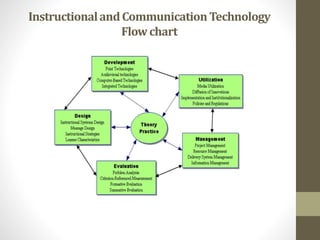
InstructionalandCommunicationTechnology
Flowchart
• Instructional technology is a systematic way of designing, carrying out,
and evaluating the total process of learning and teaching in terms of
specific objectives, based on research in human learning and
communication and employing a combination of human and non-
human resources to bring about more effective instruction President‟s
Commission on Instructional Technology. Instructional Technology is the
Development (Research, Design, Production, Evaluation, Support-
Supply, Utilization) of Instructional Systems Components (Messages,
Men, Materials, Devices, Techniques, Settings) and the Management of
that development Organization, Personnel) in a systematic manner with
the goal of solving educational problems.
• 1982:
Instructional technology is concerned with improving the effectiveness
and efficiency of learning in educational contexts, regardless of the nature
or substance of that learning. …Solutions to instructional problems might
entail social as well as machine technologies
• 1994:
Instructional Technology is the theory and practice of design,
development, utilization, management, and evaluation of processes and
resources for learning Association for Educational Communications and
Technology.
Instructional and Communication Technology

Instructional and Communication Technology

  • 1.
  • 3.
    The are followingEducational technology mainly used in this era; 1) Hardware approach or first Educational technology 2) Software approach or second Educational technology 3) Systems approach Hardware approach • Its origin lies in the application of physical or engineering to education and training system. • Technology of machines is closely related to a technology of teaching. • Teaching machine is the only mechanical aid to be designed and invented to fulfill an instructional requirement.  The mechanization is being introduced in preservation, transmission, and advancement of human knowledge.  The mass media movement, as a result of this approach, is now contributing a lot to convey the educational benefits to masses with great ease and in a cost effective way. Typesand approachesof Instructional Technology
  • 4.
    Software approach • Itrefers to the application of the teaching-learning principles to the direct and deliberately shaping of behavior. The systems approach involves three instructional designs; • i) Training psychology: It is related to problems of training and making teaching and learning more effective so as to make behavior modification through feed back and reinforcement. • ii) Systems analysis: System analysis is more objective while making any system workable and worthwhile. The systems of a system are as follows: • Sub-system: Subsystem of a system is that which is not visible but can be felt and smelt. For example, the degradation of an institution can be felt on the basis of the groupism among teachers and students. • System: System of an institution or a place or a country should be understood in relation to education. Supra-system: no system can be studied without considering its supra-system. For example the teachers of an institution could not get their salaries for the last six months, this will effect on the efficiency and skill resulting into bad results.
  • 5.
    SYSTEMS APPROACH • SystemsApproach is a problem-solving process in which the problem solver engages in series of steps taking at solving a particular identified educational problem. Broadly speaking, systems approach comprises of two major parts, namely: (i) system analysis, and (ii) system synthesis. • Education is a life long process. Every process changes from time to time, so has education changed in various ways. The revolution in science and technology has influenced the entire education system. We apply innovations of science and technology in the field of education in achieving the desired goals and objectives. Thus a new field of education called educational technology has emerged. Educational technology is an effective means of communication which uses a wide range of instructional media like Radio, TV, Closed Circuit TV, Films, Computer etc. Educational technology is not only an audio-visual aid but is also a systematic way of teaching and learning in terms if specific objectives.
  • 6.
    • Mission analysis: Onthe other hand refers to the determination of the end product of the system analysis. It includes the various steps of identifying an overall “mission objective”. • Functional Analysis: As is expected, it is closely related to mission analysis. It consists of breaking down of functions earlier identified under mission analysis with a view of grouping them into various components that would make for a functional mission profile.
  • 7.
    Types of Instructionaltechnology • There are many types of communication technology and a variety of specific programs that exist for students to interact with instructors: • • Email: • Messages sent to one or more users through electronic forums. • • Instant messaging (IM): • Synchronous communication carried on through a variety of host sites or programs. Can happen individually or as a group. • • Texting: • The use of cell phones to write and send messages to one or more people. • • Video conferencing: • The use of webcams or other electronic recording media to conduct a course. • • Podcasting: • Recording voice to audio files which can be downloaded and listened to via portable devices (mp3s) and which can be used in the transmission of course materials. • • Blackboard: • University-adopted web framework for courses. Can involve many additional add-on tools which can offer live chats, IM, email, messages, and posting of announcements. • • Social networking sites: • Web sites designed to connect people together and through which email messages, IMs, and posts can be used to communicate. Examples include facebook, myspace, linkedin, and twitter.
  • 8.
  • 9.
    • Instructional technologyis a systematic way of designing, carrying out, and evaluating the total process of learning and teaching in terms of specific objectives, based on research in human learning and communication and employing a combination of human and non- human resources to bring about more effective instruction President‟s Commission on Instructional Technology. Instructional Technology is the Development (Research, Design, Production, Evaluation, Support- Supply, Utilization) of Instructional Systems Components (Messages, Men, Materials, Devices, Techniques, Settings) and the Management of that development Organization, Personnel) in a systematic manner with the goal of solving educational problems. • 1982: Instructional technology is concerned with improving the effectiveness and efficiency of learning in educational contexts, regardless of the nature or substance of that learning. …Solutions to instructional problems might entail social as well as machine technologies • 1994: Instructional Technology is the theory and practice of design, development, utilization, management, and evaluation of processes and resources for learning Association for Educational Communications and Technology.