INSTRUCTIONAL
TECHNOLOGY
INSTRUCTIONAL TECHNOLOGY
“Instructional Technology is the theory and practice of
design, development, utilization, management and
evaluation of processes and resources for learning.” (Seels &
Richey)
It is the systematic application of theory and other
organized knowledge to the task of instructional design and
development
DEALS WITH WHAT…………
THE GOAL OF INSTRUCTIONAL
TECHNOLOGY
Instructional Technology's goal is to
understand how people learn and how to
best design instructional systems and
instructional materials to facilitate that
learning. We also use appropriate
technology to aid us in the design and
delivery of the instruction
Instructional Technology (IT) is a field concerned with
improving the efficiency and effectiveness of instruction
involving:
A. designing instruction (including all the phases of activity from
needs assessment to evaluation)
B. applying learning theory to instructional design
C. selecting delivery systems and designing techniques for a given
delivery system
D. assessing human characteristics
A. managing change and adopting innovations
B. building teams and managing projects
C. integrating instruction with other factors that influence
human performance
D. implementing delivery to reach learners when they need
it
E. using technology in support of the development and
delivery of instruction
Personalized learning Environments
Young learners of today are personalizing
their entertainment – are you preparing
for the time when these learners are
college students and/or consumers of
executive education?
Generation Y is coming into
the work place with new
attitudes. We have been so
lecture focused, but this
generation won’t tolerate it!
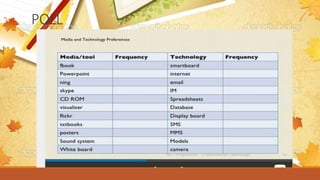
POLL
Miniturisation of Technology
THE IMPORTANCE OF
INSTRUCTIONAL
TECHNOLOGY
◦ Enables the use of more interactive educational
tools, which allows for a dynamic learning
experience that directly benefits students. Web 2.0
interaction involves not only sharing ideas and
information with someone else but also receiving
feedback. As classroom computer technology is
being used for different types of communication
(for presentation, for class interaction, and for
collaboration), students are required to be readers,
writers, editors, and publishers and must be willing
to collaborate and co-create closely with others --
all skills that are critical for students to learn as
they grow and enter the workplace.
 FLEXIBILITYAND ADAPTABILITY IN
DIFFERENTIATEDLEARNING
Instructional Technology

Instructional Technology

  • 1.
  • 2.
    INSTRUCTIONAL TECHNOLOGY “Instructional Technologyis the theory and practice of design, development, utilization, management and evaluation of processes and resources for learning.” (Seels & Richey) It is the systematic application of theory and other organized knowledge to the task of instructional design and development
  • 3.
  • 4.
    THE GOAL OFINSTRUCTIONAL TECHNOLOGY Instructional Technology's goal is to understand how people learn and how to best design instructional systems and instructional materials to facilitate that learning. We also use appropriate technology to aid us in the design and delivery of the instruction
  • 5.
    Instructional Technology (IT)is a field concerned with improving the efficiency and effectiveness of instruction involving: A. designing instruction (including all the phases of activity from needs assessment to evaluation) B. applying learning theory to instructional design C. selecting delivery systems and designing techniques for a given delivery system D. assessing human characteristics
  • 6.
    A. managing changeand adopting innovations B. building teams and managing projects C. integrating instruction with other factors that influence human performance D. implementing delivery to reach learners when they need it E. using technology in support of the development and delivery of instruction
  • 7.
    Personalized learning Environments Younglearners of today are personalizing their entertainment – are you preparing for the time when these learners are college students and/or consumers of executive education?
  • 8.
    Generation Y iscoming into the work place with new attitudes. We have been so lecture focused, but this generation won’t tolerate it!
  • 9.
  • 10.
  • 17.
  • 18.
    ◦ Enables theuse of more interactive educational tools, which allows for a dynamic learning experience that directly benefits students. Web 2.0 interaction involves not only sharing ideas and information with someone else but also receiving feedback. As classroom computer technology is being used for different types of communication (for presentation, for class interaction, and for collaboration), students are required to be readers, writers, editors, and publishers and must be willing to collaborate and co-create closely with others -- all skills that are critical for students to learn as they grow and enter the workplace.
  • 19.
     FLEXIBILITYAND ADAPTABILITYIN DIFFERENTIATEDLEARNING