Learning Theories andCurrent Trends in Instructional Design and Technology Reiser and Dempsey Chapter 4EDIT4512/11/101Kathleen Chenu, Unjoo Lee, Hina Yousufzai
Gagne’s Theory of InstructionThere are different types of learningDifferent types of learning requires different types of instruction.Five major categories of learning: verbal information, intellectual skills, cognitive strategies, motor skills and attitudes.Different types of external and internal conditions help learning to occur.There exists a hierarchy of intellectual skills.Sequenced set of nine instructional events that help external conditions for learning. 2/11/102Kathleen Chenu, Unjoo Lee, Hina Yousufzai
Gagne’s Theory of Instruction2/11/10Kathleen Chenu, Unjoo Lee, Hina Yousufzai31.  Learning can be systematically incorporated into 		instructional design.  2.  Foundations Theory of Instruction        	a.  Cognitive Information Processing Theory       	b.  Observation of "effective" classroom teachers.       	c.  Three components:  Taxonomy of learning 	outcomes, internal and external conditions that 	are tied to the acquisition each learning outcome, 	nine events of instruction that  are external which 	help internal conditions which help learning.
Gagne’s Theory of Instruction3.  Taxonomies of Learning        			a.  Types of learning humans are able to learn (3 			domains:  cognitive, affective, psychomotor)       			 b.  5 major categories that are needed for 			different types of learning:  Verbal information, 			intellectual skills, cognitive strategies, attitudes, 			motor skills    4.  Nine Instructional Events that help learning:  gaining attention, informing learning of the objective, stimulating prior knowledge, presenting stimulus, providing learning guidance, providing an opportunity to practice, providing feedback, assessing performance, enhancing retention and transfer.2/11/10Kathleen Chenu, Unjoo Lee, Hina Yousufzai4
Constructivism1.  Collection of different learning theories.   2.  Complex and high-level learning goals  	(Ex: students will engage in mathematical 	reasoning vs. students will memorize 	multiplication facts).    3.  Assessment is not standardized.   	Assessment should be based on 	students' learning goals and should be 	observed in authentic learning moment.  2/11/10Kathleen Chenu, Unjoo Lee, Hina Yousufzai5
Constructivism4.  Learner in charge of own learning        		a.  learner actively constructs meaning from 		  		world around them.        		b.  learner constantly compares/contrasts/tests 		   		own knowledge with those around them 		      		(including teacher).        		c.  learners do not all learn at the same pace 			 		and do no learn the same things from 			  		instruction (they take different perspective   		 		understanding from the knowledge acquired). 		d.  learners set their own learning goals and are   		given opportunities to self-regulate.2/11/10Kathleen Chenu, Unjoo Lee, Hina Yousufzai6
Constructivism5.  Instructors do not instruct in the traditional 	sense.  They are facilitators of knowledge.        			a.  facilitators create environments 			 			 where learning takes place in an    			 authentic and real world situation. 			 b.  facilitators create experiences where    			 collaboration and diverse perspectives 			 are welcome. 			c.  facilitators encourage students' 			 			 metacognition.2/11/10Kathleen Chenu, Unjoo Lee, Hina Yousufzai7
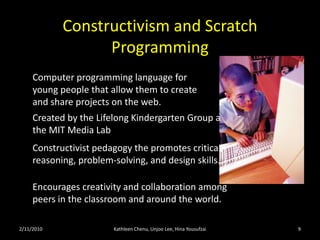
Constructivism and Scratch Programming2/11/10Kathleen Chenu, Unjoo Lee, Hina Yousufzai8Computer programming language for young people that allow them to create and share projects on the web.Created by the Lifelong Kindergarten Group at the MIT Media Lab Constructivist pedagogy the promotes critical reasoning, problem-solving, and design skills.Encourages creativity and collaboration among peers in the classroom and around the world.
 Cognitive Load Theory Sweller's theories are best applied in the area of instructional design or technically challenging material. His concentration is on the reasons that people have difficulty learning material of this nature. While in the past the theory has been applied primarily to technical areas as well as language-based discursive areas. Swell's presentation Video
Cognitive Load Theory PrinciplesChange problem solving methods to avoid means-ends approaches that impose a heavy working memory load, by using goal-free problems or worked examples.Eliminate the working memory load associated with having to mentally integrate several sources of information by physically integrating those sources of information.Eliminate the working memory load associated with unnecessarily processing repetitive information by reducing redundancy.Increase working memory capacity by using auditory as well as visual information under conditions where both sources of information are essential (i.e. non-redundant) to understanding.  (Solomon)
Situated Learning TheoryTheir model of situated learning proposed that learning involved a process of engagement in a 'community of practice'. Principles1. Knowledge needs to be presented in an authentic context.2. Learning requires social interaction and collaboration. Smith, M. K. (2003, 2009) 'Communities of practice', the encyclopedia of informal education, www.infed.org/biblio/communities_of_practice.htm.
Situated Learning - Three elementsThe domain: 	'It has an identity defined by a shared domain of interest. 	                  Membership implies a commitment to the domain.                      	  A shared competence that distinguishes members from 		  other people' The community: 'In pursuing their interest in their domain,                            	members engage in joint activities and share information.                            	They build relationships that enable them to learn from 		each other' The practice:	'Members of a community of practice are practitioners.                       	They develop a shared repertoire of resources, a shared 		practice.                       	This takes time and sustained interaction' (op. cit.).
Situated Learning - KeytermsIt is legitimate because all parties accept the position of 'unqualified' people as potential members of the 'community of practice'Peripheral because they hang around on the edge of the important stuff, do the peripheral jobs, and gradually get entrusted with more important onesParticipation because it is through doing knowledge that they acquire it. Knowledge is situated within the practices of the community of practiceATHERTON J S (2009) Learning and Teaching; Situated learning [On-line] UK: Available: http://www.learningandteaching.info/learning/situated.htm Accessed: 11 February 2010
Etienne Wenger HomepagePhoto source <http://www.ewenger.com/theory/>Communities of practicea brief introductionEtienne WengerJune, 2006
Learning TheoriesOverviewCognitive Information Processing TheoryAtkinson and Shriffin (1970’s)-environment plays an important role.- Internal processes with the. learner- B.F. Skinner (1938)- learning that focuses on behavior-There are cues in the environment that signal behavior-Consequences determine whether behavior is continuedBehavioral Learning Theory Behavior is observed both before and after an intervention.  Based on this an intervention can be deemed effective if there is a change in behaviorThese observations can be considered a formative assessment in the field and can be used to determine whether instruction resulted in learningImpact on ID fieldFeedback- Provides the learner with knowledge of the correctness of their response.- provide corrective information-Shifted our focus to various attributes of instruction-Increased emphasis on the role of prior knowledge in learning
Current Trends in Behavioral Learning TheoryChanges from remembering and repeating information to finding and using it: VideoCurrent application of Cognitive Information Processing Theory.-  Using Technology in the 21st Century Classroom
Activity:  5 words and a picture!For each learning theory presented, create 5 words and one picture.Remember each word and the accompanying picture should represent the essence of the theory being presented.  You may do this activity with any graphic/drawing software you chose…be creative and have fun!Upload your work to the www.ning.com site under our discussion post.   2/11/10Kathleen Chenu, Unjoo Lee, Hina Yousufzai17
References2/11/10Kathleen Chenu, Unjoo Lee, Hina Yousufzai18Lifelong Kindergarten Group. MIT Media Lab:  Scratch http://scratch.mit.edu/Reiser R. & Dempsey J. (2007).  Trends and Issues in Instructional Design and Technology.  Upper Saddle River, New Jersey:  Pearson Prentice Hall.Psychology 450, Learning Inquiry Project,Harlaxton College Fall 2008  http://www.youtube.com/watch?v=OascKtHXcK0Situated Learning Theory http://tip.psychology.org/strategy.htmlSituated learning theory http://www.infed.org/biblio/communities_of_practice.htmSituated Source http://www.infed.org/biblio/communities_of_practice.htmTheory into Practice Database  http://tip.psychology.org/gagne.htmlWenger, Etienne (c 2007) 'Communities of practice. A brief introduction'. Communities of practice [ http://www.ewenger.com/theory/. Accessed January 14, 2009].Youtube video: "Extraneous Cognitive Load" presented by Dr. John Sweller. http://www.youtube.com/watch?v=RyuOU2RasRQ

EDIT 451

  • 1.
    Learning Theories andCurrentTrends in Instructional Design and Technology Reiser and Dempsey Chapter 4EDIT4512/11/101Kathleen Chenu, Unjoo Lee, Hina Yousufzai
  • 2.
    Gagne’s Theory ofInstructionThere are different types of learningDifferent types of learning requires different types of instruction.Five major categories of learning: verbal information, intellectual skills, cognitive strategies, motor skills and attitudes.Different types of external and internal conditions help learning to occur.There exists a hierarchy of intellectual skills.Sequenced set of nine instructional events that help external conditions for learning. 2/11/102Kathleen Chenu, Unjoo Lee, Hina Yousufzai
  • 3.
    Gagne’s Theory ofInstruction2/11/10Kathleen Chenu, Unjoo Lee, Hina Yousufzai31.  Learning can be systematically incorporated into instructional design.  2.  Foundations Theory of Instruction        a.  Cognitive Information Processing Theory        b.  Observation of "effective" classroom teachers.        c.  Three components:  Taxonomy of learning outcomes, internal and external conditions that are tied to the acquisition each learning outcome, nine events of instruction that are external which help internal conditions which help learning.
  • 4.
    Gagne’s Theory ofInstruction3.  Taxonomies of Learning        a.  Types of learning humans are able to learn (3 domains:  cognitive, affective, psychomotor)        b.  5 major categories that are needed for different types of learning:  Verbal information, intellectual skills, cognitive strategies, attitudes, motor skills    4.  Nine Instructional Events that help learning:  gaining attention, informing learning of the objective, stimulating prior knowledge, presenting stimulus, providing learning guidance, providing an opportunity to practice, providing feedback, assessing performance, enhancing retention and transfer.2/11/10Kathleen Chenu, Unjoo Lee, Hina Yousufzai4
  • 5.
    Constructivism1.  Collection ofdifferent learning theories.   2.  Complex and high-level learning goals (Ex: students will engage in mathematical reasoning vs. students will memorize multiplication facts).    3.  Assessment is not standardized.   Assessment should be based on students' learning goals and should be observed in authentic learning moment.  2/11/10Kathleen Chenu, Unjoo Lee, Hina Yousufzai5
  • 6.
    Constructivism4.  Learner incharge of own learning        a.  learner actively constructs meaning from world around them.        b.  learner constantly compares/contrasts/tests own knowledge with those around them (including teacher).        c.  learners do not all learn at the same pace and do no learn the same things from instruction (they take different perspective understanding from the knowledge acquired). d.  learners set their own learning goals and are given opportunities to self-regulate.2/11/10Kathleen Chenu, Unjoo Lee, Hina Yousufzai6
  • 7.
    Constructivism5.  Instructors donot instruct in the traditional sense.  They are facilitators of knowledge.        a.  facilitators create environments where learning takes place in an authentic and real world situation.  b.  facilitators create experiences where collaboration and diverse perspectives are welcome.  c.  facilitators encourage students' metacognition.2/11/10Kathleen Chenu, Unjoo Lee, Hina Yousufzai7
  • 8.
    Constructivism and ScratchProgramming2/11/10Kathleen Chenu, Unjoo Lee, Hina Yousufzai8Computer programming language for young people that allow them to create and share projects on the web.Created by the Lifelong Kindergarten Group at the MIT Media Lab Constructivist pedagogy the promotes critical reasoning, problem-solving, and design skills.Encourages creativity and collaboration among peers in the classroom and around the world.
  • 9.
    Cognitive LoadTheory Sweller's theories are best applied in the area of instructional design or technically challenging material. His concentration is on the reasons that people have difficulty learning material of this nature. While in the past the theory has been applied primarily to technical areas as well as language-based discursive areas. Swell's presentation Video
  • 10.
    Cognitive Load TheoryPrinciplesChange problem solving methods to avoid means-ends approaches that impose a heavy working memory load, by using goal-free problems or worked examples.Eliminate the working memory load associated with having to mentally integrate several sources of information by physically integrating those sources of information.Eliminate the working memory load associated with unnecessarily processing repetitive information by reducing redundancy.Increase working memory capacity by using auditory as well as visual information under conditions where both sources of information are essential (i.e. non-redundant) to understanding. (Solomon)
  • 11.
    Situated Learning TheoryTheirmodel of situated learning proposed that learning involved a process of engagement in a 'community of practice'. Principles1. Knowledge needs to be presented in an authentic context.2. Learning requires social interaction and collaboration. Smith, M. K. (2003, 2009) 'Communities of practice', the encyclopedia of informal education, www.infed.org/biblio/communities_of_practice.htm.
  • 12.
    Situated Learning -Three elementsThe domain: 'It has an identity defined by a shared domain of interest. Membership implies a commitment to the domain. A shared competence that distinguishes members from other people' The community: 'In pursuing their interest in their domain, members engage in joint activities and share information. They build relationships that enable them to learn from each other' The practice: 'Members of a community of practice are practitioners. They develop a shared repertoire of resources, a shared practice. This takes time and sustained interaction' (op. cit.).
  • 13.
    Situated Learning -KeytermsIt is legitimate because all parties accept the position of 'unqualified' people as potential members of the 'community of practice'Peripheral because they hang around on the edge of the important stuff, do the peripheral jobs, and gradually get entrusted with more important onesParticipation because it is through doing knowledge that they acquire it. Knowledge is situated within the practices of the community of practiceATHERTON J S (2009) Learning and Teaching; Situated learning [On-line] UK: Available: http://www.learningandteaching.info/learning/situated.htm Accessed: 11 February 2010
  • 14.
    Etienne Wenger HomepagePhotosource <http://www.ewenger.com/theory/>Communities of practicea brief introductionEtienne WengerJune, 2006
  • 15.
    Learning TheoriesOverviewCognitive InformationProcessing TheoryAtkinson and Shriffin (1970’s)-environment plays an important role.- Internal processes with the. learner- B.F. Skinner (1938)- learning that focuses on behavior-There are cues in the environment that signal behavior-Consequences determine whether behavior is continuedBehavioral Learning Theory Behavior is observed both before and after an intervention. Based on this an intervention can be deemed effective if there is a change in behaviorThese observations can be considered a formative assessment in the field and can be used to determine whether instruction resulted in learningImpact on ID fieldFeedback- Provides the learner with knowledge of the correctness of their response.- provide corrective information-Shifted our focus to various attributes of instruction-Increased emphasis on the role of prior knowledge in learning
  • 16.
    Current Trends inBehavioral Learning TheoryChanges from remembering and repeating information to finding and using it: VideoCurrent application of Cognitive Information Processing Theory.- Using Technology in the 21st Century Classroom
  • 17.
    Activity: 5words and a picture!For each learning theory presented, create 5 words and one picture.Remember each word and the accompanying picture should represent the essence of the theory being presented. You may do this activity with any graphic/drawing software you chose…be creative and have fun!Upload your work to the www.ning.com site under our discussion post. 2/11/10Kathleen Chenu, Unjoo Lee, Hina Yousufzai17
  • 18.
    References2/11/10Kathleen Chenu, UnjooLee, Hina Yousufzai18Lifelong Kindergarten Group. MIT Media Lab: Scratch http://scratch.mit.edu/Reiser R. & Dempsey J. (2007). Trends and Issues in Instructional Design and Technology. Upper Saddle River, New Jersey: Pearson Prentice Hall.Psychology 450, Learning Inquiry Project,Harlaxton College Fall 2008 http://www.youtube.com/watch?v=OascKtHXcK0Situated Learning Theory http://tip.psychology.org/strategy.htmlSituated learning theory http://www.infed.org/biblio/communities_of_practice.htmSituated Source http://www.infed.org/biblio/communities_of_practice.htmTheory into Practice Database http://tip.psychology.org/gagne.htmlWenger, Etienne (c 2007) 'Communities of practice. A brief introduction'. Communities of practice [ http://www.ewenger.com/theory/. Accessed January 14, 2009].Youtube video: "Extraneous Cognitive Load" presented by Dr. John Sweller. http://www.youtube.com/watch?v=RyuOU2RasRQ