Instruction Level Parallelism
and Superscalar Processors
What is Superscalar?
• Common instructions (arithmetic, load/store, conditional branch) can
be initiated and executed independently
• Equally applicable to RISC & CISC
• In practice usually RISC
Why Superscalar?
• Most operations are on scalar quantities (see RISC notes)
• Improve these operations to get an overall improvement
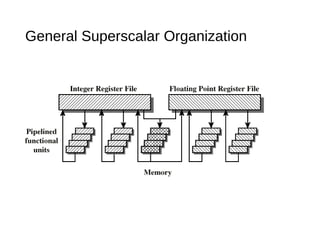
General Superscalar Organization
Superpipelined
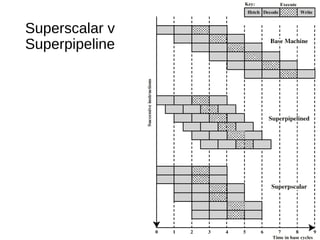
• Many pipeline stages need less than half a clock cycle
• Double internal clock speed gets two tasks per external clock cycle
• Superscalar allows parallel fetch execute
Superscalar v
Superpipeline
Limitations
• Instruction level parallelism
• Compiler based optimisation
• Hardware techniques
• Limited by
• True data dependency
• Procedural dependency
• Resource conflicts
• Output dependency
• Antidependency
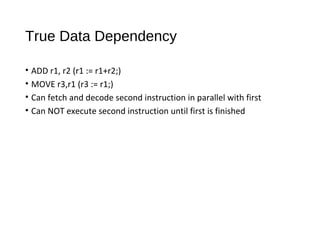
True Data Dependency
• ADD r1, r2 (r1 := r1+r2;)
• MOVE r3,r1 (r3 := r1;)
• Can fetch and decode second instruction in parallel with first
• Can NOT execute second instruction until first is finished
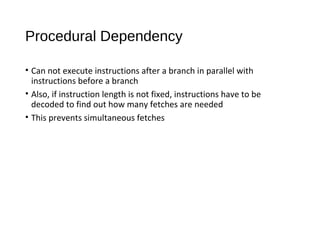
Procedural Dependency
• Can not execute instructions after a branch in parallel with
instructions before a branch
• Also, if instruction length is not fixed, instructions have to be
decoded to find out how many fetches are needed
• This prevents simultaneous fetches
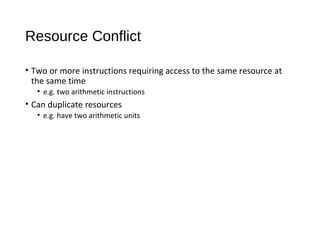
Resource Conflict
• Two or more instructions requiring access to the same resource at
the same time
• e.g. two arithmetic instructions
• Can duplicate resources
• e.g. have two arithmetic units
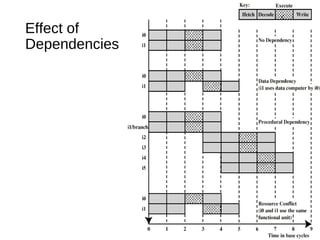
Effect of
Dependencies
Design Issues
• Instruction level parallelism
• Instructions in a sequence are independent
• Execution can be overlapped
• Governed by data and procedural dependency
• Machine Parallelism
• Ability to take advantage of instruction level parallelism
• Governed by number of parallel pipelines
Instruction Issue Policy
• Order in which instructions are fetched
• Order in which instructions are executed
• Order in which instructions change registers and memory
In-Order Issue
In-Order Completion
• Issue instructions in the order they occur
• Not very efficient
• May fetch >1 instruction
• Instructions must stall if necessary
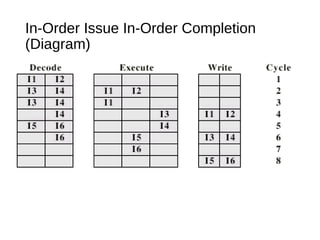
In-Order Issue In-Order Completion
(Diagram)
In-Order Issue
Out-of-Order Completion
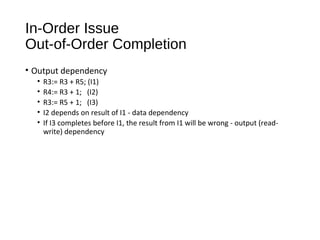
• Output dependency
• R3:= R3 + R5; (I1)
• R4:= R3 + 1; (I2)
• R3:= R5 + 1; (I3)
• I2 depends on result of I1 - data dependency
• If I3 completes before I1, the result from I1 will be wrong - output (read-
write) dependency
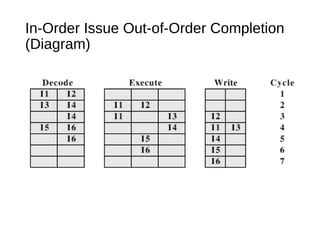
In-Order Issue Out-of-Order Completion
(Diagram)
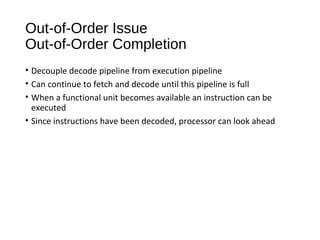
Out-of-Order Issue
Out-of-Order Completion
• Decouple decode pipeline from execution pipeline
• Can continue to fetch and decode until this pipeline is full
• When a functional unit becomes available an instruction can be
executed
• Since instructions have been decoded, processor can look ahead
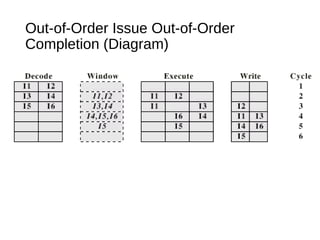
Out-of-Order Issue Out-of-Order
Completion (Diagram)
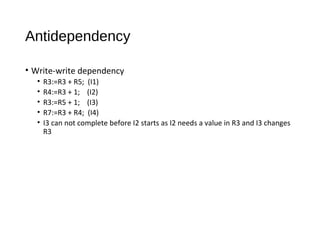
Antidependency
• Write-write dependency
• R3:=R3 + R5; (I1)
• R4:=R3 + 1; (I2)
• R3:=R5 + 1; (I3)
• R7:=R3 + R4; (I4)
• I3 can not complete before I2 starts as I2 needs a value in R3 and I3 changes
R3
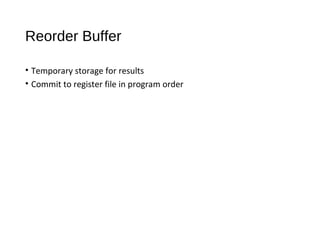
Reorder Buffer
• Temporary storage for results
• Commit to register file in program order
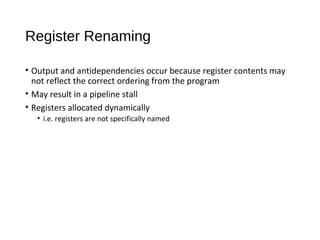
Register Renaming
• Output and antidependencies occur because register contents may
not reflect the correct ordering from the program
• May result in a pipeline stall
• Registers allocated dynamically
• i.e. registers are not specifically named
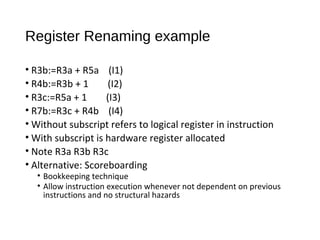
Register Renaming example
• R3b:=R3a + R5a (I1)
• R4b:=R3b + 1 (I2)
• R3c:=R5a + 1 (I3)
• R7b:=R3c + R4b (I4)
• Without subscript refers to logical register in instruction
• With subscript is hardware register allocated
• Note R3a R3b R3c
• Alternative: Scoreboarding
• Bookkeeping technique
• Allow instruction execution whenever not dependent on previous
instructions and no structural hazards
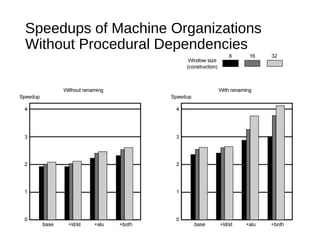
Machine Parallelism
• Duplication of Resources
• Out of order issue
• Renaming
• Not worth duplication functions without register renaming
• Need instruction window large enough (more than 8)
Speedups of Machine Organizations
Without Procedural Dependencies
Branch Prediction
• 80486 fetches both next sequential instruction after branch and
branch target instruction
• Gives two cycle delay if branch taken
RISC - Delayed Branch
• Calculate result of branch before unusable instructions pre-fetched
• Always execute single instruction immediately following branch
• Keeps pipeline full while fetching new instruction stream
• Not as good for superscalar
• Multiple instructions need to execute in delay slot
• Instruction dependence problems
• Revert to branch prediction
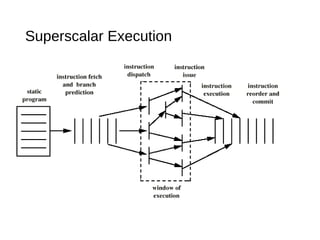
Superscalar Execution
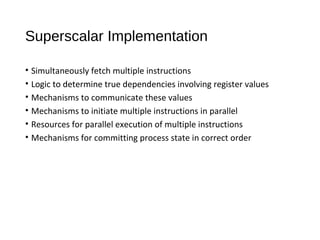
Superscalar Implementation
• Simultaneously fetch multiple instructions
• Logic to determine true dependencies involving register values
• Mechanisms to communicate these values
• Mechanisms to initiate multiple instructions in parallel
• Resources for parallel execution of multiple instructions
• Mechanisms for committing process state in correct order
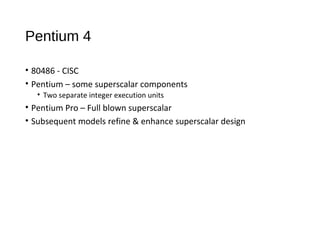
Pentium 4
• 80486 - CISC
• Pentium – some superscalar components
• Two separate integer execution units
• Pentium Pro – Full blown superscalar
• Subsequent models refine & enhance superscalar design
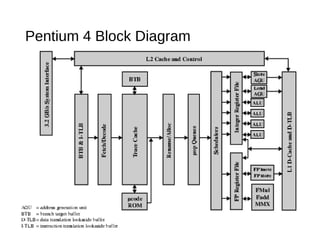
Pentium 4 Block Diagram
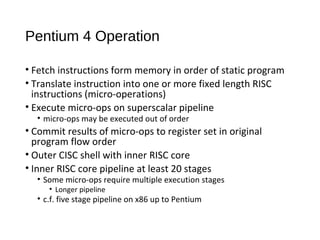
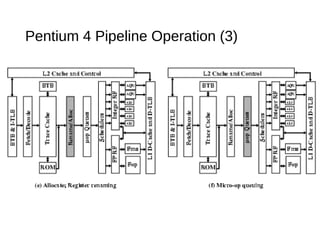
Pentium 4 Operation
• Fetch instructions form memory in order of static program
• Translate instruction into one or more fixed length RISC
instructions (micro-operations)
• Execute micro-ops on superscalar pipeline
• micro-ops may be executed out of order
• Commit results of micro-ops to register set in original
program flow order
• Outer CISC shell with inner RISC core
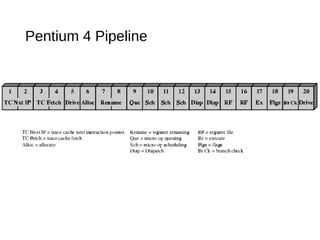
• Inner RISC core pipeline at least 20 stages
• Some micro-ops require multiple execution stages
• Longer pipeline
• c.f. five stage pipeline on x86 up to Pentium
Pentium 4 Pipeline
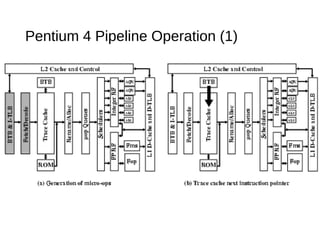
Pentium 4 Pipeline Operation (1)
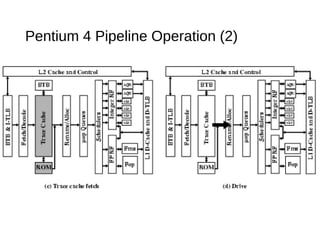
Pentium 4 Pipeline Operation (2)
Pentium 4 Pipeline Operation (3)
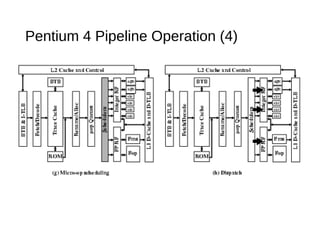
Pentium 4 Pipeline Operation (4)
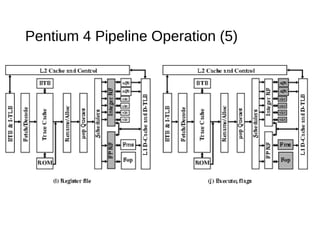
Pentium 4 Pipeline Operation (5)
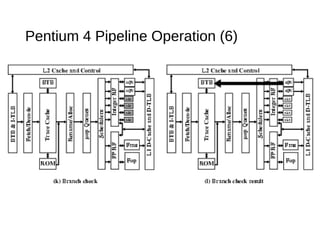
Pentium 4 Pipeline Operation (6)
ARM CORTEX-A8
• ARM refers to Cortex-A8 as application processors
• Embedded processor running complex operating system
• Wireless, consumer and imaging applications
• Mobile phones, set-top boxes, gaming consoles automotive
navigation/entertainment systems
• Three functional units
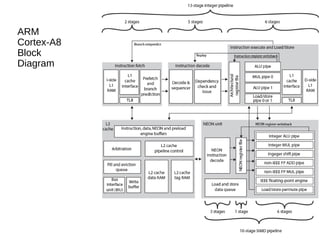
• Dual, in-order-issue, 13-stage pipeline
• Keep power required to a minimum
• Out-of-order issue needs extra logic consuming extra power
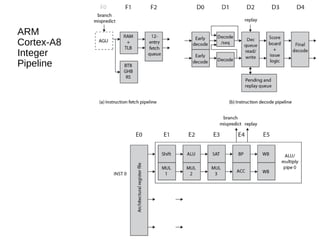
• Figure 14.11 shows the details of the main Cortex-A8
pipeline
• Separate SIMD (single-instruction-multiple-data) unit
• 10-stage pipeline
ARM
Cortex-A8
Block
Diagram
Instruction Fetch Unit
• Predicts instruction stream
• Fetches instructions from the L1 instruction cache
• Up to four instructions per cycle
• Into buffer for decode pipeline
• Fetch unit includes L1 instruction cache
• Speculative instruction fetches
• Branch or exceptional instruction cause pipeline flush
• Stages:
• F0 address generation unit generates virtual address
• Normally next sequentially
• Can also be branch target address
• F1 Used to fetch instructions from L1 instruction cache
• In parallel fetch address used to access branch prediction arrays
• F3 Instruction data are placed in instruction queue
• If branch prediction, new target address sent to address generation unit
• Two-level global history branch predictor
• Branch Target Buffer (BTB) and Global History Buffer (GHB)
• Return stack to predict subroutine return addresses
• Can fetch and queue up to 12 instructions
• Issues instructions two at a time
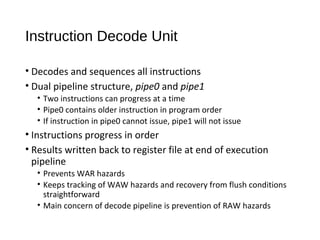
Instruction Decode Unit
• Decodes and sequences all instructions
• Dual pipeline structure, pipe0 and pipe1
• Two instructions can progress at a time
• Pipe0 contains older instruction in program order
• If instruction in pipe0 cannot issue, pipe1 will not issue
• Instructions progress in order
• Results written back to register file at end of execution
pipeline
• Prevents WAR hazards
• Keeps tracking of WAW hazards and recovery from flush conditions
straightforward
• Main concern of decode pipeline is prevention of RAW hazards
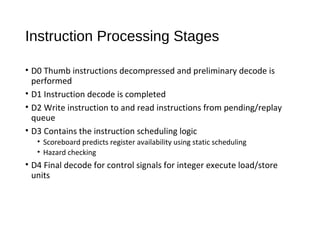
Instruction Processing Stages
• D0 Thumb instructions decompressed and preliminary decode is
performed
• D1 Instruction decode is completed
• D2 Write instruction to and read instructions from pending/replay
queue
• D3 Contains the instruction scheduling logic
• Scoreboard predicts register availability using static scheduling
• Hazard checking
• D4 Final decode for control signals for integer execute load/store
units
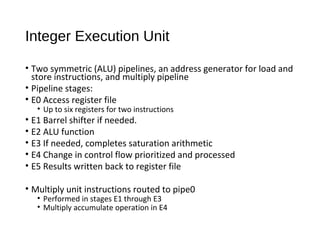
Integer Execution Unit
• Two symmetric (ALU) pipelines, an address generator for load and
store instructions, and multiply pipeline
• Pipeline stages:
• E0 Access register file
• Up to six registers for two instructions
• E1 Barrel shifter if needed.
• E2 ALU function
• E3 If needed, completes saturation arithmetic
• E4 Change in control flow prioritized and processed
• E5 Results written back to register file
• Multiply unit instructions routed to pipe0
• Performed in stages E1 through E3
• Multiply accumulate operation in E4
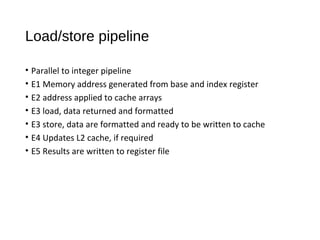
Load/store pipeline
• Parallel to integer pipeline
• E1 Memory address generated from base and index register
• E2 address applied to cache arrays
• E3 load, data returned and formatted
• E3 store, data are formatted and ready to be written to cache
• E4 Updates L2 cache, if required
• E5 Results are written to register file
ARM
Cortex-A8
Integer
Pipeline
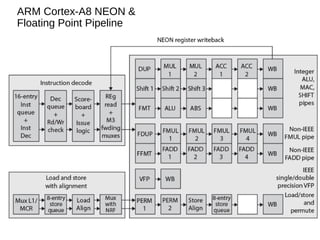
SIMD and Floating-Point Pipeline
• SIMD and floating-point instructions pass through integer pipeline
• Processed in separate 10-stage pipeline
• NEON unit
• Handles packed SIMD instructions
• Provides two types of floating-point support
• If implemented, vector floating-point (VFP) coprocessor performs
IEEE 754 floating-point operations
• If not, separate multiply and add pipelines implement floating-point
operations
ARM Cortex-A8 NEON &
Floating Point Pipeline

Instruction Level Parallelism and Superscalar Processors

  • 1.
    Instruction Level Parallelism andSuperscalar Processors
  • 2.
    What is Superscalar? •Common instructions (arithmetic, load/store, conditional branch) can be initiated and executed independently • Equally applicable to RISC & CISC • In practice usually RISC
  • 3.
    Why Superscalar? • Mostoperations are on scalar quantities (see RISC notes) • Improve these operations to get an overall improvement
  • 4.
  • 5.
    Superpipelined • Many pipelinestages need less than half a clock cycle • Double internal clock speed gets two tasks per external clock cycle • Superscalar allows parallel fetch execute
  • 6.
  • 7.
    Limitations • Instruction levelparallelism • Compiler based optimisation • Hardware techniques • Limited by • True data dependency • Procedural dependency • Resource conflicts • Output dependency • Antidependency
  • 8.
    True Data Dependency •ADD r1, r2 (r1 := r1+r2;) • MOVE r3,r1 (r3 := r1;) • Can fetch and decode second instruction in parallel with first • Can NOT execute second instruction until first is finished
  • 9.
    Procedural Dependency • Cannot execute instructions after a branch in parallel with instructions before a branch • Also, if instruction length is not fixed, instructions have to be decoded to find out how many fetches are needed • This prevents simultaneous fetches
  • 10.
    Resource Conflict • Twoor more instructions requiring access to the same resource at the same time • e.g. two arithmetic instructions • Can duplicate resources • e.g. have two arithmetic units
  • 11.
  • 12.
    Design Issues • Instructionlevel parallelism • Instructions in a sequence are independent • Execution can be overlapped • Governed by data and procedural dependency • Machine Parallelism • Ability to take advantage of instruction level parallelism • Governed by number of parallel pipelines
  • 13.
    Instruction Issue Policy •Order in which instructions are fetched • Order in which instructions are executed • Order in which instructions change registers and memory
  • 14.
    In-Order Issue In-Order Completion •Issue instructions in the order they occur • Not very efficient • May fetch >1 instruction • Instructions must stall if necessary
  • 15.
    In-Order Issue In-OrderCompletion (Diagram)
  • 16.
    In-Order Issue Out-of-Order Completion •Output dependency • R3:= R3 + R5; (I1) • R4:= R3 + 1; (I2) • R3:= R5 + 1; (I3) • I2 depends on result of I1 - data dependency • If I3 completes before I1, the result from I1 will be wrong - output (read- write) dependency
  • 17.
    In-Order Issue Out-of-OrderCompletion (Diagram)
  • 18.
    Out-of-Order Issue Out-of-Order Completion •Decouple decode pipeline from execution pipeline • Can continue to fetch and decode until this pipeline is full • When a functional unit becomes available an instruction can be executed • Since instructions have been decoded, processor can look ahead
  • 19.
  • 20.
    Antidependency • Write-write dependency •R3:=R3 + R5; (I1) • R4:=R3 + 1; (I2) • R3:=R5 + 1; (I3) • R7:=R3 + R4; (I4) • I3 can not complete before I2 starts as I2 needs a value in R3 and I3 changes R3
  • 21.
    Reorder Buffer • Temporarystorage for results • Commit to register file in program order
  • 22.
    Register Renaming • Outputand antidependencies occur because register contents may not reflect the correct ordering from the program • May result in a pipeline stall • Registers allocated dynamically • i.e. registers are not specifically named
  • 23.
    Register Renaming example •R3b:=R3a + R5a (I1) • R4b:=R3b + 1 (I2) • R3c:=R5a + 1 (I3) • R7b:=R3c + R4b (I4) • Without subscript refers to logical register in instruction • With subscript is hardware register allocated • Note R3a R3b R3c • Alternative: Scoreboarding • Bookkeeping technique • Allow instruction execution whenever not dependent on previous instructions and no structural hazards
  • 24.
    Machine Parallelism • Duplicationof Resources • Out of order issue • Renaming • Not worth duplication functions without register renaming • Need instruction window large enough (more than 8)
  • 25.
    Speedups of MachineOrganizations Without Procedural Dependencies
  • 26.
    Branch Prediction • 80486fetches both next sequential instruction after branch and branch target instruction • Gives two cycle delay if branch taken
  • 27.
    RISC - DelayedBranch • Calculate result of branch before unusable instructions pre-fetched • Always execute single instruction immediately following branch • Keeps pipeline full while fetching new instruction stream • Not as good for superscalar • Multiple instructions need to execute in delay slot • Instruction dependence problems • Revert to branch prediction
  • 28.
  • 29.
    Superscalar Implementation • Simultaneouslyfetch multiple instructions • Logic to determine true dependencies involving register values • Mechanisms to communicate these values • Mechanisms to initiate multiple instructions in parallel • Resources for parallel execution of multiple instructions • Mechanisms for committing process state in correct order
  • 30.
    Pentium 4 • 80486- CISC • Pentium – some superscalar components • Two separate integer execution units • Pentium Pro – Full blown superscalar • Subsequent models refine & enhance superscalar design
  • 31.
  • 32.
    Pentium 4 Operation •Fetch instructions form memory in order of static program • Translate instruction into one or more fixed length RISC instructions (micro-operations) • Execute micro-ops on superscalar pipeline • micro-ops may be executed out of order • Commit results of micro-ops to register set in original program flow order • Outer CISC shell with inner RISC core • Inner RISC core pipeline at least 20 stages • Some micro-ops require multiple execution stages • Longer pipeline • c.f. five stage pipeline on x86 up to Pentium
  • 33.
  • 34.
    Pentium 4 PipelineOperation (1)
  • 35.
    Pentium 4 PipelineOperation (2)
  • 36.
    Pentium 4 PipelineOperation (3)
  • 37.
    Pentium 4 PipelineOperation (4)
  • 38.
    Pentium 4 PipelineOperation (5)
  • 39.
    Pentium 4 PipelineOperation (6)
  • 40.
    ARM CORTEX-A8 • ARMrefers to Cortex-A8 as application processors • Embedded processor running complex operating system • Wireless, consumer and imaging applications • Mobile phones, set-top boxes, gaming consoles automotive navigation/entertainment systems • Three functional units • Dual, in-order-issue, 13-stage pipeline • Keep power required to a minimum • Out-of-order issue needs extra logic consuming extra power • Figure 14.11 shows the details of the main Cortex-A8 pipeline • Separate SIMD (single-instruction-multiple-data) unit • 10-stage pipeline
  • 41.
  • 42.
    Instruction Fetch Unit •Predicts instruction stream • Fetches instructions from the L1 instruction cache • Up to four instructions per cycle • Into buffer for decode pipeline • Fetch unit includes L1 instruction cache • Speculative instruction fetches • Branch or exceptional instruction cause pipeline flush • Stages: • F0 address generation unit generates virtual address • Normally next sequentially • Can also be branch target address • F1 Used to fetch instructions from L1 instruction cache • In parallel fetch address used to access branch prediction arrays • F3 Instruction data are placed in instruction queue • If branch prediction, new target address sent to address generation unit • Two-level global history branch predictor • Branch Target Buffer (BTB) and Global History Buffer (GHB) • Return stack to predict subroutine return addresses • Can fetch and queue up to 12 instructions • Issues instructions two at a time
  • 43.
    Instruction Decode Unit •Decodes and sequences all instructions • Dual pipeline structure, pipe0 and pipe1 • Two instructions can progress at a time • Pipe0 contains older instruction in program order • If instruction in pipe0 cannot issue, pipe1 will not issue • Instructions progress in order • Results written back to register file at end of execution pipeline • Prevents WAR hazards • Keeps tracking of WAW hazards and recovery from flush conditions straightforward • Main concern of decode pipeline is prevention of RAW hazards
  • 44.
    Instruction Processing Stages •D0 Thumb instructions decompressed and preliminary decode is performed • D1 Instruction decode is completed • D2 Write instruction to and read instructions from pending/replay queue • D3 Contains the instruction scheduling logic • Scoreboard predicts register availability using static scheduling • Hazard checking • D4 Final decode for control signals for integer execute load/store units
  • 45.
    Integer Execution Unit •Two symmetric (ALU) pipelines, an address generator for load and store instructions, and multiply pipeline • Pipeline stages: • E0 Access register file • Up to six registers for two instructions • E1 Barrel shifter if needed. • E2 ALU function • E3 If needed, completes saturation arithmetic • E4 Change in control flow prioritized and processed • E5 Results written back to register file • Multiply unit instructions routed to pipe0 • Performed in stages E1 through E3 • Multiply accumulate operation in E4
  • 46.
    Load/store pipeline • Parallelto integer pipeline • E1 Memory address generated from base and index register • E2 address applied to cache arrays • E3 load, data returned and formatted • E3 store, data are formatted and ready to be written to cache • E4 Updates L2 cache, if required • E5 Results are written to register file
  • 47.
  • 48.
    SIMD and Floating-PointPipeline • SIMD and floating-point instructions pass through integer pipeline • Processed in separate 10-stage pipeline • NEON unit • Handles packed SIMD instructions • Provides two types of floating-point support • If implemented, vector floating-point (VFP) coprocessor performs IEEE 754 floating-point operations • If not, separate multiply and add pipelines implement floating-point operations
  • 49.
    ARM Cortex-A8 NEON& Floating Point Pipeline