
PIPELINING
Topic:
• A Pipelining is a series of stages, where some work is
done at each stage in parallel.
• The stages are connected one to the next to form a pipe -
instructions enter at one end, progress through the stages,
and exit at the other end.
PIPELINING CASE: LAUNDRY
• 4 loads of laundry that need to washed, dried, and
folded.
• 30 minutes to wash, 40 min. to dry, and 20 min. to fold.
• We have 1 washer, 1 dryer, and 1 folding station.
• What’s the most efficient way to get the 4 loads of laundry done?
DEFINITION:
PIPELINING IS AN SPEED UP TECHNIQUE WHERE
MULTIPLE INSTRUCTIONS ARE OVERLAPPED IN
EXECUTION ON A PROCESSOR.
PIPELINING: PROCESSORS
• Computers, like laundry, typically perform the exact
same steps for every instruction:
• Fetch an instruction from memory
• Decode the instruction
• Execute the instruction
• Read memory to get input
• Write the result back to memory
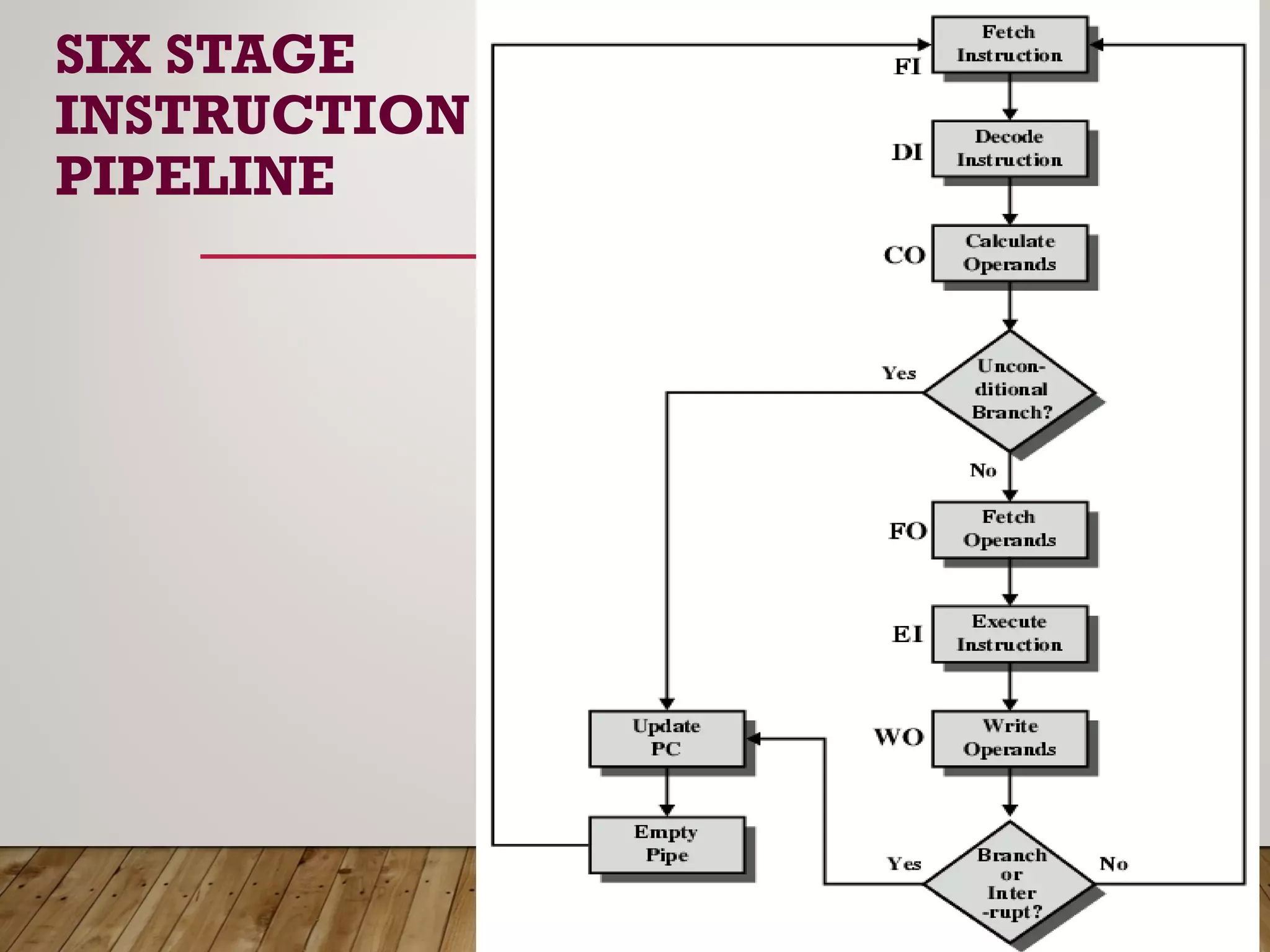
INSTRUCTION PIPELINE
• Instruction execution process lends itself naturally to pipelining
• overlap the subtasks of instruction fetch, decode and execute
 Fetch instruction (FI)
 Decode instruction (DI)
 Calculate operands (CO)
 Fetch operands (FO)
 Execute instructions (EI)
 Write result (WR)
Overlap these operations
• Instruction pipeline has six operations,
Instructions Fetch
• The IF stage is responsible for obtaining the requested
instruction from memory. The instruction and the program
counter are stored in the register as temporary storage.
Decode Instruction
• The DI stage is responsible for decoding the
instruction and sending out the various control lines
to the other parts of the processor.
Calculate Operands
• The CO stage is where any calculations are
performed.The main component in this stage is the
ALU.The ALU is made up of arithmetic, logic and
capabilities.
Fetch Operands and Execute Instruction
• The FO and EI stages are responsible for storing and loading
values to and from memory. They also responsible for input and
output from the processor respectively.
Write Operands
• The WO stage is responsible for writing the result of a
calculation, memory access or input into the register file.
SIX STAGE
INSTRUCTION
PIPELINE
Pipeline Performance: Clock & Timing
Si Si+1
τ τm d
Clock cycle of the pipeline : τ
Latch delay : d
τ = max {τm } + d
Pipeline frequency : f
f = 1 / τ
ADVANTAGES
• Pipelining makes efficient use of resources.
• Quicker time of execution of large number of
instructions
• The parallelism is invisible to the programmer.
DISADVANTAG
E
• structural hazards: attempt to use the same resource by two different instructions at
the same time
• data hazards: attempt to use data before it is ready
• An instruction’s source operand(s) are produced by a prior instruction still in
the pipeline
• control hazards: attempt to make a decision about program control flow before the
condition has been evaluated and the new PC target address calculated
• branch instructions
Any Questions???
Thank you

Pipelining

  • 1.
  • 2.
    • A Pipeliningis a series of stages, where some work is done at each stage in parallel. • The stages are connected one to the next to form a pipe - instructions enter at one end, progress through the stages, and exit at the other end.
  • 3.
    PIPELINING CASE: LAUNDRY •4 loads of laundry that need to washed, dried, and folded. • 30 minutes to wash, 40 min. to dry, and 20 min. to fold. • We have 1 washer, 1 dryer, and 1 folding station. • What’s the most efficient way to get the 4 loads of laundry done?
  • 4.
    DEFINITION: PIPELINING IS ANSPEED UP TECHNIQUE WHERE MULTIPLE INSTRUCTIONS ARE OVERLAPPED IN EXECUTION ON A PROCESSOR.
  • 5.
    PIPELINING: PROCESSORS • Computers,like laundry, typically perform the exact same steps for every instruction: • Fetch an instruction from memory • Decode the instruction • Execute the instruction • Read memory to get input • Write the result back to memory
  • 6.
    INSTRUCTION PIPELINE • Instructionexecution process lends itself naturally to pipelining • overlap the subtasks of instruction fetch, decode and execute  Fetch instruction (FI)  Decode instruction (DI)  Calculate operands (CO)  Fetch operands (FO)  Execute instructions (EI)  Write result (WR) Overlap these operations • Instruction pipeline has six operations,
  • 7.
    Instructions Fetch • TheIF stage is responsible for obtaining the requested instruction from memory. The instruction and the program counter are stored in the register as temporary storage.
  • 8.
    Decode Instruction • TheDI stage is responsible for decoding the instruction and sending out the various control lines to the other parts of the processor.
  • 9.
    Calculate Operands • TheCO stage is where any calculations are performed.The main component in this stage is the ALU.The ALU is made up of arithmetic, logic and capabilities.
  • 10.
    Fetch Operands andExecute Instruction • The FO and EI stages are responsible for storing and loading values to and from memory. They also responsible for input and output from the processor respectively.
  • 11.
    Write Operands • TheWO stage is responsible for writing the result of a calculation, memory access or input into the register file.
  • 12.
  • 13.
    Pipeline Performance: Clock& Timing Si Si+1 τ τm d Clock cycle of the pipeline : τ Latch delay : d τ = max {τm } + d Pipeline frequency : f f = 1 / τ
  • 14.
    ADVANTAGES • Pipelining makesefficient use of resources. • Quicker time of execution of large number of instructions • The parallelism is invisible to the programmer.
  • 15.
    DISADVANTAG E • structural hazards:attempt to use the same resource by two different instructions at the same time • data hazards: attempt to use data before it is ready • An instruction’s source operand(s) are produced by a prior instruction still in the pipeline • control hazards: attempt to make a decision about program control flow before the condition has been evaluated and the new PC target address calculated • branch instructions
  • 16.
  • 17.

Editor's Notes

  • #14 
  • #16 Note that data hazards can come from R-type instructions or lw instructions