Insect Pest ID and Life 
Cycle
LNT 136 – Spring 2017
Mark Valen
Invertebrate Pests
Arthropods (Phylum) – invertebrates with 
exoskeletons, a segmented body, and jointed 
appendages
Arthropods
Arthropod species are estimated to be between 
1,170,000 and 5 to 10 million and account for over 
80% of all known living animal species
• Small size, in many cases
• Flight
• Adaptability
• Mutation
• Exoskeleton
Exoskeleton
• AKA cuticle made of chitin
• May have brustles called setae
• May act as sensors to detect air currents, or contact with 
objects;
• Aquatic insects, which are air‐breathers, use thick felt‐
like coats of setae to trap air, extending the time they 
can spend under water; heavy, rigid setae serve as 
defensive spines.
• All arthropods use muscles attached to the inside 
of the exoskeleton to flex their limbs, but some also 
use hydraulic pressure to extend them (i.e. spiders)
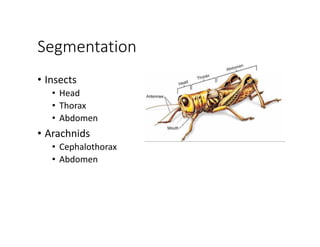
Segmentation
• Insects
• Head
• Thorax
• Abdomen
• Arachnids
• Cephalothorax
• Abdomen
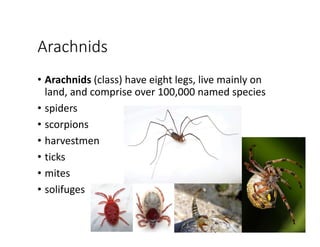
Arachnids
• Arachnids (class) have eight legs, live mainly on 
land, and comprise over 100,000 named species
• spiders
• scorpions
• harvestmen
• ticks
• mites
• solifuges
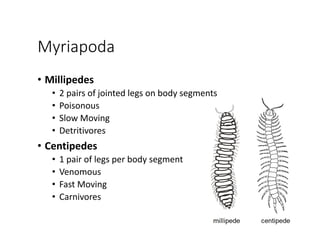
Myriapoda
• Millipedes
• 2 pairs of jointed legs on body segments
• Poisonous
• Slow Moving
• Detritivores
• Centipedes
• 1 pair of legs per body segment
• Venomous
• Fast Moving
• Carnivores
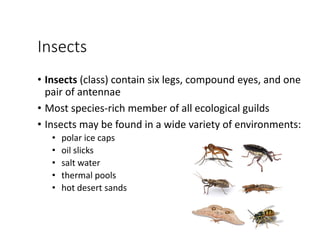
Insects
• Insects (class) contain six legs, compound eyes, and one 
pair of antennae
• Most species‐rich member of all ecological guilds
• Insects may be found in a wide variety of environments:
• polar ice caps
• oil slicks
• salt water
• thermal pools
• hot desert sands
Insects
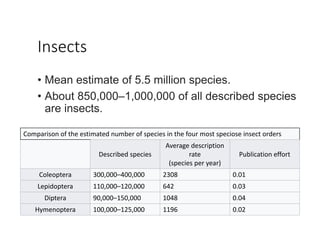
• Mean estimate of 5.5 million species.
• About 850,000–1,000,000 of all described species
are insects.
Comparison of the estimated number of species in the four most speciose insect orders
Described species
Average description 
rate
(species per year)
Publication effort
Coleoptera 300,000–400,000 2308 0.01
Lepidoptera 110,000–120,000 642 0.03
Diptera 90,000–150,000 1048 0.04
Hymenoptera 100,000–125,000 1196 0.02
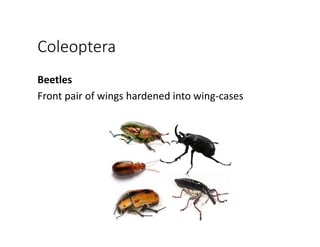
Coleoptera
Beetles
Front pair of wings hardened into wing‐cases
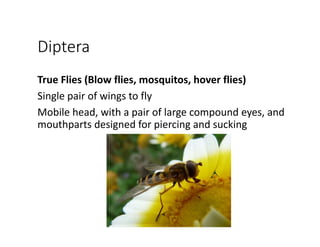
Diptera
True Flies (Blow flies, mosquitos, hover flies)
Single pair of wings to fly
Mobile head, with a pair of large compound eyes, and 
mouthparts designed for piercing and sucking
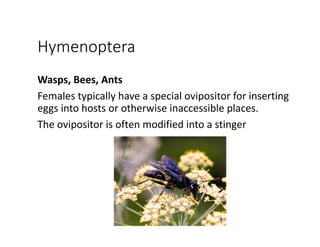
Hymenoptera
Wasps, Bees, Ants
Females typically have a special ovipositor for inserting 
eggs into hosts or otherwise inaccessible places. 
The ovipositor is often modified into a stinger
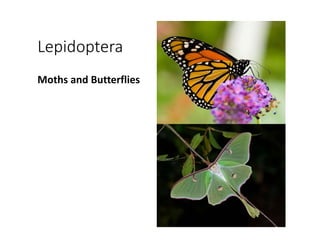
Lepidoptera
Moths and Butterflies
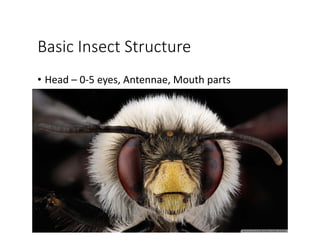
Basic Insect Structure
• Head – 0‐5 eyes, Antennae, Mouth parts
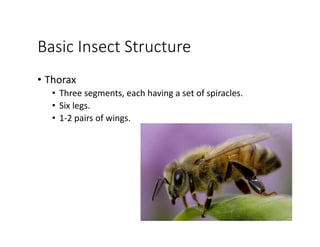
Basic Insect Structure
• Thorax
• Three segments, each having a set of spiracles.
• Six legs.
• 1‐2 pairs of wings.
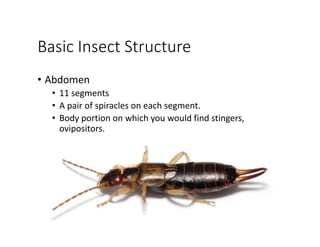
Basic Insect Structure
• Abdomen
• 11 segments
• A pair of spiracles on each segment.
• Body portion on which you would find stingers, 
ovipositors.
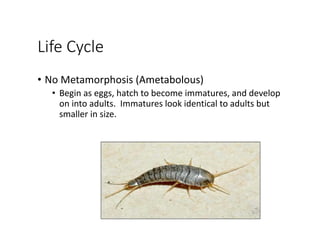
Life Cycle
• No Metamorphosis (Ametabolous)
• Begin as eggs, hatch to become immatures, and develop 
on into adults.  Immatures look identical to adults but 
smaller in size.                                     
Life Cycle
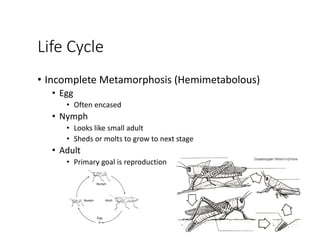
• Incomplete Metamorphosis (Hemimetabolous)
• Egg
• Often encased
• Nymph
• Looks like small adult
• Sheds or molts to grow to next stage
• Adult
• Primary goal is reproduction
Life Cycle
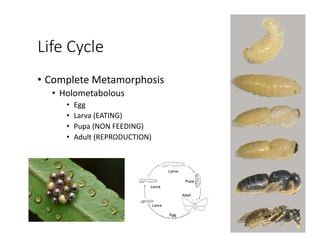
• Complete Metamorphosis
• Holometabolous
• Egg
• Larva (EATING)
• Pupa (NON FEEDING)
• Adult (REPRODUCTION)
Internal Structure
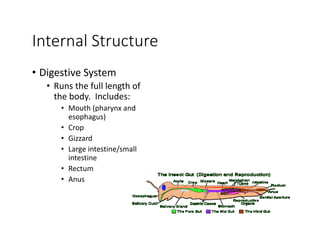
• Digestive System
• Runs the full length of 
the body.  Includes:
• Mouth (pharynx and 
esophagus)
• Crop
• Gizzard
• Large intestine/small 
intestine
• Rectum
• Anus
Internal Structure
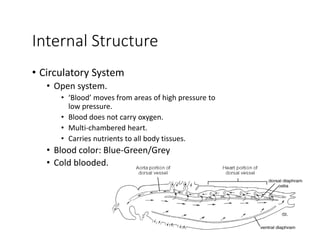
• Circulatory System
• Open system.
• ‘Blood’ moves from areas of high pressure to 
low pressure.
• Blood does not carry oxygen.
• Multi‐chambered heart.
• Carries nutrients to all body tissues.
• Blood color: Blue‐Green/Grey
• Cold blooded.
Internal Structure
• Nervous System
• Brain = central ganglia in 
the head.
• Additional ganglia are 
attached to the central 
ganglia, and one runs to 
each body segment.
Internal Structure
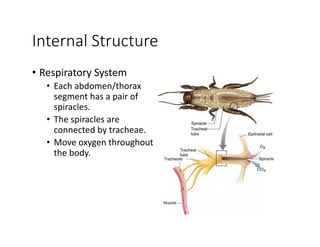
• Respiratory System
• Each abdomen/thorax 
segment has a pair of 
spiracles.
• The spiracles are 
connected by tracheae.
• Move oxygen throughout 
the body.

Insect Pest ID and Life Cycle