Cultural Practices
LNT 132 – Spring 2017
Mark Valen
Cultural Practices
The limiting factors in plant growth, in descending
order of importance, are:
• light
• temperature
• moisture
• nutrients
All of these factors occur naturally and directly
influence your management practices.
Cultural Practices
Thus, you cannot separate your cultural program from the
influence of the environment, particularly weather conditions
• Light provides the energy to drive photosynthesis.
• Temperature determines the rate of growth and metabolism.
• Moisture is critical to metabolic processes and heat dissipation.
• Wind promotes the transfer of heat and drying conditions.
Cultural Practices
Turfgrass cultural practices include:
• mowing
• fertilizing
• irrigating
• cultivating (coring, slicing, spiking or vertical mowing)
• rolling
• topdressing
• managing pests
While none of these is necessarily more important than any
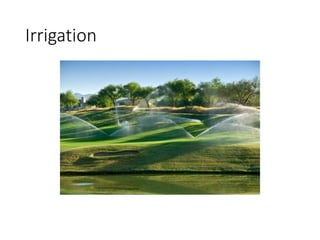
other, one of the most difficult to manage is irrigation
Irrigation
Irrigation
Turfgrass leaves and shoots are comprised of about 80%
water.
A lack or water (rainfall or irrigation) will lead to a decrease in
growth and energy production and an increase in plant stress.
When turf has insufficient water it will begin to wilt. Leaves
will roll or fold to conserve water by reducing their leaf area.
Eventually turf will display a brown wilted appearance as the
leaves die (not the plant) and the turf enters a drought
induced dormancy.
Irrigation
When to irrigate?
• footprinting is observed
• before a sports event but not right before
• when hot dry weather is anticipated
• after an application of fertilizer
• to germinate seeds
• to stop high surface temperatures from building up
Footprinting
Footprints in turfgrass are a common symptom of
drought stress. They are the result of a loss in turgor
pressure, due to lack of water, in plant tissue.
Syringing
Syringing is the practice of applying small amounts of
water, usually 0.10 inch or less, to correct plant-
water deficits, reduce plant-tissue temperatures and
wash the leaves.
Syringing applies water to the canopy, but is not
intended to restore soil moisture, as is a typical
irrigation.
Typically, superintendents syringe in the early
morning to remove dew or at midday to moderate
temperatures.
Syringing
• Work in the 1970s at Michigan State University found that an application
of 0.25 inch of water to 'Toronto' creeping bentgrass reduced canopy
temperatures 1.8 to 3.6 oF for 2 hours.
• A Cornell University researcher found that applying 0.12 inch of water to
'Astoria' creeping bentgrass between 11:30 a.m. and 3:00 p.m. resulted
in a canopy-temperature reduction of 7.2 oF immediately after spraying.
However, the cooling effect fell off to only 2.5 oF within 10 minutes, and
the bentgrass reached pre-syringing canopy temperatures just 15 to 30
minutes after syringing.
• Researchers at North Carolina State University in the 1980s found that in
the absence of wilt symptoms, canopy temperatures of well-watered
creeping bentgrass were no different 1 hour after syringing, regardless
of the volume of water they applied (0 to 0.21 inch) or timing (12:00,
1:00, 2:00, 3:00 or 4:00 p.m.).
These research studies focused on canopy-temperature reduction, and the
data do not suggest any long-term benefit of canopy-temperature
moderation from syringing.
Watering
How long to irrigate?
• Attempt to water long enough to allow water to
reach a 6 - 12 inch depth.
• If water puddles before that depth is reached, try
to use split-cycle watering.
• Increase water duration to attempt to get deeper
roots.
• Increase water duration or frequency during hot
weather.
Split Cycling
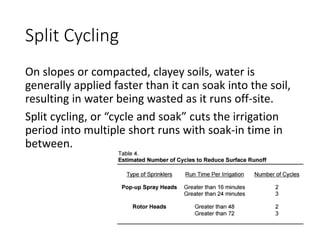
On slopes or compacted, clayey soils, water is
generally applied faster than it can soak into the soil,
resulting in water being wasted as it runs off-site.
Split cycling, or “cycle and soak” cuts the irrigation
period into multiple short runs with soak-in time in
between.
Watering
• In general, turf needs about .1 - .3 inches of water
per day in cool-warm weather and .3 - .45 inches of
water day in warm-hot/dry weather
• To encourage deeper rooting, try to skip one or two
days between waterings and apply enough water
for those days combined
• Split-cycling may be needed to accomplish this
• More water is needed when high temperatures are
combined with wind, sun exposure, and low
humidity
Watering
• Early morning is the best time to irrigate
• water pressure is usually good.
• it knocks off the dew and leaf exudates from the blades.
• the turf should not be wet when nightfall occurs. Damp turf
for long periods of time can lead to fungus diseases.
• Avoid late afternoon and evening watering unless there
is time for the turf to dry.
Watering
• If water won’t penetrate the soil:
• Try split-cycling.
• Use low precipitation rate sprinklers.
• Check for soil compaction and aerify if needed.
• Check for excessive thatch and de-thatch if needed.
• Use gypsum to improve water penetration.
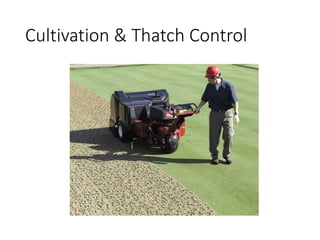
Cultivation & Thatch Control
Cultivation
• Cultivation: mechanical methods of selectively
thinning an established turf without destroying the sod
characteristics.
• relieving soil compaction
• improving poor soil structure
• removing thatch layers
• improving air and water exchange
• Other terms commonly used
• aerification
• dethatching
• vertical mowing (verticutting)
• renovating
Thatch
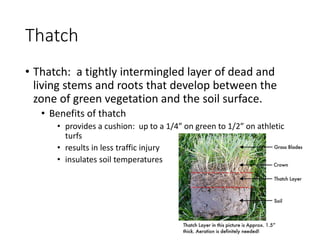
• Thatch: a tightly intermingled layer of dead and
living stems and roots that develop between the
zone of green vegetation and the soil surface.
• Benefits of thatch
• provides a cushion: up to a 1/4” on green to 1/2” on athletic
turfs
• results in less traffic injury
• insulates soil temperatures
Thatch
Detriments of thatch:
• increased disease and insect problems – thatch
harbors insects and provides a moist area for fungi.
• dry spots – water can’t penetrate.
• chlorosis – nutrients can’t penetrate.
• scalping – mower wheels sink into thatch and scalp.
• foot printing – grass does not spring back quickly.
• decreased heat, cold, and drought tolerance – can lead
to the crowns of the grass growing above the thatch
and being more exposed to extremes in climate.
Thatch
Causes of thatch
• vigorous turf varieties – grow quickly and add
stolons, rhizomes, and leaves to the thatch layer.
• acid soil conditions – too acidic for beneficial
bacteria and fungi which decompose the thatch.
• poor aeration – inhibits the beneficial bacteria and
fungi from doing their job of decomposition.
• excessive nitrogen – results in fast turfgrass growth
which leads to more thatch
Thatch Control
• Biologically: using microorganism activity
• increase the aeration into the soil
• correct acid soil conditions
• control the growth rate of the turf
• Culturally: by the use of topdressing
• Buries the thatch which allows for faster microorganism
activity
• see “Topdressing” notes in upcoming pages
• Vertical mowing
Aerification
Aerification: methods that either drill or punch a hole into the soil, or cut
a groove into the soil to provide pathways for air and water to penetrate
into the root zone.
Coring: a hollow tine is forced into the soil which removes a core of soil
and turf.
• Sizes range from 1/4” - 3/4” in diameter
• Depth of cores is from 2 - 6” deep
• Spacing of cores is from 2, 4, 5, or 6” centers
• Cores can be removed from the area or crushed and dragged back into
the surface
• Best results occur when soils are moist
• Greens are often topdressed with sand to fill in the holes
• Holes can also be drilled with drill bits
Aerification
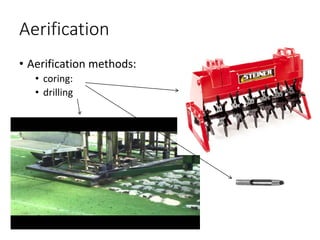
• Aerification methods:
• coring:
• drilling
Aerification
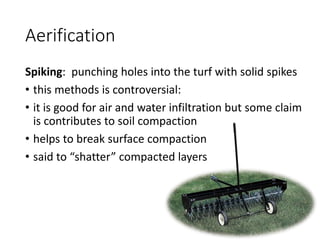
Spiking: punching holes into the turf with solid spikes
• this methods is controversial:
• it is good for air and water infiltration but some claim
is contributes to soil compaction
• helps to break surface compaction
• said to “shatter” compacted layers
Aerification
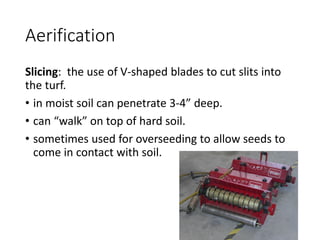
Slicing: the use of V-shaped blades to cut slits into
the turf.
• in moist soil can penetrate 3-4” deep.
• can “walk” on top of hard soil.
• sometimes used for overseeding to allow seeds to
come in contact with soil.
Aerification
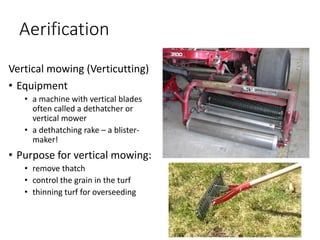
Vertical mowing (Verticutting)
• Equipment
• a machine with vertical blades
often called a dethatcher or
vertical mower
• a dethatching rake – a blister-
maker!
• Purpose for vertical mowing:
• remove thatch
• control the grain in the turf
• thinning turf for overseeding
Aerification
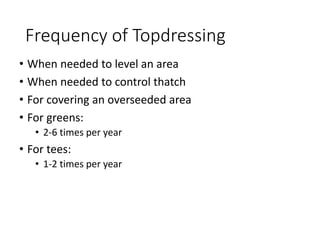
How often should you verticut?
• Depends on:
• the type of turf
• the amount of nitrogen applied
• the season (you should have at least 30 days of growth
after verticutting)
• avoid verticutting when weed seeds are present
• topdressing after verticutting speeds recovery
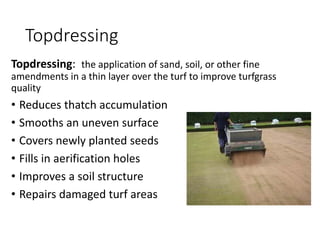
Topdressing
Topdressing: the application of sand, soil, or other fine
amendments in a thin layer over the turf to improve turfgrass
quality
• Reduces thatch accumulation
• Smooths an uneven surface
• Covers newly planted seeds
• Fills in aerification holes
• Improves a soil structure
• Repairs damaged turf areas
Reasons for Topdressing
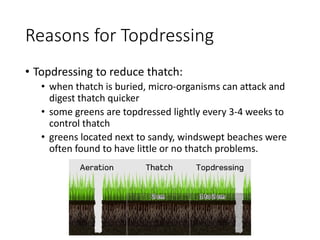
• Topdressing to reduce thatch:
• when thatch is buried, micro-organisms can attack and
digest thatch quicker
• some greens are topdressed lightly every 3-4 weeks to
control thatch
• greens located next to sandy, windswept beaches were
often found to have little or no thatch problems.
Reasons for Topdressing
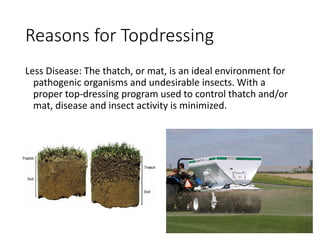
Less Disease: The thatch, or mat, is an ideal environment for
pathogenic organisms and undesirable insects. With a
proper top-dressing program used to control thatch and/or
mat, disease and insect activity is minimized.
Reasons for Topdressing
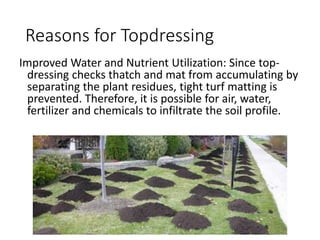
Improved Water and Nutrient Utilization: Since top-
dressing checks thatch and mat from accumulating by
separating the plant residues, tight turf matting is
prevented. Therefore, it is possible for air, water,
fertilizer and chemicals to infiltrate the soil profile.
Reasons for Topdressing
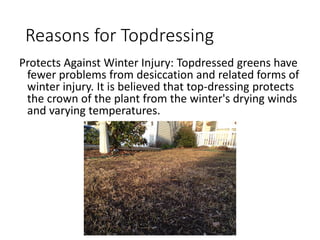
Protects Against Winter Injury: Topdressed greens have
fewer problems from desiccation and related forms of
winter injury. It is believed that top-dressing protects
the crown of the plant from the winter's drying winds
and varying temperatures.
Reasons for Topdressing
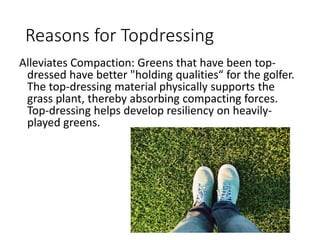
Alleviates Compaction: Greens that have been top-
dressed have better "holding qualities“ for the golfer.
The top-dressing material physically supports the
grass plant, thereby absorbing compacting forces.
Top-dressing helps develop resiliency on heavily-
played greens.
Reasons for Topdressing
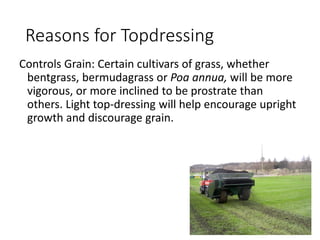
Controls Grain: Certain cultivars of grass, whether
bentgrass, bermudagrass or Poa annua, will be more
vigorous, or more inclined to be prostrate than
others. Light top-dressing will help encourage upright
growth and discourage grain.
Reasons for Topdressing
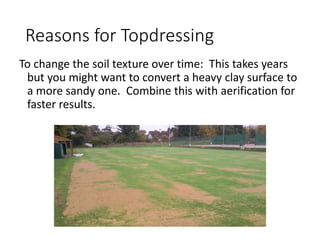
To change the soil texture over time: This takes years
but you might want to convert a heavy clay surface to
a more sandy one. Combine this with aerification for
faster results.
Frequency of Topdressing
• When needed to level an area
• When needed to control thatch
• For covering an overseeded area
• For greens:
• 2-6 times per year
• For tees:
• 1-2 times per year
Putting it all together
Woodland Hills County Club – San Fernando Valley
Putting it all together
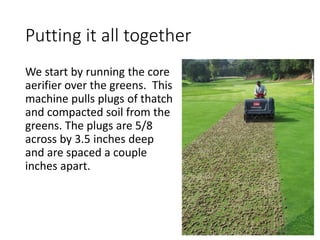
We start by running the core
aerifier over the greens. This
machine pulls plugs of thatch
and compacted soil from the
greens. The plugs are 5/8
across by 3.5 inches deep
and are spaced a couple
inches apart.
Putting it all together
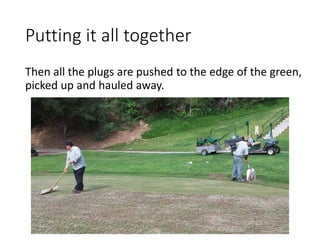
Then all the plugs are pushed to the edge of the green,
picked up and hauled away.
Putting it all together
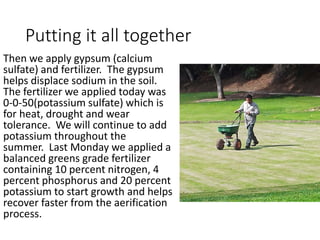
Then we apply gypsum (calcium
sulfate) and fertilizer. The gypsum
helps displace sodium in the soil.
The fertilizer we applied today was
0-0-50(potassium sulfate) which is
for heat, drought and wear
tolerance. We will continue to add
potassium throughout the
summer. Last Monday we applied a
balanced greens grade fertilizer
containing 10 percent nitrogen, 4
percent phosphorus and 20 percent
potassium to start growth and helps
recover faster from the aerification
process.
Putting it all together
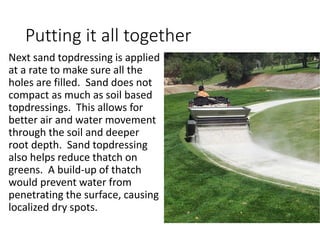
Next sand topdressing is applied
at a rate to make sure all the
holes are filled. Sand does not
compact as much as soil based
topdressings. This allows for
better air and water movement
through the soil and deeper
root depth. Sand topdressing
also helps reduce thatch on
greens. A build-up of thatch
would prevent water from
penetrating the surface, causing
localized dry spots.
Putting it all together
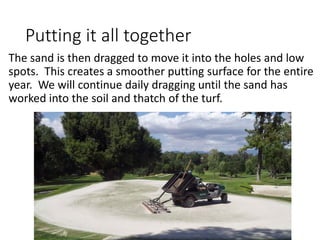
The sand is then dragged to move it into the holes and low
spots. This creates a smoother putting surface for the entire
year. We will continue daily dragging until the sand has
worked into the soil and thatch of the turf.
Putting it all together
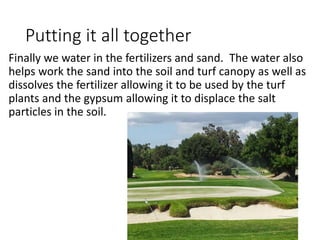
Finally we water in the fertilizers and sand. The water also
helps work the sand into the soil and turf canopy as well as
dissolves the fertilizer allowing it to be used by the turf
plants and the gypsum allowing it to displace the salt
particles in the soil.

Turfgrass Cultural Practices

  • 1.
    Cultural Practices LNT 132– Spring 2017 Mark Valen
  • 2.
    Cultural Practices The limitingfactors in plant growth, in descending order of importance, are: • light • temperature • moisture • nutrients All of these factors occur naturally and directly influence your management practices.
  • 3.
    Cultural Practices Thus, youcannot separate your cultural program from the influence of the environment, particularly weather conditions • Light provides the energy to drive photosynthesis. • Temperature determines the rate of growth and metabolism. • Moisture is critical to metabolic processes and heat dissipation. • Wind promotes the transfer of heat and drying conditions.
  • 4.
    Cultural Practices Turfgrass culturalpractices include: • mowing • fertilizing • irrigating • cultivating (coring, slicing, spiking or vertical mowing) • rolling • topdressing • managing pests While none of these is necessarily more important than any other, one of the most difficult to manage is irrigation
  • 5.
  • 6.
    Irrigation Turfgrass leaves andshoots are comprised of about 80% water. A lack or water (rainfall or irrigation) will lead to a decrease in growth and energy production and an increase in plant stress. When turf has insufficient water it will begin to wilt. Leaves will roll or fold to conserve water by reducing their leaf area. Eventually turf will display a brown wilted appearance as the leaves die (not the plant) and the turf enters a drought induced dormancy.
  • 7.
    Irrigation When to irrigate? •footprinting is observed • before a sports event but not right before • when hot dry weather is anticipated • after an application of fertilizer • to germinate seeds • to stop high surface temperatures from building up
  • 8.
    Footprinting Footprints in turfgrassare a common symptom of drought stress. They are the result of a loss in turgor pressure, due to lack of water, in plant tissue.
  • 9.
    Syringing Syringing is thepractice of applying small amounts of water, usually 0.10 inch or less, to correct plant- water deficits, reduce plant-tissue temperatures and wash the leaves. Syringing applies water to the canopy, but is not intended to restore soil moisture, as is a typical irrigation. Typically, superintendents syringe in the early morning to remove dew or at midday to moderate temperatures.
  • 10.
    Syringing • Work inthe 1970s at Michigan State University found that an application of 0.25 inch of water to 'Toronto' creeping bentgrass reduced canopy temperatures 1.8 to 3.6 oF for 2 hours. • A Cornell University researcher found that applying 0.12 inch of water to 'Astoria' creeping bentgrass between 11:30 a.m. and 3:00 p.m. resulted in a canopy-temperature reduction of 7.2 oF immediately after spraying. However, the cooling effect fell off to only 2.5 oF within 10 minutes, and the bentgrass reached pre-syringing canopy temperatures just 15 to 30 minutes after syringing. • Researchers at North Carolina State University in the 1980s found that in the absence of wilt symptoms, canopy temperatures of well-watered creeping bentgrass were no different 1 hour after syringing, regardless of the volume of water they applied (0 to 0.21 inch) or timing (12:00, 1:00, 2:00, 3:00 or 4:00 p.m.). These research studies focused on canopy-temperature reduction, and the data do not suggest any long-term benefit of canopy-temperature moderation from syringing.
  • 11.
    Watering How long toirrigate? • Attempt to water long enough to allow water to reach a 6 - 12 inch depth. • If water puddles before that depth is reached, try to use split-cycle watering. • Increase water duration to attempt to get deeper roots. • Increase water duration or frequency during hot weather.
  • 12.
    Split Cycling On slopesor compacted, clayey soils, water is generally applied faster than it can soak into the soil, resulting in water being wasted as it runs off-site. Split cycling, or “cycle and soak” cuts the irrigation period into multiple short runs with soak-in time in between.
  • 13.
    Watering • In general,turf needs about .1 - .3 inches of water per day in cool-warm weather and .3 - .45 inches of water day in warm-hot/dry weather • To encourage deeper rooting, try to skip one or two days between waterings and apply enough water for those days combined • Split-cycling may be needed to accomplish this • More water is needed when high temperatures are combined with wind, sun exposure, and low humidity
  • 14.
    Watering • Early morningis the best time to irrigate • water pressure is usually good. • it knocks off the dew and leaf exudates from the blades. • the turf should not be wet when nightfall occurs. Damp turf for long periods of time can lead to fungus diseases. • Avoid late afternoon and evening watering unless there is time for the turf to dry.
  • 15.
    Watering • If waterwon’t penetrate the soil: • Try split-cycling. • Use low precipitation rate sprinklers. • Check for soil compaction and aerify if needed. • Check for excessive thatch and de-thatch if needed. • Use gypsum to improve water penetration.
  • 16.
  • 17.
    Cultivation • Cultivation: mechanicalmethods of selectively thinning an established turf without destroying the sod characteristics. • relieving soil compaction • improving poor soil structure • removing thatch layers • improving air and water exchange • Other terms commonly used • aerification • dethatching • vertical mowing (verticutting) • renovating
  • 18.
    Thatch • Thatch: atightly intermingled layer of dead and living stems and roots that develop between the zone of green vegetation and the soil surface. • Benefits of thatch • provides a cushion: up to a 1/4” on green to 1/2” on athletic turfs • results in less traffic injury • insulates soil temperatures
  • 19.
    Thatch Detriments of thatch: •increased disease and insect problems – thatch harbors insects and provides a moist area for fungi. • dry spots – water can’t penetrate. • chlorosis – nutrients can’t penetrate. • scalping – mower wheels sink into thatch and scalp. • foot printing – grass does not spring back quickly. • decreased heat, cold, and drought tolerance – can lead to the crowns of the grass growing above the thatch and being more exposed to extremes in climate.
  • 20.
    Thatch Causes of thatch •vigorous turf varieties – grow quickly and add stolons, rhizomes, and leaves to the thatch layer. • acid soil conditions – too acidic for beneficial bacteria and fungi which decompose the thatch. • poor aeration – inhibits the beneficial bacteria and fungi from doing their job of decomposition. • excessive nitrogen – results in fast turfgrass growth which leads to more thatch
  • 21.
    Thatch Control • Biologically:using microorganism activity • increase the aeration into the soil • correct acid soil conditions • control the growth rate of the turf • Culturally: by the use of topdressing • Buries the thatch which allows for faster microorganism activity • see “Topdressing” notes in upcoming pages • Vertical mowing
  • 22.
    Aerification Aerification: methods thateither drill or punch a hole into the soil, or cut a groove into the soil to provide pathways for air and water to penetrate into the root zone. Coring: a hollow tine is forced into the soil which removes a core of soil and turf. • Sizes range from 1/4” - 3/4” in diameter • Depth of cores is from 2 - 6” deep • Spacing of cores is from 2, 4, 5, or 6” centers • Cores can be removed from the area or crushed and dragged back into the surface • Best results occur when soils are moist • Greens are often topdressed with sand to fill in the holes • Holes can also be drilled with drill bits
  • 23.
  • 24.
    Aerification Spiking: punching holesinto the turf with solid spikes • this methods is controversial: • it is good for air and water infiltration but some claim is contributes to soil compaction • helps to break surface compaction • said to “shatter” compacted layers
  • 25.
    Aerification Slicing: the useof V-shaped blades to cut slits into the turf. • in moist soil can penetrate 3-4” deep. • can “walk” on top of hard soil. • sometimes used for overseeding to allow seeds to come in contact with soil.
  • 26.
    Aerification Vertical mowing (Verticutting) •Equipment • a machine with vertical blades often called a dethatcher or vertical mower • a dethatching rake – a blister- maker! • Purpose for vertical mowing: • remove thatch • control the grain in the turf • thinning turf for overseeding
  • 27.
    Aerification How often shouldyou verticut? • Depends on: • the type of turf • the amount of nitrogen applied • the season (you should have at least 30 days of growth after verticutting) • avoid verticutting when weed seeds are present • topdressing after verticutting speeds recovery
  • 28.
    Topdressing Topdressing: the applicationof sand, soil, or other fine amendments in a thin layer over the turf to improve turfgrass quality • Reduces thatch accumulation • Smooths an uneven surface • Covers newly planted seeds • Fills in aerification holes • Improves a soil structure • Repairs damaged turf areas
  • 29.
    Reasons for Topdressing •Topdressing to reduce thatch: • when thatch is buried, micro-organisms can attack and digest thatch quicker • some greens are topdressed lightly every 3-4 weeks to control thatch • greens located next to sandy, windswept beaches were often found to have little or no thatch problems.
  • 30.
    Reasons for Topdressing LessDisease: The thatch, or mat, is an ideal environment for pathogenic organisms and undesirable insects. With a proper top-dressing program used to control thatch and/or mat, disease and insect activity is minimized.
  • 31.
    Reasons for Topdressing ImprovedWater and Nutrient Utilization: Since top- dressing checks thatch and mat from accumulating by separating the plant residues, tight turf matting is prevented. Therefore, it is possible for air, water, fertilizer and chemicals to infiltrate the soil profile.
  • 32.
    Reasons for Topdressing ProtectsAgainst Winter Injury: Topdressed greens have fewer problems from desiccation and related forms of winter injury. It is believed that top-dressing protects the crown of the plant from the winter's drying winds and varying temperatures.
  • 33.
    Reasons for Topdressing AlleviatesCompaction: Greens that have been top- dressed have better "holding qualities“ for the golfer. The top-dressing material physically supports the grass plant, thereby absorbing compacting forces. Top-dressing helps develop resiliency on heavily- played greens.
  • 34.
    Reasons for Topdressing ControlsGrain: Certain cultivars of grass, whether bentgrass, bermudagrass or Poa annua, will be more vigorous, or more inclined to be prostrate than others. Light top-dressing will help encourage upright growth and discourage grain.
  • 35.
    Reasons for Topdressing Tochange the soil texture over time: This takes years but you might want to convert a heavy clay surface to a more sandy one. Combine this with aerification for faster results.
  • 36.
    Frequency of Topdressing •When needed to level an area • When needed to control thatch • For covering an overseeded area • For greens: • 2-6 times per year • For tees: • 1-2 times per year
  • 37.
    Putting it alltogether Woodland Hills County Club – San Fernando Valley
  • 38.
    Putting it alltogether We start by running the core aerifier over the greens. This machine pulls plugs of thatch and compacted soil from the greens. The plugs are 5/8 across by 3.5 inches deep and are spaced a couple inches apart.
  • 39.
    Putting it alltogether Then all the plugs are pushed to the edge of the green, picked up and hauled away.
  • 40.
    Putting it alltogether Then we apply gypsum (calcium sulfate) and fertilizer. The gypsum helps displace sodium in the soil. The fertilizer we applied today was 0-0-50(potassium sulfate) which is for heat, drought and wear tolerance. We will continue to add potassium throughout the summer. Last Monday we applied a balanced greens grade fertilizer containing 10 percent nitrogen, 4 percent phosphorus and 20 percent potassium to start growth and helps recover faster from the aerification process.
  • 41.
    Putting it alltogether Next sand topdressing is applied at a rate to make sure all the holes are filled. Sand does not compact as much as soil based topdressings. This allows for better air and water movement through the soil and deeper root depth. Sand topdressing also helps reduce thatch on greens. A build-up of thatch would prevent water from penetrating the surface, causing localized dry spots.
  • 42.
    Putting it alltogether The sand is then dragged to move it into the holes and low spots. This creates a smoother putting surface for the entire year. We will continue daily dragging until the sand has worked into the soil and thatch of the turf.
  • 43.
    Putting it alltogether Finally we water in the fertilizers and sand. The water also helps work the sand into the soil and turf canopy as well as dissolves the fertilizer allowing it to be used by the turf plants and the gypsum allowing it to displace the salt particles in the soil.