
Snehal Arun Mane
Practical
Visit to meteorological observatory /
automatic weather reporting station.
Terrestrial and pond ecosystems of insects.
Behavior of insects and orientation.
Distribution patterns of insects, sampling
techniques for the estimation of insect
population and damage.
Pest surveillance through light traps, pheromone
traps and field incidence.
Practicable IPM practices- Mechanical and physical
methods, Cultural and biological methods.
Chemical control – Insecticides and their
formulations.
Pesticide appliances, insecticide application
techniques
Calibration of plant protection appliances,
Calculation of doses/concentrations of insecticides.
Compatibility of pesticides and Phytotoxicity of
insecticides
IPM case studies– Cotton, Sugarcane, Mango/ Citrus/
Pomegranate.
Identification of common phytophagous mites and
their morphological characters
Identification of rodents, bird pests, their damage and
management.
 Vermiculture – visit to vermiculture unit,
Biopesticides used in IPM with mass multiplication of
NPV and Entomopathogenic fungi.
Pest surveillance through traps.
Types of traps
Light trap
Bait trap
Pheromone trap
Sticky trap
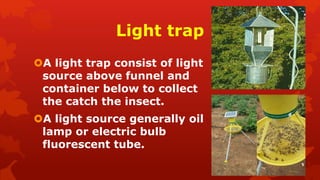
Light trap
A light trap consist of light
source above funnel and
container below to collect
the catch the insect.
A light source generally oil
lamp or electric bulb
fluorescent tube.
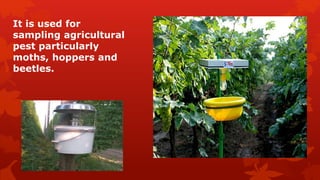
It is used for
sampling agricultural
pest particularly
moths, hoppers and
beetles.
Disadvantage
 Sometimes large number
of non target species
which may be useful one
also get trapped .
 Which is not only
cumbersome but also
disturb the ecological
balance.
Bait trap
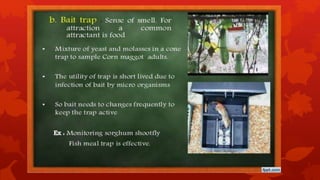
Bait traps are rely on an
insect olfaction or sense
of smell for attraction.
A common attractant is
food.(food containing
poison )
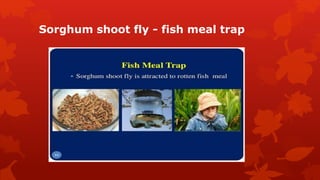
Sorghum shoot fly - fish meal trap
Corn maggot - A mixture of yeast and molasses
fruit sucking moth - over ripen banana
Disadvantage
The utility of such traps is short lived due to
infection of the bait by micro -organism .
Therefore the bait needs to be changed frequently to
keep the trap active.
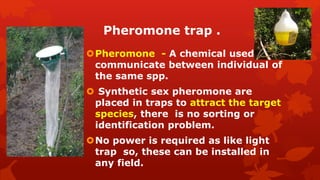
Pheromone trap .
Pheromone - A chemical used to
communicate between individual of
the same spp.
 Synthetic sex pheromone are
placed in traps to attract the target
species, there is no sorting or
identification problem.
No power is required as like light
trap so, these can be installed in
any field.
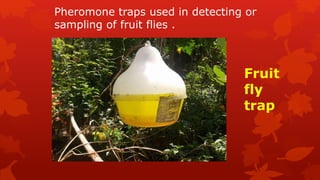
Pheromone traps used in detecting or
sampling of fruit flies .
Fruit
fly
trap
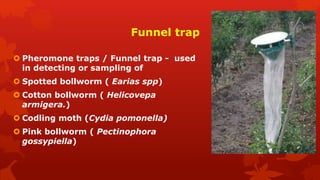
Funnel trap
 Pheromone traps / Funnel trap - used
in detecting or sampling of
 Spotted bollworm ( Earias spp)
 Cotton bollworm ( Helicovepa
armigera.)
 Codling moth (Cydia pomonella)
 Pink bollworm ( Pectinophora
gossypiella)
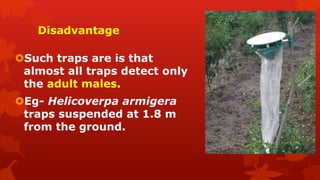
Disadvantage
Such traps are is that
almost all traps detect only
the adult males.
Eg- Helicoverpa armigera
traps suspended at 1.8 m
from the ground.
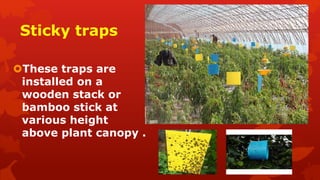
Sticky traps
These traps are
installed on a
wooden stack or
bamboo stick at
various height
above plant canopy .
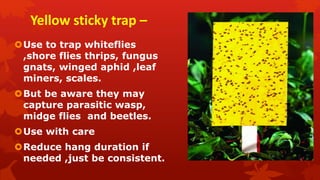
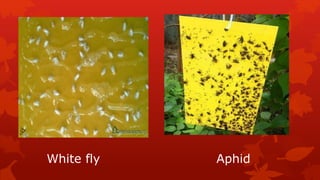
Yellow sticky trap –
Use to trap whiteflies
,shore flies thrips, fungus
gnats, winged aphid ,leaf
miners, scales.
But be aware they may
capture parasitic wasp,
midge flies and beetles.
Use with care
Reduce hang duration if
needed ,just be consistent.
White fly Aphid
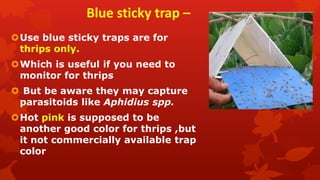
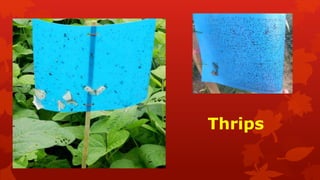
Blue sticky trap –
Use blue sticky traps are for
thrips only.
Which is useful if you need to
monitor for thrips
 But be aware they may capture
parasitoids like Aphidius spp.
Hot pink is supposed to be
another good color for thrips ,but
it not commercially available trap
color
Thrips

Types of trap

  • 1.
  • 2.
    Practical Visit to meteorologicalobservatory / automatic weather reporting station. Terrestrial and pond ecosystems of insects. Behavior of insects and orientation. Distribution patterns of insects, sampling techniques for the estimation of insect population and damage.
  • 3.
    Pest surveillance throughlight traps, pheromone traps and field incidence. Practicable IPM practices- Mechanical and physical methods, Cultural and biological methods. Chemical control – Insecticides and their formulations. Pesticide appliances, insecticide application techniques Calibration of plant protection appliances, Calculation of doses/concentrations of insecticides.
  • 4.
    Compatibility of pesticidesand Phytotoxicity of insecticides IPM case studies– Cotton, Sugarcane, Mango/ Citrus/ Pomegranate. Identification of common phytophagous mites and their morphological characters Identification of rodents, bird pests, their damage and management.  Vermiculture – visit to vermiculture unit, Biopesticides used in IPM with mass multiplication of NPV and Entomopathogenic fungi.
  • 5.
    Pest surveillance throughtraps. Types of traps Light trap Bait trap Pheromone trap Sticky trap
  • 6.
    Light trap A lighttrap consist of light source above funnel and container below to collect the catch the insect. A light source generally oil lamp or electric bulb fluorescent tube.
  • 7.
    It is usedfor sampling agricultural pest particularly moths, hoppers and beetles.
  • 8.
    Disadvantage  Sometimes largenumber of non target species which may be useful one also get trapped .  Which is not only cumbersome but also disturb the ecological balance.
  • 9.
    Bait trap Bait trapsare rely on an insect olfaction or sense of smell for attraction. A common attractant is food.(food containing poison )
  • 10.
    Sorghum shoot fly- fish meal trap
  • 11.
    Corn maggot -A mixture of yeast and molasses fruit sucking moth - over ripen banana Disadvantage The utility of such traps is short lived due to infection of the bait by micro -organism . Therefore the bait needs to be changed frequently to keep the trap active.
  • 13.
    Pheromone trap . Pheromone- A chemical used to communicate between individual of the same spp.  Synthetic sex pheromone are placed in traps to attract the target species, there is no sorting or identification problem. No power is required as like light trap so, these can be installed in any field.
  • 14.
    Pheromone traps usedin detecting or sampling of fruit flies . Fruit fly trap
  • 15.
    Funnel trap  Pheromonetraps / Funnel trap - used in detecting or sampling of  Spotted bollworm ( Earias spp)  Cotton bollworm ( Helicovepa armigera.)  Codling moth (Cydia pomonella)  Pink bollworm ( Pectinophora gossypiella)
  • 16.
    Disadvantage Such traps areis that almost all traps detect only the adult males. Eg- Helicoverpa armigera traps suspended at 1.8 m from the ground.
  • 17.
    Sticky traps These trapsare installed on a wooden stack or bamboo stick at various height above plant canopy .
  • 18.
    Yellow sticky trap– Use to trap whiteflies ,shore flies thrips, fungus gnats, winged aphid ,leaf miners, scales. But be aware they may capture parasitic wasp, midge flies and beetles. Use with care Reduce hang duration if needed ,just be consistent.
  • 19.
  • 20.
    Blue sticky trap– Use blue sticky traps are for thrips only. Which is useful if you need to monitor for thrips  But be aware they may capture parasitoids like Aphidius spp. Hot pink is supposed to be another good color for thrips ,but it not commercially available trap color
  • 21.