Turfgrass Anatomy
LNT 132 – Spring 2017
Mark Valen
Turfgrass Anatomy
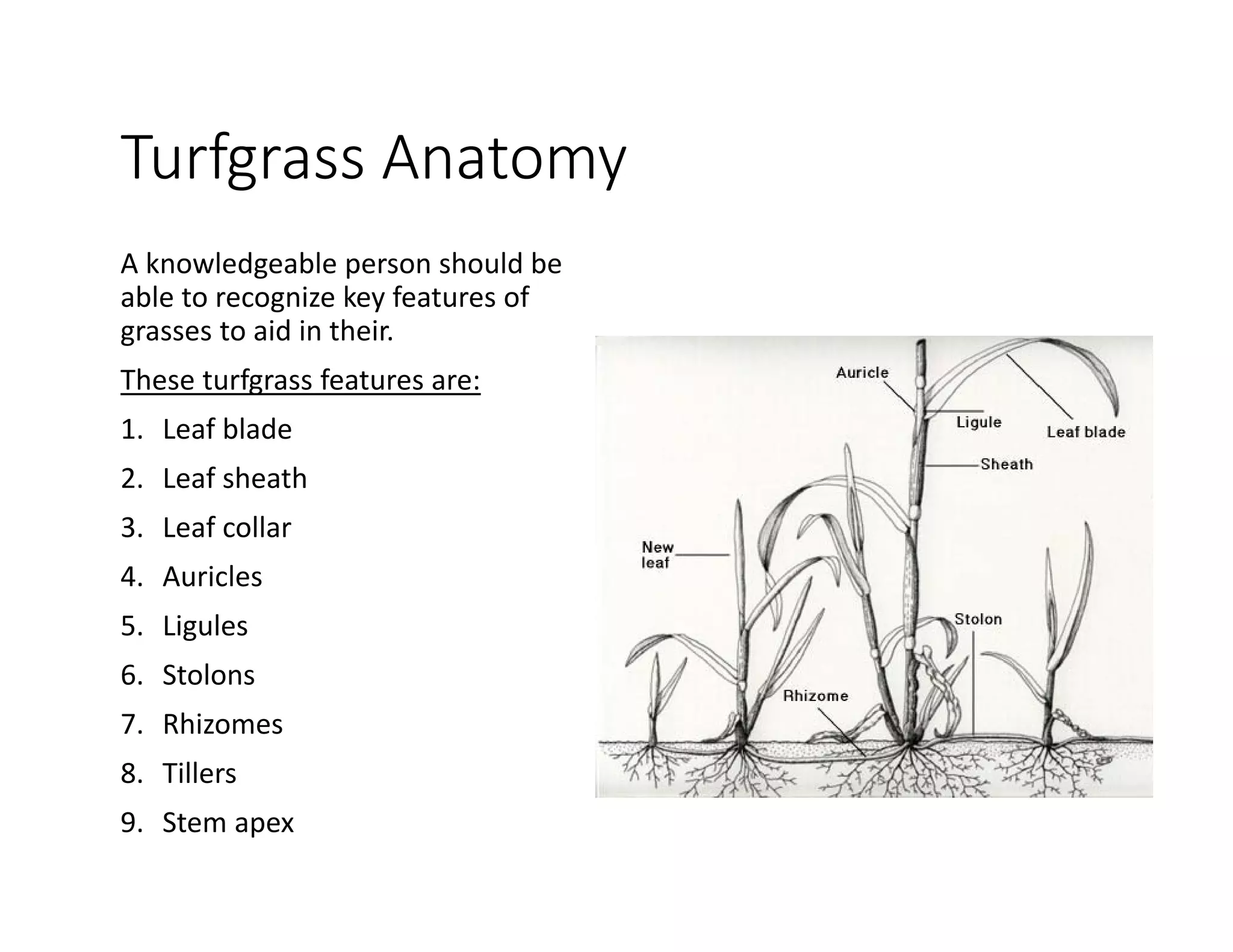
A knowledgeable person should be 
able to recognize key features of 
grasses to aid in their.
These turfgrass features are: 
1. Leaf blade
2. Leaf sheath 
3. Leaf collar 
4. Auricles 
5. Ligules 
6. Stolons
7. Rhizomes 
8. Tillers 
9. Stem apex
Turfgrass Leaves
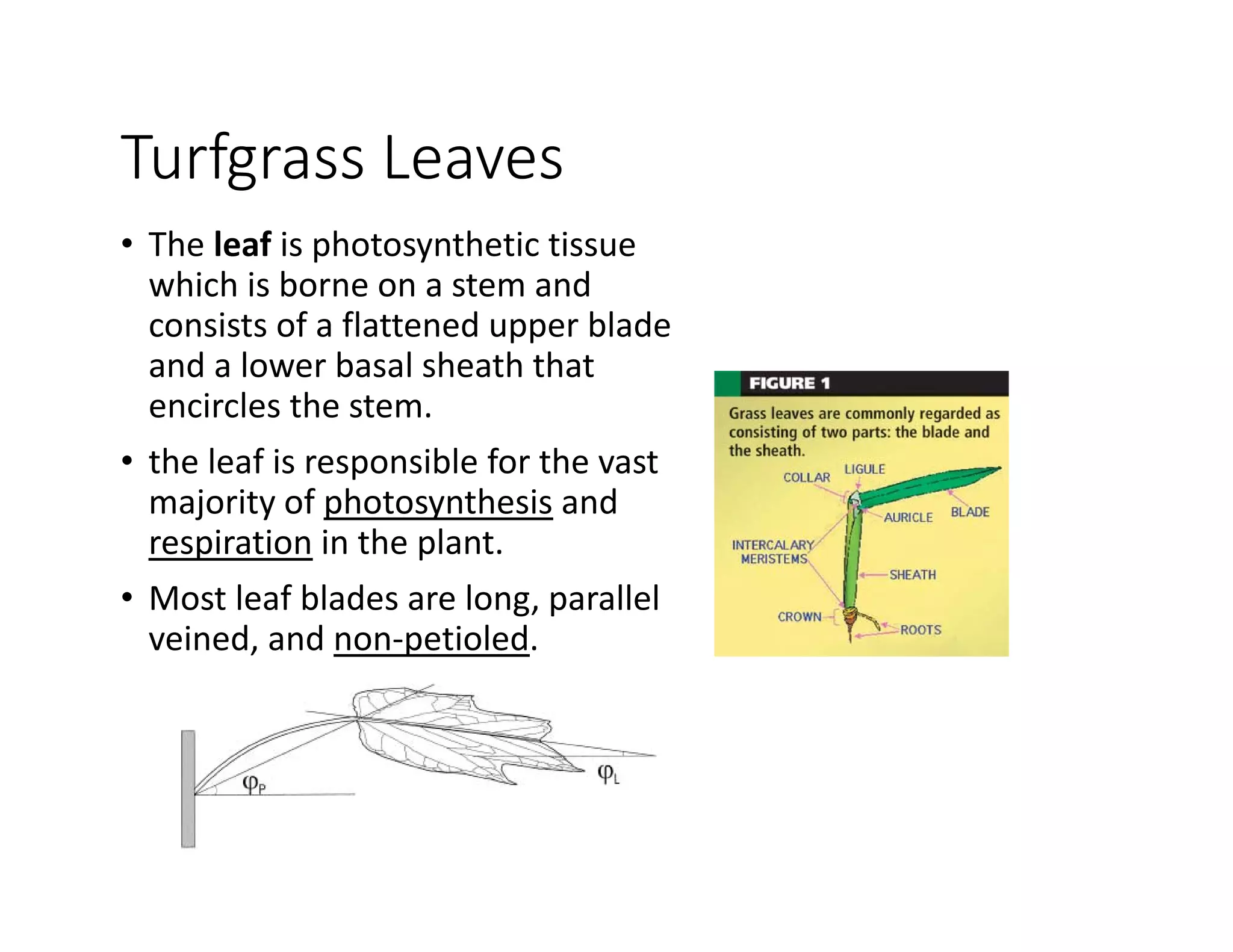
• The leaf is photosynthetic tissue 
which is borne on a stem and 
consists of a flattened upper blade 
and a lower basal sheath that 
encircles the stem.
• the leaf is responsible for the vast 
majority of photosynthesis and 
respiration in the plant.
• Most leaf blades are long, parallel 
veined, and non‐petioled.
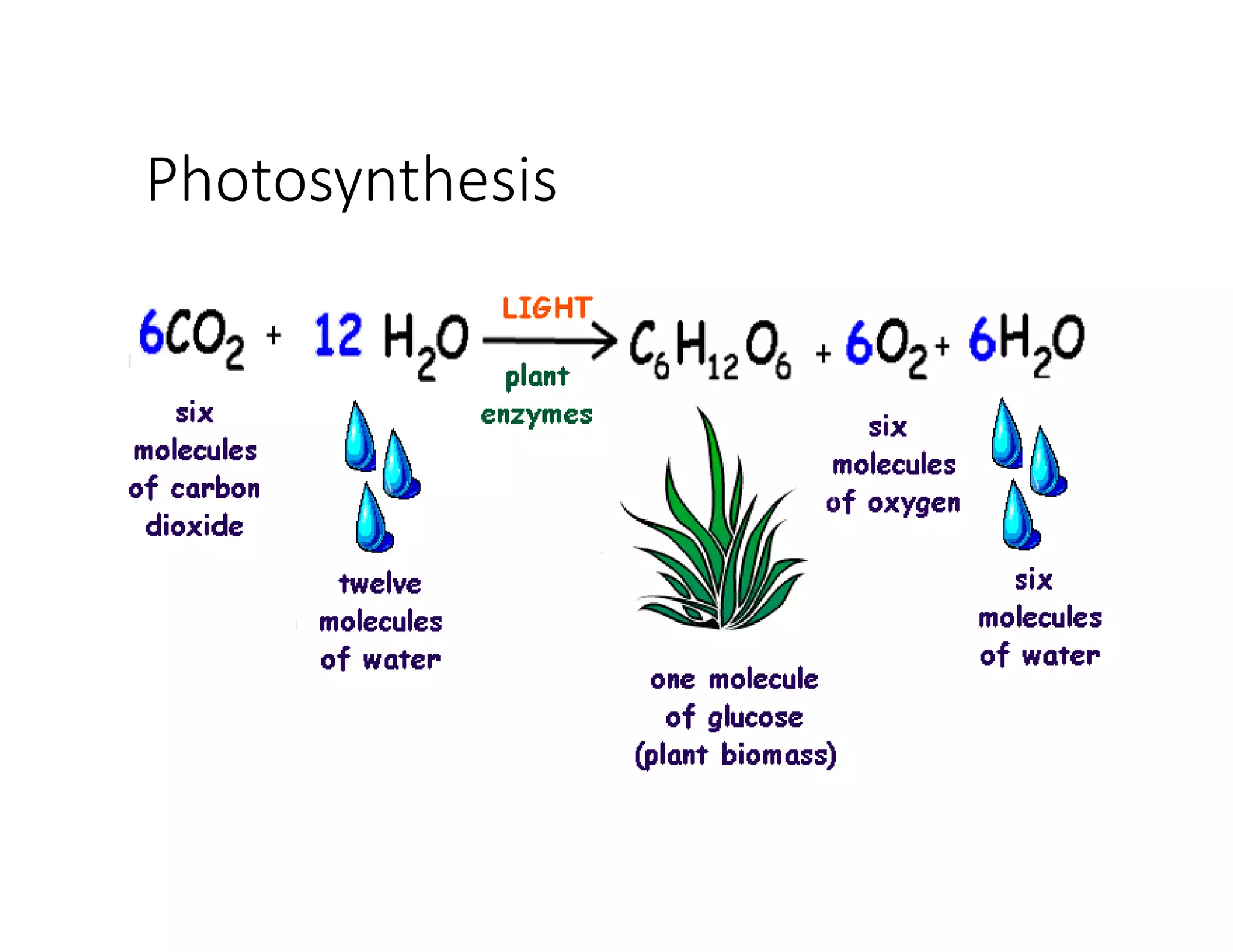
Photosynthesis
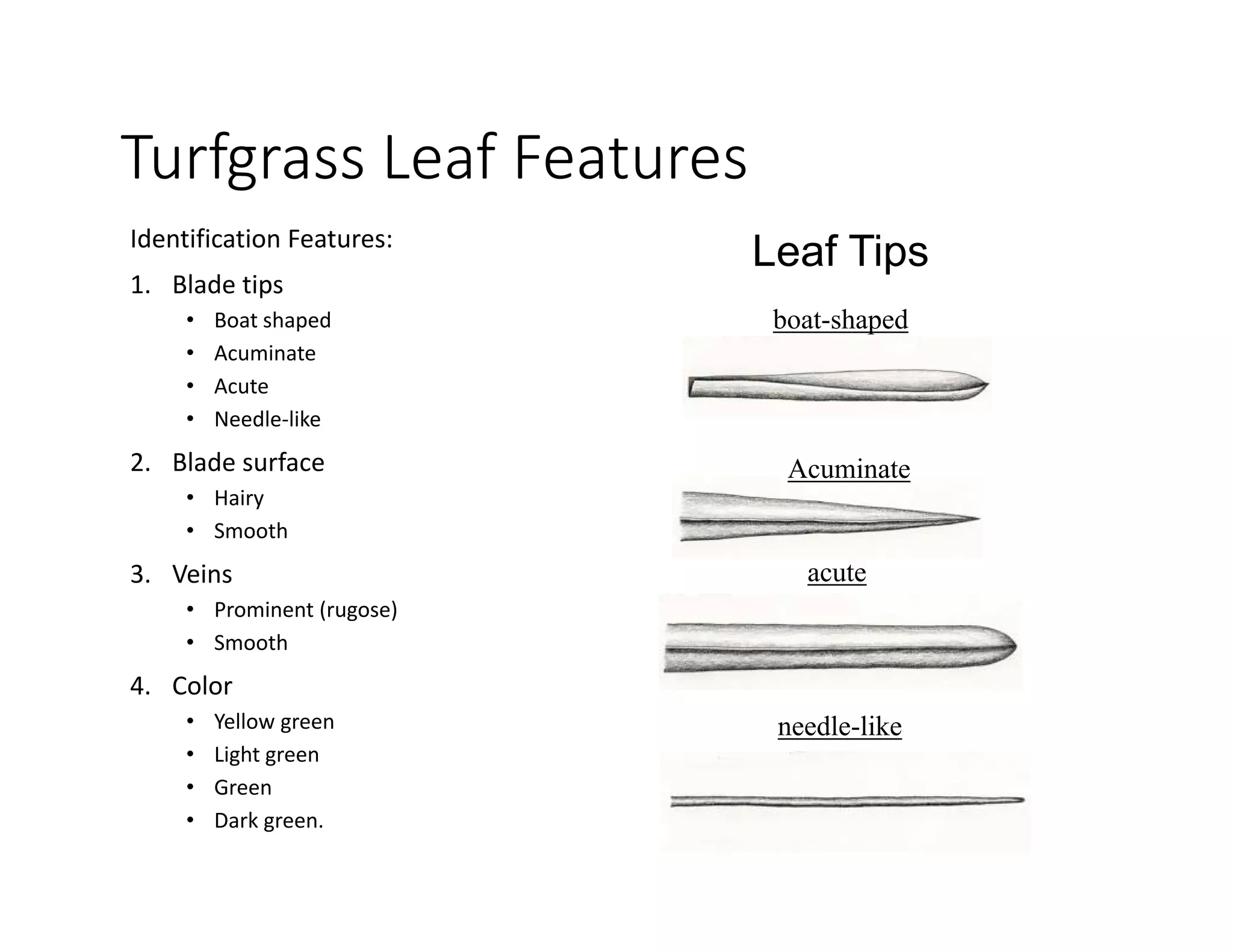
Turfgrass Leaf Features
Identification Features:
1. Blade tips
• Boat shaped 
• Acuminate
• Acute
• Needle‐like
2. Blade surface
• Hairy
• Smooth
3. Veins
• Prominent (rugose)
• Smooth
4. Color
• Yellow green 
• Light green
• Green
• Dark green.
boat-shaped
Acuminate
acute
needle-like
Leaf Tips
Leaf Sheath
• The leaf sheath is simply an 
extension of the leaf
• Shaped like a hollow cylinder 
that is split down one side 
and encloses the stem.
• Think of is as a buttoned or 
un‐buttoned coat that you 
are wearing.
• Identification features: 
1. split 
2. overlapped 
3. closed
Split Overlapped
Closed
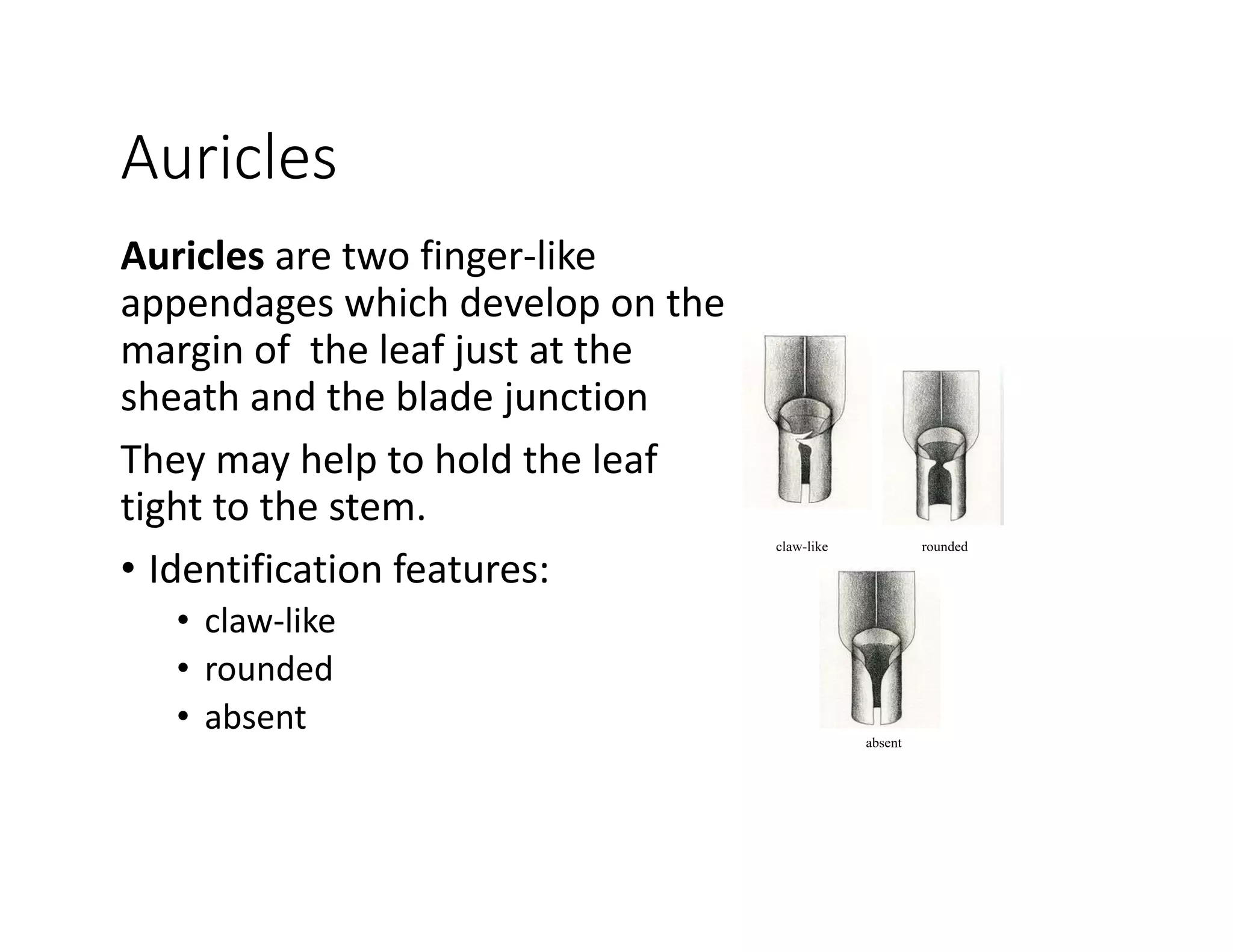
Auricles
Auricles are two finger‐like 
appendages which develop on the 
margin of  the leaf just at the 
sheath and the blade junction
They may help to hold the leaf 
tight to the stem.
• Identification features:
• claw‐like
• rounded
• absent
claw-like rounded
absent
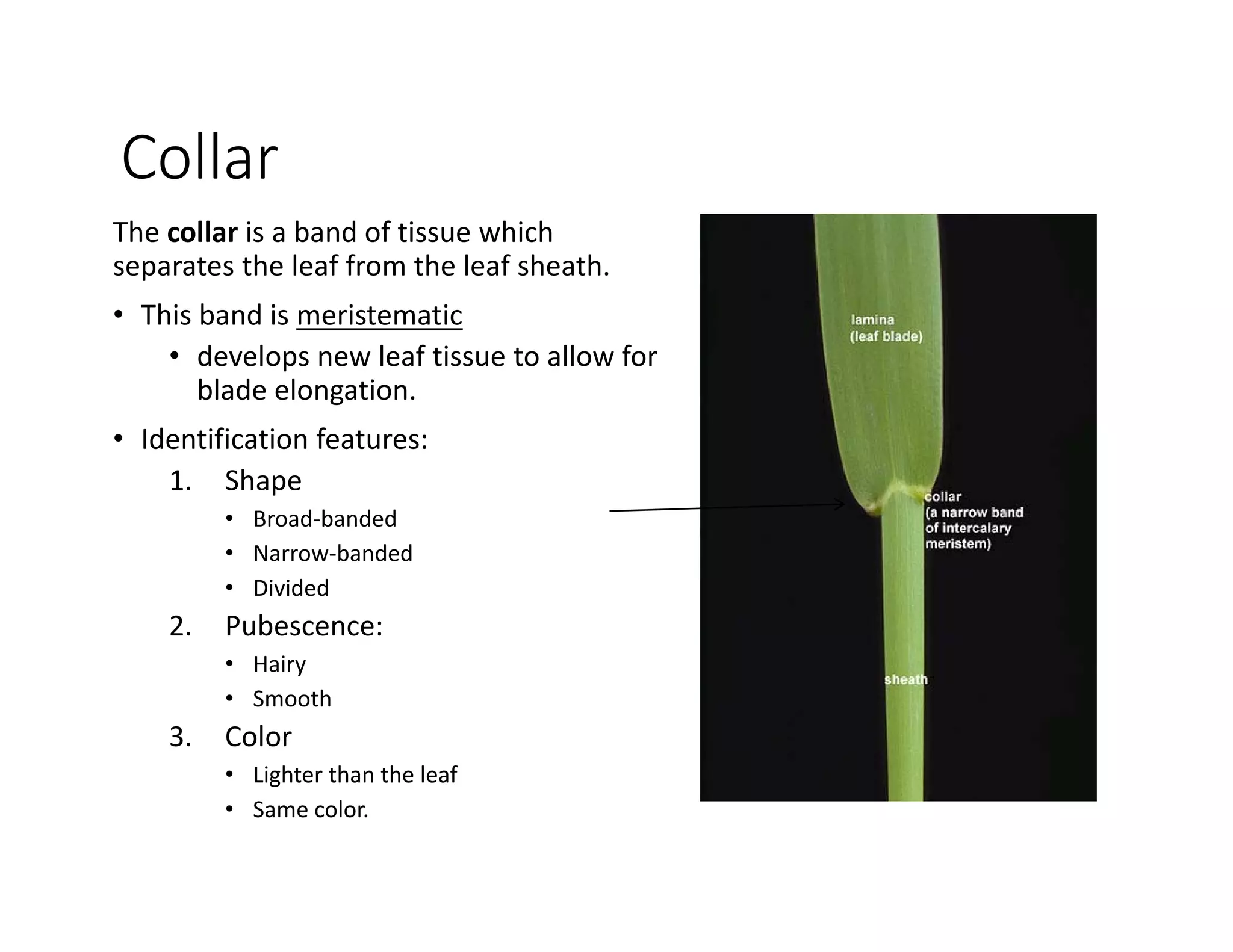
Collar
The collar is a band of tissue which 
separates the leaf from the leaf sheath. 
• This band is meristematic
• develops new leaf tissue to allow for 
blade elongation.
• Identification features:
1. Shape  
• Broad‐banded 
• Narrow‐banded 
• Divided
2. Pubescence:  
• Hairy
• Smooth
3. Color  
• Lighter than the leaf
• Same color.
Collar (cont)
• How does the collar grow 
new leaf tissue?  
• Assume you just mowed the 
leaf at the right just at the top 
of the picture.
• The collar lays down new 
layers of cells right above 
the pale green area and 
extends the blade upward.
• So, when mowing, you are 
always cutting off the older 
part of the leaf blade.
Ligules
Ligules are curtain‐like appendages 
located on the inner side of the leaf at 
the junction of the sheath and the leaf 
blade.    
They may work like eyelashes in 
keeping dirt away from the stem and 
leaf base.  
In terms of location, think of it as the 
label at the back of your neck on a shirt 
you are wearing.
• Identification features:
• Membranous
• Truncated
• Fringe of hairs
• Absent
membranous truncated
fringe of hairs absent
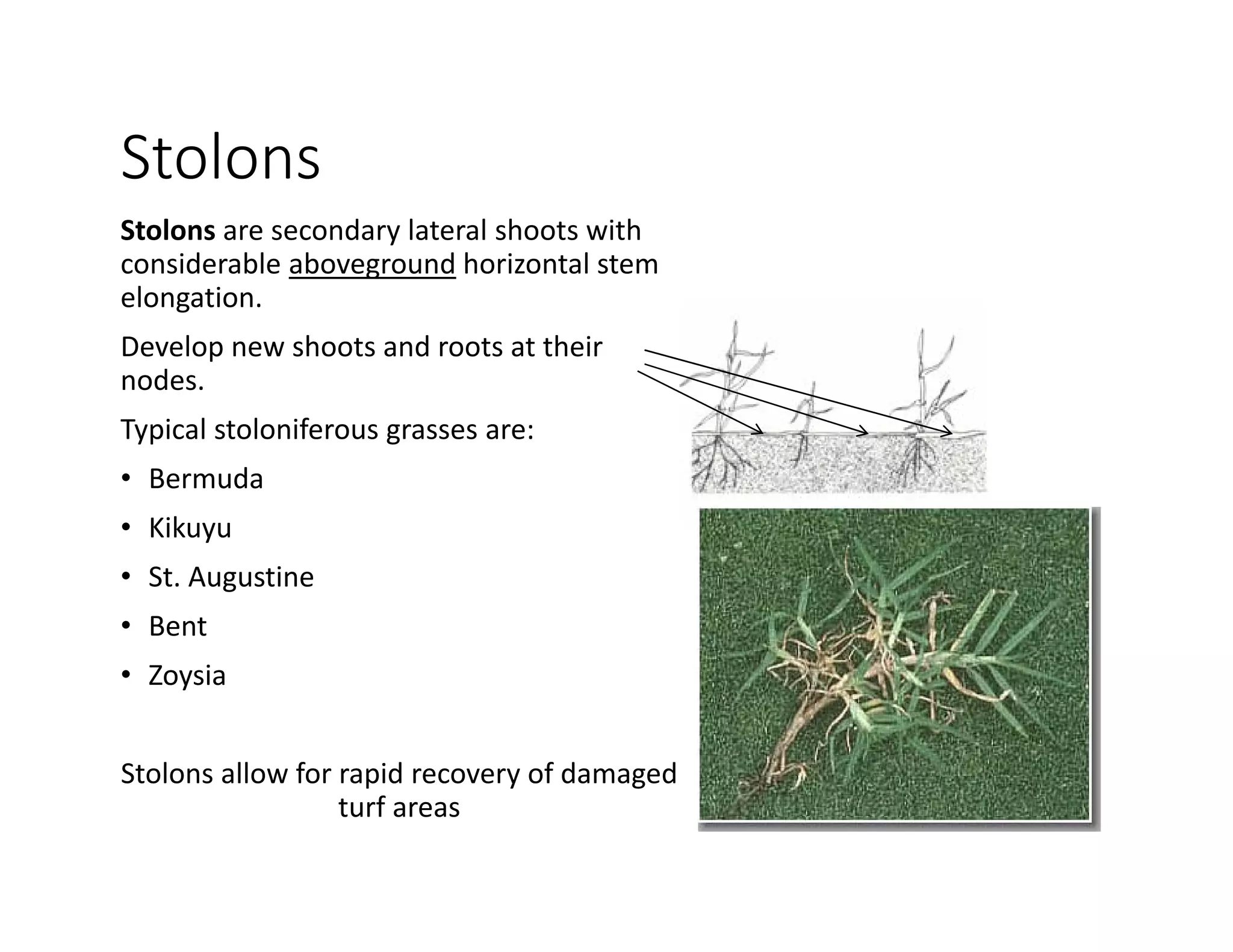
Stolons
Stolons are secondary lateral shoots with 
considerable aboveground horizontal stem 
elongation.  
Develop new shoots and roots at their 
nodes.
Typical stoloniferous grasses are:
• Bermuda
• Kikuyu
• St. Augustine
• Bent
• Zoysia
Stolons allow for rapid recovery of damaged 
turf areas
Rhizomes
Rhizomes are secondary lateral shoots 
that develops horizontally 
underground and which emerge as a 
new shoot and root at the terminal 
end
Typical rhizomatous grasses:
• Bermuda
• Kikuyu
• Kentucky blue
Rhizomes aid in repairing and 
thickening turfgrasses
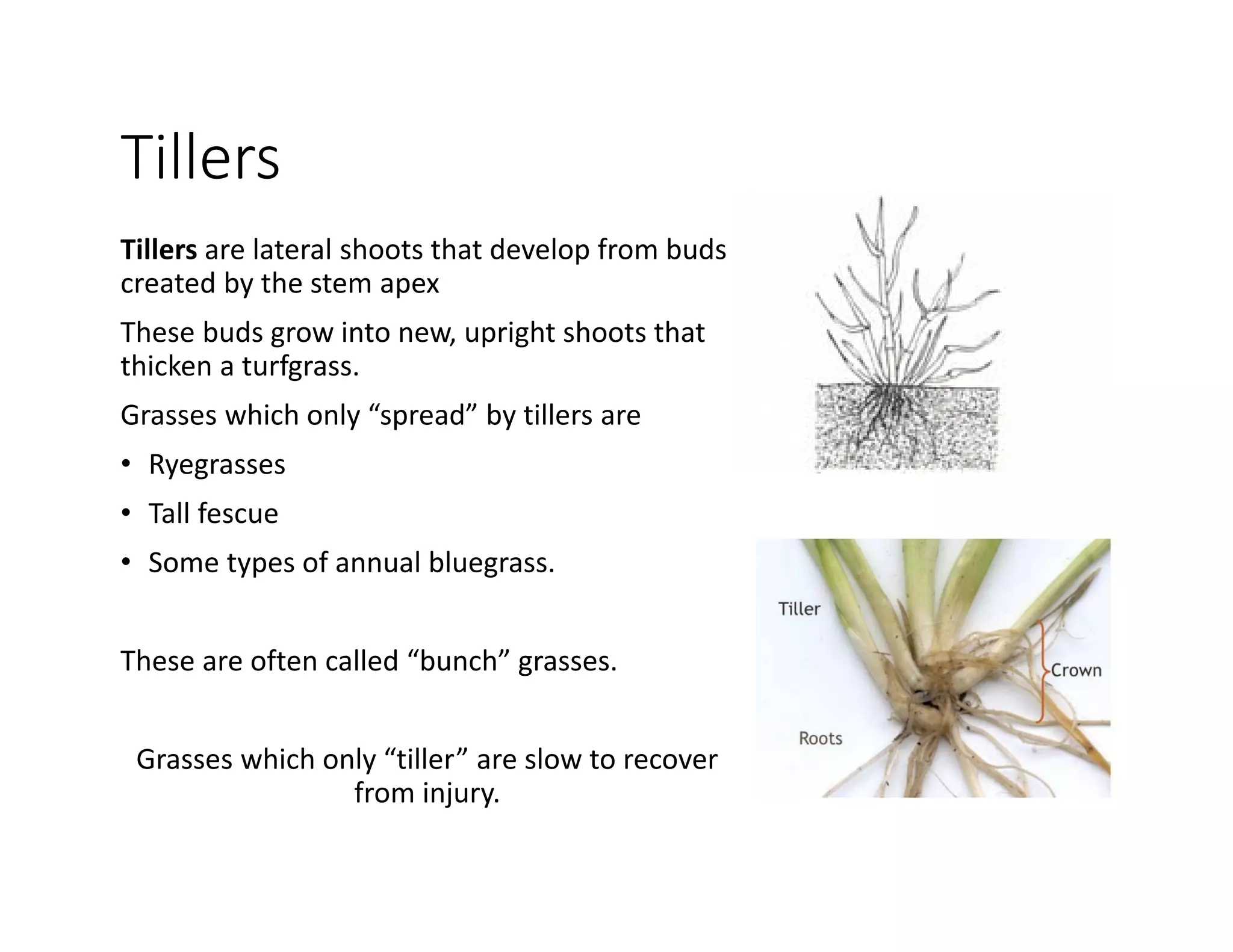
Tillers
Tillers are lateral shoots that develop from buds 
created by the stem apex 
These buds grow into new, upright shoots that 
thicken a turfgrass.
Grasses which only “spread” by tillers are 
• Ryegrasses
• Tall fescue 
• Some types of annual bluegrass.  
These are often called “bunch” grasses.
Grasses which only “tiller” are slow to recover 
from injury.
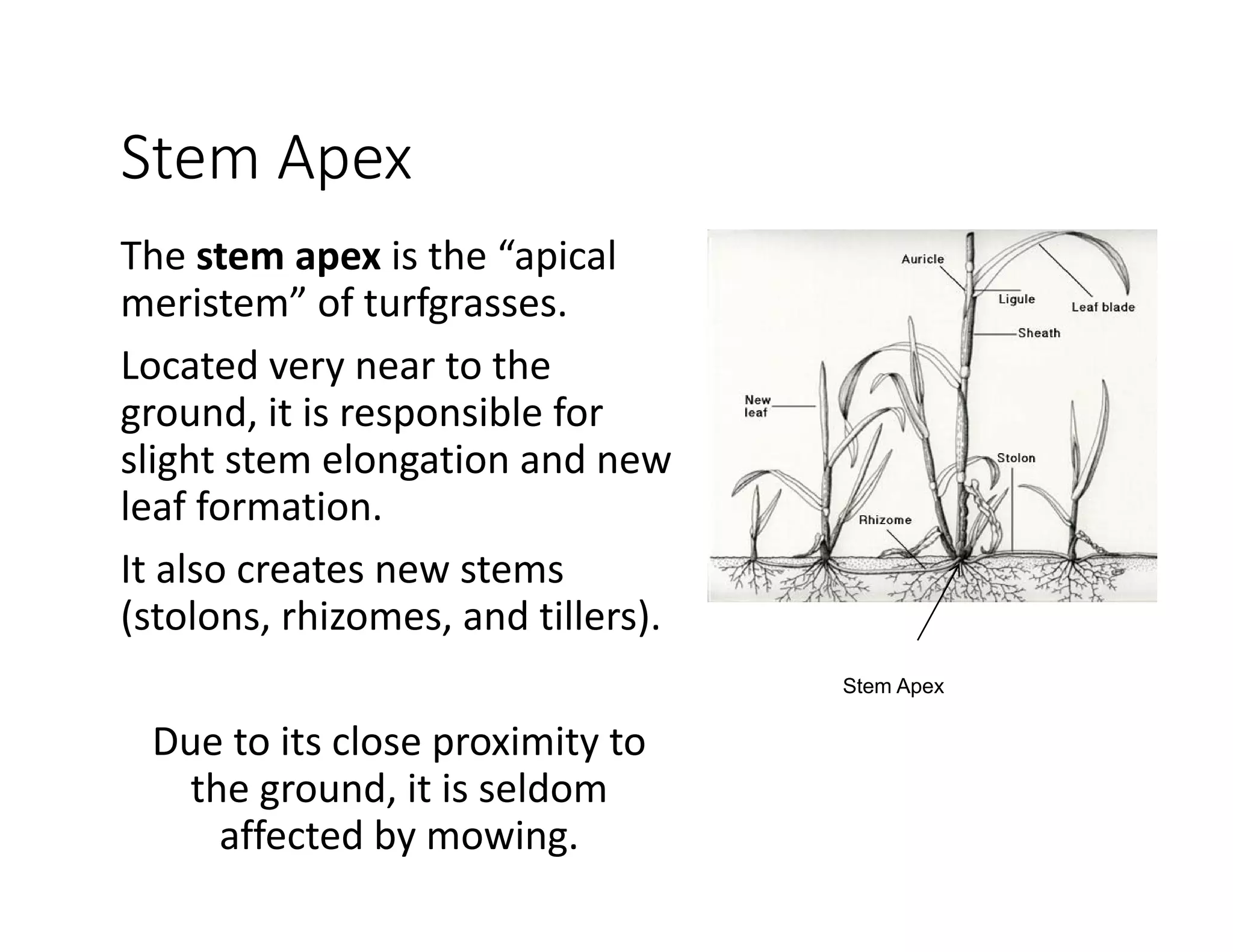
Stem Apex
The stem apex is the “apical 
meristem” of turfgrasses.  
Located very near to the 
ground, it is responsible for 
slight stem elongation and new 
leaf formation.  
It also creates new stems 
(stolons, rhizomes, and tillers). 
Due to its close proximity to 
the ground, it is seldom 
affected by mowing.
Stem Apex
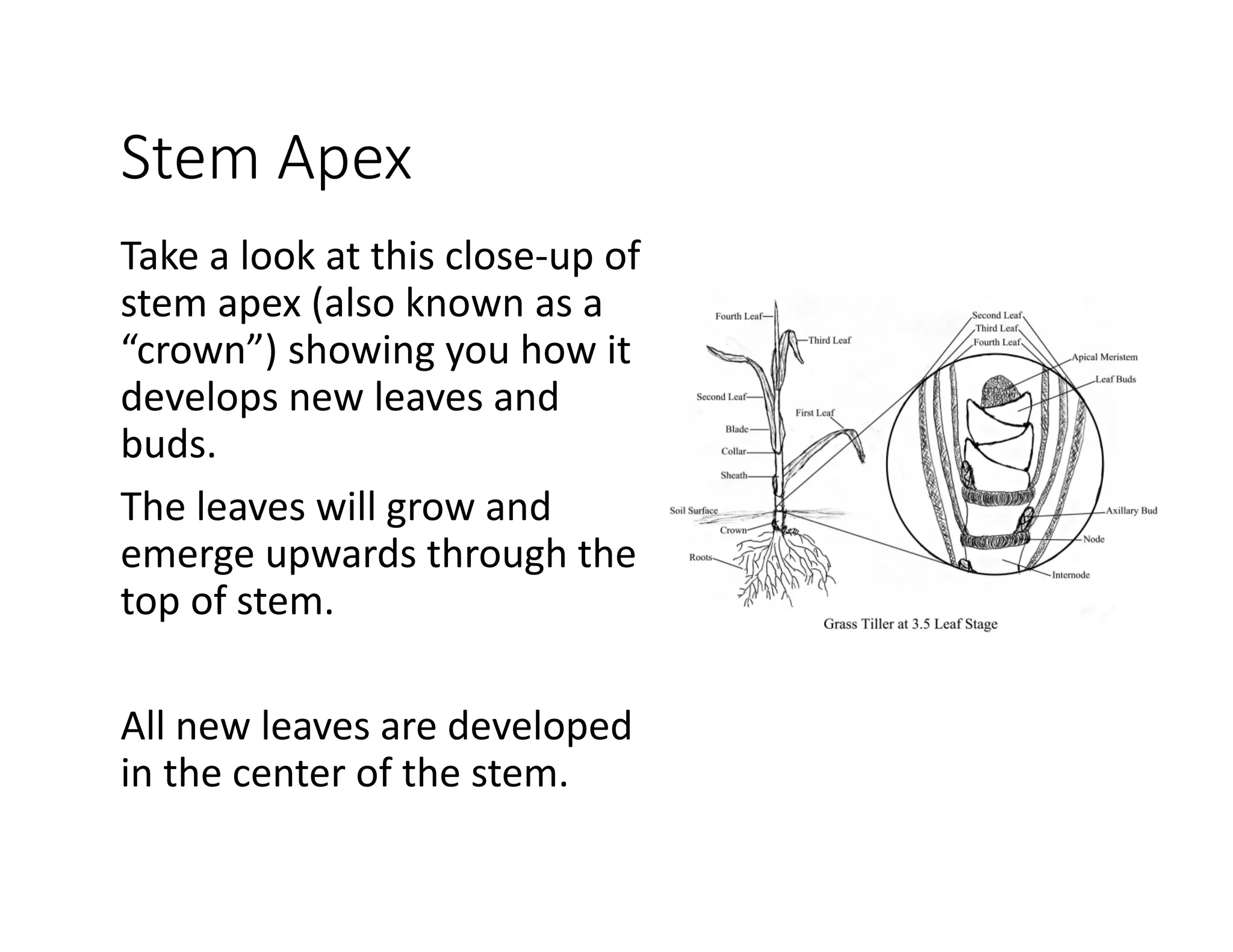
Stem Apex
Take a look at this close‐up of 
stem apex (also known as a 
“crown”) showing you how it 
develops new leaves and 
buds.  
The leaves will grow and 
emerge upwards through the 
top of stem.  
All new leaves are developed 
in the center of the stem.
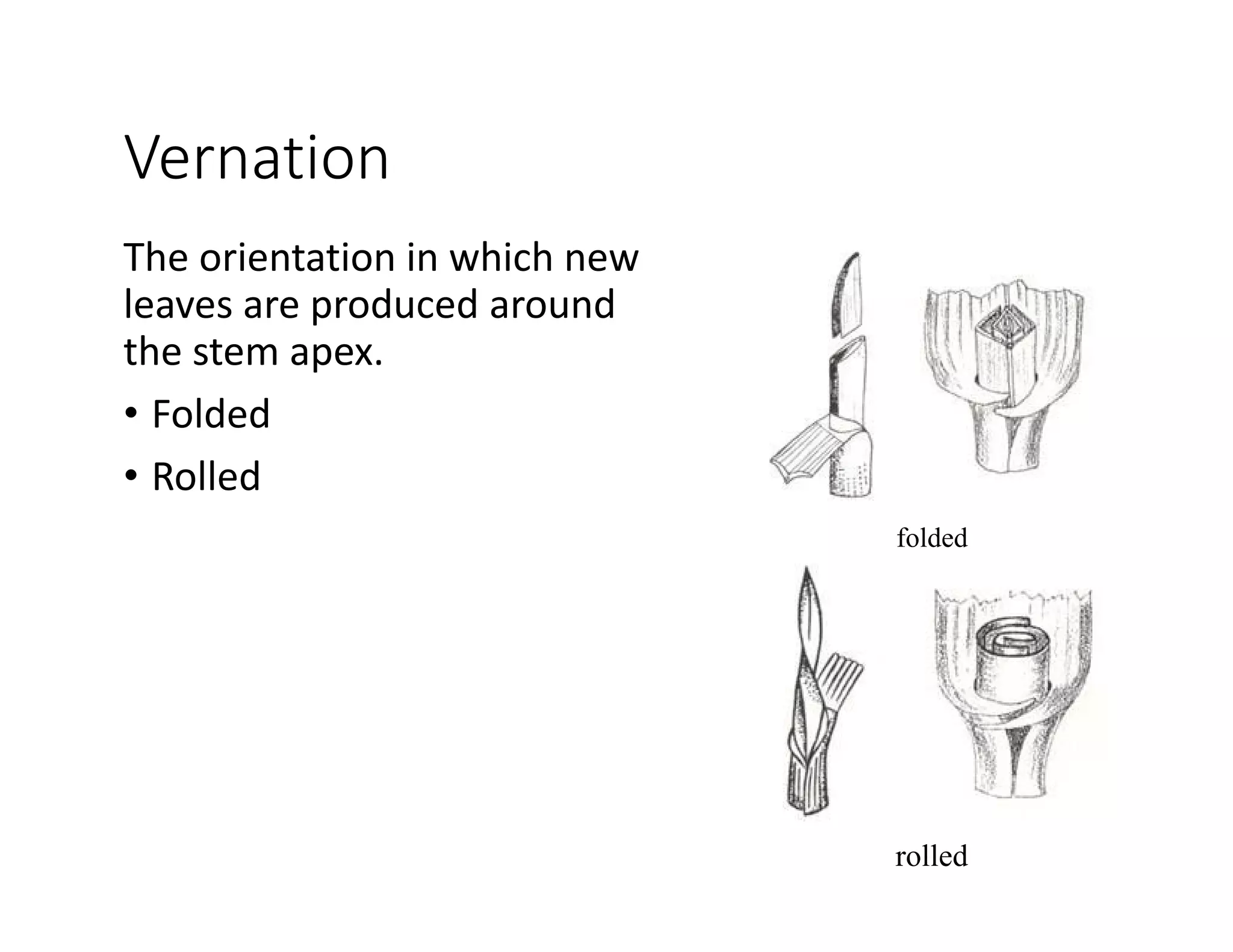
Vernation
The orientation in which new 
leaves are produced around 
the stem apex.
• Folded
• Rolled
folded
rolled

Turfgrass Anatomy