Phylum: Arthropoda
By: Asmat Babar
www.asmatbabar.blogspot.com
Isoptera
are
small,
soft-bodied,
yellowish, whitish, tan or black insects that live
in colonies in wood. Colonies consist of three
castes: workers, soldiers and swarmers.
Workers and soldiers are wingless and never
leave the colony. Swarmers, or the reproductive
forms, have dark bodies and four long, veined
wings. The front and hind wings of termites are
nearly identical in size and venation. Termites
also have beadlike antennae and thick waists
which distinguish them from ants.
The name Isoptera, derived from the
Greek "iso" meaning equal and "ptera"
meaning wings, refers to the similar size,
shape, and venation of the four wings.
Isoptera also called Isopterans or Termites


Termites are usually the most dominant
organisms
in
tropical
forest
environments. Their populations typically
range from 2000 to 4000 individuals per
square meter but may occasionally run as
high as 10,000 individuals per square
meter.
Kingdom: Animalia
Phylum: Arthropoda
Superclase: Hexapoda
Class: Insecta
Subclass: Pterygota
Infraclass: Neoptera
Order:

Isoptera




Extremely common in tropical and subtropical
climates. Generally less abundant in
temperate regions.
Isopteran are hemimetabola(egg, nymph,
adult)






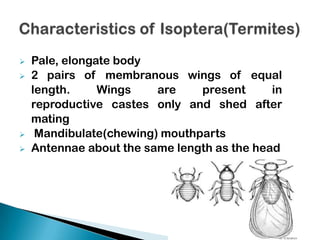
Pale, elongate body
2 pairs of membranous wings of equal
length.
Wings
are
present
in
reproductive castes only and shed after
mating
Mandibulate(chewing) mouthparts
Antennae about the same length as the head
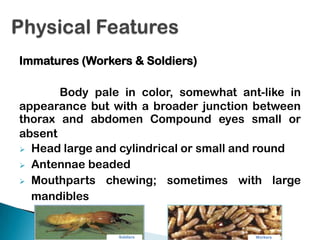
Immatures (Workers & Soldiers)
Body pale in color, somewhat ant-like in
appearance but with a broader junction between
thorax and abdomen Compound eyes small or
absent
 Head large and cylindrical or small and round
 Antennae beaded
 Mouthparts chewing; sometimes with large
mandibles

Soldiers

Workers
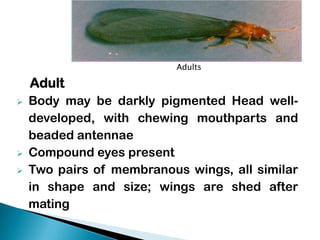
Adults

Adult





Body may be darkly pigmented Head welldeveloped, with chewing mouthparts and
beaded antennae
Compound eyes present
Two pairs of membranous wings, all similar
in shape and size; wings are shed after
mating


Termites feed on a wide variety of plant
material, which may include wood, bark,
leaves, grasses, fungi, humus or the
droppings of herbivores. Some species
forage on the surface at night collecting
grasses which they take back to be stored in
the nest.
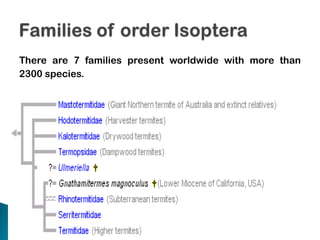
There are 7 families present worldwide with more than
2300 species.
In 7 families of order isoptera that is only 4
families are very important which are as
follows.


 Rhinotermitidae

(Subterranean termites)
 Kalotermitidae (Drywood and dampwood
termites)
 Hodotermitidae (Rottenwood termites)
 Termitidae




These insects build nests in the soil and
generally infest wood that is in contact with
the ground.
This family includes the most destructive
species


These insects nest in the wood itself and do
not require contact with the soil. Pest
species include the western drywood
termite (Incisitermes minor) and the forest
tree termite (Neotermes connexus)
Generally
found
inhabiting
moist
wood.
Contact with the soil is not a
requirement. This family includes the Pacific
dampwood
termite,
Zootermopsis

angusticollis.




This is the largest family of termites
worldwide, but all of the North American
species are relatively minor in importance.
Adults have three or four heavy veins along
the front edge of the wing, the cerci have
five or six segments and the antennae have
20 or more segments.
Termites are an important part of the community of
decomposers. They are abundant in tropical and
subtropical environments where they help break
down and recycle up to one third of the annual
production of dead wood.
Termites become
economic pests when their appetite for wood and
wood products extends to human homes, building
materials,
forests,
and
other
commercial
products. In the United States alone, annual losses
due to termite infestations are estimated at more
than 800 million dollars.

Order isoptera

  • 1.
    Phylum: Arthropoda By: AsmatBabar www.asmatbabar.blogspot.com
  • 2.
    Isoptera are small, soft-bodied, yellowish, whitish, tanor black insects that live in colonies in wood. Colonies consist of three castes: workers, soldiers and swarmers. Workers and soldiers are wingless and never leave the colony. Swarmers, or the reproductive forms, have dark bodies and four long, veined wings. The front and hind wings of termites are nearly identical in size and venation. Termites also have beadlike antennae and thick waists which distinguish them from ants.
  • 3.
    The name Isoptera,derived from the Greek "iso" meaning equal and "ptera" meaning wings, refers to the similar size, shape, and venation of the four wings. Isoptera also called Isopterans or Termites
  • 4.
     Termites are usuallythe most dominant organisms in tropical forest environments. Their populations typically range from 2000 to 4000 individuals per square meter but may occasionally run as high as 10,000 individuals per square meter.
  • 5.
    Kingdom: Animalia Phylum: Arthropoda Superclase:Hexapoda Class: Insecta Subclass: Pterygota Infraclass: Neoptera Order: Isoptera
  • 6.
      Extremely common intropical and subtropical climates. Generally less abundant in temperate regions. Isopteran are hemimetabola(egg, nymph, adult)
  • 7.
        Pale, elongate body 2pairs of membranous wings of equal length. Wings are present in reproductive castes only and shed after mating Mandibulate(chewing) mouthparts Antennae about the same length as the head
  • 8.
    Immatures (Workers &Soldiers) Body pale in color, somewhat ant-like in appearance but with a broader junction between thorax and abdomen Compound eyes small or absent  Head large and cylindrical or small and round  Antennae beaded  Mouthparts chewing; sometimes with large mandibles Soldiers Workers
  • 9.
    Adults Adult    Body may bedarkly pigmented Head welldeveloped, with chewing mouthparts and beaded antennae Compound eyes present Two pairs of membranous wings, all similar in shape and size; wings are shed after mating
  • 10.
     Termites feed ona wide variety of plant material, which may include wood, bark, leaves, grasses, fungi, humus or the droppings of herbivores. Some species forage on the surface at night collecting grasses which they take back to be stored in the nest.
  • 12.
    There are 7families present worldwide with more than 2300 species.
  • 13.
    In 7 familiesof order isoptera that is only 4 families are very important which are as follows.   Rhinotermitidae (Subterranean termites)  Kalotermitidae (Drywood and dampwood termites)  Hodotermitidae (Rottenwood termites)  Termitidae
  • 14.
      These insects buildnests in the soil and generally infest wood that is in contact with the ground. This family includes the most destructive species
  • 15.
     These insects nestin the wood itself and do not require contact with the soil. Pest species include the western drywood termite (Incisitermes minor) and the forest tree termite (Neotermes connexus)
  • 16.
    Generally found inhabiting moist wood. Contact with thesoil is not a requirement. This family includes the Pacific dampwood termite, Zootermopsis angusticollis.
  • 17.
      This is thelargest family of termites worldwide, but all of the North American species are relatively minor in importance. Adults have three or four heavy veins along the front edge of the wing, the cerci have five or six segments and the antennae have 20 or more segments.
  • 18.
    Termites are animportant part of the community of decomposers. They are abundant in tropical and subtropical environments where they help break down and recycle up to one third of the annual production of dead wood. Termites become economic pests when their appetite for wood and wood products extends to human homes, building materials, forests, and other commercial products. In the United States alone, annual losses due to termite infestations are estimated at more than 800 million dollars.