Ephemeroptera
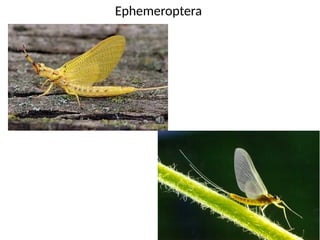
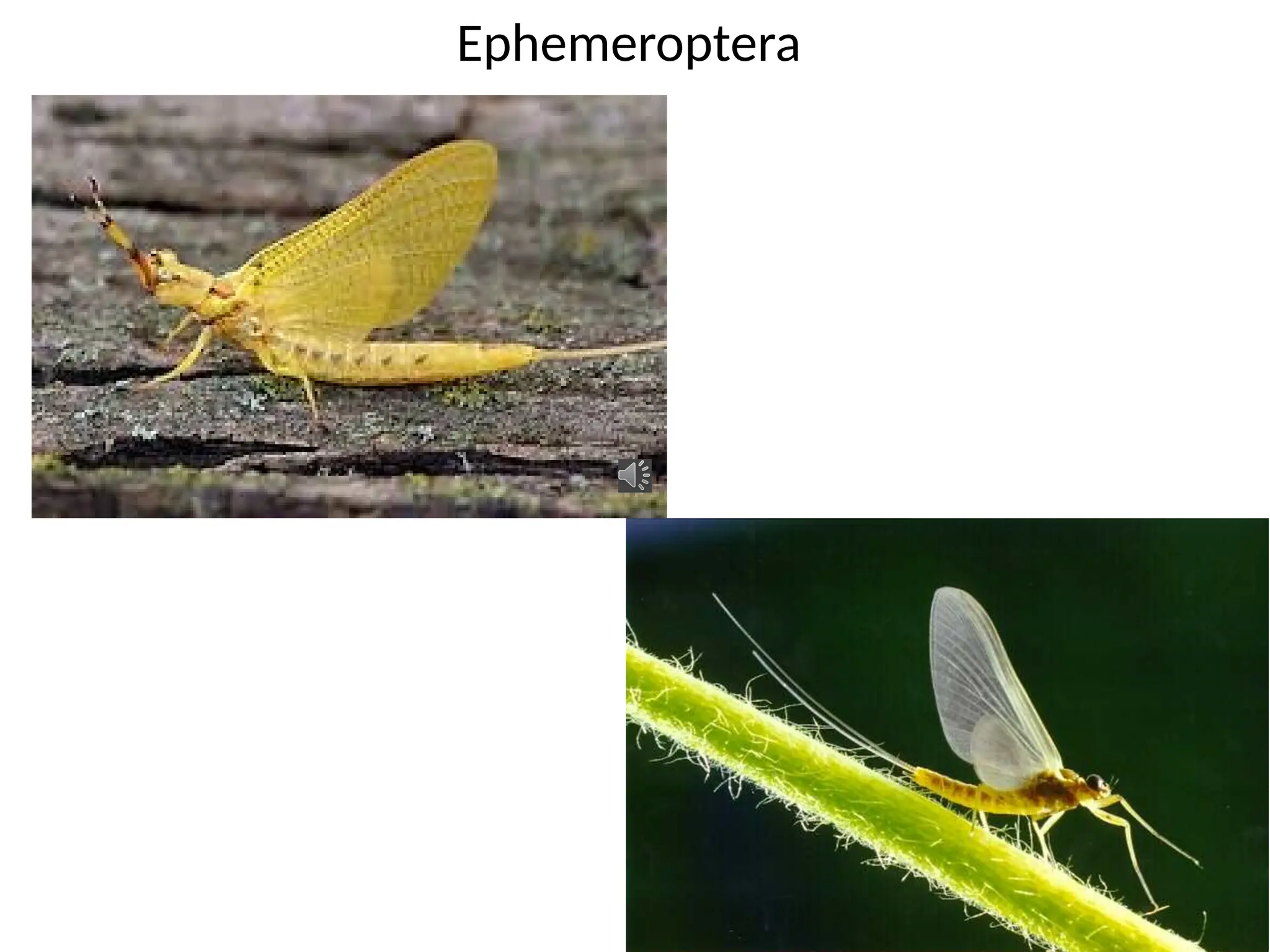
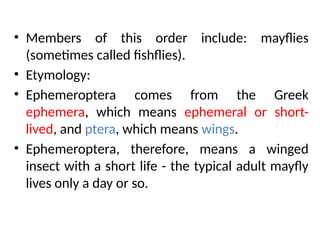
• Members of this order include: mayflies
(sometimes called fishflies).
• Etymology:
• Ephemeroptera comes from the Greek
ephemera, which means ephemeral or short-
lived, and ptera, which means wings.
• Ephemeroptera, therefore, means a winged
insect with a short life - the typical adult mayfly
lives only a day or so.
• Mayflies are small to medium-sized, elongate, very soft-
bodied insects with two or three long, threadlike tails.
• They are common near ponds and streams.
• The adults have membranous wings with numerous veins.
• The front wings are usually large and triangular, and the
hind wings are small and rounded.
• Some species have the front wings more elongate and the
hind wings very small or absent.
• The wings at rest are held together above the body.
• The antennae are small, bristle like, and inconspicuous.
• The immature stages are aquatic, and the metamorphosis
is simple.
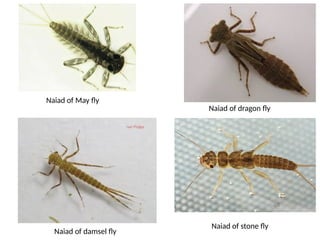
• May fly nymphs (Naiads - any of a class of nymphs
found in rivers and springs) are found in a variety of
aquatic habitats.
• Some are streamlined in form and very active,
• And others are burrowing in habit.
• They can usually be recognized by the leaf like or
plumose gills along the sides of the abdomen and the
three (rarely two) longtails.
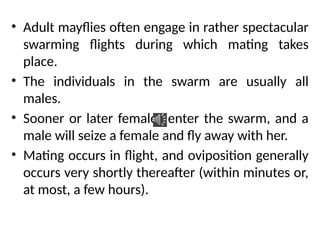
• Stonefly nymphs are similar, but have only two tails
(the cerci), and the gills are on the thorax (only rarely
on the abdomen) and are not leaf like.
• Mayfly nymphs feed chiefly on algae and detritus.
• Many are most active at night.
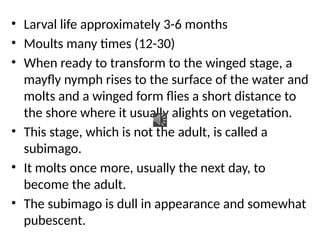
Naiad of dragon fly
Naiad of May fly
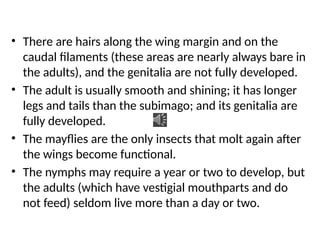
Naiad of damsel fly
Naiad of stone fly
• Larval life approximately 3-6 months
• Moults many times (12-30)
• When ready to transform to the winged stage, a
mayfly nymph rises to the surface of the water and
molts and a winged form flies a short distance to
the shore where it usually alights on vegetation.
• This stage, which is not the adult, is called a
subimago.
• It molts once more, usually the next day, to
become the adult.
• The subimago is dull in appearance and somewhat
pubescent.
• There are hairs along the wing margin and on the
caudal filaments (these areas are nearly always bare in
the adults), and the genitalia are not fully developed.
• The adult is usually smooth and shining; it has longer
legs and tails than the subimago; and its genitalia are
fully developed.
• The mayflies are the only insects that molt again after
the wings become functional.
• The nymphs may require a year or two to develop, but
the adults (which have vestigial mouthparts and do
not feed) seldom live more than a day or two.
• Adult mayflies often engage in rather spectacular
swarming flights during which mating takes
place.
• The individuals in the swarm are usually all
males.
• Sooner or later females enter the swarm, and a
male will seize a female and fly away with her.
• Mating occurs in flight, and oviposition generally
occurs very shortly thereafter (within minutes or,
at most, a few hours).
• The eggs are laid on the surface of the water or are attached
to objects in the water.
• Eggs hatch in a few days or in 3-9 months depending on the
water temperature
• In cases where the eggs are laid on the surface of the water,
they may simply be washed off the end of the abdomen a few
at a time, or they may all be laid in one clump.
• Each species has characteristic egg-Iaying habits.
• A few species are ovoviviparous.
• Feed on detritus, algae, macrophytes
• Few carnivores
• Usually change diet as size of insect increase
• The chief economic importance of mayflies
lies in their value as food for fish.
• Both adults and nymphs are an important
food of many freshwater fish, and many
artificial flies used by fishermen are modelled
after these insects.
• Mayflies also serve as food for many other
animals, including birds, amphibians, spiders, and
many predaceous insects.
• Most species of mayflies in the nymphal stage
are restricted to particular types of habitats.
• Hence, the mayfly fauna of an aquatic habitat
may serve as an indicator of the ecological
characteristics (including the degree of pollution)
of that habitat.
• The head.
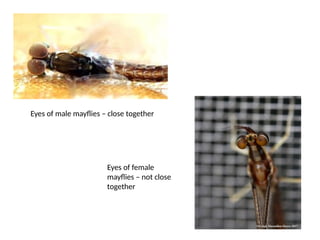
• The compound eyes often differ in the two sexes, being
generally larger and closer together in the male, and
smaller and farther apart in the female.
• In most of the smaller species, such as the Caenidae,
the eyes are small and widely separated in both sexes.
• The eyes of the male are often larger or have upper
facets that are a different color from the other facets.
• The eyes of the female are usually uniform in color and
facet size.
• In the Baetidae and some Leptophlebiidae, the upper
facets are more or less on stalks (such eyes are
described asturbinate).
Eyes of male mayflies – close together
Eyes of female
mayflies – not close
together

Ephemeroptera new biology and developmental aspects

  • 1.
  • 2.
    • Members ofthis order include: mayflies (sometimes called fishflies). • Etymology: • Ephemeroptera comes from the Greek ephemera, which means ephemeral or short- lived, and ptera, which means wings. • Ephemeroptera, therefore, means a winged insect with a short life - the typical adult mayfly lives only a day or so.
  • 3.
    • Mayflies aresmall to medium-sized, elongate, very soft- bodied insects with two or three long, threadlike tails. • They are common near ponds and streams. • The adults have membranous wings with numerous veins. • The front wings are usually large and triangular, and the hind wings are small and rounded. • Some species have the front wings more elongate and the hind wings very small or absent. • The wings at rest are held together above the body. • The antennae are small, bristle like, and inconspicuous. • The immature stages are aquatic, and the metamorphosis is simple.
  • 4.
    • May flynymphs (Naiads - any of a class of nymphs found in rivers and springs) are found in a variety of aquatic habitats. • Some are streamlined in form and very active, • And others are burrowing in habit. • They can usually be recognized by the leaf like or plumose gills along the sides of the abdomen and the three (rarely two) longtails. • Stonefly nymphs are similar, but have only two tails (the cerci), and the gills are on the thorax (only rarely on the abdomen) and are not leaf like. • Mayfly nymphs feed chiefly on algae and detritus. • Many are most active at night.
  • 6.
    Naiad of dragonfly Naiad of May fly Naiad of damsel fly Naiad of stone fly
  • 7.
    • Larval lifeapproximately 3-6 months • Moults many times (12-30) • When ready to transform to the winged stage, a mayfly nymph rises to the surface of the water and molts and a winged form flies a short distance to the shore where it usually alights on vegetation. • This stage, which is not the adult, is called a subimago. • It molts once more, usually the next day, to become the adult. • The subimago is dull in appearance and somewhat pubescent.
  • 8.
    • There arehairs along the wing margin and on the caudal filaments (these areas are nearly always bare in the adults), and the genitalia are not fully developed. • The adult is usually smooth and shining; it has longer legs and tails than the subimago; and its genitalia are fully developed. • The mayflies are the only insects that molt again after the wings become functional. • The nymphs may require a year or two to develop, but the adults (which have vestigial mouthparts and do not feed) seldom live more than a day or two.
  • 9.
    • Adult mayfliesoften engage in rather spectacular swarming flights during which mating takes place. • The individuals in the swarm are usually all males. • Sooner or later females enter the swarm, and a male will seize a female and fly away with her. • Mating occurs in flight, and oviposition generally occurs very shortly thereafter (within minutes or, at most, a few hours).
  • 10.
    • The eggsare laid on the surface of the water or are attached to objects in the water. • Eggs hatch in a few days or in 3-9 months depending on the water temperature • In cases where the eggs are laid on the surface of the water, they may simply be washed off the end of the abdomen a few at a time, or they may all be laid in one clump. • Each species has characteristic egg-Iaying habits. • A few species are ovoviviparous.
  • 11.
    • Feed ondetritus, algae, macrophytes • Few carnivores • Usually change diet as size of insect increase • The chief economic importance of mayflies lies in their value as food for fish. • Both adults and nymphs are an important food of many freshwater fish, and many artificial flies used by fishermen are modelled after these insects.
  • 12.
    • Mayflies alsoserve as food for many other animals, including birds, amphibians, spiders, and many predaceous insects. • Most species of mayflies in the nymphal stage are restricted to particular types of habitats. • Hence, the mayfly fauna of an aquatic habitat may serve as an indicator of the ecological characteristics (including the degree of pollution) of that habitat.
  • 13.
    • The head. •The compound eyes often differ in the two sexes, being generally larger and closer together in the male, and smaller and farther apart in the female. • In most of the smaller species, such as the Caenidae, the eyes are small and widely separated in both sexes. • The eyes of the male are often larger or have upper facets that are a different color from the other facets. • The eyes of the female are usually uniform in color and facet size. • In the Baetidae and some Leptophlebiidae, the upper facets are more or less on stalks (such eyes are described asturbinate).
  • 14.
    Eyes of malemayflies – close together Eyes of female mayflies – not close together