Presented By,
Rupak Subhra Sarkar
Presentation
topic
content
 Introduction
 Structure of Insect Wings
 Insect Wing Areas or Regions
 Modifications of Insect Wings
 Functions of Insect Wings
introduction
 Insect wings are adult outgrowths of the insect exoskeleton that enable insects to fly.
 They are found on the second and third thoracic segments (the Mesothorax and
Metathorax).
 The tow pairs are often referred as the Forewings and Hindwings.
 The wings are strengthened by a number of longitudinal veins.
Structure of insect wings
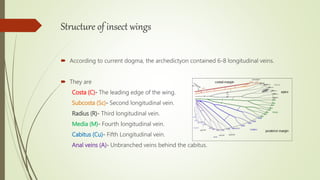
 According to current dogma, the archedictyon contained 6-8 longitudinal veins.
 They are
Costa (C)- The leading edge of the wing.
Subcosta (Sc)- Second longitudinal vein.
Radius (R)- Third longitudinal vein.
Media (M)- Fourth longitudinal vein.
Cabitus (Cu)- Fifth Longitudinal vein.
Anal veins (A)- Unbranched veins behind the cabitus.
insect wing areas or regions
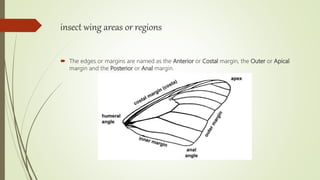
 The edges or margins are named as the Anterior or Costal margin, the Outer or Apical
margin and the Posterior or Anal margin.
Modifications of insect wings
 Tegmina- Wings are leathery or parchment like and protective in function.
E.g. Forewings of Grasshopper and Cockroach.
Modifications of insect wings
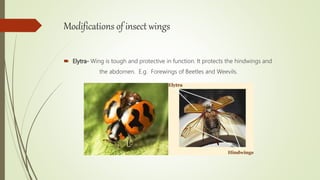
 Elytra- Wing is tough and protective in function. It protects the hindwings and
the abdomen. E.g. Forewings of Beetles and Weevils.
Modifications of insect wings
 Hemelytra- The basal half of the wing is thick and leathery. The distal half is
membranous. E.g. Red Cotton Bug.
Modifications of insect wings
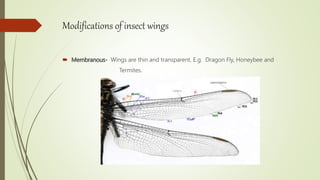
 Membranous- Wings are thin and transparent. E.g. Dragon Fly, Honeybee and
Termites.
Modifications of insect wings
 Scaly- Wings are covered with unicellular scales.
E.g. Moths and Butterfly.
Modifications of insect wings
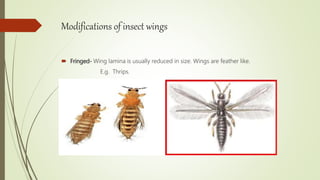
 Fringed- Wing lamina is usually reduced in size. Wings are feather like.
E.g. Thrips.
Modifications of insect wings
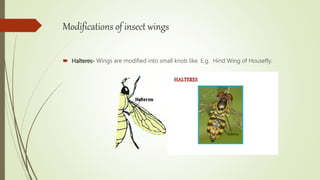
 Halteres- Wings are modified into small knob like. E.g. Hind Wing of Housefly.
Modifications of insect wings
 Pseudo Halteres- Similar to Halteres but different in Location.
E.g. Fore wings of Stripsiptera.
Functions of insect wings
 Wings in living insects serve a number of functions, including active flying, gliding,
parachuting.
 It also helps in altitude stability while jumping.
 Thermoregulation.
Insect wings &  their modifications

Insect wings & their modifications

  • 1.
    Presented By, Rupak SubhraSarkar Presentation topic
  • 2.
    content  Introduction  Structureof Insect Wings  Insect Wing Areas or Regions  Modifications of Insect Wings  Functions of Insect Wings
  • 3.
    introduction  Insect wingsare adult outgrowths of the insect exoskeleton that enable insects to fly.  They are found on the second and third thoracic segments (the Mesothorax and Metathorax).  The tow pairs are often referred as the Forewings and Hindwings.  The wings are strengthened by a number of longitudinal veins.
  • 4.
    Structure of insectwings  According to current dogma, the archedictyon contained 6-8 longitudinal veins.  They are Costa (C)- The leading edge of the wing. Subcosta (Sc)- Second longitudinal vein. Radius (R)- Third longitudinal vein. Media (M)- Fourth longitudinal vein. Cabitus (Cu)- Fifth Longitudinal vein. Anal veins (A)- Unbranched veins behind the cabitus.
  • 5.
    insect wing areasor regions  The edges or margins are named as the Anterior or Costal margin, the Outer or Apical margin and the Posterior or Anal margin.
  • 6.
    Modifications of insectwings  Tegmina- Wings are leathery or parchment like and protective in function. E.g. Forewings of Grasshopper and Cockroach.
  • 7.
    Modifications of insectwings  Elytra- Wing is tough and protective in function. It protects the hindwings and the abdomen. E.g. Forewings of Beetles and Weevils.
  • 8.
    Modifications of insectwings  Hemelytra- The basal half of the wing is thick and leathery. The distal half is membranous. E.g. Red Cotton Bug.
  • 9.
    Modifications of insectwings  Membranous- Wings are thin and transparent. E.g. Dragon Fly, Honeybee and Termites.
  • 10.
    Modifications of insectwings  Scaly- Wings are covered with unicellular scales. E.g. Moths and Butterfly.
  • 11.
    Modifications of insectwings  Fringed- Wing lamina is usually reduced in size. Wings are feather like. E.g. Thrips.
  • 12.
    Modifications of insectwings  Halteres- Wings are modified into small knob like. E.g. Hind Wing of Housefly.
  • 13.
    Modifications of insectwings  Pseudo Halteres- Similar to Halteres but different in Location. E.g. Fore wings of Stripsiptera.
  • 14.
    Functions of insectwings  Wings in living insects serve a number of functions, including active flying, gliding, parachuting.  It also helps in altitude stability while jumping.  Thermoregulation.