Input Modeling
Chapter 10 (2nd
ed.)
4 Steps to Input Modeling
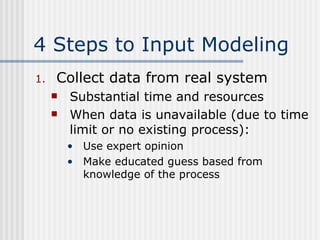
1. Collect data from real system
 Substantial time and resources
 When data is unavailable (due to time
limit or no existing process):
• Use expert opinion
• Make educated guess based from
knowledge of the process
4 Steps to Input Modeling
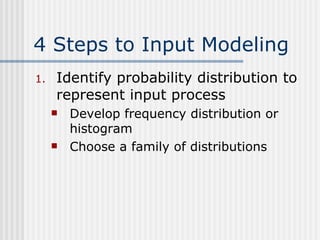
1. Identify probability distribution to
represent input process
 Develop frequency distribution or
histogram
 Choose a family of distributions
4 Steps to Input Modeling
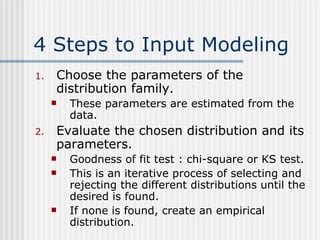
1. Choose the parameters of the
distribution family.
 These parameters are estimated from the
data.
2. Evaluate the chosen distribution and its
parameters.
 Goodness of fit test : chi-square or KS test.
 This is an iterative process of selecting and
rejecting the different distributions until the
desired is found.
 If none is found, create an empirical
distribution.
Data Collection Problems
 Inter-arrival times are not
homogenous
 Service times which are dependent
on other factors
 Service time termination
 Machine breakdowns
No DataNo Data
Old DataOld Data
Missing DataMissing Data
GuesstimatesGuesstimates
Erroneous DataErroneous Data
No resourceNo resource
Data Problems with
Simulation
SimplifyingSimplifying
assumptionsassumptions
Using AveragesUsing Averages
OutliersOutliers
Optimistic DataOptimistic Data
PoliticsPolitics
Bad data equals bad modelsBad data equals bad models
The Best models fail under badThe Best models fail under bad
datadata
Successful simulation is unlikelySuccessful simulation is unlikely
with bad datawith bad data
Consequence of Data Problems
Always question dataAlways question data
Electronic data does mean goodElectronic data does mean good
data.data.
Know the sourceKnow the source
Allocate sufficient time to collectAllocate sufficient time to collect
and analyze dataand analyze data
Guidelines in Data
Collection
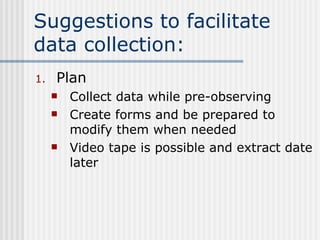
Suggestions to facilitate
data collection:
1. Plan
 Collect data while pre-observing
 Create forms and be prepared to
modify them when needed
 Video tape is possible and extract date
later
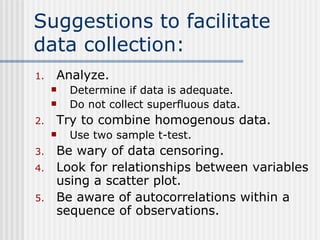
Suggestions to facilitate
data collection:
1. Analyze.
 Determine if data is adequate.
 Do not collect superfluous data.
2. Try to combine homogenous data.
 Use two sample t-test.
3. Be wary of data censoring.
4. Look for relationships between variables
using a scatter plot.
5. Be aware of autocorrelations within a
sequence of observations.

Input modeling

  • 1.
  • 2.
    4 Steps toInput Modeling 1. Collect data from real system  Substantial time and resources  When data is unavailable (due to time limit or no existing process): • Use expert opinion • Make educated guess based from knowledge of the process
  • 3.
    4 Steps toInput Modeling 1. Identify probability distribution to represent input process  Develop frequency distribution or histogram  Choose a family of distributions
  • 4.
    4 Steps toInput Modeling 1. Choose the parameters of the distribution family.  These parameters are estimated from the data. 2. Evaluate the chosen distribution and its parameters.  Goodness of fit test : chi-square or KS test.  This is an iterative process of selecting and rejecting the different distributions until the desired is found.  If none is found, create an empirical distribution.
  • 5.
    Data Collection Problems Inter-arrival times are not homogenous  Service times which are dependent on other factors  Service time termination  Machine breakdowns
  • 6.
    No DataNo Data OldDataOld Data Missing DataMissing Data GuesstimatesGuesstimates Erroneous DataErroneous Data No resourceNo resource Data Problems with Simulation SimplifyingSimplifying assumptionsassumptions Using AveragesUsing Averages OutliersOutliers Optimistic DataOptimistic Data PoliticsPolitics
  • 7.
    Bad data equalsbad modelsBad data equals bad models The Best models fail under badThe Best models fail under bad datadata Successful simulation is unlikelySuccessful simulation is unlikely with bad datawith bad data Consequence of Data Problems
  • 8.
    Always question dataAlwaysquestion data Electronic data does mean goodElectronic data does mean good data.data. Know the sourceKnow the source Allocate sufficient time to collectAllocate sufficient time to collect and analyze dataand analyze data Guidelines in Data Collection
  • 9.
    Suggestions to facilitate datacollection: 1. Plan  Collect data while pre-observing  Create forms and be prepared to modify them when needed  Video tape is possible and extract date later
  • 10.
    Suggestions to facilitate datacollection: 1. Analyze.  Determine if data is adequate.  Do not collect superfluous data. 2. Try to combine homogenous data.  Use two sample t-test. 3. Be wary of data censoring. 4. Look for relationships between variables using a scatter plot. 5. Be aware of autocorrelations within a sequence of observations.