Discrete and Continuous Simulation Marcio Carvalho Luis Luna PAD 824 – Advanced Topics in System Dynamics Fall 2002
What is it all about? Numerical simulation approach Level of Aggregation Policies versus Decisions Aggregate versus Individuals Aggregate Dynamics versus Problem solving Difficulty of the formulation Nature of the system/problem Nature of the question Nature of preferred lenses
Basic concepts Static or dynamic models Stochastic, deterministic or chaotic models Discrete or continuous change/models Aggregates or Individuals
1. Static or Dynamic models Dynamic : State variables change over time (System Dynamics, Discrete Event, Agent-Based, Econometrics?) Static : Snapshot at a single point in time (Monte Carlo simulation, optimization models, etc.)
2. Deterministic, Stochastic or Chaotic Deterministic model  is one whose behavior is entire predictable. The system is perfectly understood, then it is possible to predict precisely what will happen. Stochastic model  is one whose behavior cannot be entirely predicted. Chaotic model  is a deterministic model with a behavior that cannot be entirely predicted
3. Discrete or Continuous models Discrete model : the state variables change only at a countable number of points in time. These points in time are the ones at which the event occurs/change in state. Continuous : the state variables change in a continuous way, and not abruptly from one state to another (infinite number of states).
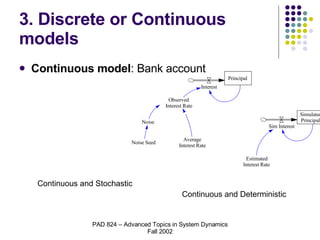
3. Discrete or Continuous models Continuous model : Bank account Continuous and Stochastic Continuous and Deterministic
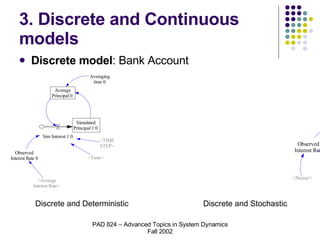
3. Discrete and Continuous models Discrete model : Bank Account Discrete and Stochastic Discrete and Deterministic
4. Aggregate and Individual models Aggregate model : we look for a more distant position. Modeler is more distant. Policy model. This view tends to be more deterministic. Individual model : modeler is taking a closer look of the individual decisions. This view tends to be more stochastic.
The “Soup” of models Waiting in line Waiting in line 1B Busy clerk Waiting in line (Stella version) Mortgages (ARENA model)
Time handling 2 approaches: Time-slicing : move forward in our models in equal time intervals.  Next-event technique : the model is only examined and updated when it is known that a state (or behavior) changes. Time moves from event to event.
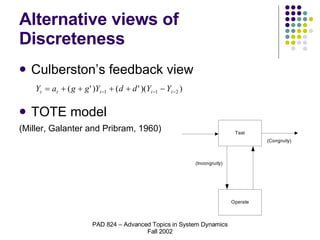
Alternative views of Discreteness Culberston’s feedback view TOTE model (Miller, Galanter and Pribram, 1960)
Peoples thoughts “The system contains a mixture of discrete events, discrete and different magnitudes, and continuous processes. Such mixed processes have generally been difficult to represent in continuous simulation models, and the common recourse has been a very high level of aggregation which has exposed the model to serious inaccuracy” (Coyle, 1982)
Peoples thoughts “Only from a more distant perspective in which events and decisions are deliberately blurred into patterns of behavior and policy structure will the notion that ‘behavior is a consequence of feedback structure’ arise and be perceived to yield powerful insights.” (Richardson, 1991)
So, is it all about these? Numerical simulation approach Level of Aggregation Policies versus Decisions Aggregate versus Individuals Problem solving versus Aggregate Dynamics Difficulty of the formulation Nature of the system/problem Nature of the question Nature of preferred lenses

Discrete And Continuous Simulation

  • 1.
    Discrete and ContinuousSimulation Marcio Carvalho Luis Luna PAD 824 – Advanced Topics in System Dynamics Fall 2002
  • 2.
    What is itall about? Numerical simulation approach Level of Aggregation Policies versus Decisions Aggregate versus Individuals Aggregate Dynamics versus Problem solving Difficulty of the formulation Nature of the system/problem Nature of the question Nature of preferred lenses
  • 3.
    Basic concepts Staticor dynamic models Stochastic, deterministic or chaotic models Discrete or continuous change/models Aggregates or Individuals
  • 4.
    1. Static orDynamic models Dynamic : State variables change over time (System Dynamics, Discrete Event, Agent-Based, Econometrics?) Static : Snapshot at a single point in time (Monte Carlo simulation, optimization models, etc.)
  • 5.
    2. Deterministic, Stochasticor Chaotic Deterministic model is one whose behavior is entire predictable. The system is perfectly understood, then it is possible to predict precisely what will happen. Stochastic model is one whose behavior cannot be entirely predicted. Chaotic model is a deterministic model with a behavior that cannot be entirely predicted
  • 6.
    3. Discrete orContinuous models Discrete model : the state variables change only at a countable number of points in time. These points in time are the ones at which the event occurs/change in state. Continuous : the state variables change in a continuous way, and not abruptly from one state to another (infinite number of states).
  • 7.
    3. Discrete orContinuous models Continuous model : Bank account Continuous and Stochastic Continuous and Deterministic
  • 8.
    3. Discrete andContinuous models Discrete model : Bank Account Discrete and Stochastic Discrete and Deterministic
  • 9.
    4. Aggregate andIndividual models Aggregate model : we look for a more distant position. Modeler is more distant. Policy model. This view tends to be more deterministic. Individual model : modeler is taking a closer look of the individual decisions. This view tends to be more stochastic.
  • 10.
    The “Soup” ofmodels Waiting in line Waiting in line 1B Busy clerk Waiting in line (Stella version) Mortgages (ARENA model)
  • 11.
    Time handling 2approaches: Time-slicing : move forward in our models in equal time intervals. Next-event technique : the model is only examined and updated when it is known that a state (or behavior) changes. Time moves from event to event.
  • 12.
    Alternative views ofDiscreteness Culberston’s feedback view TOTE model (Miller, Galanter and Pribram, 1960)
  • 13.
    Peoples thoughts “Thesystem contains a mixture of discrete events, discrete and different magnitudes, and continuous processes. Such mixed processes have generally been difficult to represent in continuous simulation models, and the common recourse has been a very high level of aggregation which has exposed the model to serious inaccuracy” (Coyle, 1982)
  • 14.
    Peoples thoughts “Onlyfrom a more distant perspective in which events and decisions are deliberately blurred into patterns of behavior and policy structure will the notion that ‘behavior is a consequence of feedback structure’ arise and be perceived to yield powerful insights.” (Richardson, 1991)
  • 15.
    So, is itall about these? Numerical simulation approach Level of Aggregation Policies versus Decisions Aggregate versus Individuals Problem solving versus Aggregate Dynamics Difficulty of the formulation Nature of the system/problem Nature of the question Nature of preferred lenses