Markov Random Field
Explained from the View of 
Probabilistic Graphical Models


SUPPLEMENTS FOR 
BAYESIAN NETWORKS COURSE
YUAN‐KAI WANG, 2011/05/05
                                 1
Goal of This Unit
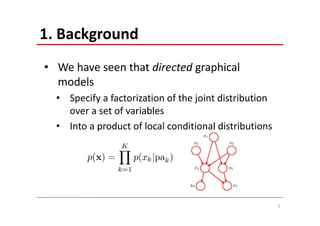
• We have seen that directed graphical models 
  specify a factorization of the joint distribution 
  over a set of variables into a product of local 
  conditional distributions
• We turn now to the second major class of 
  graphical models that are described by 
  undirected graphs and that again specify both 
  a factorization and a set of conditional 
  independence relations.
• We will talk Markov Random Field (MRF).
  •   No inference algorithms
  •   But more on modeling and energy function
                                                       2
Self‐Study Reference
• Source of this unit
  •   Section 8.3 Markov Random Fields, Pattern 
      Recognition and Machine Learning, C. M. Bishop, 
      2006.
• Background of this unit
  •   Chapter 8 Graphical Models, Pattern Recognition 
      and Machine Learning, C. M. Bishop, 2006.
  •   Probabilistic Graphical Models, Yuan‐Kai Wang’s 
      Lecture Notes for Bayesian Networks Courses, 
      2011.
                                                         3
Contents
1.   Background
2.   Conditional Independence Property
3.   Factorization Property
4.   Example: Image De‐noising
5.   Relation to Directed Graphs


                                         4
1. Background
• We have seen that directed graphical 
  models
  • Specify a factorization of the joint distribution 
    over a set of variables
  • Into a product of local conditional distributions


                                                         5
Bayesian Networks
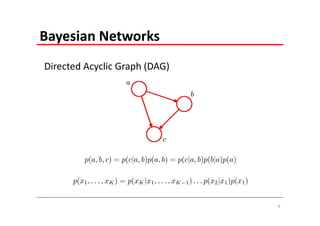
Directed Acyclic Graph (DAG)


                               6
Bayesian Networks


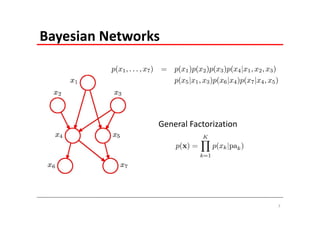
                General Factorization


                                        7
What Is Markov Random Field (MRF)
• A Markov random field (MRF) has a set of 
  •   Nodes
      •   Each node corresponds to a variable or group of 
          variables
  •   Links
      •   Each connects a pair of nodes. 
• The links are undirected
  •   They do not carry arrows
• MRF is also known as
  •   Markov network, or                    (Kindermann and Snell, 1980)
  •   Undirected graphical model

                                                                       8
Why Use MRF for Computer Vision
•   Image de‐noising
•   Image de‐blurring
•   Image segmentation
•   Image super‐resolution


                                  9
2. Conditional Independence Property

• In the case of directed graphs, we can test 
  whether a conditional independence (CI) 
  property holds by applying a graphical test 
  called d‐separation.
  • This involved testing whether or not the paths 
    connecting two sets of nodes were ‘blocked’.
• The CI definition will not apply to MRF and 
  undirected graphical models (UGMs).
  • But we will find alternative semantics of CI 
    property for MRF and UGMs.
                                                      10
CI Definition for UGM
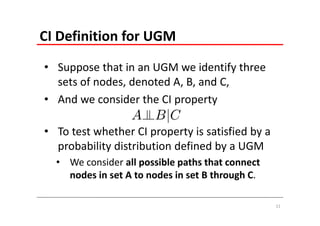
• Suppose that in an UGM we identify three 
  sets of nodes, denoted A, B, and C, 
• And we consider the CI property

• To test whether CI property is satisfied by a 
  probability distribution defined by a UGM
  • We consider all possible paths that connect 
    nodes in set A to nodes in set B through C.

                                                   11
An Example of CI
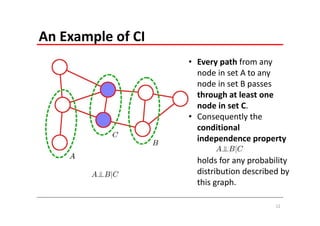
                   • Every path from any 
                     node in set A to any 
                     node in set B passes 
                     through at least one 
                     node in set C. 
                   • Consequently the 
                     conditional 
                     independence property 

                     holds for any probability 
                     distribution described by 
                     this graph.

                                          12
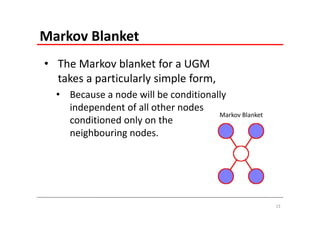
Markov Blanket
• The Markov blanket for a UGM 
  takes a particularly simple form,
  • Because a node will be conditionally 
    independent of all other nodes 
                                      Markov Blanket
    conditioned only on the 
    neighbouring nodes.


                                                       13
3. Factorization Property
• It is a factorization rule for UGM 
  corresponding to the conditional 
  independence test.
• What is factorization?
  • Expressing the joint distribution p(x) as a 
    product of functions defined over sets of 
    variables that are local to the graph.
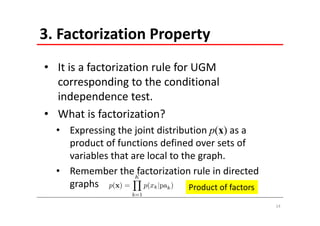
  • Remember the factorization rule in directed 
    graphs                        Product of factors
                                                       14
The Factorization Rule – Two nodes
• Consider two nodes xi and xj that are not 
  connected by a link
  • Then these variables must be conditionally 
    independent given all other nodes in the graph.
    •    There is no direct path between the two nodes.
    •    And all other paths pass through nodes that are 
         observed, and hence those paths are blocked. 
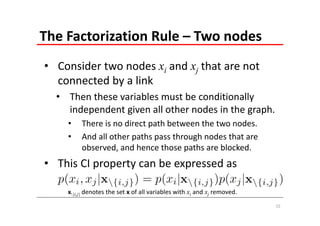
• This CI property can be expressed as

    x{i,j} denotes the set x of all variables with xi and xj removed. 
                                                                          15
The Factorization Rule – All Nodes 
• Extend the factorization of two nodes to 
  the joint distribution p(x) of all nodes 
  • It must be the product of a set of factors
  • Each factor has some nodes Xc={xi … xj} that do 
    not appear in other factors 
    •   In order for the CI property to hold for all possible 
        distributions belonging to the graph.


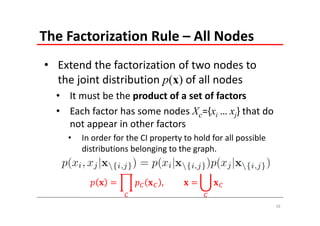
                               ,     	

                                                                 16
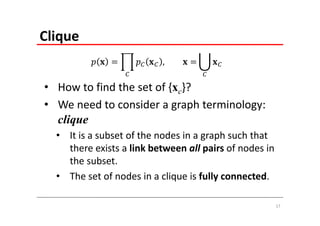
Clique
                           ,

• How to find the set of {xc}?
• We need to consider a graph terminology: 
  clique
  • It is a subset of the nodes in a graph such that 
    there exists a link between all pairs of nodes in 
    the subset.
  • The set of nodes in a clique is fully connected.

                                                     17
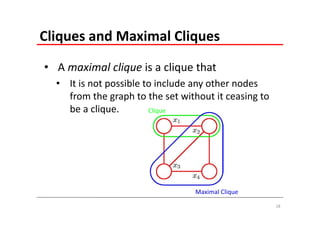
Cliques and Maximal Cliques
• A maximal clique is a clique that 
  • It is not possible to include any other nodes 
    from the graph to the set without it ceasing to 
    be a clique.        Clique


                                  Maximal Clique
                                                       18
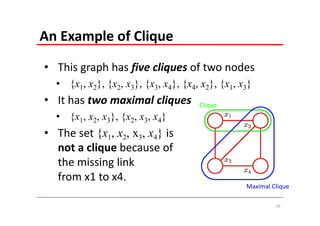
An Example of Clique
• This graph has five cliques of two nodes
  • {x1, x2}, {x2, x3}, {x3, x4}, {x4, x2}, {x1, x3}
• It has two maximal cliques          Clique
  • {x1, x2, x3}, {x2, x3, x4}
• The set {x1, x2, x3, x4} is 
  not a clique because of 
  the missing link
  from x1 to x4.
                                                  Maximal Clique

                                                           19
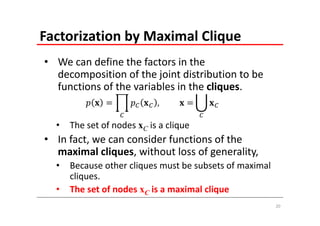
Factorization by Maximal Clique
• We can define the factors in the 
  decomposition of the joint distribution to be 
  functions of the variables in the cliques.
                            ,    	

  •   The set of nodes xC is a clique
• In fact, we can consider functions of the 
  maximal cliques, without loss of generality,
  •   Because other cliques must be subsets of maximal 
      cliques.
  •   The set of nodes xC is a maximal clique
                                                          20
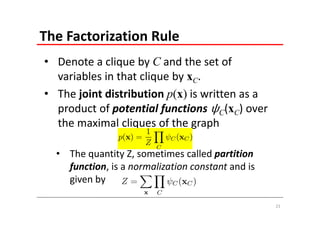
The Factorization Rule
• Denote a clique by C and the set of 
  variables in that clique by xC. 
• The joint distribution p(x) is written as a 
  product of potential functions C(xC) over 
  the maximal cliques of the graph

  • The quantity Z, sometimes called partition 
    function, is a normalization constant and is 
    given by

                                                    21
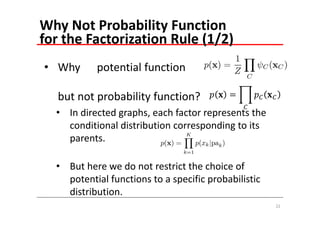
Why Not Probability Function 
for the Factorization Rule (1/2)
• Why      potential function

   but not probability function?
  • In directed graphs, each factor represents the 
    conditional distribution corresponding to its 
    parents.

  • But here we do not restrict the choice of 
    potential functions to a specific probabilistic 
    distribution.
                                                       22
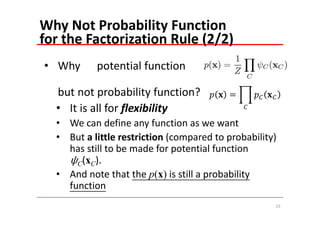
Why Not Probability Function 
for the Factorization Rule (2/2)
• Why      potential function

  but not probability function?
  • It is all for flexibility
  • We can define any function as we want
  • But a little restriction (compared to probability) 
    has still to be made for potential function 
      C(xC).
  • And note that the p(x) is still a probability 
    function
                                                      23
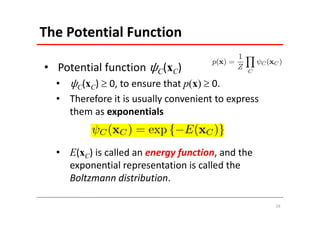
The Potential Function 

• Potential function     C(xC)
  •   C(xC)  0, to ensure that p(x)  0.
  • Therefore it is usually convenient to express 
    them as exponentials


  • E(xC) is called an energy function, and the 
    exponential representation is called the 
    Boltzmann distribution. 

                                                     24
Energy Function
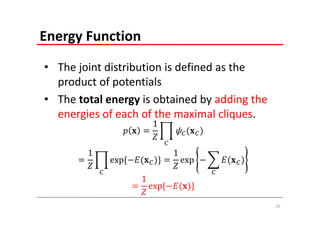
• The joint distribution is defined as the 
  product of potentials
• The total energy is obtained by adding the 
  energies of each of the maximal cliques.
                         1
                               ψ

        1                      1
             exp	                  exp	

                    1
                        exp	

                                                25
Total Energy Function
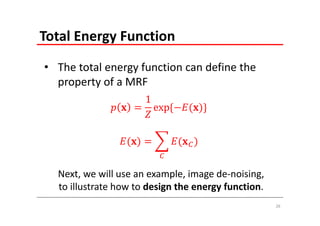
• The total energy function can define the 
  property of a MRF


  Next, we will use an example, image de‐noising, 
  to illustrate how to design the energy function.
                                                     26
4. Illustration: Image De‐Noising


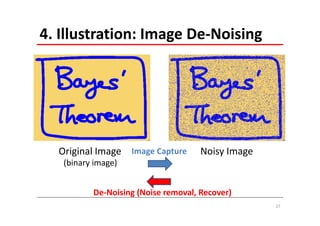
  Original Image Image Capture       Noisy Image
   (binary image)


          De‐Noising (Noise removal, Recover)
                                                   27
Binary Image
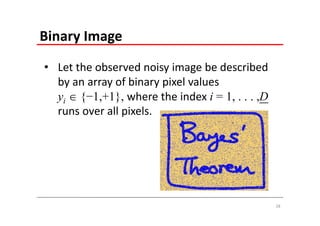
• Let the observed noisy image be described 
  by an array of binary pixel values 
  yi  {−1,+1}, where the index i = 1, . . . ,D
  runs over all pixels.


                                                  28
Simulation: generate noisy images
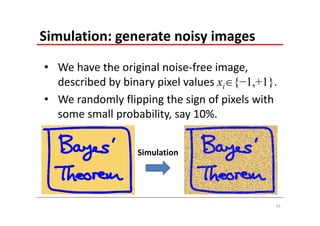
• We have the original noise‐free image, 
  described by binary pixel values xi{−1,+1}.
• We randomly flipping the sign of pixels with 
  some small probability, say 10%. 


                  Simulation


                                              29
Modelling
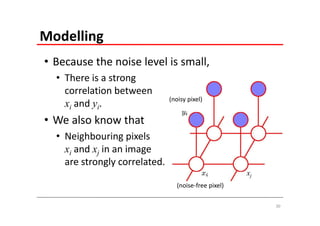
• Because the noise level is small, 
  • There is a strong 
    correlation between 
                                (noisy pixel)
    xi and yi. 
• We also know that 
  • Neighbouring pixels 
    xi and xj in an image 
    are strongly correlated. 
                                                        xj
                                   (noise‐free pixel)

                                                             30
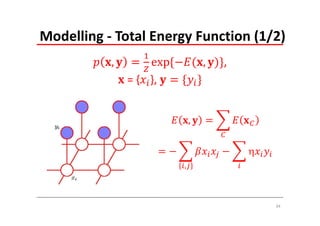
Modelling ‐ Cliques
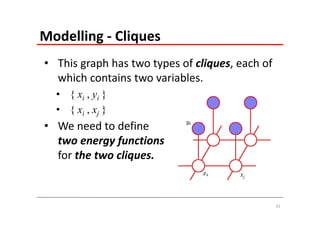
• This graph has two types of cliques, each of 
  which contains two variables.
  • { xi , yi }
  • { xi , xj }
• We need to define
  two energy functions
  for the two cliques.
                                       xj


                                                  31
Modelling – Energy Function (1/2)
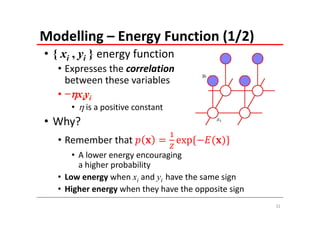
• { xi , yi } energy function
   • Expresses the correlation
     between these variables
   • −xiyi
      •  is a positive constant
• Why?
   • Remember that 
       • A lower energy encouraging 
         a higher probability
   • Low energy when xi and yi have the same sign
   • Higher energy when they have the opposite sign
                                                      32
Modelling – Energy Function (2/2)
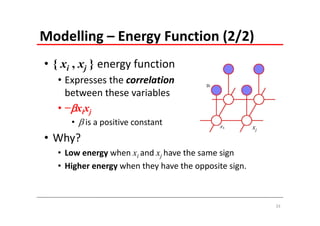
• { xi , xj } energy function
   • Expresses the correlation
     between these variables
   • −xixj
      •  is a positive constant                       xj
• Why?
   • Low energy when xi and xj have the same sign
   • Higher energy when they have the opposite sign.


                                                            33
Modelling ‐ Total Energy Function (1/2)
                             , 
             = { }, 


                                  
                       ,


                                      34
Modelling ‐ Total Energy Function (2/2)
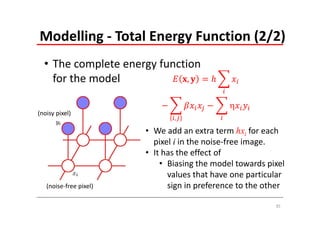
  • The complete energy function 
    for the model             ,

                                              
(noisy pixel)
                               ,

                        • We add an extra term hxi for each 
                          pixel i in the noise‐free image. 
                        • It has the effect of 
                            • Biasing the model towards pixel 
                              values that have one particular 
   (noise‐free pixel)         sign in preference to the other

                                                           35
Modelling – Final Representation

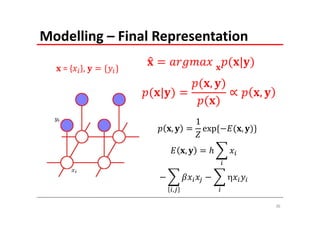
   = { }, 


                            1
                    ,           exp	       ,

                        ,

                                       
                    ,

                                               36
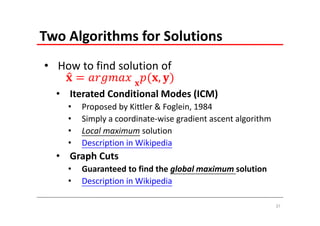
Two Algorithms for Solutions
• How to find solution of 
                  
  • Iterated Conditional Modes (ICM)
    •   Proposed by Kittler & Foglein, 1984
    •   Simply a coordinate‐wise gradient ascent algorithm
    •   Local maximum solution
    •   Description in Wikipedia
  • Graph Cuts
    •   Guaranteed to find the global maximum solution
    •   Description in Wikipedia

                                                             37
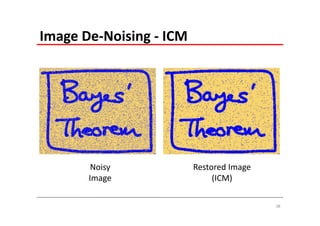
Image De‐Noising ‐ ICM


        Noisy            Restored Image 
       Image                  (ICM)

                                           38
Image De‐Noising – Graph Cuts


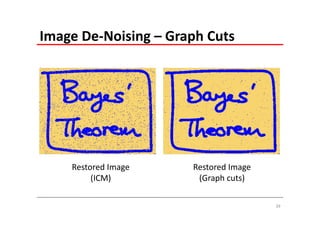
    Restored Image    Restored Image 
         (ICM)         (Graph cuts)

                                        39
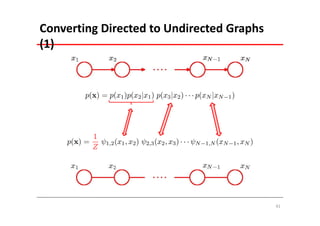
5. Relation to Directed Graphs
• We have introduced two graphical 
  frameworks for representing probability 
  distributions, corresponding to directed and 
  undirected graphs
• It is instructive to discuss the relation 
  between these.
• Details is TBU(To Be Updated)


                                              40
Converting Directed to Undirected Graphs 
(1)


                                            41
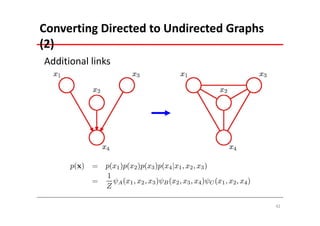
Converting Directed to Undirected Graphs 
(2)
Additional links


                                            42
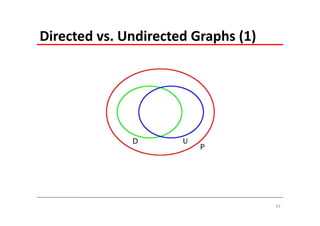
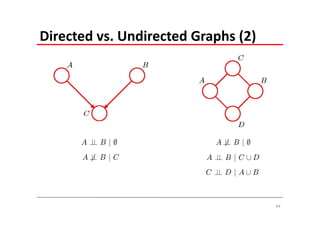
Directed vs. Undirected Graphs (1)


                                     43
Directed vs. Undirected Graphs (2)


                                     44

Markov Random Field (MRF)