RANDOM NUMBER GENERATION Lecture Notes: Chapter 8
Properties of Random Numbers Uniformity Independence
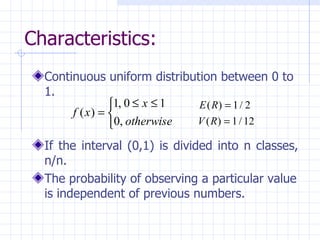
Characteristics: Continuous uniform distribution between 0 to 1. If the interval (0,1) is divided into n classes, n/n. The probability of observing a particular value is independent of previous numbers.
Psuedo-Random Numbers: A sequence of numbers between 0 to 1 which simulates the ideal properties of uniform distribution and independence as closely as possible.
Possible errors of Psuedo-Random Numbers Generated numbers may not be uniformly distributed Numbers may be discrete valued instead of continuous Mean and variance may be too high or too low Cyclic variations may occur such as autocorrelation, successive numbers,  groupings of numbers
Characteristics of Routines (Generators): Fast Portable Long cycle Replicable Imitate randomness
Techniques for Generating Psuedo-Random Numbers Mid square method Mid product method Linear Congruential method Combined Congruential method
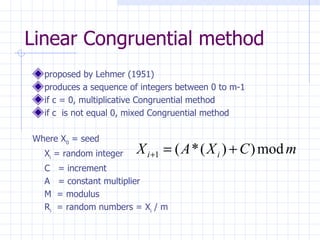
Linear Congruential method proposed by Lehmer (1951) produces a sequence of integers between 0 to m-1 if c = 0, multiplicative Congruential method if c  is not equal 0, mixed Congruential method Where X 0  = seed X i  = random integer C  = increment A  = constant multiplier M  = modulus R i   = random numbers = X i  / m
Combined Congruential method combination of two or more multiplicative congruential generators
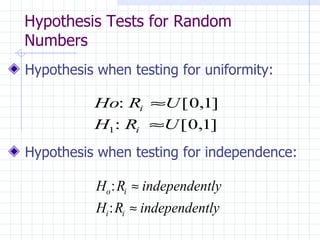
Hypothesis Tests for Random Numbers Hypothesis when testing for uniformity: Hypothesis when testing for independence:
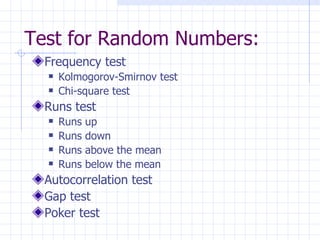
Test for Random Numbers: Frequency test Kolmogorov-Smirnov test Chi-square test Runs test Runs up Runs down Runs above the mean Runs below the mean Autocorrelation test Gap test Poker test
Other Tests Good’s Serial Test [1953, 1967] Median-Spectrum Test [Cox and Lewis, 1966, Durbin, 1967] A Variance Heterogeneity Test [Cox and Lewis, 1966] Even with all these tests, it is still no guarantee that randomness is achieve

Random number generation

  • 1.
    RANDOM NUMBER GENERATIONLecture Notes: Chapter 8
  • 2.
    Properties of RandomNumbers Uniformity Independence
  • 3.
    Characteristics: Continuous uniformdistribution between 0 to 1. If the interval (0,1) is divided into n classes, n/n. The probability of observing a particular value is independent of previous numbers.
  • 4.
    Psuedo-Random Numbers: Asequence of numbers between 0 to 1 which simulates the ideal properties of uniform distribution and independence as closely as possible.
  • 5.
    Possible errors ofPsuedo-Random Numbers Generated numbers may not be uniformly distributed Numbers may be discrete valued instead of continuous Mean and variance may be too high or too low Cyclic variations may occur such as autocorrelation, successive numbers, groupings of numbers
  • 6.
    Characteristics of Routines(Generators): Fast Portable Long cycle Replicable Imitate randomness
  • 7.
    Techniques for GeneratingPsuedo-Random Numbers Mid square method Mid product method Linear Congruential method Combined Congruential method
  • 8.
    Linear Congruential methodproposed by Lehmer (1951) produces a sequence of integers between 0 to m-1 if c = 0, multiplicative Congruential method if c is not equal 0, mixed Congruential method Where X 0 = seed X i = random integer C = increment A = constant multiplier M = modulus R i = random numbers = X i / m
  • 9.
    Combined Congruential methodcombination of two or more multiplicative congruential generators
  • 10.
    Hypothesis Tests forRandom Numbers Hypothesis when testing for uniformity: Hypothesis when testing for independence:
  • 11.
    Test for RandomNumbers: Frequency test Kolmogorov-Smirnov test Chi-square test Runs test Runs up Runs down Runs above the mean Runs below the mean Autocorrelation test Gap test Poker test
  • 12.
    Other Tests Good’sSerial Test [1953, 1967] Median-Spectrum Test [Cox and Lewis, 1966, Durbin, 1967] A Variance Heterogeneity Test [Cox and Lewis, 1966] Even with all these tests, it is still no guarantee that randomness is achieve