QUEUEING THEORYOPERES3
QUEUEING THEORYI think I shall never see a queue as long as this.-Any Customer, Anytime, Anywhere
A queue is a waiting line of "customers" requiring service from one or more servers. A queue forms whenever existing demand exceeds the existing capacity of the service facility; that is whenever arriving customers cannot receive immediate service due to busy servers. Queueing Theory is the study of the waiting line systems. QUEUEING THEORY
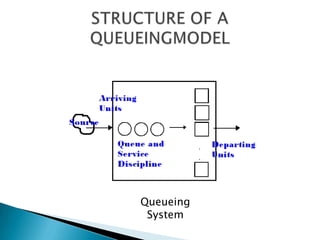
STRUCTURE OF A QUEUEINGMODELQueueing System
1.0. The Arrival Process A. The calling source may be single or multiple populations.B. The calling source may be finite or infinite. C. Single or bulk arrivals may occur. D. Total, partial or no control of arrivals can be exercised by the queueing system. E. Units can emanate from a deterministic or probabilistic generating process. F. A probabilistic arrival process can be described either by an empirical or a theoretical probability distribution. G. A stationary arrival process may or may not exist. COMPONENTS OF THE QUEUEING PROCESS
2.0 The Queue Configuration  The queue configuration refers to the number of queues in the system, their relationship to the servers and spatial consideration.  A. A queue may be a single queue or a multiple queue. B. Queues may exist B.1 physically in one place B.2 physically in disparate locations B.3 conceptually B.4 not at all C. A queueing system may impose restriction on the maximum number of units allowed. COMPONENTS OF THE QUEUEING PROCESS
3.0 Queue Discipline The following disciplines are possible:  A. lf the system is filled to capacity, the arriving unit is rejected B. Balking - a customer does not join the queue C. Reneging - a customer joins the queue and subsequently decides to leave D. Collusion - customers collaborate to reduce waiting time E. Jockeying - a customer switching between multiple queues F. Cycling - a customer returning to the queue after being given service  Customers who do not balk, renege, collude, jockey, cycle, non-randomly select from among multiple queues are said to be patient. COMPONENTS OF THE QUEUEING PROCESS
4.0 Service Discipline A. First-Come, First-Served (FCFS) B. Last-Come, First-Served (LCFS) C. Service in Random Order (SIRO) D. Round Robin Service E. Priority Service preemptive non-preemptive COMPONENTS OF THE QUEUEING PROCESS
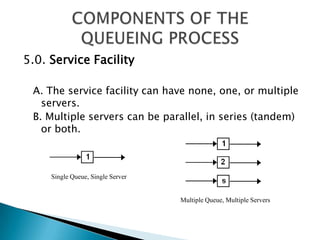
5.0. Service FacilityA. The service facility can have none, one, or multiple servers. B. Multiple servers can be parallel, in series (tandem) or both. COMPONENTS OF THE QUEUEING PROCESSSingle Queue, Single Server Multiple Queue, Multiple Servers
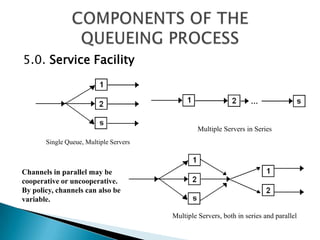
5.0. Service FacilityCOMPONENTS OF THE QUEUEING PROCESSMultiple Servers in Series Single Queue, Multiple Servers Channels in parallel may be cooperative or uncooperative. By policy, channels can also be variable. Multiple Servers, both in series and parallel
5.0. Service FacilityC. Service times can be deterministic or probabilistic. Random variables may be specified by an empirical or theoretical distribution. D. State: Dependent state parameters refer to cases where the parameters refer to cases where the parameters are affected by a change of the number of units in the system. E. Breakdowns among servers can also be considered. COMPONENTS OF THE QUEUEING PROCESS
1.0. Taxonomy of Queueing ModelsA model may be represented using the Kendall- Lee Notation: CLASSIFICATIONS OF  MODELS AND SOLUTIONS (a/b/c):( d/e/f) where:     a = arrival rate distribution     b = service rate distribution     c = no. of parallel service channels (identical service)     d = service discipline     e  = maximum no. allowed in the system     f = calling source Common Notations: M – Poissonl/Exponential rates G - General Distribution of Service Times Ek- Erlangian Distribution
2.0 Methods of Solution A. Analytical: The use of standard queueing models yields analytical results. 	B. Simulation: Some complex queueing systems cannot be solved analytically. (non-Poisson models) 3.0 Transient vs. Steady State A. A solution in the transient state is one that is time dependent. B. A solution is in the steady state when it is in statistical equilibrium (time independent) CLASSIFICATIONS OF  MODELS AND SOLUTIONS
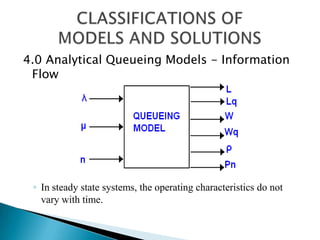
4.0 Analytical Queueing Models - Information Flow In steady state systems, the operating characteristics do not vary with time. CLASSIFICATIONS OF  MODELS AND SOLUTIONS
Notations: λc = effective mean arrival rate λ	= λc if queue is infinite λe = λ - [expected number who balk if the queue is finite] W = expected waiting time of a customer in the system Wq = expected waiting time of a customer in the queue L	 = expected no. of customers in the system Lq = expected number of customers in the queue Po = probability of no customers in the system Pn = probability of n customers in the system ρ  = traffic intensity= λ/μρc= effective traffic intensity= λe/μCLASSIFICATIONS OF  MODELS AND SOLUTIONS
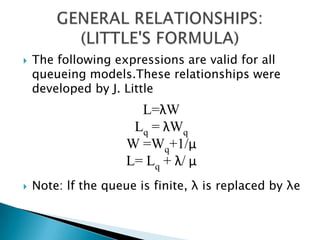
The following expressions are valid for all queueingmodels.These relationships were developed by J. Little Note: lf the queue is finite, λ is replaced by λeGENERAL RELATIONSHIPS: (LITTLE'S FORMULA) L=λWLq = λWqW =Wq+1/μL= Lq + λ/ μ
In the models that will be presented the following assumptions hold true for any model: 1. The customers of the queueing system are patient customers. 2. The service discipline is general discipline (GD), which means that the derivations do not consider any specific type of service discipline. EXPONENTIAL QUEUEING MODELS
The derivation of the queueing models involve the use of a set of difference-differential equations which allow the determination of the state probabilities. These state probabilities can also be calculated by the use of the following principle: Rate-Equality Principle: The rate at which the process enters state n equals the rate at which it leaves state n.EXPONENTIAL QUEUEING MODELS
SINGLE CHANNEL-POISSON/EXPONENTIAL MODEL [(M/M/1):(GD/ α /α)] Characteristics: 1. Input population is infinite. 2. Arrival rate has a Poisson Distribution 3. There is only one server. 4. Service time is exponentially distributed with mean1/μ. [λ<μ] 5. System capacity is infinite. 	.6. Balking and reneging are not allowed. CASE 1: SINGLE CHANNEL-POISSON/EXPONENTIAL MODEL
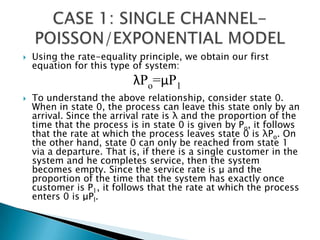
Using the rate-equality principle, we obtain our first equation for this type of system: To understand the above relationship, consider state 0. When in state 0, the process can leave this state only by an arrival. Since the arrival rate is λ and the proportion of the time that the process is in state 0 is given by Po, it follows that the rate at which the process leaves state 0 is λPo. On the other hand, state 0 can only be reached from state 1 via a departure. That is, if there is a single customer in the system and he completes service, then the system becomes empty. Since the service rate is μ and the proportion of the time that the system has exactly once customer is P1, it follows that the rate at which the process enters 0 is μPl. CASE 1: SINGLE CHANNEL-POISSON/EXPONENTIAL MODEL λPo=μP1
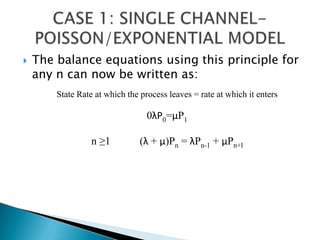
The balance equations using this principle for any n can now be written as:CASE 1: SINGLE CHANNEL-POISSON/EXPONENTIAL MODEL State Rate at which the process leaves = rate at which it enters 0λP0=μP1n ≥1           (λ + μ)Pn = λPn-1 + μPn+l
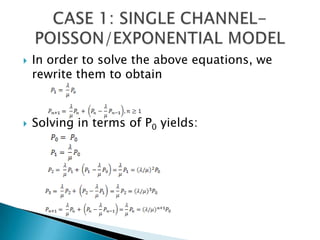
In order to solve the above equations, we rewrite them to obtain Solving in terms of P0 yields: CASE 1: SINGLE CHANNEL-POISSON/EXPONENTIAL MODEL
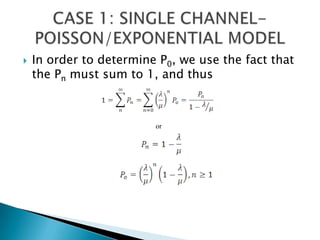
In order to determine P0, we use the fact that the Pn must sum to 1, and thus CASE 1: SINGLE CHANNEL-POISSON/EXPONENTIAL MODEL or
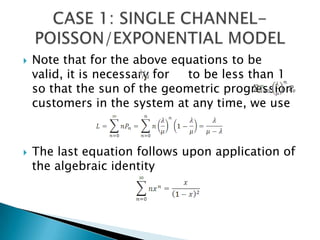
Note that for the above equations to be valid, it is necessary for     to be less than 1 so that the sun of the geometric progression  customers in the system at any time, we useThe last equation follows upon application of the algebraic identityCASE 1: SINGLE CHANNEL-POISSON/EXPONENTIAL MODEL
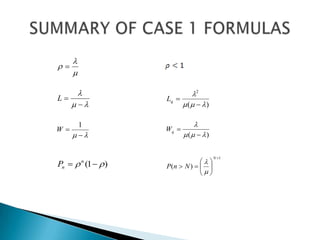
The rest of the steady state queueing statistics can be calculated using the expression for L and Little's Formula. A summary of the queueing formulas for Case I is given below.CASE 1: SINGLE CHANNEL-POISSON/EXPONENTIAL MODEL
SUMMARY OF CASE 1 FORMULAS
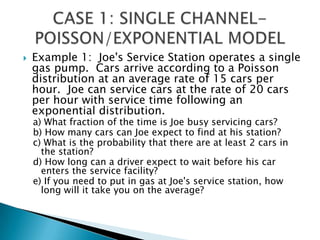
Example 1:  Joe's Service Station operates a single gas pump.  Cars arrive according to a Poisson distribution at an average rate of 15 cars per hour.  Joe can service cars at the rate of 20 cars per hour with service time following an exponential distribution.a) What fraction of the time is Joe busy servicing cars?b) How many cars can Joe expect to find at his station?c) What is the probability that there are at least 2 cars in the station?d) How long can a driver expect to wait before his car enters the service facility?e) If you need to put in gas at Joe's service station, how long will it take you on the average?CASE 1: SINGLE CHANNEL-POISSON/EXPONENTIAL MODEL
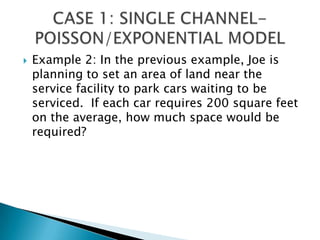
Example 2: In the previous example, Joe is planning to set an area of land near the service facility to park cars waiting to be serviced.  If each car requires 200 square feet on the average, how much space would be required?CASE 1: SINGLE CHANNEL-POISSON/EXPONENTIAL MODEL
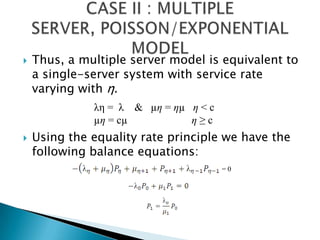
MULTIPLE SERVER, POISSON/EXPONENTIAL MODEL [(M/M/C):(GD/∞/∞ )] The assumptions of Case II are the same as Case 1 except that the number of service channels is more than one. For this case, the service rate of the system is given by: CASE II : MULTIPLE SERVER, POISSON/EXPONENTIAL MODEL cµ      η ≥ cηµ      η < c
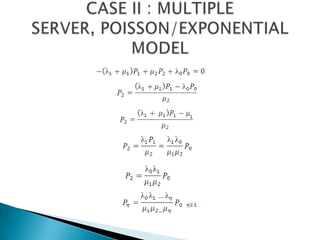
Thus, a multiple server model is equivalent to a single-server system with service rate varying with η. Using the equality rate principle we have the following balance equations: CASE II : MULTIPLE SERVER, POISSON/EXPONENTIAL MODEL λη =  λ    &   µη = ηµ   η < cµη = cµ                        η ≥ c= 0
CASE II : MULTIPLE SERVER, POISSON/EXPONENTIAL MODEL
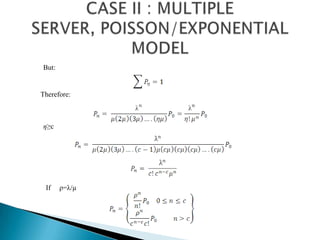
CASE II : MULTIPLE SERVER, POISSON/EXPONENTIAL MODELBut:Therefore:η≥cIf     ρ=λ/µ
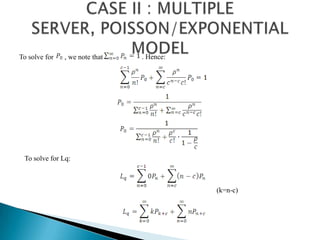
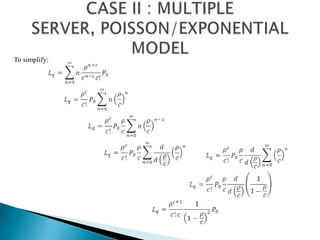
CASE II : MULTIPLE SERVER, POISSON/EXPONENTIAL MODEL. Hence:To solve for , we note that To solve for Lq:(k=n-c)
CASE II : MULTIPLE SERVER, POISSON/EXPONENTIAL MODELTo simplify:
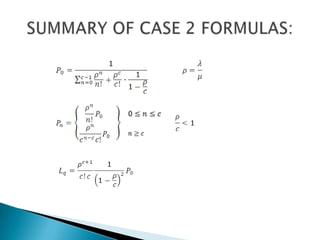
SUMMARY OF CASE 2 FORMULAS:
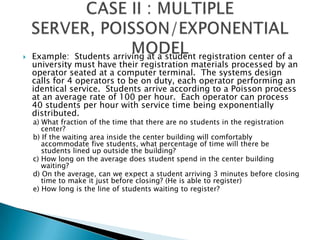
Example:  Students arriving at a student registration center of a university must have their registration materials processed by an operator seated at a computer terminal.  The systems design calls for 4 operators to be on duty, each operator performing an identical service.  Students arrive according to a Poisson process at an average rate of 100 per hour.  Each operator can process 40 students per hour with service time being exponentially distributed.a) What fraction of the time that there are no students in the registration center?b) If the waiting area inside the center building will comfortably accommodate five students, what percentage of time will there be students lined up outside the building?c) How long on the average does student spend in the center building waiting?d) On the average, can we expect a student arriving 3 minutes before closing time to make it just before closing? (He is able to register)e) How long is the line of students waiting to register?CASE II : MULTIPLE SERVER, POISSON/EXPONENTIAL MODEL
SINGLE CHANNEL,POISSON ARRIVALS, ARBITRARY SERVICE TIME : Pollaczek - Khintchine Formula [(M/G/l): (GD/∞/∞)] This case is similar to Case 1 except that the service rate distribution is arbitrary. Let:   N = no. of units in the queueing system immediately after a unit departs   T = the time needed to service the unit that follows the one departing (unit 1) at the beginning of the time count.   K= no. of new arrivals units the system during the time needed to service the unit that follows the one departing (unit 1)  Nl = no. of units left in the system when the unit (1) departs CASE III: 	SINGLE CHANNEL,POISSON ARRIVALS, ARBITRARY SERVICE TIME
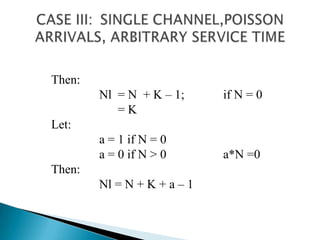
CASE III: 	SINGLE CHANNEL,POISSON ARRIVALS, ARBITRARY SERVICE TIMEThen: Nl  = N  + K – 1;	         if N = 0   	      = KLet:		a = 1 if N = 0  		a = 0 if N > 0 	         a*N =0 Then:Nl = N + K + a – 1
CASE III: 	SINGLE CHANNEL,POISSON ARRIVALS, ARBITRARY SERVICE TIMEIn a steady state system: ~. 	E(N) = 	E(                       )    E () =E[         ]           ) = E (E (a) = -E (K) + 1 =a*N= 0          =Since a = 0 or 1: But
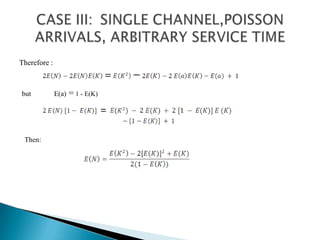
CASE III: 	SINGLE CHANNEL,POISSON ARRIVALS, ARBITRARY SERVICE TIMETherefore : but E(a) = 1 - E(K) Then:
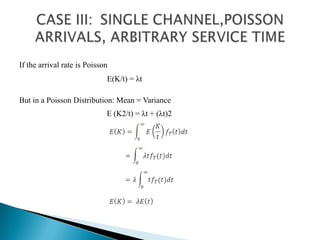
CASE III: 	SINGLE CHANNEL,POISSON ARRIVALS, ARBITRARY SERVICE TIMEIf the arrival rate is Poisson E(K/t) = λtBut in a Poisson Distribution: Mean = VarianceE (K2/t) = λt + (λt)2
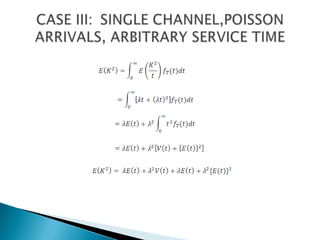
CASE III: 	SINGLE CHANNEL,POISSON ARRIVALS, ARBITRARY SERVICE TIME
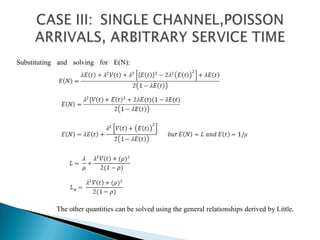
CASE III: 	SINGLE CHANNEL,POISSON ARRIVALS, ARBITRARY SERVICE TIMESubstituting and solving for E(N):	The other quantities can be solved using the general relationships derived by Little.
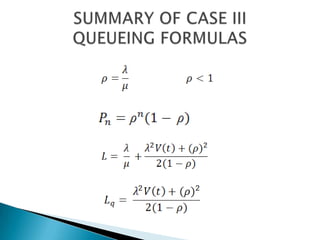
SUMMARY OF CASE III QUEUEING FORMULAS
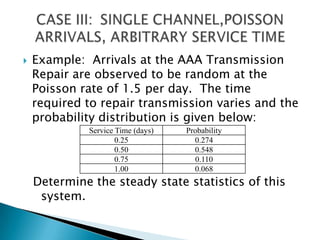
Example:  Arrivals at the AAA Transmission Repair are observed to be random at the Poisson rate of 1.5 per day.  The time required to repair transmission varies and the probability distribution is given below:Determine the steady state statistics of this system.CASE III: 	SINGLE CHANNEL,POISSON ARRIVALS, ARBITRARY SERVICE TIME
POISSON ARRIVAL AND SERVICE RATE, INFINITE NUMBER OF SERVERS: Self-Service Model [(M/M/∞): (GD/∞/∞)]Consider a multiple server system. The equivalent single server system if the number of servers is infinite would be:From the multiple server system:CASE IV: POISSON ARRIVAL AND SERVICE RATE, INFINITE NUMBER OF SERVERS
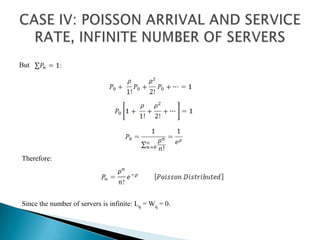
CASE IV: POISSON ARRIVAL AND SERVICE RATE, INFINITE NUMBER OF SERVERSBut Therefore:Since the number of servers is infinite: Lq = Wq = 0.
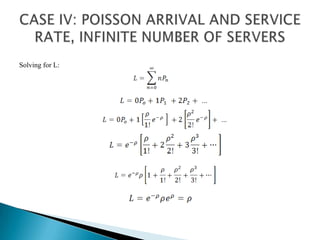
CASE IV: POISSON ARRIVAL AND SERVICE RATE, INFINITE NUMBER OF SERVERSSolving for L:
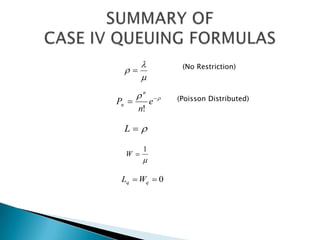
SUMMARY OF CASE IV QUEUING FORMULAS(No Restriction)(Poisson Distributed)
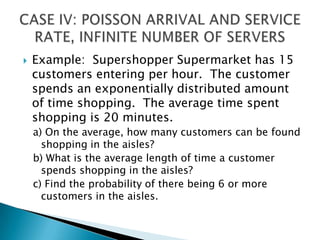
Example:  Supershopper Supermarket has 15 customers entering per hour.  The customer spends an exponentially distributed amount of time shopping.  The average time spent shopping is 20 minutes.a) On the average, how many customers can be found shopping in the aisles?b) What is the average length of time a customer spends shopping in the aisles?c) Find the probability of there being 6 or more customers in the aisles.CASE IV: POISSON ARRIVAL AND SERVICE RATE, INFINITE NUMBER OF SERVERS
SINGLE CHANNEL, POISSON/EXPONENTIAL MODEL, FINITE QUEUE [(M/M/1) : (GD/m/∞)]This case is similar to Case 1 except that the queue is finite, i.e., when the total number of customers in the system reaches the allowable limit, all arrivals balk.CASE V: SINGLE CHANNEL, POISSON/ EXPONENTIAL MODEL, FINITE QUEUE
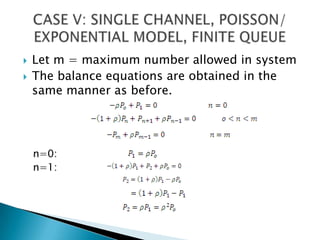
Let m = maximum number allowed in systemThe balance equations are obtained in the same manner as before.n=0:n=1:CASE V: SINGLE CHANNEL, POISSON/ EXPONENTIAL MODEL, FINITE QUEUE
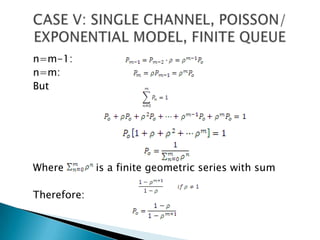
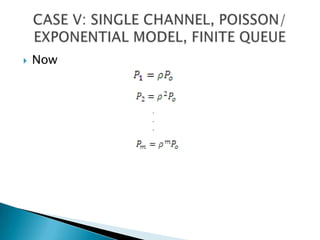
n=m-1:n=m:ButWhere          is a finite geometric series with sumTherefore:CASE V: SINGLE CHANNEL, POISSON/ EXPONENTIAL MODEL, FINITE QUEUE
NowCASE V: SINGLE CHANNEL, POISSON/ EXPONENTIAL MODEL, FINITE QUEUE...
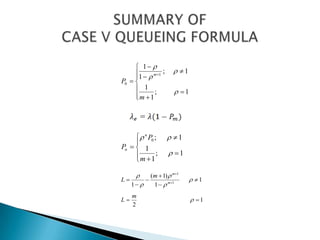
SUMMARY OF CASE V QUEUEING FORMULA
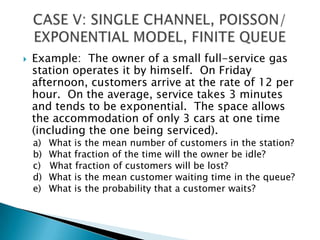
Example:  The owner of a small full-service gas station operates it by himself.  On Friday afternoon, customers arrive at the rate of 12 per hour.  On the average, service takes 3 minutes and tends to be exponential.  The space allows the accommodation of only 3 cars at one time (including the one being serviced).a)	What is the mean number of customers in the station?b)	What fraction of the time will the owner be idle?c)	   What fraction of customers will be lost?d)	What is the mean customer waiting time in the queue?e)	What is the probability that a customer waits?CASE V: SINGLE CHANNEL, POISSON/ EXPONENTIAL MODEL, FINITE QUEUE
MULTIPLE CHANNEL, POISSON\ EXPONENTIAL MODEL, FINITE QUEUE [(M/M/c):(GD/m/∞)]This case is an extension of Case V. We assume that the number  of service channels is more than one. For this system: CASE VI : MULTIPLE CHANNEL, POISSON\EXPONENTIAL MODEL, FINITE QUEUE
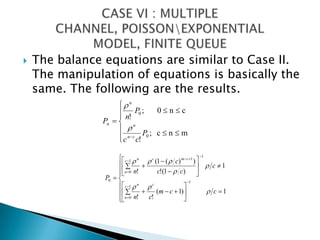
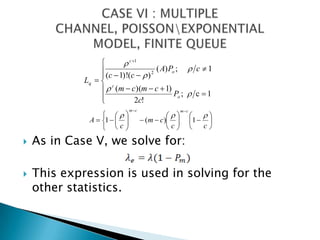
The balance equations are similar to Case II. The manipulation of equations is basically the same. The following are the results. CASE VI : MULTIPLE CHANNEL, POISSON\EXPONENTIAL MODEL, FINITE QUEUE
As in Case V, we solve for:This expression is used in solving for the other statistics.CASE VI : MULTIPLE CHANNEL, POISSON\EXPONENTIAL MODEL, FINITE QUEUE
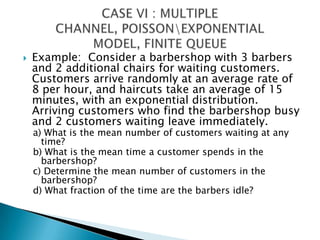
Example:  Consider a barbershop with 3 barbers and 2 additional chairs for waiting customers.  Customers arrive randomly at an average rate of 8 per hour, and haircuts take an average of 15 minutes, with an exponential distribution.  Arriving customers who find the barbershop busy and 2 customers waiting leave immediately.a) What is the mean number of customers waiting at any time?b) What is the mean time a customer spends in the barbershop?c)	 Determine the mean number of customers in the barbershop?d) What fraction of the time are the barbers idle?CASE VI : MULTIPLE CHANNEL, POISSON\EXPONENTIAL MODEL, FINITE QUEUE
MACHINE SERVICING MODEL [(M/M/R):(GD/K/K)]This model assumes that R repairmen are available for servicing a total of K machines. Since a broken machine cannot generate new calls while in service, this model is an example of finite calling source. This model can be treated as a special case of the single server, infinite queue model. CASE VII : MACHINE SERVICING MODEL
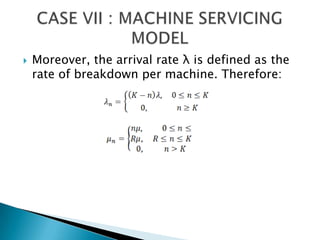
Moreover, the arrival rate λ is defined as the rate of breakdown per machine. Therefore:CASE VII : MACHINE SERVICING MODEL
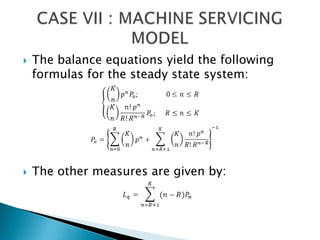
The balance equations yield the following formulas for the steady state system: The other measures are given by:CASE VII : MACHINE SERVICING MODEL
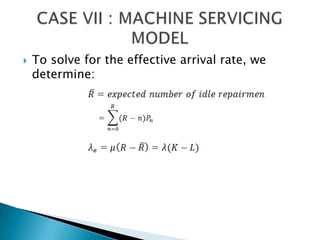
To solve for the effective arrival rate, we determine:CASE VII : MACHINE SERVICING MODEL
Example:  Two repairmen are attending five machines in a workshop.  Each machine breaks down according to a poisson distribution with a mean of 3 per hour.  The repair time per machine is exponential with a mean of 15 minutes.a) Find the probability that the two repairmen are idle.  That one repairman is idle.b) What is expected number of idle machines not being repaired?CASE VII : MACHINE SERVICING MODEL
COSTS INVOLVED IN THE QUEUEING SYSTEM 1. FACILITY COST - cost of (acquiring) services facilities Construction (capital investment) expressed by interest and amortization Cost of operation: labor, energy & materials Cost of maintenance & repair Other Costs such as insurance, taxes, rental of space 2. WAITING COST - may include ill-will due to poor service, opportunity loss of customers who get impatient and leave or a possible loss of repeat business due to dissatisfaction. ECONOMIC CONDITIONS
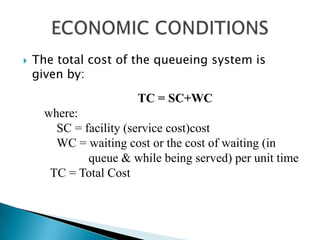
The total cost of the queueing system is given by: ECONOMIC CONDITIONSTC = SC+WC where:     SC = facility (service cost)cost  	WC = waiting cost or the cost of waiting (in 			queue & while being served) per unit time   TC = Total Cost
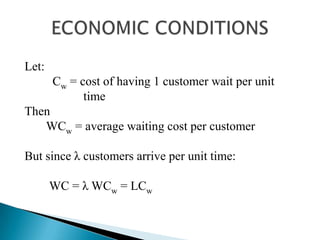
ECONOMIC CONDITIONSLet: Cw = cost of having 1 customer wait per unit 	time Then WCw = average waiting cost per customer But since λ customers arrive per unit time: WC = λ WCw = LCw
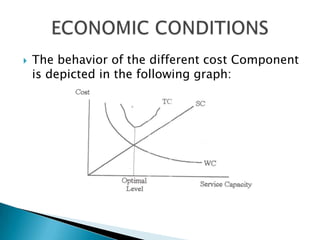
The behavior of the different cost Component is depicted in the following graph:ECONOMIC CONDITIONS
Management Objective: Cost Minimization or Achieving a Desired Service Level An example of a desired service level is the reduction of waiting time of customers. The minimization of cost would involve the minimization of the sum of service cost and waiting cost. The decision is a matter of organizational policy and influenced by competition and consumer pressure. ECONOMIC CONDITIONS
Example 1: A firm operates a single-server maintenance storeroom where electrical repair persons check out needed spare parts and equipment.  Repair persons arrive at a rate of 8 per hour.  The service rate is 10 per hour.  Arrivals are Poisson distributed and service completion times follow the exponential model.  The cost of waiting is Php 9 per hour.  The company is considering giving the stock clerk a helper which would increase the service rate to 12 per hour.  The cost of the helper is Php 6 per hour.  What do you recommend?ECONOMIC CONDITIONS
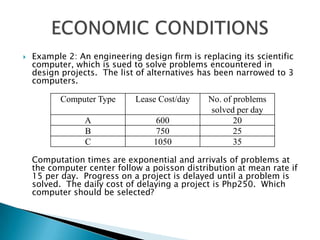
Example 2: An engineering design firm is replacing its scientific computer, which is sued to solve problems encountered in design projects.  The list of alternatives has been narrowed to 3 computers.	Computation times are exponential and arrivals of problems at the computer center follow a poisson distribution at mean rate if 15 per day.  Progress on a project is delayed until a problem is solved.  The daily cost of delaying a project is Php250.  Which computer should be selected?ECONOMIC CONDITIONS

Queueing theory

  • 1.
  • 2.
    QUEUEING THEORYI thinkI shall never see a queue as long as this.-Any Customer, Anytime, Anywhere
  • 3.
    A queue isa waiting line of "customers" requiring service from one or more servers. A queue forms whenever existing demand exceeds the existing capacity of the service facility; that is whenever arriving customers cannot receive immediate service due to busy servers. Queueing Theory is the study of the waiting line systems. QUEUEING THEORY
  • 4.
    STRUCTURE OF AQUEUEINGMODELQueueing System
  • 5.
    1.0. The ArrivalProcess A. The calling source may be single or multiple populations.B. The calling source may be finite or infinite. C. Single or bulk arrivals may occur. D. Total, partial or no control of arrivals can be exercised by the queueing system. E. Units can emanate from a deterministic or probabilistic generating process. F. A probabilistic arrival process can be described either by an empirical or a theoretical probability distribution. G. A stationary arrival process may or may not exist. COMPONENTS OF THE QUEUEING PROCESS
  • 6.
    2.0 The QueueConfiguration  The queue configuration refers to the number of queues in the system, their relationship to the servers and spatial consideration.  A. A queue may be a single queue or a multiple queue. B. Queues may exist B.1 physically in one place B.2 physically in disparate locations B.3 conceptually B.4 not at all C. A queueing system may impose restriction on the maximum number of units allowed. COMPONENTS OF THE QUEUEING PROCESS
  • 7.
    3.0 Queue DisciplineThe following disciplines are possible:  A. lf the system is filled to capacity, the arriving unit is rejected B. Balking - a customer does not join the queue C. Reneging - a customer joins the queue and subsequently decides to leave D. Collusion - customers collaborate to reduce waiting time E. Jockeying - a customer switching between multiple queues F. Cycling - a customer returning to the queue after being given service  Customers who do not balk, renege, collude, jockey, cycle, non-randomly select from among multiple queues are said to be patient. COMPONENTS OF THE QUEUEING PROCESS
  • 8.
    4.0 Service DisciplineA. First-Come, First-Served (FCFS) B. Last-Come, First-Served (LCFS) C. Service in Random Order (SIRO) D. Round Robin Service E. Priority Service preemptive non-preemptive COMPONENTS OF THE QUEUEING PROCESS
  • 9.
    5.0. Service FacilityA.The service facility can have none, one, or multiple servers. B. Multiple servers can be parallel, in series (tandem) or both. COMPONENTS OF THE QUEUEING PROCESSSingle Queue, Single Server Multiple Queue, Multiple Servers
  • 10.
    5.0. Service FacilityCOMPONENTSOF THE QUEUEING PROCESSMultiple Servers in Series Single Queue, Multiple Servers Channels in parallel may be cooperative or uncooperative. By policy, channels can also be variable. Multiple Servers, both in series and parallel
  • 11.
    5.0. Service FacilityC.Service times can be deterministic or probabilistic. Random variables may be specified by an empirical or theoretical distribution. D. State: Dependent state parameters refer to cases where the parameters refer to cases where the parameters are affected by a change of the number of units in the system. E. Breakdowns among servers can also be considered. COMPONENTS OF THE QUEUEING PROCESS
  • 12.
    1.0. Taxonomy ofQueueing ModelsA model may be represented using the Kendall- Lee Notation: CLASSIFICATIONS OF MODELS AND SOLUTIONS (a/b/c):( d/e/f) where: a = arrival rate distribution b = service rate distribution c = no. of parallel service channels (identical service) d = service discipline e = maximum no. allowed in the system f = calling source Common Notations: M – Poissonl/Exponential rates G - General Distribution of Service Times Ek- Erlangian Distribution
  • 13.
    2.0 Methods ofSolution A. Analytical: The use of standard queueing models yields analytical results. B. Simulation: Some complex queueing systems cannot be solved analytically. (non-Poisson models) 3.0 Transient vs. Steady State A. A solution in the transient state is one that is time dependent. B. A solution is in the steady state when it is in statistical equilibrium (time independent) CLASSIFICATIONS OF MODELS AND SOLUTIONS
  • 14.
    4.0 Analytical QueueingModels - Information Flow In steady state systems, the operating characteristics do not vary with time. CLASSIFICATIONS OF MODELS AND SOLUTIONS
  • 15.
    Notations: λc =effective mean arrival rate λ = λc if queue is infinite λe = λ - [expected number who balk if the queue is finite] W = expected waiting time of a customer in the system Wq = expected waiting time of a customer in the queue L = expected no. of customers in the system Lq = expected number of customers in the queue Po = probability of no customers in the system Pn = probability of n customers in the system ρ = traffic intensity= λ/μρc= effective traffic intensity= λe/μCLASSIFICATIONS OF MODELS AND SOLUTIONS
  • 16.
    The following expressionsare valid for all queueingmodels.These relationships were developed by J. Little Note: lf the queue is finite, λ is replaced by λeGENERAL RELATIONSHIPS: (LITTLE'S FORMULA) L=λWLq = λWqW =Wq+1/μL= Lq + λ/ μ
  • 17.
    In the modelsthat will be presented the following assumptions hold true for any model: 1. The customers of the queueing system are patient customers. 2. The service discipline is general discipline (GD), which means that the derivations do not consider any specific type of service discipline. EXPONENTIAL QUEUEING MODELS
  • 18.
    The derivation ofthe queueing models involve the use of a set of difference-differential equations which allow the determination of the state probabilities. These state probabilities can also be calculated by the use of the following principle: Rate-Equality Principle: The rate at which the process enters state n equals the rate at which it leaves state n.EXPONENTIAL QUEUEING MODELS
  • 19.
    SINGLE CHANNEL-POISSON/EXPONENTIAL MODEL[(M/M/1):(GD/ α /α)] Characteristics: 1. Input population is infinite. 2. Arrival rate has a Poisson Distribution 3. There is only one server. 4. Service time is exponentially distributed with mean1/μ. [λ<μ] 5. System capacity is infinite. .6. Balking and reneging are not allowed. CASE 1: SINGLE CHANNEL-POISSON/EXPONENTIAL MODEL
  • 20.
    Using the rate-equalityprinciple, we obtain our first equation for this type of system: To understand the above relationship, consider state 0. When in state 0, the process can leave this state only by an arrival. Since the arrival rate is λ and the proportion of the time that the process is in state 0 is given by Po, it follows that the rate at which the process leaves state 0 is λPo. On the other hand, state 0 can only be reached from state 1 via a departure. That is, if there is a single customer in the system and he completes service, then the system becomes empty. Since the service rate is μ and the proportion of the time that the system has exactly once customer is P1, it follows that the rate at which the process enters 0 is μPl. CASE 1: SINGLE CHANNEL-POISSON/EXPONENTIAL MODEL λPo=μP1
  • 21.
    The balance equationsusing this principle for any n can now be written as:CASE 1: SINGLE CHANNEL-POISSON/EXPONENTIAL MODEL State Rate at which the process leaves = rate at which it enters 0λP0=μP1n ≥1 (λ + μ)Pn = λPn-1 + μPn+l
  • 22.
    In order tosolve the above equations, we rewrite them to obtain Solving in terms of P0 yields: CASE 1: SINGLE CHANNEL-POISSON/EXPONENTIAL MODEL
  • 23.
    In order todetermine P0, we use the fact that the Pn must sum to 1, and thus CASE 1: SINGLE CHANNEL-POISSON/EXPONENTIAL MODEL or
  • 24.
    Note that forthe above equations to be valid, it is necessary for to be less than 1 so that the sun of the geometric progression customers in the system at any time, we useThe last equation follows upon application of the algebraic identityCASE 1: SINGLE CHANNEL-POISSON/EXPONENTIAL MODEL
  • 25.
    The rest ofthe steady state queueing statistics can be calculated using the expression for L and Little's Formula. A summary of the queueing formulas for Case I is given below.CASE 1: SINGLE CHANNEL-POISSON/EXPONENTIAL MODEL
  • 26.
    SUMMARY OF CASE1 FORMULAS
  • 27.
    Example 1: Joe's Service Station operates a single gas pump. Cars arrive according to a Poisson distribution at an average rate of 15 cars per hour. Joe can service cars at the rate of 20 cars per hour with service time following an exponential distribution.a) What fraction of the time is Joe busy servicing cars?b) How many cars can Joe expect to find at his station?c) What is the probability that there are at least 2 cars in the station?d) How long can a driver expect to wait before his car enters the service facility?e) If you need to put in gas at Joe's service station, how long will it take you on the average?CASE 1: SINGLE CHANNEL-POISSON/EXPONENTIAL MODEL
  • 28.
    Example 2: Inthe previous example, Joe is planning to set an area of land near the service facility to park cars waiting to be serviced. If each car requires 200 square feet on the average, how much space would be required?CASE 1: SINGLE CHANNEL-POISSON/EXPONENTIAL MODEL
  • 29.
    MULTIPLE SERVER, POISSON/EXPONENTIALMODEL [(M/M/C):(GD/∞/∞ )] The assumptions of Case II are the same as Case 1 except that the number of service channels is more than one. For this case, the service rate of the system is given by: CASE II : MULTIPLE SERVER, POISSON/EXPONENTIAL MODEL cµ η ≥ cηµ η < c
  • 30.
    Thus, a multipleserver model is equivalent to a single-server system with service rate varying with η. Using the equality rate principle we have the following balance equations: CASE II : MULTIPLE SERVER, POISSON/EXPONENTIAL MODEL λη = λ & µη = ηµ η < cµη = cµ η ≥ c= 0
  • 31.
    CASE II :MULTIPLE SERVER, POISSON/EXPONENTIAL MODEL
  • 32.
    CASE II :MULTIPLE SERVER, POISSON/EXPONENTIAL MODELBut:Therefore:η≥cIf ρ=λ/µ
  • 33.
    CASE II :MULTIPLE SERVER, POISSON/EXPONENTIAL MODEL. Hence:To solve for , we note that To solve for Lq:(k=n-c)
  • 34.
    CASE II :MULTIPLE SERVER, POISSON/EXPONENTIAL MODELTo simplify:
  • 35.
    SUMMARY OF CASE2 FORMULAS:
  • 36.
    Example: Studentsarriving at a student registration center of a university must have their registration materials processed by an operator seated at a computer terminal. The systems design calls for 4 operators to be on duty, each operator performing an identical service. Students arrive according to a Poisson process at an average rate of 100 per hour. Each operator can process 40 students per hour with service time being exponentially distributed.a) What fraction of the time that there are no students in the registration center?b) If the waiting area inside the center building will comfortably accommodate five students, what percentage of time will there be students lined up outside the building?c) How long on the average does student spend in the center building waiting?d) On the average, can we expect a student arriving 3 minutes before closing time to make it just before closing? (He is able to register)e) How long is the line of students waiting to register?CASE II : MULTIPLE SERVER, POISSON/EXPONENTIAL MODEL
  • 37.
    SINGLE CHANNEL,POISSON ARRIVALS,ARBITRARY SERVICE TIME : Pollaczek - Khintchine Formula [(M/G/l): (GD/∞/∞)] This case is similar to Case 1 except that the service rate distribution is arbitrary. Let: N = no. of units in the queueing system immediately after a unit departs T = the time needed to service the unit that follows the one departing (unit 1) at the beginning of the time count. K= no. of new arrivals units the system during the time needed to service the unit that follows the one departing (unit 1)  Nl = no. of units left in the system when the unit (1) departs CASE III: SINGLE CHANNEL,POISSON ARRIVALS, ARBITRARY SERVICE TIME
  • 38.
    CASE III: SINGLECHANNEL,POISSON ARRIVALS, ARBITRARY SERVICE TIMEThen: Nl = N + K – 1; if N = 0 = KLet: a = 1 if N = 0 a = 0 if N > 0 a*N =0 Then:Nl = N + K + a – 1
  • 39.
    CASE III: SINGLECHANNEL,POISSON ARRIVALS, ARBITRARY SERVICE TIMEIn a steady state system: ~. E(N) = E( ) E () =E[ ] ) = E (E (a) = -E (K) + 1 =a*N= 0 =Since a = 0 or 1: But
  • 40.
    CASE III: SINGLECHANNEL,POISSON ARRIVALS, ARBITRARY SERVICE TIMETherefore : but E(a) = 1 - E(K) Then:
  • 41.
    CASE III: SINGLECHANNEL,POISSON ARRIVALS, ARBITRARY SERVICE TIMEIf the arrival rate is Poisson E(K/t) = λtBut in a Poisson Distribution: Mean = VarianceE (K2/t) = λt + (λt)2
  • 42.
    CASE III: SINGLECHANNEL,POISSON ARRIVALS, ARBITRARY SERVICE TIME
  • 43.
    CASE III: SINGLECHANNEL,POISSON ARRIVALS, ARBITRARY SERVICE TIMESubstituting and solving for E(N): The other quantities can be solved using the general relationships derived by Little.
  • 44.
    SUMMARY OF CASEIII QUEUEING FORMULAS
  • 45.
    Example: Arrivalsat the AAA Transmission Repair are observed to be random at the Poisson rate of 1.5 per day. The time required to repair transmission varies and the probability distribution is given below:Determine the steady state statistics of this system.CASE III: SINGLE CHANNEL,POISSON ARRIVALS, ARBITRARY SERVICE TIME
  • 46.
    POISSON ARRIVAL ANDSERVICE RATE, INFINITE NUMBER OF SERVERS: Self-Service Model [(M/M/∞): (GD/∞/∞)]Consider a multiple server system. The equivalent single server system if the number of servers is infinite would be:From the multiple server system:CASE IV: POISSON ARRIVAL AND SERVICE RATE, INFINITE NUMBER OF SERVERS
  • 47.
    CASE IV: POISSONARRIVAL AND SERVICE RATE, INFINITE NUMBER OF SERVERSBut Therefore:Since the number of servers is infinite: Lq = Wq = 0.
  • 48.
    CASE IV: POISSONARRIVAL AND SERVICE RATE, INFINITE NUMBER OF SERVERSSolving for L:
  • 49.
    SUMMARY OF CASEIV QUEUING FORMULAS(No Restriction)(Poisson Distributed)
  • 50.
    Example: SupershopperSupermarket has 15 customers entering per hour. The customer spends an exponentially distributed amount of time shopping. The average time spent shopping is 20 minutes.a) On the average, how many customers can be found shopping in the aisles?b) What is the average length of time a customer spends shopping in the aisles?c) Find the probability of there being 6 or more customers in the aisles.CASE IV: POISSON ARRIVAL AND SERVICE RATE, INFINITE NUMBER OF SERVERS
  • 51.
    SINGLE CHANNEL, POISSON/EXPONENTIALMODEL, FINITE QUEUE [(M/M/1) : (GD/m/∞)]This case is similar to Case 1 except that the queue is finite, i.e., when the total number of customers in the system reaches the allowable limit, all arrivals balk.CASE V: SINGLE CHANNEL, POISSON/ EXPONENTIAL MODEL, FINITE QUEUE
  • 52.
    Let m =maximum number allowed in systemThe balance equations are obtained in the same manner as before.n=0:n=1:CASE V: SINGLE CHANNEL, POISSON/ EXPONENTIAL MODEL, FINITE QUEUE
  • 53.
    n=m-1:n=m:ButWhere is a finite geometric series with sumTherefore:CASE V: SINGLE CHANNEL, POISSON/ EXPONENTIAL MODEL, FINITE QUEUE
  • 54.
    NowCASE V: SINGLECHANNEL, POISSON/ EXPONENTIAL MODEL, FINITE QUEUE...
  • 55.
    SUMMARY OF CASEV QUEUEING FORMULA
  • 56.
    Example: Theowner of a small full-service gas station operates it by himself. On Friday afternoon, customers arrive at the rate of 12 per hour. On the average, service takes 3 minutes and tends to be exponential. The space allows the accommodation of only 3 cars at one time (including the one being serviced).a) What is the mean number of customers in the station?b) What fraction of the time will the owner be idle?c) What fraction of customers will be lost?d) What is the mean customer waiting time in the queue?e) What is the probability that a customer waits?CASE V: SINGLE CHANNEL, POISSON/ EXPONENTIAL MODEL, FINITE QUEUE
  • 57.
    MULTIPLE CHANNEL, POISSON\EXPONENTIAL MODEL, FINITE QUEUE [(M/M/c):(GD/m/∞)]This case is an extension of Case V. We assume that the number of service channels is more than one. For this system: CASE VI : MULTIPLE CHANNEL, POISSON\EXPONENTIAL MODEL, FINITE QUEUE
  • 58.
    The balance equationsare similar to Case II. The manipulation of equations is basically the same. The following are the results. CASE VI : MULTIPLE CHANNEL, POISSON\EXPONENTIAL MODEL, FINITE QUEUE
  • 59.
    As in CaseV, we solve for:This expression is used in solving for the other statistics.CASE VI : MULTIPLE CHANNEL, POISSON\EXPONENTIAL MODEL, FINITE QUEUE
  • 60.
    Example: Considera barbershop with 3 barbers and 2 additional chairs for waiting customers. Customers arrive randomly at an average rate of 8 per hour, and haircuts take an average of 15 minutes, with an exponential distribution. Arriving customers who find the barbershop busy and 2 customers waiting leave immediately.a) What is the mean number of customers waiting at any time?b) What is the mean time a customer spends in the barbershop?c) Determine the mean number of customers in the barbershop?d) What fraction of the time are the barbers idle?CASE VI : MULTIPLE CHANNEL, POISSON\EXPONENTIAL MODEL, FINITE QUEUE
  • 61.
    MACHINE SERVICING MODEL[(M/M/R):(GD/K/K)]This model assumes that R repairmen are available for servicing a total of K machines. Since a broken machine cannot generate new calls while in service, this model is an example of finite calling source. This model can be treated as a special case of the single server, infinite queue model. CASE VII : MACHINE SERVICING MODEL
  • 62.
    Moreover, the arrivalrate λ is defined as the rate of breakdown per machine. Therefore:CASE VII : MACHINE SERVICING MODEL
  • 63.
    The balance equationsyield the following formulas for the steady state system: The other measures are given by:CASE VII : MACHINE SERVICING MODEL
  • 64.
    To solve forthe effective arrival rate, we determine:CASE VII : MACHINE SERVICING MODEL
  • 65.
    Example: Tworepairmen are attending five machines in a workshop. Each machine breaks down according to a poisson distribution with a mean of 3 per hour. The repair time per machine is exponential with a mean of 15 minutes.a) Find the probability that the two repairmen are idle. That one repairman is idle.b) What is expected number of idle machines not being repaired?CASE VII : MACHINE SERVICING MODEL
  • 66.
    COSTS INVOLVED INTHE QUEUEING SYSTEM 1. FACILITY COST - cost of (acquiring) services facilities Construction (capital investment) expressed by interest and amortization Cost of operation: labor, energy & materials Cost of maintenance & repair Other Costs such as insurance, taxes, rental of space 2. WAITING COST - may include ill-will due to poor service, opportunity loss of customers who get impatient and leave or a possible loss of repeat business due to dissatisfaction. ECONOMIC CONDITIONS
  • 67.
    The total costof the queueing system is given by: ECONOMIC CONDITIONSTC = SC+WC where: SC = facility (service cost)cost WC = waiting cost or the cost of waiting (in queue & while being served) per unit time TC = Total Cost
  • 68.
    ECONOMIC CONDITIONSLet: Cw= cost of having 1 customer wait per unit time Then WCw = average waiting cost per customer But since λ customers arrive per unit time: WC = λ WCw = LCw
  • 69.
    The behavior ofthe different cost Component is depicted in the following graph:ECONOMIC CONDITIONS
  • 70.
    Management Objective: CostMinimization or Achieving a Desired Service Level An example of a desired service level is the reduction of waiting time of customers. The minimization of cost would involve the minimization of the sum of service cost and waiting cost. The decision is a matter of organizational policy and influenced by competition and consumer pressure. ECONOMIC CONDITIONS
  • 71.
    Example 1: Afirm operates a single-server maintenance storeroom where electrical repair persons check out needed spare parts and equipment. Repair persons arrive at a rate of 8 per hour. The service rate is 10 per hour. Arrivals are Poisson distributed and service completion times follow the exponential model. The cost of waiting is Php 9 per hour. The company is considering giving the stock clerk a helper which would increase the service rate to 12 per hour. The cost of the helper is Php 6 per hour. What do you recommend?ECONOMIC CONDITIONS
  • 72.
    Example 2: Anengineering design firm is replacing its scientific computer, which is sued to solve problems encountered in design projects. The list of alternatives has been narrowed to 3 computers. Computation times are exponential and arrivals of problems at the computer center follow a poisson distribution at mean rate if 15 per day. Progress on a project is delayed until a problem is solved. The daily cost of delaying a project is Php250. Which computer should be selected?ECONOMIC CONDITIONS