RANDOM VARIATE
GENERATION
Chapter 9
Random Variate
 A value being sampled from a proven
distribution of an input variable.
 Examples such as inter-arrival time and
service time.
 RV generators – techniques used to generate
random variates.
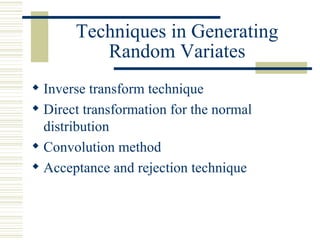
Techniques in Generating
Random Variates
 Inverse transform technique
 Direct transformation for the normal
distribution
 Convolution method
 Acceptance and rejection technique
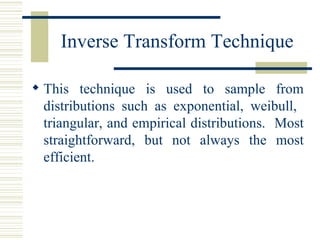
Inverse Transform Technique
 This technique is used to sample from
distributions such as exponential, weibull,
triangular, and empirical distributions. Most
straightforward, but not always the most
efficient.
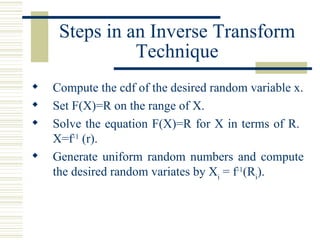
Steps in an Inverse Transform
Technique
 Compute the cdf of the desired random variable x.
 Set F(X)=R on the range of X.
 Solve the equation F(X)=R for X in terms of R.
X=f-1
(r).
 Generate uniform random numbers and compute
the desired random variates by Xi
= f-1
(Ri
).
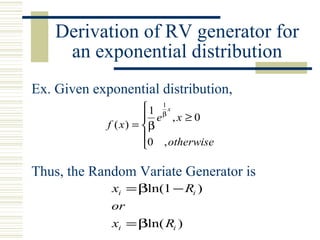
Derivation of RV generator for
an exponential distribution
Ex. Given exponential distribution,
Thus, the Random Variate Generator is
f x
e x
otherwise
x
( )
,
,
=
≥





1
0
0
1
β
β
x R
or
x R
i i
i i
= −
=
β
β
ln( )
ln( )
1
Uniform Distribution
Thus, the RVG is
f x b a
a x b
otherwise
( )
,
,
= −
≤ ≤




1
0
x a b a Ri i= + −( )
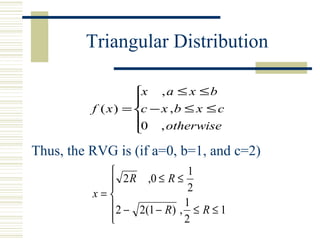
Triangular Distribution
Thus, the RVG is (if a=0, b=1, and c=2)
f x
x a x b
c x b x c
otherwise
( )
,
,
,
=
≤ ≤
− ≤ ≤




0
x
R R
R R
=
≤ ≤
− − ≤ ≤






2 0
1
2
2 2 1
1
2
1
,
( ) ,
Direct Transformation for the
Normal Distribution
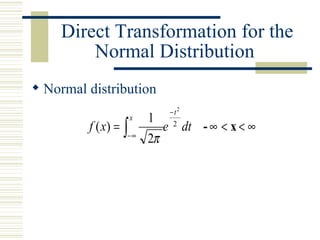
 Normal distribution
∞<<∞=
−
∞−∫ x-dtexf
t
x
2
2
2
1
)(
π
Direct Transformation for the
Normal Distribution
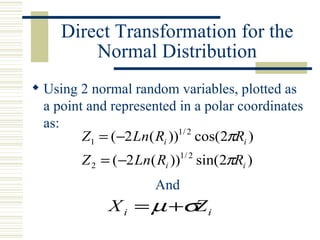
 Using 2 normal random variables, plotted as
a point and represented in a polar coordinates
as:
And
)2sin())(2(
)2cos())(2(
2/1
2
2/1
1
ii
ii
RRLnZ
RRLnZ
π
π
−=
−=
ii ZX σµ+=
Convolution Method
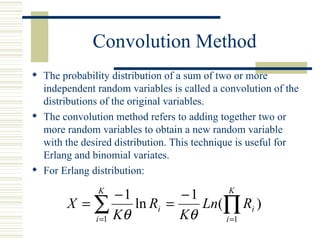
 The probability distribution of a sum of two or more
independent random variables is called a convolution of the
distributions of the original variables.
 The convolution method refers to adding together two or
more random variables to obtain a new random variable
with the desired distribution. This technique is useful for
Erlang and binomial variates.
 For Erlang distribution:
)(
1
ln
1
11
∏∑ ==
−
=
−
=
K
i
ii
K
i
RLn
K
R
K
X
θθ
Acceptance and Rejection
Technique
The efficiency of the technique
depends on being able to minimize
the number of rejections.
Example of Acceptance
Rejection Technique
 Generate uniformly distributed random
variates [1/4,1]:
STEP 1: generate RN
STEP 2: if RN > or = ¼, accept, let X=RN. If
RN < ¼, reject and return to 1.
STEP 3:if another uniform random Variate on
[1/4,1] is needed, go to step 1.
Analysis of Simulation Data
 Data Collection
 Identification of Distribution of Data
 Parameter Estimation
 Goodness of fit Test

Random variate generation

  • 1.
  • 2.
    Random Variate  Avalue being sampled from a proven distribution of an input variable.  Examples such as inter-arrival time and service time.  RV generators – techniques used to generate random variates.
  • 3.
    Techniques in Generating RandomVariates  Inverse transform technique  Direct transformation for the normal distribution  Convolution method  Acceptance and rejection technique
  • 4.
    Inverse Transform Technique This technique is used to sample from distributions such as exponential, weibull, triangular, and empirical distributions. Most straightforward, but not always the most efficient.
  • 5.
    Steps in anInverse Transform Technique  Compute the cdf of the desired random variable x.  Set F(X)=R on the range of X.  Solve the equation F(X)=R for X in terms of R. X=f-1 (r).  Generate uniform random numbers and compute the desired random variates by Xi = f-1 (Ri ).
  • 6.
    Derivation of RVgenerator for an exponential distribution Ex. Given exponential distribution, Thus, the Random Variate Generator is f x e x otherwise x ( ) , , = ≥      1 0 0 1 β β x R or x R i i i i = − = β β ln( ) ln( ) 1
  • 7.
    Uniform Distribution Thus, theRVG is f x b a a x b otherwise ( ) , , = − ≤ ≤     1 0 x a b a Ri i= + −( )
  • 8.
    Triangular Distribution Thus, theRVG is (if a=0, b=1, and c=2) f x x a x b c x b x c otherwise ( ) , , , = ≤ ≤ − ≤ ≤     0 x R R R R = ≤ ≤ − − ≤ ≤       2 0 1 2 2 2 1 1 2 1 , ( ) ,
  • 9.
    Direct Transformation forthe Normal Distribution  Normal distribution ∞<<∞= − ∞−∫ x-dtexf t x 2 2 2 1 )( π
  • 10.
    Direct Transformation forthe Normal Distribution  Using 2 normal random variables, plotted as a point and represented in a polar coordinates as: And )2sin())(2( )2cos())(2( 2/1 2 2/1 1 ii ii RRLnZ RRLnZ π π −= −= ii ZX σµ+=
  • 11.
    Convolution Method  Theprobability distribution of a sum of two or more independent random variables is called a convolution of the distributions of the original variables.  The convolution method refers to adding together two or more random variables to obtain a new random variable with the desired distribution. This technique is useful for Erlang and binomial variates.  For Erlang distribution: )( 1 ln 1 11 ∏∑ == − = − = K i ii K i RLn K R K X θθ
  • 12.
    Acceptance and Rejection Technique Theefficiency of the technique depends on being able to minimize the number of rejections.
  • 13.
    Example of Acceptance RejectionTechnique  Generate uniformly distributed random variates [1/4,1]: STEP 1: generate RN STEP 2: if RN > or = ¼, accept, let X=RN. If RN < ¼, reject and return to 1. STEP 3:if another uniform random Variate on [1/4,1] is needed, go to step 1.
  • 14.
    Analysis of SimulationData  Data Collection  Identification of Distribution of Data  Parameter Estimation  Goodness of fit Test