Manual Work
E. N. Sathishkumar M.Sc., M.Phil., [Ph.D.,]
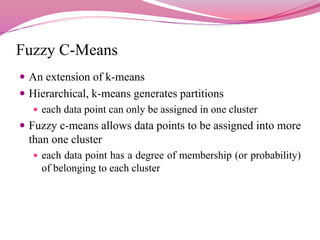
Fuzzy C-Means
 An extension of k-means
 Hierarchical, k-means generates partitions
 each data point can only be assigned in one cluster
 Fuzzy c-means allows data points to be assigned into more
than one cluster
 each data point has a degree of membership (or probability)
of belonging to each cluster
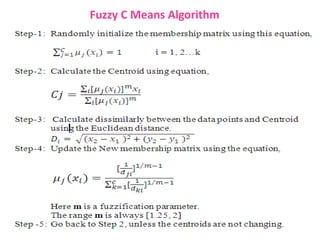
Fuzzy C Means Algorithm
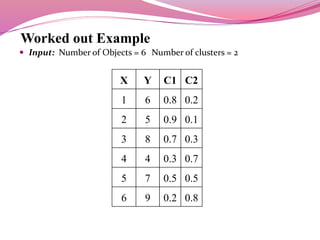
Worked out Example
 Input: Number of Objects = 6 Number of clusters = 2
X Y C1 C2
1 6 0.8 0.2
2 5 0.9 0.1
3 8 0.7 0.3
4 4 0.3 0.7
5 7 0.5 0.5
6 9 0.2 0.8
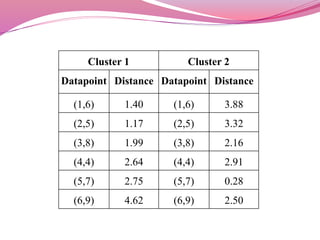
Cluster 1 Cluster 2
Datapoint Distance Datapoint Distance
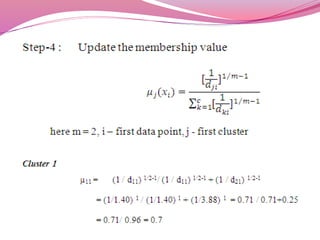
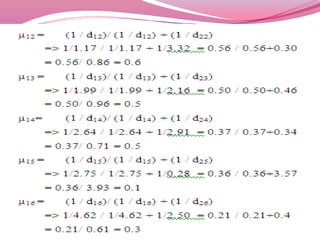
(1,6) 1.40 (1,6) 3.88
(2,5) 1.17 (2,5) 3.32
(3,8) 1.99 (3,8) 2.16
(4,4) 2.64 (4,4) 2.91
(5,7) 2.75 (5,7) 0.28
(6,9) 4.62 (6,9) 2.50
 Now the New Membership value is
Step 5 : Now continue this process until get the same
centroids.
X Y C1 C2
1 6 0.7 0.3
2 5 0.6 0.4
3 8 0.5 0.5
4 4 0.5 0.5
5 7 0.1 0.9
6 9 0.3 0.7

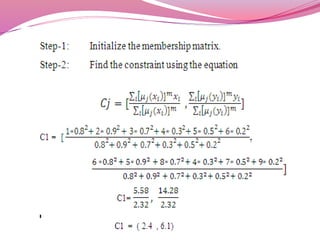
Fuzzy c means manual work

  • 1.
    Manual Work E. N.Sathishkumar M.Sc., M.Phil., [Ph.D.,]
  • 2.
    Fuzzy C-Means  Anextension of k-means  Hierarchical, k-means generates partitions  each data point can only be assigned in one cluster  Fuzzy c-means allows data points to be assigned into more than one cluster  each data point has a degree of membership (or probability) of belonging to each cluster
  • 3.
    Fuzzy C MeansAlgorithm
  • 4.
    Worked out Example Input: Number of Objects = 6 Number of clusters = 2 X Y C1 C2 1 6 0.8 0.2 2 5 0.9 0.1 3 8 0.7 0.3 4 4 0.3 0.7 5 7 0.5 0.5 6 9 0.2 0.8
  • 9.
    Cluster 1 Cluster2 Datapoint Distance Datapoint Distance (1,6) 1.40 (1,6) 3.88 (2,5) 1.17 (2,5) 3.32 (3,8) 1.99 (3,8) 2.16 (4,4) 2.64 (4,4) 2.91 (5,7) 2.75 (5,7) 0.28 (6,9) 4.62 (6,9) 2.50
  • 14.
     Now theNew Membership value is Step 5 : Now continue this process until get the same centroids. X Y C1 C2 1 6 0.7 0.3 2 5 0.6 0.4 3 8 0.5 0.5 4 4 0.5 0.5 5 7 0.1 0.9 6 9 0.3 0.7