Innovative radiotherapy in HNC:
         IMRT and IGRT

       Dr Chris Nutting MD FRCP FRCR
  Consultant and Senior Lecturer in Clinical Oncology
    Head and Neck Unit, Royal Marsden Hospital &
The Institute of Cancer Research, Fulham Road, London


             ESMO Stockholm 2008
Goals of Head and Neck IMRT
1. Reduce local failure by improved target volume
   localisation, and dose escalation
Site: larynx and hypopharynx organ preserving
   chemoradiation protocols in Stage III and IV
2. Reduce toxicity by improved dose distributions to
   OAR
Site: Oropharynx – Parotid gland sparing
3.     Novel techniques
Site: Unknown primary SCCHN
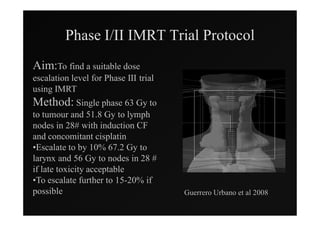
Phase I/II IMRT Trial Protocol
Aim:To find a suitable dose
escalation level for Phase III trial
using IMRT
Method: Single phase 63 Gy to
to tumour and 51.8 Gy to lymph
nodes in 28# with induction CF
and concomitant cisplatin
•Escalate to by 10% 67.2 Gy to
larynx and 56 Gy to nodes in 28 #
if late toxicity acceptable
•To escalate further to 15-20% if
possible                               Guerrero Urbano et al 2008
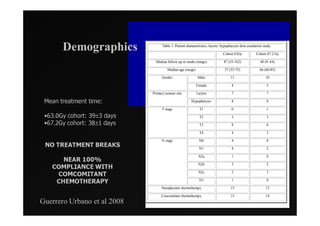
Demographics                         Table 1. Patient characteristics, larynx/ hypopharynx dose escalation study

                                                                                          Cohort 63Gy            Cohort 67.2 Gy

                                            Median follow up in weeks (range)             87 (55-162)              40 (9- 64)

                                                   Median age (range)                      57 (35-75)              66 (60-85)

                                                Gender                  Male                   11                      10

                                                                        Female                  4                       5

                                          Primary tumour site           Larynx                  7                       7

 : e mi t t n e m t a e r t n a e M                                 Hypopharynx                 8                       8

                                                T stage                  T1                     0                       1
                              ±
 s y a d 3 9 3 :tr o h o c y G 0. 3 6 •                                  T2                     3                       3
 syad 1 83 :trohoc yG2.76•    ±                                          T3                     8                       8

                                                                         T4                     4                       3

                                               N stage                   N0                     4                       8
 SKAERB TNE MTAERT ON                                                    N1                     4                       2

                                                                         N2a                    1                       0
         %001 RAEN                                                       N2b                    3                       2
     HTI W E C N AIL P M O C                                             N2c                    2                       3
      TNATIMOCMOC
                                                                         N3                     1                       0
      YPAREHTO MEHC
                                               Neoadjuvant chemotherapy                        15                      13

                                               Concomitant chemotherapy                        15                      14
Guerrero Urbano et al 2008
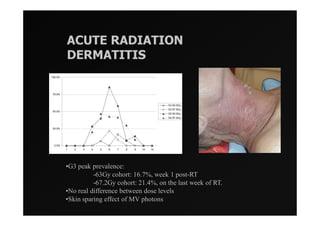
ACUTE RADIATION
         DERMATITIS
100.0%


75.0%


                                                       G3 63.0Gy
                                                       G3 67.2Gy
50.0%
                                                       G2 63.0Gy
                                                       G2 67.2Gy


25.0%


 0.0%
         1   2   3   4   5   6   7   8   9   10   14


         •G3 peak prevalence:
                   -63Gy cohort: 16.7%, week 1 post-RT
                   -67.2Gy cohort: 21.4%, on the last week of RT.
         •No real difference between dose levels
         •Skin sparing effect of MV photons
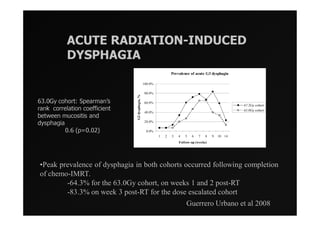
ACUTE RADIATION-INDUCED
                DYSPHAGIA
                                                                                Prevalence of acute G3 dysphagia

                                                               100.0%

                                                               80.0%


                                             G3 dysphagia, %
s’namraepS :trohoc yG0.36                                      60.0%
                                                                                                                    67.2Gy cohort
tneiciffeoc noitalerroc knar                                   40.0%
                                                                                                                    63.0Gy cohort
     d n a si ti s o c u m n e e w t e b
                                                               20.0%
                          ai g a h p s y d
    ) 2 0. 0 = p ( 6. 0                                         0.0%
                                                                        1   2   3   4   5   6   7   8   9   10 14
                                                                                    Follow-up (weeks)


 •Peak prevalence of dysphagia in both cohorts occurred following completion
 of chemo-IMRT.
         -64.3% for the 63.0Gy cohort, on weeks 1 and 2 post-RT
         -83.3% on week 3 post-RT for the dose escalated cohort
                                                                                        Guerrero Urbano et al 2008
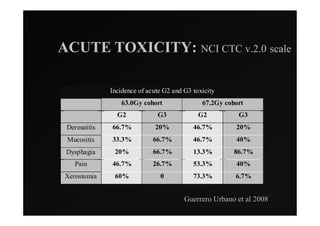
ACUTE TOXICITY: NCI CTC v.2.0 scale

              Incidence of acute G2 and G3 toxicity
                 63.0Gy cohort                67.2Gy cohort
                G2            G3             G2          G3
 Dermatitis   66.7%           20%          46.7%        20%
 Mucositis    33.3%          66.7%         46.7%        40%
 Dysphagia     20%           66.7%         13.3%        86.7%
    Pain      46.7%          26.7%         53.3%        40%
 Xerostomia    60%             0           73.3%        6.7%


                                        Guerrero Urbano et al 2008
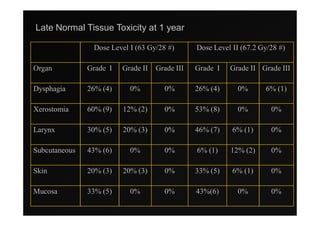
Late Normal Tissue Toxicity at 1 year

                Dose Level I (63 Gy/28 #)       Dose Level II (67.2 Gy/28 #)

Organ          Grade I   Grade II   Grade III   Grade I   Grade II Grade III

Dysphagia      26% (4)     0%         0%        26% (4)      0%      6% (1)

Xerostomia     60% (9)   12% (2)      0%        53% (8)      0%        0%

Larynx         30% (5)   20% (3)      0%        46% (7)    6% (1)      0%

Subcutaneous   43% (6)     0%         0%        6% (1)    12% (2)      0%

Skin           20% (3)   20% (3)      0%        33% (5)    6% (1)      0%

Mucosa         33% (5)     0%         0%        43%(6)       0%        0%
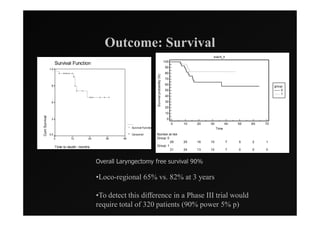
Outcome: Survival
                                                                                                                                event_lr
                                                                                                           100
                     Survival Function
                                                                                                            90
               1.0
                                                                                                            80


                                                                                Survival probability (%)
                                                                                                            70

                .8                                                                                          60
                                                                                                                                                               group
                                                                                                            50                                                     0
                                                                                                                                                                   1
                                                                                                            40
                .5                                                                                          30
                                                                                                            20
                                                                                                            10
Cum Survival


                .3                                                                                           0
                                                                                                                 0   10   20   30          40   50   60   70
                                                            Survival Function                                                       Time
               0.0                                          Censored            Number at risk
                     0        12         24      36    48                       Group: 0
                                                                                         29                          25   16   10          7    5    2    1
                     Time to death- months                                      Group: 1
                                                                                         31                          24   13   10          7    0    0    0


                                              %09 lavivrus eerf ymotcegnyraL llarevO
                                              •Loco-regional 65% vs. 82% at 3 years

                                              •To detect this difference in a Phase III trial would
                                              require total of 320 patients (90% power 5% p)
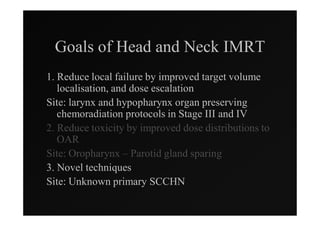
Goals of Head and Neck IMRT
1. Reduce local failure by improved target volume
   localisation, and dose escalation
Site: larynx and hypopharynx organ preserving
   chemoradiation protocols in Stage III and IV
2. Reduce toxicity by improved dose distributions to
   OAR
Site: Oropharynx – Parotid gland sparing
3. Novel techniques
Site: Unknown primary SCCHN
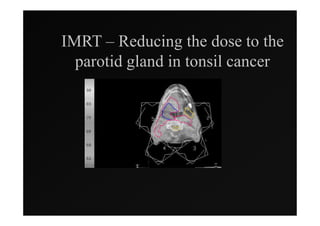
IMRT – Reducing the dose to the
  parotid gland in tonsil cancer
Head and neck IMRT: Xerostomia
• Graff et al IJROBP 02/2007
• Matched case-control study of QoL after bilateral
  CRT/IMRT
   – IMRT improved dry mouth and sticky saliva (p= 0.0001)
   – Prevalence Odds Ratios were: Dry mouth 3.2, Sticky
     saliva 3.2, Oral pain 3.6, Trismus 2.6, Difficulty
     swallowing 2.8.
Head and neck IMRT: Xerostomia
• Fang et al Cancer Jan 2007
• 237 Nasopharynx carcinoma patients
• Non-randomised allocation: Conv (152) vs
  Conformal (CFRT – 33 IMRT 52)
• Conformal group showed improved QoL scores,
  and multiple functional scores including
  xerostomia, eating, speech, senses etc
• OR for xerostomia was 0.37 (CI 0.2-0.66)
• OR for global QoL was 2.0 (CI 1.2-3.7)
Head and neck IMRT: Xerostomia
• Pow et al IJROBP 2006
• Small randomised trial of 51 patients with T2
  N0/1 M0 nasopharynx cancer
• CRT vs IMRT
• Recovery of parotid flow to at least 25% of pre-
  treatment levels was 83% with IMRT, and 10%
  with CRT
• IMRT patients had improved dry mouth and sticky
  saliva
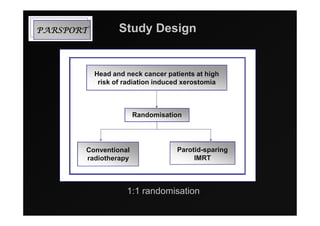
TROPSRAP          Study Design


           Head and neck cancer patients at high
            risk of radiation induced xerostomia


                      Randomisation


       Conventional                Parotid-sparing
       radiotherapy                     IMRT


                    1:1 randomisation
TROPSRAP      Current status


  PARSPORT closed to recruitment in Dec 2007
  96 patients were randomised from 6 UK centers
  Data collection rates ~80%
  10% of trial participants died before reaching the
primary endpoint (usually of non-HNC)
  Primary endpoint data collection should be
completed Dec 2008
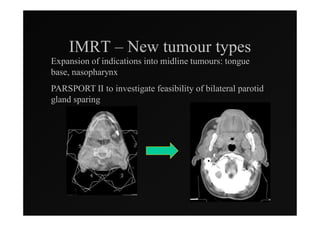
IMRT – New tumour types
Expansion of indications into midline tumours: tongue
base, nasopharynx
PARSPORT II to investigate feasibility of bilateral parotid
gland sparing
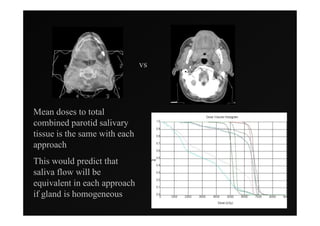
vs


Mean doses to total
combined parotid salivary
tissue is the same with each
approach
This would predict that
saliva flow will be
equivalent in each approach
if gland is homogeneous
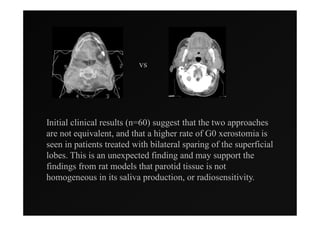
vs


Initial clinical results (n=60) suggest that the two approaches
are not equivalent, and that a higher rate of G0 xerostomia is
seen in patients treated with bilateral sparing of the superficial
lobes. This is an unexpected finding and may support the
findings from rat models that parotid tissue is not
homogeneous in its saliva production, or radiosensitivity.
Goals of Head and Neck IMRT
1. Reduce local failure by improved target volume
   localisation, and dose escalation
Site: larynx and hypopharynx organ preserving
   chemoradiation protocols in Stage III and IV
2. Reduce toxicity by improved dose distributions to
   OAR
Site: Oropharynx – Parotid gland sparing
3. Novel techniques
Site: Unknown primary SCCHN
IMRT for unknown primary site
• Patients presenting with cervical lymph node
  metastases and no mucosal tumour
• Post-operative options of hemi-neck RT or TMI
  issues of local control vs survival
• Target volumes for post-op and potential
  microscopic disease can be defined
• Hypothesis: Can TM-IMRT offer the advantages
  of local control without the high levels of toxicity?
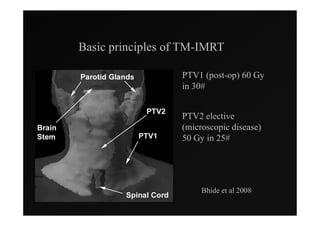
Basic principles of TM-IMRT

                   PTV1 (post-op) 60 Gy
                   in 30#


                   PTV2 elective
                   (microscopic disease)
                   50 Gy in 25#


                        Bhide et al 2008
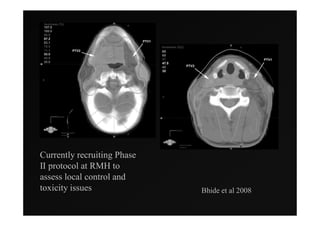
Currently recruiting Phase
II protocol at RMH to
assess local control and
toxicity issues              Bhide et al 2008
IGRT in Head and Neck Cancer
1. Optimise conventional anatomic imaging
      Site specific protocols e.g. skull base/BOT
      Image registration

2. Add functional/biological information
      FDG PET/CT, dceMRI, dynamic CT

3. Image areas of potential radioresistance
     Hypoxia tracers, proliferation markers
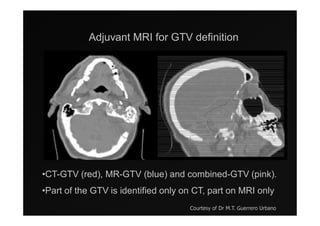
Adjuvant MRI for GTV definition


•CT-GTV (red), MR-GTV (blue) and combined-GTV (pink).
•Part of the GTV is identified only on CT, part on MRI only
                                     onabrU orerreuG .T.M rD fo ysetruoC
onabrU orerreuG .T.M rD fo ysetruoC
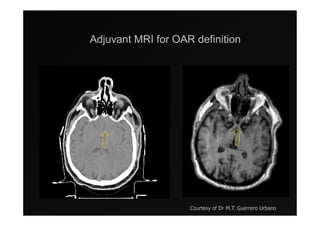
              Adjuvant MRI for OAR definition
RMH Experience With PET/CT For
        RT Planning
• Two groups of patients: 9 with known
  primary site and 9 unknown
• RT planning performed with or without
  PET/CT data
• Unknown primary planned for ipsilateral
  neck irradiation only


                                   8002 la te dlobweN
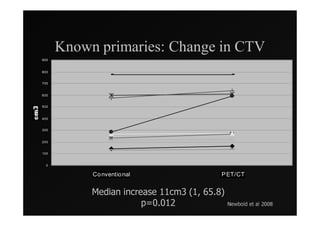
Known primaries: Change in CTV
900


800


700


600


500


400


300


200


100


  0

           Co nventio nal                P ET/CT


           Median increase 11cm3 (1, 65.8)
                       p=0.012               8002 la te dlobweN
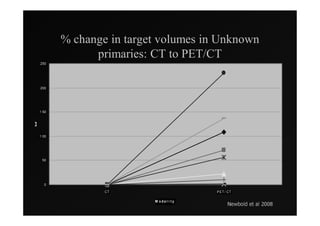
% change in target volumes in Unknown
             primaries: CT to PET/CT
250


200


1 50


1 00


 50


  0
               CT                     P E T / CT

                        M odal i ty
                                             8002 la te dlobweN
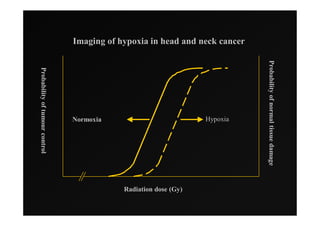
Imaging of hypoxia in head and neck cancer


                                                                             Probability of normal tissue damage
Probability of tumour control


                                Normoxia                          Hypoxia


                                            Radiation dose (Gy)
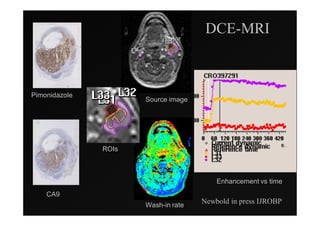
DCE-MRI


Pimonidazole
                      Source image


               ROIs


                                         Enhancement vs time
    CA9
                      Wash-in rate
                                     Newbold in press IJROBP
Conclusions
• We have attempted to design clinical trials with
  clear questions to test IMRT in HNC
• Phase I and II results support dose escalation
  strategies in SCCHN
• Parotid sparing IMRT: Randomised trial data now
  available
• Novel IMRT techniques can be formulated and
  tested to expand indications
• IGRT potentially offers new RT targets
• More clinical research in this area is required

Innovative Radiotherapy In Hnc

  • 1.
    Innovative radiotherapy inHNC: IMRT and IGRT Dr Chris Nutting MD FRCP FRCR Consultant and Senior Lecturer in Clinical Oncology Head and Neck Unit, Royal Marsden Hospital & The Institute of Cancer Research, Fulham Road, London ESMO Stockholm 2008
  • 2.
    Goals of Headand Neck IMRT 1. Reduce local failure by improved target volume localisation, and dose escalation Site: larynx and hypopharynx organ preserving chemoradiation protocols in Stage III and IV 2. Reduce toxicity by improved dose distributions to OAR Site: Oropharynx – Parotid gland sparing 3. Novel techniques Site: Unknown primary SCCHN
  • 3.
    Phase I/II IMRTTrial Protocol Aim:To find a suitable dose escalation level for Phase III trial using IMRT Method: Single phase 63 Gy to to tumour and 51.8 Gy to lymph nodes in 28# with induction CF and concomitant cisplatin •Escalate to by 10% 67.2 Gy to larynx and 56 Gy to nodes in 28 # if late toxicity acceptable •To escalate further to 15-20% if possible Guerrero Urbano et al 2008
  • 4.
    Demographics Table 1. Patient characteristics, larynx/ hypopharynx dose escalation study Cohort 63Gy Cohort 67.2 Gy Median follow up in weeks (range) 87 (55-162) 40 (9- 64) Median age (range) 57 (35-75) 66 (60-85) Gender Male 11 10 Female 4 5 Primary tumour site Larynx 7 7 : e mi t t n e m t a e r t n a e M Hypopharynx 8 8 T stage T1 0 1 ± s y a d 3 9 3 :tr o h o c y G 0. 3 6 • T2 3 3 syad 1 83 :trohoc yG2.76• ± T3 8 8 T4 4 3 N stage N0 4 8 SKAERB TNE MTAERT ON N1 4 2 N2a 1 0 %001 RAEN N2b 3 2 HTI W E C N AIL P M O C N2c 2 3 TNATIMOCMOC N3 1 0 YPAREHTO MEHC Neoadjuvant chemotherapy 15 13 Concomitant chemotherapy 15 14 Guerrero Urbano et al 2008
  • 5.
    ACUTE RADIATION DERMATITIS 100.0% 75.0% G3 63.0Gy G3 67.2Gy 50.0% G2 63.0Gy G2 67.2Gy 25.0% 0.0% 1 2 3 4 5 6 7 8 9 10 14 •G3 peak prevalence: -63Gy cohort: 16.7%, week 1 post-RT -67.2Gy cohort: 21.4%, on the last week of RT. •No real difference between dose levels •Skin sparing effect of MV photons
  • 6.
    ACUTE RADIATION-INDUCED DYSPHAGIA Prevalence of acute G3 dysphagia 100.0% 80.0% G3 dysphagia, % s’namraepS :trohoc yG0.36 60.0% 67.2Gy cohort tneiciffeoc noitalerroc knar 40.0% 63.0Gy cohort d n a si ti s o c u m n e e w t e b 20.0% ai g a h p s y d ) 2 0. 0 = p ( 6. 0 0.0% 1 2 3 4 5 6 7 8 9 10 14 Follow-up (weeks) •Peak prevalence of dysphagia in both cohorts occurred following completion of chemo-IMRT. -64.3% for the 63.0Gy cohort, on weeks 1 and 2 post-RT -83.3% on week 3 post-RT for the dose escalated cohort Guerrero Urbano et al 2008
  • 7.
    ACUTE TOXICITY: NCICTC v.2.0 scale Incidence of acute G2 and G3 toxicity 63.0Gy cohort 67.2Gy cohort G2 G3 G2 G3 Dermatitis 66.7% 20% 46.7% 20% Mucositis 33.3% 66.7% 46.7% 40% Dysphagia 20% 66.7% 13.3% 86.7% Pain 46.7% 26.7% 53.3% 40% Xerostomia 60% 0 73.3% 6.7% Guerrero Urbano et al 2008
  • 8.
    Late Normal TissueToxicity at 1 year Dose Level I (63 Gy/28 #) Dose Level II (67.2 Gy/28 #) Organ Grade I Grade II Grade III Grade I Grade II Grade III Dysphagia 26% (4) 0% 0% 26% (4) 0% 6% (1) Xerostomia 60% (9) 12% (2) 0% 53% (8) 0% 0% Larynx 30% (5) 20% (3) 0% 46% (7) 6% (1) 0% Subcutaneous 43% (6) 0% 0% 6% (1) 12% (2) 0% Skin 20% (3) 20% (3) 0% 33% (5) 6% (1) 0% Mucosa 33% (5) 0% 0% 43%(6) 0% 0%
  • 9.
    Outcome: Survival event_lr 100 Survival Function 90 1.0 80 Survival probability (%) 70 .8 60 group 50 0 1 40 .5 30 20 10 Cum Survival .3 0 0 10 20 30 40 50 60 70 Survival Function Time 0.0 Censored Number at risk 0 12 24 36 48 Group: 0 29 25 16 10 7 5 2 1 Time to death- months Group: 1 31 24 13 10 7 0 0 0 %09 lavivrus eerf ymotcegnyraL llarevO •Loco-regional 65% vs. 82% at 3 years •To detect this difference in a Phase III trial would require total of 320 patients (90% power 5% p)
  • 10.
    Goals of Headand Neck IMRT 1. Reduce local failure by improved target volume localisation, and dose escalation Site: larynx and hypopharynx organ preserving chemoradiation protocols in Stage III and IV 2. Reduce toxicity by improved dose distributions to OAR Site: Oropharynx – Parotid gland sparing 3. Novel techniques Site: Unknown primary SCCHN
  • 11.
    IMRT – Reducingthe dose to the parotid gland in tonsil cancer
  • 12.
    Head and neckIMRT: Xerostomia • Graff et al IJROBP 02/2007 • Matched case-control study of QoL after bilateral CRT/IMRT – IMRT improved dry mouth and sticky saliva (p= 0.0001) – Prevalence Odds Ratios were: Dry mouth 3.2, Sticky saliva 3.2, Oral pain 3.6, Trismus 2.6, Difficulty swallowing 2.8.
  • 13.
    Head and neckIMRT: Xerostomia • Fang et al Cancer Jan 2007 • 237 Nasopharynx carcinoma patients • Non-randomised allocation: Conv (152) vs Conformal (CFRT – 33 IMRT 52) • Conformal group showed improved QoL scores, and multiple functional scores including xerostomia, eating, speech, senses etc • OR for xerostomia was 0.37 (CI 0.2-0.66) • OR for global QoL was 2.0 (CI 1.2-3.7)
  • 14.
    Head and neckIMRT: Xerostomia • Pow et al IJROBP 2006 • Small randomised trial of 51 patients with T2 N0/1 M0 nasopharynx cancer • CRT vs IMRT • Recovery of parotid flow to at least 25% of pre- treatment levels was 83% with IMRT, and 10% with CRT • IMRT patients had improved dry mouth and sticky saliva
  • 15.
    TROPSRAP Study Design Head and neck cancer patients at high risk of radiation induced xerostomia Randomisation Conventional Parotid-sparing radiotherapy IMRT 1:1 randomisation
  • 16.
    TROPSRAP Current status PARSPORT closed to recruitment in Dec 2007 96 patients were randomised from 6 UK centers Data collection rates ~80% 10% of trial participants died before reaching the primary endpoint (usually of non-HNC) Primary endpoint data collection should be completed Dec 2008
  • 17.
    IMRT – Newtumour types Expansion of indications into midline tumours: tongue base, nasopharynx PARSPORT II to investigate feasibility of bilateral parotid gland sparing
  • 18.
    vs Mean doses tototal combined parotid salivary tissue is the same with each approach This would predict that saliva flow will be equivalent in each approach if gland is homogeneous
  • 19.
    vs Initial clinical results(n=60) suggest that the two approaches are not equivalent, and that a higher rate of G0 xerostomia is seen in patients treated with bilateral sparing of the superficial lobes. This is an unexpected finding and may support the findings from rat models that parotid tissue is not homogeneous in its saliva production, or radiosensitivity.
  • 20.
    Goals of Headand Neck IMRT 1. Reduce local failure by improved target volume localisation, and dose escalation Site: larynx and hypopharynx organ preserving chemoradiation protocols in Stage III and IV 2. Reduce toxicity by improved dose distributions to OAR Site: Oropharynx – Parotid gland sparing 3. Novel techniques Site: Unknown primary SCCHN
  • 21.
    IMRT for unknownprimary site • Patients presenting with cervical lymph node metastases and no mucosal tumour • Post-operative options of hemi-neck RT or TMI issues of local control vs survival • Target volumes for post-op and potential microscopic disease can be defined • Hypothesis: Can TM-IMRT offer the advantages of local control without the high levels of toxicity?
  • 22.
    Basic principles ofTM-IMRT PTV1 (post-op) 60 Gy in 30# PTV2 elective (microscopic disease) 50 Gy in 25# Bhide et al 2008
  • 23.
    Currently recruiting Phase IIprotocol at RMH to assess local control and toxicity issues Bhide et al 2008
  • 24.
    IGRT in Headand Neck Cancer 1. Optimise conventional anatomic imaging Site specific protocols e.g. skull base/BOT Image registration 2. Add functional/biological information FDG PET/CT, dceMRI, dynamic CT 3. Image areas of potential radioresistance Hypoxia tracers, proliferation markers
  • 25.
    Adjuvant MRI forGTV definition •CT-GTV (red), MR-GTV (blue) and combined-GTV (pink). •Part of the GTV is identified only on CT, part on MRI only onabrU orerreuG .T.M rD fo ysetruoC
  • 26.
    onabrU orerreuG .T.MrD fo ysetruoC Adjuvant MRI for OAR definition
  • 27.
    RMH Experience WithPET/CT For RT Planning • Two groups of patients: 9 with known primary site and 9 unknown • RT planning performed with or without PET/CT data • Unknown primary planned for ipsilateral neck irradiation only 8002 la te dlobweN
  • 28.
    Known primaries: Changein CTV 900 800 700 600 500 400 300 200 100 0 Co nventio nal P ET/CT Median increase 11cm3 (1, 65.8) p=0.012 8002 la te dlobweN
  • 29.
    % change intarget volumes in Unknown primaries: CT to PET/CT 250 200 1 50 1 00 50 0 CT P E T / CT M odal i ty 8002 la te dlobweN
  • 30.
    Imaging of hypoxiain head and neck cancer Probability of normal tissue damage Probability of tumour control Normoxia Hypoxia Radiation dose (Gy)
  • 31.
    DCE-MRI Pimonidazole Source image ROIs Enhancement vs time CA9 Wash-in rate Newbold in press IJROBP
  • 32.
    Conclusions • We haveattempted to design clinical trials with clear questions to test IMRT in HNC • Phase I and II results support dose escalation strategies in SCCHN • Parotid sparing IMRT: Randomised trial data now available • Novel IMRT techniques can be formulated and tested to expand indications • IGRT potentially offers new RT targets • More clinical research in this area is required