Novel RT Techniques
For Lung Cancer Treatment

Yong Chan Ahn, MD, PhD
Dept. of Radiation Oncology
Samsung Medical Center
Sungkyunkwan University School of Medicine
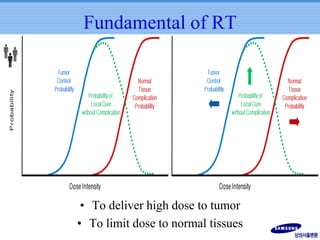
Fundamental of RT

• To deliver high dose to tumor
• To limit dose to normal tissues
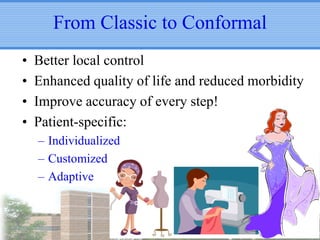
From Classic to Conformal
•
•
•
•

Better local control
Enhanced quality of life and reduced morbidity
Improve accuracy of every step!
Patient-specific:
– Individualized
– Customized
– Adaptive
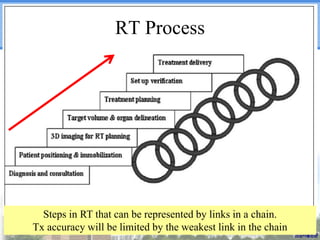
RT Process

Steps in RT that can be represented by links in a chain.
Tx accuracy will be limited by the weakest link in the chain
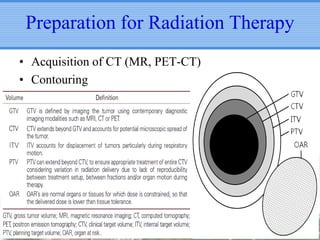
Preparation for Radiation Therapy
• Acquisition of CT (MR, PET-CT)
• Contouring
Novel Technology in RT
Image guided RT (IGRT)
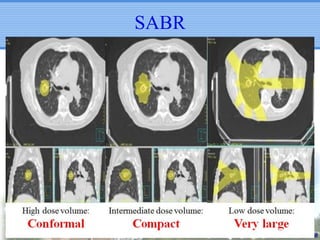
Stereotactic Ablative RT (SABR, SBRT)
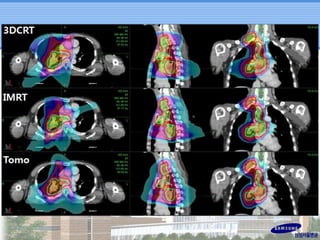
Intensity Modulated RT (IMRT)
Particle Beam Therapy (Proton; Carbon)
Image guided RT (IGRT)
Stereotactic Ablative RT (SABR, SBRT)
Intensity Modulated RT (IMRT)
Particle Beam Therapy (Proton; Carbon)
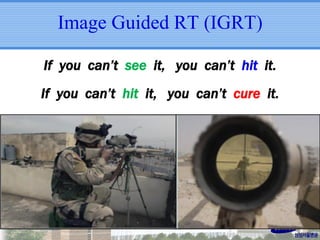
Image Guided RT (IGRT)
If you can’t see it, you can’t hit it.

If you can’t hit it, you can’t cure it.
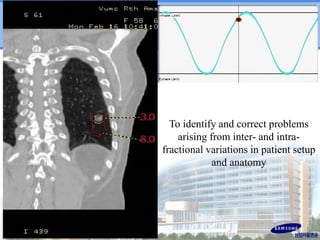
To identify and correct problems
arising from inter- and intrafractional variations in patient setup
and anatomy
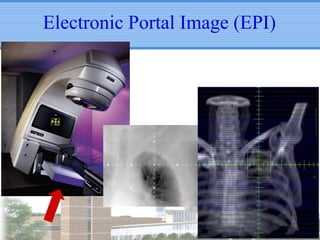
Electronic Portal Image (EPI)
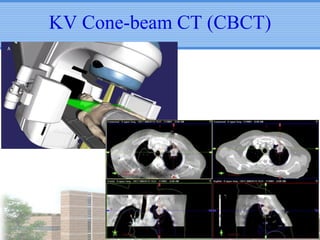
KV Cone-beam CT (CBCT)
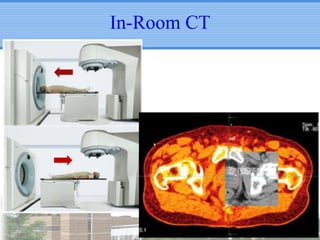
In-Room CT
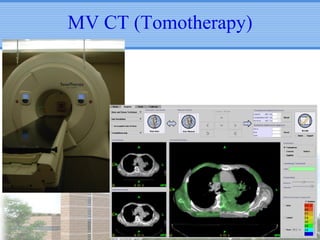
MV CT (Tomotherapy)
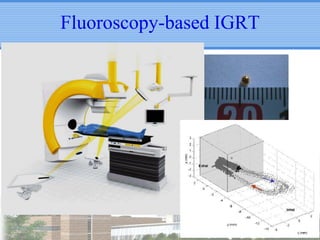
Fluoroscopy-based IGRT
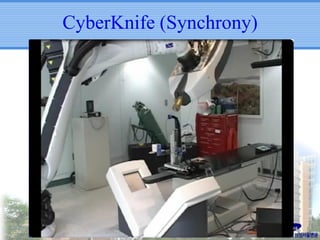
CyberKnife (Synchrony)
Image guided RT (IGRT)
Stereotactic Ablative RT (SABR, SBRT)
Intensity Modulated RT (IMRT)
Particle Beam Therapy (Proton; Carbon)
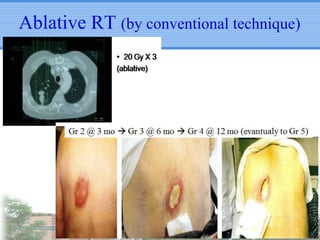
Ablative RT (by conventional technique)
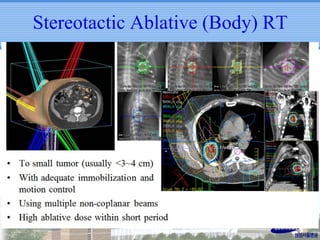
Stereotactic Ablative (Body) RT
SABR
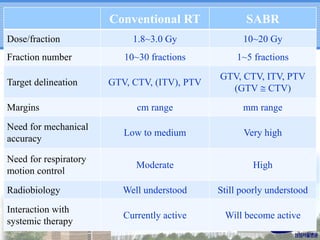
Conventional RT

SABR

1.8~3.0 Gy

10~20 Gy

10~30 fractions

1~5 fractions

GTV, CTV, (ITV), PTV

GTV, CTV, ITV, PTV
(GTV  CTV)

cm range

mm range

Need for mechanical
accuracy

Low to medium

Very high

Need for respiratory
motion control

Moderate

High

Radiobiology

Well understood

Still poorly understood

Interaction with
systemic therapy

Currently active

Will become active

Dose/fraction
Fraction number
Target delineation
Margins
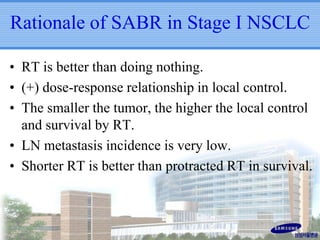
Rationale of SABR in Stage I NSCLC
• RT is better than doing nothing.
• (+) dose-response relationship in local control.
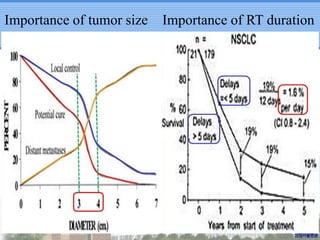
• The smaller the tumor, the higher the local control
and survival by RT.
• LN metastasis incidence is very low.
• Shorter RT is better than protracted RT in survival.
Importance of tumor size

Importance of RT duration
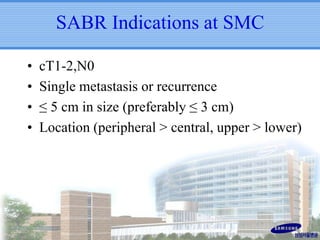
SABR Indications at SMC
•
•
•
•

cT1-2,N0
Single metastasis or recurrence
≤ 5 cm in size (preferably ≤ 3 cm)
Location (peripheral > central, upper > lower)
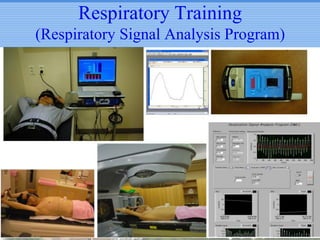
Respiratory Training
(Respiratory Signal Analysis Program)
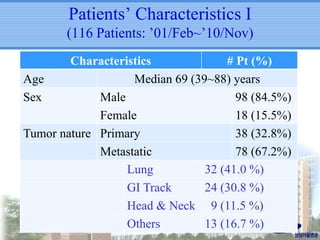
Patients’ Characteristics I
(116 Patients: ’01/Feb~’10/Nov)
Characteristics
# Pt (%)
Age
Median 69 (39~88) years
Sex
Male
98 (84.5%)
Female
18 (15.5%)
Tumor nature Primary
38 (32.8%)
Metastatic
78 (67.2%)
Lung
32 (41.0 %)
GI Track
24 (30.8 %)
Head & Neck 9 (11.5 %)
Others
13 (16.7 %)
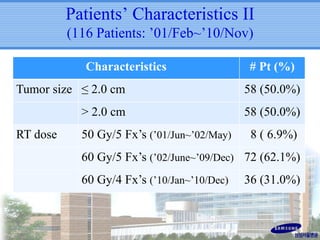
Patients’ Characteristics II
(116 Patients: ’01/Feb~’10/Nov)
Characteristics

# Pt (%)

Tumor size ≤ 2.0 cm

58 (50.0%)

> 2.0 cm

58 (50.0%)

RT dose

50 Gy/5 Fx’s (’01/Jun~’02/May)

8 ( 6.9%)

60 Gy/5 Fx’s (’02/June~’09/Dec) 72 (62.1%)
60 Gy/4 Fx’s (’10/Jan~’10/Dec)

36 (31.0%)
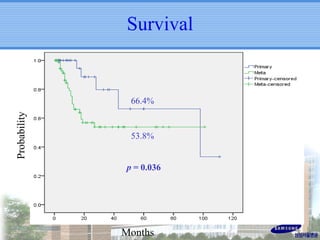
Survival

Probability

66.4%

53.8%

p = 0.036

Months
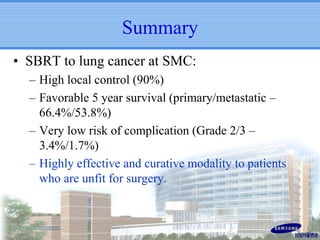
Summary
• SBRT to lung cancer at SMC:
– High local control (90%)
– Favorable 5 year survival (primary/metastatic –
66.4%/53.8%)
– Very low risk of complication (Grade 2/3 –
3.4%/1.7%)
– Highly effective and curative modality to patients
who are unfit for surgery.
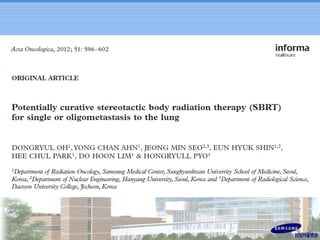
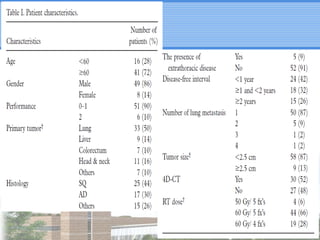
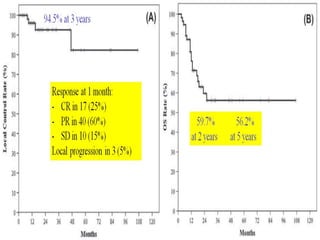
Acta Oncologica, 2012
Summary
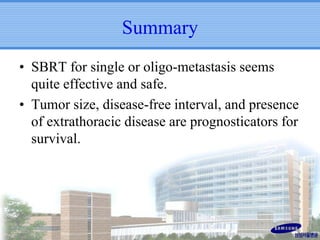
• SBRT for single or oligo-metastasis seems
quite effective and safe.
• Tumor size, disease-free interval, and presence
of extrathoracic disease are prognosticators for
survival.
Image guided RT (IGRT)
Stereotactic Ablative RT (SABR, SBRT)
Intensity Modulated RT (IMRT)
Particle Beam Therapy (Proton; Carbon)
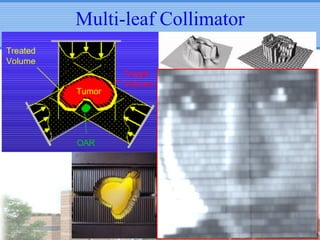
Multi-leaf Collimator
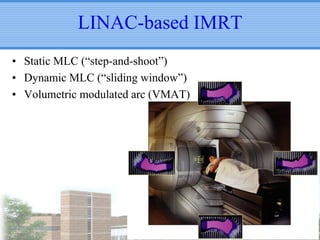
LINAC-based IMRT
• Static MLC (“step-and-shoot”)
• Dynamic MLC (“sliding window”)
• Volumetric modulated arc (VMAT)
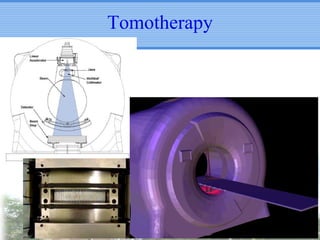
Tomotherapy
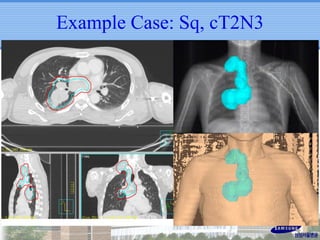
Example Case: Sq, cT2N3
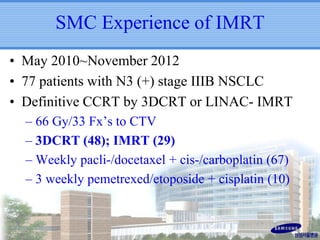
SMC Experience of IMRT
• May 2010~November 2012
• 77 patients with N3 (+) stage IIIB NSCLC
• Definitive CCRT by 3DCRT or LINAC- IMRT
– 66 Gy/33 Fx’s to CTV
– 3DCRT (48); IMRT (29)
– Weekly pacli-/docetaxel + cis-/carboplatin (67)
– 3 weekly pemetrexed/etoposide + cisplatin (10)
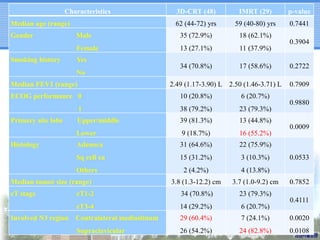
Characteristics
Gender

Male

IMRT (29)

p-value

62 (44-72) yrs

Median age (range)

3D-CRT (48)

59 (40-80) yrs

0.7441

35 (72.9%)

18 (62.1%)
0.3904

Female

11 (37.9%)

34 (70.8%)

Smoking history

13 (27.1%)

17 (58.6%)

Yes
0.2722

No
Median FEV1 (range)

2.49 (1.17-3.90) L 2.50 (1.46-3.71) L

ECOG performance 0

10 (20.8%)

0.7909

6 (20.7%)
0.9880

1
Primary site lobe

38 (79.2%)

23 (79.3%)

Upper/middle

39 (81.3%)

13 (44.8%)
0.0009

Lower

16 (55.2%)

Adenoca

31 (64.6%)

22 (75.9%)

Sq cell ca

Histology

9 (18.7%)

15 (31.2%)

3 (10.3%)

2 (4.2%)

4 (13.8%)

3.8 (1.3-12.2) cm

3.7 (1.0-9.2) cm

34 (70.8%)

23 (79.3%)

Others
Median tumor size (range)
cT stage

cT1-2

0.0533

0.7852
0.4111

cT3-4
Involved N3 region

14 (29.2%)

6 (20.7%)

Contralateral mediastinum

29 (60.4%)

7 (24.1%)

0.0020

Supraclavicular

26 (54.2%)

24 (82.8%)

0.0108
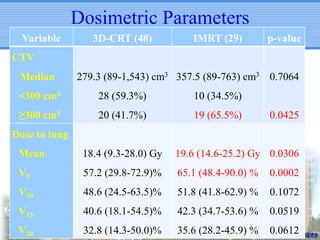
Dosimetric Parameters
Variable

3D-CRT (48)

IMRT (29)

p-value

CTV
Median

279.3 (89-1,543) cm3 357.5 (89-763) cm3 0.7064

<300 cm3

28 (59.3%)

10 (34.5%)

≥300 cm3

20 (41.7%)

19 (65.5%)

0.0425

Dose to lung
Mean

18.4 (9.3-28.0) Gy

19.6 (14.6-25.2) Gy 0.0306

V5

57.2 (29.8-72.9)%

65.1 (48.4-90.0) %

0.0002

V10

48.6 (24.5-63.5)%

51.8 (41.8-62.9) %

0.1072

V15

40.6 (18.1-54.5)%

42.3 (34.7-53.6) %

0.0519

V20

32.8 (14.3-50.0)%

35.6 (28.2-45.9) %

0.0612
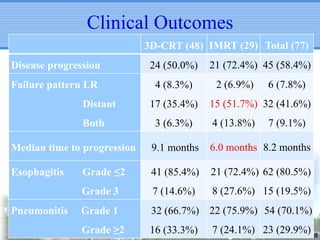
Clinical Outcomes
3D-CRT (48) IMRT (29) Total (77)
Disease progression

24 (50.0%)

Failure pattern LR

4 (8.3%)

Distant

Both

17 (35.4%)

3 (6.3%)

21 (72.4%) 45 (58.4%)
2 (6.9%)

6 (7.8%)

15 (51.7%) 32 (41.6%)
4 (13.8%)

7 (9.1%)

9.1 months

6.0 months 8.2 months

Grade ≤2

41 (85.4%)

21 (72.4%) 62 (80.5%)

Grade 3

7 (14.6%)

8 (27.6%) 15 (19.5%)

Grade 1

32 (66.7%) 22 (75.9%) 54 (70.1%)

Grade ≥2

16 (33.3%)

Median time to progression
Esophagitis

Pneumonitis

7 (24.1%) 23 (29.9%)
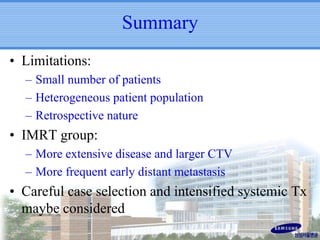
Summary
• Limitations:
– Small number of patients
– Heterogeneous patient population
– Retrospective nature

• IMRT group:
– More extensive disease and larger CTV
– More frequent early distant metastasis

• Careful case selection and intensified systemic Tx
maybe considered
Image guided RT (IGRT)
Stereotactic Ablative RT (SABR, SBRT)
Intensity Modulated RT (IMRT)
Particle Beam Therapy (Proton)
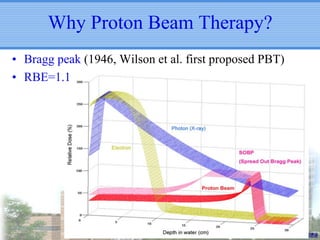
Why Proton Beam Therapy?
• Bragg peak (1946, Wilson et al. first proposed PBT)
• RBE=1.1
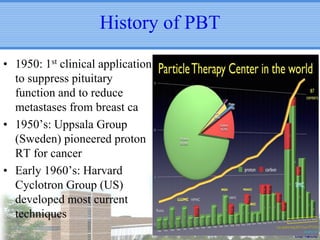
History of PBT
• 1950: 1st clinical application
to suppress pituitary
function and to reduce
metastases from breast ca
• 1950’s: Uppsala Group
(Sweden) pioneered proton
RT for cancer
• Early 1960’s: Harvard
Cyclotron Group (US)
developed most current
techniques
50
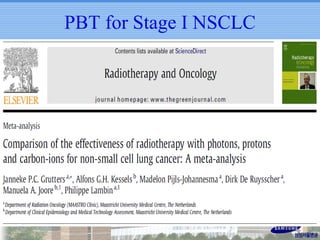
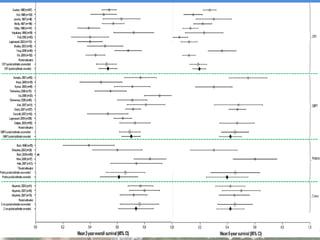
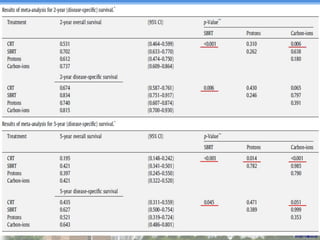
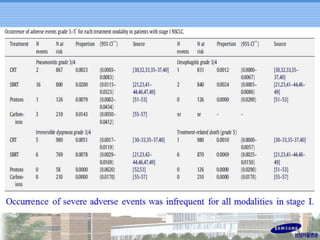
PBT for Stage I NSCLC
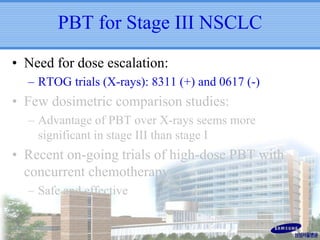
PBT for Stage III NSCLC
• Need for dose escalation:
– RTOG trials (X-rays): 8311 (+) and 0617 (-)

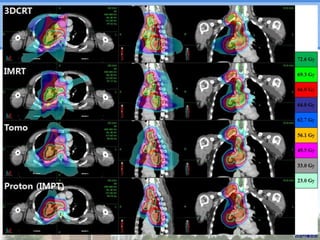
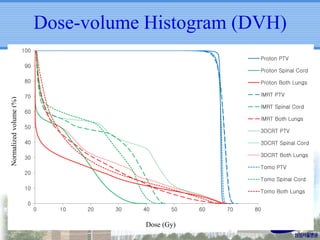
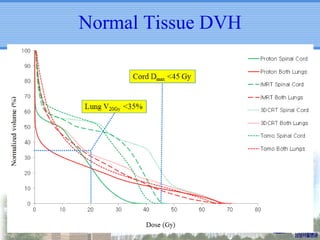
• Few dosimetric comparison studies:
– Advantage of PBT over X-rays seems more
significant in stage III than stage I

• Recent on-going trials of high-dose PBT with
concurrent chemotherapy
– Safe and effective
Dose-volume Histogram (DVH)
100
Proton PTV
90

Proton Spinal Cord

Normalized volume (%)

80

Proton Both Lungs

70

IMRT PTV
IMRT Spinal Cord

60

IMRT Both Lungs
50

3DCRT PTV

40

3DCRT Spinal Cord

30

3DCRT Both Lungs
Tomo PTV

20
Tomo Spinal Cord
10

Tomo Both Lungs

0
0

10

20

30

40

50

Dose (Gy)

60

70

80
Normal Tissue DVH
Normalized volume (%)

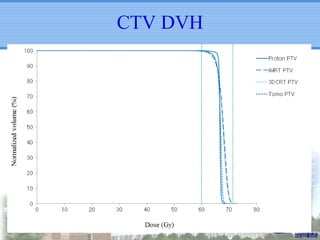
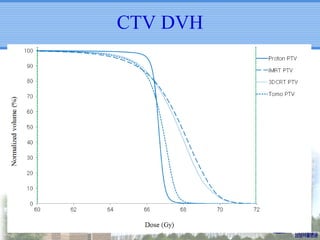
CTV DVH
CTV DVH
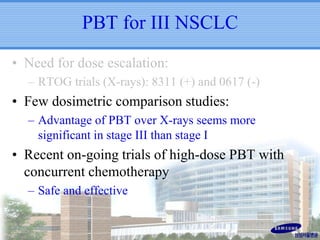
PBT for III NSCLC
• Need for dose escalation:
– RTOG trials (X-rays): 8311 (+) and 0617 (-)

• Few dosimetric comparison studies:
– Advantage of PBT over X-rays seems more
significant in stage III than stage I

• Recent on-going trials of high-dose PBT with
concurrent chemotherapy
– Safe and effective
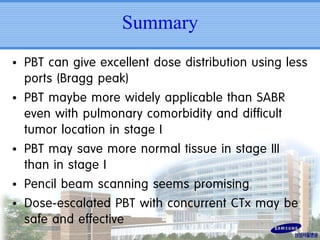
Summary
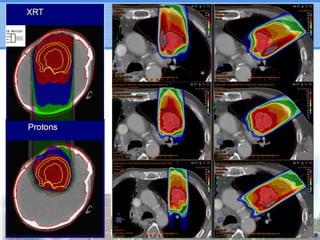
• PBT can give excellent dose distribution using less
ports (Bragg peak)
• PBT maybe more widely applicable than SABR
even with pulmonary comorbidity and difficult
tumor location in stage I
• PBT may save more normal tissue in stage III
than in stage I
• Pencil beam scanning seems promising
• Dose-escalated PBT with concurrent CTx may be
safe and effective
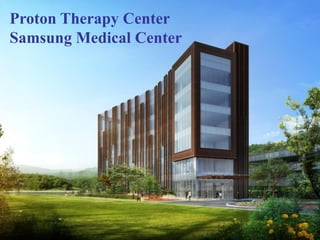
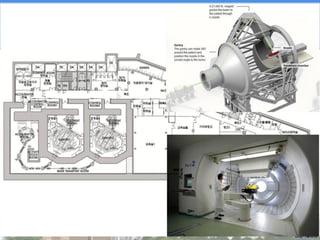
Proton Therapy Center
Samsung Medical Center
Multidisciplinary
approach
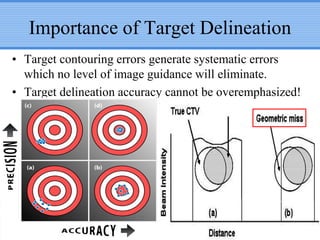
Importance of Target Delineation
• Target contouring errors generate systematic errors
which no level of image guidance will eliminate.
• Target delineation accuracy cannot be overemphasized!
Novel RT techniques for treating lung cancer 1403

Novel RT techniques for treating lung cancer 1403

  • 1.
    Novel RT Techniques ForLung Cancer Treatment Yong Chan Ahn, MD, PhD Dept. of Radiation Oncology Samsung Medical Center Sungkyunkwan University School of Medicine
  • 3.
    Fundamental of RT •To deliver high dose to tumor • To limit dose to normal tissues
  • 4.
    From Classic toConformal • • • • Better local control Enhanced quality of life and reduced morbidity Improve accuracy of every step! Patient-specific: – Individualized – Customized – Adaptive
  • 5.
    RT Process Steps inRT that can be represented by links in a chain. Tx accuracy will be limited by the weakest link in the chain
  • 6.
    Preparation for RadiationTherapy • Acquisition of CT (MR, PET-CT) • Contouring
  • 7.
    Novel Technology inRT Image guided RT (IGRT) Stereotactic Ablative RT (SABR, SBRT) Intensity Modulated RT (IMRT) Particle Beam Therapy (Proton; Carbon)
  • 8.
    Image guided RT(IGRT) Stereotactic Ablative RT (SABR, SBRT) Intensity Modulated RT (IMRT) Particle Beam Therapy (Proton; Carbon)
  • 9.
    Image Guided RT(IGRT) If you can’t see it, you can’t hit it. If you can’t hit it, you can’t cure it.
  • 10.
    To identify andcorrect problems arising from inter- and intrafractional variations in patient setup and anatomy
  • 11.
  • 12.
  • 13.
  • 14.
  • 15.
  • 16.
  • 17.
    Image guided RT(IGRT) Stereotactic Ablative RT (SABR, SBRT) Intensity Modulated RT (IMRT) Particle Beam Therapy (Proton; Carbon)
  • 18.
    Ablative RT (byconventional technique)
  • 19.
  • 20.
  • 21.
    Conventional RT SABR 1.8~3.0 Gy 10~20Gy 10~30 fractions 1~5 fractions GTV, CTV, (ITV), PTV GTV, CTV, ITV, PTV (GTV  CTV) cm range mm range Need for mechanical accuracy Low to medium Very high Need for respiratory motion control Moderate High Radiobiology Well understood Still poorly understood Interaction with systemic therapy Currently active Will become active Dose/fraction Fraction number Target delineation Margins
  • 22.
    Rationale of SABRin Stage I NSCLC • RT is better than doing nothing. • (+) dose-response relationship in local control. • The smaller the tumor, the higher the local control and survival by RT. • LN metastasis incidence is very low. • Shorter RT is better than protracted RT in survival.
  • 23.
    Importance of tumorsize Importance of RT duration
  • 24.
    SABR Indications atSMC • • • • cT1-2,N0 Single metastasis or recurrence ≤ 5 cm in size (preferably ≤ 3 cm) Location (peripheral > central, upper > lower)
  • 25.
  • 28.
    Patients’ Characteristics I (116Patients: ’01/Feb~’10/Nov) Characteristics # Pt (%) Age Median 69 (39~88) years Sex Male 98 (84.5%) Female 18 (15.5%) Tumor nature Primary 38 (32.8%) Metastatic 78 (67.2%) Lung 32 (41.0 %) GI Track 24 (30.8 %) Head & Neck 9 (11.5 %) Others 13 (16.7 %)
  • 29.
    Patients’ Characteristics II (116Patients: ’01/Feb~’10/Nov) Characteristics # Pt (%) Tumor size ≤ 2.0 cm 58 (50.0%) > 2.0 cm 58 (50.0%) RT dose 50 Gy/5 Fx’s (’01/Jun~’02/May) 8 ( 6.9%) 60 Gy/5 Fx’s (’02/June~’09/Dec) 72 (62.1%) 60 Gy/4 Fx’s (’10/Jan~’10/Dec) 36 (31.0%)
  • 30.
  • 31.
    Summary • SBRT tolung cancer at SMC: – High local control (90%) – Favorable 5 year survival (primary/metastatic – 66.4%/53.8%) – Very low risk of complication (Grade 2/3 – 3.4%/1.7%) – Highly effective and curative modality to patients who are unfit for surgery.
  • 34.
  • 35.
    Summary • SBRT forsingle or oligo-metastasis seems quite effective and safe. • Tumor size, disease-free interval, and presence of extrathoracic disease are prognosticators for survival.
  • 36.
    Image guided RT(IGRT) Stereotactic Ablative RT (SABR, SBRT) Intensity Modulated RT (IMRT) Particle Beam Therapy (Proton; Carbon)
  • 37.
  • 38.
    LINAC-based IMRT • StaticMLC (“step-and-shoot”) • Dynamic MLC (“sliding window”) • Volumetric modulated arc (VMAT)
  • 39.
  • 40.
  • 42.
    SMC Experience ofIMRT • May 2010~November 2012 • 77 patients with N3 (+) stage IIIB NSCLC • Definitive CCRT by 3DCRT or LINAC- IMRT – 66 Gy/33 Fx’s to CTV – 3DCRT (48); IMRT (29) – Weekly pacli-/docetaxel + cis-/carboplatin (67) – 3 weekly pemetrexed/etoposide + cisplatin (10)
  • 43.
    Characteristics Gender Male IMRT (29) p-value 62 (44-72)yrs Median age (range) 3D-CRT (48) 59 (40-80) yrs 0.7441 35 (72.9%) 18 (62.1%) 0.3904 Female 11 (37.9%) 34 (70.8%) Smoking history 13 (27.1%) 17 (58.6%) Yes 0.2722 No Median FEV1 (range) 2.49 (1.17-3.90) L 2.50 (1.46-3.71) L ECOG performance 0 10 (20.8%) 0.7909 6 (20.7%) 0.9880 1 Primary site lobe 38 (79.2%) 23 (79.3%) Upper/middle 39 (81.3%) 13 (44.8%) 0.0009 Lower 16 (55.2%) Adenoca 31 (64.6%) 22 (75.9%) Sq cell ca Histology 9 (18.7%) 15 (31.2%) 3 (10.3%) 2 (4.2%) 4 (13.8%) 3.8 (1.3-12.2) cm 3.7 (1.0-9.2) cm 34 (70.8%) 23 (79.3%) Others Median tumor size (range) cT stage cT1-2 0.0533 0.7852 0.4111 cT3-4 Involved N3 region 14 (29.2%) 6 (20.7%) Contralateral mediastinum 29 (60.4%) 7 (24.1%) 0.0020 Supraclavicular 26 (54.2%) 24 (82.8%) 0.0108
  • 44.
    Dosimetric Parameters Variable 3D-CRT (48) IMRT(29) p-value CTV Median 279.3 (89-1,543) cm3 357.5 (89-763) cm3 0.7064 <300 cm3 28 (59.3%) 10 (34.5%) ≥300 cm3 20 (41.7%) 19 (65.5%) 0.0425 Dose to lung Mean 18.4 (9.3-28.0) Gy 19.6 (14.6-25.2) Gy 0.0306 V5 57.2 (29.8-72.9)% 65.1 (48.4-90.0) % 0.0002 V10 48.6 (24.5-63.5)% 51.8 (41.8-62.9) % 0.1072 V15 40.6 (18.1-54.5)% 42.3 (34.7-53.6) % 0.0519 V20 32.8 (14.3-50.0)% 35.6 (28.2-45.9) % 0.0612
  • 45.
    Clinical Outcomes 3D-CRT (48)IMRT (29) Total (77) Disease progression 24 (50.0%) Failure pattern LR 4 (8.3%) Distant Both 17 (35.4%) 3 (6.3%) 21 (72.4%) 45 (58.4%) 2 (6.9%) 6 (7.8%) 15 (51.7%) 32 (41.6%) 4 (13.8%) 7 (9.1%) 9.1 months 6.0 months 8.2 months Grade ≤2 41 (85.4%) 21 (72.4%) 62 (80.5%) Grade 3 7 (14.6%) 8 (27.6%) 15 (19.5%) Grade 1 32 (66.7%) 22 (75.9%) 54 (70.1%) Grade ≥2 16 (33.3%) Median time to progression Esophagitis Pneumonitis 7 (24.1%) 23 (29.9%)
  • 46.
    Summary • Limitations: – Smallnumber of patients – Heterogeneous patient population – Retrospective nature • IMRT group: – More extensive disease and larger CTV – More frequent early distant metastasis • Careful case selection and intensified systemic Tx maybe considered
  • 47.
    Image guided RT(IGRT) Stereotactic Ablative RT (SABR, SBRT) Intensity Modulated RT (IMRT) Particle Beam Therapy (Proton)
  • 48.
    Why Proton BeamTherapy? • Bragg peak (1946, Wilson et al. first proposed PBT) • RBE=1.1
  • 49.
    History of PBT •1950: 1st clinical application to suppress pituitary function and to reduce metastases from breast ca • 1950’s: Uppsala Group (Sweden) pioneered proton RT for cancer • Early 1960’s: Harvard Cyclotron Group (US) developed most current techniques
  • 50.
  • 51.
  • 55.
    PBT for StageIII NSCLC • Need for dose escalation: – RTOG trials (X-rays): 8311 (+) and 0617 (-) • Few dosimetric comparison studies: – Advantage of PBT over X-rays seems more significant in stage III than stage I • Recent on-going trials of high-dose PBT with concurrent chemotherapy – Safe and effective
  • 57.
    Dose-volume Histogram (DVH) 100 ProtonPTV 90 Proton Spinal Cord Normalized volume (%) 80 Proton Both Lungs 70 IMRT PTV IMRT Spinal Cord 60 IMRT Both Lungs 50 3DCRT PTV 40 3DCRT Spinal Cord 30 3DCRT Both Lungs Tomo PTV 20 Tomo Spinal Cord 10 Tomo Both Lungs 0 0 10 20 30 40 50 Dose (Gy) 60 70 80
  • 58.
  • 59.
  • 60.
  • 61.
    PBT for IIINSCLC • Need for dose escalation: – RTOG trials (X-rays): 8311 (+) and 0617 (-) • Few dosimetric comparison studies: – Advantage of PBT over X-rays seems more significant in stage III than stage I • Recent on-going trials of high-dose PBT with concurrent chemotherapy – Safe and effective
  • 64.
    Summary • PBT cangive excellent dose distribution using less ports (Bragg peak) • PBT maybe more widely applicable than SABR even with pulmonary comorbidity and difficult tumor location in stage I • PBT may save more normal tissue in stage III than in stage I • Pencil beam scanning seems promising • Dose-escalated PBT with concurrent CTx may be safe and effective
  • 65.
  • 67.
  • 69.
    Importance of TargetDelineation • Target contouring errors generate systematic errors which no level of image guidance will eliminate. • Target delineation accuracy cannot be overemphasized!