ACROMEGALY

  Ilan Shimon, MD
Rabin Medical Center,
    Petach-Tiqva
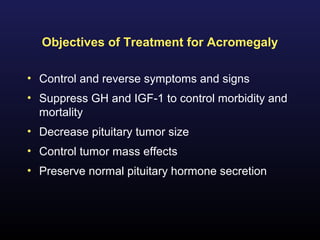
Objectives of Treatment for Acromegaly

• Control and reverse symptoms and signs
• Suppress GH and IGF-1 to control morbidity and
  mortality
• Decrease pituitary tumor size
• Control tumor mass effects
• Preserve normal pituitary hormone secretion
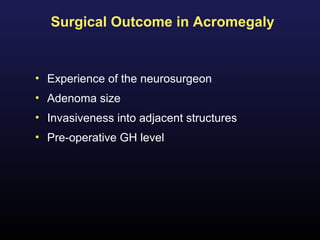
Surgical Outcome in Acromegaly


• Experience of the neurosurgeon
• Adenoma size
• Invasiveness into adjacent structures
• Pre-operative GH level
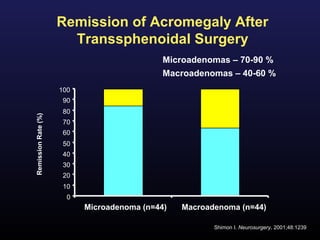
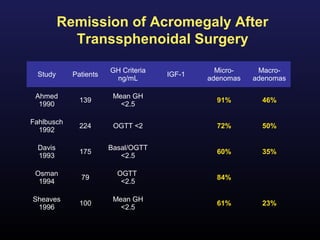
Remission of Acromegaly After
                       Transsphenoidal Surgery
                                             Microadenomas – 70-90 %
                                             Macroadenomas – 40-60 %
                     100
                      90
                      80
Remission Rate (%)


                      70
                      60
                      50
                      40
                      30
                      20
                      10
                       0
                           Microadenoma (n=44)   Macroadenoma (n=44)

                                                        Shimon I. Neurosurgery. 2001;48:1239
Remission of Acromegaly After
            Transsphenoidal Surgery

                       GH Criteria             Micro-    Macro-
  Study     Patients                 IGF-1
                        ng/mL                adenomas   adenomas

 Ahmed                  Mean GH
              139                              91%        46%
  1990                    <2.5

Fahlbusch
              224       OGTT <2                72%        50%
  1992

  Davis                Basal/OGTT
              175                              60%        35%
  1993                    <2.5

 Osman                   OGTT
              79                               84%
  1994                    <2.5

Sheaves                 Mean GH
              100                              61%        23%
 1996                     <2.5
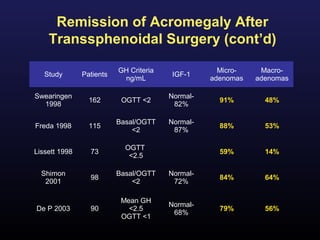
Remission of Acromegaly After
    Transsphenoidal Surgery (cont’d)

                          GH Criteria               Micro-    Macro-
   Study       Patients                 IGF-1
                           ng/mL                  adenomas   adenomas

Swearingen                              Normal-
                 162       OGTT <2                  91%        48%
  1998                                   82%

                          Basal/OGTT    Normal-
Freda 1998       115                                88%        53%
                              <2         87%

                            OGTT
Lissett 1998     73                                 59%        14%
                             <2.5

  Shimon                  Basal/OGTT    Normal-
                 98                                 84%        64%
   2001                       <2         72%

                           Mean GH
                                        Normal-
De P 2003        90          <2.5                   79%        56%
                                         68%
                           OGTT <1
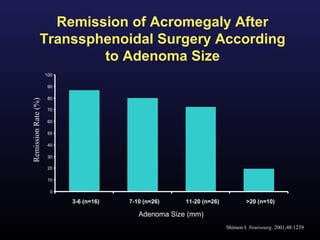
Remission of Acromegaly After
               Transsphenoidal Surgery According
                       to Adenoma Size
                     100

                      90

                      80
Remission Rate (%)


                      70

                      60

                      50

                      40

                      30

                      20

                      10

                       0

                           3-6 (n=16)   7-10 (n=26)    11-20 (n=26)           >20 (n=10)

                                           Adenoma Size (mm)
                                                                      Shimon I. Neurosurg. 2001;48:1239
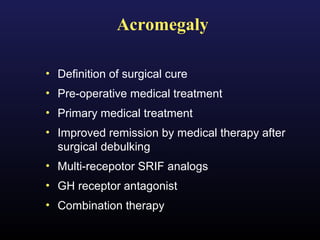
Acromegaly

• Definition of surgical cure
• Pre-operative medical treatment
• Primary medical treatment
• Improved remission by medical therapy after
  surgical debulking
• Multi-recepotor SRIF analogs
• GH receptor antagonist
• Combination therapy
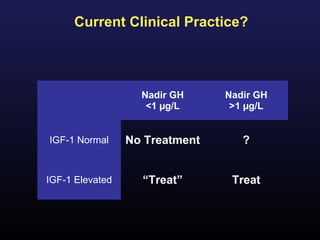
Current Clinical Practice?


                   Nadir GH     Nadir GH
                    <1 µg/L      >1 µg/L


IGF-1 Normal     No Treatment      ?


IGF-1 Elevated     “Treat”       Treat
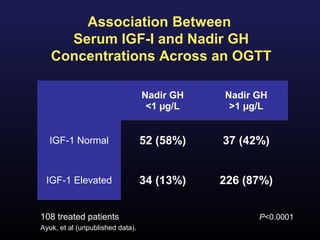
Association Between
     Serum IGF-I and Nadir GH
   Concentrations Across an OGTT

                                  Nadir GH   Nadir GH
                                   <1 µg/L    >1 µg/L


  IGF-1 Normal                    52 (58%)   37 (42%)


 IGF-1 Elevated                   34 (13%)   226 (87%)


108 treated patients                               P<0.0001
Ayuk, et al (unpublished data).
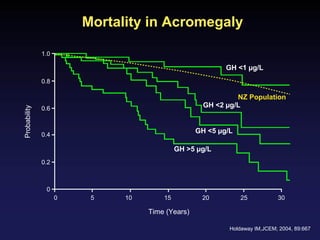
Mortality in Acromegaly

              1.0

                                                          GH <1 µg/L
              0.8

                                                             NZ Population
              0.6                                   GH <2 µg/L
Probability


                                                  GH <5 µg/L
              0.4

                                            GH >5 µg/L
              0.2


               0
                    0    5    10       15          20          25           30

                                   Time (Years)

                                                           Holdaway IM,JCEM; 2004, 89:667
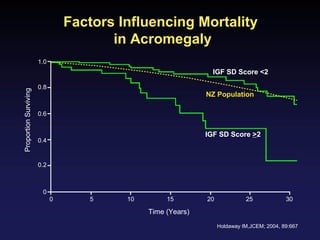
Factors Influencing Mortality
                                        in Acromegaly
                       1.0
                                                                IGF SD Score <2

                       0.8
Proportion Surviving


                                                              NZ Population

                       0.6


                                                              IGF SD Score >2
                       0.4


                       0.2


                        0
                             0      5     10        15        20             25             30

                                               Time (Years)
                                                                   Holdaway IM,JCEM; 2004, 89:667
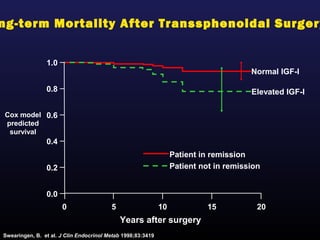
ng-term Mortality After Transsphenoidal Surgery


                1.0
                                                                                       Normal IGF-I

                0.8                                                                    Elevated IGF-I

Cox model 0.6
predicted
 survival
                0.4
                                                                  Patient in remission
                0.2                                               Patient not in remission


                0.0
                      0                  5                   10             15           20
                                             Years after surgery
Swearingen, B. et al. J Clin Endocrinol Metab 1998;83:3419
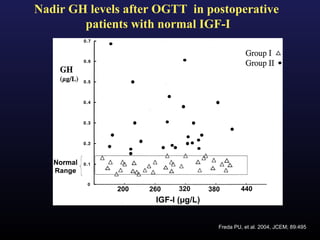
Nadir GH levels after OGTT in postoperative
        patients with normal IGF-I


                                Freda PU, et al. 2004, JCEM; 89:495
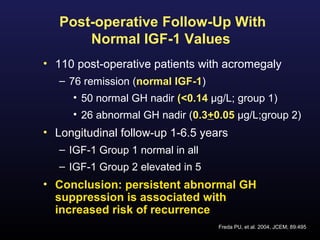
Post-operative Follow-Up With
       Normal IGF-1 Values
• 110 post-operative patients with acromegaly
   – 76 remission (normal IGF-1)
     • 50 normal GH nadir (<0.14 µg/L; group 1)
     • 26 abnormal GH nadir (0.3+0.05 µg/L;group 2)
• Longitudinal follow-up 1-6.5 years
   – IGF-1 Group 1 normal in all
   – IGF-1 Group 2 elevated in 5
• Conclusion: persistent abnormal GH
  suppression is associated with
  increased risk of recurrence
                                   Freda PU, et al. 2004, JCEM; 89:495
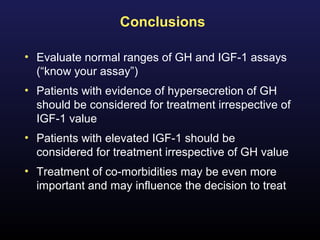
Conclusions

• Evaluate normal ranges of GH and IGF-1 assays
  (“know your assay”)
• Patients with evidence of hypersecretion of GH
  should be considered for treatment irrespective of
  IGF-1 value
• Patients with elevated IGF-1 should be
  considered for treatment irrespective of GH value
• Treatment of co-morbidities may be even more
  important and may influence the decision to treat
Pre-operative Treatment With
       Somatostatin Analogs—
           Clinical Studies

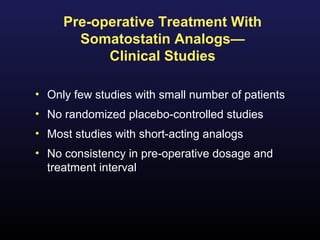
• Only few studies with small number of patients
• No randomized placebo-controlled studies
• Most studies with short-acting analogs
• No consistency in pre-operative dosage and
  treatment interval
Pre-operative Treatment With
        Somatostatin Analogs

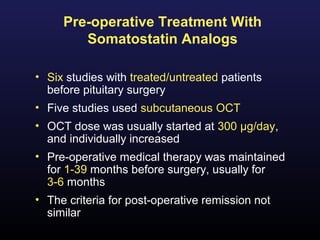
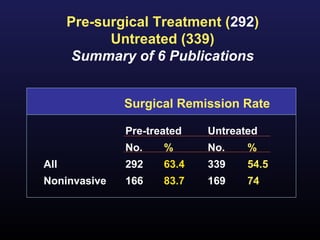
• Six studies with treated/untreated patients
  before pituitary surgery
• Five studies used subcutaneous OCT
• OCT dose was usually started at 300 µg/day,
  and individually increased
• Pre-operative medical therapy was maintained
  for 1-39 months before surgery, usually for
  3-6 months
• The criteria for post-operative remission not
  similar
Available Comparative Studies

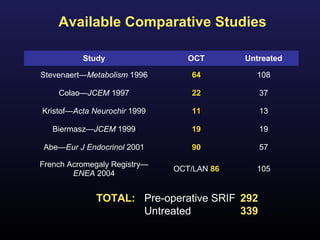
          Study                  OCT       Untreated

Stevenaert—Metabolism 1996        64         108

    Colao—JCEM 1997               22          37

Kristof—Acta Neurochir 1999       11          13

   Biermasz—JCEM 1999             19          19

Abe—Eur J Endocrinol 2001         90          57

French Acromegaly Registry—
                              OCT/LAN 86     105
        ENEA 2004


              TOTAL: Pre-operative SRIF 292
                     Untreated          339
French Acromegaly Registry–
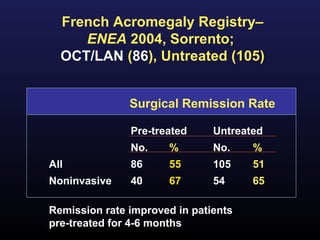
     ENEA 2004, Sorrento;
  OCT/LAN (86), Untreated (105)


               Surgical Remission Rate

               Pre-treated     Untreated
               No.    %        No.    %
All            86     55       105    51
Noninvasive    40     67       54     65

Remission rate improved in patients
pre-treated for 4-6 months
Pre-surgical Treatment (292)
            Untreated (339)
       Summary of 6 Publications


              Surgical Remission Rate

              Pre-treated   Untreated
              No.    %      No.    %
All           292    63.4   339    54.5
Noninvasive   166    83.7   169    74
Odds Ratio Plot
                                 (Fixed Effects)
                                           Mantel-Haenszel chi-square = 0.7341; P = 0.3916
                             Odds ratio meta-analysis plot [fixed effects]


       stratum 1   French Registry                                                   1.14 (0.62, 2.10)


       stratum 2   Abe & Ludecke                                                     0.65 (0.28, 1.48)


       stratum 3   Biermasz NR                                                       0.61 (0.12, 2.98)


       stratum 4   Kristof RA                                                        0.53 (0.07, 3.79)


       stratum 5   Colao A                                                           2.84 (0.83, 9.77)


       stratum 6                                                                     5.74 (1.42, 32.93)
                   Stevenaert & Beckers
       stratum 7                                                                     0.98 (0.29, 3.10)


combined [fixed]                                                                     1.18 (0.84, 1.66)


                   0.01           0.1    0.2      0.5    1     2        5      10   100
                                        odds ratio (95% confidence interval)
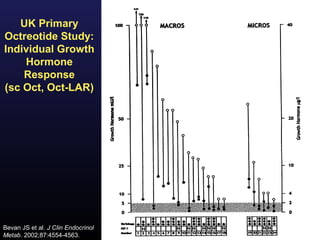
UK Primary
Octreotide Study:
Individual Growth
    Hormone
    Response
(sc Oct, Oct-LAR)


Bevan JS et al. J Clin Endocrinol
Metab. 2002;87:4554-4563.
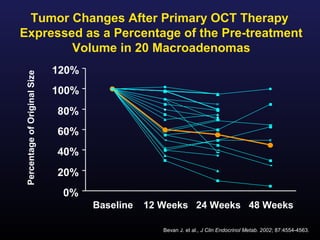
Tumor Changes After Primary OCT Therapy
Expressed as a Percentage of the Pre-treatment
        Volume in 20 Macroadenomas
                              120%
Percentage of Original Size


                              100%
                              80%
                              60%
                              40%
                              20%
                               0%
                                     Baseline   12 Weeks 24 Weeks 48 Weeks

                                                   Bevan J. et al., J Clin Endocrinol Metab. 2002; 87:4554-4563.
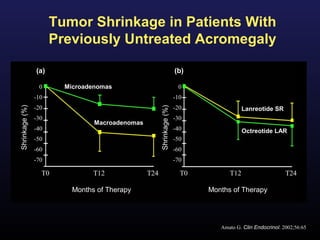
Tumor Shrinkage in Patients With
                      Previously Untreated Acromegaly

                (a)                                                   (b)

                 0      Microadenomas                                  0
                -10                                                   -10
Shrinkage (%)


                                                      Shrinkage (%)
                -20                                                   -20                Lanreotide SR
                -30                                                   -30
                                Macroadenomas
                -40                                                   -40                Octreotide LAR
                -50                                                   -50
                -60                                                   -60
                -70                                                   -70

                  T0            T12             T24                     T0         T12                     T24

                          Months of Therapy                                  Months of Therapy


                                                                                Amato G. Clin Endocrinol. 2002;56:65
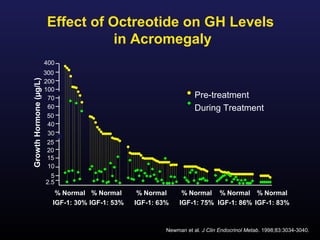
Effect of Octreotide on GH Levels
                                   in Acromegaly
                        400
                        300
Growth Hormone (µg/L)


                        200
                        100
                         70                                           Pre-treatment
                         60                                           During Treatment
                         50
                         40
                         30
                         25
                         20
                         15
                         10
                          5
                        2.5
                           % Normal % Normal       % Normal      % Normal % Normal % Normal
                          IGF-1: 30% IGF-1: 53%   IGF-1: 63%    IGF-1: 75% IGF-1: 86% IGF-1: 83%


                                                           Newman et al. J Clin Endocrinol Metab. 1998;83:3034-3040.
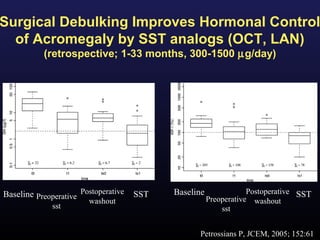
Surgical Debulking Improves Hormonal Control
  of Acromegaly by SST analogs (OCT, LAN)
           (retrospective; 1-33 months, 300-1500 µg/day)


Baseline Preoperative Postoperative   SST   Baseline               Postoperative SST
                        washout                        Preoperative washout
              sst                                          sst


                                                  Petrossians P, JCEM, 2005; 152:61
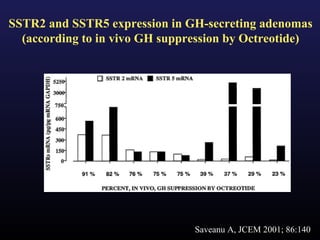
SSTR2 and SSTR5 expression in GH-secreting adenomas
  (according to in vivo GH suppression by Octreotide)


                                Saveanu A, JCEM 2001; 86:140
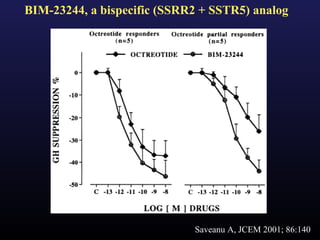
BIM-23244, a bispecific (SSRR2 + SSTR5) analog


                             Saveanu A, JCEM 2001; 86:140
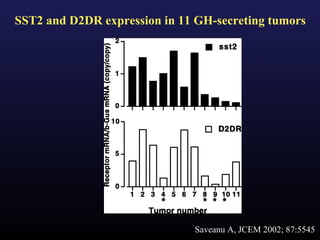
SST2 and D2DR expression in 11 GH-secreting tumors


                              Saveanu A, JCEM 2002; 87:5545
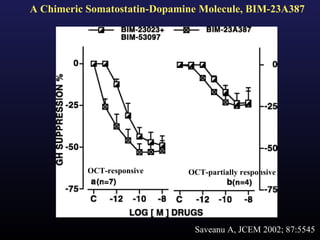
A Chimeric Somatostatin-Dopamine Molecule, BIM-23A387


           OCT-responsive     OCT-partially responsive


                               Saveanu A, JCEM 2002; 87:5545
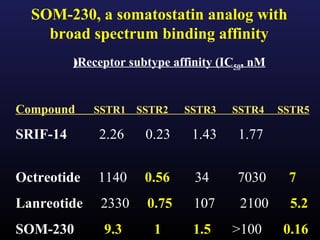
SOM-230, a somatostatin analog with
    broad spectrum binding affinity
          (Receptor subtype affinity (IC50, nM


Compound     SSTR1    SSTR2   SSTR3    SSTR4     SSTR5

SRIF-14       2.26     0.23     1.43    1.77


Octreotide    1140     0.56     34      7030      7
Lanreotide     2330    0.75     107      2100     5.2
SOM-230        9.3       1      1.5    >100      0.16
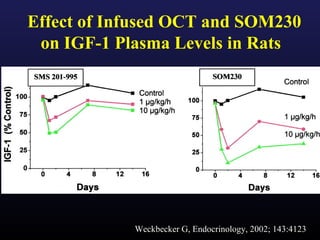
Effect of Infused OCT and SOM230
 on IGF-1 Plasma Levels in Rats


            Weckbecker G, Endocrinology, 2002; 143:4123
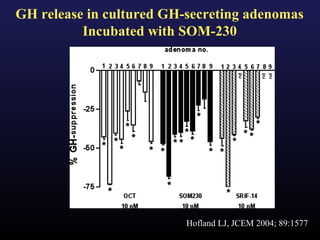
GH release in cultured GH-secreting adenomas
          Incubated with SOM-230


                          Hofland LJ, JCEM 2004; 89:1577
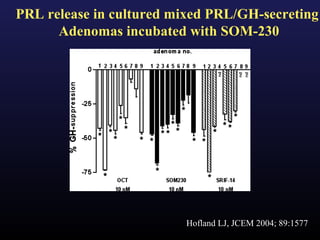
PRL release in cultured mixed PRL/GH-secreting
      Adenomas incubated with SOM-230


                         Hofland LJ, JCEM 2004; 89:1577
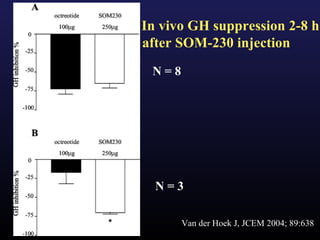
In vivo GH suppression 2-8 h
after SOM-230 injection
 N=8


  N=3

       Van der Hoek J, JCEM 2004; 89:638
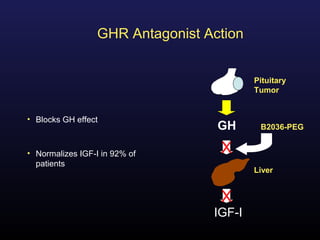
GHR Antagonist Action


                                          Pituitary
                                          Tumor


• Blocks GH effect
                                   GH      B2036-PEG


• Normalizes IGF-I in 92% of       X
  patients
                                          Liver


                                   X
                                  IGF-I
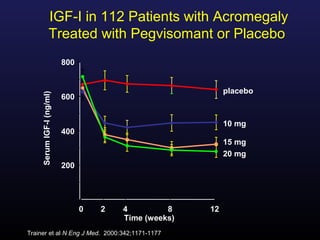
IGF-I in 112 Patients with Acromegaly
                  Treated with Pegvisomant or Placebo
                           800


                                                             placebo
     Serum IGF-I (ng/ml)


                           600


                                                             10 mg
                           400
                                                             15 mg
                                                             20 mg
                           200


                                 0   2   4         8    12
                                         Time (weeks)
Trainer et al N Eng J Med. 2000:342;1171-1177
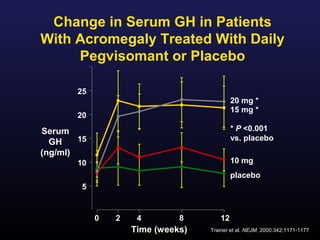
Change in Serum GH in Patients
With Acromegaly Treated With Daily
     Pegvisomant or Placebo

        25
                                            20 mg *
                                            15 mg *
        20

Serum                                       * P <0.001
        15                                  vs. placebo
  GH
(ng/ml)
        10                                  10 mg
                                            placebo
         5


             0   2    4        8       12
                     Time (weeks)   Trainer et al. NEJM. 2000:342;1171-1177
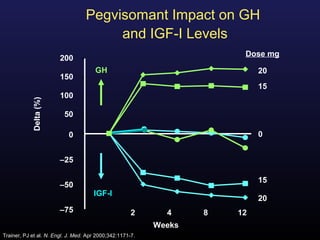
Pegvisomant Impact on GH
                                        and IGF-I Levels
                                                                        Dose mg
                        200
                                       GH                                   20
                        150
                                                                            15
                        100
            Delta (%)


                          50

                           0                                                0


                        –25

                                                                            15
                        –50
                                      IGF-I
                                                                            20
                        –75                           2      4     8   12
                                                           Weeks
Trainer, PJ et al. N. Engl. J. Med. Apr 2000;342:1171-7.
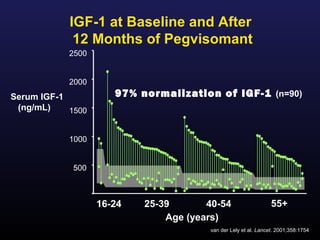
IGF-1 at Baseline and After
             12 Months of Pegvisomant
            2500


            2000
Serum IGF-1           97% normalization of IGF-1 (n=90)
 (ng/mL)    1500


            1000


             500


                   16-24   25-39       40-54                    55+
                               Age (years)
                                       van der Lely et al. Lancet. 2001;358:1754
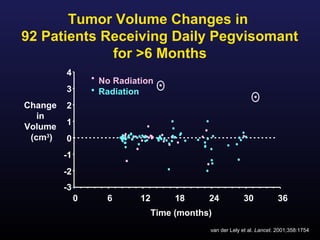
Tumor Volume Changes in
92 Patients Receiving Daily Pegvisomant
             for >6 Months
         4
                  No Radiation
         3        Radiation
Change   2
   in
         1
Volume
 (cm3)   0
         -1
         -2
         -3
              0    6       12        18     24           30            36
                                Time (months)
                                            van der Lely et al. Lancet. 2001;358:1754
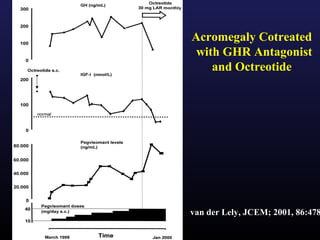
Acromegaly Cotreated
 with GHR Antagonist
    and Octreotide


van der Lely, JCEM; 2001, 86:478
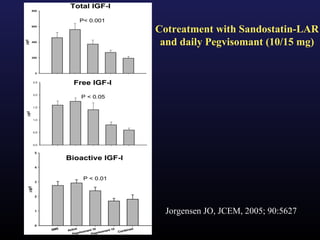
Cotreatment with Sandostatin-LAR
 and daily Pegvisomant (10/15 mg)


  Jorgensen JO, JCEM, 2005; 90:5627
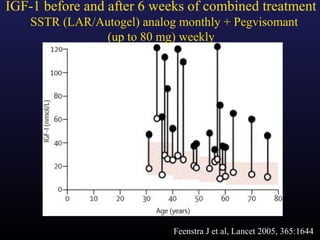
IGF-1 before and after 6 weeks of combined treatment
    SSTR (LAR/Autogel) analog monthly + Pegvisomant
                (up to 80 mg) weekly


                             Feenstra J et al, Lancet 2005, 365:1644

Acromegal

  • 1.
    ACROMEGALY IlanShimon, MD Rabin Medical Center, Petach-Tiqva
  • 2.
    Objectives of Treatmentfor Acromegaly • Control and reverse symptoms and signs • Suppress GH and IGF-1 to control morbidity and mortality • Decrease pituitary tumor size • Control tumor mass effects • Preserve normal pituitary hormone secretion
  • 3.
    Surgical Outcome inAcromegaly • Experience of the neurosurgeon • Adenoma size • Invasiveness into adjacent structures • Pre-operative GH level
  • 4.
    Remission of AcromegalyAfter Transsphenoidal Surgery Microadenomas – 70-90 % Macroadenomas – 40-60 % 100 90 80 Remission Rate (%) 70 60 50 40 30 20 10 0 Microadenoma (n=44) Macroadenoma (n=44) Shimon I. Neurosurgery. 2001;48:1239
  • 5.
    Remission of AcromegalyAfter Transsphenoidal Surgery GH Criteria Micro- Macro- Study Patients IGF-1 ng/mL adenomas adenomas Ahmed Mean GH 139 91% 46% 1990 <2.5 Fahlbusch 224 OGTT <2 72% 50% 1992 Davis Basal/OGTT 175 60% 35% 1993 <2.5 Osman OGTT 79 84% 1994 <2.5 Sheaves Mean GH 100 61% 23% 1996 <2.5
  • 6.
    Remission of AcromegalyAfter Transsphenoidal Surgery (cont’d) GH Criteria Micro- Macro- Study Patients IGF-1 ng/mL adenomas adenomas Swearingen Normal- 162 OGTT <2 91% 48% 1998 82% Basal/OGTT Normal- Freda 1998 115 88% 53% <2 87% OGTT Lissett 1998 73 59% 14% <2.5 Shimon Basal/OGTT Normal- 98 84% 64% 2001 <2 72% Mean GH Normal- De P 2003 90 <2.5 79% 56% 68% OGTT <1
  • 7.
    Remission of AcromegalyAfter Transsphenoidal Surgery According to Adenoma Size 100 90 80 Remission Rate (%) 70 60 50 40 30 20 10 0 3-6 (n=16) 7-10 (n=26) 11-20 (n=26) >20 (n=10) Adenoma Size (mm) Shimon I. Neurosurg. 2001;48:1239
  • 8.
    Acromegaly • Definition ofsurgical cure • Pre-operative medical treatment • Primary medical treatment • Improved remission by medical therapy after surgical debulking • Multi-recepotor SRIF analogs • GH receptor antagonist • Combination therapy
  • 9.
    Current Clinical Practice? Nadir GH Nadir GH <1 µg/L >1 µg/L IGF-1 Normal No Treatment ? IGF-1 Elevated “Treat” Treat
  • 10.
    Association Between Serum IGF-I and Nadir GH Concentrations Across an OGTT Nadir GH Nadir GH <1 µg/L >1 µg/L IGF-1 Normal 52 (58%) 37 (42%) IGF-1 Elevated 34 (13%) 226 (87%) 108 treated patients P<0.0001 Ayuk, et al (unpublished data).
  • 11.
    Mortality in Acromegaly 1.0 GH <1 µg/L 0.8 NZ Population 0.6 GH <2 µg/L Probability GH <5 µg/L 0.4 GH >5 µg/L 0.2 0 0 5 10 15 20 25 30 Time (Years) Holdaway IM,JCEM; 2004, 89:667
  • 12.
    Factors Influencing Mortality in Acromegaly 1.0 IGF SD Score <2 0.8 Proportion Surviving NZ Population 0.6 IGF SD Score >2 0.4 0.2 0 0 5 10 15 20 25 30 Time (Years) Holdaway IM,JCEM; 2004, 89:667
  • 13.
    ng-term Mortality AfterTranssphenoidal Surgery 1.0 Normal IGF-I 0.8 Elevated IGF-I Cox model 0.6 predicted survival 0.4 Patient in remission 0.2 Patient not in remission 0.0 0 5 10 15 20 Years after surgery Swearingen, B. et al. J Clin Endocrinol Metab 1998;83:3419
  • 14.
    Nadir GH levelsafter OGTT in postoperative patients with normal IGF-I Freda PU, et al. 2004, JCEM; 89:495
  • 15.
    Post-operative Follow-Up With Normal IGF-1 Values • 110 post-operative patients with acromegaly – 76 remission (normal IGF-1) • 50 normal GH nadir (<0.14 µg/L; group 1) • 26 abnormal GH nadir (0.3+0.05 µg/L;group 2) • Longitudinal follow-up 1-6.5 years – IGF-1 Group 1 normal in all – IGF-1 Group 2 elevated in 5 • Conclusion: persistent abnormal GH suppression is associated with increased risk of recurrence Freda PU, et al. 2004, JCEM; 89:495
  • 16.
    Conclusions • Evaluate normalranges of GH and IGF-1 assays (“know your assay”) • Patients with evidence of hypersecretion of GH should be considered for treatment irrespective of IGF-1 value • Patients with elevated IGF-1 should be considered for treatment irrespective of GH value • Treatment of co-morbidities may be even more important and may influence the decision to treat
  • 17.
    Pre-operative Treatment With Somatostatin Analogs— Clinical Studies • Only few studies with small number of patients • No randomized placebo-controlled studies • Most studies with short-acting analogs • No consistency in pre-operative dosage and treatment interval
  • 18.
    Pre-operative Treatment With Somatostatin Analogs • Six studies with treated/untreated patients before pituitary surgery • Five studies used subcutaneous OCT • OCT dose was usually started at 300 µg/day, and individually increased • Pre-operative medical therapy was maintained for 1-39 months before surgery, usually for 3-6 months • The criteria for post-operative remission not similar
  • 19.
    Available Comparative Studies Study OCT Untreated Stevenaert—Metabolism 1996 64 108 Colao—JCEM 1997 22 37 Kristof—Acta Neurochir 1999 11 13 Biermasz—JCEM 1999 19 19 Abe—Eur J Endocrinol 2001 90 57 French Acromegaly Registry— OCT/LAN 86 105 ENEA 2004 TOTAL: Pre-operative SRIF 292 Untreated 339
  • 20.
    French Acromegaly Registry– ENEA 2004, Sorrento; OCT/LAN (86), Untreated (105) Surgical Remission Rate Pre-treated Untreated No. % No. % All 86 55 105 51 Noninvasive 40 67 54 65 Remission rate improved in patients pre-treated for 4-6 months
  • 21.
    Pre-surgical Treatment (292) Untreated (339) Summary of 6 Publications Surgical Remission Rate Pre-treated Untreated No. % No. % All 292 63.4 339 54.5 Noninvasive 166 83.7 169 74
  • 22.
    Odds Ratio Plot (Fixed Effects) Mantel-Haenszel chi-square = 0.7341; P = 0.3916 Odds ratio meta-analysis plot [fixed effects] stratum 1 French Registry 1.14 (0.62, 2.10) stratum 2 Abe & Ludecke 0.65 (0.28, 1.48) stratum 3 Biermasz NR 0.61 (0.12, 2.98) stratum 4 Kristof RA 0.53 (0.07, 3.79) stratum 5 Colao A 2.84 (0.83, 9.77) stratum 6 5.74 (1.42, 32.93) Stevenaert & Beckers stratum 7 0.98 (0.29, 3.10) combined [fixed] 1.18 (0.84, 1.66) 0.01 0.1 0.2 0.5 1 2 5 10 100 odds ratio (95% confidence interval)
  • 23.
    UK Primary Octreotide Study: IndividualGrowth Hormone Response (sc Oct, Oct-LAR) Bevan JS et al. J Clin Endocrinol Metab. 2002;87:4554-4563.
  • 24.
    Tumor Changes AfterPrimary OCT Therapy Expressed as a Percentage of the Pre-treatment Volume in 20 Macroadenomas 120% Percentage of Original Size 100% 80% 60% 40% 20% 0% Baseline 12 Weeks 24 Weeks 48 Weeks Bevan J. et al., J Clin Endocrinol Metab. 2002; 87:4554-4563.
  • 25.
    Tumor Shrinkage inPatients With Previously Untreated Acromegaly (a) (b) 0 Microadenomas 0 -10 -10 Shrinkage (%) Shrinkage (%) -20 -20 Lanreotide SR -30 -30 Macroadenomas -40 -40 Octreotide LAR -50 -50 -60 -60 -70 -70 T0 T12 T24 T0 T12 T24 Months of Therapy Months of Therapy Amato G. Clin Endocrinol. 2002;56:65
  • 26.
    Effect of Octreotideon GH Levels in Acromegaly 400 300 Growth Hormone (µg/L) 200 100 70 Pre-treatment 60 During Treatment 50 40 30 25 20 15 10 5 2.5 % Normal % Normal % Normal % Normal % Normal % Normal IGF-1: 30% IGF-1: 53% IGF-1: 63% IGF-1: 75% IGF-1: 86% IGF-1: 83% Newman et al. J Clin Endocrinol Metab. 1998;83:3034-3040.
  • 27.
    Surgical Debulking ImprovesHormonal Control of Acromegaly by SST analogs (OCT, LAN) (retrospective; 1-33 months, 300-1500 µg/day) Baseline Preoperative Postoperative SST Baseline Postoperative SST washout Preoperative washout sst sst Petrossians P, JCEM, 2005; 152:61
  • 29.
    SSTR2 and SSTR5expression in GH-secreting adenomas (according to in vivo GH suppression by Octreotide) Saveanu A, JCEM 2001; 86:140
  • 30.
    BIM-23244, a bispecific(SSRR2 + SSTR5) analog Saveanu A, JCEM 2001; 86:140
  • 31.
    SST2 and D2DRexpression in 11 GH-secreting tumors Saveanu A, JCEM 2002; 87:5545
  • 32.
    A Chimeric Somatostatin-DopamineMolecule, BIM-23A387 OCT-responsive OCT-partially responsive Saveanu A, JCEM 2002; 87:5545
  • 33.
    SOM-230, a somatostatinanalog with broad spectrum binding affinity (Receptor subtype affinity (IC50, nM Compound SSTR1 SSTR2 SSTR3 SSTR4 SSTR5 SRIF-14 2.26 0.23 1.43 1.77 Octreotide 1140 0.56 34 7030 7 Lanreotide 2330 0.75 107 2100 5.2 SOM-230 9.3 1 1.5 >100 0.16
  • 34.
    Effect of InfusedOCT and SOM230 on IGF-1 Plasma Levels in Rats Weckbecker G, Endocrinology, 2002; 143:4123
  • 35.
    GH release incultured GH-secreting adenomas Incubated with SOM-230 Hofland LJ, JCEM 2004; 89:1577
  • 36.
    PRL release incultured mixed PRL/GH-secreting Adenomas incubated with SOM-230 Hofland LJ, JCEM 2004; 89:1577
  • 37.
    In vivo GHsuppression 2-8 h after SOM-230 injection N=8 N=3 Van der Hoek J, JCEM 2004; 89:638
  • 38.
    GHR Antagonist Action Pituitary Tumor • Blocks GH effect GH B2036-PEG • Normalizes IGF-I in 92% of X patients Liver X IGF-I
  • 39.
    IGF-I in 112Patients with Acromegaly Treated with Pegvisomant or Placebo 800 placebo Serum IGF-I (ng/ml) 600 10 mg 400 15 mg 20 mg 200 0 2 4 8 12 Time (weeks) Trainer et al N Eng J Med. 2000:342;1171-1177
  • 40.
    Change in SerumGH in Patients With Acromegaly Treated With Daily Pegvisomant or Placebo 25 20 mg * 15 mg * 20 Serum * P <0.001 15 vs. placebo GH (ng/ml) 10 10 mg placebo 5 0 2 4 8 12 Time (weeks) Trainer et al. NEJM. 2000:342;1171-1177
  • 41.
    Pegvisomant Impact onGH and IGF-I Levels Dose mg 200 GH 20 150 15 100 Delta (%) 50 0 0 –25 15 –50 IGF-I 20 –75 2 4 8 12 Weeks Trainer, PJ et al. N. Engl. J. Med. Apr 2000;342:1171-7.
  • 42.
    IGF-1 at Baselineand After 12 Months of Pegvisomant 2500 2000 Serum IGF-1 97% normalization of IGF-1 (n=90) (ng/mL) 1500 1000 500 16-24 25-39 40-54 55+ Age (years) van der Lely et al. Lancet. 2001;358:1754
  • 43.
    Tumor Volume Changesin 92 Patients Receiving Daily Pegvisomant for >6 Months 4 No Radiation 3 Radiation Change 2 in 1 Volume (cm3) 0 -1 -2 -3 0 6 12 18 24 30 36 Time (months) van der Lely et al. Lancet. 2001;358:1754
  • 44.
    Acromegaly Cotreated withGHR Antagonist and Octreotide van der Lely, JCEM; 2001, 86:478
  • 45.
    Cotreatment with Sandostatin-LAR and daily Pegvisomant (10/15 mg) Jorgensen JO, JCEM, 2005; 90:5627
  • 46.
    IGF-1 before andafter 6 weeks of combined treatment SSTR (LAR/Autogel) analog monthly + Pegvisomant (up to 80 mg) weekly Feenstra J et al, Lancet 2005, 365:1644