How would we practice today using optimal human
     resources, technology and techniques ?
           “Achieving the Achievable”

            HEAD AND NECK CANCER

      Radiation Treatment Program Symposium
“The Future of Radiation Treatment in the 21st Century”
                   2 – 3 March, Toronto


               Brian O’Sullivan MD, FRCPC
             Department of Radiation Oncology
                   University of Toronto
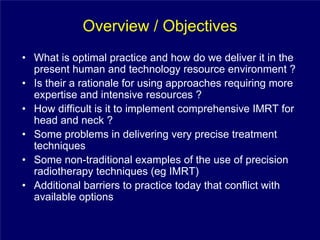
Overview / Objectives
• What is optimal practice and how do we deliver it in the
  present human and technology resource environment ?
• Is their a rationale for using approaches requiring more
  expertise and intensive resources ?
• How difficult is it to implement comprehensive IMRT for
  head and neck ?
• Some problems in delivering very precise treatment
  techniques
• Some non-traditional examples of the use of precision
  radiotherapy techniques (eg IMRT)
• Additional barriers to practice today that conflict with
  available options
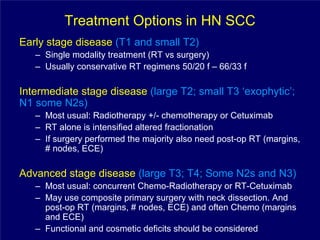
Treatment Options in HN SCC
Early stage disease (T1 and small T2)
   – Single modality treatment (RT vs surgery)
   – Usually conservative RT regimens 50/20 f – 66/33 f

Intermediate stage disease (large T2; small T3 ‘exophytic’;
N1 some N2s)
   – Most usual: Radiotherapy +/- chemotherapy or Cetuximab
   – RT alone is intensified altered fractionation
   – If surgery performed the majority also need post-op RT (margins,
     # nodes, ECE)

Advanced stage disease (large T3; T4; Some N2s and N3)
   – Most usual: concurrent Chemo-Radiotherapy or RT-Cetuximab
   – May use composite primary surgery with neck dissection. And
     post-op RT (margins, # nodes, ECE) and often Chemo (margins
     and ECE)
   – Functional and cosmetic deficits should be considered
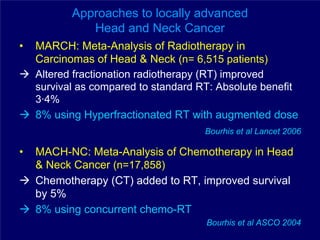
Approaches to locally advanced
              Head and Neck Cancer
•   MARCH: Meta-Analysis of Radiotherapy in
    Carcinomas of Head & Neck (n= 6,515 patients)
    Altered fractionation radiotherapy (RT) improved
    survival as compared to standard RT: Absolute benefit
    3·4%
    8% using Hyperfractionated RT with augmented dose
                                      Bourhis et al Lancet 2006

•   MACH-NC: Meta-Analysis of Chemotherapy in Head
    & Neck Cancer (n=17,858)
    Chemotherapy (CT) added to RT, improved survival
    by 5%
    8% using concurrent chemo-RT
                                      Bourhis et al ASCO 2004
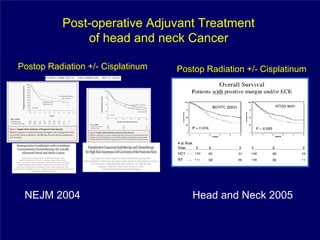
Post-operative Adjuvant Treatment
               of head and neck Cancer

Postop Radiation +/- Cisplatinum   Postop Radiation +/- Cisplatinum


 NEJM 2004                            Head and Neck 2005
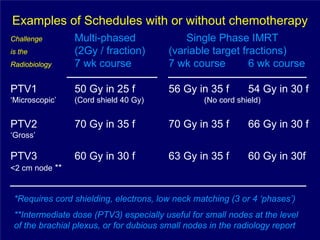
Examples of Schedules with or without chemotherapy
Challenge       Multi-phased                 Single Phase IMRT
is the          (2Gy / fraction)         (variable target fractions)
Radiobiology    7 wk course              7 wk course        6 wk course

PTV1            50 Gy in 25 f            56 Gy in 35 f        54 Gy in 30 f
‘Microscopic’   (Cord shield 40 Gy)               (No cord shield)


PTV2            70 Gy in 35 f            70 Gy in 35 f        66 Gy in 30 f
‘Gross’

PTV3            60 Gy in 30 f            63 Gy in 35 f        60 Gy in 30f
<2 cm node **


 *Requires cord shielding, electrons, low neck matching (3 or 4 ‘phases’)
 **Intermediate dose (PTV3) especially useful for small nodes at the level
 of the brachial plexus, or for dubious small nodes in the radiology report
What is optimal ?
• Potential to include the Target Objects properly
• Spare as much normal tissue as possible, and especially
  normal tissues where function is compromised
       –   Critical neurological tissues
       –   Salivary function
       –   Swallowing mechanism
       –   Mandible
• Options for augmentation (combined modality) are
  numerous (available skills and resources affect choice)
• Several balances in decision-making re: technique
       –   Balance against resources to accomplish
       –   What drives the decision ?
            • Inclusion of the target
            • Avoidance of normal tissues
            • Accomplish both: “Include and avoid”
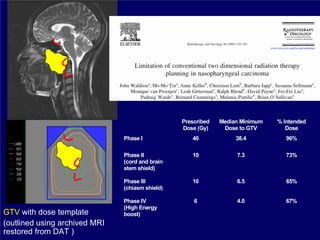
Prescribed   Median Minimum   % Intended
                                                 Dose (Gy)     Dose to GTV        Dose
                               Phase I              40             38.4           96%

                               Phase II             10             7.3            73%
                               (cord and brain
                               stem shield)

                               Phase III            10             6.5            65%
                               (chiasm shield)

                               Phase IV              6             4.0            67%
                               (High Energy
GTV with dose template         boost)
(outlined using archived MRI
restored from DAT )
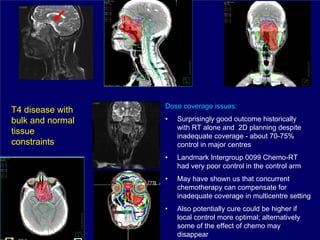
Dose coverage issues:
T4 disease with
bulk and normal   •   Surprisingly good outcome historically
                      with RT alone and 2D planning despite
tissue                inadequate coverage - about 70-75%
constraints           control in major centres
                  •   Landmark Intergroup 0099 Chemo-RT
                      had very poor control in the control arm
                  •   May have shown us that concurrent
                      chemotherapy can compensate for
                      inadequate coverage in multicentre setting
                  •   Also potentially cure could be higher if
                      local control more optimal; alternatively
                      some of the effect of chemo may
                      disappear
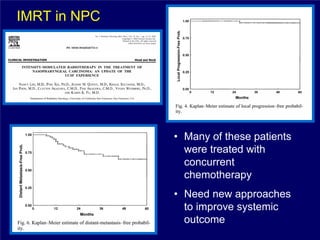
IMRT in NPC


              • Many of these patients
                were treated with
                concurrent
                chemotherapy
              • Need new approaches
                to improve systemic
                outcome
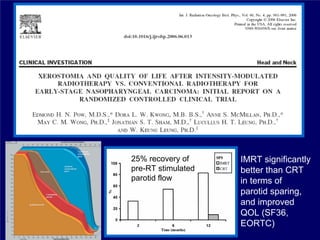
25% recovery of     IMRT significantly
pre-RT stimulated   better than CRT
parotid flow        in terms of
                    parotid sparing,
                    and improved
                    QOL (SF36,
                    EORTC)
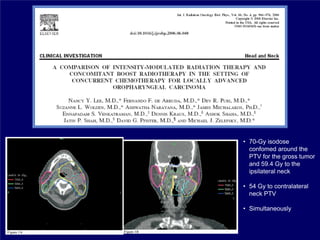
• 70-Gy isodose
  confomed around the
  PTV for the gross tumor
  and 59.4 Gy to the
  ipsilateral neck

• 54 Gy to contralateral
  neck PTV

• Simultaneously
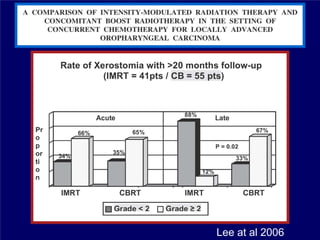
Lee at al 2006
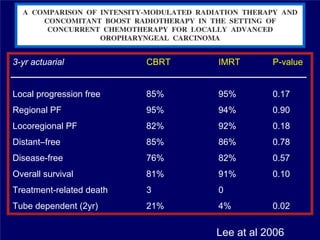
3-yr actuarial            CBRT   IMRT       P-value


Local progression free    85%    95%        0.17
Regional PF               95%    94%        0.90
Locoregional PF           82%    92%        0.18
Distant–free              85%    86%        0.78
Disease-free              76%    82%        0.57
Overall survival          81%    91%        0.10
Treatment-related death   3      0
Tube dependent (2yr)      21%    4%         0.02


                                 Lee at al 2006
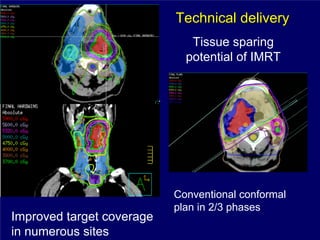
Technical delivery
                              Tissue sparing
                             potential of IMRT


                           Conventional conformal
                           plan in 2/3 phases
Improved target coverage
in numerous sites
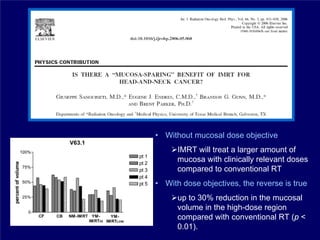
• Without mucosal dose objective
      IMRT will treat a larger amount of
      mucosa with clinically relevant doses
      compared to conventional RT
• With dose objectives, the reverse is true
      up to 30% reduction in the mucosal
      volume in the high-dose region
      compared with conventional RT (p <
      0.01).
Caveats about IMRT for Head and Neck Cancer
 Preliminary Results:
 Extraneous and unusual/unexpected dose deposition:

 “Nausea, Vomiting, and Other Unanticipated Toxicities During
 IMRT for Head and Neck Squamous Cell Carcinoma”

     •    Headache
     •    Nausea and vomiting
     •    Hair
     •    Eyes and lacrimal glands
     •    Lips
     •    Larynx
     •    Skin
     •    Mucosa


          JW Fan, DI Rosenthal et al 2007: ASTRO / ASCO / AHNS Palm Spring
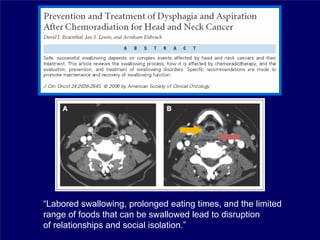
“Labored swallowing, prolonged eating times, and the limited
range of foods that can be swallowed lead to disruption
of relationships and social isolation.”
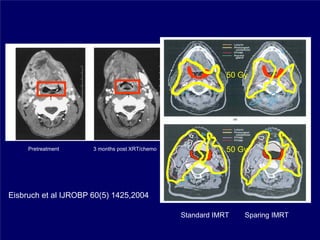
50 Gy


     Pretreatment     3 months post XRT/chemo               50 Gy


Eisbruch et al IJROBP 60(5) 1425,2004

                                                Standard IMRT   Sparing IMRT
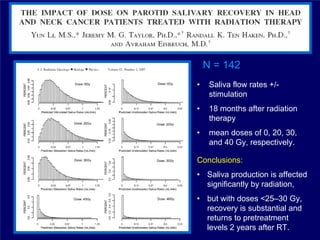
N = 142
•    Saliva flow rates +/-
     stimulation
•    18 months after radiation
     therapy
•    mean doses of 0, 20, 30,
     and 40 Gy, respectively.

Conclusions:
• Saliva production is affected
  significantly by radiation,
• but with doses <25–30 Gy,
  recovery is substantial and
  returns to pretreatment
  levels 2 years after RT.
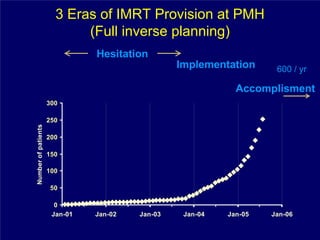
3 Eras of IMRT Provision at PMH
                            (Full inverse planning)
                               Hesitation
                                                 Implementation      600 / yr

                                                             Accomplisment
                     300

                     250
Number of patients


                     200

                     150

                     100

                      50

                       0
                      Jan-01   Jan-02   Jan-03    Jan-04   Jan-05   Jan-06
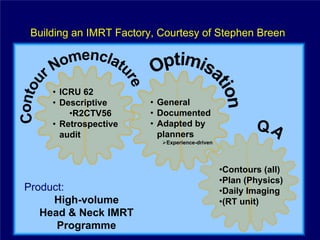
Building an IMRT Factory, Courtesy of Stephen Breen


     • ICRU 62
     • Descriptive      • General
         •R2CTV56       • Documented
     • Retrospective    • Adapted by
       audit              planners
                            Experience-driven


                                                •Contours (all)
                                                •Plan (Physics)
Product:                                        •Daily Imaging
     High-volume                                •(RT unit)
   Head & Neck IMRT
      Programme
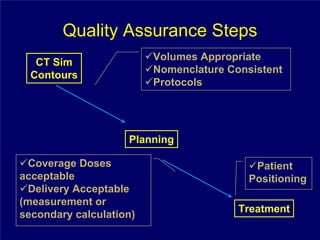
Quality Assurance Steps
                         Volumes Appropriate
   CT Sim
                         Nomenclature Consistent
  Contours
                         Protocols


                    Planning

  Coverage Doses                           Patient
acceptable                                Positioning
  Delivery Acceptable
(measurement or
                                        Treatment
secondary calculation)
This H&N structure nomenclature, contouring
  guidelines and terminology system was
  implemented to:

• facilitate multidisciplinary communication
  between radiation oncologists, planners and
  physicists
• facilitate quality assurance review of H&N
  planning
• enable the automation of complex programming
  tasks within our planning system
• facilitate audit of outcomes
                          Slide: courtesy John Kim
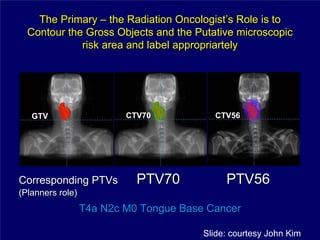
The Primary – the Radiation Oncologist’s Role is to
  Contour the Gross Objects and the Putative microscopic
             risk area and label appropriartely


   GTV                    CTV70           CTV56


Corresponding PTVs          PTV70            PTV56
(Planners role)
                  T4a N2c M0 Tongue Base Cancer

                                        Slide: courtesy John Kim
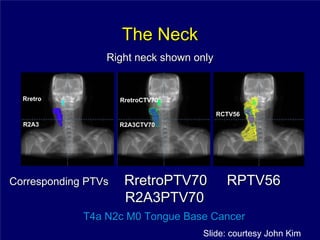
The Neck
                 Right neck shown only


  Rretro             RretroCTV70

                                         RCTV56
  R2A3               R2A3CTV70


Corresponding PTVs    RretroPTV70          RPTV56
                      R2A3PTV70
             T4a N2c M0 Tongue Base Cancer
                                   Slide: courtesy John Kim
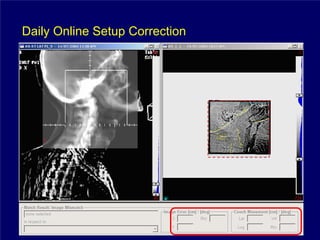
Daily Online Setup Correction
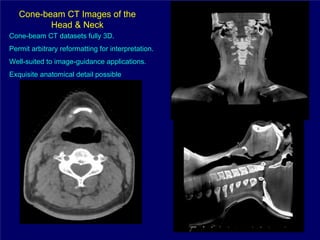
Cone-beam CT Images of the
          Head & Neck
Cone-beam CT datasets fully 3D.
Permit arbitrary reformatting for interpretation.
Well-suited to image-guidance applications.
Exquisite anatomical detail possible
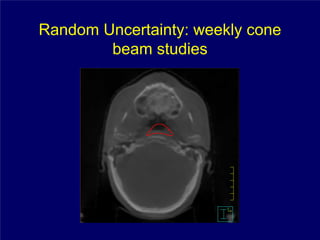
Random Uncertainty: weekly cone
        beam studies
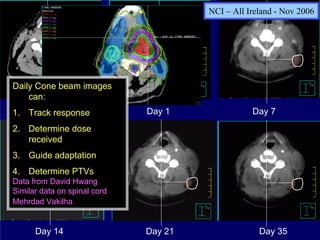
NCI – All Ireland - Nov 2006


Daily Cone beam images
    can:
1. TrackCT sim
Planning response             Day 1               Day 7
2. Determine dose
   received
3. Guide adaptation
4. Determine PTVs
Data from David Hwang
Similar data on spinal cord
Mehrdad Vakilha


      Day 14                  Day 21                Day 35
Evaluation of a Semi-Automated Segmentation
Method for Delineation of Organs at Risk and
Lymph Node Target Volumes in Head and Neck
Radiotherapy Planning
Michael Kaus
Philips Radiation Oncology Systems, Madison, WI

J. Kim, B. O'Sullivan, A. Mansouri, S. Breen, L. A. Dawson, D. A. Jaffray
Radiation Medicine Program, Princess Margaret Hospital, University Health Network
University of Toronto, Toronto, ON, Canada


                                                    ASTRO 2006
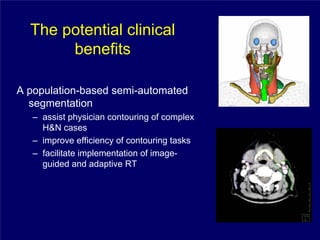
The potential clinical
       benefits

A population-based semi-automated
  segmentation
   – assist physician contouring of complex
     H&N cases
   – improve efficiency of contouring tasks
   – facilitate implementation of image-
     guided and adaptive RT
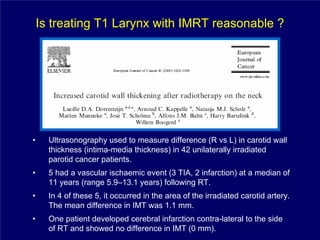
Is treating T1 Larynx with IMRT reasonable ?


•     Ultrasonography used to measure difference (R vs L) in carotid wall
      thickness (intima-media thickness) in 42 unilaterally irradiated
      parotid cancer patients.
•     5 had a vascular ischaemic event (3 TIA, 2 infarction) at a median of
      11 years (range 5.9–13.1 years) following RT.
•     In 4 of these 5, it occurred in the area of the irradiated carotid artery.
      The mean difference in IMT was 1.1 mm.
•     One patient developed cerebral infarction contra-lateral to the side
      of RT and showed no difference in IMT (0 mm).
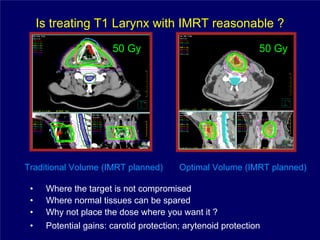
Is treating T1 Larynx with IMRT reasonable ?
                       50 Gy                                  50 Gy


Traditional Volume (IMRT planned)        Optimal Volume (IMRT planned)

 •    Where the target is not compromised
 •    Where normal tissues can be spared
 •    Why not place the dose where you want it ?
 •    Potential gains: carotid protection; arytenoid protection
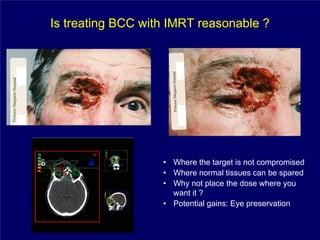
Is treating BCC with IMRT reasonable ?


                   • Where the target is not compromised
                   • Where normal tissues can be spared
                   • Why not place the dose where you
                     want it ?
                   • Potential gains: Eye preservation
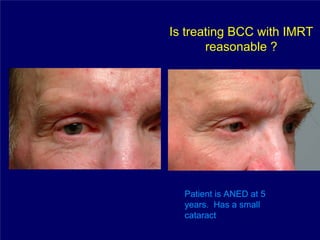
Is treating BCC with IMRT
       reasonable ?


  Patient is ANED at 5
  years. Has a small
  cataract
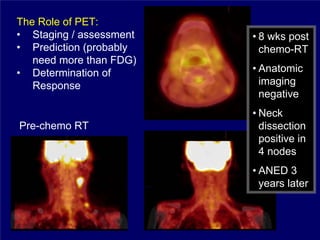
The Role of PET:
• Staging / assessment   • 8 wks post
• Prediction (probably     chemo-RT
   need more than FDG)
• Determination of       • Anatomic
   Response                imaging
                           negative
                         • Neck
Pre-chemo RT               dissection
                           positive in
                           4 nodes
                         • ANED 3
                           years later
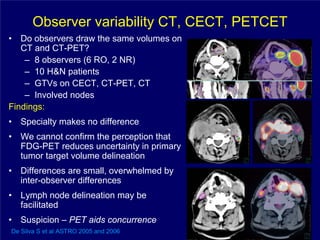
Observer variability CT, CECT, PETCET
•  Do observers draw the same volumes on
   CT and CT-PET?
    – 8 observers (6 RO, 2 NR)
    – 10 H&N patients
    – GTVs on CECT, CT-PET, CT               CECT   PETCT

    – Involved nodes
Findings:
•   Specialty makes no difference
•   We cannot confirm the perception that
    FDG-PET reduces uncertainty in primary
    tumor target volume delineation
•   Differences are small, overwhelmed by
    inter-observer differences
•   Lymph node delineation may be
    facilitated
•   Suspicion – PET aids concurrence
De Silva S et al ASTRO 2005 and 2006
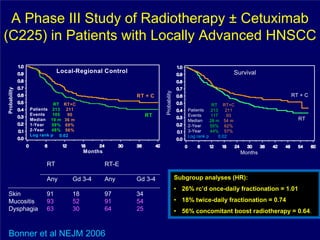
A Phase III Study of Radiotherapy ± Cetuximab
(C225) in Patients with Locally Advanced HNSCC

                           Local-Regional Control                                                    Survival
Probability


                                                               Probability
                                                     RT + C                                                           RT + C
                          RT RT+C                                                            RT RT+C
              Patients    213 211                                                Patients   213    211
              Events      105  90                         RT                     Events     117     93
              Median     19 m 36 m                                               Median     28 m 54 m                     RT
              1-Year     59% 69%                                                 2-Year     55% 62%
              2-Year     48% 56%                                                 3-Year     44% 57%
              Log rank   p 0.02                                                  Log rank p     0.02


                                     Months                                                              Months

                     RT                       RT-E

                     Any        Gd 3-4        Any    Gd 3-4                  Subgroup analyses (HR):
                                                                             • 26% rc’d once-daily fractionation = 1.01
Skin                 91         18            97     34
Mucositis            93         52            91     54                      • 18% twice-daily fractionation = 0.74
Dysphagia            63         30            64     25                      • 56% concomitant boost radiotherapy = 0.64.


Bonner et al NEJM 2006
How should we practice ?
• Use Level 1 evidence based ev
  evidence for dose fractionation regimen
• Concerning Technique
  – Do not compromise on the targets
  – Spare the normal tissues when this is possible
• Place the dose where you want it and where
  it needs to go
• Often that means IMRT in complex Head and
  Neck cancers
Planning & Treatment Team
•   Radiation Oncology
     – A. Bayley, B. Cummings, L Dawson, J. Kim, B. O’Sullivan, J. Ringash,
       J. Waldron

•   Physicists
     – S. Breen, J. Borg, A. Damyanovich, B. Zhang

•   Team 1 Planners
     – J.Roussos, M.Ryan, D.Sajac, I Kaminsky, S.Pillay, S.Pizzale,
        C.Rocca, L.Chau, P. Rakaric, S.Singh, M.Glinnyi, J.Giovinazzo

•   Therapists (33)
     – S.Singh, S. Pizzale, I.Kaminsky, C. Rocca, L.Chau, P. Rakaric
       C.Bradley, E.Borodina, C.Cerase, C.Chow, C.Dupuis, M.Engel,
       C.Field, A.Fung, J.Giovinazzo, M.Glinnyi, B.Guibord,, S.Hua,
       S.Huang, J.Loudon, L.Johnson, K.Man, D.Marshall, , E.Mettrick,
       G.Parlan, S.Pillay, F.Sie , W.So, A.Sperdutti, M.Tamerou,
       W.Tang, V.Truong, G.Wu
Additional Key Team Members

Medical Imaging      Head and Neck Surgery Image Management Translational Science
                      Pat Gullane            David Jaffray      Fei-Fei Liu
Ann Keller
                      Ralph Gilbert          Michael Sharpe     Carlo Bastianutto
Eugene Yu                                                       Angelo Hui
                      Jon Irish              Jeff Siewerdsen
                      Dale Brown             Bern Norrlinger    Sizanne Kame-Reid
RMP IT Infrastructure                        Ting Jun Zhang
                      Ian Witterick
                                             Doug Moseley       Pathology
                      Jerry Freeman
Terry Michaelson                             Anna Kirilova
                      Peter Neligan                             Bayardo Perez-
Stuart Rose                                  Kristy Brock
and team                                                        Ordonez

Medical Oncology
Lillian Siu
                                          Nursing, Nutrition, Psycho-social
Eric Chen
                                The Susan Grange Family
                   Bartley-Smith/Wharton Fund of the PMH Foundation
                           CARO/ACURA Fellowship Program
                                 Elekta Oncology Systems
                                 Varian Medical Systems
Future Rt Cco (0sullivan)

Future Rt Cco (0sullivan)

  • 1.
    How would wepractice today using optimal human resources, technology and techniques ? “Achieving the Achievable” HEAD AND NECK CANCER Radiation Treatment Program Symposium “The Future of Radiation Treatment in the 21st Century” 2 – 3 March, Toronto Brian O’Sullivan MD, FRCPC Department of Radiation Oncology University of Toronto
  • 2.
    Overview / Objectives •What is optimal practice and how do we deliver it in the present human and technology resource environment ? • Is their a rationale for using approaches requiring more expertise and intensive resources ? • How difficult is it to implement comprehensive IMRT for head and neck ? • Some problems in delivering very precise treatment techniques • Some non-traditional examples of the use of precision radiotherapy techniques (eg IMRT) • Additional barriers to practice today that conflict with available options
  • 3.
    Treatment Options inHN SCC Early stage disease (T1 and small T2) – Single modality treatment (RT vs surgery) – Usually conservative RT regimens 50/20 f – 66/33 f Intermediate stage disease (large T2; small T3 ‘exophytic’; N1 some N2s) – Most usual: Radiotherapy +/- chemotherapy or Cetuximab – RT alone is intensified altered fractionation – If surgery performed the majority also need post-op RT (margins, # nodes, ECE) Advanced stage disease (large T3; T4; Some N2s and N3) – Most usual: concurrent Chemo-Radiotherapy or RT-Cetuximab – May use composite primary surgery with neck dissection. And post-op RT (margins, # nodes, ECE) and often Chemo (margins and ECE) – Functional and cosmetic deficits should be considered
  • 4.
    Approaches to locallyadvanced Head and Neck Cancer • MARCH: Meta-Analysis of Radiotherapy in Carcinomas of Head & Neck (n= 6,515 patients) Altered fractionation radiotherapy (RT) improved survival as compared to standard RT: Absolute benefit 3·4% 8% using Hyperfractionated RT with augmented dose Bourhis et al Lancet 2006 • MACH-NC: Meta-Analysis of Chemotherapy in Head & Neck Cancer (n=17,858) Chemotherapy (CT) added to RT, improved survival by 5% 8% using concurrent chemo-RT Bourhis et al ASCO 2004
  • 5.
    Post-operative Adjuvant Treatment of head and neck Cancer Postop Radiation +/- Cisplatinum Postop Radiation +/- Cisplatinum NEJM 2004 Head and Neck 2005
  • 6.
    Examples of Scheduleswith or without chemotherapy Challenge Multi-phased Single Phase IMRT is the (2Gy / fraction) (variable target fractions) Radiobiology 7 wk course 7 wk course 6 wk course PTV1 50 Gy in 25 f 56 Gy in 35 f 54 Gy in 30 f ‘Microscopic’ (Cord shield 40 Gy) (No cord shield) PTV2 70 Gy in 35 f 70 Gy in 35 f 66 Gy in 30 f ‘Gross’ PTV3 60 Gy in 30 f 63 Gy in 35 f 60 Gy in 30f <2 cm node ** *Requires cord shielding, electrons, low neck matching (3 or 4 ‘phases’) **Intermediate dose (PTV3) especially useful for small nodes at the level of the brachial plexus, or for dubious small nodes in the radiology report
  • 7.
    What is optimal? • Potential to include the Target Objects properly • Spare as much normal tissue as possible, and especially normal tissues where function is compromised – Critical neurological tissues – Salivary function – Swallowing mechanism – Mandible • Options for augmentation (combined modality) are numerous (available skills and resources affect choice) • Several balances in decision-making re: technique – Balance against resources to accomplish – What drives the decision ? • Inclusion of the target • Avoidance of normal tissues • Accomplish both: “Include and avoid”
  • 8.
    Prescribed Median Minimum % Intended Dose (Gy) Dose to GTV Dose Phase I 40 38.4 96% Phase II 10 7.3 73% (cord and brain stem shield) Phase III 10 6.5 65% (chiasm shield) Phase IV 6 4.0 67% (High Energy GTV with dose template boost) (outlined using archived MRI restored from DAT )
  • 9.
    Dose coverage issues: T4disease with bulk and normal • Surprisingly good outcome historically with RT alone and 2D planning despite tissue inadequate coverage - about 70-75% constraints control in major centres • Landmark Intergroup 0099 Chemo-RT had very poor control in the control arm • May have shown us that concurrent chemotherapy can compensate for inadequate coverage in multicentre setting • Also potentially cure could be higher if local control more optimal; alternatively some of the effect of chemo may disappear
  • 10.
    IMRT in NPC • Many of these patients were treated with concurrent chemotherapy • Need new approaches to improve systemic outcome
  • 11.
    25% recovery of IMRT significantly pre-RT stimulated better than CRT parotid flow in terms of parotid sparing, and improved QOL (SF36, EORTC)
  • 12.
    • 70-Gy isodose confomed around the PTV for the gross tumor and 59.4 Gy to the ipsilateral neck • 54 Gy to contralateral neck PTV • Simultaneously
  • 13.
  • 14.
    3-yr actuarial CBRT IMRT P-value Local progression free 85% 95% 0.17 Regional PF 95% 94% 0.90 Locoregional PF 82% 92% 0.18 Distant–free 85% 86% 0.78 Disease-free 76% 82% 0.57 Overall survival 81% 91% 0.10 Treatment-related death 3 0 Tube dependent (2yr) 21% 4% 0.02 Lee at al 2006
  • 15.
    Technical delivery Tissue sparing potential of IMRT Conventional conformal plan in 2/3 phases Improved target coverage in numerous sites
  • 16.
    • Without mucosaldose objective IMRT will treat a larger amount of mucosa with clinically relevant doses compared to conventional RT • With dose objectives, the reverse is true up to 30% reduction in the mucosal volume in the high-dose region compared with conventional RT (p < 0.01).
  • 17.
    Caveats about IMRTfor Head and Neck Cancer Preliminary Results: Extraneous and unusual/unexpected dose deposition: “Nausea, Vomiting, and Other Unanticipated Toxicities During IMRT for Head and Neck Squamous Cell Carcinoma” • Headache • Nausea and vomiting • Hair • Eyes and lacrimal glands • Lips • Larynx • Skin • Mucosa JW Fan, DI Rosenthal et al 2007: ASTRO / ASCO / AHNS Palm Spring
  • 18.
    “Labored swallowing, prolongedeating times, and the limited range of foods that can be swallowed lead to disruption of relationships and social isolation.”
  • 19.
    50 Gy Pretreatment 3 months post XRT/chemo 50 Gy Eisbruch et al IJROBP 60(5) 1425,2004 Standard IMRT Sparing IMRT
  • 20.
    N = 142 • Saliva flow rates +/- stimulation • 18 months after radiation therapy • mean doses of 0, 20, 30, and 40 Gy, respectively. Conclusions: • Saliva production is affected significantly by radiation, • but with doses <25–30 Gy, recovery is substantial and returns to pretreatment levels 2 years after RT.
  • 21.
    3 Eras ofIMRT Provision at PMH (Full inverse planning) Hesitation Implementation 600 / yr Accomplisment 300 250 Number of patients 200 150 100 50 0 Jan-01 Jan-02 Jan-03 Jan-04 Jan-05 Jan-06
  • 22.
    Building an IMRTFactory, Courtesy of Stephen Breen • ICRU 62 • Descriptive • General •R2CTV56 • Documented • Retrospective • Adapted by audit planners Experience-driven •Contours (all) •Plan (Physics) Product: •Daily Imaging High-volume •(RT unit) Head & Neck IMRT Programme
  • 23.
    Quality Assurance Steps Volumes Appropriate CT Sim Nomenclature Consistent Contours Protocols Planning Coverage Doses Patient acceptable Positioning Delivery Acceptable (measurement or Treatment secondary calculation)
  • 24.
    This H&N structurenomenclature, contouring guidelines and terminology system was implemented to: • facilitate multidisciplinary communication between radiation oncologists, planners and physicists • facilitate quality assurance review of H&N planning • enable the automation of complex programming tasks within our planning system • facilitate audit of outcomes Slide: courtesy John Kim
  • 25.
    The Primary –the Radiation Oncologist’s Role is to Contour the Gross Objects and the Putative microscopic risk area and label appropriartely GTV CTV70 CTV56 Corresponding PTVs PTV70 PTV56 (Planners role) T4a N2c M0 Tongue Base Cancer Slide: courtesy John Kim
  • 26.
    The Neck Right neck shown only Rretro RretroCTV70 RCTV56 R2A3 R2A3CTV70 Corresponding PTVs RretroPTV70 RPTV56 R2A3PTV70 T4a N2c M0 Tongue Base Cancer Slide: courtesy John Kim
  • 27.
  • 28.
    Cone-beam CT Imagesof the Head & Neck Cone-beam CT datasets fully 3D. Permit arbitrary reformatting for interpretation. Well-suited to image-guidance applications. Exquisite anatomical detail possible
  • 29.
    Random Uncertainty: weeklycone beam studies
  • 30.
    NCI – AllIreland - Nov 2006 Daily Cone beam images can: 1. TrackCT sim Planning response Day 1 Day 7 2. Determine dose received 3. Guide adaptation 4. Determine PTVs Data from David Hwang Similar data on spinal cord Mehrdad Vakilha Day 14 Day 21 Day 35
  • 31.
    Evaluation of aSemi-Automated Segmentation Method for Delineation of Organs at Risk and Lymph Node Target Volumes in Head and Neck Radiotherapy Planning Michael Kaus Philips Radiation Oncology Systems, Madison, WI J. Kim, B. O'Sullivan, A. Mansouri, S. Breen, L. A. Dawson, D. A. Jaffray Radiation Medicine Program, Princess Margaret Hospital, University Health Network University of Toronto, Toronto, ON, Canada ASTRO 2006
  • 32.
    The potential clinical benefits A population-based semi-automated segmentation – assist physician contouring of complex H&N cases – improve efficiency of contouring tasks – facilitate implementation of image- guided and adaptive RT
  • 33.
    Is treating T1Larynx with IMRT reasonable ? • Ultrasonography used to measure difference (R vs L) in carotid wall thickness (intima-media thickness) in 42 unilaterally irradiated parotid cancer patients. • 5 had a vascular ischaemic event (3 TIA, 2 infarction) at a median of 11 years (range 5.9–13.1 years) following RT. • In 4 of these 5, it occurred in the area of the irradiated carotid artery. The mean difference in IMT was 1.1 mm. • One patient developed cerebral infarction contra-lateral to the side of RT and showed no difference in IMT (0 mm).
  • 34.
    Is treating T1Larynx with IMRT reasonable ? 50 Gy 50 Gy Traditional Volume (IMRT planned) Optimal Volume (IMRT planned) • Where the target is not compromised • Where normal tissues can be spared • Why not place the dose where you want it ? • Potential gains: carotid protection; arytenoid protection
  • 35.
    Is treating BCCwith IMRT reasonable ? • Where the target is not compromised • Where normal tissues can be spared • Why not place the dose where you want it ? • Potential gains: Eye preservation
  • 36.
    Is treating BCCwith IMRT reasonable ? Patient is ANED at 5 years. Has a small cataract
  • 37.
    The Role ofPET: • Staging / assessment • 8 wks post • Prediction (probably chemo-RT need more than FDG) • Determination of • Anatomic Response imaging negative • Neck Pre-chemo RT dissection positive in 4 nodes • ANED 3 years later
  • 38.
    Observer variability CT,CECT, PETCET • Do observers draw the same volumes on CT and CT-PET? – 8 observers (6 RO, 2 NR) – 10 H&N patients – GTVs on CECT, CT-PET, CT CECT PETCT – Involved nodes Findings: • Specialty makes no difference • We cannot confirm the perception that FDG-PET reduces uncertainty in primary tumor target volume delineation • Differences are small, overwhelmed by inter-observer differences • Lymph node delineation may be facilitated • Suspicion – PET aids concurrence De Silva S et al ASTRO 2005 and 2006
  • 39.
    A Phase IIIStudy of Radiotherapy ± Cetuximab (C225) in Patients with Locally Advanced HNSCC Local-Regional Control Survival Probability Probability RT + C RT + C RT RT+C RT RT+C Patients 213 211 Patients 213 211 Events 105 90 RT Events 117 93 Median 19 m 36 m Median 28 m 54 m RT 1-Year 59% 69% 2-Year 55% 62% 2-Year 48% 56% 3-Year 44% 57% Log rank p 0.02 Log rank p 0.02 Months Months RT RT-E Any Gd 3-4 Any Gd 3-4 Subgroup analyses (HR): • 26% rc’d once-daily fractionation = 1.01 Skin 91 18 97 34 Mucositis 93 52 91 54 • 18% twice-daily fractionation = 0.74 Dysphagia 63 30 64 25 • 56% concomitant boost radiotherapy = 0.64. Bonner et al NEJM 2006
  • 41.
    How should wepractice ? • Use Level 1 evidence based ev evidence for dose fractionation regimen • Concerning Technique – Do not compromise on the targets – Spare the normal tissues when this is possible • Place the dose where you want it and where it needs to go • Often that means IMRT in complex Head and Neck cancers
  • 42.
    Planning & TreatmentTeam • Radiation Oncology – A. Bayley, B. Cummings, L Dawson, J. Kim, B. O’Sullivan, J. Ringash, J. Waldron • Physicists – S. Breen, J. Borg, A. Damyanovich, B. Zhang • Team 1 Planners – J.Roussos, M.Ryan, D.Sajac, I Kaminsky, S.Pillay, S.Pizzale, C.Rocca, L.Chau, P. Rakaric, S.Singh, M.Glinnyi, J.Giovinazzo • Therapists (33) – S.Singh, S. Pizzale, I.Kaminsky, C. Rocca, L.Chau, P. Rakaric C.Bradley, E.Borodina, C.Cerase, C.Chow, C.Dupuis, M.Engel, C.Field, A.Fung, J.Giovinazzo, M.Glinnyi, B.Guibord,, S.Hua, S.Huang, J.Loudon, L.Johnson, K.Man, D.Marshall, , E.Mettrick, G.Parlan, S.Pillay, F.Sie , W.So, A.Sperdutti, M.Tamerou, W.Tang, V.Truong, G.Wu
  • 43.
    Additional Key TeamMembers Medical Imaging Head and Neck Surgery Image Management Translational Science Pat Gullane David Jaffray Fei-Fei Liu Ann Keller Ralph Gilbert Michael Sharpe Carlo Bastianutto Eugene Yu Angelo Hui Jon Irish Jeff Siewerdsen Dale Brown Bern Norrlinger Sizanne Kame-Reid RMP IT Infrastructure Ting Jun Zhang Ian Witterick Doug Moseley Pathology Jerry Freeman Terry Michaelson Anna Kirilova Peter Neligan Bayardo Perez- Stuart Rose Kristy Brock and team Ordonez Medical Oncology Lillian Siu Nursing, Nutrition, Psycho-social Eric Chen The Susan Grange Family Bartley-Smith/Wharton Fund of the PMH Foundation CARO/ACURA Fellowship Program Elekta Oncology Systems Varian Medical Systems