Subclinical
hyperthyroidism(SH)
By Dr Mengistu Kassa
Assistant professor of General surgery
Debretabor university , Ethiopia
Outlines
• Introduction
• Classification
• Prevalence
• Etiology
• Natural history
• clinical segnificance
• Diagnosis
• Treatment
Introduction
• Low or undetectable TSH levels, with normal free
T4 and total or free T3 levels.
• Somewhat of a misnomer because the condition is
defined by biochemical characteristics, and it is
preferable to say mild thyroid dysfunction
Classification
Divided into two categories:
1. low but detectable TSH levels (0.1 to 0.4 mIU per
L), and
2. suppressed TSH levels (less than 0.1 mIU per L).
Prevalence
• Prevalence in adult population depends on age,
sex, and iodine intake
• 0.7% had suppressed TSH levels (<0.1 mU/L), and
1.8% had low TSH levels (<0.4 mU/L)
• In old patient >70 yrs(~15%)
• In pt taking thyroxine(~20%)
Etiology
1. Endogenous
A. Persistant
• Toxic Multinodular
Goiter
• Graves’ ddiseas
• Toxic adenoma
• Pituitary disease (Central
hypothyroidism)
B. Transient
• Subacute thyroiditis
• Silent ththyroiditi
• Postpartum thyroiditis
• Euthyroid Sick Syndrome
• Initial post-therapy period
after treatment for overt
hyperthyroidism
Etiology....
• Exogenous
• Iatrogenic Overtreatment with levothyroxine (most
common cause)
• Factitial thyrotoxicosis (surreptitious levothyroxine
intake)
• Drug-induced thyroiditis (amiodarone, α-IFN)
• Iodide excess (radiographic contrasts)
• TSH-lowering medications (steroids, dopamine)
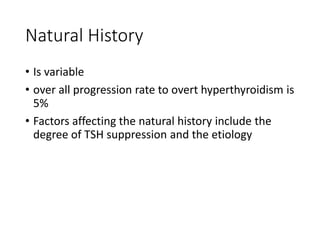
Natural History
• Is variable
• over all progression rate to overt hyperthyroidism is
5%
• Factors affecting the natural history include the
degree of TSH suppression and the etiology
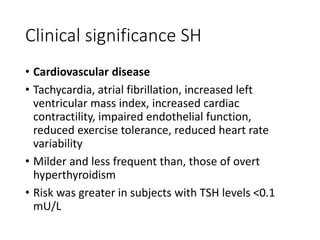
Clinical significance SH
• Cardiovascular disease
• Tachycardia, atrial fibrillation, increased left
ventricular mass index, increased cardiac
contractility, impaired endothelial function,
reduced exercise tolerance, reduced heart rate
variability
• Milder and less frequent than, those of overt
hyperthyroidism
• Risk was greater in subjects with TSH levels <0.1
mU/L
• Osteoporosis and fractures
• Influenced by the duration of the disease,
associated risk factors for bone loss, and degree of
TSH suppression
• Changes induced by the thyroid hormones???
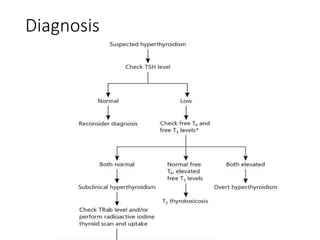
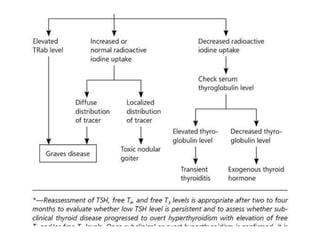
Diagnosis
Management
• Aim of therapy is to restore the euthyroid state and
avoid potential side effects
• Involves the following 6 steps:
• 1) confirmation,
• 2) assessment of severity,
• 3) determination of the cause,
• 4) assessment of potential cocomplications
• 5) evaluation of the necessity of treatment, and
• 6) selection of the most convenient therapy_x0000_
• Therapeutic strategies vary depending on 3 key
factors
• 1) cause,
• 2) severity, and
• 3) associated morbidity.
Before starting treatment
• Patients at high risk of complications from SH, TSH
and free T4 should be repeated within 2–6 weeks
• For all other patients, it is important to document
that SH is a persistent problem by repeating the
serum TSH at 3–6 months, prior to initiating
therapy.
Principle of treatment
Factor TSH (<0.1 mU/L) TSH (0.1–0.4 mU/L)
Age >65 years Treat Consider treating
Age <65 years with
comorbidities(Heart
disease ,Osteoporosis
Menopausal, not on
estrogens or
bisphosphonates &
Hyperthyroid symptoms)
Treat Consider treating
Age <65 years,
asymptomatic
Consider treating Observe
Election of Treatment
• The armamentarium of treatment is similar for overt and
subclinical disease
Thionamides
• Mild Grave's disease in young patient
• To make pt euthyroid before surgery or radioiodine therapy
Surgery
• Young individuals with a single hyperfunctioning nodule (toxic
adenoma) and toxic multinodular goiter
• Graves’ disease if medical therapy fails
Radioiodine
• For old patient with MNG and cardiac disease
Referance
• William's Text Book of endocrinology 14th ed
• Americal thyroid association guidline
• International journal of endocrinology
• Europian thyroid association guidline

Subclinical hyperthyroidism.pptx

  • 1.
    Subclinical hyperthyroidism(SH) By Dr MengistuKassa Assistant professor of General surgery Debretabor university , Ethiopia
  • 2.
    Outlines • Introduction • Classification •Prevalence • Etiology • Natural history • clinical segnificance • Diagnosis • Treatment
  • 3.
    Introduction • Low orundetectable TSH levels, with normal free T4 and total or free T3 levels. • Somewhat of a misnomer because the condition is defined by biochemical characteristics, and it is preferable to say mild thyroid dysfunction
  • 4.
    Classification Divided into twocategories: 1. low but detectable TSH levels (0.1 to 0.4 mIU per L), and 2. suppressed TSH levels (less than 0.1 mIU per L).
  • 5.
    Prevalence • Prevalence inadult population depends on age, sex, and iodine intake • 0.7% had suppressed TSH levels (<0.1 mU/L), and 1.8% had low TSH levels (<0.4 mU/L) • In old patient >70 yrs(~15%) • In pt taking thyroxine(~20%)
  • 6.
    Etiology 1. Endogenous A. Persistant •Toxic Multinodular Goiter • Graves’ ddiseas • Toxic adenoma • Pituitary disease (Central hypothyroidism) B. Transient • Subacute thyroiditis • Silent ththyroiditi • Postpartum thyroiditis • Euthyroid Sick Syndrome • Initial post-therapy period after treatment for overt hyperthyroidism
  • 7.
    Etiology.... • Exogenous • IatrogenicOvertreatment with levothyroxine (most common cause) • Factitial thyrotoxicosis (surreptitious levothyroxine intake) • Drug-induced thyroiditis (amiodarone, α-IFN) • Iodide excess (radiographic contrasts) • TSH-lowering medications (steroids, dopamine)
  • 8.
    Natural History • Isvariable • over all progression rate to overt hyperthyroidism is 5% • Factors affecting the natural history include the degree of TSH suppression and the etiology
  • 9.
    Clinical significance SH •Cardiovascular disease • Tachycardia, atrial fibrillation, increased left ventricular mass index, increased cardiac contractility, impaired endothelial function, reduced exercise tolerance, reduced heart rate variability • Milder and less frequent than, those of overt hyperthyroidism • Risk was greater in subjects with TSH levels <0.1 mU/L
  • 10.
    • Osteoporosis andfractures • Influenced by the duration of the disease, associated risk factors for bone loss, and degree of TSH suppression • Changes induced by the thyroid hormones???
  • 11.
  • 13.
    Management • Aim oftherapy is to restore the euthyroid state and avoid potential side effects • Involves the following 6 steps: • 1) confirmation, • 2) assessment of severity, • 3) determination of the cause, • 4) assessment of potential cocomplications • 5) evaluation of the necessity of treatment, and • 6) selection of the most convenient therapy_x0000_
  • 14.
    • Therapeutic strategiesvary depending on 3 key factors • 1) cause, • 2) severity, and • 3) associated morbidity.
  • 15.
    Before starting treatment •Patients at high risk of complications from SH, TSH and free T4 should be repeated within 2–6 weeks • For all other patients, it is important to document that SH is a persistent problem by repeating the serum TSH at 3–6 months, prior to initiating therapy.
  • 16.
    Principle of treatment FactorTSH (<0.1 mU/L) TSH (0.1–0.4 mU/L) Age >65 years Treat Consider treating Age <65 years with comorbidities(Heart disease ,Osteoporosis Menopausal, not on estrogens or bisphosphonates & Hyperthyroid symptoms) Treat Consider treating Age <65 years, asymptomatic Consider treating Observe
  • 17.
    Election of Treatment •The armamentarium of treatment is similar for overt and subclinical disease Thionamides • Mild Grave's disease in young patient • To make pt euthyroid before surgery or radioiodine therapy Surgery • Young individuals with a single hyperfunctioning nodule (toxic adenoma) and toxic multinodular goiter • Graves’ disease if medical therapy fails Radioiodine • For old patient with MNG and cardiac disease
  • 18.
    Referance • William's TextBook of endocrinology 14th ed • Americal thyroid association guidline • International journal of endocrinology • Europian thyroid association guidline