


Dan Steinberg
  N Scott Cardell
Mykhaylo Golovnya
 November, 2011
 Salford Systems
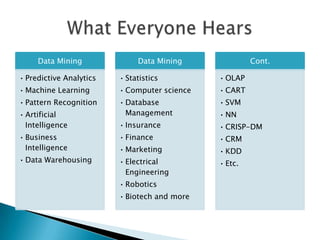
Data Mining              Data Mining              Cont.

• Predictive Analytics   • Statistics         • OLAP
• Machine Learning       • Computer science   • CART
• Pattern Recognition    • Database           • SVM
• Artificial               Management         • NN
  Intelligence           • Insurance          • CRISP-DM
• Business               • Finance            • CRM
  Intelligence           • Marketing          • KDD
• Data Warehousing       • Electrical         • Etc.
                           Engineering
                         • Robotics
                         • Biotech and more
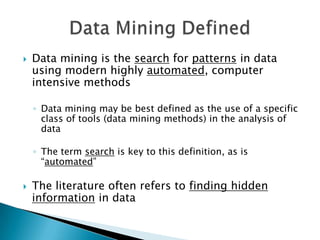
   Data mining is the search for patterns in data
    using modern highly automated, computer
    intensive methods

    ◦ Data mining may be best defined as the use of a specific
      class of tools (data mining methods) in the analysis of
      data

    ◦ The term search is key to this definition, as is
      “automated”

   The literature often refers to finding hidden
    information in data
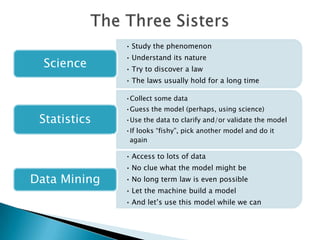
• Study the phenomenon
              • Understand its nature
  Science     • Try to discover a law
              • The laws usually hold for a long time

              •Collect some data
              •Guess the model (perhaps, using science)
 Statistics   •Use the data to clarify and/or validate the model
              •If looks “fishy”, pick another model and do it
               again

              • Access to lots of data
              • No clue what the model might be
Data Mining   • No long term law is even possible
              • Let the machine build a model
              • And let‟s use this model while we can
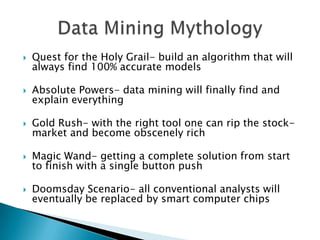
   Quest for the Holy Grail- build an algorithm that will
    always find 100% accurate models

   Absolute Powers- data mining will finally find and
    explain everything

   Gold Rush- with the right tool one can rip the stock-
    market and become obscenely rich

   Magic Wand- getting a complete solution from start
    to finish with a single button push

   Doomsday Scenario- all conventional analysts will
    eventually be replaced by smart computer chips
   This is known as “supervised learning”

    ◦ We will focus on patterns that allow us to accomplish two tasks
       Classification
       Regression

   This is known as “unsupervised learning”

    ◦ We will briefly touch on a third common task
       Finding groups in data (clustering, density estimation)

   There are other patterns we will not discuss today
    including

    ◦ Patterns in sequences
    ◦ Connections in networks (the web, social networks, link analysis)
   CART® (Decision Trees, C4.5, CHAID among others)

   MARS® (Multivariate Adaptive Regression Splines)

   Artificial Neural Networks (ANNs, many commercial)

   Association Rules (Clustering, market basket analysis)

   TreeNet® (Stochastic Gradient Tree Boosting)
   RandomForests® (Ensembles of trees w/ random splits)
   Genetic Algorithms (evolutionary model development)

   Self Organizing Maps (SOM, like k-means clustering)

   Support Vector Machine (SVM wrapped in many patents)

   Nearest Neighbor Classifiers
   (Insert chart)

   In a nutshell: Use historical data to gain
    insights and/or make predictions on the new
    data
   Given enough learning iterations, most data mining methods are
    capable of explaining everything they see in the input
    data, including noise

   Thus one cannot rely on conventional (whole sample) statistical
    measures of model quality

   A common technique is to partition historical data into several
    mutually exclusive parts

    ◦ LEARN set is used to build a sequence of models varying in size and level
      of explained details

    ◦ TEST set is used to evaluate each candidate model and suggest the
      optimal one

    ◦ VALIDATE set is sometimes used to independently confirm the optimal
      model performance on yet another sample
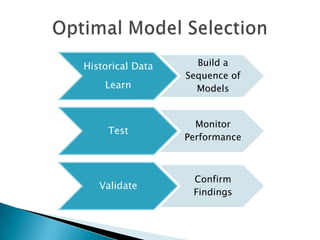
Historical Data     Build a
                  Sequence of
    Learn           Models


                    Monitor
     Test
                  Performance


                   Confirm
   Validate
                   Findings
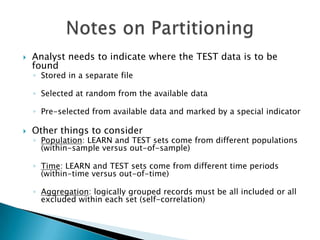
   Analyst needs to indicate where the TEST data is to be
    found
    ◦ Stored in a separate file

    ◦ Selected at random from the available data

    ◦ Pre-selected from available data and marked by a special indicator

   Other things to consider
    ◦ Population: LEARN and TEST sets come from different populations
      (within-sample versus out-of-sample)

    ◦ Time: LEARN and TEST sets come from different time periods
      (within-time versus out-of-time)

    ◦ Aggregation: logically grouped records must be all included or all
      excluded within each set (self-correlation)
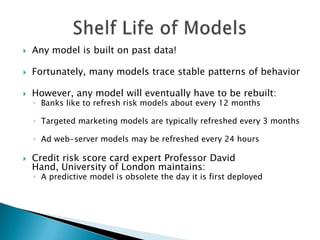
   Any model is built on past data!

   Fortunately, many models trace stable patterns of behavior

   However, any model will eventually have to be rebuilt:
    ◦ Banks like to refresh risk models about every 12 months

    ◦ Targeted marketing models are typically refreshed every 3 months

    ◦ Ad web-server models may be refreshed every 24 hours

   Credit risk score card expert Professor David
    Hand, University of London maintains:
    ◦ A predictive model is obsolete the day it is first deployed
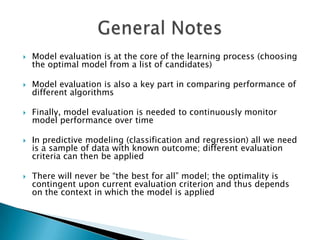
   Model evaluation is at the core of the learning process (choosing
    the optimal model from a list of candidates)

   Model evaluation is also a key part in comparing performance of
    different algorithms

   Finally, model evaluation is needed to continuously monitor
    model performance over time

   In predictive modeling (classification and regression) all we need
    is a sample of data with known outcome; different evaluation
    criteria can then be applied

   There will never be “the best for all” model; the optimality is
    contingent upon current evaluation criterion and thus depends
    on the context in which the model is applied
   (insert graph)

   One usually computes some measure of average
    discrepancy between the continuous model predictions f
    and the actual outcome y
    ◦ Least Squared Deviation: R= Σ(y-f)^2
    ◦ Least Absolute Deviation: R= Σ Iy-fI

   Fancier definitions also exist
    ◦ Huber-M Loss: is defined as a hybrid between the LS and LAD
      losses
    ◦ SVM Loss: ignores very small discrepancies and then switches to
      LAD-style

   The raw loss value is often re-expressed in relative terms
    as R-squared
   There are three progressively more demanding approaches to
    solving binary classification problems

   Division: a model makes the final class assignment for each
    observation internally
    ◦ Observations with identical class assignment are no longer discriminated
    ◦ A model needs to be rebuilt to change decision rules

   Rank: a model assigns a continuous score to each observation
    ◦ The score on its own bears no direct interpretation

    ◦ But, higher class score means higher likelihood of class presence in
      general (without precise quantitative statements)

    ◦ Any monotone transformation of scores is admissible

    ◦ A spectrum of decision rules can be constructed strictly based on varying
      score threshold without model rebuilding

   Probability: a model assigns a probability score to each observation
    ◦ Same as above, but the output is interpreted directly in the exact probabilistic
      terms
   Depending on the prediction emphasis, various performance evaluation
    criteria can be constructed for binary classification models

   The following list, far from being exhausting, presents some of the
    frequently used evaluation criteria
    ◦ Accuracy (more generally- Expected Cost)
       Applicable to all models

    ◦ ROC Curve and Area Under Curve
       Not Applicable to Division Models

    ◦ Gains and Lift
       Not Applicable to Division Models

    ◦ Log-likelihood (a.k.a Cross-Entropy, Deviate)
       Not Applicable to Division and Rank Models

   The criteria above are listed in the order from the least specific to the
    most

   It is not guaranteed that all criteria will suggest the same model as the
    optimal from a list of candidate models
   Most intuitive and also the weakest evaluation method that can be
    applied to any classification model

   Each record must be assigned to a specific class

   One first constructs a Prediction Success Table- a 2 by 2 matrix showing
    how many true 0s and 1s (rows) were classified by the model correctly or
    incorrectly (columns)

   The classification accuracy is then the number of correct class
    assignments divided by the sample size

   More general approaches will also include user supplied prior
    probabilities and cost matrix to compute the Expected Cost

   The example below reports prediction success tables for two separate
    models along with the accuracy calculations

   The method is not sensitive enough to emphasize larger class unbalance
    in model 1
   (insert table)
   The classification accuracy approach assumes that each record
    has already been classified which is not always convenient

    ◦ Those algorithms producing a continuous score (Rank or Probability) will
      require a user-specified threshold to make final class assignments

    ◦ Different thresholds will result to different class assignments and likely
      different classification accuracies

   The accuracy approach focuses on the separating boundary and
    ignores fine probability structure outside the boundary

   Ideally, need an evaluator working directly with the score itself
    and not dependent on any external considerations like costs and
    thresholds

   Also, for Rank models the evaluator needs to be invariant with
    respect to monotone transformation of the scores so that the
    “spirit” of such models is not violated
   The following approach will take full advantage of the set of
    continuous scores produced by Rank or Probability models

   Pick one of the two target classes as the class in focus

   Sort a database by predicted score in descending order

   Choose a set of different score values
    ◦ Could be ALL of the unique scores produced by the model
    ◦ More often a set of scores obtained by binning sorted records into equal
      size bins

   For any fixed value of the score we can now compute:
    ◦ Sensitivity (a.k.a True Positive): Percent of the class in focus with the
      predicted scores above the threshold
    ◦ Specificity (a.k.a False Positive): Percent of the opposite class with the
      predicted scores below the threshold

   We then display the results as a plot of [sensitivity] versus [1-specificity]

   The resulting curve is known as the ROC Curve
   (insert graph)
   ROC Curves for three different rank models are shown

   No model can be considered as the absolute best in all times

   The optimal model selection will rest with the user

   Average overall performance can be measured as Area Under
    ROC Curve (AUC)
    ◦ ROC Curve (up to orientation) and AUC are invariant with respect to the
      focus class selection
    ◦ The best attainable AUS is always 1.0
    ◦ AUC of a model with randomly assigned scores is 0.5

   AUC can be interpreted
    ◦ Suppose we randomly and repeatedly pick one observation at random
      from the focus class and another observation from the opposite class
    ◦ Then AUC is the fraction of trials resulting to the focus class observation
      having greater predicted score than the opposite class observation
    ◦ AUC below 0.5 means that something is fundamentally wrong
   The following example justifies another slightly different approach to model
    evaluation
   Suppose we want to mail a certain offer to P fraction of the population

   Mailing to a randomly chosen sample will capture about P fraction of the
    responders (random sampling procedure)

   Now suppose that we have access to a response model which ranks each potential
    responder by a score

   Now if we sample the P fraction of the population targeting members with the
    highest predicted scores first (model guided sampling), we could now get T
    fraction of the responders which we expect to be higher than P

   The lift in P(th) percentile is defined as the ratio T/P

   Obviously, meaningful models will always produce lift greater than 1

   The process can be repeated for all possible percentiles and the results can be
    summarized graphically as Gains and Cumulative Lift curves

   In practice, one usually first sorts observations by scores and then partitions
    sorted data into a fixed number of bins to save on calculations just like it is
    usually done for ROC curves
   (insert graphs and tables)
   (insert graphs)
   Lift in the given percentile provides a point measure of
    performance for the given population cutoff
    ◦ Can be viewed as the relative length of the vertical line segment
      connecting the gains curve at the given population cutoff

   Area Under the Gains curve (AUG): Provides an integral measure
    of performance across all bins
    ◦ Unlike AUC, the largest attainable value of AUG is (1-p/2), P being the
      fraction of responders in the population

   Just like ROC-curves, gains and lift curves for different models
    can intersect, so that performance-wise one model is better for
    one range of cutoffs while another model is better for a different
    range

   Unlike ROC-curve, gains and lift curves do depend on the class
    in focus
    ◦ For the dominant class, gains and lift curves degenerate to the trivial 45-
      degree line random case
   ROC, Gains, and lift curves together with AUC and AUG are invariant
    with respect to monotone transformation of the model scores
    ◦ Scores are only used to sort records in the evaluation set, the actual score
      values are of no consequence

   All these measures address the same conceptual phenomenon
    emphasizing different sides and thus can be easily derived from
    each other
    ◦ Any point (P,G) on a gains curve corresponds to the point (P,G/P) on the
      lift curve
    ◦ Suppose that the focus class occupies fraction F of the population; then
      any point (P,G) on a gains curve corresponds to the point {(P-FG)/(1-F),G}
      on the ROC curve

       It follows that the ROC graph “pushes” the gains graph “away” from the 45
        degree line
       Dominant focus class (large F) is “pushed” harder so that the degeneracy of
        its gain curve disappears
       In contrast, rare focus class (small F) has ROC curve naturally “close” to the
        gains curve

   All of these measures are widely used as robust performance
    evaluations in various practical applications
   When the output score can be interpreted as probability, a more specific
    evaluation criterion can be constructed to access probabilistic accuracy
    of the model

   We assume that the model generates P(X)-the conditional probability of
    1 given X

   We also assume that the binary target Y is coded as -1 and +1 (only for
    notational convenience)

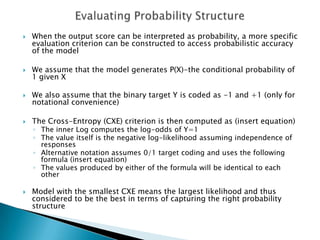
   The Cross-Entropy (CXE) criterion is then computed as (insert equation)
    ◦ The inner Log computes the log-odds of Y=1
    ◦ The value itself is the negative log-likelihood assuming independence of
      responses
    ◦ Alternative notation assumes 0/1 target coding and uses the following
      formula (insert equation)
    ◦ The values produced by either of the formula will be identical to each
      other

   Model with the smallest CXE means the largest likelihood and thus
    considered to be the best in terms of capturing the right probability
    structure
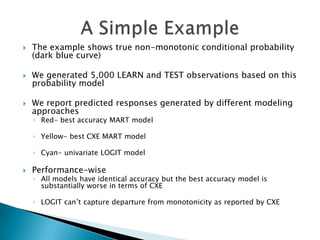
   The example shows true non-monotonic conditional probability
    (dark blue curve)

   We generated 5,000 LEARN and TEST observations based on this
    probability model

   We report predicted responses generated by different modeling
    approaches
    ◦ Red- best accuracy MART model

    ◦ Yellow- best CXE MART model

    ◦ Cyan- univariate LOGIT model

   Performance-wise
    ◦ All models have identical accuracy but the best accuracy model is
      substantially worse in terms of CXE

    ◦ LOGIT can‟t capture departure from monotonicity as reported by CXE
   MARS is a highly-automated tool for regression

   Developed by Jerome H. Friedman of Stanford University
    ◦ Annals of statistics, 1991 dense 65 page article
    ◦ Takes some inspiration from its ancestor CART®
    ◦ Produces smooth curves and surfaces, not the step-functions of CART

   Appropriate target variables are continuous

   End result of a MARS run is a regression model
    ◦   MARS automatically chooses which variables to use
    ◦   Variables are optimally transformed
    ◦   Interactions are detected
    ◦   Model is self-tested to protect against over-fitting

   Can also perform well on binary dependent variables
    ◦ Censored survival model (waiting time models as in churn)
   Harrison, D. and D. Rubinfeld.
    Hedonic Housing Prices and Demand for Clean Air. Journal of
    Environmental Economics and Management v5, 81-102, 1978

   506 census tracts in city of Boston for the year 1970

   Goal: study relationship between quality of life variables and property
    values

    ◦   MV- median value of owner-occupied homes in tract („000s)
    ◦   CRIM- per capita crime rates
    ◦   NOX- concentration of nitrogen oxides (pphm)
    ◦   AGE- percent built before 1940
    ◦   DIS- weighted distance to centers of employment
    ◦   RM- average number of rooms per house
    ◦   LSTAT- percent neighborhood „lower socio-economic status‟
    ◦   RAD- accessibility to radial highways
    ◦   CHAS- borders Charles River (0/1)
    ◦   INDUS- percent non-retail business
    ◦   TAX- tax rate
    ◦   PT- pupil teacher ratio
   (insert graph)
   The dataset poses significant challenges to
    conventional regression modeling

    ◦ Clearly departure from normality, non-linear
      relationships, and skewed distributions

    ◦ Multicollinearity, mutual dependency, and outlying
      observations
   (insert graph)

   A typical MARS solution (univariate for simplicity)
    is shown above

    ◦ Essentially a piece-wise linear regression model with the
      continuity requirement at the transition points called
      knots

    ◦ The locations and number of knots were determined
      automatically to ensure the best possible model fit

    ◦ The solution can be analytically expressed as
      conventional regression equations
   Finding the one best knot in a simple regression is a straightforward
    search problem
    ◦ Try a large number of potential knots and choose one with the best R-
      squared
    ◦ Computation can be implemented efficiently using update algorithms;
      entire regression does not have to be rerun for every possible knot (just
      update X‟X matrices)

   Finding k knots simultaneously would require n^k order of
    computations assuming N observations

   To preserve linear problem complexity, multiple knot
    replacement is implemented in a step-wise manner:
    ◦ Need a forward/backward procedure
    ◦ The forward procedure adds knots sequentially one at a time
       The resulting model will have many knots and overfit the training data
    ◦ The backward procedure removes least contributing knots one at a time
       This produces a list of models of varying complexity
    ◦ Using appropriate evaluation criterion, identify the optimal model

   Resulting model will have approximately correct knot locations
   (insert graphs)

   True conditional mean has two knots at X=30
    and X=60, observed data includes additional
    random error

   Best single knot will be at X=45, subsequent best
    locations are true knots around 30 and 60

   The backward elimination step is needed to
    remove the redundant node at X=45
   Thinking in terms of knot selection works very well to
    illustrate splines in one dimension but unwieldy for
    working with a large number of variables simultaneously
    ◦ Need a concise notation easy to program and extend in multiple
      dimensions

    ◦ Need to support interactions, categorical variables, and missing
      values

   Basis functions (BF) provide analytical machinery to
    express the knot placement strategy

   Basis function is a continuous univariate transform that
    reduces predictor influence to a smaller range of values
    controlled by a parameter c (20 in the example below)
    ◦ Direct BF: max(X-c, 0)- the original range is cut below c

    ◦ Mirror BF: max (c-X, 0)- the original range is cut above c
    ◦ (insert graphs)
   The following model represents a 3-knot
    univariate solution for the Boston Housing
    Dataset using two direct and one mirror basis
    functions

   (insert equations)

   All three line segments have negative slope
    even though two coefficients are above zero

   (insert graph)
   MARS core technology:
    ◦ Forward step: add basis function pairs one at a time in conventional step-
      wise forward manner until the largest model size (specified by the user) is
      reached
       Possible collinearity due to redundancy in pairs must be detected and
        eliminated
       For categorical predictors define basis functions as indicator variables for all
        possible subsets of levels
       To support interactions, allow cross products between a new candidate pair
        and basis functions already present in the model

    ◦ Backward step: remove basis functions one at a time in conventional step-
      wise backward manner to obtain a sequence of candidate models
    ◦ Use test sample or cross-validation to identify the optimal model size

   Missing values are treated by constructing missing value
    indicator (MVI) variables and nesting the basis functions within
    the corresponding MVIs

   Fast update formulae and smart computational shortcuts exist to
    make the MARS process as fast and efficient as possible
   OLS and MARS regression (insert graphs)

   We compare the results of classical linear regression
    and MARS
    ◦ Top three significant predictors are shown for each model

    ◦ Linear regression provides global insights

    ◦ MARS regression provides local insights and has superior
      accuracy

      All cut points were automatically discovered by MARS

      MARS model can be presented as a linear regression model in
       the BF space
   One of the oldest Data Mining tools for classification
   The method was originally developed by Fix and Hodges (1951) in an
    unpublished technical report

   Later on it was reproduced by Agrawala (1977), Silverman and Jones
    (1989)
   A review book with many references on the topic is Dasarathy (1991)

   Other books that treat the issue:
    ◦ Ripley B.D. 1996. Pattern Recognition and Neural Networks (chapter 6)
    ◦ Hastie T, Tibshirani R and Friedman J. 2001. The Elements of Statistical Learning Data
      Mining, Inference and Prediction (chapter 13)

   The underlying idea is quite simple: make the predictions by proximity
    or similarity

   Example: we are interested in predicting if a customer will respond to an
    offer. A NN classifier will do the following:
    ◦ Identify a set of people most similar to the customer- the nearest neighbor
    ◦ Observe what they have done in the past on a similar offer
    ◦ Classify by majority voting: if most of them are responders, predict a
      responder, otherwise, predict a non-responder
   (insert graphs)
   Consider binary classification problem

   Want to classify the new case highlighted in yellow

   The circle contains the nearest neighbors (the most similar
    cases)
    ◦ Number of neighbors= 16
    ◦ Votes for blue class= 13
    ◦ Votes for red class= 3

   Classify the new case in the blue class. The estimated probability
    of belonging to the blue class is 13/16=0.8125

   Similarly in this example:
    ◦ Classify the yellow instance in the blue class
    ◦ Classify the green instance in the red class
    ◦ The black point receives three votes from the blue class and another three
      from the red one- the resulting classification is indeterminate
   There are two decisions that should be made in advance before
    applying the NN classifier
    ◦ The shape of the neighborhood
         Answers the question “Who are our nearest neighbors?”
    ◦ The number of neighbors (neighborhood size)
         Answers the question “How many neighbors do we want to consider?”

   Neighborhood shape amounts to choosing the
    proximity/distance measure
    ◦   Manhattan distance
    ◦   Euclidean distance
    ◦   Infinity distance
    ◦   Adaptive distances

   Neighborhood size K can vary between 1 and N (the dataset size)
    ◦ K=1-classification is based on the closest case in the dataset
    ◦ K=N-classification is always to the majority class
    ◦ Thus K acts as a smoothing parameter and can be determined by using a
      test sample or cross-validation
   NN advantages
    ◦ Simple to understand and easy to implement
    ◦ The underlying idea is appealing and makes logical sense
    ◦ Available for both classification and regression problems
       Predictions determined by averaging the values of nearest neighbors
    ◦ Can produce surprisingly accurate results in a number of
      applications
       NN have been proved to perform equal or better than LDA, CART, Neural
        Networks and other approaches when applied to remote sensed data

   NN disadvantages
    ◦ Unlike decision trees, LDA, or logistic regression, their decision
      boundaries are not easy to describe and interpret
    ◦ No variable selection of any kind- vulnerable to noisy inputs
       All the variables have the same weight when computing the distance, so
        two cases could be considered similar (or dissimilar) due to the role of
        irrelevant features (masking effects)
    ◦ Subject to the curse of dimensionality in high dimension datasets
    ◦ The technique is quite time consuming. However, Friedman et. Al.
      (1975 and 1977) have proposed fast algorithms
   Classification and Regression Trees (CART®)- original approach
    based on the “let the data decide local regions” concept
    developed by Breiman, Friedman, Olshen, and Stone in 1984

   The algorithm can be summarized as:
    ◦ For each current data region, consider all possible orthogonal splits (based
      on one variable) into 2 sub-regions
    ◦ The best split is defined as the one having the smallest MSE after fitting a
      constant in each sub-region (regression) or the smallest resulting class
      impurity (classification)
    ◦ Proceed recursively until all structure in the training set has been
      completely exhausted- largest tree is produced
    ◦ Create a sequence of nested sub-trees with different amount of
      localization (tree pruning)
    ◦ Pick the best tree based on the performance on a test set or cross-
      validated

   One can view CART tree as a set of dynamically constructed
    orthogonal nearest neighbor boxes of varying sizes guided by
    the response variable (homogeneity of response within each box)
   CART is best illustrated with a famous example- the UCSD Heart
    Disease study
    ◦ Given the diagnosis of a heart attack based on
       Chest pain, Indicative EKGs, Elevation of enzymes typically released by
        damaged heart muscle, etc.

    ◦ Predict who is at risk of a 2nd heart attack and early death within 30 days

    ◦ Prediction will determine treatment program (intensive care or not)

   For each patient about 100 variables were available, including:
    ◦ Demographics, medical history, lab results

    ◦ 19 noninvasive variables were used in the analysis
       Age, gender, blood pressure, heart rate, etc.

   CART discovered a very useful model utilizing only 3 final
    variables
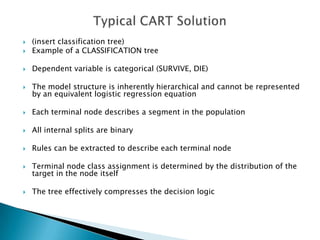
   (insert classification tree)
   Example of a CLASSIFICATION tree

   Dependent variable is categorical (SURVIVE, DIE)

   The model structure is inherently hierarchical and cannot be represented
    by an equivalent logistic regression equation

   Each terminal node describes a segment in the population

   All internal splits are binary

   Rules can be extracted to describe each terminal node

   Terminal node class assignment is determined by the distribution of the
    target in the node itself

   The tree effectively compresses the decision logic
   CART advantages:
    ◦ One of the fastest data mining algorithms available
    ◦ Requires minimal supervision and produces easy to understand
      models
    ◦ Focuses on finding interactions and signal discontinuities
    ◦ Important variables are automatically identified
    ◦ Handles missing values via surrogate splits
       A surrogate split is an alternative decision rule supporting the main rule
        by exploiting local rank-correlation in a node
    ◦ Invariant to monotone transformations of predictors

   CART disadvantages:
    ◦ Model structure is fundamentally different from conventional
      modeling paradigms- may confuse reviewers and classical
      modelers
    ◦ Has limited number of positions to accommodate available
      predictors- ineffective at presenting global linear structure (but
      great for interactions)
    ◦ Produces coarse-grained piece-wise constant response surfaces
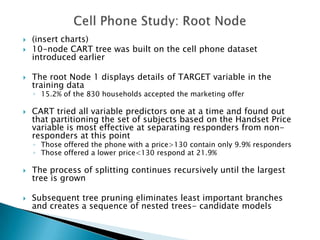
   (insert charts)
   10-node CART tree was built on the cell phone dataset
    introduced earlier

   The root Node 1 displays details of TARGET variable in the
    training data
    ◦ 15.2% of the 830 households accepted the marketing offer

   CART tried all variable predictors one at a time and found out
    that partitioning the set of subjects based on the Handset Price
    variable is most effective at separating responders from non-
    responders at this point
    ◦ Those offered the phone with a price>130 contain only 9.9% responders
    ◦ Those offered a lower price<130 respond at 21.9%

   The process of splitting continues recursively until the largest
    tree is grown

   Subsequent tree pruning eliminates least important branches
    and creates a sequence of nested trees- candidate models
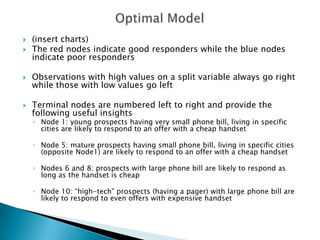
   (insert charts)
   The red nodes indicate good responders while the blue nodes
    indicate poor responders

   Observations with high values on a split variable always go right
    while those with low values go left

   Terminal nodes are numbered left to right and provide the
    following useful insights
    ◦ Node 1: young prospects having very small phone bill, living in specific
      cities are likely to respond to an offer with a cheap handset

    ◦ Node 5: mature prospects having small phone bill, living in specific cities
      (opposite Node1) are likely to respond to an offer with a cheap handset

    ◦ Nodes 6 and 8: prospects with large phone bill are likely to respond as
      long as the handset is cheap

    ◦ Node 10: “high-tech” prospects (having a pager) with large phone bill are
      likely to respond to even offers with expensive handset
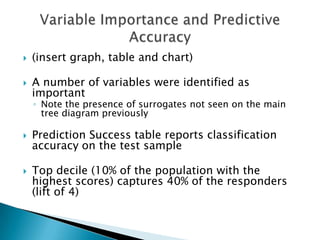
   (insert graph, table and chart)

   A number of variables were identified as
    important
    ◦ Note the presence of surrogates not seen on the main
      tree diagram previously

   Prediction Success table reports classification
    accuracy on the test sample

   Top decile (10% of the population with the
    highest scores) captures 40% of the responders
    (lift of 4)
   (insert graphs)

   CART has a powerful mechanism of priors built
    into the core of the tree building mechanism

   Here we report the results of an experiment with
    prior on responders varying from 0.05 to 0.95 in
    increments of 0.05

   The resulting CART models “sweep” the modeling
    space enforcing different sensitivity-specificity
    tradeoff
   As prior on the given class decreases
   The class assignment threshold increases
   Node richness goes up
   But class accuracy goes down

   PRIORS EQUAL uses the root node class ratio as the class assignment
    threshold- hence, most favorable conditions to build a tree

   PRIORS DATA uses the majority rule as the class assignment threshold-
    hence, difficult modeling conditions on unbalanced classes.

   In reality, a proper combination of priors can be found experimentally

   Eventually, when priors are too extreme, CART will refuse to build a tree.
    ◦ Often the hottest spot is a single node in the tree built with the most
      extreme priors with which CART will still build a tree.

    ◦ Comparing hotspots in successive trees can be informative, particularly in
      moderately-sized data sets.
   (insert graph)

   We have a mixture of two overlapping classes

   The vertical lines show root node splits for
    different sets of priors. (the left child is classified
    as red, the right child is classified as blue)

   Varying priors provides effective control over the
    tradeoff between class purity and class accuracy
   Hot spots are areas of data very rich in the event of interest, even
    though they could only cover a small fraction of the targeted
    group
    ◦ A set of prospects rich in responders

    ◦ A set of transactions with abnormal amount of fraud

   The varying-priors collection of runs introduced above gives
    perfect raw material in the search of hot spots
    ◦ Simply look at all terminal nodes across all trees in the collection and
      identify the highest response segments

    ◦ Also want to have such segments as large as possible

    ◦ Once identified, the rules leading to such segments (nodes) are easily
      available

    ◦ (insert graph)
    ◦ The graph on the left reports all nodes according to their target coverage
      and lift
    ◦ The blue curve connects the nodes most likely to be a hot spot
   (insert graph)
   Our next experiment (variable shaving) runs as follows:
    ◦ Build a CART model with the full set of predictors

    ◦ Check the variable importance, remove the least important
      variable and rebuild CART model

    ◦ Repeat previous step until all variables have been removed

   Six-variable model has the best performance so far

   Alternative shaving techniques include:
    ◦ Proceed by removing the most important variable- useful in
      removal of model “hijackers”- variables looking very strong on the
      train data but failing on the test data (e.g. ID variables)

    ◦ Set up nested looping to remove redundant variables from the
      inner positions on the variable importance list
   (insert tree)
   Many predictive models benefit from Salford Systems
    patent on “Structured Trees”

   Trees constrained in how they are grown to reflect
    decision support requirements
    ◦ Variables allowed/disallowed depending on a level in a tree

    ◦ Variable allowed/disallowed depending on a node size

   In mobile phone example: want tree to first segment on
    customer characteristics and then complete using price
    variables
    ◦ Price variables are under the control of the company

    ◦ Customer characteristics are beyond company control
   Various areas of research were spawned by CART

   We report on some of the most interesting and well developed
    approaches

   Hybrid models
    ◦ Combining CART with linear and Logistic Regression
    ◦ Combining CART with Neural Nets

   Linear combination splits

   Committees of trees
    ◦ Bagging
    ◦ Arcing
    ◦ Random Forest

   Stochastic Gradient Boosting (MART a.k.a TreeNet)

   Rule Fit and Path Finder
   (insert images)
   Grow a tree on training data

   Find a way to grow another tree, different from currently
    available (change something in set up)

   Repeat many times, say 500 replications

   Average results or create voting scheme
    ◦ For example, relate PD to fraction of trees predicting default for a given

   Beauty of the method is that every new tree starts with a
    complete set of data

   Any one tree can run out of data, but when that happens we just
    start again with a new tree and all the data (before sampling)
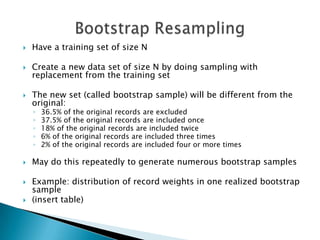
   Have a training set of size N

   Create a new data set of size N by doing sampling with
    replacement from the training set

   The new set (called bootstrap sample) will be different from the
    original:
    ◦   36.5% of the original records are excluded
    ◦   37.5% of the original records are included once
    ◦   18% of the original records are included twice
    ◦   6% of the original records are included three times
    ◦   2% of the original records are included four or more times

   May do this repeatedly to generate numerous bootstrap samples

   Example: distribution of record weights in one realized bootstrap
    sample
   (insert table)
   To generate predicted response, multiple trees are combined via
    voting (classification) or averaging (regression) schemas

   Classification trees “vote”
    ◦ Recall that classification trees classify
       Assign each case to ONE class only

    ◦ With 100 trees, 100 separate class assignment (votes) for each record

    ◦ Winner is the class with the most votes

    ◦ Fraction of votes can be used as a crude approximation to class
      probability

    ◦ Votes could be weighted- say by accuracy of individual trees or node sizes

    ◦ Class weights can be introduced to counter the effects of dominant classes

   Regression trees assign a real predicted value for each case
    ◦ Predictions are combined via averaging

    ◦ Results will be much smoother than from a single tree
   Breiman reports the results of running bootstrap
    aggregation (bagger) on four publicly available
    datasets from Statlog project

   In all cases the bagger shows substantial
    improvement in the classification accuracy

   It all comes at a price of no longer having a
    single interpretable model, substantially longer
    run time and greater demand on model storage
    space

   (insert tables)
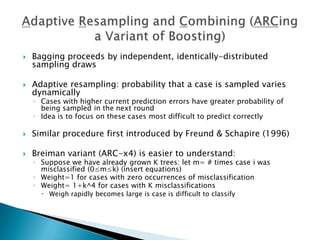
   Bagging proceeds by independent, identically-distributed
    sampling draws

   Adaptive resampling: probability that a case is sampled varies
    dynamically
    ◦ Cases with higher current prediction errors have greater probability of
      being sampled in the next round
    ◦ Idea is to focus on these cases most difficult to predict correctly

   Similar procedure first introduced by Freund & Schapire (1996)

   Breiman variant (ARC-x4) is easier to understand:
    ◦ Suppose we have already grown K trees: let m= # times case i was
      misclassified (0≤m≤k) (insert equations)
    ◦ Weight=1 for cases with zero occurrences of misclassification
    ◦ Weight= 1+k^4 for cases with K misclassifications
       Weigh rapidly becomes large is case is difficult to classify
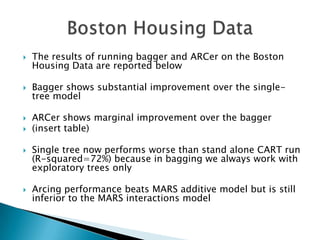
   The results of running bagger and ARCer on the Boston
    Housing Data are reported below

   Bagger shows substantial improvement over the single-
    tree model

   ARCer shows marginal improvement over the bagger
   (insert table)

   Single tree now performs worse than stand alone CART run
    (R-squared=72%) because in bagging we always work with
    exploratory trees only

   Arcing performance beats MARS additive model but is still
    inferior to the MARS interactions model
   Boosting (and Bagging) are very slow and consume a lot of
    memory, the final models tend to be awkwardly large and
    unwieldy

   Boosting in general is vulnerable to overtraining
    ◦ Much better fit on training than on test data

    ◦ Tendency to perform poorly on future data

    ◦ Important to employ additional considerations to reduce overfitting

   Boosting is also highly vulnerable to errors in the data
    ◦ Technique designed to obsess over errors

    ◦ Will keep trying to “learn” patterns to predict miscoded data

    ◦ Ideally would like to be able to identify miscoded and outlying data and
      exclude those records from the learning process

    ◦ Documented in study by Dietterich (1998)
       An Experimental Comparison of Three Methods for Constructing Ensembles
        of Decision Trees, Bagging, Boosting, and Randomization
   New approach for many data analytical tasks developed by
    Leo Breiman of University of California, Berkeley
    ◦ Co-author of CART® with Friedman, Olshen, and Stone

    ◦ Author of Bagging and Arcing approaches to combining trees

   Good for classification and regression problems
    ◦ Also for clustering, density estimation

    ◦ Outlier and anomaly detection

    ◦ Explicit missing value imputation

   Builds on the notions of committees of experts but is
    substantially different in key implementation details
   A random forest is a collection of single trees grown in a
    special way
    ◦ Each tree is grown on a bootstrap sample from the learning set
    ◦ A number R is specified (square root by defualt) such that is
      noticeably smaller than the total number of available predictors
    ◦ During tree growing phase, at each node only R predictors are
      randomly selected and tried

   The overall prediction is determined by voting (in
    classification) or averaging (in regression)

   The law of Large Numbers ensures convergence

   The key to accuracy is low correlation and bias

   To keep bias low, trees are grown to maximum depth
   Randomness is introduced in two distinct ways

   Each tree is grown on a bootstrap sample from the learning set
    ◦ Default bootstrap sample size equals original sample size
    ◦ Smaller bootstrap sample sizes are sometimes useful

   A number R is specified (square root by default) such that it is
    noticeably smaller than the total number of available predictors

   During tree growing phase, at each node only R predictors are
    randomly selected and tried.

   Randomness also reduces the signal to noise ratio in a single
    tree
    ◦ A low correlation between trees is more important than a high signal when
      many trees contribute to forming the model
    ◦ RandomForests™ trees often have very low signal strength, even when the
      signal strength of the forest is high.
   (insert graph)

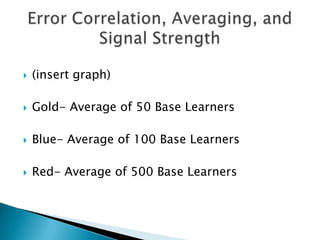
   Gold- Average of 50 Base Learners

   Blue- Average of 100 Base Learners

   Red- Average of 500 Base Learners
   (insert graph)

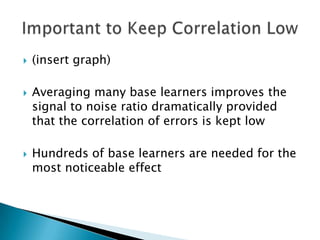
   Averaging many base learners improves the
    signal to noise ratio dramatically provided
    that the correlation of errors is kept low

   Hundreds of base learners are needed for the
    most noticeable effect
   All major advantages of a single tree are automatically preserved

   Since each tree is grown on a bootstrap sample, one can
    ◦ Use out of bag samples to compute an unbiased estimate of the accuracy
    ◦ Use out of bag samples to determine variable importances

   There is no overfitting as the number of trees increases

   It is possible to compute generalized proximity between any pair
    of cases

   Based on proximities one can
    ◦   Proceed with a target-driven clustering solution
    ◦   Detect outliers
    ◦   Generate informative data views/projections using scaling coordinates
    ◦   Do missing value imputation

   Interesting approaches to expanding the methodology into
    survival models and the unsupervised learning domain
   RF introduces a novel way to define proximity between two observations:
    ◦ For a dataset of size N define an NXN matrix of proximities

    ◦ Initialize all proximities to zeroes

    ◦ For any given tree, apply the tree to the dataset

    ◦ If case i and case j both end up in the same node, increase proximity
      proxij between i and j by one

    ◦ Accumulate over all trees in RF and normalize by twice the number of trees
      in RF

   The resulting matrix provides intrinsic measure of proximity
    ◦ Observations that are “alike” will have proximities close to one

    ◦ The closer the proximity to 0, the more dissimilar cases i and j are

    ◦ The measure is invariant to monotone transformations

    ◦ The measure is clearly defined for any type of independent
      variables, including categorical
   TreeNet (TN) is a new approach to machine learning and function
    approximation developed by Jerome H, Friedman at Stanford
    University
    ◦ Co-author of CART® with Breiman, Olshen and Stone
    ◦ Author of MARS®, PRIM, Projection Pursuit, COSA, RuleFit™ and more

   Also known as Stochastic Gradient Boosting and MART (Multiple
    Additive Regression Trees)

   Naturally supports the following classes of predictive models
    ◦ Regression (continuous target, LS and LAD loss functions)
    ◦ Binary Classification (binary target, logistic likelihood loss function)
    ◦ Multinomial classification (multiclass target, multinomial likelihood loss
      function)
    ◦ Poisson regression (counting target, Poisson Likelihood loss function)
    ◦ Exponential survival (positive target with censoring)
    ◦ Proportional hazard cox survival model

   TN builds on the notions of committees of experts and boosting
    but is substantially different in key implementation details
   We focus on TreeNet because:
   It is the method introduced in the original Stochastic Gradient
    Boosting article

   It is the method used in many successful real world studies

   We have found it to be more accurate than the other methods
    ◦ Many decisions that affect many people are made using a TreeNet model
    ◦ Major new fraud detection engine uses TreeNet
    ◦ David Cossock of Yahoo recently published a paper on uses of TreeNet in
      web search

   TreeNet is a fully developed methodology. New capabilities
    include:
    ◦   Graphical display of the impact of any predictor
    ◦   New automated ways to test for existence of interactions
    ◦   New ways to identify and rank interactions
    ◦   Ability to constrain model: allow some interactions and disallow others.
    ◦   Method to recast TreeNet model as a logistic regression.
   Built on CART trees and thus
    ◦ Immune to outliers

    ◦ Selects variables

    ◦ Results invariant with monotone transformations of variables

    ◦ Handles missing values automatically

   Resistant to mislabeled target data
    ◦ In medicine cases are commonly misdiagnosed

    ◦ In business, occasionally non-responders flagged as “responders”

   Resistant to overtraining- generalizes very well

   Can be remarkably accurate with little effort

   Trains very rapidly; comparable to CART
   2007 PAKDD competition: home loans up-sell to credit card owners
    2nd place
    ◦ Model built in half a day using previous year submission as a blueprint

   2006 PAKDD competition: customer type discrimination 3rd place
    ◦ Model built in one day. 1st place accuracy 81.9% TreeNet accuracy 81.2%

   2005 BI-CUP Sponsored by University of Chile attracted 60 competitors

   2004 KDDCup “Most Accurate”

   2003 “Duke University/NCR Teradata CRN modeling competition
    ◦ Most Accurate and Best Top Decile Lift on both in and out of time samples

   A major financial services company has tested TreeNet across a
    broad range of targeted marketing and risk models for the past two
    years
    ◦ TreeNet consistently outperforms previous best models (around 10%
      AUROC)
    ◦ TreeNet models can be built in a fraction of the time previously devoted
    ◦ TreeNet reveals previously undetected predictive power in data
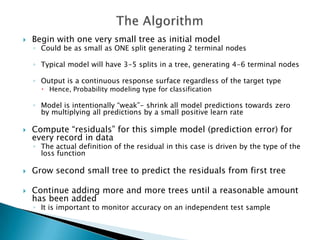
   Begin with one very small tree as initial model
    ◦ Could be as small as ONE split generating 2 terminal nodes

    ◦ Typical model will have 3-5 splits in a tree, generating 4-6 terminal nodes

    ◦ Output is a continuous response surface regardless of the target type
       Hence, Probability modeling type for classification

    ◦ Model is intentionally “weak”- shrink all model predictions towards zero
      by multiplying all predictions by a small positive learn rate

   Compute “residuals” for this simple model (prediction error) for
    every record in data
    ◦ The actual definition of the residual in this case is driven by the type of the
      loss function

   Grow second small tree to predict the residuals from first tree

   Continue adding more and more trees until a reasonable amount
    has been added
    ◦ It is important to monitor accuracy on an independent test sample
   (insert chart)
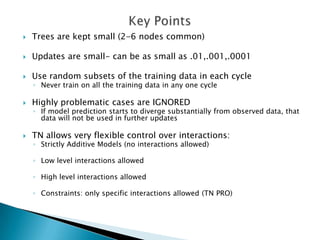
   Trees are kept small (2-6 nodes common)

   Updates are small- can be as small as .01,.001,.0001

   Use random subsets of the training data in each cycle
    ◦ Never train on all the training data in any one cycle

   Highly problematic cases are IGNORED
    ◦ If model prediction starts to diverge substantially from observed data, that
      data will not be used in further updates

   TN allows very flexible control over interactions:
    ◦ Strictly Additive Models (no interactions allowed)

    ◦ Low level interactions allowed

    ◦ High level interactions allowed

    ◦ Constraints: only specific interactions allowed (TN PRO)
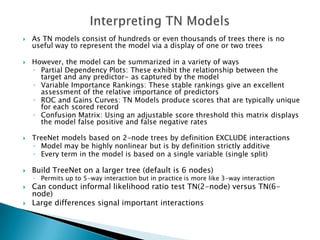
   As TN models consist of hundreds or even thousands of trees there is no
    useful way to represent the model via a display of one or two trees

   However, the model can be summarized in a variety of ways
    ◦ Partial Dependency Plots: These exhibit the relationship between the
      target and any predictor- as captured by the model
    ◦ Variable Importance Rankings: These stable rankings give an excellent
      assessment of the relative importance of predictors
    ◦ ROC and Gains Curves: TN Models produce scores that are typically unique
      for each scored record
    ◦ Confusion Matrix: Using an adjustable score threshold this matrix displays
      the model false positive and false negative rates

   TreeNet models based on 2-node trees by definition EXCLUDE interactions
    ◦ Model may be highly nonlinear but is by definition strictly additive
    ◦ Every term in the model is based on a single variable (single split)

   Build TreeNet on a larger tree (default is 6 nodes)
    ◦ Permits up to 5-way interaction but in practice is more like 3-way interaction
   Can conduct informal likelihood ratio test TN(2-node) versus TN(6-
    node)
   Large differences signal important interactions
   (insert graphs)

   The results of running TN on the Boston
    Housing Database are shown

   All of the key insights agree with previous
    findings by MARS and CART
   Slope reverses due to interaction

   Note that the dominant pattern is downward
    sloping, but that a key segment defined by
    the 3rd variable is upward sloping

   (insert graph)
   CART: Model is one optimized Tree
    ◦ Model is easy to interpret as rules
       Can be useful for data exploration, prior to attempting a more complex
         model
    ◦ Model can be applied quickly with a variety of workers:
       A series of questions for phone bank operators to detect fraudulent
         purchases
       Rapid triage in hospital emergency rooms
    ◦ In some cases may produce the best or the most predictive model, for example
      in classification with a barely detectable signal
    ◦ Missing values handled easily and naturally. Can be deployed effectively even
      when new data have a different missingness pattern
   Random Forests: combination of many LARGE trees
    ◦ Unique nonparametric distance metric that works in high dimensional spaces
    ◦ Often predicts well when other models work poorly, e.g. data with high level
      interactions
    ◦ In the most difficult data sets can be the best way to identify important
      variables
   Tree Net: combination of MANY small trees
    ◦ Best overall forecast performance in many cases
    ◦ Constrained models can be used to test the complexity of the data structure
      non-parametrically
    ◦ Exceptionally good with binary targets
   Neural Networks, combination of a few sigmoidal activation
    functions
    ◦ Very complex models can be represented in a very compact form

    ◦ Can accurately forecast both levels and slopes and even higher order
      derivatives

    ◦ Can efficiently use vector dependent variables
       Cross equation constraints can be imposed. (see Symmetry constraints for
        feedforward network models of gradient systems, Cardell, Joerding, and
        Li, IEEE Transactions on Neural Networks, 1993)

    ◦ During deployment phase, forecasts can be computed very quickly
       High voltage transmission lines use a neural network to detect whether there
        has been a lightning strike and are fast enough to shut down the line before
        it can be damaged

   Kernel function estimators, use a local mean or a local regression
    ◦ Local estimates easy to understand and interpret
    ◦ Local regression versions can estimate slopes and levels
    ◦ Initial estimation can be quick
   Random Forests:
    ◦ Models are large, complex and un-interpretable
    ◦ Limited to moderate sample sizes (usually less than 100,000
      observations)
    ◦ Hard to tell in advance which case Random Forests will work well
      on
    ◦ Deployed models require substantial computation

   Tree Net
    ◦ Models are large and complex, interpretation requires additional
      work
    ◦ Deployed models either require substantial computation or post-
      processing of the original model into a more compact form

   CART
    ◦ In most cases models are less accurate than TreeNet
    ◦ Works poorly in cases where effects are approximately linear in
      continuous variables or additive over many variables
   Neural Networks:
    ◦ Neural Networks cover such a wide variety of models that no good widely-
      applicable modeling software exists or may even be possible
       The most dramatic successes have been with Neural Network models that are
        idiosyncratic to the specific case, and ere developed with great effort
       Fully optimized Neural Network parameter estimates can be very difficult to
        compute, and sometimes perform substantially worse than initial statistically
        inferior estimates. (this is called the “over training” issue)

    ◦ In almost all cases initial estimation is very compute intensive

    ◦ Limited to very small numbers of variables (typically between about 6 and
      20 depending on the application)

   Kernel Function Estimators:
    ◦ Deployed models can require substantial computation

    ◦ Limited to small numbers of variables

    ◦ Sensitive to distance measures. Even a modest number of variables can
      degrade performance substantially, due to the influence of relatively
      unimportant variables on the distance metric
   Breiman, L., J. Friedman, R. Olshen and C. Stone
    (1984), Classification and Regression Trees, Pacific Grove:
    Wadsworth
   Breiman, L. (1996). Bagging predictors. Machine
    Learning, 24, 123-140.
   Hastie, T., Tibshirani, R., and Friedman, J.H (2000). The
    Elements of Statistical Learning. Springer.
   Freund, Y. & Schapire, R. E. (1996). Experiments with a
    new boosting algorithm. In L. Saitta, ed., Machine
    Learning: Proceedings of the Thirteenth National
    Conference, Morgan Kaufmann, pp. 148-156.
   Friedman, J.H. (1999). Stochastic gradient boosting.
    Stanford: Statistics Department, Stanford University.
   Friedman, J.H. (1999). Greedy function approximation: a
    gradient boosting machine. Stanford: Statistics
    Department, Stanford University.

Informs presentation new ppt

  • 1.
    Dan Steinberg N Scott Cardell Mykhaylo Golovnya November, 2011 Salford Systems
  • 3.
    Data Mining Data Mining Cont. • Predictive Analytics • Statistics • OLAP • Machine Learning • Computer science • CART • Pattern Recognition • Database • SVM • Artificial Management • NN Intelligence • Insurance • CRISP-DM • Business • Finance • CRM Intelligence • Marketing • KDD • Data Warehousing • Electrical • Etc. Engineering • Robotics • Biotech and more
  • 4.
    Data mining is the search for patterns in data using modern highly automated, computer intensive methods ◦ Data mining may be best defined as the use of a specific class of tools (data mining methods) in the analysis of data ◦ The term search is key to this definition, as is “automated”  The literature often refers to finding hidden information in data
  • 5.
    • Study thephenomenon • Understand its nature Science • Try to discover a law • The laws usually hold for a long time •Collect some data •Guess the model (perhaps, using science) Statistics •Use the data to clarify and/or validate the model •If looks “fishy”, pick another model and do it again • Access to lots of data • No clue what the model might be Data Mining • No long term law is even possible • Let the machine build a model • And let‟s use this model while we can
  • 6.
    Quest for the Holy Grail- build an algorithm that will always find 100% accurate models  Absolute Powers- data mining will finally find and explain everything  Gold Rush- with the right tool one can rip the stock- market and become obscenely rich  Magic Wand- getting a complete solution from start to finish with a single button push  Doomsday Scenario- all conventional analysts will eventually be replaced by smart computer chips
  • 7.
    This is known as “supervised learning” ◦ We will focus on patterns that allow us to accomplish two tasks  Classification  Regression  This is known as “unsupervised learning” ◦ We will briefly touch on a third common task  Finding groups in data (clustering, density estimation)  There are other patterns we will not discuss today including ◦ Patterns in sequences ◦ Connections in networks (the web, social networks, link analysis)
  • 8.
    CART® (Decision Trees, C4.5, CHAID among others)  MARS® (Multivariate Adaptive Regression Splines)  Artificial Neural Networks (ANNs, many commercial)  Association Rules (Clustering, market basket analysis)  TreeNet® (Stochastic Gradient Tree Boosting)  RandomForests® (Ensembles of trees w/ random splits)  Genetic Algorithms (evolutionary model development)  Self Organizing Maps (SOM, like k-means clustering)  Support Vector Machine (SVM wrapped in many patents)  Nearest Neighbor Classifiers
  • 9.
    (Insert chart)  In a nutshell: Use historical data to gain insights and/or make predictions on the new data
  • 10.
    Given enough learning iterations, most data mining methods are capable of explaining everything they see in the input data, including noise  Thus one cannot rely on conventional (whole sample) statistical measures of model quality  A common technique is to partition historical data into several mutually exclusive parts ◦ LEARN set is used to build a sequence of models varying in size and level of explained details ◦ TEST set is used to evaluate each candidate model and suggest the optimal one ◦ VALIDATE set is sometimes used to independently confirm the optimal model performance on yet another sample
  • 11.
    Historical Data Build a Sequence of Learn Models Monitor Test Performance Confirm Validate Findings
  • 12.
    Analyst needs to indicate where the TEST data is to be found ◦ Stored in a separate file ◦ Selected at random from the available data ◦ Pre-selected from available data and marked by a special indicator  Other things to consider ◦ Population: LEARN and TEST sets come from different populations (within-sample versus out-of-sample) ◦ Time: LEARN and TEST sets come from different time periods (within-time versus out-of-time) ◦ Aggregation: logically grouped records must be all included or all excluded within each set (self-correlation)
  • 13.
    Any model is built on past data!  Fortunately, many models trace stable patterns of behavior  However, any model will eventually have to be rebuilt: ◦ Banks like to refresh risk models about every 12 months ◦ Targeted marketing models are typically refreshed every 3 months ◦ Ad web-server models may be refreshed every 24 hours  Credit risk score card expert Professor David Hand, University of London maintains: ◦ A predictive model is obsolete the day it is first deployed
  • 15.
    Model evaluation is at the core of the learning process (choosing the optimal model from a list of candidates)  Model evaluation is also a key part in comparing performance of different algorithms  Finally, model evaluation is needed to continuously monitor model performance over time  In predictive modeling (classification and regression) all we need is a sample of data with known outcome; different evaluation criteria can then be applied  There will never be “the best for all” model; the optimality is contingent upon current evaluation criterion and thus depends on the context in which the model is applied
  • 16.
    (insert graph)  One usually computes some measure of average discrepancy between the continuous model predictions f and the actual outcome y ◦ Least Squared Deviation: R= Σ(y-f)^2 ◦ Least Absolute Deviation: R= Σ Iy-fI  Fancier definitions also exist ◦ Huber-M Loss: is defined as a hybrid between the LS and LAD losses ◦ SVM Loss: ignores very small discrepancies and then switches to LAD-style  The raw loss value is often re-expressed in relative terms as R-squared
  • 17.
    There are three progressively more demanding approaches to solving binary classification problems  Division: a model makes the final class assignment for each observation internally ◦ Observations with identical class assignment are no longer discriminated ◦ A model needs to be rebuilt to change decision rules  Rank: a model assigns a continuous score to each observation ◦ The score on its own bears no direct interpretation ◦ But, higher class score means higher likelihood of class presence in general (without precise quantitative statements) ◦ Any monotone transformation of scores is admissible ◦ A spectrum of decision rules can be constructed strictly based on varying score threshold without model rebuilding  Probability: a model assigns a probability score to each observation ◦ Same as above, but the output is interpreted directly in the exact probabilistic terms
  • 18.
    Depending on the prediction emphasis, various performance evaluation criteria can be constructed for binary classification models  The following list, far from being exhausting, presents some of the frequently used evaluation criteria ◦ Accuracy (more generally- Expected Cost)  Applicable to all models ◦ ROC Curve and Area Under Curve  Not Applicable to Division Models ◦ Gains and Lift  Not Applicable to Division Models ◦ Log-likelihood (a.k.a Cross-Entropy, Deviate)  Not Applicable to Division and Rank Models  The criteria above are listed in the order from the least specific to the most  It is not guaranteed that all criteria will suggest the same model as the optimal from a list of candidate models
  • 19.
    Most intuitive and also the weakest evaluation method that can be applied to any classification model  Each record must be assigned to a specific class  One first constructs a Prediction Success Table- a 2 by 2 matrix showing how many true 0s and 1s (rows) were classified by the model correctly or incorrectly (columns)  The classification accuracy is then the number of correct class assignments divided by the sample size  More general approaches will also include user supplied prior probabilities and cost matrix to compute the Expected Cost  The example below reports prediction success tables for two separate models along with the accuracy calculations  The method is not sensitive enough to emphasize larger class unbalance in model 1  (insert table)
  • 20.
    The classification accuracy approach assumes that each record has already been classified which is not always convenient ◦ Those algorithms producing a continuous score (Rank or Probability) will require a user-specified threshold to make final class assignments ◦ Different thresholds will result to different class assignments and likely different classification accuracies  The accuracy approach focuses on the separating boundary and ignores fine probability structure outside the boundary  Ideally, need an evaluator working directly with the score itself and not dependent on any external considerations like costs and thresholds  Also, for Rank models the evaluator needs to be invariant with respect to monotone transformation of the scores so that the “spirit” of such models is not violated
  • 21.
    The following approach will take full advantage of the set of continuous scores produced by Rank or Probability models  Pick one of the two target classes as the class in focus  Sort a database by predicted score in descending order  Choose a set of different score values ◦ Could be ALL of the unique scores produced by the model ◦ More often a set of scores obtained by binning sorted records into equal size bins  For any fixed value of the score we can now compute: ◦ Sensitivity (a.k.a True Positive): Percent of the class in focus with the predicted scores above the threshold ◦ Specificity (a.k.a False Positive): Percent of the opposite class with the predicted scores below the threshold  We then display the results as a plot of [sensitivity] versus [1-specificity]  The resulting curve is known as the ROC Curve
  • 22.
    (insert graph)  ROC Curves for three different rank models are shown  No model can be considered as the absolute best in all times  The optimal model selection will rest with the user  Average overall performance can be measured as Area Under ROC Curve (AUC) ◦ ROC Curve (up to orientation) and AUC are invariant with respect to the focus class selection ◦ The best attainable AUS is always 1.0 ◦ AUC of a model with randomly assigned scores is 0.5  AUC can be interpreted ◦ Suppose we randomly and repeatedly pick one observation at random from the focus class and another observation from the opposite class ◦ Then AUC is the fraction of trials resulting to the focus class observation having greater predicted score than the opposite class observation ◦ AUC below 0.5 means that something is fundamentally wrong
  • 23.
    The following example justifies another slightly different approach to model evaluation  Suppose we want to mail a certain offer to P fraction of the population  Mailing to a randomly chosen sample will capture about P fraction of the responders (random sampling procedure)  Now suppose that we have access to a response model which ranks each potential responder by a score  Now if we sample the P fraction of the population targeting members with the highest predicted scores first (model guided sampling), we could now get T fraction of the responders which we expect to be higher than P  The lift in P(th) percentile is defined as the ratio T/P  Obviously, meaningful models will always produce lift greater than 1  The process can be repeated for all possible percentiles and the results can be summarized graphically as Gains and Cumulative Lift curves  In practice, one usually first sorts observations by scores and then partitions sorted data into a fixed number of bins to save on calculations just like it is usually done for ROC curves
  • 24.
    (insert graphs and tables)
  • 25.
    (insert graphs)  Lift in the given percentile provides a point measure of performance for the given population cutoff ◦ Can be viewed as the relative length of the vertical line segment connecting the gains curve at the given population cutoff  Area Under the Gains curve (AUG): Provides an integral measure of performance across all bins ◦ Unlike AUC, the largest attainable value of AUG is (1-p/2), P being the fraction of responders in the population  Just like ROC-curves, gains and lift curves for different models can intersect, so that performance-wise one model is better for one range of cutoffs while another model is better for a different range  Unlike ROC-curve, gains and lift curves do depend on the class in focus ◦ For the dominant class, gains and lift curves degenerate to the trivial 45- degree line random case
  • 26.
    ROC, Gains, and lift curves together with AUC and AUG are invariant with respect to monotone transformation of the model scores ◦ Scores are only used to sort records in the evaluation set, the actual score values are of no consequence  All these measures address the same conceptual phenomenon emphasizing different sides and thus can be easily derived from each other ◦ Any point (P,G) on a gains curve corresponds to the point (P,G/P) on the lift curve ◦ Suppose that the focus class occupies fraction F of the population; then any point (P,G) on a gains curve corresponds to the point {(P-FG)/(1-F),G} on the ROC curve  It follows that the ROC graph “pushes” the gains graph “away” from the 45 degree line  Dominant focus class (large F) is “pushed” harder so that the degeneracy of its gain curve disappears  In contrast, rare focus class (small F) has ROC curve naturally “close” to the gains curve  All of these measures are widely used as robust performance evaluations in various practical applications
  • 27.
    When the output score can be interpreted as probability, a more specific evaluation criterion can be constructed to access probabilistic accuracy of the model  We assume that the model generates P(X)-the conditional probability of 1 given X  We also assume that the binary target Y is coded as -1 and +1 (only for notational convenience)  The Cross-Entropy (CXE) criterion is then computed as (insert equation) ◦ The inner Log computes the log-odds of Y=1 ◦ The value itself is the negative log-likelihood assuming independence of responses ◦ Alternative notation assumes 0/1 target coding and uses the following formula (insert equation) ◦ The values produced by either of the formula will be identical to each other  Model with the smallest CXE means the largest likelihood and thus considered to be the best in terms of capturing the right probability structure
  • 28.
    The example shows true non-monotonic conditional probability (dark blue curve)  We generated 5,000 LEARN and TEST observations based on this probability model  We report predicted responses generated by different modeling approaches ◦ Red- best accuracy MART model ◦ Yellow- best CXE MART model ◦ Cyan- univariate LOGIT model  Performance-wise ◦ All models have identical accuracy but the best accuracy model is substantially worse in terms of CXE ◦ LOGIT can‟t capture departure from monotonicity as reported by CXE
  • 30.
    MARS is a highly-automated tool for regression  Developed by Jerome H. Friedman of Stanford University ◦ Annals of statistics, 1991 dense 65 page article ◦ Takes some inspiration from its ancestor CART® ◦ Produces smooth curves and surfaces, not the step-functions of CART  Appropriate target variables are continuous  End result of a MARS run is a regression model ◦ MARS automatically chooses which variables to use ◦ Variables are optimally transformed ◦ Interactions are detected ◦ Model is self-tested to protect against over-fitting  Can also perform well on binary dependent variables ◦ Censored survival model (waiting time models as in churn)
  • 31.
    Harrison, D. and D. Rubinfeld. Hedonic Housing Prices and Demand for Clean Air. Journal of Environmental Economics and Management v5, 81-102, 1978  506 census tracts in city of Boston for the year 1970  Goal: study relationship between quality of life variables and property values ◦ MV- median value of owner-occupied homes in tract („000s) ◦ CRIM- per capita crime rates ◦ NOX- concentration of nitrogen oxides (pphm) ◦ AGE- percent built before 1940 ◦ DIS- weighted distance to centers of employment ◦ RM- average number of rooms per house ◦ LSTAT- percent neighborhood „lower socio-economic status‟ ◦ RAD- accessibility to radial highways ◦ CHAS- borders Charles River (0/1) ◦ INDUS- percent non-retail business ◦ TAX- tax rate ◦ PT- pupil teacher ratio
  • 32.
    (insert graph)  The dataset poses significant challenges to conventional regression modeling ◦ Clearly departure from normality, non-linear relationships, and skewed distributions ◦ Multicollinearity, mutual dependency, and outlying observations
  • 33.
    (insert graph)  A typical MARS solution (univariate for simplicity) is shown above ◦ Essentially a piece-wise linear regression model with the continuity requirement at the transition points called knots ◦ The locations and number of knots were determined automatically to ensure the best possible model fit ◦ The solution can be analytically expressed as conventional regression equations
  • 34.
    Finding the one best knot in a simple regression is a straightforward search problem ◦ Try a large number of potential knots and choose one with the best R- squared ◦ Computation can be implemented efficiently using update algorithms; entire regression does not have to be rerun for every possible knot (just update X‟X matrices)  Finding k knots simultaneously would require n^k order of computations assuming N observations  To preserve linear problem complexity, multiple knot replacement is implemented in a step-wise manner: ◦ Need a forward/backward procedure ◦ The forward procedure adds knots sequentially one at a time  The resulting model will have many knots and overfit the training data ◦ The backward procedure removes least contributing knots one at a time  This produces a list of models of varying complexity ◦ Using appropriate evaluation criterion, identify the optimal model  Resulting model will have approximately correct knot locations
  • 35.
    (insert graphs)  True conditional mean has two knots at X=30 and X=60, observed data includes additional random error  Best single knot will be at X=45, subsequent best locations are true knots around 30 and 60  The backward elimination step is needed to remove the redundant node at X=45
  • 36.
    Thinking in terms of knot selection works very well to illustrate splines in one dimension but unwieldy for working with a large number of variables simultaneously ◦ Need a concise notation easy to program and extend in multiple dimensions ◦ Need to support interactions, categorical variables, and missing values  Basis functions (BF) provide analytical machinery to express the knot placement strategy  Basis function is a continuous univariate transform that reduces predictor influence to a smaller range of values controlled by a parameter c (20 in the example below) ◦ Direct BF: max(X-c, 0)- the original range is cut below c ◦ Mirror BF: max (c-X, 0)- the original range is cut above c ◦ (insert graphs)
  • 37.
    The following model represents a 3-knot univariate solution for the Boston Housing Dataset using two direct and one mirror basis functions  (insert equations)  All three line segments have negative slope even though two coefficients are above zero  (insert graph)
  • 38.
    MARS core technology: ◦ Forward step: add basis function pairs one at a time in conventional step- wise forward manner until the largest model size (specified by the user) is reached  Possible collinearity due to redundancy in pairs must be detected and eliminated  For categorical predictors define basis functions as indicator variables for all possible subsets of levels  To support interactions, allow cross products between a new candidate pair and basis functions already present in the model ◦ Backward step: remove basis functions one at a time in conventional step- wise backward manner to obtain a sequence of candidate models ◦ Use test sample or cross-validation to identify the optimal model size  Missing values are treated by constructing missing value indicator (MVI) variables and nesting the basis functions within the corresponding MVIs  Fast update formulae and smart computational shortcuts exist to make the MARS process as fast and efficient as possible
  • 39.
    OLS and MARS regression (insert graphs)  We compare the results of classical linear regression and MARS ◦ Top three significant predictors are shown for each model ◦ Linear regression provides global insights ◦ MARS regression provides local insights and has superior accuracy  All cut points were automatically discovered by MARS  MARS model can be presented as a linear regression model in the BF space
  • 41.
    One of the oldest Data Mining tools for classification  The method was originally developed by Fix and Hodges (1951) in an unpublished technical report  Later on it was reproduced by Agrawala (1977), Silverman and Jones (1989)  A review book with many references on the topic is Dasarathy (1991)  Other books that treat the issue: ◦ Ripley B.D. 1996. Pattern Recognition and Neural Networks (chapter 6) ◦ Hastie T, Tibshirani R and Friedman J. 2001. The Elements of Statistical Learning Data Mining, Inference and Prediction (chapter 13)  The underlying idea is quite simple: make the predictions by proximity or similarity  Example: we are interested in predicting if a customer will respond to an offer. A NN classifier will do the following: ◦ Identify a set of people most similar to the customer- the nearest neighbor ◦ Observe what they have done in the past on a similar offer ◦ Classify by majority voting: if most of them are responders, predict a responder, otherwise, predict a non-responder
  • 42.
    (insert graphs)  Consider binary classification problem  Want to classify the new case highlighted in yellow  The circle contains the nearest neighbors (the most similar cases) ◦ Number of neighbors= 16 ◦ Votes for blue class= 13 ◦ Votes for red class= 3  Classify the new case in the blue class. The estimated probability of belonging to the blue class is 13/16=0.8125  Similarly in this example: ◦ Classify the yellow instance in the blue class ◦ Classify the green instance in the red class ◦ The black point receives three votes from the blue class and another three from the red one- the resulting classification is indeterminate
  • 43.
    There are two decisions that should be made in advance before applying the NN classifier ◦ The shape of the neighborhood  Answers the question “Who are our nearest neighbors?” ◦ The number of neighbors (neighborhood size)  Answers the question “How many neighbors do we want to consider?”  Neighborhood shape amounts to choosing the proximity/distance measure ◦ Manhattan distance ◦ Euclidean distance ◦ Infinity distance ◦ Adaptive distances  Neighborhood size K can vary between 1 and N (the dataset size) ◦ K=1-classification is based on the closest case in the dataset ◦ K=N-classification is always to the majority class ◦ Thus K acts as a smoothing parameter and can be determined by using a test sample or cross-validation
  • 44.
    NN advantages ◦ Simple to understand and easy to implement ◦ The underlying idea is appealing and makes logical sense ◦ Available for both classification and regression problems  Predictions determined by averaging the values of nearest neighbors ◦ Can produce surprisingly accurate results in a number of applications  NN have been proved to perform equal or better than LDA, CART, Neural Networks and other approaches when applied to remote sensed data  NN disadvantages ◦ Unlike decision trees, LDA, or logistic regression, their decision boundaries are not easy to describe and interpret ◦ No variable selection of any kind- vulnerable to noisy inputs  All the variables have the same weight when computing the distance, so two cases could be considered similar (or dissimilar) due to the role of irrelevant features (masking effects) ◦ Subject to the curse of dimensionality in high dimension datasets ◦ The technique is quite time consuming. However, Friedman et. Al. (1975 and 1977) have proposed fast algorithms
  • 46.
    Classification and Regression Trees (CART®)- original approach based on the “let the data decide local regions” concept developed by Breiman, Friedman, Olshen, and Stone in 1984  The algorithm can be summarized as: ◦ For each current data region, consider all possible orthogonal splits (based on one variable) into 2 sub-regions ◦ The best split is defined as the one having the smallest MSE after fitting a constant in each sub-region (regression) or the smallest resulting class impurity (classification) ◦ Proceed recursively until all structure in the training set has been completely exhausted- largest tree is produced ◦ Create a sequence of nested sub-trees with different amount of localization (tree pruning) ◦ Pick the best tree based on the performance on a test set or cross- validated  One can view CART tree as a set of dynamically constructed orthogonal nearest neighbor boxes of varying sizes guided by the response variable (homogeneity of response within each box)
  • 47.
    CART is best illustrated with a famous example- the UCSD Heart Disease study ◦ Given the diagnosis of a heart attack based on  Chest pain, Indicative EKGs, Elevation of enzymes typically released by damaged heart muscle, etc. ◦ Predict who is at risk of a 2nd heart attack and early death within 30 days ◦ Prediction will determine treatment program (intensive care or not)  For each patient about 100 variables were available, including: ◦ Demographics, medical history, lab results ◦ 19 noninvasive variables were used in the analysis  Age, gender, blood pressure, heart rate, etc.  CART discovered a very useful model utilizing only 3 final variables
  • 48.
    (insert classification tree)  Example of a CLASSIFICATION tree  Dependent variable is categorical (SURVIVE, DIE)  The model structure is inherently hierarchical and cannot be represented by an equivalent logistic regression equation  Each terminal node describes a segment in the population  All internal splits are binary  Rules can be extracted to describe each terminal node  Terminal node class assignment is determined by the distribution of the target in the node itself  The tree effectively compresses the decision logic
  • 49.
    CART advantages: ◦ One of the fastest data mining algorithms available ◦ Requires minimal supervision and produces easy to understand models ◦ Focuses on finding interactions and signal discontinuities ◦ Important variables are automatically identified ◦ Handles missing values via surrogate splits  A surrogate split is an alternative decision rule supporting the main rule by exploiting local rank-correlation in a node ◦ Invariant to monotone transformations of predictors  CART disadvantages: ◦ Model structure is fundamentally different from conventional modeling paradigms- may confuse reviewers and classical modelers ◦ Has limited number of positions to accommodate available predictors- ineffective at presenting global linear structure (but great for interactions) ◦ Produces coarse-grained piece-wise constant response surfaces
  • 50.
    (insert charts)  10-node CART tree was built on the cell phone dataset introduced earlier  The root Node 1 displays details of TARGET variable in the training data ◦ 15.2% of the 830 households accepted the marketing offer  CART tried all variable predictors one at a time and found out that partitioning the set of subjects based on the Handset Price variable is most effective at separating responders from non- responders at this point ◦ Those offered the phone with a price>130 contain only 9.9% responders ◦ Those offered a lower price<130 respond at 21.9%  The process of splitting continues recursively until the largest tree is grown  Subsequent tree pruning eliminates least important branches and creates a sequence of nested trees- candidate models
  • 51.
    (insert charts)  The red nodes indicate good responders while the blue nodes indicate poor responders  Observations with high values on a split variable always go right while those with low values go left  Terminal nodes are numbered left to right and provide the following useful insights ◦ Node 1: young prospects having very small phone bill, living in specific cities are likely to respond to an offer with a cheap handset ◦ Node 5: mature prospects having small phone bill, living in specific cities (opposite Node1) are likely to respond to an offer with a cheap handset ◦ Nodes 6 and 8: prospects with large phone bill are likely to respond as long as the handset is cheap ◦ Node 10: “high-tech” prospects (having a pager) with large phone bill are likely to respond to even offers with expensive handset
  • 52.
    (insert graph, table and chart)  A number of variables were identified as important ◦ Note the presence of surrogates not seen on the main tree diagram previously  Prediction Success table reports classification accuracy on the test sample  Top decile (10% of the population with the highest scores) captures 40% of the responders (lift of 4)
  • 53.
    (insert graphs)  CART has a powerful mechanism of priors built into the core of the tree building mechanism  Here we report the results of an experiment with prior on responders varying from 0.05 to 0.95 in increments of 0.05  The resulting CART models “sweep” the modeling space enforcing different sensitivity-specificity tradeoff
  • 54.
    As prior on the given class decreases  The class assignment threshold increases  Node richness goes up  But class accuracy goes down  PRIORS EQUAL uses the root node class ratio as the class assignment threshold- hence, most favorable conditions to build a tree  PRIORS DATA uses the majority rule as the class assignment threshold- hence, difficult modeling conditions on unbalanced classes.  In reality, a proper combination of priors can be found experimentally  Eventually, when priors are too extreme, CART will refuse to build a tree. ◦ Often the hottest spot is a single node in the tree built with the most extreme priors with which CART will still build a tree. ◦ Comparing hotspots in successive trees can be informative, particularly in moderately-sized data sets.
  • 55.
    (insert graph)  We have a mixture of two overlapping classes  The vertical lines show root node splits for different sets of priors. (the left child is classified as red, the right child is classified as blue)  Varying priors provides effective control over the tradeoff between class purity and class accuracy
  • 56.
    Hot spots are areas of data very rich in the event of interest, even though they could only cover a small fraction of the targeted group ◦ A set of prospects rich in responders ◦ A set of transactions with abnormal amount of fraud  The varying-priors collection of runs introduced above gives perfect raw material in the search of hot spots ◦ Simply look at all terminal nodes across all trees in the collection and identify the highest response segments ◦ Also want to have such segments as large as possible ◦ Once identified, the rules leading to such segments (nodes) are easily available ◦ (insert graph) ◦ The graph on the left reports all nodes according to their target coverage and lift ◦ The blue curve connects the nodes most likely to be a hot spot
  • 57.
    (insert graph)  Our next experiment (variable shaving) runs as follows: ◦ Build a CART model with the full set of predictors ◦ Check the variable importance, remove the least important variable and rebuild CART model ◦ Repeat previous step until all variables have been removed  Six-variable model has the best performance so far  Alternative shaving techniques include: ◦ Proceed by removing the most important variable- useful in removal of model “hijackers”- variables looking very strong on the train data but failing on the test data (e.g. ID variables) ◦ Set up nested looping to remove redundant variables from the inner positions on the variable importance list
  • 58.
    (insert tree)  Many predictive models benefit from Salford Systems patent on “Structured Trees”  Trees constrained in how they are grown to reflect decision support requirements ◦ Variables allowed/disallowed depending on a level in a tree ◦ Variable allowed/disallowed depending on a node size  In mobile phone example: want tree to first segment on customer characteristics and then complete using price variables ◦ Price variables are under the control of the company ◦ Customer characteristics are beyond company control
  • 59.
    Various areas of research were spawned by CART  We report on some of the most interesting and well developed approaches  Hybrid models ◦ Combining CART with linear and Logistic Regression ◦ Combining CART with Neural Nets  Linear combination splits  Committees of trees ◦ Bagging ◦ Arcing ◦ Random Forest  Stochastic Gradient Boosting (MART a.k.a TreeNet)  Rule Fit and Path Finder
  • 61.
    (insert images)  Grow a tree on training data  Find a way to grow another tree, different from currently available (change something in set up)  Repeat many times, say 500 replications  Average results or create voting scheme ◦ For example, relate PD to fraction of trees predicting default for a given  Beauty of the method is that every new tree starts with a complete set of data  Any one tree can run out of data, but when that happens we just start again with a new tree and all the data (before sampling)
  • 62.
    Have a training set of size N  Create a new data set of size N by doing sampling with replacement from the training set  The new set (called bootstrap sample) will be different from the original: ◦ 36.5% of the original records are excluded ◦ 37.5% of the original records are included once ◦ 18% of the original records are included twice ◦ 6% of the original records are included three times ◦ 2% of the original records are included four or more times  May do this repeatedly to generate numerous bootstrap samples  Example: distribution of record weights in one realized bootstrap sample  (insert table)
  • 63.
    To generate predicted response, multiple trees are combined via voting (classification) or averaging (regression) schemas  Classification trees “vote” ◦ Recall that classification trees classify  Assign each case to ONE class only ◦ With 100 trees, 100 separate class assignment (votes) for each record ◦ Winner is the class with the most votes ◦ Fraction of votes can be used as a crude approximation to class probability ◦ Votes could be weighted- say by accuracy of individual trees or node sizes ◦ Class weights can be introduced to counter the effects of dominant classes  Regression trees assign a real predicted value for each case ◦ Predictions are combined via averaging ◦ Results will be much smoother than from a single tree
  • 64.
    Breiman reports the results of running bootstrap aggregation (bagger) on four publicly available datasets from Statlog project  In all cases the bagger shows substantial improvement in the classification accuracy  It all comes at a price of no longer having a single interpretable model, substantially longer run time and greater demand on model storage space  (insert tables)
  • 65.
    Bagging proceeds by independent, identically-distributed sampling draws  Adaptive resampling: probability that a case is sampled varies dynamically ◦ Cases with higher current prediction errors have greater probability of being sampled in the next round ◦ Idea is to focus on these cases most difficult to predict correctly  Similar procedure first introduced by Freund & Schapire (1996)  Breiman variant (ARC-x4) is easier to understand: ◦ Suppose we have already grown K trees: let m= # times case i was misclassified (0≤m≤k) (insert equations) ◦ Weight=1 for cases with zero occurrences of misclassification ◦ Weight= 1+k^4 for cases with K misclassifications  Weigh rapidly becomes large is case is difficult to classify
  • 66.
    The results of running bagger and ARCer on the Boston Housing Data are reported below  Bagger shows substantial improvement over the single- tree model  ARCer shows marginal improvement over the bagger  (insert table)  Single tree now performs worse than stand alone CART run (R-squared=72%) because in bagging we always work with exploratory trees only  Arcing performance beats MARS additive model but is still inferior to the MARS interactions model
  • 67.
    Boosting (and Bagging) are very slow and consume a lot of memory, the final models tend to be awkwardly large and unwieldy  Boosting in general is vulnerable to overtraining ◦ Much better fit on training than on test data ◦ Tendency to perform poorly on future data ◦ Important to employ additional considerations to reduce overfitting  Boosting is also highly vulnerable to errors in the data ◦ Technique designed to obsess over errors ◦ Will keep trying to “learn” patterns to predict miscoded data ◦ Ideally would like to be able to identify miscoded and outlying data and exclude those records from the learning process ◦ Documented in study by Dietterich (1998)  An Experimental Comparison of Three Methods for Constructing Ensembles of Decision Trees, Bagging, Boosting, and Randomization
  • 69.
    New approach for many data analytical tasks developed by Leo Breiman of University of California, Berkeley ◦ Co-author of CART® with Friedman, Olshen, and Stone ◦ Author of Bagging and Arcing approaches to combining trees  Good for classification and regression problems ◦ Also for clustering, density estimation ◦ Outlier and anomaly detection ◦ Explicit missing value imputation  Builds on the notions of committees of experts but is substantially different in key implementation details
  • 70.
    A random forest is a collection of single trees grown in a special way ◦ Each tree is grown on a bootstrap sample from the learning set ◦ A number R is specified (square root by defualt) such that is noticeably smaller than the total number of available predictors ◦ During tree growing phase, at each node only R predictors are randomly selected and tried  The overall prediction is determined by voting (in classification) or averaging (in regression)  The law of Large Numbers ensures convergence  The key to accuracy is low correlation and bias  To keep bias low, trees are grown to maximum depth
  • 71.
    Randomness is introduced in two distinct ways  Each tree is grown on a bootstrap sample from the learning set ◦ Default bootstrap sample size equals original sample size ◦ Smaller bootstrap sample sizes are sometimes useful  A number R is specified (square root by default) such that it is noticeably smaller than the total number of available predictors  During tree growing phase, at each node only R predictors are randomly selected and tried.  Randomness also reduces the signal to noise ratio in a single tree ◦ A low correlation between trees is more important than a high signal when many trees contribute to forming the model ◦ RandomForests™ trees often have very low signal strength, even when the signal strength of the forest is high.
  • 72.
    (insert graph)  Gold- Average of 50 Base Learners  Blue- Average of 100 Base Learners  Red- Average of 500 Base Learners
  • 73.
    (insert graph)  Averaging many base learners improves the signal to noise ratio dramatically provided that the correlation of errors is kept low  Hundreds of base learners are needed for the most noticeable effect
  • 74.
    All major advantages of a single tree are automatically preserved  Since each tree is grown on a bootstrap sample, one can ◦ Use out of bag samples to compute an unbiased estimate of the accuracy ◦ Use out of bag samples to determine variable importances  There is no overfitting as the number of trees increases  It is possible to compute generalized proximity between any pair of cases  Based on proximities one can ◦ Proceed with a target-driven clustering solution ◦ Detect outliers ◦ Generate informative data views/projections using scaling coordinates ◦ Do missing value imputation  Interesting approaches to expanding the methodology into survival models and the unsupervised learning domain
  • 75.
    RF introduces a novel way to define proximity between two observations: ◦ For a dataset of size N define an NXN matrix of proximities ◦ Initialize all proximities to zeroes ◦ For any given tree, apply the tree to the dataset ◦ If case i and case j both end up in the same node, increase proximity proxij between i and j by one ◦ Accumulate over all trees in RF and normalize by twice the number of trees in RF  The resulting matrix provides intrinsic measure of proximity ◦ Observations that are “alike” will have proximities close to one ◦ The closer the proximity to 0, the more dissimilar cases i and j are ◦ The measure is invariant to monotone transformations ◦ The measure is clearly defined for any type of independent variables, including categorical
  • 77.
    TreeNet (TN) is a new approach to machine learning and function approximation developed by Jerome H, Friedman at Stanford University ◦ Co-author of CART® with Breiman, Olshen and Stone ◦ Author of MARS®, PRIM, Projection Pursuit, COSA, RuleFit™ and more  Also known as Stochastic Gradient Boosting and MART (Multiple Additive Regression Trees)  Naturally supports the following classes of predictive models ◦ Regression (continuous target, LS and LAD loss functions) ◦ Binary Classification (binary target, logistic likelihood loss function) ◦ Multinomial classification (multiclass target, multinomial likelihood loss function) ◦ Poisson regression (counting target, Poisson Likelihood loss function) ◦ Exponential survival (positive target with censoring) ◦ Proportional hazard cox survival model  TN builds on the notions of committees of experts and boosting but is substantially different in key implementation details
  • 78.
    We focus on TreeNet because:  It is the method introduced in the original Stochastic Gradient Boosting article  It is the method used in many successful real world studies  We have found it to be more accurate than the other methods ◦ Many decisions that affect many people are made using a TreeNet model ◦ Major new fraud detection engine uses TreeNet ◦ David Cossock of Yahoo recently published a paper on uses of TreeNet in web search  TreeNet is a fully developed methodology. New capabilities include: ◦ Graphical display of the impact of any predictor ◦ New automated ways to test for existence of interactions ◦ New ways to identify and rank interactions ◦ Ability to constrain model: allow some interactions and disallow others. ◦ Method to recast TreeNet model as a logistic regression.
  • 79.
    Built on CART trees and thus ◦ Immune to outliers ◦ Selects variables ◦ Results invariant with monotone transformations of variables ◦ Handles missing values automatically  Resistant to mislabeled target data ◦ In medicine cases are commonly misdiagnosed ◦ In business, occasionally non-responders flagged as “responders”  Resistant to overtraining- generalizes very well  Can be remarkably accurate with little effort  Trains very rapidly; comparable to CART
  • 80.
    2007 PAKDD competition: home loans up-sell to credit card owners 2nd place ◦ Model built in half a day using previous year submission as a blueprint  2006 PAKDD competition: customer type discrimination 3rd place ◦ Model built in one day. 1st place accuracy 81.9% TreeNet accuracy 81.2%  2005 BI-CUP Sponsored by University of Chile attracted 60 competitors  2004 KDDCup “Most Accurate”  2003 “Duke University/NCR Teradata CRN modeling competition ◦ Most Accurate and Best Top Decile Lift on both in and out of time samples  A major financial services company has tested TreeNet across a broad range of targeted marketing and risk models for the past two years ◦ TreeNet consistently outperforms previous best models (around 10% AUROC) ◦ TreeNet models can be built in a fraction of the time previously devoted ◦ TreeNet reveals previously undetected predictive power in data
  • 81.
    Begin with one very small tree as initial model ◦ Could be as small as ONE split generating 2 terminal nodes ◦ Typical model will have 3-5 splits in a tree, generating 4-6 terminal nodes ◦ Output is a continuous response surface regardless of the target type  Hence, Probability modeling type for classification ◦ Model is intentionally “weak”- shrink all model predictions towards zero by multiplying all predictions by a small positive learn rate  Compute “residuals” for this simple model (prediction error) for every record in data ◦ The actual definition of the residual in this case is driven by the type of the loss function  Grow second small tree to predict the residuals from first tree  Continue adding more and more trees until a reasonable amount has been added ◦ It is important to monitor accuracy on an independent test sample
  • 82.
    (insert chart)
  • 83.
    Trees are kept small (2-6 nodes common)  Updates are small- can be as small as .01,.001,.0001  Use random subsets of the training data in each cycle ◦ Never train on all the training data in any one cycle  Highly problematic cases are IGNORED ◦ If model prediction starts to diverge substantially from observed data, that data will not be used in further updates  TN allows very flexible control over interactions: ◦ Strictly Additive Models (no interactions allowed) ◦ Low level interactions allowed ◦ High level interactions allowed ◦ Constraints: only specific interactions allowed (TN PRO)
  • 84.
    As TN models consist of hundreds or even thousands of trees there is no useful way to represent the model via a display of one or two trees  However, the model can be summarized in a variety of ways ◦ Partial Dependency Plots: These exhibit the relationship between the target and any predictor- as captured by the model ◦ Variable Importance Rankings: These stable rankings give an excellent assessment of the relative importance of predictors ◦ ROC and Gains Curves: TN Models produce scores that are typically unique for each scored record ◦ Confusion Matrix: Using an adjustable score threshold this matrix displays the model false positive and false negative rates  TreeNet models based on 2-node trees by definition EXCLUDE interactions ◦ Model may be highly nonlinear but is by definition strictly additive ◦ Every term in the model is based on a single variable (single split)  Build TreeNet on a larger tree (default is 6 nodes) ◦ Permits up to 5-way interaction but in practice is more like 3-way interaction  Can conduct informal likelihood ratio test TN(2-node) versus TN(6- node)  Large differences signal important interactions
  • 85.
    (insert graphs)  The results of running TN on the Boston Housing Database are shown  All of the key insights agree with previous findings by MARS and CART
  • 86.
    Slope reverses due to interaction  Note that the dominant pattern is downward sloping, but that a key segment defined by the 3rd variable is upward sloping  (insert graph)
  • 88.
    CART: Model is one optimized Tree ◦ Model is easy to interpret as rules  Can be useful for data exploration, prior to attempting a more complex model ◦ Model can be applied quickly with a variety of workers:  A series of questions for phone bank operators to detect fraudulent purchases  Rapid triage in hospital emergency rooms ◦ In some cases may produce the best or the most predictive model, for example in classification with a barely detectable signal ◦ Missing values handled easily and naturally. Can be deployed effectively even when new data have a different missingness pattern  Random Forests: combination of many LARGE trees ◦ Unique nonparametric distance metric that works in high dimensional spaces ◦ Often predicts well when other models work poorly, e.g. data with high level interactions ◦ In the most difficult data sets can be the best way to identify important variables  Tree Net: combination of MANY small trees ◦ Best overall forecast performance in many cases ◦ Constrained models can be used to test the complexity of the data structure non-parametrically ◦ Exceptionally good with binary targets
  • 89.
    Neural Networks, combination of a few sigmoidal activation functions ◦ Very complex models can be represented in a very compact form ◦ Can accurately forecast both levels and slopes and even higher order derivatives ◦ Can efficiently use vector dependent variables  Cross equation constraints can be imposed. (see Symmetry constraints for feedforward network models of gradient systems, Cardell, Joerding, and Li, IEEE Transactions on Neural Networks, 1993) ◦ During deployment phase, forecasts can be computed very quickly  High voltage transmission lines use a neural network to detect whether there has been a lightning strike and are fast enough to shut down the line before it can be damaged  Kernel function estimators, use a local mean or a local regression ◦ Local estimates easy to understand and interpret ◦ Local regression versions can estimate slopes and levels ◦ Initial estimation can be quick
  • 90.
    Random Forests: ◦ Models are large, complex and un-interpretable ◦ Limited to moderate sample sizes (usually less than 100,000 observations) ◦ Hard to tell in advance which case Random Forests will work well on ◦ Deployed models require substantial computation  Tree Net ◦ Models are large and complex, interpretation requires additional work ◦ Deployed models either require substantial computation or post- processing of the original model into a more compact form  CART ◦ In most cases models are less accurate than TreeNet ◦ Works poorly in cases where effects are approximately linear in continuous variables or additive over many variables
  • 91.
    Neural Networks: ◦ Neural Networks cover such a wide variety of models that no good widely- applicable modeling software exists or may even be possible  The most dramatic successes have been with Neural Network models that are idiosyncratic to the specific case, and ere developed with great effort  Fully optimized Neural Network parameter estimates can be very difficult to compute, and sometimes perform substantially worse than initial statistically inferior estimates. (this is called the “over training” issue) ◦ In almost all cases initial estimation is very compute intensive ◦ Limited to very small numbers of variables (typically between about 6 and 20 depending on the application)  Kernel Function Estimators: ◦ Deployed models can require substantial computation ◦ Limited to small numbers of variables ◦ Sensitive to distance measures. Even a modest number of variables can degrade performance substantially, due to the influence of relatively unimportant variables on the distance metric
  • 92.
    Breiman, L., J. Friedman, R. Olshen and C. Stone (1984), Classification and Regression Trees, Pacific Grove: Wadsworth  Breiman, L. (1996). Bagging predictors. Machine Learning, 24, 123-140.  Hastie, T., Tibshirani, R., and Friedman, J.H (2000). The Elements of Statistical Learning. Springer.  Freund, Y. & Schapire, R. E. (1996). Experiments with a new boosting algorithm. In L. Saitta, ed., Machine Learning: Proceedings of the Thirteenth National Conference, Morgan Kaufmann, pp. 148-156.  Friedman, J.H. (1999). Stochastic gradient boosting. Stanford: Statistics Department, Stanford University.  Friedman, J.H. (1999). Greedy function approximation: a gradient boosting machine. Stanford: Statistics Department, Stanford University.