Information Sources and
Services
By:
JEHN MARIE A.
SIMON
BLIS-2
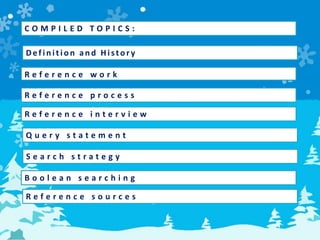
C O M P I L E D T O P I C S :
Def in ition an d Histor y
R e f e r e n c e w o r k
R e f e r e n c e p r o c e s s
R e f e r e n c e i n t e r v i e w
Q u e r y s t a t e m e n t
S e a r c h s t r a t e g y
B o o l e a n s e a r c h i n g
R e f e r e n c e s o u r c e s
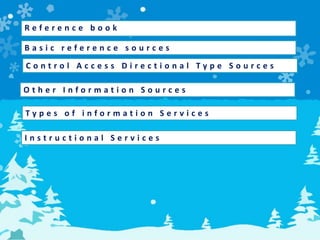
R e f e r e n c e b o o k
B a s i c r e f e r e n c e s o u r c e s
C o n t r o l A c c e s s D i r e c t i o n a l T y p e S o u r c e s
O t h e r I n f o r m a t i o n S o u r c e s
T y p e s o f i n f o r m a t i o n S e r v i c e s
I n s t r u c t i o n a l S e r v i c e s
Definition and History
Samuel Green’s Personal Relation between Librarians and Reader’s, 1876
 assistance to library readers in searching for information
 suggesting books
 searching and gathering information for researchers
 reaching young people how to use the library and reference sources
 making users understand the system we use in the library
Alice Bertha Kroeger (1902 and 1908)
 from “the assistance given to the readers in the use of the resources of
the library” to expanding the responsibility of the reference librarian to
include guiding readers to information and reference service as an activity
not limited to librarianship.
William S. Learned (1924)
 specialized “intelligence service” with each person having his or her unique
needs
James I. Wyer (1930)
 introduces the concept of interpretation and mediation aside from the aid
and direction
 reference transaction: inquirer, reference librarian, sources or materials
Gilbert Mudge and Louis Shores (1930s)
 “everything necessary to help the reader in his inquiry” (Mudge)
 “interpret books to readers” (Shores)
Ranganathan (1945)
 “ the process of establishing a contact between a reader and his documents
In a personal way”
ALA Reference & User Services Association (2000)
 “ information services in libraries take a variety of forms including direct
personal assistance, directories, signs, exchange of information culled from
a reference source, reader’s advisory service, dissemination of information
in anticipation of user needs or interests, and access to electronic information.”
REFERENCE WORK
 Term emerged in the 1890’s
 Some overlap between the concepts of “reference work”
and “reference service”
 according to Rothstein reference work is the personal
assistance given by the librarian to individual readers in
pursuit of information while reference service implies a
“definite recognition” of the responsibility for providing
reference work
Samuel Rothstein
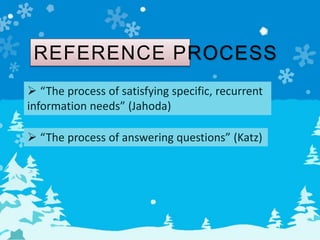
REFERENCE PROCESS
 “The process of satisfying specific, recurrent
information needs” (Jahoda)
 “The process of answering questions” (Katz)
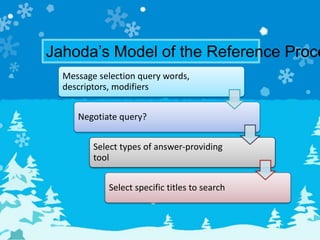
Message selection query words,
descriptors, modifiers
Negotiate query?
Select types of answer-providing
tool
Select specific titles to search
Jahoda’s Model of the Reference Proce
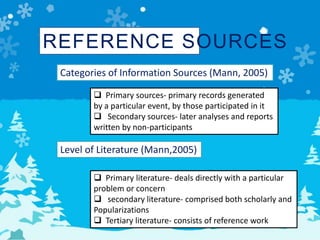
REFERENCE SOURCES
Categories of Information Sources (Mann, 2005)
 Primary sources- primary records generated
by a particular event, by those participated in it
 Secondary sources- later analyses and reports
written by non-participants
Level of Literature (Mann,2005)
 Primary literature- deals directly with a particular
problem or concern
 secondary literature- comprised both scholarly and
Popularizations
 Tertiary literature- consists of reference work
REFERENCE BOOK
 A book designed by the arrangement and treatment
of its subject matter to be consulted for the definite items
of information rather than to be read consecutively (ALA)
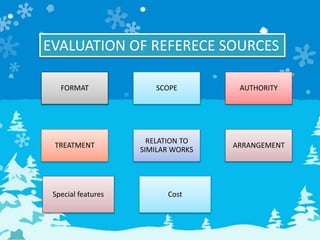
EVALUATION OF REFERECE SOURCES
FORMAT SCOPE AUTHORITY
TREATMENT
RELATION TO
SIMILAR WORKS
ARRANGEMENT
Special features Cost
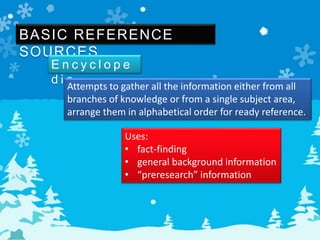
BASIC REFERENCE
SOURCES
E n c y c l o p e
d i aAttempts to gather all the information either from all
branches of knowledge or from a single subject area,
arrange them in alphabetical order for ready reference.
Uses:
• fact-finding
• general background information
• “preresearch” information
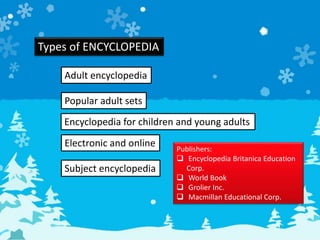
Types of ENCYCLOPEDIA
Adult encyclopedia
Popular adult sets
Encyclopedia for children and young adults
Electronic and online
Subject encyclopedia
Publishers:
 Encyclopedia Britanica Education
Corp.
 World Book
 Grolier Inc.
 Macmillan Educational Corp.
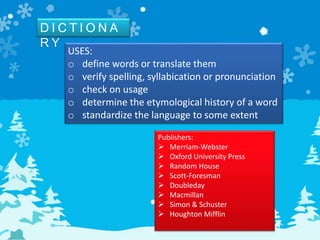
D I C T I O N A
R Y
USES:
o define words or translate them
o verify spelling, syllabication or pronunciation
o check on usage
o determine the etymological history of a word
o standardize the language to some extent
Publishers:
 Merriam-Webster
 Oxford University Press
 Random House
 Scott-Foresman
 Doubleday
 Macmillan
 Simon & Schuster
 Houghton Mifflin
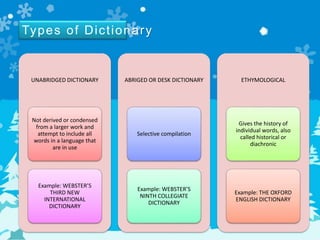
Types of Dictionary
UNABRIDGED DICTIONARY
Not derived or condensed
from a larger work and
attempt to include all
words in a language that
are in use
Example: WEBSTER’S
THIRD NEW
INTERNATIONAL
DICTIONARY
ABRIGED OR DESK DICTIONARY
Selective compilation
Example: WEBSTER’S
NINTH COLLEGIATE
DICTIONARY
ETHYMOLOGICAL
Gives the history of
individual words, also
called historical or
diachronic
Example: THE OXFORD
ENGLISH DICTIONARY
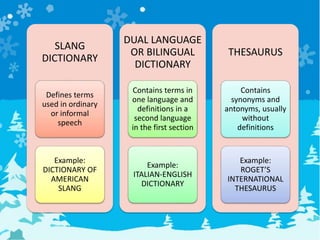
SLANG
DICTIONARY
Defines terms
used in ordinary
or informal
speech
Example:
DICTIONARY OF
AMERICAN
SLANG
DUAL LANGUAGE
OR BILINGUAL
DICTIONARY
Contains terms in
one language and
definitions in a
second language
in the first section
Example:
ITALIAN-ENGLISH
DICTIONARY
THESAURUS
Contains
synonyms and
antonyms, usually
without
definitions
Example:
ROGET’S
INTERNATIONAL
THESAURUS
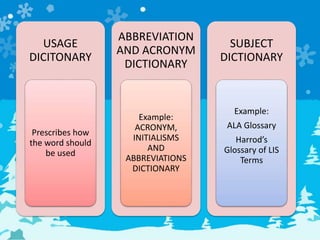
USAGE
DICITONARY
Prescribes how
the word should
be used
ABBREVIATION
AND ACRONYM
DICTIONARY
Example:
ACRONYM,
INITIALISMS
AND
ABBREVIATIONS
DICTIONARY
SUBJECT
DICTIONARY
Example:
ALA Glossary
Harrod’s
Glossary of LIS
Terms
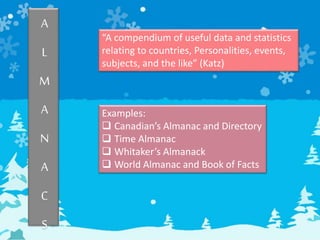
A
L
M
A
N
A
C
S
“A compendium of useful data and statistics
relating to countries, Personalities, events,
subjects, and the like” (Katz)
Examples:
 Canadian’s Almanac and Directory
 Time Almanac
 Whitaker’s Almanack
 World Almanac and Book of Facts
Y
E
A
R
B
O
O
K
S
“An annual compendium of the data and statistics of
a given year” (Katz)
Examples:
General works
 Facts on File World News Digest Yearbook
 Annual Register: World Events
Subject yearbooks
 The Europa World Yearbook
 The Stateman’s Yearbook’s: the Politics, Cultures and Economies
of the World
H A N D B O O K S A N D M A N U A L S
Ready reference guides to particular fields of knowledge as they compress
large amounts of information on that field or subject into one or a few volumes
 BOOKS OFDAYS IN FIRST
 CURIOSITIES AD WONDERS
 ETIQUETTE
 LITERATURE
 QUOTATIONS
DI RECTORI ES
“ A listof person’s or organizations systematicallyarranged,
usuallyin alphabeticor classed order giving address, affiliations,
etc. for individuals, and address, officers, functions, and similar
data for organizations” (ALA)
USES
 For information and referral purposes
 to locate a person, organization or
institution
 to verify the spelling
 look for descriptions/ biographic data
 compiling mailing lists
 for sampling purposes for social or
commercial surveys
Categories ofDirectories
 Local Directories
 GovernmentDirectories
 Institutional Directories
 Tradeand Business Directories and investment services
 Professional Directories
Examples:
 Encyclopedia of Associations
 The Foundation Directory
 The Europa World of Learning
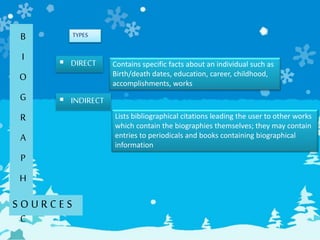
B
I
O
G
R
A
P
H
I
C
S O U R C E S
TYPES
 DIRECT Contains specific facts about an individual such as
Birth/death dates, education, career, childhood,
accomplishments, works
 INDIRECT
Lists bibliographical citations leading the user to other works
which contain the biographies themselves; they may contain
entries to periodicals and books containing biographical
information
Categories:
• current
• retrospective
• professional andsubjectbiographies
• internationalbiographies
• pseudonym
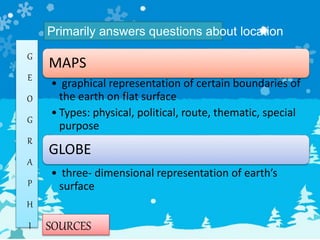
G
E
O
G
R
A
P
H
I SOURCES
Primarily answers questions about location
MAPS
• graphical representation of certain boundaries of
the earth on flat surface
• Types: physical, political, route, thematic, special
purpose
GLOBE
• three- dimensional representation of earth’s
surface
GAZETTEERS
• geographical dictionaries
GUIDEBOOKS
• travel guide
CONTROL-ACCESS-DIRETIONAL TYPE SOURCES
BIBLIOGRAPHIES
a list of works whether intended to be complete or selective, compiled
on some organizing principle, such as authorship, subject, place of publication,
chronology or printer
LIBRARY CATALOG
list of holdings found in a library or group of libraries
INDEXES AND ABSTACTS
index- a tool used to locate information within a document
abstract- same as index but contains a summary of the material’s content
OTHER INFORMATION SOURCES
SERIALS
A publication in any medium issued in successive parts bearing numerical
or chronological designations and intended to be continued indefinitely.
Examples: periodical, magazine, journal
GOVERNMENT PUBLICATIONS
any publication originating in, or issued with the imprints of, or at
the expense and by the authority of, any office of a legally organized government
or international organizations
PRINTED NON-BOOK MATERIALS
 Company and Trade literature
 Technical reports
 Standards
 Specifications
 Patents
 Trademark
 Dissertations and Thesis
TYPES OF INFORMATION SERVICES
• INTERLIBRARY LOAN AND
DOCUMENT DELIVERY
• CURRENT AWARENESS SERVICE
• SELECTIVE DISSEMINATION OF
INFORMATION
• INFORMATION AND REFERRAL
SERVICES
• INFORMATION BROKERING
• TECHNICAL INQUIRY SERVICE
• RESEARCH ASSISTANCE AND
CONSULTING
• TERM-PAPER COUNSELING
• BIBLIOTHERAPY
• READER’S ADVISORY SERVICE
INSTRUCTIONAL SERVICES
LIBRARY ORIENTATION
- designed to welcome and introduce new and potential users
to the library’s services.
LIBRARY INSTRUCTION
- service provided by the library which trains users how to use
the tools and resources within its environs
BIBLIOGRAPHIC INSTRUCTIONS
- teaches learners how to locate and use information beyond
the physical boundaries of the library
INFORMATION LITERACY
- the information literate person is one who is able to
recognize when information is needed, have the ability to clocate.
INFORMATION SOURCES AND SERVICES

INFORMATION SOURCES AND SERVICES

  • 1.
  • 2.
    C O MP I L E D T O P I C S : Def in ition an d Histor y R e f e r e n c e w o r k R e f e r e n c e p r o c e s s R e f e r e n c e i n t e r v i e w Q u e r y s t a t e m e n t S e a r c h s t r a t e g y B o o l e a n s e a r c h i n g R e f e r e n c e s o u r c e s
  • 3.
    R e fe r e n c e b o o k B a s i c r e f e r e n c e s o u r c e s C o n t r o l A c c e s s D i r e c t i o n a l T y p e S o u r c e s O t h e r I n f o r m a t i o n S o u r c e s T y p e s o f i n f o r m a t i o n S e r v i c e s I n s t r u c t i o n a l S e r v i c e s
  • 4.
    Definition and History SamuelGreen’s Personal Relation between Librarians and Reader’s, 1876  assistance to library readers in searching for information  suggesting books  searching and gathering information for researchers  reaching young people how to use the library and reference sources  making users understand the system we use in the library Alice Bertha Kroeger (1902 and 1908)  from “the assistance given to the readers in the use of the resources of the library” to expanding the responsibility of the reference librarian to include guiding readers to information and reference service as an activity not limited to librarianship.
  • 5.
    William S. Learned(1924)  specialized “intelligence service” with each person having his or her unique needs James I. Wyer (1930)  introduces the concept of interpretation and mediation aside from the aid and direction  reference transaction: inquirer, reference librarian, sources or materials Gilbert Mudge and Louis Shores (1930s)  “everything necessary to help the reader in his inquiry” (Mudge)  “interpret books to readers” (Shores)
  • 6.
    Ranganathan (1945)  “the process of establishing a contact between a reader and his documents In a personal way” ALA Reference & User Services Association (2000)  “ information services in libraries take a variety of forms including direct personal assistance, directories, signs, exchange of information culled from a reference source, reader’s advisory service, dissemination of information in anticipation of user needs or interests, and access to electronic information.”
  • 7.
    REFERENCE WORK  Termemerged in the 1890’s  Some overlap between the concepts of “reference work” and “reference service”  according to Rothstein reference work is the personal assistance given by the librarian to individual readers in pursuit of information while reference service implies a “definite recognition” of the responsibility for providing reference work Samuel Rothstein
  • 8.
    REFERENCE PROCESS  “Theprocess of satisfying specific, recurrent information needs” (Jahoda)  “The process of answering questions” (Katz)
  • 9.
    Message selection querywords, descriptors, modifiers Negotiate query? Select types of answer-providing tool Select specific titles to search Jahoda’s Model of the Reference Proce
  • 10.
    REFERENCE SOURCES Categories ofInformation Sources (Mann, 2005)  Primary sources- primary records generated by a particular event, by those participated in it  Secondary sources- later analyses and reports written by non-participants Level of Literature (Mann,2005)  Primary literature- deals directly with a particular problem or concern  secondary literature- comprised both scholarly and Popularizations  Tertiary literature- consists of reference work
  • 11.
    REFERENCE BOOK  Abook designed by the arrangement and treatment of its subject matter to be consulted for the definite items of information rather than to be read consecutively (ALA)
  • 12.
    EVALUATION OF REFERECESOURCES FORMAT SCOPE AUTHORITY TREATMENT RELATION TO SIMILAR WORKS ARRANGEMENT Special features Cost
  • 13.
    BASIC REFERENCE SOURCES E nc y c l o p e d i aAttempts to gather all the information either from all branches of knowledge or from a single subject area, arrange them in alphabetical order for ready reference. Uses: • fact-finding • general background information • “preresearch” information
  • 14.
    Types of ENCYCLOPEDIA Adultencyclopedia Popular adult sets Encyclopedia for children and young adults Electronic and online Subject encyclopedia Publishers:  Encyclopedia Britanica Education Corp.  World Book  Grolier Inc.  Macmillan Educational Corp.
  • 15.
    D I CT I O N A R Y USES: o define words or translate them o verify spelling, syllabication or pronunciation o check on usage o determine the etymological history of a word o standardize the language to some extent Publishers:  Merriam-Webster  Oxford University Press  Random House  Scott-Foresman  Doubleday  Macmillan  Simon & Schuster  Houghton Mifflin
  • 16.
    Types of Dictionary UNABRIDGEDDICTIONARY Not derived or condensed from a larger work and attempt to include all words in a language that are in use Example: WEBSTER’S THIRD NEW INTERNATIONAL DICTIONARY ABRIGED OR DESK DICTIONARY Selective compilation Example: WEBSTER’S NINTH COLLEGIATE DICTIONARY ETHYMOLOGICAL Gives the history of individual words, also called historical or diachronic Example: THE OXFORD ENGLISH DICTIONARY
  • 17.
    SLANG DICTIONARY Defines terms used inordinary or informal speech Example: DICTIONARY OF AMERICAN SLANG DUAL LANGUAGE OR BILINGUAL DICTIONARY Contains terms in one language and definitions in a second language in the first section Example: ITALIAN-ENGLISH DICTIONARY THESAURUS Contains synonyms and antonyms, usually without definitions Example: ROGET’S INTERNATIONAL THESAURUS
  • 18.
    USAGE DICITONARY Prescribes how the wordshould be used ABBREVIATION AND ACRONYM DICTIONARY Example: ACRONYM, INITIALISMS AND ABBREVIATIONS DICTIONARY SUBJECT DICTIONARY Example: ALA Glossary Harrod’s Glossary of LIS Terms
  • 19.
    A L M A N A C S “A compendium ofuseful data and statistics relating to countries, Personalities, events, subjects, and the like” (Katz) Examples:  Canadian’s Almanac and Directory  Time Almanac  Whitaker’s Almanack  World Almanac and Book of Facts
  • 20.
    Y E A R B O O K S “An annual compendiumof the data and statistics of a given year” (Katz) Examples: General works  Facts on File World News Digest Yearbook  Annual Register: World Events Subject yearbooks  The Europa World Yearbook  The Stateman’s Yearbook’s: the Politics, Cultures and Economies of the World
  • 21.
    H A ND B O O K S A N D M A N U A L S Ready reference guides to particular fields of knowledge as they compress large amounts of information on that field or subject into one or a few volumes  BOOKS OFDAYS IN FIRST  CURIOSITIES AD WONDERS  ETIQUETTE  LITERATURE  QUOTATIONS
  • 22.
    DI RECTORI ES “A listof person’s or organizations systematicallyarranged, usuallyin alphabeticor classed order giving address, affiliations, etc. for individuals, and address, officers, functions, and similar data for organizations” (ALA) USES  For information and referral purposes  to locate a person, organization or institution  to verify the spelling  look for descriptions/ biographic data  compiling mailing lists  for sampling purposes for social or commercial surveys
  • 23.
    Categories ofDirectories  LocalDirectories  GovernmentDirectories  Institutional Directories  Tradeand Business Directories and investment services  Professional Directories Examples:  Encyclopedia of Associations  The Foundation Directory  The Europa World of Learning
  • 24.
    B I O G R A P H I C S O UR C E S TYPES  DIRECT Contains specific facts about an individual such as Birth/death dates, education, career, childhood, accomplishments, works  INDIRECT Lists bibliographical citations leading the user to other works which contain the biographies themselves; they may contain entries to periodicals and books containing biographical information
  • 25.
    Categories: • current • retrospective •professional andsubjectbiographies • internationalbiographies • pseudonym
  • 26.
    G E O G R A P H I SOURCES Primarily answersquestions about location MAPS • graphical representation of certain boundaries of the earth on flat surface • Types: physical, political, route, thematic, special purpose GLOBE • three- dimensional representation of earth’s surface
  • 27.
  • 28.
    CONTROL-ACCESS-DIRETIONAL TYPE SOURCES BIBLIOGRAPHIES alist of works whether intended to be complete or selective, compiled on some organizing principle, such as authorship, subject, place of publication, chronology or printer LIBRARY CATALOG list of holdings found in a library or group of libraries INDEXES AND ABSTACTS index- a tool used to locate information within a document abstract- same as index but contains a summary of the material’s content
  • 29.
    OTHER INFORMATION SOURCES SERIALS Apublication in any medium issued in successive parts bearing numerical or chronological designations and intended to be continued indefinitely. Examples: periodical, magazine, journal GOVERNMENT PUBLICATIONS any publication originating in, or issued with the imprints of, or at the expense and by the authority of, any office of a legally organized government or international organizations
  • 30.
    PRINTED NON-BOOK MATERIALS Company and Trade literature  Technical reports  Standards  Specifications  Patents  Trademark  Dissertations and Thesis TYPES OF INFORMATION SERVICES • INTERLIBRARY LOAN AND DOCUMENT DELIVERY • CURRENT AWARENESS SERVICE • SELECTIVE DISSEMINATION OF INFORMATION • INFORMATION AND REFERRAL SERVICES • INFORMATION BROKERING • TECHNICAL INQUIRY SERVICE • RESEARCH ASSISTANCE AND CONSULTING • TERM-PAPER COUNSELING • BIBLIOTHERAPY • READER’S ADVISORY SERVICE
  • 31.
    INSTRUCTIONAL SERVICES LIBRARY ORIENTATION -designed to welcome and introduce new and potential users to the library’s services. LIBRARY INSTRUCTION - service provided by the library which trains users how to use the tools and resources within its environs BIBLIOGRAPHIC INSTRUCTIONS - teaches learners how to locate and use information beyond the physical boundaries of the library INFORMATION LITERACY - the information literate person is one who is able to recognize when information is needed, have the ability to clocate.