PPHHPP NNaammeessppaacceess 
AA ccaassee ssttuuddyy 
By Tamaghna Banerjee
What is Namespace? 
● A class of elements (e.g. addresses, file 
locations, etc.) in which each element has a 
name unique to that class, although it may be 
shared with elements in other classes. 
● In otherways, you could say a namespace 
uniquely identifies a set of names so that there 
is no ambiguity when objects having different 
origins but the same class names are mixed 
together.
Real Scenario – An use case 
● For example, suppose the same XML document included the 
element type of OWNER for owners of motorcycles as well as 
for owners of automobiles. 
● It might be necessary or desirable to know that an owner name 
was one of those who owned a motorcyle rather than an 
automobile. Having different motorcycle and automobile 
namespaces would make this possible. 
● Effectively, it would make it possible to label motorcycle 
owners differently than automobile owners without having to 
create a different element type for each.
What about Namespace in PHP ? 
● In PHP version 5.x namespacing, a new feature known 
was added to the language. 
● Many modern languages like C#, Ruby on Rails already 
had this feature for some time, but PHP was a little late to 
this scene. 
● None the less, every new feature has a purpose, let’s find 
out why PHP namespaces can benefit our application. 
● PHP namespaces allow us to circumvent this issue, in fact 
we can have as many User classes as we like. Not only 
that, but we can use namespaces to contain our similar 
code into neat little packages, or even to show ownership.
Issues with same named Class 
● In PHP you can’t have two classes that share 
the same name. They have to be unique. The 
issue with this restriction is that if you are using 
a third party library which has a class named 
UUsseerr, then you can’t create your own class also 
called UUsseerr. This is a real shame, because that’s 
a pretty convenient class name right?
Let's take a look ahead!! 
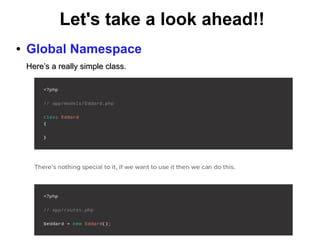
● Global Namespace 
Here’s a rreeaallllyy ssiimmppllee ccllaassss..
What sounds like guys? 
● Yeah!!basically, we can think of this class as 
being in the ‘global’ namespace. I don’t know 
if that’s the right term for it, but it sounds 
quite fitting to me. It essentially means that 
the class exists without a namespace. It’s 
just a normal class.
Okk lets play with simple namespace !! 
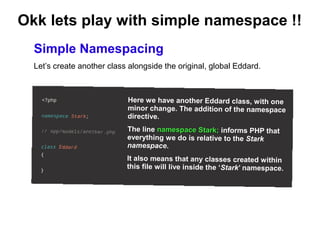
Simple Namespacing 
Let’s create another class alongside the original, global Eddard. 
Here we have another Eddard class, w ith one 
minor change. The addition of the namespace 
directive. 
The line namespace Stark; informs PHP that 
everything we do is relative to the Stark 
namespace. 
It also means that any classes created within 
this file w ill live inside the ‘Stark’ namespace.
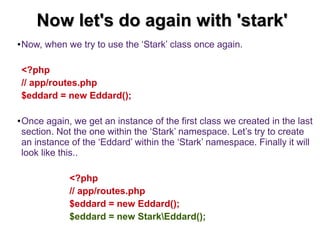
NNooww lleett''ss ddoo aaggaaiinn wwiitthh ''ssttaarrkk'' 
●Now, when we try to use the ‘Stark’ class once again. 
<?php 
// app/routes.php 
$eddard = new Eddard(); 
●Once again, we get an instance of the first class we created in the last 
section. Not the one within the ‘Stark’ namespace. Let’s try to create 
an instance of the ‘Eddard’ within the ‘Stark’ namespace. Finally it will 
look like this.. 
<?php 
// app/routes.php 
$eddard = new Eddard(); 
$eddard = new StarkEddard();
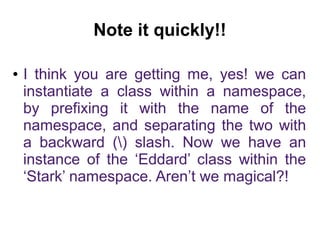
Note it quickly!! 
● I think you are getting me, yes! we can 
instantiate a class within a namespace, 
by prefixing it with the name of the 
namespace, and separating the two with 
a backward () slash. Now we have an 
instance of the ‘Eddard’ class within the 
‘Stark’ namespace. Aren’t we magical?!
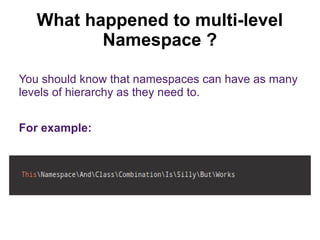
What happened to multi-level 
Namespace ? 
You should know that namespaces can have as many 
levels of hierarchy as they need to. 
For example:
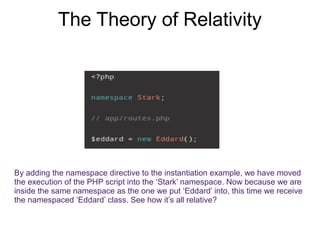
The Theory of Relativity 
By adding the namespace directive to the instantiation example, we have moved 
the execution of the PHP script into the ‘Stark’ namespace. Now because we are 
inside the same namespace as the one we put ‘Eddard’ into, this time we receive 
the namespaced ‘Eddard’ class. See how it’s all relative?
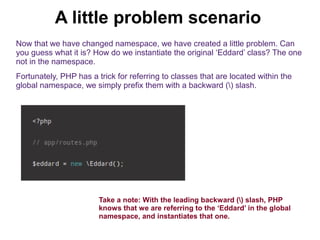
A little problem scenario 
Now that we have changed namespace, we have created a little problem. Can 
you guess what it is? How do we instantiate the original ‘Eddard’ class? The one 
not in the namespace. 
Fortunately, PHP has a trick for referring to classes that are located within the 
global namespace, we simply prefix them with a backward () slash. 
Take a note: With the leading backward () slash, PHP 
knows that we are referring to the ‘Eddard’ in the global 
namespace, and instantiates that one.
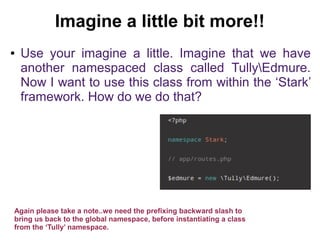
Imagine a little bit more!! 
● Use your imagine a little. Imagine that we have 
another namespaced class called TullyEdmure. 
Now I want to use this class from within the ‘Stark’ 
framework. How do we do that? 
Again please take a note..we need the prefixing backward slash to 
bring us back to the global namespace, before instantiating a class 
from the ‘Tully’ namespace.
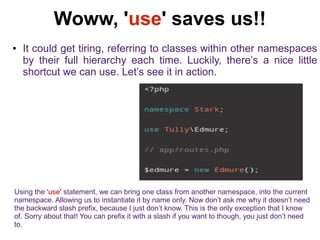
Woww, 'use' saves us!! 
● It could get tiring, referring to classes within other namespaces 
by their full hierarchy each time. Luckily, there’s a nice little 
shortcut we can use. Let’s see it in action. 
Using the 'use' statement, we can bring one class from another namespace, into the current 
namespace. Allowing us to instantiate it by name only. Now don’t ask me why it doesn’t need 
the backward slash prefix, because I just don’t know. This is the only exception that I know 
of. Sorry about that! You can prefix it with a slash if you want to though, you just don’t need 
to.
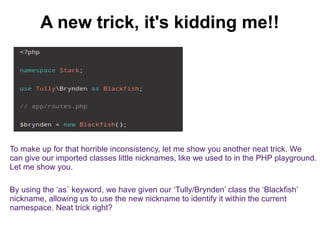
A new trick, it's kidding me!! 
To make up for that horrible inconsistency, let me show you another neat trick. We 
can give our imported classes little nicknames, like we used to in the PHP playground. 
Let me show you. 
By using the ‘as` keyword, we have given our ‘Tully/Brynden’ class the ‘Blackfish’ 
nickname, allowing us to use the new nickname to identify it within the current 
namespace. Neat trick right?
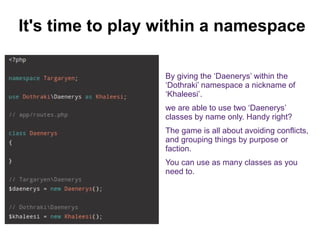
It's time to play within a namespace 
By giving the ‘Daenerys’ within the 
‘Dothraki’ namespace a nickname of 
‘Khaleesi’. 
we are able to use two ‘Daenerys’ 
classes by name only. Handy right? 
The game is all about avoiding conflicts, 
and grouping things by purpose or 
faction. 
You can use as many classes as you 
need to.
Structure - Namespace 
● Namespaces aren’t just about avoiding conflicts, we can also 
use them for organisation, and for ownership. Let me explain 
with another example. 
● Let’s say I want to create an open source library. I’d love for 
others to use my code, it would be great! 
● The trouble is, I don’t want to cause any problematic class name 
conflicts for the person using my code. That would be terribly 
inconvenient. 
● Here’s how I can avoid causing hassle for the wonderful, open 
source embracing, individual. 
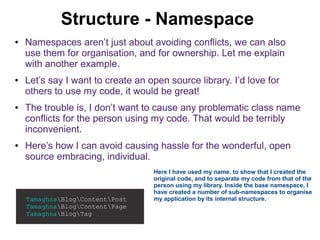
TamaghnaBlogContentPost 
TamaghnaBlogContentPage 
TamaghnaBlogTag 
Here I have used my name, to show that I created the 
original code, and to separate my code from that of the 
person using my library. Inside the base namespace, I 
have created a number of sub-namespaces to organise 
my application by its internal structure.
Namespace - Limitations 
● In truth, I feel a little guilty for calling this sub-heading ‘Limitations’. What I’m 
about to talk about isn’t really a bug. 
● You see, in other languages, namespaces are implemented in a similar way, 
and those other languages provide an additional feature when interacting 
with namespaces. 
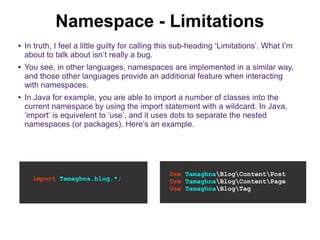
● In Java for example, you are able to import a number of classes into the 
current namespace by using the import statement with a wildcard. In Java, 
‘import’ is equivelent to ‘use’, and it uses dots to separate the nested 
namespaces (or packages). Here’s an example. 
Use TamaghnaBlogContentPost 
Use TamaghnaBlogContentPage 
Use TamaghnaBlogTag 
import Tamaghna.blog.*;
My Content Reference 
Namespace - Reference 
( Click the above link to start reading ) 
Thank you, 
Enjoy new learning

Namespace inPHP

  • 1.
    PPHHPP NNaammeessppaacceess AAccaassee ssttuuddyy By Tamaghna Banerjee
  • 2.
    What is Namespace? ● A class of elements (e.g. addresses, file locations, etc.) in which each element has a name unique to that class, although it may be shared with elements in other classes. ● In otherways, you could say a namespace uniquely identifies a set of names so that there is no ambiguity when objects having different origins but the same class names are mixed together.
  • 3.
    Real Scenario –An use case ● For example, suppose the same XML document included the element type of OWNER for owners of motorcycles as well as for owners of automobiles. ● It might be necessary or desirable to know that an owner name was one of those who owned a motorcyle rather than an automobile. Having different motorcycle and automobile namespaces would make this possible. ● Effectively, it would make it possible to label motorcycle owners differently than automobile owners without having to create a different element type for each.
  • 4.
    What about Namespacein PHP ? ● In PHP version 5.x namespacing, a new feature known was added to the language. ● Many modern languages like C#, Ruby on Rails already had this feature for some time, but PHP was a little late to this scene. ● None the less, every new feature has a purpose, let’s find out why PHP namespaces can benefit our application. ● PHP namespaces allow us to circumvent this issue, in fact we can have as many User classes as we like. Not only that, but we can use namespaces to contain our similar code into neat little packages, or even to show ownership.
  • 5.
    Issues with samenamed Class ● In PHP you can’t have two classes that share the same name. They have to be unique. The issue with this restriction is that if you are using a third party library which has a class named UUsseerr, then you can’t create your own class also called UUsseerr. This is a real shame, because that’s a pretty convenient class name right?
  • 6.
    Let's take alook ahead!! ● Global Namespace Here’s a rreeaallllyy ssiimmppllee ccllaassss..
  • 7.
    What sounds likeguys? ● Yeah!!basically, we can think of this class as being in the ‘global’ namespace. I don’t know if that’s the right term for it, but it sounds quite fitting to me. It essentially means that the class exists without a namespace. It’s just a normal class.
  • 8.
    Okk lets playwith simple namespace !! Simple Namespacing Let’s create another class alongside the original, global Eddard. Here we have another Eddard class, w ith one minor change. The addition of the namespace directive. The line namespace Stark; informs PHP that everything we do is relative to the Stark namespace. It also means that any classes created within this file w ill live inside the ‘Stark’ namespace.
  • 9.
    NNooww lleett''ss ddooaaggaaiinn wwiitthh ''ssttaarrkk'' ●Now, when we try to use the ‘Stark’ class once again. <?php // app/routes.php $eddard = new Eddard(); ●Once again, we get an instance of the first class we created in the last section. Not the one within the ‘Stark’ namespace. Let’s try to create an instance of the ‘Eddard’ within the ‘Stark’ namespace. Finally it will look like this.. <?php // app/routes.php $eddard = new Eddard(); $eddard = new StarkEddard();
  • 10.
    Note it quickly!! ● I think you are getting me, yes! we can instantiate a class within a namespace, by prefixing it with the name of the namespace, and separating the two with a backward () slash. Now we have an instance of the ‘Eddard’ class within the ‘Stark’ namespace. Aren’t we magical?!
  • 11.
    What happened tomulti-level Namespace ? You should know that namespaces can have as many levels of hierarchy as they need to. For example:
  • 12.
    The Theory ofRelativity By adding the namespace directive to the instantiation example, we have moved the execution of the PHP script into the ‘Stark’ namespace. Now because we are inside the same namespace as the one we put ‘Eddard’ into, this time we receive the namespaced ‘Eddard’ class. See how it’s all relative?
  • 13.
    A little problemscenario Now that we have changed namespace, we have created a little problem. Can you guess what it is? How do we instantiate the original ‘Eddard’ class? The one not in the namespace. Fortunately, PHP has a trick for referring to classes that are located within the global namespace, we simply prefix them with a backward () slash. Take a note: With the leading backward () slash, PHP knows that we are referring to the ‘Eddard’ in the global namespace, and instantiates that one.
  • 14.
    Imagine a littlebit more!! ● Use your imagine a little. Imagine that we have another namespaced class called TullyEdmure. Now I want to use this class from within the ‘Stark’ framework. How do we do that? Again please take a note..we need the prefixing backward slash to bring us back to the global namespace, before instantiating a class from the ‘Tully’ namespace.
  • 15.
    Woww, 'use' savesus!! ● It could get tiring, referring to classes within other namespaces by their full hierarchy each time. Luckily, there’s a nice little shortcut we can use. Let’s see it in action. Using the 'use' statement, we can bring one class from another namespace, into the current namespace. Allowing us to instantiate it by name only. Now don’t ask me why it doesn’t need the backward slash prefix, because I just don’t know. This is the only exception that I know of. Sorry about that! You can prefix it with a slash if you want to though, you just don’t need to.
  • 16.
    A new trick,it's kidding me!! To make up for that horrible inconsistency, let me show you another neat trick. We can give our imported classes little nicknames, like we used to in the PHP playground. Let me show you. By using the ‘as` keyword, we have given our ‘Tully/Brynden’ class the ‘Blackfish’ nickname, allowing us to use the new nickname to identify it within the current namespace. Neat trick right?
  • 17.
    It's time toplay within a namespace By giving the ‘Daenerys’ within the ‘Dothraki’ namespace a nickname of ‘Khaleesi’. we are able to use two ‘Daenerys’ classes by name only. Handy right? The game is all about avoiding conflicts, and grouping things by purpose or faction. You can use as many classes as you need to.
  • 18.
    Structure - Namespace ● Namespaces aren’t just about avoiding conflicts, we can also use them for organisation, and for ownership. Let me explain with another example. ● Let’s say I want to create an open source library. I’d love for others to use my code, it would be great! ● The trouble is, I don’t want to cause any problematic class name conflicts for the person using my code. That would be terribly inconvenient. ● Here’s how I can avoid causing hassle for the wonderful, open source embracing, individual. TamaghnaBlogContentPost TamaghnaBlogContentPage TamaghnaBlogTag Here I have used my name, to show that I created the original code, and to separate my code from that of the person using my library. Inside the base namespace, I have created a number of sub-namespaces to organise my application by its internal structure.
  • 19.
    Namespace - Limitations ● In truth, I feel a little guilty for calling this sub-heading ‘Limitations’. What I’m about to talk about isn’t really a bug. ● You see, in other languages, namespaces are implemented in a similar way, and those other languages provide an additional feature when interacting with namespaces. ● In Java for example, you are able to import a number of classes into the current namespace by using the import statement with a wildcard. In Java, ‘import’ is equivelent to ‘use’, and it uses dots to separate the nested namespaces (or packages). Here’s an example. Use TamaghnaBlogContentPost Use TamaghnaBlogContentPage Use TamaghnaBlogTag import Tamaghna.blog.*;
  • 20.
    My Content Reference Namespace - Reference ( Click the above link to start reading ) Thank you, Enjoy new learning