Introduction to Library and It’s
Services
Presented By
Dr.M.C.SUBANGI
Deputy Librarian
Agricultural Engineering College & Research Institute (TNAU),
Kumulur,Tiruchirappalli , Tamilnadu, India.
WHY THIS COURSE?
Library is an essential component of the Education
and Research Institutions. The students pursuing higher
studies need to learn various information sources and their
use. The course impart the skill to know the storage,
searching and retrieval system of Agricultural information
and learn how to use the information efficiently and
ethically in their course and research work.
Point to be Discussed
• Introduction
• History of Library
• Father of Library Science
• Library ACT
• Five Law of Library Science
• Functions of Library
• Types of Library
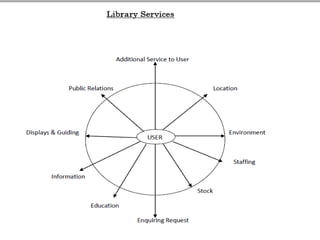
• Library Services
• In the 21st Century we are living in an information age.
Information has become the “Key Word” in the every sphere
of our life in the context of information explosion era.
Information becomes the power of human being.
• As a nonprofit organization and a social service institution,
library is one of the main centre's for generation, collection,
storage & dissemination of information.
• It is the vital centre for the interaction in between document
and user.
• For this the operation of libraries is becoming increasingly
complex, involving mechanization, computerization and
centralization of library services.
• There has been rapid growth in the size and scope of
collections in the variety of services offered and in the
expectation of users.
Introduction
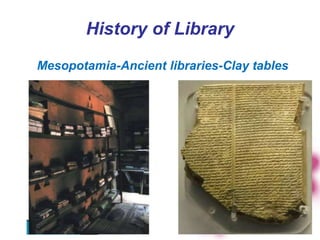
History of Library
Mesopotamia-Ancient libraries-Clay tables
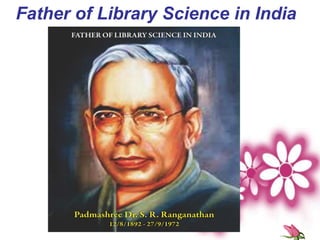
Father of Library Science in India
• According to Dr.S.R.Ranganathan “ Library is a public
institution or establishment charged with the care of a
collection of books the duty of making them assessable
to those who require the use of them and the task of
converting every person in its neighborhood into a
habitual library gore and reader of books.
• According to Carl T. Rowan. “The library is the temple of
Learning and Learning has Liberated more people than
all the wars in History.”
Definition of Library
Library ACT
• Tamil Nadu Public Libraries Act, was enacted in
Madras State, India, in 1948.
• The Connemara Public Library became the first library to
come under the purview of this act, as a “State central
library”.
• Nine district libraries were added during the Five year
plan from 1951. The act was enacted based on research
and activity by S.R.Ranganathan and the Madras
Library Association.
• 1st Law : BOOKS ARE FOR USE
• 2nd Law : EVERY READER HIS/HER BOOK
• 3rd Law : EVERY BOOKS ITS READER
• 4th Law : SAVE THE TIME OF THE READER
• 5th Law : THE LIBRARY IS A GROWING ORGANISM
Five Laws of Library Science
Functions of Library
• Rules and Regulation
• Collection Building
• Circulation
• Catalogue
• Classification
• Preservation
• Documentation
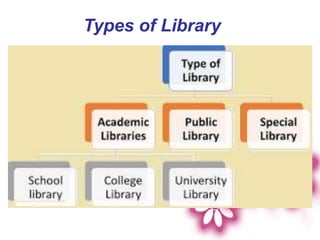
Types of Library
Academic Libraries
• Academic libraries serve at College and
Universities.
• Large institutions may several libraries on
their campuses dedicated to serving
particular schools such as law and science
libraries.
• Academic librarians become specialists in
an area of knowledge and can faculty
status.
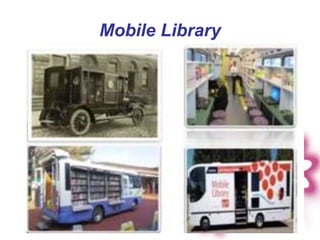
Mobile Library
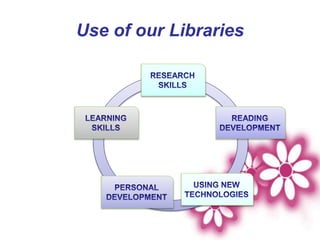
Use of our Libraries
• A Library functions are nerve centre of an academic
institution. It is “ThinkTank” of a research organization.
Conventionally libraries provided popular services like
reference, lending, bibliographic and documentation,
current awareness and reprographic services, etc.,
Library & Its Services
Services
• Reference Service
• Current Awareness Service
• Selective Dissemination of Information Service (SDI)
• Indexing Service
• Abstracting Service
• Translation Service
• Reprographic Service
• Newspaper Clipping Service
• Computer based Service
• Document Delivery Service
• Lending Service
• Inter Library Loan
• Literature Search and Database Service
• Electronic Document Delivery systems / Internet services
• Bibliographic Service
Reference Service
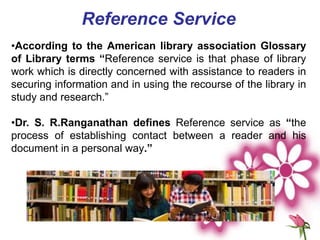
•According to the American library association Glossary
of Library terms “Reference service is that phase of library
work which is directly concerned with assistance to readers in
securing information and in using the recourse of the library in
study and research.”
•Dr. S. R.Ranganathan defines Reference service as “the
process of establishing contact between a reader and his
document in a personal way.”
Types of Reference Service
 Ready Reference Service
Ready Reference service is Reference service
finished in a very short time – in a moment if
possible. i.e. between 30 second and 30 minutes.
 Long range Reference service
This service may take more than 30 minutes and
the duration depends upon the user needs. The
process of information flow may take days,
months and years
Current Awareness Service
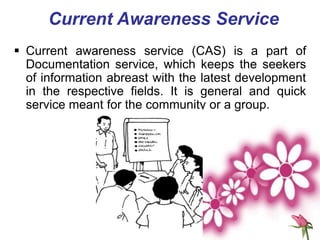
 Current awareness service (CAS) is a part of
Documentation service, which keeps the seekers
of information abreast with the latest development
in the respective fields. It is general and quick
service meant for the community or a group.
Characteristics of CAS
 Speed or timeliness is the soul of CAS. Its aim is
to notify the information to the users as quickly as
possible.
 This service is not in response to a particular
enquiry, but a continuous process of keeping the
users abreast of the latest information. It only
gives a panoramic view of current developments in
their field of work as also in the related fields.
 A CAS is usually easy to use and as such no
search strategy is needed for its consultation.
Selective Dissemination of
Information (SDI)Service
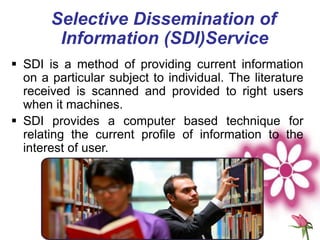
 SDI is a method of providing current information
on a particular subject to individual. The literature
received is scanned and provided to right users
when it machines.
 SDI provides a computer based technique for
relating the current profile of information to the
interest of user.
Characteristics of SDI
 It is a current awareness service meant to keep its
user abreast of the latest development in the field
of his interest.
 It is a personalized service meant for an individual
or a group of the users having identical information
needs.
 It is a quick service which provides the pin –
pointed information.
 The requirements of information is being collected
from each users and converted into machine
readable from called “User Profile.”
Indexing Service
A service that indexes the contents of a number of
publications for use in printed or machine-readable form.
An information system is mainly concerned with the
following activities.
 Building up of a comprehensive, balanced, up to date and
need based store of information -bearing documents
 Organization and control of the store information – bearing
documents to put them to user quickly and conveniently
 Retrieving the information – baring documents in response
to particular query from the organized store with the help of
a control system
Abstracting Service
A service that provides abstracts of publications on a
subject or group of related subjects, usually on a
subscription basis.
Purpose of Abstract
 Provide the users with all the essential information, like
the nature and purpose of the work, new approach, novel
findings, results and conclusions, in order to enable the
reader to consult or not to consult the original document.
 To save the time of the users and help him in his literature
search both current and retrospective
 To locate the document a scientist expects and abstract to
tell him what the paper is about and the address of the
paper
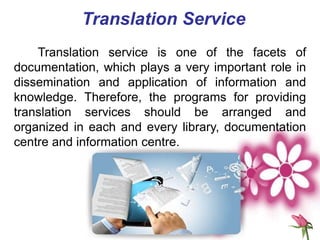
Translation Service
Translation service is one of the facets of
documentation, which plays a very important role in
dissemination and application of information and
knowledge. Therefore, the programs for providing
translation services should be arranged and
organized in each and every library, documentation
centre and information centre.
Translation Tools
 National Translation Centre (NTC), Chicago, USA
 International Translation Centre (ITC), Delft, The
Netherlands
 British Library Lending Division (BLLD) Boston,
UK
 All Union Translation Centre, USSR.
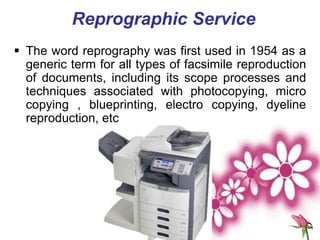
Reprographic Service
 The word reprography was first used in 1954 as a
generic term for all types of facsimile reproduction
of documents, including its scope processes and
techniques associated with photocopying, micro
copying , blueprinting, electro copying, dyeline
reproduction, etc
Need for Reprography
 The need of rare and important documents in the
field of research in multiple copies.
 For preserving the costly and rare materials.
 For Enlargement of a Graph, Maps, Diagram,
etc...
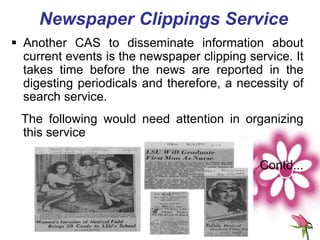
Newspaper Clippings Service
 Another CAS to disseminate information about
current events is the newspaper clipping service. It
takes time before the news are reported in the
digesting periodicals and therefore, a necessity of
search service.
The following would need attention in organizing
this service
Contd...
 Subject or area to be covered
 Selection of event to be noticed such as report on
government actions and its policies on current
issues pertaining to educational, research,
economic, social and political matters editorials,
views and comments, feature articles and others
 Newspapers to be scanned
 Clipping and its organizations
 Index file and arrangement of entries
 Frequency
Computer based service
 With the application of information technology a
large amount of scientific information is in
electronic form ie electronic books, electronic
journals and CD-ROMs. Libraries having these
electronic facilities provide CD-ROM Databases
searches, Computerized databases searches from
their own PCs and through local area network and
internet service
Document Delivery Service
 Document Delivery Service (DDS) is actually
concerned with the supply of documents to the
users on demand, either in original or its copy in
print or non-print from, irrespective of the location
and form of the original.
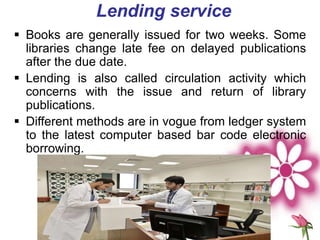
Lending service
 Books are generally issued for two weeks. Some
libraries change late fee on delayed publications
after the due date.
 Lending is also called circulation activity which
concerns with the issue and return of library
publications.
 Different methods are in vogue from ledger system
to the latest computer based bar code electronic
borrowing.
Inter Library Loan
 Abbreviated ILL, and sometimes called interloan,
interlending, document delivery, or document
supply.
 Interlibrary loan is a service whereby a user of one
library can borrow books or receive photocopies of
documents that are owned by another library.
 Libraries all over the world participate in
Interlibrary Loan (ILL) in a cooperative effort to
provide articles, books, and other materials to
researchers, students, and others.
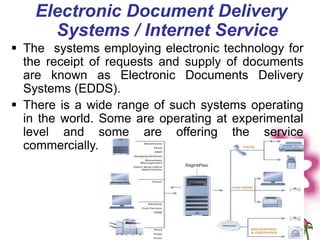
Electronic Document Delivery
Systems / Internet Service
 The systems employing electronic technology for
the receipt of requests and supply of documents
are known as Electronic Documents Delivery
Systems (EDDS).
 There is a wide range of such systems operating
in the world. Some are operating at experimental
level and some are offering the service
commercially.
Bibliographic Service
 The term Bibliography has derived from two Greek
words namely “Biblion” and ‘grapheln’ which mean’
book’ and to write respectively
Types of Bibliography
 Systematic or enumerative Bibliography:
It is a simple listing of documents with minimum
details on given subject usually arrange in logical
order.
 Analytical or critical bibliography:
It is usually a detailed study of documents which
aim at determining facts and data concerning a
publication by examining the signatures,
catchwords, water marks etc.
Contd...
 Historical bibliography
It is used in two contexts
 To study the history of books- their editions
authorship etc.
 To study the methods of book- production, printing,
binding, paper making etc.
Literature Search and
Database Service
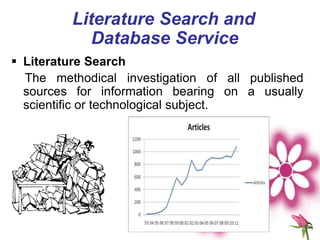
 Literature Search
The methodical investigation of all published
sources for information bearing on a usually
scientific or technological subject.
 Several aims of this kind of Literature search:
 Review existing critical opinions/theories
 Identify current research findings on a topic
 Identify potential research methods or models you
could use
 Having carried out research, enabling comparison
with your own research findings
 The Stages of the Literature Search
A good literature search involves the following
steps which should be worked through
systematically:
Background reading and preparation
Working with your title: identify search terms
Identify the resources to search
Search using search techniques
Collate your results
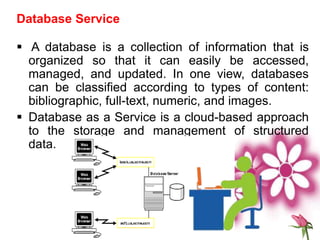
Database Service
 A database is a collection of information that is
organized so that it can easily be accessed,
managed, and updated. In one view, databases
can be classified according to types of content:
bibliographic, full-text, numeric, and images.
 Database as a Service is a cloud-based approach
to the storage and management of structured
data.
Different types of Databases
 Multi-disciplinary journal databases
Resources such as Academic Search Complete,
Academic OneFile and JSTOR contain journal
content across a large range of academic
subjects. Often multi-disciplinary databases will
contain professional and trade journals as well as
academic peer-reviewed journals. You will
however usually be able to restrict your search to
just find academic peer-reviewed journals.
 Subject specific databases
Contain journal articles and/or other types of
content relevant to a specific subject or group of
related subjects. Examples include PsycArticles,
Education Research Complete, Westlaw and
International Index to Performing Arts.
 Publishers’ databases
Databases such as Science Direct, Sage
Journals and Emerald contain journal content
published by a particular publishing company.
Such resources may also have a subject focus or
may be multi-disciplinary.
 Other types of Content
Remember Online Library allows access to a
large number of databases containing other
relevant non-journal content that may contribute to
your literature search such as E-books,
newspapers, images, audio & video, legal and
Government information and Encyclopedias
Gide Lines for Library Use
• Sit proper way in the library
• Silence is observed in the library
• Food items are not allowed
• Cell phones are not allowed
• Don’t damage the books physically
• Don’t write on the books
• Please leave the book on the table before
leaving the library
Thank you

1st Lesson -Introduction to Library & its Services3.pptx

  • 1.
    Introduction to Libraryand It’s Services Presented By Dr.M.C.SUBANGI Deputy Librarian Agricultural Engineering College & Research Institute (TNAU), Kumulur,Tiruchirappalli , Tamilnadu, India.
  • 2.
    WHY THIS COURSE? Libraryis an essential component of the Education and Research Institutions. The students pursuing higher studies need to learn various information sources and their use. The course impart the skill to know the storage, searching and retrieval system of Agricultural information and learn how to use the information efficiently and ethically in their course and research work.
  • 3.
    Point to beDiscussed • Introduction • History of Library • Father of Library Science • Library ACT • Five Law of Library Science • Functions of Library • Types of Library • Library Services
  • 4.
    • In the21st Century we are living in an information age. Information has become the “Key Word” in the every sphere of our life in the context of information explosion era. Information becomes the power of human being. • As a nonprofit organization and a social service institution, library is one of the main centre's for generation, collection, storage & dissemination of information. • It is the vital centre for the interaction in between document and user. • For this the operation of libraries is becoming increasingly complex, involving mechanization, computerization and centralization of library services. • There has been rapid growth in the size and scope of collections in the variety of services offered and in the expectation of users. Introduction
  • 5.
  • 6.
    Father of LibraryScience in India
  • 8.
    • According toDr.S.R.Ranganathan “ Library is a public institution or establishment charged with the care of a collection of books the duty of making them assessable to those who require the use of them and the task of converting every person in its neighborhood into a habitual library gore and reader of books. • According to Carl T. Rowan. “The library is the temple of Learning and Learning has Liberated more people than all the wars in History.” Definition of Library
  • 9.
    Library ACT • TamilNadu Public Libraries Act, was enacted in Madras State, India, in 1948. • The Connemara Public Library became the first library to come under the purview of this act, as a “State central library”. • Nine district libraries were added during the Five year plan from 1951. The act was enacted based on research and activity by S.R.Ranganathan and the Madras Library Association.
  • 10.
    • 1st Law: BOOKS ARE FOR USE • 2nd Law : EVERY READER HIS/HER BOOK • 3rd Law : EVERY BOOKS ITS READER • 4th Law : SAVE THE TIME OF THE READER • 5th Law : THE LIBRARY IS A GROWING ORGANISM Five Laws of Library Science
  • 16.
    Functions of Library •Rules and Regulation • Collection Building • Circulation • Catalogue • Classification • Preservation • Documentation
  • 17.
  • 18.
    Academic Libraries • Academiclibraries serve at College and Universities. • Large institutions may several libraries on their campuses dedicated to serving particular schools such as law and science libraries. • Academic librarians become specialists in an area of knowledge and can faculty status.
  • 19.
  • 20.
    Use of ourLibraries
  • 21.
    • A Libraryfunctions are nerve centre of an academic institution. It is “ThinkTank” of a research organization. Conventionally libraries provided popular services like reference, lending, bibliographic and documentation, current awareness and reprographic services, etc., Library & Its Services
  • 23.
    Services • Reference Service •Current Awareness Service • Selective Dissemination of Information Service (SDI) • Indexing Service • Abstracting Service • Translation Service • Reprographic Service • Newspaper Clipping Service • Computer based Service • Document Delivery Service • Lending Service • Inter Library Loan • Literature Search and Database Service • Electronic Document Delivery systems / Internet services • Bibliographic Service
  • 24.
    Reference Service •According tothe American library association Glossary of Library terms “Reference service is that phase of library work which is directly concerned with assistance to readers in securing information and in using the recourse of the library in study and research.” •Dr. S. R.Ranganathan defines Reference service as “the process of establishing contact between a reader and his document in a personal way.”
  • 25.
    Types of ReferenceService  Ready Reference Service Ready Reference service is Reference service finished in a very short time – in a moment if possible. i.e. between 30 second and 30 minutes.  Long range Reference service This service may take more than 30 minutes and the duration depends upon the user needs. The process of information flow may take days, months and years
  • 26.
    Current Awareness Service Current awareness service (CAS) is a part of Documentation service, which keeps the seekers of information abreast with the latest development in the respective fields. It is general and quick service meant for the community or a group.
  • 27.
    Characteristics of CAS Speed or timeliness is the soul of CAS. Its aim is to notify the information to the users as quickly as possible.  This service is not in response to a particular enquiry, but a continuous process of keeping the users abreast of the latest information. It only gives a panoramic view of current developments in their field of work as also in the related fields.  A CAS is usually easy to use and as such no search strategy is needed for its consultation.
  • 28.
    Selective Dissemination of Information(SDI)Service  SDI is a method of providing current information on a particular subject to individual. The literature received is scanned and provided to right users when it machines.  SDI provides a computer based technique for relating the current profile of information to the interest of user.
  • 29.
    Characteristics of SDI It is a current awareness service meant to keep its user abreast of the latest development in the field of his interest.  It is a personalized service meant for an individual or a group of the users having identical information needs.  It is a quick service which provides the pin – pointed information.  The requirements of information is being collected from each users and converted into machine readable from called “User Profile.”
  • 30.
    Indexing Service A servicethat indexes the contents of a number of publications for use in printed or machine-readable form. An information system is mainly concerned with the following activities.  Building up of a comprehensive, balanced, up to date and need based store of information -bearing documents  Organization and control of the store information – bearing documents to put them to user quickly and conveniently  Retrieving the information – baring documents in response to particular query from the organized store with the help of a control system
  • 31.
    Abstracting Service A servicethat provides abstracts of publications on a subject or group of related subjects, usually on a subscription basis. Purpose of Abstract  Provide the users with all the essential information, like the nature and purpose of the work, new approach, novel findings, results and conclusions, in order to enable the reader to consult or not to consult the original document.  To save the time of the users and help him in his literature search both current and retrospective  To locate the document a scientist expects and abstract to tell him what the paper is about and the address of the paper
  • 32.
    Translation Service Translation serviceis one of the facets of documentation, which plays a very important role in dissemination and application of information and knowledge. Therefore, the programs for providing translation services should be arranged and organized in each and every library, documentation centre and information centre.
  • 33.
    Translation Tools  NationalTranslation Centre (NTC), Chicago, USA  International Translation Centre (ITC), Delft, The Netherlands  British Library Lending Division (BLLD) Boston, UK  All Union Translation Centre, USSR.
  • 34.
    Reprographic Service  Theword reprography was first used in 1954 as a generic term for all types of facsimile reproduction of documents, including its scope processes and techniques associated with photocopying, micro copying , blueprinting, electro copying, dyeline reproduction, etc
  • 35.
    Need for Reprography The need of rare and important documents in the field of research in multiple copies.  For preserving the costly and rare materials.  For Enlargement of a Graph, Maps, Diagram, etc...
  • 36.
    Newspaper Clippings Service Another CAS to disseminate information about current events is the newspaper clipping service. It takes time before the news are reported in the digesting periodicals and therefore, a necessity of search service. The following would need attention in organizing this service Contd...
  • 37.
     Subject orarea to be covered  Selection of event to be noticed such as report on government actions and its policies on current issues pertaining to educational, research, economic, social and political matters editorials, views and comments, feature articles and others  Newspapers to be scanned  Clipping and its organizations  Index file and arrangement of entries  Frequency
  • 38.
    Computer based service With the application of information technology a large amount of scientific information is in electronic form ie electronic books, electronic journals and CD-ROMs. Libraries having these electronic facilities provide CD-ROM Databases searches, Computerized databases searches from their own PCs and through local area network and internet service
  • 39.
    Document Delivery Service Document Delivery Service (DDS) is actually concerned with the supply of documents to the users on demand, either in original or its copy in print or non-print from, irrespective of the location and form of the original.
  • 40.
    Lending service  Booksare generally issued for two weeks. Some libraries change late fee on delayed publications after the due date.  Lending is also called circulation activity which concerns with the issue and return of library publications.  Different methods are in vogue from ledger system to the latest computer based bar code electronic borrowing.
  • 41.
    Inter Library Loan Abbreviated ILL, and sometimes called interloan, interlending, document delivery, or document supply.  Interlibrary loan is a service whereby a user of one library can borrow books or receive photocopies of documents that are owned by another library.  Libraries all over the world participate in Interlibrary Loan (ILL) in a cooperative effort to provide articles, books, and other materials to researchers, students, and others.
  • 42.
    Electronic Document Delivery Systems/ Internet Service  The systems employing electronic technology for the receipt of requests and supply of documents are known as Electronic Documents Delivery Systems (EDDS).  There is a wide range of such systems operating in the world. Some are operating at experimental level and some are offering the service commercially.
  • 43.
    Bibliographic Service  Theterm Bibliography has derived from two Greek words namely “Biblion” and ‘grapheln’ which mean’ book’ and to write respectively
  • 44.
    Types of Bibliography Systematic or enumerative Bibliography: It is a simple listing of documents with minimum details on given subject usually arrange in logical order.  Analytical or critical bibliography: It is usually a detailed study of documents which aim at determining facts and data concerning a publication by examining the signatures, catchwords, water marks etc. Contd...
  • 45.
     Historical bibliography Itis used in two contexts  To study the history of books- their editions authorship etc.  To study the methods of book- production, printing, binding, paper making etc.
  • 46.
    Literature Search and DatabaseService  Literature Search The methodical investigation of all published sources for information bearing on a usually scientific or technological subject.
  • 47.
     Several aimsof this kind of Literature search:  Review existing critical opinions/theories  Identify current research findings on a topic  Identify potential research methods or models you could use  Having carried out research, enabling comparison with your own research findings
  • 48.
     The Stagesof the Literature Search A good literature search involves the following steps which should be worked through systematically: Background reading and preparation Working with your title: identify search terms Identify the resources to search Search using search techniques Collate your results
  • 49.
    Database Service  Adatabase is a collection of information that is organized so that it can easily be accessed, managed, and updated. In one view, databases can be classified according to types of content: bibliographic, full-text, numeric, and images.  Database as a Service is a cloud-based approach to the storage and management of structured data.
  • 50.
    Different types ofDatabases  Multi-disciplinary journal databases Resources such as Academic Search Complete, Academic OneFile and JSTOR contain journal content across a large range of academic subjects. Often multi-disciplinary databases will contain professional and trade journals as well as academic peer-reviewed journals. You will however usually be able to restrict your search to just find academic peer-reviewed journals.
  • 51.
     Subject specificdatabases Contain journal articles and/or other types of content relevant to a specific subject or group of related subjects. Examples include PsycArticles, Education Research Complete, Westlaw and International Index to Performing Arts.  Publishers’ databases Databases such as Science Direct, Sage Journals and Emerald contain journal content published by a particular publishing company. Such resources may also have a subject focus or may be multi-disciplinary.
  • 52.
     Other typesof Content Remember Online Library allows access to a large number of databases containing other relevant non-journal content that may contribute to your literature search such as E-books, newspapers, images, audio & video, legal and Government information and Encyclopedias
  • 53.
    Gide Lines forLibrary Use • Sit proper way in the library • Silence is observed in the library • Food items are not allowed • Cell phones are not allowed • Don’t damage the books physically • Don’t write on the books • Please leave the book on the table before leaving the library
  • 54.