Technical Writing
Definition
Goals
Writing Process
What is Technical Writing?
 Technical writing introduces you to some of
the most important aspects of writing in the
world of science, technology, and business –
the kind of writing that scientists, nurses,
doctors, computer specialists, government
officials, engineers, and other people
do as a part of their regular work.
What is Technical Writing?
 The term “technical” refers to knowledge
that is not widespread, that is more the
territory of experts and specialists.
 Whatever your major is, you are
developing an expertise, and whenever
you try to write anything about your field,
you are engaged in technical writing.
What is Technical Writing?
 Technical communication can be written, oral,
or visual.
 Technical writing is composed in and for the
workplace.
 Technical writing is a significant factor in work
experience for a variety of reasons.
 Technical writing serves valuable purposes in
the workplace and often involves teamwork.
IMPORTANCE OF Technical Writing
 Completion of a task
 Facility of Work
 Improvement of Interpersonal Relationships
 Increase of Income
 Means of Job promotion
 Improvement of Personality traits
 Security of Records
Qualities of a Technical Writer
• Superior Communication Skills
• HOTS or Higher-Order Thinking Skills
• Persuasive Skills
• Integrity
• Zest
• Tech.Writing in this Era of Globalization and Modern Tech. by
Baraceros
What is the purpose of technical
writing?
 Technical writing is the delivery of
technical information to readers in a
manner that is adapted to their needs,
level of understanding, and background.
 Technical writing is intended to
communicate to a specific audience, for a
specific purpose.
The Audience
 The audience element is so important that it is
one of the cornerstones of technical writing.
 You are challenged to write about highly
technical subjects but in a way that a beginner
—a non-specialist—could understand.
Translating Technical Information
 In a world of rapid technological
development, people are constantly falling
behind and becoming technological
illiterates.
 As a technical writer, you need to write
about the area of specialization you know
and plan to write about in such a way that
even Granddad can understand.
Q & A
 What are the five qualities of and effective
Technical Writer?
• Superior Communication Skills
• HOTS or Higher-Order Thinking Skills
• Persuasive Skills
• Integrity
• Zest
 In the Importance of Tw, this depends on
emotional stability, interpersonal relationships
and ethical standards;
* Improvement of Personality traits
 Transactions, dealings, agreements have to be
recorded or documented for safekeeping
purposes or for knowledge transmission. TW
prevents a possible loss or change of data
*Security of Records
 This element in TW is so important that it is
one of the cornerstones of technical writing.
You are challenged to write about highly
technical subjects but in a way that a beginner
—a non-specialist—could understand.
 *The Audience
 Fill in the blanks
 Technical writing introduces you to some of the most important
aspects of writing in the world of________,________, and
_________– the kind of writing
that_________,________,_______, _________,
__________officials, engineers, and other people do as a
part of their regular work.
*science, technology, and business
scientists, nurses, doctors, computer specialists,
government officials
 What does HOTS stand for?
 *Higher-Order Thinking Skills
*Goals of Effective Technical
Writing
Clarity
Conciseness
Accuracy
Organization
Ethics
Effective Technical Writing: Clarity
Methods for developing ideas precisely
– An expressive essay can clarify the writer’s intent
through emotional, impressionistic, connotative
words (soon, many, several, etc.).
– An impressionistic word such as
“near” will mean different things
to different people which is okay
in in an essay where the goal may
be to convey a feeling.
Effective Technical Writing: Clarity
 The ultimate goal of effective technical writing is to say
the same thing to every reader.
 Let’s say I write instructional manuals for company
manufacturing space heaters. If I write,
“Place the space heater near an open window,”
what will this mean to thousands of customers who
purchase the machine?
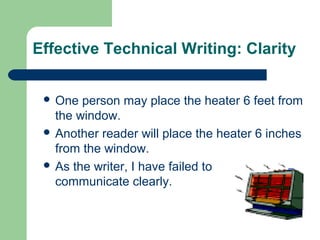
 One person may place the heater 6 feet from
the window.
 Another reader will place the heater 6 inches
from the window.
 As the writer, I have failed to
communicate clearly.
Effective Technical Writing: Clarity
 Specify
– Provide specific detail
– Avoid vague words (some,
recently)
– Answer reporters’ questions
(who, what, where, when, why,
how)
Effective Technical Writing: Clarity
 Avoid obscure words
– Use easily understood words
– Write to express, not to impress
– Write to communicate, not to confuse
– Write the way you speak
aforementioned already discussed
in lieu of instead of
Effective Technical Writing: Clarity
 Limit and/or define your use of
abbreviations , acronyms, and jargon.
 Define your terms parenthetically
 CIA (Cash in Advance)
or
 Supply a separate glossary
 Alphabetized list of terms, followed by their
definitions
Effective Technical Writing: Clarity
 Use the active versus the passive voice.
 Passive voice:
It was decided all employees will take a ten percent cut in
pay.
 Unclear: Who decided?
 Active: The Board of Directors decided that all
employees . . .
Overtime is favored by hourly workers.
 Wordy
 Active: Hourly workers favor overtime.
Effective Technical Writing:
Conciseness
 Conciseness which means expressing oneself
in the fewest number of words at the same
time retaining completeness in meaning.
Effective Technical Writing:
Conciseness
 Limit paragraph, word, and sentence length.
– A paragraph in a memo, letter, or short report should consist of
 No more than four to six typed lines or
 No more than fifty words.
– Fog index (sixth to eighth grade level)
 Strive for an average of 15 words per sentence
 No more than 5 multisyllabic words per 100 words
Effective Technical Writing:
Conciseness
Fog Index
 Count up to 100 words in successive sentences
– Divide words by number of sentences = average
number of words per sentence
 Count number of long words (three or more syllables)
within sentences
– Don’t count proper names (Christopher Columbus),
long words created by combining shorter words
(chairperson), or three syllable words created by ed
or es endings (united).

Effective Technical Writing:
Conciseness
– Use the meat cleaver theory of revision
Cut the sentence in half or thirds
– Avoid shun words– replace them with
active words
Avoid words ending in –tion or –sion
Came to the conclusion concluded
– Avoid camouflaged words
Make an amendment to amend
Effective Technical Writing:
Conciseness
 Avoid the expletive pattern
– There is, are, was, were, will be
– It is, was
– There are three people who will work for Acme.
– Three people will work for Acme.
 Omit redundancies
– During the year of 1996
– During 1996
Effective Technical Writing:
Conciseness
 Avoid wordy phrases
– In order to purchase to purchase
 Proofread for accuracy
 Consider ethics
Effective Technical Writing:
Accuracy
 The importance of correct
grammar and mechanics
– Grammatical or mechanical
errors make writers look
unprofessional and
incompetent.
Effective Technical Writing:
Accuracy
 Grammar is so important in technical
writing that in a one page assignment
– 4 major grammatical errors = F
– 3 major grammatical errors = D
– 2 major grammatical errors = C
– 1 major grammatical error = B
 “A” means “excellent” which is defined as
“without flaw”
Effective Technical Writing:
Organization
 Methods for organizing
– Spatial
– General to Specific
– Chronological
– Mechanism Description
– Process Description
– Classification
Effective Technical Writing:
Organization
 Methods for organizing
– Definition
– Comparison/Contrast
– More Important to Less Important
– Situation-Problem-Solution-
Evaluation
– Cause-Effect
Effective Technical Writing: Ethics
 Ethics – methods encouraging moral
standards in technical writing
– Practical
– Legal
– Moral
Effective Technical Writing: Ethics
 General categories of ethics in communication
– Behavior towards colleagues, subordinates and
others (plagiarism, harassment, malicious actions)
– Dealing with experimental subjects, interviewees,
etc. (informed consent)
– Telling the “truth” (falsify data, misrepresent facts)
– Rhetoric—choosing your words (loaded words, discriminatory
language, logical fallacies)
 In the goals of effective TW:
– The ultimate goal of effective technical writing is to
say the same thing to every reader.
*CLARITY
 _____________which means expressing
oneself in the fewest number of words at the
same time retaining completeness in meaning.
 * CONCISENESS
 The importance of correct grammar and
mechanics
*ACCURACY
Effective Technical Writing:
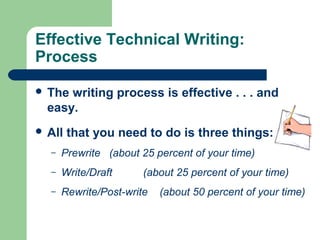
Process
 The writing process is effective . . . and
easy.
 All that you need to do is three things:
– Prewrite (about 25 percent of your time)
– Write/Draft (about 25 percent of your time)
– Rewrite/Post-write (about 50 percent of your time)
Effective Technical Writing:
Prewriting Techniques
 Brainstorming sessions
 Free writing of looping
 Interview
 Questionnaire survey
 Reading
 Listing
 Speculating
 Semantic Mapping or Drawing
DRAFTING or WRITING
 The stage of packaging or formatting data
– Data packaging– means spending time and effort in forming
clear and correct sentences to express the ideas you have
collected through a pre-writing strategy or data-collecting
technique
- It involves the use of appropriate transitional devices and
paragraph organizational techniques that are suitable to
your purpose and are effective for paragraph unity,
coherence and emphasis.
– Formatting Data – makes you think of how your
report should appear
– This means giving your written work a design, lay-
out, or arrangement of its words, sentences, and
paragraphs, illustrations, colors and so forth.
POST-WRITING
 A. Revising – making changes in the context
and organization of the text so that it will reflect
your specific purpose, fit your intended
audience, and apply the essential qualities of a
paragraph like unity, coherence, emphasis and
correctness
 B. Editing – means to check the
grammaticalness of the text
– The use of the different parts of speech, to diction or
choice of words, to construction of sentences, and
to your punctuation marks and spelling.
 C. Proofreading – focusing attention to
typographical errors, report format,
documentation style as well as missing parts or
words in the written work.
Technical Writing
 Is important to success in business
 Lets you conduct business
 Takes time
 Costs the company
 Reflects your interpersonal communication
skills
 Often involves teamwork
Sources
 Society for Technical Communication
 Technical Writing - A Dalton: Organizing
 Online Technical Writing: Information
Infrastructures – Comparison
 Online Technical Writing

technical writing styles

  • 1.
  • 2.
    What is TechnicalWriting?  Technical writing introduces you to some of the most important aspects of writing in the world of science, technology, and business – the kind of writing that scientists, nurses, doctors, computer specialists, government officials, engineers, and other people do as a part of their regular work.
  • 3.
    What is TechnicalWriting?  The term “technical” refers to knowledge that is not widespread, that is more the territory of experts and specialists.  Whatever your major is, you are developing an expertise, and whenever you try to write anything about your field, you are engaged in technical writing.
  • 4.
    What is TechnicalWriting?  Technical communication can be written, oral, or visual.  Technical writing is composed in and for the workplace.  Technical writing is a significant factor in work experience for a variety of reasons.  Technical writing serves valuable purposes in the workplace and often involves teamwork.
  • 5.
    IMPORTANCE OF TechnicalWriting  Completion of a task  Facility of Work  Improvement of Interpersonal Relationships  Increase of Income  Means of Job promotion  Improvement of Personality traits  Security of Records
  • 6.
    Qualities of aTechnical Writer • Superior Communication Skills • HOTS or Higher-Order Thinking Skills • Persuasive Skills • Integrity • Zest • Tech.Writing in this Era of Globalization and Modern Tech. by Baraceros
  • 7.
    What is thepurpose of technical writing?  Technical writing is the delivery of technical information to readers in a manner that is adapted to their needs, level of understanding, and background.  Technical writing is intended to communicate to a specific audience, for a specific purpose.
  • 8.
    The Audience  Theaudience element is so important that it is one of the cornerstones of technical writing.  You are challenged to write about highly technical subjects but in a way that a beginner —a non-specialist—could understand.
  • 9.
    Translating Technical Information In a world of rapid technological development, people are constantly falling behind and becoming technological illiterates.  As a technical writer, you need to write about the area of specialization you know and plan to write about in such a way that even Granddad can understand.
  • 10.
    Q & A What are the five qualities of and effective Technical Writer? • Superior Communication Skills • HOTS or Higher-Order Thinking Skills • Persuasive Skills • Integrity • Zest
  • 11.
     In theImportance of Tw, this depends on emotional stability, interpersonal relationships and ethical standards; * Improvement of Personality traits
  • 12.
     Transactions, dealings,agreements have to be recorded or documented for safekeeping purposes or for knowledge transmission. TW prevents a possible loss or change of data *Security of Records
  • 13.
     This elementin TW is so important that it is one of the cornerstones of technical writing. You are challenged to write about highly technical subjects but in a way that a beginner —a non-specialist—could understand.  *The Audience
  • 14.
     Fill inthe blanks  Technical writing introduces you to some of the most important aspects of writing in the world of________,________, and _________– the kind of writing that_________,________,_______, _________, __________officials, engineers, and other people do as a part of their regular work. *science, technology, and business scientists, nurses, doctors, computer specialists, government officials
  • 15.
     What doesHOTS stand for?  *Higher-Order Thinking Skills
  • 16.
    *Goals of EffectiveTechnical Writing Clarity Conciseness Accuracy Organization Ethics
  • 17.
    Effective Technical Writing:Clarity Methods for developing ideas precisely – An expressive essay can clarify the writer’s intent through emotional, impressionistic, connotative words (soon, many, several, etc.). – An impressionistic word such as “near” will mean different things to different people which is okay in in an essay where the goal may be to convey a feeling.
  • 18.
    Effective Technical Writing:Clarity  The ultimate goal of effective technical writing is to say the same thing to every reader.  Let’s say I write instructional manuals for company manufacturing space heaters. If I write, “Place the space heater near an open window,” what will this mean to thousands of customers who purchase the machine?
  • 19.
     One personmay place the heater 6 feet from the window.  Another reader will place the heater 6 inches from the window.  As the writer, I have failed to communicate clearly. Effective Technical Writing: Clarity
  • 20.
    Effective Technical Writing:Clarity  Specify – Provide specific detail – Avoid vague words (some, recently) – Answer reporters’ questions (who, what, where, when, why, how)
  • 21.
    Effective Technical Writing:Clarity  Avoid obscure words – Use easily understood words – Write to express, not to impress – Write to communicate, not to confuse – Write the way you speak aforementioned already discussed in lieu of instead of
  • 22.
    Effective Technical Writing:Clarity  Limit and/or define your use of abbreviations , acronyms, and jargon.  Define your terms parenthetically  CIA (Cash in Advance) or  Supply a separate glossary  Alphabetized list of terms, followed by their definitions
  • 23.
    Effective Technical Writing:Clarity  Use the active versus the passive voice.  Passive voice: It was decided all employees will take a ten percent cut in pay.  Unclear: Who decided?  Active: The Board of Directors decided that all employees . . . Overtime is favored by hourly workers.  Wordy  Active: Hourly workers favor overtime.
  • 24.
    Effective Technical Writing: Conciseness Conciseness which means expressing oneself in the fewest number of words at the same time retaining completeness in meaning.
  • 25.
    Effective Technical Writing: Conciseness Limit paragraph, word, and sentence length. – A paragraph in a memo, letter, or short report should consist of  No more than four to six typed lines or  No more than fifty words. – Fog index (sixth to eighth grade level)  Strive for an average of 15 words per sentence  No more than 5 multisyllabic words per 100 words
  • 26.
    Effective Technical Writing: Conciseness FogIndex  Count up to 100 words in successive sentences – Divide words by number of sentences = average number of words per sentence  Count number of long words (three or more syllables) within sentences – Don’t count proper names (Christopher Columbus), long words created by combining shorter words (chairperson), or three syllable words created by ed or es endings (united).
  • 27.
    Effective Technical Writing: Conciseness –Use the meat cleaver theory of revision Cut the sentence in half or thirds – Avoid shun words– replace them with active words Avoid words ending in –tion or –sion Came to the conclusion concluded – Avoid camouflaged words Make an amendment to amend
  • 28.
    Effective Technical Writing: Conciseness Avoid the expletive pattern – There is, are, was, were, will be – It is, was – There are three people who will work for Acme. – Three people will work for Acme.  Omit redundancies – During the year of 1996 – During 1996
  • 29.
    Effective Technical Writing: Conciseness Avoid wordy phrases – In order to purchase to purchase  Proofread for accuracy  Consider ethics
  • 30.
    Effective Technical Writing: Accuracy The importance of correct grammar and mechanics – Grammatical or mechanical errors make writers look unprofessional and incompetent.
  • 31.
    Effective Technical Writing: Accuracy Grammar is so important in technical writing that in a one page assignment – 4 major grammatical errors = F – 3 major grammatical errors = D – 2 major grammatical errors = C – 1 major grammatical error = B  “A” means “excellent” which is defined as “without flaw”
  • 32.
    Effective Technical Writing: Organization Methods for organizing – Spatial – General to Specific – Chronological – Mechanism Description – Process Description – Classification
  • 33.
    Effective Technical Writing: Organization Methods for organizing – Definition – Comparison/Contrast – More Important to Less Important – Situation-Problem-Solution- Evaluation – Cause-Effect
  • 34.
    Effective Technical Writing:Ethics  Ethics – methods encouraging moral standards in technical writing – Practical – Legal – Moral
  • 35.
    Effective Technical Writing:Ethics  General categories of ethics in communication – Behavior towards colleagues, subordinates and others (plagiarism, harassment, malicious actions) – Dealing with experimental subjects, interviewees, etc. (informed consent) – Telling the “truth” (falsify data, misrepresent facts) – Rhetoric—choosing your words (loaded words, discriminatory language, logical fallacies)
  • 36.
     In thegoals of effective TW: – The ultimate goal of effective technical writing is to say the same thing to every reader. *CLARITY
  • 37.
     _____________which meansexpressing oneself in the fewest number of words at the same time retaining completeness in meaning.  * CONCISENESS
  • 38.
     The importanceof correct grammar and mechanics *ACCURACY
  • 40.
    Effective Technical Writing: Process The writing process is effective . . . and easy.  All that you need to do is three things: – Prewrite (about 25 percent of your time) – Write/Draft (about 25 percent of your time) – Rewrite/Post-write (about 50 percent of your time)
  • 41.
    Effective Technical Writing: PrewritingTechniques  Brainstorming sessions  Free writing of looping  Interview  Questionnaire survey  Reading  Listing  Speculating  Semantic Mapping or Drawing
  • 42.
    DRAFTING or WRITING The stage of packaging or formatting data – Data packaging– means spending time and effort in forming clear and correct sentences to express the ideas you have collected through a pre-writing strategy or data-collecting technique - It involves the use of appropriate transitional devices and paragraph organizational techniques that are suitable to your purpose and are effective for paragraph unity, coherence and emphasis.
  • 43.
    – Formatting Data– makes you think of how your report should appear – This means giving your written work a design, lay- out, or arrangement of its words, sentences, and paragraphs, illustrations, colors and so forth.
  • 44.
    POST-WRITING  A. Revising– making changes in the context and organization of the text so that it will reflect your specific purpose, fit your intended audience, and apply the essential qualities of a paragraph like unity, coherence, emphasis and correctness
  • 45.
     B. Editing– means to check the grammaticalness of the text – The use of the different parts of speech, to diction or choice of words, to construction of sentences, and to your punctuation marks and spelling.  C. Proofreading – focusing attention to typographical errors, report format, documentation style as well as missing parts or words in the written work.
  • 46.
    Technical Writing  Isimportant to success in business  Lets you conduct business  Takes time  Costs the company  Reflects your interpersonal communication skills  Often involves teamwork
  • 47.
    Sources  Society forTechnical Communication  Technical Writing - A Dalton: Organizing  Online Technical Writing: Information Infrastructures – Comparison  Online Technical Writing

Editor's Notes

  • #7 On the progress of projects; systematic planning and performance of work; definitive course of action w/c assures involvement of people and things in their desire to make the project reach its full ending Tw is an act of communicating what are happening in the workplace; update on the present, past or future of the work; workers being informed of the status of the job; awareness of their contribution; involves graphics and figures to help workers get a clear, specific and emphatic understanding of the nature of the assigned task Initiates a meeting of minds bet. Two or more people in relation to their accomplishment– emails, memos etc Research proposals, bid proposals, brochures, sales letters, order letters offers buying-selling activities By reflecting your thinking prowess, communicative competence and professional preparations Tw also depends on emotional stability, interpersonal relationships and ethical standards; Transactions, dealings, agreements have to be recorded or documented for safekeeping purposes or for knowledge transmission. TW prevents a possible loss or change of data
  • #8 Listening, speaking, reading and writing has to be mastered to be able to exchange ideas excellently; writing is the most used skill; the other skills are means of obtaining data for your tech.work; these are used needed for varieties of ideas, information,opinions and other forms of knowledge; -All these 4 macro skills of comm. Increases your schemata or stored ideas in the brain essential in writing your projects and assignments 2.Deeper mental effort from thinker; thinking beyond sensory experience– called abstract knowledge;this makes you entertain ideas beyond what the eyes can see;this takes place during—interpreting, evaluating, creating and appreciating; these elicit meanings based on reader’s viewpoints or personal thought/feelings 3. writer—seller; reader-buyer;the writer ha the burden of proof to convince/persuade reader of the excellence of the technical ppr; - to succeed in this you need to apply ETHOS- appeal to one’s moral, educational, ethics/values/standards ; PATHOS – appeal to ones emotions or feelings and LOGOS– appeal to one’slogical, sytematic, or orderly thinking 4. Always practice truthfulness; honesty; not plaigarize others’ work 5. Knows how to turn anything difficult to something that’s easy and enjoyable; manuals, memos, brochures, tech.reports,etc have the power to stimulate reader’s interest and curiosity when tech.written report reflects your sense of humor, optimism, positive thinking;positive dispositions
  • #31 Proofread means— Ethics --
  • #34 Spatial— General to specific— Chronological— Mechanism des— Process des— Classification—
  • #36 Practical- Legal— Moral--
  • #43 *Tech.Writing in this era of globalization and modern technology