Virtual Reference
Services
Presented by:
Iqra Mubeen
Roll No. 04
M.Phil PU
Reference Services
“Reference Service as direct, personal assistance
to readers seeking information. ”
“Reference services are the services which
refers users to other services.”
( The Encyclopedia of Library and Information Science)
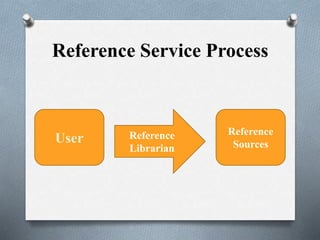
Reference Service Process
User
Reference
Sources
Reference
Librarian
Virtual Reference Services
"Virtual reference is reference service
initiated electronically, often in real-time,
where users employ computers or other Internet
technology to communicate with librarians,
without being physically present.“
(MARS Ad Hoc Committee on Virtual Reference Guidelines
(2003, May). Draft Guidelines 5/2003.)
Objective of Virtual
Reference Services
O To provide individual assistance and instruction
O To provide and maintain an appropriate collection
of reference resources, both print and electronic
O To assist users with locating the best sources of
information
O To help in marketing reference and resources
O To serve as a public relations representative
O To educate users concerning resources and
research techniques in order to help them become
information literate.
History
O Not common in libraries until late 1800s.
O These services initially began in public
libraries.
O At first librarians were hesitant to offer
reference services.
O Did not have a large enough staff
Continue…
O Samuel Swett Green 1876 ( concept of
reference librarian).
O Four goals of reference librarian.
Teaching patrons
Answering patrons' questions
Helping patrons
Promoting the library to the greater
community.
Continue…
O Beginning in 1883 with the Boston Public
Library through E-mail and web form.
O In 1989, started education for reference
services
O The later decades of 19th century.
O Incorporate information communication
technologies in reference services.
O Reference librarian
Elements of Virtual Reference
Service
According to Linda Berube, a digital reference
service incorporates the following four basic
elements:
O The User
O The interface (web form; e- mail; chat; video etc.)
O Electronic resources (including electronic or CD –
based resources; web) resources; local digitized
material etc.) as well as print resources
O The information professional
Benefits
 Psychological barrier (shy users)
 Useful for the users
 Removed physical boundaries
 Reference librarian find more time to think ,
chalk and plan out a strategy and finally search
and give the answer.
 No restrictions of working time
 This mode of receiving and answering
questions is cost-effective.
Two Types of Virtual
Reference Services
Asynchronous Virtual reference:
O Patron submits a question and the librarian
responds at a later time
Example: Email, Web Form.
Synchronous Virtual reference:
O Patron and librarian communicate in real
time.
Example: Chat, Voice over IP, Video
Conferencing, SMS, IM.
Asynchronous Virtual
reference services
OE-mail reference service:
This is a simple, cheapest and cost
effective service in which transaction involves
back and forth exchange of information . User
sends the query in the form of a message and
receives an answer at a later time. User can ask a
question even when the library is closed.
Continue…
Following are the some of the e-mail services
provided to the users:
O Inforocket
O Askme
O All Experts
O Question Point
O Britannica
O Infoplease
Continue…
OReference via Web form:
Ask a Librarian website which provide
a structured web form where user must have to
respond to specific queries. The web form has to
be accessed from library home page. This web
form is useful for reference librarian as well as
users as it provide structured format for
questions.
Synchronous Virtual
reference Services
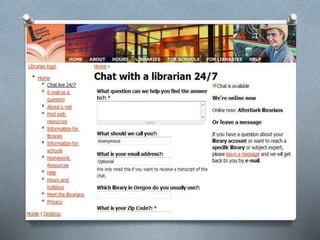
OInstant Messaging:
Chat and Instant messaging solutions
have been used in digital reference with a large
degree of success. This software is widely
available across platforms, very easy to learn,
and cheap (normally free). As customers ask
questions windows will pop up on the librarian’s
screen.
Continue…
Popular IM services are:
O MSN Messenger
O AOL Instant Messenger
O Yahoo Messenger
O Google Talk
O NET Messenger Service
O ICQ
Continue…
O Video Conferencing:
Video Conferencing is introduced as a
remedy to the communication problems inherent in
text based services.
O Visual elements
O Similar to face to face interview
O Distance learning
O Off-campus access
Continue…
ODigital Reference Robots:
An artificial intelligence is used to
response the questions when the reference
librarian is not available, is known as Digital
Robots. The most well-known of this type of
service is Ask Jeeves.
Collaborative Reference
Services
O Collaborative Digital Reference Service (CDRS):
This is a free reference service project of
Library of Congress and more than 100 partner
libraries form various countries. It is a world
wide network of libraries in which OCLC builds
and maintains a database which include three
main components:
O Member Profiles
O Request Manager
O Knowledge Base
Continue…
OVirtual Reference Desk:
This project is sponsored by US
Department of Education. The VRD does not
actually answer questions, but provides
resources and links to experts that offer these
services. It allows co-browsing, webpage
sending, text message, slide shows, chat
transferring.
Continue…
O 24/7 Reference Service:
A pilot network established in
California, Los Angeles and Orange County
areas to provide real time reference services
directly to the library patrons over the
Continue…
It can be used to:
O Communicate with users real time chat.
O Customize the software to integrate with
participant library’s website
O Send files, images, power point presentations
to patron’s computer
O Network with others by transferring complex
to a local or remote expert
Commercial Reference
Services
These services are either free or fee-based. They
answer users‟ questions and provide research
guidance. Some of them are computer-
generated expert services (example: AskJeeves)
and the other are human-mediated (example:
Google Answers, AllExperts).
Continue…
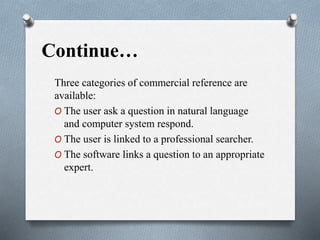
Three categories of commercial reference are
available:
O The user ask a question in natural language
and computer system respond.
O The user is linked to a professional searcher.
O The software links a question to an appropriate
expert.
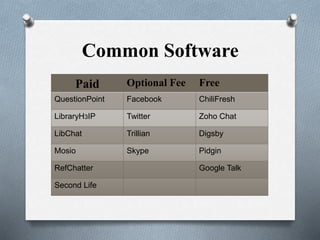
Common Software
Paid Optional Fee Free
QuestionPoint Facebook ChiliFresh
LibraryH3IP Twitter Zoho Chat
LibChat Trillian Digsby
Mosio Skype Pidgin
RefChatter Google Talk
Second Life
Implementation of Digital
Reference Service
O Reference Policy
O Planning
O Staffing
O Training
O Interface Design
O Publicity and Promotion
O Collaboration
Evaluation of Reference
Services
To evaluate means to assess the quality means to
judge the standard of the service that should be
provided to the users.
According to Lankes (2002), these components
consider when evaluate reference services:
O Outcome Measures
O Process Measures
O Economic Measures
O User Satisfaction
Conclusion
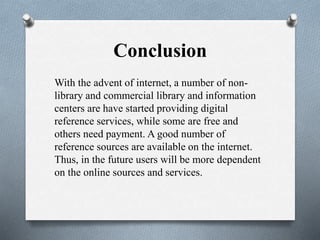
With the advent of internet, a number of non-
library and commercial library and information
centers are have started providing digital
reference services, while some are free and
others need payment. A good number of
reference sources are available on the internet.
Thus, in the future users will be more dependent
on the online sources and services.
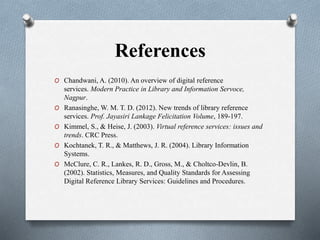
References
O Chandwani, A. (2010). An overview of digital reference
services. Modern Practice in Library and Information Servoce,
Nagpur.
O Ranasinghe, W. M. T. D. (2012). New trends of library reference
services. Prof. Jayasiri Lankage Felicitation Volume, 189-197.
O Kimmel, S., & Heise, J. (2003). Virtual reference services: issues and
trends. CRC Press.
O Kochtanek, T. R., & Matthews, J. R. (2004). Library Information
Systems.
O McClure, C. R., Lankes, R. D., Gross, M., & Choltco-Devlin, B.
(2002). Statistics, Measures, and Quality Standards for Assessing
Digital Reference Library Services: Guidelines and Procedures.
Virtual reference srevices

Virtual reference srevices

  • 1.
  • 2.
    Reference Services “Reference Serviceas direct, personal assistance to readers seeking information. ” “Reference services are the services which refers users to other services.” ( The Encyclopedia of Library and Information Science)
  • 3.
  • 4.
    Virtual Reference Services "Virtualreference is reference service initiated electronically, often in real-time, where users employ computers or other Internet technology to communicate with librarians, without being physically present.“ (MARS Ad Hoc Committee on Virtual Reference Guidelines (2003, May). Draft Guidelines 5/2003.)
  • 5.
    Objective of Virtual ReferenceServices O To provide individual assistance and instruction O To provide and maintain an appropriate collection of reference resources, both print and electronic O To assist users with locating the best sources of information O To help in marketing reference and resources O To serve as a public relations representative O To educate users concerning resources and research techniques in order to help them become information literate.
  • 6.
    History O Not commonin libraries until late 1800s. O These services initially began in public libraries. O At first librarians were hesitant to offer reference services. O Did not have a large enough staff
  • 7.
    Continue… O Samuel SwettGreen 1876 ( concept of reference librarian). O Four goals of reference librarian. Teaching patrons Answering patrons' questions Helping patrons Promoting the library to the greater community.
  • 8.
    Continue… O Beginning in1883 with the Boston Public Library through E-mail and web form. O In 1989, started education for reference services O The later decades of 19th century. O Incorporate information communication technologies in reference services. O Reference librarian
  • 9.
    Elements of VirtualReference Service According to Linda Berube, a digital reference service incorporates the following four basic elements: O The User O The interface (web form; e- mail; chat; video etc.) O Electronic resources (including electronic or CD – based resources; web) resources; local digitized material etc.) as well as print resources O The information professional
  • 10.
    Benefits  Psychological barrier(shy users)  Useful for the users  Removed physical boundaries  Reference librarian find more time to think , chalk and plan out a strategy and finally search and give the answer.  No restrictions of working time  This mode of receiving and answering questions is cost-effective.
  • 11.
    Two Types ofVirtual Reference Services Asynchronous Virtual reference: O Patron submits a question and the librarian responds at a later time Example: Email, Web Form. Synchronous Virtual reference: O Patron and librarian communicate in real time. Example: Chat, Voice over IP, Video Conferencing, SMS, IM.
  • 12.
    Asynchronous Virtual reference services OE-mailreference service: This is a simple, cheapest and cost effective service in which transaction involves back and forth exchange of information . User sends the query in the form of a message and receives an answer at a later time. User can ask a question even when the library is closed.
  • 13.
    Continue… Following are thesome of the e-mail services provided to the users: O Inforocket O Askme O All Experts O Question Point O Britannica O Infoplease
  • 14.
    Continue… OReference via Webform: Ask a Librarian website which provide a structured web form where user must have to respond to specific queries. The web form has to be accessed from library home page. This web form is useful for reference librarian as well as users as it provide structured format for questions.
  • 15.
    Synchronous Virtual reference Services OInstantMessaging: Chat and Instant messaging solutions have been used in digital reference with a large degree of success. This software is widely available across platforms, very easy to learn, and cheap (normally free). As customers ask questions windows will pop up on the librarian’s screen.
  • 16.
    Continue… Popular IM servicesare: O MSN Messenger O AOL Instant Messenger O Yahoo Messenger O Google Talk O NET Messenger Service O ICQ
  • 18.
    Continue… O Video Conferencing: VideoConferencing is introduced as a remedy to the communication problems inherent in text based services. O Visual elements O Similar to face to face interview O Distance learning O Off-campus access
  • 19.
    Continue… ODigital Reference Robots: Anartificial intelligence is used to response the questions when the reference librarian is not available, is known as Digital Robots. The most well-known of this type of service is Ask Jeeves.
  • 20.
    Collaborative Reference Services O CollaborativeDigital Reference Service (CDRS): This is a free reference service project of Library of Congress and more than 100 partner libraries form various countries. It is a world wide network of libraries in which OCLC builds and maintains a database which include three main components: O Member Profiles O Request Manager O Knowledge Base
  • 21.
    Continue… OVirtual Reference Desk: Thisproject is sponsored by US Department of Education. The VRD does not actually answer questions, but provides resources and links to experts that offer these services. It allows co-browsing, webpage sending, text message, slide shows, chat transferring.
  • 22.
    Continue… O 24/7 ReferenceService: A pilot network established in California, Los Angeles and Orange County areas to provide real time reference services directly to the library patrons over the
  • 23.
    Continue… It can beused to: O Communicate with users real time chat. O Customize the software to integrate with participant library’s website O Send files, images, power point presentations to patron’s computer O Network with others by transferring complex to a local or remote expert
  • 24.
    Commercial Reference Services These servicesare either free or fee-based. They answer users‟ questions and provide research guidance. Some of them are computer- generated expert services (example: AskJeeves) and the other are human-mediated (example: Google Answers, AllExperts).
  • 25.
    Continue… Three categories ofcommercial reference are available: O The user ask a question in natural language and computer system respond. O The user is linked to a professional searcher. O The software links a question to an appropriate expert.
  • 26.
    Common Software Paid OptionalFee Free QuestionPoint Facebook ChiliFresh LibraryH3IP Twitter Zoho Chat LibChat Trillian Digsby Mosio Skype Pidgin RefChatter Google Talk Second Life
  • 27.
    Implementation of Digital ReferenceService O Reference Policy O Planning O Staffing O Training O Interface Design O Publicity and Promotion O Collaboration
  • 28.
    Evaluation of Reference Services Toevaluate means to assess the quality means to judge the standard of the service that should be provided to the users. According to Lankes (2002), these components consider when evaluate reference services: O Outcome Measures O Process Measures O Economic Measures O User Satisfaction
  • 29.
    Conclusion With the adventof internet, a number of non- library and commercial library and information centers are have started providing digital reference services, while some are free and others need payment. A good number of reference sources are available on the internet. Thus, in the future users will be more dependent on the online sources and services.
  • 30.
    References O Chandwani, A.(2010). An overview of digital reference services. Modern Practice in Library and Information Servoce, Nagpur. O Ranasinghe, W. M. T. D. (2012). New trends of library reference services. Prof. Jayasiri Lankage Felicitation Volume, 189-197. O Kimmel, S., & Heise, J. (2003). Virtual reference services: issues and trends. CRC Press. O Kochtanek, T. R., & Matthews, J. R. (2004). Library Information Systems. O McClure, C. R., Lankes, R. D., Gross, M., & Choltco-Devlin, B. (2002). Statistics, Measures, and Quality Standards for Assessing Digital Reference Library Services: Guidelines and Procedures.