LIB 640 Information Sources and Services
                   Summer 2012


  What are
Information
  Sources?
2


    What are information sources?

  Information sources
• Each item of information is created in context to its
  originator's purpose, whether it was to inform,
  entertain, or educate and its quality and value
  depends on the information need
   • Glossary
3


    What about reference sources?

  reference source
• Any publication from which authoritative
  information can be obtained, including but not
  limited to reference books, catalog records, printed
  indexes and abstracting services, and bibliographic
  databases. Individuals and services outside the
  library that can be relied upon to provide
  authoritative information are considered
  resources for referral.
4


        And reference books?
 reference book
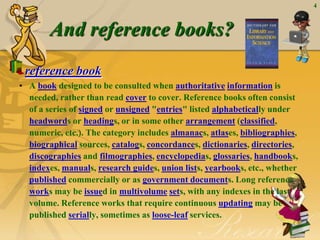
• A book designed to be consulted when authoritative information is
  needed, rather than read cover to cover. Reference books often consist
  of a series of signed or unsigned "entries" listed alphabetically under
  headwords or headings, or in some other arrangement (classified,
  numeric, etc.). The category includes almanacs, atlases, bibliographies,
  biographical sources, catalogs, concordances, dictionaries, directories,
  discographies and filmographies, encyclopedias, glossaries, handbooks,
  indexes, manuals, research guides, union lists, yearbooks, etc., whether
  published commercially or as government documents. Long reference
  works may be issued in multivolume sets, with any indexes in the last
  volume. Reference works that require continuous updating may be
  published serially, sometimes as loose-leaf services.
Another                                                 5


      way to
      look at it
 What are reference books?
• They are those we „refer‟ to. Referring is a very similar
  to the strategy of scanning. We use a reference book
  just to look up the odd fact or confirm a supposition.
  Look at the design of reference books - e.g. the
  Reference Book of Water and Weather and the
  Encyclopaedia of British Wild Animals. They are laid
  out so that the reader can very quickly access
  information. You do not read an encyclopaedia from
  cover to cover - you think what you want to know and
  then search for one very small area of text.
   • Teaching Non-fiction?: Reading Reference Books
     By Bobbie Neate
6


                 Know your reference books
                When you pick up a reference book:
          • Note the author and publisher, and perhaps the author's
            credentials.
          • Check the copyright date. Given the type of information the
            tool covers, is it likely to be current enough?
          • What is the purpose and scope of the book (check for
            preface)?
          • Review the table of contents. What is the scope of the
            material? Is it biased toward one viewpoint?
          • Review the index (if there is none, is that a significant
            drawback?). What approaches does the index use?

June 23, 2012
7


                More know your books

       • Page through to see what special features may be there. Are
         there photos? Charts and graphs? Appendices?
       • What is the level of the book? Who is the intended
         audience?
       • Make up a short “test” for the book. Think up some
         questions that you feel, based on the review you've done,
         that the book should be able to answer. Does it?
       • Has anyone else on the staff had experience with this book?
         How do they feel about it?


June 23, 2012
8


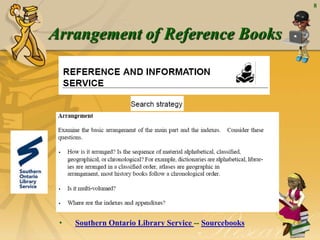
Arrangement of Reference Books


 •   Southern Ontario Library Service -- Sourcebooks
9


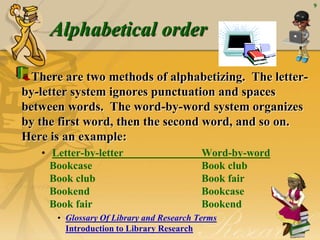
     Alphabetical order

  There are two methods of alphabetizing. The letter-
by-letter system ignores punctuation and spaces
between words. The word-by-word system organizes
by the first word, then the second word, and so on.
Here is an example:
   • Letter-by-letter                     Word-by-word
     Bookcase                             Book club
     Book club                            Book fair
     Bookend                              Bookcase
     Book fair                            Bookend
      • Glossary Of Library and Research Terms
        Introduction to Library Research
10


    Evaluating print sources
• Is the information recent? Select up-to-date,
  current information unless you are conducting
  historical research. This is particularly true in the
  sciences.
• Did an expert in the field prepare the information?
  Look for the author's credentials and affiliations.
  For citations to biographical material about an
  author, consult a biographical source, such as
  Biography and Genealogy Master Index,
  Contemporary Authors or Biography Index.
   • Introduction to Writing Research Papers,
     IV. Evaluating Print and Electronic Sources
11


     More evaluation guidelines
• Is the information from a reliable source? Choose
  information from a scholarly journal (Finding Scholarly
  Journals) or from a book published by a reputable
  publisher. Choose books that have received favorable
  reviews. Consult one of these indexes for citations to
  reviews: Book Review Index, Book Review Digest, Index to
  Book Reviews in the Humanities, Children’s Book Review
  Index, and Balay’s Guide to Reference Books.
• Does the writer seem to be represent material fairly and
  accurately? All argument shows bias because it attempts to
  persuade or influence its audience. However, guard against
  using information that seems unreasonably or unfairly
  biased.
• Who is the intended audience? Is the information for a
  specialized or general audience?
   • Adapted from Evaluating Print and Electronic Sources
12


   Critical Evaluation of Resources


   How do you make sense of what is out there
and evaluate its authority and appropriateness
for your research?
 • Suitability
 • Authority
 • Other indicators
   • http://www.lib.berkeley.edu/TeachingLib/Guides/Evaluation.html
13


       Suitability
 Scope
• What is the breadth of the article, book, website or
  other material?
 Audience
• Who is the intended audience for this source?
 Timeliness
• When was the source published?
 Scholarly vs. Popular
   • http://www.lib.berkeley.edu/TeachingLib/Guides/Evaluation.html
14


    Authority

  Who is the author?
  What are his or her credentials?
• Sometimes information about the author is listed
  somewhere in the article. Other times, you may
  need to consult another resource to get background
  information on the author. Sometimes it helps to
  search the author‟s name in a general web search
  engine like Google.
     • http://www.lib.berkeley.edu/TeachingLib/Guides/Evaluation.html
15


     Other indicators
 Documentation
• A bibliography, along with footnotes, indicate that the
  author has consulted other sources and serves to
  authenticate the information that he or she is
  presenting.
 Objectivity
• What point of view does the author represent?
 Primary vs. secondary research
• In determining the appropriateness of a resource, it
  may be helpful to determine whether it is primary
  research or secondary research.
      • http://www.lib.berkeley.edu/TeachingLib/Guides/Evaluation.html
16

     Distinguish Between Primary
     and Secondary Sources
  Primary Sources
• Primary sources are original materials. They are
  from the time period involved and have not been
  filtered through interpretation.
• [For a list of examples, see
 http://www.lib.umd.edu/guides/primary-sources.html#primary ]
17
       Distinguish Between Primary and
       Secondary Sources

  Secondary Sources
• Secondary sources are accounts written after the
  fact with the benefit of hindsight. They are
  interpretations and evaluations of primary sources.
  Secondary sources are not evidence, but rather
  commentary on and discussion of evidence.
   • Biographies
   • Commentaries
   • Dissertations
   • Indexes, Abstracts, Bibliographies
     (used to locate primary & secondary sources)
   • Journal Articles
   • Monographs
18


     What about Tertiary Sources?

  Tertiary Sources
• Tertiary sources consist of information which
  is a distillation and collection of primary and
  secondary sources. You‟ll find some
                      differences in
  • Almanacs          interpretation about these
  • Encyclopedias     examples. Some consider
  • Fact books        encyclopedias secondary
                      sources. See this guide
                      from the University of
                      Illinois, for example.

What are information sources

  • 1.
    LIB 640 InformationSources and Services Summer 2012 What are Information Sources?
  • 2.
    2 What are information sources? Information sources • Each item of information is created in context to its originator's purpose, whether it was to inform, entertain, or educate and its quality and value depends on the information need • Glossary
  • 3.
    3 What about reference sources? reference source • Any publication from which authoritative information can be obtained, including but not limited to reference books, catalog records, printed indexes and abstracting services, and bibliographic databases. Individuals and services outside the library that can be relied upon to provide authoritative information are considered resources for referral.
  • 4.
    4 And reference books? reference book • A book designed to be consulted when authoritative information is needed, rather than read cover to cover. Reference books often consist of a series of signed or unsigned "entries" listed alphabetically under headwords or headings, or in some other arrangement (classified, numeric, etc.). The category includes almanacs, atlases, bibliographies, biographical sources, catalogs, concordances, dictionaries, directories, discographies and filmographies, encyclopedias, glossaries, handbooks, indexes, manuals, research guides, union lists, yearbooks, etc., whether published commercially or as government documents. Long reference works may be issued in multivolume sets, with any indexes in the last volume. Reference works that require continuous updating may be published serially, sometimes as loose-leaf services.
  • 5.
    Another 5 way to look at it What are reference books? • They are those we „refer‟ to. Referring is a very similar to the strategy of scanning. We use a reference book just to look up the odd fact or confirm a supposition. Look at the design of reference books - e.g. the Reference Book of Water and Weather and the Encyclopaedia of British Wild Animals. They are laid out so that the reader can very quickly access information. You do not read an encyclopaedia from cover to cover - you think what you want to know and then search for one very small area of text. • Teaching Non-fiction?: Reading Reference Books By Bobbie Neate
  • 6.
    6 Know your reference books When you pick up a reference book: • Note the author and publisher, and perhaps the author's credentials. • Check the copyright date. Given the type of information the tool covers, is it likely to be current enough? • What is the purpose and scope of the book (check for preface)? • Review the table of contents. What is the scope of the material? Is it biased toward one viewpoint? • Review the index (if there is none, is that a significant drawback?). What approaches does the index use? June 23, 2012
  • 7.
    7 More know your books • Page through to see what special features may be there. Are there photos? Charts and graphs? Appendices? • What is the level of the book? Who is the intended audience? • Make up a short “test” for the book. Think up some questions that you feel, based on the review you've done, that the book should be able to answer. Does it? • Has anyone else on the staff had experience with this book? How do they feel about it? June 23, 2012
  • 8.
    8 Arrangement of ReferenceBooks • Southern Ontario Library Service -- Sourcebooks
  • 9.
    9 Alphabetical order There are two methods of alphabetizing. The letter- by-letter system ignores punctuation and spaces between words. The word-by-word system organizes by the first word, then the second word, and so on. Here is an example: • Letter-by-letter Word-by-word Bookcase Book club Book club Book fair Bookend Bookcase Book fair Bookend • Glossary Of Library and Research Terms Introduction to Library Research
  • 10.
    10 Evaluating print sources • Is the information recent? Select up-to-date, current information unless you are conducting historical research. This is particularly true in the sciences. • Did an expert in the field prepare the information? Look for the author's credentials and affiliations. For citations to biographical material about an author, consult a biographical source, such as Biography and Genealogy Master Index, Contemporary Authors or Biography Index. • Introduction to Writing Research Papers, IV. Evaluating Print and Electronic Sources
  • 11.
    11 More evaluation guidelines • Is the information from a reliable source? Choose information from a scholarly journal (Finding Scholarly Journals) or from a book published by a reputable publisher. Choose books that have received favorable reviews. Consult one of these indexes for citations to reviews: Book Review Index, Book Review Digest, Index to Book Reviews in the Humanities, Children’s Book Review Index, and Balay’s Guide to Reference Books. • Does the writer seem to be represent material fairly and accurately? All argument shows bias because it attempts to persuade or influence its audience. However, guard against using information that seems unreasonably or unfairly biased. • Who is the intended audience? Is the information for a specialized or general audience? • Adapted from Evaluating Print and Electronic Sources
  • 12.
    12 Critical Evaluation of Resources How do you make sense of what is out there and evaluate its authority and appropriateness for your research? • Suitability • Authority • Other indicators • http://www.lib.berkeley.edu/TeachingLib/Guides/Evaluation.html
  • 13.
    13 Suitability Scope • What is the breadth of the article, book, website or other material? Audience • Who is the intended audience for this source? Timeliness • When was the source published? Scholarly vs. Popular • http://www.lib.berkeley.edu/TeachingLib/Guides/Evaluation.html
  • 14.
    14 Authority Who is the author? What are his or her credentials? • Sometimes information about the author is listed somewhere in the article. Other times, you may need to consult another resource to get background information on the author. Sometimes it helps to search the author‟s name in a general web search engine like Google. • http://www.lib.berkeley.edu/TeachingLib/Guides/Evaluation.html
  • 15.
    15 Other indicators Documentation • A bibliography, along with footnotes, indicate that the author has consulted other sources and serves to authenticate the information that he or she is presenting. Objectivity • What point of view does the author represent? Primary vs. secondary research • In determining the appropriateness of a resource, it may be helpful to determine whether it is primary research or secondary research. • http://www.lib.berkeley.edu/TeachingLib/Guides/Evaluation.html
  • 16.
    16 Distinguish Between Primary and Secondary Sources Primary Sources • Primary sources are original materials. They are from the time period involved and have not been filtered through interpretation. • [For a list of examples, see http://www.lib.umd.edu/guides/primary-sources.html#primary ]
  • 17.
    17 Distinguish Between Primary and Secondary Sources Secondary Sources • Secondary sources are accounts written after the fact with the benefit of hindsight. They are interpretations and evaluations of primary sources. Secondary sources are not evidence, but rather commentary on and discussion of evidence. • Biographies • Commentaries • Dissertations • Indexes, Abstracts, Bibliographies (used to locate primary & secondary sources) • Journal Articles • Monographs
  • 18.
    18 What about Tertiary Sources? Tertiary Sources • Tertiary sources consist of information which is a distillation and collection of primary and secondary sources. You‟ll find some differences in • Almanacs interpretation about these • Encyclopedias examples. Some consider • Fact books encyclopedias secondary sources. See this guide from the University of Illinois, for example.