Dictionaries, Encyclopedias,
Yearbook, Handbook and
Almanac
Reference Sources
It has come to mean a specific kind of
publication which has been planned and
written to be consulted for items of
information, rather than read throughout.
It contains facts that have been brought
together from many sourced and organized
for which and easy use, either in alphabetical
or chronological arrangement or by use of
detailed indexes and numerous cross
references.
1. Contains needed information (e.g. dictionary,
encyclopedia, handbooks, biographical
dictionaries, atlases and gazetteers)
2. Tell the user where the information can be
found (e.g. indexes and bibliographies)
 a reference book on any subject, the items of which
are arranged in alphabetical order: a dictionary of
quotations
 a book that lists the words of a language in
alphabetical order and gives their meaning, or that
gives the equivalent words in a different language.
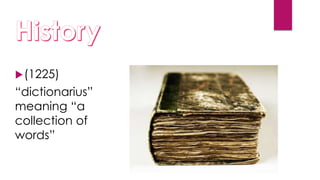
(1225)
“dictionarius”
meaning “a
collection of
words”
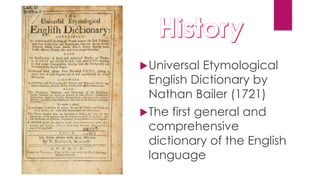
Universal Etymological
English Dictionary by
Nathan Bailer (1721)
The first general and
comprehensive
dictionary of the English
language
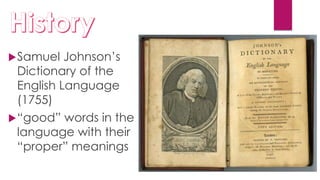
Samuel Johnson’s
Dictionary of the
English Language
(1755)
“good” words in the
language with their
“proper” meanings
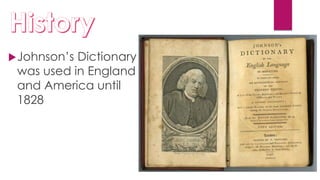
Johnson’s Dictionary
was used in England
and America until
1828
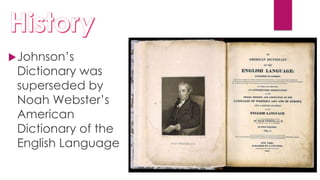
Johnson’s
Dictionary was
superseded by
Noah Webster’s
American
Dictionary of the
English Language
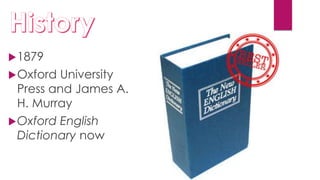
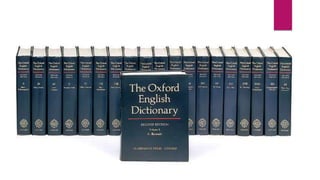
1879
Oxford University
Press and James A.
H. Murray
Oxford English
Dictionary now
Collection of words
Organized
Vocabulary
Glossary
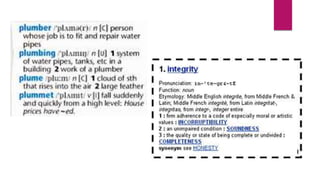
In which each word is treated as to
pronunciation, derivation, usage, meaning
and syllabication.
In addition, the dictionary may give synonyms,
antonyms, illustrative quotations, maps and
plates, biographical facts, and geographical
and historical information.
The word “dictionary” has come to any
alphabetical arrangement of words or topics.
Words were partially explained
(e.g. Thesaurus)
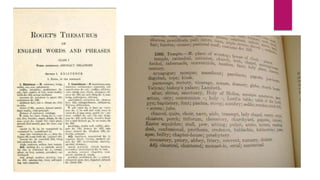
a book that lists words in groups of synonyms
and related concepts.
Peter Mark Roget's Thesaurus of English Words
and Phrases was published in 1852 and was
the first modern thesaurus arranged
conceptually.
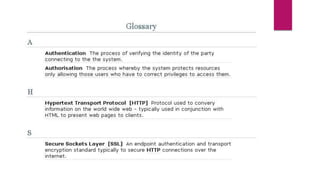
List of explanations of technical
words and expressions in some
particular subject or in a book; a
brief dictionary (e.g Glossary)
Desk dictionaries
Unabridged dictionaries
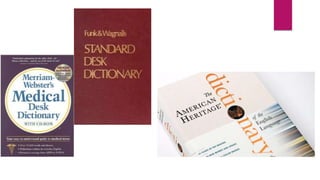
Abridged dictionaries, often
called desk dictionaries, list 150,000
to 250,000 words and concentrate
largely on fairly common words and
meanings
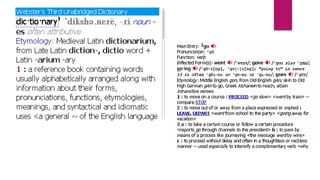
 Most scholarly and comprehensive of all
dictionaries
 They emphasize the history of words and the
variety of their uses.
 Useful when studying a word in depth, reading
or writing about the literature of another
century, or looking for a quotation containing
a particular word.
Uses of
Dictionaries
oIncreases vocabulary
oMakes more fluent in English or in any
languages
oFamiliarize with words
oIncreases communication skills
oMore confident in speaking and writing
oA treasury of words and its history
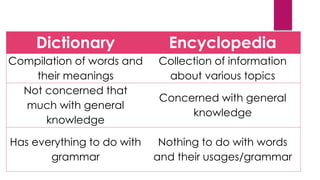
Dictionary Encyclopedia
Compilation of words and
their meanings
Collection of information
about various topics
Not concerned that
much with general
knowledge
Concerned with general
knowledge
Has everything to do with
grammar
Nothing to do with words
and their usages/grammar
A book or set of books giving
information on many subjects or on
many aspects of one subject and
typically arranged alphabetically.
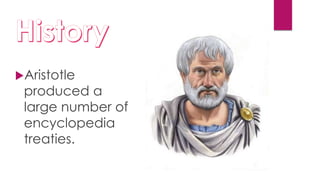
Aristotle
produced a
large number of
encyclopedia
treaties.
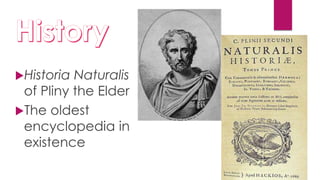
Historia Naturalis
of Pliny the Elder
The oldest
encyclopedia in
existence
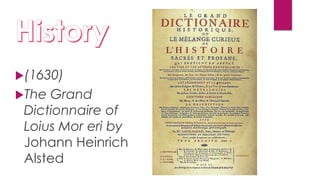
(1630)
The Grand
Dictionnaire of
Loius Mor eri by
Johann Heinrich
Alsted
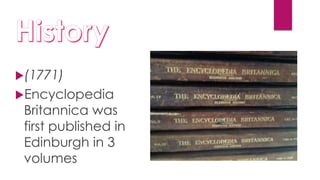
(1771)
Encyclopedia
Britannica was
first published in
Edinburgh in 3
volumes
Repository of information on all branches
of knowledge
General principles and most essential
details of each esp., on the arts and
sciences
Overview of each subject with definition,
description, explanation, history, current
status, statistics and bibliography
Alphabetical arranged
Has indexes
Academic Research
Personal Research
Professional Research
History
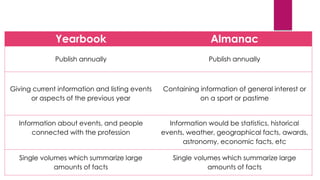
Yearbook Almanac
Publish annually Publish annually
Giving current information and listing events
or aspects of the previous year
Containing information of general interest or
on a sport or pastime
Information about events, and people
connected with the profession
Information would be statistics, historical
events, weather, geographical facts, awards,
astronomy, economic facts, etc
Single volumes which summarize large
amounts of facts
Single volumes which summarize large
amounts of facts
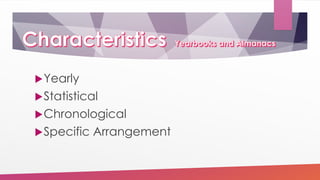
Yearly
Statistical
Chronological
Specific Arrangement
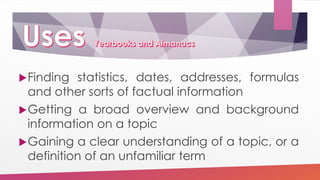
Finding statistics, dates, addresses, formulas
and other sorts of factual information
Getting a broad overview and background
information on a topic
Gaining a clear understanding of a topic, or a
definition of an unfamiliar term
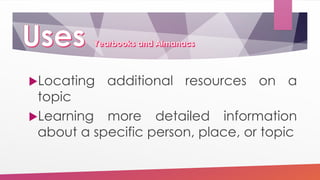
Locating additional resources on a
topic
Learning more detailed information
about a specific person, place, or topic
Obtaining a summary of events and
developments surrounding a topic
Discovering how to complete a task,
solve a problem, or answer a question
 Contain an abundance of information related to
one subject
 Concise explanatory information on a topic
 Facts, formulas, technical information; quick
reference about a broad subject area
 A single-volume reference book of compact size that
provides concise factual information on a specific
subject, organized systematically for quick and easy
access. Statistical information is often published in
handbook form (example: Statistical Handbook on
the American Family). Some handbooks are
published serially (CRC Handbook of Chemistry and
Physics).
Handbooks
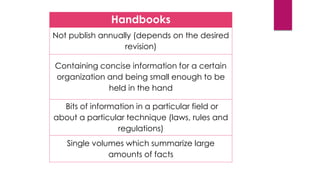
Not publish annually (depends on the desired
revision)
Containing concise information for a certain
organization and being small enough to be
held in the hand
Bits of information in a particular field or
about a particular technique (laws, rules and
regulations)
Single volumes which summarize large
amounts of facts
Contains technical information
Overview/brief
Obtaining a summary of events and
developments surrounding a topic
Discovering how to complete a task,
solve a problem, or answer a question
 Contain one or more lists of resources and materials sharing
some common attribute such as location, publishing date,
subject, etc.
 List of works
 A branch of library science dealing with the history, physical
description, comparison, and classification of books and ot
her works (dictionary.com)
a. What are the author's qualifications
for the fulfillment of his purpose?
b. What were the sources of his
knowledge?
c. The imprint of the publisher may
indicate the relative worth of a book.
Some publishers has excellent reputations
for issuing reference works, others are
noteworthy for bad titles.
d. Writing styles.
a. Purpose
b. Coverage
c. Recency
d. Special aids to the reader
e. Period Covered (optional)
a. Accuracy
b. Objectivity
c. Style
a. Sequence
b. Indexing
 Katz, William A. (1992). Introduction to Reference Work: Basic Information Sources. 6th ed.
New York: McGraw Hill.
 Bopp, Richard E., Smith, Linda C. (2011). Reference and Information Services: An
Introduction. 4th ed. California: ABC-CLIO, LLC.
 http://www.montgomerycollege.edu/~steuben/dictionaryuse.htm
 http://oxforddictionaries.com/definition/english/glossary?q=glossary
 http://oxforddictionaries.com
 http://www.differencebetween.com/difference-between-encyclopedia-and-vs-dictionary/
 http://www.ehow.com/info_8239908_uses-encyclopedia.html
 http://oxforddictionaries.com
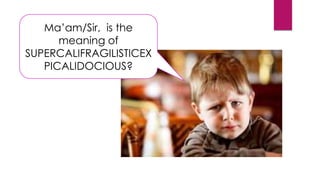
Ma’am/Sir, is the
meaning of
SUPERCALIFRAGILISTICEX
PICALIDOCIOUS?
Do you have any
book about the
Philippines’ events
last 2013?
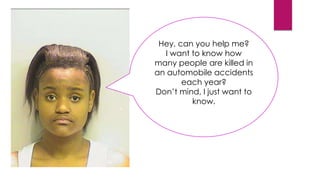
Hey, can you help me?
I want to know how
many people are killed in
an automobile accidents
each year?
Don’t mind, I just want to
know.
I want to know other
works related to
Library Designs. Can
you help me?
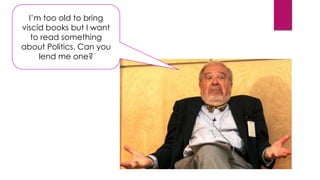
I’m too old to bring
viscid books but I want
to read something
about Politics. Can you
lend me one?
Martin Luther King, Jr was
died on April 4, 1968,
Memphis, Tennessee, United
States. Where could I find
what event happened
before he died?
Another one, where
does football
originated?

Reference powerpoint (dictio,etc)

  • 1.
  • 2.
    It has cometo mean a specific kind of publication which has been planned and written to be consulted for items of information, rather than read throughout.
  • 3.
    It contains factsthat have been brought together from many sourced and organized for which and easy use, either in alphabetical or chronological arrangement or by use of detailed indexes and numerous cross references.
  • 4.
    1. Contains neededinformation (e.g. dictionary, encyclopedia, handbooks, biographical dictionaries, atlases and gazetteers) 2. Tell the user where the information can be found (e.g. indexes and bibliographies)
  • 7.
     a referencebook on any subject, the items of which are arranged in alphabetical order: a dictionary of quotations  a book that lists the words of a language in alphabetical order and gives their meaning, or that gives the equivalent words in a different language.
  • 8.
  • 9.
    Universal Etymological English Dictionaryby Nathan Bailer (1721) The first general and comprehensive dictionary of the English language
  • 10.
    Samuel Johnson’s Dictionary ofthe English Language (1755) “good” words in the language with their “proper” meanings
  • 11.
    Johnson’s Dictionary was usedin England and America until 1828
  • 12.
    Johnson’s Dictionary was superseded by NoahWebster’s American Dictionary of the English Language
  • 13.
    1879 Oxford University Press andJames A. H. Murray Oxford English Dictionary now
  • 15.
  • 16.
    In which eachword is treated as to pronunciation, derivation, usage, meaning and syllabication. In addition, the dictionary may give synonyms, antonyms, illustrative quotations, maps and plates, biographical facts, and geographical and historical information.
  • 18.
    The word “dictionary”has come to any alphabetical arrangement of words or topics.
  • 19.
    Words were partiallyexplained (e.g. Thesaurus)
  • 20.
    a book thatlists words in groups of synonyms and related concepts. Peter Mark Roget's Thesaurus of English Words and Phrases was published in 1852 and was the first modern thesaurus arranged conceptually.
  • 22.
    List of explanationsof technical words and expressions in some particular subject or in a book; a brief dictionary (e.g Glossary)
  • 24.
  • 25.
    Abridged dictionaries, often calleddesk dictionaries, list 150,000 to 250,000 words and concentrate largely on fairly common words and meanings
  • 27.
     Most scholarlyand comprehensive of all dictionaries  They emphasize the history of words and the variety of their uses.  Useful when studying a word in depth, reading or writing about the literature of another century, or looking for a quotation containing a particular word.
  • 29.
  • 30.
    oIncreases vocabulary oMakes morefluent in English or in any languages oFamiliarize with words oIncreases communication skills oMore confident in speaking and writing oA treasury of words and its history
  • 31.
    Dictionary Encyclopedia Compilation ofwords and their meanings Collection of information about various topics Not concerned that much with general knowledge Concerned with general knowledge Has everything to do with grammar Nothing to do with words and their usages/grammar
  • 33.
    A book orset of books giving information on many subjects or on many aspects of one subject and typically arranged alphabetically.
  • 34.
    Aristotle produced a large numberof encyclopedia treaties.
  • 35.
    Historia Naturalis of Plinythe Elder The oldest encyclopedia in existence
  • 36.
    (1630) The Grand Dictionnaire of LoiusMor eri by Johann Heinrich Alsted
  • 37.
  • 38.
    Repository of informationon all branches of knowledge General principles and most essential details of each esp., on the arts and sciences
  • 39.
    Overview of eachsubject with definition, description, explanation, history, current status, statistics and bibliography Alphabetical arranged Has indexes
  • 40.
  • 42.
    Yearbook Almanac Publish annuallyPublish annually Giving current information and listing events or aspects of the previous year Containing information of general interest or on a sport or pastime Information about events, and people connected with the profession Information would be statistics, historical events, weather, geographical facts, awards, astronomy, economic facts, etc Single volumes which summarize large amounts of facts Single volumes which summarize large amounts of facts
  • 43.
  • 44.
    Finding statistics, dates,addresses, formulas and other sorts of factual information Getting a broad overview and background information on a topic Gaining a clear understanding of a topic, or a definition of an unfamiliar term
  • 45.
    Locating additional resourceson a topic Learning more detailed information about a specific person, place, or topic
  • 46.
    Obtaining a summaryof events and developments surrounding a topic Discovering how to complete a task, solve a problem, or answer a question
  • 48.
     Contain anabundance of information related to one subject  Concise explanatory information on a topic  Facts, formulas, technical information; quick reference about a broad subject area
  • 49.
     A single-volumereference book of compact size that provides concise factual information on a specific subject, organized systematically for quick and easy access. Statistical information is often published in handbook form (example: Statistical Handbook on the American Family). Some handbooks are published serially (CRC Handbook of Chemistry and Physics).
  • 50.
    Handbooks Not publish annually(depends on the desired revision) Containing concise information for a certain organization and being small enough to be held in the hand Bits of information in a particular field or about a particular technique (laws, rules and regulations) Single volumes which summarize large amounts of facts
  • 51.
  • 52.
    Obtaining a summaryof events and developments surrounding a topic Discovering how to complete a task, solve a problem, or answer a question
  • 54.
     Contain oneor more lists of resources and materials sharing some common attribute such as location, publishing date, subject, etc.  List of works  A branch of library science dealing with the history, physical description, comparison, and classification of books and ot her works (dictionary.com)
  • 56.
    a. What arethe author's qualifications for the fulfillment of his purpose? b. What were the sources of his knowledge?
  • 57.
    c. The imprintof the publisher may indicate the relative worth of a book. Some publishers has excellent reputations for issuing reference works, others are noteworthy for bad titles. d. Writing styles.
  • 58.
    a. Purpose b. Coverage c.Recency d. Special aids to the reader e. Period Covered (optional)
  • 59.
  • 60.
  • 61.
     Katz, WilliamA. (1992). Introduction to Reference Work: Basic Information Sources. 6th ed. New York: McGraw Hill.  Bopp, Richard E., Smith, Linda C. (2011). Reference and Information Services: An Introduction. 4th ed. California: ABC-CLIO, LLC.  http://www.montgomerycollege.edu/~steuben/dictionaryuse.htm  http://oxforddictionaries.com/definition/english/glossary?q=glossary  http://oxforddictionaries.com  http://www.differencebetween.com/difference-between-encyclopedia-and-vs-dictionary/  http://www.ehow.com/info_8239908_uses-encyclopedia.html  http://oxforddictionaries.com
  • 63.
    Ma’am/Sir, is the meaningof SUPERCALIFRAGILISTICEX PICALIDOCIOUS?
  • 64.
    Do you haveany book about the Philippines’ events last 2013?
  • 65.
    Hey, can youhelp me? I want to know how many people are killed in an automobile accidents each year? Don’t mind, I just want to know.
  • 66.
    I want toknow other works related to Library Designs. Can you help me?
  • 67.
    I’m too oldto bring viscid books but I want to read something about Politics. Can you lend me one?
  • 68.
    Martin Luther King,Jr was died on April 4, 1968, Memphis, Tennessee, United States. Where could I find what event happened before he died? Another one, where does football originated?