RESEARCH SOURCES
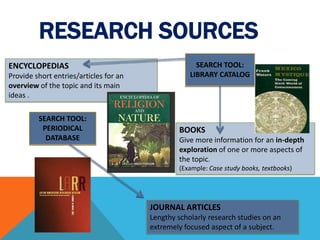
ENCYCLOPEDIAS                                         SEARCH TOOL:
Provide short entries/articles for an               LIBRARY CATALOG
overview of the topic and its main
ideas .

         SEARCH TOOL:
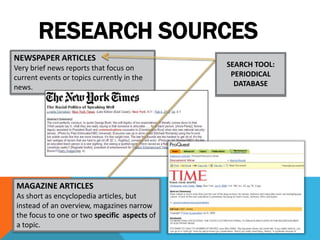
          PERIODICAL                            BOOKS
           DATABASE                             Give more information for an in-depth
                                                exploration of one or more aspects of
                                                the topic.
                                                (Example: Case study books, textbooks)


                                        JOURNAL ARTICLES
                                        Lengthy scholarly research studies on an
                                        extremely focused aspect of a subject.
RESEARCH SOURCES
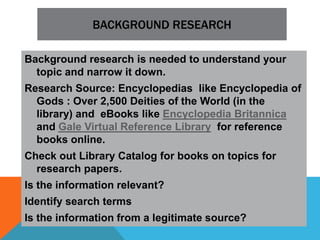
NEWSPAPER ARTICLES
Very brief news reports that focus on         SEARCH TOOL:
current events or topics currently in the      PERIODICAL
news.                                           DATABASE


MAGAZINE ARTICLES
As short as encyclopedia articles, but
instead of an overview, magazines narrow
the focus to one or two specific aspects of
a topic.
TYPES OF RESOURCES

Scholarly Sources
         It has abstract in the beginning
         It may have a list of keyword
         Article has a research problem
         Mentions studies that have addressed the problem in the past
         Has a purpose statement
         Has research question and hypothesis
         Uses qualitative, quantitative or mixed method approach to conduct research
         Has a conclusion at the end
         Has a bibliography or reference list at the end
Popular Sources: Magazine articles like Style, Newsweek, Time etc.
Newspaper sources: LA Times, Whittier Daily News etc.
Primary Sources: Original writings created at the time when the event occurred.
Secondary Sources: Sources that evaluate, summarize, analyze written by experts
   from that field after the event has occurred.
Source:
  http://www.ala.org/ala/mgrps/divs/rusa/sections/history/resources/pu
  bs/usingprimarysources/index.cfm
MAGAZINES VS. SCHOLARLY JOURNALS


         Magazines                     Scholarly Journals

                                Audience: Experts in the field,
                                  students
Audience: Large group of
   people                       Lengthy, technical language
Brief, non-technical language   Author are experts in the field &
                                  credentials are always listed
Author is journalist or
   freelance writer             Peer-reviewed
Look: Graphics, images,         Look: Graphs, charts, statistical
   advertising                    data, plain cover
No references                   References at the end
Examples: Cosmopolitan,         Examples: Child Development,
   Newsweek, Sports               Social Science Quarterly,
   Illustrated etc.               Journal of Applied
                                  Psychology etc.
BACKGROUND RESEARCH

Background research is needed to understand your
  topic and narrow it down.
Research Source: Encyclopedias like Encyclopedia of
  Gods : Over 2,500 Deities of the World (in the
  library) and eBooks like Encyclopedia Britannica
  and Gale Virtual Reference Library for reference
  books online.
Check out Library Catalog for books on topics for
  research papers.
Is the information relevant?
Identify search terms
Is the information from a legitimate source?
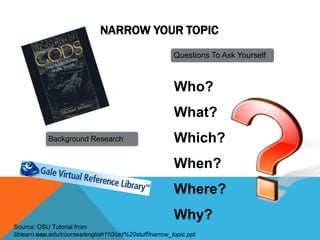
NARROW YOUR TOPIC
                                                        Questions To Ask Yourself


                                                        Who?
                                                        What?
            Background Research                         Which?
                                                        When?
                                                        Where?
                                                        Why?
Source: OSU Tutorial from
liblearn.osu.edu/courses/english110/old%20stuff/narrow_topic.ppt
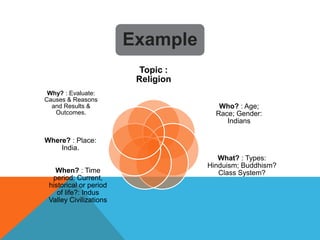
Example
                          Topic :
                         Religion
 Why? : Evaluate:
Causes & Reasons
  and Results &                        Who? : Age;
   Outcomes.                          Race; Gender:
                                         Indians

Where? : Place:
    India.
                                       What? : Types:
                                    Hinduism; Buddhism?
   When? : Time                        Class System?
  period: Current,
 historical or period
    of life?: Indus
 Valley Civilizations
Research Question

Mix and Match two elements together and form a research
question and form a topic of your choice.
New Topic: The Influence of Caste System on Hinduism.

Read the requirements of the assignment: How many
pages? How many sources are required? What kind of
sources are required?


What are the search terms and related terms that you
would use? For example: Brahmins, Shudras, Hindus etc.
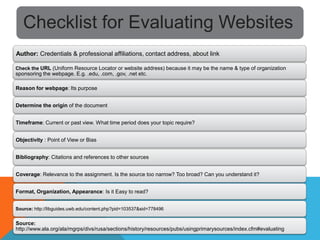
Checklist for Evaluating Websites
Author: Credentials & professional affiliations, contact address, about link

Check the URL (Uniform Resource Locator or website address) because it may be the name & type of organization
sponsoring the webpage. E.g. .edu, .com, .gov, .net etc.

Reason for webpage: Its purpose


Determine the origin of the document


Timeframe: Current or past view. What time period does your topic require?


Objectivity : Point of View or Bias


Bibliography: Citations and references to other sources


Coverage: Relevance to the assignment. Is the source too narrow? Too broad? Can you understand it?


Format, Organization, Appearance: Is it Easy to read?


Source: http://libguides.uwb.edu/content.php?pid=103537&sid=778496


Source:
http://www.ala.org/ala/mgrps/divs/rusa/sections/history/resources/pubs/usingprimarysources/index.cfm#evaluating
START RESEARCH FROM THE LIBRARY
                HOMEPAGE


FIND BOOKS


FIND JOURNAL,
MAGAZINE, AND
 NEWSPAPER
   ARTICLES
DATABASES TO EXPLORE


• Gale Virtual Reference Library

• Proquest

• EBSCO

• Gale Trial Database (Through Access Rio)

• ARTstor Digital Library (For images) (Set up
  an account on campus first)
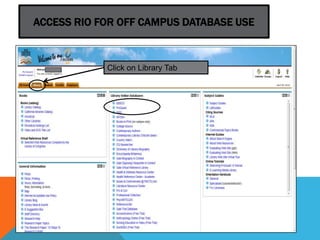
ACCESS RIO FOR OFF CAMPUS DATABASE USE


            Click on Library Tab
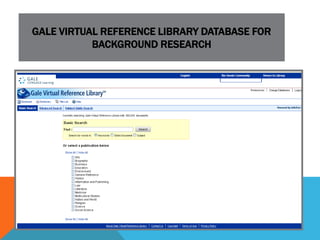
GALE VIRTUAL REFERENCE LIBRARY DATABASE FOR
           BACKGROUND RESEARCH
TWO SEARCH TOOLS TO FIND GOOD
                 SOURCES

                                  PROQUEST
                              RESEARCH LIBRARY
                               (Journal Articles)


LIBRARY CATALOG
     (Books)
EBSCO: For Articles

Through Online Databases link on http://library.riohondo.edu/
For Home Access: Login Access Rio, click on library tab and click
on EBSCO in the middle column.
WHERE TO SEARCH

For Books: Library Catalog http://library.riohondo.edu/
For Scholarly Articles: Databases: Proquest, EBSCO, Gale Reference Library, Gale Trial Database (Through
     Access Rio)
 Off Campus Users: Access Rio
For Controversial Topics: Gale Opposing Viewpoints In Context, Issues and Controversies, SIRS
Check out Controversial Topics Books Link on the library homepage http://library.riohondo.edu/
For Current Issues: CQ Researcher, EBSCO, Proquest, Gale Opposing Viewpoints, Issues and Controversies
For Biographies: Gale Biography in Context
For Historical Books : Google Books at http://books.google.com/
For Historical Newspapers: Google News Archives Search at http://news.google.com/archivesearch
For Statistics Data & Charts: Social Science Database
For Population Stats: US Census Bureau database
Legitimate sources: Google Books, Google Scholar
For Periodical Holdings List: Access from our library homepage. Direct url at
     http://library.riohondo.edu/Research_Help/Periodical%20Holdings%20List%20-%202010-2011.pdf
     (Check out the listings by subject in the end).
CITATION HELP

In the Library:

•Books: MLA Handbook for Writers of Research Papers
•Handouts: Available at the reference desk & on the
Libguide for the class.

Online:
•Son of Citation Machine
 http://citationmachine.net/
•Easy Bib
 http://www.easybib.com/

IMP: Always double check your citations with the
handbook or the handouts given to you in the
library. DONOT rely on online citation
generators for correct and accurate citations.

Research Sources & Techniques

  • 2.
    RESEARCH SOURCES ENCYCLOPEDIAS SEARCH TOOL: Provide short entries/articles for an LIBRARY CATALOG overview of the topic and its main ideas . SEARCH TOOL: PERIODICAL BOOKS DATABASE Give more information for an in-depth exploration of one or more aspects of the topic. (Example: Case study books, textbooks) JOURNAL ARTICLES Lengthy scholarly research studies on an extremely focused aspect of a subject.
  • 3.
    RESEARCH SOURCES NEWSPAPER ARTICLES Verybrief news reports that focus on SEARCH TOOL: current events or topics currently in the PERIODICAL news. DATABASE MAGAZINE ARTICLES As short as encyclopedia articles, but instead of an overview, magazines narrow the focus to one or two specific aspects of a topic.
  • 4.
    TYPES OF RESOURCES ScholarlySources  It has abstract in the beginning  It may have a list of keyword  Article has a research problem  Mentions studies that have addressed the problem in the past  Has a purpose statement  Has research question and hypothesis  Uses qualitative, quantitative or mixed method approach to conduct research  Has a conclusion at the end  Has a bibliography or reference list at the end Popular Sources: Magazine articles like Style, Newsweek, Time etc. Newspaper sources: LA Times, Whittier Daily News etc. Primary Sources: Original writings created at the time when the event occurred. Secondary Sources: Sources that evaluate, summarize, analyze written by experts from that field after the event has occurred. Source: http://www.ala.org/ala/mgrps/divs/rusa/sections/history/resources/pu bs/usingprimarysources/index.cfm
  • 5.
    MAGAZINES VS. SCHOLARLYJOURNALS Magazines Scholarly Journals Audience: Experts in the field, students Audience: Large group of people Lengthy, technical language Brief, non-technical language Author are experts in the field & credentials are always listed Author is journalist or freelance writer Peer-reviewed Look: Graphics, images, Look: Graphs, charts, statistical advertising data, plain cover No references References at the end Examples: Cosmopolitan, Examples: Child Development, Newsweek, Sports Social Science Quarterly, Illustrated etc. Journal of Applied Psychology etc.
  • 6.
    BACKGROUND RESEARCH Background researchis needed to understand your topic and narrow it down. Research Source: Encyclopedias like Encyclopedia of Gods : Over 2,500 Deities of the World (in the library) and eBooks like Encyclopedia Britannica and Gale Virtual Reference Library for reference books online. Check out Library Catalog for books on topics for research papers. Is the information relevant? Identify search terms Is the information from a legitimate source?
  • 7.
    NARROW YOUR TOPIC Questions To Ask Yourself Who? What? Background Research Which? When? Where? Why? Source: OSU Tutorial from liblearn.osu.edu/courses/english110/old%20stuff/narrow_topic.ppt
  • 8.
    Example Topic : Religion Why? : Evaluate: Causes & Reasons and Results & Who? : Age; Outcomes. Race; Gender: Indians Where? : Place: India. What? : Types: Hinduism; Buddhism? When? : Time Class System? period: Current, historical or period of life?: Indus Valley Civilizations
  • 9.
    Research Question Mix andMatch two elements together and form a research question and form a topic of your choice. New Topic: The Influence of Caste System on Hinduism. Read the requirements of the assignment: How many pages? How many sources are required? What kind of sources are required? What are the search terms and related terms that you would use? For example: Brahmins, Shudras, Hindus etc.
  • 10.
    Checklist for EvaluatingWebsites Author: Credentials & professional affiliations, contact address, about link Check the URL (Uniform Resource Locator or website address) because it may be the name & type of organization sponsoring the webpage. E.g. .edu, .com, .gov, .net etc. Reason for webpage: Its purpose Determine the origin of the document Timeframe: Current or past view. What time period does your topic require? Objectivity : Point of View or Bias Bibliography: Citations and references to other sources Coverage: Relevance to the assignment. Is the source too narrow? Too broad? Can you understand it? Format, Organization, Appearance: Is it Easy to read? Source: http://libguides.uwb.edu/content.php?pid=103537&sid=778496 Source: http://www.ala.org/ala/mgrps/divs/rusa/sections/history/resources/pubs/usingprimarysources/index.cfm#evaluating
  • 11.
    START RESEARCH FROMTHE LIBRARY HOMEPAGE FIND BOOKS FIND JOURNAL, MAGAZINE, AND NEWSPAPER ARTICLES
  • 12.
    DATABASES TO EXPLORE •Gale Virtual Reference Library • Proquest • EBSCO • Gale Trial Database (Through Access Rio) • ARTstor Digital Library (For images) (Set up an account on campus first)
  • 13.
    ACCESS RIO FOROFF CAMPUS DATABASE USE Click on Library Tab
  • 14.
    GALE VIRTUAL REFERENCELIBRARY DATABASE FOR BACKGROUND RESEARCH
  • 15.
    TWO SEARCH TOOLSTO FIND GOOD SOURCES PROQUEST RESEARCH LIBRARY (Journal Articles) LIBRARY CATALOG (Books)
  • 16.
    EBSCO: For Articles ThroughOnline Databases link on http://library.riohondo.edu/ For Home Access: Login Access Rio, click on library tab and click on EBSCO in the middle column.
  • 17.
    WHERE TO SEARCH ForBooks: Library Catalog http://library.riohondo.edu/ For Scholarly Articles: Databases: Proquest, EBSCO, Gale Reference Library, Gale Trial Database (Through Access Rio)  Off Campus Users: Access Rio For Controversial Topics: Gale Opposing Viewpoints In Context, Issues and Controversies, SIRS Check out Controversial Topics Books Link on the library homepage http://library.riohondo.edu/ For Current Issues: CQ Researcher, EBSCO, Proquest, Gale Opposing Viewpoints, Issues and Controversies For Biographies: Gale Biography in Context For Historical Books : Google Books at http://books.google.com/ For Historical Newspapers: Google News Archives Search at http://news.google.com/archivesearch For Statistics Data & Charts: Social Science Database For Population Stats: US Census Bureau database Legitimate sources: Google Books, Google Scholar For Periodical Holdings List: Access from our library homepage. Direct url at http://library.riohondo.edu/Research_Help/Periodical%20Holdings%20List%20-%202010-2011.pdf (Check out the listings by subject in the end).
  • 18.
    CITATION HELP In theLibrary: •Books: MLA Handbook for Writers of Research Papers •Handouts: Available at the reference desk & on the Libguide for the class. Online: •Son of Citation Machine http://citationmachine.net/ •Easy Bib http://www.easybib.com/ IMP: Always double check your citations with the handbook or the handouts given to you in the library. DONOT rely on online citation generators for correct and accurate citations.