FINANCIAL MANAGEMENT
IN LIBRARIES
Presented by:
MICHAEL A. PINTO, MPA
Librarian IV/Head
Cagayan Provincial Learning and Resource Center
PAARL Seminar on Managing Today’s Learning
Commons: Re-Skilling Seminar for Information
Professionals
September 20-22, 2016
Baguio City
Managing a budget and handling basic
financial literacy can be daunting and
overwhelming, but the ability to do so is
crucial for librarians
ALA
WHAT IS FINANCIAL MANAGEMENT?
- means planning, organizing, directing and
controlling the financial activities such as
procurement and utilization of funds of the
enterprise.
- It means applying general management
principles to financial resources of the
enterprise.
- Management Study Guide
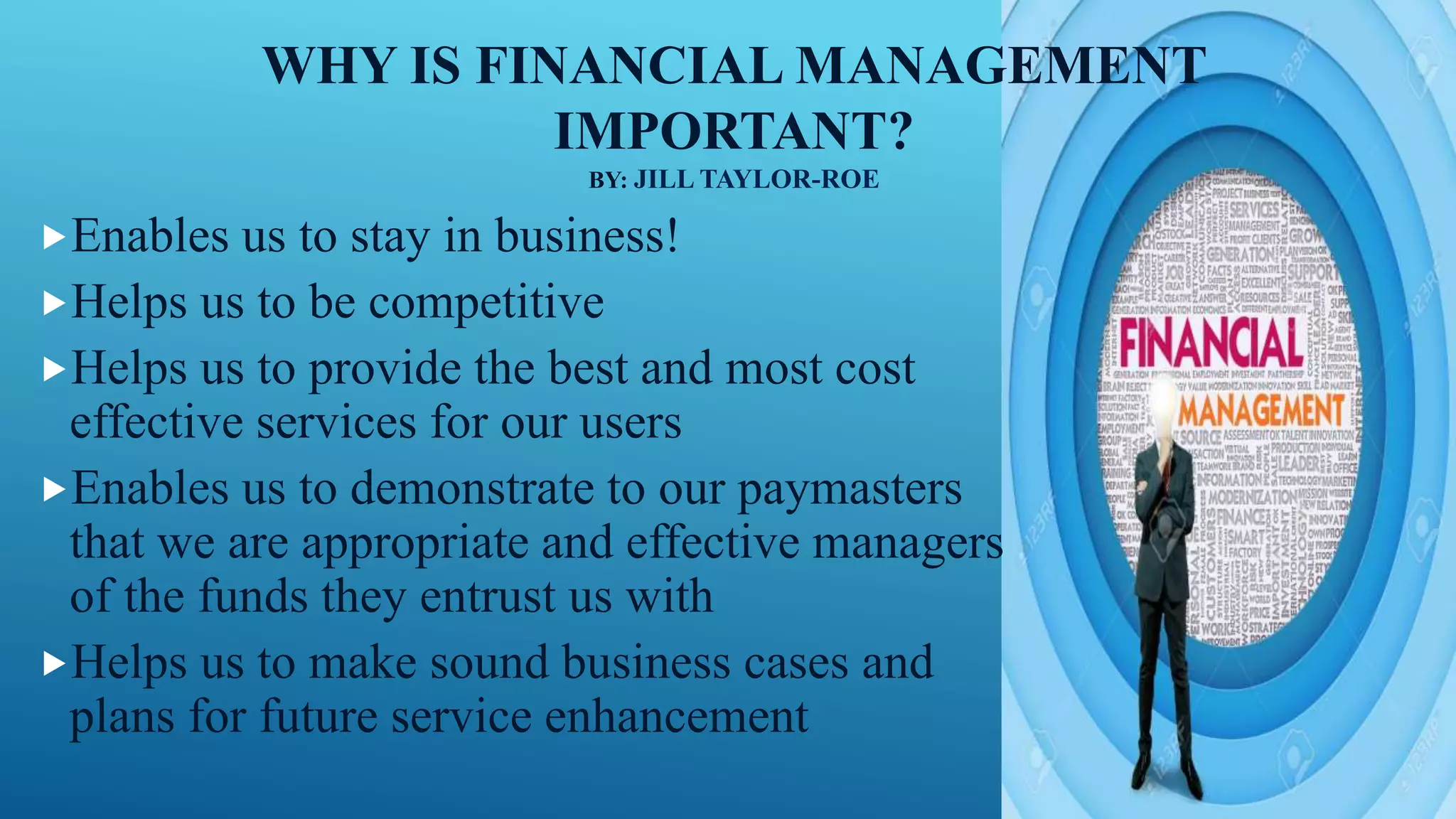
WHY IS FINANCIAL MANAGEMENT
IMPORTANT?
BY: JILL TAYLOR-ROE
Enables us to stay in business!
Helps us to be competitive
Helps us to provide the best and most cost
effective services for our users
Enables us to demonstrate to our paymasters
that we are appropriate and effective managers
of the funds they entrust us with
Helps us to make sound business cases and
plans for future service enhancement
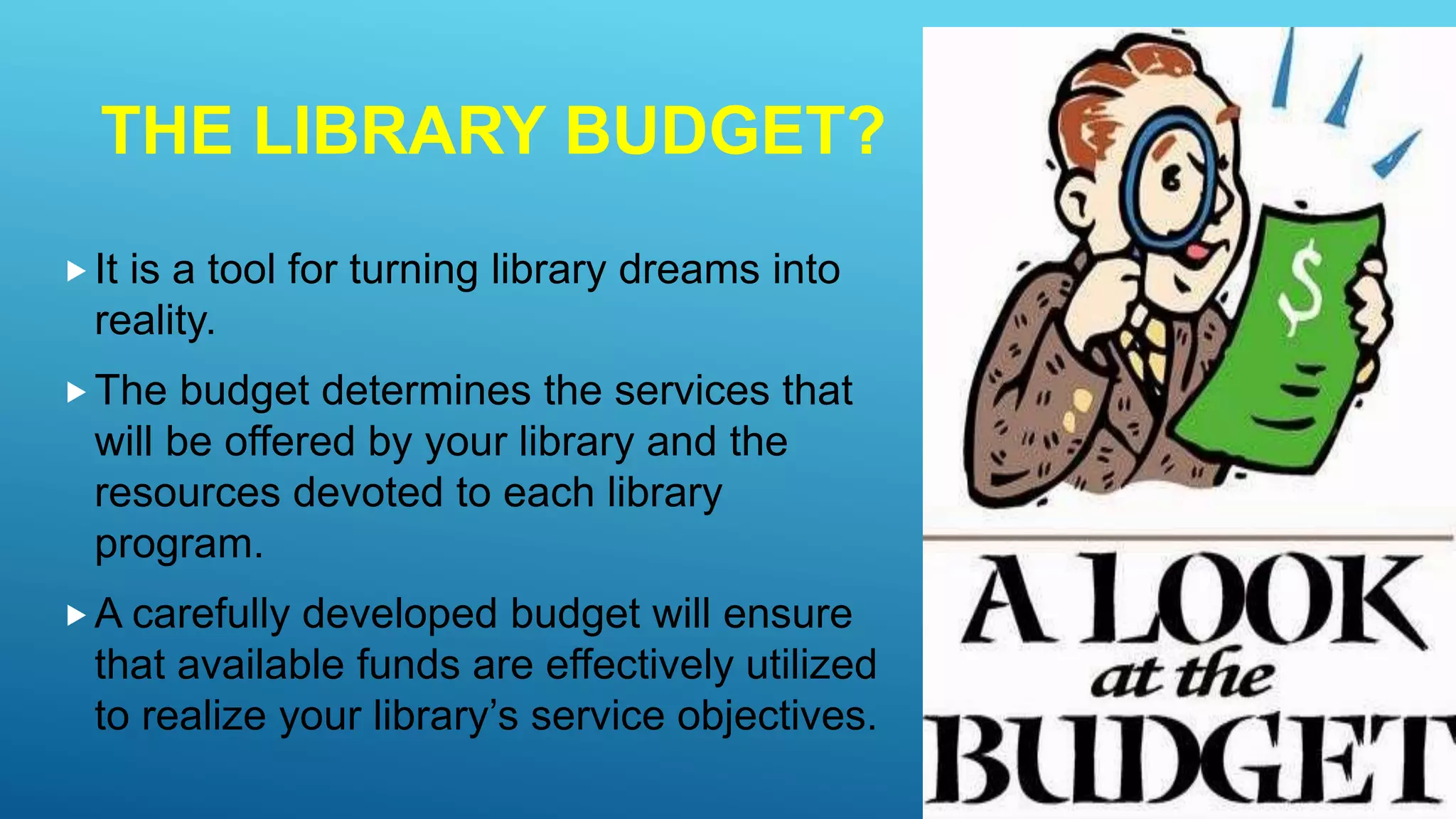
THE LIBRARY BUDGET?
It is a tool for turning library dreams into
reality.
The budget determines the services that
will be offered by your library and the
resources devoted to each library
program.
A carefully developed budget will ensure
that available funds are effectively utilized
to realize your library’s service objectives.
IMPORTANCE OF BUDGET
Sets planning parameters for the administration
Justifies the allocation of funds
Provides accountability from item of expenditures
Links achievement of student outcomes to
resources input
Identifies priorities of the library
Develops awareness of the financial requirements
of the library
SOURCES OF BUDGET
Library Fees
Share from the institutions’ budget
Library Fines
Donations
Book Fairs
Fund raising activities
Taxes (public libraries)
Gifts
Contributions
SCOPE OF THE BUDGET
1. Collection development
Books is ____% of the budget
Periodicals is ___ % of the budget
Audio-visuals is ___% of the budget
Online and E-resource subscription is ___% of
the budget
SCOPE OF THE BUDGET
2. Building/furniture/equipment maintenance
- New Furniture/fixtures
-New Equipment (i.e. computers)
- Repair and maintenance of the building
- Repair and maintenance of furniture
SCOPE OF THE BUDGET
3. Growth in priority areas
- recommendations during accreditations
- priority programs of the institutions (e-services)
- Weak areas in the collection
- Staff requirements
SCOPE OF THE BUDGET
4. Administration costs of the library
- lighting and ventilation
- electricity and water consumption
- additional staff benefits
- supplies and other materials
SCOPE OF THE BUDGET
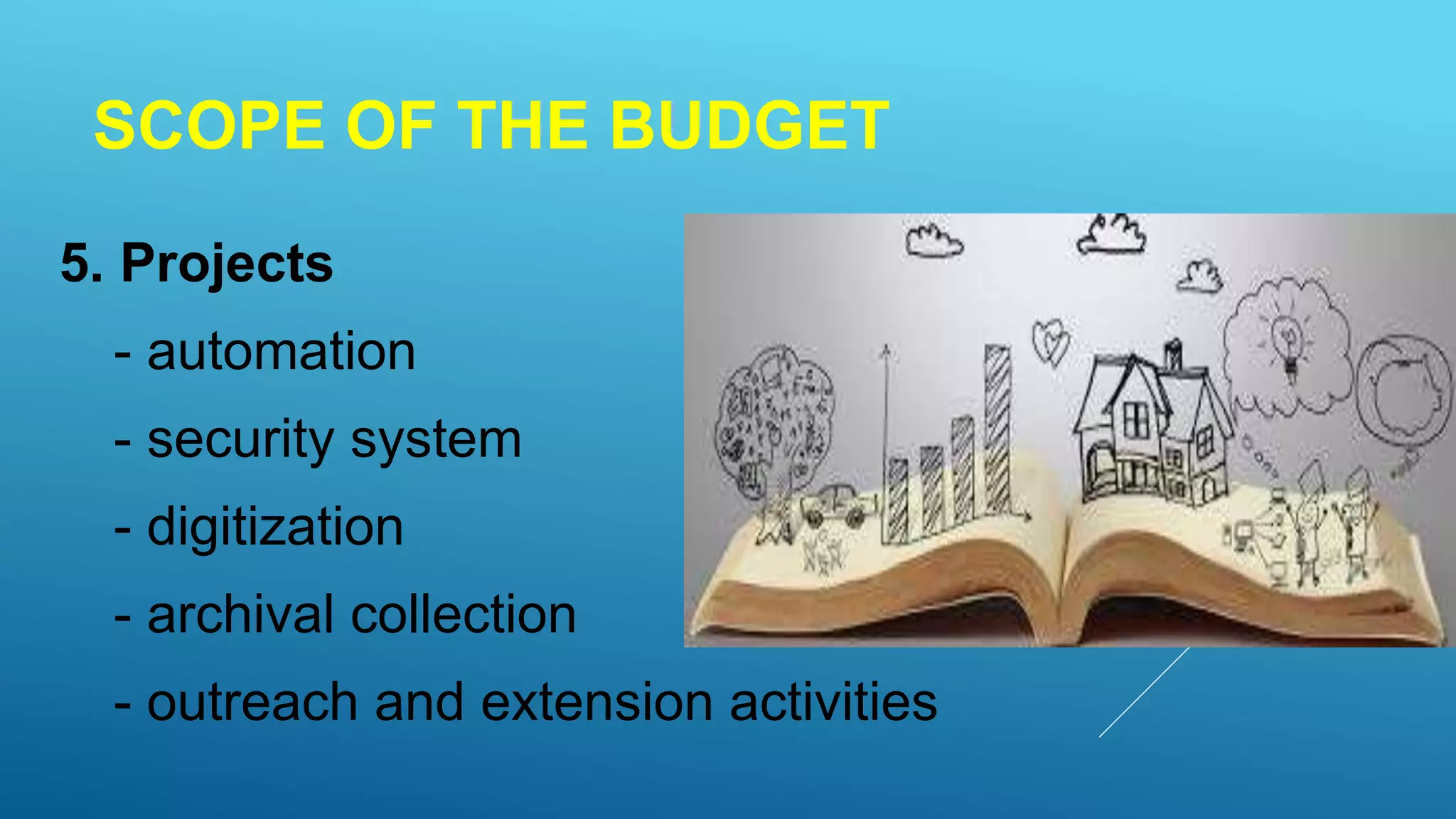
5. Projects
- automation
- security system
- digitization
- archival collection
- outreach and extension activities
SCOPE OF THE BUDGET
6. Licenses or subscription
- Renewal/withdrawal of subscription
- Maintenance /Technical Support Fee
- additional subscription/licenses
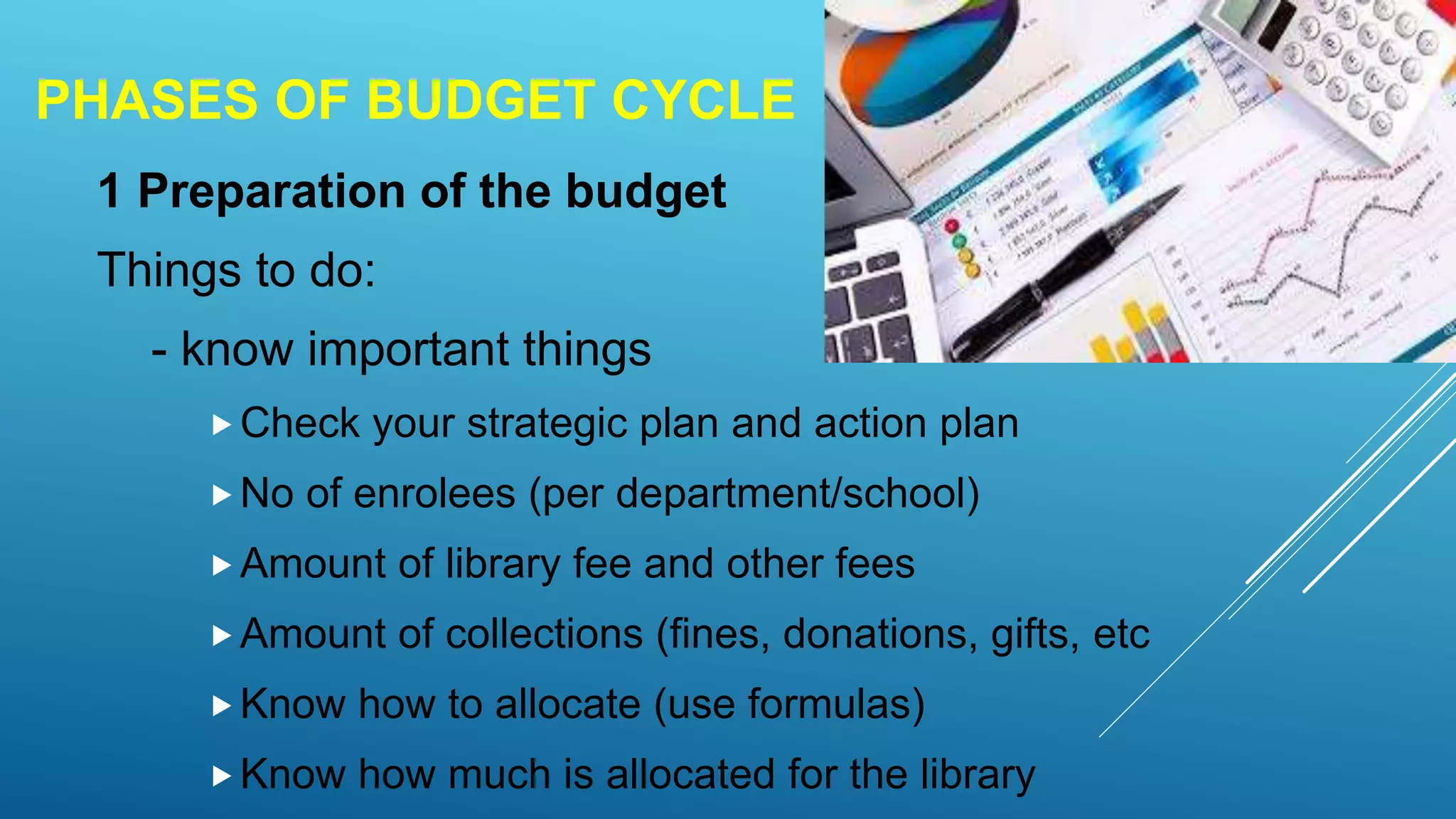
PHASES OF BUDGET CYCLE
1 Preparation of the budget
Things to do:
- know important things
Check your strategic plan and action plan
No of enrolees (per department/school)
Amount of library fee and other fees
Amount of collections (fines, donations, gifts, etc
Know how to allocate (use formulas)
Know how much is allocated for the library
PHASES OF BUDGET CYCLE
2. Presentation to the funding
authorities, with full justification
linking inputs (financial) with
outputs (results)
Justification – convincing the
funding authority that a certain
development makes sense and that
it should be supported
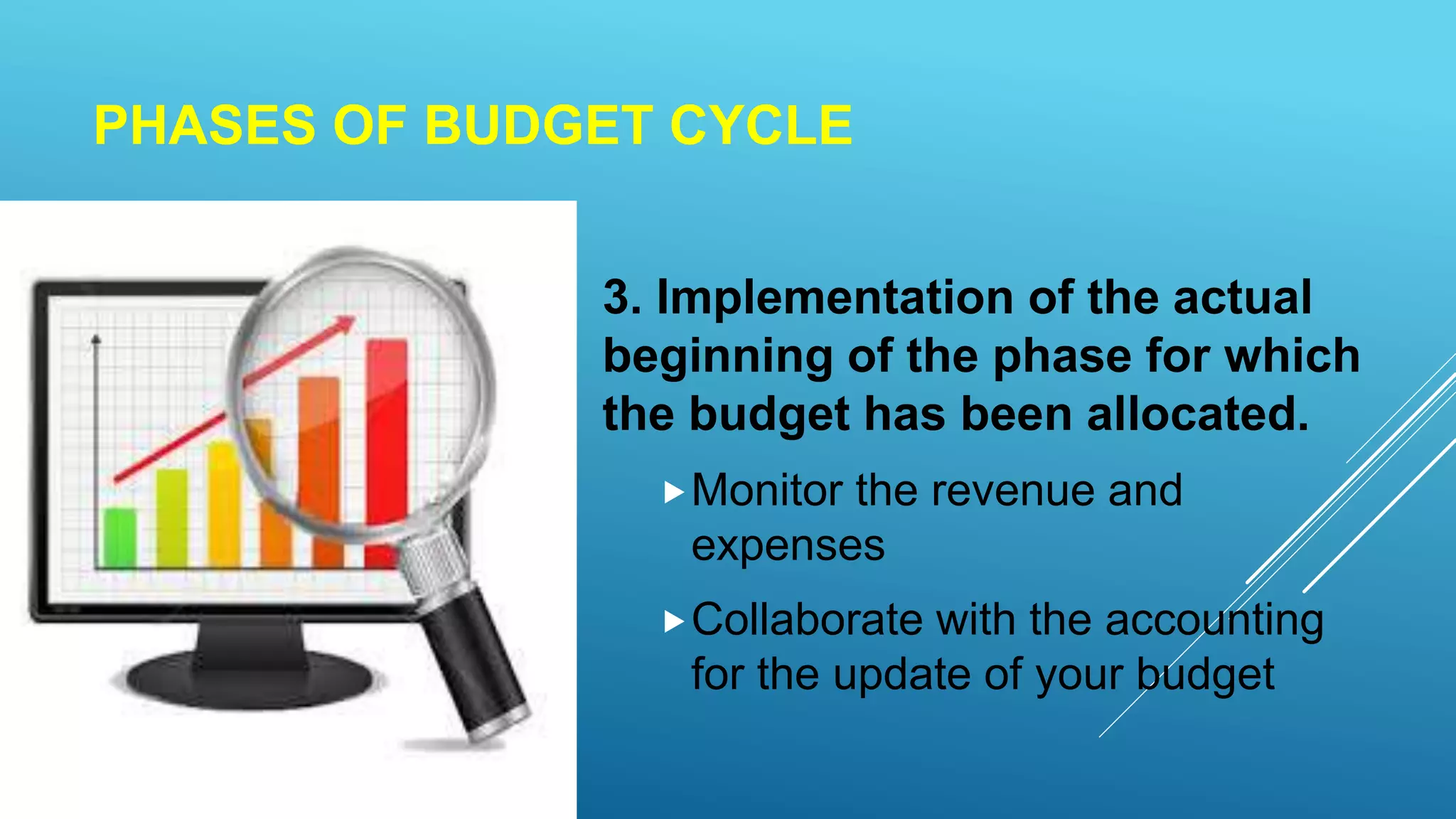
PHASES OF BUDGET CYCLE
3. Implementation of the actual
beginning of the phase for which
the budget has been allocated.
Monitor the revenue and
expenses
Collaborate with the accounting
for the update of your budget
SAMPLE BUDGET COMPUTATION
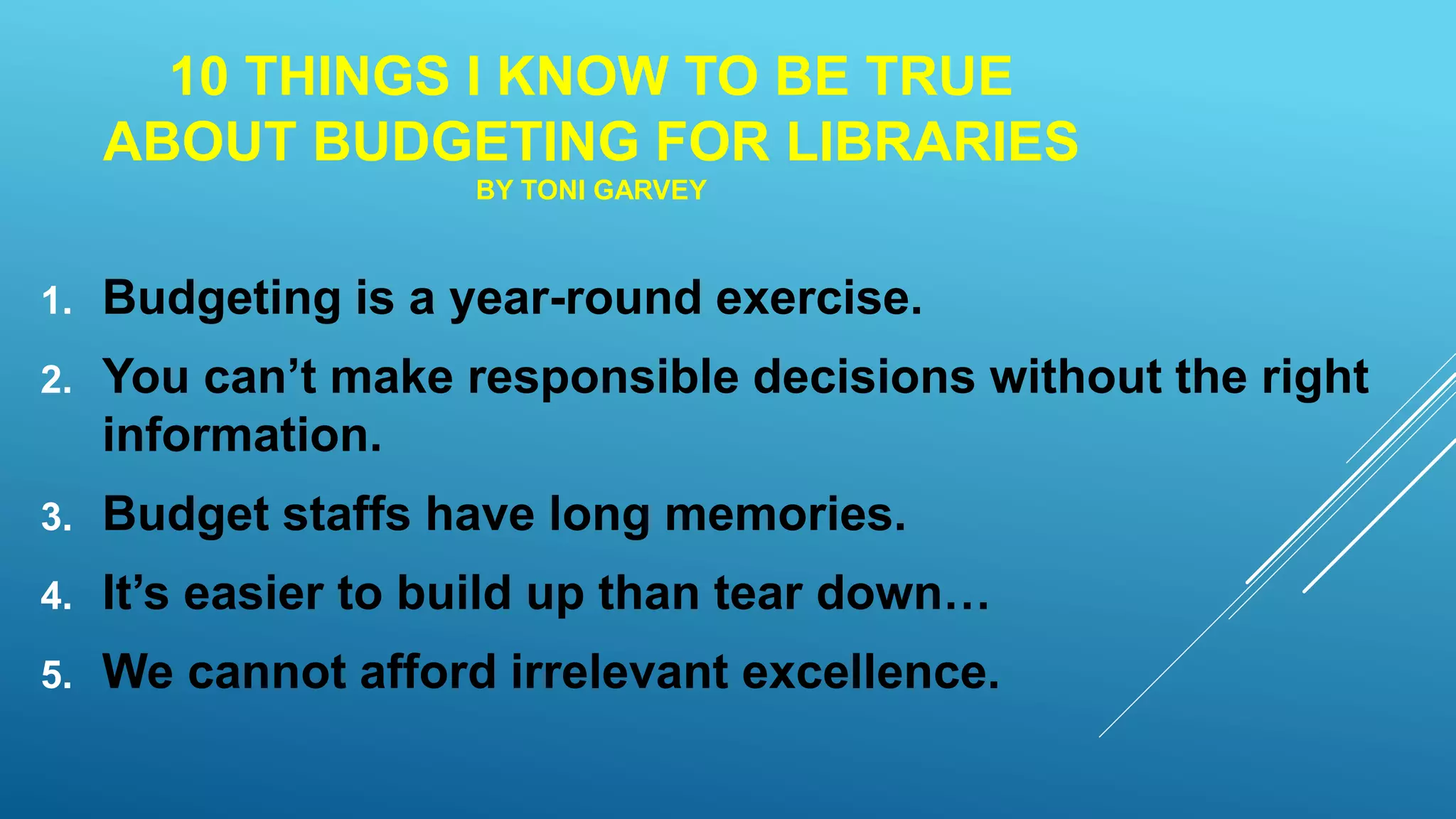
10 THINGS I KNOW TO BE TRUE
ABOUT BUDGETING FOR LIBRARIES
BY TONI GARVEY
1. Budgeting is a year-round exercise.
2. You can’t make responsible decisions without the right
information.
3. Budget staffs have long memories.
4. It’s easier to build up than tear down…
5. We cannot afford irrelevant excellence.
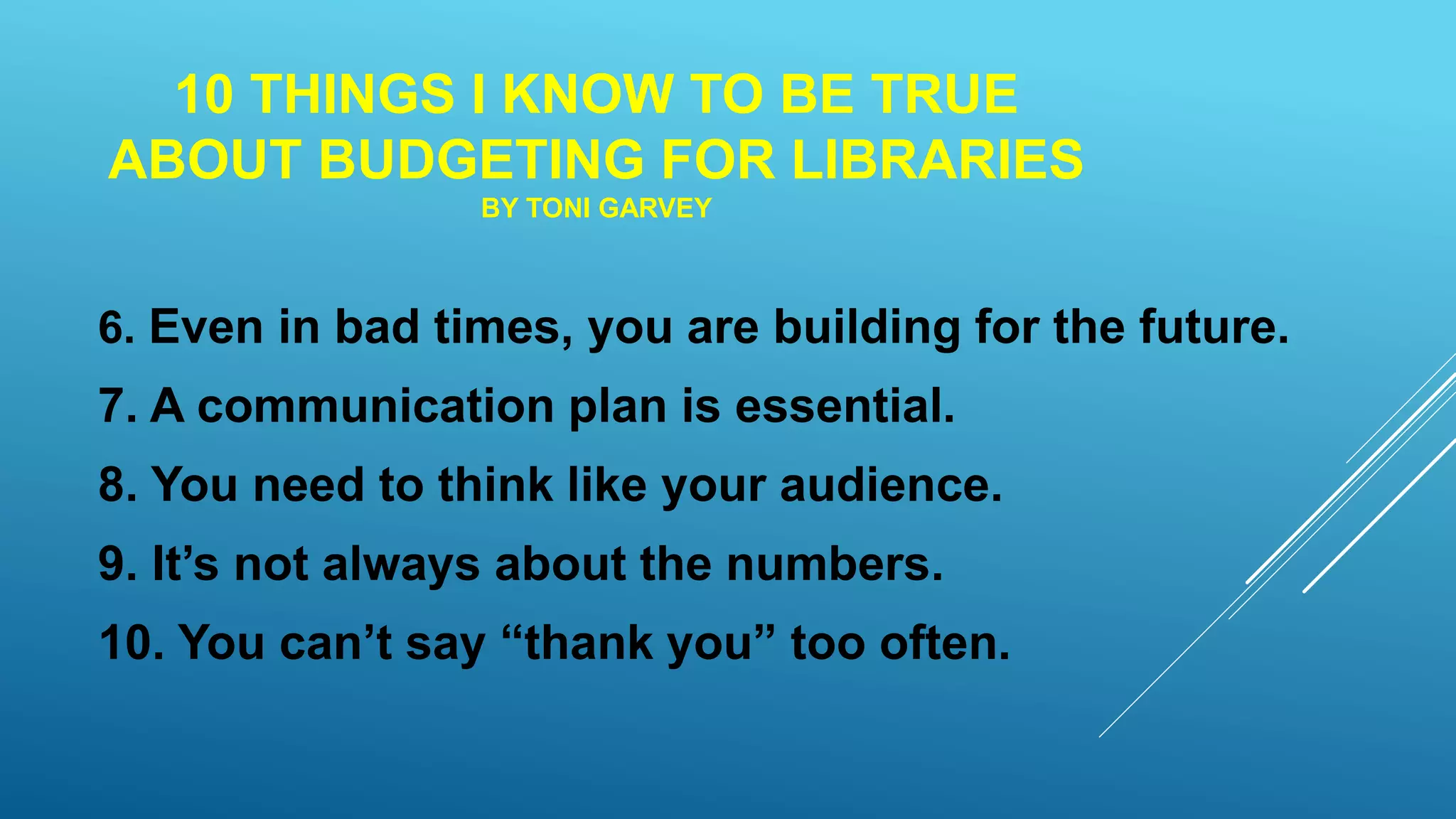
10 THINGS I KNOW TO BE TRUE
ABOUT BUDGETING FOR LIBRARIES
BY TONI GARVEY
6. Even in bad times, you are building for the future.
7. A communication plan is essential.
8. You need to think like your audience.
9. It’s not always about the numbers.
10. You can’t say “thank you” too often.
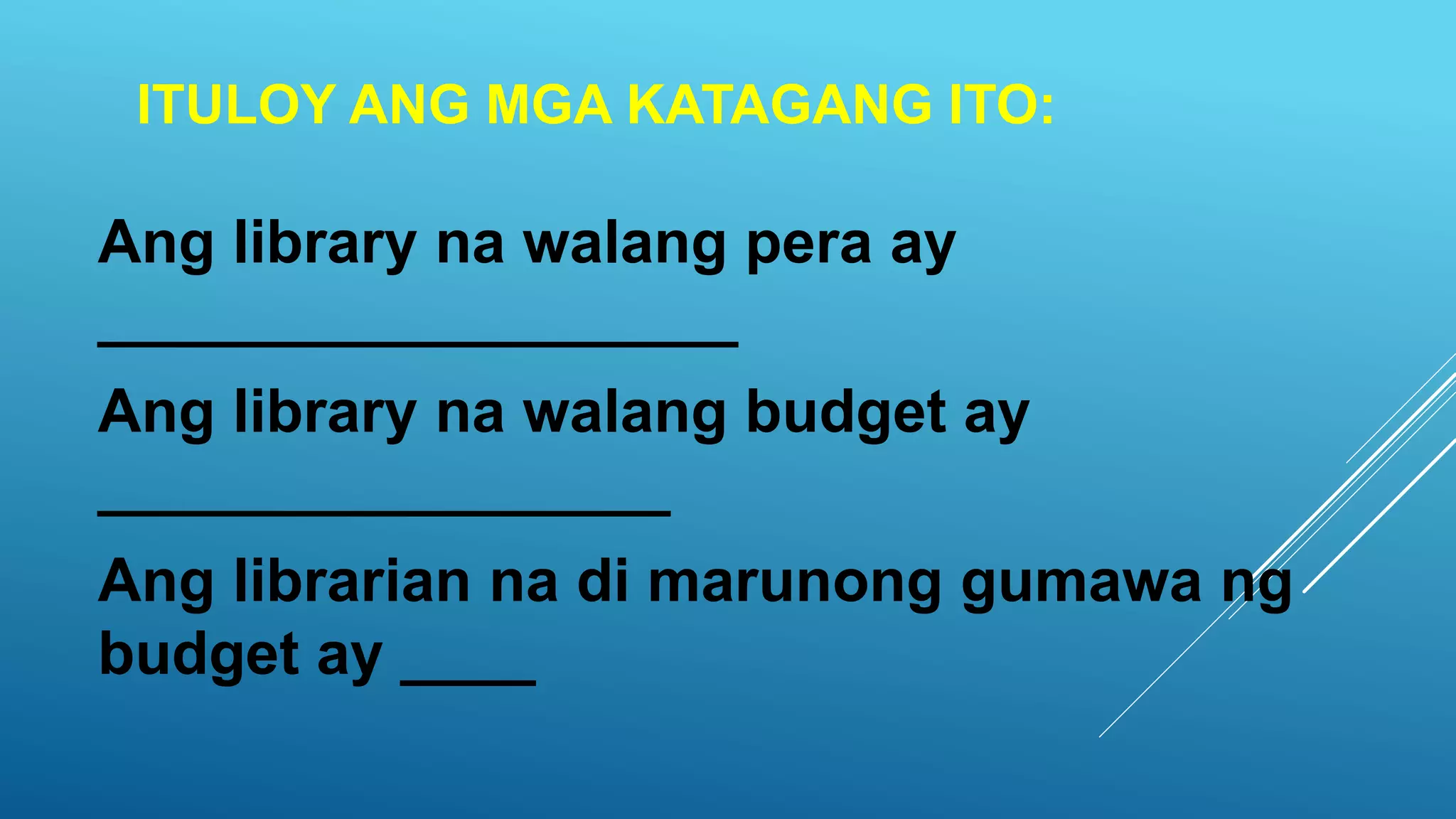
ITULOY ANG MGA KATAGANG ITO:
Ang library na walang pera ay
___________________
Ang library na walang budget ay
_________________
Ang librarian na di marunong gumawa ng
budget ay ____
THANK YOU
FOR
LISTENING!!
WORKSHOP
REFERENCES:
 www.uksg.org/sites/uksg.org/files/PresentationTaylor-Roe.ppt
 https://www.webjunction.org/documents/webjunction/Developing_the_Li
brary_Budget.html
 http://www.managementstudyguide.com/financial-management.htm
 http://www.ala.org/advocacy/advleg/advocacyuniversity/budgetpresenta
tion/preparing/tenthings

Financial Management in Libraries

  • 1.
    FINANCIAL MANAGEMENT IN LIBRARIES Presentedby: MICHAEL A. PINTO, MPA Librarian IV/Head Cagayan Provincial Learning and Resource Center PAARL Seminar on Managing Today’s Learning Commons: Re-Skilling Seminar for Information Professionals September 20-22, 2016 Baguio City
  • 2.
    Managing a budgetand handling basic financial literacy can be daunting and overwhelming, but the ability to do so is crucial for librarians ALA
  • 3.
    WHAT IS FINANCIALMANAGEMENT? - means planning, organizing, directing and controlling the financial activities such as procurement and utilization of funds of the enterprise. - It means applying general management principles to financial resources of the enterprise. - Management Study Guide
  • 4.
    WHY IS FINANCIALMANAGEMENT IMPORTANT? BY: JILL TAYLOR-ROE Enables us to stay in business! Helps us to be competitive Helps us to provide the best and most cost effective services for our users Enables us to demonstrate to our paymasters that we are appropriate and effective managers of the funds they entrust us with Helps us to make sound business cases and plans for future service enhancement
  • 5.
    THE LIBRARY BUDGET? Itis a tool for turning library dreams into reality. The budget determines the services that will be offered by your library and the resources devoted to each library program. A carefully developed budget will ensure that available funds are effectively utilized to realize your library’s service objectives.
  • 6.
    IMPORTANCE OF BUDGET Setsplanning parameters for the administration Justifies the allocation of funds Provides accountability from item of expenditures Links achievement of student outcomes to resources input Identifies priorities of the library Develops awareness of the financial requirements of the library
  • 7.
    SOURCES OF BUDGET LibraryFees Share from the institutions’ budget Library Fines Donations Book Fairs Fund raising activities Taxes (public libraries) Gifts Contributions
  • 8.
    SCOPE OF THEBUDGET 1. Collection development Books is ____% of the budget Periodicals is ___ % of the budget Audio-visuals is ___% of the budget Online and E-resource subscription is ___% of the budget
  • 9.
    SCOPE OF THEBUDGET 2. Building/furniture/equipment maintenance - New Furniture/fixtures -New Equipment (i.e. computers) - Repair and maintenance of the building - Repair and maintenance of furniture
  • 10.
    SCOPE OF THEBUDGET 3. Growth in priority areas - recommendations during accreditations - priority programs of the institutions (e-services) - Weak areas in the collection - Staff requirements
  • 11.
    SCOPE OF THEBUDGET 4. Administration costs of the library - lighting and ventilation - electricity and water consumption - additional staff benefits - supplies and other materials
  • 12.
    SCOPE OF THEBUDGET 5. Projects - automation - security system - digitization - archival collection - outreach and extension activities
  • 13.
    SCOPE OF THEBUDGET 6. Licenses or subscription - Renewal/withdrawal of subscription - Maintenance /Technical Support Fee - additional subscription/licenses
  • 14.
    PHASES OF BUDGETCYCLE 1 Preparation of the budget Things to do: - know important things Check your strategic plan and action plan No of enrolees (per department/school) Amount of library fee and other fees Amount of collections (fines, donations, gifts, etc Know how to allocate (use formulas) Know how much is allocated for the library
  • 15.
    PHASES OF BUDGETCYCLE 2. Presentation to the funding authorities, with full justification linking inputs (financial) with outputs (results) Justification – convincing the funding authority that a certain development makes sense and that it should be supported
  • 16.
    PHASES OF BUDGETCYCLE 3. Implementation of the actual beginning of the phase for which the budget has been allocated. Monitor the revenue and expenses Collaborate with the accounting for the update of your budget
  • 17.
  • 18.
    10 THINGS IKNOW TO BE TRUE ABOUT BUDGETING FOR LIBRARIES BY TONI GARVEY 1. Budgeting is a year-round exercise. 2. You can’t make responsible decisions without the right information. 3. Budget staffs have long memories. 4. It’s easier to build up than tear down… 5. We cannot afford irrelevant excellence.
  • 19.
    10 THINGS IKNOW TO BE TRUE ABOUT BUDGETING FOR LIBRARIES BY TONI GARVEY 6. Even in bad times, you are building for the future. 7. A communication plan is essential. 8. You need to think like your audience. 9. It’s not always about the numbers. 10. You can’t say “thank you” too often.
  • 20.
    ITULOY ANG MGAKATAGANG ITO: Ang library na walang pera ay ___________________ Ang library na walang budget ay _________________ Ang librarian na di marunong gumawa ng budget ay ____
  • 21.
  • 22.
  • 23.
    REFERENCES:  www.uksg.org/sites/uksg.org/files/PresentationTaylor-Roe.ppt  https://www.webjunction.org/documents/webjunction/Developing_the_Li brary_Budget.html http://www.managementstudyguide.com/financial-management.htm  http://www.ala.org/advocacy/advleg/advocacyuniversity/budgetpresenta tion/preparing/tenthings