Simplified DES:
• A teaching tool
• Designed by Prof. Edward Schaeter,
Santa Clara University, 1996
Given:
plaintext 8-bit, Key 10-bit
Output:
ciphertext 8-bit
Simplified DES
 SDES ‘s five steps:
 IP - an initial permutation
 fk - a complex, 2-input function
 SW - switches the left half and the right
half of a data string
 fk - a complex, 2-input function; again
 IP-1 - inverse permutation of the initial
permutation
SDES may be said to have two ROUNDS of the
function fk.
3
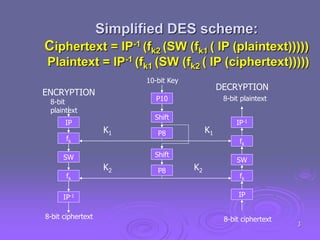
Simplified DES scheme:
Ciphertext = IP-1 (fk2 (SW (fk1 ( IP (plaintext)))))
Plaintext = IP-1 (fk1 (SW (fk2 ( IP (ciphertext)))))
SW
IP
fk
fk
Shift
P8
Shift
P10
P8
IP
fk
SW
fk
IP-1
ENCRYPTION
8-bit
plaintext
10-bit Key
DECRYPTION
8-bit plaintext
8-bit ciphertext 8-bit ciphertext
IP-1
K1 K1
K2 K2
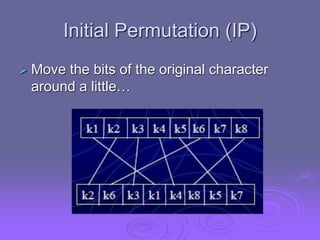
Initial Permutation (IP)
 Move the bits of the original character
around a little…
Inverse Permutation (IP-1)
1 2 3 4 5 6 7 8
4 1 3 5 7 2 8 6
1 2 3 4 5 6 7 8
2 6 3 1 4 8 5 7
4 1 3 5 7 2 8 6
IP-1(IP(X))=X
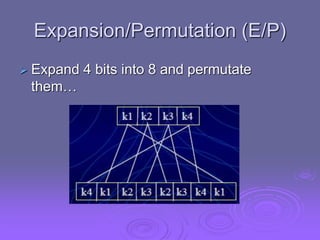
Expansion/Permutation (E/P)
 Expand 4 bits into 8 and permutate
them…
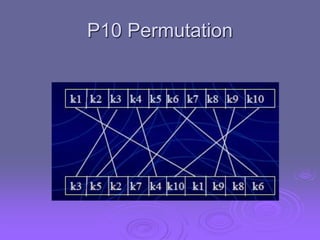
P10 Permutation
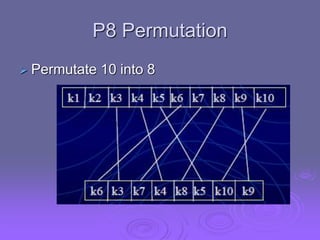
P8 Permutation
 Permutate 10 into 8
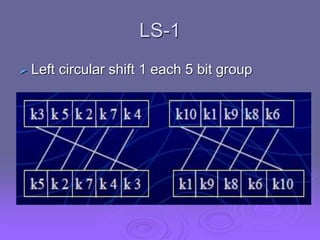
LS-1
 Left circular shift 1 each 5 bit group
LS-2
 Left circular shift 2 each 5 bit group
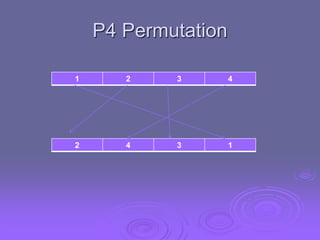
P4 Permutation
1 2 3 4
2 4 3 1
12
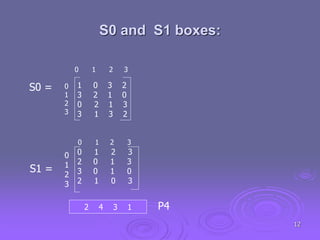
S0 and S1 boxes:
1 0 3 2
3 2 1 0
0 2 1 3
3 1 3 2
0
1
2
3
0 1 2 3
S0 =
0 1 2 3
2 0 1 3
3 0 1 0
2 1 0 3
0 1 2 3
0
1
2
3
2 4 3 1 P4
S1 =
13
Key generation for simplified DES:
K1 = P8 ( Shift (P10 (Key)))
K2 = P8 ( Shift ( Shift (P10 (Key))))
P10
LS-1 LS-1
P8
LS-2
P8
LS-2
K1
K2
5
5
5 5
8
5 5
5 5
1 10
10 bit key
3 5 2 7 4 10 1 9 8 6
6 3 7 4 8 5 10 9
Circular left shift by 1, separately on
the left and the right halves
Circular left shift by 2 , separately on
the left and the right halves
8
6 3 7 4 8 5 10 9
P10
P8
P8
14
SDES (continued)
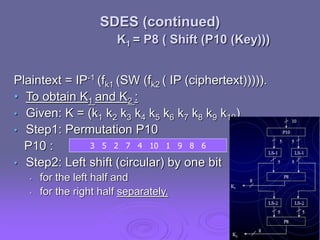
K1 = P8 ( Shift (P10 (Key)))
Plaintext = IP-1 (fk1 (SW (fk2 ( IP (ciphertext))))).
• To obtain K1 and K2 :
• Given: K = (k1 k2 k3 k4 k5 k6 k7 k8 k9 k10)
• Step1: Permutation P10
P10 :
• Step2: Left shift (circular) by one bit
• for the left half and
• for the right half separately.
3 5 2 7 4 10 1 9 8 6
15
To obtain K1 and K2
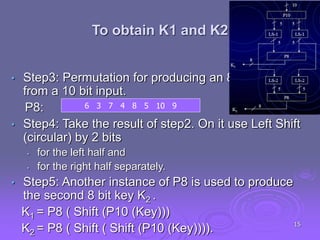
• Step3: Permutation for producing an 8 bit key K1
from a 10 bit input.
P8:
• Step4: Take the result of step2. On it use Left Shift
(circular) by 2 bits
• for the left half and
• for the right half separately.
• Step5: Another instance of P8 is used to produce
the second 8 bit key K2 .
K1 = P8 ( Shift (P10 (Key)))
K2 = P8 ( Shift ( Shift (P10 (Key)))).
6 3 7 4 8 5 10 9
Simplified DES Encryption
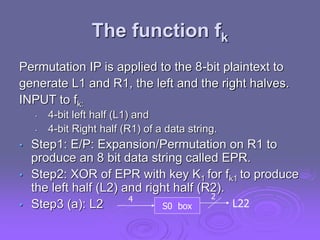
The function fk
Permutation IP is applied to the 8-bit plaintext to
generate L1 and R1, the left and the right halves.
INPUT to fk:
• 4-bit left half (L1) and
• 4-bit Right half (R1) of a data string.
• Step1: E/P: Expansion/Permutation on R1 to
produce an 8 bit data string called EPR.
• Step2: XOR of EPR with key K1 for fk1 to produce
the left half (L2) and right half (R2).
• Step3 (a): L2 S0 box L22
4 2
18
The function fk (continued):
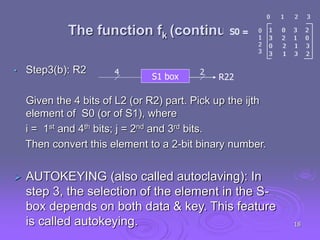
• Step3(b): R2
Given the 4 bits of L2 (or R2) part. Pick up the ijth
element of S0 (or of S1), where
i = 1st and 4th bits; j = 2nd and 3rd bits.
Then convert this element to a 2-bit binary number.
 AUTOKEYING (also called autoclaving): In
step 3, the selection of the element in the S-
box depends on both data & key. This feature
is called autokeying.
S1 box R22
4 2
19
The function fk (continued)
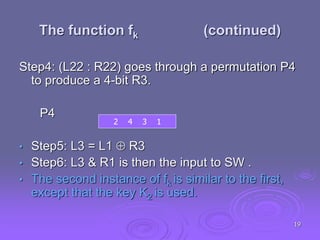
Step4: (L22 : R22) goes through a permutation P4
to produce a 4-bit R3.
P4
• Step5: L3 = L1  R3
• Step6: L3 & R1 is then the input to SW .
• The second instance of fk is similar to the first,
except that the key K2 is used.
2 4 3 1
Switch function (SW)
 Interchange the left and right 4 bits
 So, second instances of fk operates on
different 4 bits with different key K2

S-DES.ppt

  • 1.
    Simplified DES: • Ateaching tool • Designed by Prof. Edward Schaeter, Santa Clara University, 1996 Given: plaintext 8-bit, Key 10-bit Output: ciphertext 8-bit
  • 2.
    Simplified DES  SDES‘s five steps:  IP - an initial permutation  fk - a complex, 2-input function  SW - switches the left half and the right half of a data string  fk - a complex, 2-input function; again  IP-1 - inverse permutation of the initial permutation SDES may be said to have two ROUNDS of the function fk.
  • 3.
    3 Simplified DES scheme: Ciphertext= IP-1 (fk2 (SW (fk1 ( IP (plaintext))))) Plaintext = IP-1 (fk1 (SW (fk2 ( IP (ciphertext))))) SW IP fk fk Shift P8 Shift P10 P8 IP fk SW fk IP-1 ENCRYPTION 8-bit plaintext 10-bit Key DECRYPTION 8-bit plaintext 8-bit ciphertext 8-bit ciphertext IP-1 K1 K1 K2 K2
  • 4.
    Initial Permutation (IP) Move the bits of the original character around a little…
  • 5.
    Inverse Permutation (IP-1) 12 3 4 5 6 7 8 4 1 3 5 7 2 8 6 1 2 3 4 5 6 7 8 2 6 3 1 4 8 5 7 4 1 3 5 7 2 8 6 IP-1(IP(X))=X
  • 6.
    Expansion/Permutation (E/P)  Expand4 bits into 8 and permutate them…
  • 7.
  • 8.
  • 9.
    LS-1  Left circularshift 1 each 5 bit group
  • 10.
    LS-2  Left circularshift 2 each 5 bit group
  • 11.
    P4 Permutation 1 23 4 2 4 3 1
  • 12.
    12 S0 and S1boxes: 1 0 3 2 3 2 1 0 0 2 1 3 3 1 3 2 0 1 2 3 0 1 2 3 S0 = 0 1 2 3 2 0 1 3 3 0 1 0 2 1 0 3 0 1 2 3 0 1 2 3 2 4 3 1 P4 S1 =
  • 13.
    13 Key generation forsimplified DES: K1 = P8 ( Shift (P10 (Key))) K2 = P8 ( Shift ( Shift (P10 (Key)))) P10 LS-1 LS-1 P8 LS-2 P8 LS-2 K1 K2 5 5 5 5 8 5 5 5 5 1 10 10 bit key 3 5 2 7 4 10 1 9 8 6 6 3 7 4 8 5 10 9 Circular left shift by 1, separately on the left and the right halves Circular left shift by 2 , separately on the left and the right halves 8 6 3 7 4 8 5 10 9 P10 P8 P8
  • 14.
    14 SDES (continued) K1 =P8 ( Shift (P10 (Key))) Plaintext = IP-1 (fk1 (SW (fk2 ( IP (ciphertext))))). • To obtain K1 and K2 : • Given: K = (k1 k2 k3 k4 k5 k6 k7 k8 k9 k10) • Step1: Permutation P10 P10 : • Step2: Left shift (circular) by one bit • for the left half and • for the right half separately. 3 5 2 7 4 10 1 9 8 6
  • 15.
    15 To obtain K1and K2 • Step3: Permutation for producing an 8 bit key K1 from a 10 bit input. P8: • Step4: Take the result of step2. On it use Left Shift (circular) by 2 bits • for the left half and • for the right half separately. • Step5: Another instance of P8 is used to produce the second 8 bit key K2 . K1 = P8 ( Shift (P10 (Key))) K2 = P8 ( Shift ( Shift (P10 (Key)))). 6 3 7 4 8 5 10 9
  • 16.
  • 17.
    The function fk PermutationIP is applied to the 8-bit plaintext to generate L1 and R1, the left and the right halves. INPUT to fk: • 4-bit left half (L1) and • 4-bit Right half (R1) of a data string. • Step1: E/P: Expansion/Permutation on R1 to produce an 8 bit data string called EPR. • Step2: XOR of EPR with key K1 for fk1 to produce the left half (L2) and right half (R2). • Step3 (a): L2 S0 box L22 4 2
  • 18.
    18 The function fk(continued): • Step3(b): R2 Given the 4 bits of L2 (or R2) part. Pick up the ijth element of S0 (or of S1), where i = 1st and 4th bits; j = 2nd and 3rd bits. Then convert this element to a 2-bit binary number.  AUTOKEYING (also called autoclaving): In step 3, the selection of the element in the S- box depends on both data & key. This feature is called autokeying. S1 box R22 4 2
  • 19.
    19 The function fk(continued) Step4: (L22 : R22) goes through a permutation P4 to produce a 4-bit R3. P4 • Step5: L3 = L1  R3 • Step6: L3 & R1 is then the input to SW . • The second instance of fk is similar to the first, except that the key K2 is used. 2 4 3 1
  • 20.
    Switch function (SW) Interchange the left and right 4 bits  So, second instances of fk operates on different 4 bits with different key K2