 In the presence of a strong base, two
different molecules of aldehyde or ketone
combine to form a β-hydroxyaldehyde or a
β-hydroxyketone.
 This reaction is called as the aldol
condensation.
 The enolate ion (carbanion) is the actual
nucleophilic reagent.
 The reaction breaks down to the following:
The α-carbon of the donor attaches itself to
the carbonyl carbon of the acceptor.
CH3 C
H
O CH3 C
H
O
CH2
C
H
O
CH2
C
H
O
+ _ _
..
_
acceptor
donor
 The carbonyl group plays two roles in this reaction:
 1. It provides a site for nucleophilic attack by the
enolate ion.
 2. It makes the a-hydrogens sufficiently acidic
to enable the formation of reasonable
concentrations of enolate ion.
 NOTE: There must be a-hydrogens in order to
undergo aldol condensation.
 Without a-hydrogens, the only possible reaction is
Cannizarro reaction
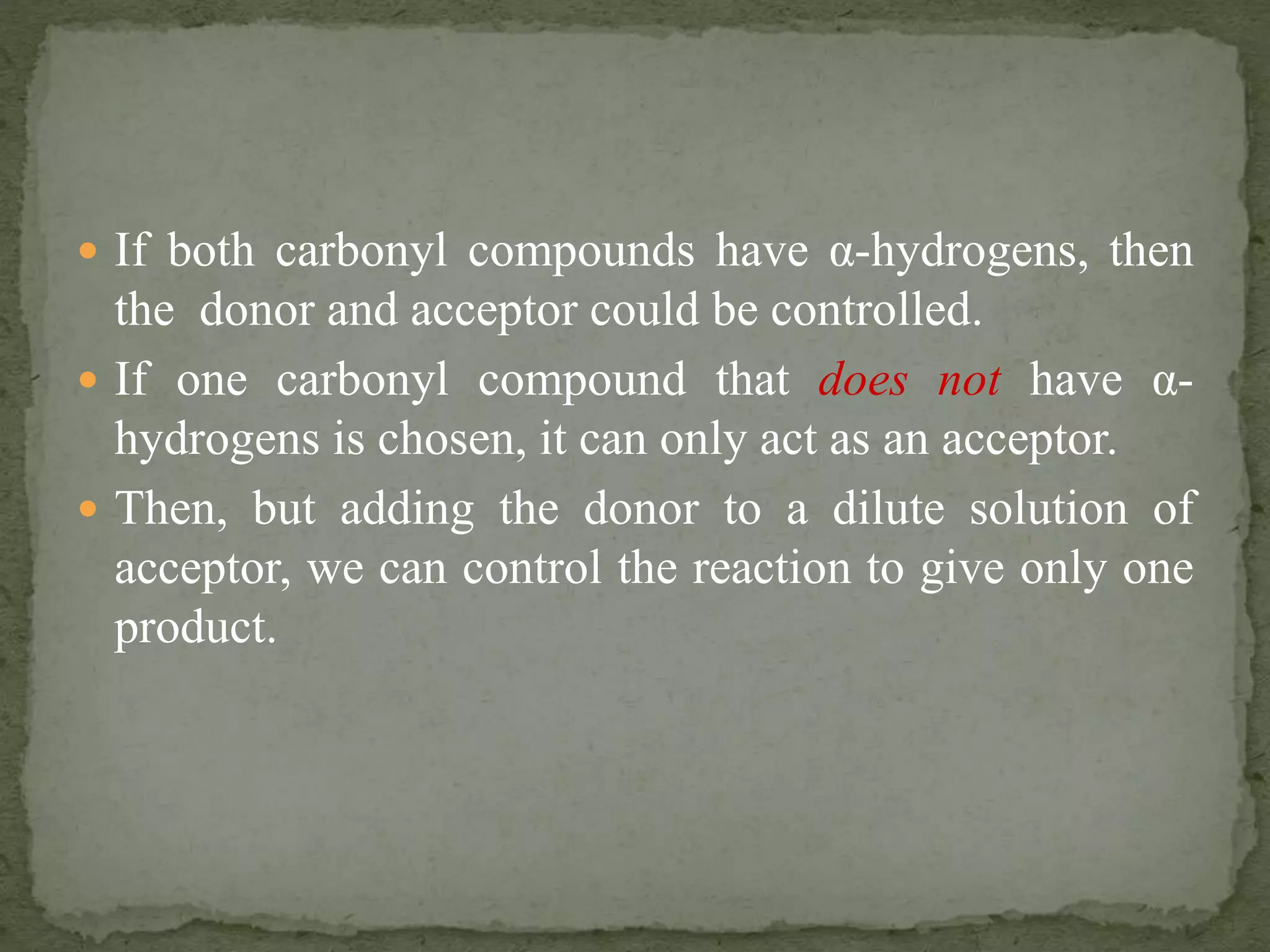
 If both carbonyl compounds have α-hydrogens, then
the donor and acceptor could be controlled.
 If one carbonyl compound that does not have α-
hydrogens is chosen, it can only act as an acceptor.
 Then, but adding the donor to a dilute solution of
acceptor, we can control the reaction to give only one
product.
C H
O
+
CH3 C H
O
NaOH
C CH2
OH
H
C H
O
- H2O
(spontaneously)
CH CH C H
O
CINNAMALDEHYDE
 Step 1: Deprotonation and formation of nucleophile.
• Step 2: Attack by nucleophile: Formation of alkoxide
ion.
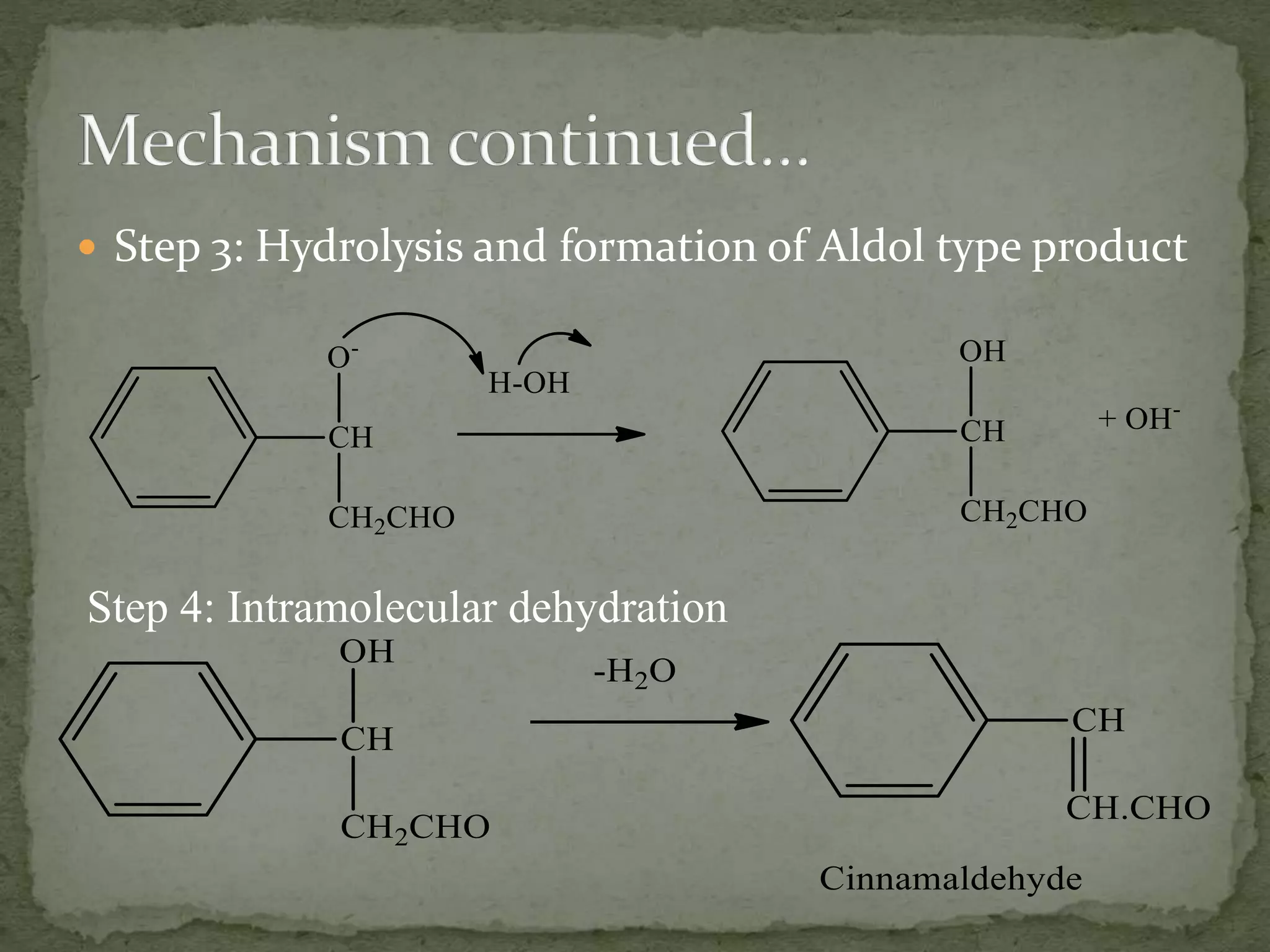
 Step 3: Hydrolysis and formation of Aldol type product
Step 4: Intramolecular dehydration
 The aldol condensation is very useful in the
preparation of large molecules from simple starting
materials.
 In biosynthesis, where large molecules are products,
condensation reactions provide the only reasonable
route, since all of the starting materials are small
molecules containing only two or three carbons.
 In synthesis of insect repellants such as 2-Ethyl-3-
hydroxy hexanal
CH2 CH C H
O
OHO
P
OH
OO
CH2 C CH2 O P OH
OH
O O
O
CH2
CH C CH C CH2
O P OH
O
O
O
OH
OH
HOHO
P
OH
O O
+
Glyceraldehyde-3-phosphate
Dihydroxyacetone phosphate
Fructose-1,6-diphosphate
a
ALDOL
CONDENSATION
enzyme

Crossed Aldol Condensation

  • 2.
     In thepresence of a strong base, two different molecules of aldehyde or ketone combine to form a β-hydroxyaldehyde or a β-hydroxyketone.  This reaction is called as the aldol condensation.
  • 3.
     The enolateion (carbanion) is the actual nucleophilic reagent.  The reaction breaks down to the following: The α-carbon of the donor attaches itself to the carbonyl carbon of the acceptor.
  • 4.
    CH3 C H O CH3C H O CH2 C H O CH2 C H O + _ _ .. _ acceptor donor
  • 5.
     The carbonylgroup plays two roles in this reaction:  1. It provides a site for nucleophilic attack by the enolate ion.  2. It makes the a-hydrogens sufficiently acidic to enable the formation of reasonable concentrations of enolate ion.  NOTE: There must be a-hydrogens in order to undergo aldol condensation.  Without a-hydrogens, the only possible reaction is Cannizarro reaction
  • 6.
     If bothcarbonyl compounds have α-hydrogens, then the donor and acceptor could be controlled.  If one carbonyl compound that does not have α- hydrogens is chosen, it can only act as an acceptor.  Then, but adding the donor to a dilute solution of acceptor, we can control the reaction to give only one product.
  • 7.
    C H O + CH3 CH O NaOH C CH2 OH H C H O - H2O (spontaneously) CH CH C H O CINNAMALDEHYDE
  • 8.
     Step 1:Deprotonation and formation of nucleophile. • Step 2: Attack by nucleophile: Formation of alkoxide ion.
  • 9.
     Step 3:Hydrolysis and formation of Aldol type product Step 4: Intramolecular dehydration
  • 10.
     The aldolcondensation is very useful in the preparation of large molecules from simple starting materials.  In biosynthesis, where large molecules are products, condensation reactions provide the only reasonable route, since all of the starting materials are small molecules containing only two or three carbons.  In synthesis of insect repellants such as 2-Ethyl-3- hydroxy hexanal
  • 11.
    CH2 CH CH O OHO P OH OO CH2 C CH2 O P OH OH O O O CH2 CH C CH C CH2 O P OH O O O OH OH HOHO P OH O O + Glyceraldehyde-3-phosphate Dihydroxyacetone phosphate Fructose-1,6-diphosphate a ALDOL CONDENSATION enzyme