“INFLAMMATION”
Dr.Zulcaif Ahmad
+92 03204998472
INTRODUCTION
• It is derived from LATIN word
meaning ignite.
• It literally means flaming, burning
Defination:
“It refers to reaction of living
tissue to all forms of injury, and
involves vascular, neuralgic,
humoral & cellular response at
the site of injury.”
“NOMENCLATURE OF
INFLAMMATION”
• The nomenclature used to
describe inflammation in
different tissues employs the
tissue name & suffix “itis”.
• Example:
pancreatitis
nephritis
appendicitis & etc.
Clinical Significance
“It is a protective or defensive
process why?”
• it removes or destroys causative agents
• Repairs tissue damage
• Inactivate toxins
• Prepare tissue or organ for healing & repair
WITHOUT INFLAMMATION??
• Infections would go unchecked.
• Wounds would never heal.
• Injured organs may remain permanently
damaged.
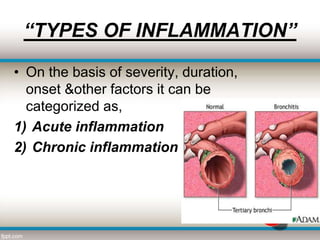
“TYPES OF INFLAMMATION”
• On the basis of severity, duration,
onset &other factors it can be
categorized as,
1) Acute inflammation
2) Chronic inflammation
Acute Inflammation
• “The acute inflammatory response rapidly
delivers leukocytes and plasma proteins to
site of injury. once there leukocytes clear
the invaders and begins the process of
digesting and getting rid of necrotic
tissue.”
• Cells of Acute Inflammation:
• Neutrophils (for first 24-48 hours)
• Macrophages (after 48 hours)
ETIOLOGY OF ACUTE
INFLAMMATION
• MECHANICAL TRAUMA: cutting or crushing
• CHEMICAL INJURY: corrosive acids, alkalis,
phenol, general poisons.
• RADIATION INJURY: heat, UV light, all forms of
ionizing radiations.
• INJURY DUE TO COLD AND HEAT
• INJURY BY LIVING ORGANISM: infection by
viruses, bacteria & larger parasites.
• INJURY DUE TO IMMUNOLOGICAL
MECHANISM: diseases mediated by Ag-
AB interactions
• Hypoxia
• BURNS
• TOXINS
• STRESS
• CHEMICAL IRRITANTS etc.
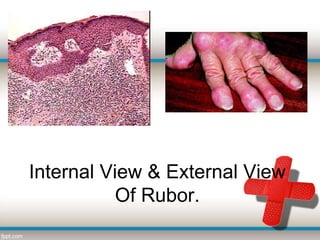
Internal View & External View
Of Rubor.
DOLOR Tumor
FUNCTIO LAESA
.
CELLULAR EVENTS OF
ACUTE INFLAMMATION
• Vascular changes (Vasodilation, inc.
vascular permeability)
• Cellular events takes place such as;
 MARGINATION
ADHESION
EMIGRATION
CHEMOTAXIS
PHAGOCYTOSIS
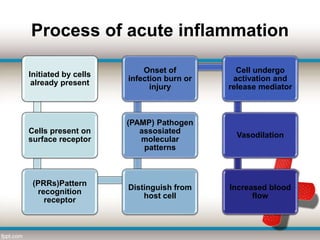
Process of acute inflammation
Initiated by cells
already present
Cells present on
surface receptor
(PRRs)Pattern
recognition
receptor
Distinguish from
host cell
(PAMP) Pathogen
assosiated
molecular
patterns
Onset of
infection burn or
injury
Cell undergo
activation and
release mediator
Vasodilation
Increased blood
flow
Causes redness
& heat
Inc.permeability
of blood vessels
result
Exudation
(leakage) of
plasma protein
And fluid into
tissue
Manifests itself
as swelling
Some mediator
such as
bradykinin
Mediator alter the
migration of
leukocytes
Mainly neutrophil
& macrophages
out side he
b.vessels
Neutrophils
migrate along
chemotactic
gradient
Reach the site
of injury
Loss of
function result
of neurological
reflex
Inflammation
ceased once
the stimuli has
been removed
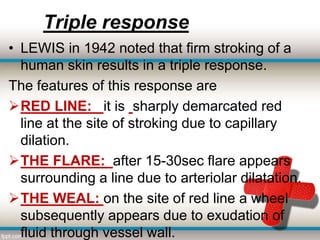
Triple response
• LEWIS in 1942 noted that firm stroking of a
human skin results in a triple response.
The features of this response are
RED LINE: it is sharply demarcated red
line at the site of stroking due to capillary
dilation.
THE FLARE: after 15-30sec flare appears
surrounding a line due to arteriolar dilatation.
THE WEAL: on the site of red line a wheel
subsequently appears due to exudation of
fluid through vessel wall.
“EXUDATION”
• EXUDATION:
“The escape of fluid, cells, and cellular debris
from blood vessels and their deposition in or
on to the tissues as result of inflammation is
known as exudation.”
• Exudate:
“It is an inflammatory extravascular fluid that
has high protein conc., much cellular debris
which leaks from vessels into the interstitial
space due to increased vascular
permeability.”
MEDIATORS OF ACUTE
INFLAMMATION
• MEDIATORS:-
These are the chemical substances that
trigger certain process in an inflammation.
TYPES OF MEDIATORS:
1. Histamine
2. Serotonin
3. NEUTROPHILIC PROTEASES
4. ADRENALINE AND NOR ADRENALINE
5. The kinins
6. Plasmin
7)DERRIVATIVES OF ARACHIDONIC ACID(AA)
– THE PROSTAGLANDINS
– LEUKOTRIENES
8) PLATELET ACTIVATING FACTOR (PAF)
9) CYTOKINES
10) LYSOSOMAL CONTENTS OF
NEUTROPHILS
11) COMPLEMENT SYSTEM
12) OTHER MEDIATORS:
NEUROPEPTIDES
NITRIC OXIDE:
OUTCOMES OF ACUTE
INFLAMMATION
• COMPLETE RESOLUTION
• SCARRING OR FIBROSIS
• ABCESS FORMATION
• PROGRESSION TO CHRONIC
INFLAMMATION
• SCARRING
*ABCESS
CHRONIC INFLAMMATION
SPECIAL TYPES OF ACUTE
INFLAMMATION
On principle components of exudates, acute
inflammation has followimg types:
1. Serous Inflammation
2. Fibrinous Inflammation
3. Suppurative Inflammation
4. Abcess Forming Inflammation
5. HEMORRHAGIC INFLAMMATION
CHRONIC INFLAMMATION
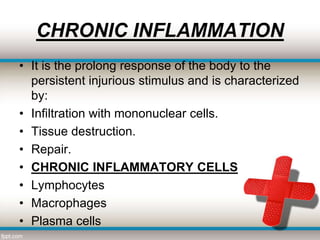
• It is the prolong response of the body to the
persistent injurious stimulus and is characterized
by:
• Infiltration with mononuclear cells.
• Tissue destruction.
• Repair.
• CHRONIC INFLAMMATORY CELLS
• Lymphocytes
• Macrophages
• Plasma cells
ETIOLOGY
• Unresolved acute inflammation:
Due to persistence of injurious agent
interference of normal process of healing
• Chronic inflammation without acute
phase:
It may start from the very beginning
Such type of injurious agents are of low
toxicity in comparison of those that lead to
acute inflammation.
CAUSES
1. CHRONIC VIRAL INFECTIONS:
chronic viral hepatitis
2. CHRONIC AUTOIMMUNE DISEASES:
rheumatoid arthritis
3.CHRONIC CHEMICAL INTOXICATION:
chronic alcoholic liver disease
4.ALLERGIC INFLAMMATION:
bronchial asthma
TYPES
1) GRANULOMATOUS CHRONIC
INFLAMMATION
2) NON GRANULOMATOUS CHRONIC
INFLAMMATION
GRANULOMATOUS
• This type of chronic inflammation is
characterized by formation of epithelioid
cells & granuloma
• GRANULOMA:
A collection of modified macrophages
resembling epithelial cells, usually
surrounded by a rim of lymphocytes.
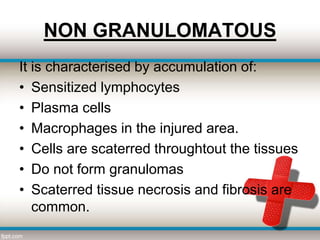
NON GRANULOMATOUS
It is characterised by accumulation of:
• Sensitized lymphocytes
• Plasma cells
• Macrophages in the injured area.
• Cells are scaterred throughtout the tissues
• Do not form granulomas
• Scaterred tissue necrosis and fibrosis are
common.
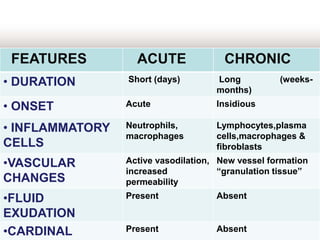
FEATURES ACUTE CHRONIC
• DURATION Short (days) Long (weeks-
months)
• ONSET Acute Insidious
• INFLAMMATORY
CELLS
Neutrophils,
macrophages
Lymphocytes,plasma
cells,macrophages &
fibroblasts
•VASCULAR
CHANGES
Active vasodilation,
increased
permeability
New vessel formation
“granulation tissue”
•FLUID
EXUDATION
Present Absent
•CARDINAL Present Absent
REFERENCES
• COLOR ATLAS OF PATHOLOGY BY
URUS.
• GROSS PATHOLOGY BY JAWAD
AHMED.
• GENERAL PATHOLOGY BY ROBIN’S
AND CARTON’S.
• GENERAL PATHOLOGY BY WALTER
AND ISRAEL.
• SHORT TEXTBOOK OF PATHOLOGY
BY INAM DANISH.

Inflammation

  • 1.
  • 2.
    INTRODUCTION • It isderived from LATIN word meaning ignite. • It literally means flaming, burning Defination: “It refers to reaction of living tissue to all forms of injury, and involves vascular, neuralgic, humoral & cellular response at the site of injury.”
  • 3.
    “NOMENCLATURE OF INFLAMMATION” • Thenomenclature used to describe inflammation in different tissues employs the tissue name & suffix “itis”. • Example: pancreatitis nephritis appendicitis & etc.
  • 4.
    Clinical Significance “It isa protective or defensive process why?” • it removes or destroys causative agents • Repairs tissue damage • Inactivate toxins • Prepare tissue or organ for healing & repair
  • 5.
    WITHOUT INFLAMMATION?? • Infectionswould go unchecked. • Wounds would never heal. • Injured organs may remain permanently damaged.
  • 6.
    “TYPES OF INFLAMMATION” •On the basis of severity, duration, onset &other factors it can be categorized as, 1) Acute inflammation 2) Chronic inflammation
  • 7.
    Acute Inflammation • “Theacute inflammatory response rapidly delivers leukocytes and plasma proteins to site of injury. once there leukocytes clear the invaders and begins the process of digesting and getting rid of necrotic tissue.” • Cells of Acute Inflammation: • Neutrophils (for first 24-48 hours) • Macrophages (after 48 hours)
  • 8.
    ETIOLOGY OF ACUTE INFLAMMATION •MECHANICAL TRAUMA: cutting or crushing • CHEMICAL INJURY: corrosive acids, alkalis, phenol, general poisons. • RADIATION INJURY: heat, UV light, all forms of ionizing radiations. • INJURY DUE TO COLD AND HEAT • INJURY BY LIVING ORGANISM: infection by viruses, bacteria & larger parasites.
  • 9.
    • INJURY DUETO IMMUNOLOGICAL MECHANISM: diseases mediated by Ag- AB interactions • Hypoxia • BURNS • TOXINS • STRESS • CHEMICAL IRRITANTS etc.
  • 10.
    Internal View &External View Of Rubor.
  • 11.
  • 12.
  • 13.
  • 15.
    CELLULAR EVENTS OF ACUTEINFLAMMATION • Vascular changes (Vasodilation, inc. vascular permeability) • Cellular events takes place such as;  MARGINATION ADHESION EMIGRATION CHEMOTAXIS PHAGOCYTOSIS
  • 16.
    Process of acuteinflammation Initiated by cells already present Cells present on surface receptor (PRRs)Pattern recognition receptor Distinguish from host cell (PAMP) Pathogen assosiated molecular patterns Onset of infection burn or injury Cell undergo activation and release mediator Vasodilation Increased blood flow
  • 17.
    Causes redness & heat Inc.permeability ofblood vessels result Exudation (leakage) of plasma protein And fluid into tissue Manifests itself as swelling Some mediator such as bradykinin Mediator alter the migration of leukocytes Mainly neutrophil & macrophages out side he b.vessels Neutrophils migrate along chemotactic gradient
  • 18.
    Reach the site ofinjury Loss of function result of neurological reflex Inflammation ceased once the stimuli has been removed
  • 20.
    Triple response • LEWISin 1942 noted that firm stroking of a human skin results in a triple response. The features of this response are RED LINE: it is sharply demarcated red line at the site of stroking due to capillary dilation. THE FLARE: after 15-30sec flare appears surrounding a line due to arteriolar dilatation. THE WEAL: on the site of red line a wheel subsequently appears due to exudation of fluid through vessel wall.
  • 21.
    “EXUDATION” • EXUDATION: “The escapeof fluid, cells, and cellular debris from blood vessels and their deposition in or on to the tissues as result of inflammation is known as exudation.” • Exudate: “It is an inflammatory extravascular fluid that has high protein conc., much cellular debris which leaks from vessels into the interstitial space due to increased vascular permeability.”
  • 22.
    MEDIATORS OF ACUTE INFLAMMATION •MEDIATORS:- These are the chemical substances that trigger certain process in an inflammation. TYPES OF MEDIATORS: 1. Histamine 2. Serotonin 3. NEUTROPHILIC PROTEASES 4. ADRENALINE AND NOR ADRENALINE 5. The kinins 6. Plasmin
  • 23.
    7)DERRIVATIVES OF ARACHIDONICACID(AA) – THE PROSTAGLANDINS – LEUKOTRIENES 8) PLATELET ACTIVATING FACTOR (PAF) 9) CYTOKINES 10) LYSOSOMAL CONTENTS OF NEUTROPHILS 11) COMPLEMENT SYSTEM 12) OTHER MEDIATORS: NEUROPEPTIDES NITRIC OXIDE:
  • 24.
    OUTCOMES OF ACUTE INFLAMMATION •COMPLETE RESOLUTION • SCARRING OR FIBROSIS • ABCESS FORMATION • PROGRESSION TO CHRONIC INFLAMMATION
  • 25.
  • 26.
    SPECIAL TYPES OFACUTE INFLAMMATION On principle components of exudates, acute inflammation has followimg types: 1. Serous Inflammation 2. Fibrinous Inflammation 3. Suppurative Inflammation 4. Abcess Forming Inflammation 5. HEMORRHAGIC INFLAMMATION
  • 27.
    CHRONIC INFLAMMATION • Itis the prolong response of the body to the persistent injurious stimulus and is characterized by: • Infiltration with mononuclear cells. • Tissue destruction. • Repair. • CHRONIC INFLAMMATORY CELLS • Lymphocytes • Macrophages • Plasma cells
  • 28.
    ETIOLOGY • Unresolved acuteinflammation: Due to persistence of injurious agent interference of normal process of healing • Chronic inflammation without acute phase: It may start from the very beginning Such type of injurious agents are of low toxicity in comparison of those that lead to acute inflammation.
  • 29.
    CAUSES 1. CHRONIC VIRALINFECTIONS: chronic viral hepatitis 2. CHRONIC AUTOIMMUNE DISEASES: rheumatoid arthritis 3.CHRONIC CHEMICAL INTOXICATION: chronic alcoholic liver disease 4.ALLERGIC INFLAMMATION: bronchial asthma
  • 30.
    TYPES 1) GRANULOMATOUS CHRONIC INFLAMMATION 2)NON GRANULOMATOUS CHRONIC INFLAMMATION
  • 31.
    GRANULOMATOUS • This typeof chronic inflammation is characterized by formation of epithelioid cells & granuloma • GRANULOMA: A collection of modified macrophages resembling epithelial cells, usually surrounded by a rim of lymphocytes.
  • 32.
    NON GRANULOMATOUS It ischaracterised by accumulation of: • Sensitized lymphocytes • Plasma cells • Macrophages in the injured area. • Cells are scaterred throughtout the tissues • Do not form granulomas • Scaterred tissue necrosis and fibrosis are common.
  • 33.
    FEATURES ACUTE CHRONIC •DURATION Short (days) Long (weeks- months) • ONSET Acute Insidious • INFLAMMATORY CELLS Neutrophils, macrophages Lymphocytes,plasma cells,macrophages & fibroblasts •VASCULAR CHANGES Active vasodilation, increased permeability New vessel formation “granulation tissue” •FLUID EXUDATION Present Absent •CARDINAL Present Absent
  • 34.
    REFERENCES • COLOR ATLASOF PATHOLOGY BY URUS. • GROSS PATHOLOGY BY JAWAD AHMED. • GENERAL PATHOLOGY BY ROBIN’S AND CARTON’S. • GENERAL PATHOLOGY BY WALTER AND ISRAEL. • SHORT TEXTBOOK OF PATHOLOGY BY INAM DANISH.

Editor's Notes