POTS Management & Consolidation
What is POTS Consolidation?
 Plain Old Telephone Service (POTS) - analog business







phone lines.
Companies with multiple offices spread across wide
geographical areas can have hundreds of POTS lines
serviced by multiple carriers.
The result is a legion of bills, from multiple
providers, complicating bill and inventory management.
POTS Aggregators have wholesale agreements with most of
the local phone companies servicing the US.
Those agreements make it possible for POTS Aggregators to
offer companies one bill and a single point of contact.
Benefits:
 Reduces administrative costs
 Facilitates bill and inventory management
 Cost reduction
 Single point of contact
 Electronic billing

 Eliminates third party billing charges
Reduces Administration Costs:
According to The Institute of Management and
Administration, the average cost to pay an invoice is
$11.63.
 A company with 500 offices that receives an individual bill
for their phone lines at each location, would face
administrative costs approaching $6000 a month.
 With POTS Aggregation the company could eliminate 499
bills and save approximately $6000 per month or $72,000
per year.

Facilitates Inventory & Bill Management:


Carrier Web Portal:
 Access to all billing charges
 Visibility of POTS and broadband inventory
 Ability to manipulate data and generate custom reports
Cost Reduction:
 Percentage savings off the carriers’ tariff pricing.
 Approximate 5 to 8 dollars in savings per phone line, per

month.
Single Point:
 Single point of contact for:
 Billing issues.
 Moves, adds and changes.
 Service issues.
 Repair tickets.
Electronic Billing:
 POTS Aggregators are electronically bonded to major carrier

networks and provide real time reporting.
 They offer detailed site billing and reporting capabilities.
 Provide consolidated national invoicing.
 Billing statistics can be manipulated to produce custom
reports.
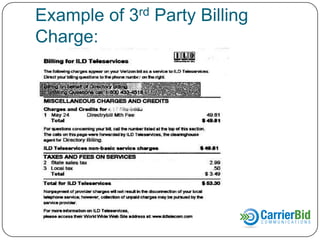
Eliminate 3rd Party Billing
Charges:
 Incumbent carriers operate as billing agents for 3rd parties.
 Their customers are exposed to third party billing charges or

Cramming.
 Most charges are for services that were never
requested, authorized or received.
 With incumbent billing it is important to analyze each and
every bill to spot 3rd party billing charges.
 Eliminating unwanted services and obtaining credits can be
time consuming.
Example of 3rd Party Billing
Charge:
Three Main Providers:
Provider One:
 Strictly POTS and DSL
 Promises a discount off carrier’s tariffed rates
 Focuses on line rates and impressive customer list
Provider Two:
 CLEC that acquired Ernest Communications
 Line rates include all surcharges
 Only additional charges would be state and local sales tax
 Can provide a full suite of telecom services
Provider Three:
 National CLEC that offers POTS aggregation
 Can provide a full suite of telecom services including SIP

and Hosted VoIP
The CarrierBid Difference:
 One-stop-shop
 Expertise and experience
 Full disclosure
 Customer advocacy
 POTS inventorying and evaluation

 Project management
 CarrierBid does not charge a fee or request a split of the

savings
Contact Information:
 John Gelhard
 CarrierBid Sales Director
 Toll free: 888-706-5656 x 701
 Direct: 609-921-3434
 Email: johngelhard@carrierbid.com

Pots Management

  • 1.
    POTS Management &Consolidation
  • 2.
    What is POTSConsolidation?  Plain Old Telephone Service (POTS) - analog business     phone lines. Companies with multiple offices spread across wide geographical areas can have hundreds of POTS lines serviced by multiple carriers. The result is a legion of bills, from multiple providers, complicating bill and inventory management. POTS Aggregators have wholesale agreements with most of the local phone companies servicing the US. Those agreements make it possible for POTS Aggregators to offer companies one bill and a single point of contact.
  • 3.
    Benefits:  Reduces administrativecosts  Facilitates bill and inventory management  Cost reduction  Single point of contact  Electronic billing  Eliminates third party billing charges
  • 4.
    Reduces Administration Costs: Accordingto The Institute of Management and Administration, the average cost to pay an invoice is $11.63.  A company with 500 offices that receives an individual bill for their phone lines at each location, would face administrative costs approaching $6000 a month.  With POTS Aggregation the company could eliminate 499 bills and save approximately $6000 per month or $72,000 per year. 
  • 5.
    Facilitates Inventory &Bill Management:  Carrier Web Portal:  Access to all billing charges  Visibility of POTS and broadband inventory  Ability to manipulate data and generate custom reports
  • 6.
    Cost Reduction:  Percentagesavings off the carriers’ tariff pricing.  Approximate 5 to 8 dollars in savings per phone line, per month.
  • 7.
    Single Point:  Singlepoint of contact for:  Billing issues.  Moves, adds and changes.  Service issues.  Repair tickets.
  • 8.
    Electronic Billing:  POTSAggregators are electronically bonded to major carrier networks and provide real time reporting.  They offer detailed site billing and reporting capabilities.  Provide consolidated national invoicing.  Billing statistics can be manipulated to produce custom reports.
  • 9.
    Eliminate 3rd PartyBilling Charges:  Incumbent carriers operate as billing agents for 3rd parties.  Their customers are exposed to third party billing charges or Cramming.  Most charges are for services that were never requested, authorized or received.  With incumbent billing it is important to analyze each and every bill to spot 3rd party billing charges.  Eliminating unwanted services and obtaining credits can be time consuming.
  • 10.
    Example of 3rdParty Billing Charge:
  • 11.
  • 12.
    Provider One:  StrictlyPOTS and DSL  Promises a discount off carrier’s tariffed rates  Focuses on line rates and impressive customer list
  • 13.
    Provider Two:  CLECthat acquired Ernest Communications  Line rates include all surcharges  Only additional charges would be state and local sales tax  Can provide a full suite of telecom services
  • 14.
    Provider Three:  NationalCLEC that offers POTS aggregation  Can provide a full suite of telecom services including SIP and Hosted VoIP
  • 15.
    The CarrierBid Difference: One-stop-shop  Expertise and experience  Full disclosure  Customer advocacy  POTS inventorying and evaluation  Project management  CarrierBid does not charge a fee or request a split of the savings
  • 16.
    Contact Information:  JohnGelhard  CarrierBid Sales Director  Toll free: 888-706-5656 x 701  Direct: 609-921-3434  Email: johngelhard@carrierbid.com