Course Description
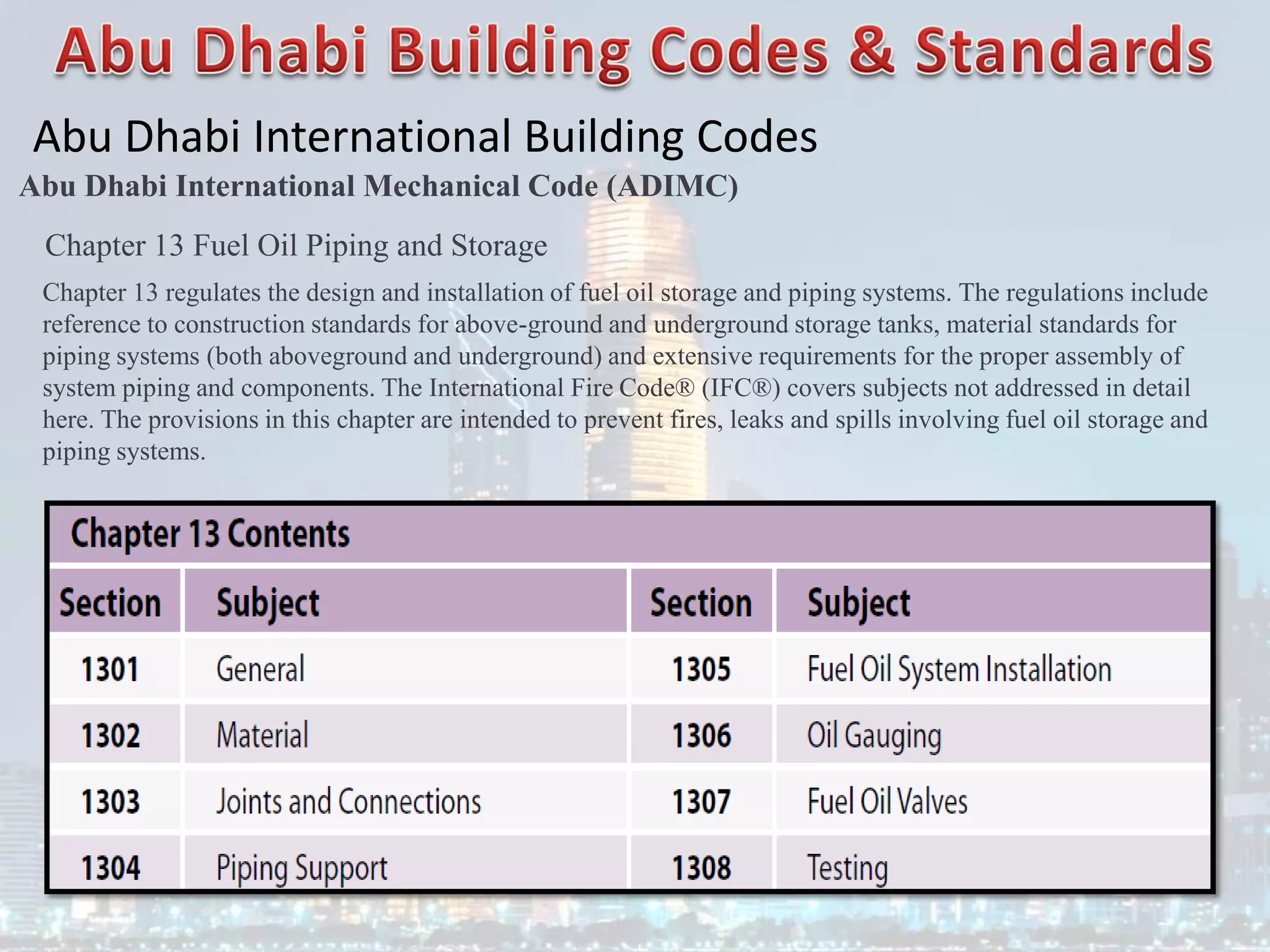
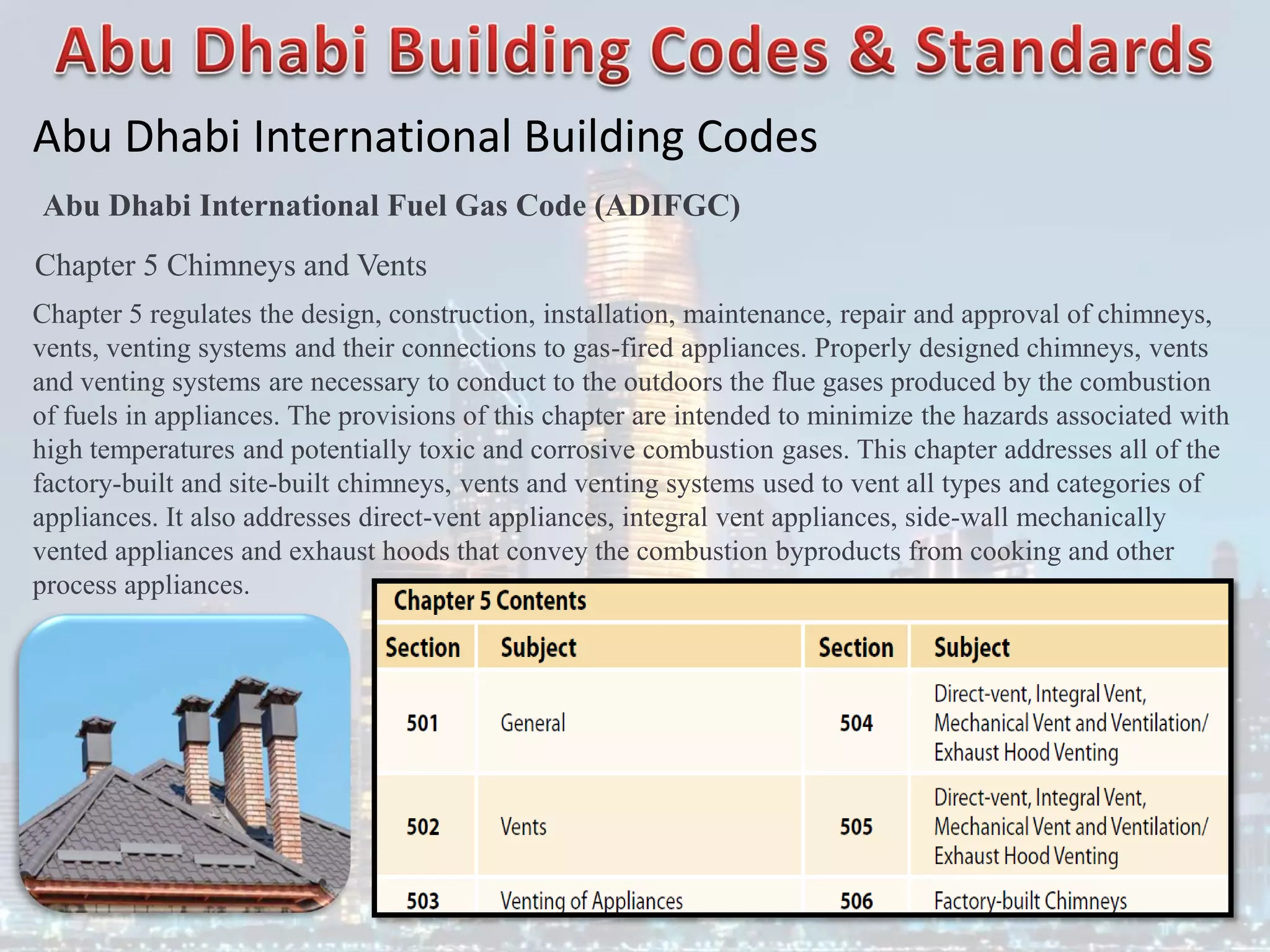
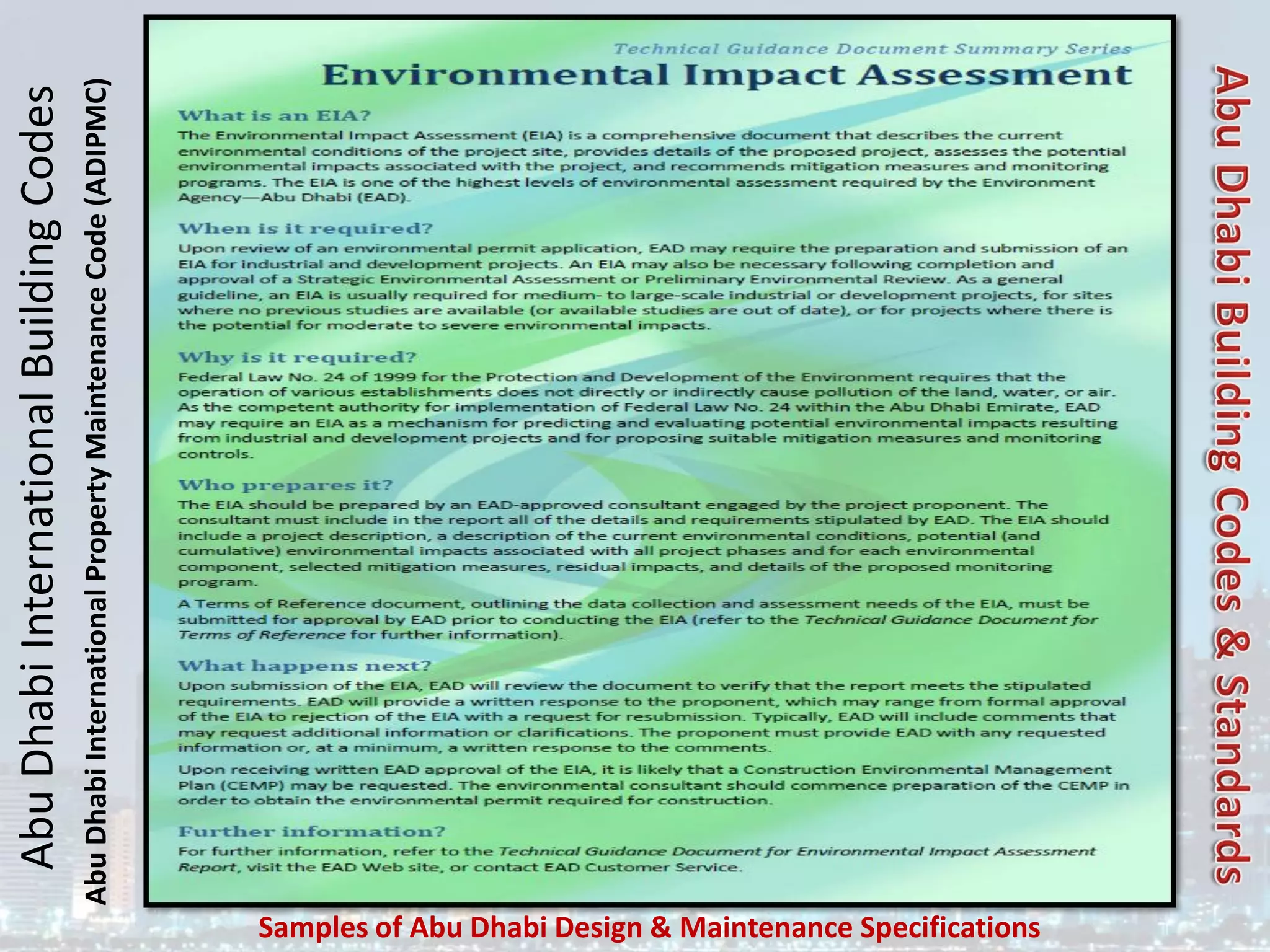
The aim of this course is to
introduce the required skill for
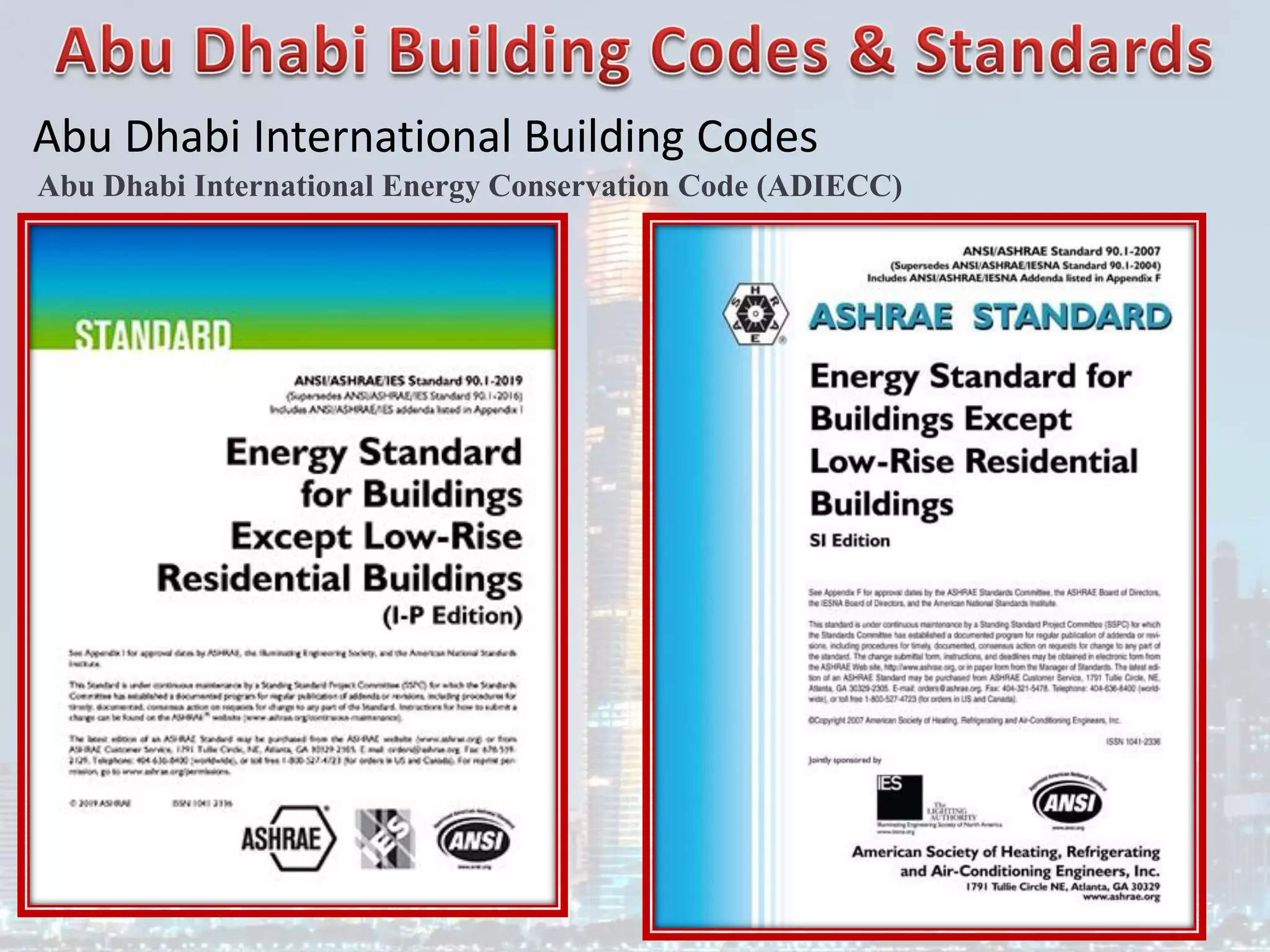
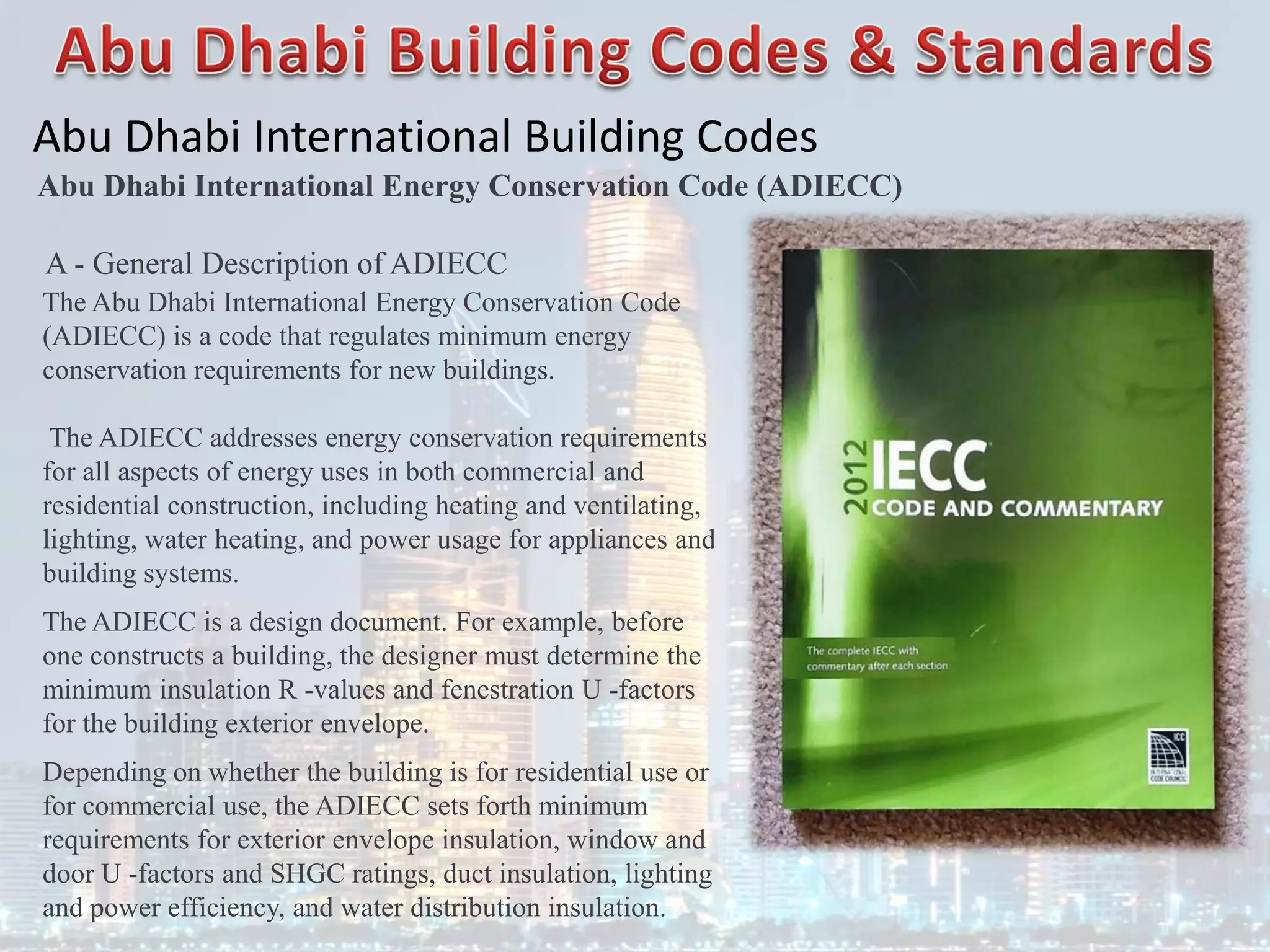
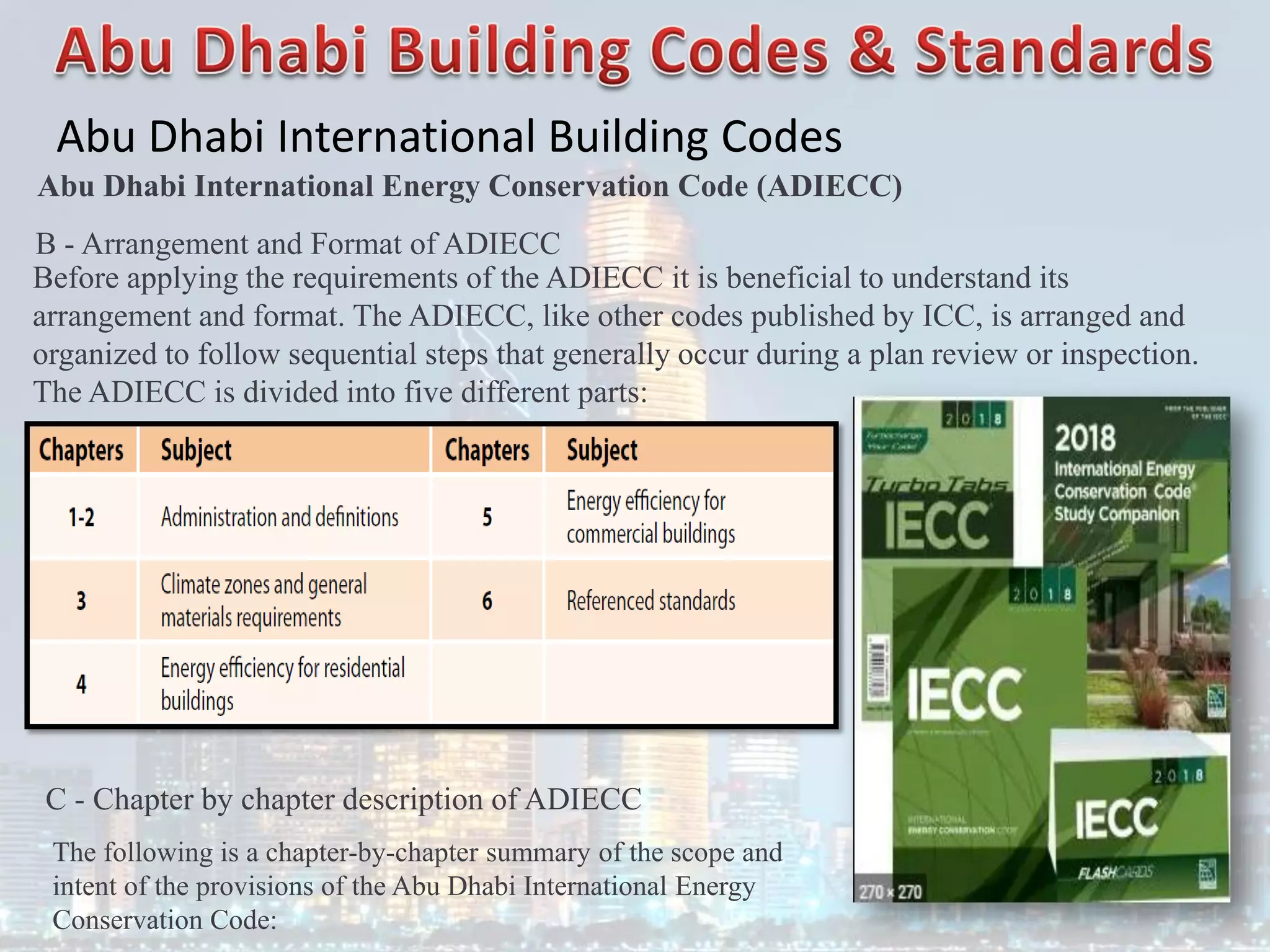
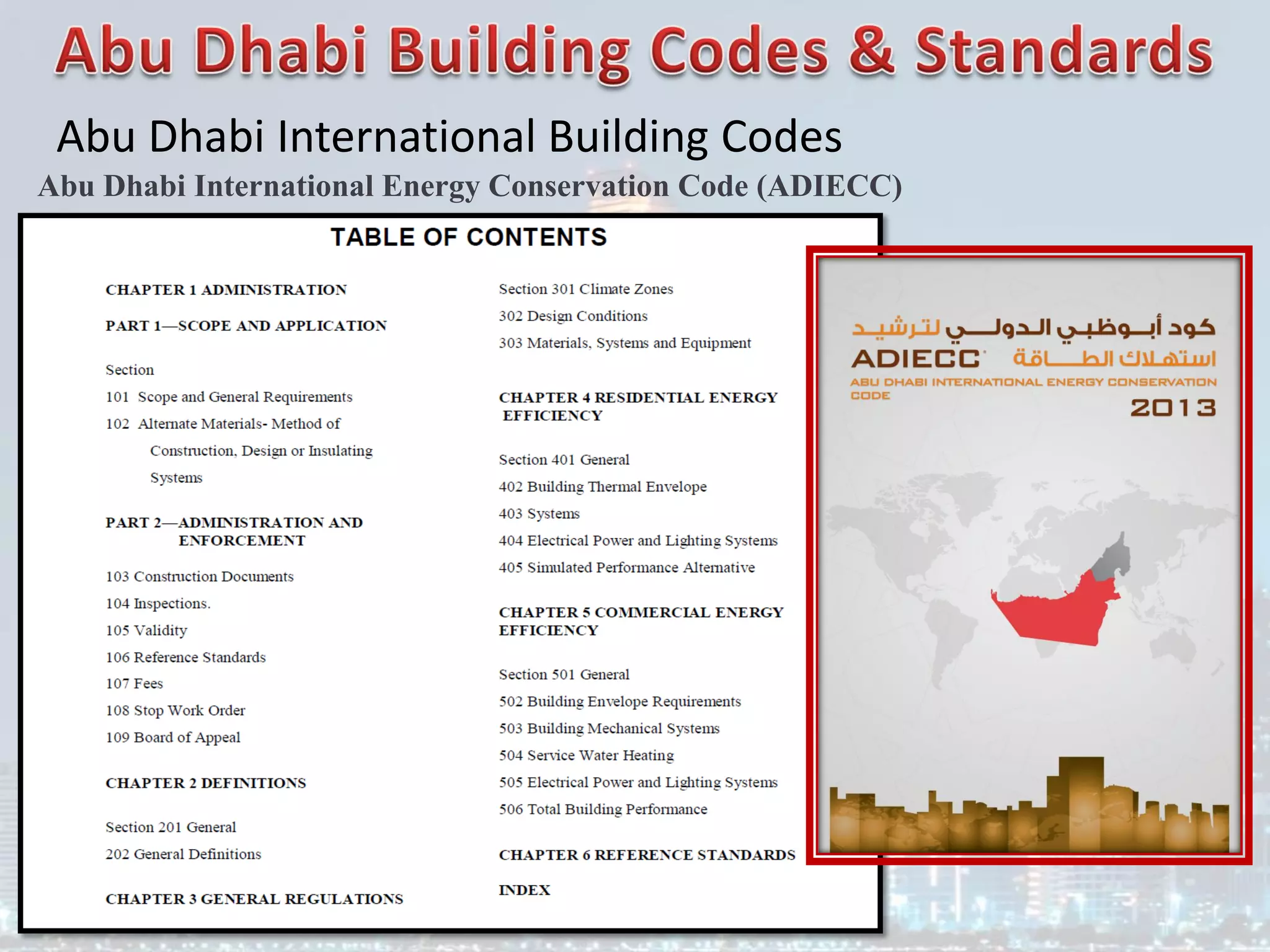
understanding the importance,
application, use, and
management of various
buildings and constructions
codes, regulations,
specifications and standards
around the world; especially in
UAE (Abu Dhabi).
TRAINING METHODOLOGY
This is an interactive course. There will be open
question and answer sessions, regular group exercises
and activities, videos, case studies, and presentations on
best practice. Participants will have the opportunity to
share with the facilitator and other participants on what
works well and not so well for them, as well as work on
issues from their own organizations.
Who Should Attend?
This program is suitable for
Engineers who would like to
be exposed on the different
aspects of the various
standards & codes used in
the industry.
Course Certificate:
IFM certificate will be issued to all attendees
completing minimum of 75% of the total tuition
hours of the course.
Course Outline:
Upon the successful completion of this program, participants will be able to:
1. Understand the various standards and codes in the Process industry with emphasis
on the right approach & methodology for using such codes. Applicable codes
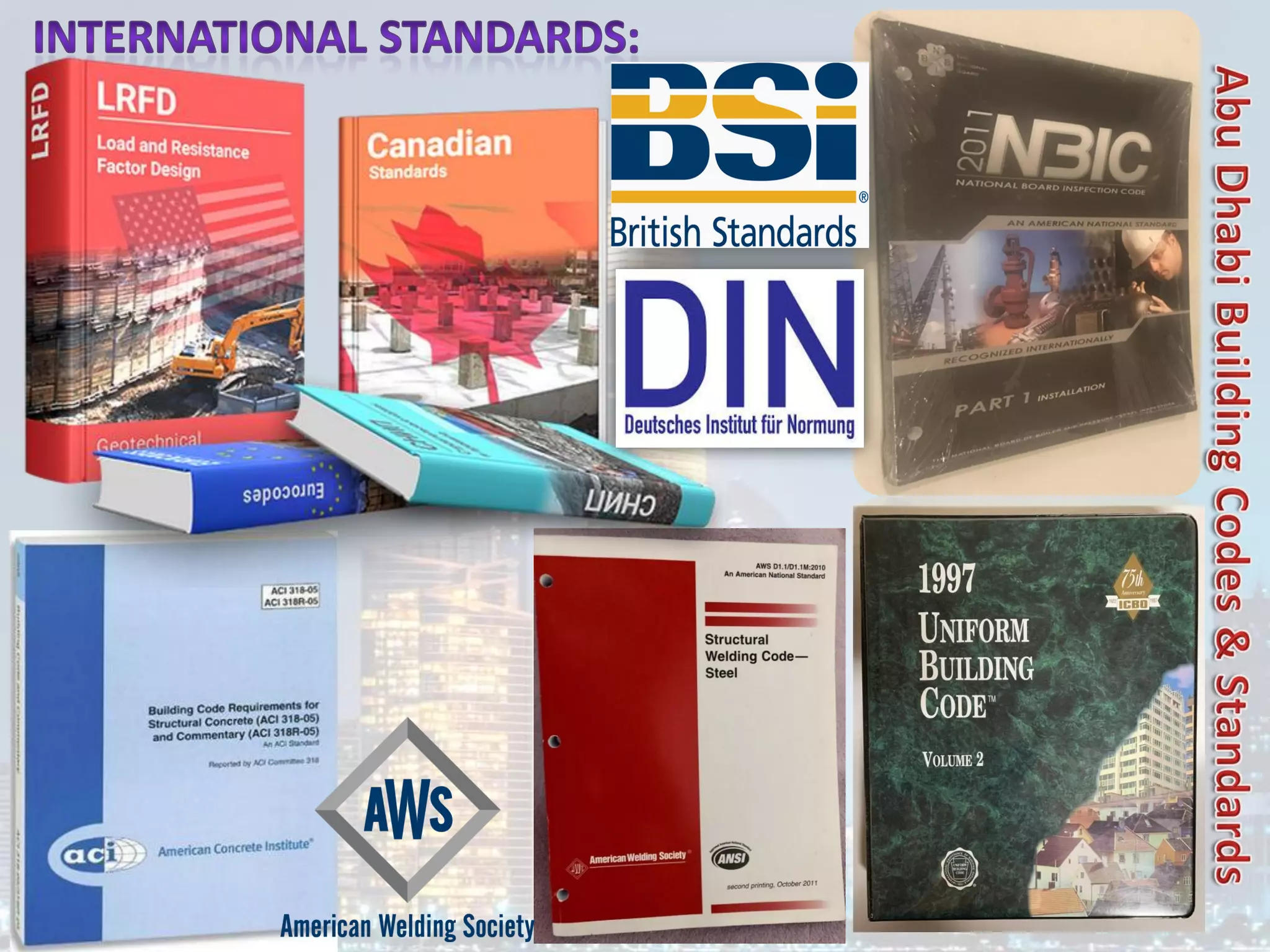
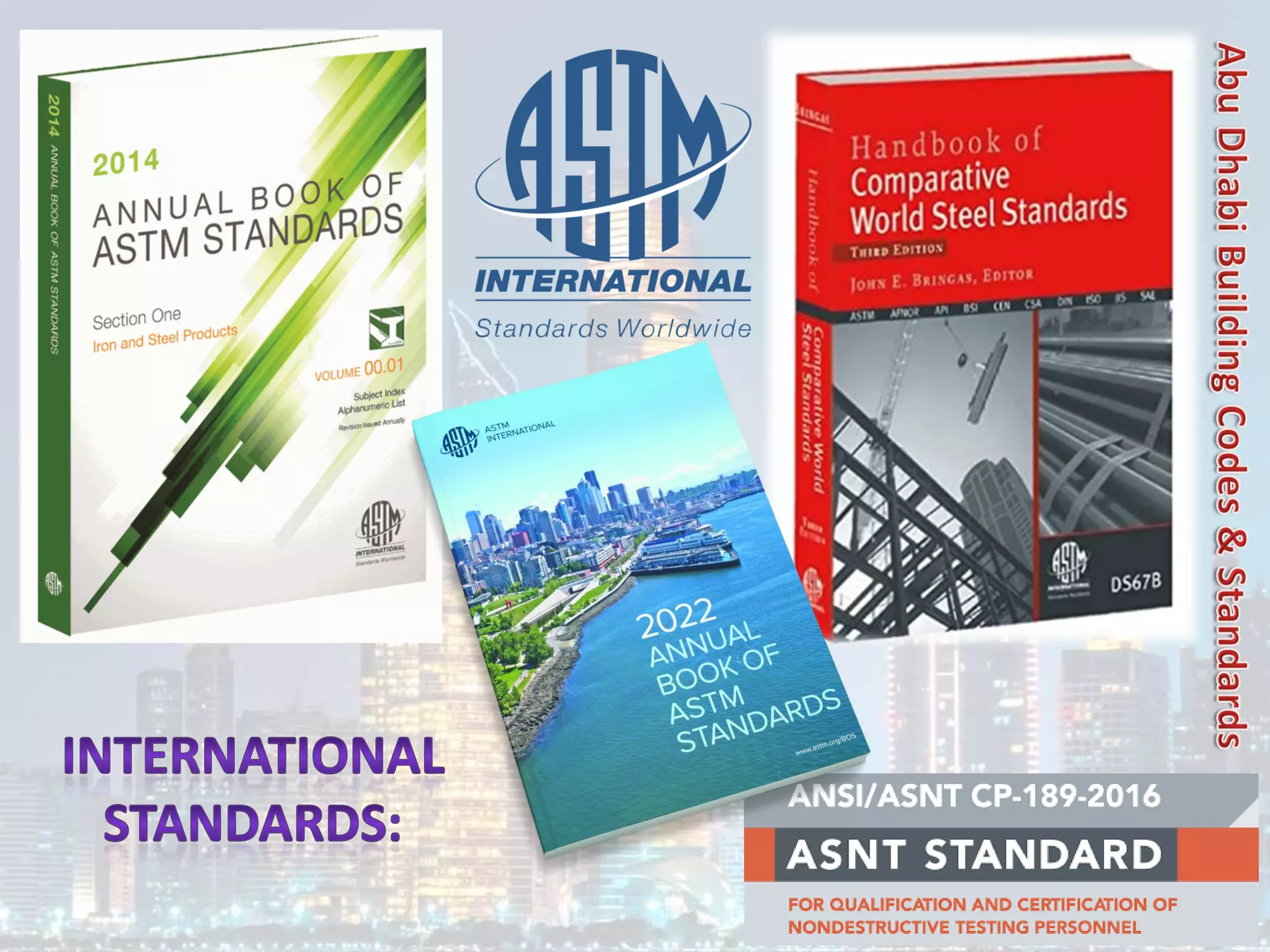
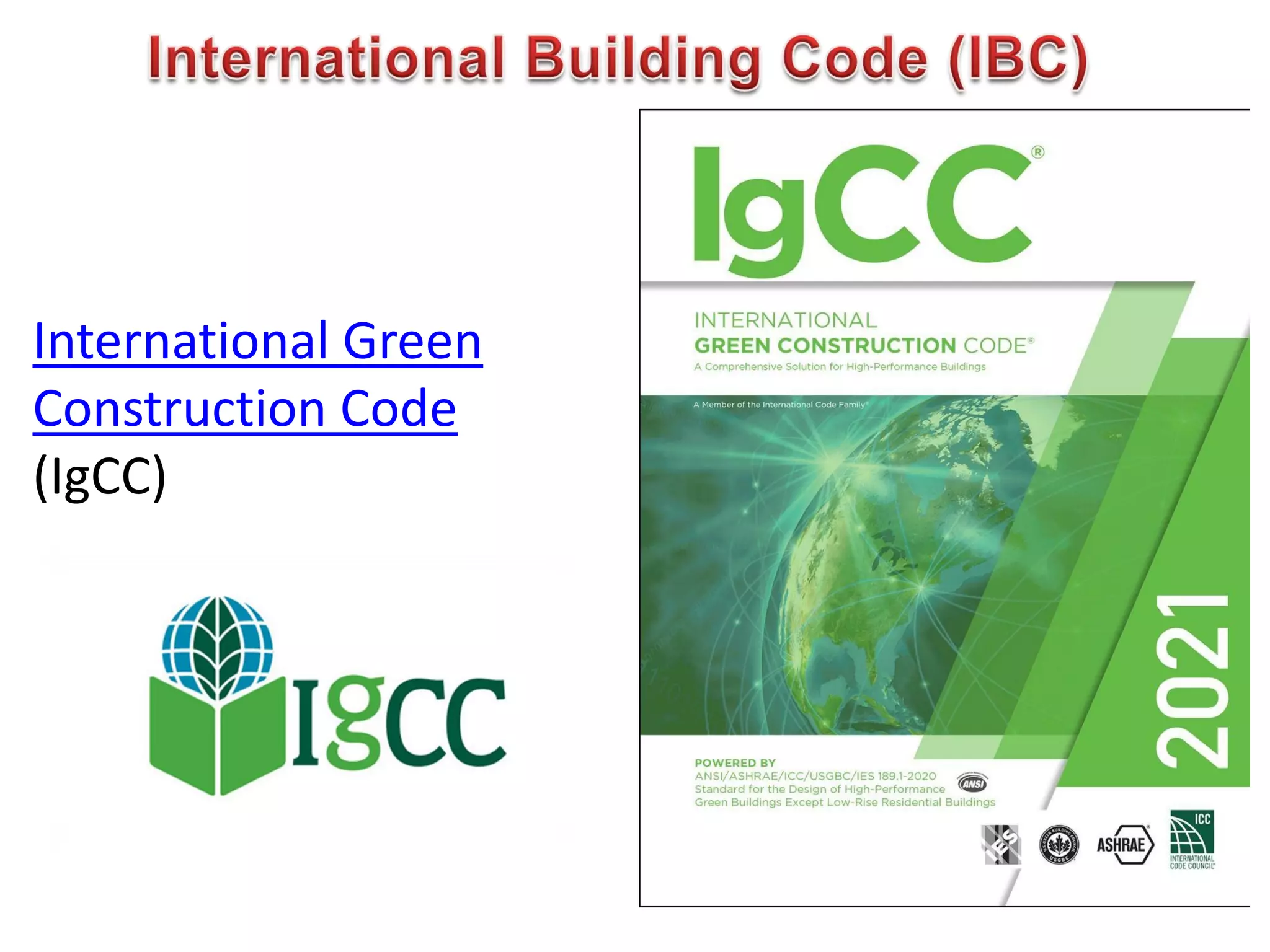
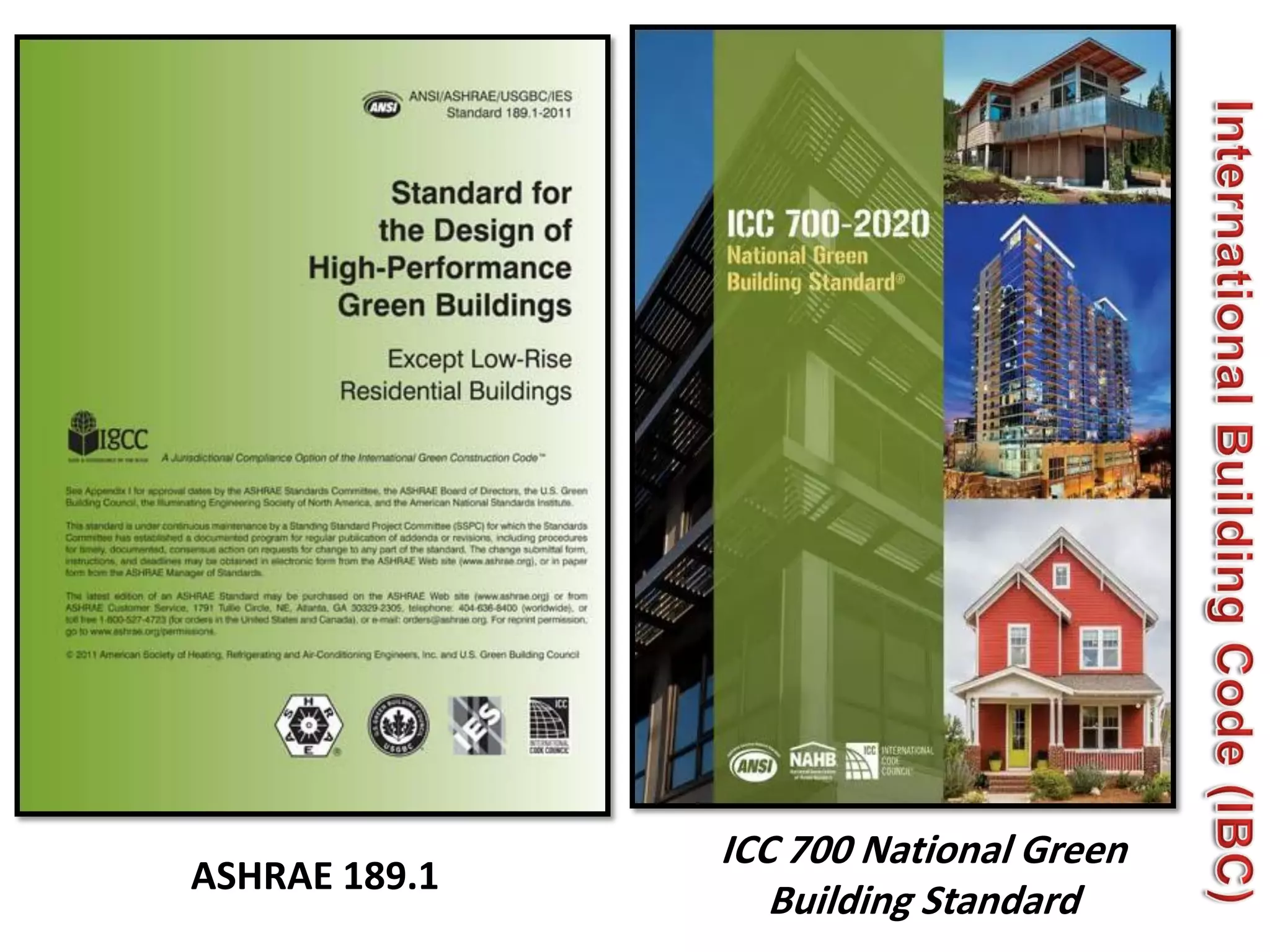
include ANSI, ISO, NBIC, ASME, ASTM, NEC, API, AWS, NFPA and ISA
2. Understand the various standards and codes of UAE (Dubai, JAFZA, & Abu Dhabi) in
the Process construction industry with emphasis on the right approach &
methodology for using such codes.
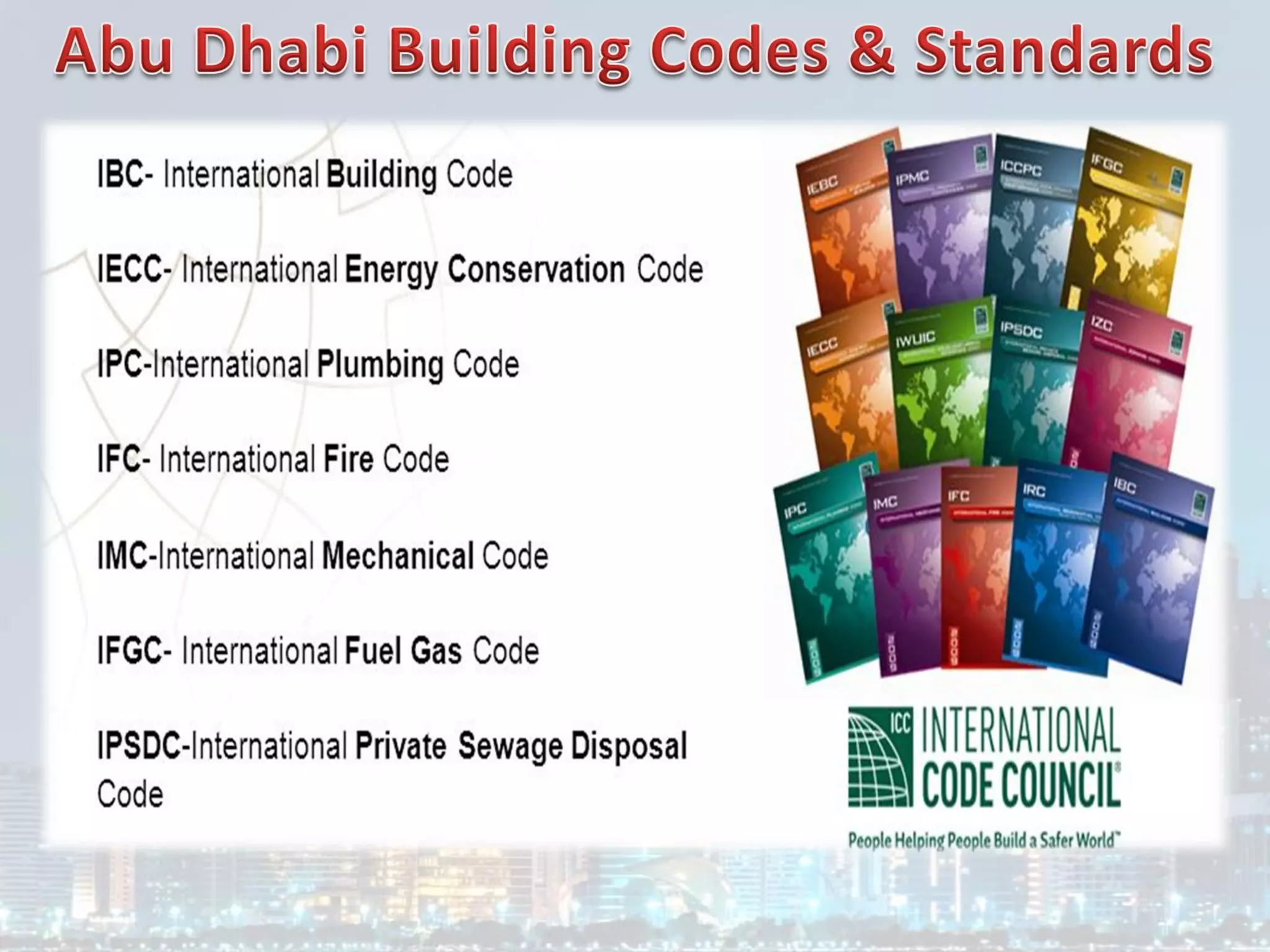
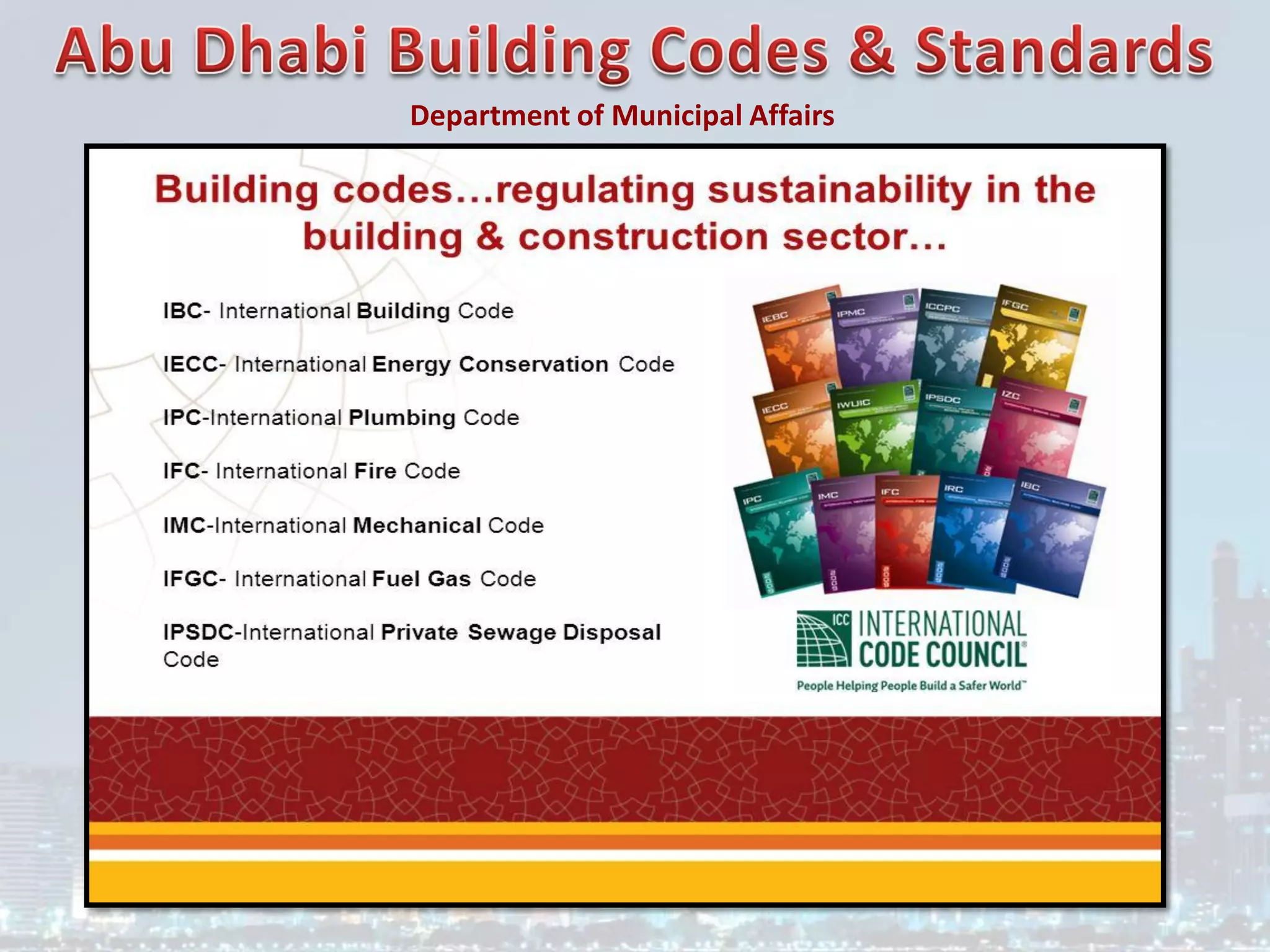
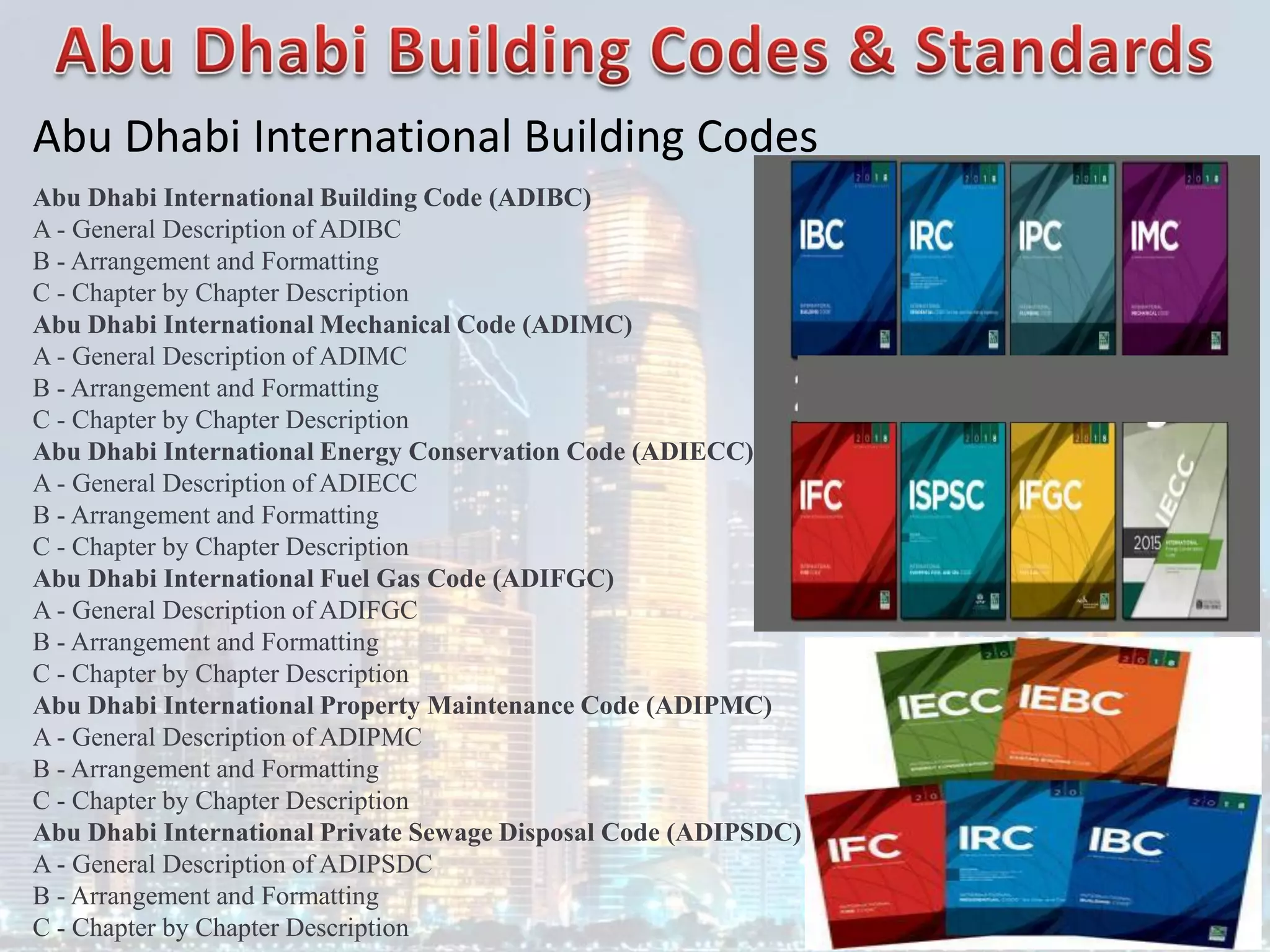
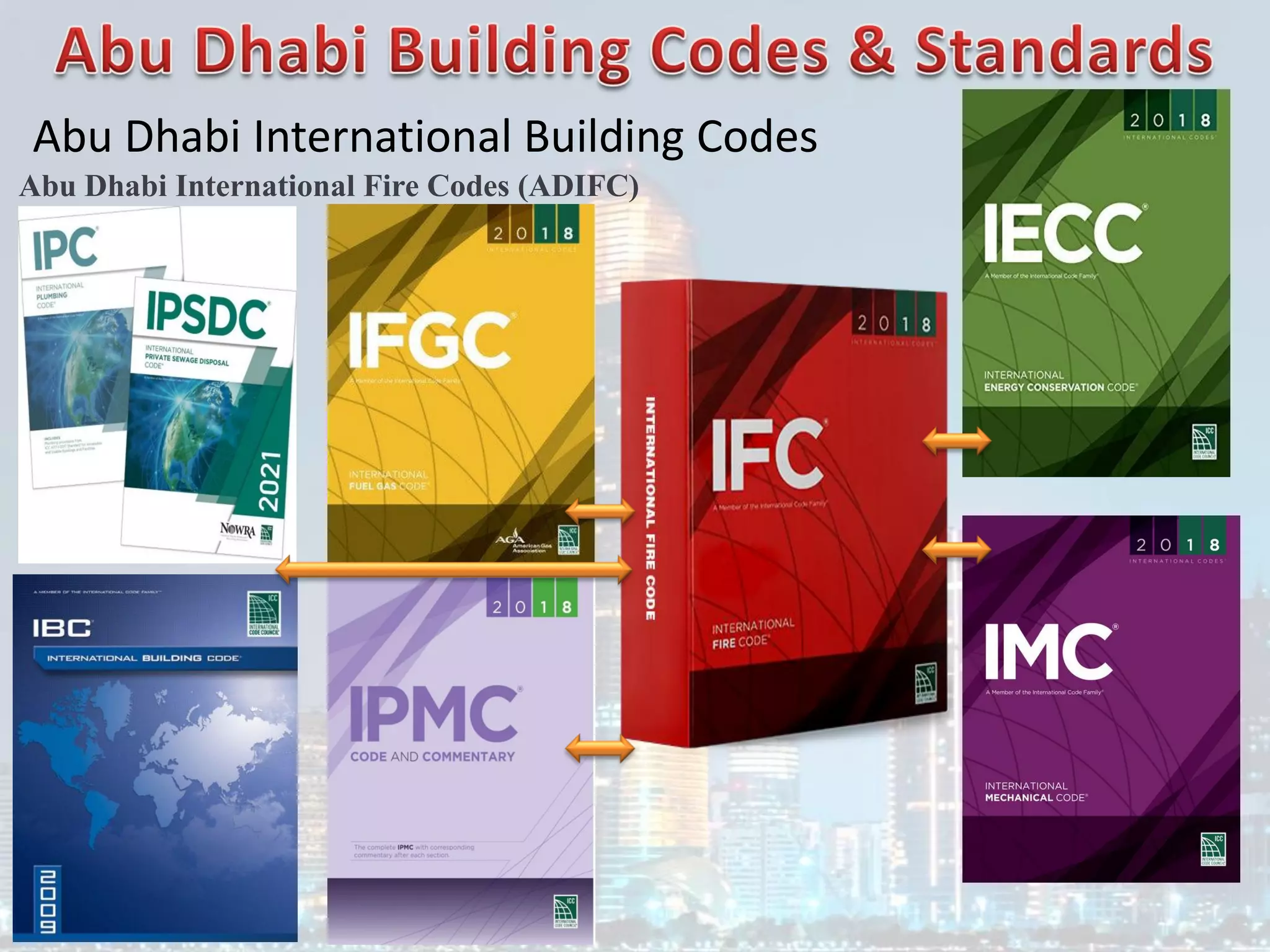
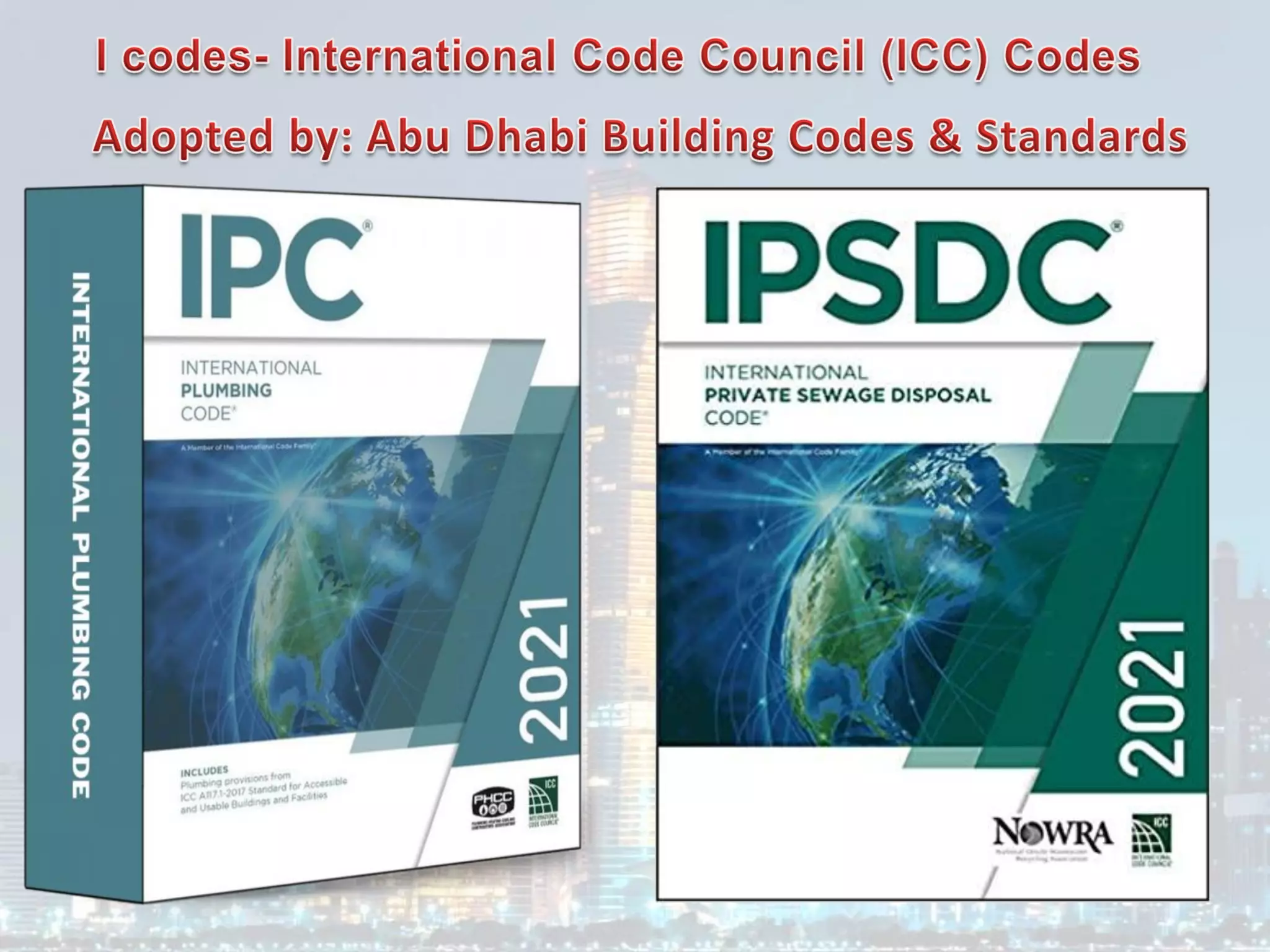
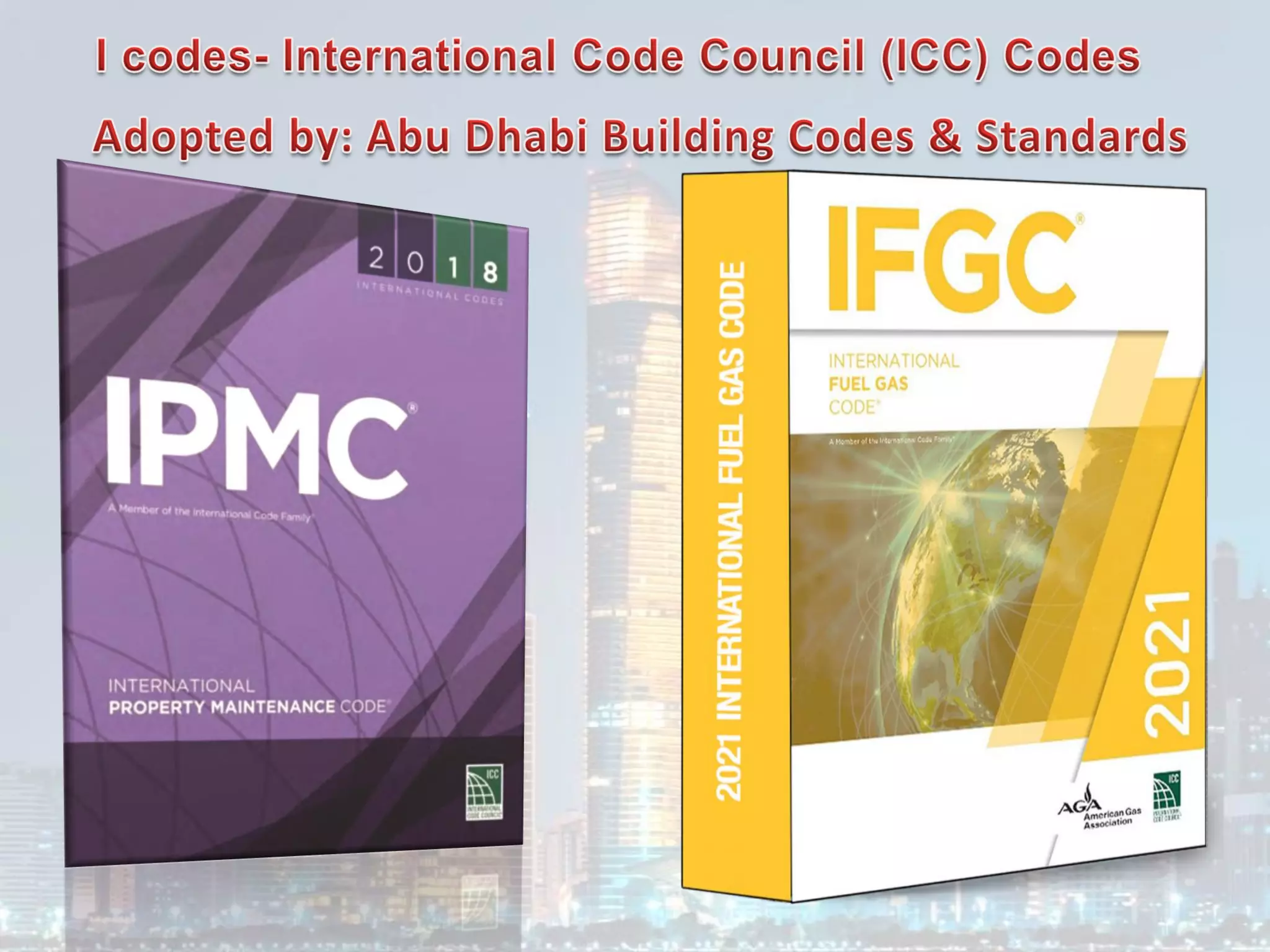
3. Detailed applicable codes of Abu Dhabi include : International Building Code (IBC),
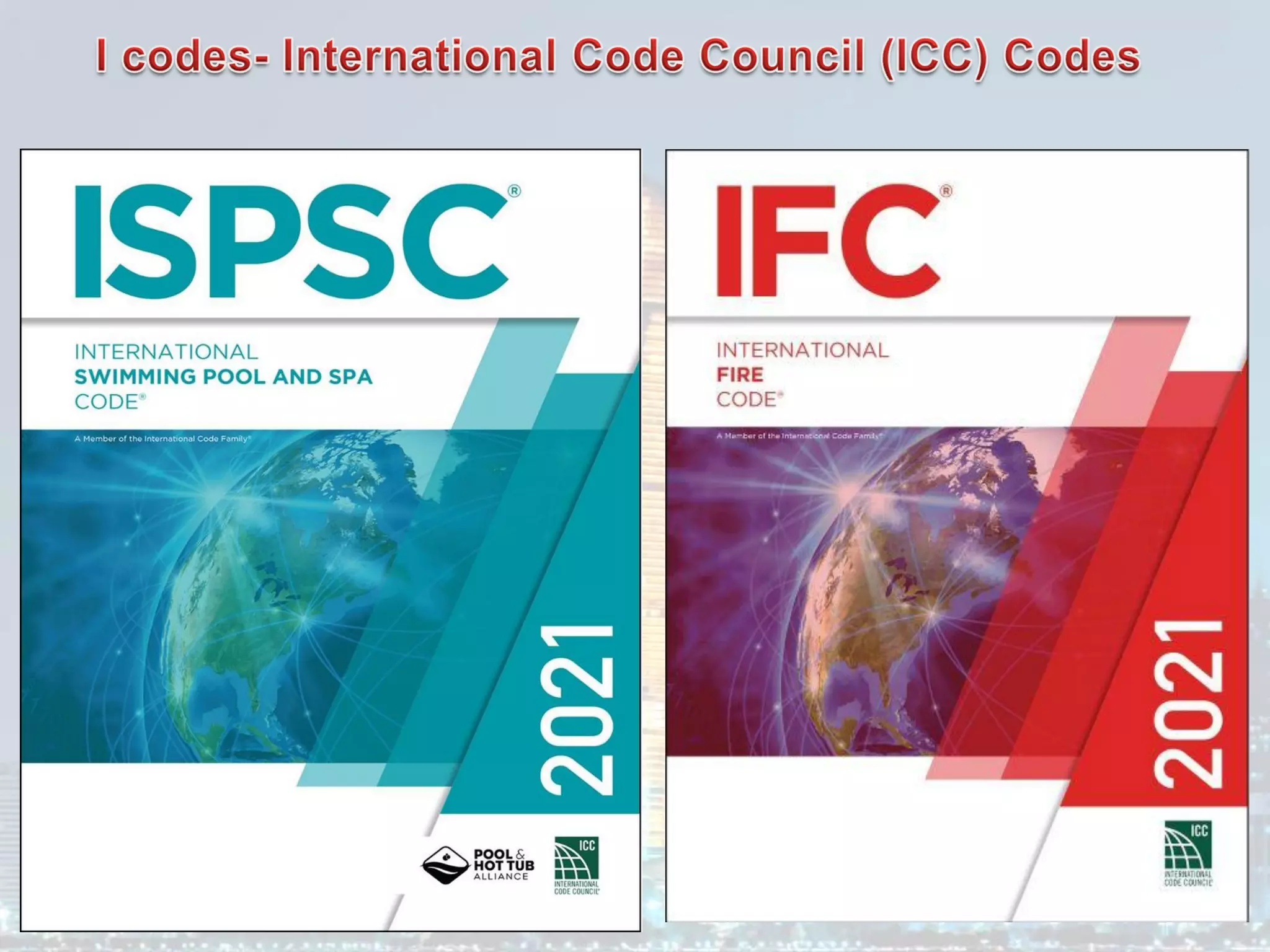
International Energy Conservation Code (IECC), International Fire Code (IFC),
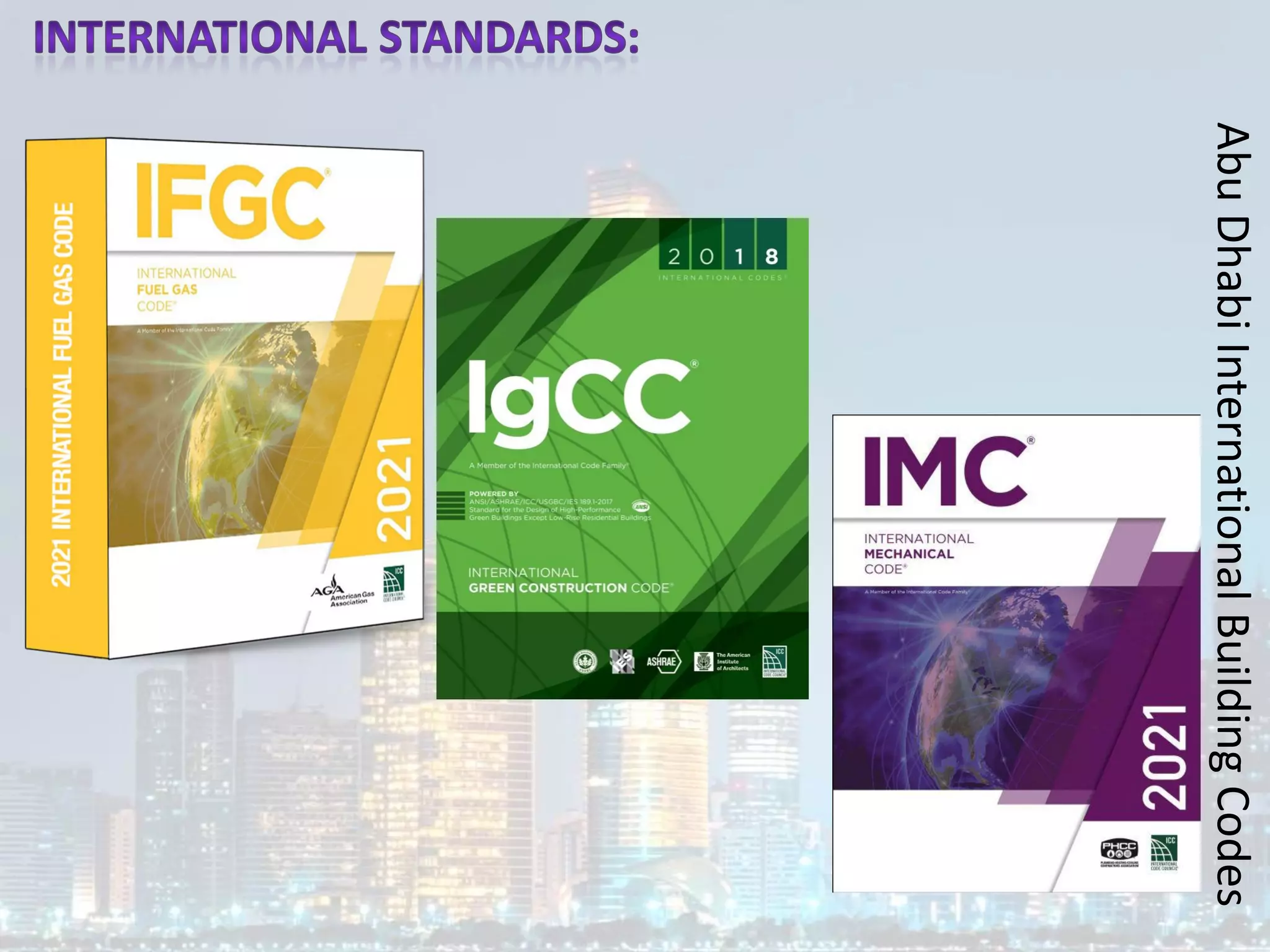
International Fuel Gas Code (IFGC), International Mechanical Code (IMC),
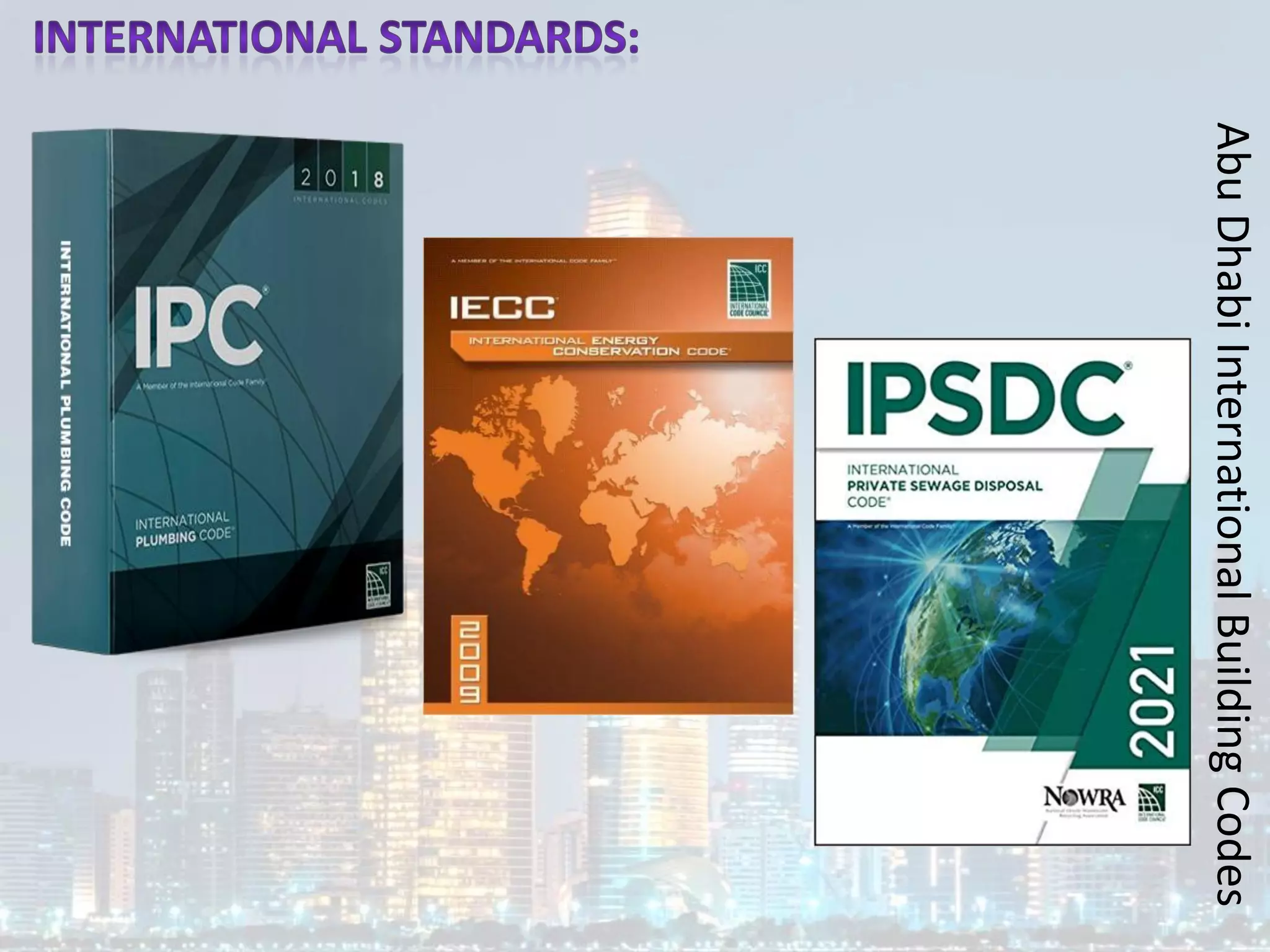
International Plumbing Code (IPC), International Private Sewage Disposal Code
(IPSDC), & International Property Maintenance Code (IPMC).
4. Review the definitions of codes, standards & regulations and be able to distinguish
the differences among them
5. Understand the code objectives, code intents, stated and implied requirements
6. Determine the various uses of codes, standards & regulations for design,
construction, continuing integrity, repairs and quality
7. Know the mandatory, recommended and optional stipulations of the code
8. Recognize the importance & role of compliance and be able to understand codes,
code bodies and their relationships.
9. Heighten knowledge on super codes and standards globally, particular in UAE/ AD.
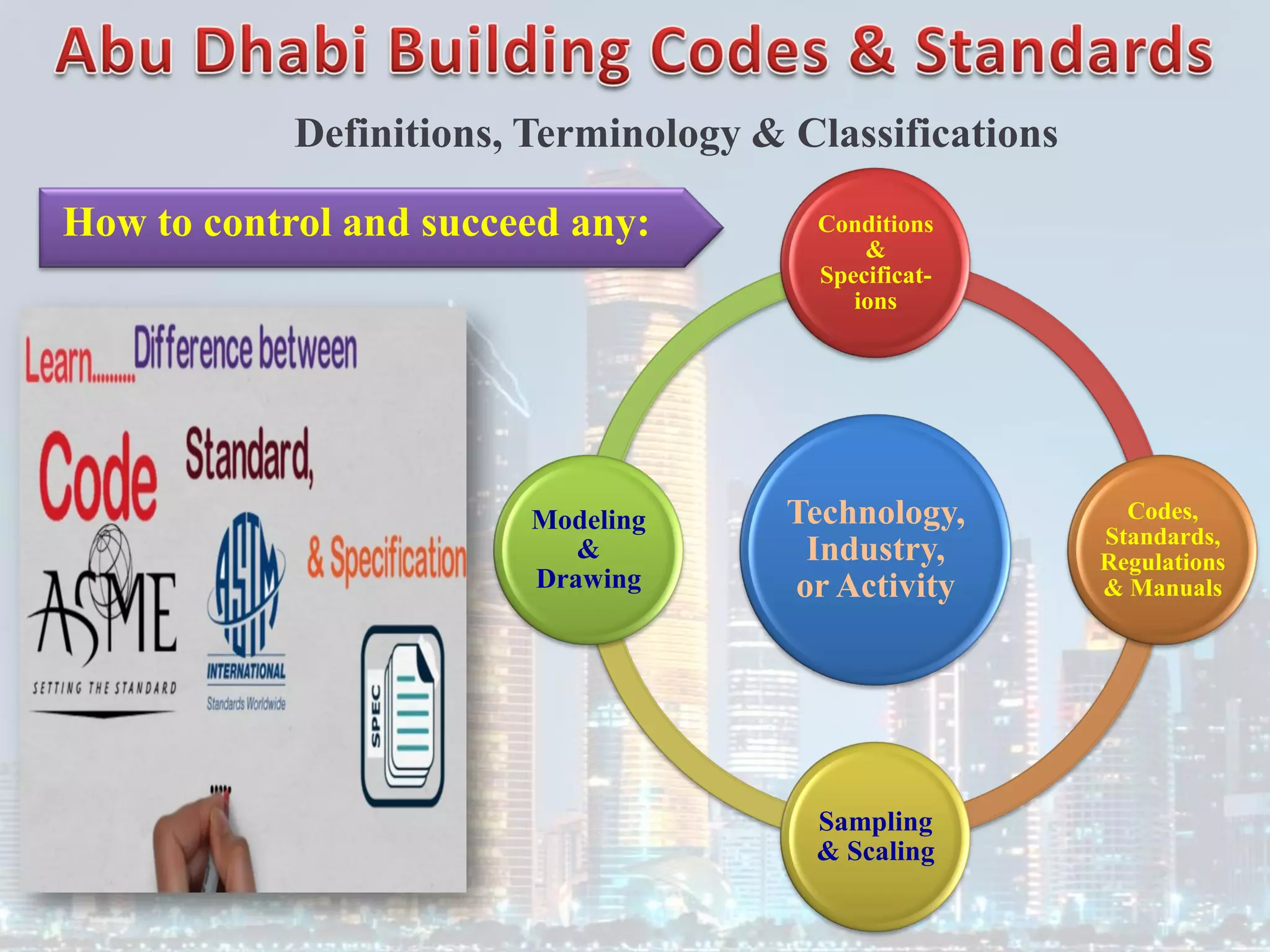
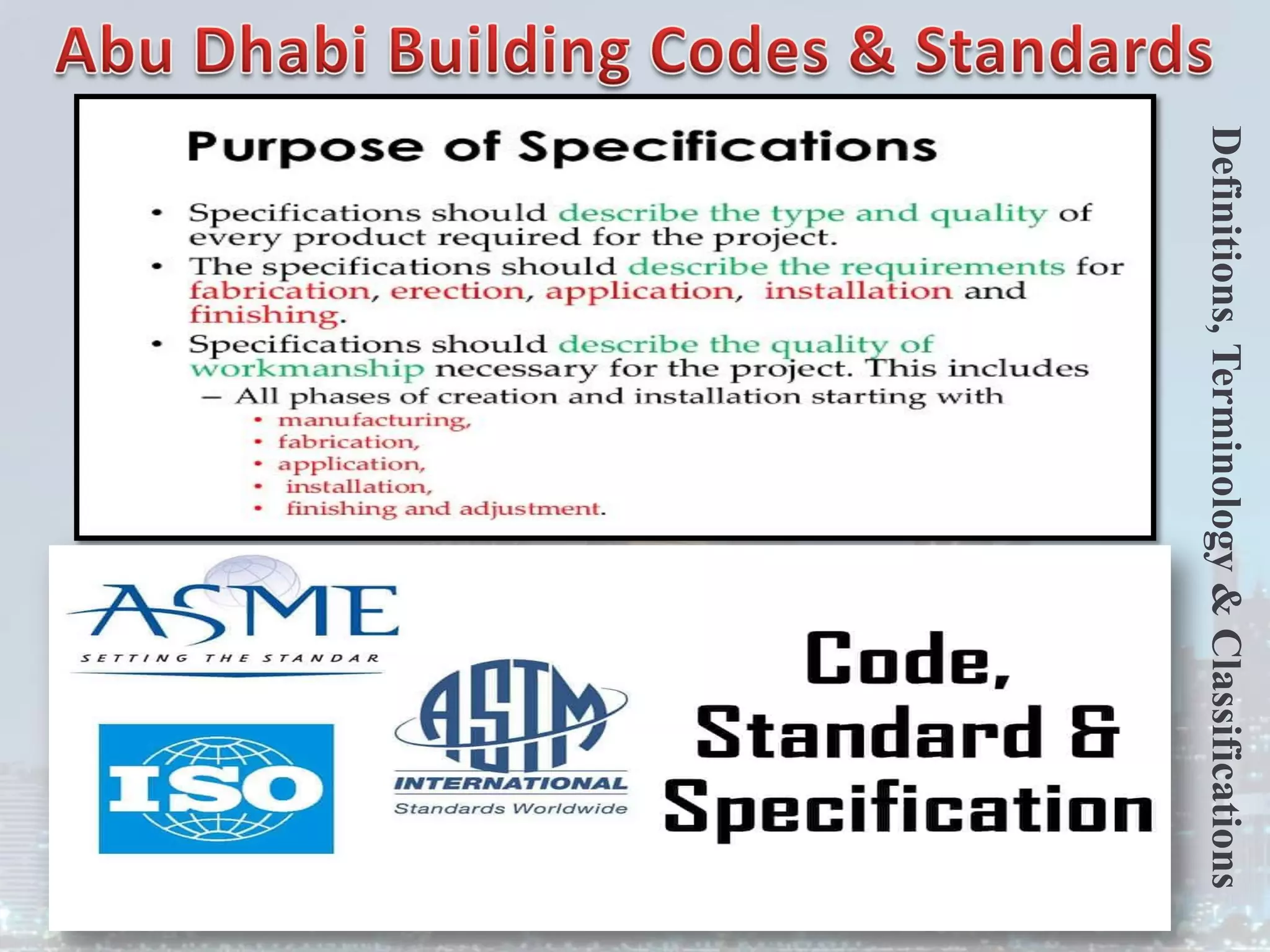
Definitions, Terminology & Classifications
Technology,
Industry,
or Activity
Conditions
&
Specificat-
ions
Codes,
Standards,
Regulations
& Manuals
Sampling
& Scaling
Modeling
&
Drawing
How to control and succeed any:
Definitions, Terminology & Classifications
A standard is a repeatable, harmonized, agreed and documented way of doing
something. Standards contain technical specifications or other precise criteria designed
to be used consistently as a rule, guideline, or definition. They help to make life simpler
and increase the reliability and the effectiveness of many of the goods and services we
use.
Standards result from collective work by experts in a field and provide a consensus at
the time when the standards are developed. As standards in the international arena are
established on a consensus and broad stakeholder basis, they represent what can be
agreed upon. A published standard is therefore the harmonized synthesis of what the
group is prepared to publish. In terms of international and regional standardization, this
is even more important than at the national level: the importance of consensus is critical
because of large and diverse stakeholder groups and needs. Ultimately this may mean
that a standard might lack some of the clarity, detail or specific criteria certain
stakeholder groups or individuals would have preferred.
Standards do not necessarily have to be developed by standardization bodies, such as
ISO or the IEC. Any organization can establish standards for internal or external use.
However, to be truly called a standard, the requirements stated above must be met.
Definitions, Terminology & Classifications
Regulation is broadly defined as imposition of rules by government, backed by the use
of penalties that are intended specifically to modify the economic behavior of
individuals and firms in the private sector. Various regulatory instruments or targets
exist. Or; Regulation is a law, rule, or other order prescribed by authority, especially
to regulate conduct: Safety regulations require the use of impact-resistant helmets.
Or; it is the act of regulating or the state of being regulated: Adolescence is a
potentially important time in the development of emotion regulation.
Code is a system of words, letters, or signs used to represent a message in secret
form, or a system of numbers, letters, or signals used to represent something in a
shorter or more convenient form. Or; a code is a systematic statement of a body of
law, or it is a system of principles or rules, or it is a a system of signals or symbols for
communication.
Manual is a book that gives you practical instructions on how to do something or how
to use something, such as a machine. Or it is a book that is conveniently handled
especially : HANDBOOK which is an instruction manual, or the prescribed movements
in the handling of a weapon or other military item during a drill or ceremony.
Definitions, Terminology & Classifications
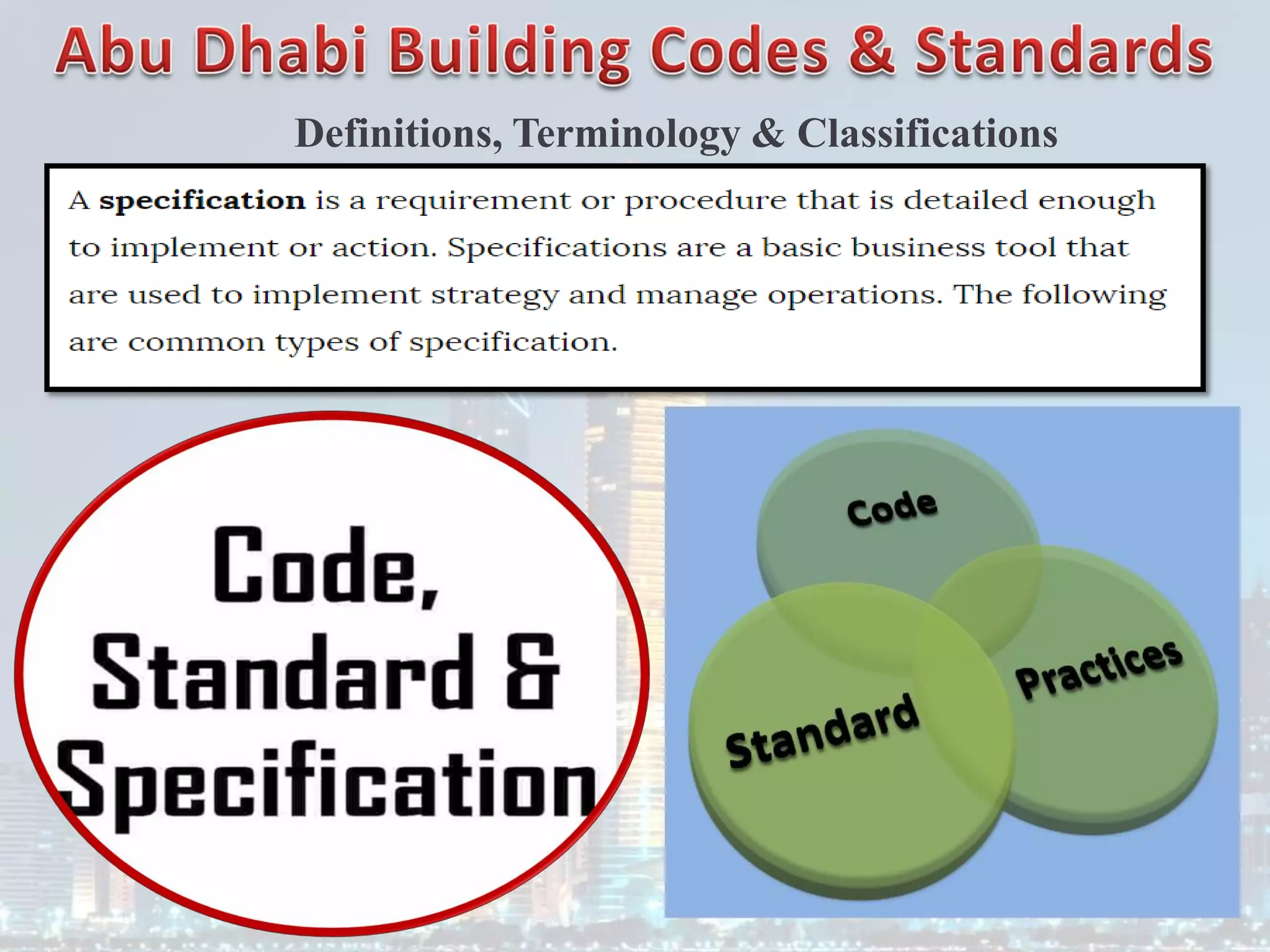
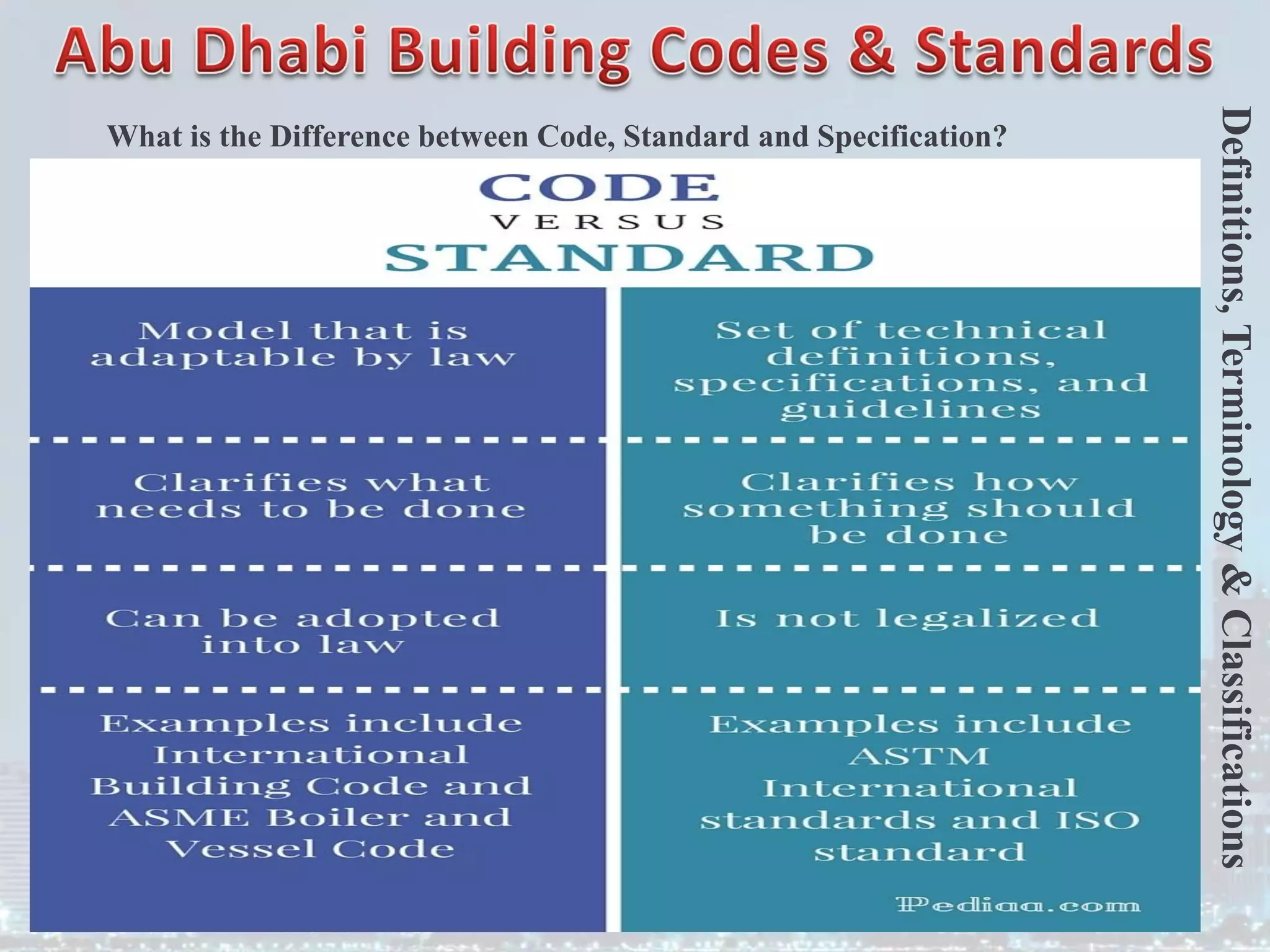
What is the Difference between Code, Standard and Specification?
What is the Standard?
Standard can define as a set of technical definitions and guidelines – or simply “how-to” instructions for
designers and manufacturers. It gives all the requirements for the product, service, and operation.
A designer will use the standard to design the product, and a manufacturer will use the standard for the
manufacturing of the product.
Standard serves as a common language for defining quality and establishing safety criteria for the product.
ASTM, API, and ISO are some examples of the standard. ASTM has more than 12000 standards they
cover all most everything. If you visit the ASTM website, they say that they have standards from toys to
aircraft.
Why is the standard required?
let’s take the example of a mobile phone charger. If you are in the USA and traveling to India, you need an
adapter to use your charger. This is because both the country follows different standards for power sockets. But
your USB cables will work worldwide because they are manufactured as per the globally accepted standard.
In the case of the process industry, piping components are sourced from around the world; we want all these
materials, irrespective of their country of origin should fit perfectly with each other at the site. Standard help to
achieve these;
•By establishing common engineering or technical requirements for products, practices, methods, or operations
that the manufacturer has to follow while manufacturing piping components.
•Standard Built confidence about product quality in the users and
•With standardization cost of production will reduce as you can produce in bulk for global markets.
Definitions, Terminology & Classifications
What is the Difference between Code, Standard and Specification?
What is the Code?
When governmental bodies adopt the standard and become legally enforceable, or when it has been incorporated
into a business contract, the standard will become a code.
ASME Codes are legally enforceable in many US states. Whereas, in the other part of the world, they are not
legally enforceable, but such countries have similar codes.
Please note that the requirements mentioned in the code will only be mandatory requirements if
•The Code is adopted as law by a regulatory body
•It is a part of the business contract
Otherwise, the Code will serve as generally accepted guidelines for design, fabrication, construction, and
installation,
However, all most all process facility follows various American code and Standard in addition to their national
standard.
Examples of the codes are ASME Boiler and Pressure Vessel Code, BS, DIN, etc.
Why is a Code required?
•Code Provides a set of rules that specify the minimum acceptable level of safety & Quality for
manufactured, fabricated, or constructed goods.
•Codes also refer to standards or specifications for the specific details on additional requirements that are
not specified in the Code.
Definitions, Terminology & Classifications
What is the Difference between Code, Standard and Specification?
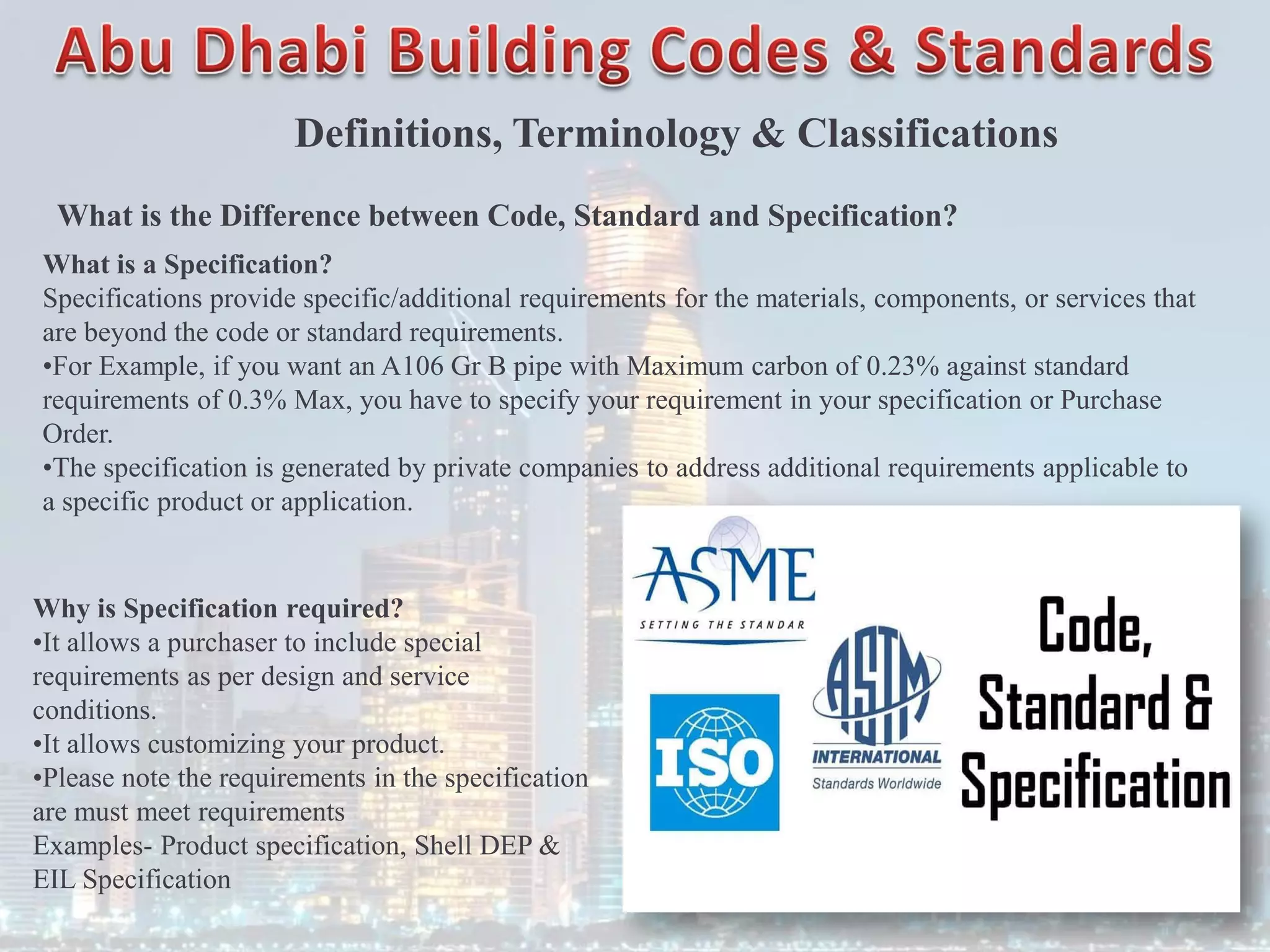
What is a Specification?
Specifications provide specific/additional requirements for the materials, components, or services that
are beyond the code or standard requirements.
•For Example, if you want an A106 Gr B pipe with Maximum carbon of 0.23% against standard
requirements of 0.3% Max, you have to specify your requirement in your specification or Purchase
Order.
•The specification is generated by private companies to address additional requirements applicable to
a specific product or application.
Why is Specification required?
•It allows a purchaser to include special
requirements as per design and service
conditions.
•It allows customizing your product.
•Please note the requirements in the specification
are must meet requirements
Examples- Product specification, Shell DEP &
EIL Specification
Definitions,
Terminology
&
Classifications
What is the Difference between Code, Standard and Specification?
Definitions, Terminology & Classifications
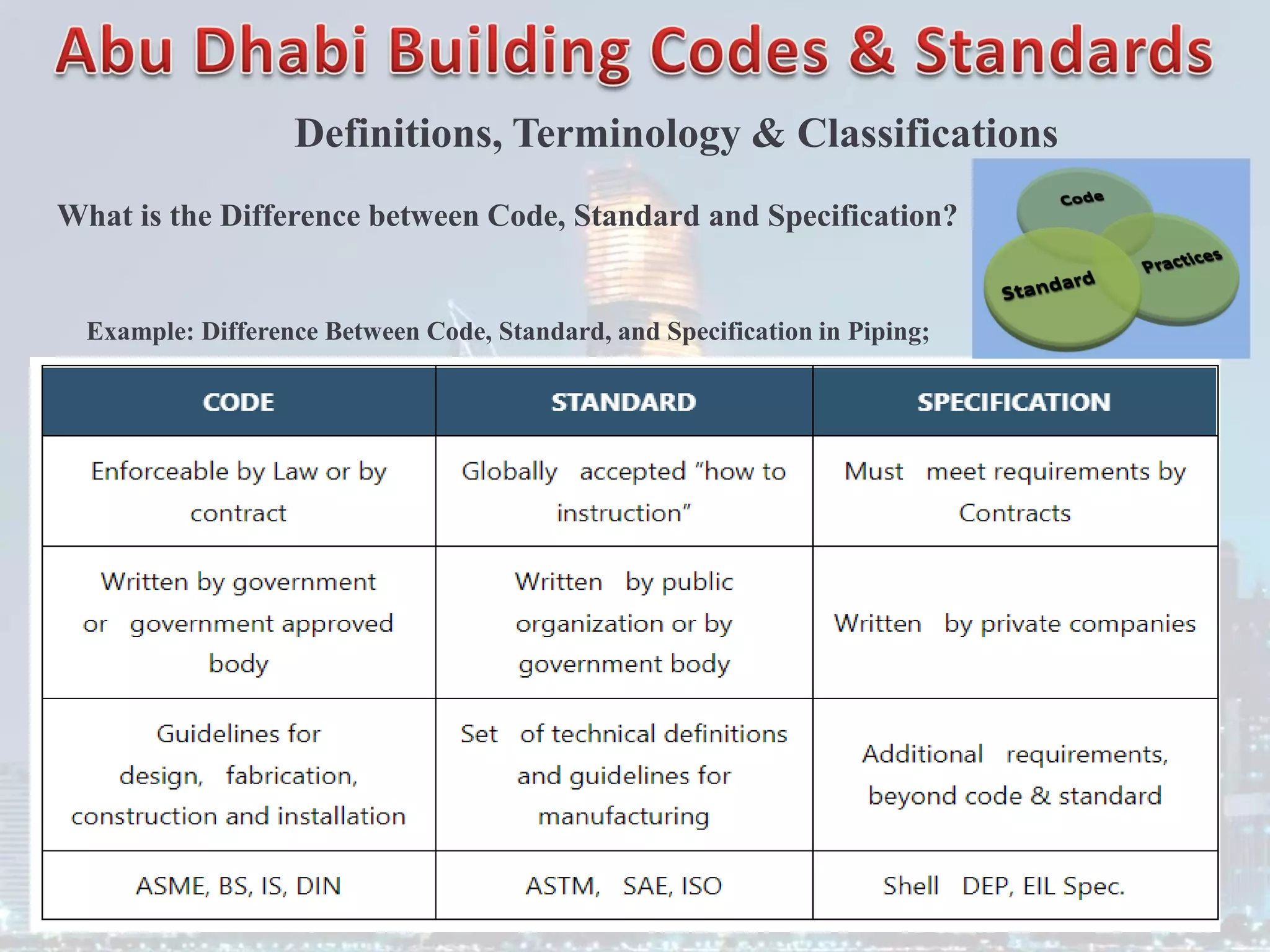
What is the Difference between Code, Standard and Specification?
Example: Difference Between Code, Standard, and Specification in Piping;
Definitions, Terminology & Classifications
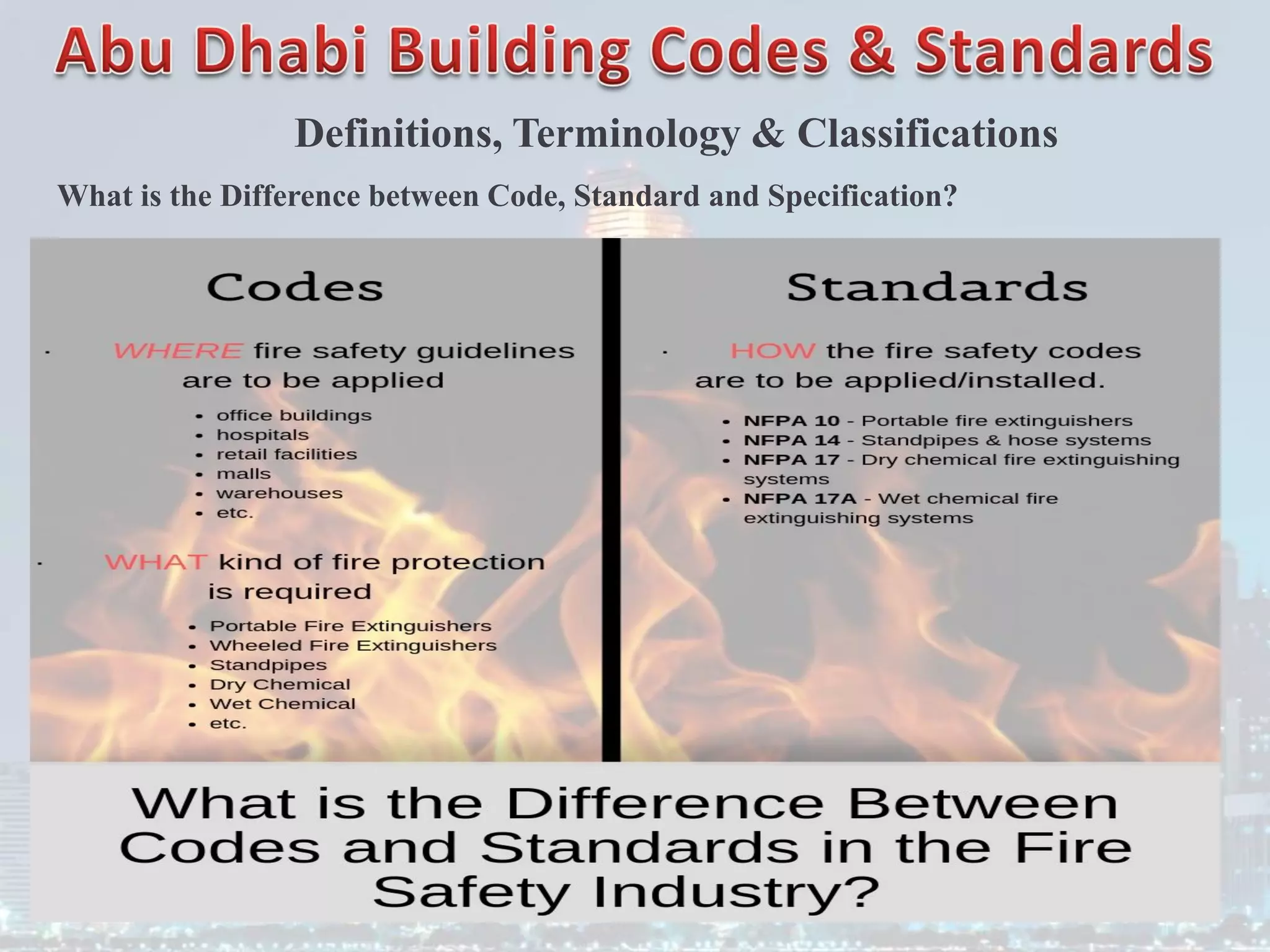
What is the Difference between Code, Standard and Specification?
Definitions,
Terminology
&
Classifications
Building
Codes
Life and Safety Issues
“Some History”
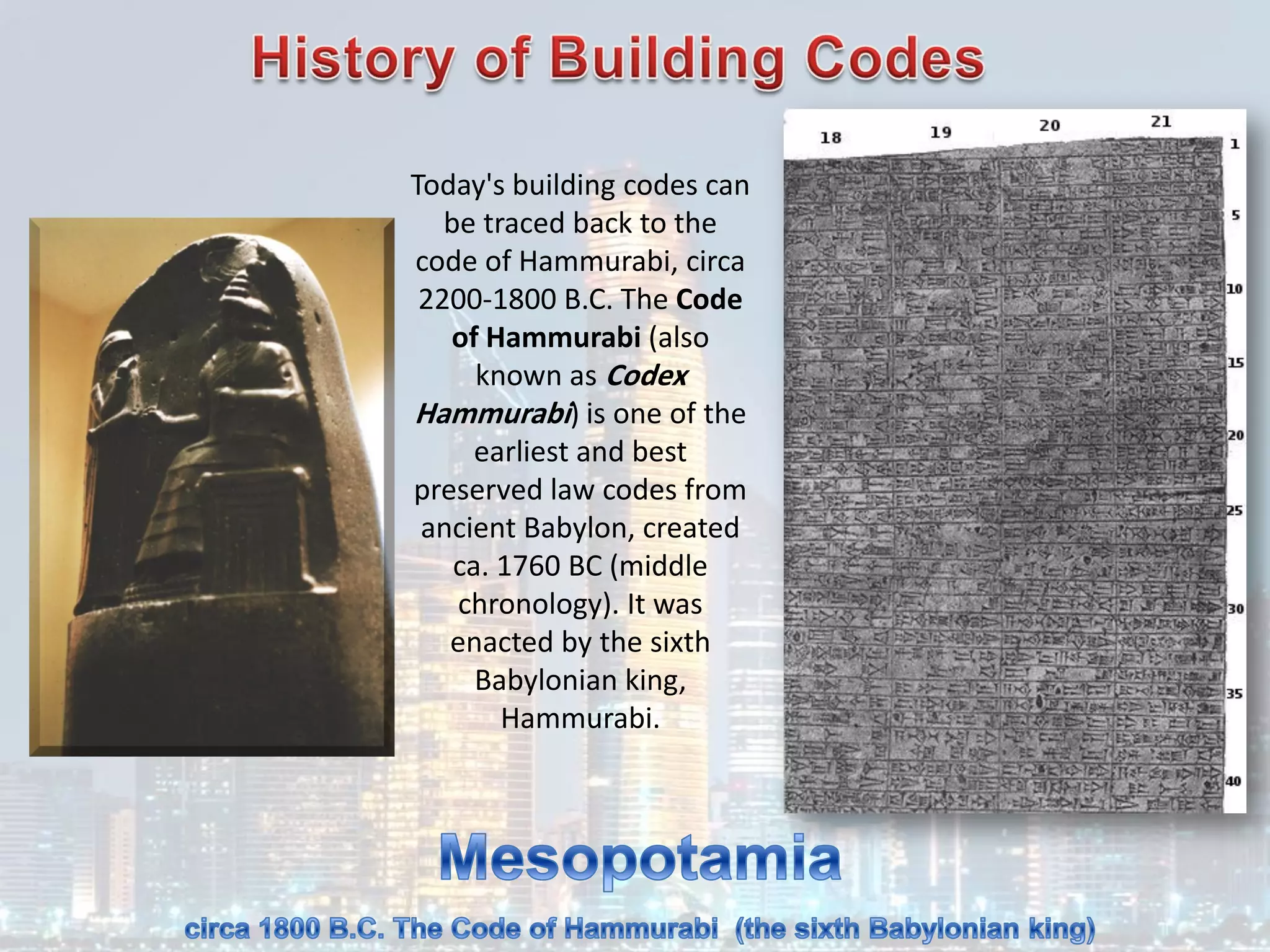
Today's building codes can
be traced back to the
code of Hammurabi, circa
2200-1800 B.C. The Code
of Hammurabi (also
known as Codex
Hammurabi) is one of the
earliest and best
preserved law codes from
ancient Babylon, created
ca. 1760 BC (middle
chronology). It was
enacted by the sixth
Babylonian king,
Hammurabi.
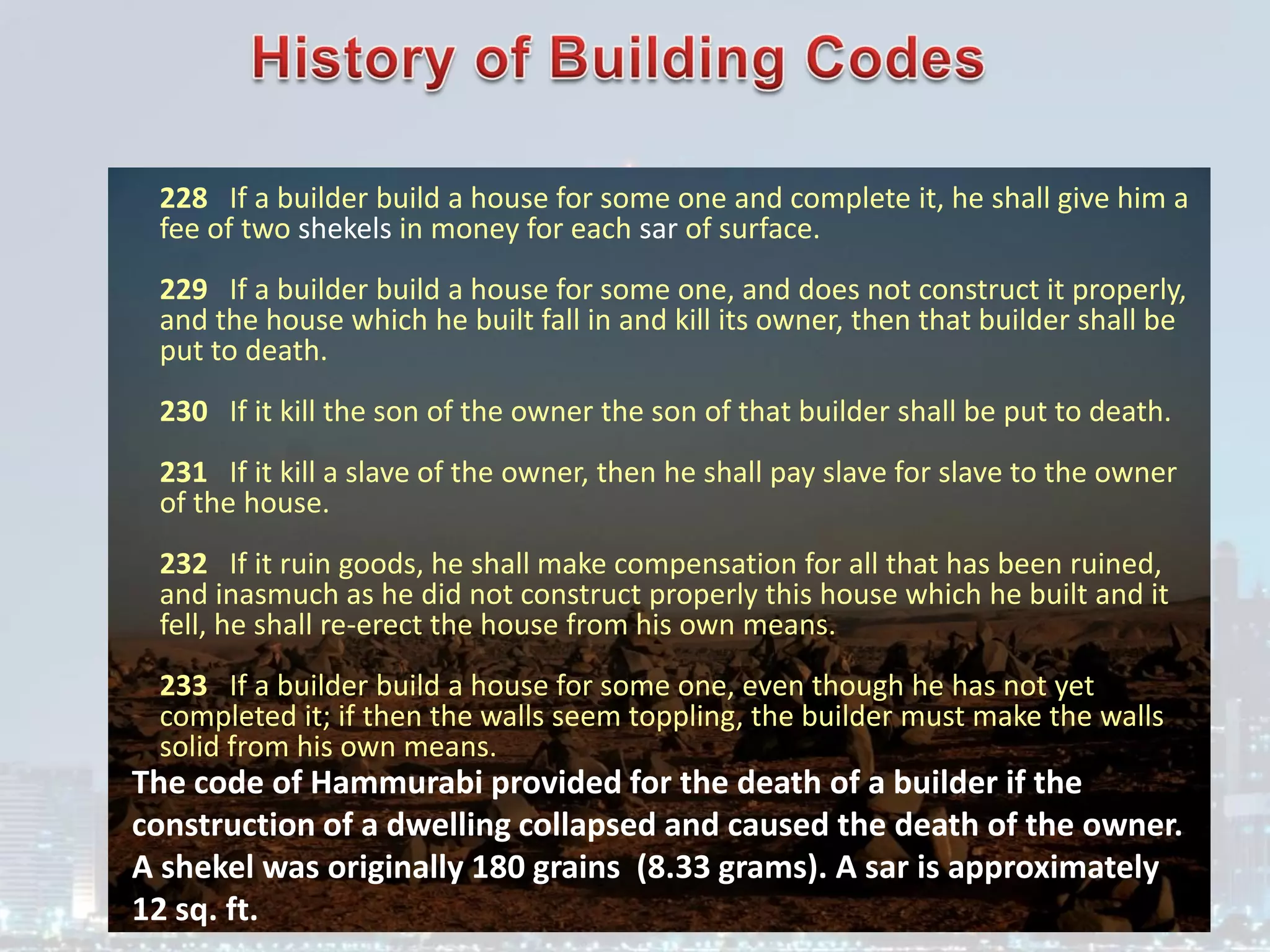
228 If a builder build a house for some one and complete it, he shall give him a
fee of two shekels in money for each sar of surface.
229 If a builder build a house for some one, and does not construct it properly,
and the house which he built fall in and kill its owner, then that builder shall be
put to death.
230 If it kill the son of the owner the son of that builder shall be put to death.
231 If it kill a slave of the owner, then he shall pay slave for slave to the owner
of the house.
232 If it ruin goods, he shall make compensation for all that has been ruined,
and inasmuch as he did not construct properly this house which he built and it
fell, he shall re-erect the house from his own means.
233 If a builder build a house for some one, even though he has not yet
completed it; if then the walls seem toppling, the builder must make the walls
solid from his own means.
The code of Hammurabi provided for the death of a builder if the
construction of a dwelling collapsed and caused the death of the owner.
A shekel was originally 180 grains (8.33 grams). A sar is approximately
12 sq. ft.
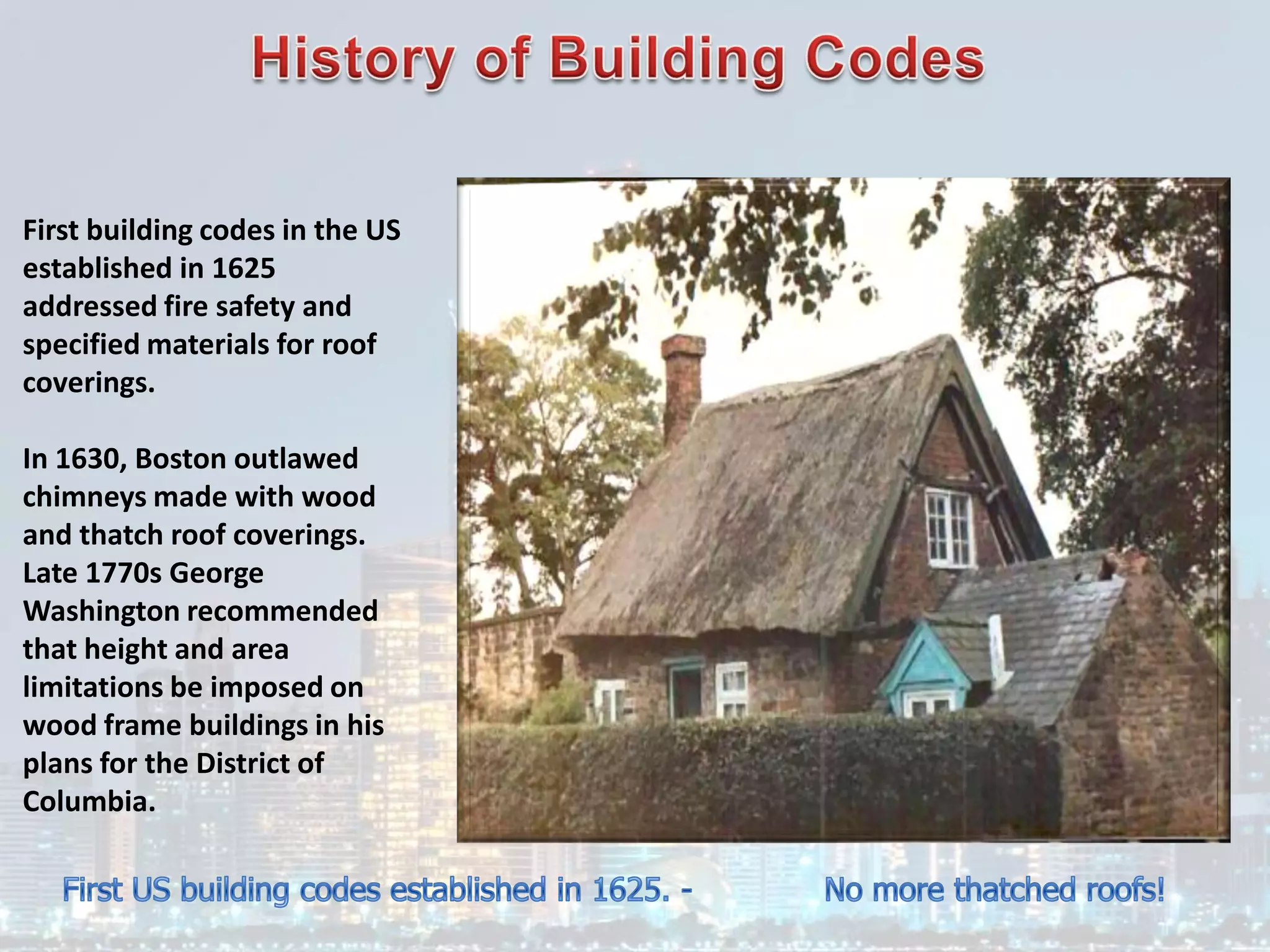
First building codes in the US
established in 1625
addressed fire safety and
specified materials for roof
coverings.
In 1630, Boston outlawed
chimneys made with wood
and thatch roof coverings.
Late 1770s George
Washington recommended
that height and area
limitations be imposed on
wood frame buildings in his
plans for the District of
Columbia.
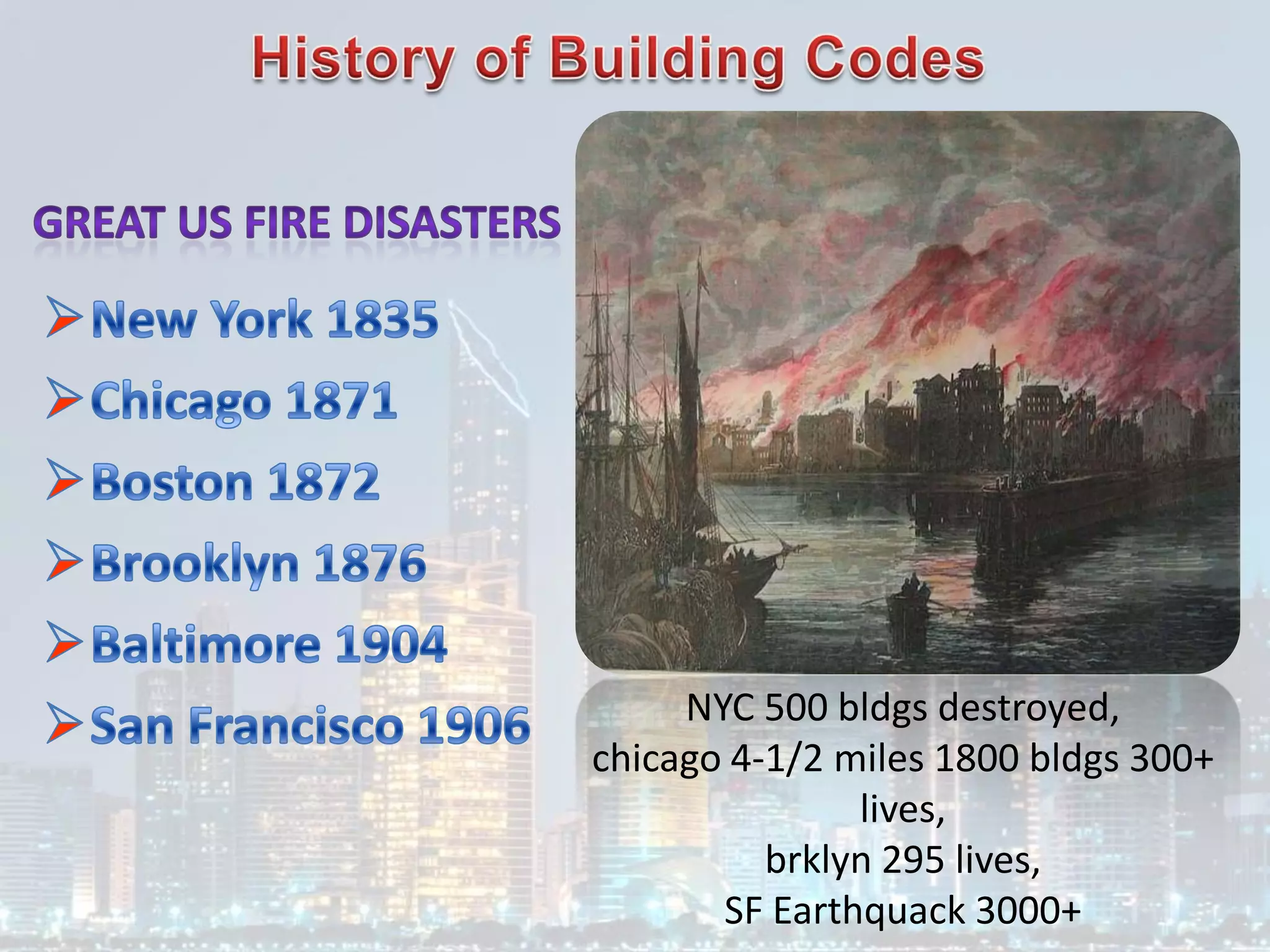
NYC 500 bldgs destroyed,
chicago 4-1/2 miles 1800 bldgs 300+
lives,
brklyn 295 lives,
SF Earthquack 3000+
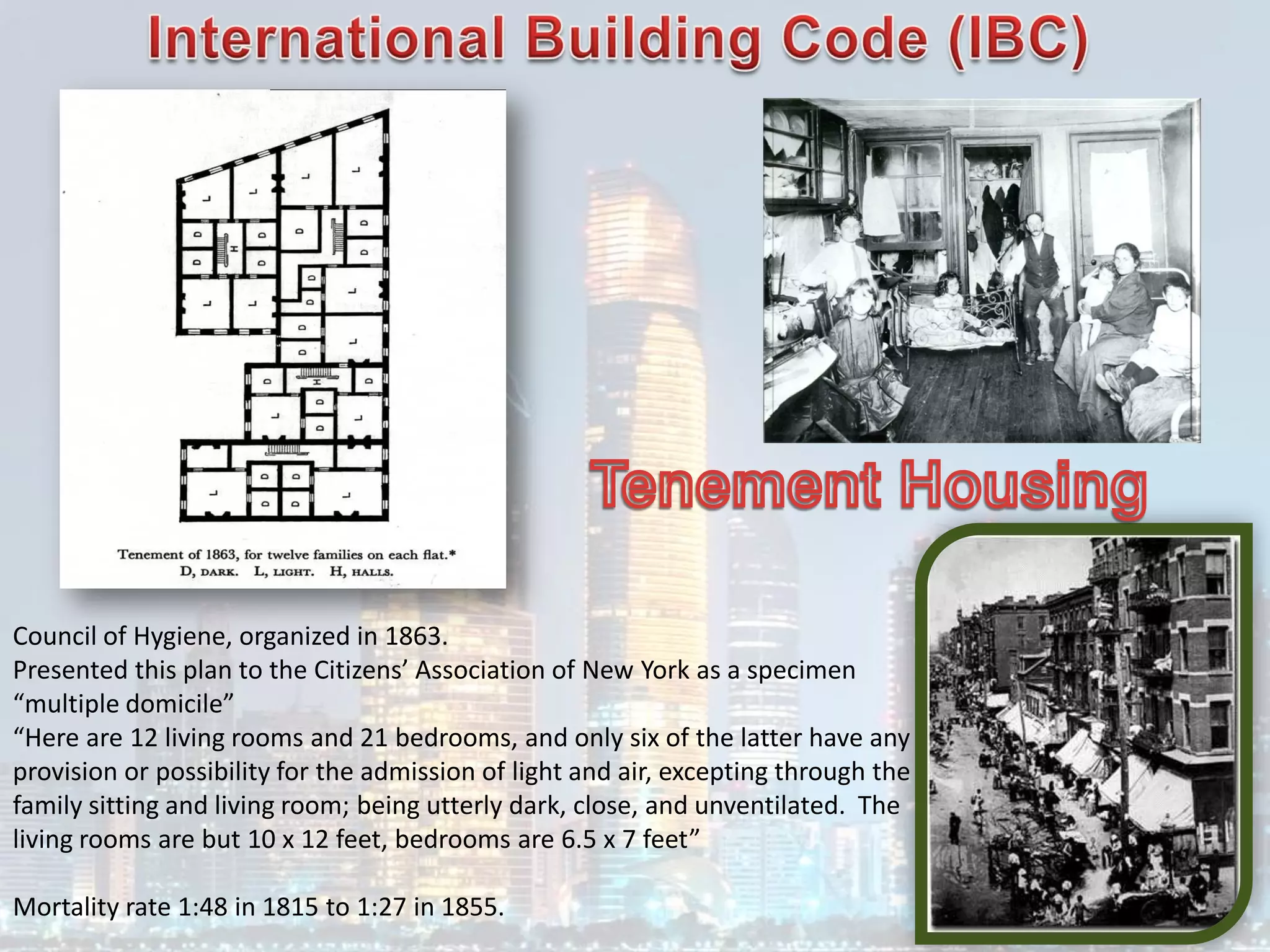
Council of Hygiene, organized in 1863.
Presented this plan to the Citizens’ Association of New York as a specimen
“multiple domicile”
“Here are 12 living rooms and 21 bedrooms, and only six of the latter have any
provision or possibility for the admission of light and air, excepting through the
family sitting and living room; being utterly dark, close, and unventilated. The
living rooms are but 10 x 12 feet, bedrooms are 6.5 x 7 feet”
Mortality rate 1:48 in 1815 to 1:27 in 1855.
Disease
Tuberculosis, cholera, small pox; A death of a child was recorded as “plainly due to suffocation
in the foul air of an unventilated apartment”.
Injuries lead to concern
Today’s building code addresses many
issues of life and safety.
Prior to the International Code Council,
building safety codes were regional. Most
codes were produced by three model cod
organizations.
BOCA National Codes were used mostly in
Eastern and Great Lakes states;
ICBO Uniform Codes in Western and
Midwest states;
SBCCI Standard codes in Southern states.
As a result the construction industry often
faced the challenge, and cost, of building
to different codes in different areas of the
country.
BUILDING
PLANNING
and
CONSTRUCTION
BUILDING
PLANNING
FOUNDATIONS
FLOORS
WALLS
CEILING
AND ROOF
CHIMNEYS
And
FIREPLACES
ELECTRICAL
and
MECHANICAL
SYSTEMS
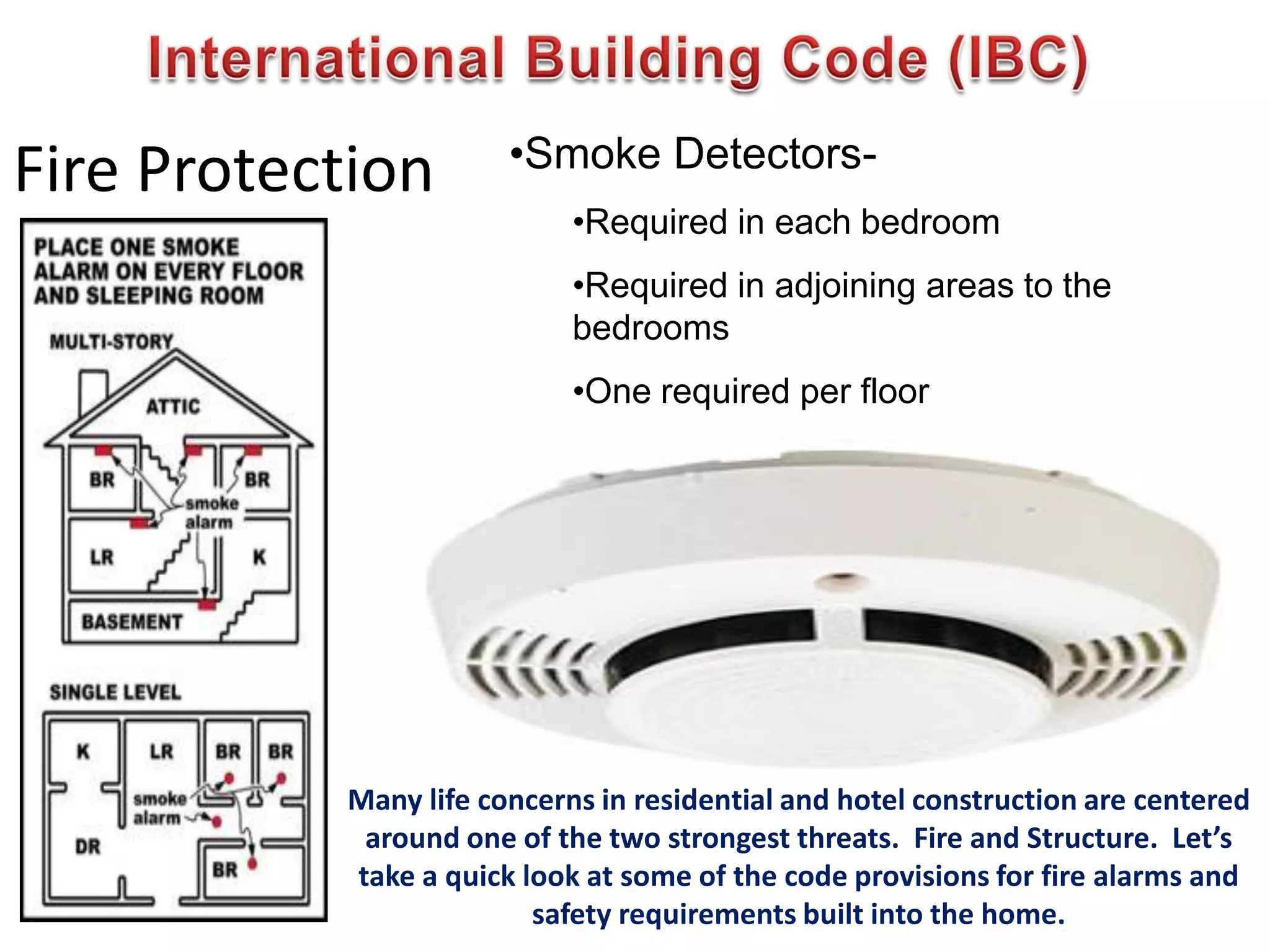
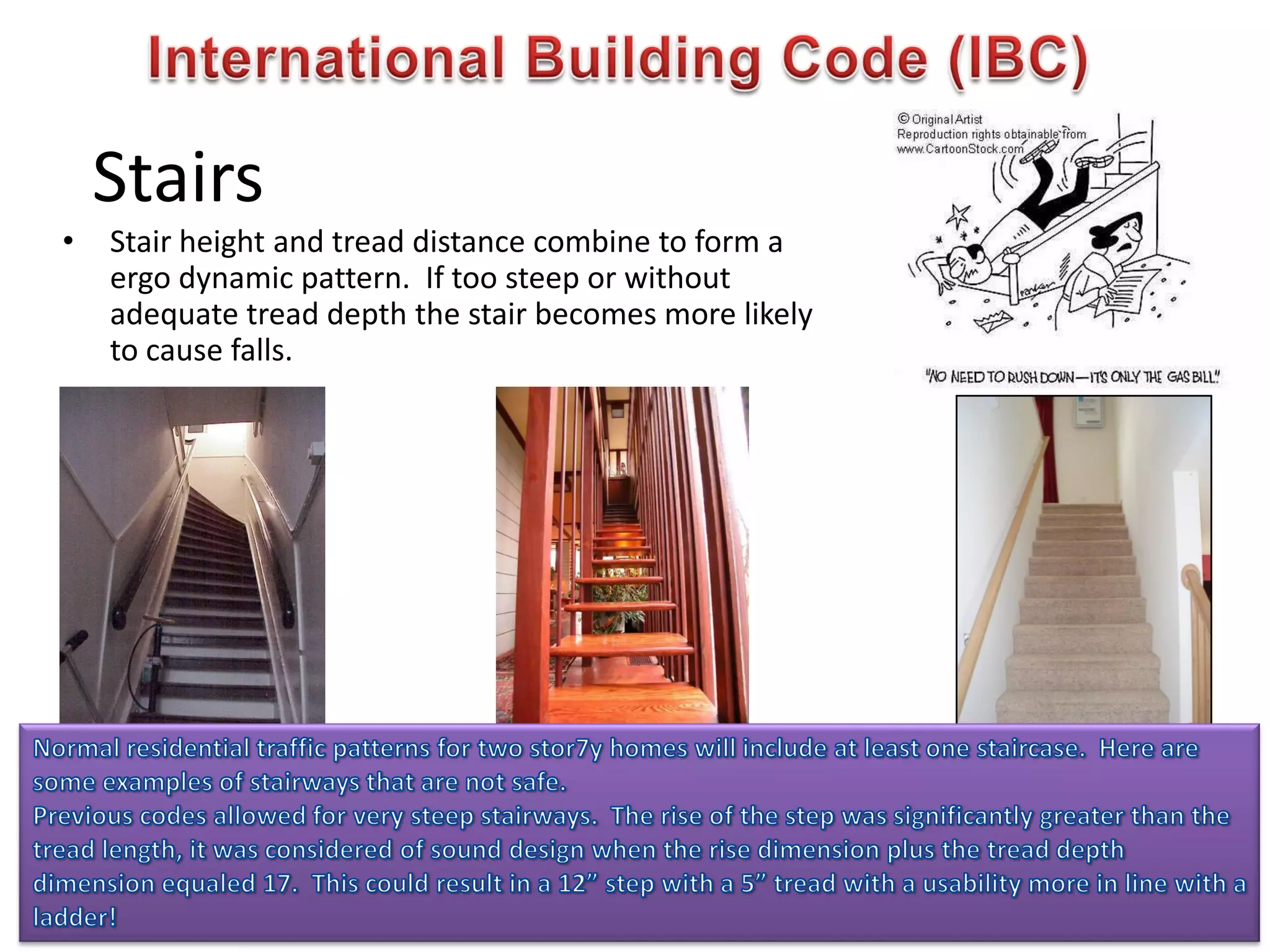
Modern building codes include all aspects of the construction trade.
•Light, Ventilation, Heating
•Room sizes and Ceiling heights
•Sanitation and bathroom
requirements
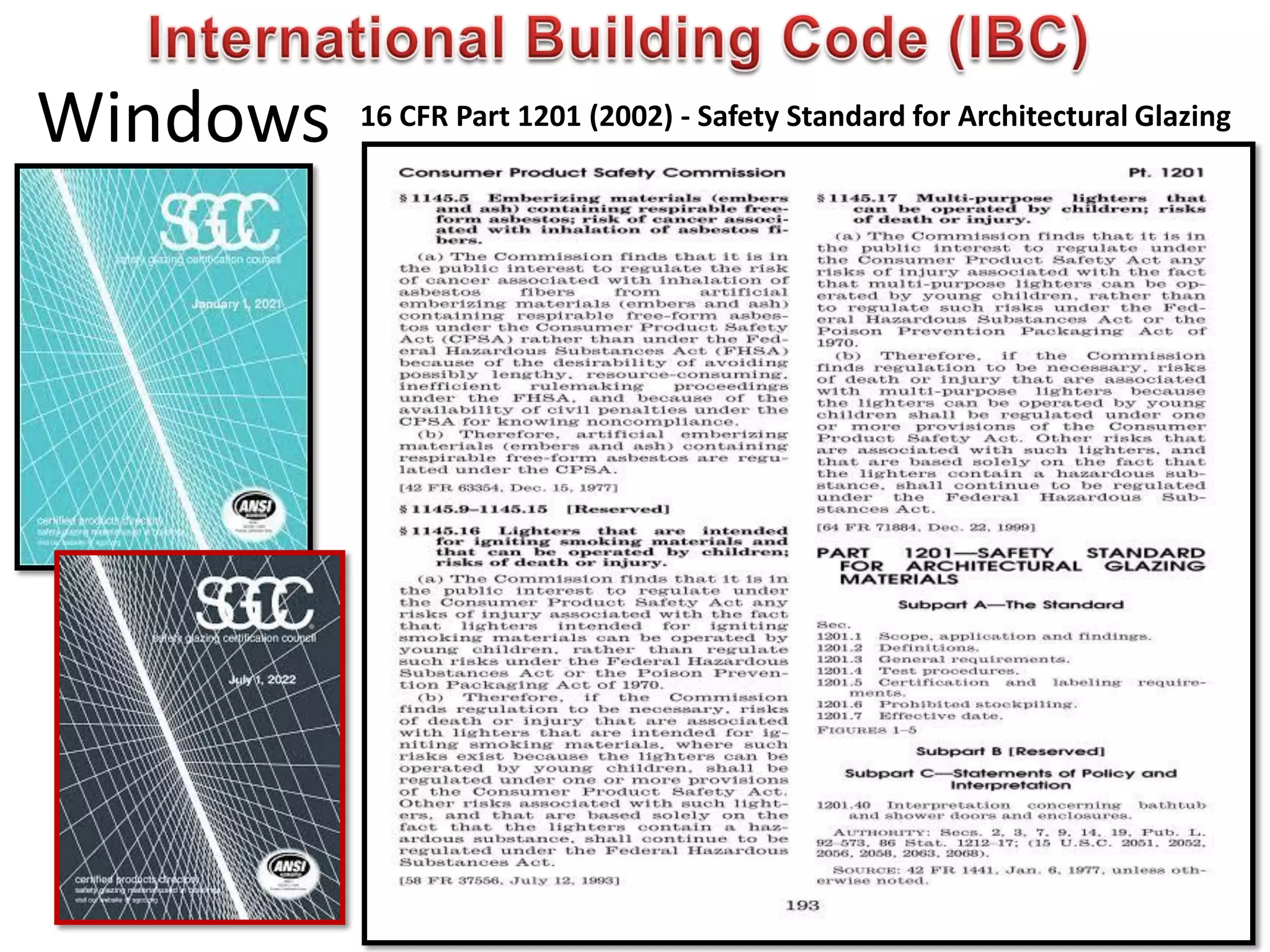
•Glazing and Hazardous
locations
•Other use areas—like Garages
•How to get out safely.
•Stairways and special
requirements
•Fire protection
•Moisture and decay protection
•Pesky pests… (termites among
others)
•And more….addresses, flood
stuff…
Types & Classifications of Specifications
General Specifications Detailed Specifications
Definitions,
Terminology
&
Classifications
Types
of
Specifications
Definitions, Terminology & Classifications
Types
of
Specifications
Definitions, Terminology & Classifications
8 Types of
Specifications
Requirement
Specifications
Design
Specifications
Material
Specifications
Standard
Specifications
Interface
Specifications
Test
Specifications
Performance
Specifications
Quality
Specifications
Documentation of a
business need
Descriptions of how
requirements will be
realized
Types
of
Specifications
Definitions,
Terminology
&
Classifications
Types of
Specifications
Definitions,
Terminology
&
Classifications
Types
of
Specifications
Definitions,
Terminology
&
Classifications
Types
of
Specifications
Definitions,
Terminology
&
Classifications
Types
of
Specifications
Definitions,
Terminology
&
Classifications
Types
of
Specifications
Definitions,
Terminology
&
Classifications
Types
of
Specifications
Definitions,
Terminology
&
Classifications
Types
of
Specifications
In civil engineering, the specification is a detailed
description document of all workmanship and materials
which are going to be used in the building construction
work.
Specifications play an important role in the execution of
the quality of work, so the specification must be clear,
concise, and free from any uncertainty.
Definitions,
Terminology
&
Classifications
Types
of
Specifications
Types of Construction Specifications
According to the American Institute of Architects (AIA) Document A201-2007,
the Contract Documents for a construction project consist of “the Agreement,
Conditions of the Contract, Drawing, Specifications, Addenda…”, as well as
other miscellaneous documents associated with the contract between the project
Owner and the Contractor hired to complete the work. Construction
specifications, as noted, become a part of the legal documents of the agreement
and form a cornerstone of the project design. In fact, in most cases, the
construction specifications override the project drawings in the event of
conflicting information.
The purpose of construction specifications is to delineate the requirements
regarding the materials, products, installation procedures and quality aspects
involved with execution of the work and fulfillment of the contract.
There are three main types of construction specifications:
1. performance,
2. prescriptive , and
3. Proprietary.
which are described below.
Definitions, Terminology & Classifications
Types
of
Specifications
1- Performance Specifications:
A performance specification is a document that specifies the operational requirements of a
component or installation. Simply put, a performance specification tells the contractor what the
final installed product must be capable of doing. The contractor is not instructed as to how to
accomplish the task of meeting the performance specification requirements - only as to how the
component must function after installation.
For example, a performance specification may be used in the construction of an industrial
pumping system. The specification would provide a required pumping rate (say 500 gallons per
minute), a required pressure (20 psi) and the difference in height between the pump and the final
destination (+40 feet). The specification will also state that the liquid to be pumped will be at a
temperature of 140°F and is corrosive (pH of 3). It is up to the contractor to provide pumping
equipment that meets or exceeds the requirements stated in the specification. In many cases the
contractor will also be required to test equipment to make sure that is operating properly, and will
provide operations manuals.
The general concept behind the performance specification is for the architect or engineer to
describe what they need, and the contractor to determine the best way to get there. The
performance specification focuses on the outcome and shifts the selection of materials and
methods, as well as a portion of the design work, onto the shoulders of the contractor. This
approach can provide incentives for innovation and flexibility in the construction approach, but
also reduces the amount of control that the architect or engineer has over the project./p>
Definitions, Terminology & Classifications
Types
of
Specifications
2- Prescriptive Specifications:
Prescriptive specifications convey the requirements of a project through a detailed
explanation of the materials that the contractor must use, and the means of installing
those materials. This type of specification will typically be formatted in a manner similar
to the following sections:
A. General: This section will typically contain references to national/international
standards, design requirements, a list of required submittals from the contractor
to the architect/engineer, quality control requirements and product handling
requirements.
B. Products: This section will describe, in detail, the various products required for
the task covered by the specification along with the individual structural and
performance requirements of each product.
C. Execution: This section will explain how to prepare the materials and conduct
the installation, including the testing requirements to be followed.
Prescriptive specifications shift more of the project design control onto the shoulders of
the architect or engineer and away from the contractor by establishing a set of rules that is
to be followed for each project component. This type of specification provides more
certainty regarding the final product composition than the performance specification, and
is very frequently used for highly complex portions of a project.
Definitions, Terminology & Classifications
Types
of
Specifications
3- Proprietary Specifications:
Proprietary specifications are those that require the use of a single
approved product type for any particular installation. Proprietary
specifications are often used in cases where there is existing equipment
or installations already on site. In these cases the owner may want to
maintain consistency of materials or possibly simply prefers a specific
type of product. Also, in highly complex installations where there is only
one specific piece of equipment that will accomplish a specified task, a
proprietary specification is required.
Architects and engineers typically try to avoid utilizing proprietary
specifications except when absolutely necessary, and will usually allow
the contractor to select from a list of approved suppliers. Requiring the
use of one specific product type can lead to the perception of favoritism
towards a certain manufacturer and may eliminate competition during
the bid phase, which may increase the project cost.
Definitions, Terminology & Classifications
Types of
Specifications
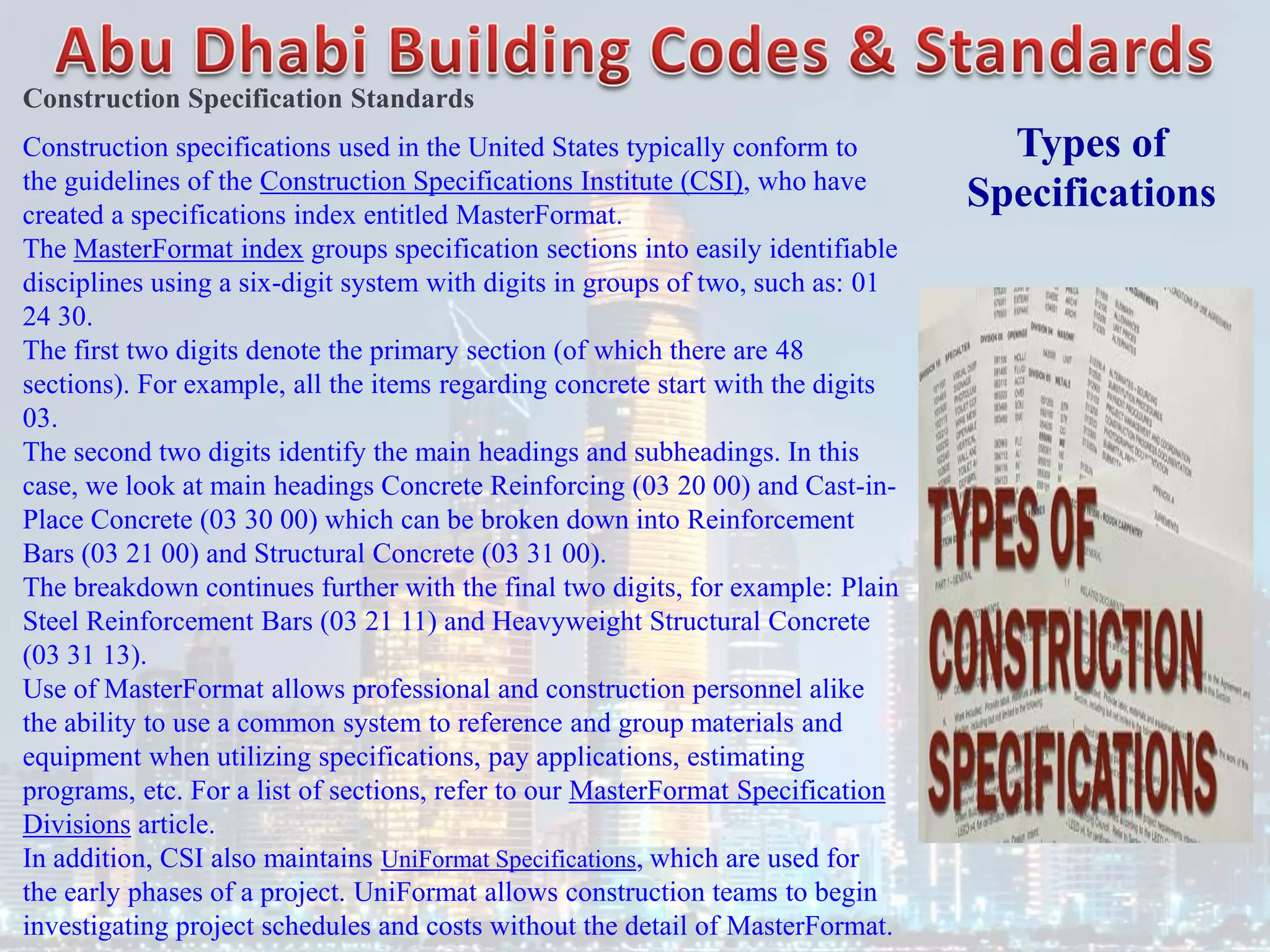
Construction Specification Standards
Construction specifications used in the United States typically conform to
the guidelines of the Construction Specifications Institute (CSI), who have
created a specifications index entitled MasterFormat.
The MasterFormat index groups specification sections into easily identifiable
disciplines using a six-digit system with digits in groups of two, such as: 01
24 30.
The first two digits denote the primary section (of which there are 48
sections). For example, all the items regarding concrete start with the digits
03.
The second two digits identify the main headings and subheadings. In this
case, we look at main headings Concrete Reinforcing (03 20 00) and Cast-in-
Place Concrete (03 30 00) which can be broken down into Reinforcement
Bars (03 21 00) and Structural Concrete (03 31 00).
The breakdown continues further with the final two digits, for example: Plain
Steel Reinforcement Bars (03 21 11) and Heavyweight Structural Concrete
(03 31 13).
Use of MasterFormat allows professional and construction personnel alike
the ability to use a common system to reference and group materials and
equipment when utilizing specifications, pay applications, estimating
programs, etc. For a list of sections, refer to our MasterFormat Specification
Divisions article.
In addition, CSI also maintains UniFormat Specifications, which are used for
the early phases of a project. UniFormat allows construction teams to begin
investigating project schedules and costs without the detail of MasterFormat.
Types
of
Specifications
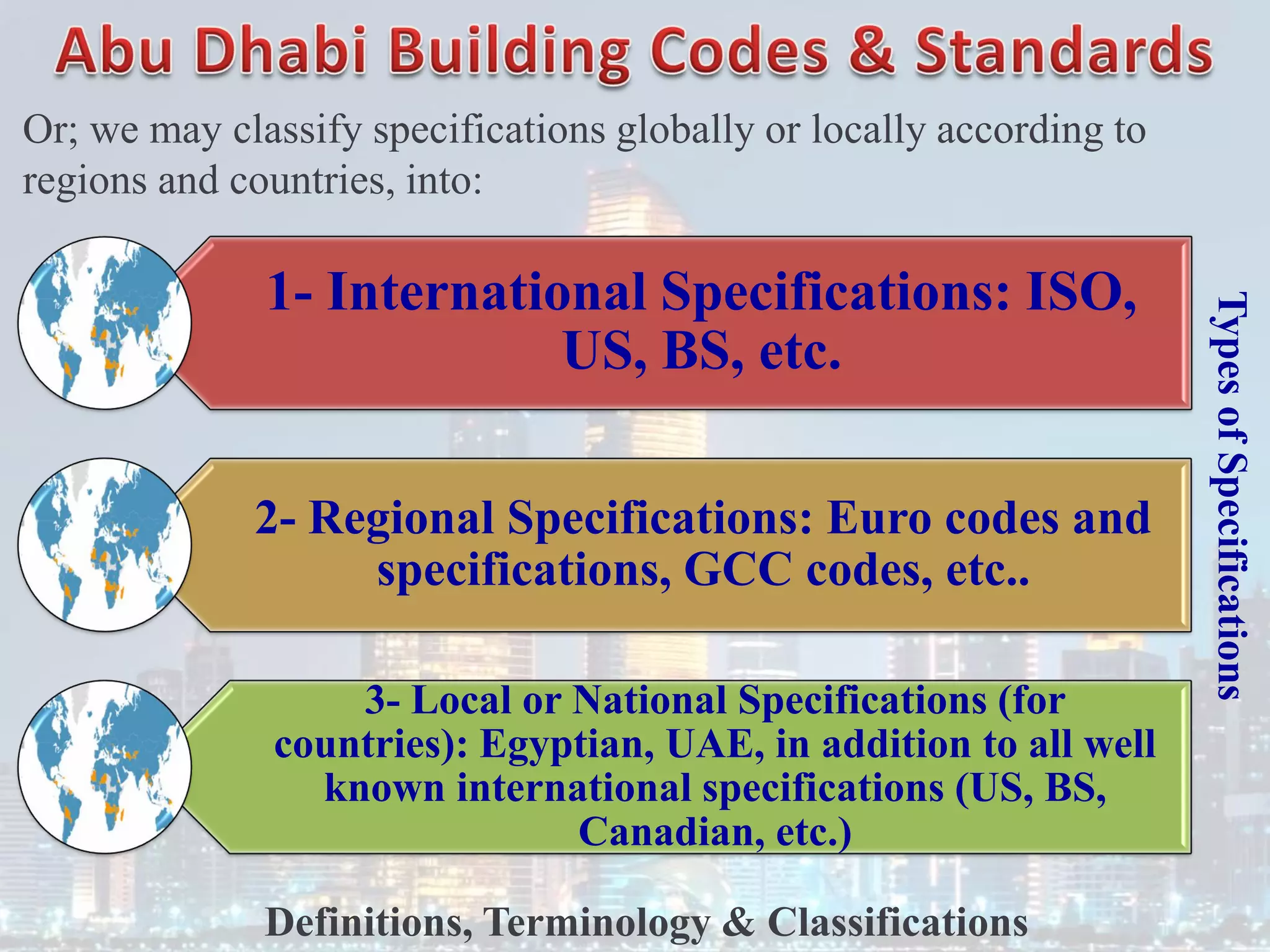
Or; we may classify specifications globally or locally according to
regions and countries, into:
1- International Specifications: ISO,
US, BS, etc.
2- Regional Specifications: Euro codes and
specifications, GCC codes, etc..
3- Local or National Specifications (for
countries): Egyptian, UAE, in addition to all well
known international specifications (US, BS,
Canadian, etc.)
Definitions, Terminology & Classifications
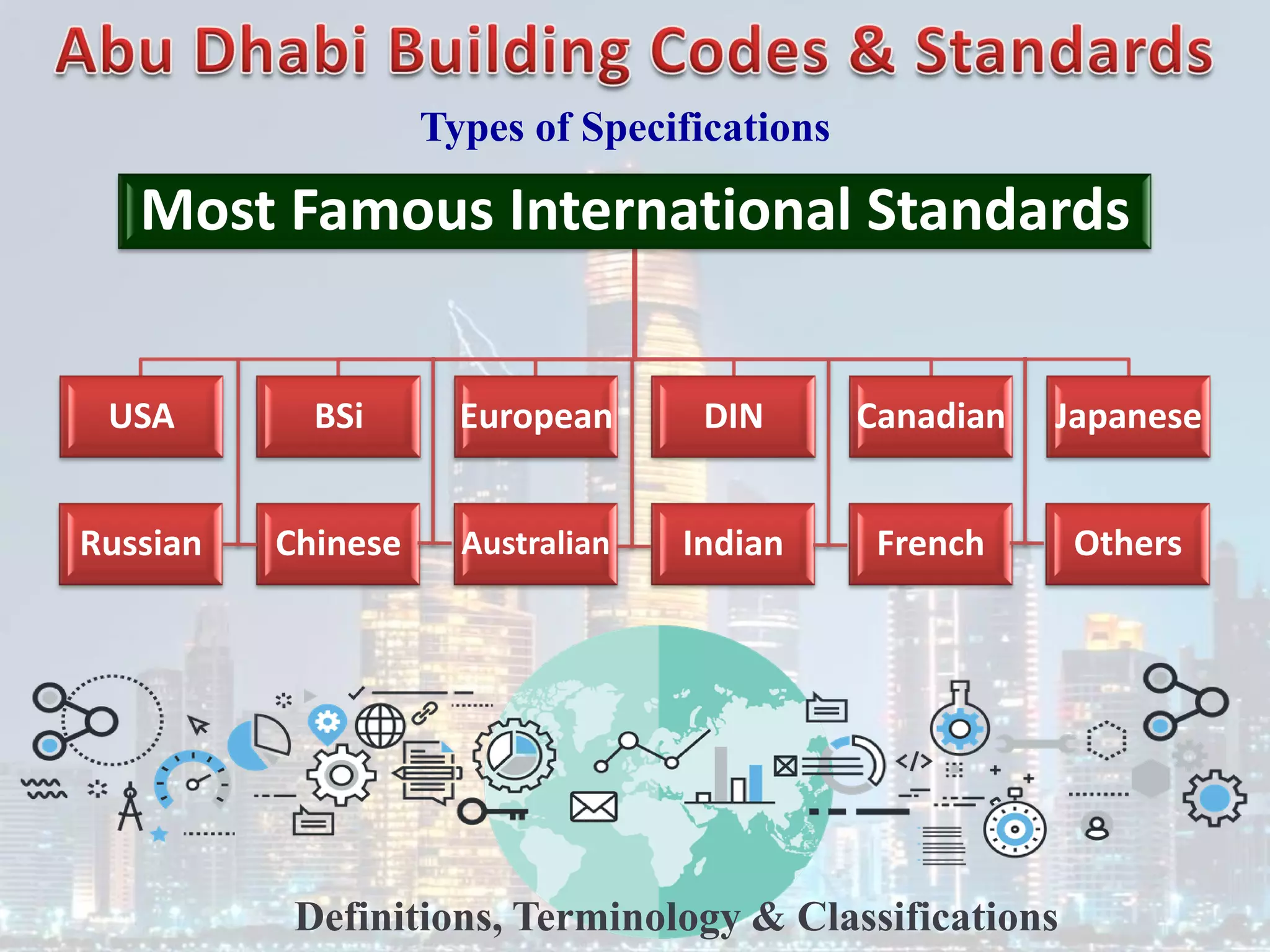
Most Famous International Standards
USA BSi European DIN Canadian Japanese
Russian Chinese Australian Indian French Others
Types of Specifications
Definitions, Terminology & Classifications
Types
of
Specifications
Definitions, Terminology & Classifications
ANSI, NBIC, ASME, ASTM, NEC, API, AWS, UBC,
NFPA, ACI, PCI, AASHTO, AREA, ABS, ISA, etc.
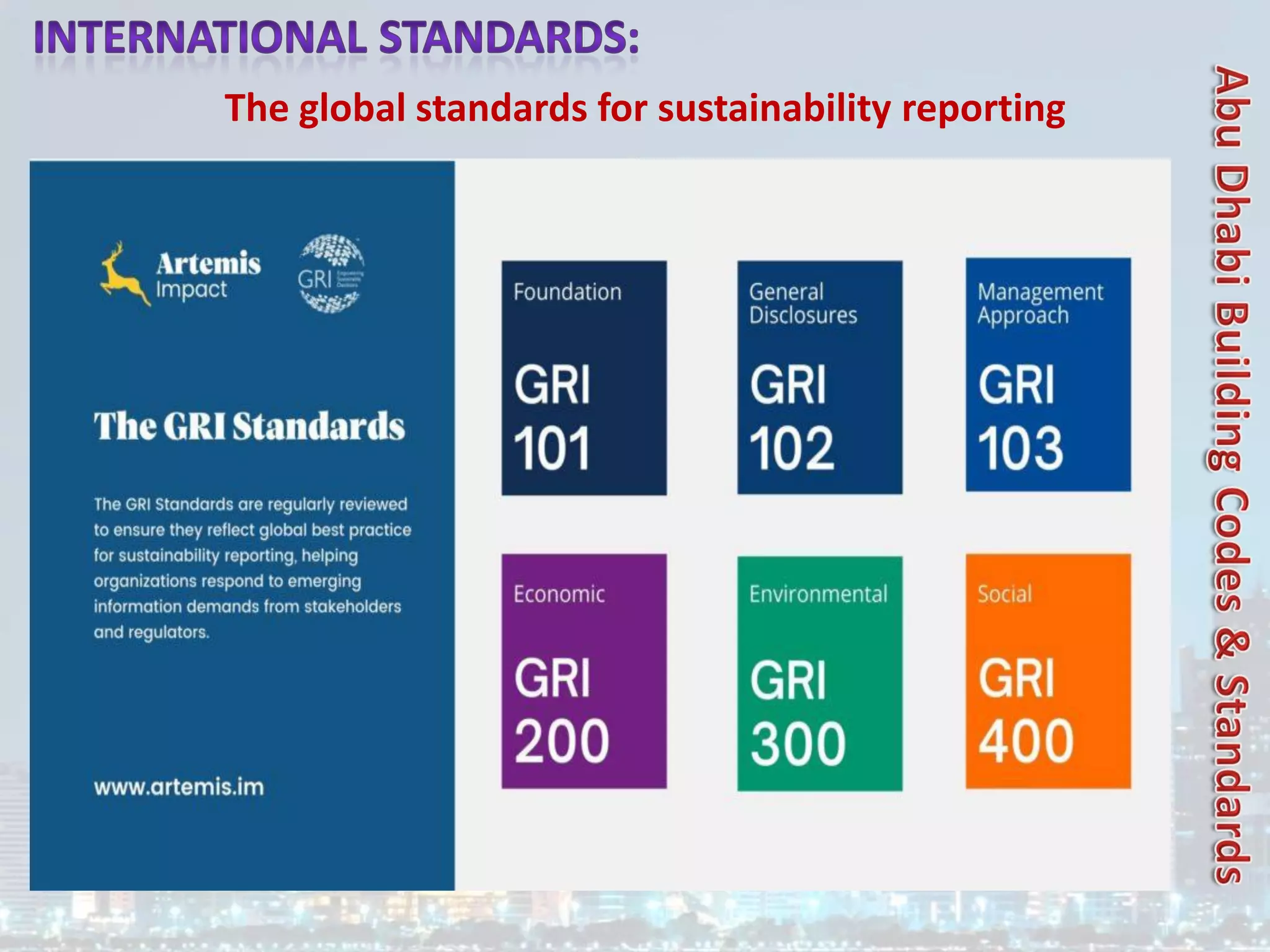
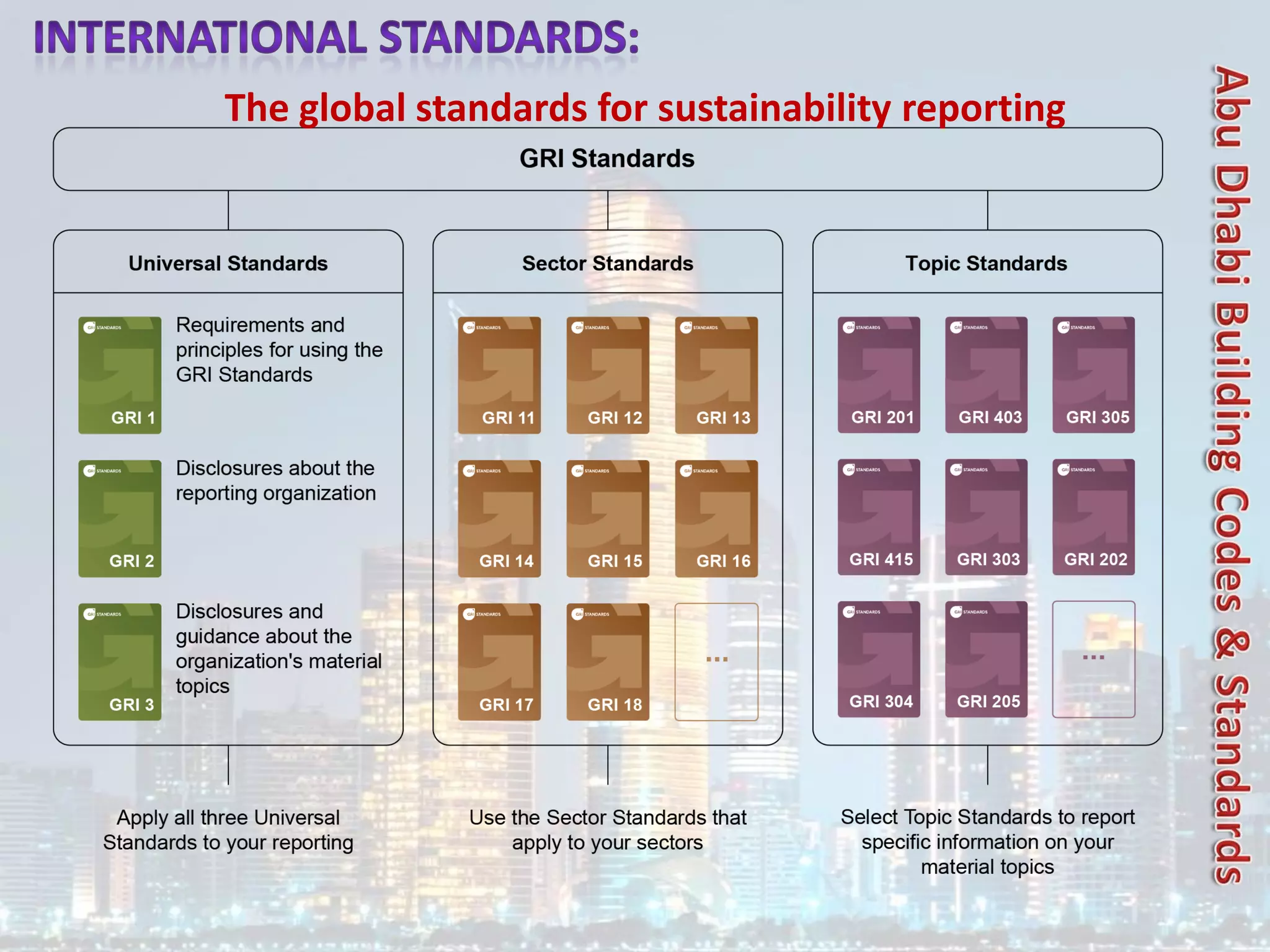
The
global standards
for sustainability
reporting
The global standards for sustainability reporting
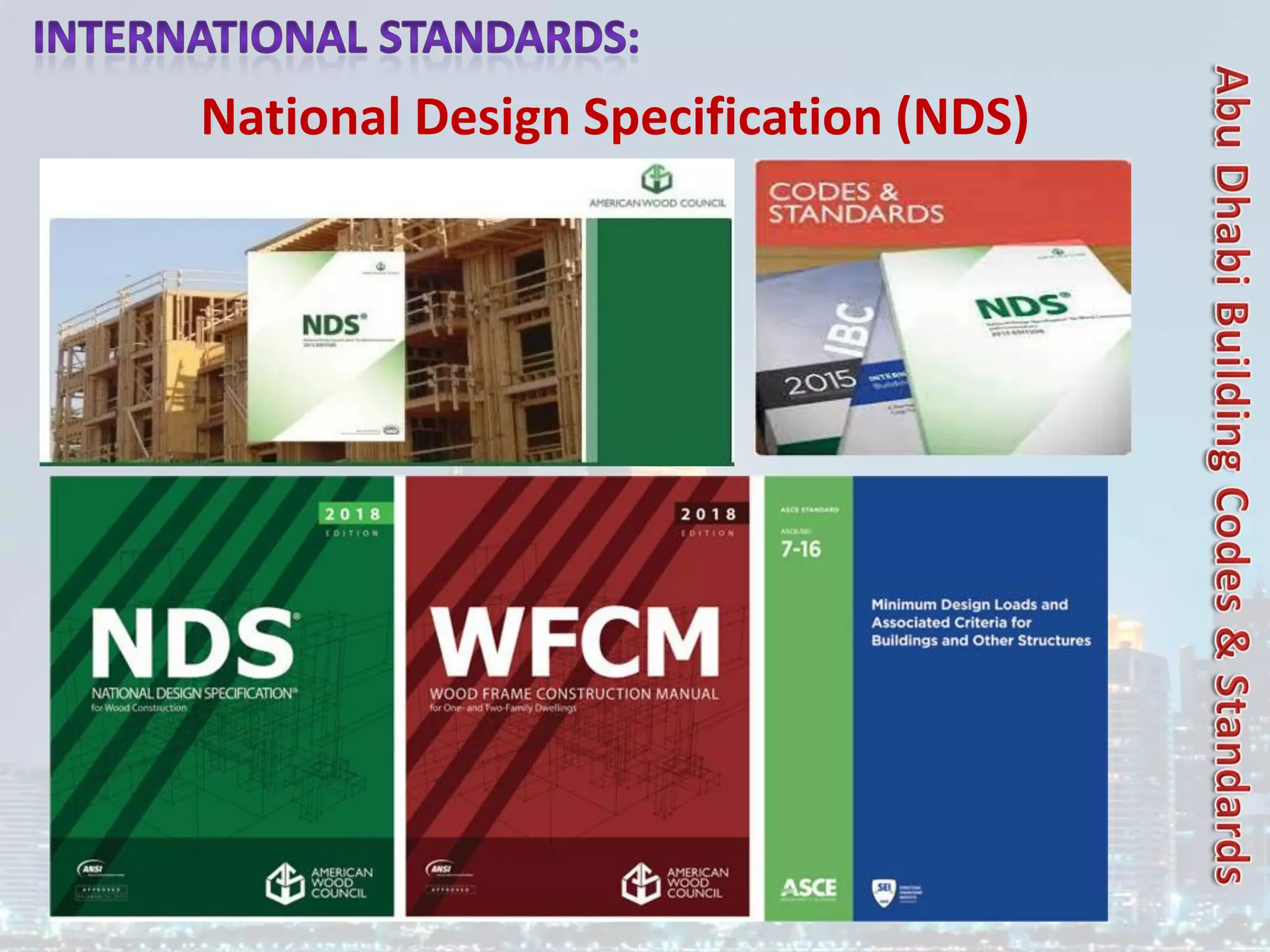
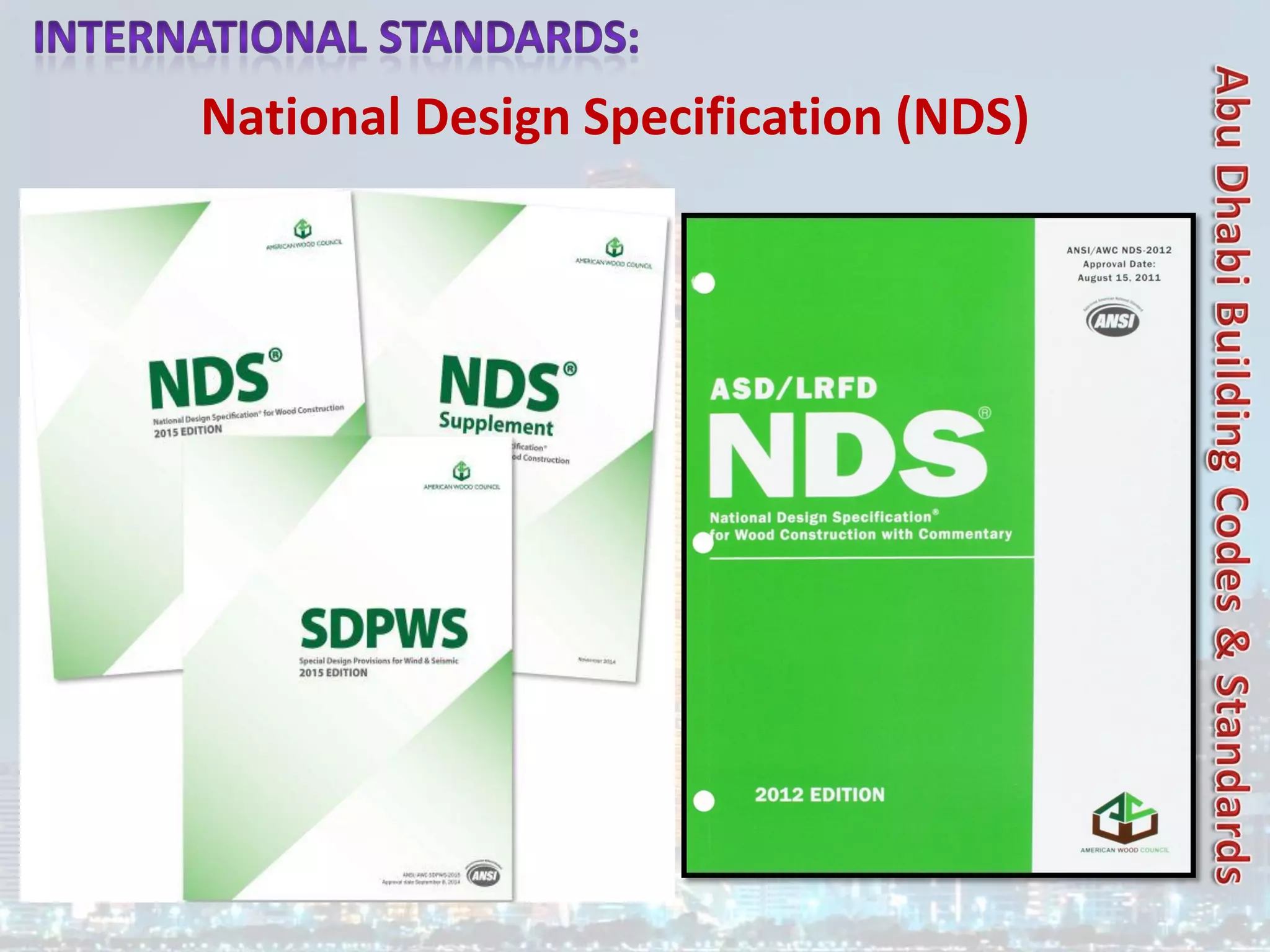
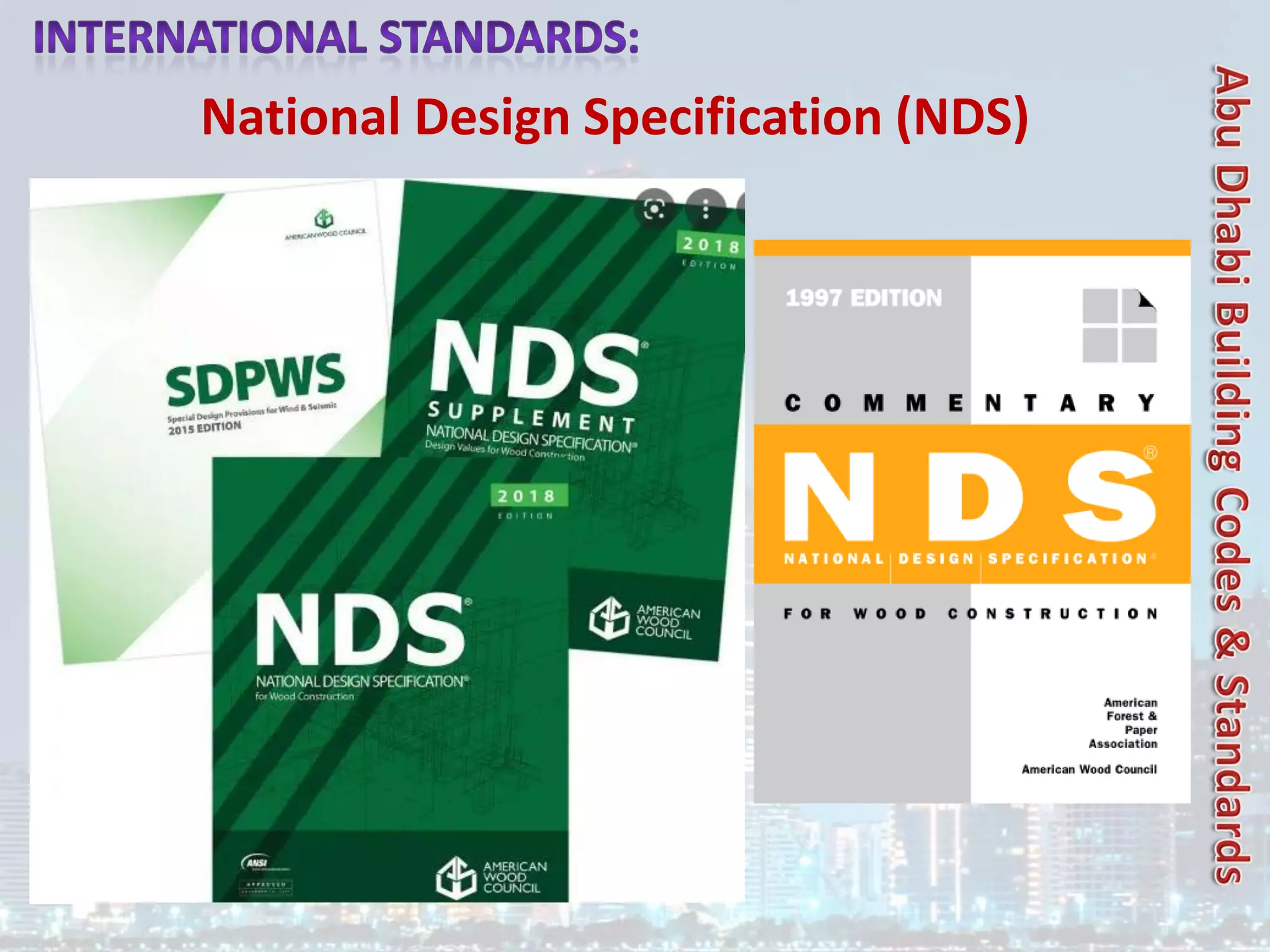
National Design Specification (NDS)
International Code Council (ICC)
The International Codes, or I-Codes, are the most trusted source of model
codes and standards. Decades of knowledge and experience guide our code
development process to create safe, sustainable and affordable communities
and a level playing field for builders, developers and manufacturers. As
industry experts, we provide the codes and standards that our members turn
to, building safety professionals rely on and manufacturers trust.
International Code Council (ICC)
The International Codes, or I-Codes, are the gathering and
joining of all types of building and construction codes,
standards, regulations and instructions in USA (e.g.;
construction, materials, operational, environmental, and
maintenance standards) to put them into a unique manner and
arrangement in order to control and manage the entire
activities of the construction industry.
Codes: Our democratic approach
to developing and publishing
codes (I-Codes) enables the
people closest to codes to shape
the regulations and participate in
ensuring public health, safety and
welfare of the people who live in,
work in and visit the community
you serve.
Standards: The process of
developing standards is led by a
technical committee, including
stakeholders, through meetings
guided by expert opinions to
ensure the safest standards are
implemented.
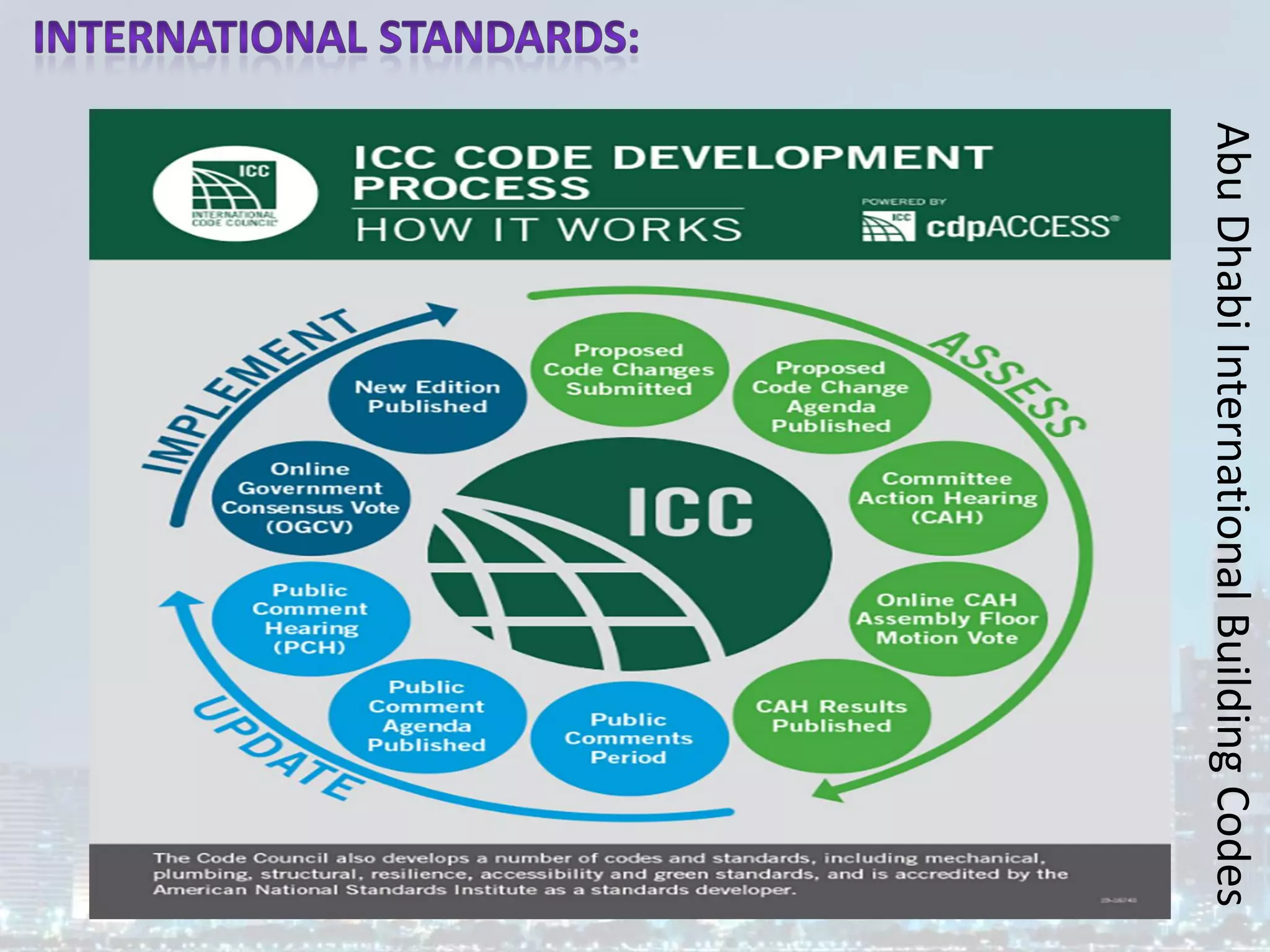
Codes and Standards Development Processes: The International Code
Council has a system for developing model codes and standards based on
trust and transparency.
The Code Development
Process: The International
Code Council develops
construction and public safety
codes through a governmental
consensus process. This system
of code development has
provided the highest level of
safety in the world for more
than 90 years. Click the buttons
below to learn more about the
code development process, and
to download infographics that
help explain the process.
The Standards Development Process: As is
the case with its codes, the Code Council
adheres to openness and transparency in our
standards development process. All Code
Council standards committee meetings are
open to the public. Any interested party can
participate in committee meetings and can
be considered by the committee for
membership on any work-group that the
committee creates.
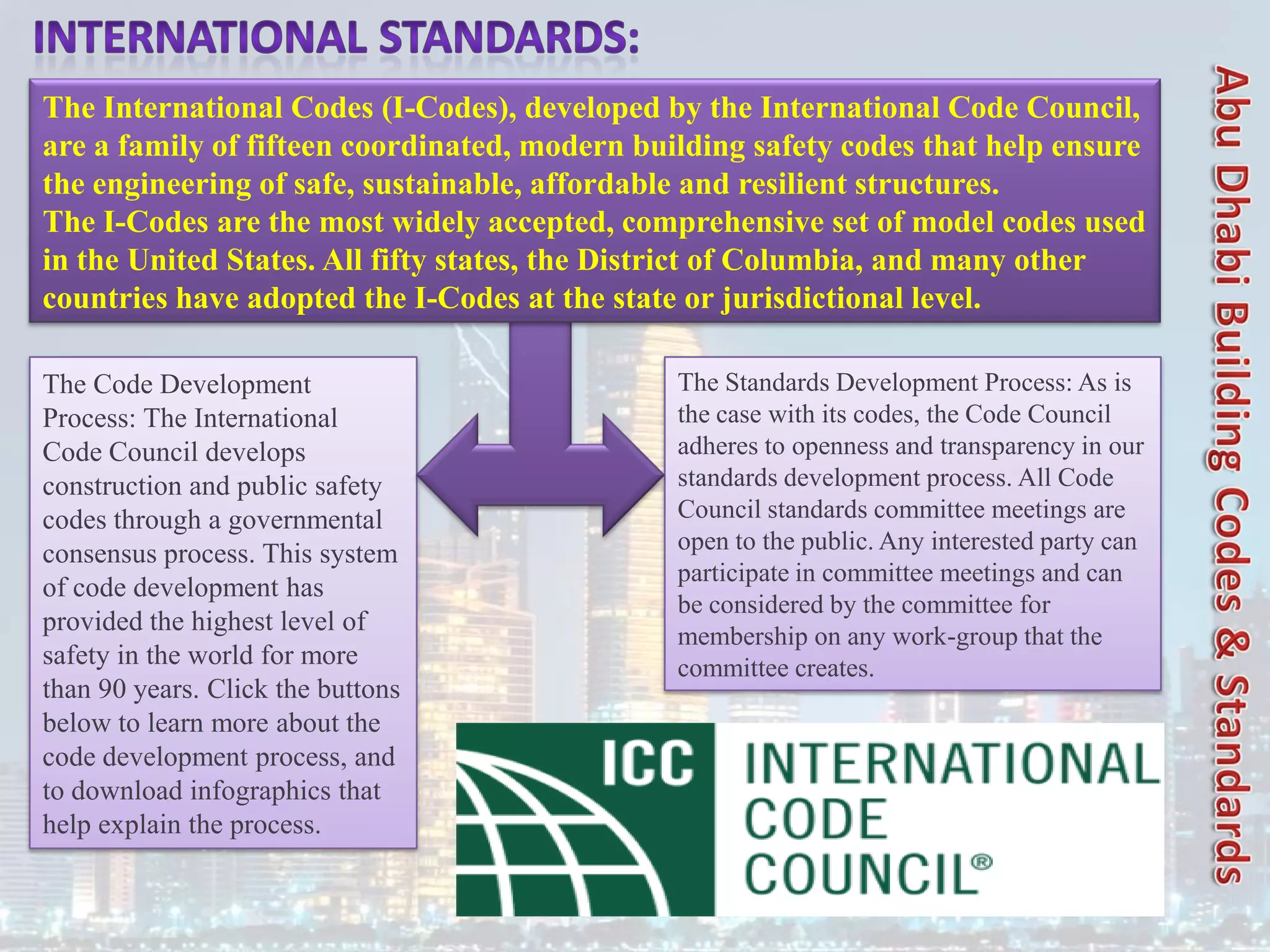
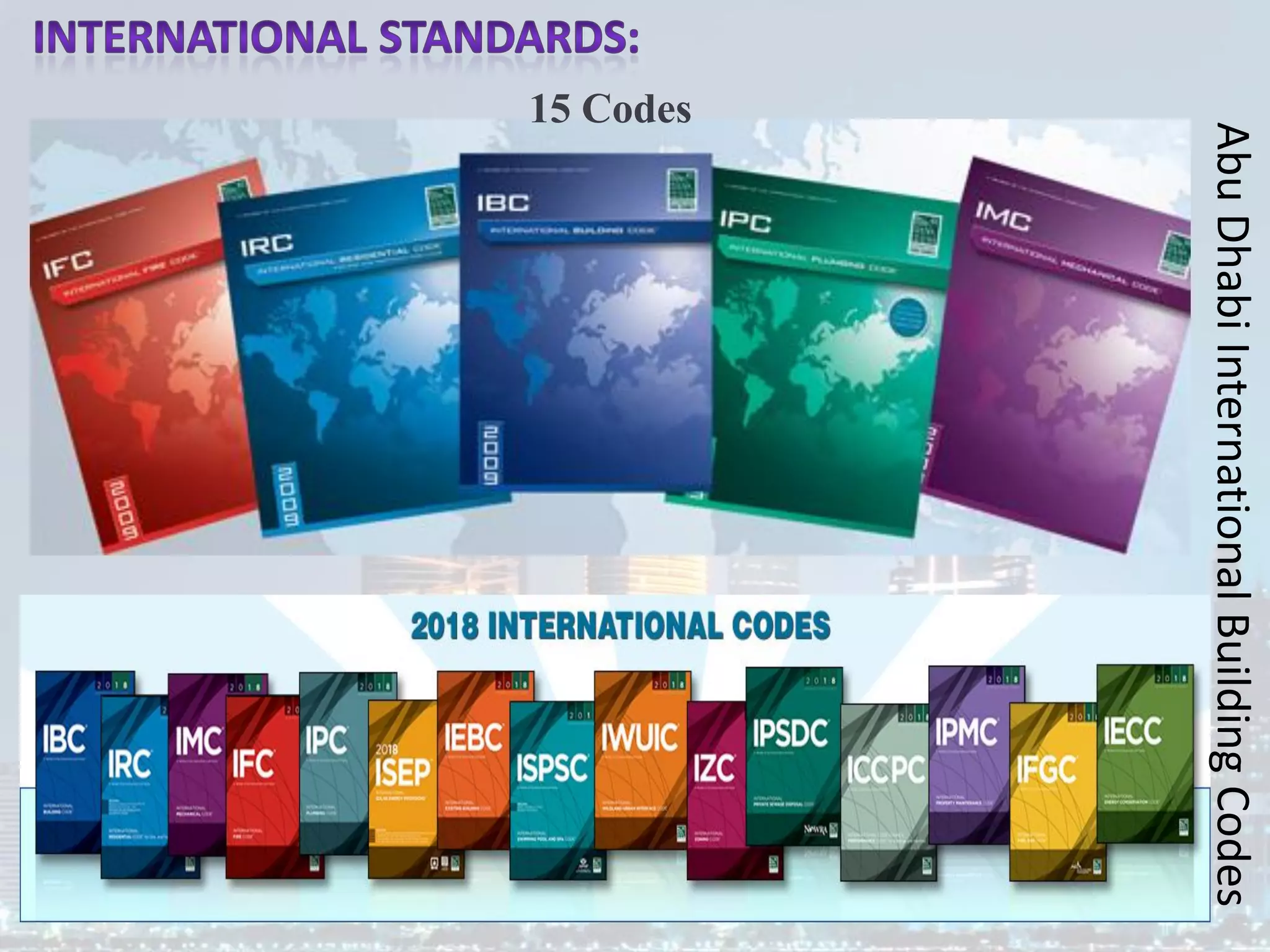
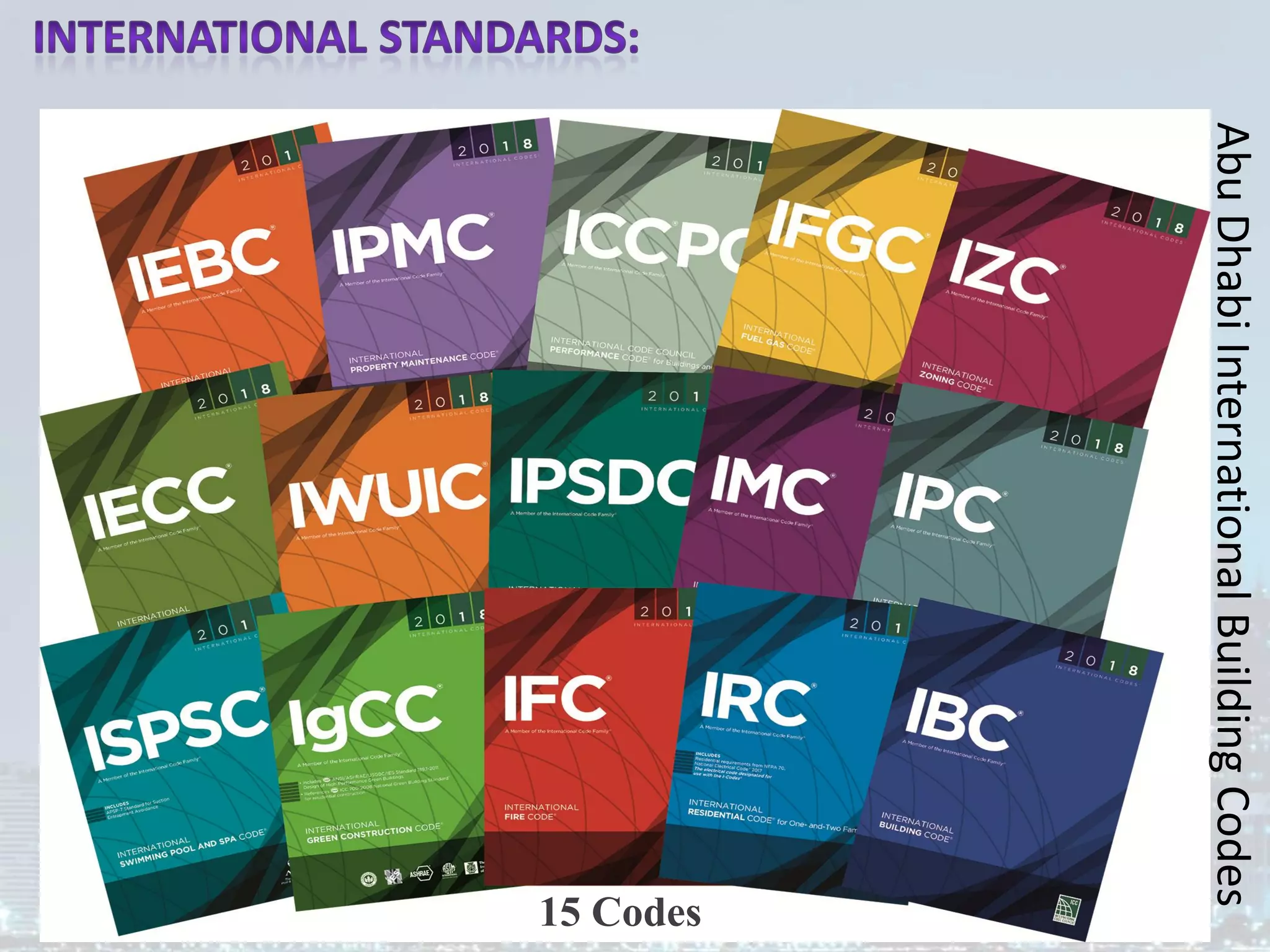
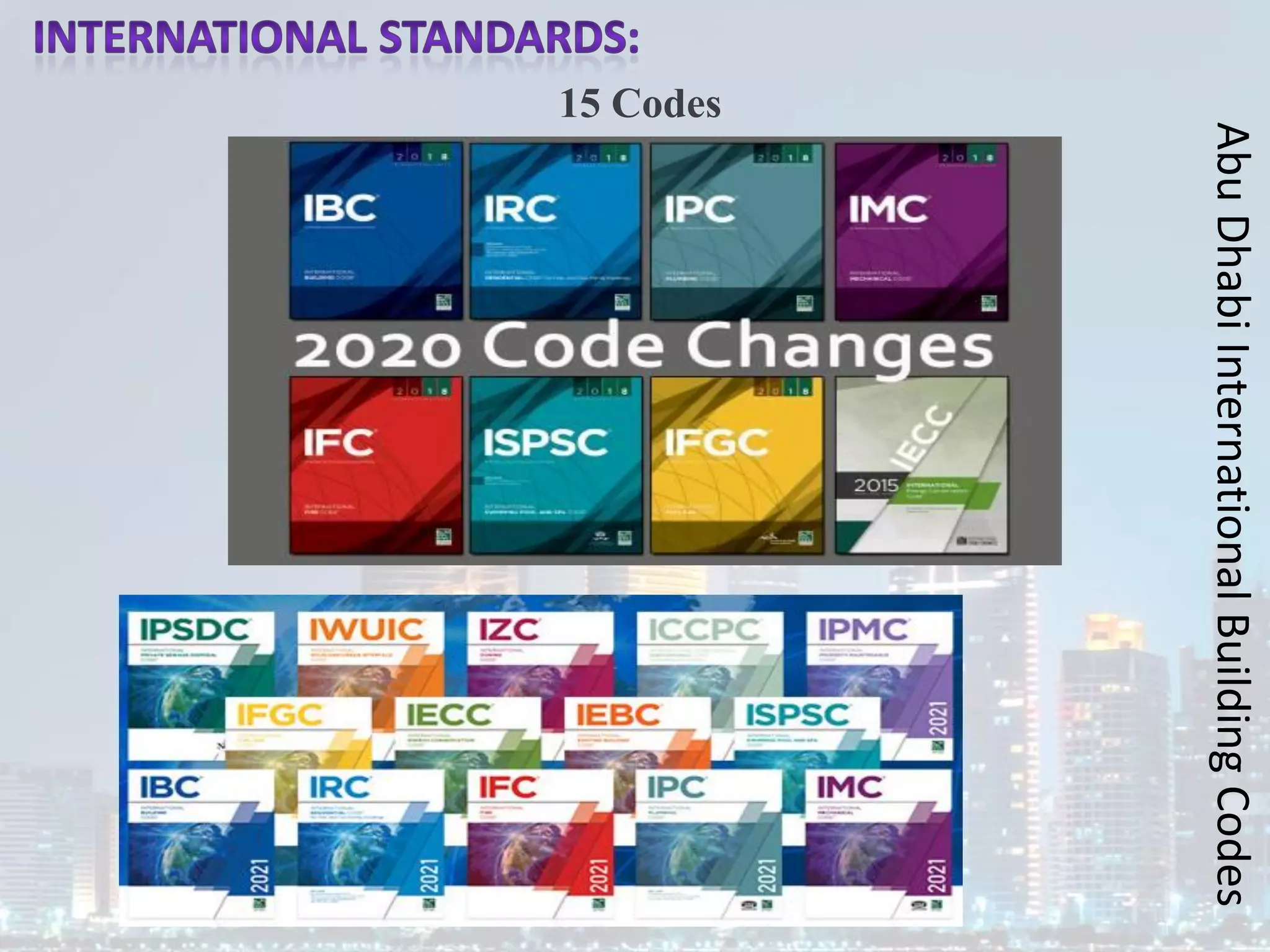
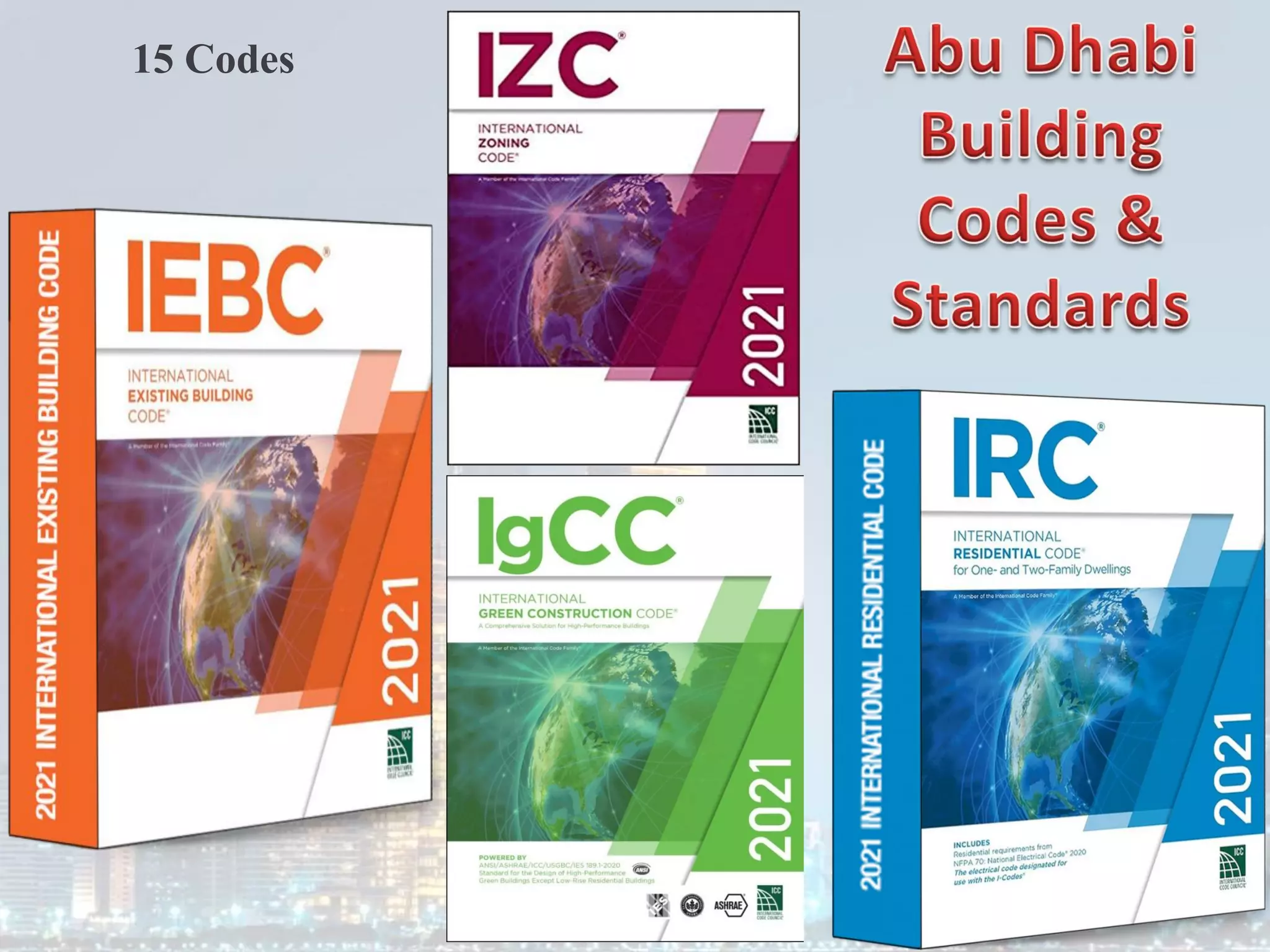
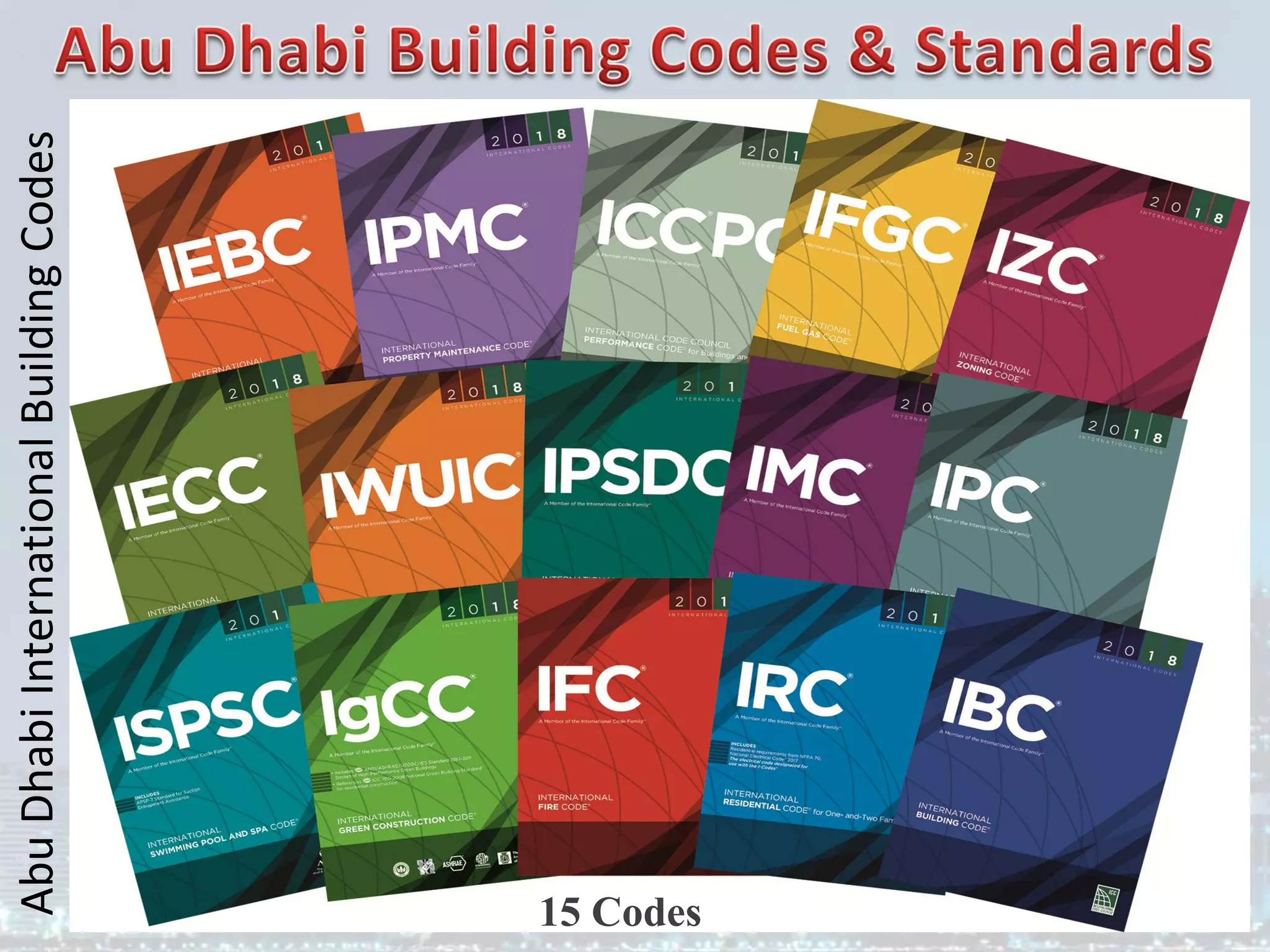
The International Codes (I-Codes), developed by the International Code Council,
are a family of fifteen coordinated, modern building safety codes that help ensure
the engineering of safe, sustainable, affordable and resilient structures.
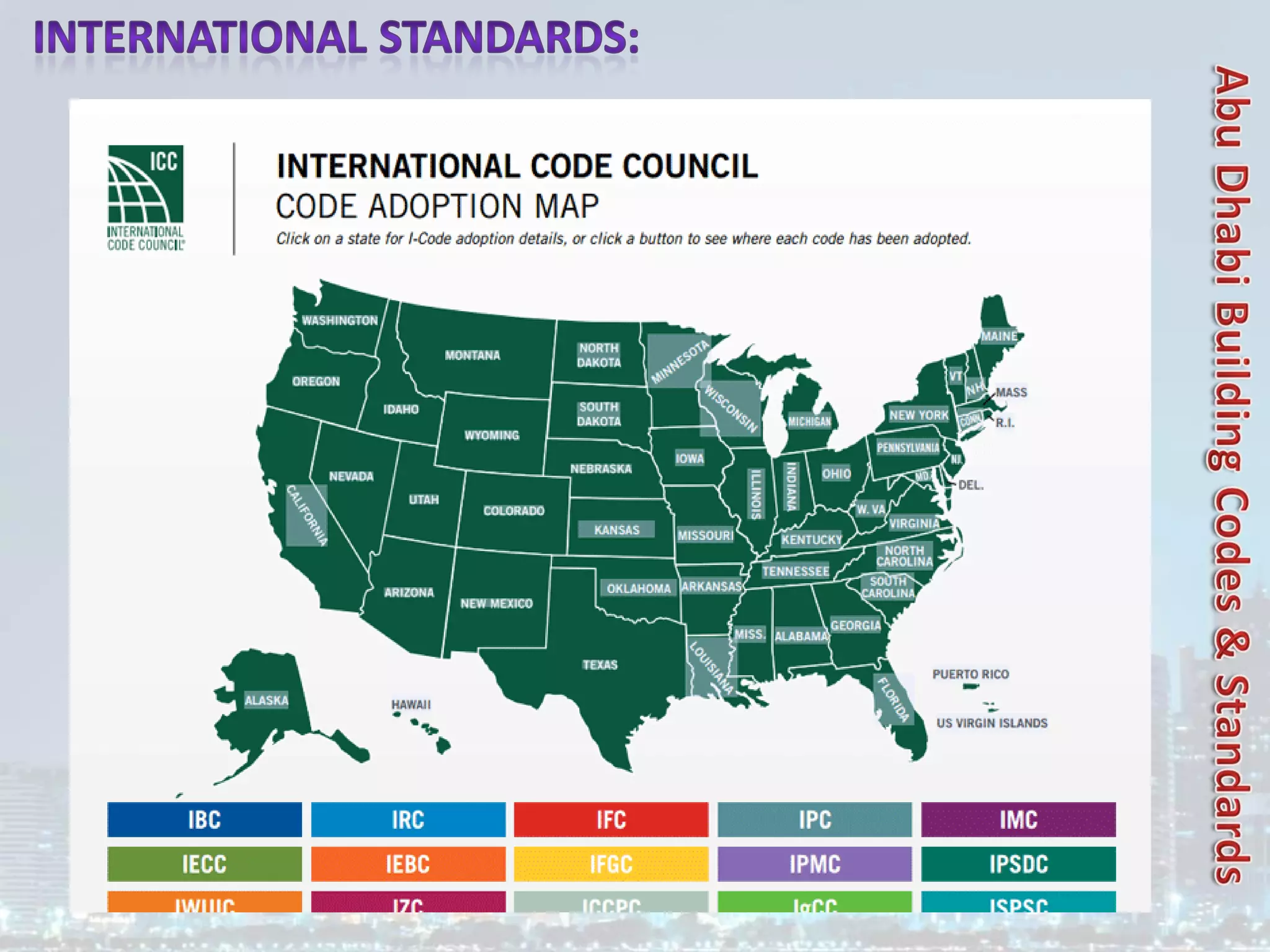
The I-Codes are the most widely accepted, comprehensive set of model codes used
in the United States. All fifty states, the District of Columbia, and many other
countries have adopted the I-Codes at the state or jurisdictional level.
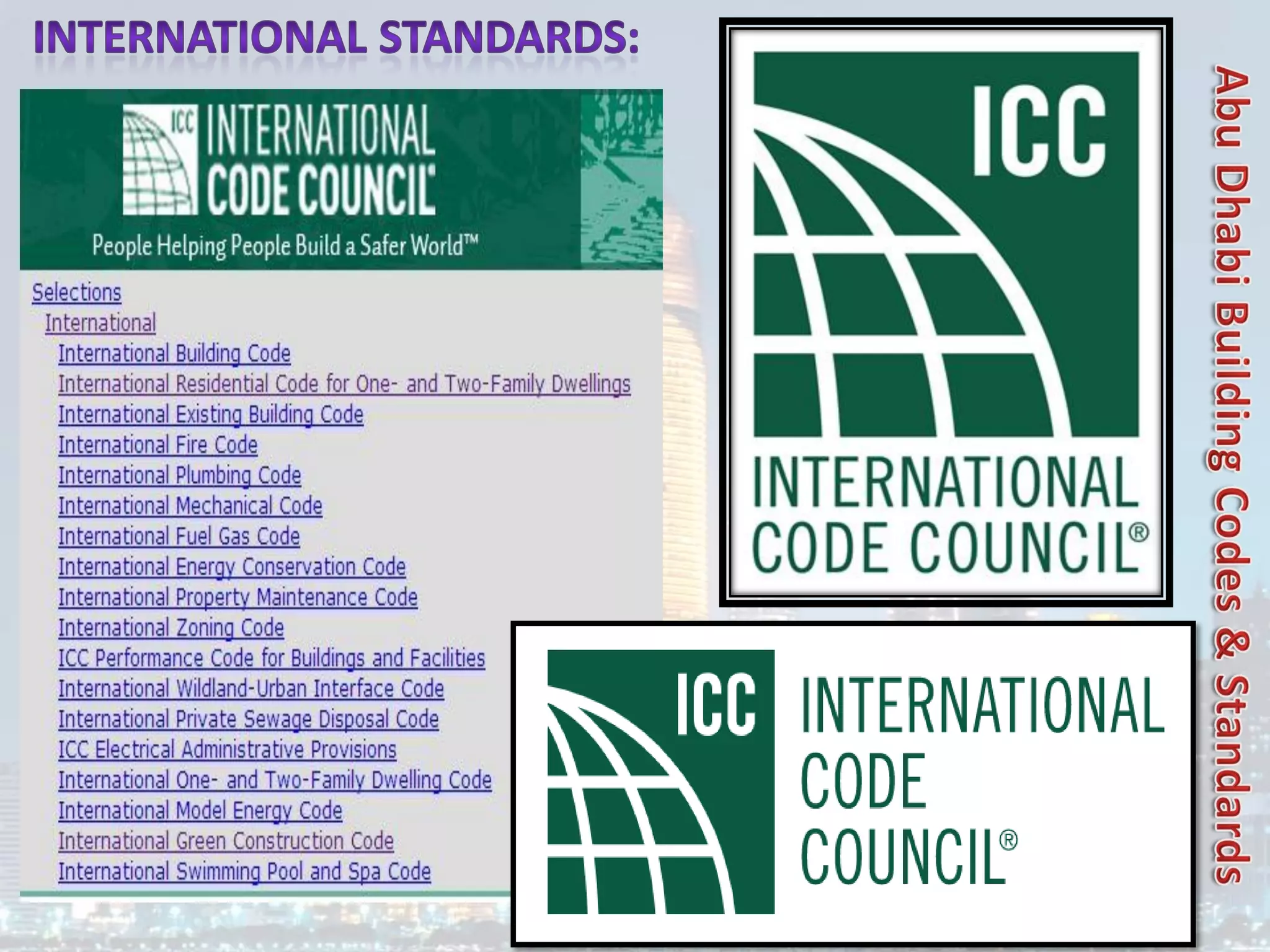
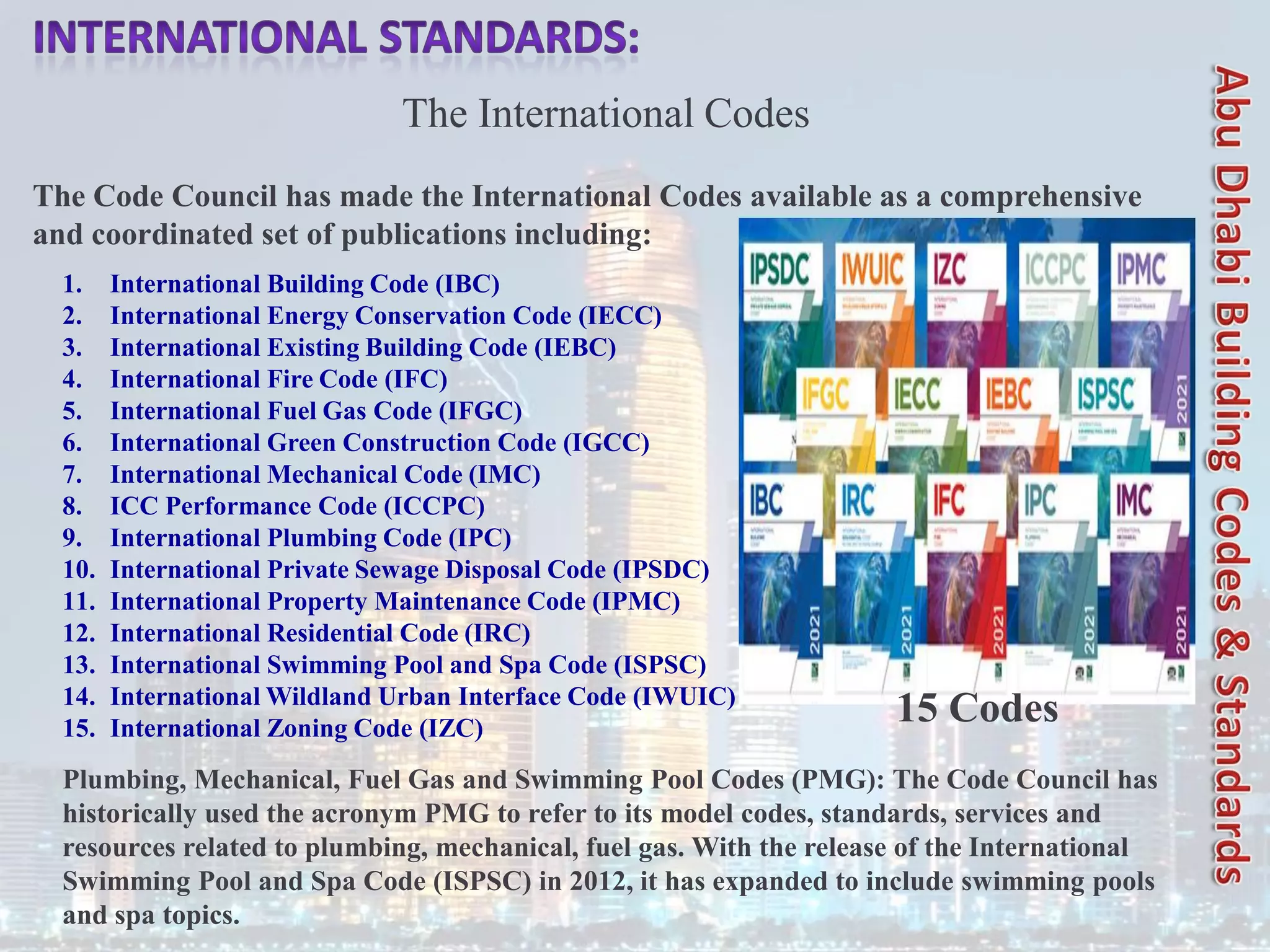
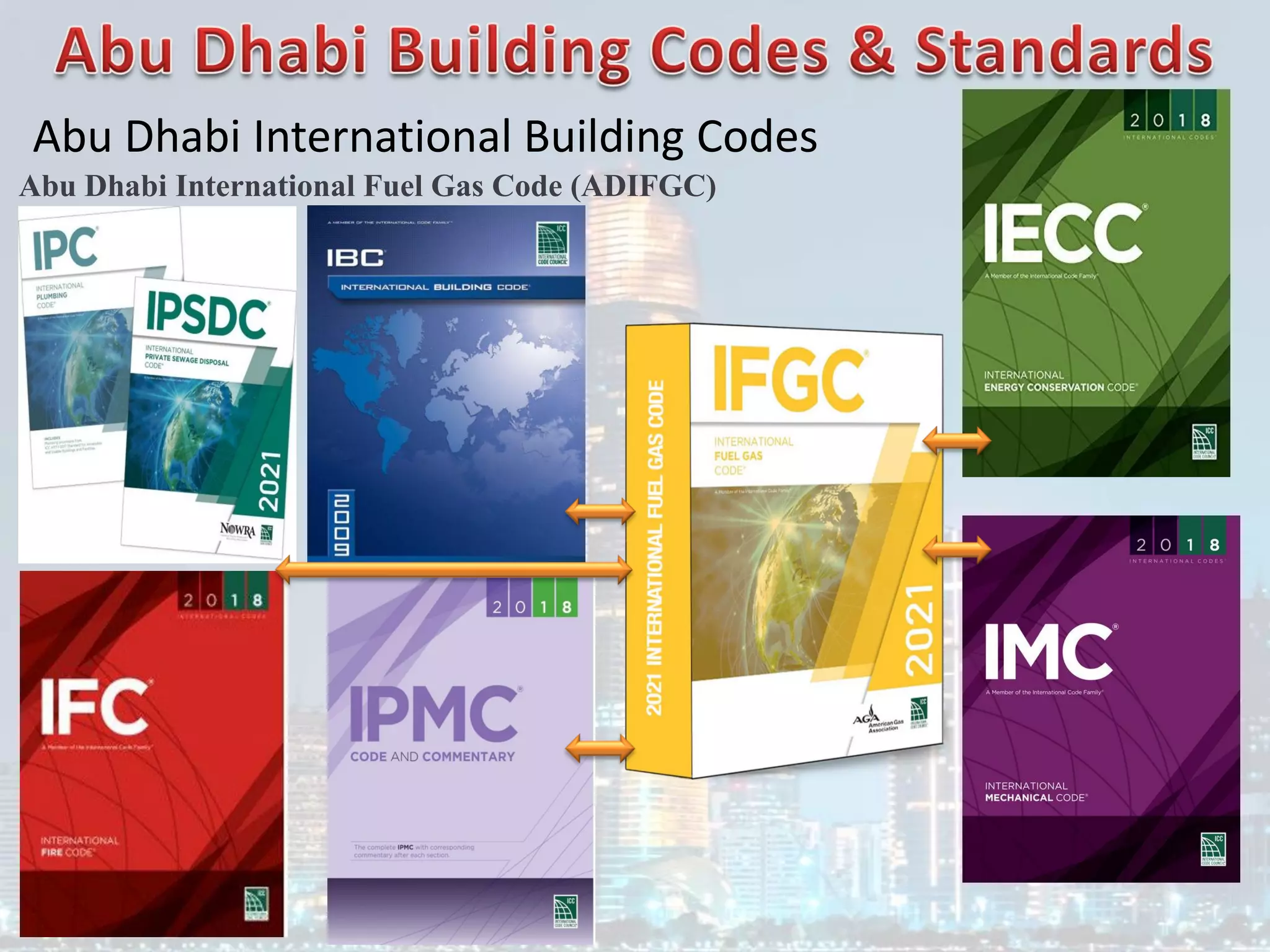
The International Codes
The Code Council has made the International Codes available as a comprehensive
and coordinated set of publications including:
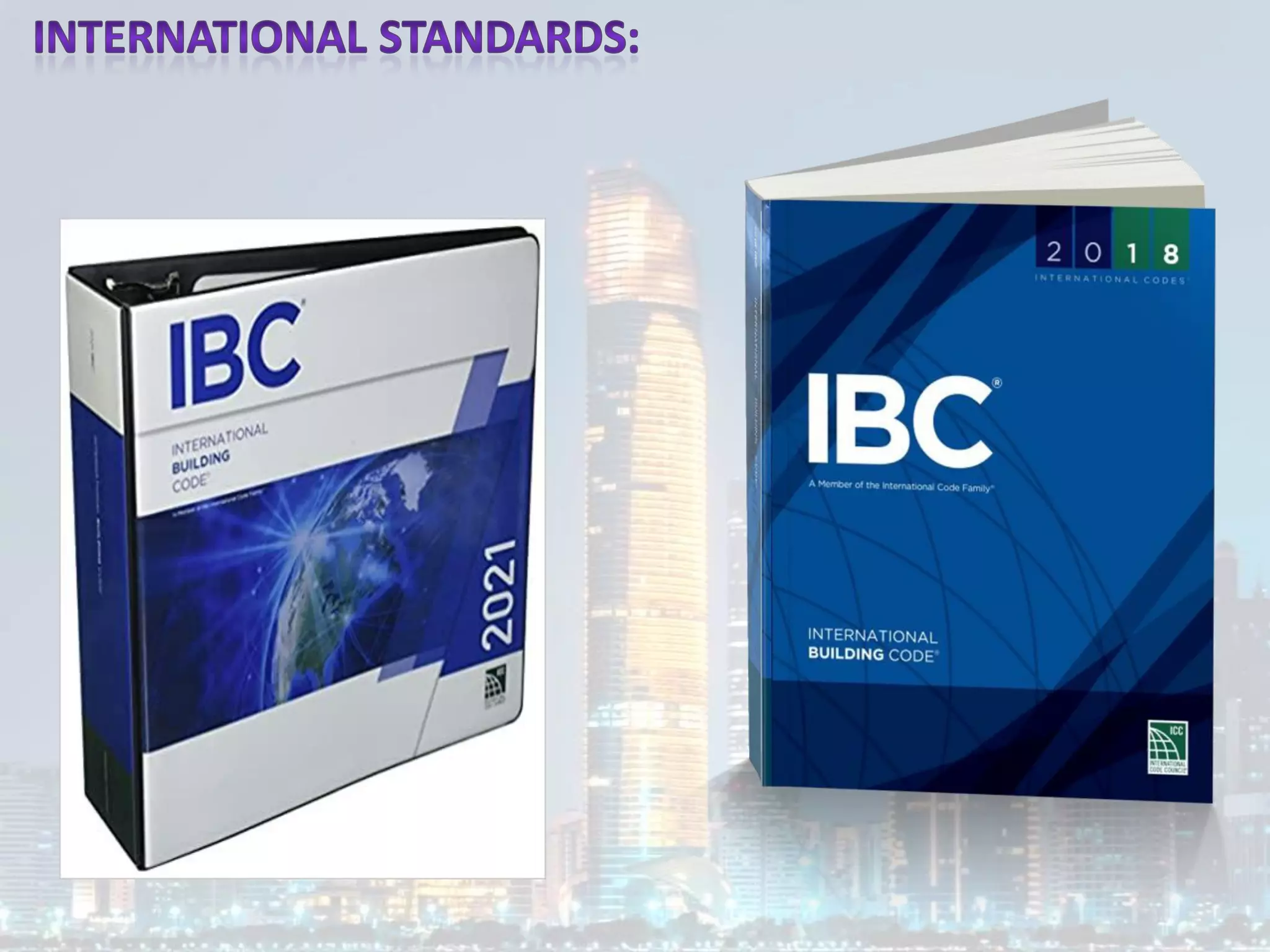
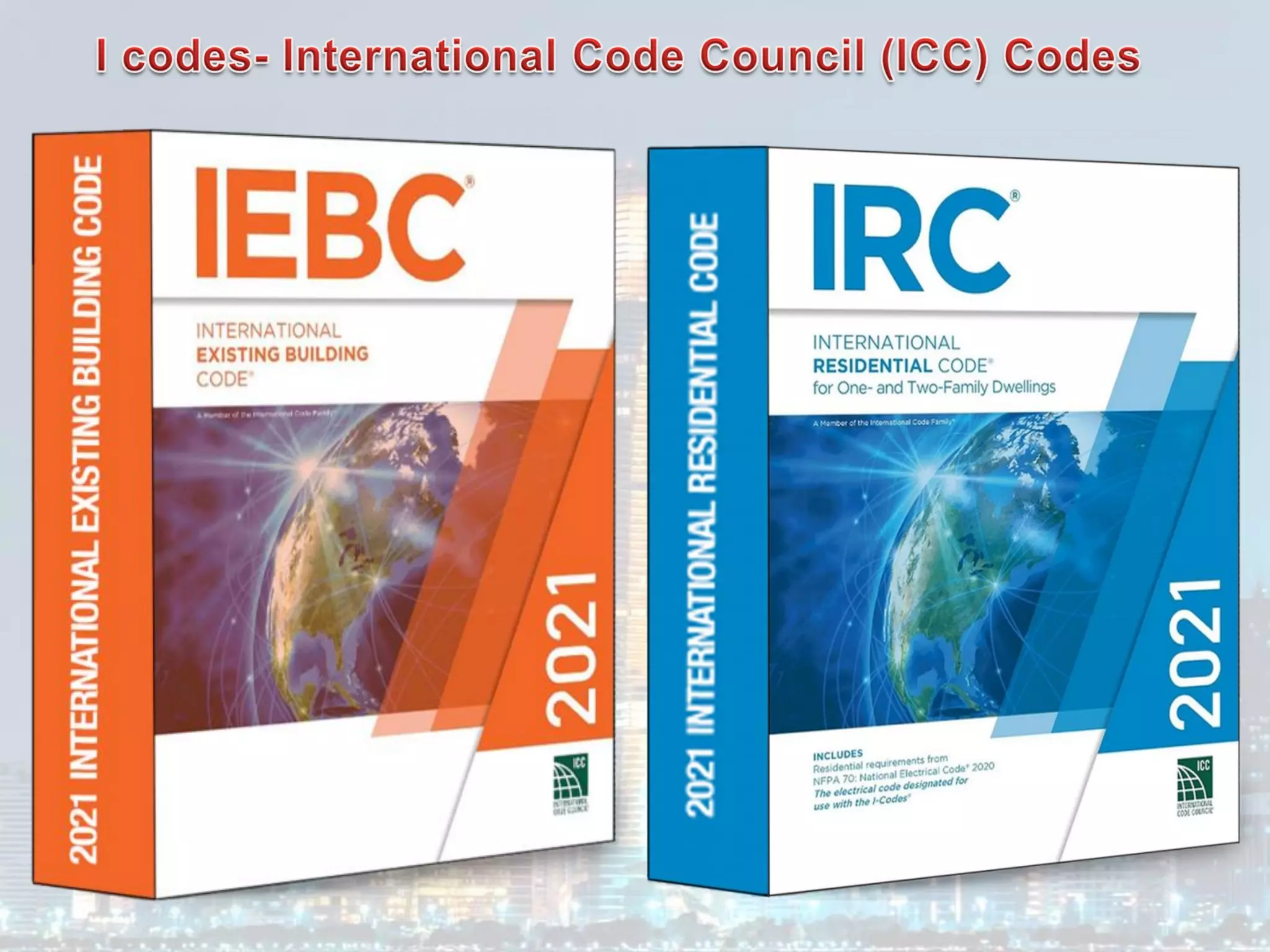
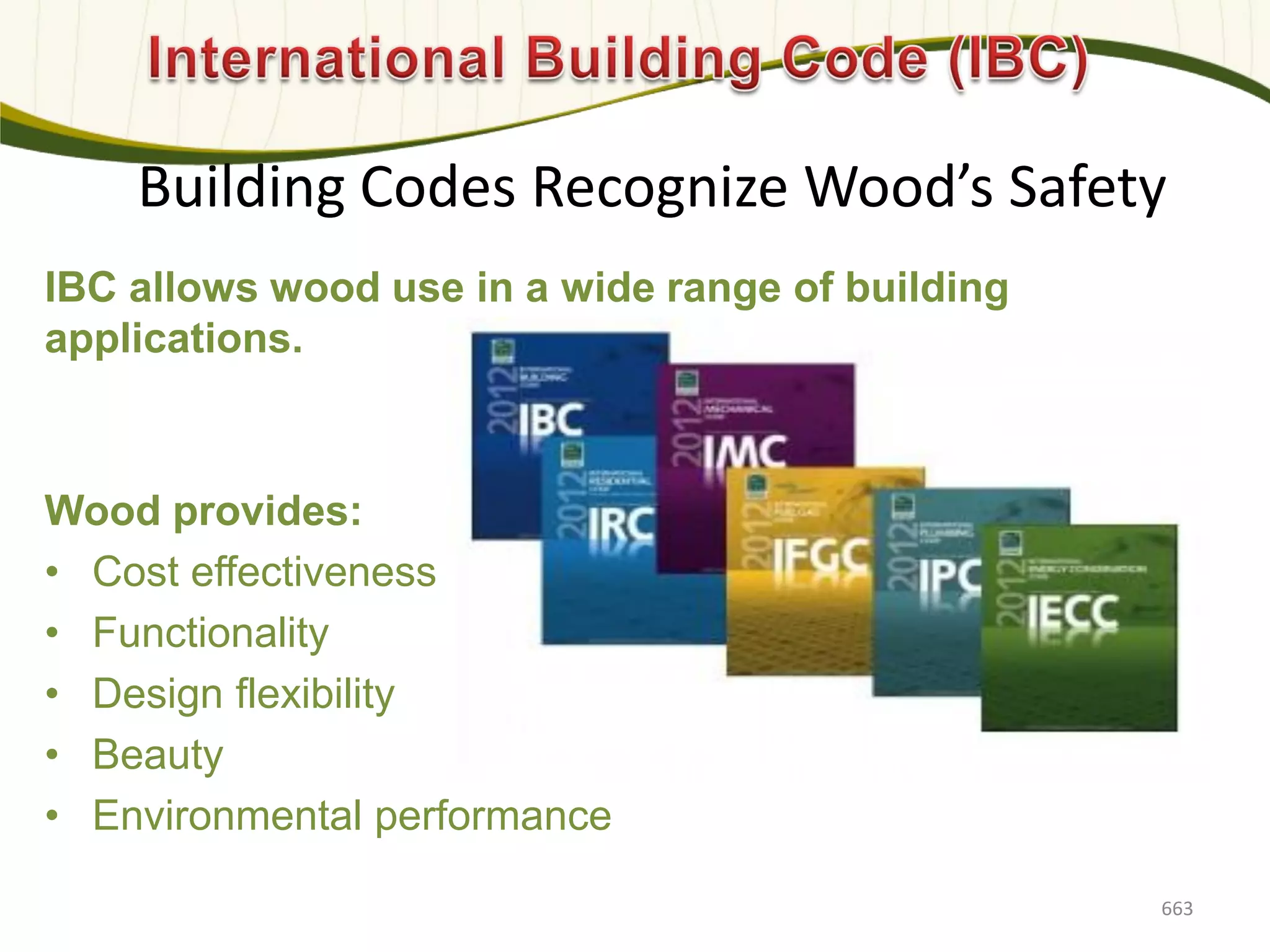
1. International Building Code (IBC)
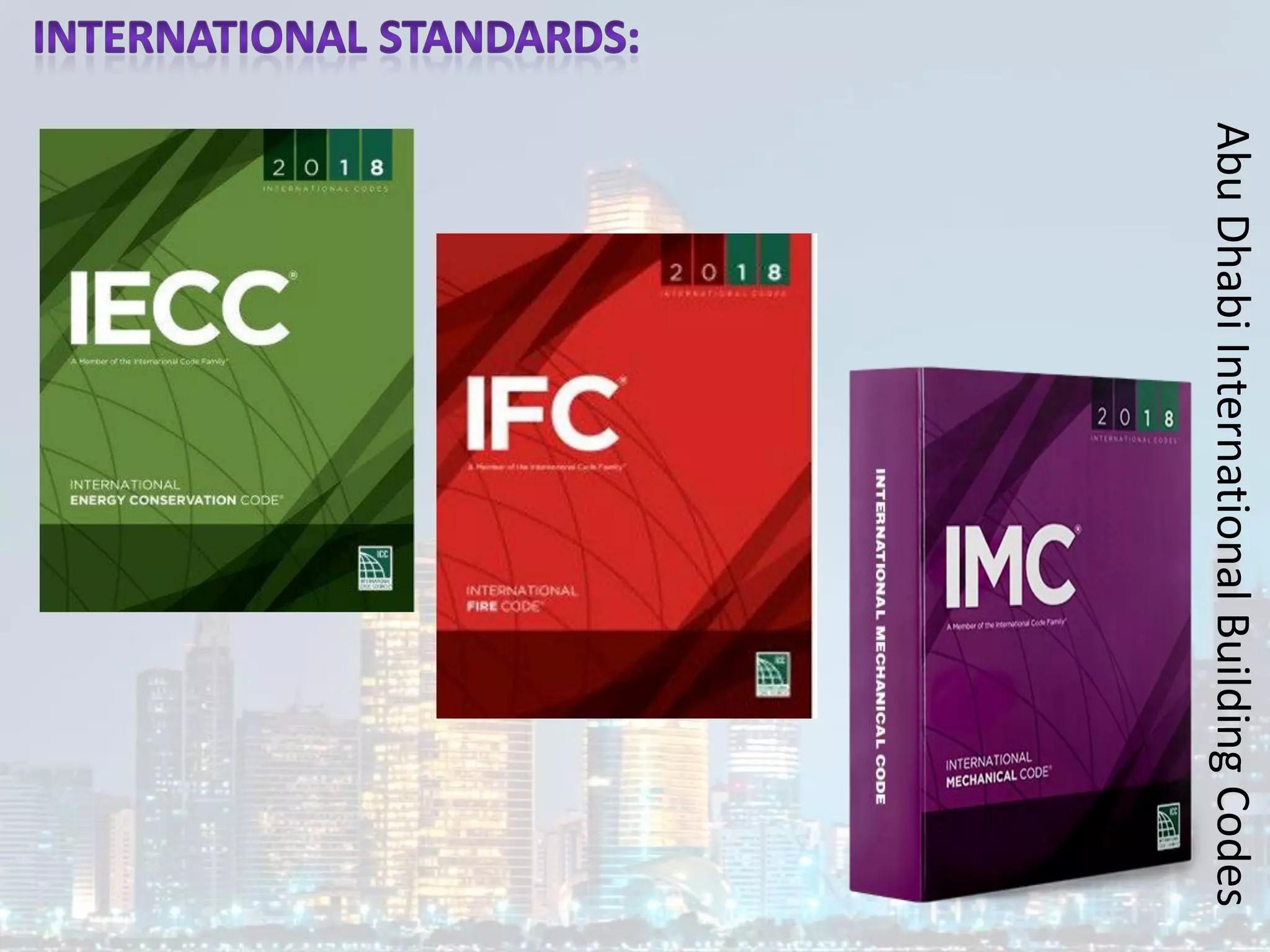
2. International Energy Conservation Code (IECC)
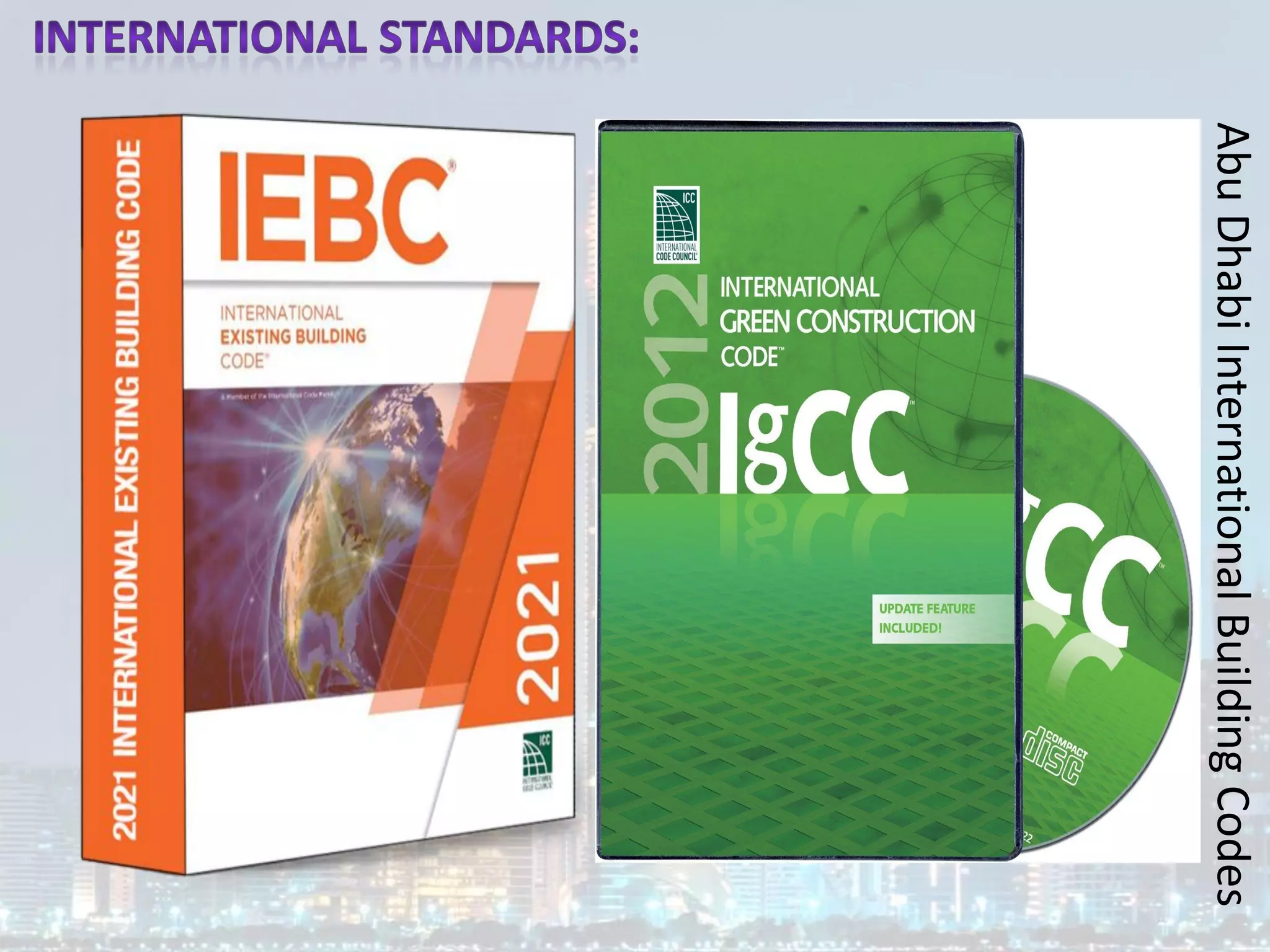
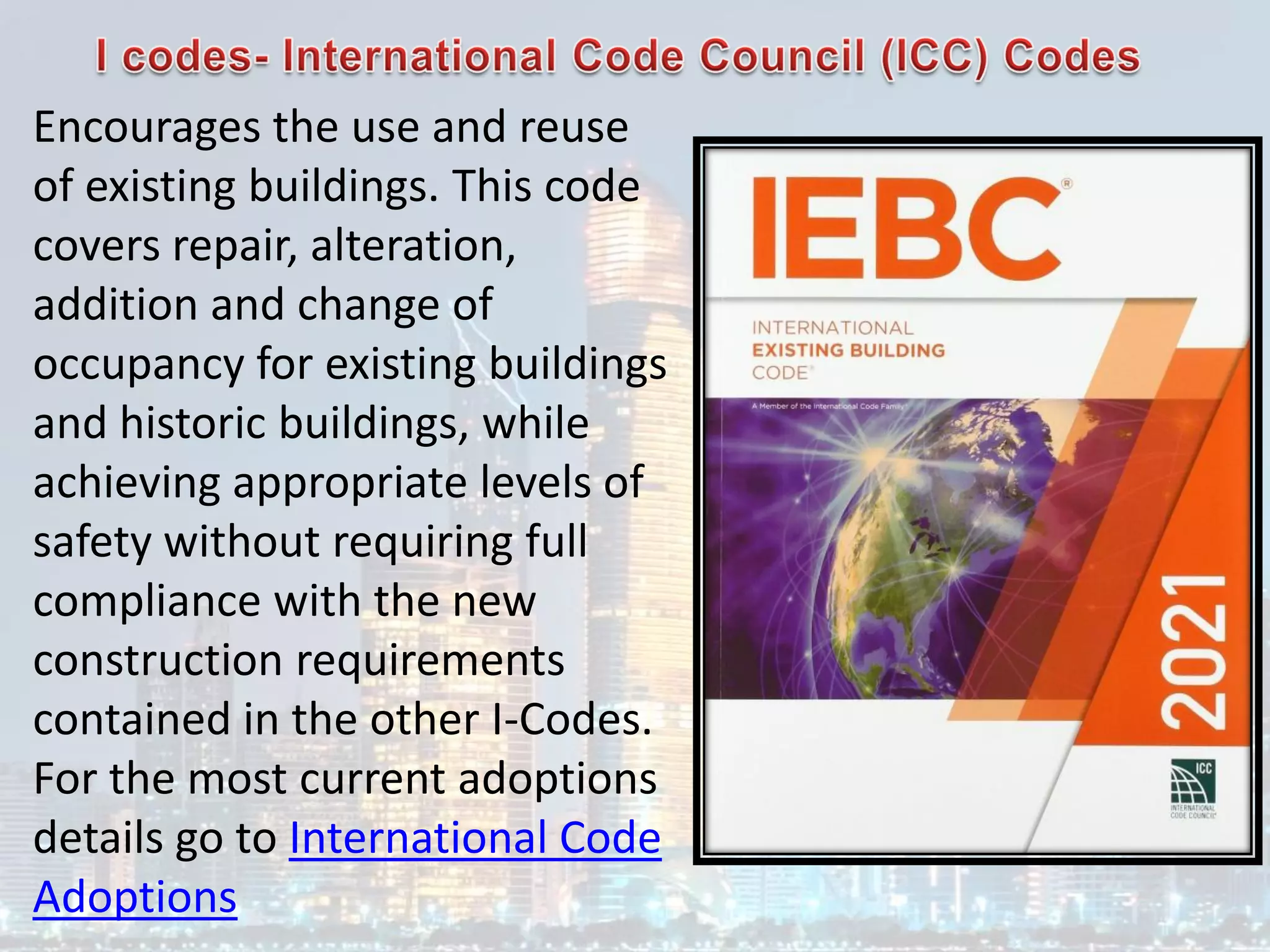
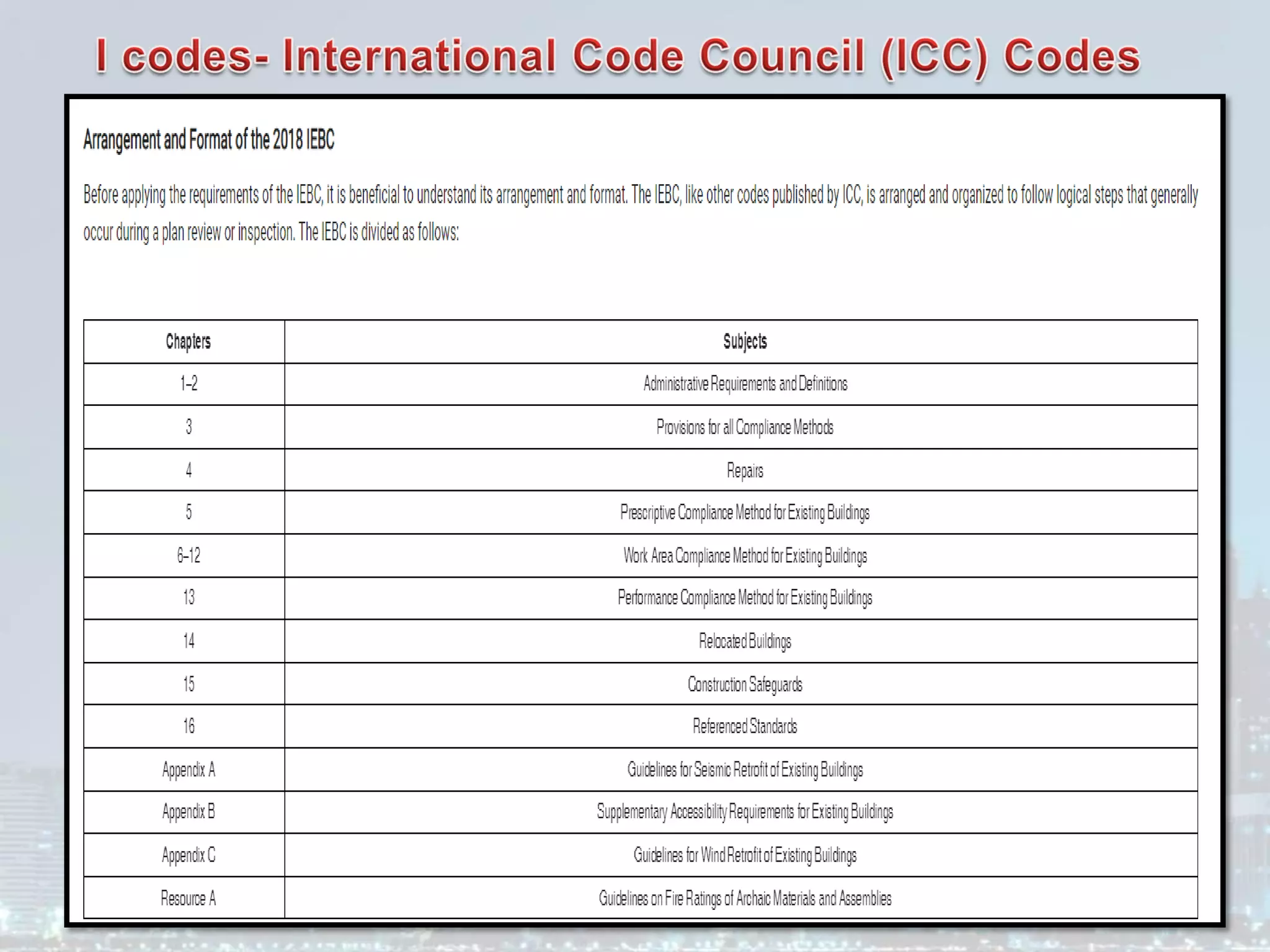
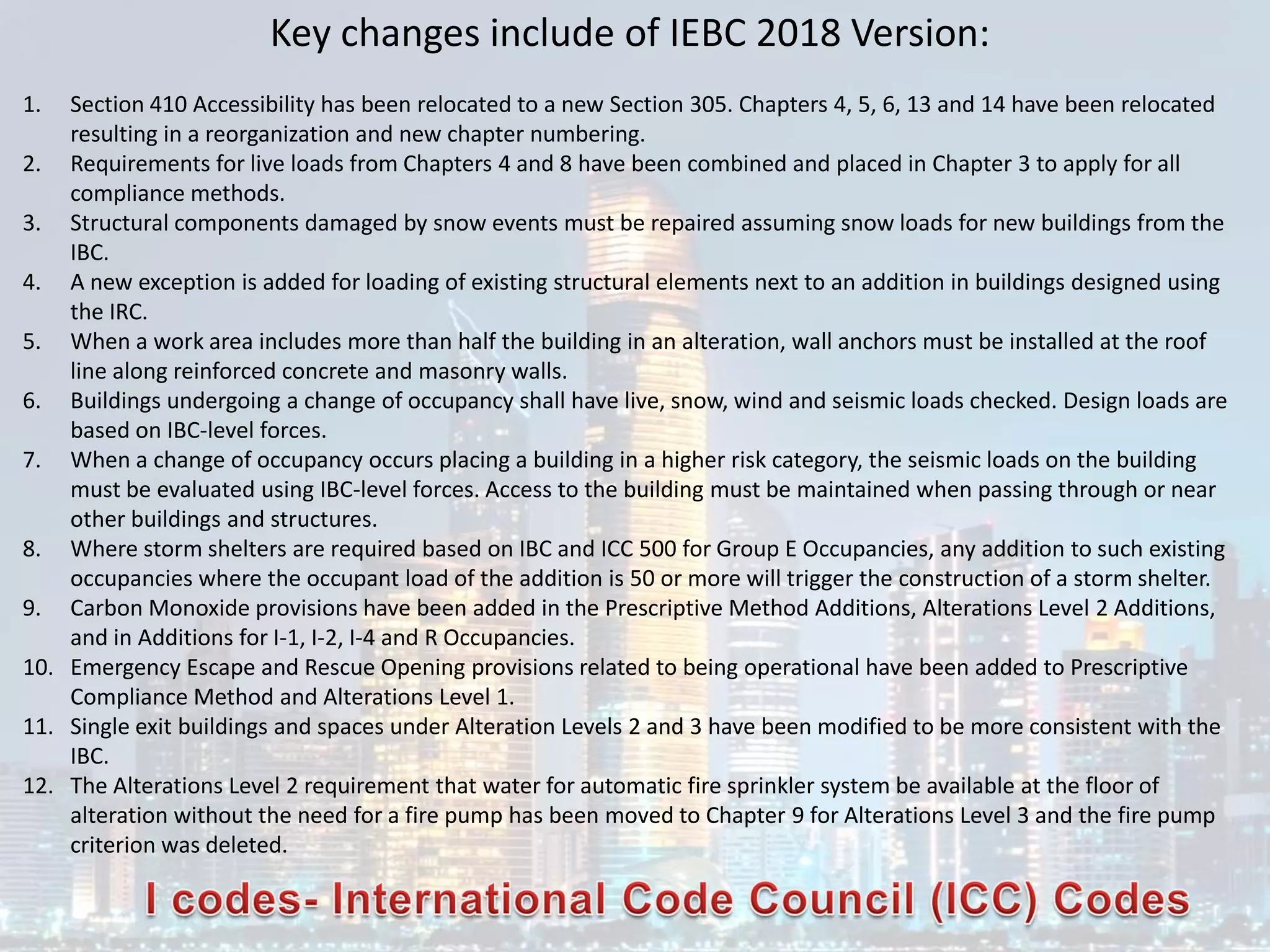
3. International Existing Building Code (IEBC)
4. International Fire Code (IFC)
5. International Fuel Gas Code (IFGC)
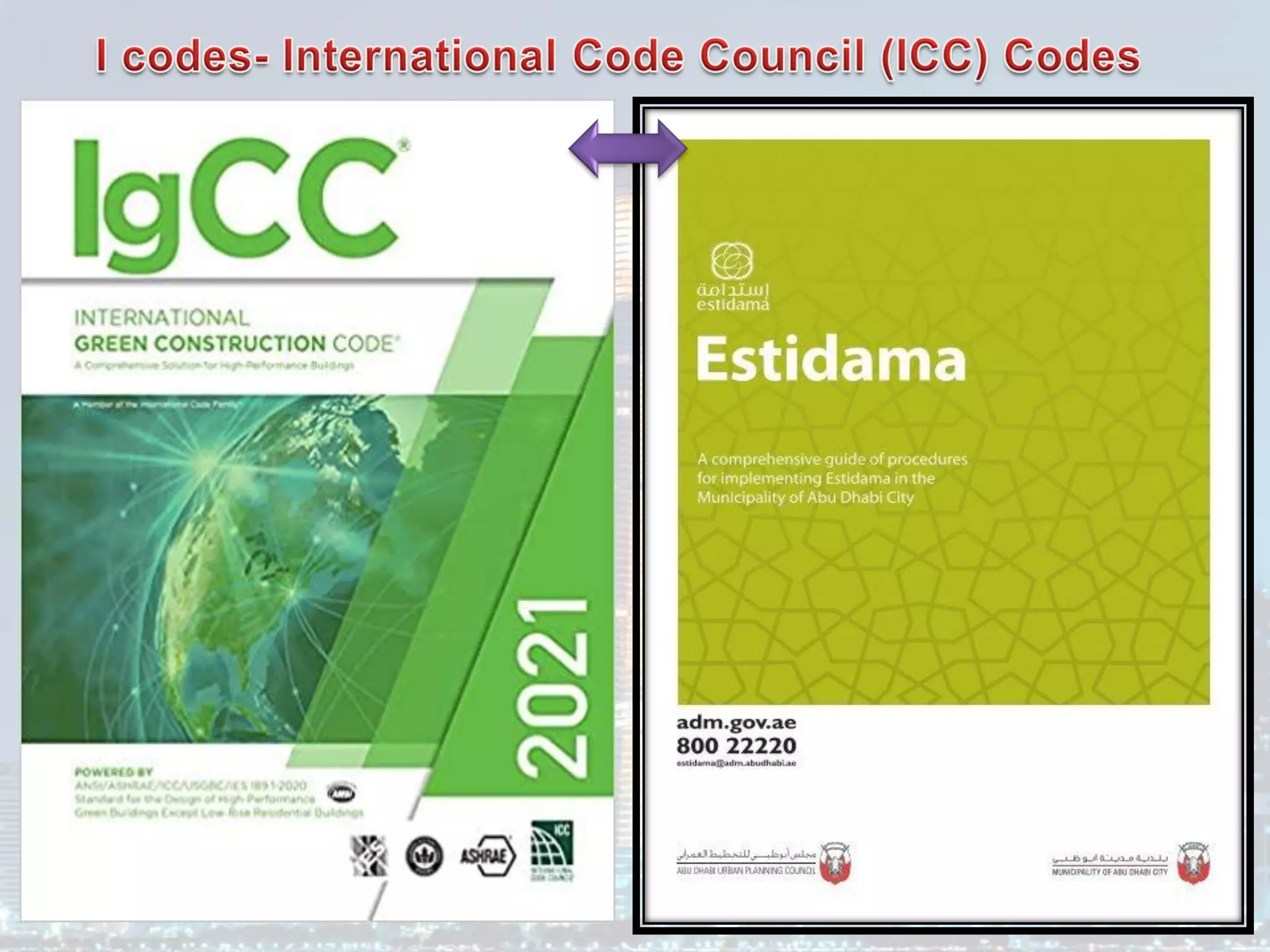
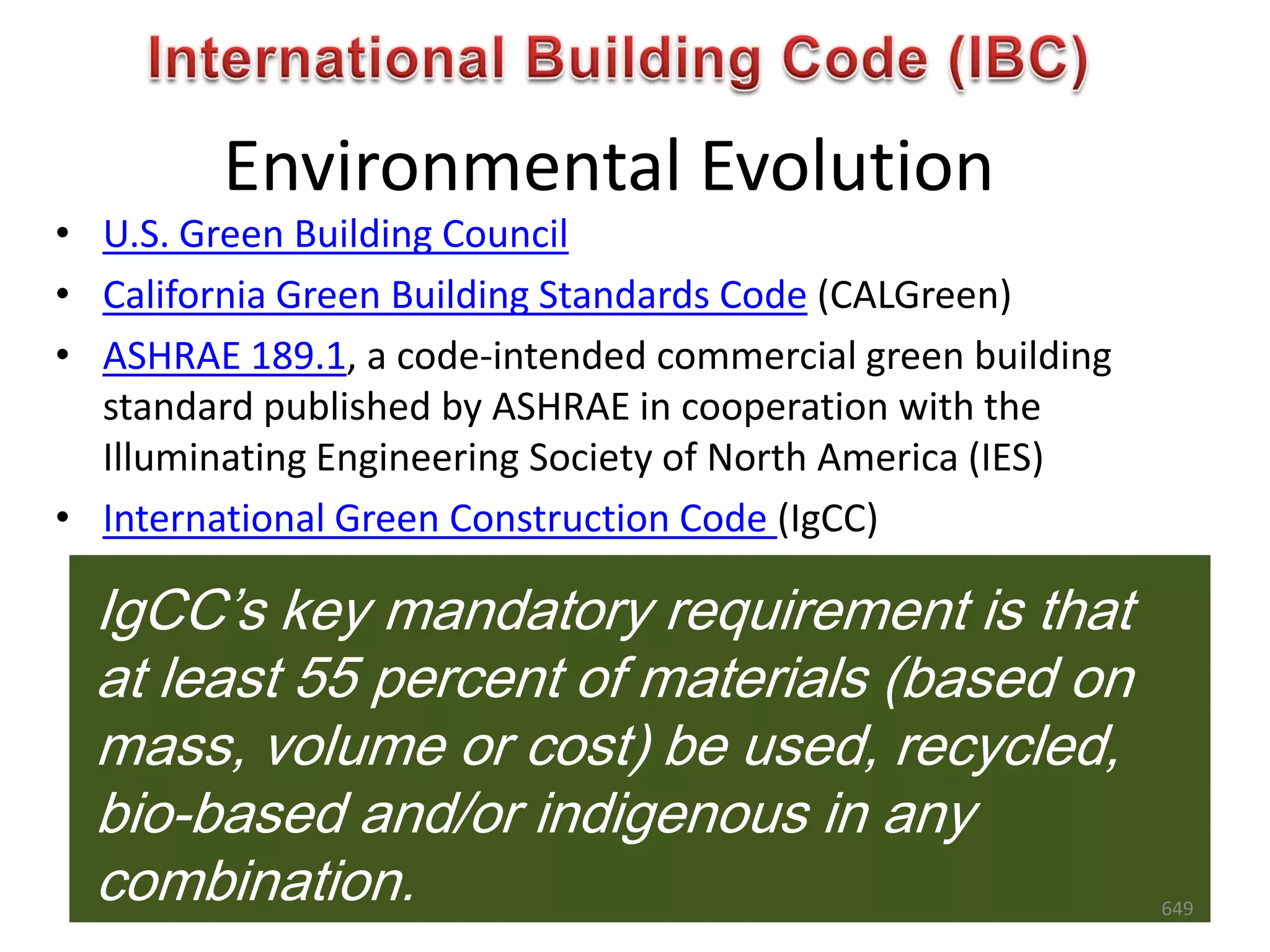
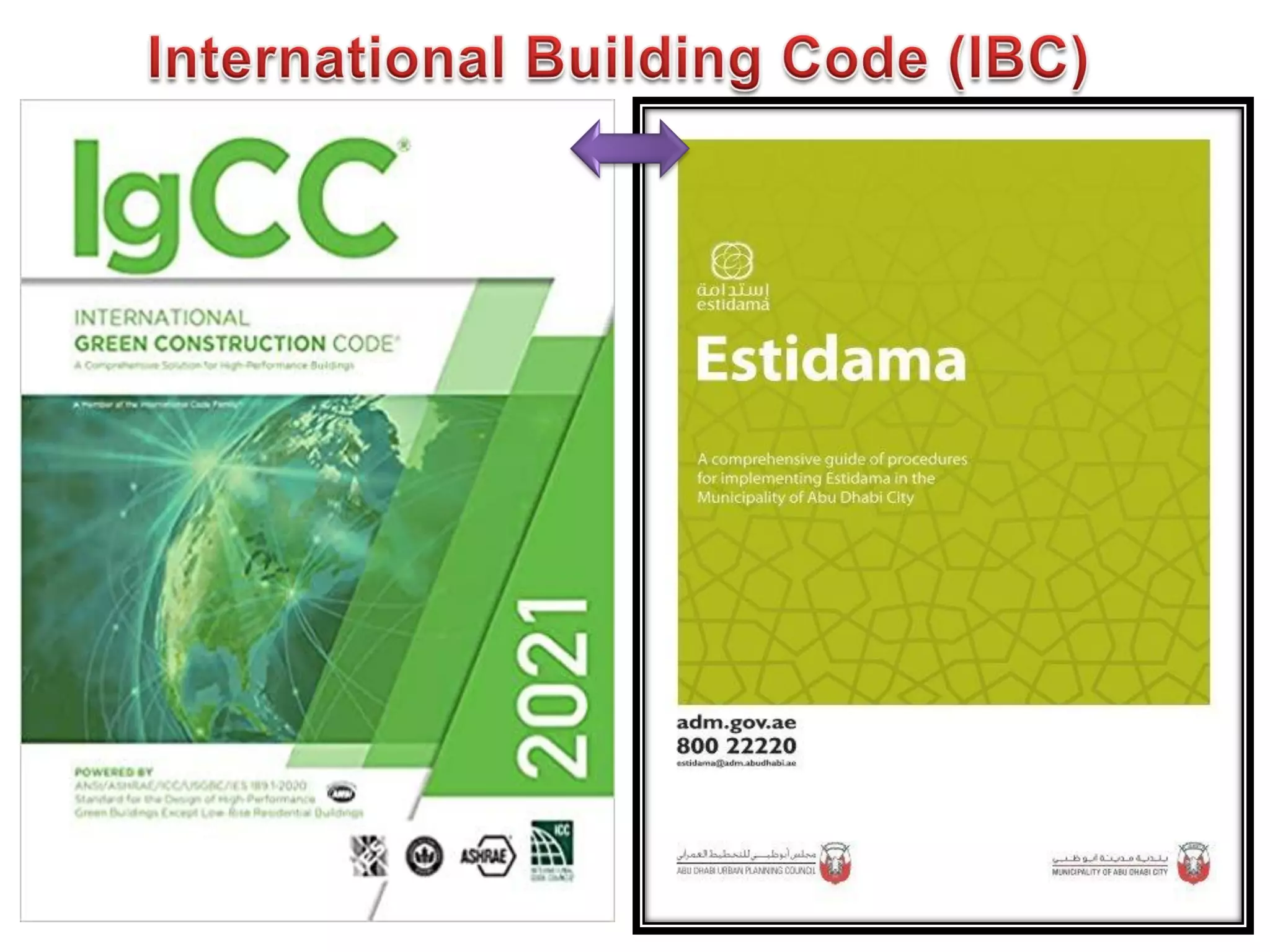
6. International Green Construction Code (IGCC)
7. International Mechanical Code (IMC)
8. ICC Performance Code (ICCPC)
9. International Plumbing Code (IPC)
10. International Private Sewage Disposal Code (IPSDC)
11. International Property Maintenance Code (IPMC)
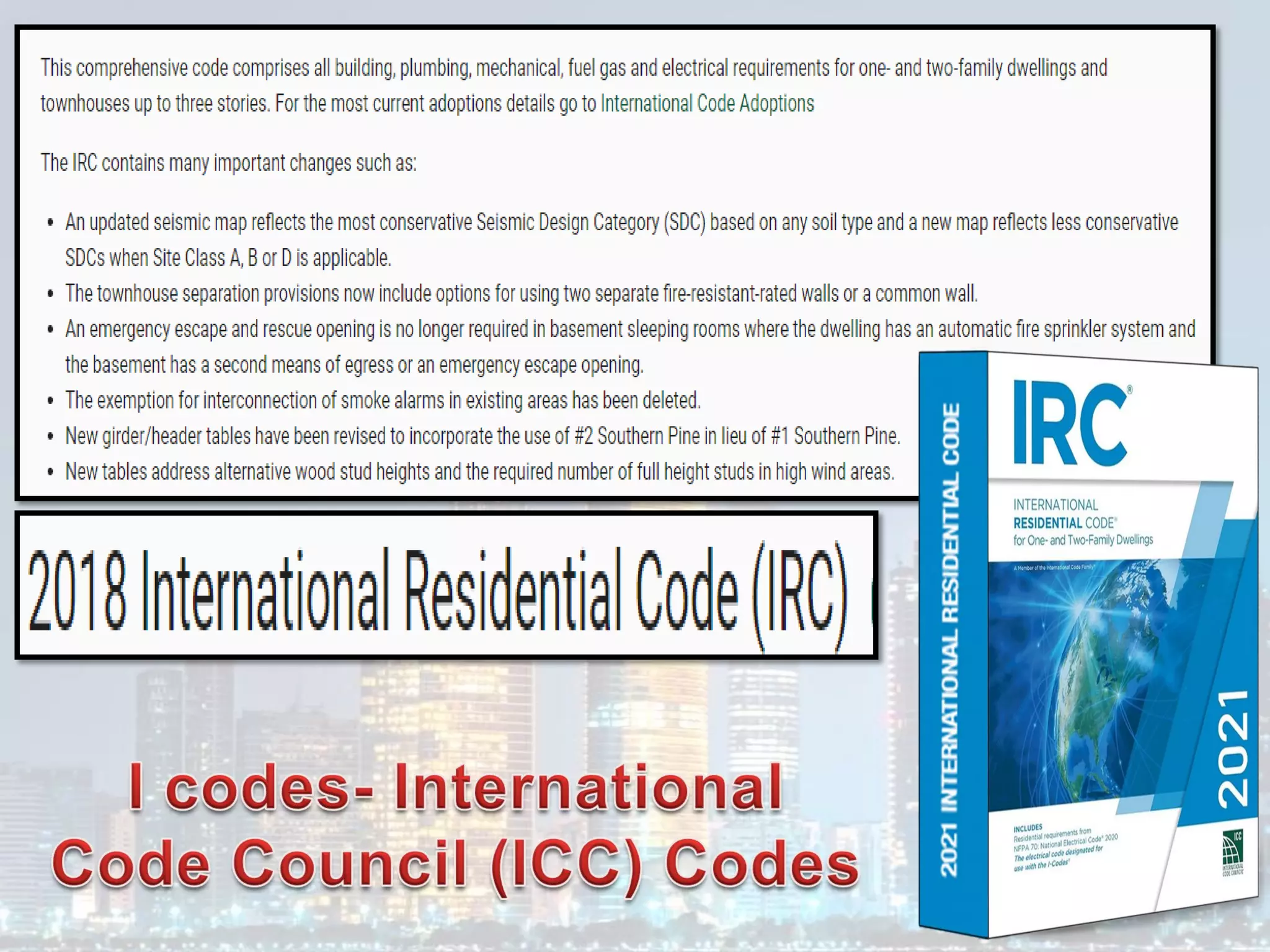
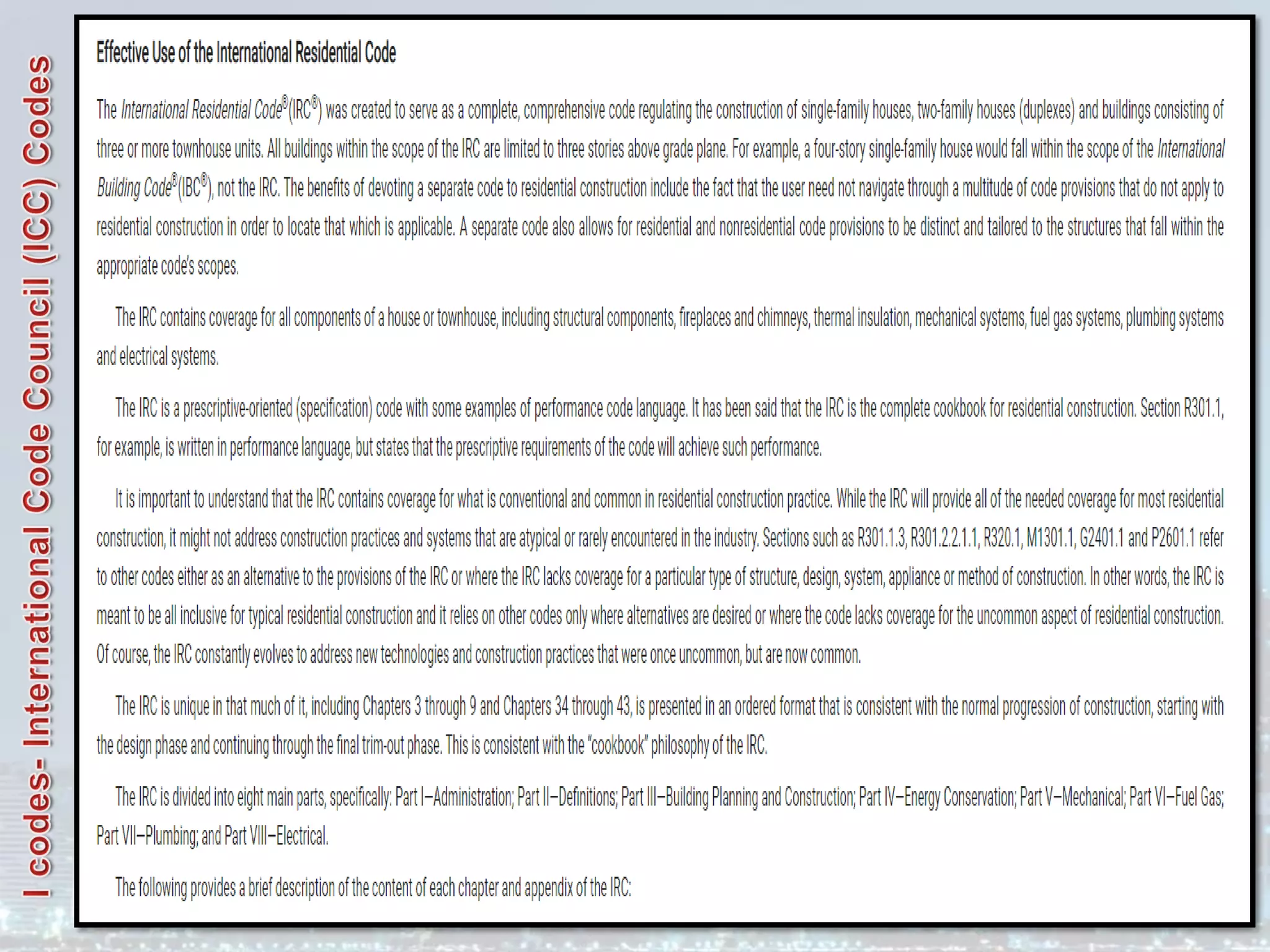
12. International Residential Code (IRC)
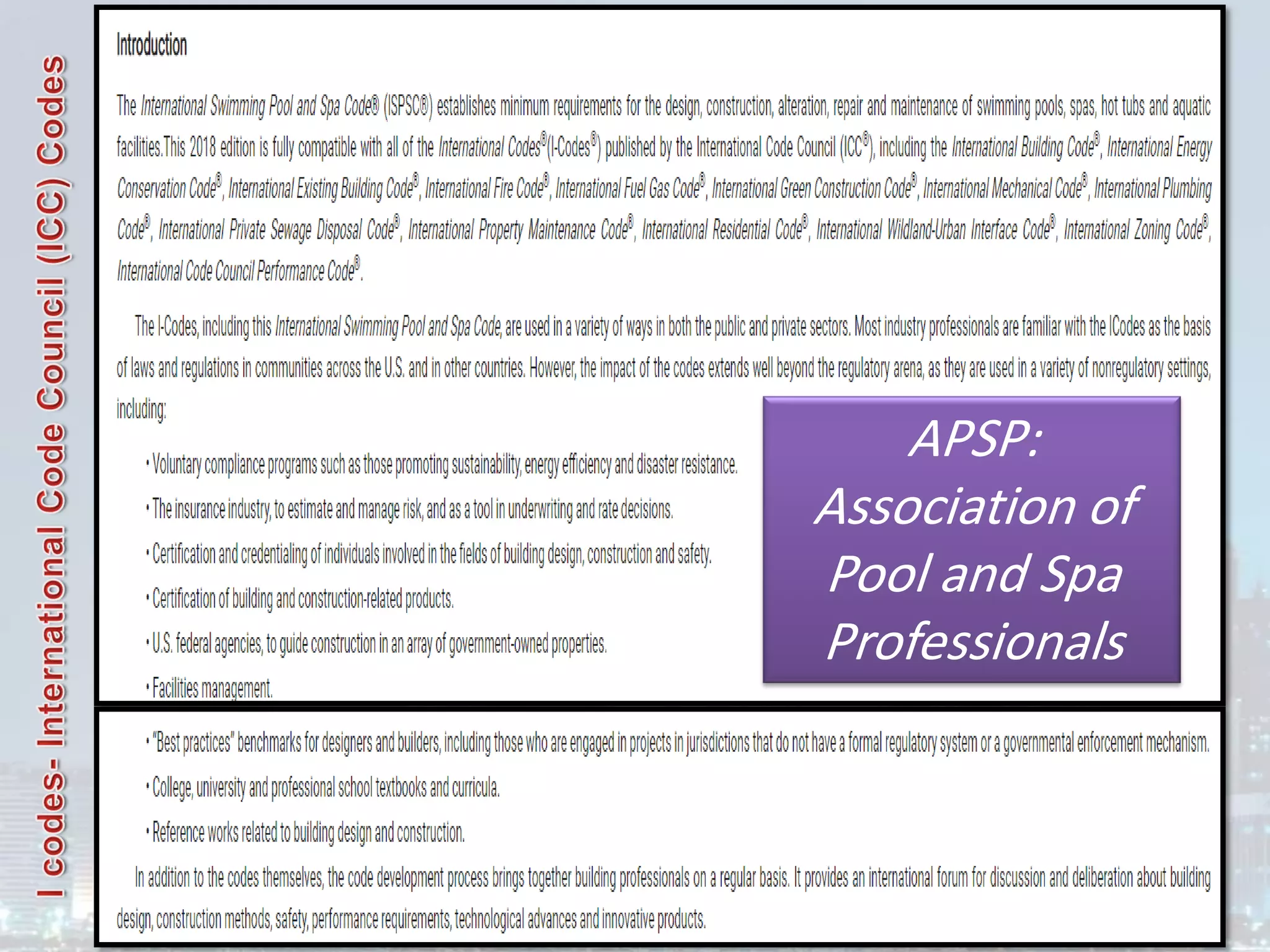
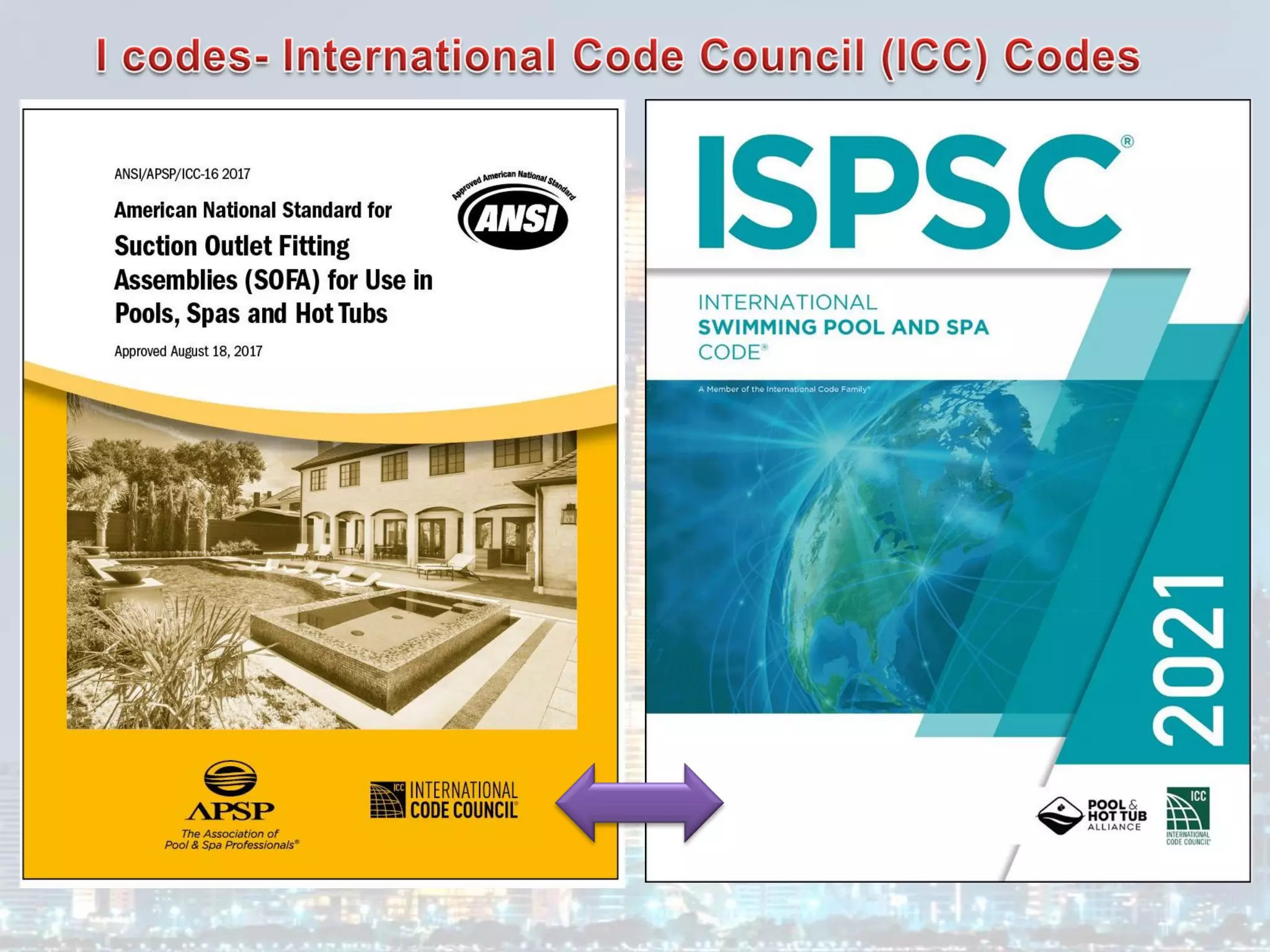
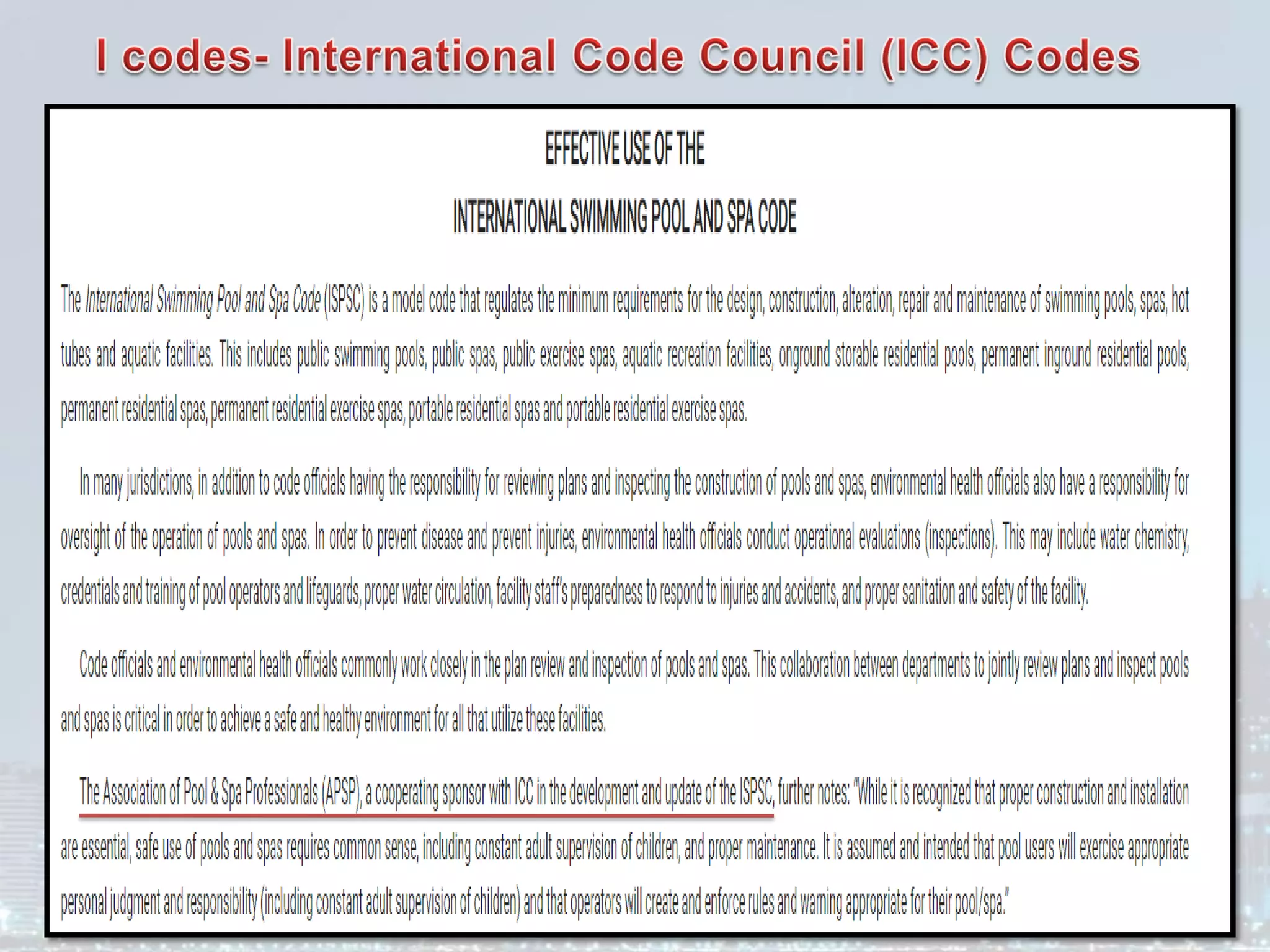
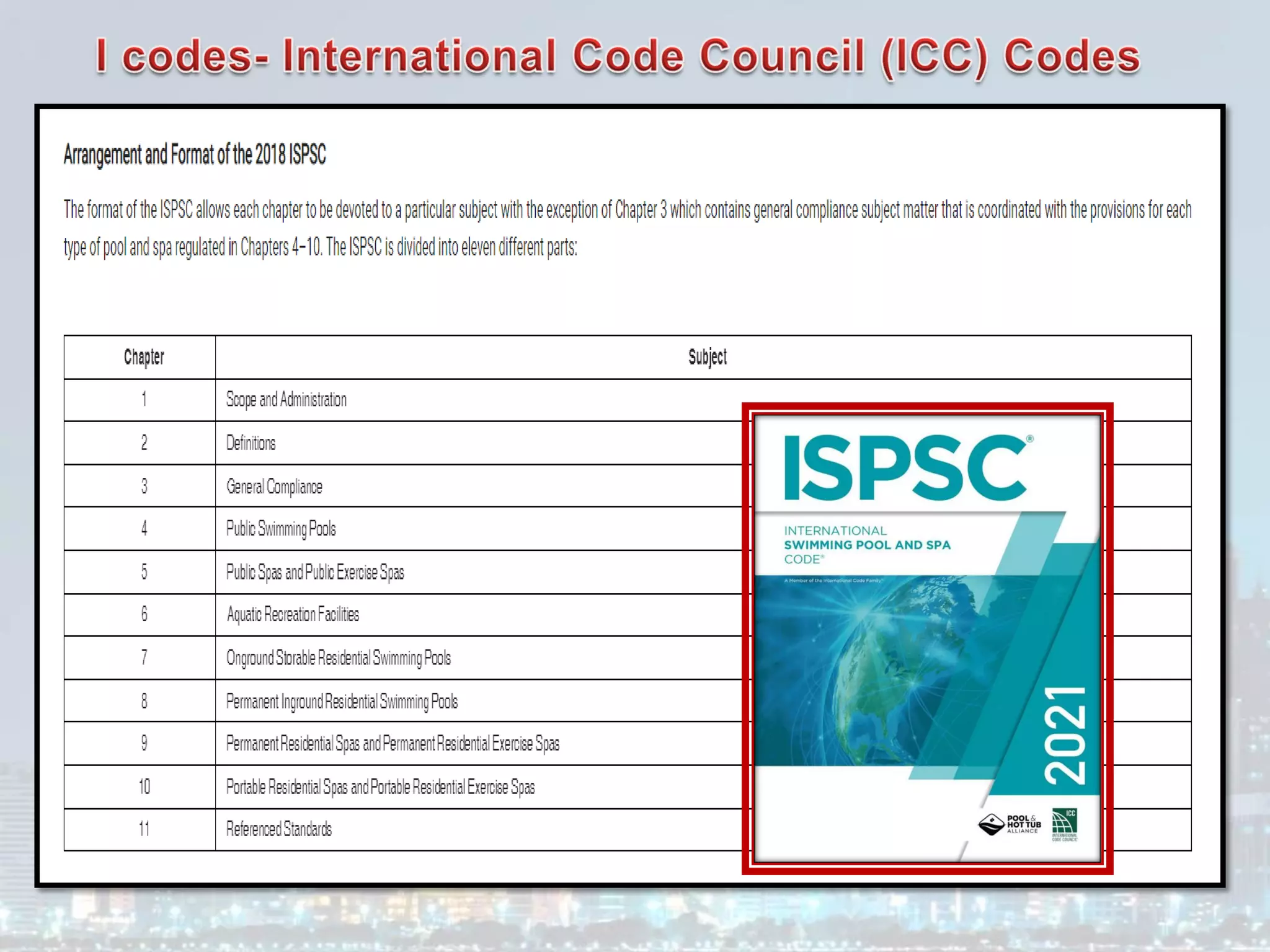
13. International Swimming Pool and Spa Code (ISPSC)
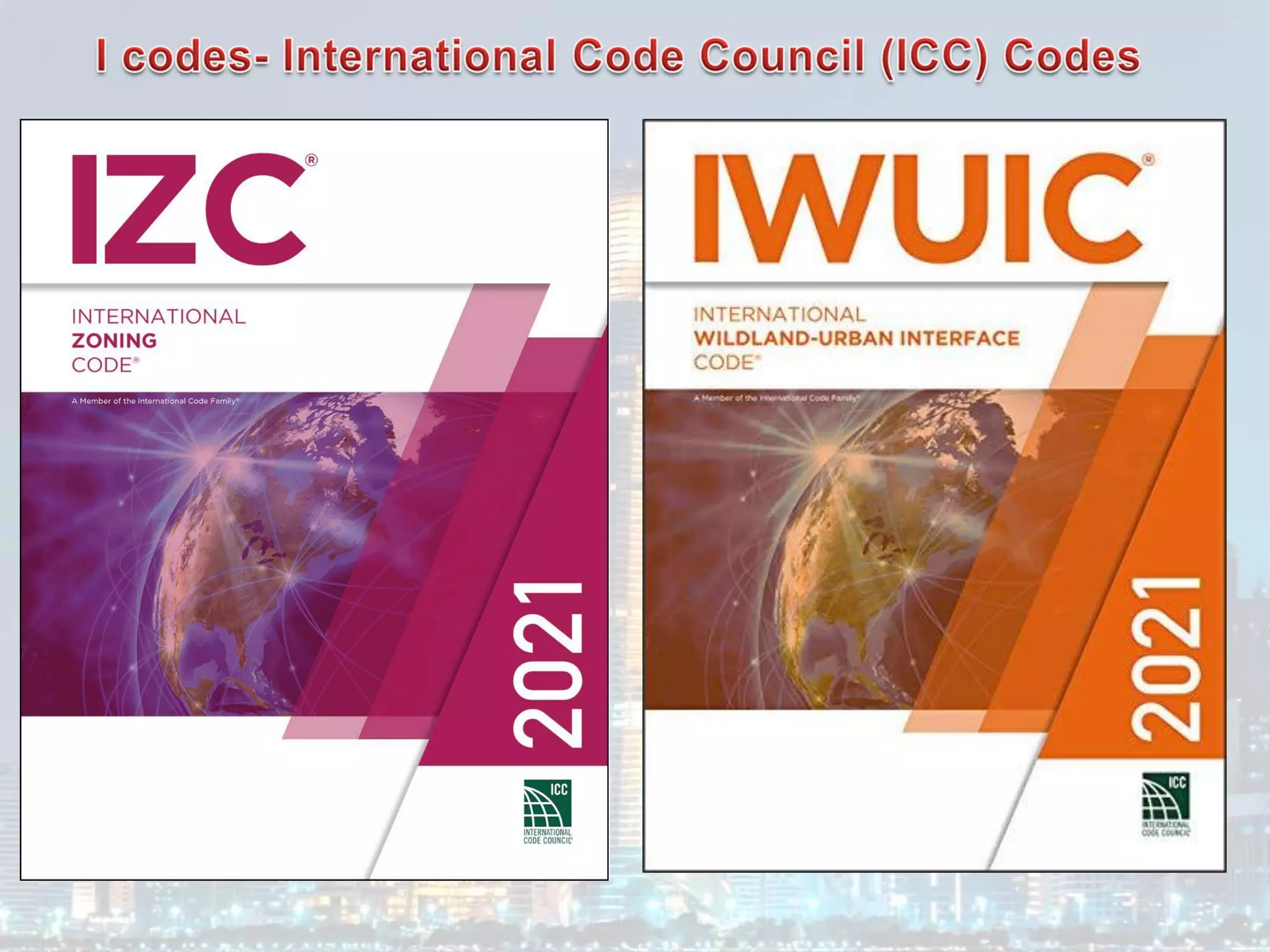
14. International Wildland Urban Interface Code (IWUIC)
15. International Zoning Code (IZC)
Plumbing, Mechanical, Fuel Gas and Swimming Pool Codes (PMG): The Code Council has
historically used the acronym PMG to refer to its model codes, standards, services and
resources related to plumbing, mechanical, fuel gas. With the release of the International
Swimming Pool and Spa Code (ISPSC) in 2012, it has expanded to include swimming pools
and spa topics.
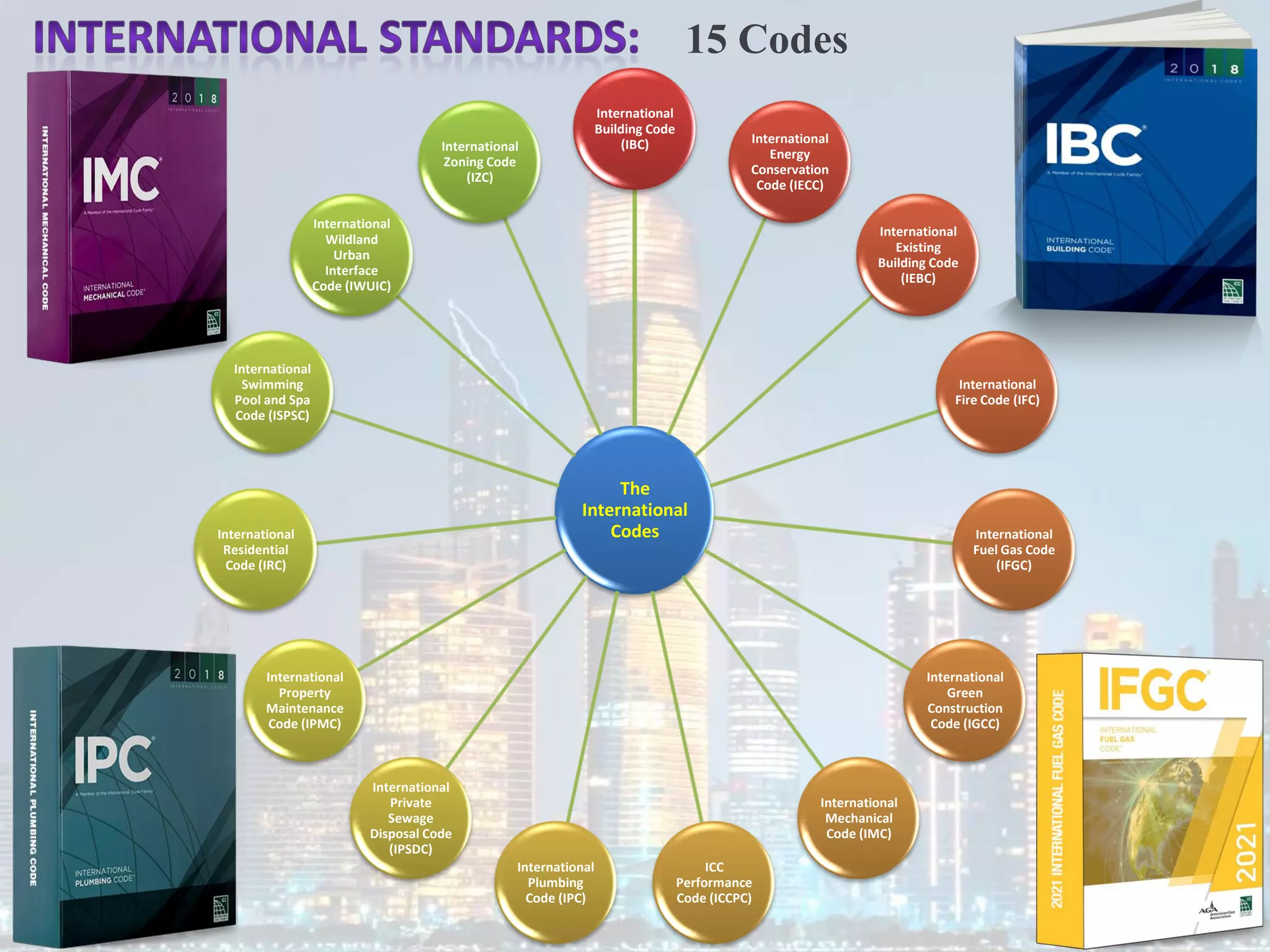
15 Codes
The
International
Codes
International
Building Code
(IBC) International
Energy
Conservation
Code (IECC)
International
Existing
Building Code
(IEBC)
International
Fire Code (IFC)
International
Fuel Gas Code
(IFGC)
International
Green
Construction
Code (IGCC)
International
Mechanical
Code (IMC)
ICC
Performance
Code (ICCPC)
International
Plumbing
Code (IPC)
International
Private
Sewage
Disposal Code
(IPSDC)
International
Property
Maintenance
Code (IPMC)
International
Residential
Code (IRC)
International
Swimming
Pool and Spa
Code (ISPSC)
International
Wildland
Urban
Interface
Code (IWUIC)
International
Zoning Code
(IZC)
15 Codes
Abu
Dhabi
International
Building
Codes
15 Codes
Abu
Dhabi
International
Building
Codes
15 Codes
Abu
Dhabi
International
Building
Codes
15 Codes
15 Codes
Abu
Dhabi
International
Building
Codes
Abu
Dhabi
International
Building
Codes
Abu
Dhabi
International
Building
Codes
Abu
Dhabi
International
Building
Codes
Abu
Dhabi
International
Building
Codes
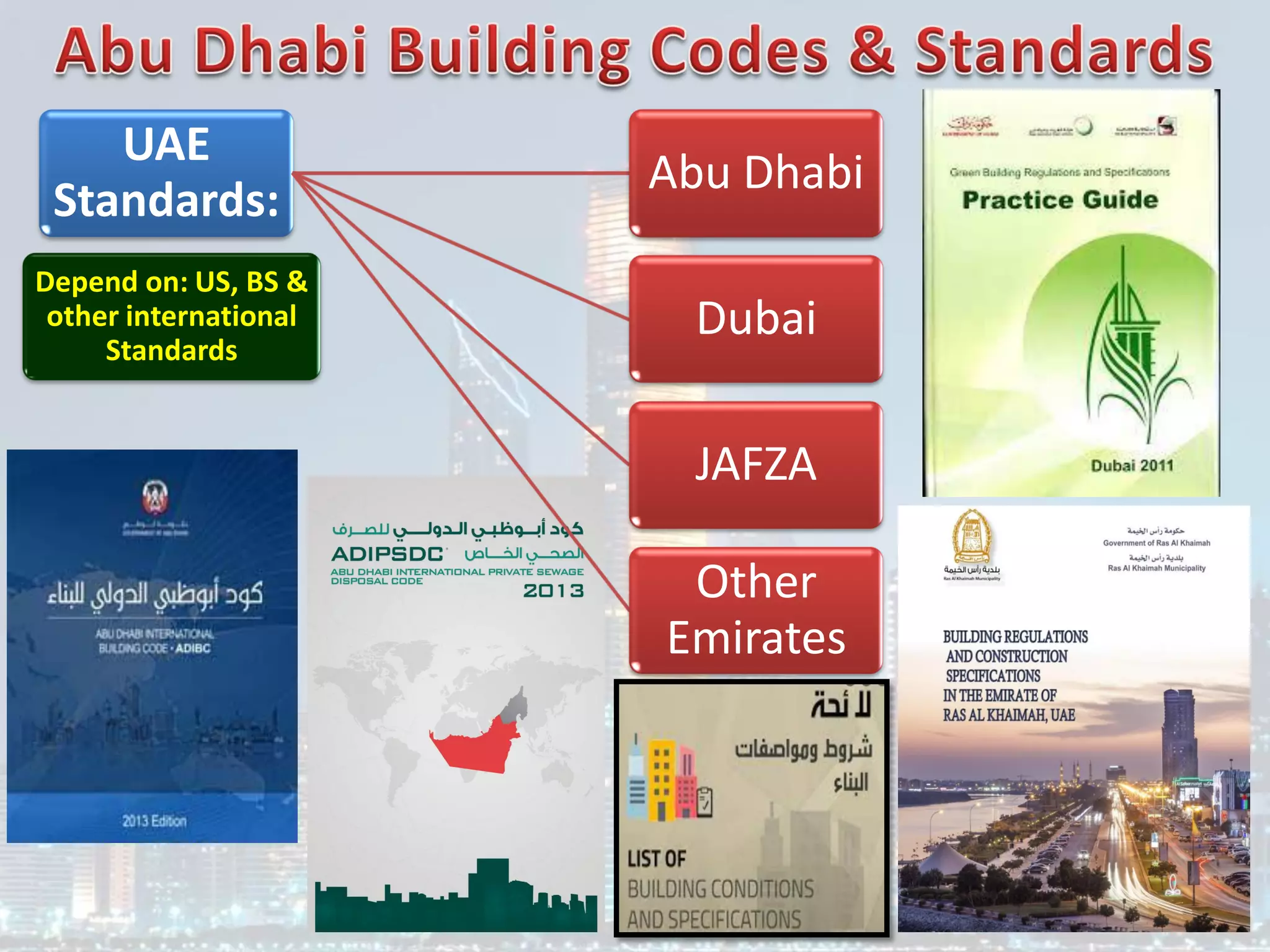
Depend on: US, BS &
other international
Standards
UAE
Standards:
Abu Dhabi
Dubai
JAFZA
Other
Emirates
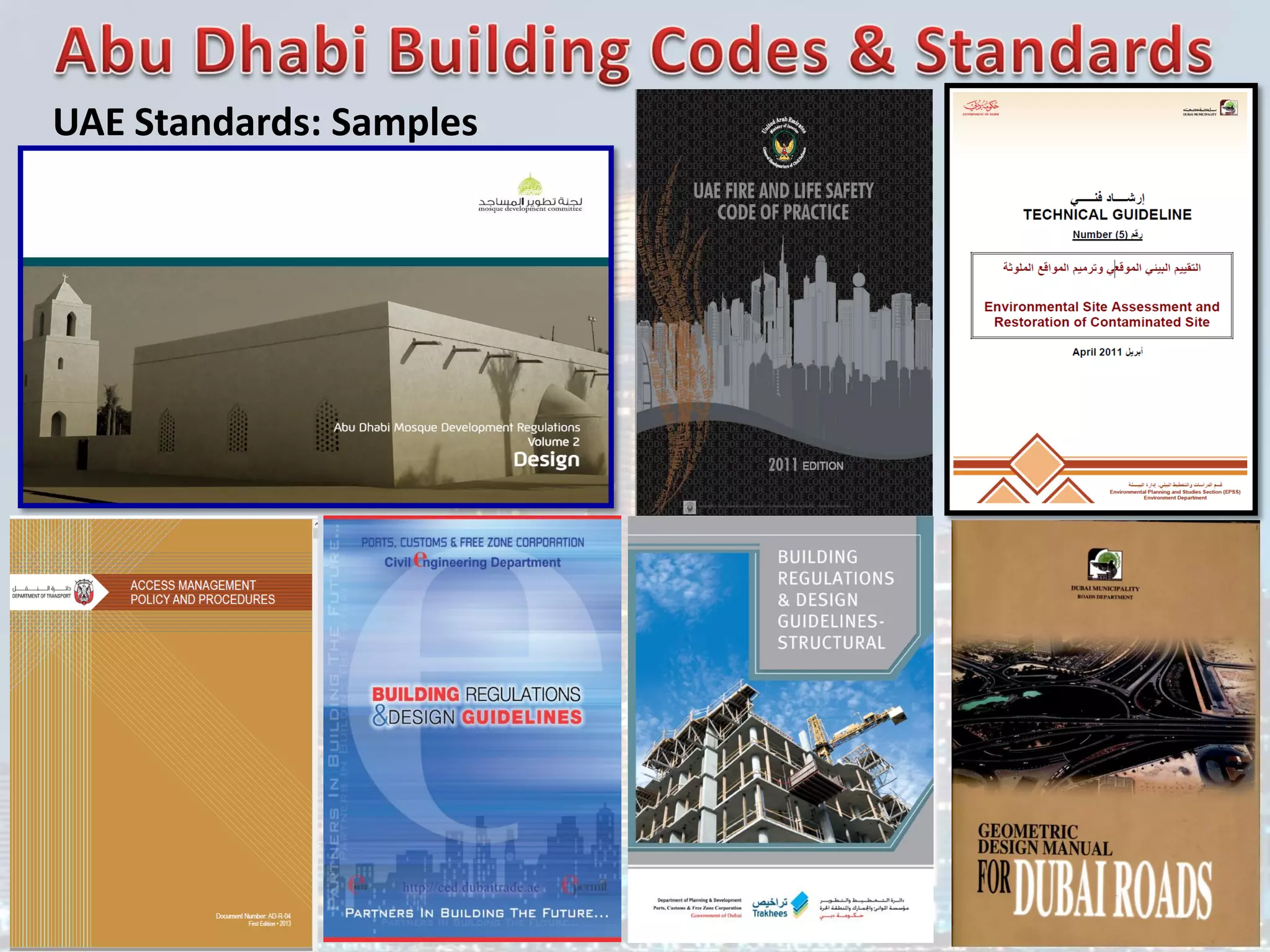
UAE Standards: Samples
Abu Dhabi Building Codes control all
construction and real estate activities
throughout the Emirate and is applied to
all projects in Abu Dhabi. The system is
the minimum standard of technical
specifications and standards that govern
the design, implementation and
maintenance of buildings to promote
sustainable HSE standards.
Abu Dhabi Codes economic benefits vary and corresponds with Abu Dhabi
2030 vision to achieve sustainable building standards. The benefits include
reduced cost, improved structural safety, improved building quality,
emergence of new markets due to the use of modern materials as well as
technology and systems in construction, reduced building maintenance
cost and long-term energy saving.
INTRODUCTION
UAE/AD Standards:
UAE/AD Standards:
Abu Dhabi’s new Building Codes –
underpinning sustainable development ADSG FQM
2011.
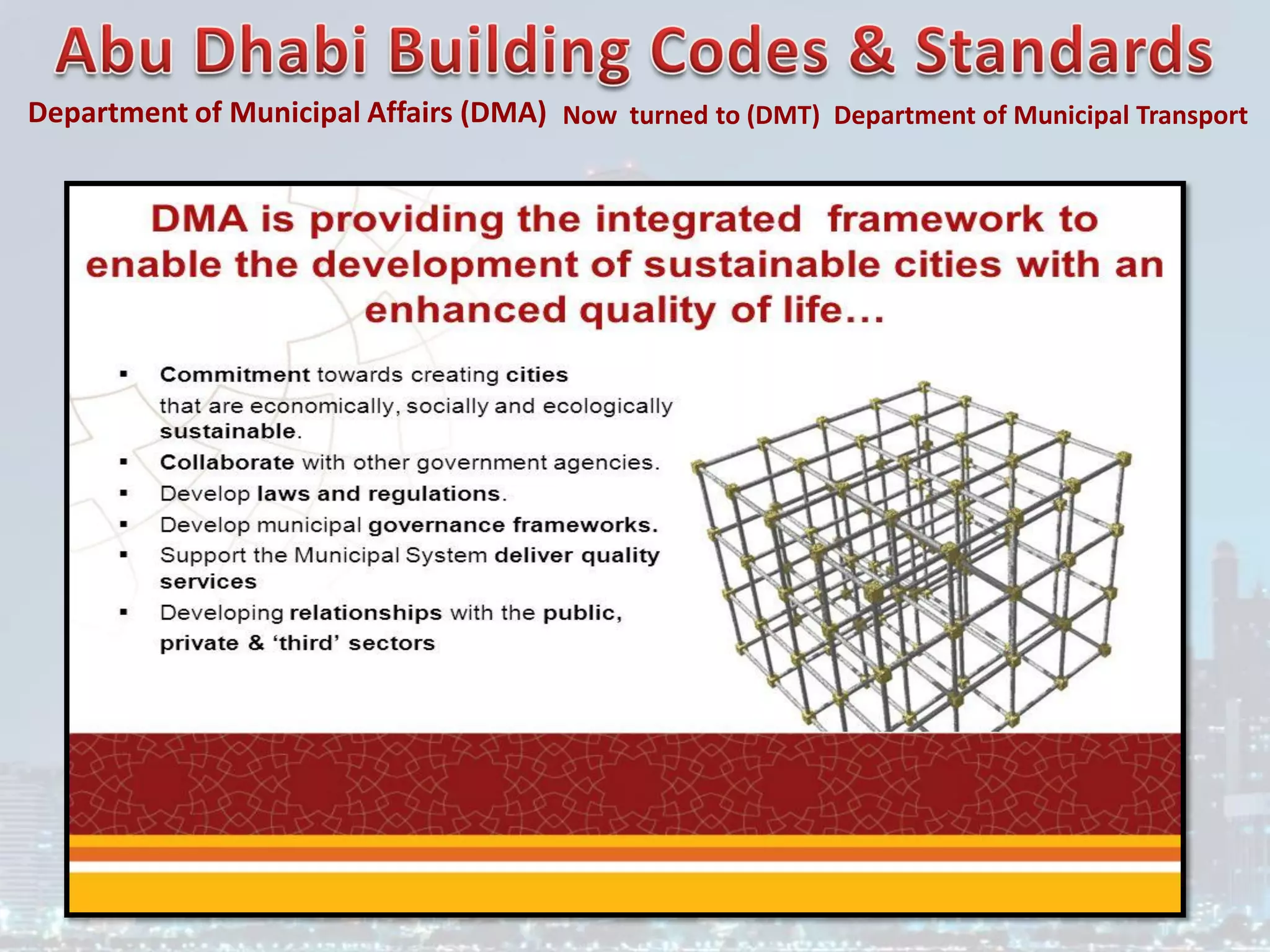
Now turned to (DMT) Department of Municipal Transport
Department of Municipal Affairs
Now turned to (DMT) Department of Municipal Transport
Department of Municipal Affairs (DMA) Now turned to (DMT) Department of Municipal Transport
Department of Urban Planning and
Municipalities
The Department is specialized in
developing sustainable urban growth
standards in Abu Dhabi. The Department
of Urban Planning and Municipalities is
the main authority responsible for the Abu
Dhabi Building Codes.
The Department adopted the new international codes issued by the
International Code Council as the international body for building
specifications. Employees of government departments, academia and
consulting companies to determine the required modifications to
international codes to become suitable for local specifications in the
Emirate of Abu Dhabi. For more information about the Department, please
visit the Department of Urban Planning and Municipalities page.
UAE/AD Standards:
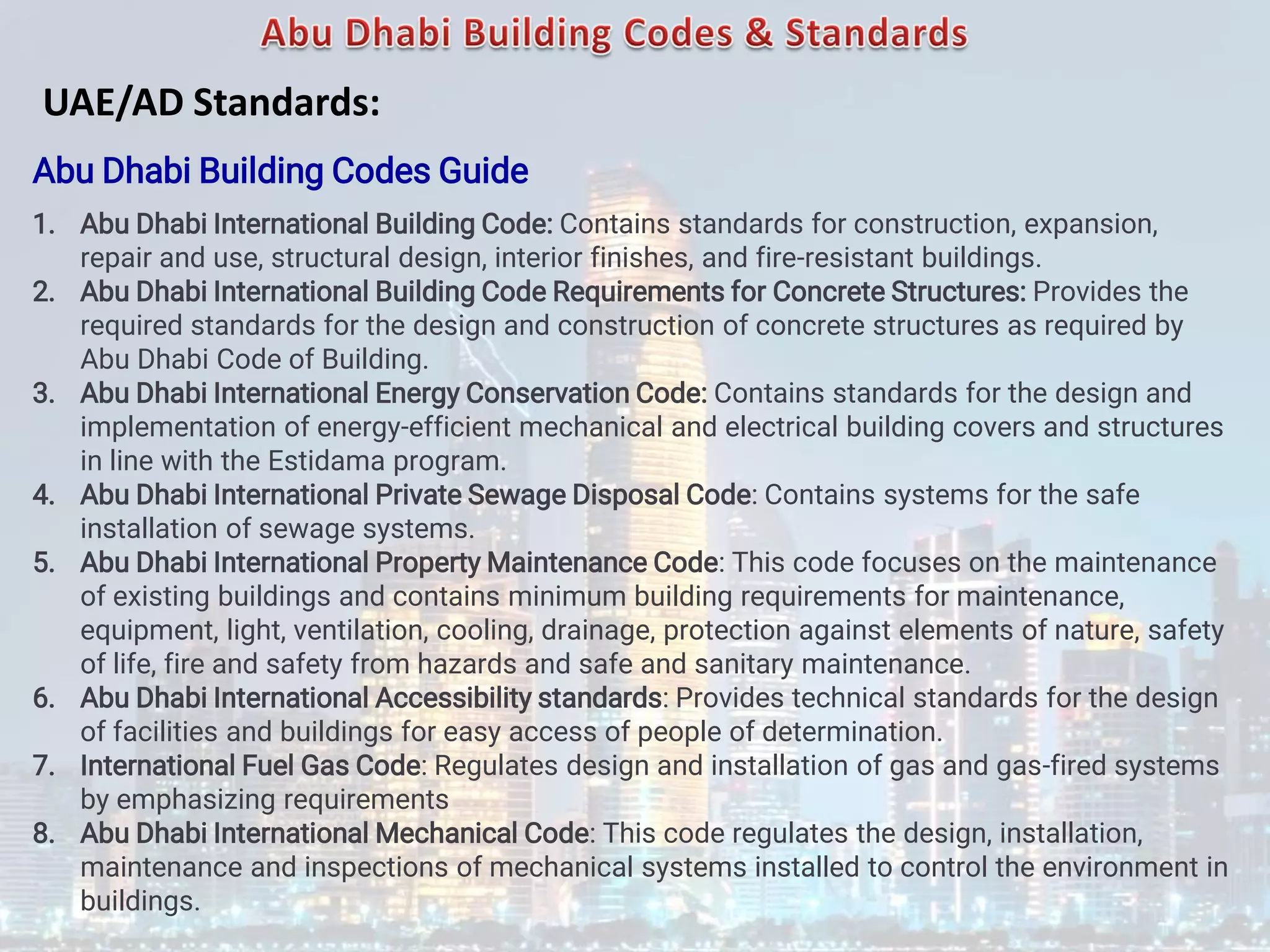
Abu Dhabi Building Codes Guide
1. Abu Dhabi International Building Code: Contains standards for construction, expansion,
repair and use, structural design, interior finishes, and fire-resistant buildings.
2. Abu Dhabi International Building Code Requirements for Concrete Structures: Provides the
required standards for the design and construction of concrete structures as required by
Abu Dhabi Code of Building.
3. Abu Dhabi International Energy Conservation Code: Contains standards for the design and
implementation of energy-efficient mechanical and electrical building covers and structures
in line with the Estidama program.
4. Abu Dhabi International Private Sewage Disposal Code: Contains systems for the safe
installation of sewage systems.
5. Abu Dhabi International Property Maintenance Code: This code focuses on the maintenance
of existing buildings and contains minimum building requirements for maintenance,
equipment, light, ventilation, cooling, drainage, protection against elements of nature, safety
of life, fire and safety from hazards and safe and sanitary maintenance.
6. Abu Dhabi International Accessibility standards: Provides technical standards for the design
of facilities and buildings for easy access of people of determination.
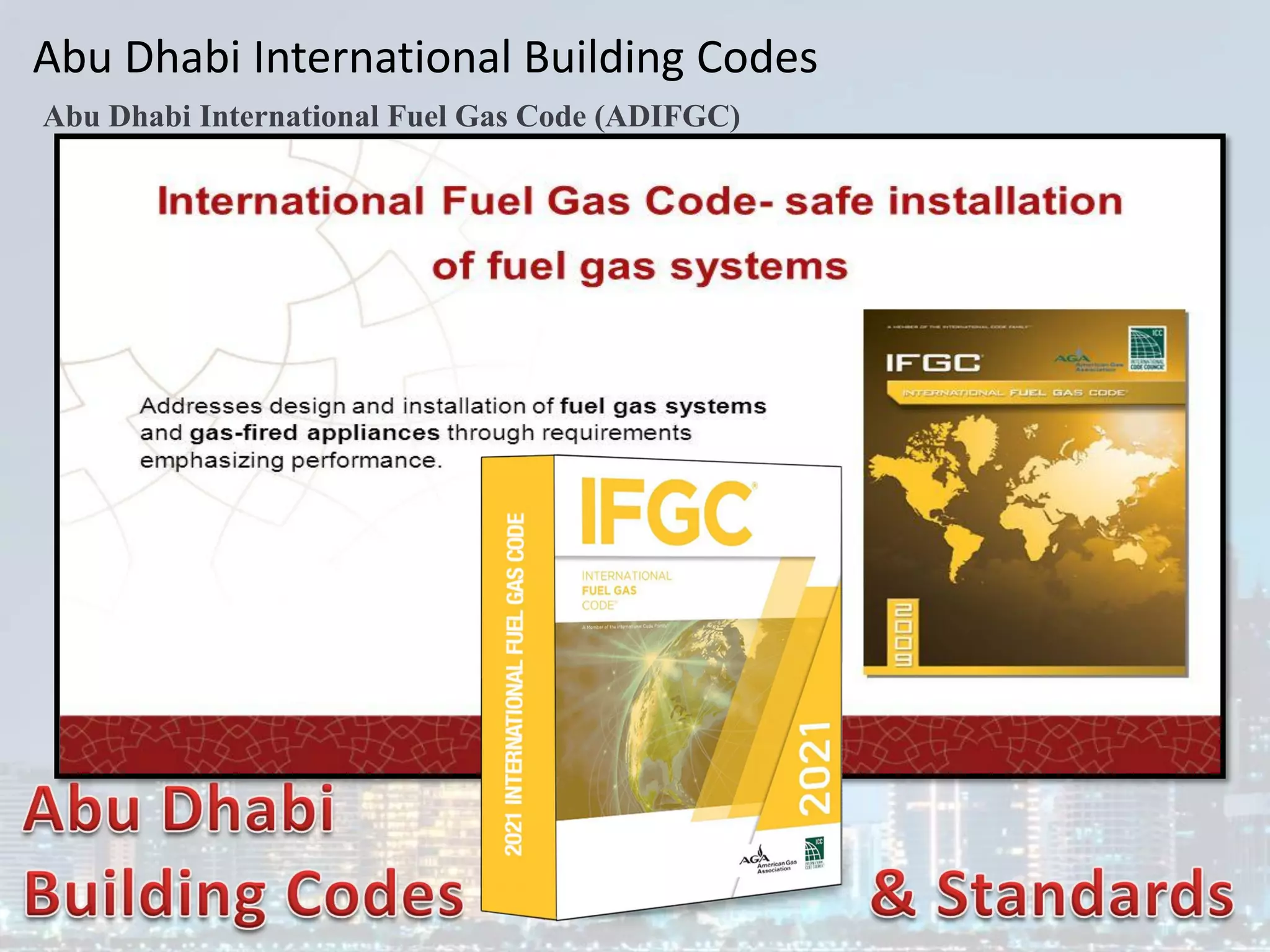
7. International Fuel Gas Code: Regulates design and installation of gas and gas-fired systems
by emphasizing requirements
8. Abu Dhabi International Mechanical Code: This code regulates the design, installation,
maintenance and inspections of mechanical systems installed to control the environment in
buildings.
UAE/AD Standards:
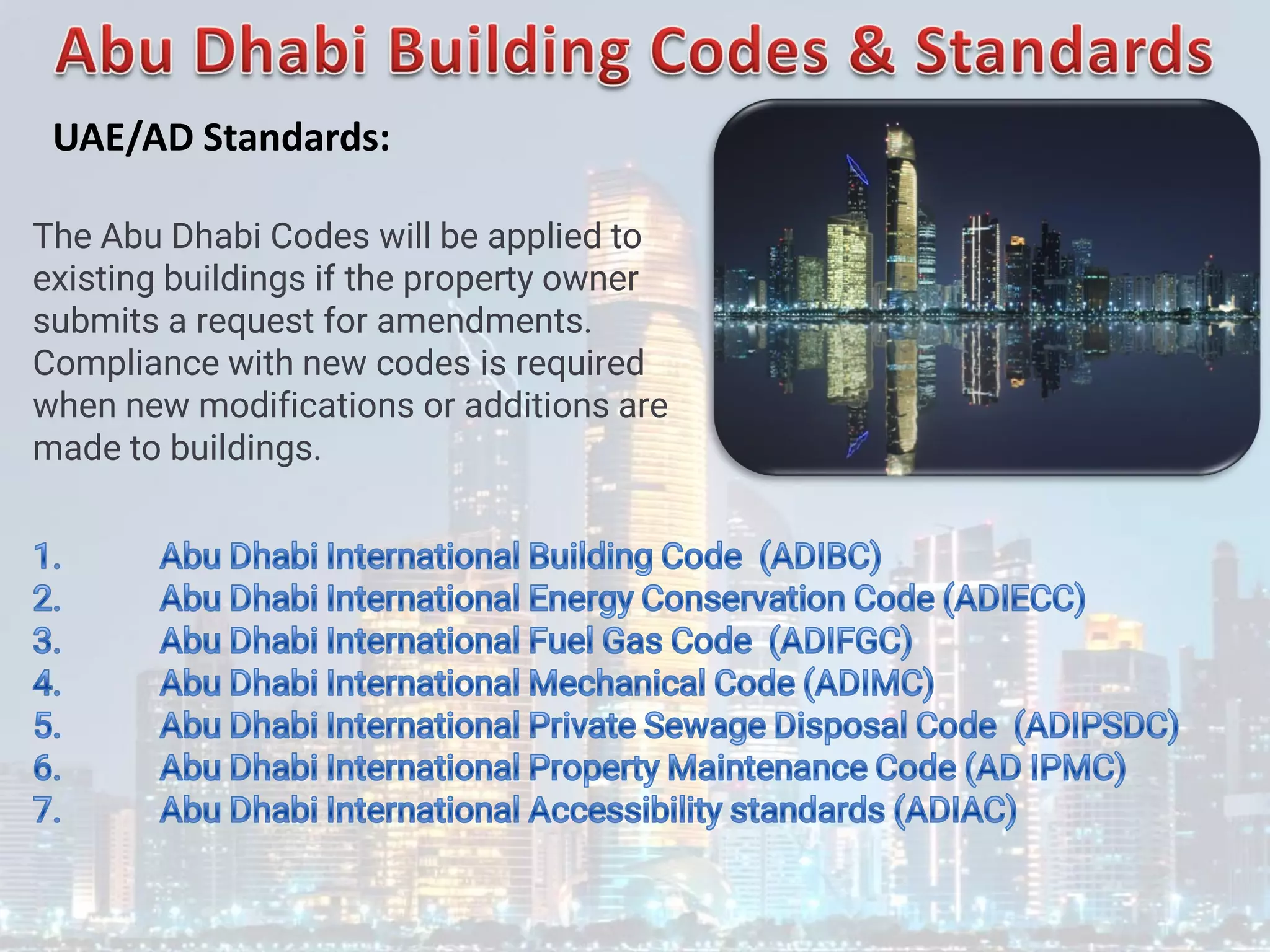
The Abu Dhabi Codes will be applied to
existing buildings if the property owner
submits a request for amendments.
Compliance with new codes is required
when new modifications or additions are
made to buildings.
UAE/AD Standards:
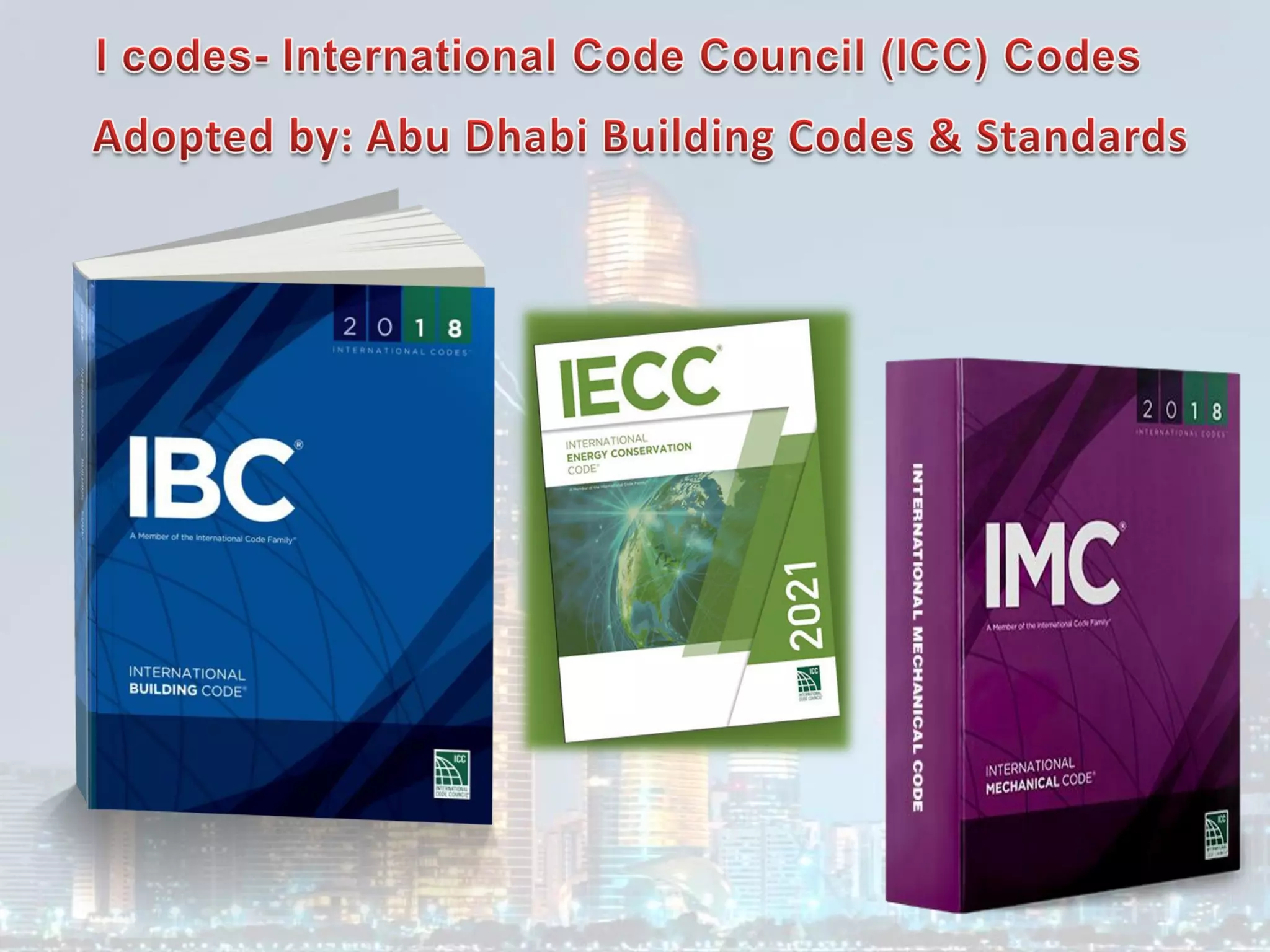
International Codes Adopted by the Emirate of Abu Dhabi
Abu Dhabi government, through its Department of Municipal
Affairs, has adopted the ICC family of codes to be the
standards that will guide the development of construction
projects in the Emirate of Abu Dhabi.
Codes implemented effective
I. International Building Code (IBC)
II. International Energy Conservation Code (IECC)
III. International Fire Code (IFC)
IV. International Fuel Gas Code (IFGC)
V. International Mechanical Code (IMC)
VI. International Plumbing Code (IPC)
VII. International Private Sewage Disposal Code
(IPSDC)
VIII.International Property Maintenance Code (IPMC)
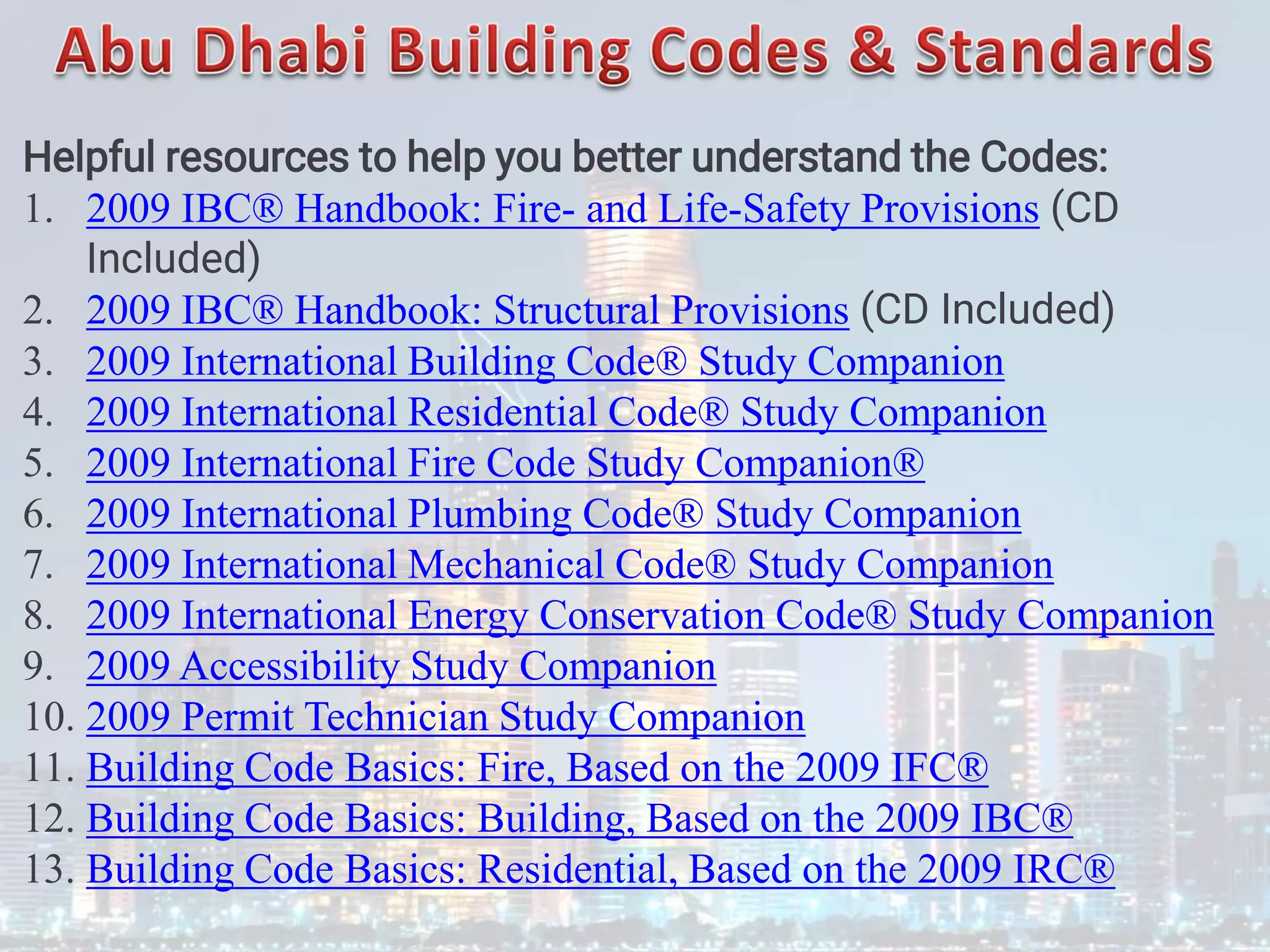
Helpful resources to help you better understand the Codes:
1. 2009 IBC® Handbook: Fire- and Life-Safety Provisions (CD
Included)
2. 2009 IBC® Handbook: Structural Provisions (CD Included)
3. 2009 International Building Code® Study Companion
4. 2009 International Residential Code® Study Companion
5. 2009 International Fire Code Study Companion®
6. 2009 International Plumbing Code® Study Companion
7. 2009 International Mechanical Code® Study Companion
8. 2009 International Energy Conservation Code® Study Companion
9. 2009 Accessibility Study Companion
10. 2009 Permit Technician Study Companion
11. Building Code Basics: Fire, Based on the 2009 IFC®
12. Building Code Basics: Building, Based on the 2009 IBC®
13. Building Code Basics: Residential, Based on the 2009 IRC®
Abu Dhabi International Building Codes
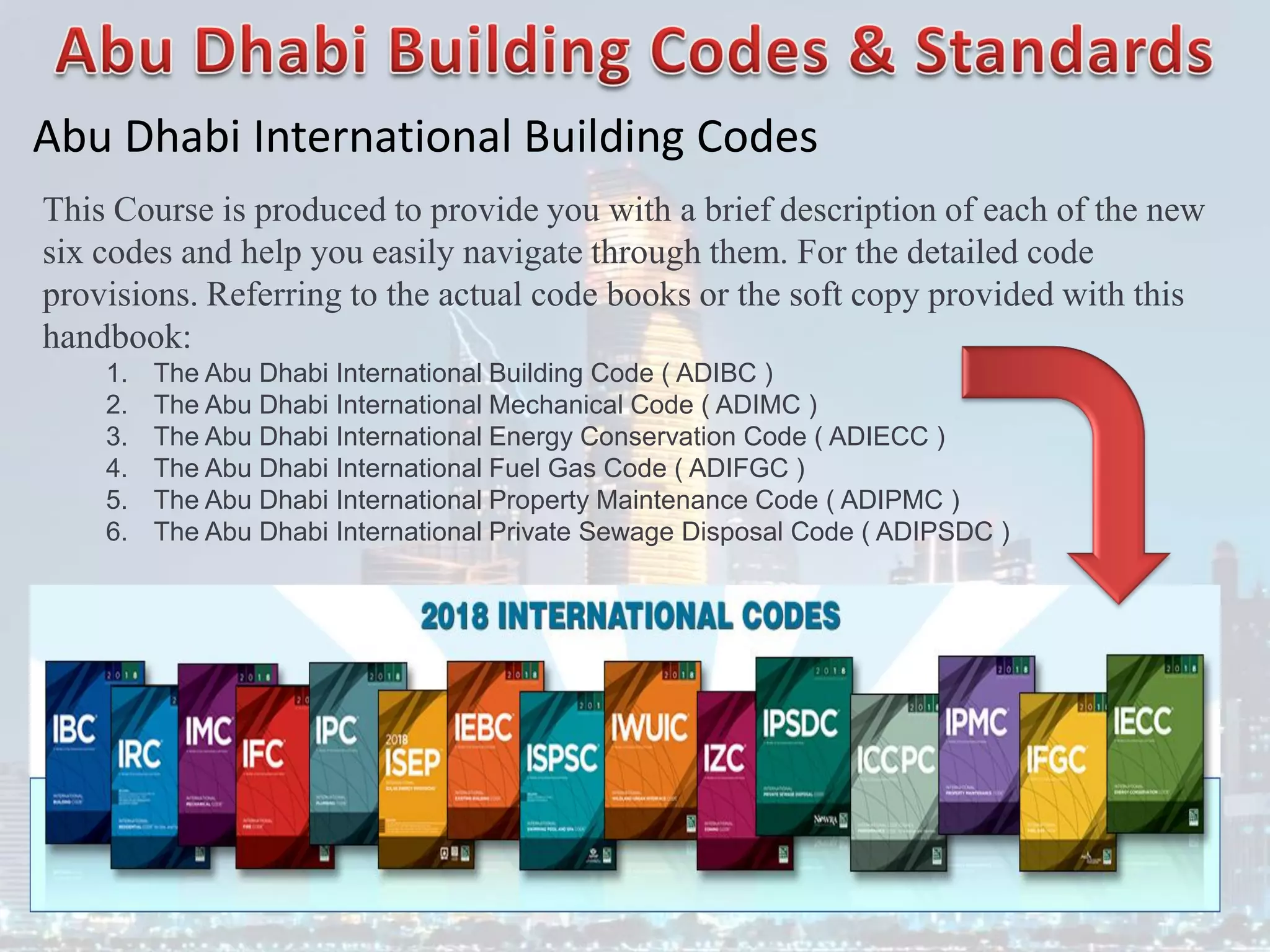
This Course is produced to provide you with a brief description of each of the new
six codes and help you easily navigate through them. For the detailed code
provisions. Referring to the actual code books or the soft copy provided with this
handbook:
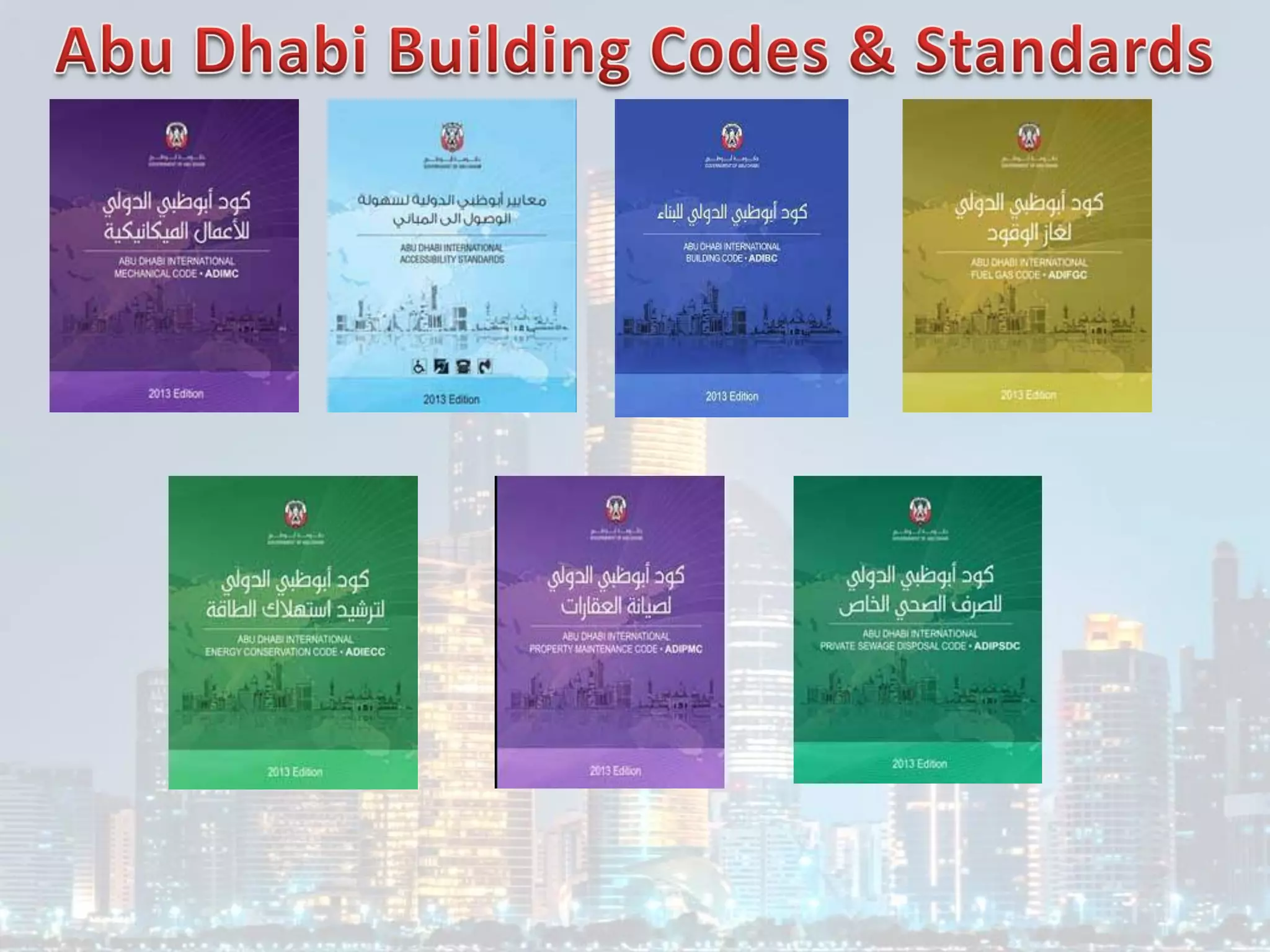
1. The Abu Dhabi International Building Code ( ADIBC )
2. The Abu Dhabi International Mechanical Code ( ADIMC )
3. The Abu Dhabi International Energy Conservation Code ( ADIECC )
4. The Abu Dhabi International Fuel Gas Code ( ADIFGC )
5. The Abu Dhabi International Property Maintenance Code ( ADIPMC )
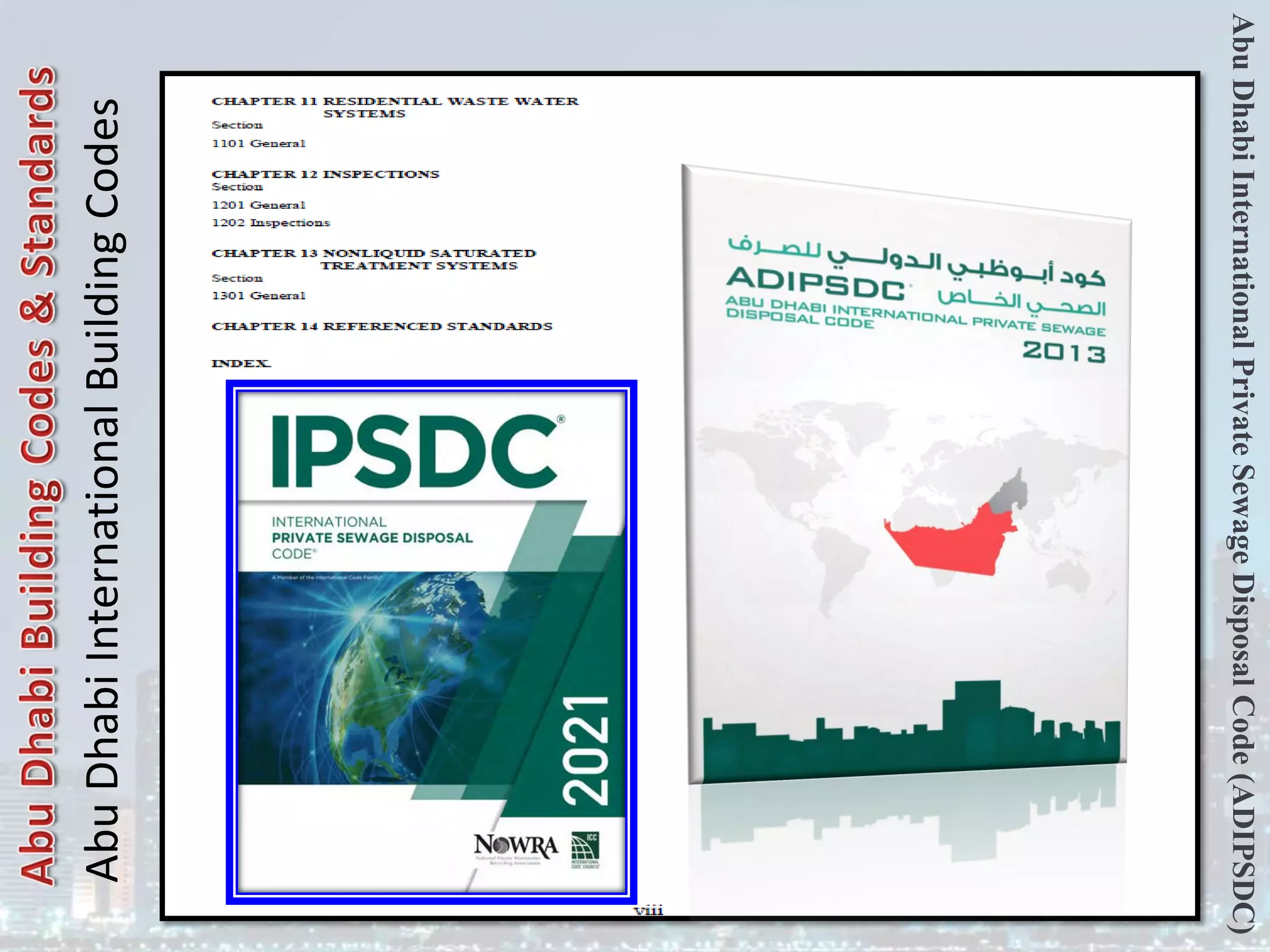
6. The Abu Dhabi International Private Sewage Disposal Code ( ADIPSDC )
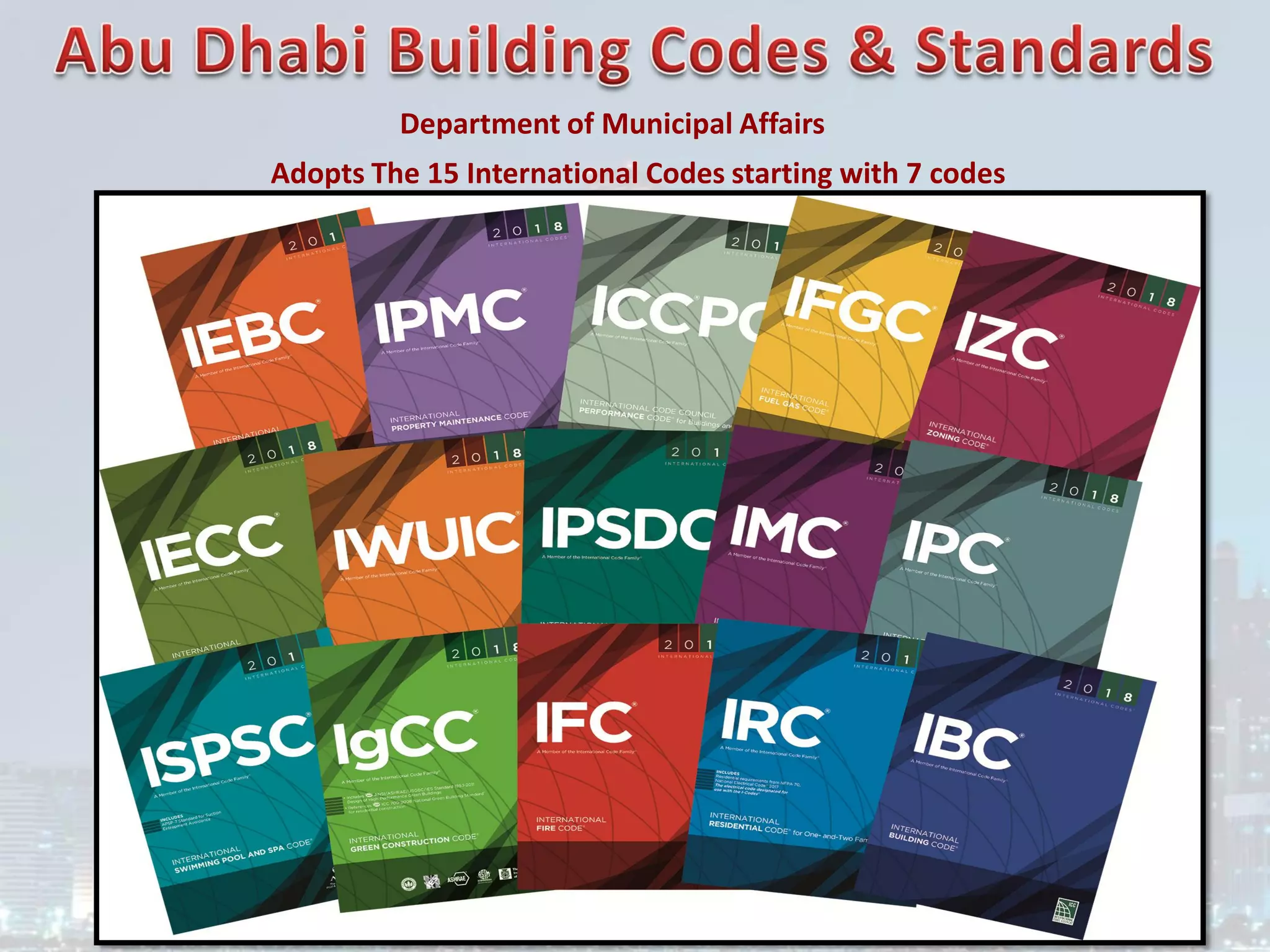
Department of Municipal Affairs
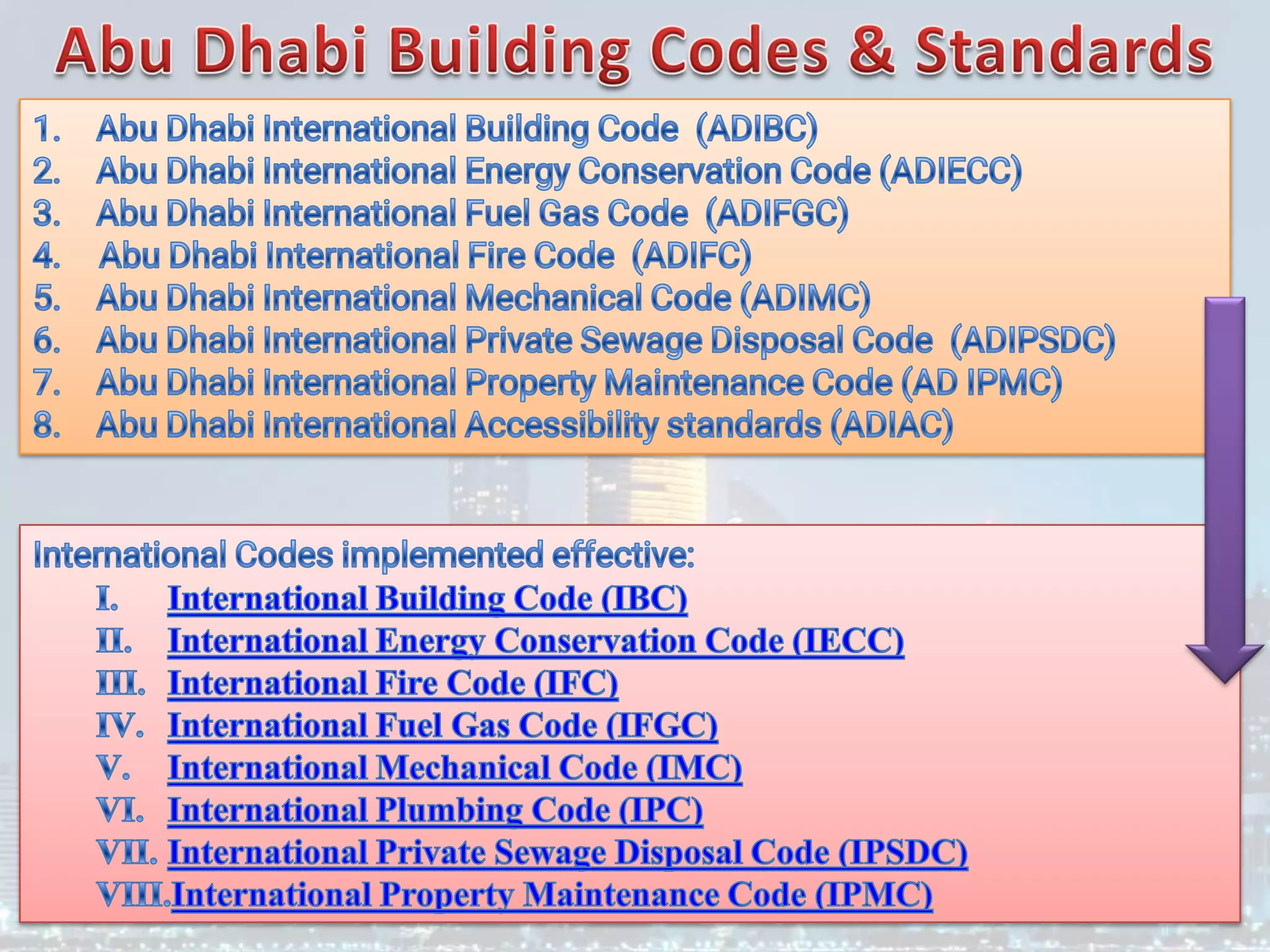
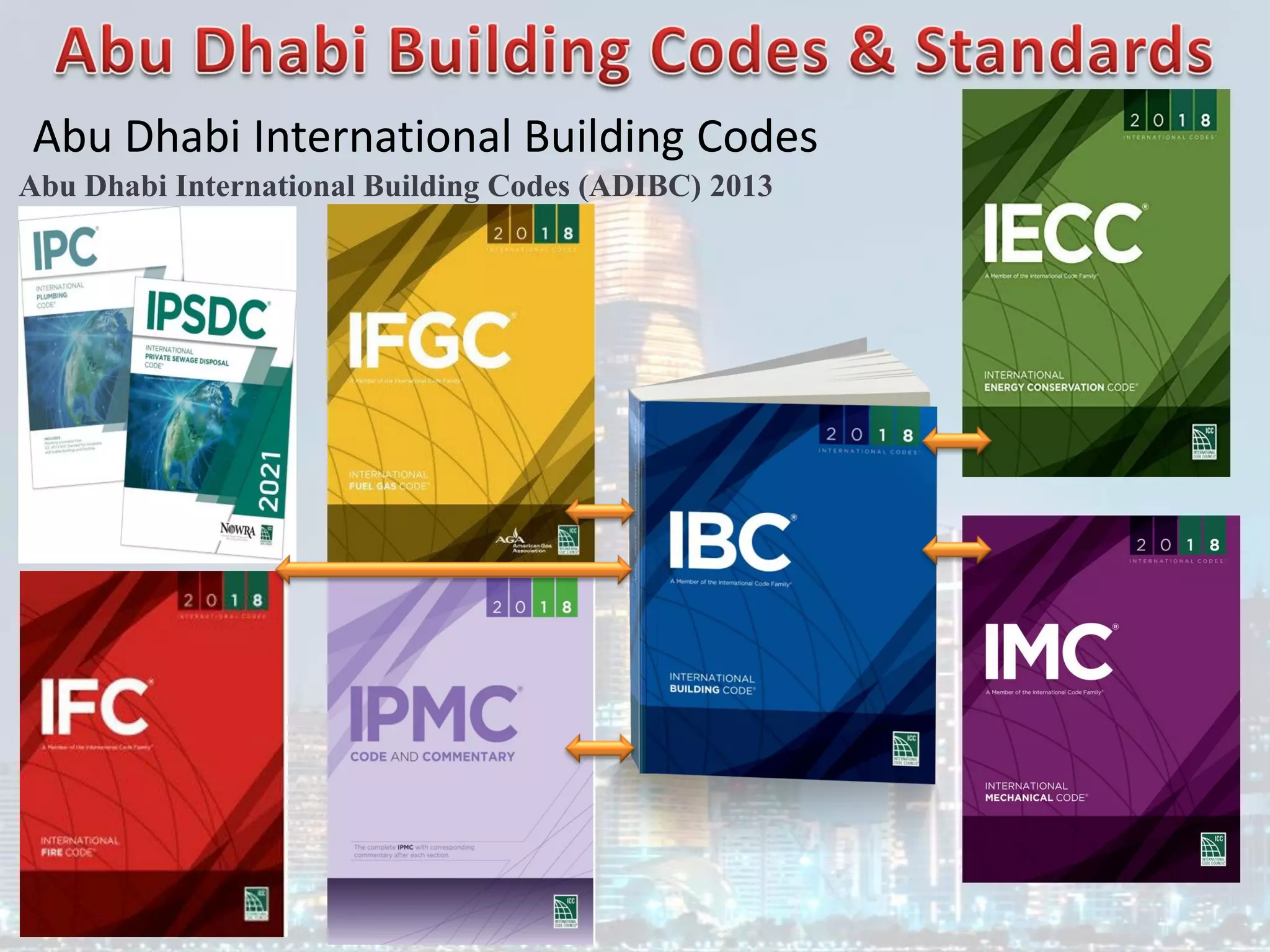
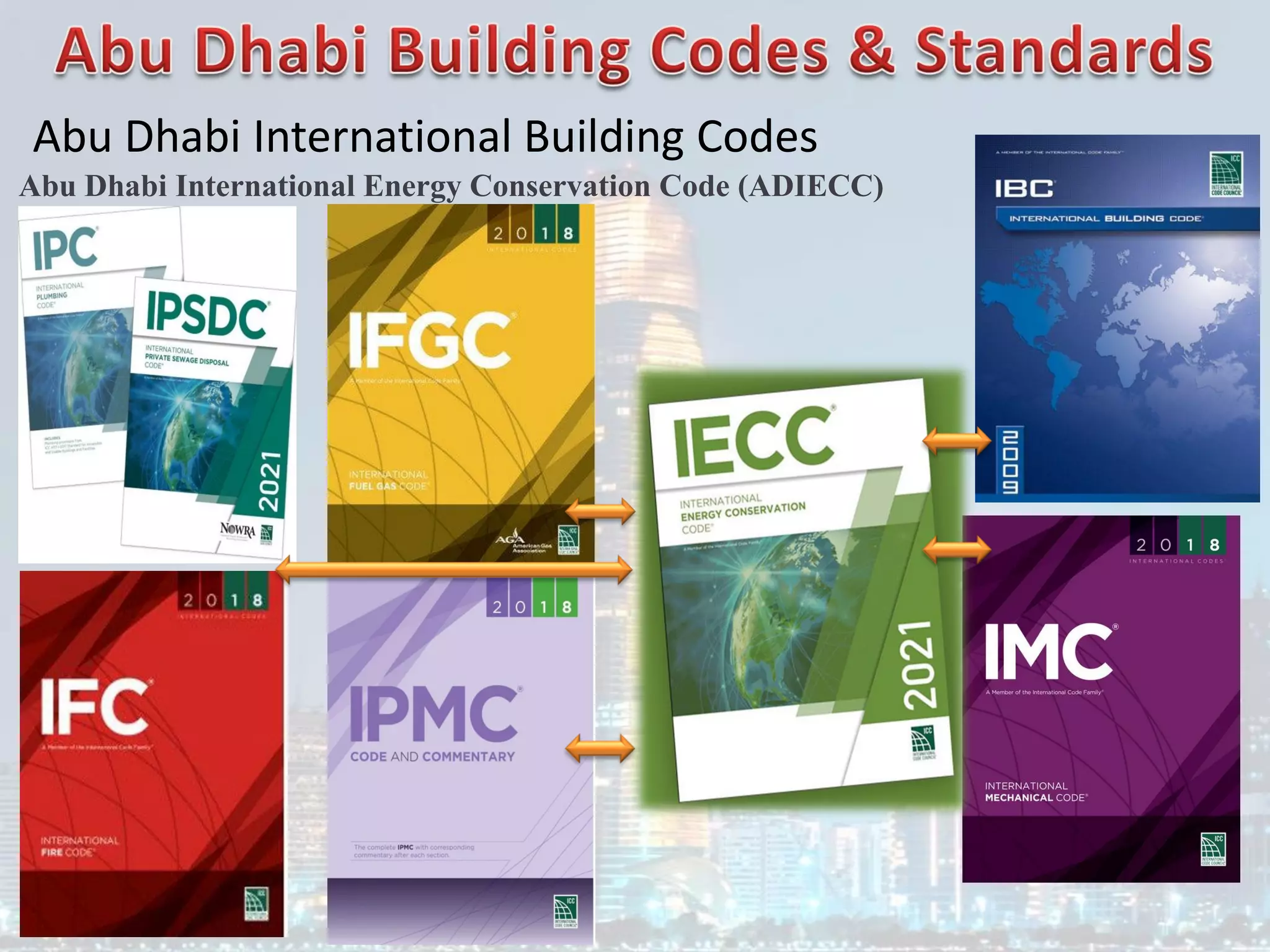
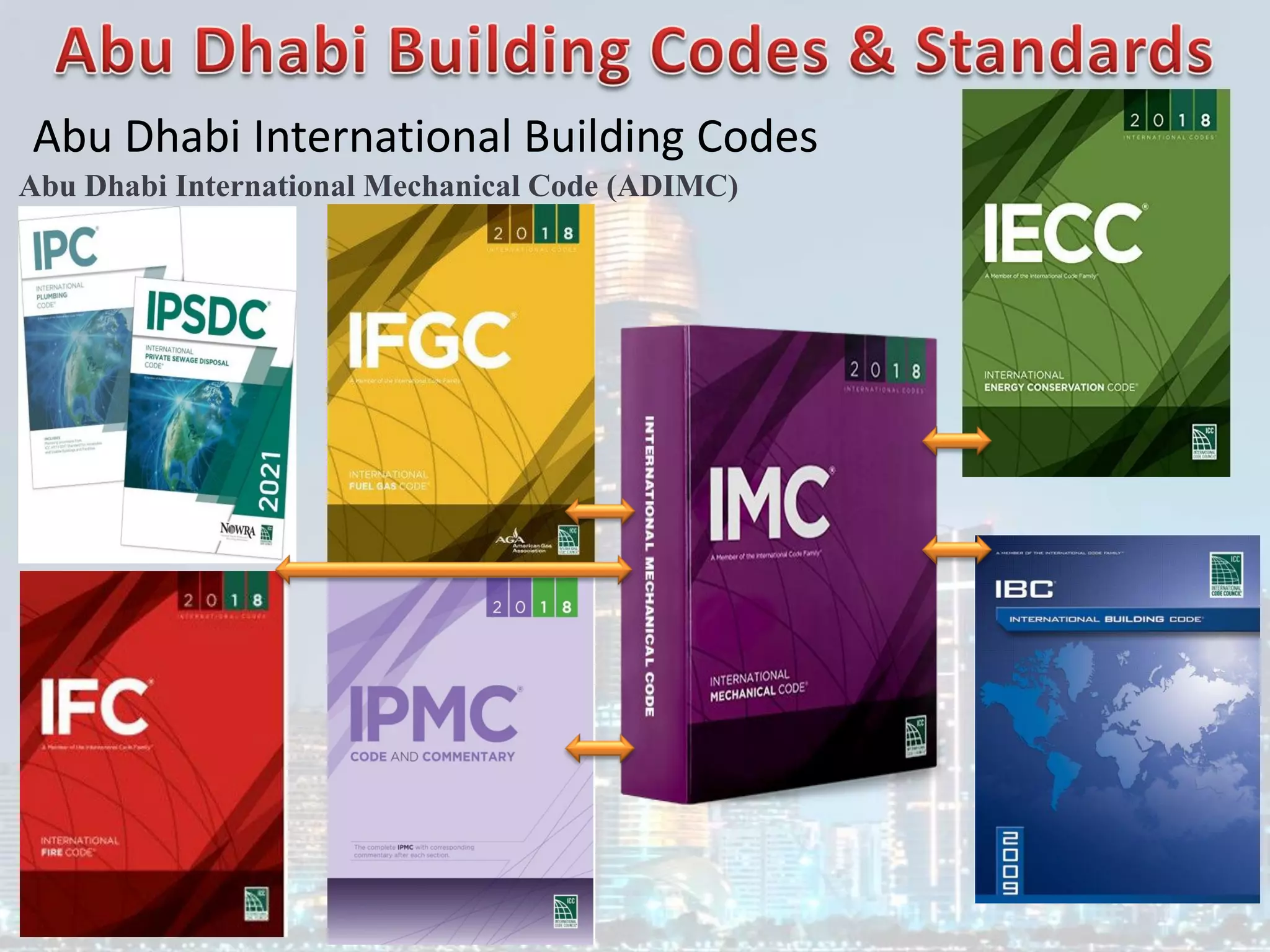
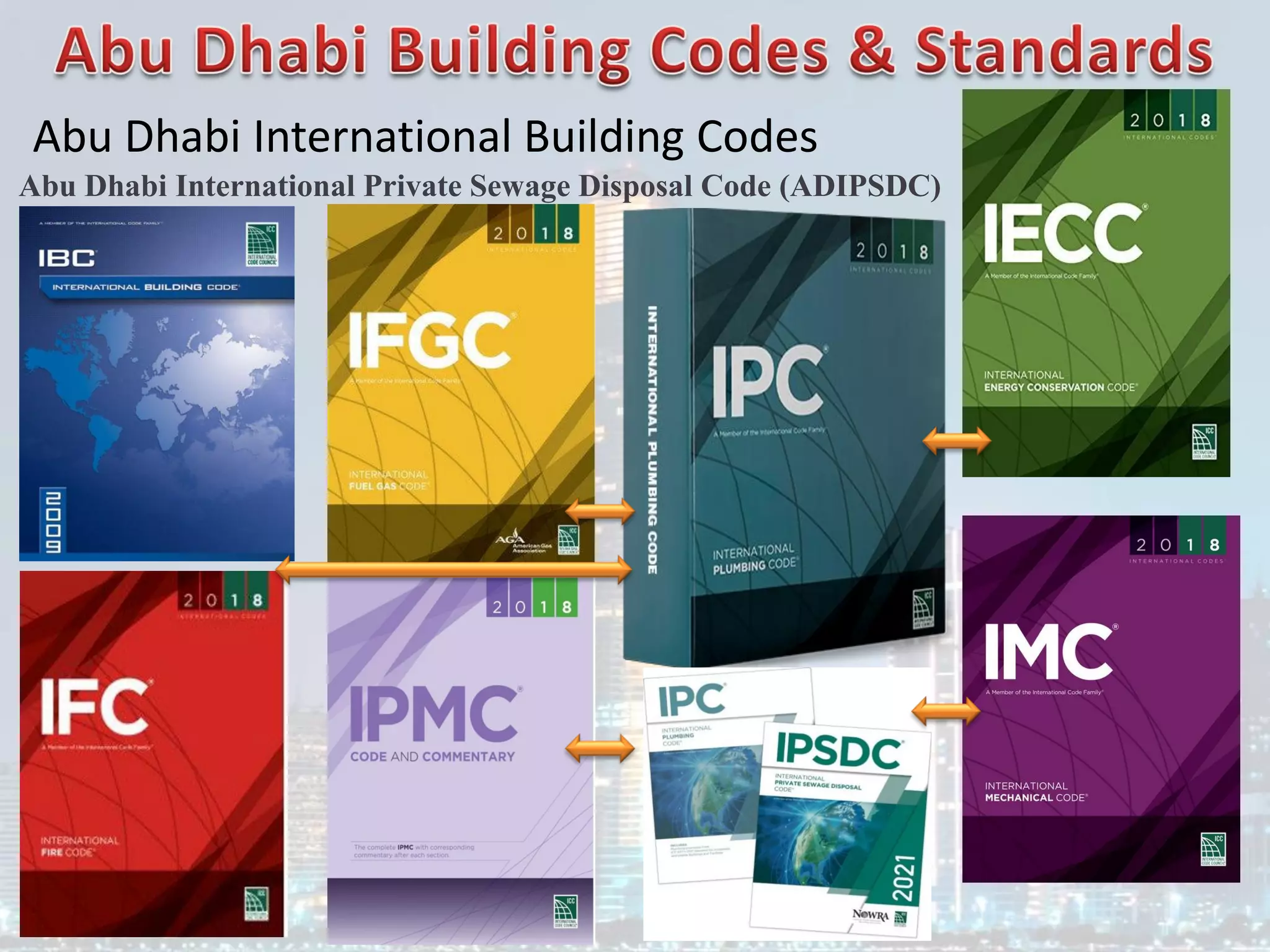
Adopts The 15 International Codes starting with 7 codes
Department of Municipal Affairs
Abu Dhabi International Building Codes
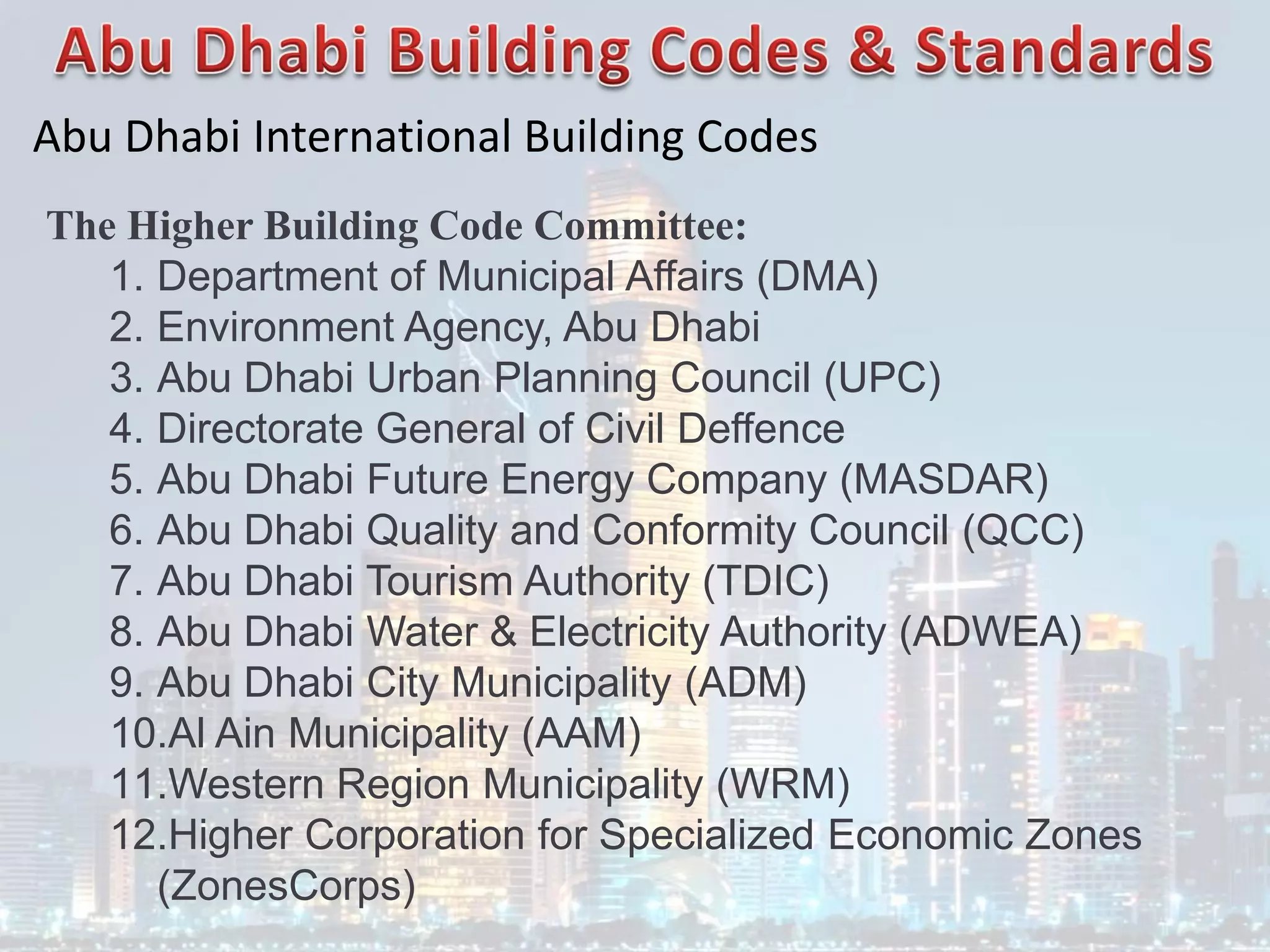
The Higher Building Code Committee:
1. Department of Municipal Affairs (DMA)
2. Environment Agency, Abu Dhabi
3. Abu Dhabi Urban Planning Council (UPC)
4. Directorate General of Civil Deffence
5. Abu Dhabi Future Energy Company (MASDAR)
6. Abu Dhabi Quality and Conformity Council (QCC)
7. Abu Dhabi Tourism Authority (TDIC)
8. Abu Dhabi Water & Electricity Authority (ADWEA)
9. Abu Dhabi City Municipality (ADM)
10.Al Ain Municipality (AAM)
11.Western Region Municipality (WRM)
12.Higher Corporation for Specialized Economic Zones
(ZonesCorps)
Abu Dhabi International Building Codes
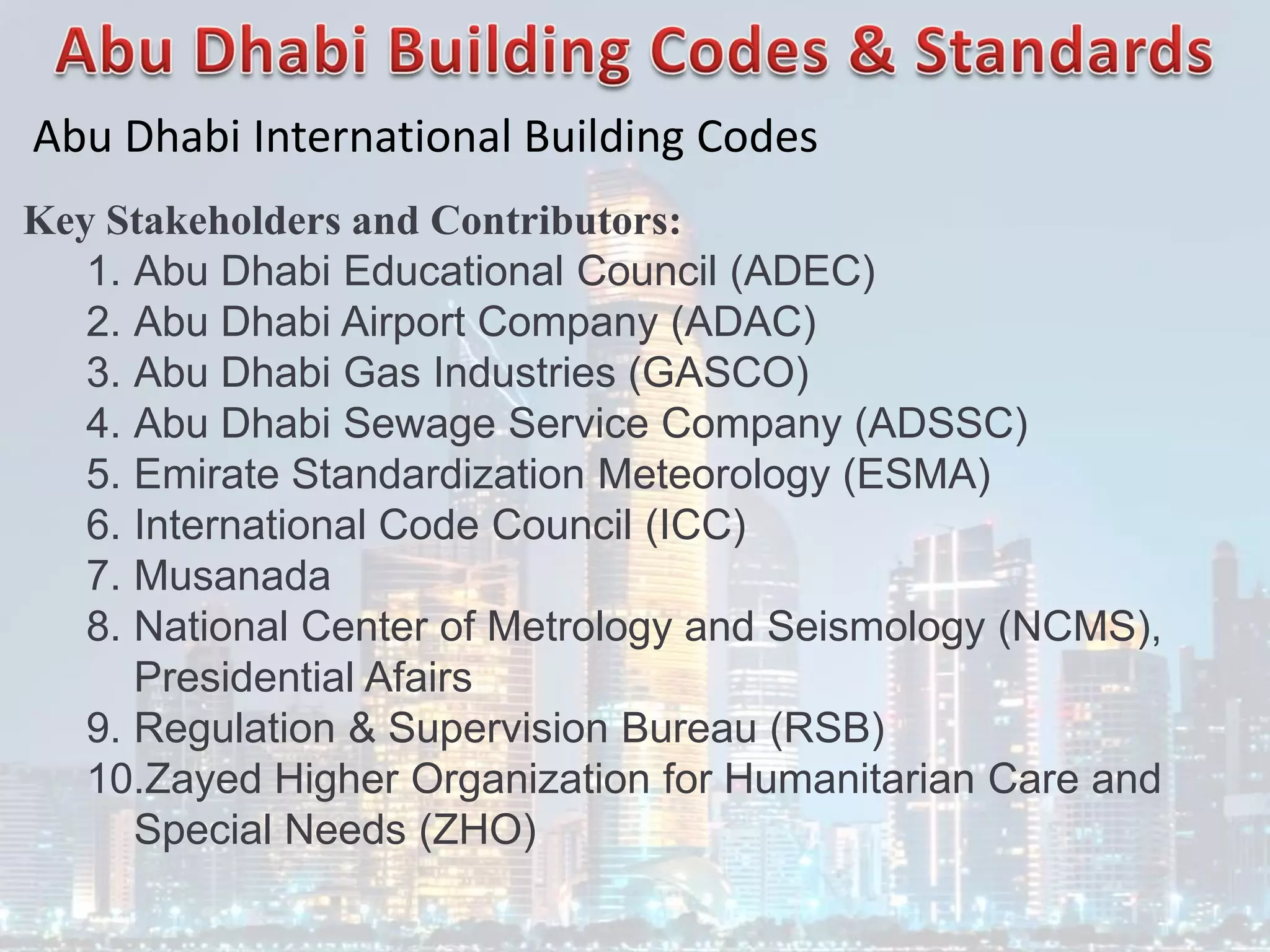
Key Stakeholders and Contributors:
1. Abu Dhabi Educational Council (ADEC)
2. Abu Dhabi Airport Company (ADAC)
3. Abu Dhabi Gas Industries (GASCO)
4. Abu Dhabi Sewage Service Company (ADSSC)
5. Emirate Standardization Meteorology (ESMA)
6. International Code Council (ICC)
7. Musanada
8. National Center of Metrology and Seismology (NCMS),
Presidential Afairs
9. Regulation & Supervision Bureau (RSB)
10.Zayed Higher Organization for Humanitarian Care and
Special Needs (ZHO)
Abu Dhabi International Building Codes
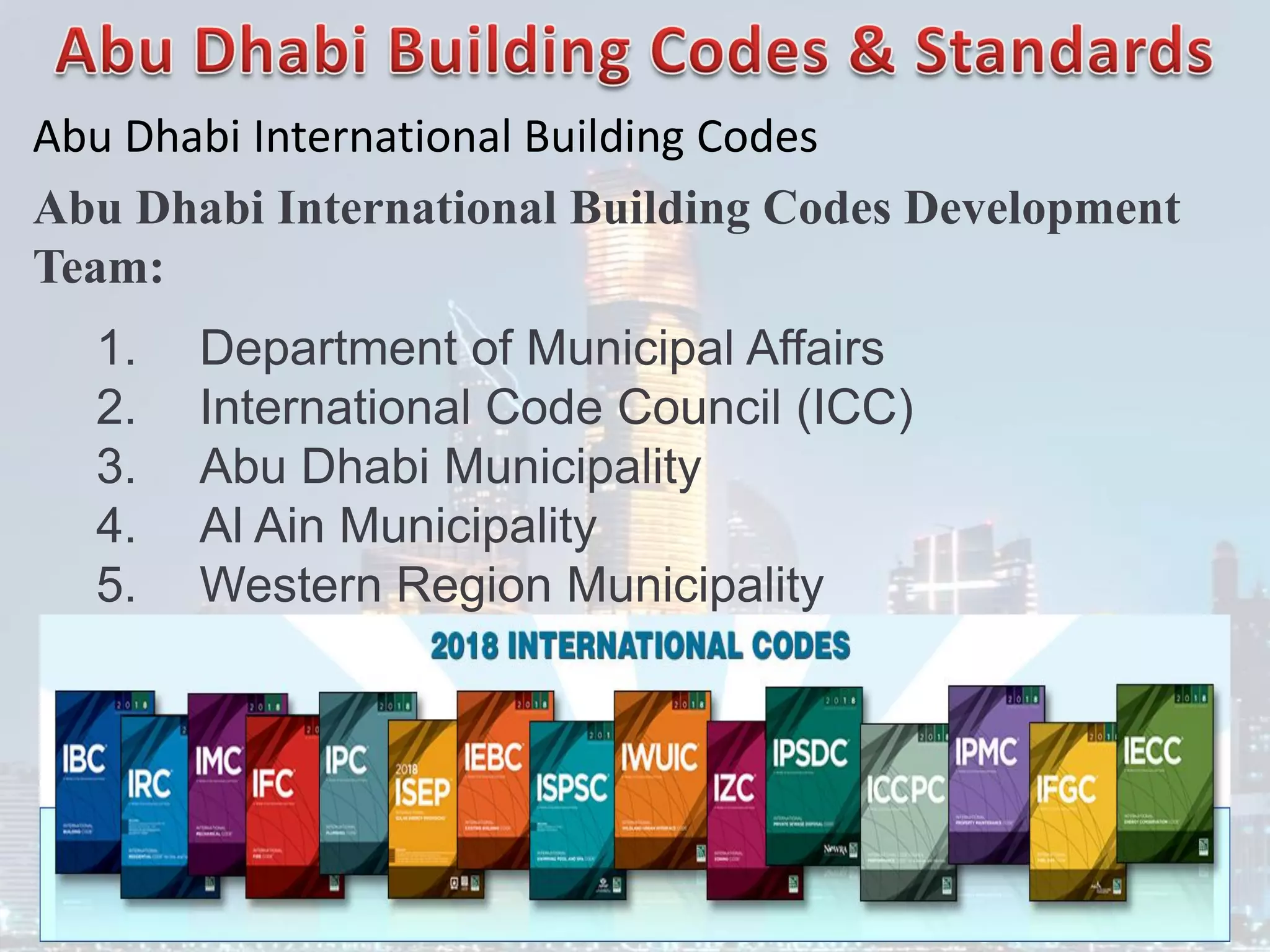
Abu Dhabi International Building Codes Development
Team:
1. Department of Municipal Affairs
2. International Code Council (ICC)
3. Abu Dhabi Municipality
4. Al Ain Municipality
5. Western Region Municipality
Abu Dhabi International Building Codes
Abu Dhabi International Building Codes Development phases
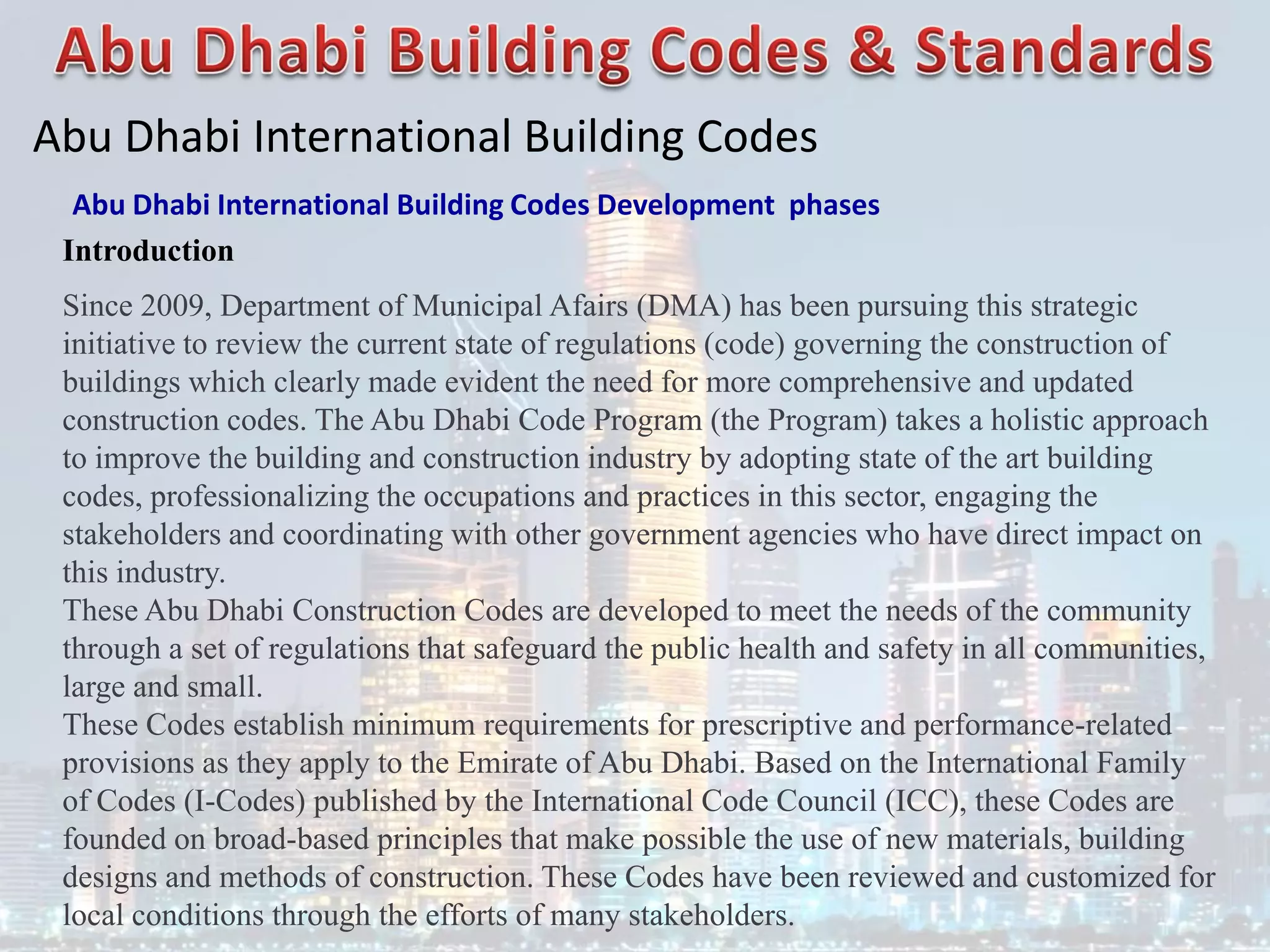
Introduction
Since 2009, Department of Municipal Afairs (DMA) has been pursuing this strategic
initiative to review the current state of regulations (code) governing the construction of
buildings which clearly made evident the need for more comprehensive and updated
construction codes. The Abu Dhabi Code Program (the Program) takes a holistic approach
to improve the building and construction industry by adopting state of the art building
codes, professionalizing the occupations and practices in this sector, engaging the
stakeholders and coordinating with other government agencies who have direct impact on
this industry.
These Abu Dhabi Construction Codes are developed to meet the needs of the community
through a set of regulations that safeguard the public health and safety in all communities,
large and small.
These Codes establish minimum requirements for prescriptive and performance-related
provisions as they apply to the Emirate of Abu Dhabi. Based on the International Family
of Codes (I-Codes) published by the International Code Council (ICC), these Codes are
founded on broad-based principles that make possible the use of new materials, building
designs and methods of construction. These Codes have been reviewed and customized for
local conditions through the efforts of many stakeholders.
Abu Dhabi International Building Codes
Abu Dhabi International Building Codes Development phases
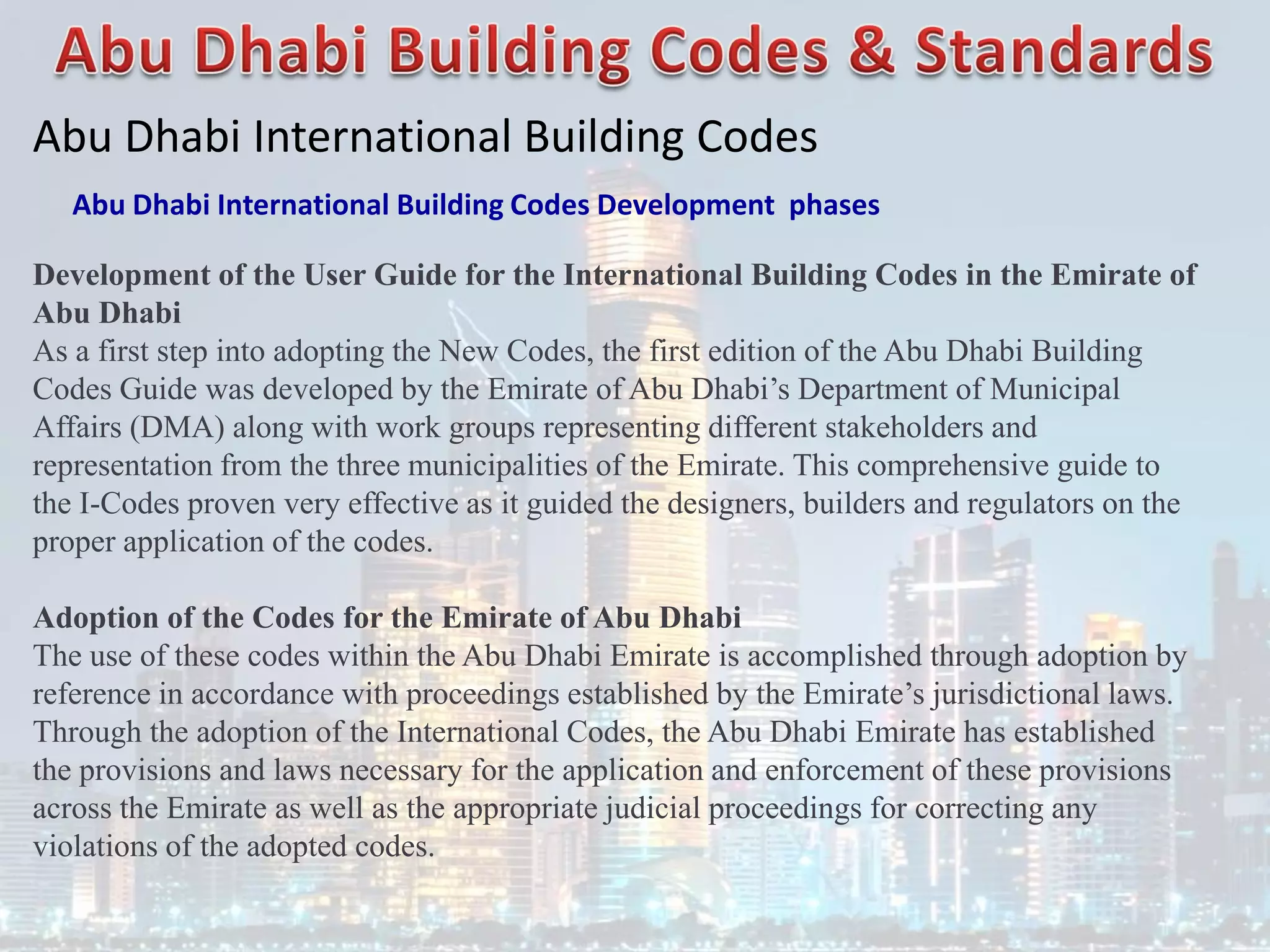
Development of the User Guide for the International Building Codes in the Emirate of
Abu Dhabi
As a first step into adopting the New Codes, the first edition of the Abu Dhabi Building
Codes Guide was developed by the Emirate of Abu Dhabi’s Department of Municipal
Affairs (DMA) along with work groups representing different stakeholders and
representation from the three municipalities of the Emirate. This comprehensive guide to
the I-Codes proven very effective as it guided the designers, builders and regulators on the
proper application of the codes.
Adoption of the Codes for the Emirate of Abu Dhabi
The use of these codes within the Abu Dhabi Emirate is accomplished through adoption by
reference in accordance with proceedings established by the Emirate’s jurisdictional laws.
Through the adoption of the International Codes, the Abu Dhabi Emirate has established
the provisions and laws necessary for the application and enforcement of these provisions
across the Emirate as well as the appropriate judicial proceedings for correcting any
violations of the adopted codes.
Abu Dhabi International Building Codes
Abu Dhabi International Building Codes Development phases
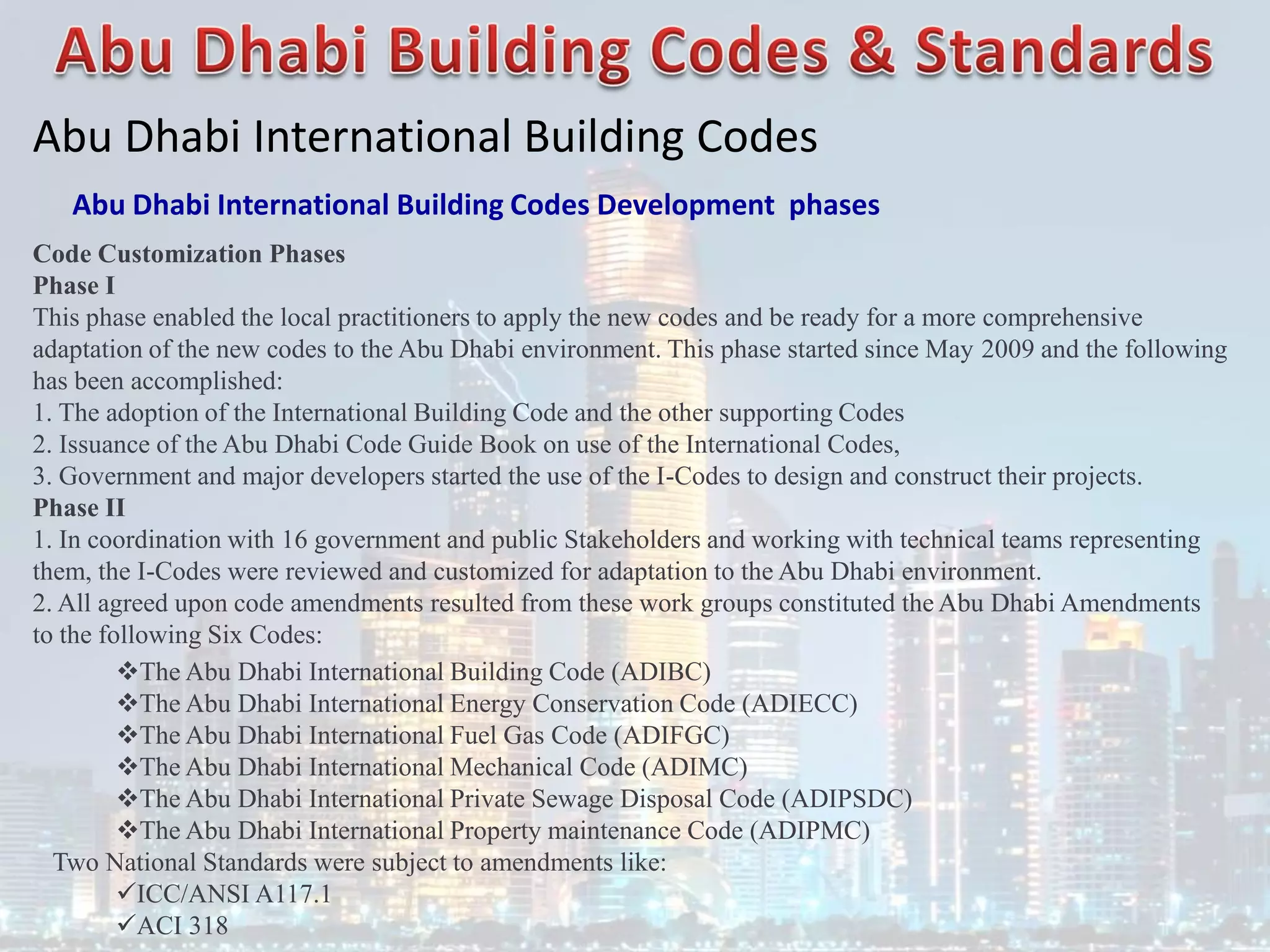
Code Customization Phases
Phase I
This phase enabled the local practitioners to apply the new codes and be ready for a more comprehensive
adaptation of the new codes to the Abu Dhabi environment. This phase started since May 2009 and the following
has been accomplished:
1. The adoption of the International Building Code and the other supporting Codes
2. Issuance of the Abu Dhabi Code Guide Book on use of the International Codes,
3. Government and major developers started the use of the I-Codes to design and construct their projects.
Phase II
1. In coordination with 16 government and public Stakeholders and working with technical teams representing
them, the I-Codes were reviewed and customized for adaptation to the Abu Dhabi environment.
2. All agreed upon code amendments resulted from these work groups constituted the Abu Dhabi Amendments
to the following Six Codes:
The Abu Dhabi International Building Code (ADIBC)
The Abu Dhabi International Energy Conservation Code (ADIECC)
The Abu Dhabi International Fuel Gas Code (ADIFGC)
The Abu Dhabi International Mechanical Code (ADIMC)
The Abu Dhabi International Private Sewage Disposal Code (ADIPSDC)
The Abu Dhabi International Property maintenance Code (ADIPMC)
Two National Standards were subject to amendments like:
ICC/ANSI A117.1
ACI 318
Abu Dhabi International Building Codes
Abu Dhabi International Building Codes Development phases
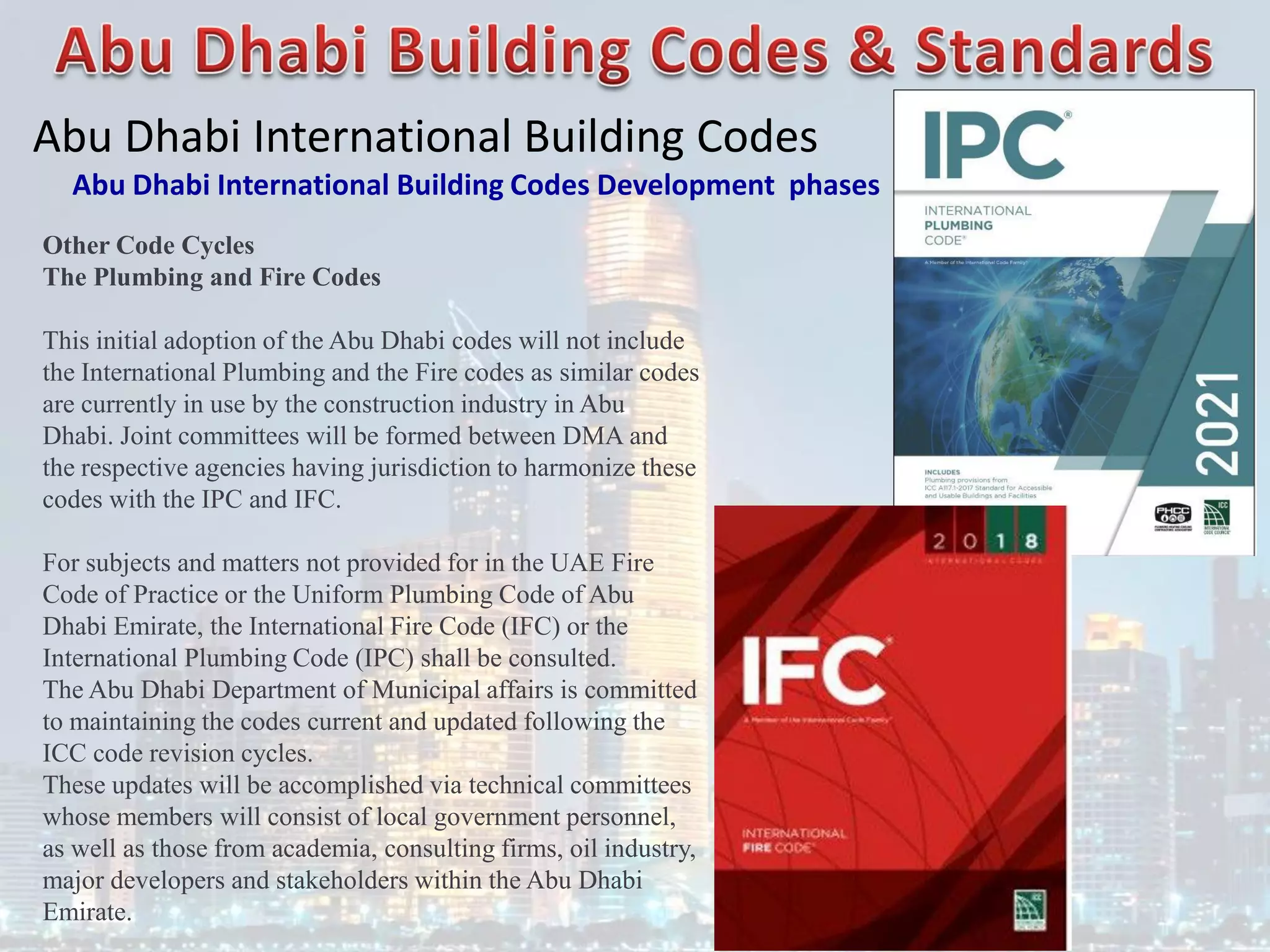
Other Code Cycles
The Plumbing and Fire Codes
This initial adoption of the Abu Dhabi codes will not include
the International Plumbing and the Fire codes as similar codes
are currently in use by the construction industry in Abu
Dhabi. Joint committees will be formed between DMA and
the respective agencies having jurisdiction to harmonize these
codes with the IPC and IFC.
For subjects and matters not provided for in the UAE Fire
Code of Practice or the Uniform Plumbing Code of Abu
Dhabi Emirate, the International Fire Code (IFC) or the
International Plumbing Code (IPC) shall be consulted.
The Abu Dhabi Department of Municipal affairs is committed
to maintaining the codes current and updated following the
ICC code revision cycles.
These updates will be accomplished via technical committees
whose members will consist of local government personnel,
as well as those from academia, consulting firms, oil industry,
major developers and stakeholders within the Abu Dhabi
Emirate.
Abu Dhabi International Building Codes
Abu Dhabi International Building Codes Development phases
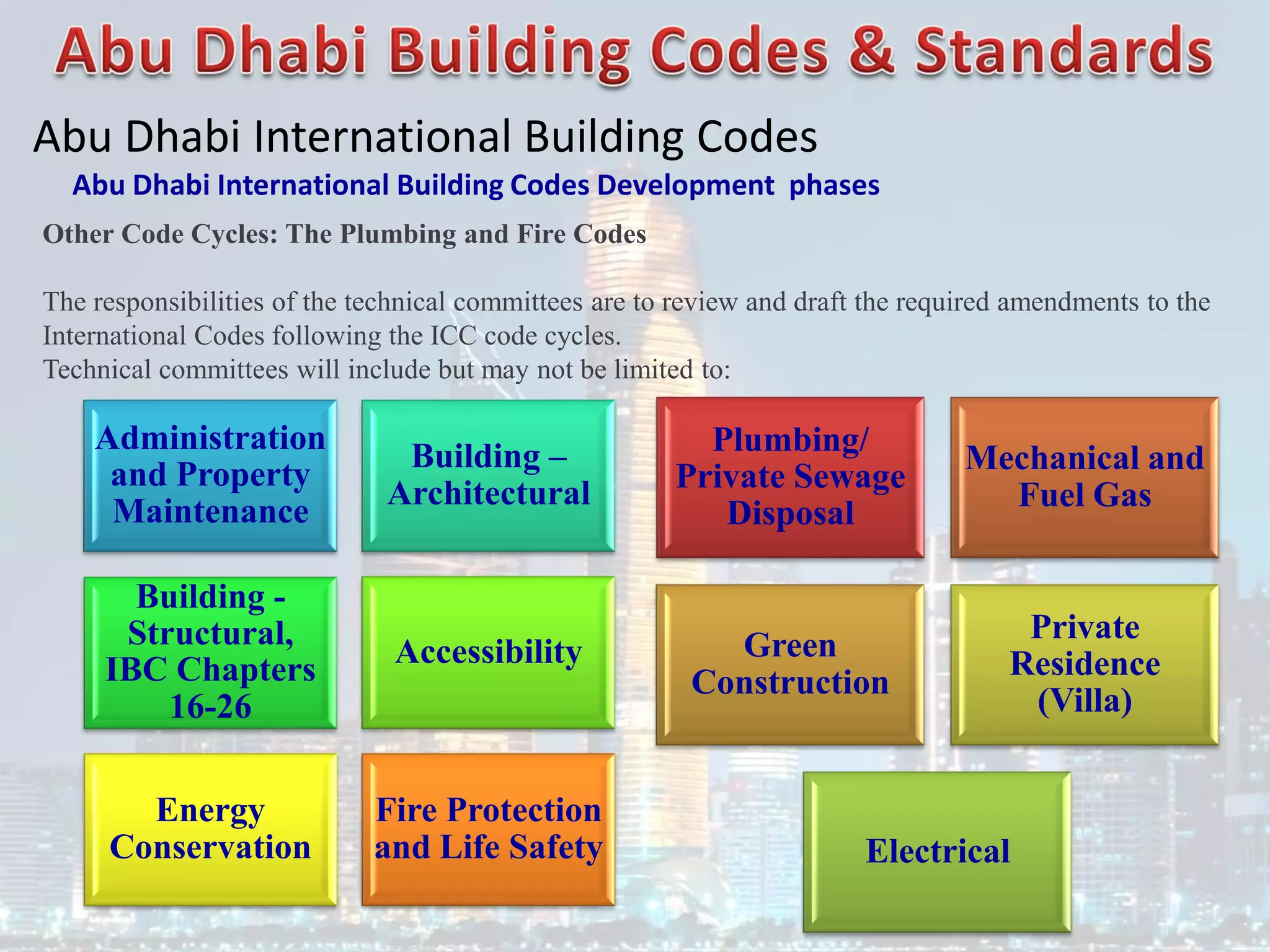
Other Code Cycles: The Plumbing and Fire Codes
The responsibilities of the technical committees are to review and draft the required amendments to the
International Codes following the ICC code cycles.
Technical committees will include but may not be limited to:
Administration
and Property
Maintenance
Building –
Architectural
Building -
Structural,
IBC Chapters
16-26
Accessibility
Energy
Conservation
Fire Protection
and Life Safety
Plumbing/
Private Sewage
Disposal
Mechanical and
Fuel Gas
Green
Construction
Private
Residence
(Villa)
Electrical
Abu Dhabi International Building Codes
Abu Dhabi International Building Codes Development phases
Identification of Amended Language
In the adopted I-Codes, solid vertical lines in the margins within the body of the codes indicate a
technical change from the requirements of the previous edition. Deletion indicators in the form of an
arrow ( → ) are provided in the margin where an entire section, paragraph, exception or table has been
deleted or an item in a list of items or in a table has been deleted.
Text in the Abu Dhabi Amendments’ Document
In the Amendments’ document, text shown with a Strikethrough is “Deleted”, and Underlined is “New”
Coordination between the International Codes The six codes are adopted as a family of codes and will
be complimented by other I-Codes as needed. When adopted together, as they are by the Abu Dhabi
Emirate, there should be no conflict of any of the technical provisions. As multiple model codes are
adopted by the Abu Dhabi Emirate, should a question of enforcement authority occur, the Department of
Municipal Affairs will evaluate the issue in order to establish the appropriate enforcement agency.
Italicized Terms
Selected terms set forth in the definitions chapters of the adopted codes, are italicized where they appear
in code text. Such terms are not italicized where the definition set forth in the definitions chapter does
not impart the intended meaning in the use of the term. The terms selected have definitions which the
user should read carefully to facilitate better understanding of the codes.
Abu Dhabi International Building Codes
Abu Dhabi International Building Codes Development phases
Arrangement and Format of the 2009 Editions of the International Codes
The I-Codes are arranged and organized to follow sequential steps that generally occur
during a design, plan review or inspection procedure. Users should gain a better
understanding of the requirements outlined in each document by researching the contents of
all applicable code sections.
Training
The Department of Municipal Affairs in collaboration with the International Code Council
(ICC) and local colleges and universities has been, and will continue to provide the
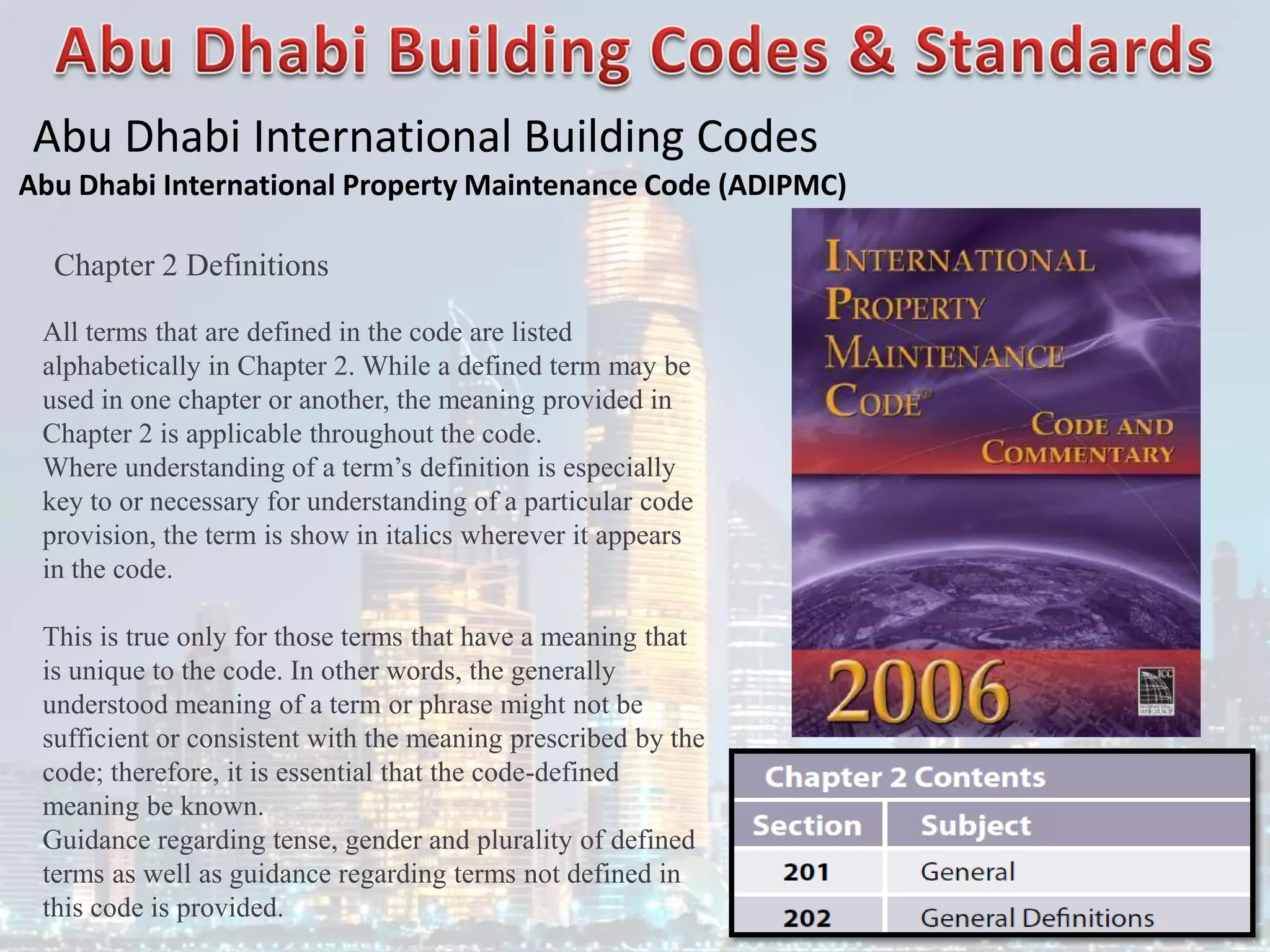
necessary training programs for all affected professionals, public and private, in order to
assure a smooth transition to these adopted codes. Available training has been provided with
interactive classroom instruction by highly qualified ICC instructors as well as through
online courses and webinars. A structured training and “professional certification” program
is also being offered for municipal employees and construction professionals in order to
insure a high level of professional competence is achieved throughout the Emirate.
Abu Dhabi International Building Codes
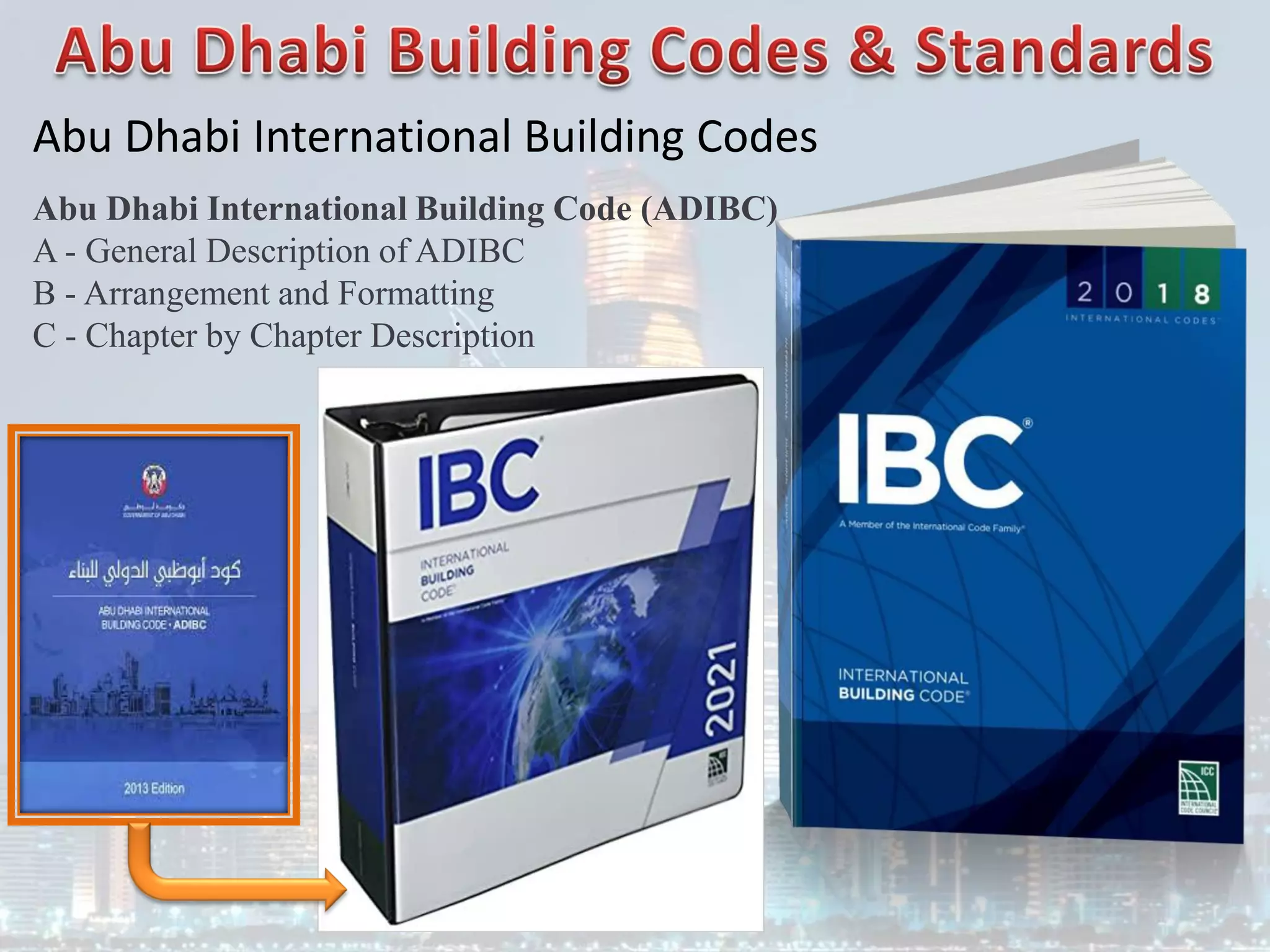
Abu Dhabi International Building Code (ADIBC)
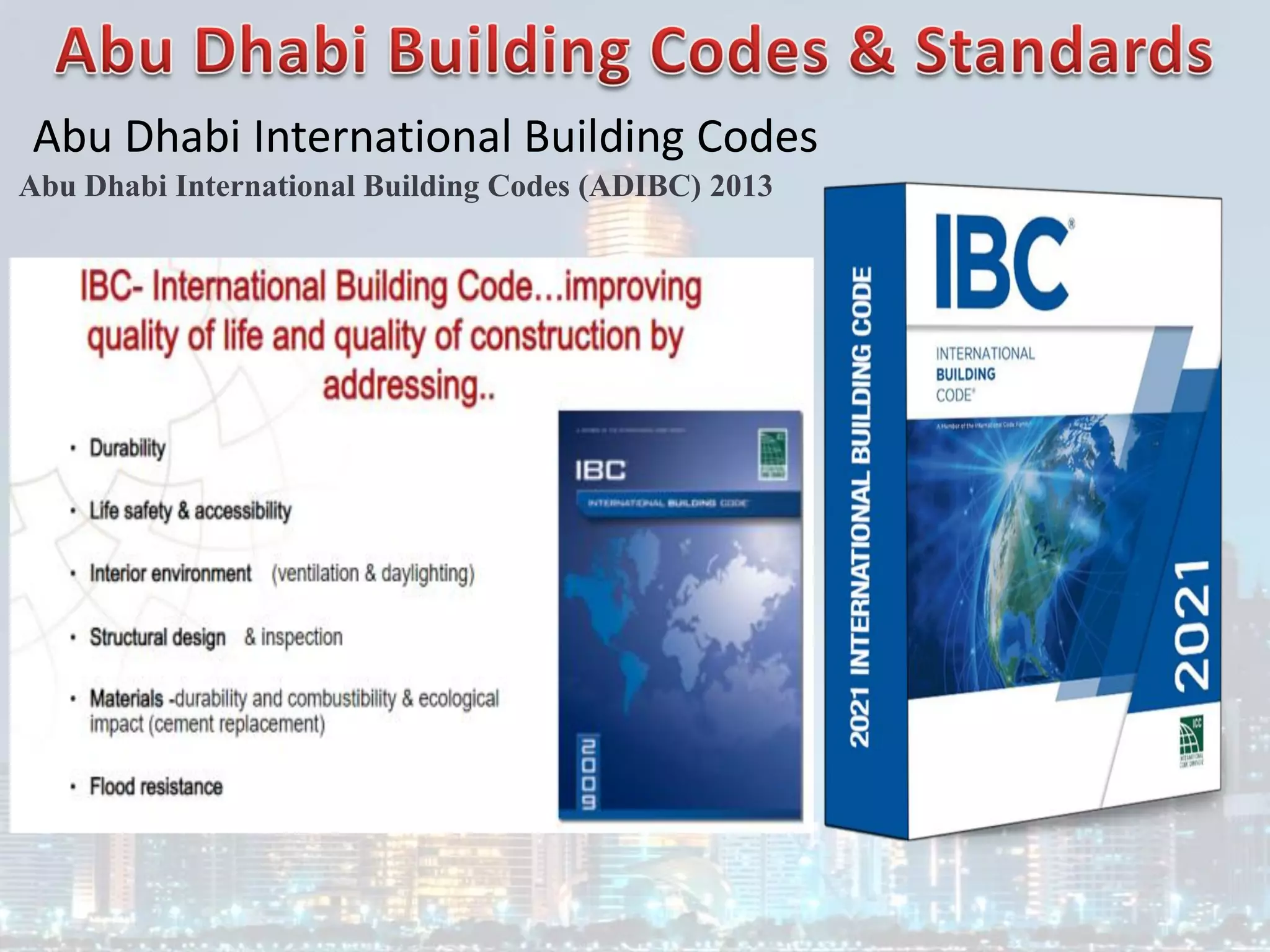
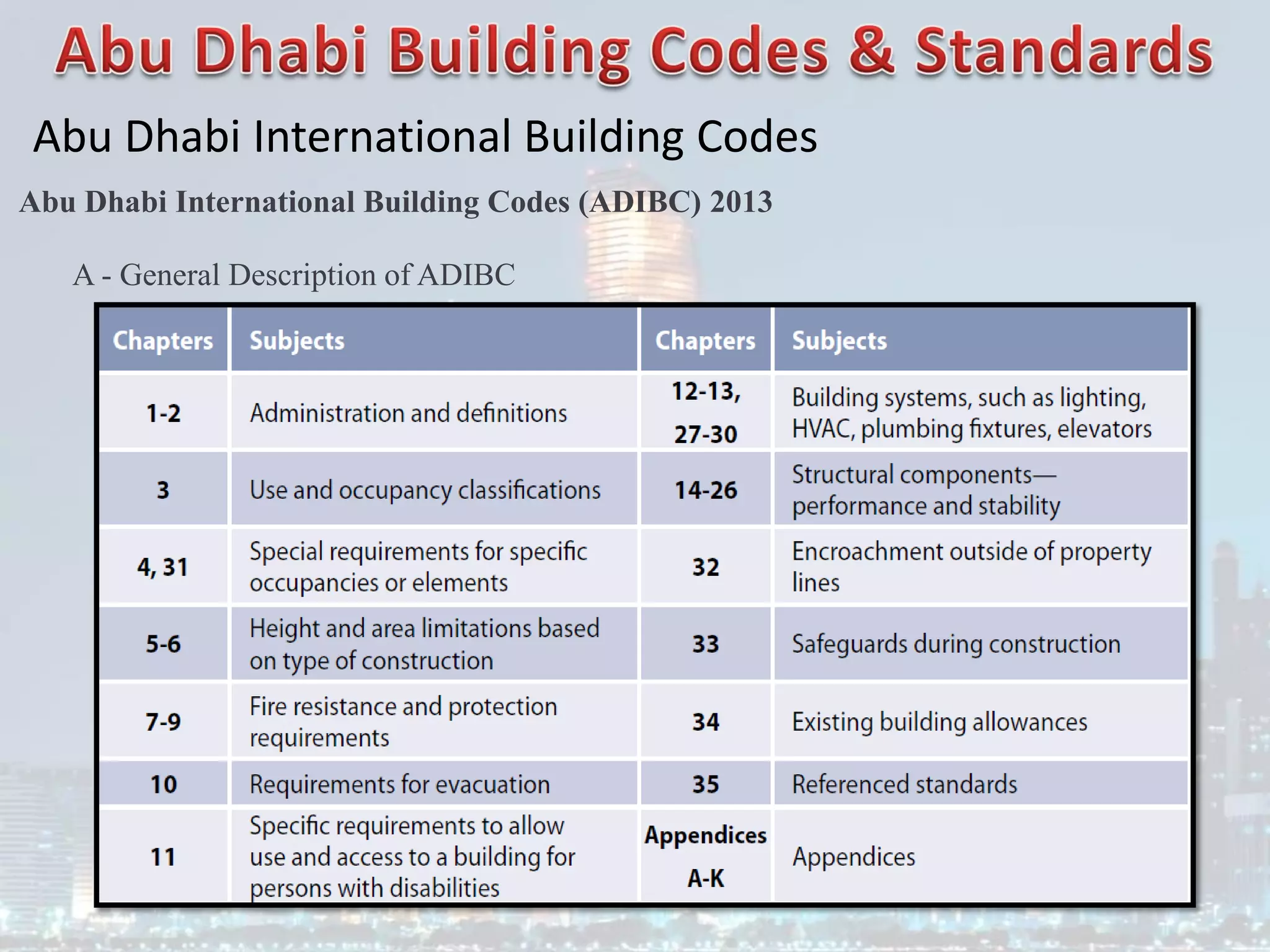
A - General Description of ADIBC
B - Arrangement and Formatting
C - Chapter by Chapter Description
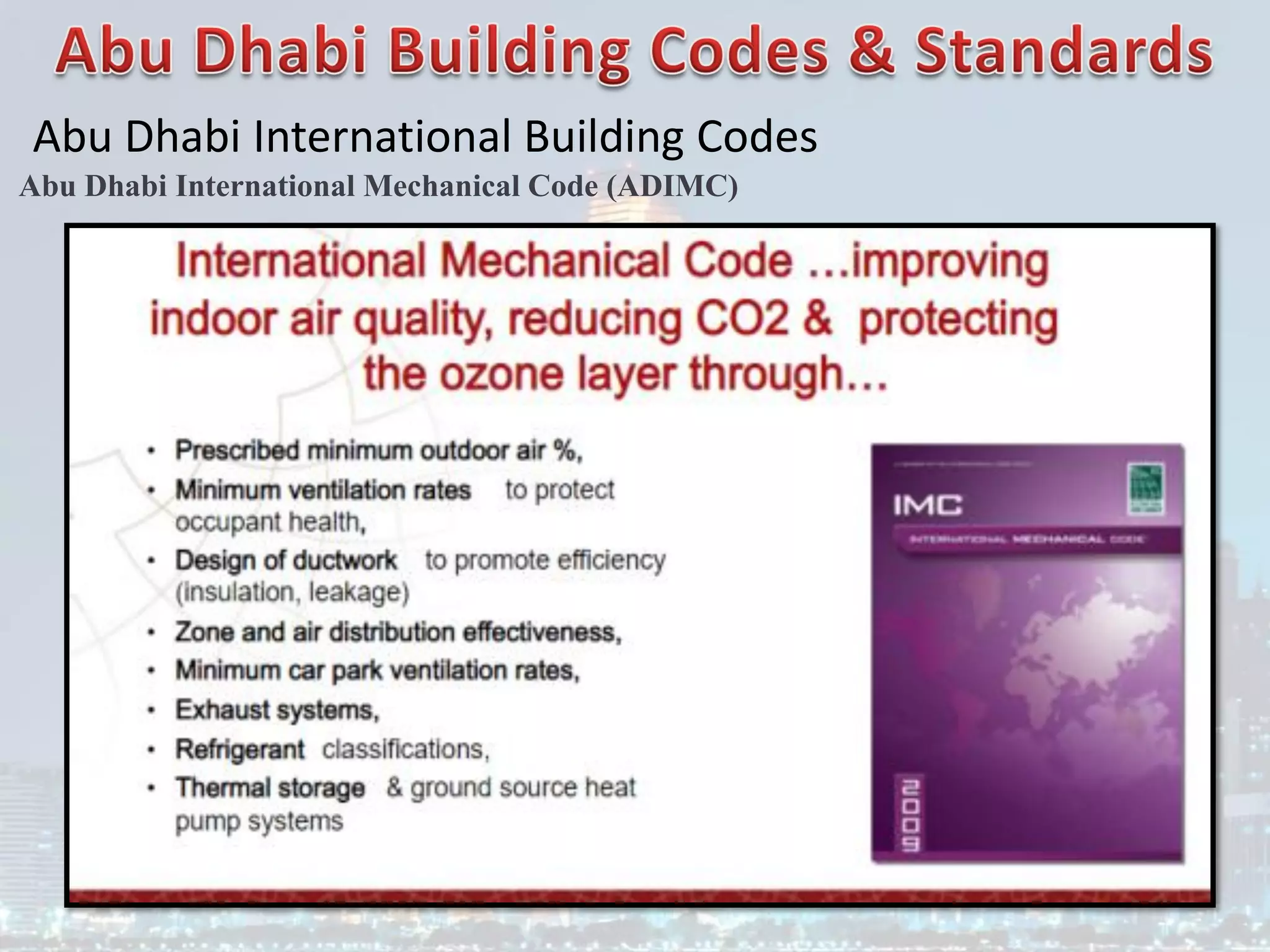
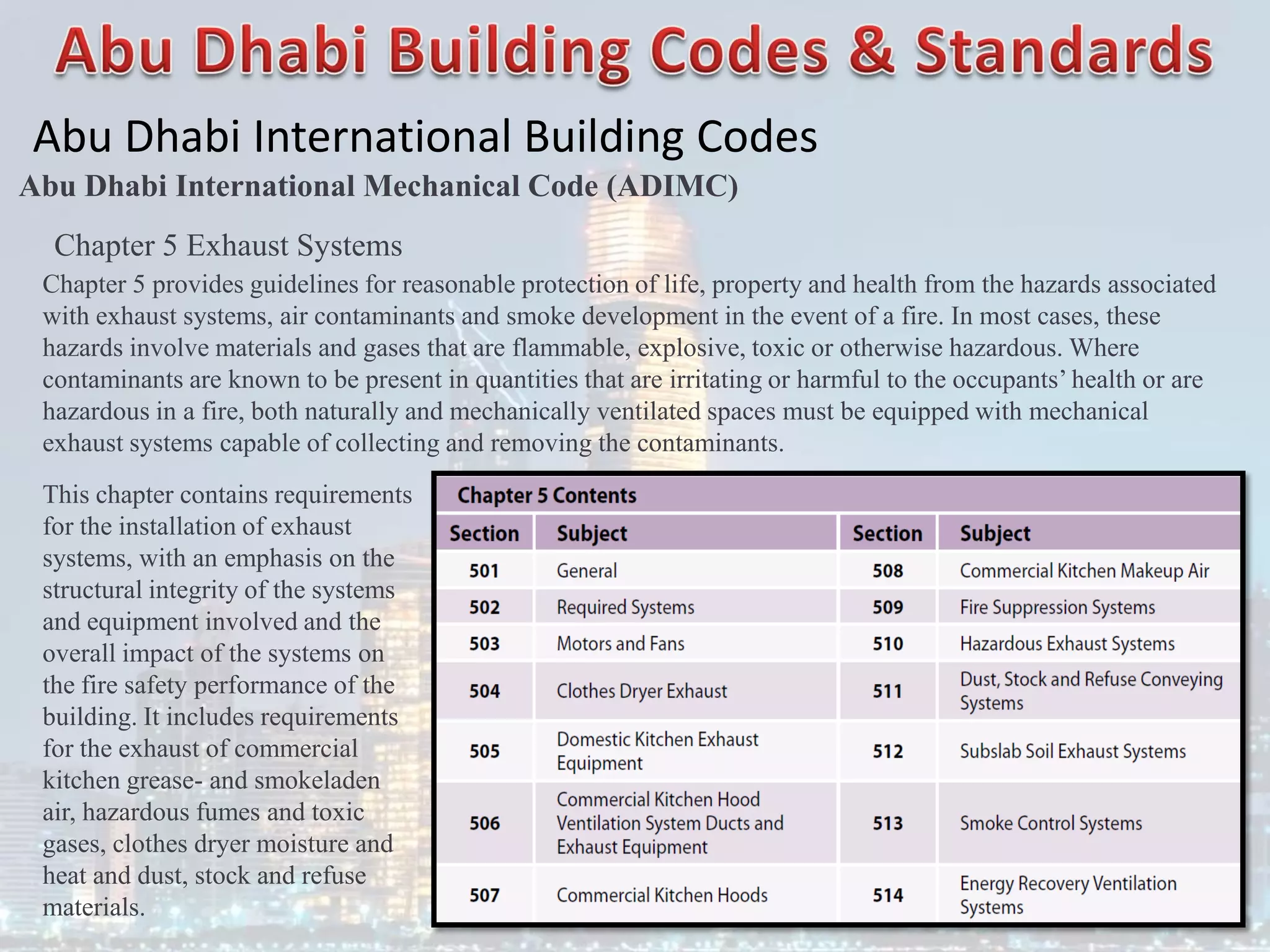
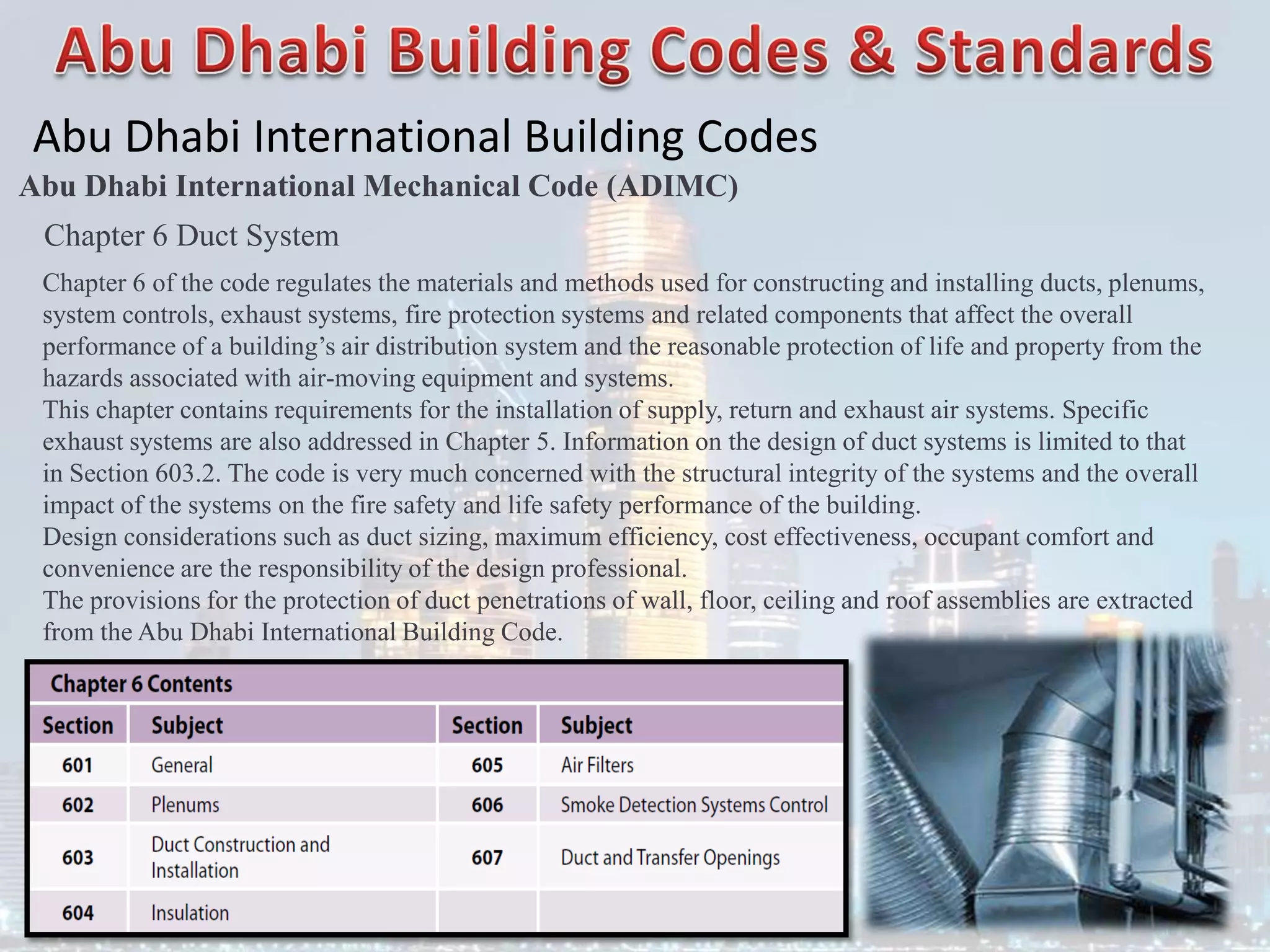
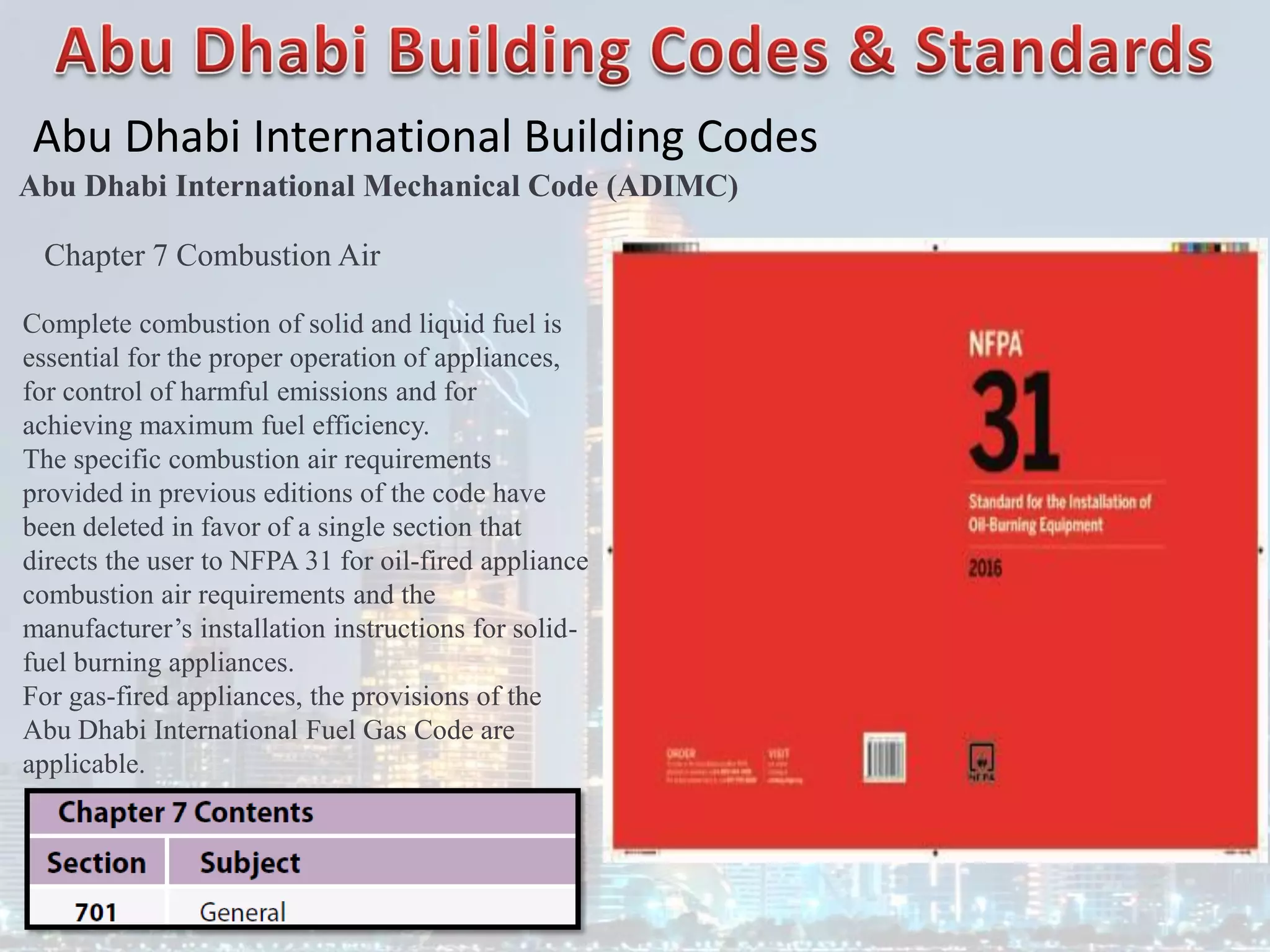
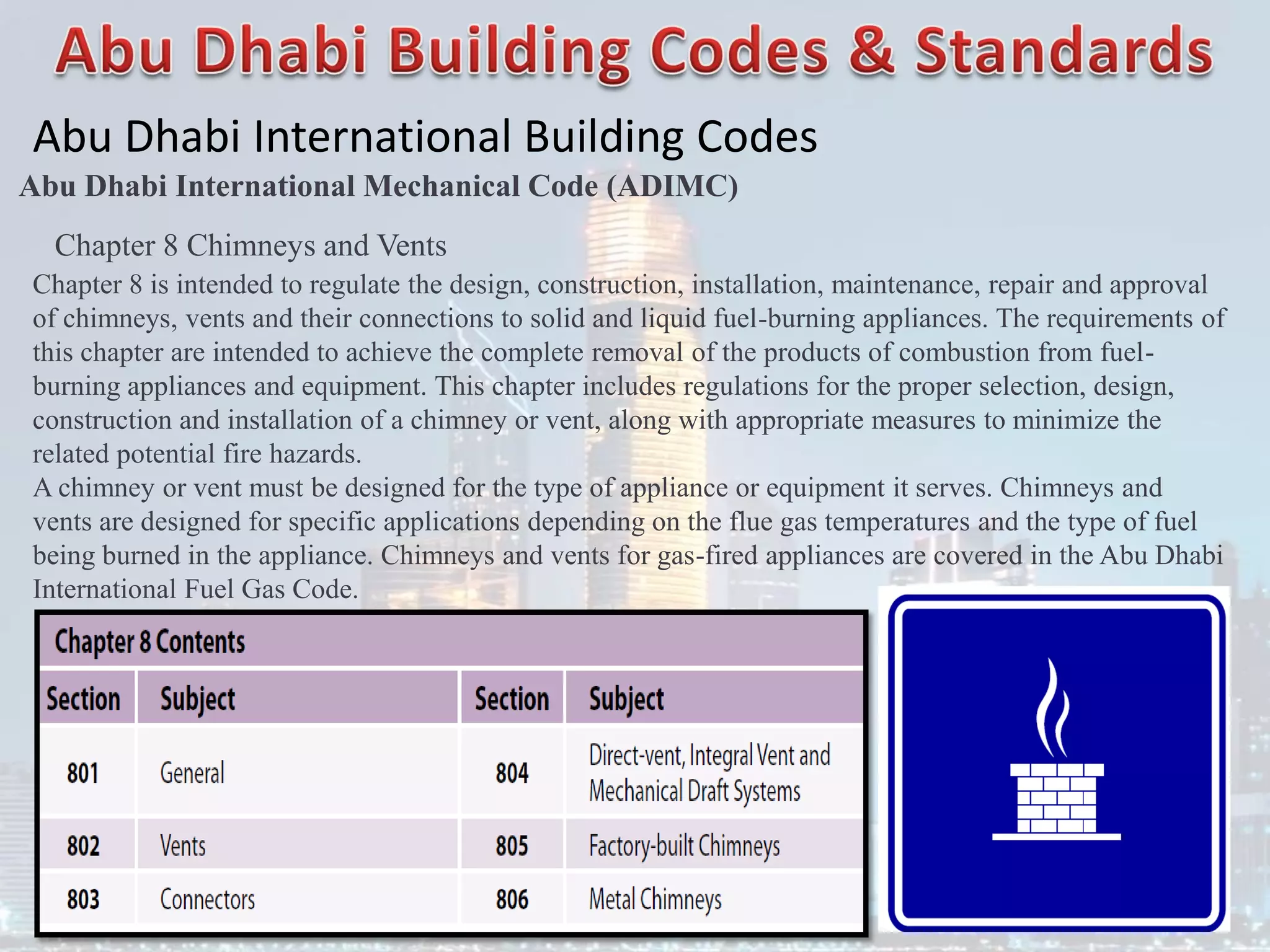
Abu Dhabi International Mechanical Code (ADIMC)
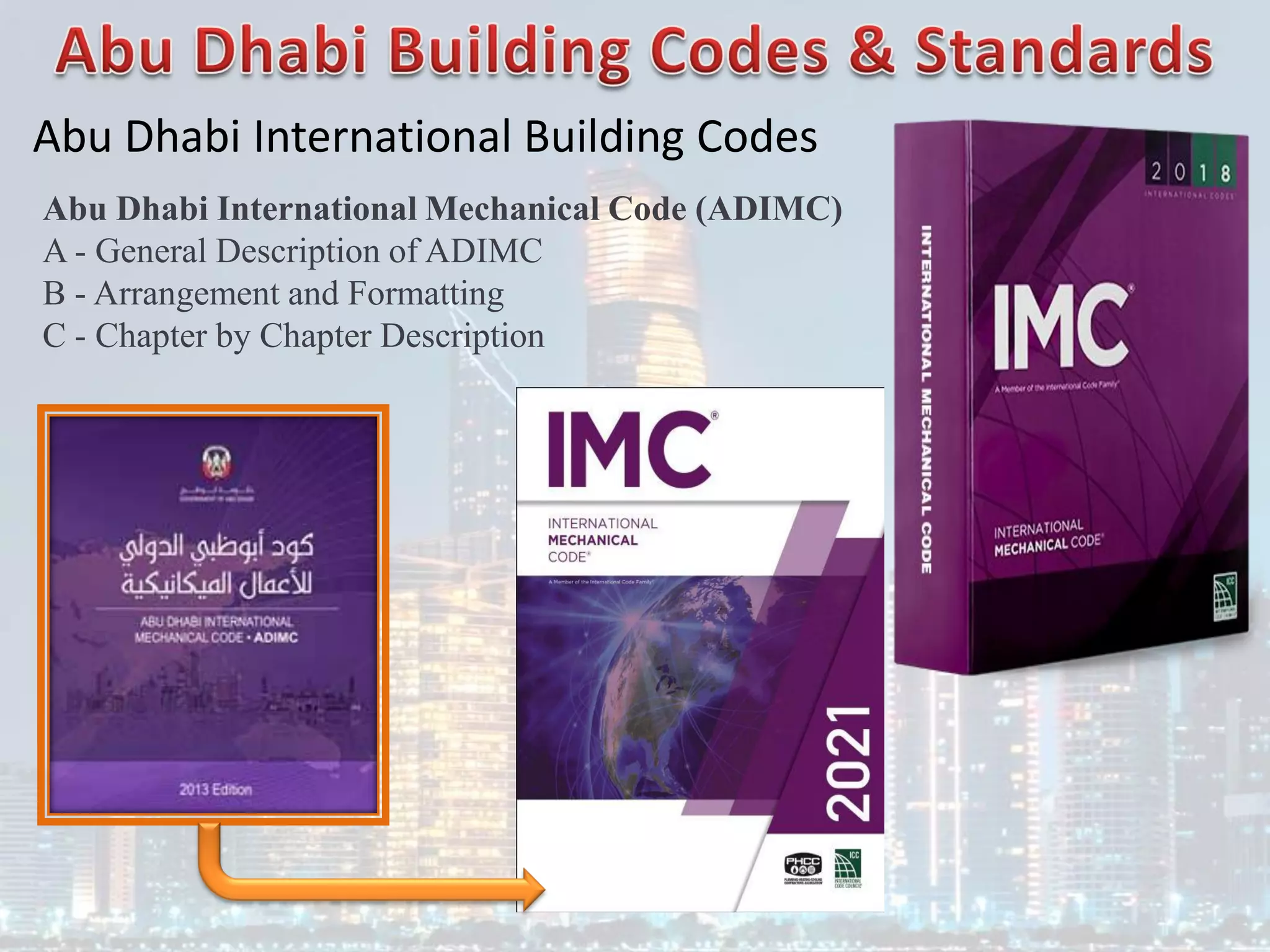
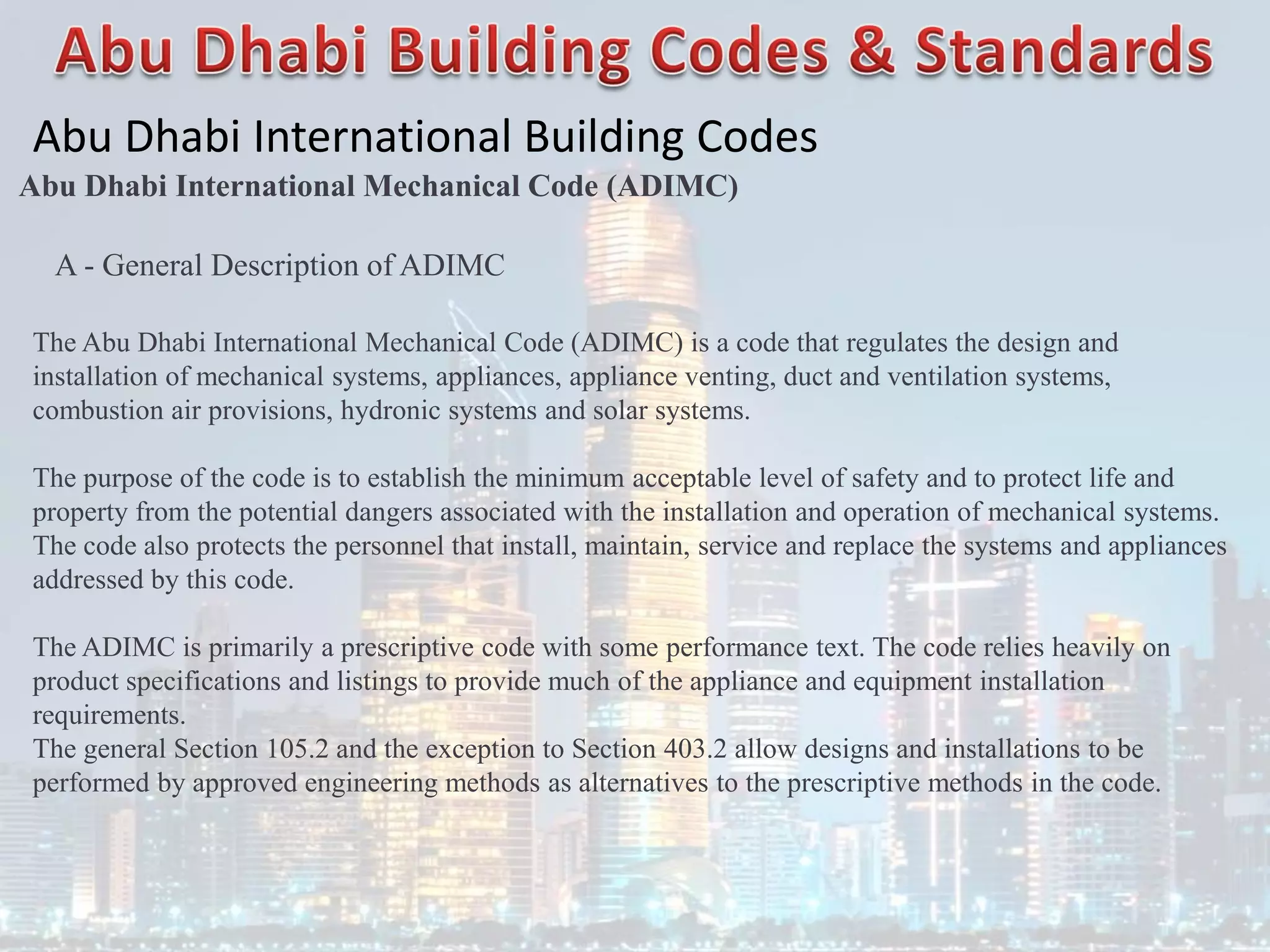
A - General Description of ADIMC
B - Arrangement and Formatting
C - Chapter by Chapter Description
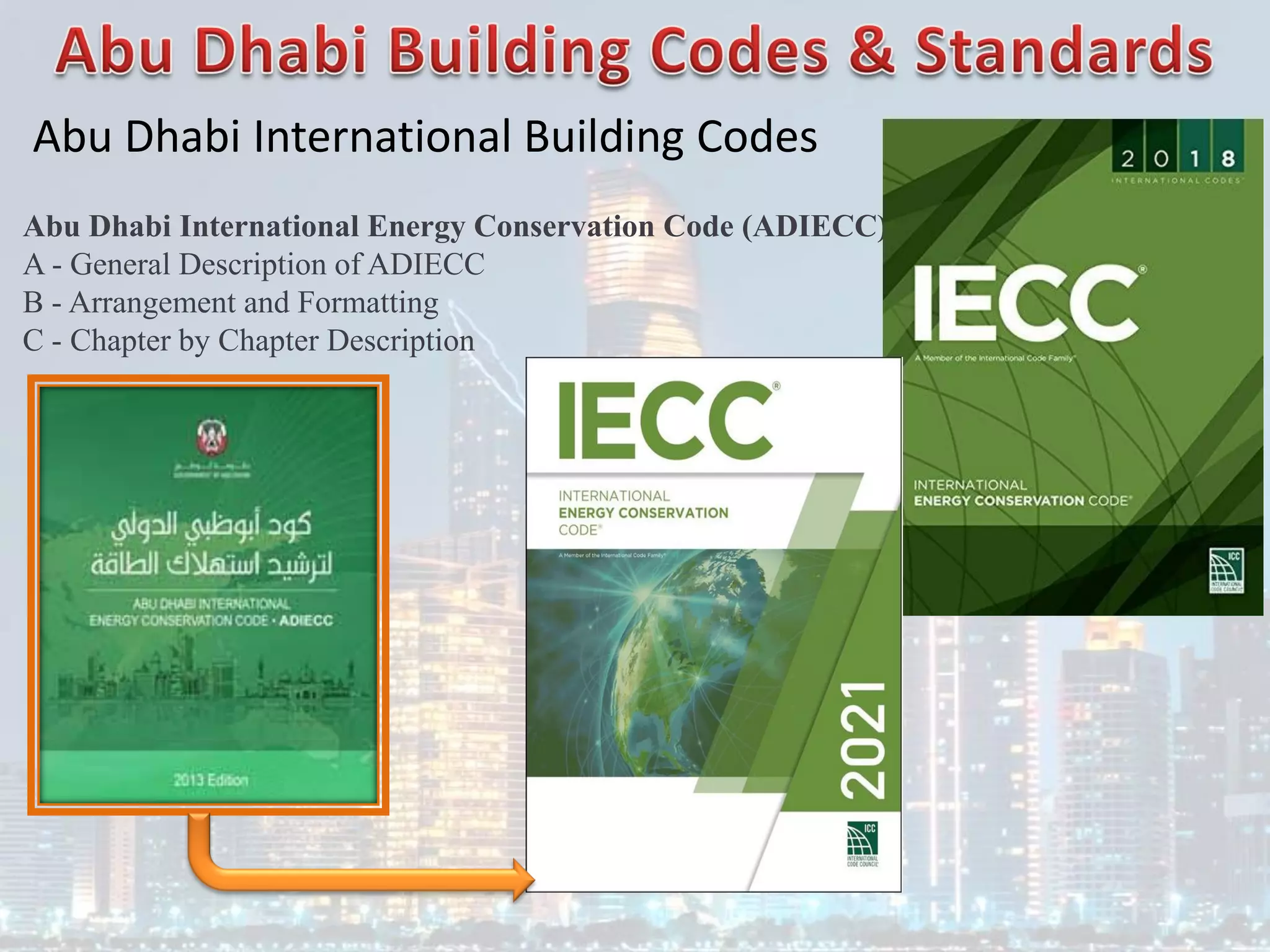
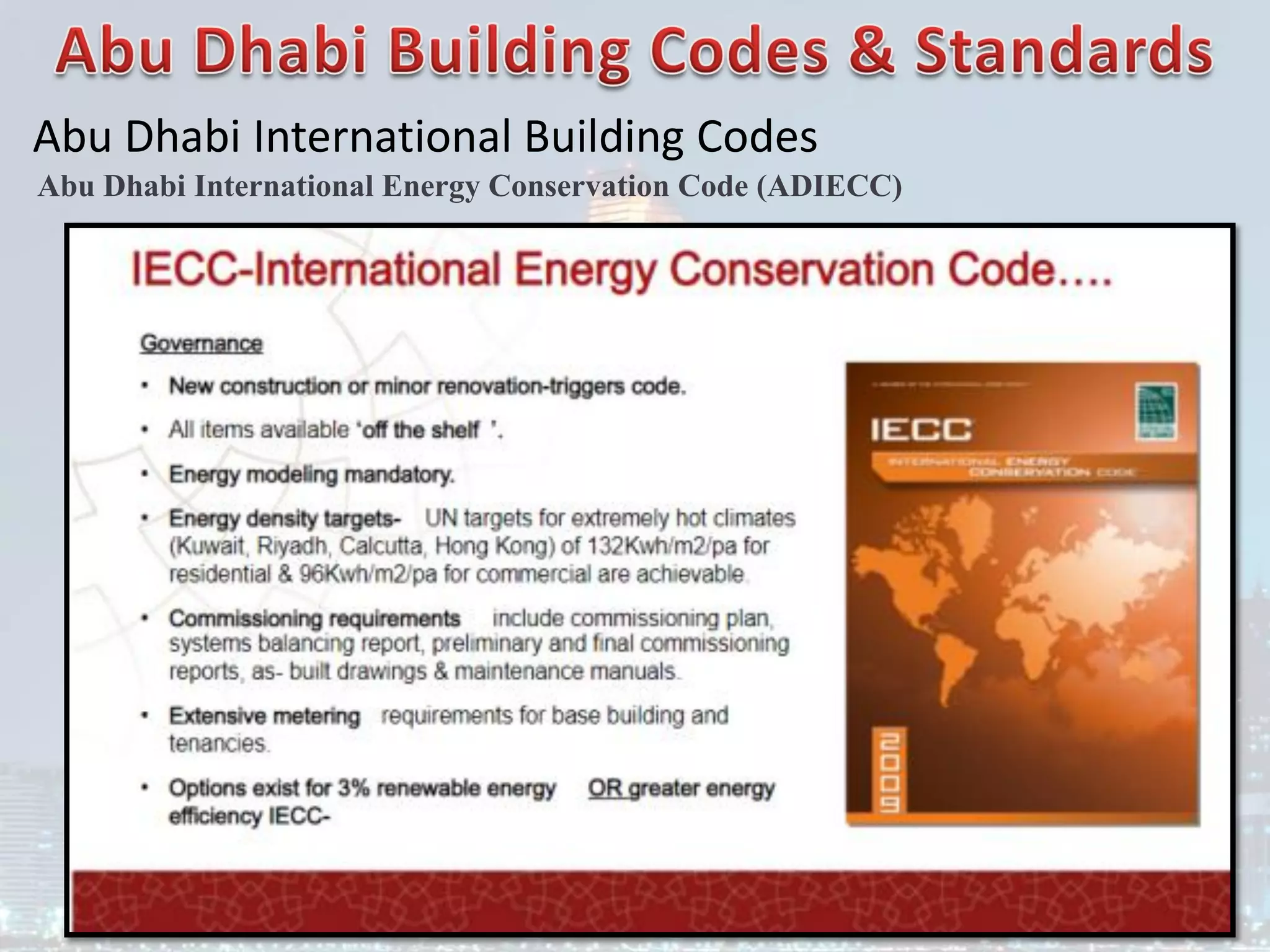
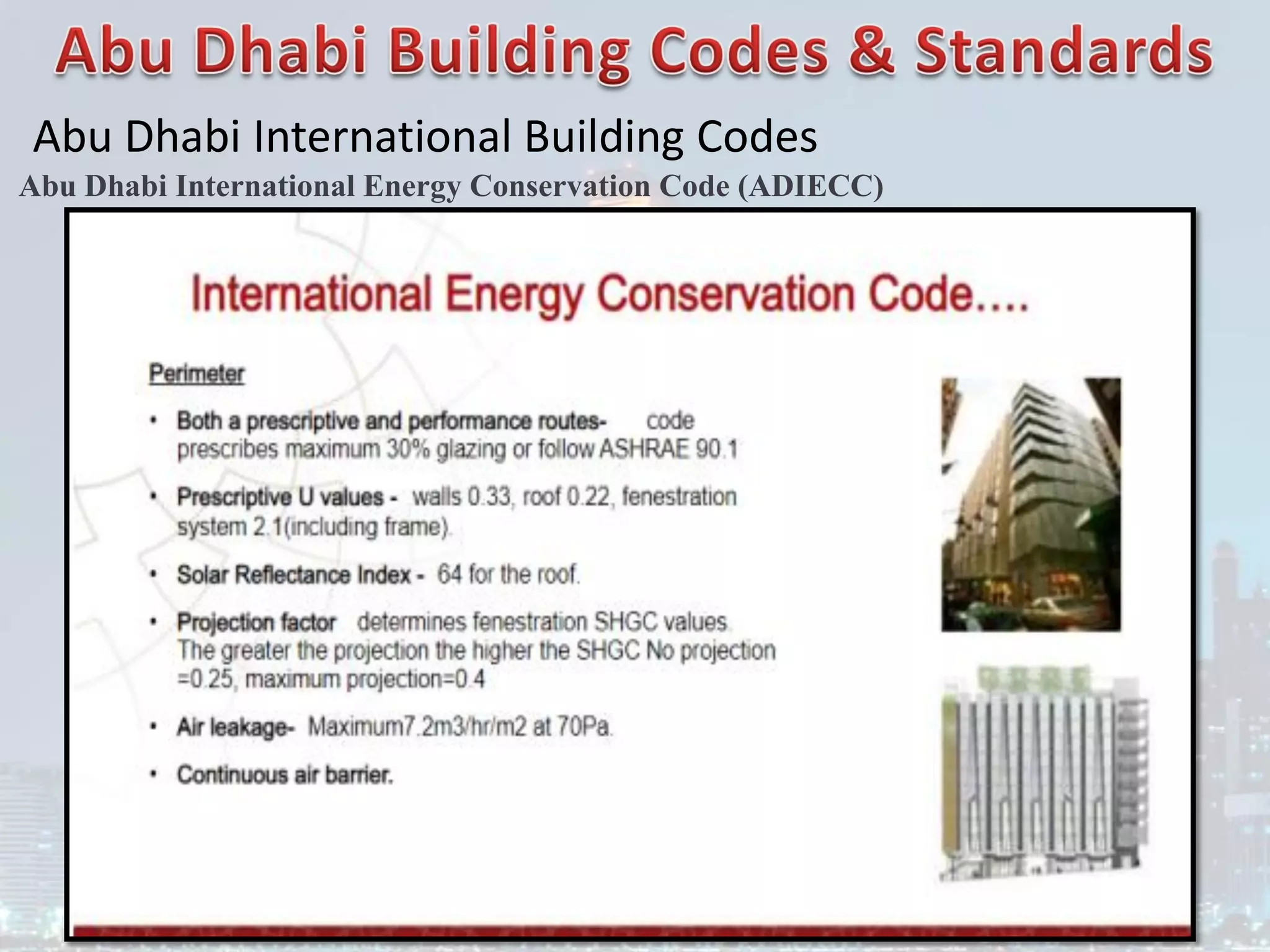
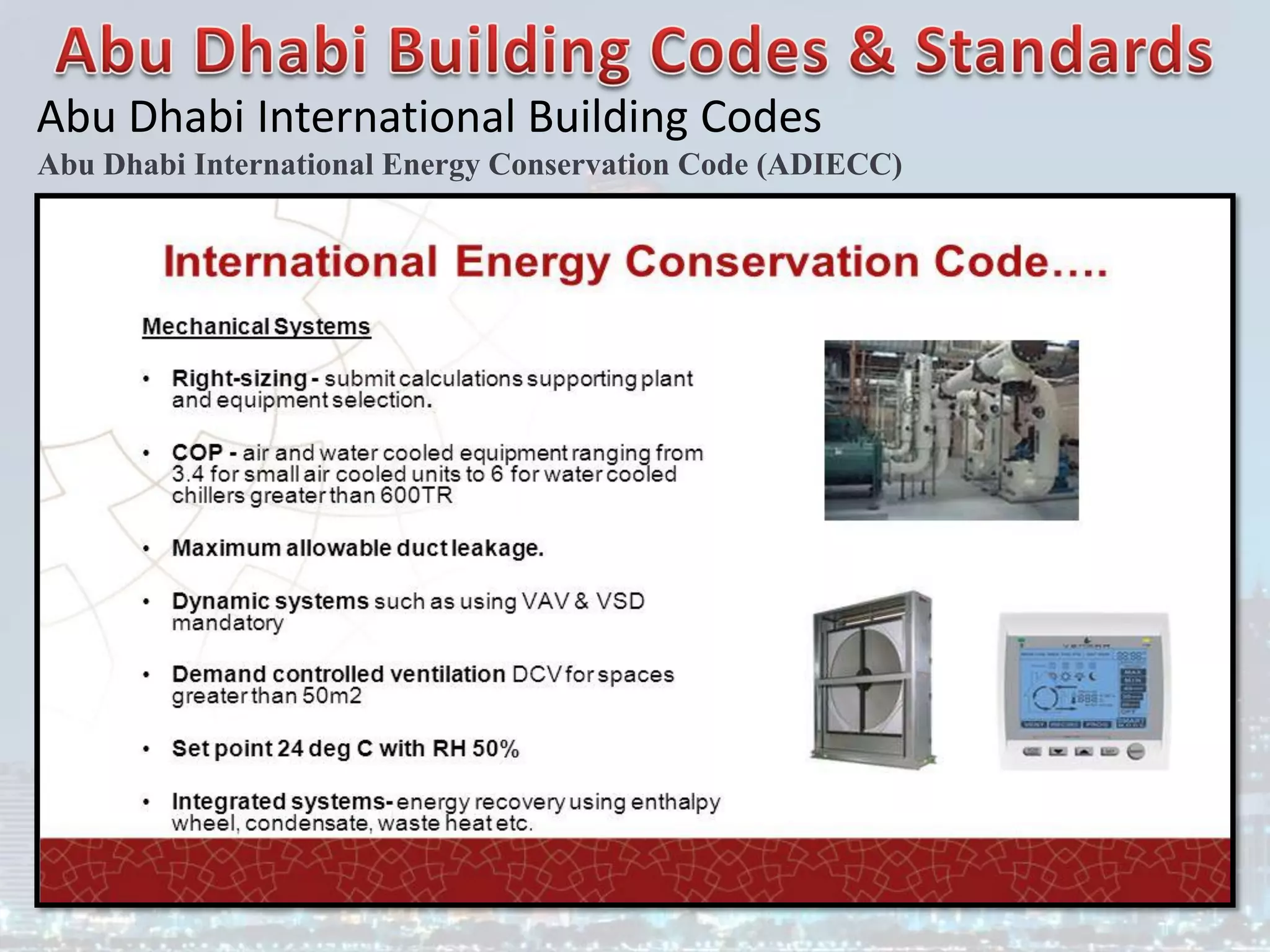
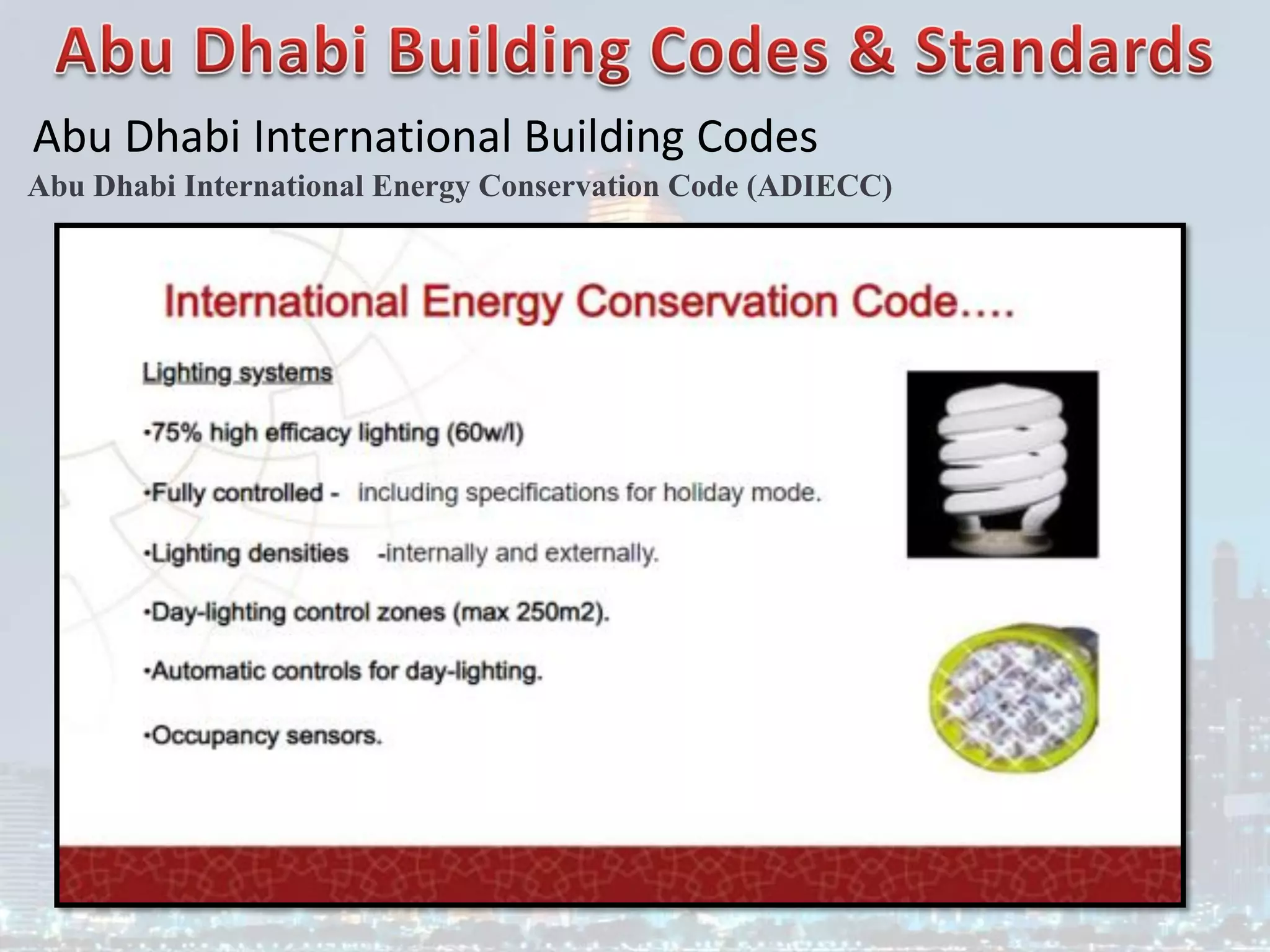
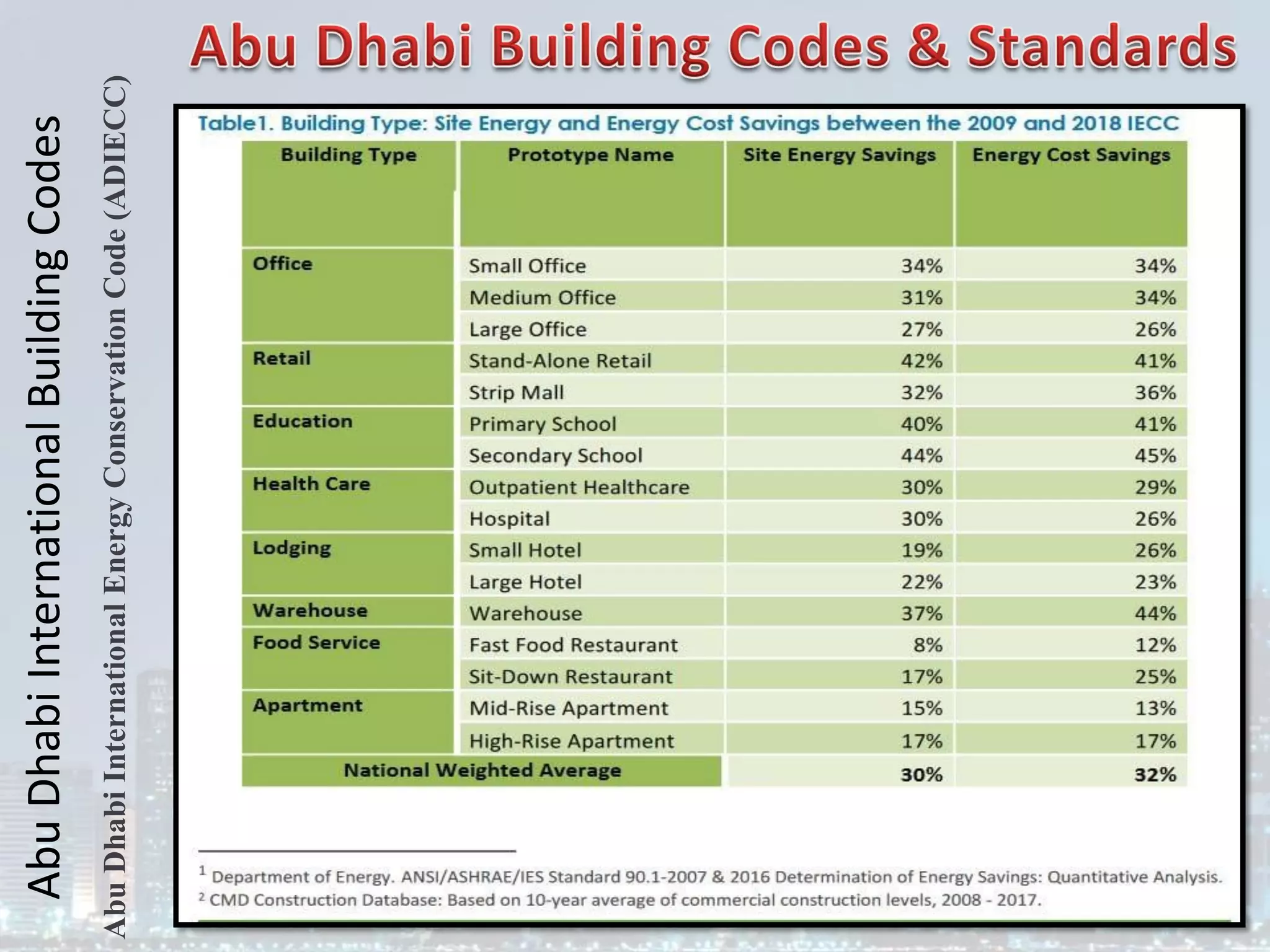
Abu Dhabi International Energy Conservation Code (ADIECC)
A - General Description of ADIECC
B - Arrangement and Formatting
C - Chapter by Chapter Description
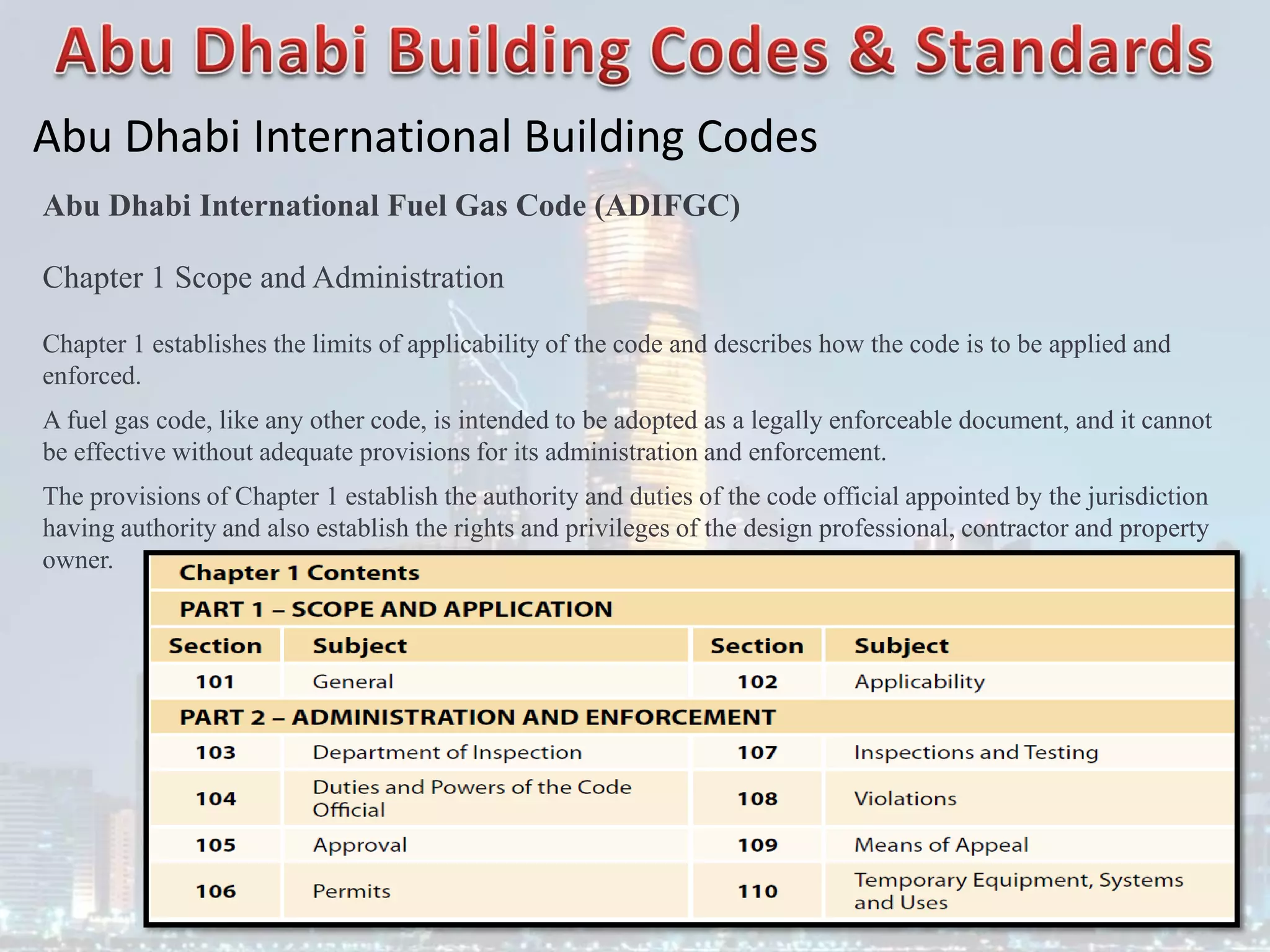
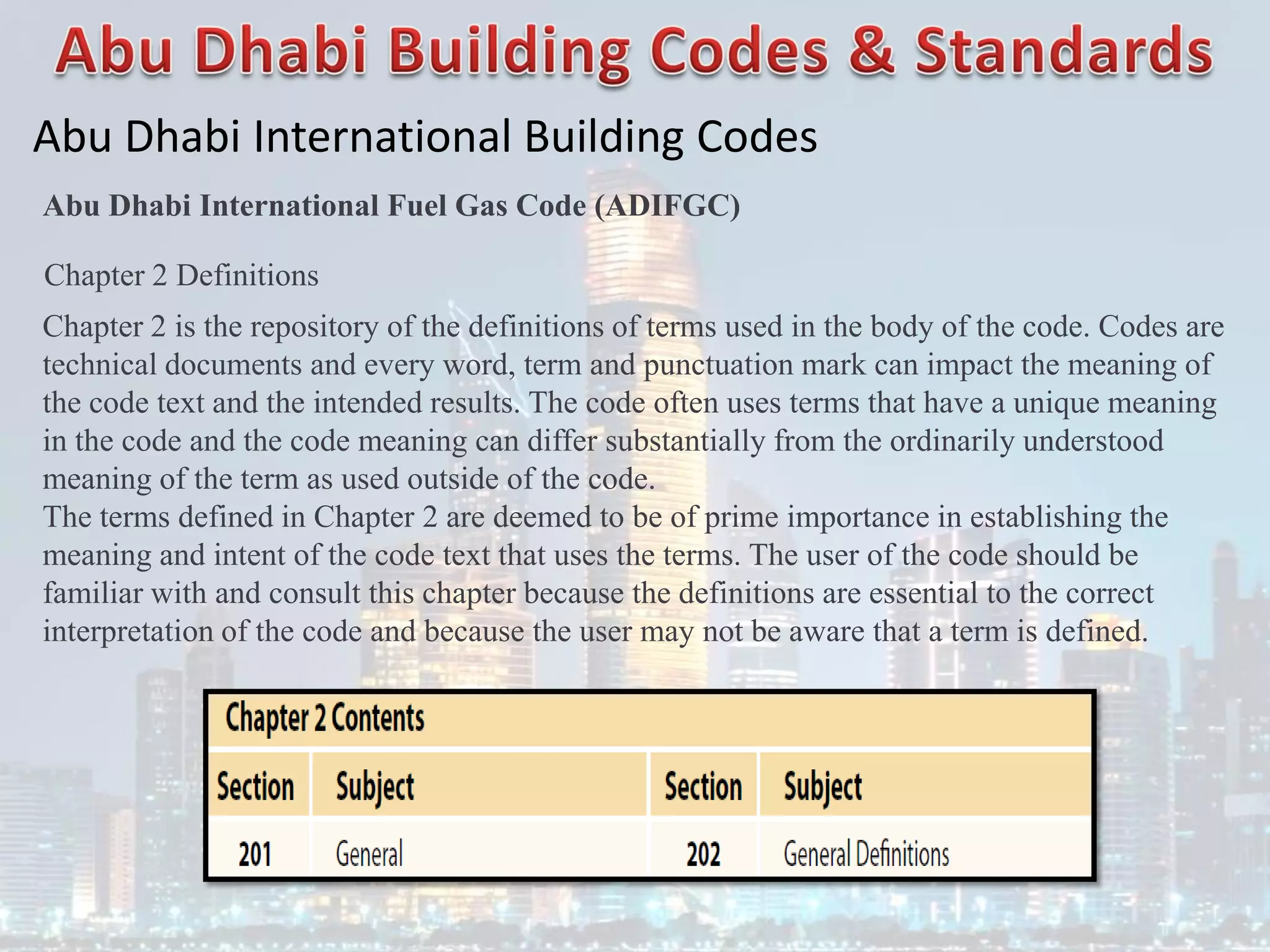
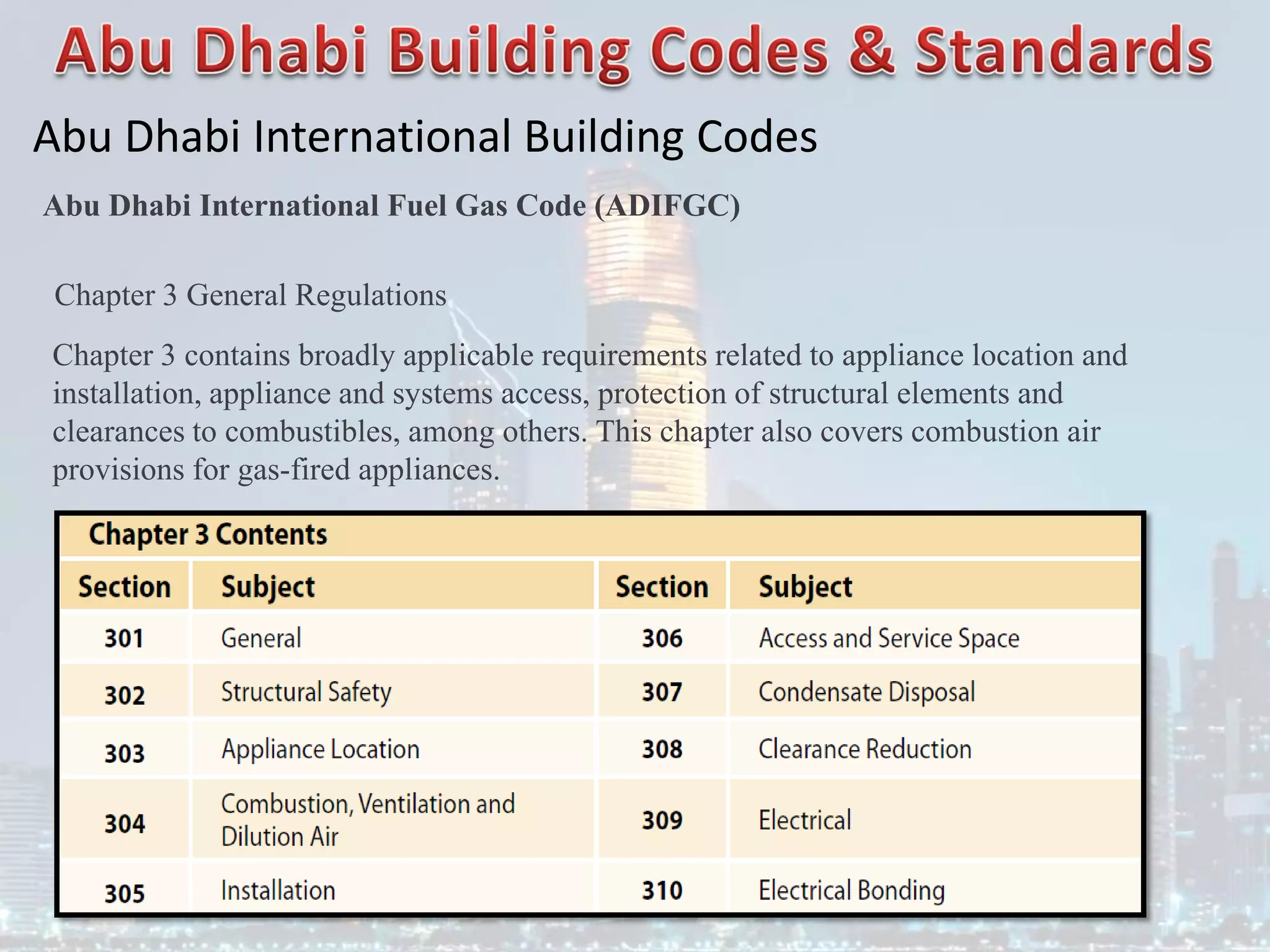
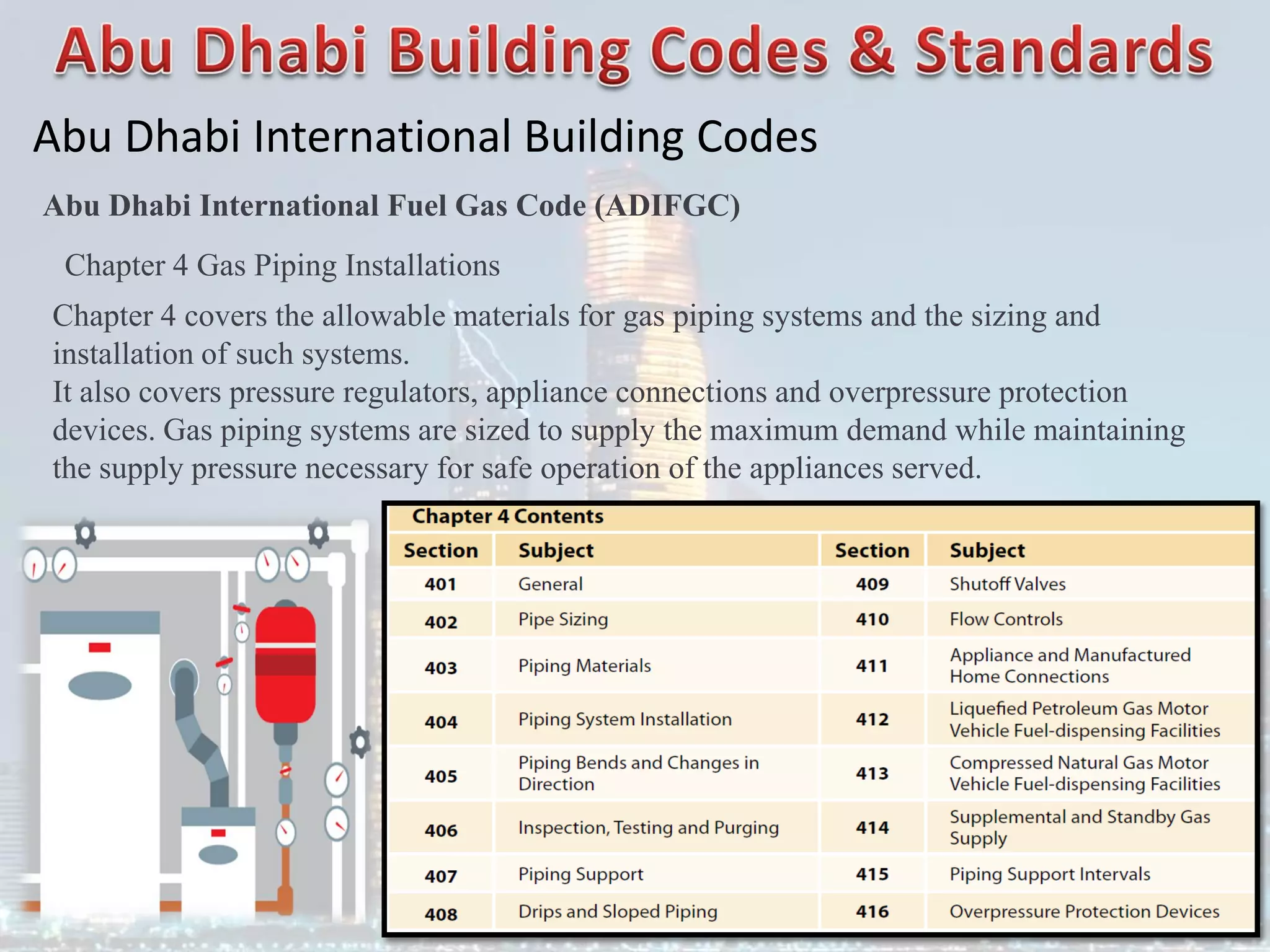
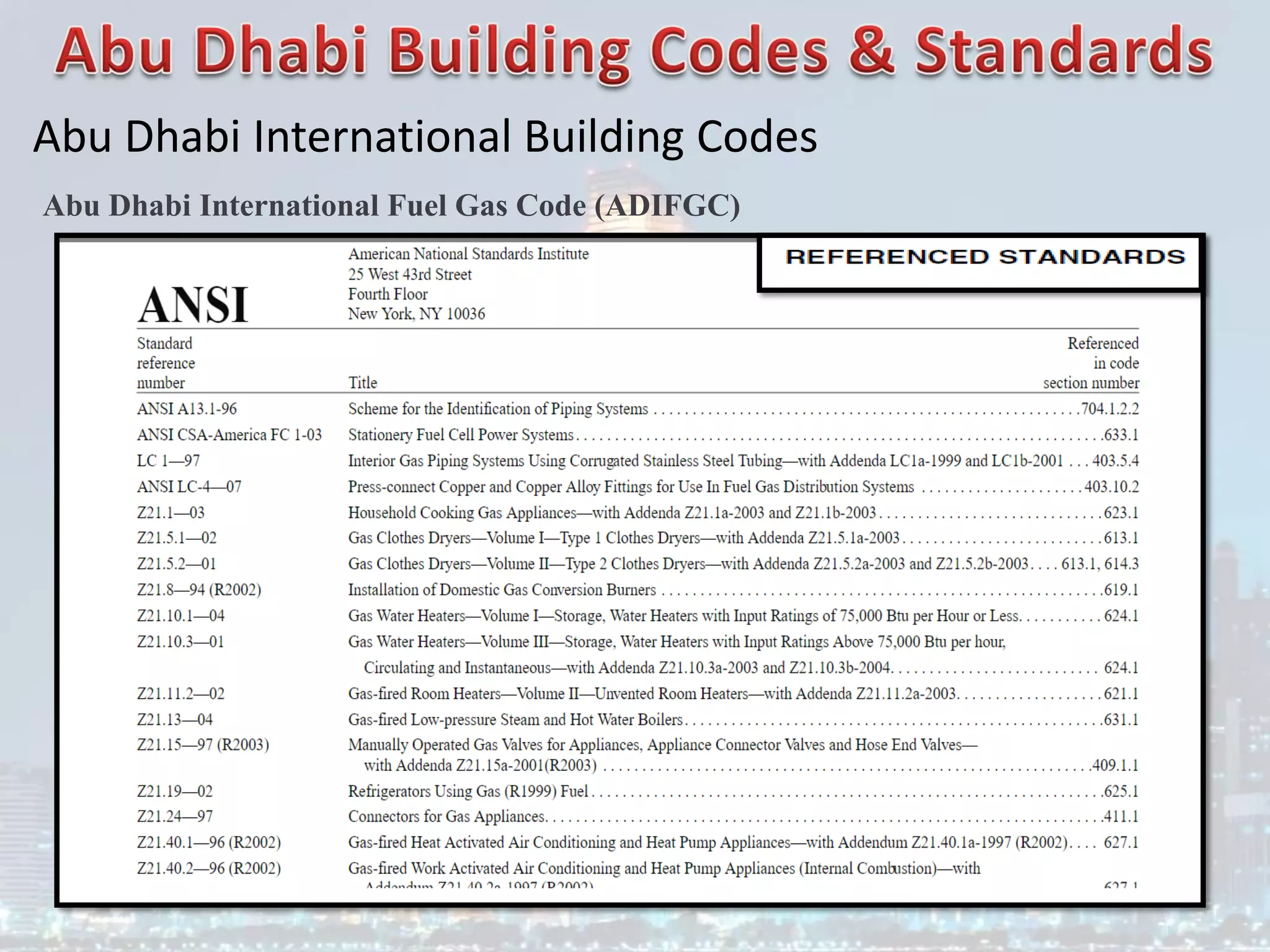
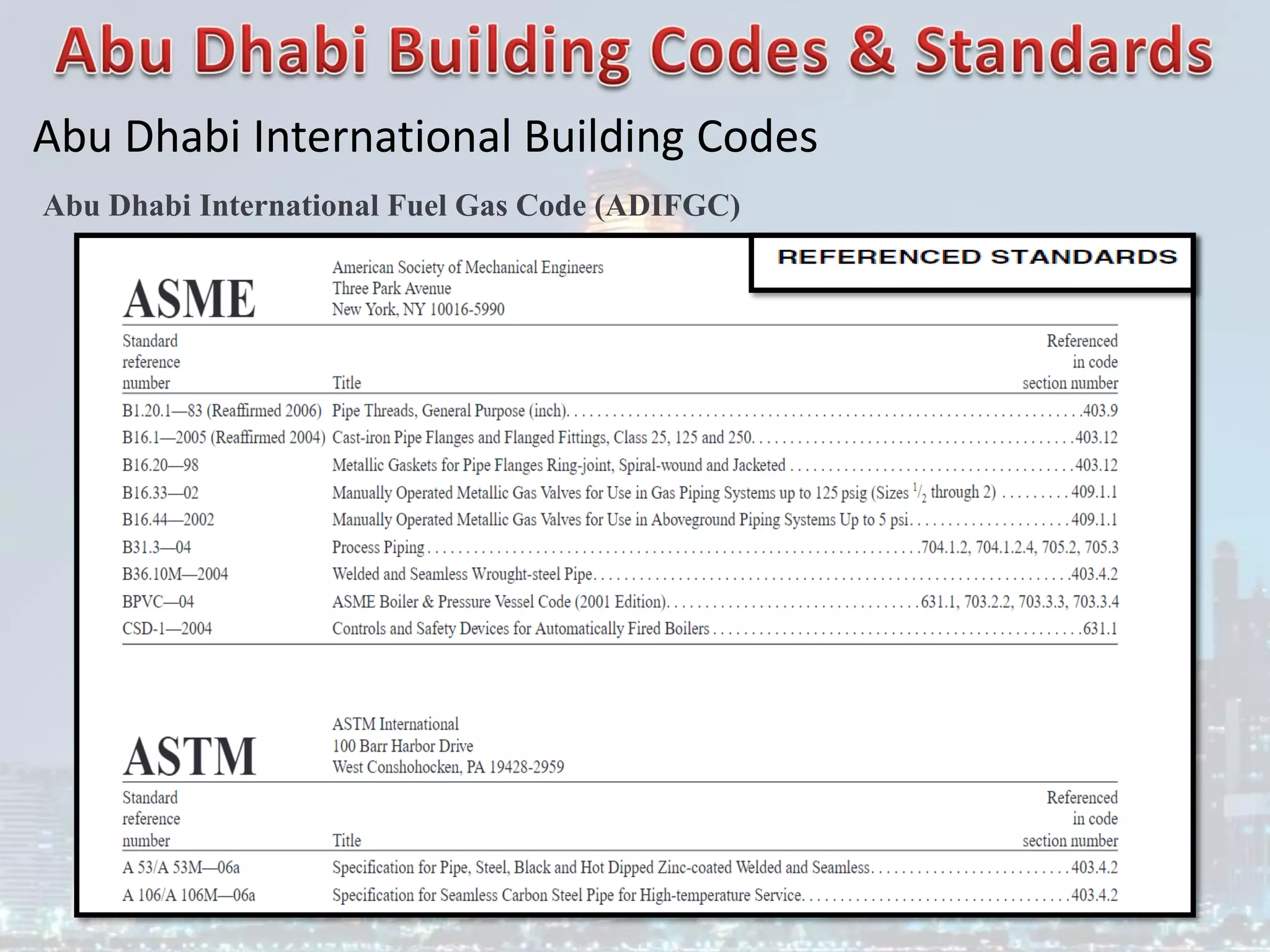
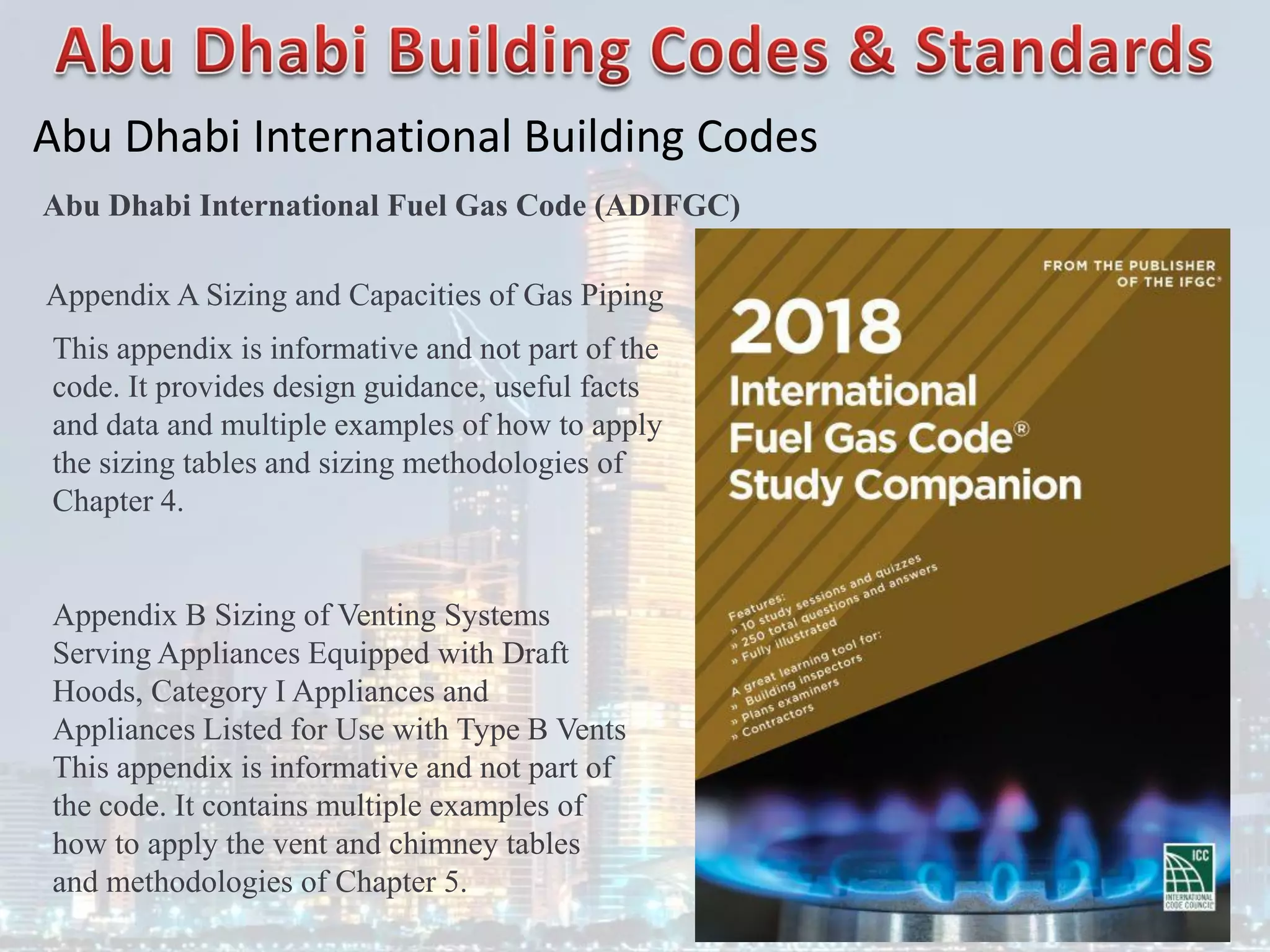
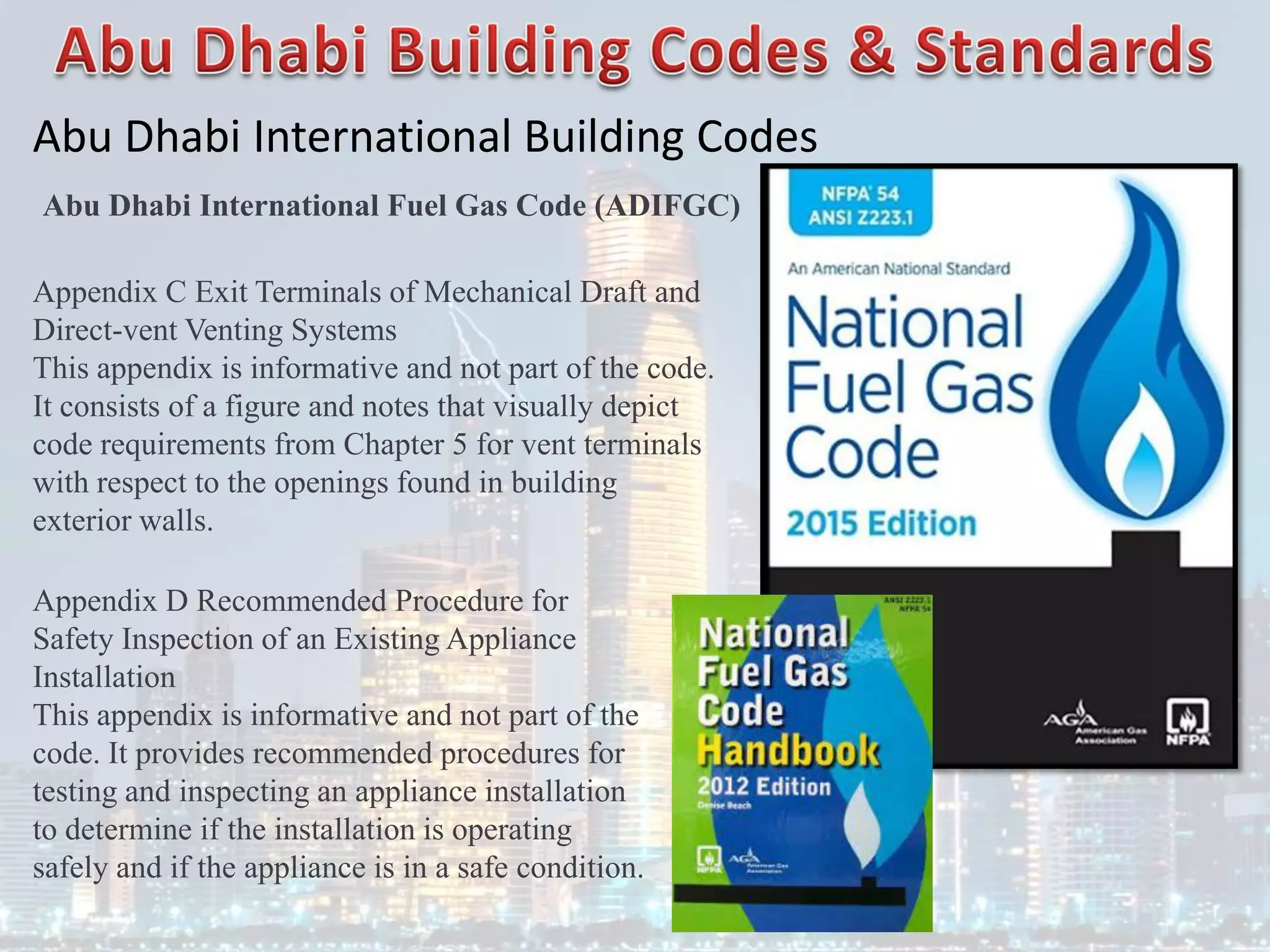
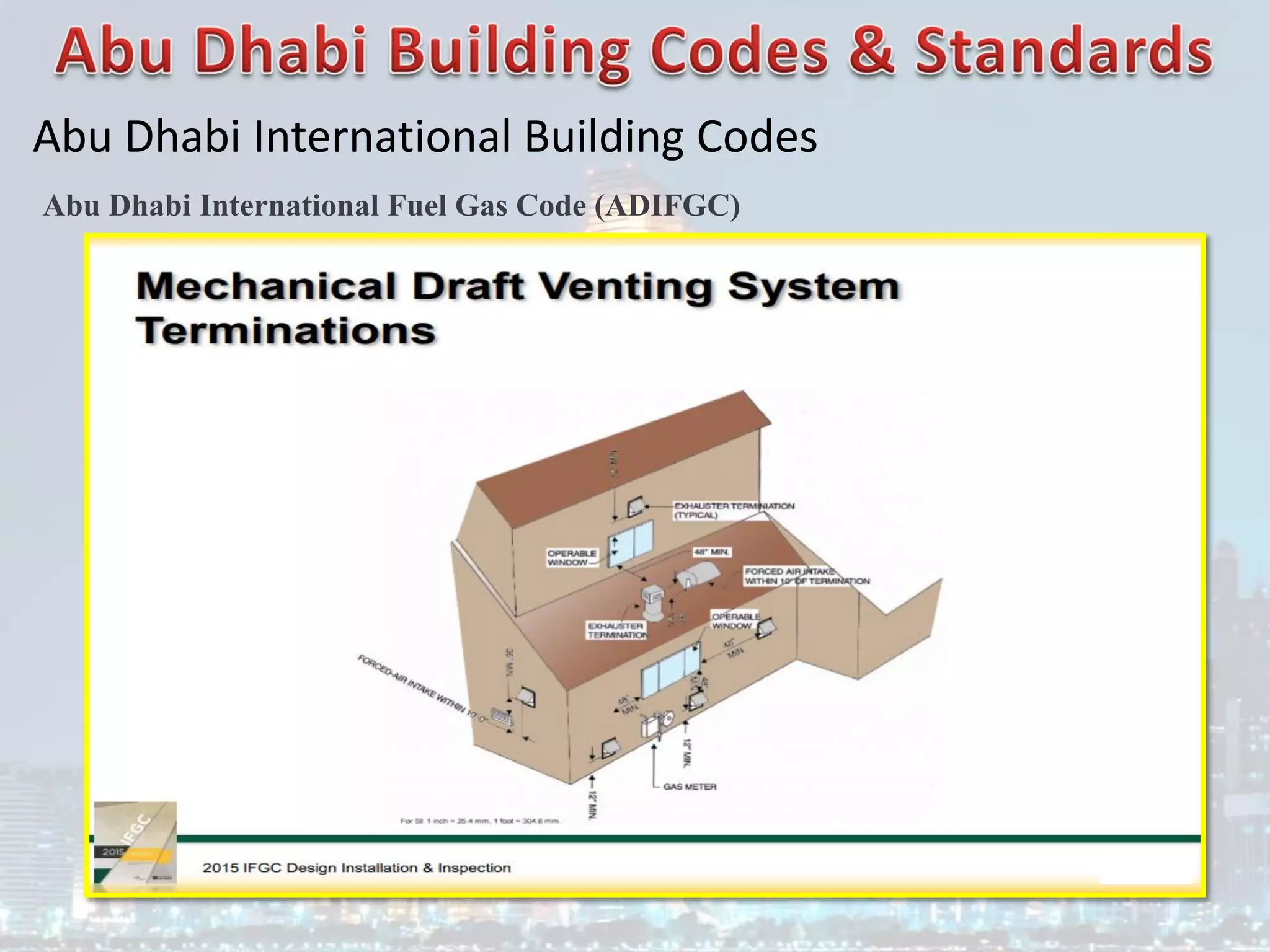
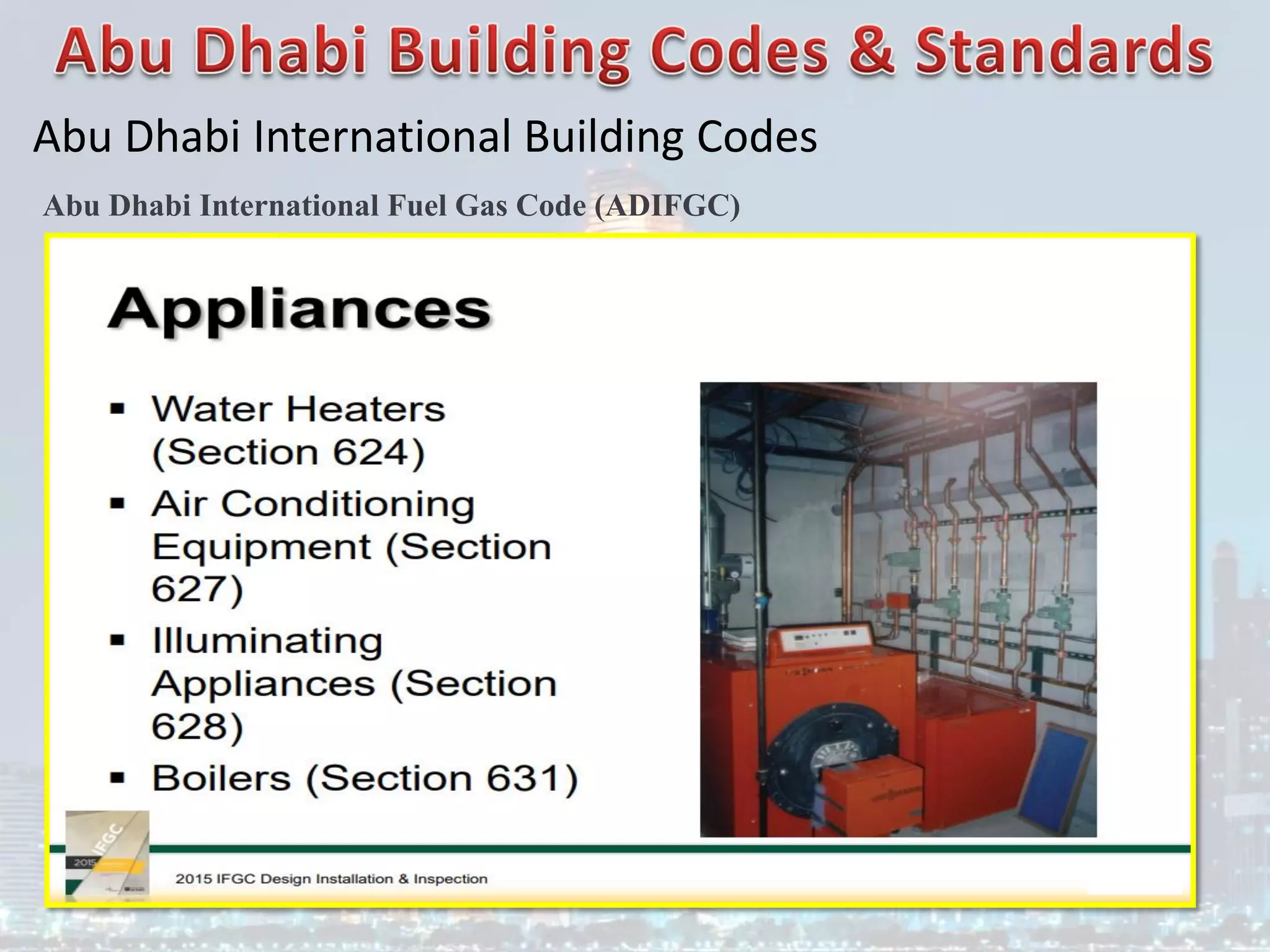
Abu Dhabi International Fuel Gas Code (ADIFGC)
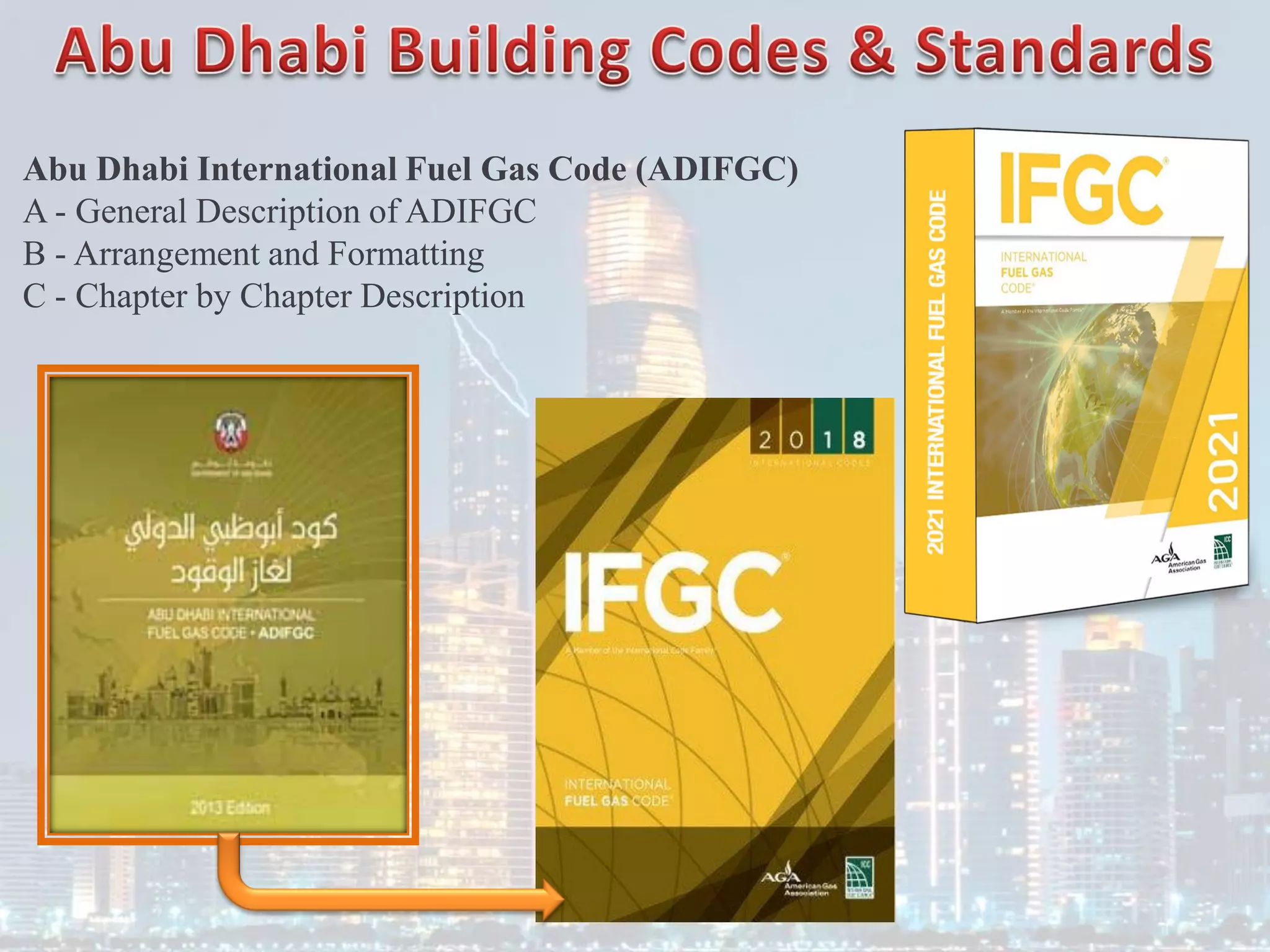
A - General Description of ADIFGC
B - Arrangement and Formatting
C - Chapter by Chapter Description
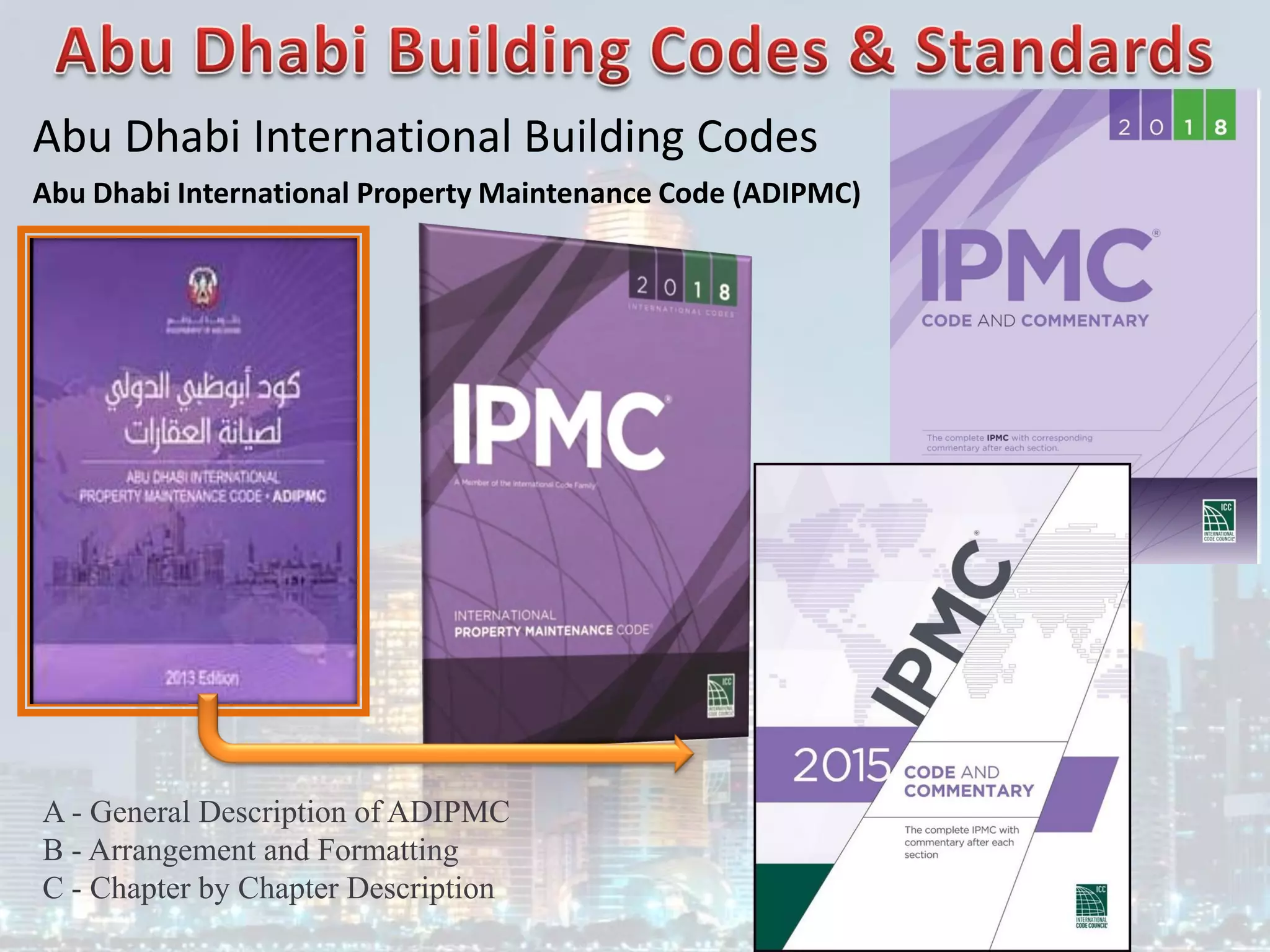
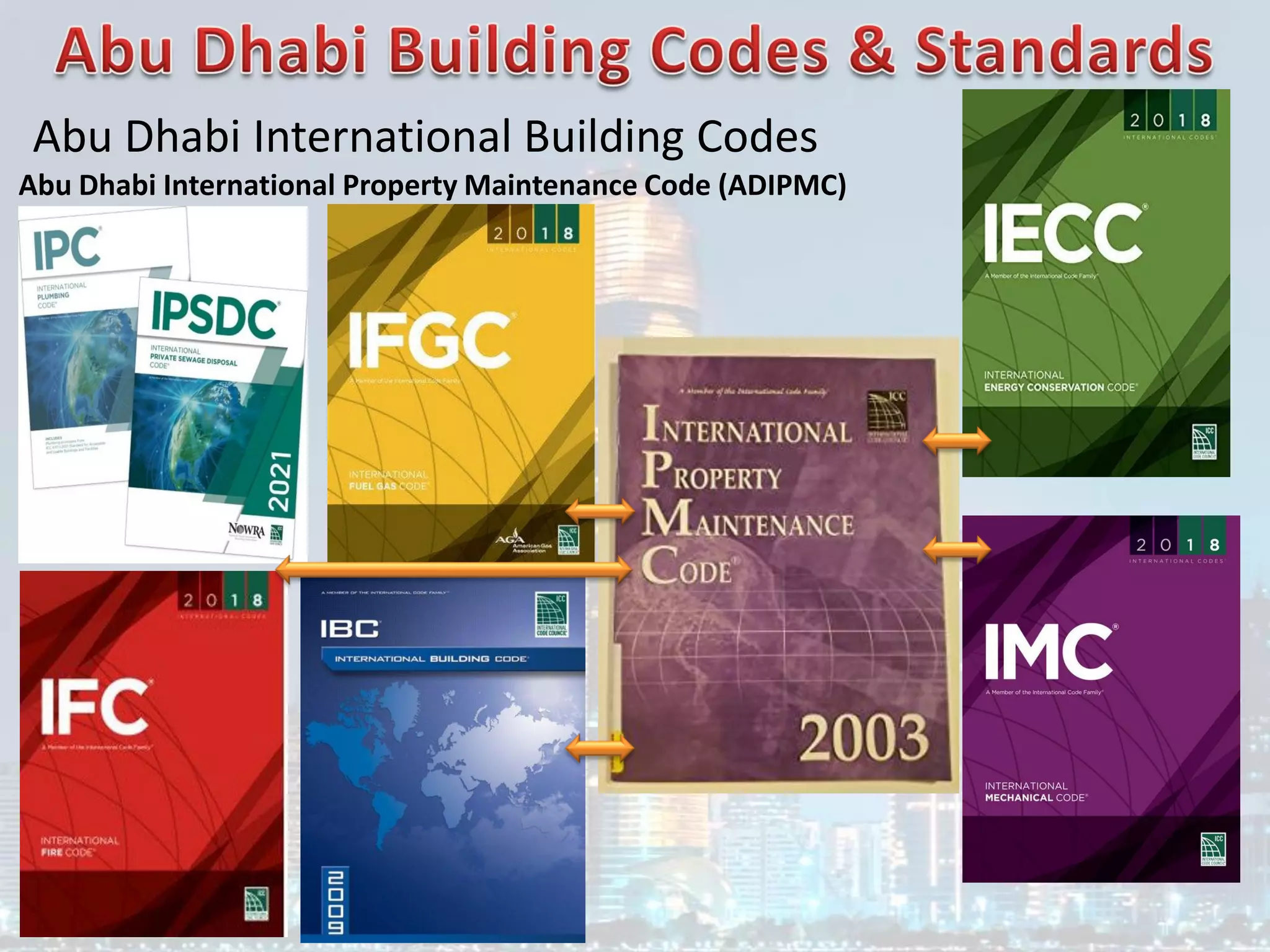
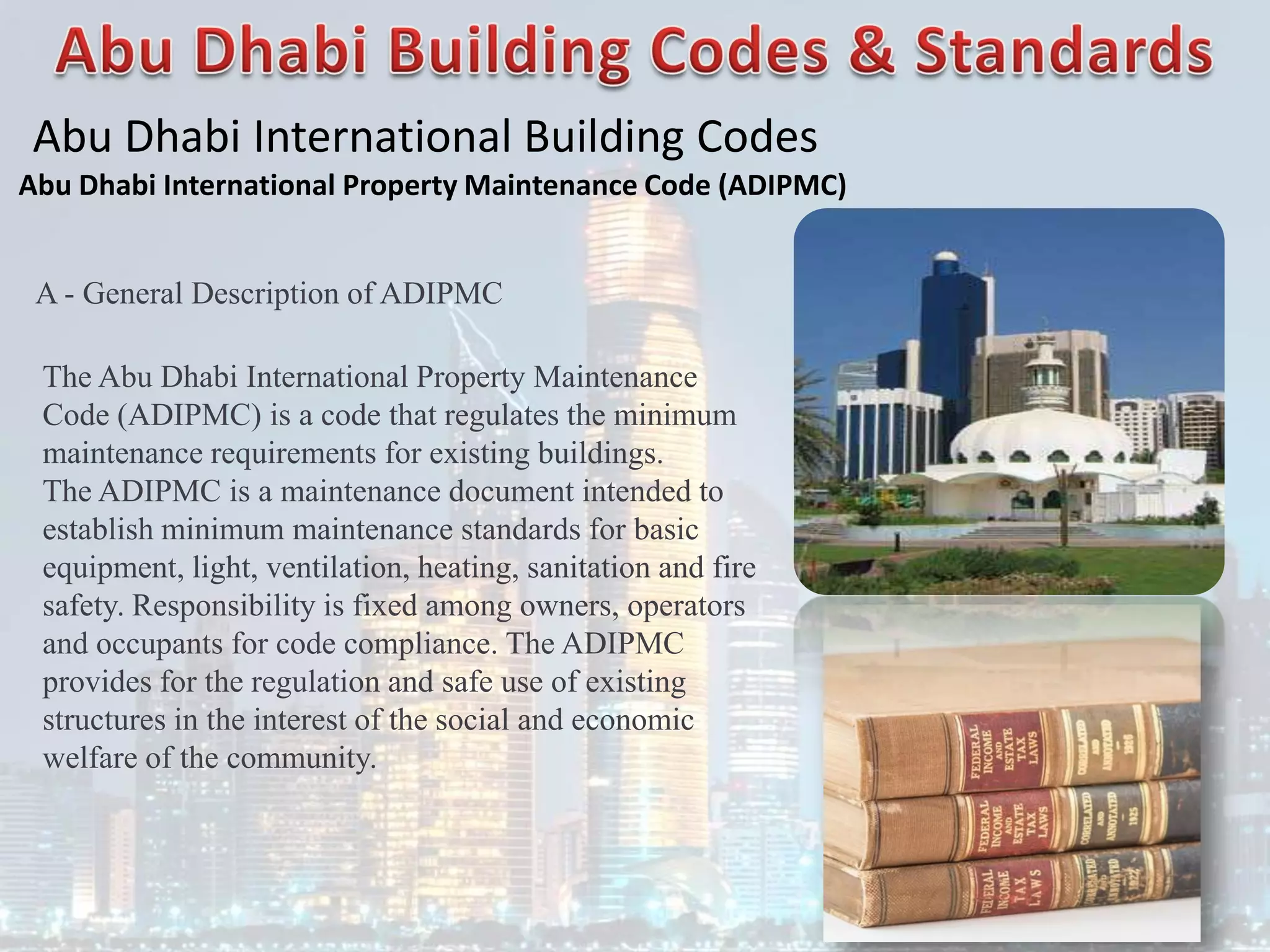
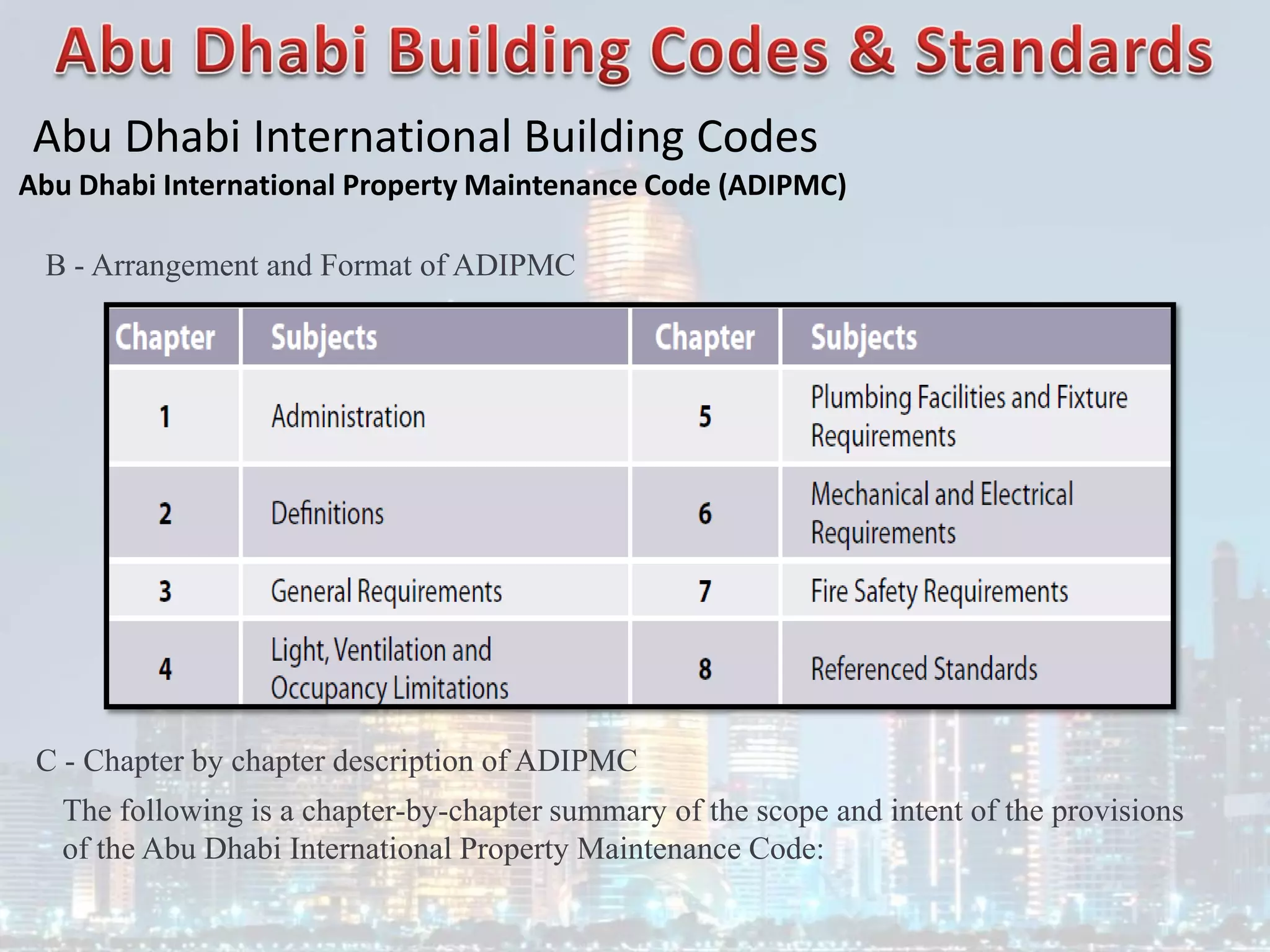
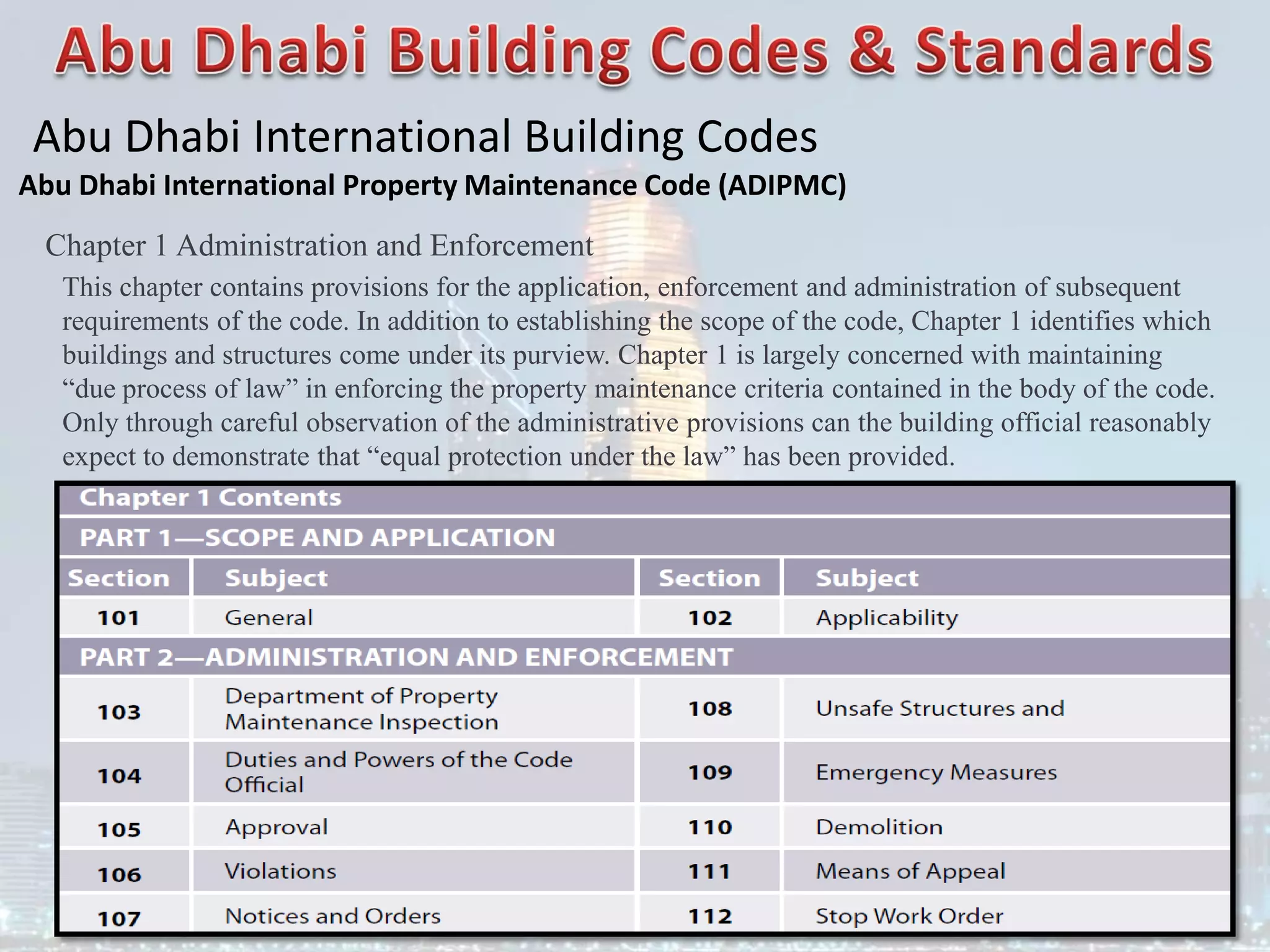
Abu Dhabi International Property Maintenance Code (ADIPMC)
A - General Description of ADIPMC
B - Arrangement and Formatting
C - Chapter by Chapter Description
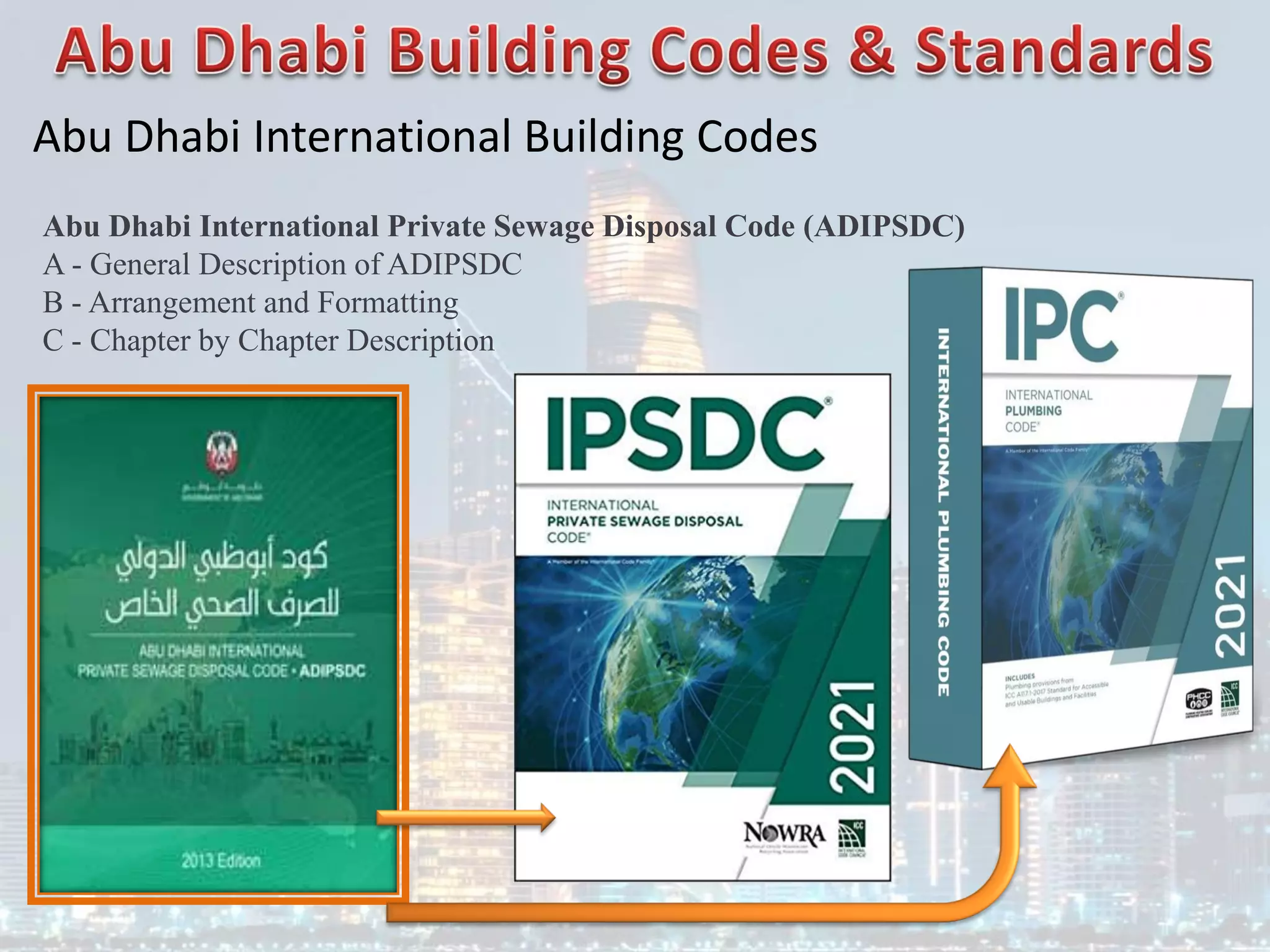
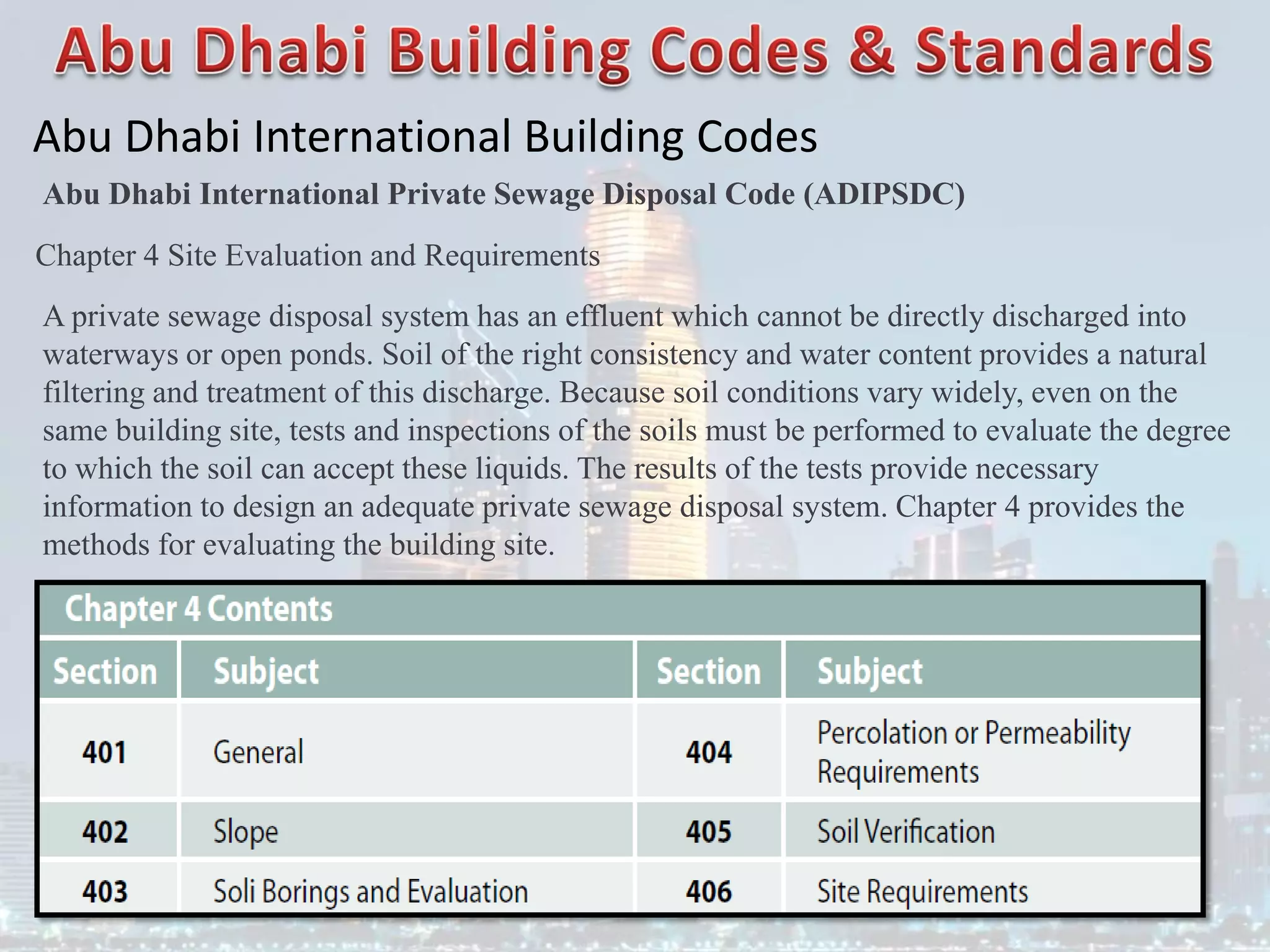
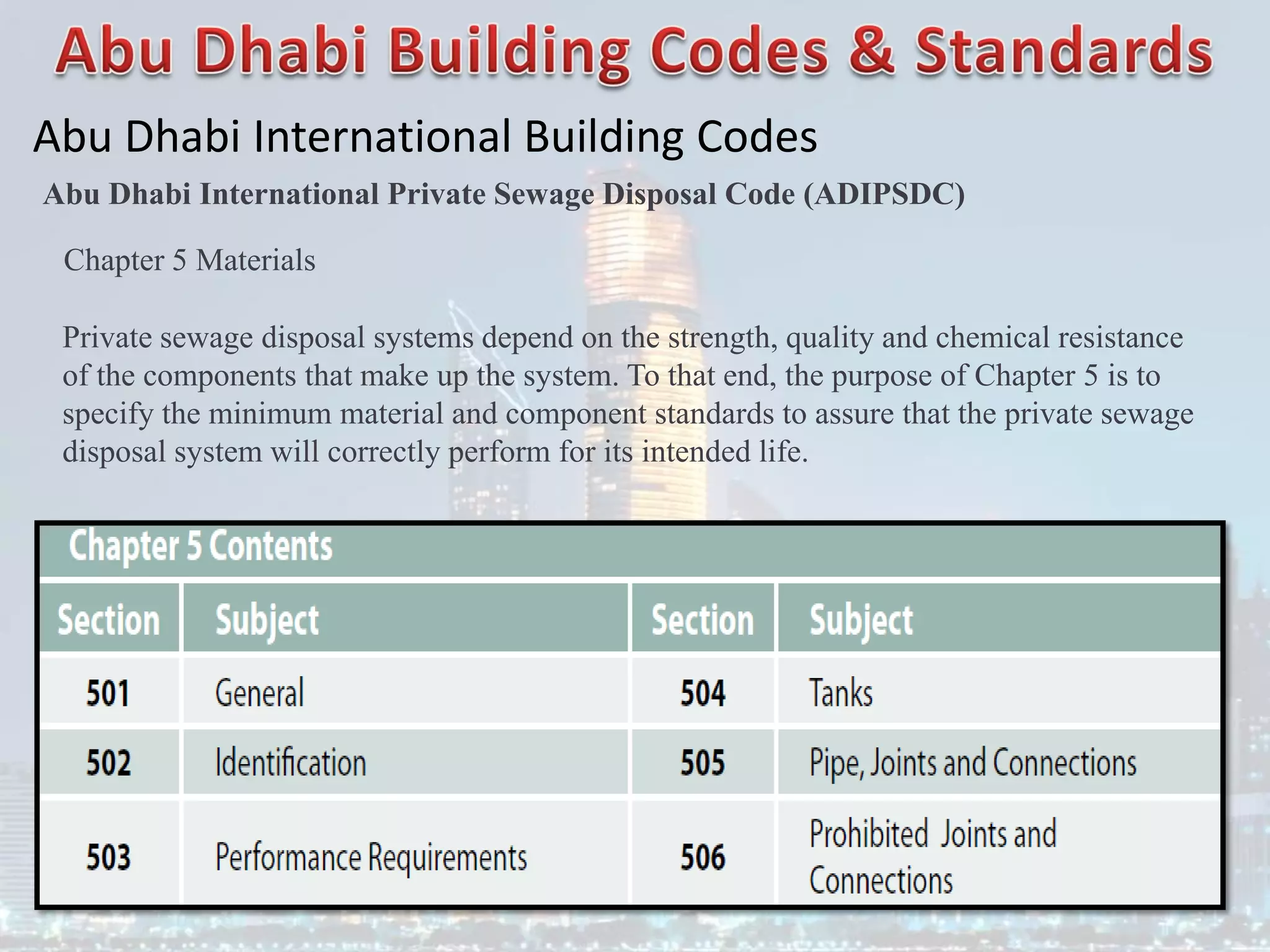
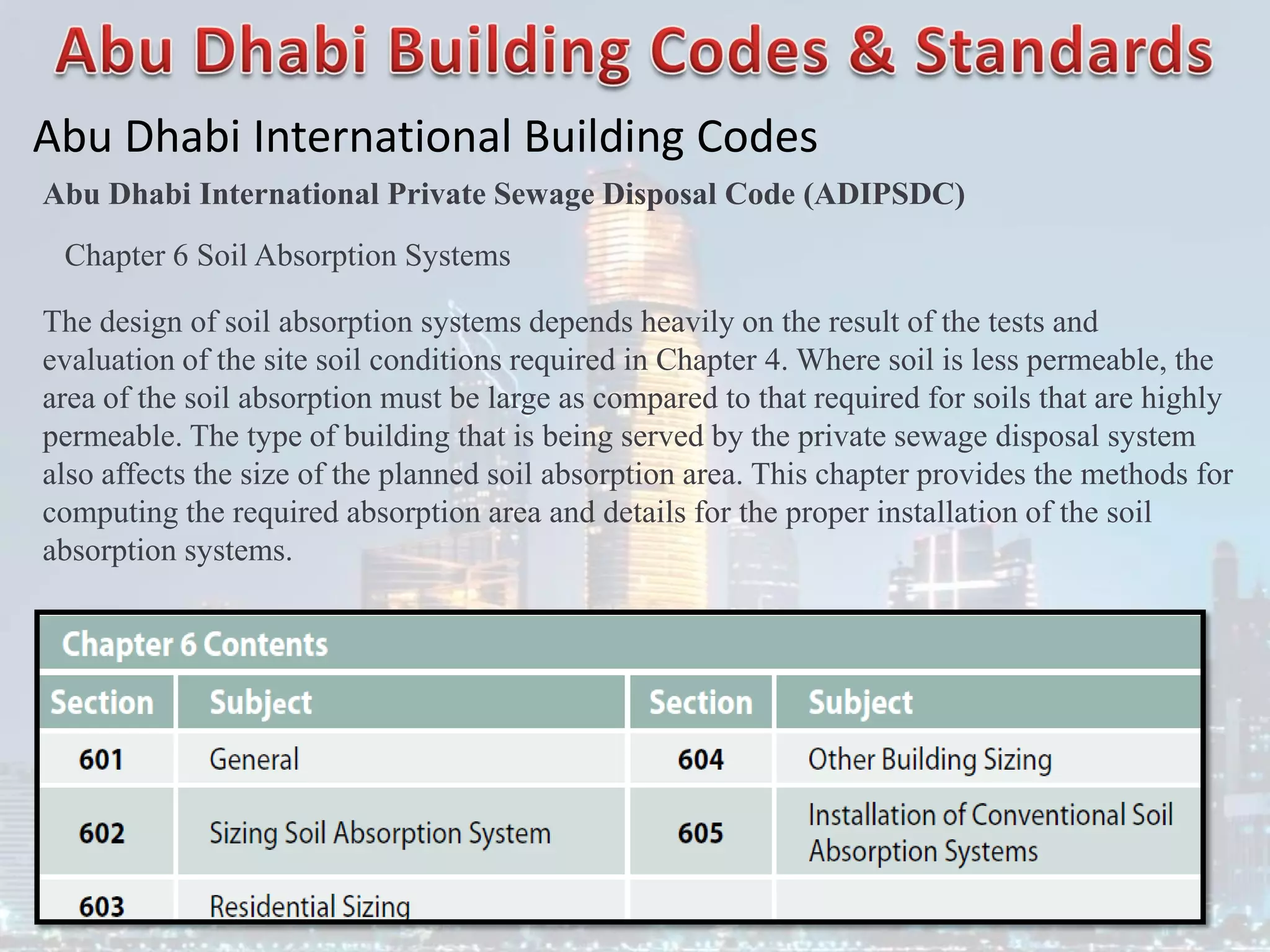
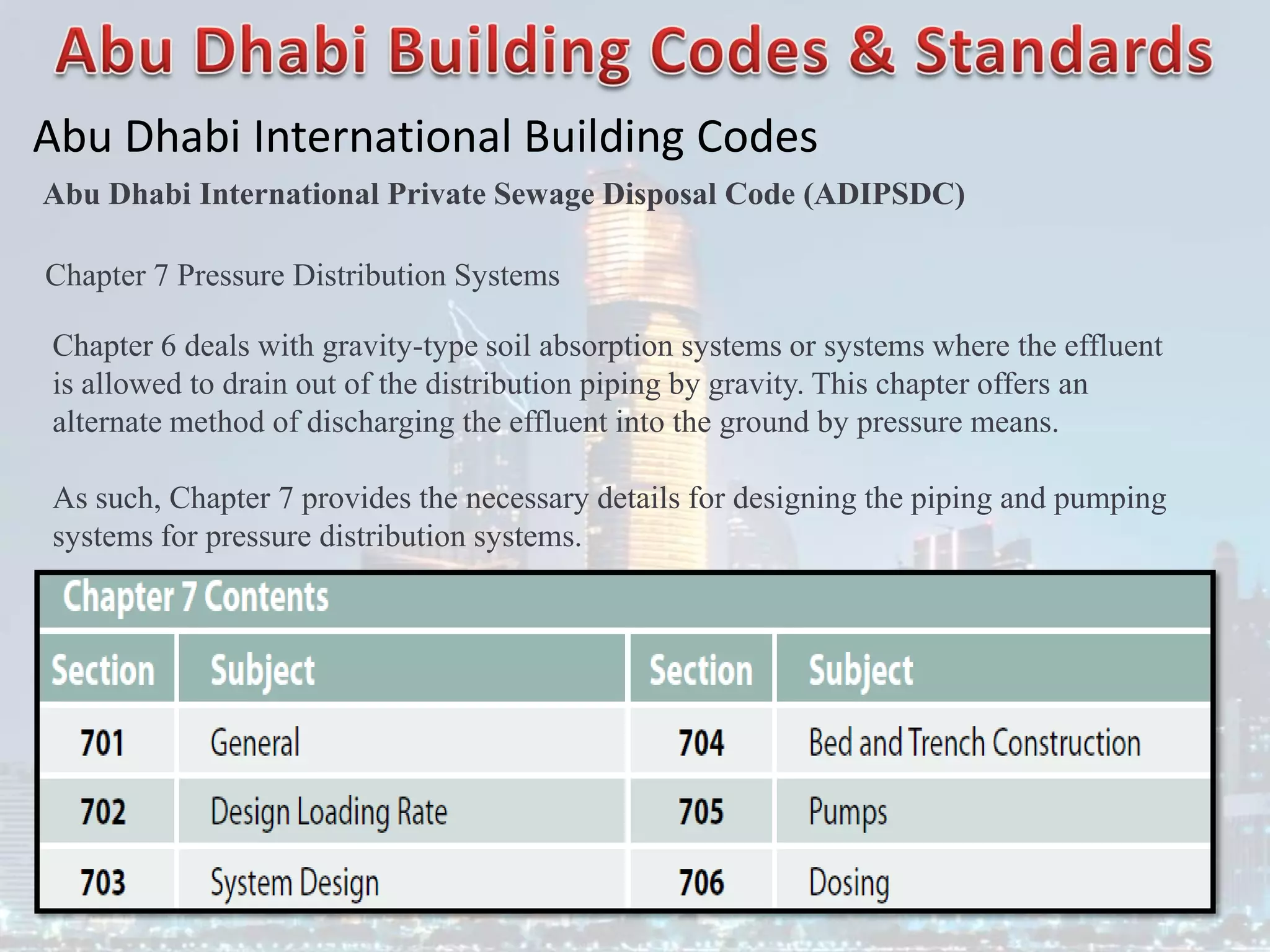
Abu Dhabi International Private Sewage Disposal Code (ADIPSDC)
A - General Description of ADIPSDC
B - Arrangement and Formatting
C - Chapter by Chapter Description
Abu Dhabi International Building Codes
Abu Dhabi International Building Code (ADIBC)
A - General Description of ADIBC
B - Arrangement and Formatting
C - Chapter by Chapter Description
Abu Dhabi International Building Codes
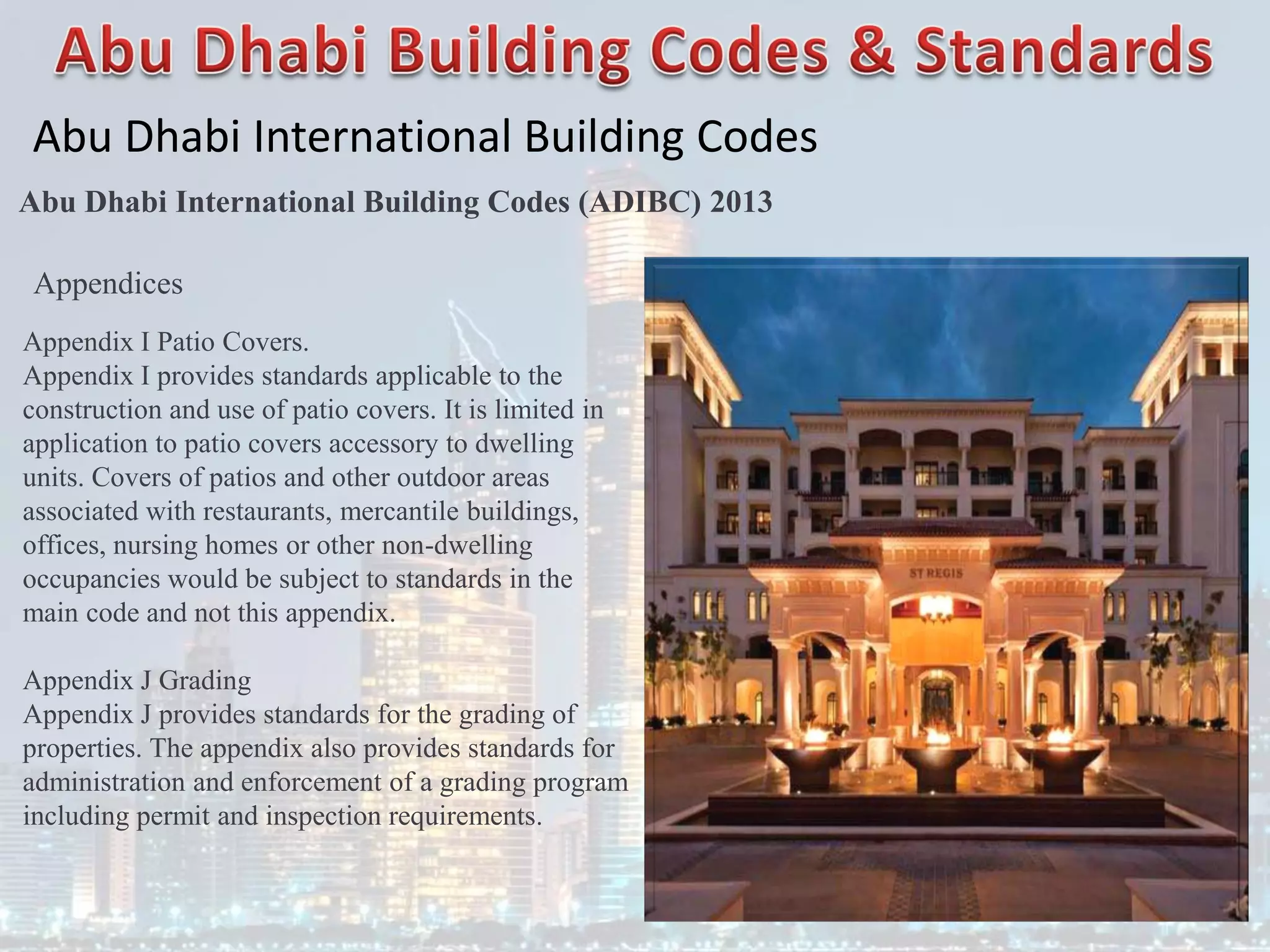
Abu Dhabi International Building Codes (ADIBC) 2013
Abu Dhabi International Building Codes
Abu Dhabi International Building Codes (ADIBC) 2013
Abu Dhabi International Building Codes
Abu Dhabi International Building Codes (ADIBC) 2013
A - General Description of ADIBC
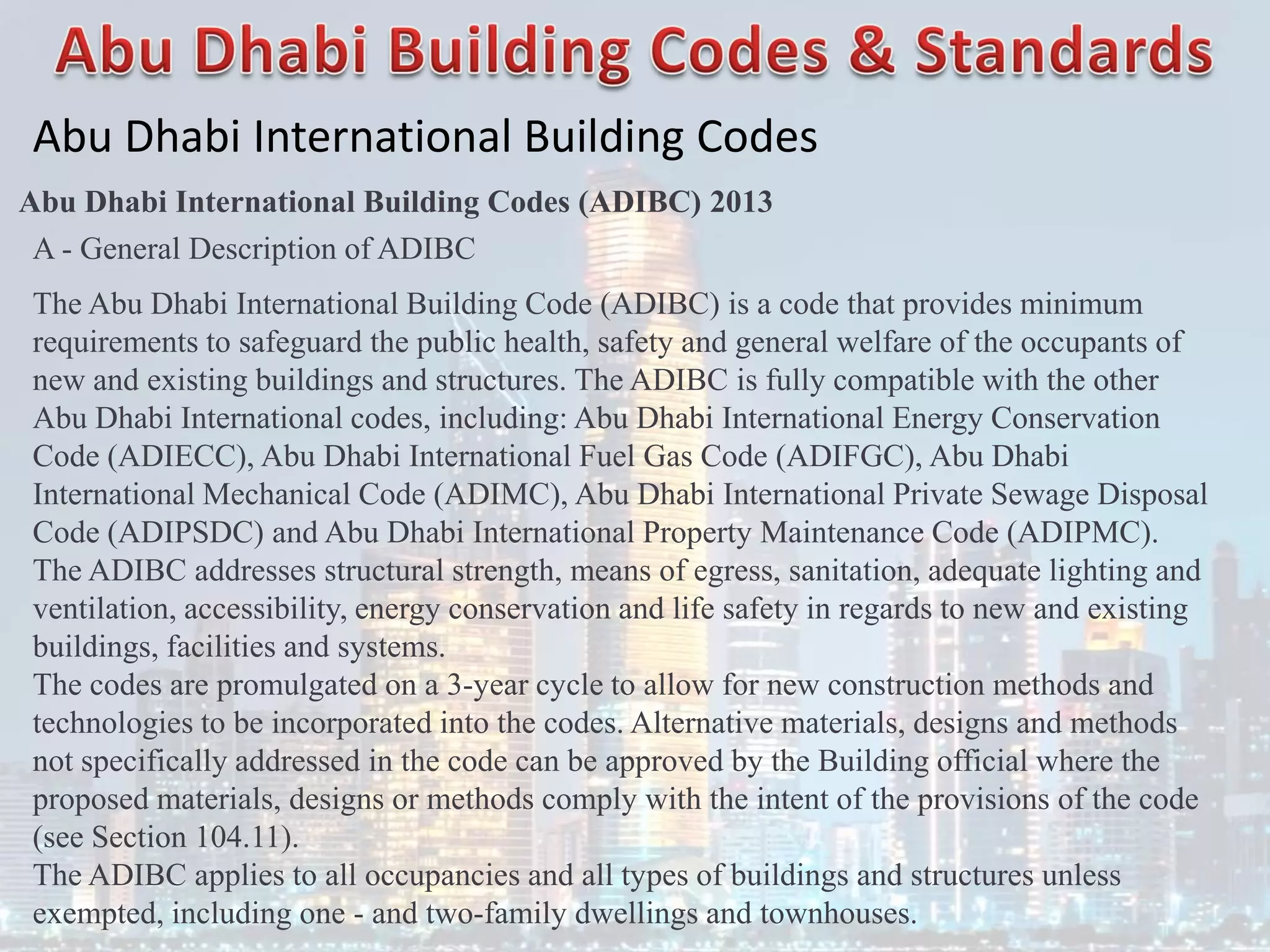
The Abu Dhabi International Building Code (ADIBC) is a code that provides minimum
requirements to safeguard the public health, safety and general welfare of the occupants of
new and existing buildings and structures. The ADIBC is fully compatible with the other
Abu Dhabi International codes, including: Abu Dhabi International Energy Conservation
Code (ADIECC), Abu Dhabi International Fuel Gas Code (ADIFGC), Abu Dhabi
International Mechanical Code (ADIMC), Abu Dhabi International Private Sewage Disposal
Code (ADIPSDC) and Abu Dhabi International Property Maintenance Code (ADIPMC).
The ADIBC addresses structural strength, means of egress, sanitation, adequate lighting and
ventilation, accessibility, energy conservation and life safety in regards to new and existing
buildings, facilities and systems.
The codes are promulgated on a 3-year cycle to allow for new construction methods and
technologies to be incorporated into the codes. Alternative materials, designs and methods
not specifically addressed in the code can be approved by the Building official where the
proposed materials, designs or methods comply with the intent of the provisions of the code
(see Section 104.11).
The ADIBC applies to all occupancies and all types of buildings and structures unless
exempted, including one - and two-family dwellings and townhouses.
Abu Dhabi International Building Codes
Abu Dhabi International Building Codes (ADIBC) 2013
A - General Description of ADIBC
Abu Dhabi International Building Codes
Abu Dhabi International Building Codes (ADIBC) 2013
B - Arrangement and Format of ADIBC
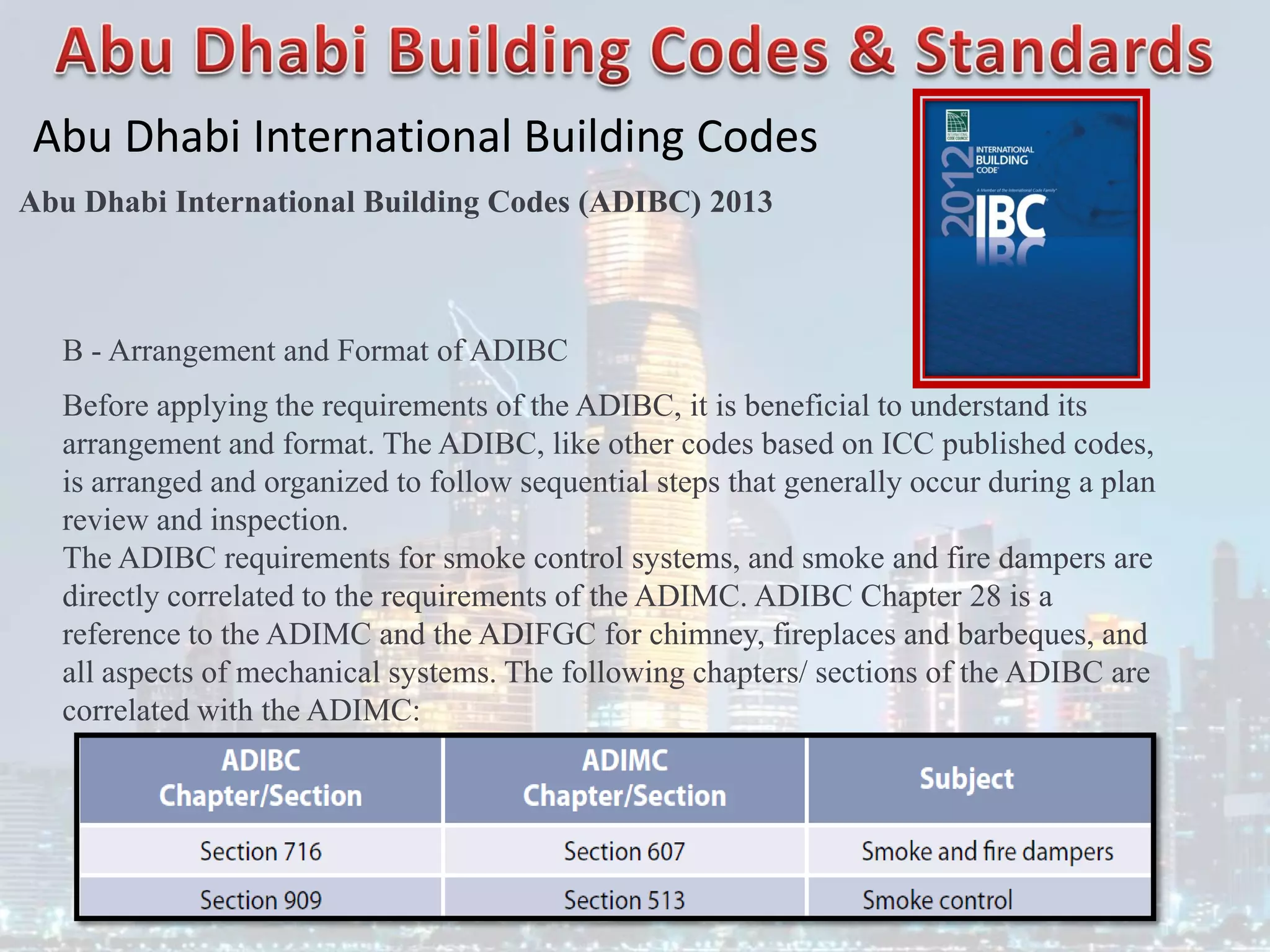
Before applying the requirements of the ADIBC, it is beneficial to understand its
arrangement and format. The ADIBC, like other codes based on ICC published codes,
is arranged and organized to follow sequential steps that generally occur during a plan
review and inspection.
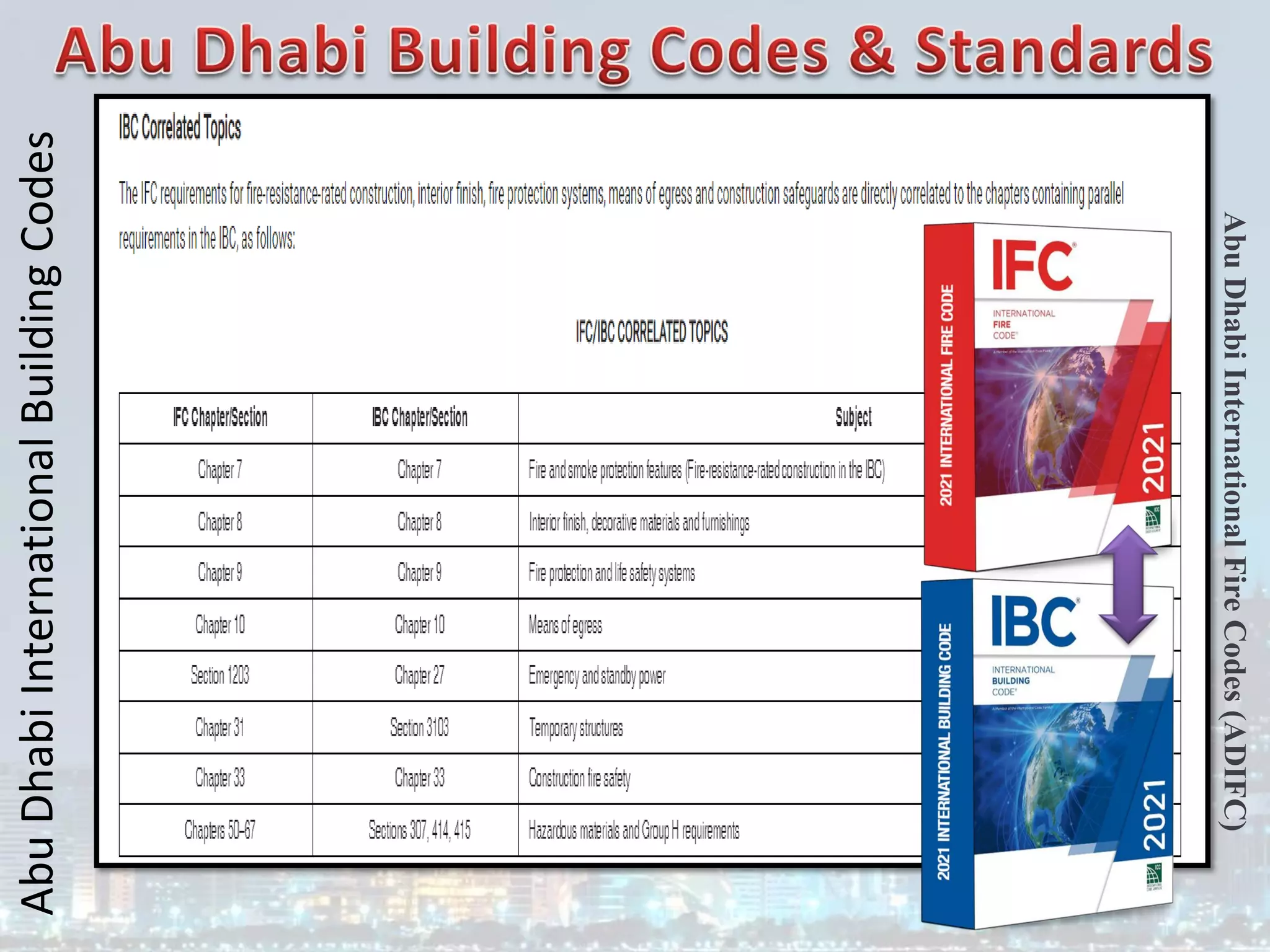
The ADIBC requirements for smoke control systems, and smoke and fire dampers are
directly correlated to the requirements of the ADIMC. ADIBC Chapter 28 is a
reference to the ADIMC and the ADIFGC for chimney, fireplaces and barbeques, and
all aspects of mechanical systems. The following chapters/ sections of the ADIBC are
correlated with the ADIMC:
Abu Dhabi International Building Codes
Abu Dhabi International Building Codes (ADIBC) 2013
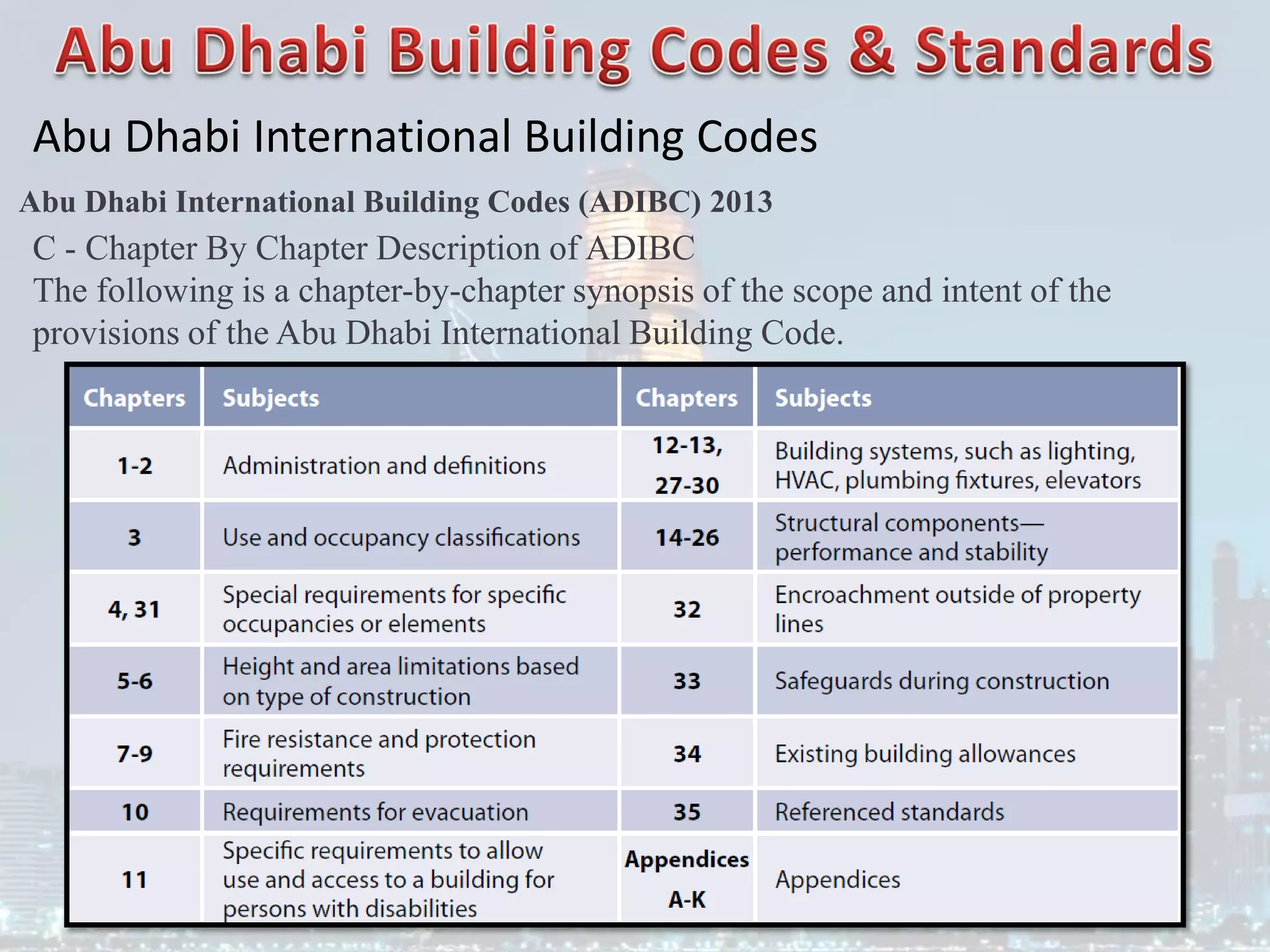
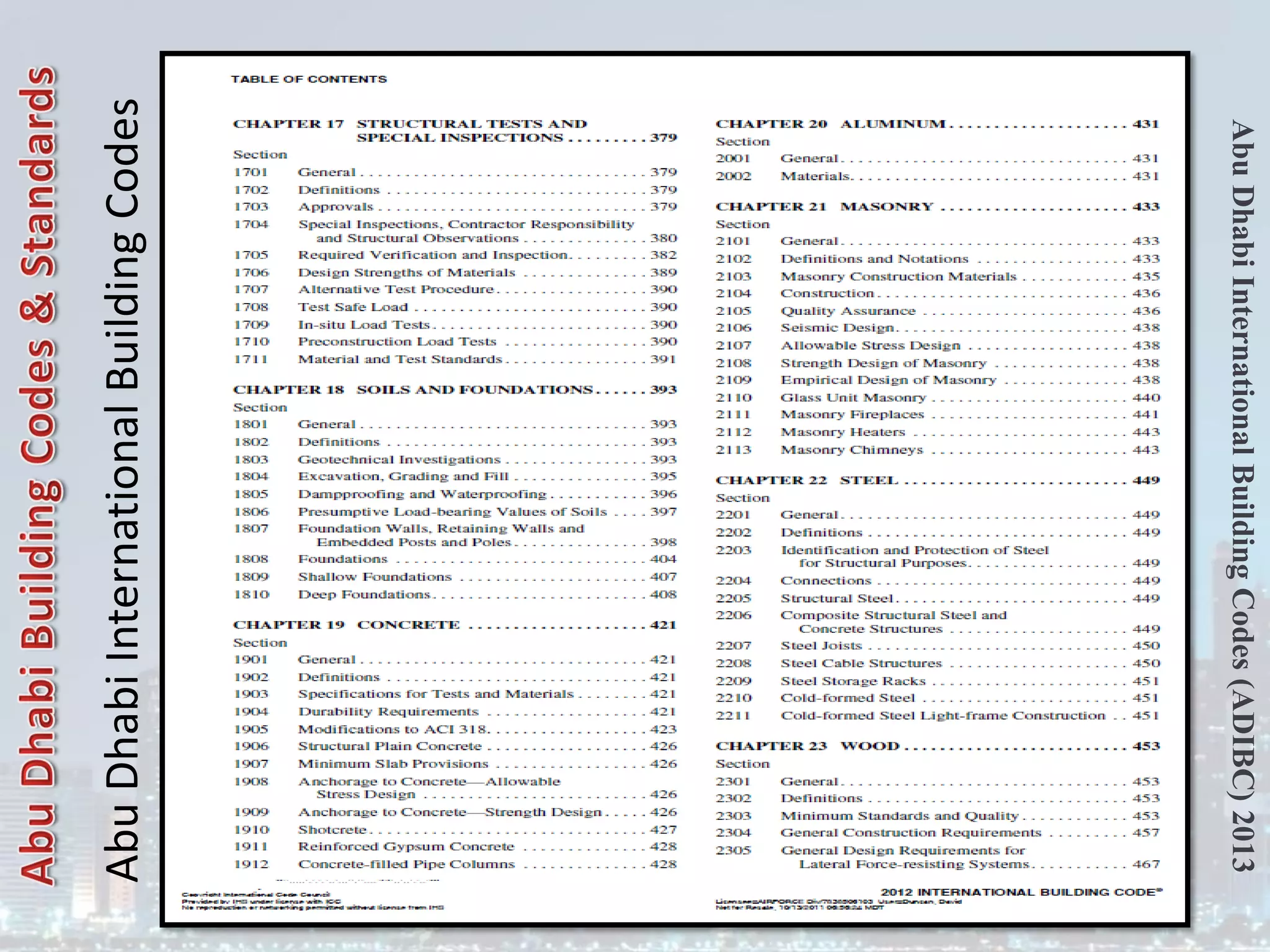
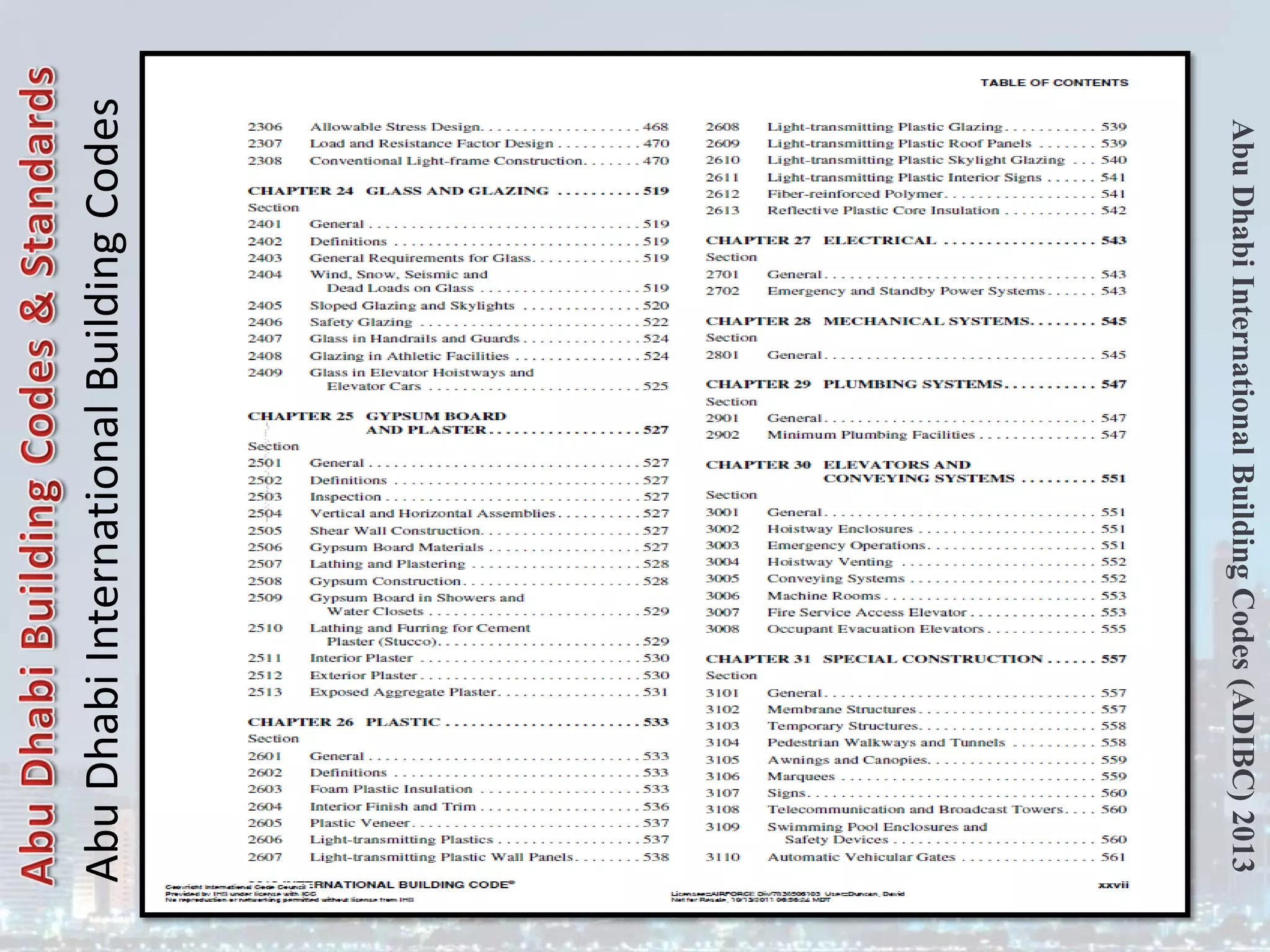
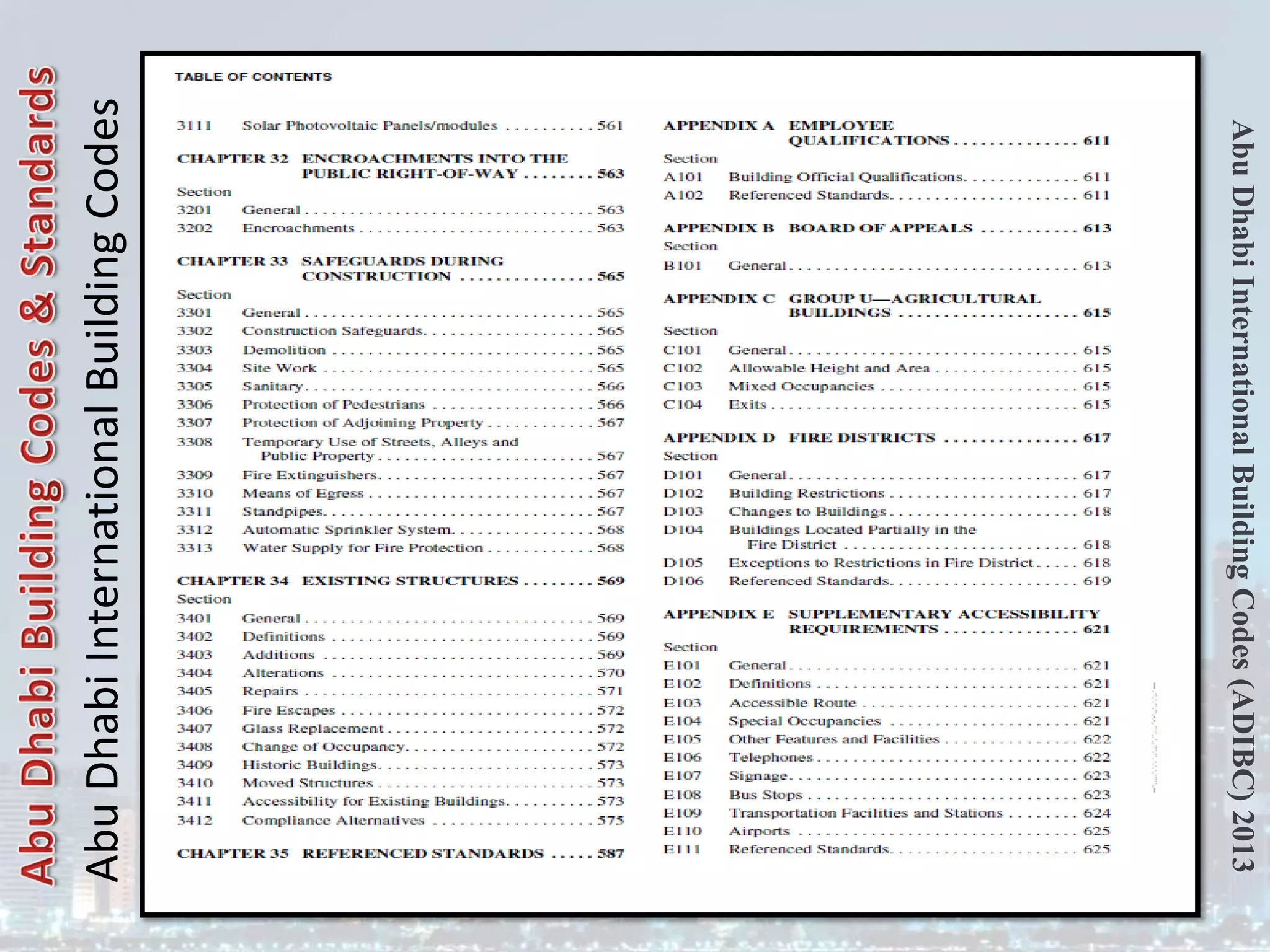
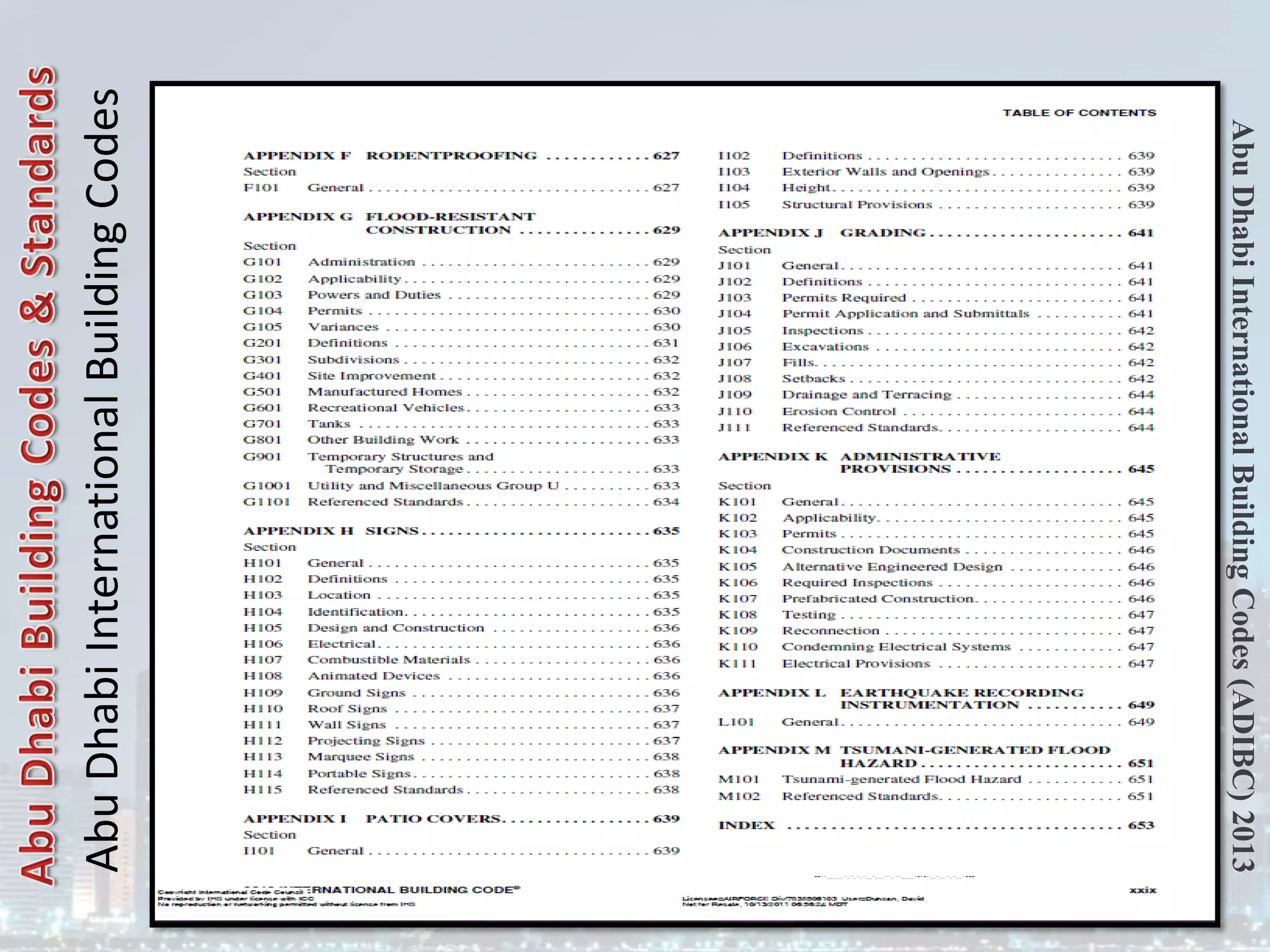
C - Chapter By Chapter Description of ADIBC
The following is a chapter-by-chapter synopsis of the scope and intent of the
provisions of the Abu Dhabi International Building Code.
Abu
Dhabi
International
Building
Codes
Abu
Dhabi
International
Building
Codes
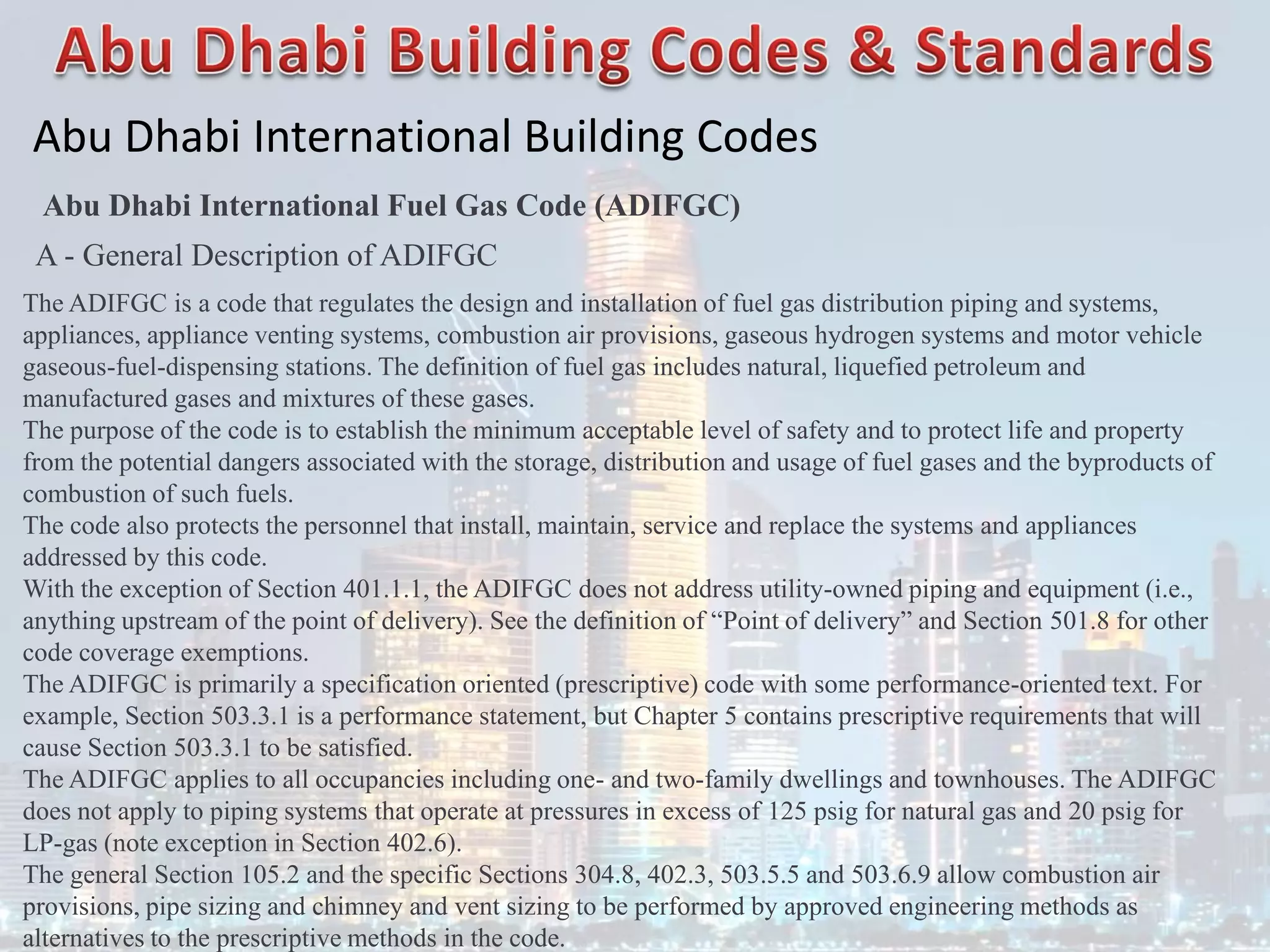
(ADIBC)
2013
Abu
Dhabi
International
Building
Codes
Abu
Dhabi
International
Building
Codes
(ADIBC)
2013
Abu
Dhabi
International
Building
Codes
Abu
Dhabi
International
Building
Codes
(ADIBC)
2013
Abu
Dhabi
International
Building
Codes
Abu
Dhabi
International
Building
Codes
(ADIBC)
2013
Abu
Dhabi
International
Building
Codes
Abu
Dhabi
International
Building
Codes
(ADIBC)
2013
Abu
Dhabi
International
Building
Codes
Abu
Dhabi
International
Building
Codes
(ADIBC)
2013
Abu
Dhabi
International
Building
Codes
Abu
Dhabi
International
Building
Codes
(ADIBC)
2013
Abu Dhabi International Building Codes
Abu Dhabi International Building Codes (ADIBC) 2013
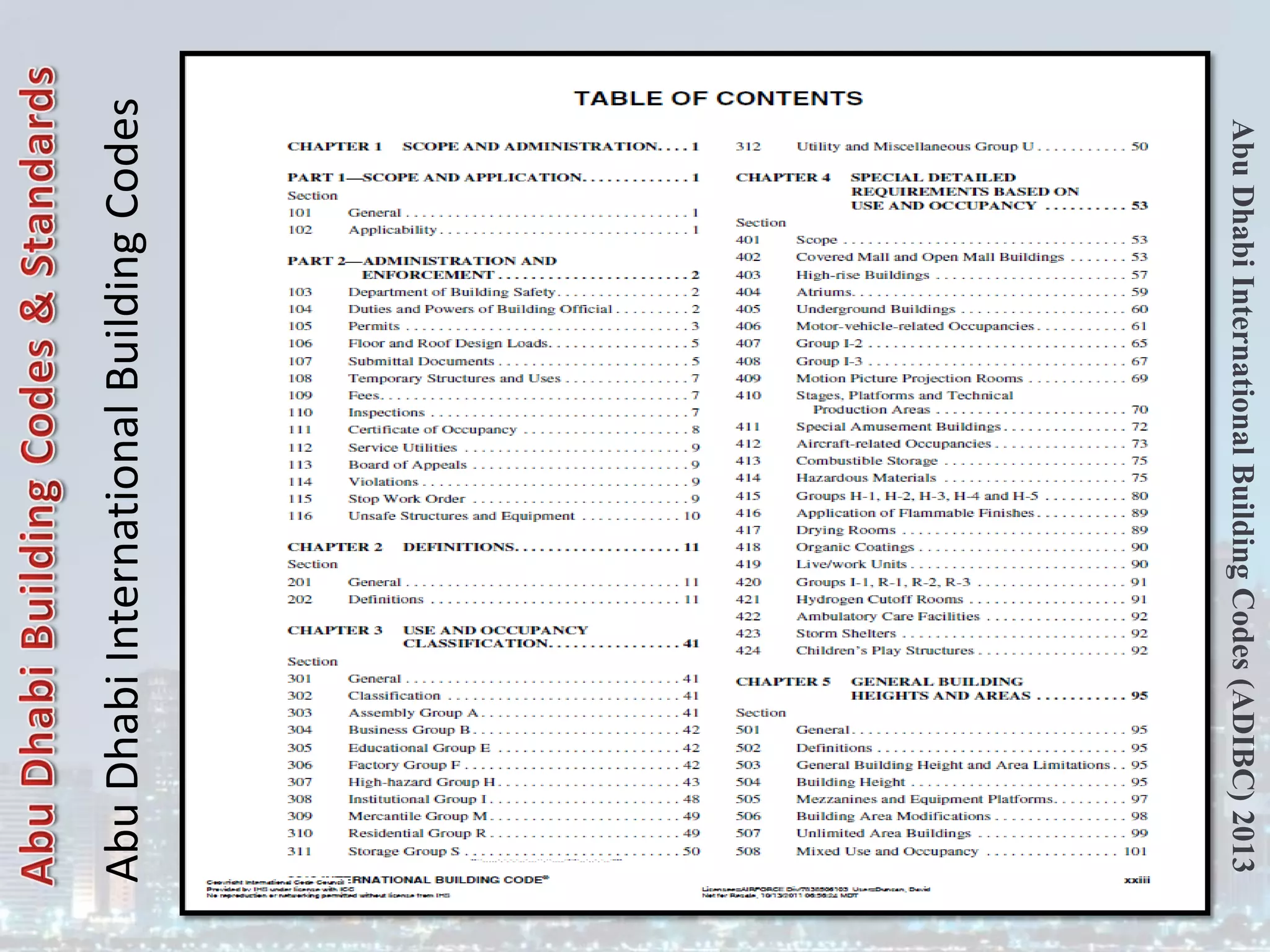
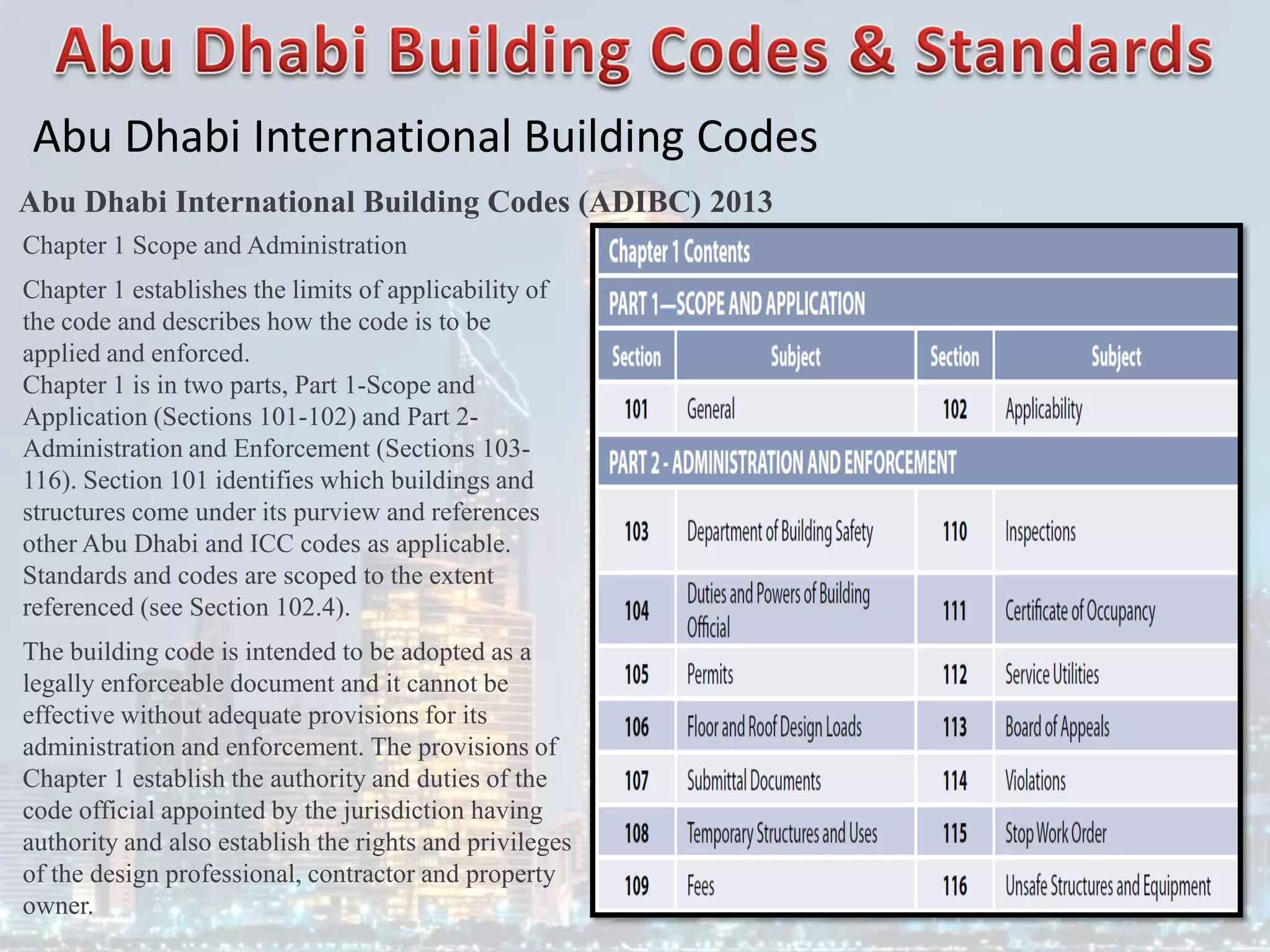
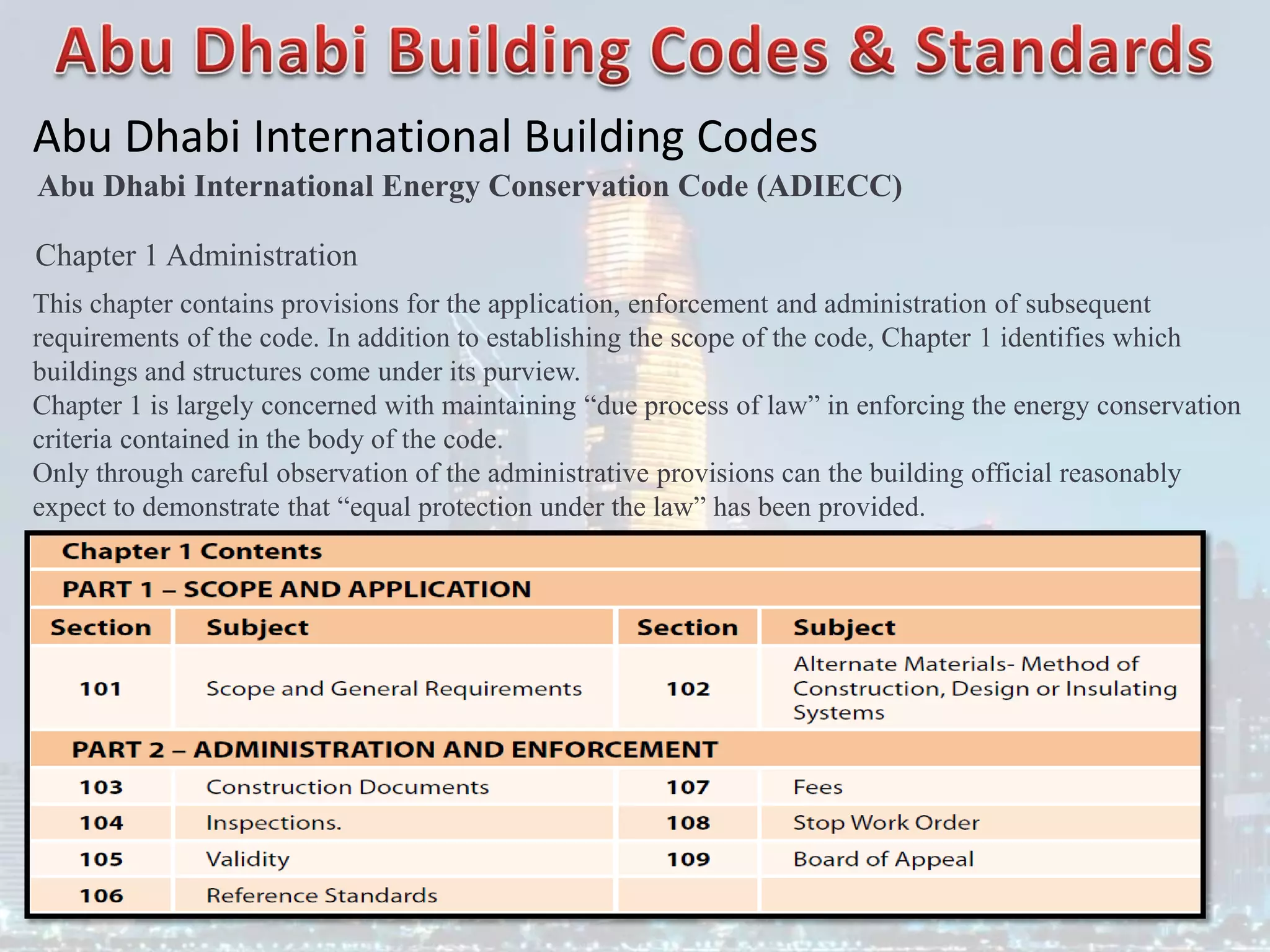
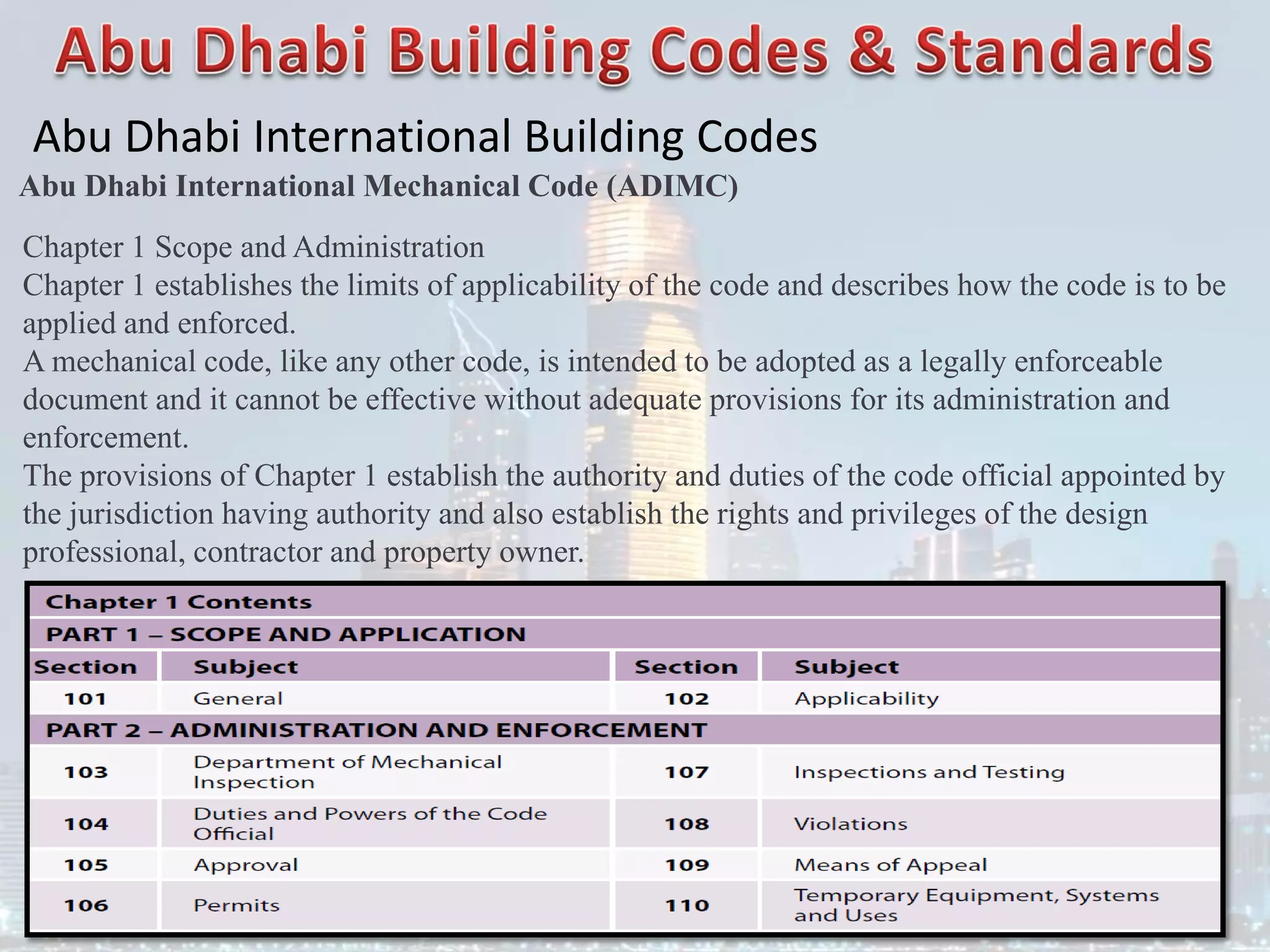
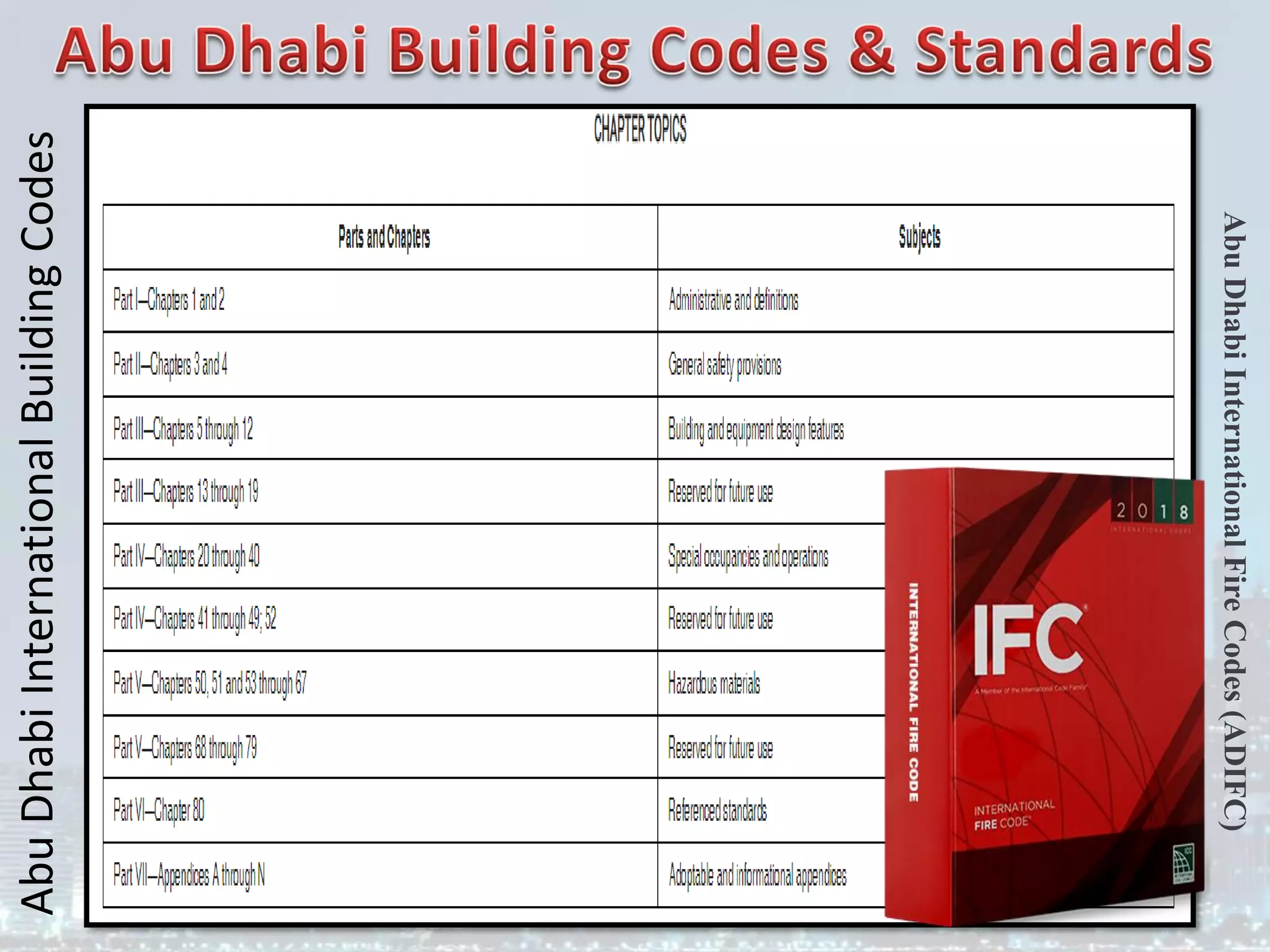
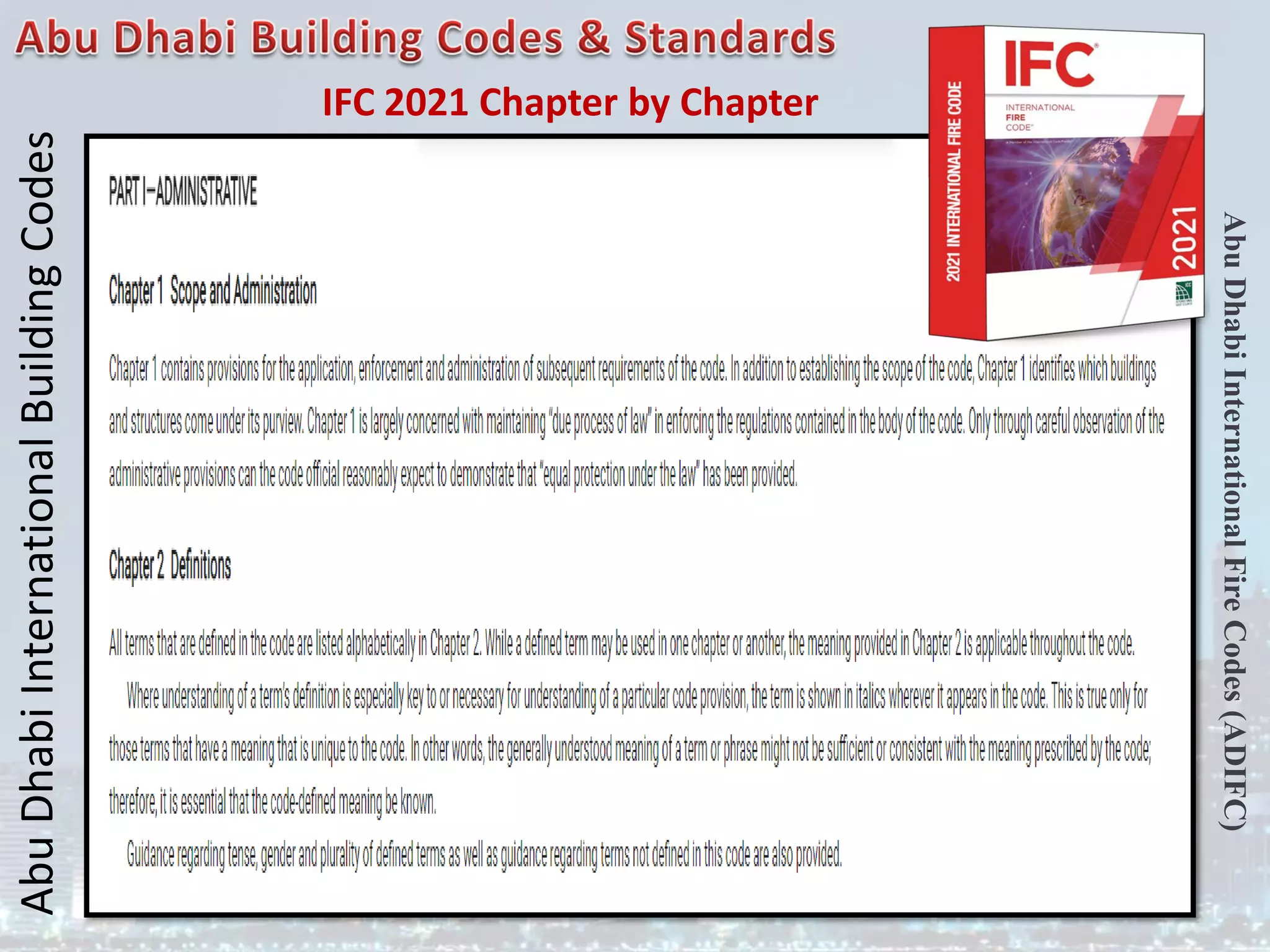
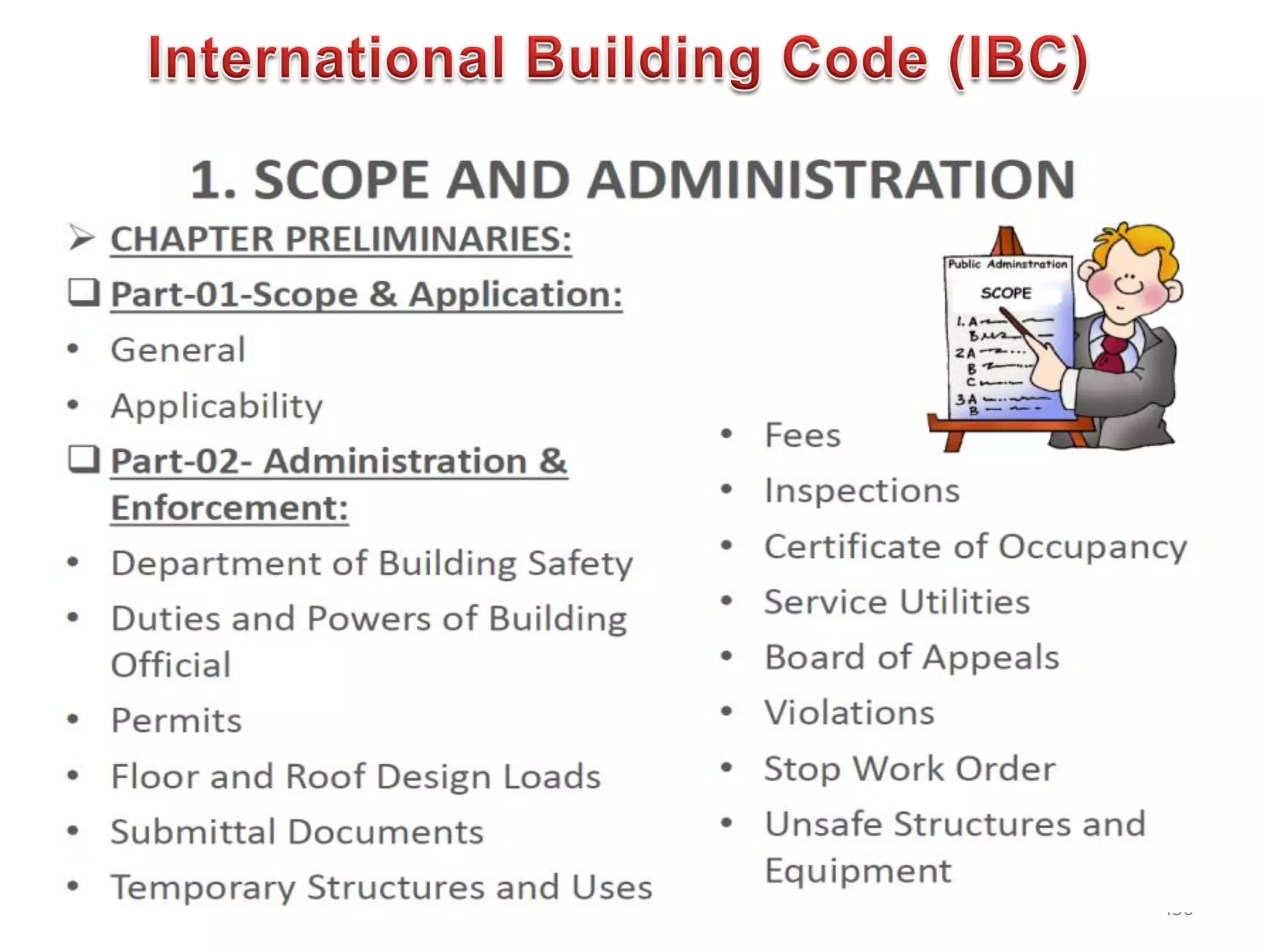
Chapter 1 Scope and Administration
Chapter 1 establishes the limits of applicability of
the code and describes how the code is to be
applied and enforced.
Chapter 1 is in two parts, Part 1-Scope and
Application (Sections 101-102) and Part 2-
Administration and Enforcement (Sections 103-
116). Section 101 identifies which buildings and
structures come under its purview and references
other Abu Dhabi and ICC codes as applicable.
Standards and codes are scoped to the extent
referenced (see Section 102.4).
The building code is intended to be adopted as a
legally enforceable document and it cannot be
effective without adequate provisions for its
administration and enforcement. The provisions of
Chapter 1 establish the authority and duties of the
code official appointed by the jurisdiction having
authority and also establish the rights and privileges
of the design professional, contractor and property
owner.
Abu Dhabi International Building Codes
Abu Dhabi International Building Codes (ADIBC) 2013
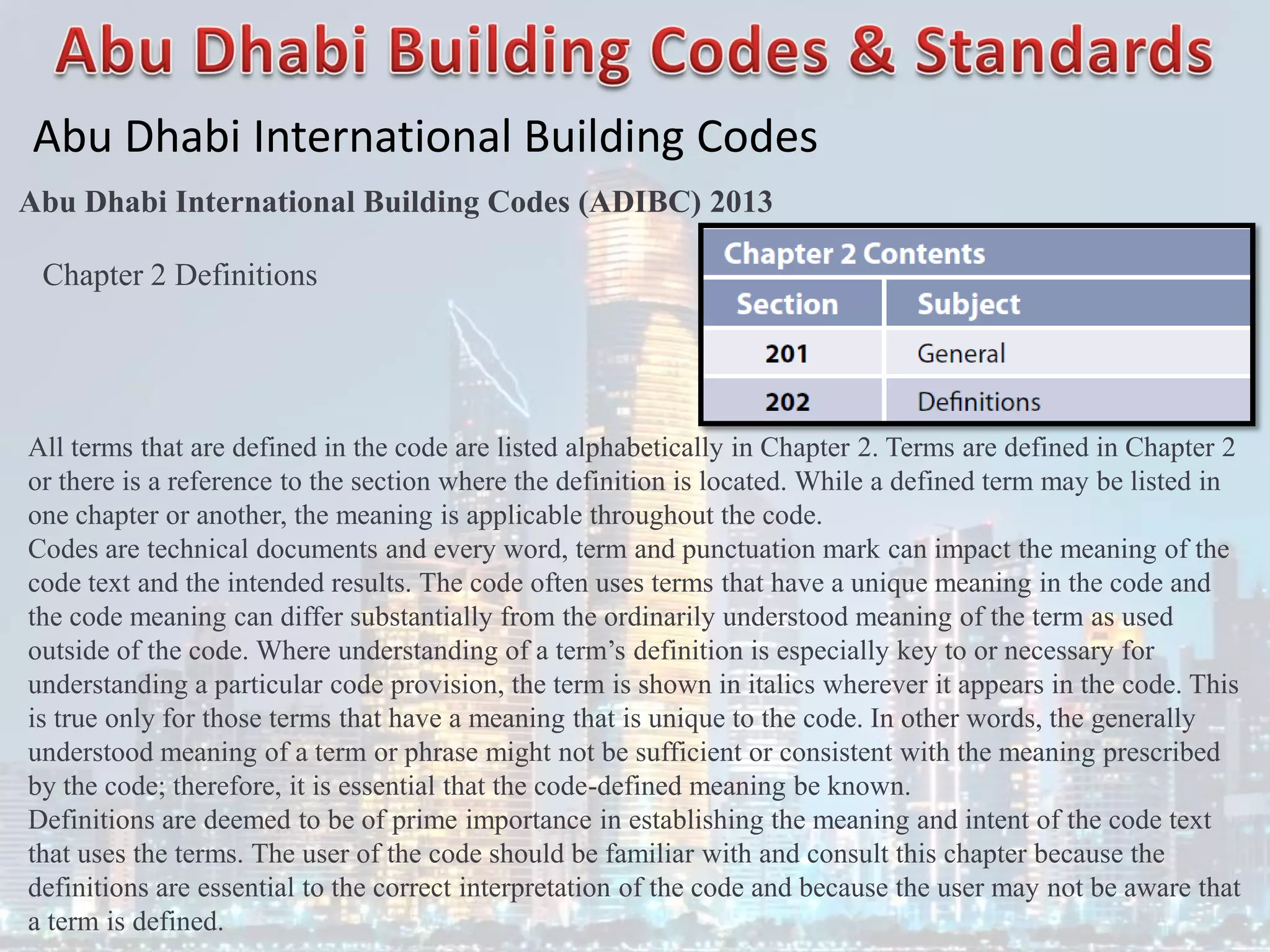
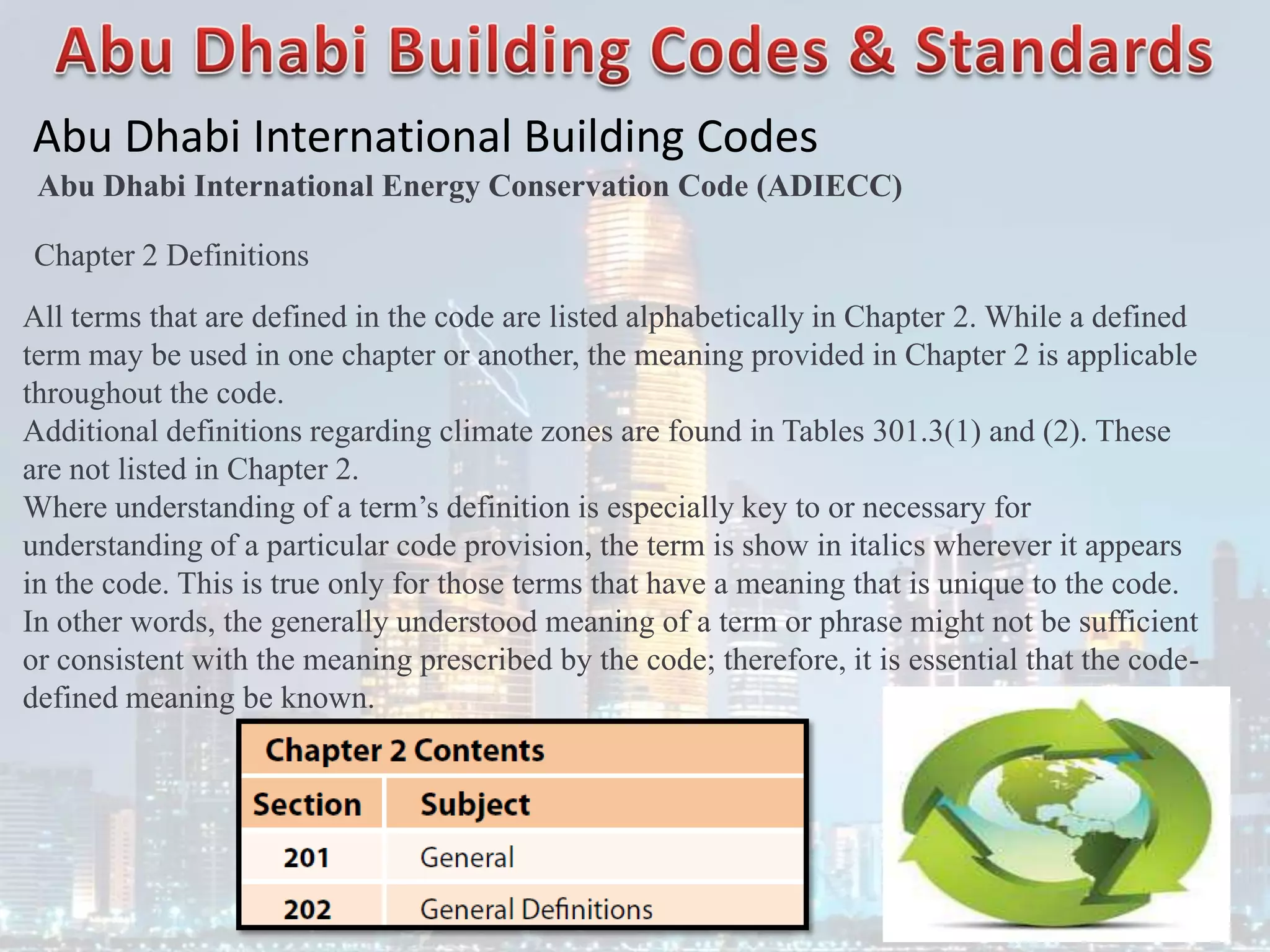
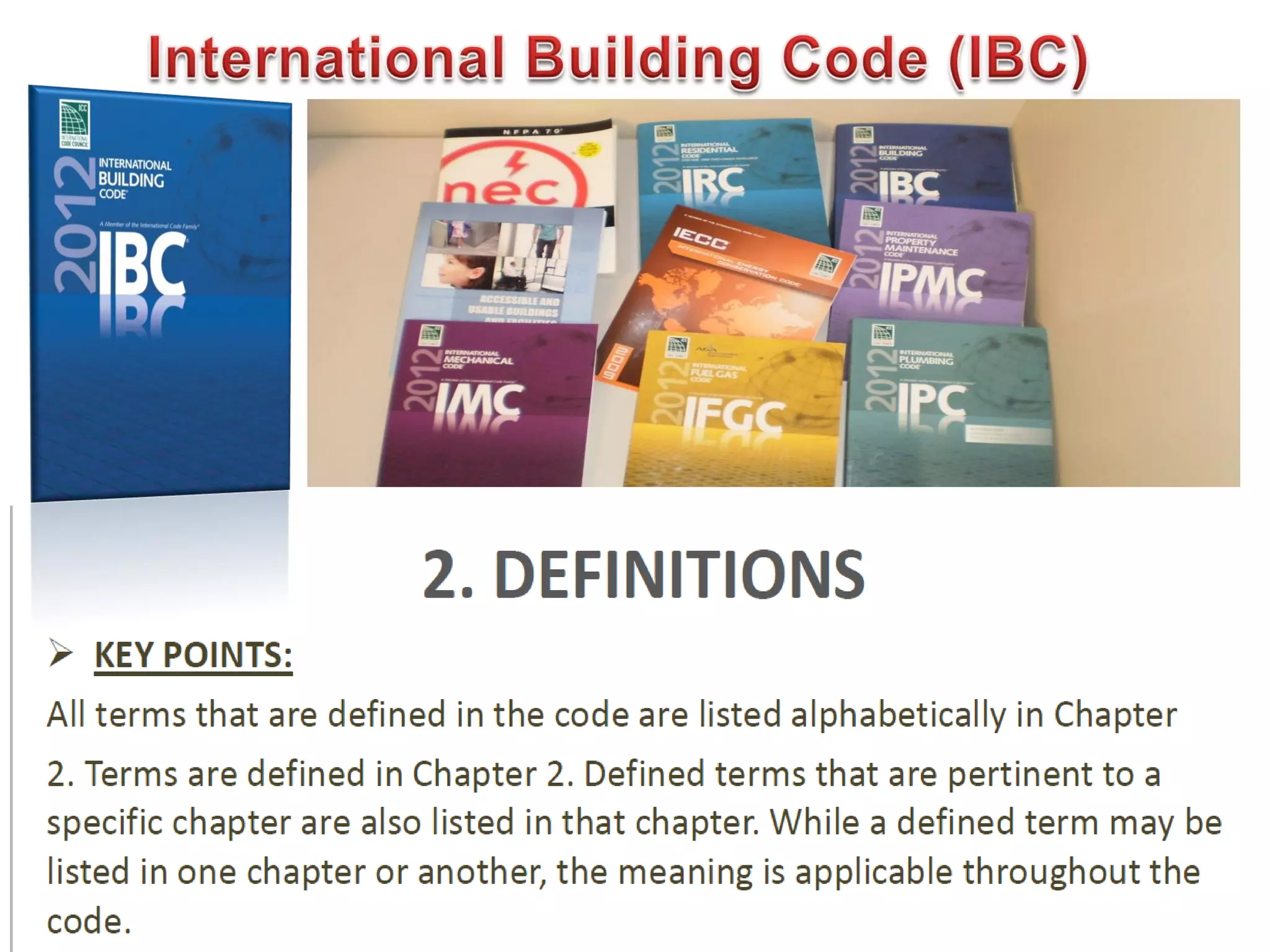
All terms that are defined in the code are listed alphabetically in Chapter 2. Terms are defined in Chapter 2
or there is a reference to the section where the definition is located. While a defined term may be listed in
one chapter or another, the meaning is applicable throughout the code.
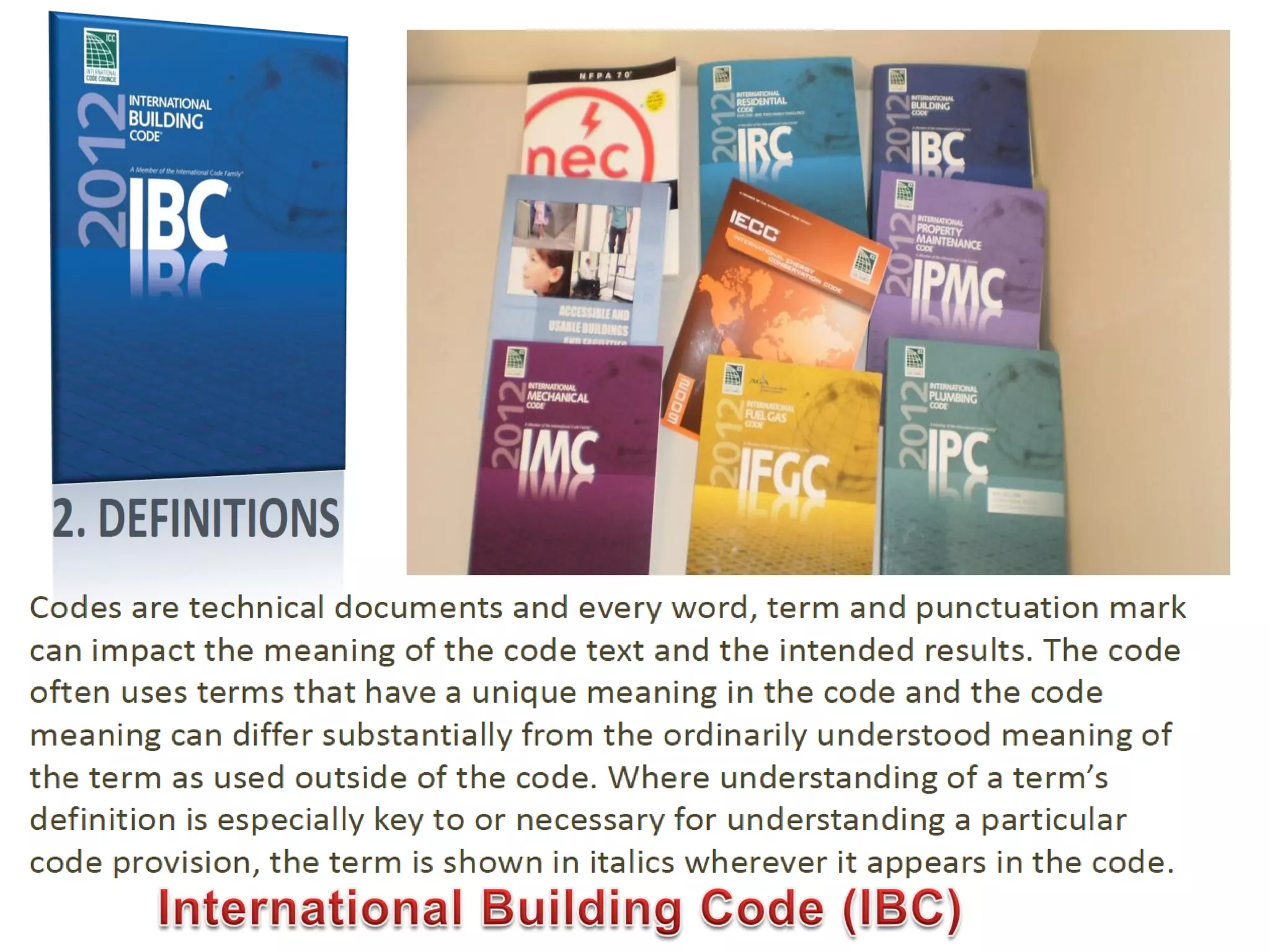
Codes are technical documents and every word, term and punctuation mark can impact the meaning of the
code text and the intended results. The code often uses terms that have a unique meaning in the code and
the code meaning can differ substantially from the ordinarily understood meaning of the term as used
outside of the code. Where understanding of a term’s definition is especially key to or necessary for
understanding a particular code provision, the term is shown in italics wherever it appears in the code. This
is true only for those terms that have a meaning that is unique to the code. In other words, the generally
understood meaning of a term or phrase might not be sufficient or consistent with the meaning prescribed
by the code; therefore, it is essential that the code-defined meaning be known.
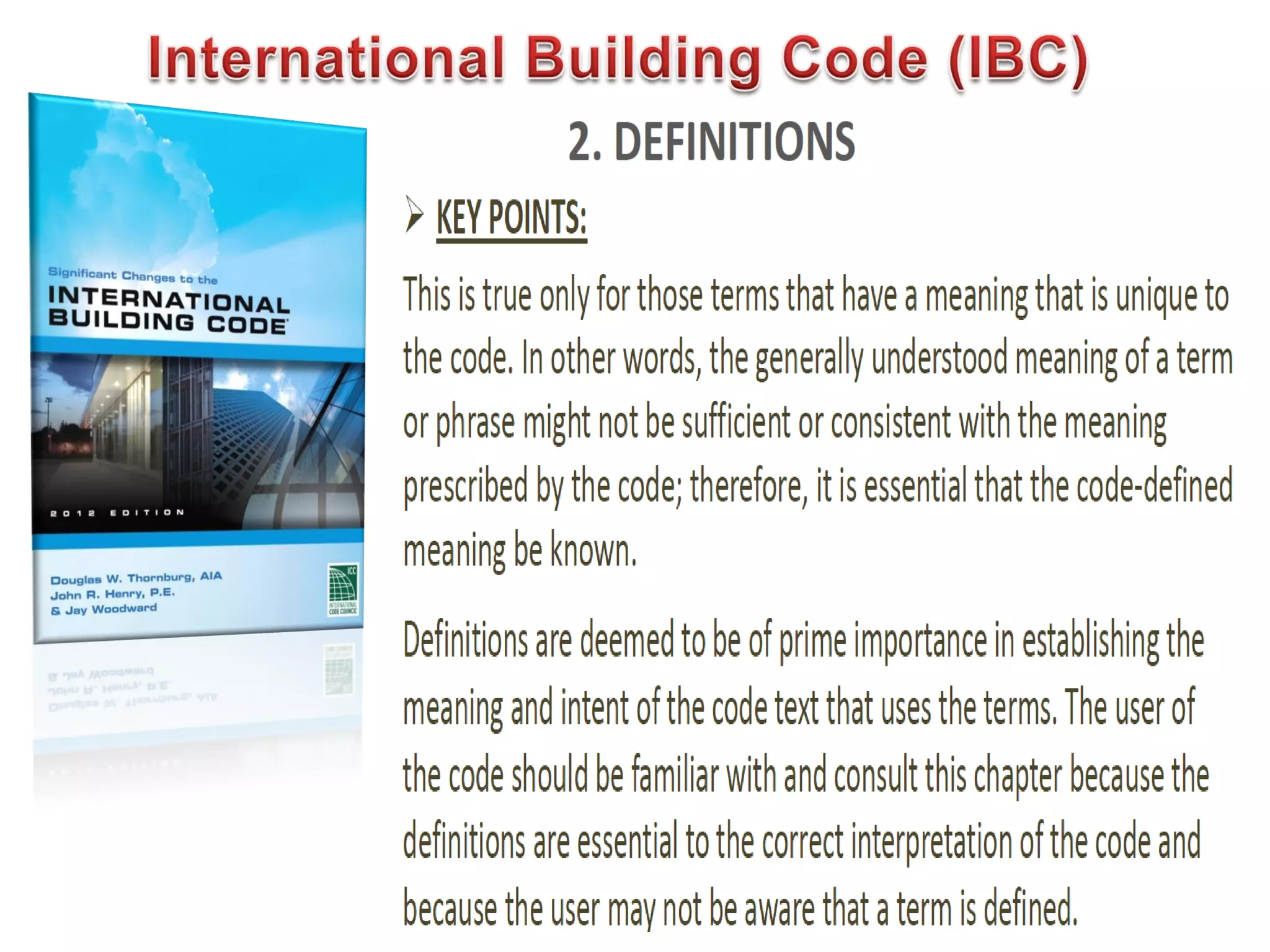
Definitions are deemed to be of prime importance in establishing the meaning and intent of the code text
that uses the terms. The user of the code should be familiar with and consult this chapter because the
definitions are essential to the correct interpretation of the code and because the user may not be aware that
a term is defined.
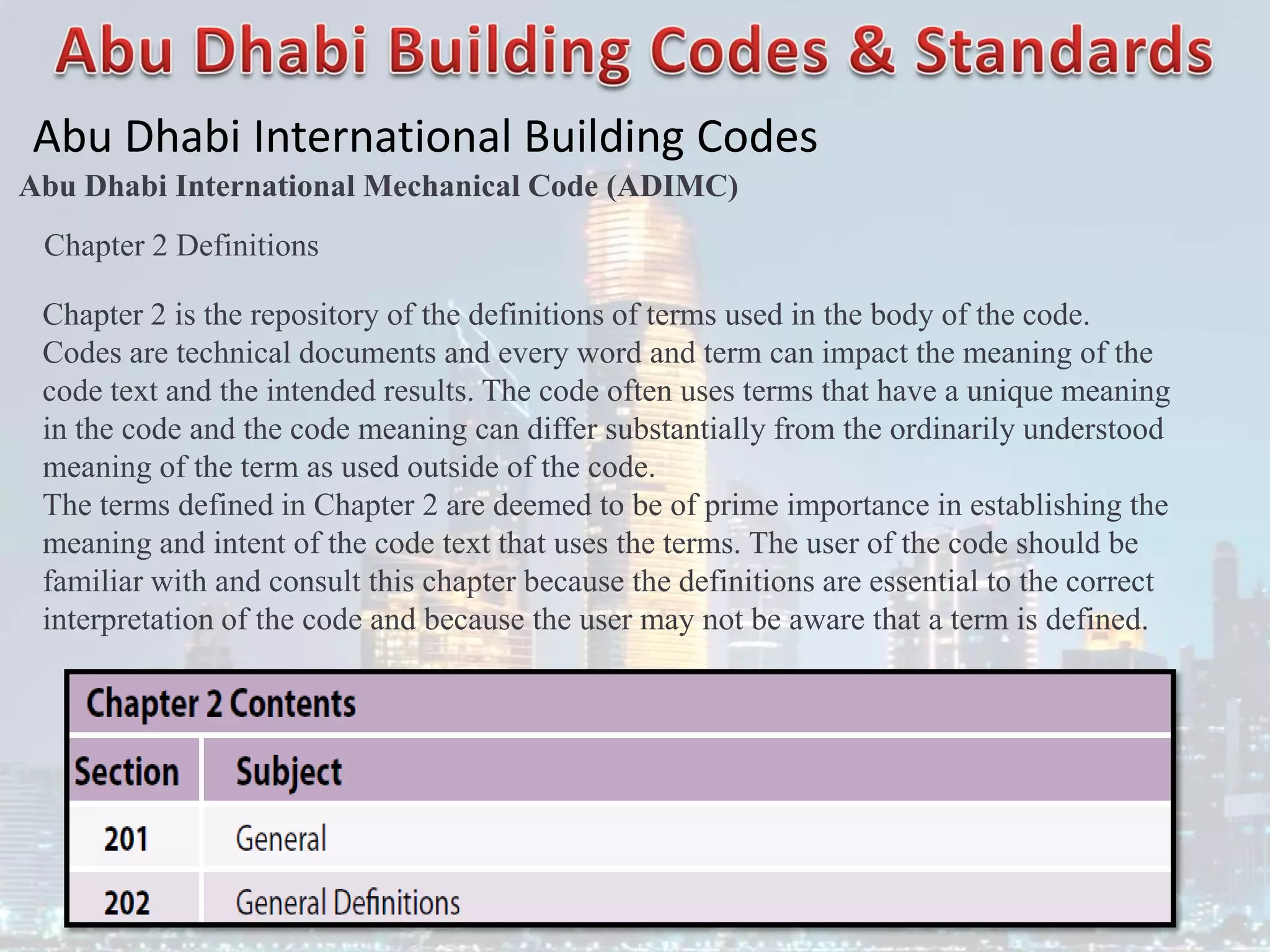
Chapter 2 Definitions
Abu Dhabi International Building Codes
Abu Dhabi International Building Codes (ADIBC) 2013
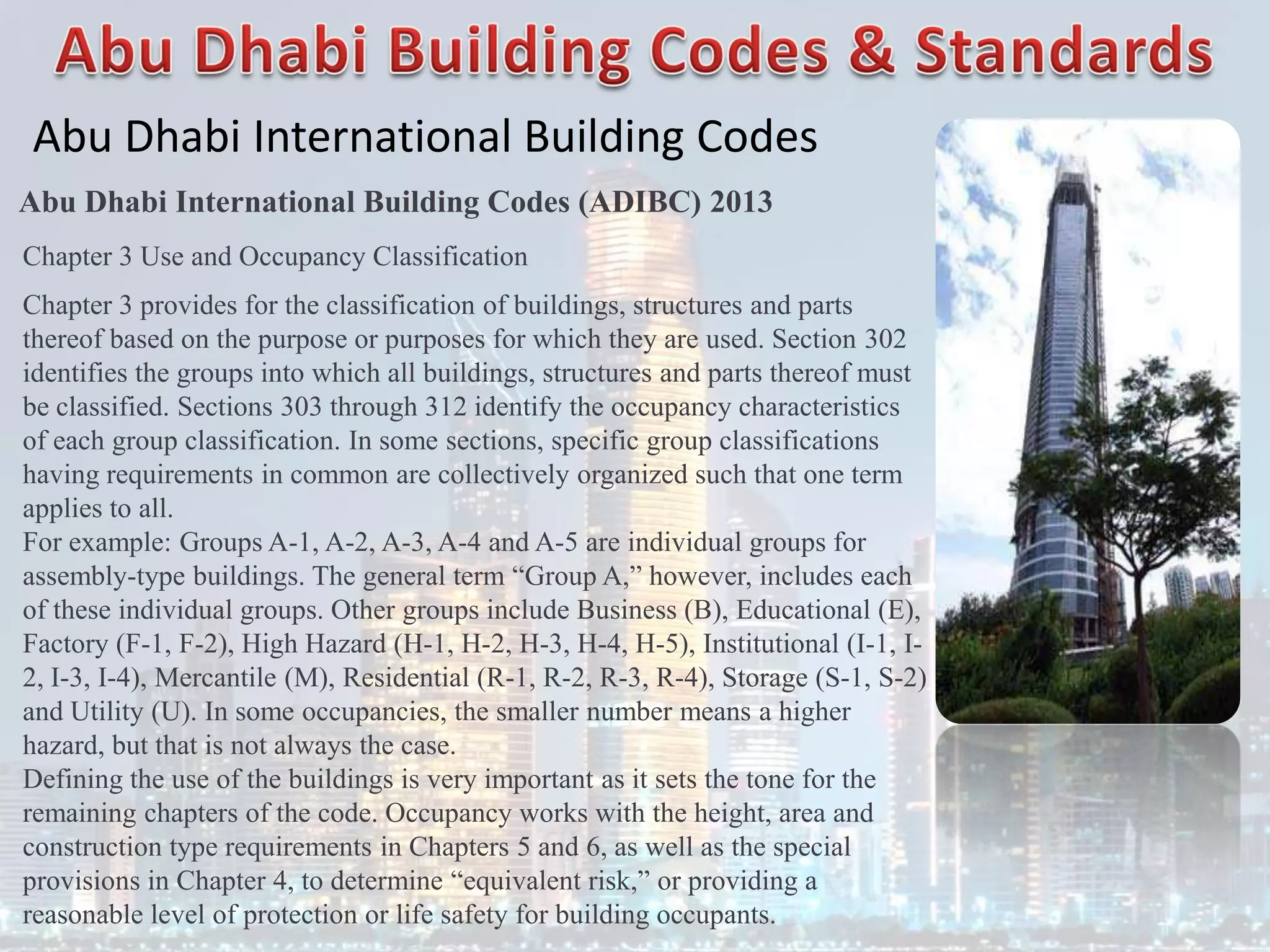
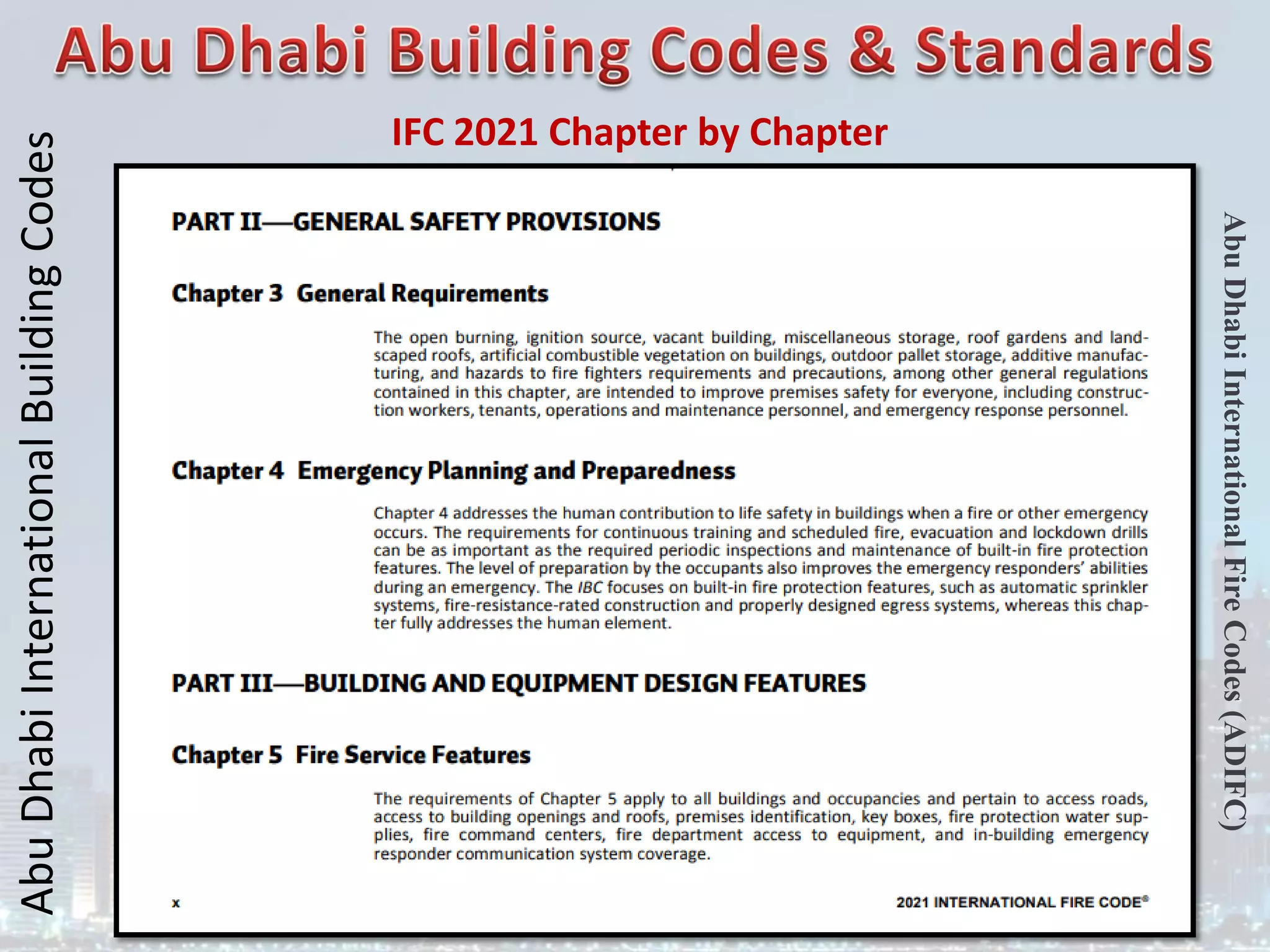
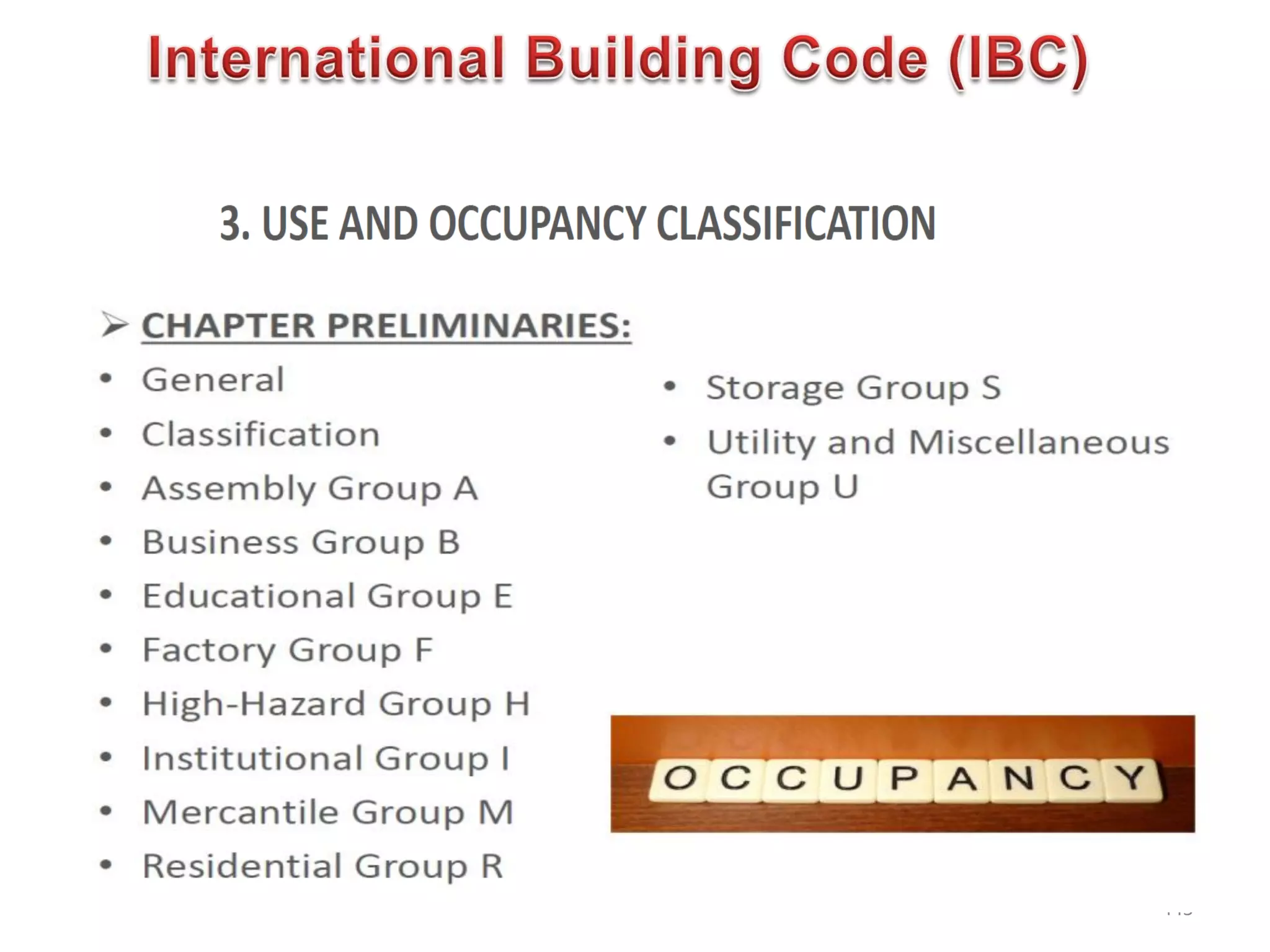
Chapter 3 Use and Occupancy Classification
Chapter 3 provides for the classification of buildings, structures and parts
thereof based on the purpose or purposes for which they are used. Section 302
identifies the groups into which all buildings, structures and parts thereof must
be classified. Sections 303 through 312 identify the occupancy characteristics
of each group classification. In some sections, specific group classifications
having requirements in common are collectively organized such that one term
applies to all.
For example: Groups A-1, A-2, A-3, A-4 and A-5 are individual groups for
assembly-type buildings. The general term “Group A,” however, includes each
of these individual groups. Other groups include Business (B), Educational (E),
Factory (F-1, F-2), High Hazard (H-1, H-2, H-3, H-4, H-5), Institutional (I-1, I-
2, I-3, I-4), Mercantile (M), Residential (R-1, R-2, R-3, R-4), Storage (S-1, S-2)
and Utility (U). In some occupancies, the smaller number means a higher
hazard, but that is not always the case.
Defining the use of the buildings is very important as it sets the tone for the
remaining chapters of the code. Occupancy works with the height, area and
construction type requirements in Chapters 5 and 6, as well as the special
provisions in Chapter 4, to determine “equivalent risk,” or providing a
reasonable level of protection or life safety for building occupants.
Abu Dhabi International Building Codes
Abu Dhabi International Building Codes (ADIBC) 2013
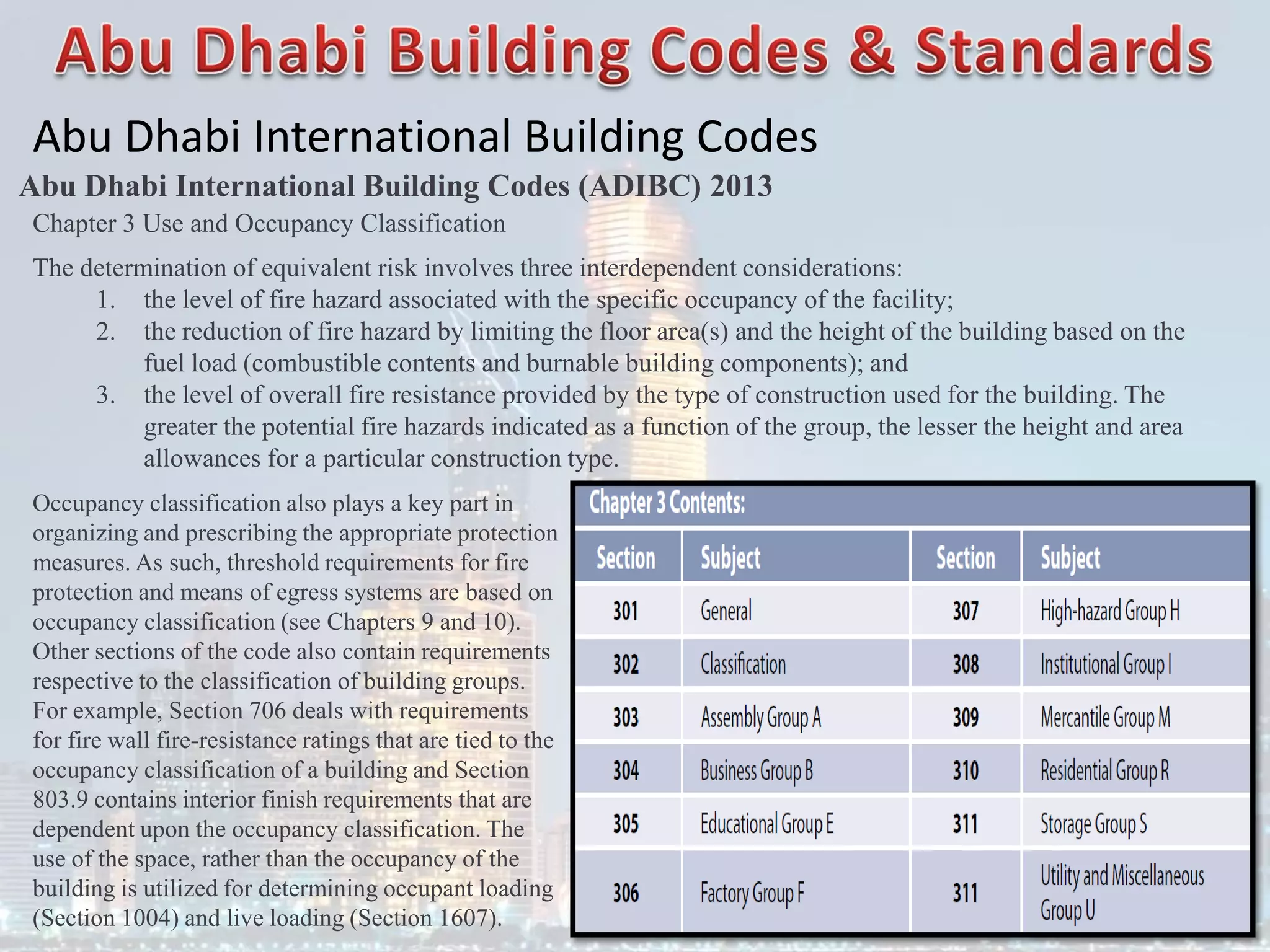
Chapter 3 Use and Occupancy Classification
The determination of equivalent risk involves three interdependent considerations:
1. the level of fire hazard associated with the specific occupancy of the facility;
2. the reduction of fire hazard by limiting the floor area(s) and the height of the building based on the
fuel load (combustible contents and burnable building components); and
3. the level of overall fire resistance provided by the type of construction used for the building. The
greater the potential fire hazards indicated as a function of the group, the lesser the height and area
allowances for a particular construction type.
Occupancy classification also plays a key part in
organizing and prescribing the appropriate protection
measures. As such, threshold requirements for fire
protection and means of egress systems are based on
occupancy classification (see Chapters 9 and 10).
Other sections of the code also contain requirements
respective to the classification of building groups.
For example, Section 706 deals with requirements
for fire wall fire-resistance ratings that are tied to the
occupancy classification of a building and Section
803.9 contains interior finish requirements that are
dependent upon the occupancy classification. The
use of the space, rather than the occupancy of the
building is utilized for determining occupant loading
(Section 1004) and live loading (Section 1607).
Abu Dhabi International Building Codes
Abu Dhabi International Building Codes (ADIBC) 2013
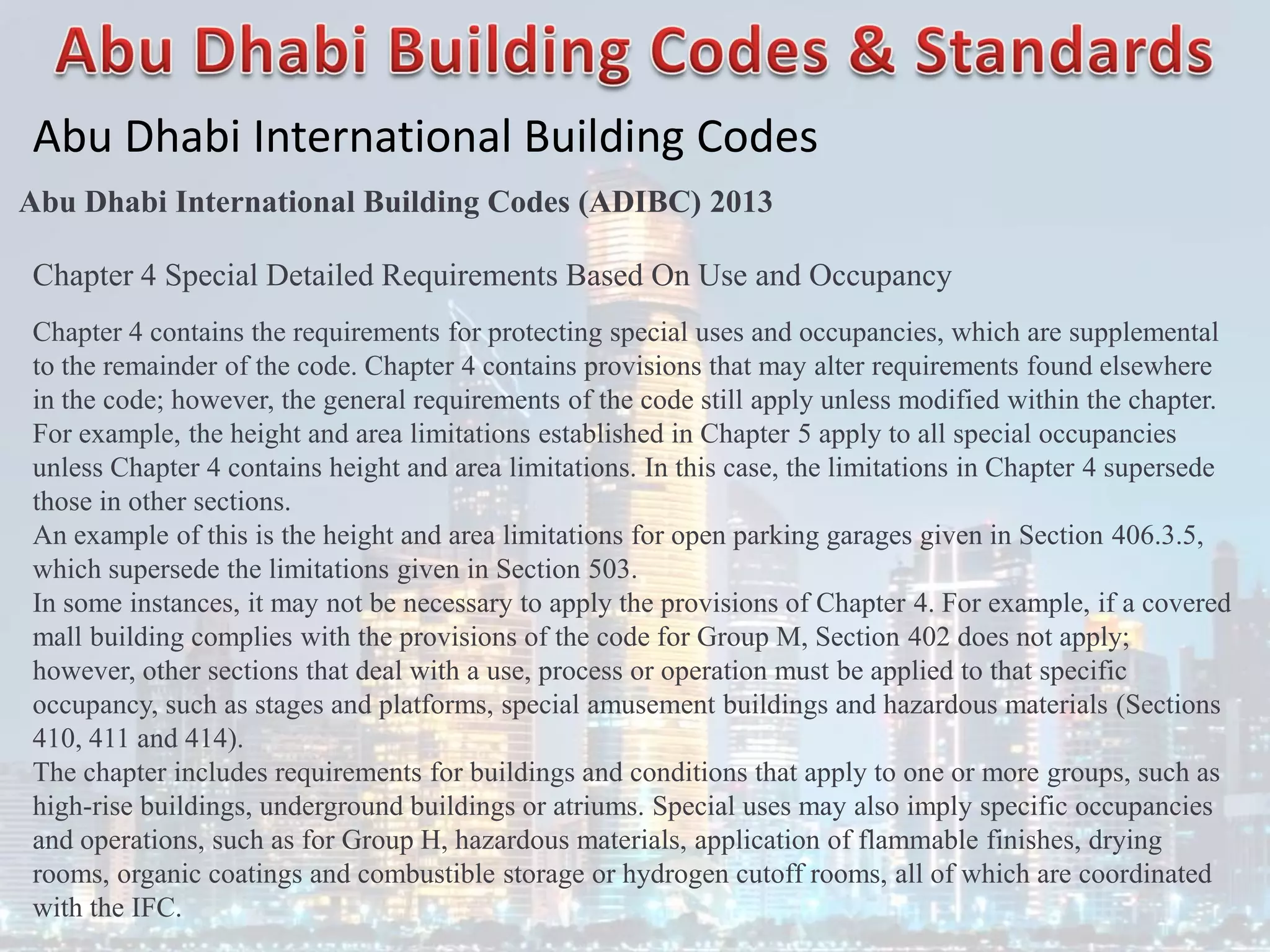
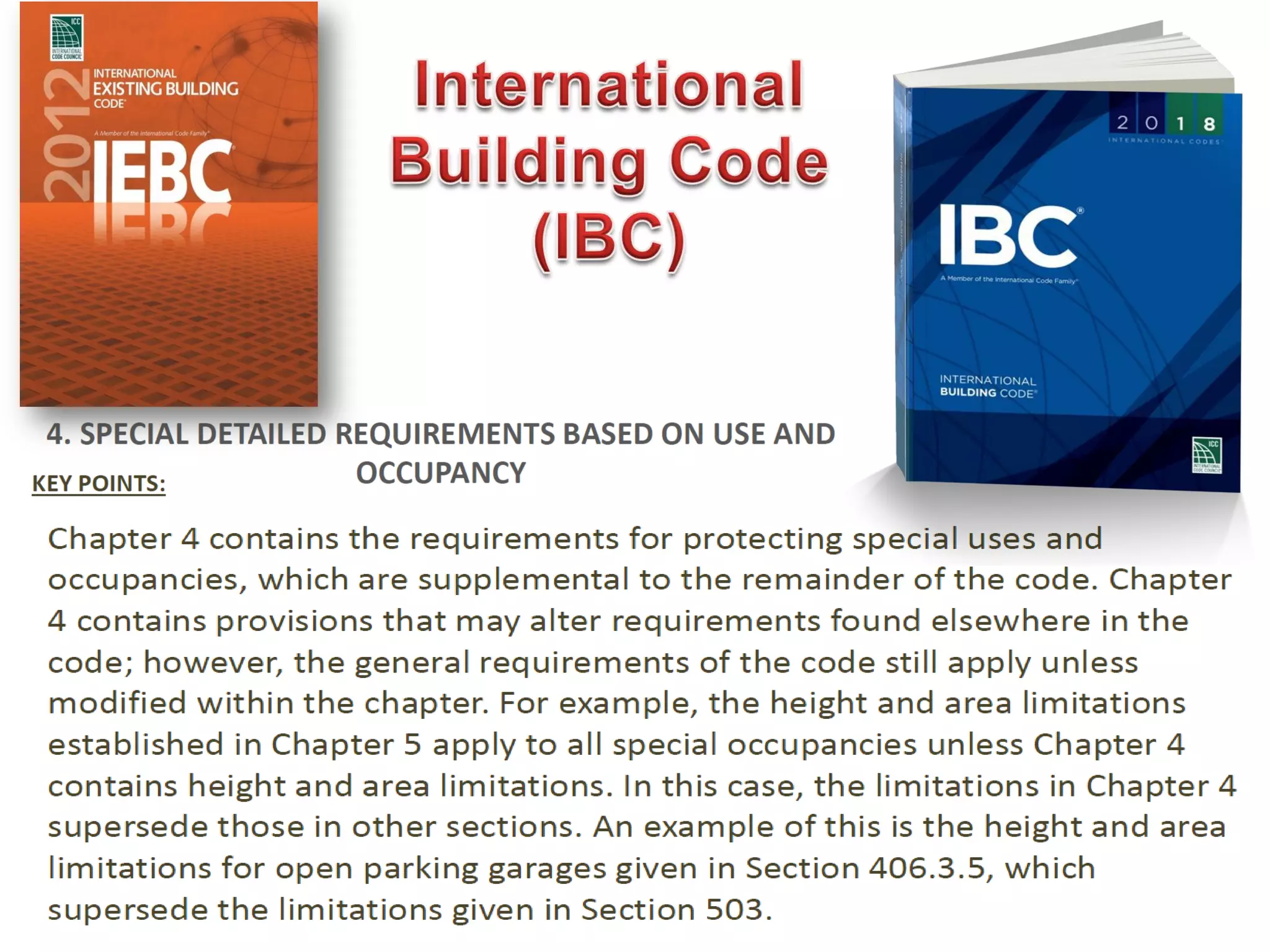
Chapter 4 Special Detailed Requirements Based On Use and Occupancy
Chapter 4 contains the requirements for protecting special uses and occupancies, which are supplemental
to the remainder of the code. Chapter 4 contains provisions that may alter requirements found elsewhere
in the code; however, the general requirements of the code still apply unless modified within the chapter.
For example, the height and area limitations established in Chapter 5 apply to all special occupancies
unless Chapter 4 contains height and area limitations. In this case, the limitations in Chapter 4 supersede
those in other sections.
An example of this is the height and area limitations for open parking garages given in Section 406.3.5,
which supersede the limitations given in Section 503.
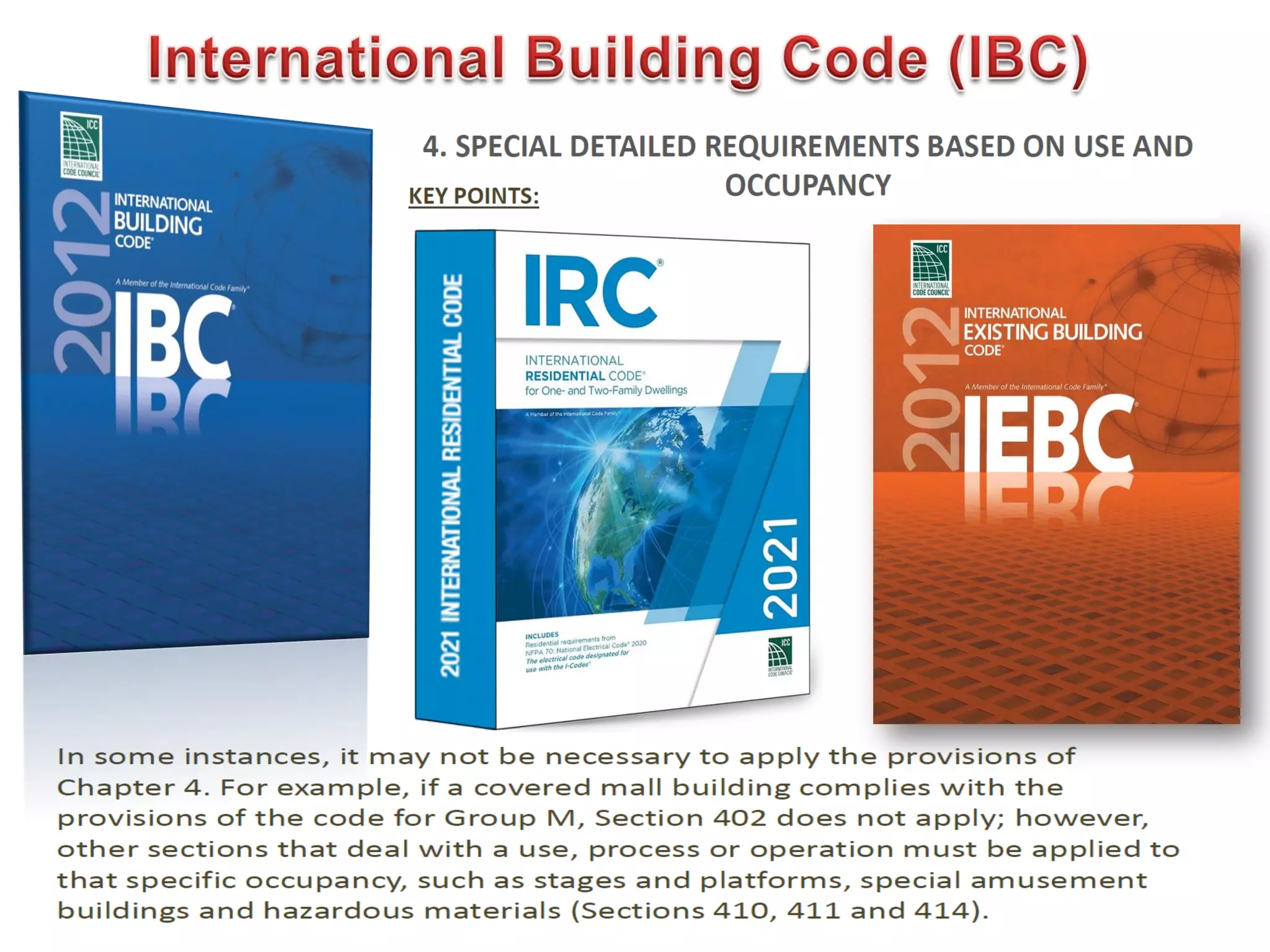
In some instances, it may not be necessary to apply the provisions of Chapter 4. For example, if a covered
mall building complies with the provisions of the code for Group M, Section 402 does not apply;
however, other sections that deal with a use, process or operation must be applied to that specific
occupancy, such as stages and platforms, special amusement buildings and hazardous materials (Sections
410, 411 and 414).
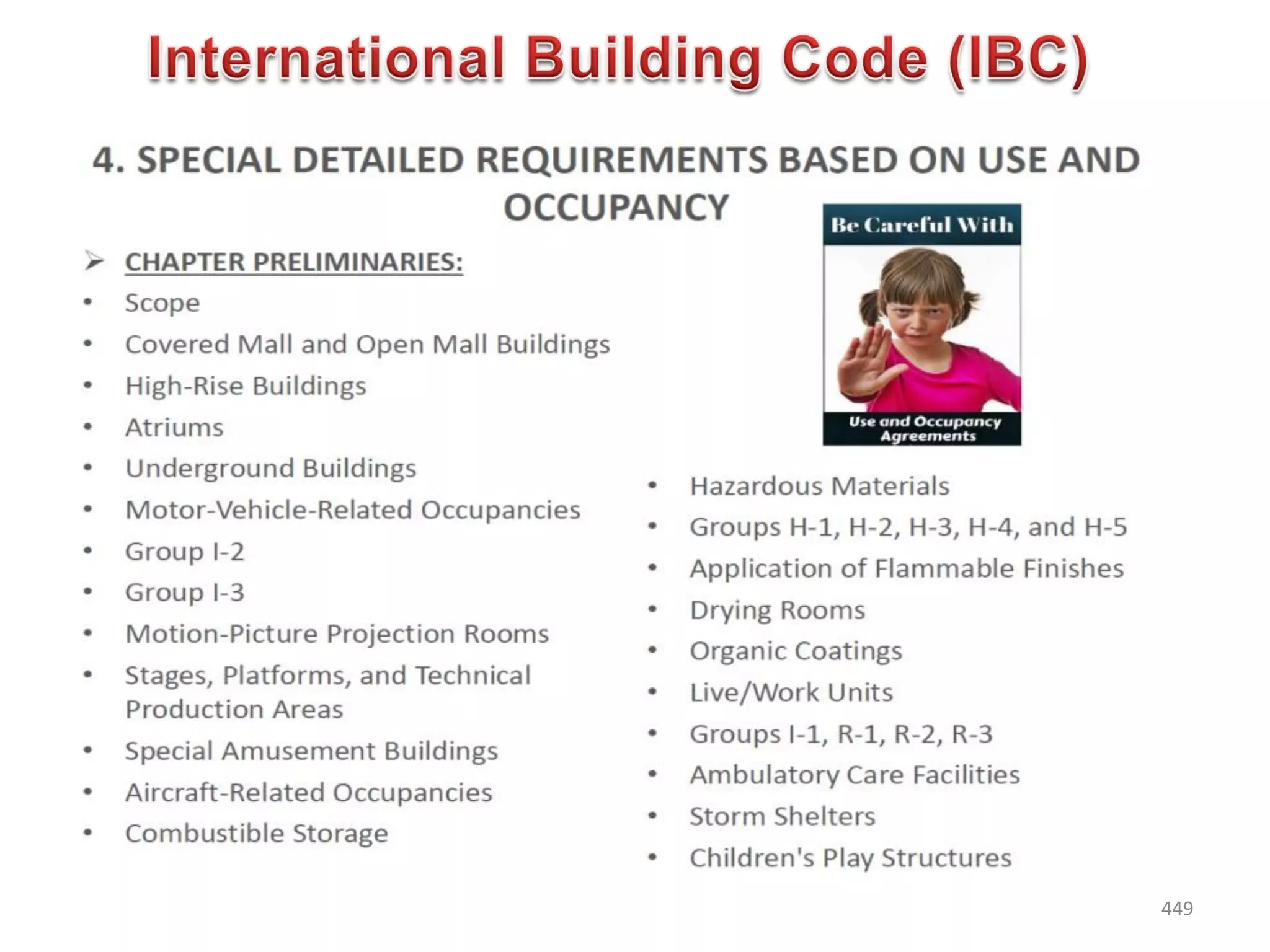
The chapter includes requirements for buildings and conditions that apply to one or more groups, such as
high-rise buildings, underground buildings or atriums. Special uses may also imply specific occupancies
and operations, such as for Group H, hazardous materials, application of flammable finishes, drying
rooms, organic coatings and combustible storage or hydrogen cutoff rooms, all of which are coordinated
with the IFC.
Abu Dhabi International Building Codes
Abu Dhabi International Building Codes (ADIBC) 2013
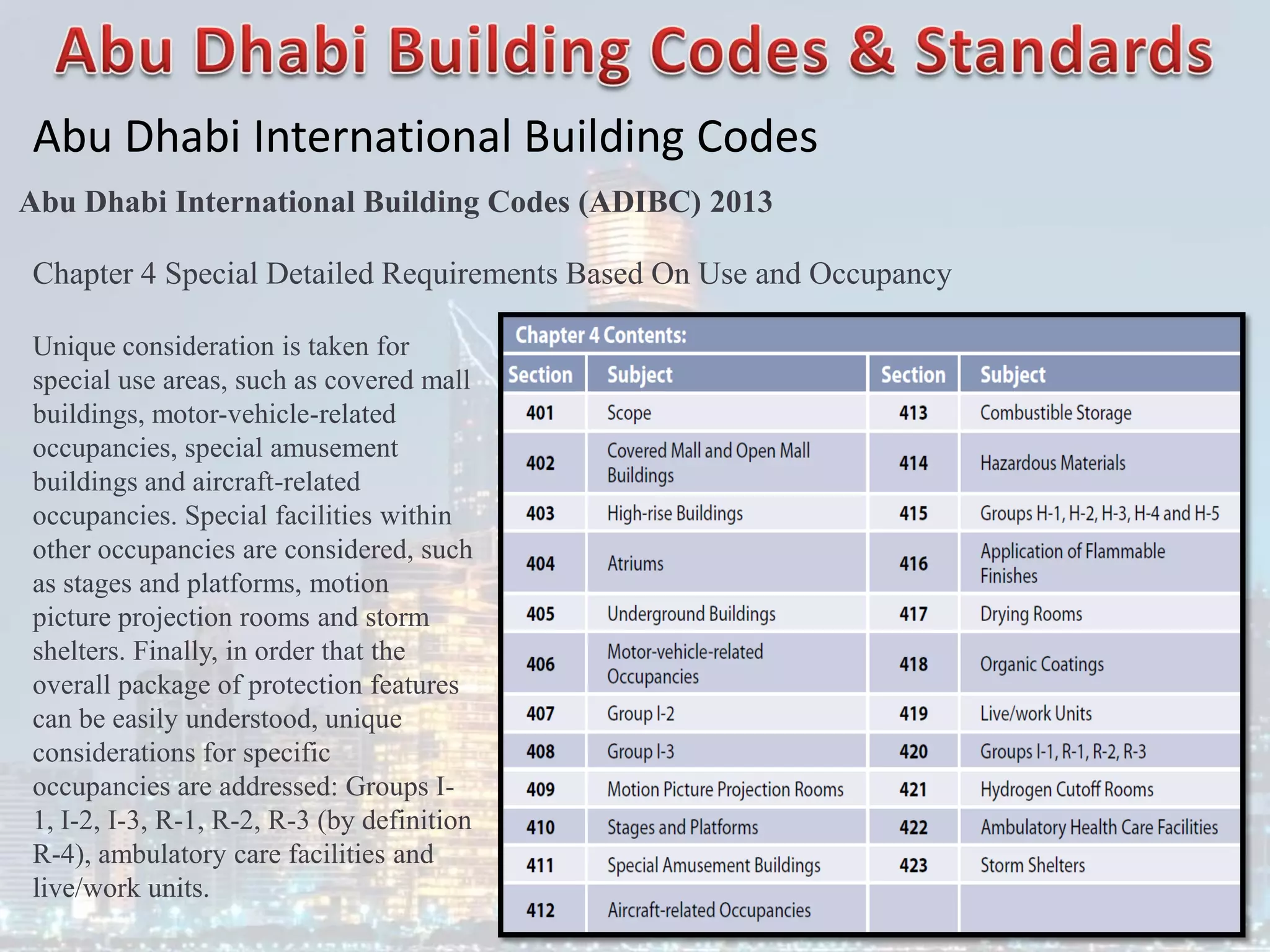
Chapter 4 Special Detailed Requirements Based On Use and Occupancy
Unique consideration is taken for
special use areas, such as covered mall
buildings, motor-vehicle-related
occupancies, special amusement
buildings and aircraft-related
occupancies. Special facilities within
other occupancies are considered, such
as stages and platforms, motion
picture projection rooms and storm
shelters. Finally, in order that the
overall package of protection features
can be easily understood, unique
considerations for specific
occupancies are addressed: Groups I-
1, I-2, I-3, R-1, R-2, R-3 (by definition
R-4), ambulatory care facilities and
live/work units.
Abu Dhabi International Building Codes
Abu Dhabi International Building Codes (ADIBC) 2013
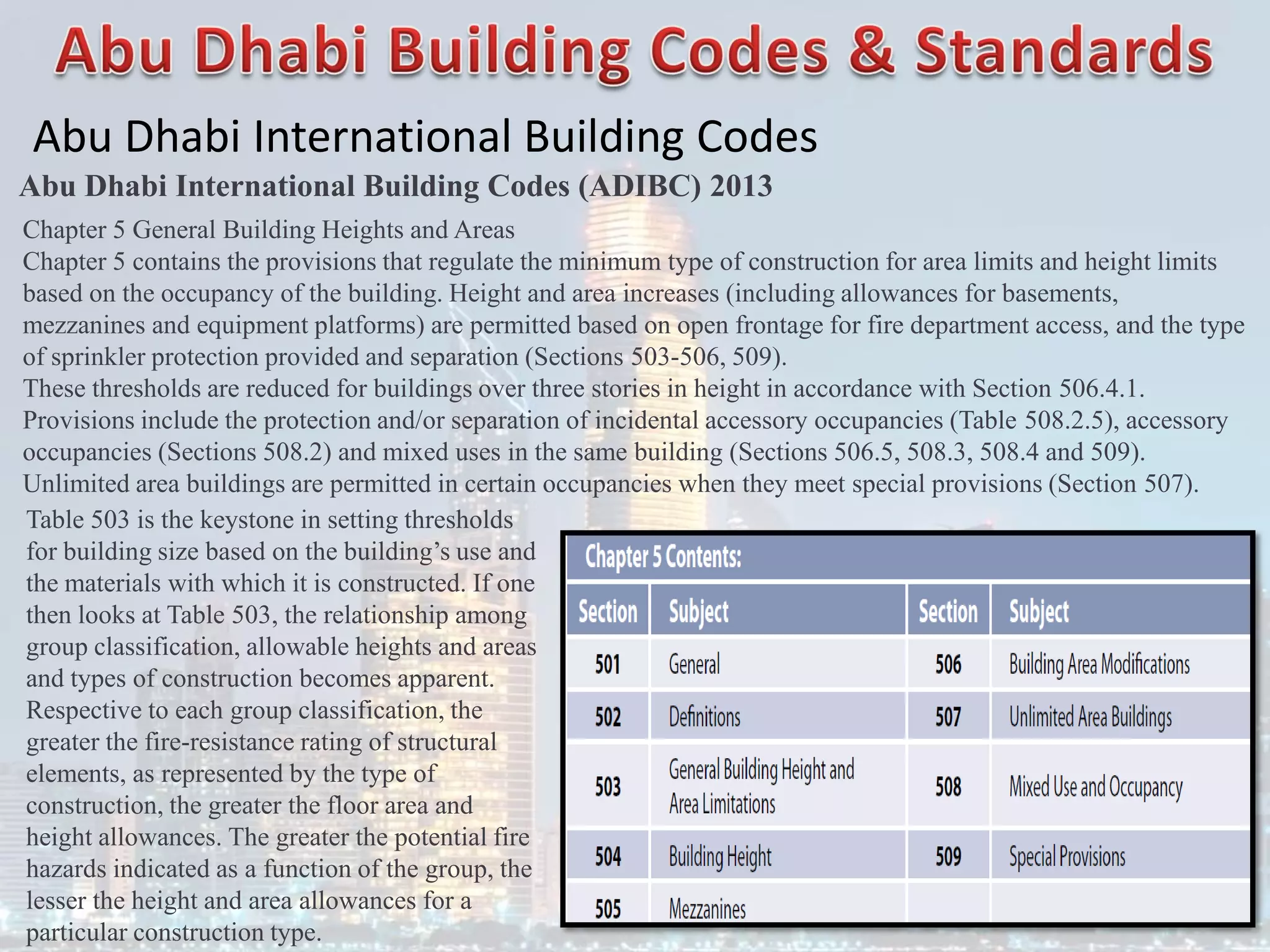
Chapter 5 General Building Heights and Areas
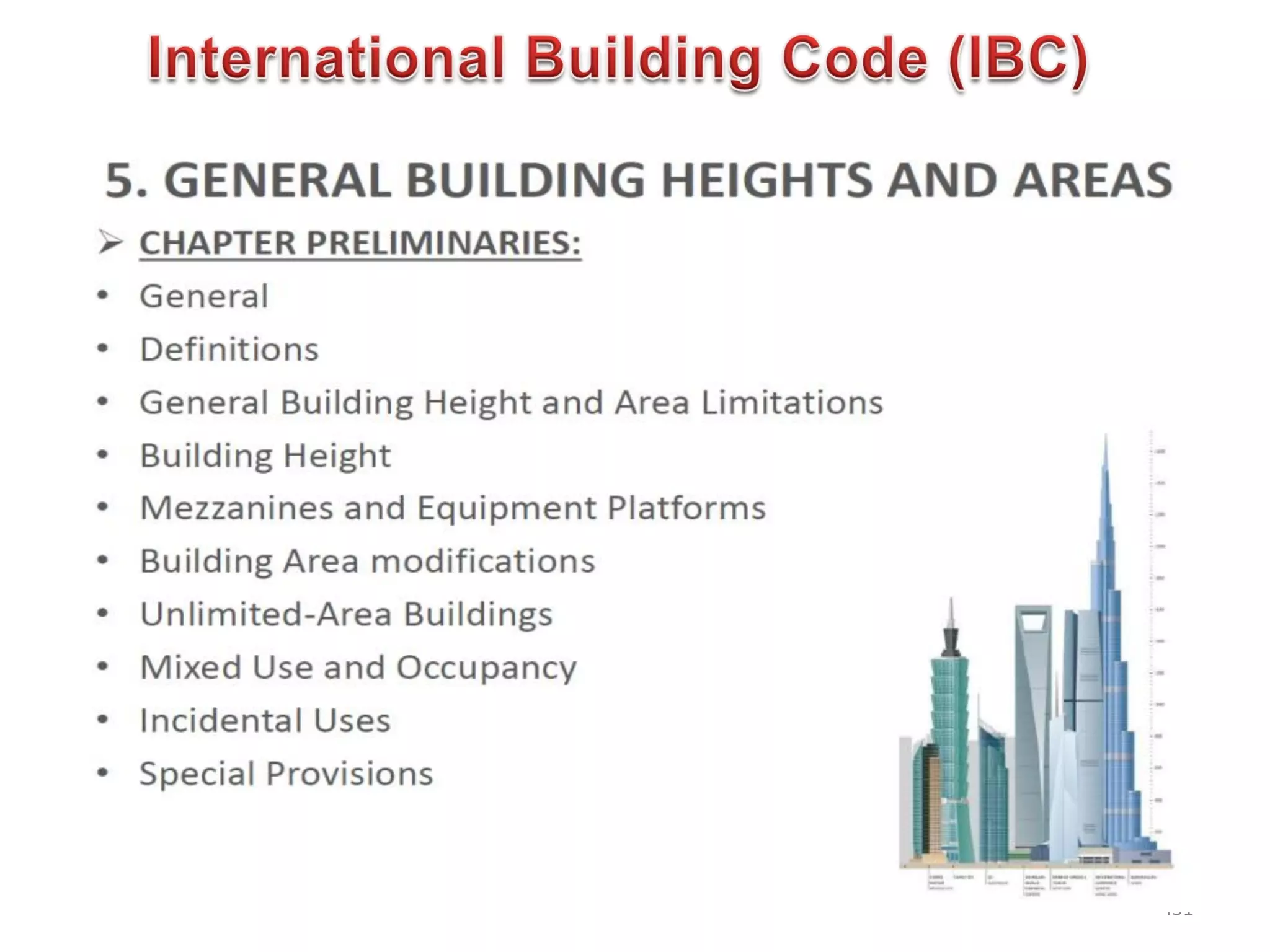
Chapter 5 contains the provisions that regulate the minimum type of construction for area limits and height limits
based on the occupancy of the building. Height and area increases (including allowances for basements,
mezzanines and equipment platforms) are permitted based on open frontage for fire department access, and the type
of sprinkler protection provided and separation (Sections 503-506, 509).
These thresholds are reduced for buildings over three stories in height in accordance with Section 506.4.1.
Provisions include the protection and/or separation of incidental accessory occupancies (Table 508.2.5), accessory
occupancies (Sections 508.2) and mixed uses in the same building (Sections 506.5, 508.3, 508.4 and 509).
Unlimited area buildings are permitted in certain occupancies when they meet special provisions (Section 507).
Table 503 is the keystone in setting thresholds
for building size based on the building’s use and
the materials with which it is constructed. If one
then looks at Table 503, the relationship among
group classification, allowable heights and areas
and types of construction becomes apparent.
Respective to each group classification, the
greater the fire-resistance rating of structural
elements, as represented by the type of
construction, the greater the floor area and
height allowances. The greater the potential fire
hazards indicated as a function of the group, the
lesser the height and area allowances for a
particular construction type.
Abu Dhabi International Building Codes
Abu Dhabi International Building Codes (ADIBC) 2013
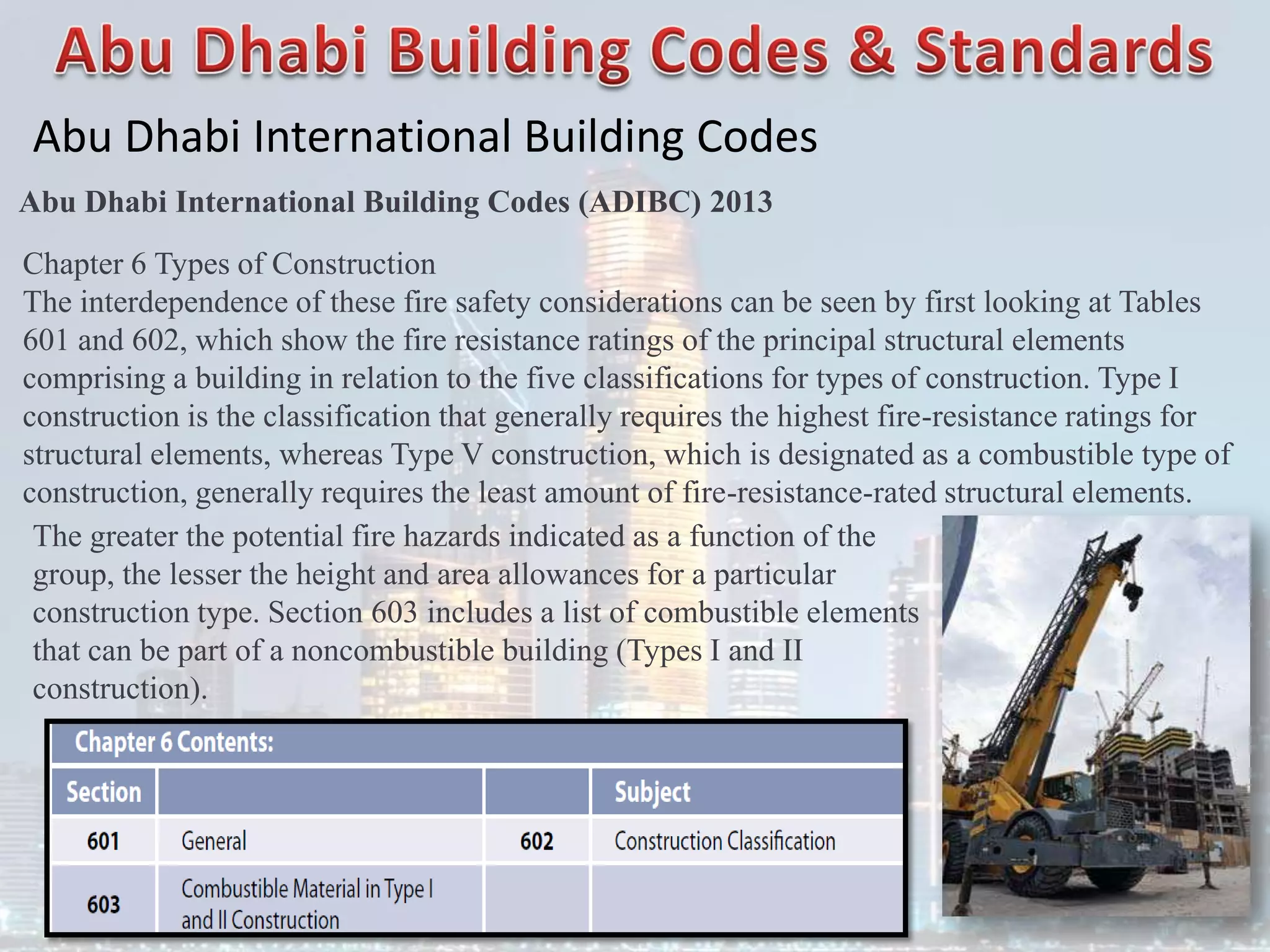
Chapter 6 Types of Construction
The interdependence of these fire safety considerations can be seen by first looking at Tables
601 and 602, which show the fire resistance ratings of the principal structural elements
comprising a building in relation to the five classifications for types of construction. Type I
construction is the classification that generally requires the highest fire-resistance ratings for
structural elements, whereas Type V construction, which is designated as a combustible type of
construction, generally requires the least amount of fire-resistance-rated structural elements.
The greater the potential fire hazards indicated as a function of the
group, the lesser the height and area allowances for a particular
construction type. Section 603 includes a list of combustible elements
that can be part of a noncombustible building (Types I and II
construction).
Abu Dhabi International Building Codes
Abu Dhabi International Building Codes (ADIBC) 2013
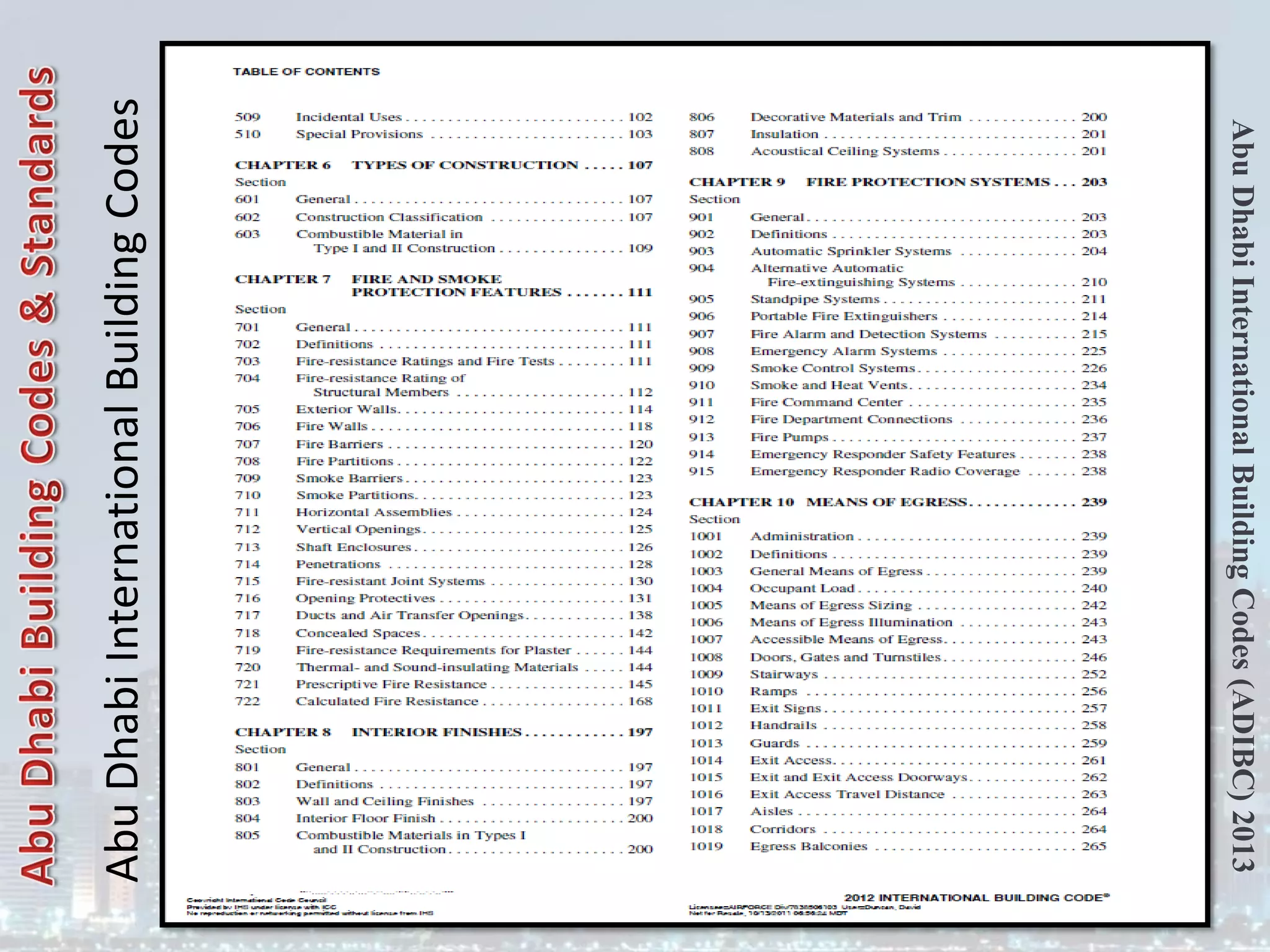
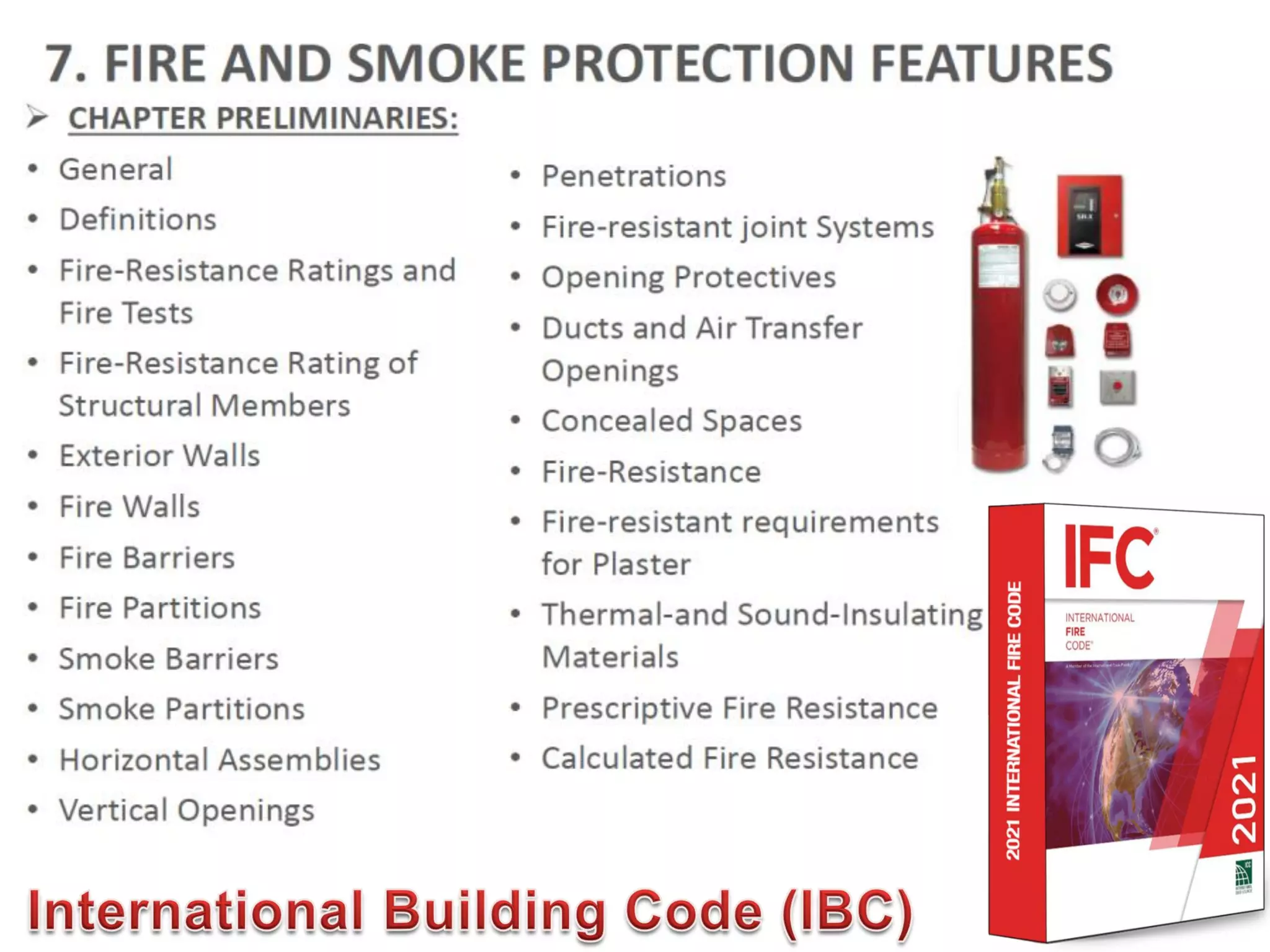
Chapter 7 Fire and Smoke Protection Features
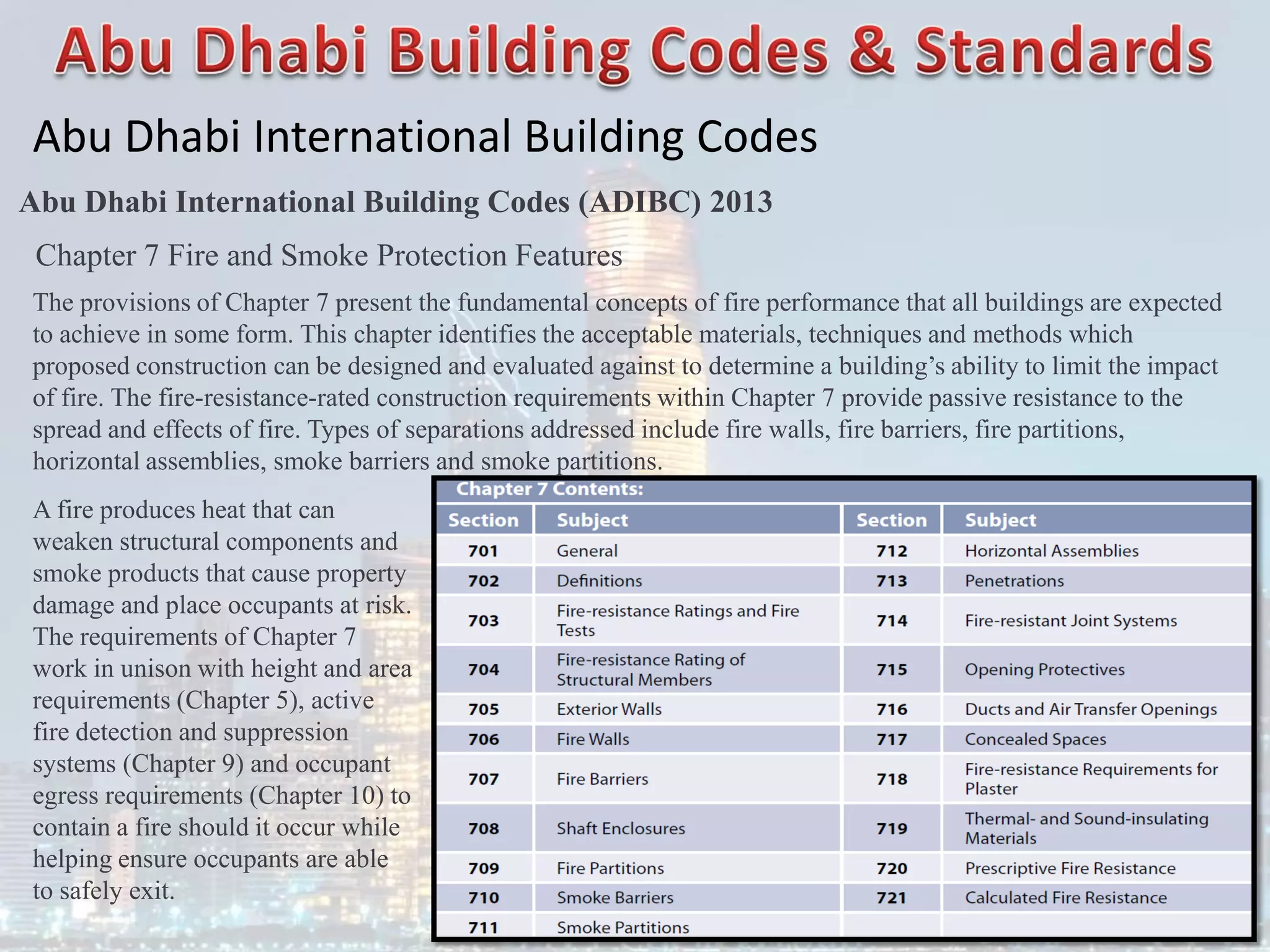
The provisions of Chapter 7 present the fundamental concepts of fire performance that all buildings are expected
to achieve in some form. This chapter identifies the acceptable materials, techniques and methods which
proposed construction can be designed and evaluated against to determine a building’s ability to limit the impact
of fire. The fire-resistance-rated construction requirements within Chapter 7 provide passive resistance to the
spread and effects of fire. Types of separations addressed include fire walls, fire barriers, fire partitions,
horizontal assemblies, smoke barriers and smoke partitions.
A fire produces heat that can
weaken structural components and
smoke products that cause property
damage and place occupants at risk.
The requirements of Chapter 7
work in unison with height and area
requirements (Chapter 5), active
fire detection and suppression
systems (Chapter 9) and occupant
egress requirements (Chapter 10) to
contain a fire should it occur while
helping ensure occupants are able
to safely exit.
Abu Dhabi International Building Codes
Abu Dhabi International Building Codes (ADIBC) 2013
Chapter 8 Interior Finishes
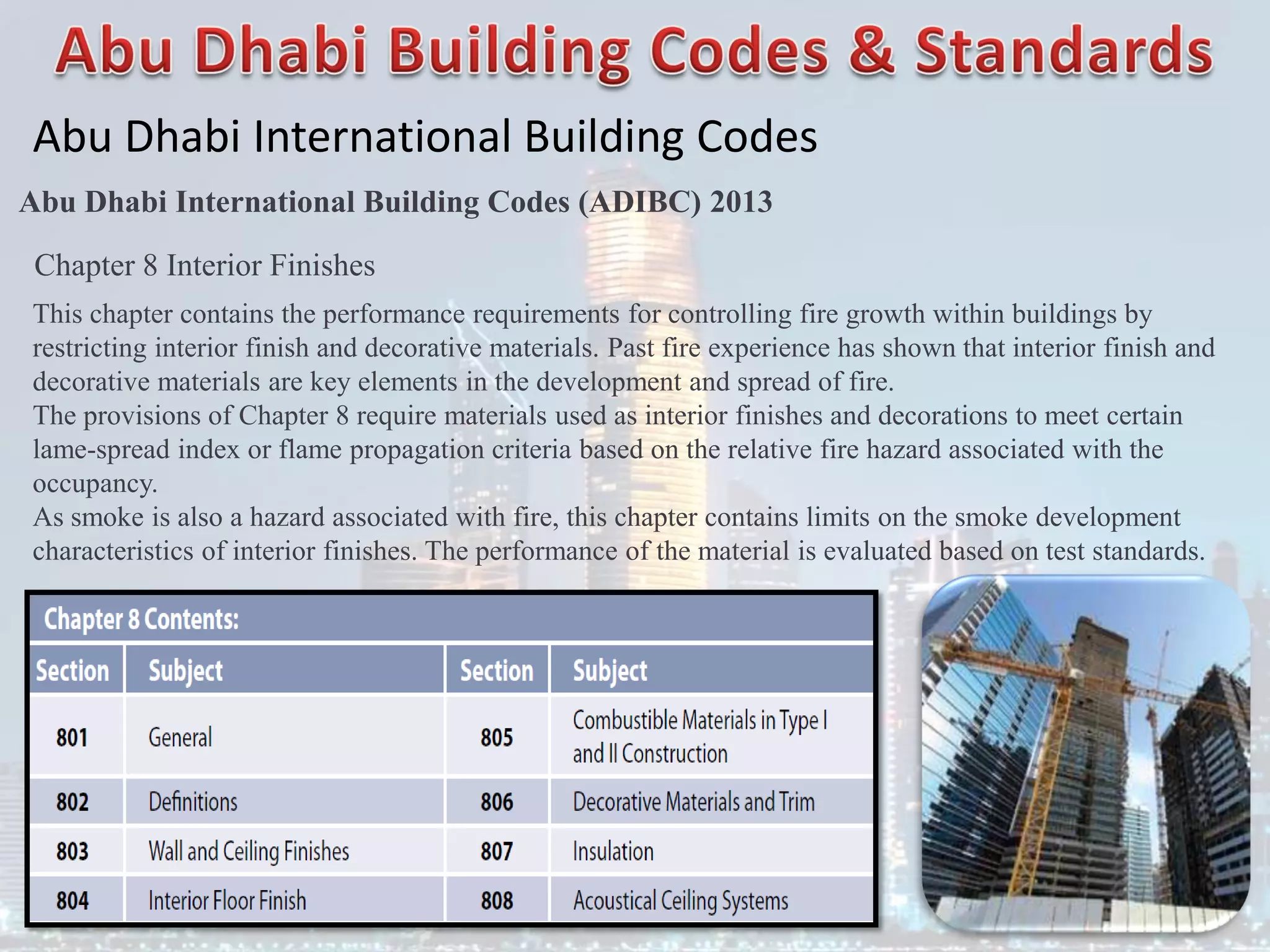
This chapter contains the performance requirements for controlling fire growth within buildings by
restricting interior finish and decorative materials. Past fire experience has shown that interior finish and
decorative materials are key elements in the development and spread of fire.
The provisions of Chapter 8 require materials used as interior finishes and decorations to meet certain
lame-spread index or flame propagation criteria based on the relative fire hazard associated with the
occupancy.
As smoke is also a hazard associated with fire, this chapter contains limits on the smoke development
characteristics of interior finishes. The performance of the material is evaluated based on test standards.
Abu Dhabi International Building Codes
Abu Dhabi International Building Codes (ADIBC) 2013
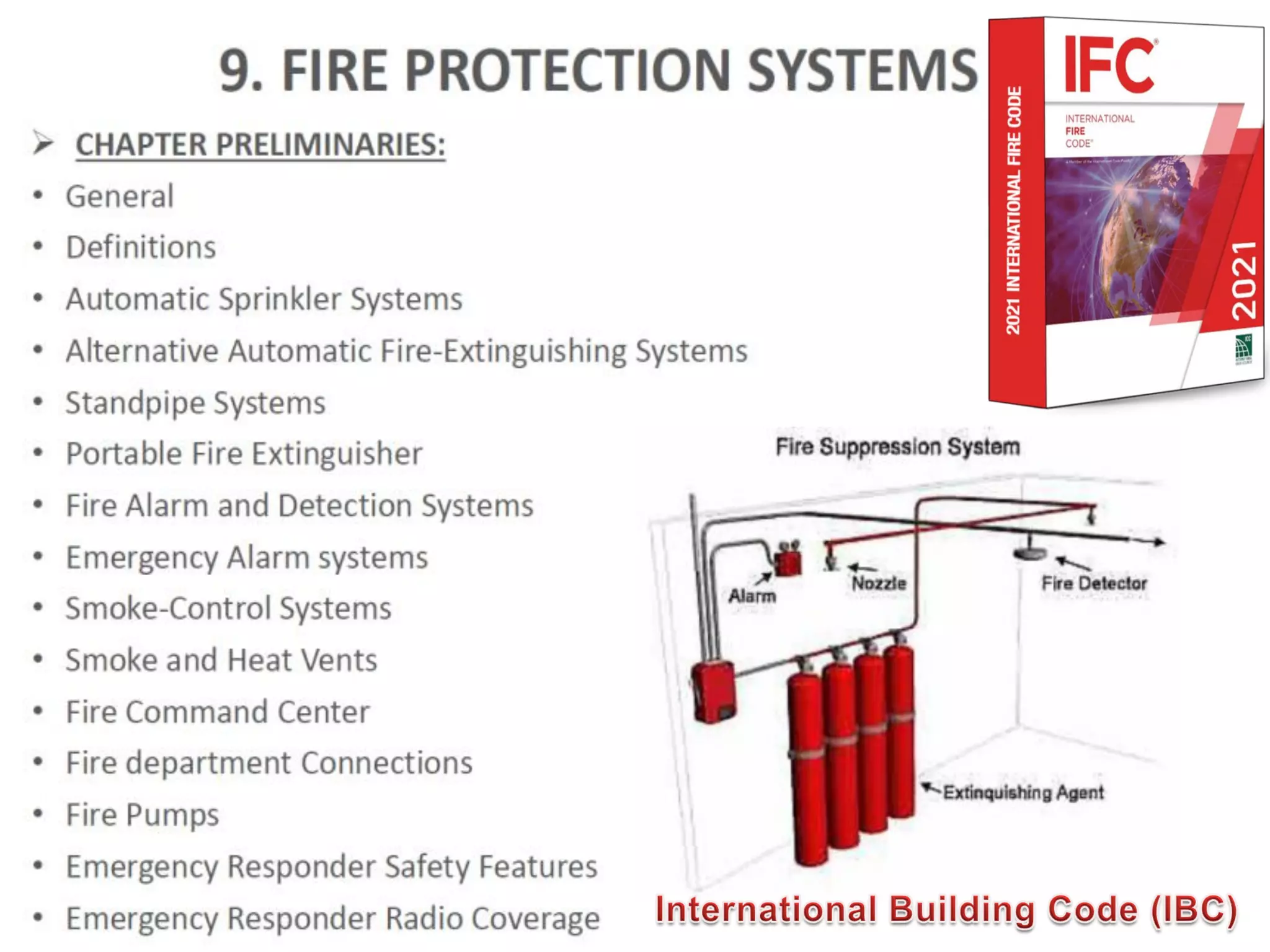
Chapter 9 Fire Protection Systems
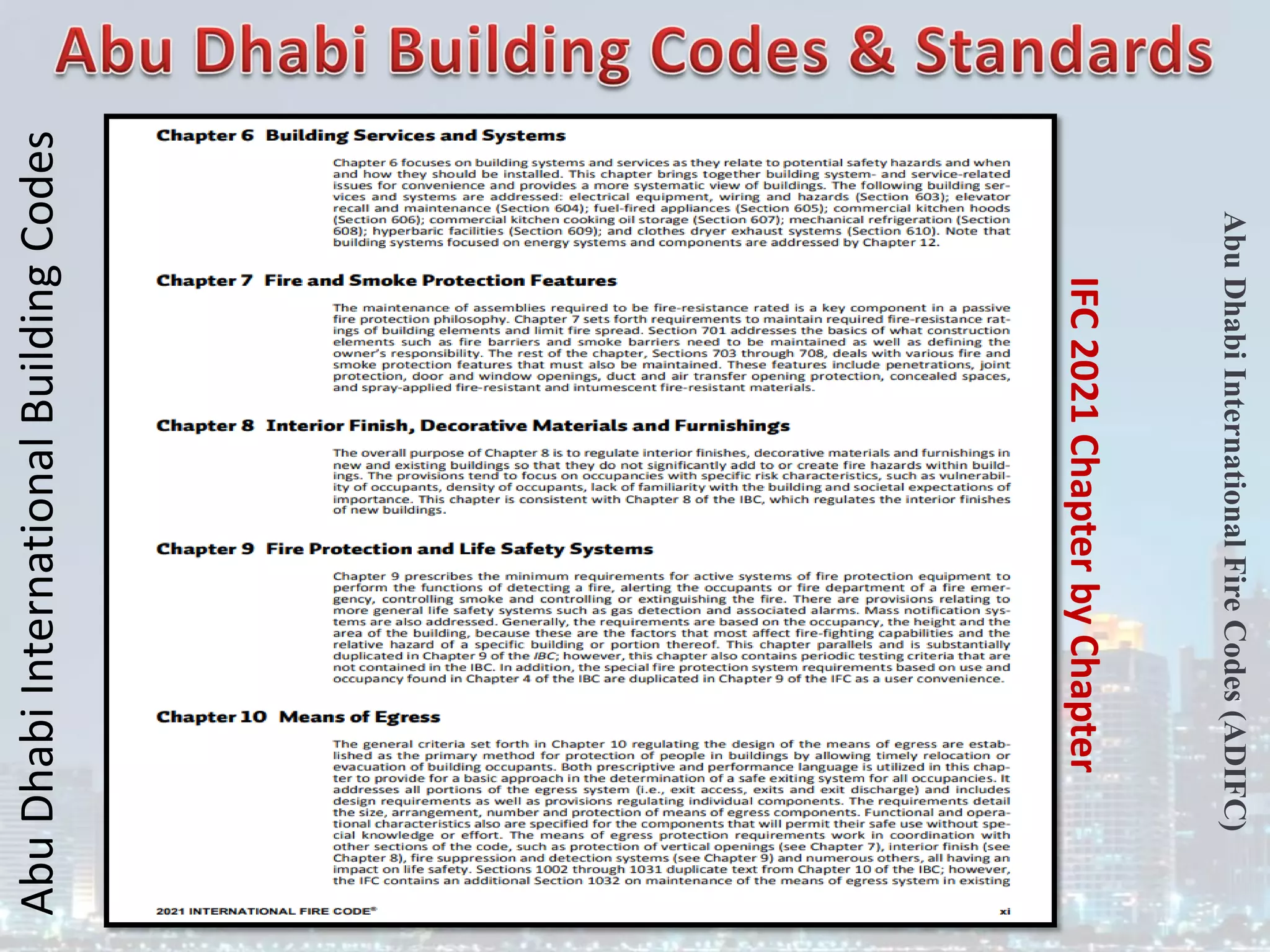
Chapter 9 prescribes the minimum requirements for active systems of fire protection equipment to
perform the following functions: detect a fire; alert the occupants or fire department of a fire
emergency; and control smoke and control or extinguish the fire. Generally, the requirements are based
on the occupancy, the height and the area of the building, because these are the factors that most affect
fire-fighting capabilities and the relative hazard of a specific building or portion thereof. This chapter
parallels and is substantially duplicated in Chapter 9 of the International Fire Code (IFC); however, the
IFC Chapter 9 also contains periodic testing criteria that are not contained in the ADIBC. In addition,
the special fire protection system requirements based on use and occupancy found in ADIBC Chapter 4
are duplicated in IFC Chapter 9 as a user convenience. This chapter references the UAE Fire and Life
safety code of Practice.
Abu Dhabi International Building Codes
Abu Dhabi International Building Codes (ADIBC) 2013
Chapter 10 Means of Egress
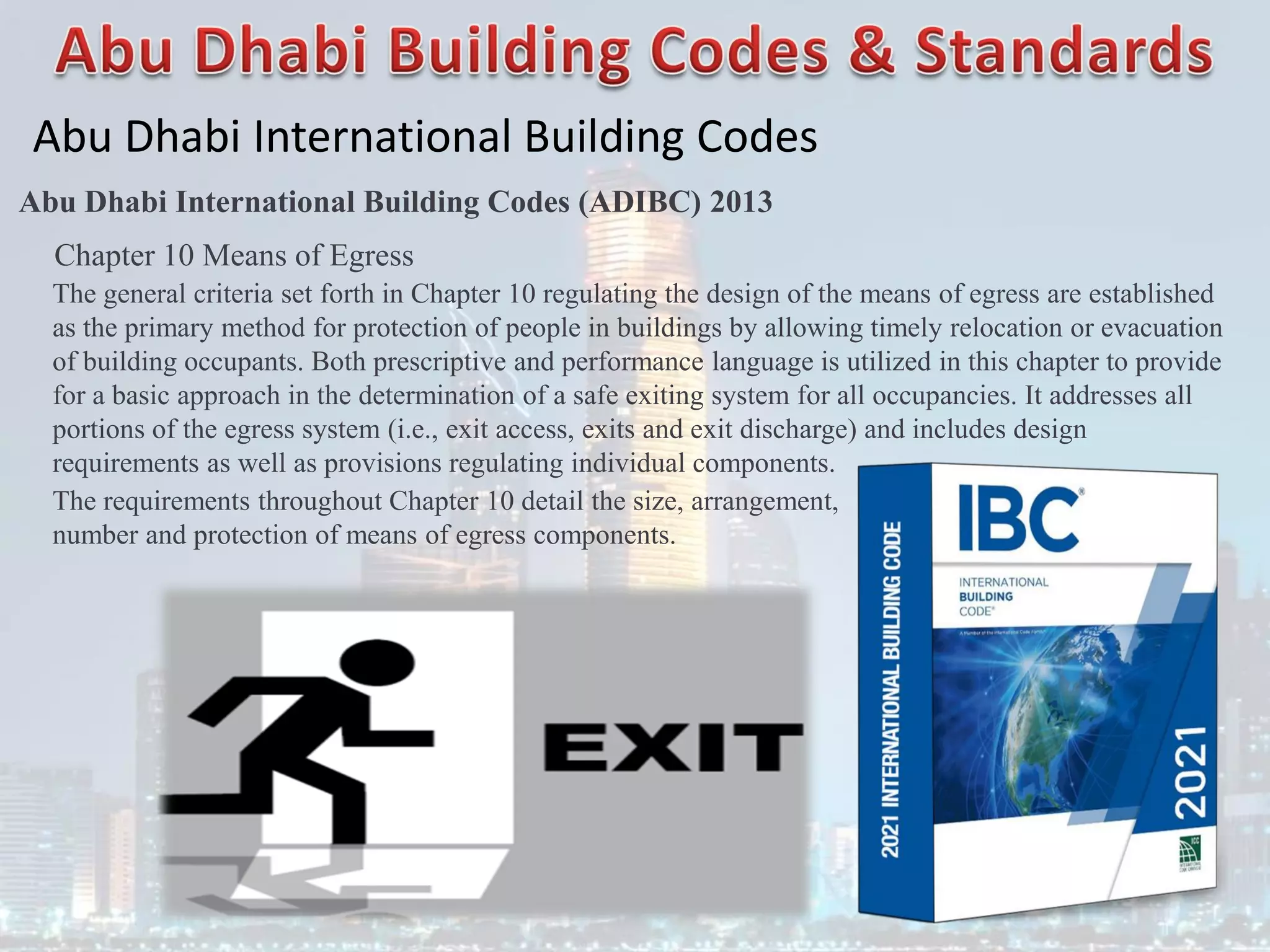
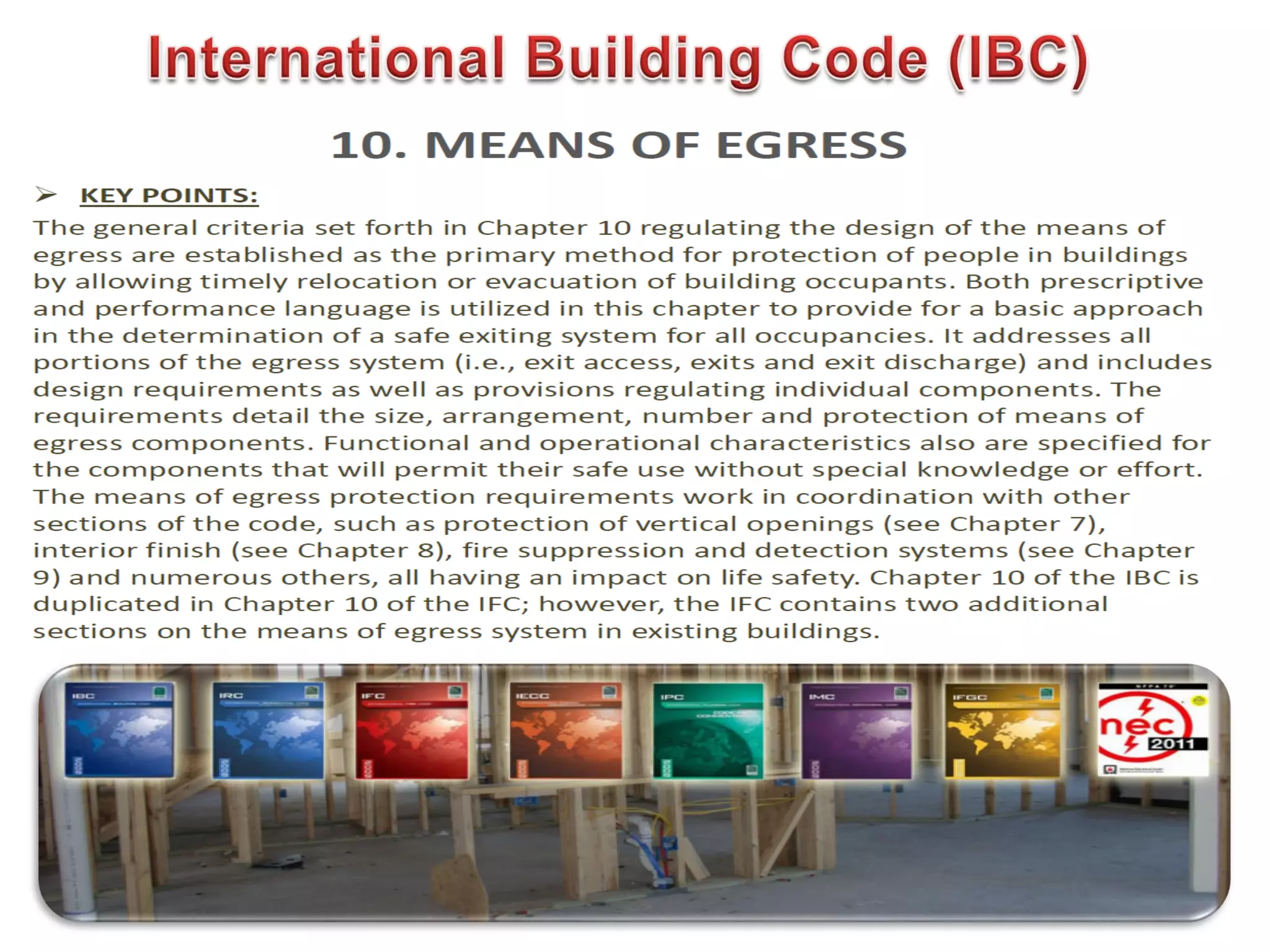
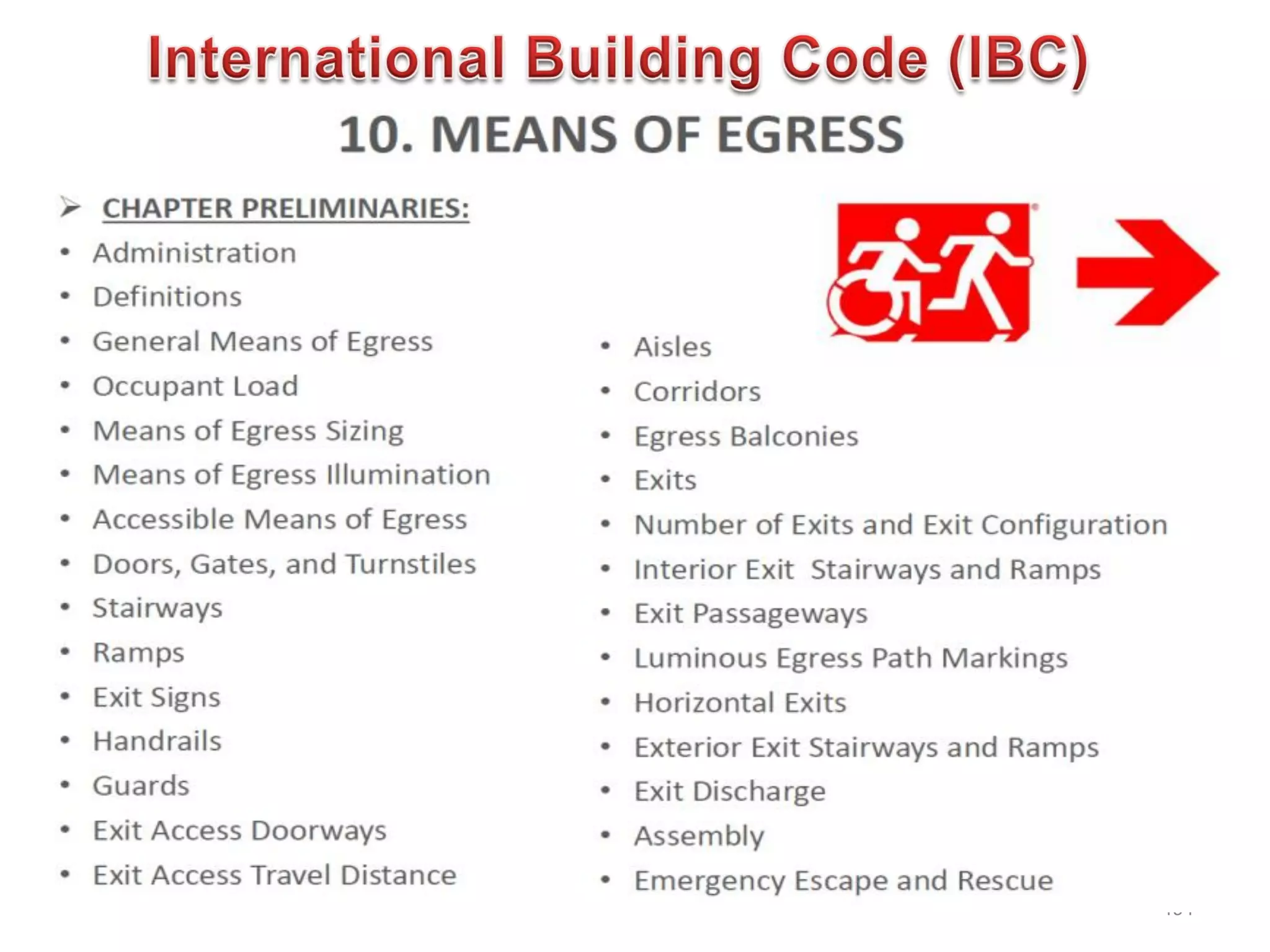
The general criteria set forth in Chapter 10 regulating the design of the means of egress are established
as the primary method for protection of people in buildings by allowing timely relocation or evacuation
of building occupants. Both prescriptive and performance language is utilized in this chapter to provide
for a basic approach in the determination of a safe exiting system for all occupancies. It addresses all
portions of the egress system (i.e., exit access, exits and exit discharge) and includes design
requirements as well as provisions regulating individual components.
The requirements throughout Chapter 10 detail the size, arrangement,
number and protection of means of egress components.
Abu Dhabi International Building Codes
Abu Dhabi International Building Codes (ADIBC) 2013
Chapter 10 Means of Egress
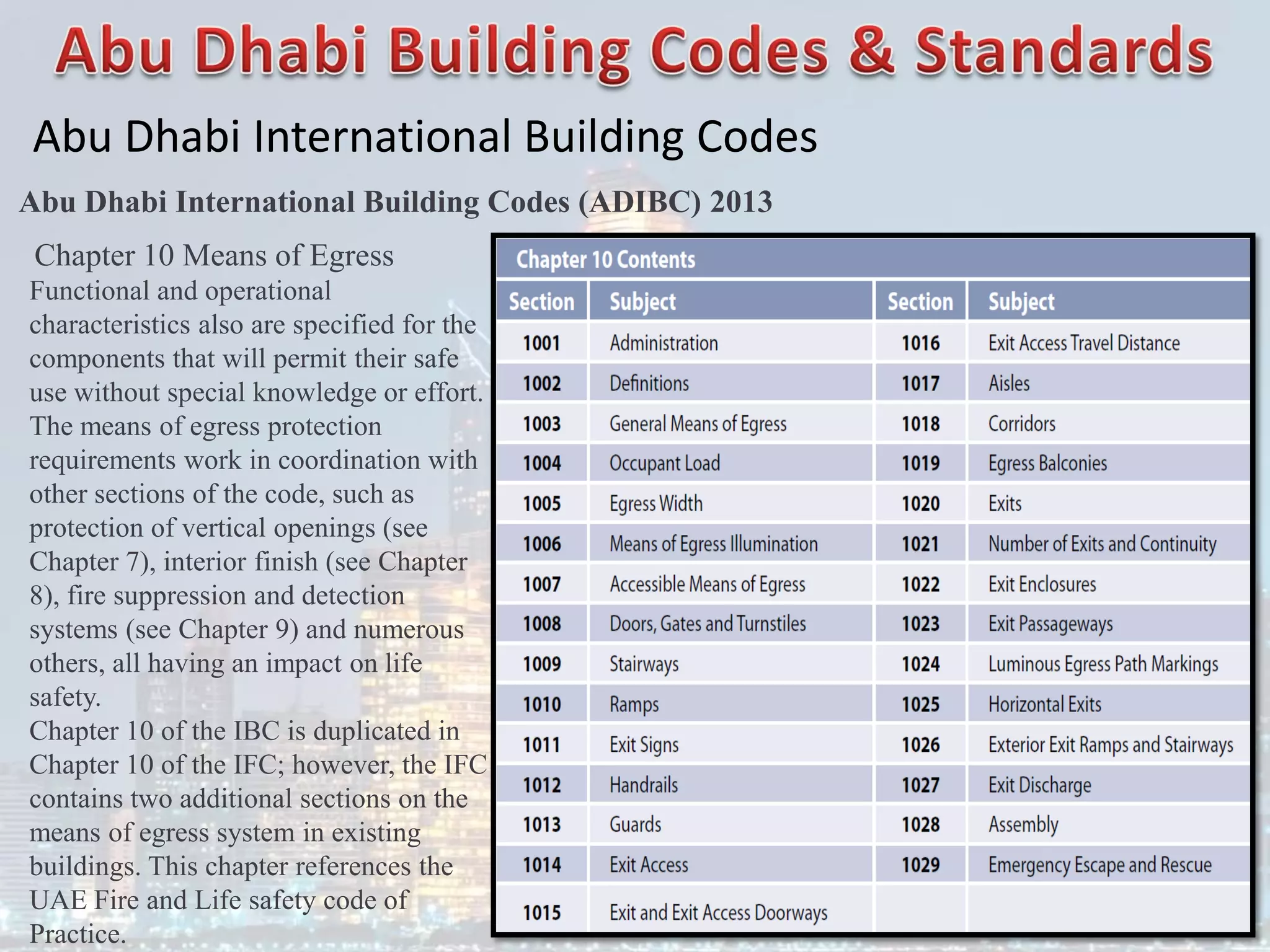
Functional and operational
characteristics also are specified for the
components that will permit their safe
use without special knowledge or effort.
The means of egress protection
requirements work in coordination with
other sections of the code, such as
protection of vertical openings (see
Chapter 7), interior finish (see Chapter
8), fire suppression and detection
systems (see Chapter 9) and numerous
others, all having an impact on life
safety.
Chapter 10 of the IBC is duplicated in
Chapter 10 of the IFC; however, the IFC
contains two additional sections on the
means of egress system in existing
buildings. This chapter references the
UAE Fire and Life safety code of
Practice.
Abu Dhabi International Building Codes
Abu Dhabi International Building Codes (ADIBC) 2013
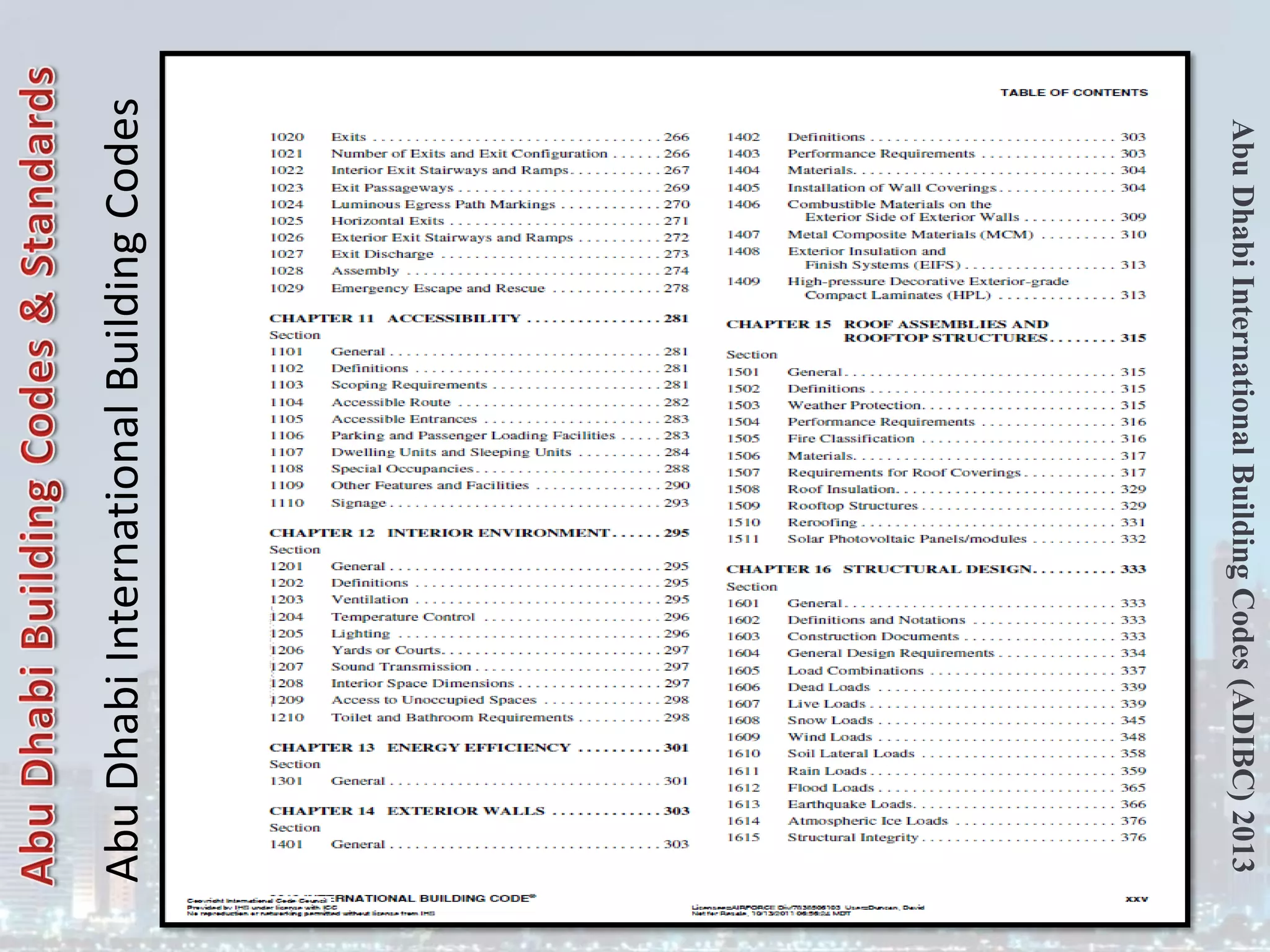
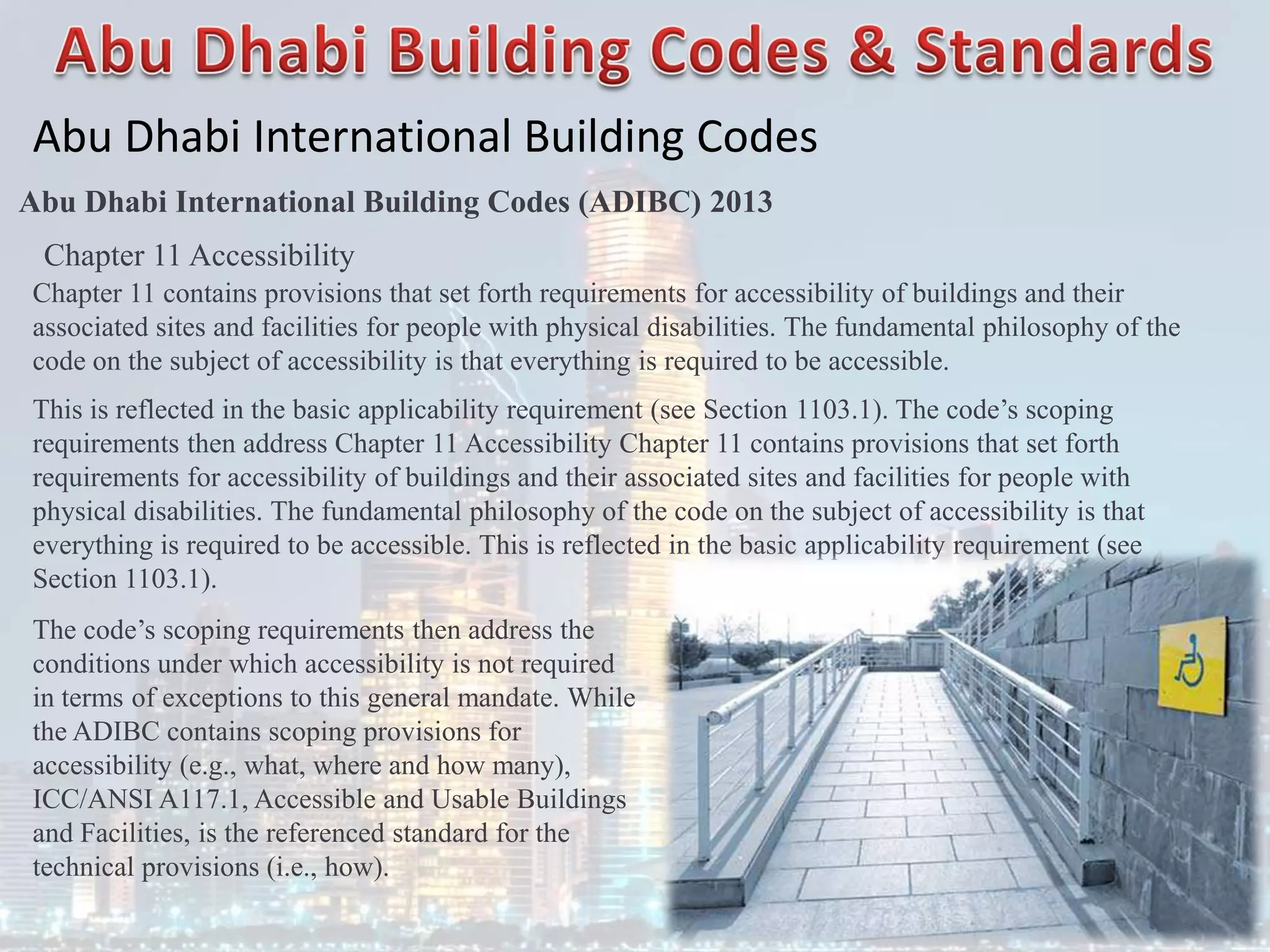
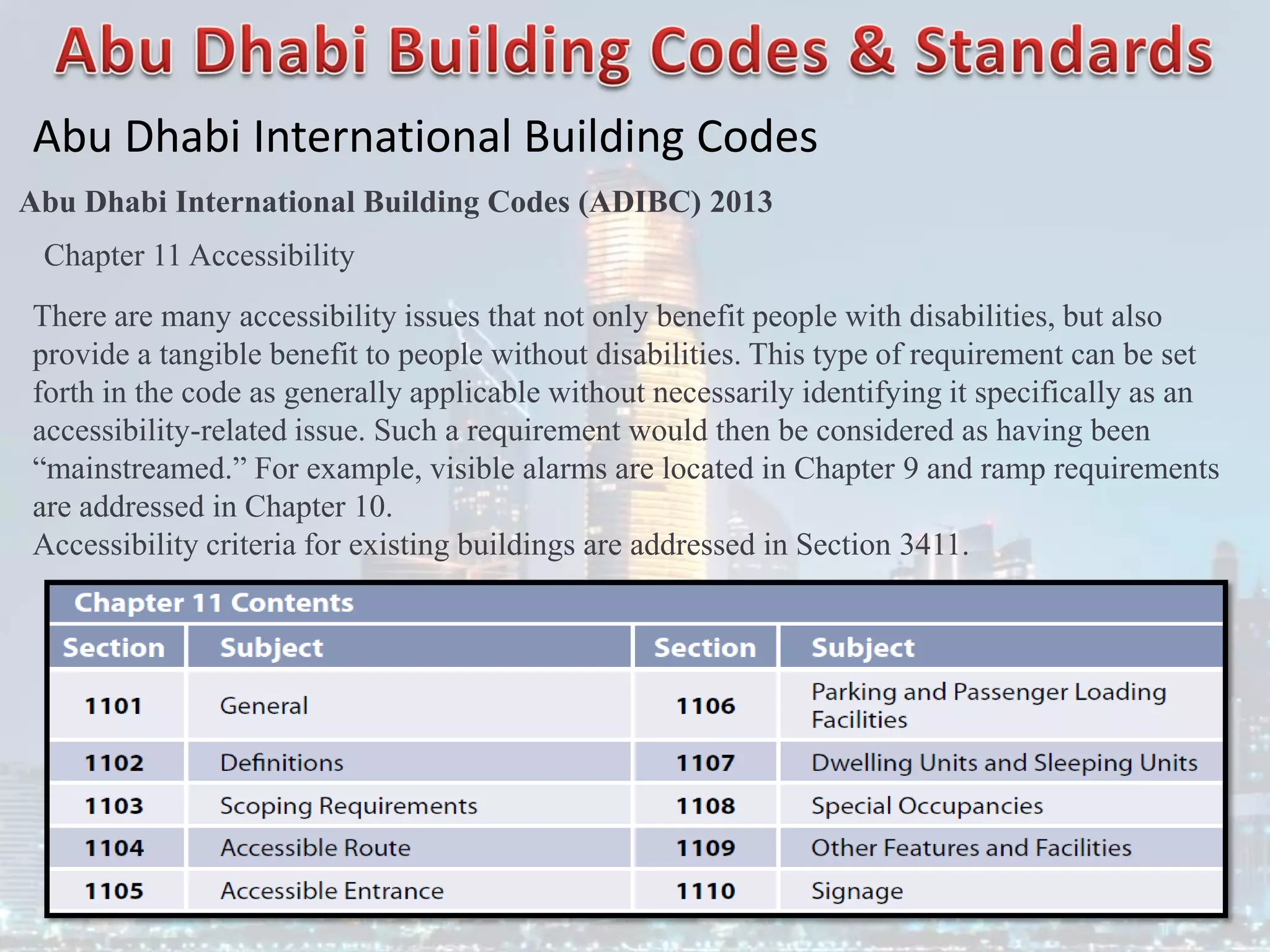
Chapter 11 Accessibility
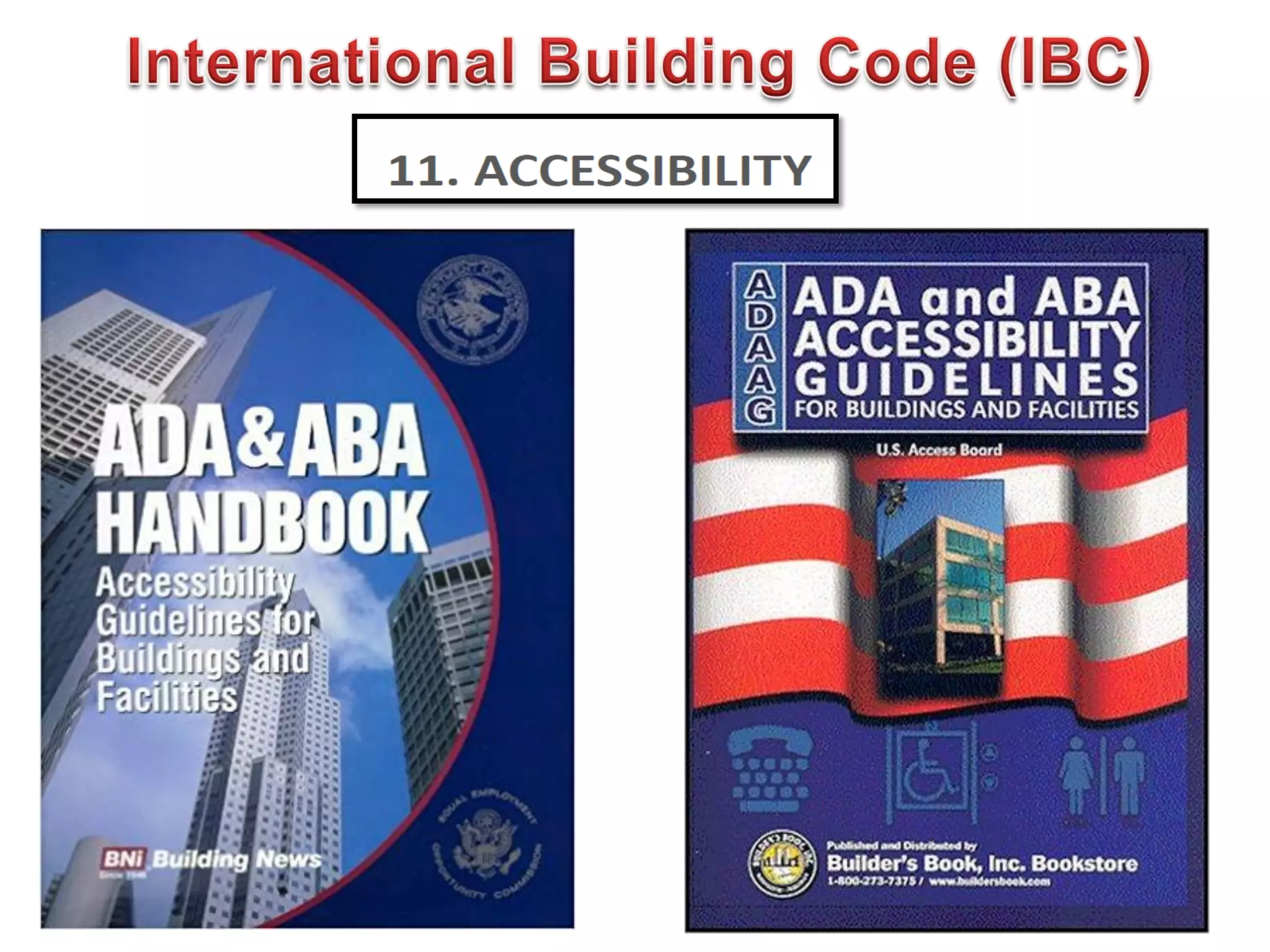
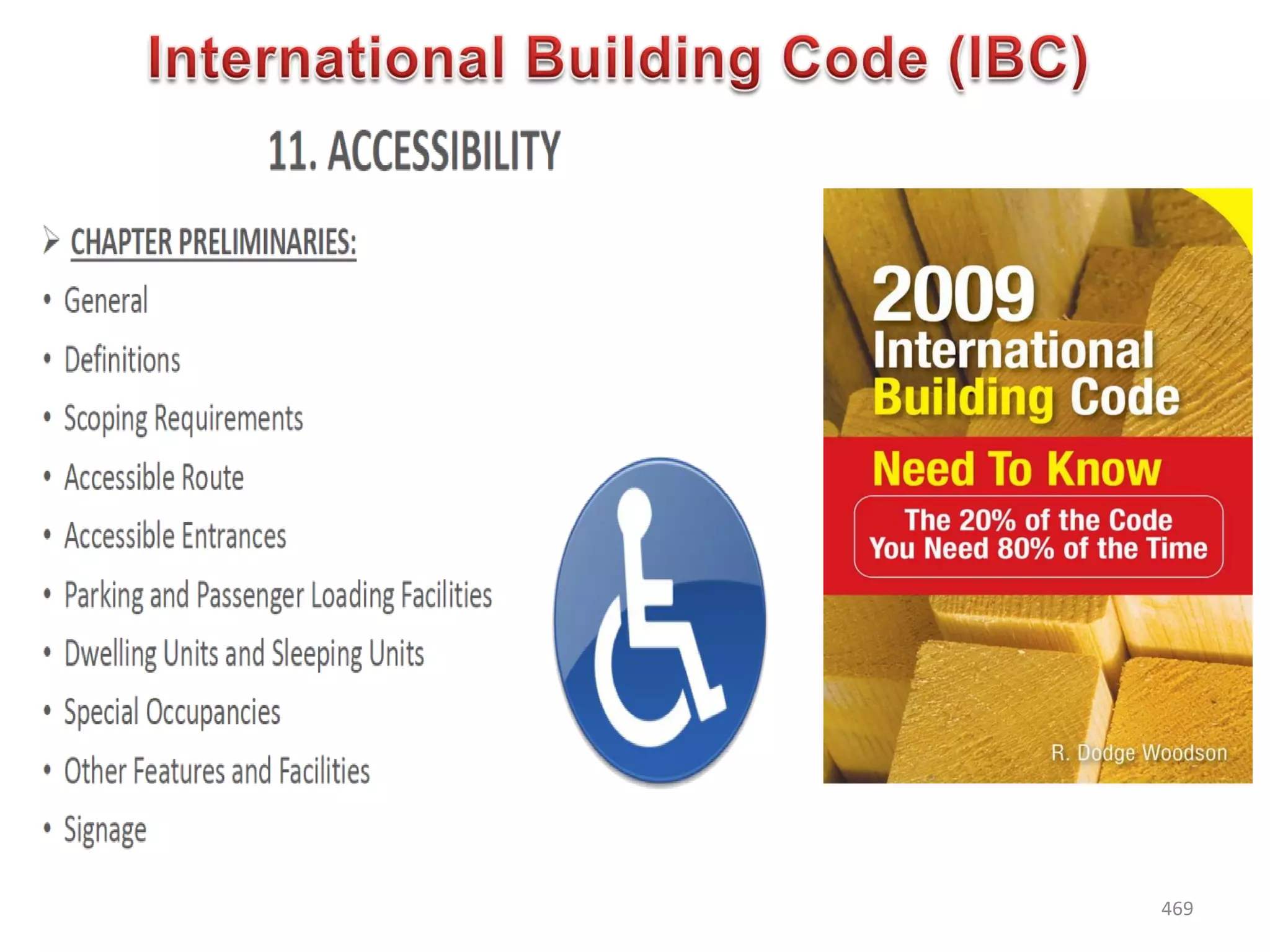
Chapter 11 contains provisions that set forth requirements for accessibility of buildings and their
associated sites and facilities for people with physical disabilities. The fundamental philosophy of the
code on the subject of accessibility is that everything is required to be accessible.
This is reflected in the basic applicability requirement (see Section 1103.1). The code’s scoping
requirements then address Chapter 11 Accessibility Chapter 11 contains provisions that set forth
requirements for accessibility of buildings and their associated sites and facilities for people with
physical disabilities. The fundamental philosophy of the code on the subject of accessibility is that
everything is required to be accessible. This is reflected in the basic applicability requirement (see
Section 1103.1).
The code’s scoping requirements then address the
conditions under which accessibility is not required
in terms of exceptions to this general mandate. While
the ADIBC contains scoping provisions for
accessibility (e.g., what, where and how many),
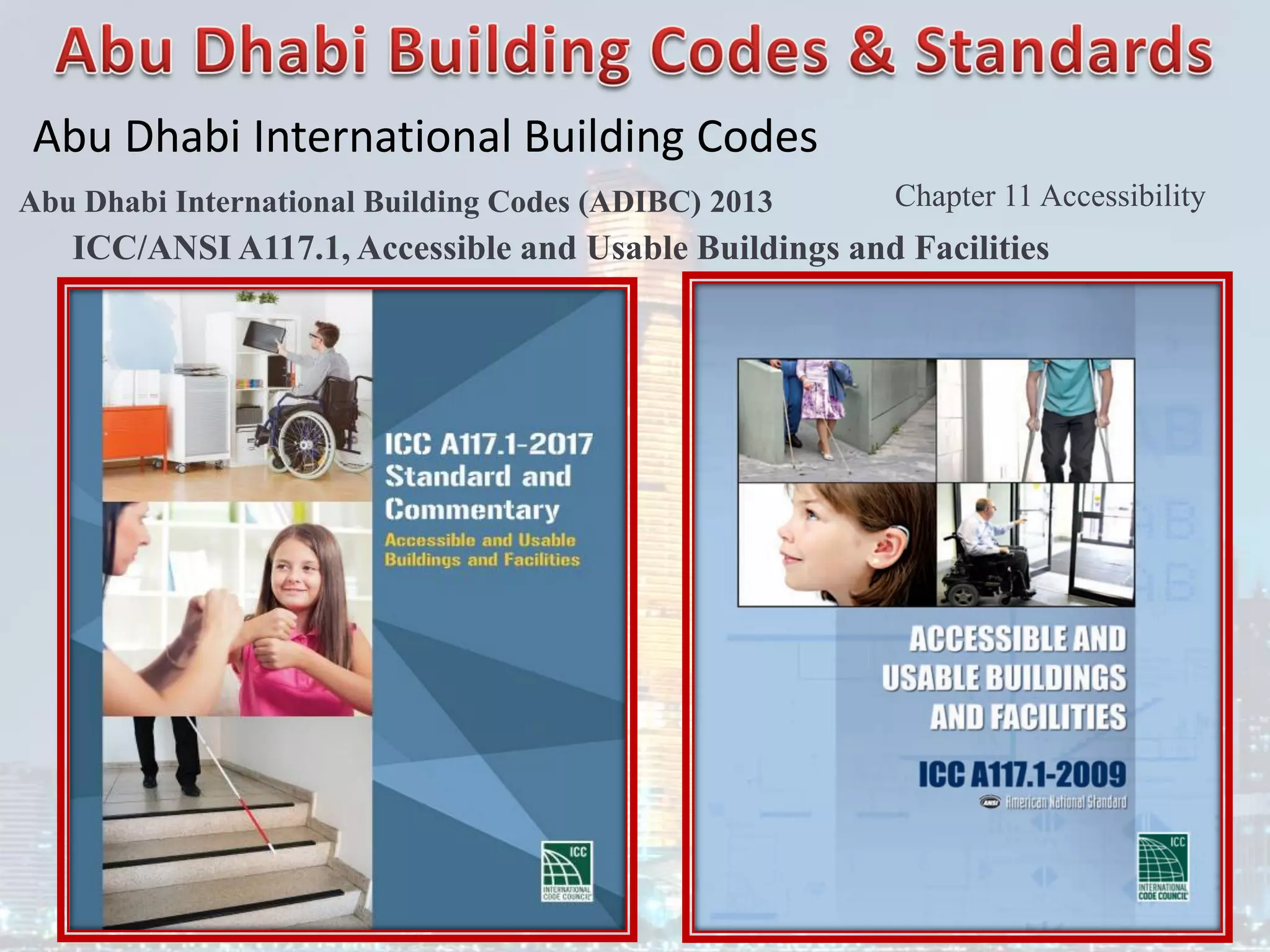
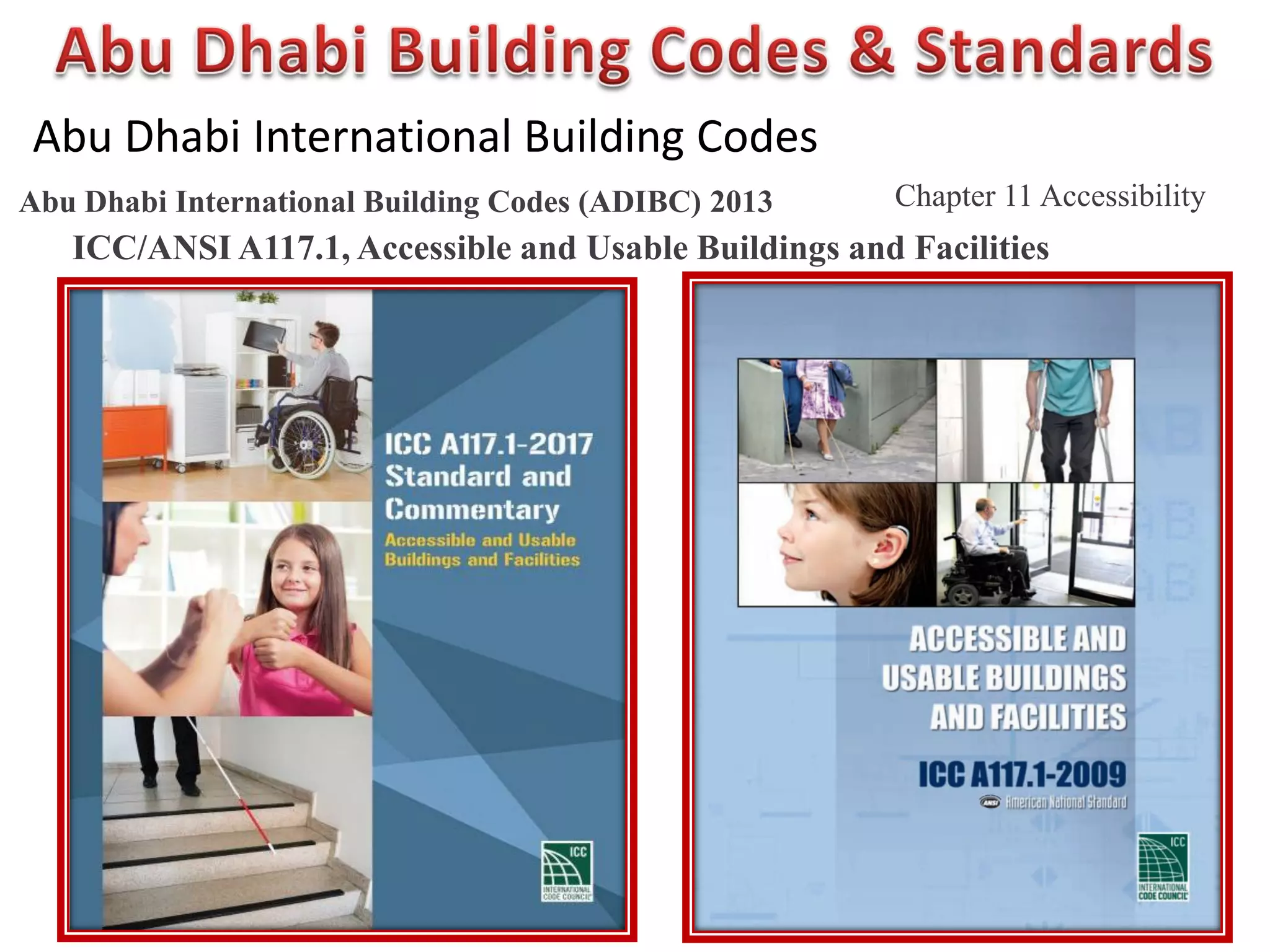
ICC/ANSI A117.1, Accessible and Usable Buildings
and Facilities, is the referenced standard for the
technical provisions (i.e., how).
Abu Dhabi International Building Codes
Abu Dhabi International Building Codes (ADIBC) 2013 Chapter 11 Accessibility
ICC/ANSI A117.1, Accessible and Usable Buildings and Facilities
152
Abu Dhabi International Building Codes
Abu Dhabi International Building Codes (ADIBC) 2013 Chapter 11 Accessibility
153
Abu
Dhabi
International
Building
Codes
Chapter 11 Accessibility
Abu Dhabi International Building Codes (ADIBC) 2013
154
Abu
Dhabi
International
Building
Codes
Chapter 11 Accessibility
Abu Dhabi International Building Codes (ADIBC) 2013
Abu Dhabi International Building Codes
Abu Dhabi International Building Codes (ADIBC) 2013
Chapter 11 Accessibility
There are many accessibility issues that not only benefit people with disabilities, but also
provide a tangible benefit to people without disabilities. This type of requirement can be set
forth in the code as generally applicable without necessarily identifying it specifically as an
accessibility-related issue. Such a requirement would then be considered as having been
“mainstreamed.” For example, visible alarms are located in Chapter 9 and ramp requirements
are addressed in Chapter 10.
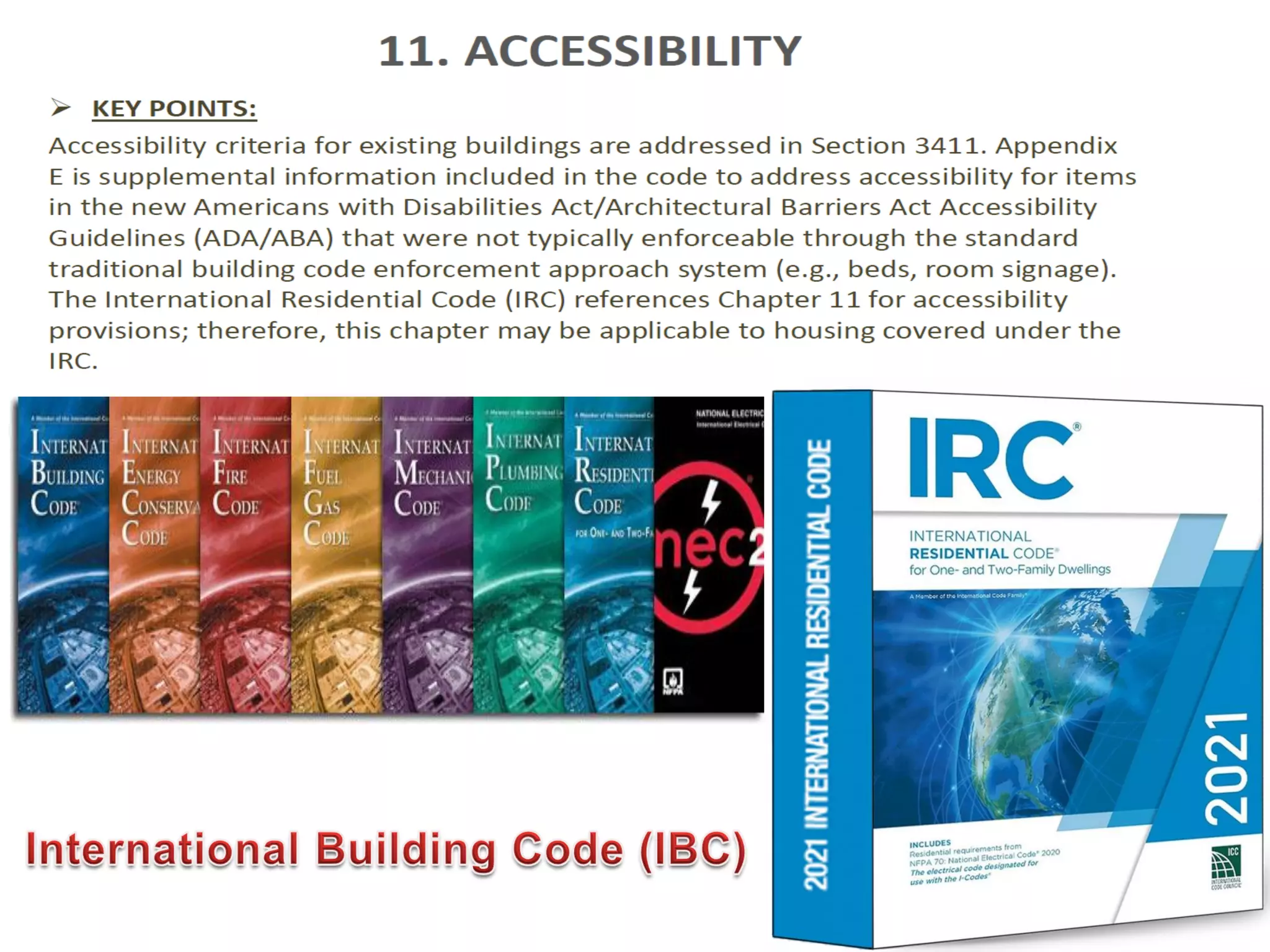
Accessibility criteria for existing buildings are addressed in Section 3411.
Abu Dhabi International Building Codes
Abu Dhabi International Building Codes (ADIBC) 2013
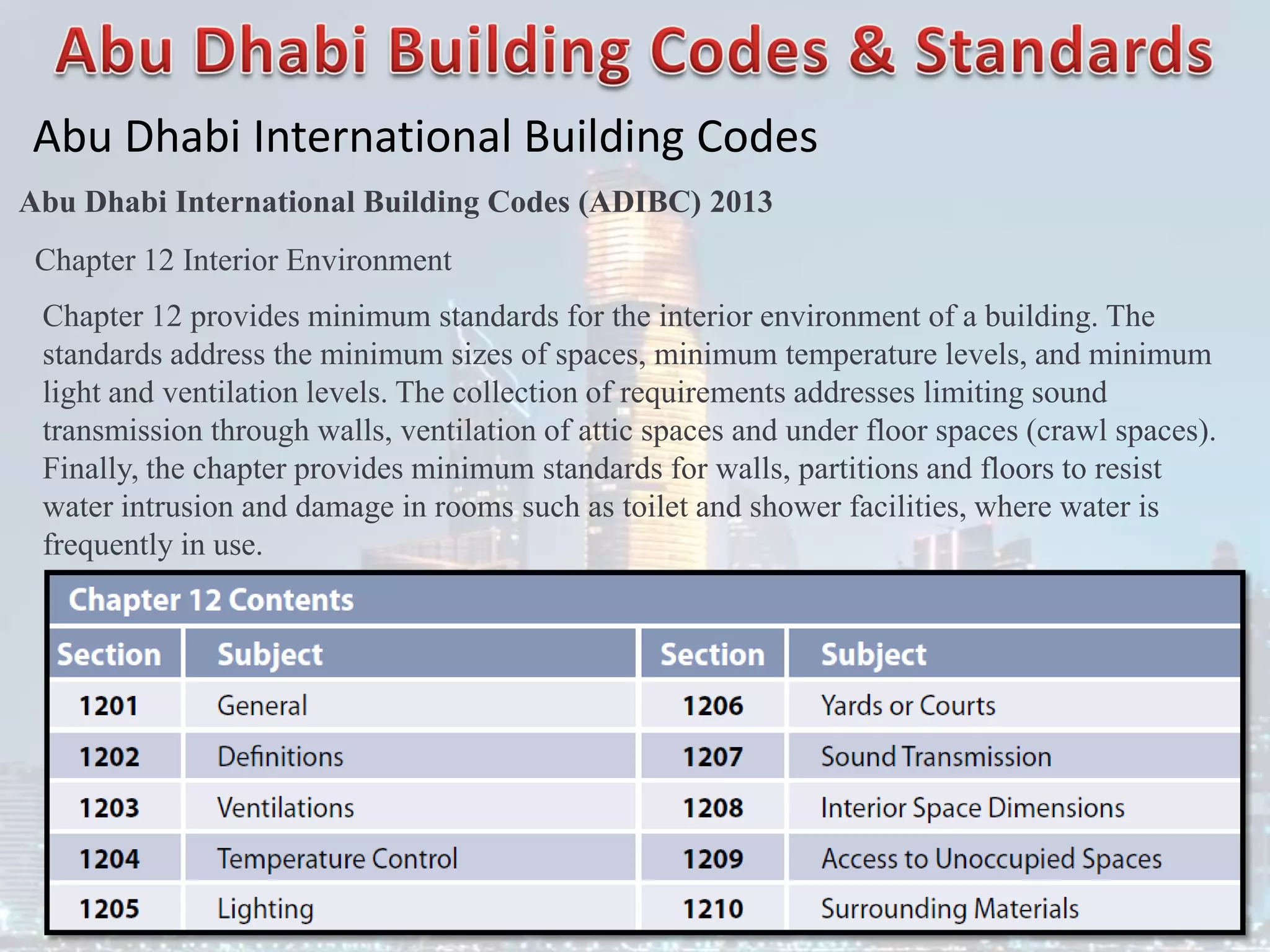
Chapter 12 Interior Environment
Chapter 12 provides minimum standards for the interior environment of a building. The
standards address the minimum sizes of spaces, minimum temperature levels, and minimum
light and ventilation levels. The collection of requirements addresses limiting sound
transmission through walls, ventilation of attic spaces and under floor spaces (crawl spaces).
Finally, the chapter provides minimum standards for walls, partitions and floors to resist
water intrusion and damage in rooms such as toilet and shower facilities, where water is
frequently in use.
Abu Dhabi International Building Codes
Abu Dhabi International Building Codes (ADIBC) 2013
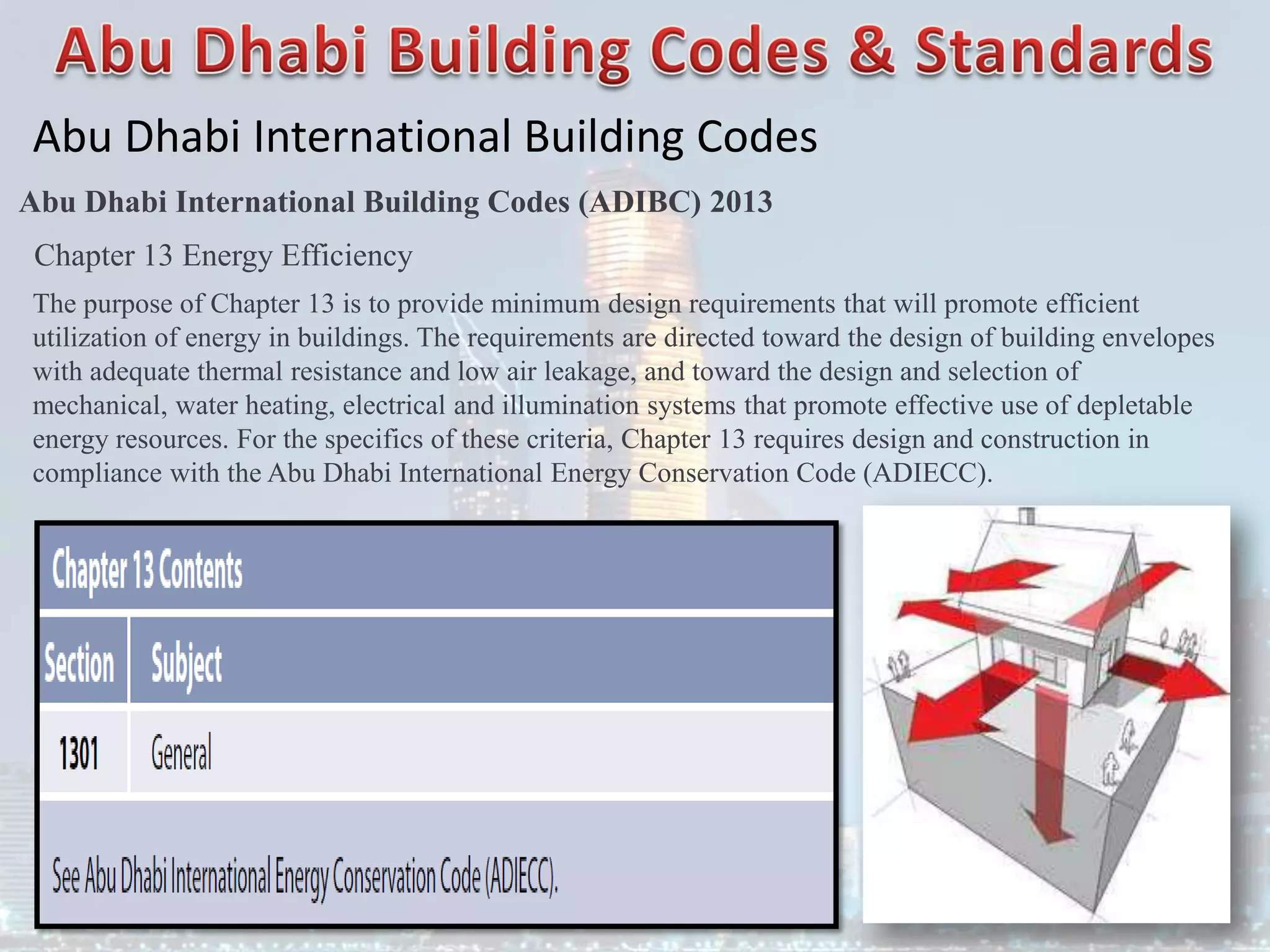
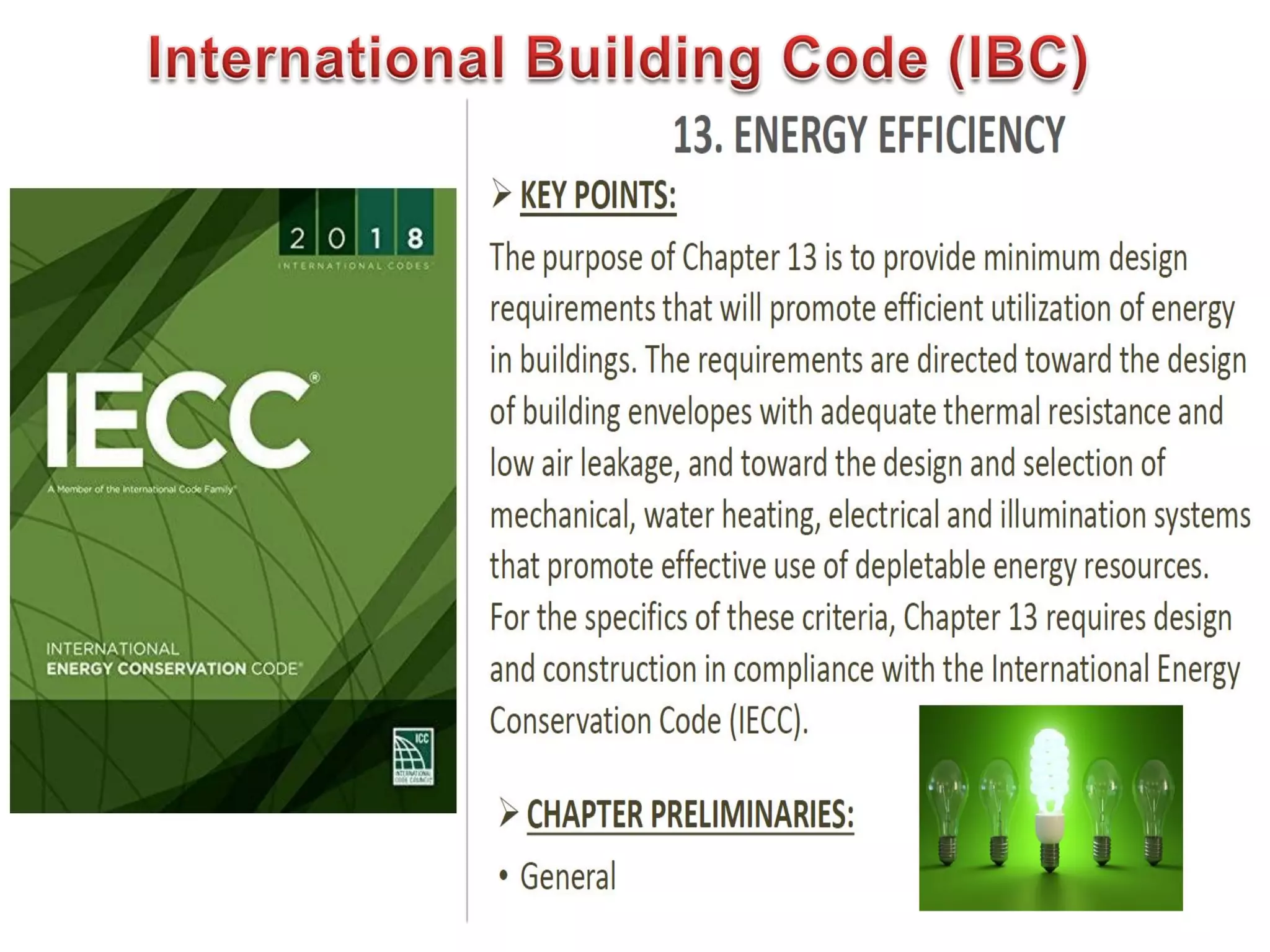
Chapter 13 Energy Efficiency
The purpose of Chapter 13 is to provide minimum design requirements that will promote efficient
utilization of energy in buildings. The requirements are directed toward the design of building envelopes
with adequate thermal resistance and low air leakage, and toward the design and selection of
mechanical, water heating, electrical and illumination systems that promote effective use of depletable
energy resources. For the specifics of these criteria, Chapter 13 requires design and construction in
compliance with the Abu Dhabi International Energy Conservation Code (ADIECC).
Abu Dhabi International Building Codes
Abu Dhabi International Building Codes (ADIBC) 2013
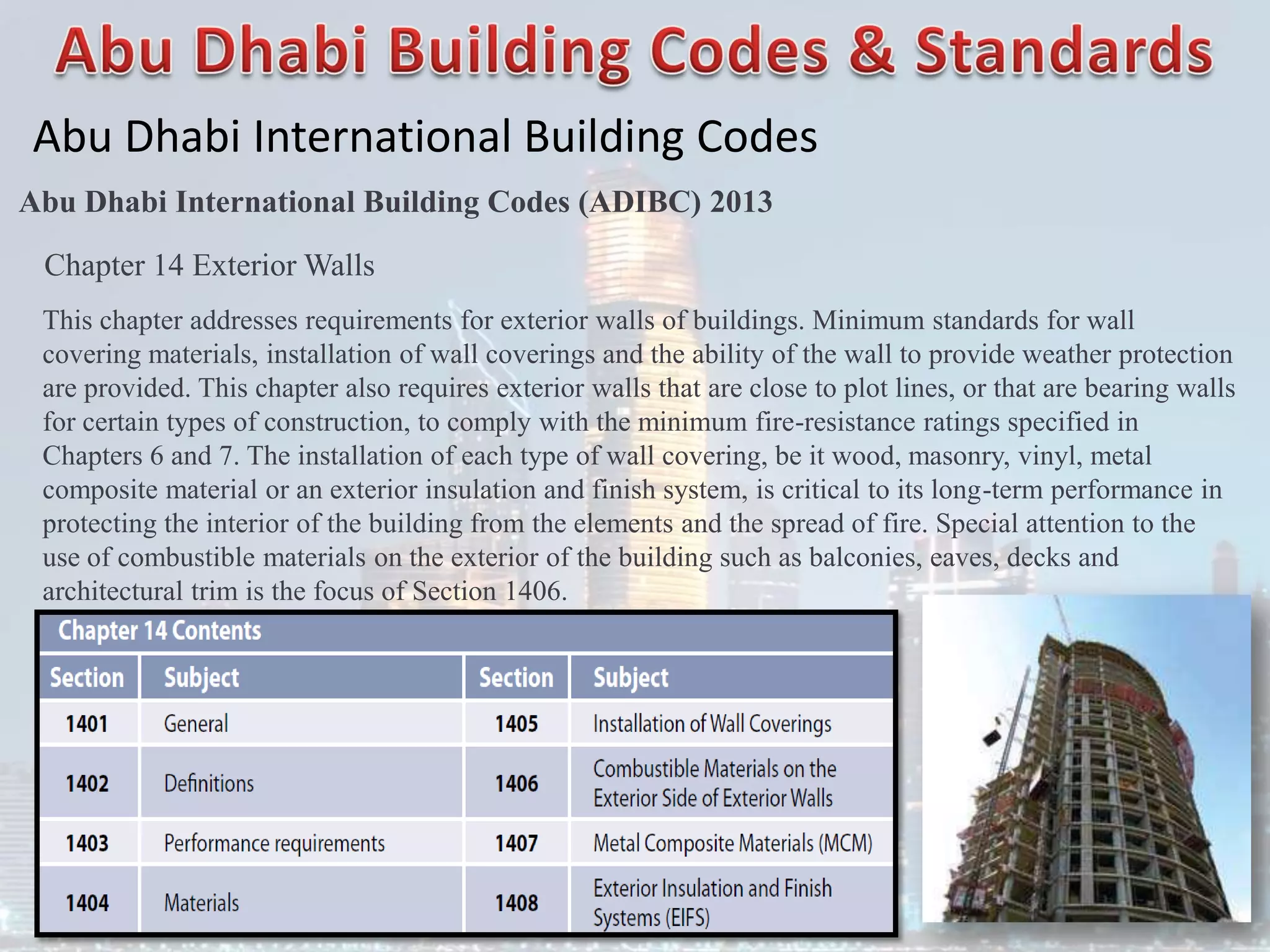
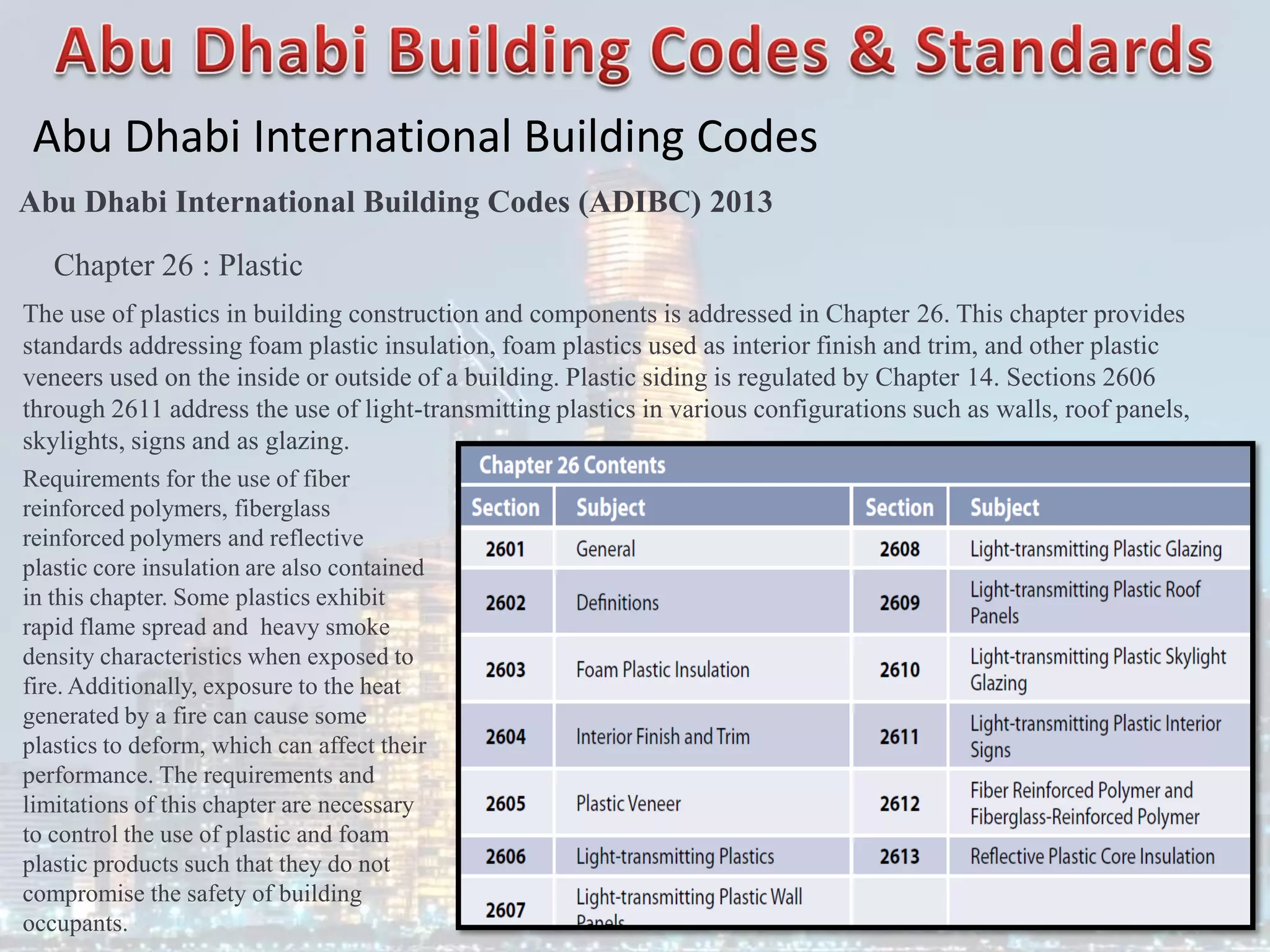
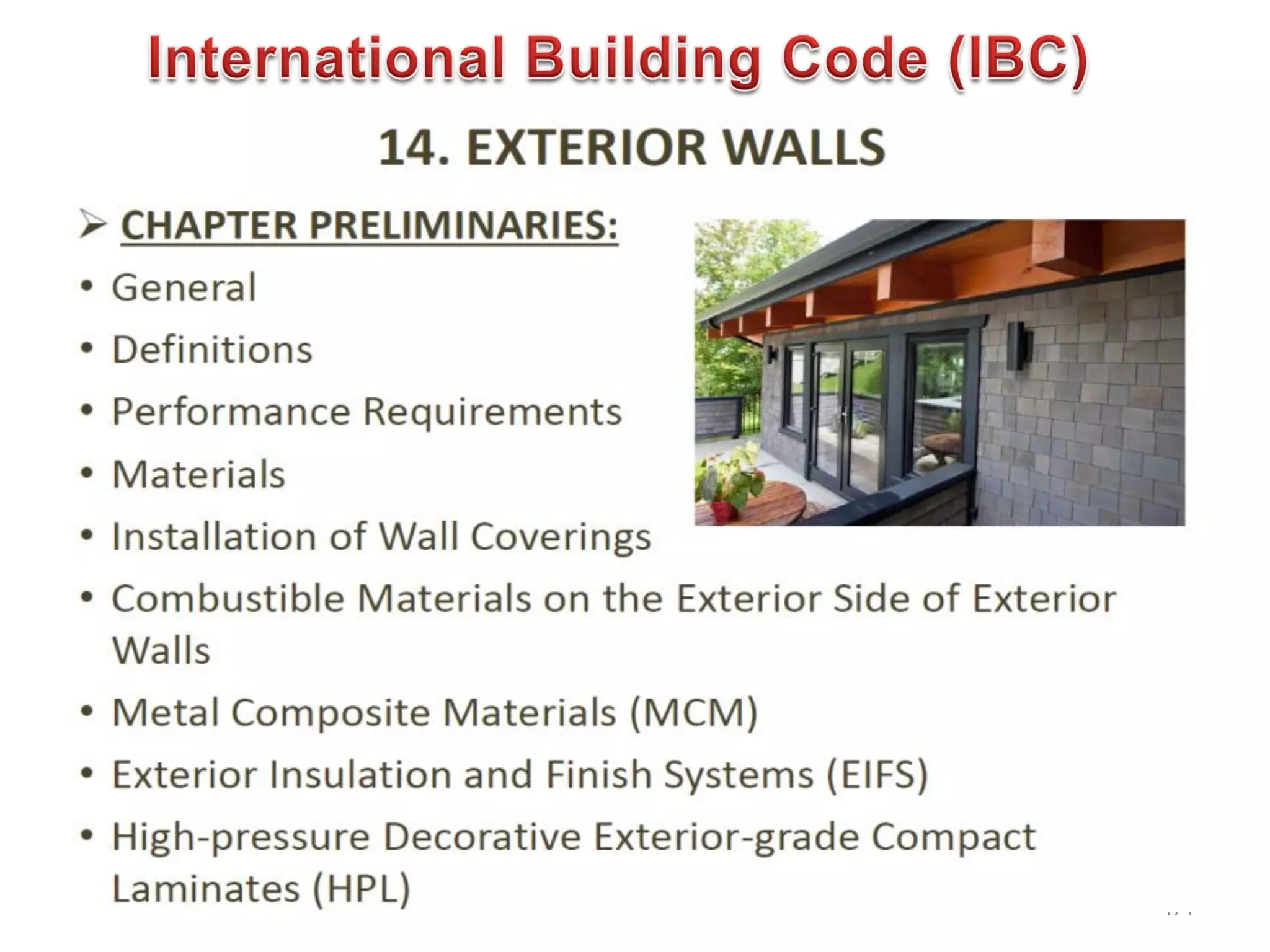
Chapter 14 Exterior Walls
This chapter addresses requirements for exterior walls of buildings. Minimum standards for wall
covering materials, installation of wall coverings and the ability of the wall to provide weather protection
are provided. This chapter also requires exterior walls that are close to plot lines, or that are bearing walls
for certain types of construction, to comply with the minimum fire-resistance ratings specified in
Chapters 6 and 7. The installation of each type of wall covering, be it wood, masonry, vinyl, metal
composite material or an exterior insulation and finish system, is critical to its long-term performance in
protecting the interior of the building from the elements and the spread of fire. Special attention to the
use of combustible materials on the exterior of the building such as balconies, eaves, decks and
architectural trim is the focus of Section 1406.
Abu Dhabi International Building Codes
Abu Dhabi International Building Codes (ADIBC) 2013
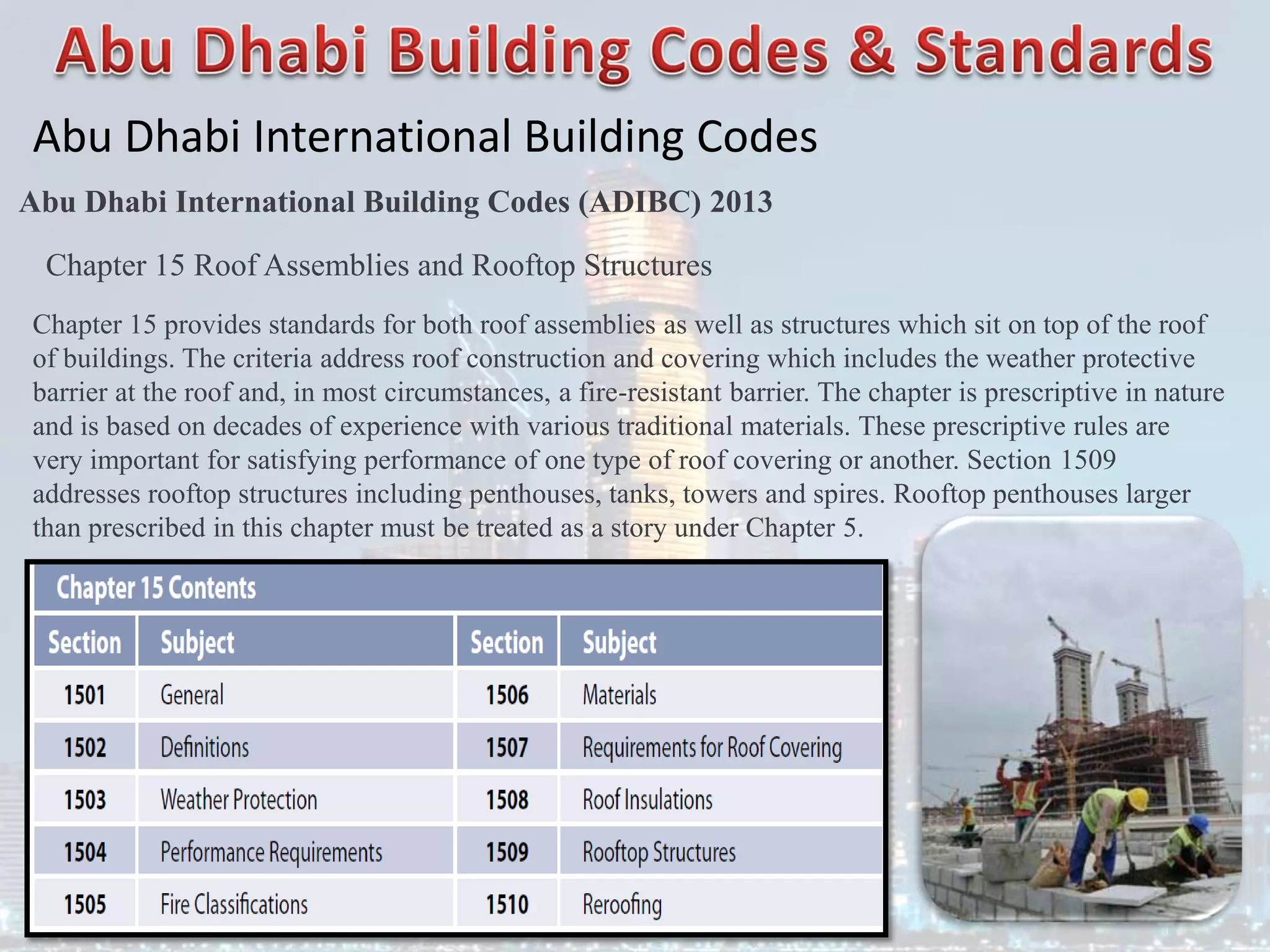
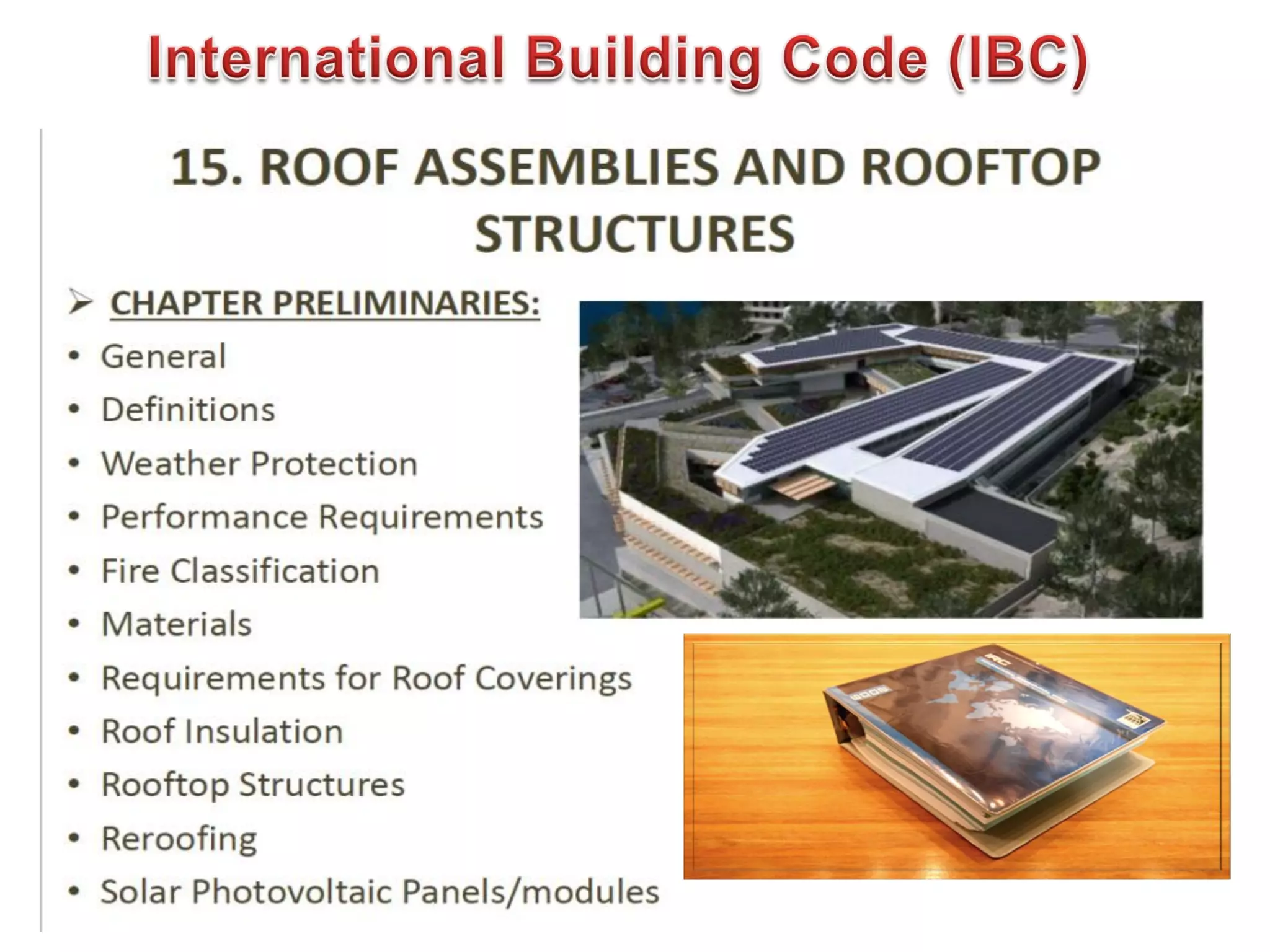
Chapter 15 Roof Assemblies and Rooftop Structures
Chapter 15 provides standards for both roof assemblies as well as structures which sit on top of the roof
of buildings. The criteria address roof construction and covering which includes the weather protective
barrier at the roof and, in most circumstances, a fire-resistant barrier. The chapter is prescriptive in nature
and is based on decades of experience with various traditional materials. These prescriptive rules are
very important for satisfying performance of one type of roof covering or another. Section 1509
addresses rooftop structures including penthouses, tanks, towers and spires. Rooftop penthouses larger
than prescribed in this chapter must be treated as a story under Chapter 5.
Abu Dhabi International Building Codes
Abu Dhabi International Building Codes (ADIBC) 2013
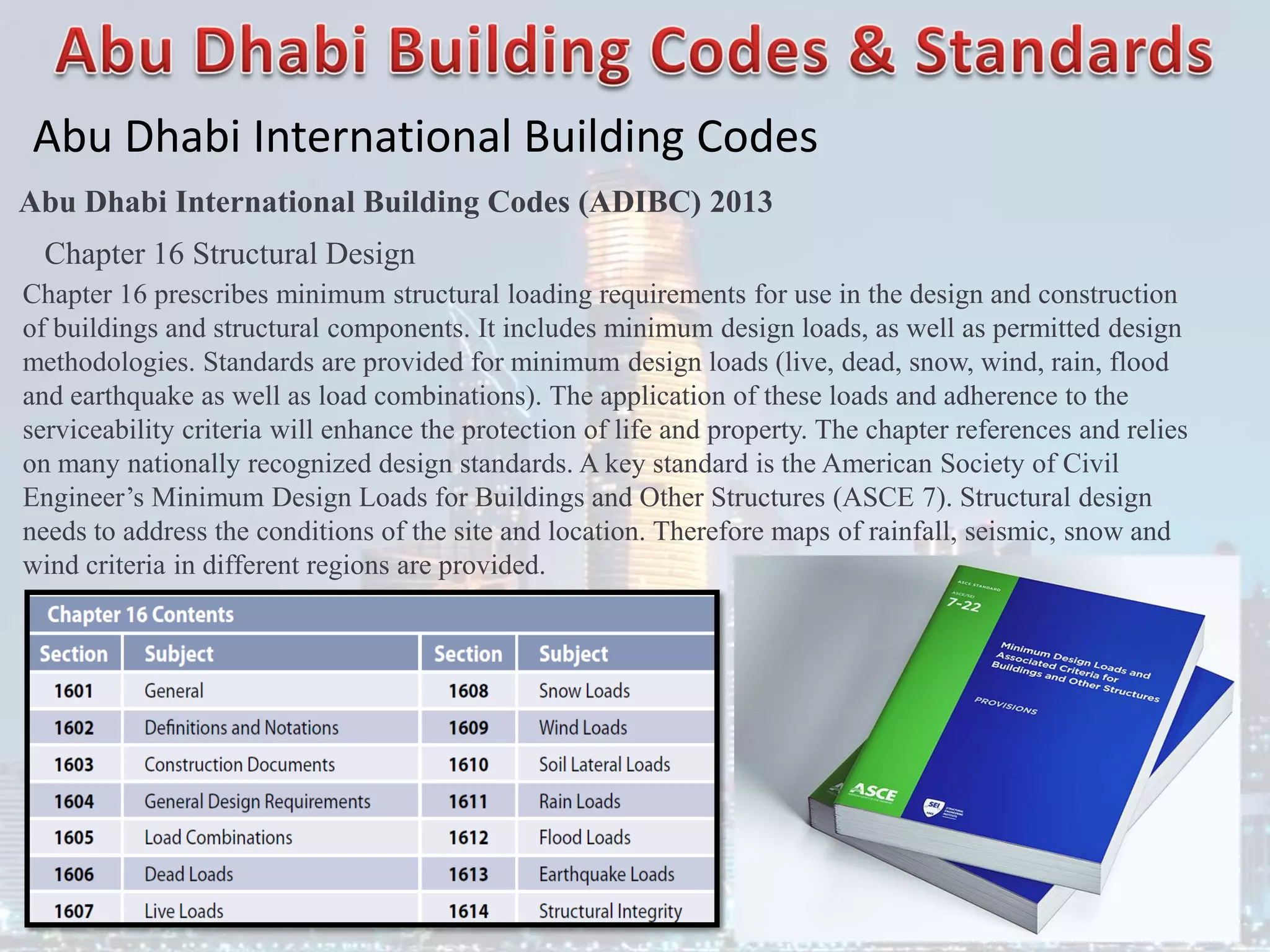
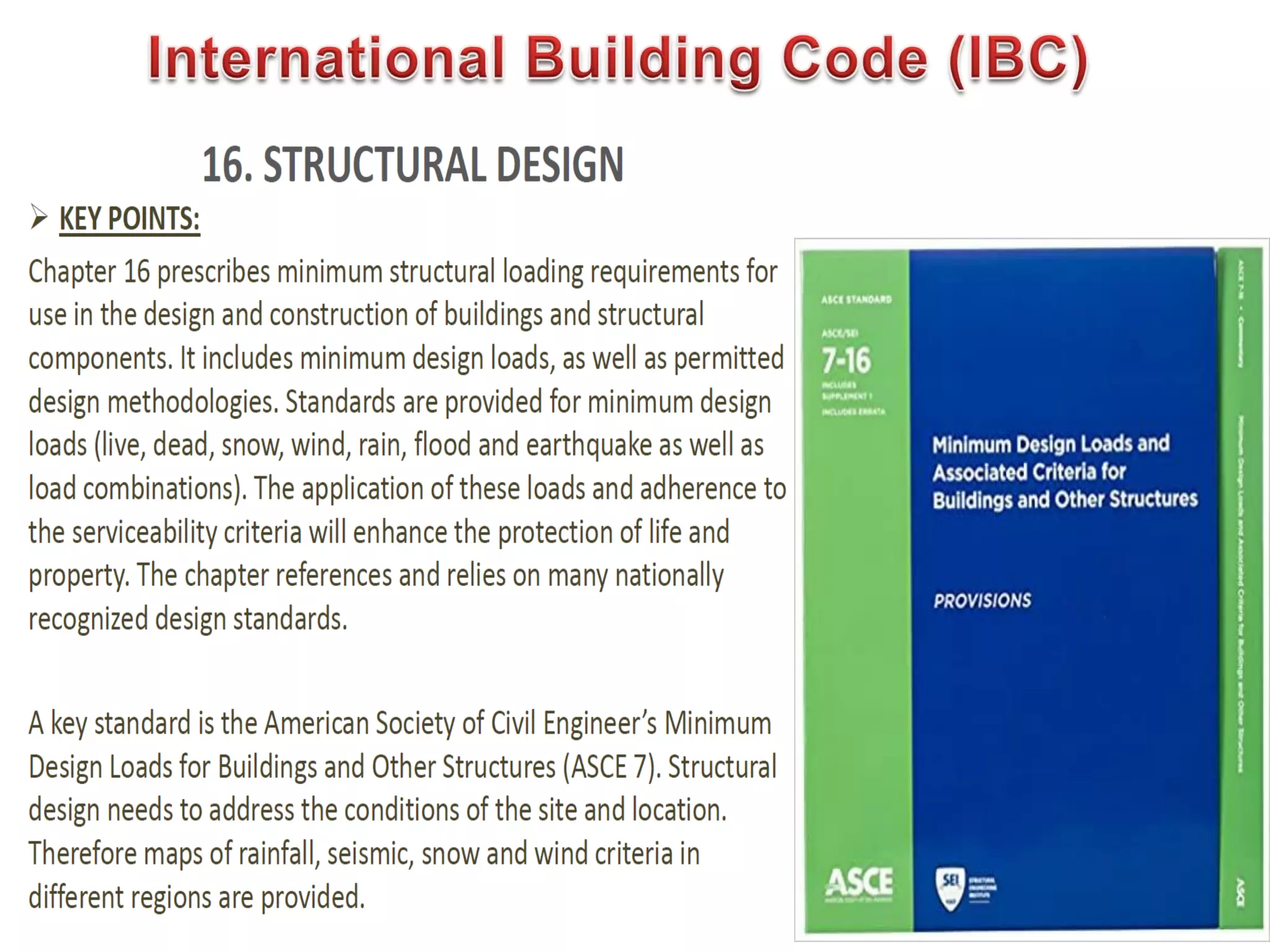
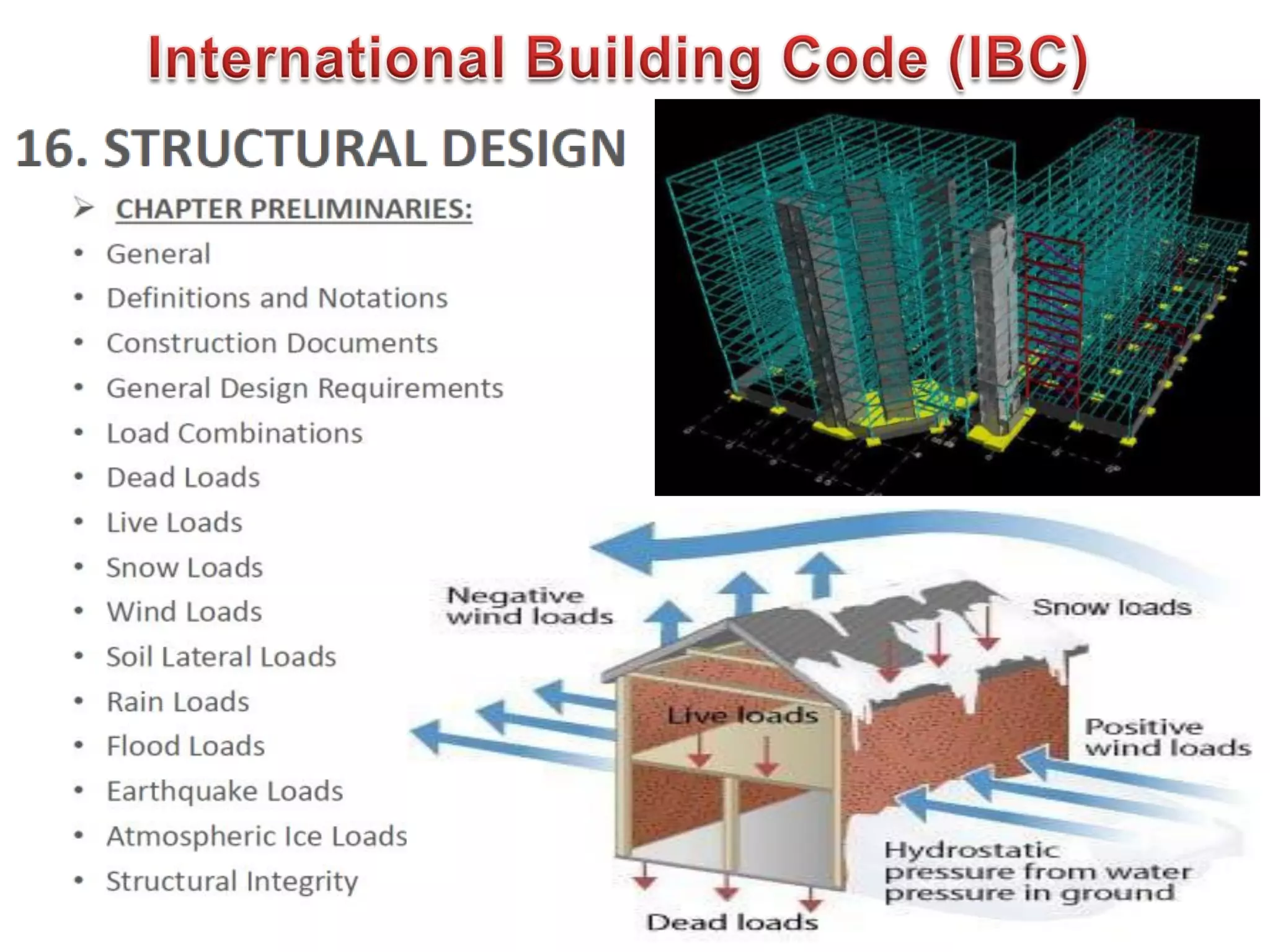
Chapter 16 Structural Design
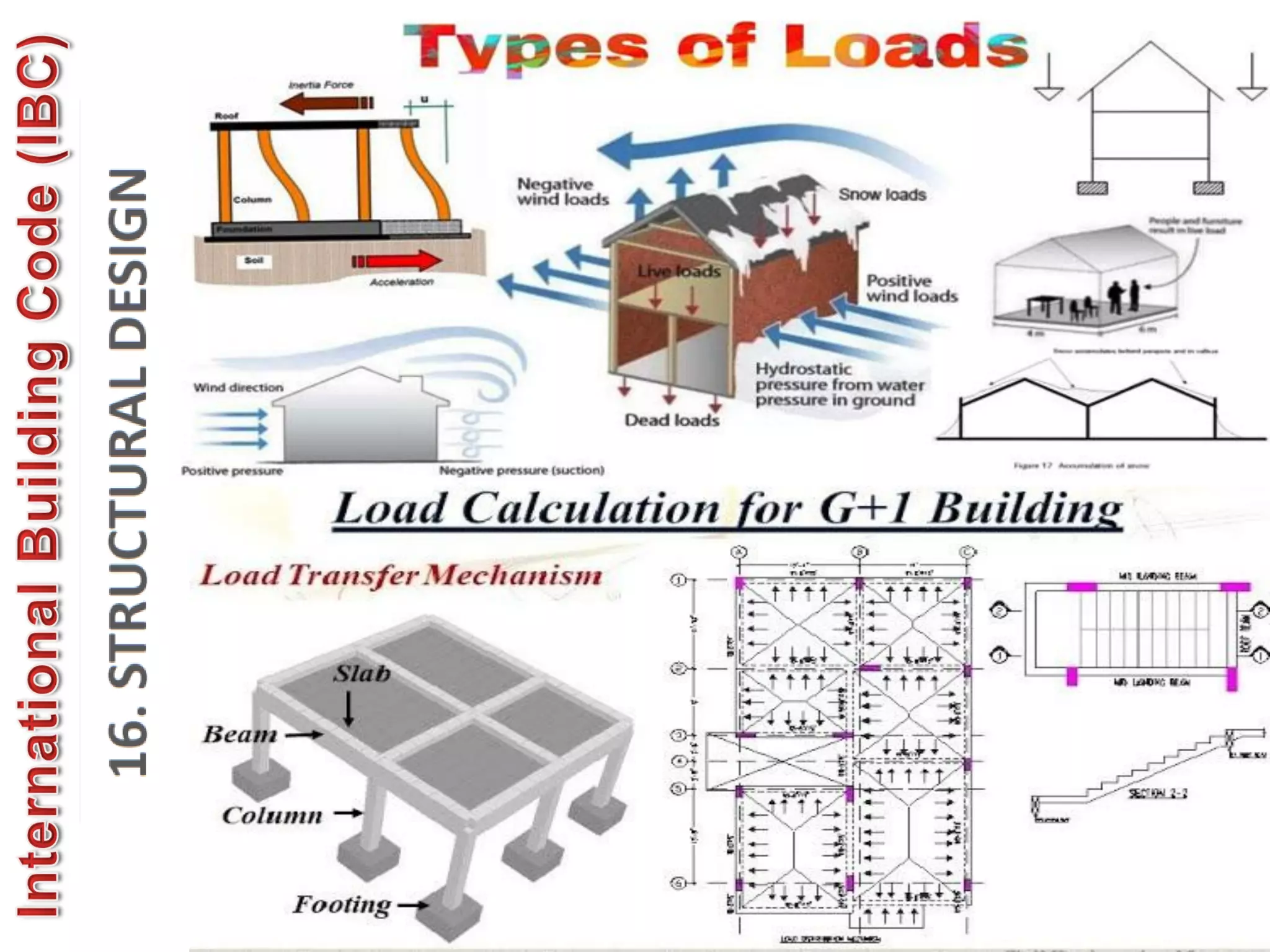
Chapter 16 prescribes minimum structural loading requirements for use in the design and construction
of buildings and structural components. It includes minimum design loads, as well as permitted design
methodologies. Standards are provided for minimum design loads (live, dead, snow, wind, rain, flood
and earthquake as well as load combinations). The application of these loads and adherence to the
serviceability criteria will enhance the protection of life and property. The chapter references and relies
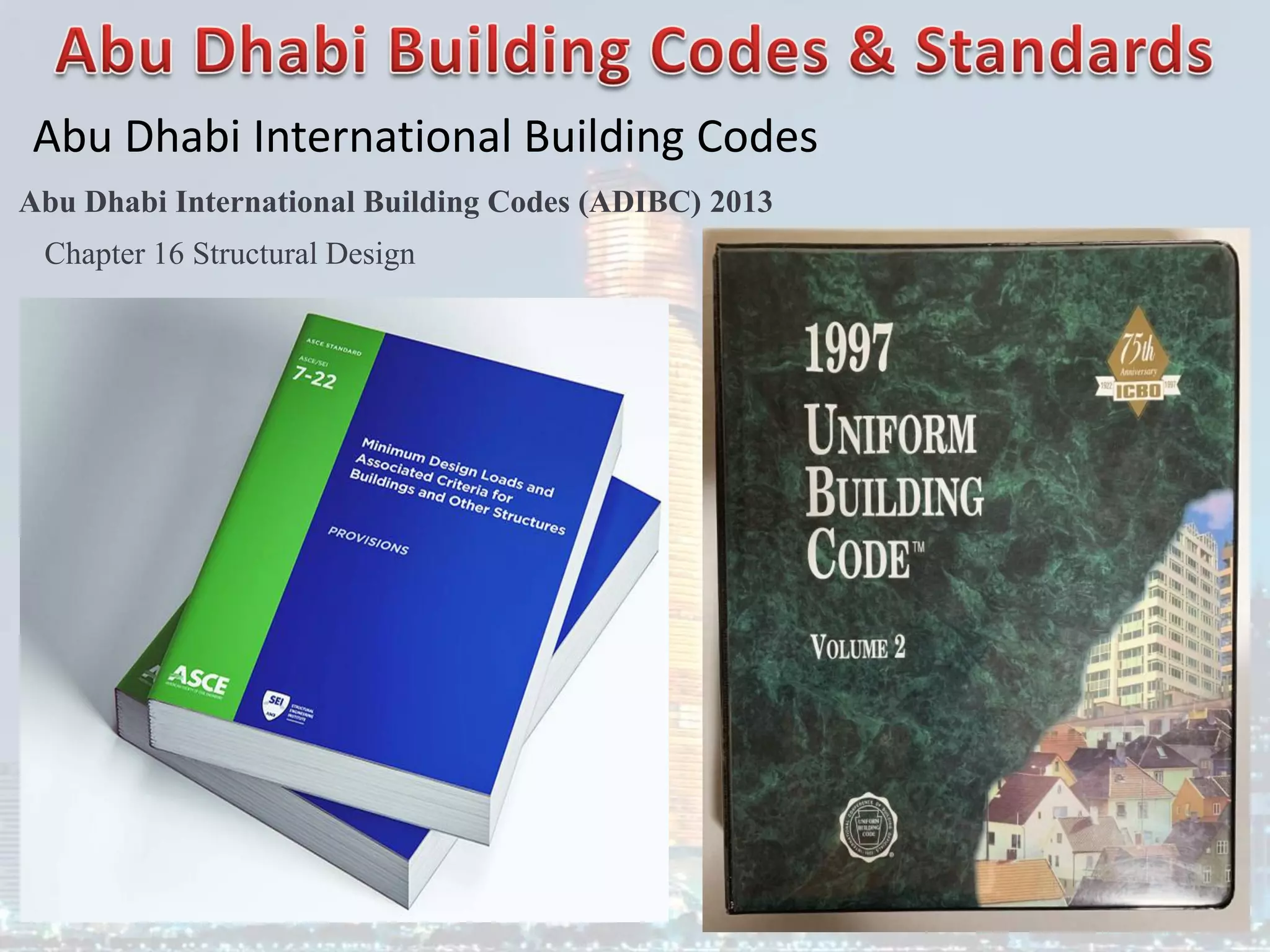
on many nationally recognized design standards. A key standard is the American Society of Civil
Engineer’s Minimum Design Loads for Buildings and Other Structures (ASCE 7). Structural design
needs to address the conditions of the site and location. Therefore maps of rainfall, seismic, snow and
wind criteria in different regions are provided.
Abu Dhabi International Building Codes
Abu Dhabi International Building Codes (ADIBC) 2013
Chapter 16 Structural Design
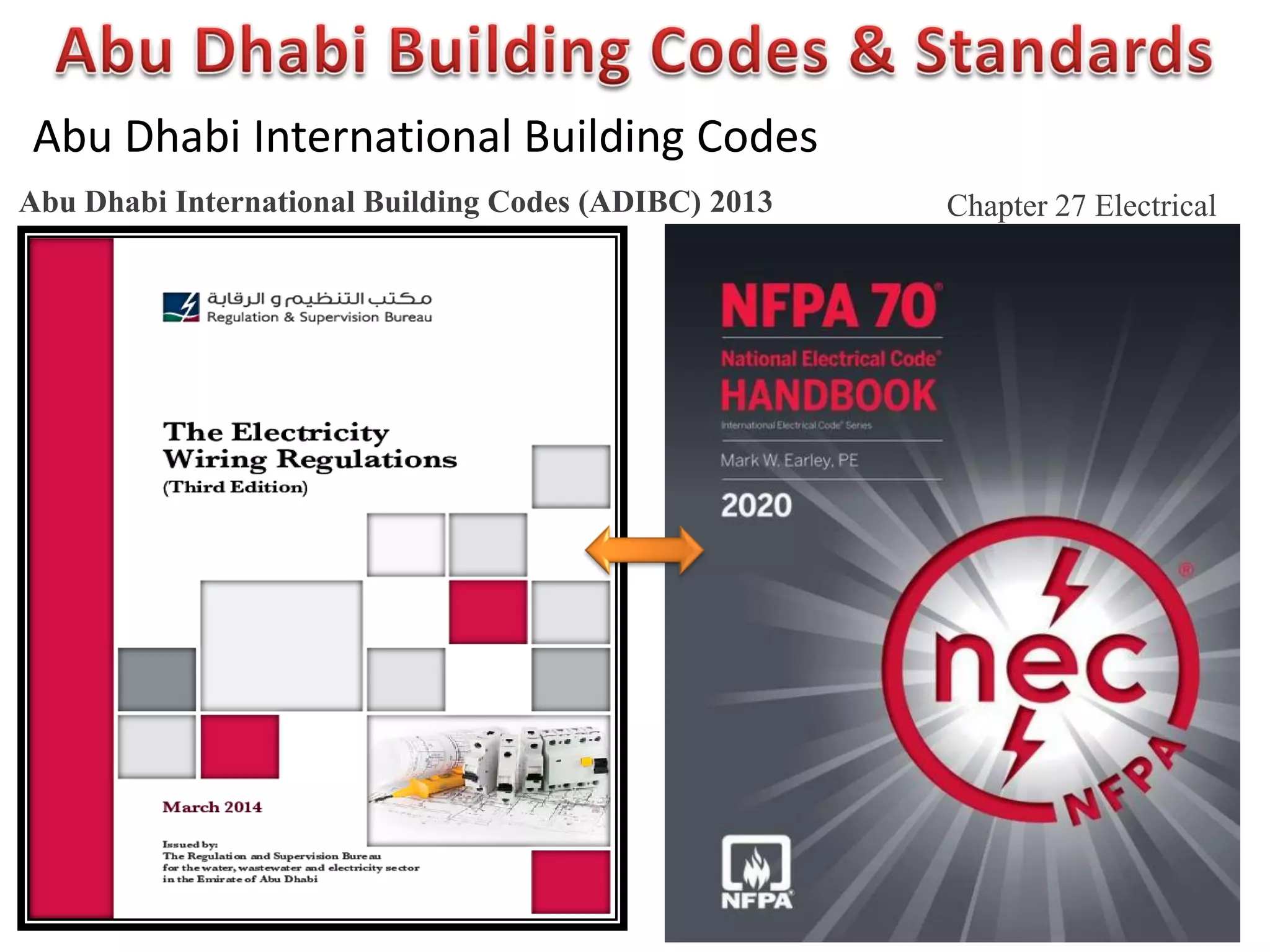
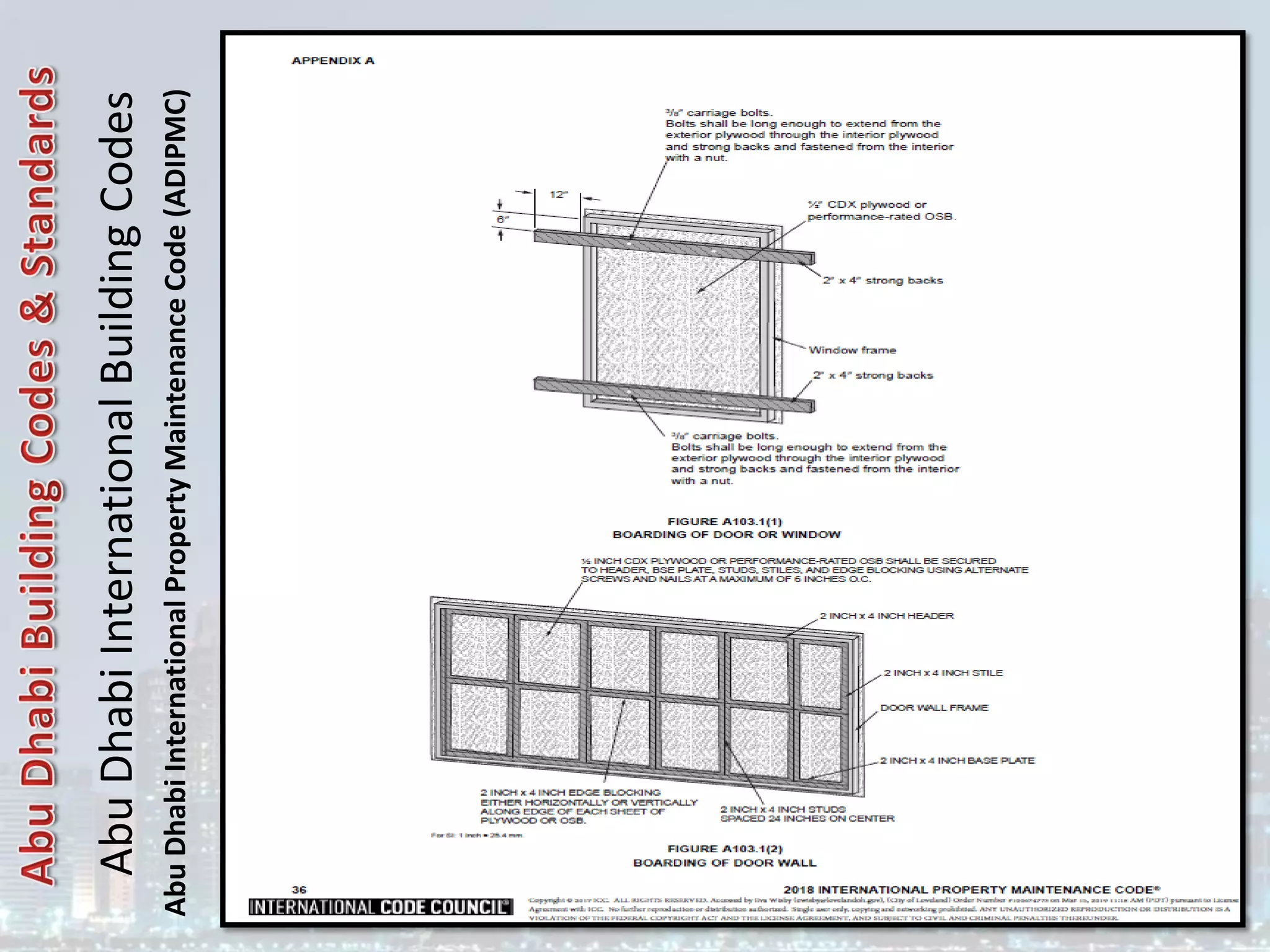
Abu Dhabi International Building Codes
Abu Dhabi International Building Codes (ADIBC) 2013
Chapter 17 Structural Tests and Special Inspections
Chapter 17 provides a variety of procedures and criteria for testing materials and assemblies, for labeling
materials and assemblies, and for special inspection of structural assemblies. This chapter expands on the
requirements of Chapter 1 regarding the roles and responsibilities of the building official regarding approval of
building components. It also provides additional duties and responsibilities for the owner, contractor, design
professionals and special inspectors. Proper assembly of structural components, proper quality of materials used,
and proper application of materials are essential to ensuring that a building, once constructed, complies with the
structural and fire-resistance minimums of the code and the approved design. To determine this compliance often
requires continuous or frequent inspection and testing. Chapter 17 establishes these special inspection and
testing standards as well as reporting of the work to the building official.
Chapter 17 Structural Tests
and Special Inspections
refer to projects contract
conditions & specifications
that include the QA/QC
report and inspection
planning, in addition to all
international standards
related to this issue (ASTM,
BS, NBIC, etc.)
Total Quality Management (TQM)
Quality Assurance (QA)
Quality Control (QC)
Inspection
Abu Dhabi International Building Codes
Abu
Dhabi
International
Building
Codes
(ADIBC)
2013
Abu Dhabi International Building Codes
Abu Dhabi International Building Codes (ADIBC) 2013
Abu Dhabi International Building Codes
Abu Dhabi International Building Codes (ADIBC) 2013
Abu Dhabi International Building Codes
Abu Dhabi International Building Codes (ADIBC) 2013
Chapter 18 Soils and Foundations
Chapter 18 contains minimum requirements for design, construction and resistance to water intrusion of
foundation systems for buildings and other structures. It provides criteria for the geotechnical and structural
considerations in the selection and installation of adequate support for the loads transferred from the structure
above. The uncertainties of foundation construction make it extremely difficult to address every potential
failure within the text of the code. The chapter includes requirements for soils investigation and site preparation
for receiving a foundation including the allowed load-bearing values for soils and for protecting the foundation
from water intrusion. Section 1808 addresses the basic requirements for all foundation types. Later sections
address foundation requirements that are specific to shallow foundations and deep foundations.
Due care must be exercised in the planning and design of foundation systems based on obtaining sufficient soils
information, the use of accepted engineering procedures, experience and good technical judgment.
Abu
Dhabi
International
Building
Codes
(ADIBC)
2013
Chapter 18 Soils and Foundations
Abu
Dhabi
International
Building
Codes
Abu Dhabi International Building Codes (ADIBC) 2013
Chapter 18 Soils and Foundations
Abu
Dhabi
International
Building
Codes
Abu Dhabi International Building Codes (ADIBC) 2013
Chapter 18 Soils and Foundations
Abu
Dhabi
International
Building
Codes
Abu Dhabi International Building Codes (ADIBC) 2013
Chapter 18 Soils and Foundations
Abu
Dhabi
International
Building
Codes
Abu Dhabi International Building Codes (ADIBC) 2013
Chapter 18 Soils and Foundations
Abu
Dhabi
International
Building
Codes
Abu Dhabi International Building Codes
Abu Dhabi International Building Codes (ADIBC) 2013
Chapter 19 Concrete
concrete slabs, anchorage to concrete, shotcrete, reinforced gypsum concrete and concrete-
filled pipe columns. Because of the variable properties of material and numerous design and
construction options available in the uses of concrete, due care and control throughout the
construction process is necessary.
This chapter provides minimum accepted practices to the design and construction of buildings and structural
components using concrete-both plain and reinforced.
Chapter 19 is formatted to parallel American Concrete Institute (ACI) 318, Building Code Requirements for Structural
Concrete. The chapter also includes references to additional standards. Structural concrete must be designed and
constructed to comply with this code and all listed standards. There are specific sections of the chapter addressing
Abu
Dhabi
International
Building
Codes
Abu Dhabi International Building
Codes (ADIBC) 2013
Abu Dhabi International Building Codes
Abu Dhabi International Building Codes (ADIBC) 2013
Chapter 20 Aluminum
Chapter 20 contains standards for the use of aluminum in
building construction. Only the structural applications of
aluminum are addressed. The chapter does not address the use
of aluminum in specialty products such as storefront or window
framing or architectural hardware. The use of aluminum in
heating, ventilating or air-conditioning systems is addressed in
the Abu Dhabi International Mechanical Code (ADIMC).
The chapter references national standards from the Aluminum
Association for use of aluminum in building construction, AA
ASM 35, Aluminum Sheet Metal Work in Building
Construction , and AAADM 1, Aluminum Design Manual . By
utilizing the standards set forth, a proper application of this
material can be obtained.
Abu
Dhabi
International
Building
Codes
Abu Dhabi International Building Codes (ADIBC) 2013
the Aluminum
Association for use
of aluminum in
building
construction, AA
ASM 35, Aluminum
Sheet Metal Work
in Building
Construction , and
AAADM 1,
Aluminum Design
Manual.
Chapter 20 Aluminum
Abu Dhabi International Building Codes
Abu Dhabi International Building Codes (ADIBC) 2013
the Aluminum Association for use of aluminum in building construction, AAASM 35, Aluminum
Sheet Metal Work in Building Construction , and AAADM 1, Aluminum Design Manual.
Abu Dhabi International Building Codes
Abu Dhabi International Building Codes (ADIBC) 2013
Chapter 21 Masonry
This chapter provides comprehensive and practical requirements for masonry construction. The provisions of Chapter 21
require minimum accepted practices and the use of standards for the design and construction of masonry structures. The
provisions address: material specifications and test methods; types of wall construction; criteria for engineered and
empirical designs; required details of construction including the execution of construction.
Masonry design methodologies including allowable stress design, strength design
and empirical design are covered by provisions of the chapter. Also addressed are
masonry fireplaces and chimneys, masonry heaters and glass unit masonry.
Fire-resistant construction using masonry is also required to comply with Chapter
7. Masonry foundations are also subject to the requirements of Chapter 18.
Abu Dhabi International Building Codes
Abu Dhabi International Building Codes (ADIBC) 2013
Chapter 22 Steel
Chapter 22 provides the requirements necessary for the design and construction of structural steel (including
composite construction), cold-formed steel, steel joists, steel cable structures and steel storage racks. The chapter
specifies appropriate design and construction standards for these types of structures. It also provides a road map of
the applicable technical requirements for steel structures. Steel is a noncombustible building material commonly
associated with Types I and II construction; however, it is permitted to be used in all types of construction. The
code requires that materials used in the design of structural steel members conform to designated national
standards. Chapter 22 is involved with the design and use of steel materials using the specifications and standards
of the American Institute for Steel Construction, the American Iron and Steel Institute, the Steel Joist Institute and
the American Society of Civil Engineers.
Abu Dhabi International Building Codes
Abu Dhabi International Building Codes (ADIBC) 2013
AISC:
American
Institute for
Steel
Construction
AISC:
American
Institute for
Steel
Construction
Abu Dhabi International Building Codes
Abu Dhabi International Building Codes (ADIBC) 2013
Abu Dhabi
International
Building Codes
Abu Dhabi International Building Codes (ADIBC) 2013
Abu Dhabi International Building Codes
Abu Dhabi International Building Codes (ADIBC) 2013
Chapter 23 Wood
This Chapter has been reserved in the ADIBC version due to the
fact that wood construction is not common in the area.
Therefore, in the event of using wood in the construction of any
building, the original Chapter 23 of IBC shall be used.
Abu
Dhabi
International
Building
Codes Abu Dhabi International Building Codes (ADIBC) 2013
ANSI/APA PRG
320-2011
Standard for
Performance-
Rated Cross-
Laminated
Timber
Chapter 23 Wood
Abu Dhabi International Building Codes
Abu Dhabi International Building Codes (ADIBC) 2013
Chapter 24 Glass and Glazing
This chapter establishes regulations for glass and glazing used in buildings and structures that, when installed,
are subjected to wind, snow and dead loads. Engineering and design requirements are included in the chapter.
Additional structural requirements are found in Chapter 16. A second concern of this chapter is glass and glazing
used in areas where it is likely to have an impact on the occupants.
Section 2406 identifies hazardous locations where glazing installed must either be safety glazing or blocked to
prevent human impact. Safety glazing must meet stringent standards and be appropriately marked or identified.
Additional standards for glass and glazing in guards, handrails, elevator hoistways and elevator cars, and in
athletic facilities are provided.
Abu Dhabi International Building Codes
Abu Dhabi International Building Codes (ADIBC) 2013
Chapter 24 Glass and Glazing
Abu Dhabi International Building Codes
Abu Dhabi International Building Codes (ADIBC) 2013
Abu Dhabi International Building Codes
Abu Dhabi International Building Codes (ADIBC) 2013
Chapter 25 Gypsum Board and Plaster
Chapter 25 contains the provisions and referenced standards that regulate the design, construction and quality
of gypsum board and plaster. These represent the most common interior and exterior finish materials in the
building industry. This chapter primarily addresses quality-control related issues with regard to material
specifications and installation requirements.
Most products are manufactured under the control of industry standards. The building official or inspector
primarily needs to verify that the appropriate product is used and properly installed for the intended use and
location. While often simply used as wall and ceiling coverings, proper design and application are necessary to
provide weather resistance and required fire protection for both structural and nonstructural building
components.
Abu
Dhabi
International
Building
Codes
Abu Dhabi International Building Codes (ADIBC) 2013
Chapter 25 Gypsum Board and Plaster
Abu Dhabi International Building Codes
Abu Dhabi International Building Codes (ADIBC) 2013
Chapter 26 : Plastic
The use of plastics in building construction and components is addressed in Chapter 26. This chapter provides
standards addressing foam plastic insulation, foam plastics used as interior finish and trim, and other plastic
veneers used on the inside or outside of a building. Plastic siding is regulated by Chapter 14. Sections 2606
through 2611 address the use of light-transmitting plastics in various configurations such as walls, roof panels,
skylights, signs and as glazing.
Requirements for the use of fiber
reinforced polymers, fiberglass
reinforced polymers and reflective
plastic core insulation are also contained
in this chapter. Some plastics exhibit
rapid flame spread and heavy smoke
density characteristics when exposed to
fire. Additionally, exposure to the heat
generated by a fire can cause some
plastics to deform, which can affect their
performance. The requirements and
limitations of this chapter are necessary
to control the use of plastic and foam
plastic products such that they do not
compromise the safety of building
occupants.
Abu Dhabi International Building Codes
Abu Dhabi International Building Codes (ADIBC) 2013 Chapter 26 : Plastic
Abu Dhabi International Building Codes
Abu Dhabi International Building Codes (ADIBC) 2013 Chapter 26 : Plastic
Abu Dhabi International Building Codes
Abu Dhabi International Building Codes (ADIBC) 2013
Chapter 27 Electrical
Since electrical systems and components are an integral part of almost all
structures, it is necessary for the code to address the installation of such systems.
For this purpose, Chapter 27 references the Electricity Wiring Regulations 2007,
Revision 1, dated January, 2009, as promulgated by the Regulation and
Supervision Bureau, Emirate of Abu Dhabi.
In addition, Section 2702 addresses emergency and standby power requirements.
Such systems must comply with the International Fire Code (IFC) and referenced
standards. This section also provides references to the various code sections
requiring emergency and standby power, such as high-rise buildings and
buildings containing hazardous materials.
Abu Dhabi International Building Codes
Abu Dhabi International Building Codes (ADIBC) 2013 Chapter 27 Electrical
Abu Dhabi International Building Codes
Abu Dhabi International Building Codes (ADIBC) 2013
Chapter 28 Mechanical Systems
Nearly all buildings will include mechanical systems. This chapter provides references to the Abu Dhabi
International Mechanical Code (ADIMC) and the Abu Dhabi International Fuel Gas Code (ADIFGC) for
the design and installation of mechanical systems. In addition, the chapter references Chapter 21 of the
ADIBC for masonry chimneys, fireplaces and barbecues.
Abu Dhabi International Building Codes
Abu Dhabi International Building Codes (ADIBC) 2013
Chapter 29 Plumbing Systems
Chapter 29 regulates the minimum requirements to design and install plumbing systems that must be provided for
every type of building. This chapter also regulates the low rates of the required fixtures in various types of
buildings to achieve the water conservation objective of Estidama program.
This chapter provides references to the Uniform Plumbing Code– Abu
Dhabi as published by the Abu Dhabi Environmental Agency and the
Water Supply Regulations, January, 2009 (WRS) as published by the
Regulation and Supervision Bureau. And for matters not provided for,
the International Plumbing Code (IPC) shall be used.
Abu
Dhabi
International
Building
Codes
Abu Dhabi International Building Codes (ADIBC) 2013
1. the Uniform Plumbing Code– Abu Dhabi; by the
Abu Dhabi Environmental Agency
2. the Water Supply Regulations, January, 2009
(WRS); the Regulation and Supervision Bureau
3. the International Plumbing Code (IPC)
Abu Dhabi International Building Codes
Abu Dhabi International Building Codes (ADIBC) 2013
Chapter 30 Elevators and Conveying Systems
Chapter 30 provides standards for the installation of elevators into buildings. Referenced standards
provide the requirements for the elevator system and mechanisms. Detailed standards are provided in
the chapter for hoistway enclosures, hoistway venting and machine rooms. New provisions are added
in the 2009 IBC for Fire Service Access Elevators required in high-rise buildings and for the optional
choice of Occupant Evacuation Elevators (see Section 403).
Abu Dhabi International Building Codes
Abu Dhabi International Building Codes (ADIBC) 2013
Chapter 31 Special Construction
Chapter 31 contains a collection of regulations for a variety of unique structures and architectural features.
Pedestrian walkways and tunnels connecting two buildings are addressed in Section 3104.
Membrane and air-supported structures are addressed by Section 3102. Safeguards for swimming pool safety are
found in Section 3109. Standards for temporary structures, including permit requirements are provided in Section
3103. Structures as varied as awnings, marquees, signs, telecommunication and broadcast towers and automatic
vehicular gates are also addressed (see Sections 3105 through 3108 and 3110).
Abu Dhabi International Building Codes
Abu Dhabi International Building Codes (ADIBC) 2013
Chapter 32 Encroachments into the Public Right-of-way
Buildings and structures from time to time are designed to extend over a property line and into the public right-
of-way. Local regulations outside of the building code usually set limits to such encroachments, and such
regulations take precedence over the provisions of this chapter. Standards are provided for encroachments below
grade for structural support, vaults and areaways.
Encroachments above grade are divided into below 8 feet, 8 feet to 15
feet, and above 15 feet, because of headroom and vehicular height issues.
This includes steps, columns, awnings, canopies, marquees, signs,
windows, balconies. Similar architectural features above grade are also
addressed. Pedestrian walkways must also comply with Chapter 31.
Abu Dhabi International Building Codes
Abu Dhabi International Building Codes (ADIBC) 2013
Chapter 33 Safeguards During Construction
Chapter 33 provides safety requirements during construction and demolition of buildings and structures.
These requirements are intended to protect the public from injury and adjoining property from damage.
In addition the chapter provides for the progressive installation and operation of exit stairways and
standpipe systems during construction. This Chapter refers to the Codes of Practice issued by the
Environment, Health and Safety Center of Abu Dhabi.
Abu
Dhabi
International
Building
Codes
Abu Dhabi International Building Codes (ADIBC) 2013
The Occupational Safety and Health of Abu Dhabi - OSHAD
Abu
Dhabi
International
Building
Codes
Abu Dhabi International Building Codes (ADIBC) 2013
the Codes of Practice issued by: the
Environment, Health and Safety Center of
Abu Dhabi.
Abu Dhabi International Building Codes
Abu Dhabi International Building Codes (ADIBC) 2013
Chapter 34 Existing Structures
The provisions in Chapter 34 deal with alternative methods or reduced compliance requirements when dealing
with existing building constraints. This chapter allows for a controlled departure from full compliance with the
technical codes, without compromising the minimum standards for fire prevention and life safety features of the
rehabilitated building. Provisions are divided by addition, alterations, repairs, change of occupancy and moved
structures. There are further allowances for registered historic buildings. There are also special allowances for
replacement of existing stairways, replacement of glass and accessibility requirements.
Section 3412, Compliance Alternatives, allows for existing buildings to be evaluated so as to show that
alterations, while not meeting new construction requirements, will improve the current existing situation.
Provisions are based on a numerical scoring system involving 18 various safety parameters and the degree of
code compliance for each issue.
Abu Dhabi International Building Codes
Abu Dhabi International Building Codes (ADIBC) 2013
Chapter 35 Referenced Standards
The code contains numerous references to standards that are used to
regulate materials and methods of construction.
Chapter 35 contains a comprehensive list of all standards that are
referenced in the code, including the appendices. The standards are part
of the code to the extent of the reference to the standard (see Section
102.4). Compliance with the referenced standard is necessary for
compliance with this code. By providing specifically adopted standards,
the construction and installation requirements necessary for compliance
with the code can be readily determined.
The basis for code compliance is, therefore, established and available on
an equal basis to the building code official, contractor, designer and
owner.
Chapter 35 is organized in a manner that makes it easy to locate specific
standards. It lists all of the referenced standards, alphabetically, by
acronym of the promulgating agency of the standard.
Each agency’s standards are then listed in either alphabetical or numeric
order based upon the standard identification. The list also contains the
title of the standard; the edition (date) of the standard referenced; any
addenda included as part of the ICC adoption; and the section or sections
of this code that reference the standard.
Abu
Dhabi
International
Building
Codes Abu Dhabi International Building Codes (ADIBC) 2013
Abu
Dhabi
International
Building
Codes Abu Dhabi International Building Codes (ADIBC) 2013
Abu Dhabi International Building Codes
Abu Dhabi International Building Codes (ADIBC) 2013
Appendices
Appendices are provided in the ADIBC to offer supplemental criteria to
the provisions in the main chapters of the code. Appendices have the
same force and effect as the first 35 chapters of the ADIBC.
Appendix A ( Reserved )
Appendix B ( Reserved )
Appendix C Group U-Agricultural Buildings.
Appendix C provides a more liberal set of standards for the construction
of agricultural buildings, rather than strictly following the Utility
building provision, reflective of their specific usage and limited occupant
load. The provisions of the appendix allow reasonable heights and areas
commensurate with the risk of agricultural buildings.
Appendix E Supplemental Accessibility Requirements.
Appendix E includes scoping requirements contained in the new
ADA/ABAAccessibility Guidelines that are not in Chapter 11 and not
otherwise mentioned or mainstreamed throughout the code. Items in the
appendix deal with subjects not typically addressed in the main chapter
(e.g., beds, room signage, transportation facilities).
Abu Dhabi International Building Codes
Abu Dhabi International Building Codes (ADIBC) 2013
Appendices
Appendix F Rodent proofing.
The provisions of this appendix are minimum mechanical methods
to prevent the entry of rodents into a building. These standards,
when used in conjunction with cleanliness and maintenance
programs, can significantly reduce the potential of rodents invading
a building.
Appendix G Flood-resistant Construction.
Appendix G is intended to fulfill the floodplain management and
administrative requirements of the Emirate of Abu Dhabi agencies
having jurisdiction over such regulations.
Appendix H Signs.
Appendix H gathers in one place the various code standards that
regulate the construction and protection of outdoor signs.
Whenever possible, the appendix provides standards in
performance language, thus allowing the widest possible
application.
Abu Dhabi International Building Codes
Abu Dhabi International Building Codes (ADIBC) 2013
Appendix I Patio Covers.
Appendix I provides standards applicable to the
construction and use of patio covers. It is limited in
application to patio covers accessory to dwelling
units. Covers of patios and other outdoor areas
associated with restaurants, mercantile buildings,
offices, nursing homes or other non-dwelling
occupancies would be subject to standards in the
main code and not this appendix.
Appendix J Grading
Appendix J provides standards for the grading of
properties. The appendix also provides standards for
administration and enforcement of a grading program
including permit and inspection requirements.
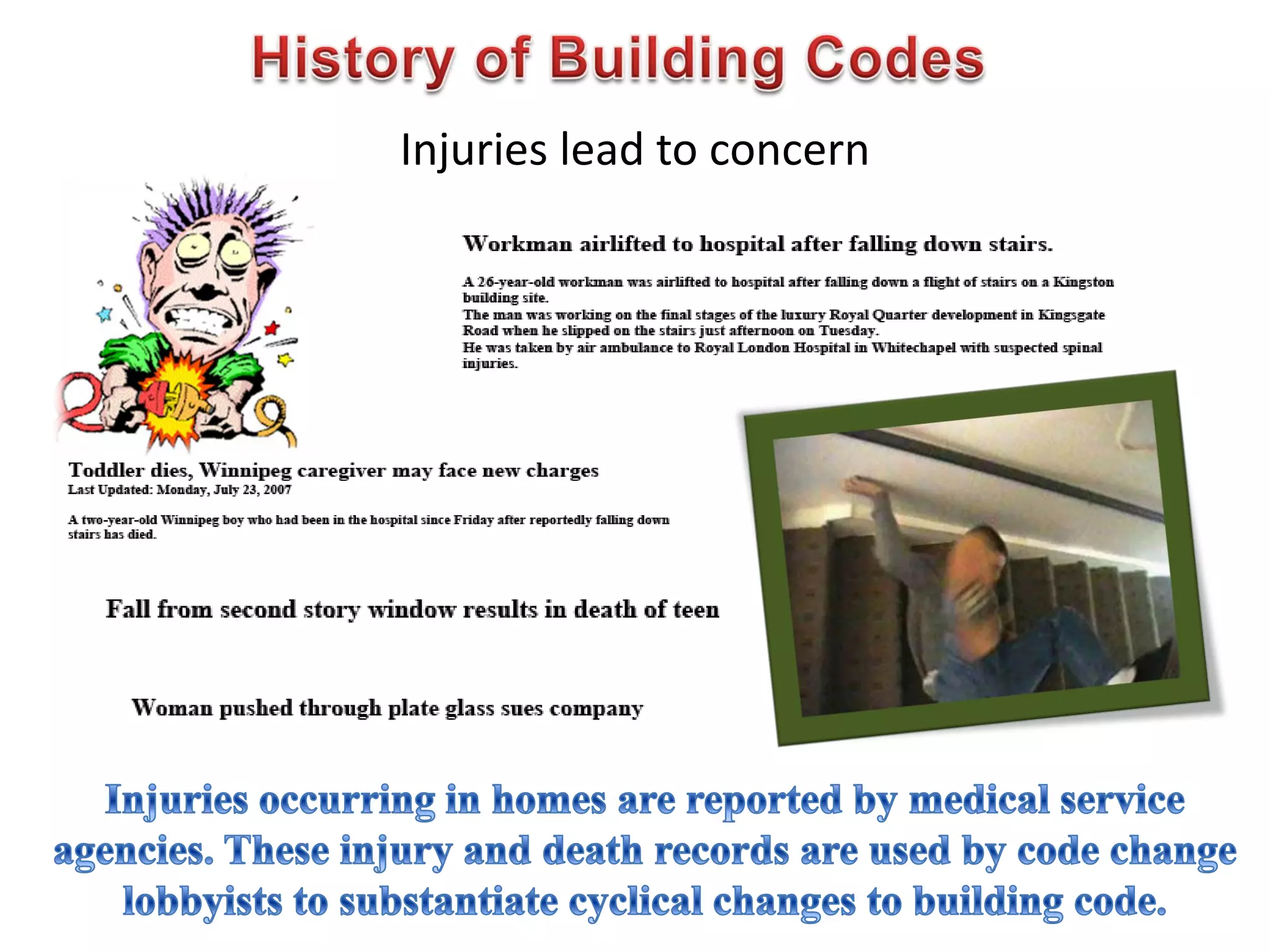
Appendices
Abu Dhabi International Building Codes
Abu Dhabi International Energy Conservation Code (ADIECC)
A - General Description of ADIECC
B - Arrangement and Formatting
C - Chapter by Chapter Description
Abu Dhabi International Building Codes
Abu Dhabi International Energy Conservation Code (ADIECC)
Abu Dhabi International Building Codes
Abu Dhabi International Energy Conservation Code (ADIECC)
Abu Dhabi International Building Codes
Abu Dhabi International Energy Conservation Code (ADIECC)
Abu Dhabi International Building Codes
Abu Dhabi International Energy Conservation Code (ADIECC)
Abu
Dhabi
International
Building
Codes
Abu
Dhabi
International
Energy
Conservation
Code
(ADIECC)
Abu Dhabi International Building Codes
Abu Dhabi International Energy Conservation Code (ADIECC)
Abu Dhabi International Building Codes
A - General Description of ADIECC
The Abu Dhabi International Energy Conservation Code
(ADIECC) is a code that regulates minimum energy
conservation requirements for new buildings.
The ADIECC addresses energy conservation requirements
for all aspects of energy uses in both commercial and
residential construction, including heating and ventilating,
lighting, water heating, and power usage for appliances and
building systems.
The ADIECC is a design document. For example, before
one constructs a building, the designer must determine the
minimum insulation R -values and fenestration U -factors
for the building exterior envelope.
Depending on whether the building is for residential use or
for commercial use, the ADIECC sets forth minimum
requirements for exterior envelope insulation, window and
door U -factors and SHGC ratings, duct insulation, lighting
and power efficiency, and water distribution insulation.
Abu Dhabi International Energy Conservation Code (ADIECC)
Abu Dhabi International Building Codes
B - Arrangement and Format of ADIECC
Before applying the requirements of the ADIECC it is beneficial to understand its
arrangement and format. The ADIECC, like other codes published by ICC, is arranged and
organized to follow sequential steps that generally occur during a plan review or inspection.
The ADIECC is divided into five different parts:
C - Chapter by chapter description of ADIECC
The following is a chapter-by-chapter summary of the scope and
intent of the provisions of the Abu Dhabi International Energy
Conservation Code:
Abu Dhabi International Energy Conservation Code (ADIECC)
Abu Dhabi International Building Codes
Abu Dhabi International Energy Conservation Code (ADIECC)
Abu Dhabi International Building Codes
Abu Dhabi International Energy Conservation Code (ADIECC)
Chapter 1 Administration
This chapter contains provisions for the application, enforcement and administration of subsequent
requirements of the code. In addition to establishing the scope of the code, Chapter 1 identifies which
buildings and structures come under its purview.
Chapter 1 is largely concerned with maintaining “due process of law” in enforcing the energy conservation
criteria contained in the body of the code.
Only through careful observation of the administrative provisions can the building official reasonably
expect to demonstrate that “equal protection under the law” has been provided.
Abu Dhabi International Building Codes
Abu Dhabi International Energy Conservation Code (ADIECC)
Chapter 2 Definitions
All terms that are defined in the code are listed alphabetically in Chapter 2. While a defined
term may be used in one chapter or another, the meaning provided in Chapter 2 is applicable
throughout the code.
Additional definitions regarding climate zones are found in Tables 301.3(1) and (2). These
are not listed in Chapter 2.
Where understanding of a term’s definition is especially key to or necessary for
understanding of a particular code provision, the term is show in italics wherever it appears
in the code. This is true only for those terms that have a meaning that is unique to the code.
In other words, the generally understood meaning of a term or phrase might not be sufficient
or consistent with the meaning prescribed by the code; therefore, it is essential that the code-
defined meaning be known.
Abu Dhabi International Building Codes
Abu Dhabi International Energy Conservation Code (ADIECC)
Chapter 3 General Requirements
Chapter 3 specifies the climate zones that will serve to establish the exterior design conditions. In addition,
Chapter 3 provides interior design conditions that are used as a basis for assumptions in heating and cooling
load calculations, and provides basic material requirements for insulation materials and fenestration materials.
Climate has a major impact on the energy use of most buildings.
The code establishes many requirements such as wall and roof insulation R -values, window and door thermal
transmittance requirement (U-factors) as well as provisions that affect the mechanical systems based upon the
climate where the building is located.
This chapter will contain the information that will be used to properly assign the building location into the
correct climate zone and will then be used as the basis for establishing requirements or elimination of
requirements.
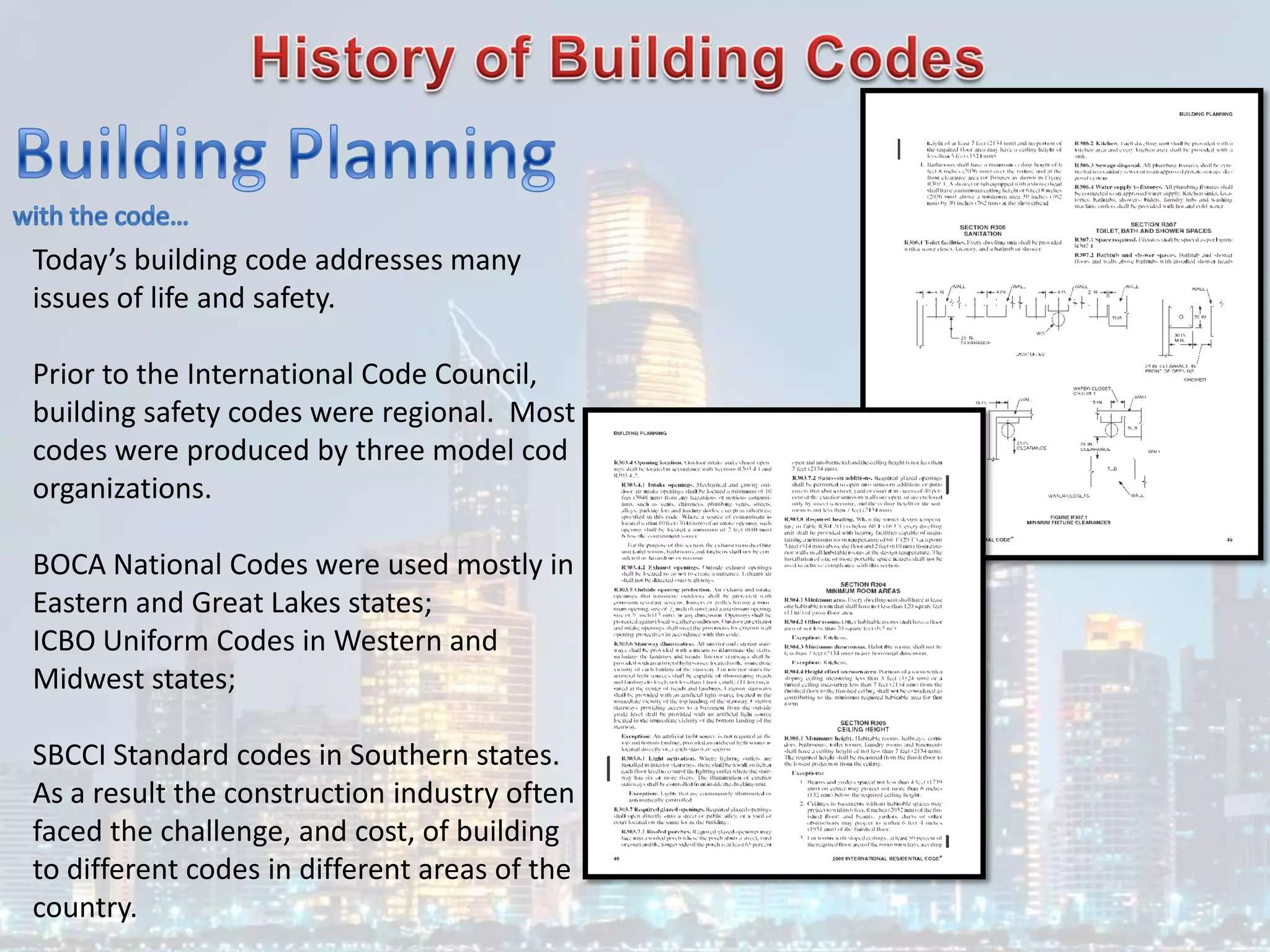
Abu Dhabi International Building Codes
Abu Dhabi International Energy Conservation Code (ADIECC)
Chapter 4 Residential Energy Efficiency
Chapter 4 contains the energy-efficiency related requirements for the design and construction of
residential buildings regulated under this code. It should be noted that the definition of a residential
building in this code is unique for this code. In this code, a residential building is an R-2, R-3 or R-4
building three stories or less in height. All other buildings, including residential buildings greater than
three stories in height, are regulated by the energy conservation requirements of Chapter 5.
The applicable portions of a residential building must comply with the provisions within this chapter
for energy efficiency. This chapter defines requirements for the portions of the building and building
systems that impact energy use in new residential construction and promotes the effective use of
energy.
The provisions within the chapter promote energy efficiency in the building envelope, the heating and
cooling system and the service water heating system of the building.
Abu Dhabi International Building Codes
Abu Dhabi International Energy Conservation Code (ADIECC)
Chapter 5 Commercial Energy Efficiency
Chapter 5 contains the energy-efficiency related requirements for the design and construction of most
types of commercial buildings and residential buildings greater than three stories in height above grade.
Residential buildings, townhouses and garden apartments three stories or less in height are covered in
Chapter 4.
Like Chapter 4, this chapter defines requirements for the portions of the building and building systems that
impact energy use in new commercial construction and new residential construction greater than three
stories in height, and promotes the effective use of energy. The provisions within the chapter promote
energy efficiency in the building envelope, the heating and cooling system and the service water heating
system of the building.
Abu Dhabi International Building Codes
Abu Dhabi International Energy Conservation Code (ADIECC)
Chapter 6 Referenced Standards
The code contains numerous references to standards that are used to regulate materials and methods of
construction.
Chapter 6 contains a comprehensive list of all standards that are referenced in the code. The standards are
part of the code to the extent of the reference to the standard. Compliance with the referenced standard is
necessary for compliance with this code. By providing specifically adopted standards, the construction
and installation requirements necessary for compliance with the code can be readily determined.
The basis for code compliance is, therefore, established and available on an equal basis to the code
official, contractor, designer and owner.
Chapter 6 is organized in a manner that makes it easy to locate
specific standards. It lists all of the referenced standards,
alphabetically, by acronym of the promulgating agency of the
standard.
Each agency’s standards are then listed in either alphabetical or
numeric order based upon the standard identification. The list
also contains the title of the standard; the edition (date) of the
standard referenced; any addenda included as part of the ICC
adoption; and the section or sections of this code that reference
the standard.
Abu Dhabi International Building Codes
Abu Dhabi International Energy Conservation Code (ADIECC)
Abu Dhabi International Building Codes
Abu Dhabi International Energy Conservation Code (ADIECC)
Abu Dhabi International Building Codes
Abu Dhabi International Mechanical Code (ADIMC)
A - General Description of ADIMC
B - Arrangement and Formatting
C - Chapter by Chapter Description
Abu Dhabi International Building Codes
Abu Dhabi International Mechanical Code (ADIMC)
Abu Dhabi International Building Codes
Abu Dhabi International Mechanical Code (ADIMC)
Abu Dhabi International Building Codes
Abu Dhabi International Mechanical Code (ADIMC)
A - General Description of ADIMC
The Abu Dhabi International Mechanical Code (ADIMC) is a code that regulates the design and
installation of mechanical systems, appliances, appliance venting, duct and ventilation systems,
combustion air provisions, hydronic systems and solar systems.
The purpose of the code is to establish the minimum acceptable level of safety and to protect life and
property from the potential dangers associated with the installation and operation of mechanical systems.
The code also protects the personnel that install, maintain, service and replace the systems and appliances
addressed by this code.
The ADIMC is primarily a prescriptive code with some performance text. The code relies heavily on
product specifications and listings to provide much of the appliance and equipment installation
requirements.
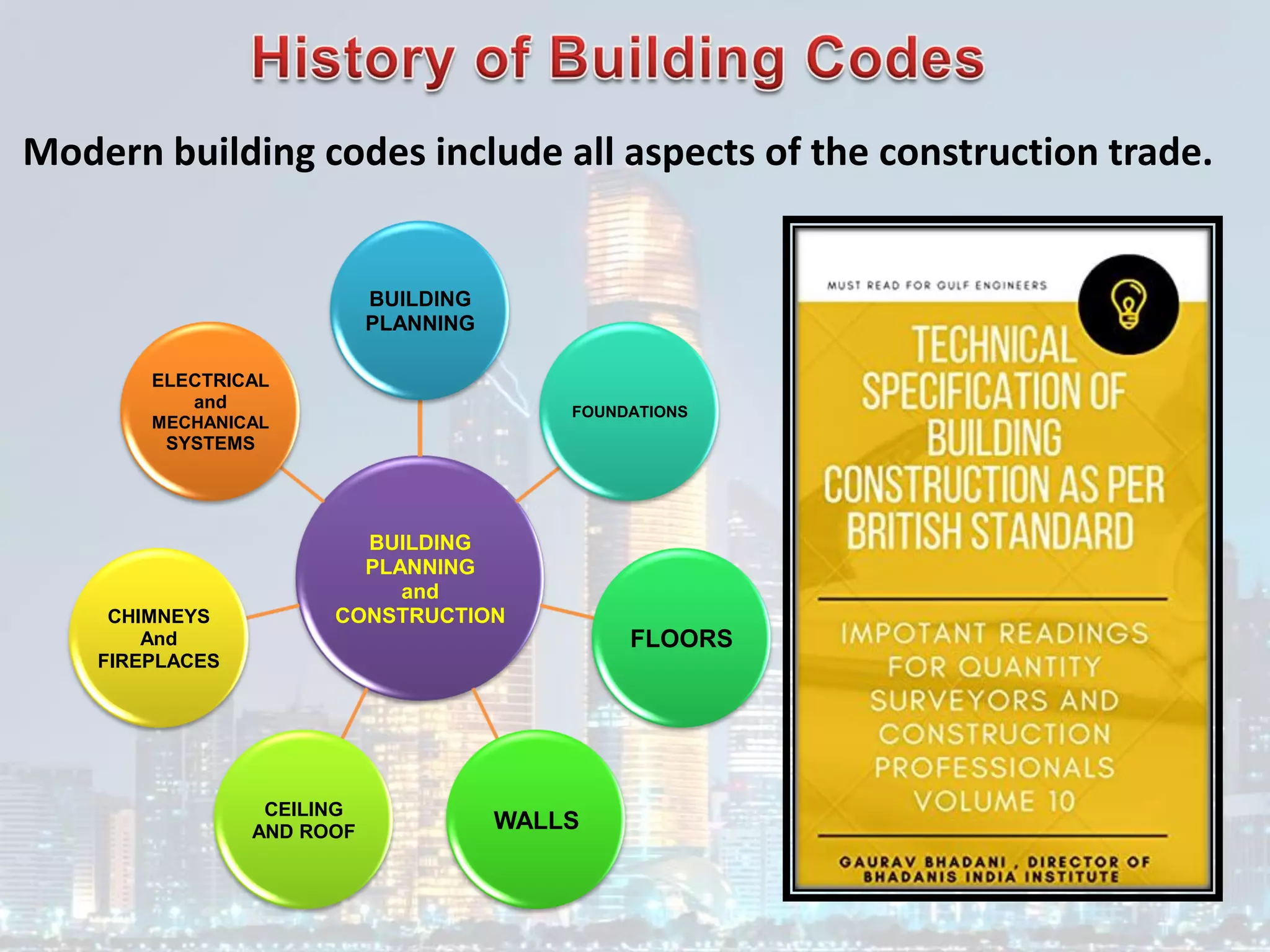
The general Section 105.2 and the exception to Section 403.2 allow designs and installations to be
performed by approved engineering methods as alternatives to the prescriptive methods in the code.
Abu Dhabi International Building Codes
Abu Dhabi International Mechanical Code (ADIMC)
B - Arrangement and Format of ADIMC
The format of the ADIMC allows each chapter to be devoted to a particular subject
with the exception of Chapter 3, which contains general subject matters that are not
extensive enough to warrant their own independent chapter.
C - Chapter by chapter
description of ADIMC
Abu
Dhabi
International
Building
Codes
Abu
Dhabi
International
Mechanical
Code
(ADIMC)
Abu
Dhabi
International
Building
Codes
Abu
Dhabi
International
Mechanical
Code
(ADIMC)
Abu Dhabi International Building Codes
Abu Dhabi International Mechanical Code (ADIMC)
Abu Dhabi International Building Codes
Abu Dhabi International Mechanical Code (ADIMC)
Chapter 1 Scope and Administration
Chapter 1 establishes the limits of applicability of the code and describes how the code is to be
applied and enforced.
A mechanical code, like any other code, is intended to be adopted as a legally enforceable
document and it cannot be effective without adequate provisions for its administration and
enforcement.
The provisions of Chapter 1 establish the authority and duties of the code official appointed by
the jurisdiction having authority and also establish the rights and privileges of the design
professional, contractor and property owner.
Abu Dhabi International Building Codes
Abu Dhabi International Mechanical Code (ADIMC)
Chapter 2 Definitions
Chapter 2 is the repository of the definitions of terms used in the body of the code.
Codes are technical documents and every word and term can impact the meaning of the
code text and the intended results. The code often uses terms that have a unique meaning
in the code and the code meaning can differ substantially from the ordinarily understood
meaning of the term as used outside of the code.
The terms defined in Chapter 2 are deemed to be of prime importance in establishing the
meaning and intent of the code text that uses the terms. The user of the code should be
familiar with and consult this chapter because the definitions are essential to the correct
interpretation of the code and because the user may not be aware that a term is defined.
Abu Dhabi International Building Codes
Abu Dhabi International Mechanical Code (ADIMC)
Chapter 3 General Regulations
Chapter 3 contains broadly applicable requirements related to appliance location and
installation, appliance and systems access, protection of structural elements, condensate
disposal and clearances to combustibles, among others.
Abu Dhabi International Building Codes
Abu Dhabi International Mechanical Code (ADIMC)
Chapter 4 Ventilation
Chapter 4 includes means for protecting building occupant health by controlling the quality of indoor air
and protecting property from the effects of inadequate ventilation. In some cases, ventilation is required
to prevent or reduce a health hazard by removing contaminants at their source.
Ventilation is both necessary and desirable for the control of air contaminants, moisture and temperature.
Habitable and occupiable spaces are ventilated to promote a healthy and comfortable environment for the
occupants. Uninhabited and unoccupied spaces are ventilated to protect the building structure from the
harmful effects of excessive humidity and heat. Ventilation of specific occupancies is necessary to
minimize the potential for toxic or otherwise harmful substances to reach dangerously high
concentrations in air.
Abu Dhabi International Building Codes
Abu Dhabi International Mechanical Code (ADIMC)
Chapter 5 Exhaust Systems
Chapter 5 provides guidelines for reasonable protection of life, property and health from the hazards associated
with exhaust systems, air contaminants and smoke development in the event of a fire. In most cases, these
hazards involve materials and gases that are flammable, explosive, toxic or otherwise hazardous. Where
contaminants are known to be present in quantities that are irritating or harmful to the occupants’ health or are
hazardous in a fire, both naturally and mechanically ventilated spaces must be equipped with mechanical
exhaust systems capable of collecting and removing the contaminants.
This chapter contains requirements
for the installation of exhaust
systems, with an emphasis on the
structural integrity of the systems
and equipment involved and the
overall impact of the systems on
the fire safety performance of the
building. It includes requirements
for the exhaust of commercial
kitchen grease- and smokeladen
air, hazardous fumes and toxic
gases, clothes dryer moisture and
heat and dust, stock and refuse
materials.
Abu Dhabi International Building Codes
Abu Dhabi International Mechanical Code (ADIMC)
Chapter 6 Duct System
Chapter 6 of the code regulates the materials and methods used for constructing and installing ducts, plenums,
system controls, exhaust systems, fire protection systems and related components that affect the overall
performance of a building’s air distribution system and the reasonable protection of life and property from the
hazards associated with air-moving equipment and systems.
This chapter contains requirements for the installation of supply, return and exhaust air systems. Specific
exhaust systems are also addressed in Chapter 5. Information on the design of duct systems is limited to that
in Section 603.2. The code is very much concerned with the structural integrity of the systems and the overall
impact of the systems on the fire safety and life safety performance of the building.
Design considerations such as duct sizing, maximum efficiency, cost effectiveness, occupant comfort and
convenience are the responsibility of the design professional.
The provisions for the protection of duct penetrations of wall, floor, ceiling and roof assemblies are extracted
from the Abu Dhabi International Building Code.
Abu Dhabi International Building Codes
Abu Dhabi International Mechanical Code (ADIMC)
Chapter 7 Combustion Air
Complete combustion of solid and liquid fuel is
essential for the proper operation of appliances,
for control of harmful emissions and for
achieving maximum fuel efficiency.
The specific combustion air requirements
provided in previous editions of the code have
been deleted in favor of a single section that
directs the user to NFPA 31 for oil-fired appliance
combustion air requirements and the
manufacturer’s installation instructions for solid-
fuel burning appliances.
For gas-fired appliances, the provisions of the
Abu Dhabi International Fuel Gas Code are
applicable.
Abu Dhabi International Building Codes
Abu Dhabi International Mechanical Code (ADIMC)
Chapter 8 Chimneys and Vents
Chapter 8 is intended to regulate the design, construction, installation, maintenance, repair and approval
of chimneys, vents and their connections to solid and liquid fuel-burning appliances. The requirements of
this chapter are intended to achieve the complete removal of the products of combustion from fuel-
burning appliances and equipment. This chapter includes regulations for the proper selection, design,
construction and installation of a chimney or vent, along with appropriate measures to minimize the
related potential fire hazards.
A chimney or vent must be designed for the type of appliance or equipment it serves. Chimneys and
vents are designed for specific applications depending on the flue gas temperatures and the type of fuel
being burned in the appliance. Chimneys and vents for gas-fired appliances are covered in the Abu Dhabi
International Fuel Gas Code.
Abu Dhabi International Building Codes
Abu Dhabi International Mechanical Code (ADIMC)
Chapter 9 Specific Appliances,
Fireplaces and Solid Fuel-
burning Appliances Chapter 9
sets minimum construction and
performance criteria for
fireplaces, appliances and
equipment and provides for the
safe installation of these items. It
reflects the code’s intent to
specifically address all of the
types of appliances that the code
intends to regulate. Other
regulations affecting the
installation of solid fuel-burning
fireplaces, appliances and
accessory appliances are found in
Chapters 3, 6, 7, 8, 10, 11, 12, 13
and 14.
Abu Dhabi International Building Codes
Abu Dhabi International Mechanical Code (ADIMC)
Chapter 10 Boilers, Water Heaters and Pressure Vessels
Chapter 10 presents regulations for the proper installation of boilers, water heaters and pressure vessels to
protect life and property from the hazards associated with those appliances and vessels. It applies to all
types of boilers and pressure vessels, regardless of size, heat input, operating pressure or operating
temperature.
Because pressure vessels are closed containers designed to contain liquids, gases or both under pressure,
they must be designed and installed to prevent structural failures that can result in extremely hazardous
situations. Certain safety features are therefore provided in Chapter 10 to reduce the potential for explosion
hazards.
Abu Dhabi International Building Codes
Abu Dhabi International Mechanical Code (ADIMC)
Chapter 11 Refrigeration
Chapter 11 contains regulations pertaining to the life safety of building occupants.
These regulations establish minimum requirements to achieve the proper design, construction,
installation and operation of refrigeration systems. Refrigeration systems are a combination of
interconnected components and piping assembled to form a closed circuit in which a refrigerant is
circulated. The system’s function is to extract heat from a location or medium, 51 and to reject that
heat to a different location or medium. This chapter establishes reasonable safeguards for the
occupants by defining and mandating practices that are consistent with the practices and experience of
the industry.
Abu Dhabi International Building Codes
Abu Dhabi International Mechanical Code (ADIMC)
Chapter 12 Hydronic Piping
Hydronic piping includes piping, fittings and valves used in building space conditioning
systems. Applications include hot water, chilled water, steam, steam condensate, brines and
water/antifreeze mixtures.
Chapter 12 contains the provisions that govern the construction, installation, alteration and
repair of all hydronic piping systems that affect reliability, serviceability, energy efficiency
and safety.
Abu Dhabi International Building Codes
Abu Dhabi International Mechanical Code (ADIMC)
Chapter 13 Fuel Oil Piping and Storage
Chapter 13 regulates the design and installation of fuel oil storage and piping systems. The regulations include
reference to construction standards for above-ground and underground storage tanks, material standards for
piping systems (both aboveground and underground) and extensive requirements for the proper assembly of
system piping and components. The International Fire Code® (IFC®) covers subjects not addressed in detail
here. The provisions in this chapter are intended to prevent fires, leaks and spills involving fuel oil storage and
piping systems.
Abu Dhabi International Building Codes
Abu Dhabi International Mechanical Code (ADIMC)
Chapter 14 Solar Systems
Chapter 14 establishes provisions for the safe installation, operation and repair of solar
energy systems used for space heating or cooling, domestic hot water heating or processing.
Although such systems use components similar to those of conventional mechanical
equipment, many of these provisions are unique to solar energy systems.
Abu Dhabi International Building Codes
Abu Dhabi International Mechanical Code (ADIMC)
Chapter 15 Referenced Standards
Chapter 15 lists all of the product
and installation standards and codes
that are referenced throughout
Chapters 1 through 14. As stated in
Section 102.8, these standards and
codes become an enforceable part of
the code (to the prescribed extent of
the reference) as if printed in the
body of the code.
Chapter 15 provides the full title and
edition year of the standards and
codes in addition to the address of
the promulgators and the section
numbers in which the standards and
codes are referenced.
Abu Dhabi International Building Codes
Abu Dhabi International Mechanical Code (ADIMC)
Abu Dhabi International Building Codes
Abu Dhabi International Mechanical Code (ADIMC)
Abu Dhabi International Building Codes
Abu Dhabi International Mechanical Code (ADIMC)
Appendix A Combustion Air Openings and Chimney Connector Passthroughs
Appendix A provides figures
that illustrate various
requirements in the body of the
code.
Figures A-1 through A-4
illustrate typical combustion air
requirements.
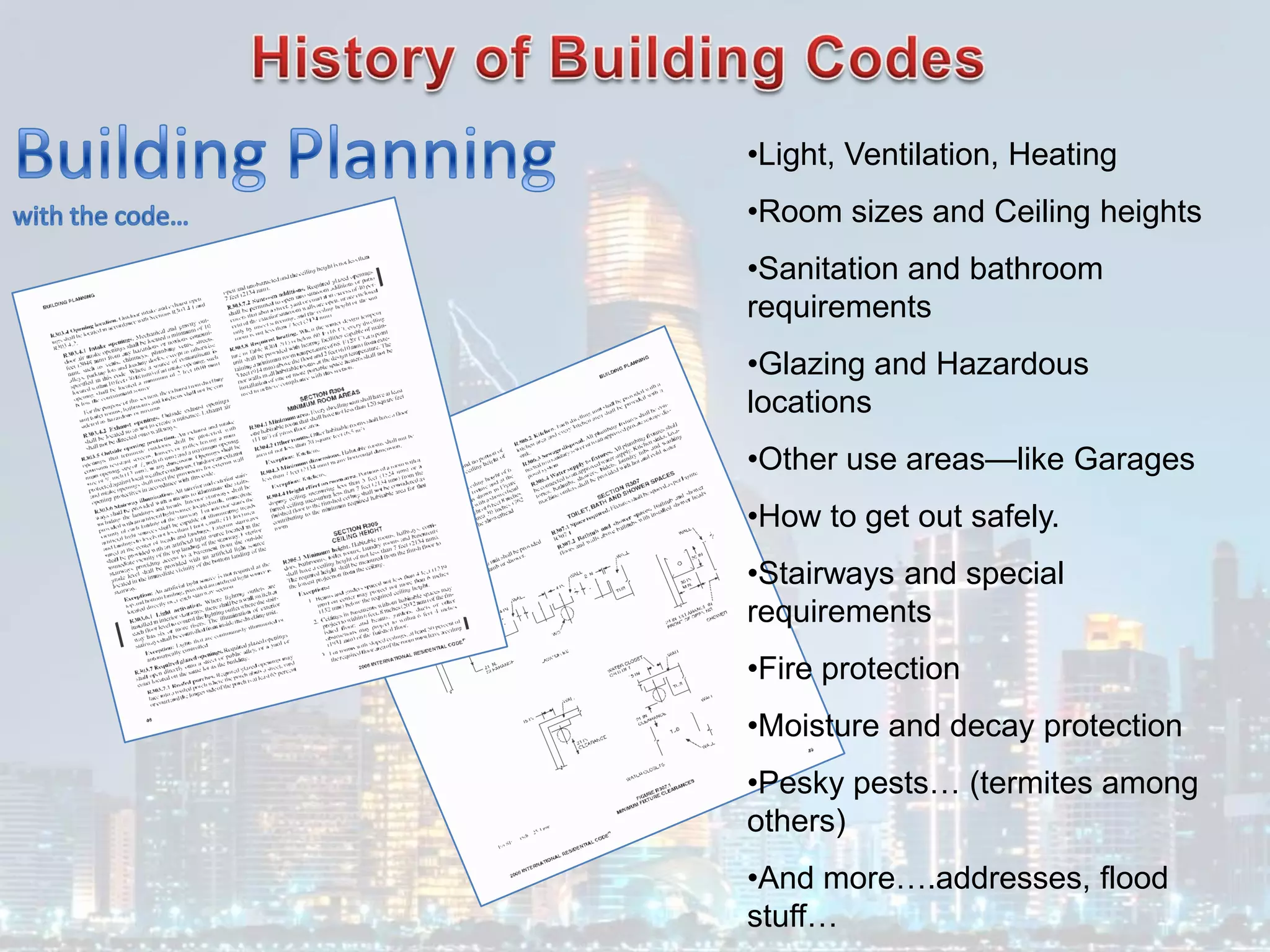
Figure A-5 illustrates the
chimney connector clearance
requirements of Table 803.10.4.
APPENDIX B
RECOMMENDED PERMIT FEE
SCHEDULE
Abu
Dhabi
International
Building
Codes
Abu
Dhabi
International
Mechanical
Code
(ADIMC)
APPENDIX B: RECOMMENDED PERMIT FEE SCHEDULE
Abu
Dhabi
International
Building
Codes
Abu
Dhabi
International
Mechanical
Code
(ADIMC)
APPENDIX B: RECOMMENDED PERMIT FEE SCHEDULE
Abu Dhabi International Building Codes
Abu Dhabi International Private Sewage Disposal Code (ADIPSDC)
A - General Description of ADIPSDC
B - Arrangement and Formatting
C - Chapter by Chapter Description
Abu Dhabi International Building Codes
Abu Dhabi International Private Sewage Disposal Code (ADIPSDC)
Abu Dhabi International Building Codes
Abu Dhabi International Private Sewage Disposal Code (ADIPSDC)
Abu Dhabi International Building Codes
Abu Dhabi International Private Sewage Disposal Code (ADIPSDC)
Abu Dhabi International Building Codes
Abu Dhabi International Private Sewage Disposal Code (ADIPSDC)
Abu Dhabi International Building Codes
Abu Dhabi International Private Sewage Disposal Code (ADIPSDC)
A - General Description of ADIPSDC
The Abu Dhabi International Private Sewage Disposal Code (ADIPSDC) is a code that regulates
minimum requirements for the installation of new or the alteration of existing private sewage disposal
systems.
Where a building cannot be served by a public sewer system, the building site must be provided with
a system for treating the waste water generated from the use of plumbing fixtures in the building.
The ADIPSDC addresses site evaluations, materials, various soil absorption systems, holding tanks,
cesspools and onsite waste water treatment systems. The ADIPSDC provides a total approach for the
onsite, safe disposal of the waste low discharged to the plumbing fixtures in a building.
The ADIPSDC is a specification- (prescriptive-) oriented code with very few occurrences of
performance-oriented text. The site soil must be evaluated in a prescribed manner to determine its
ability to accept the waste low.
The chosen waste treatment method must be designed in a prescribed manner for the soil conditions
at the building site, constructed using prescribed materials and installed according to prescribed
dimensions. The ADIPSDC sets forth the minimum acceptable requirements for private sewage
disposal systems in order to protect humans and the environment from insanitary conditions that
would develop if waste lows were not rendered harmless.
Abu Dhabi International Building Codes
Abu Dhabi International Private Sewage Disposal Code (ADIPSDC)
Abu Dhabi International Building Codes
Abu Dhabi International Private Sewage Disposal Code (ADIPSDC)
B - Arrangement and Format of ADIPSDC
C - Chapter by chapter description of ADIPSDC
Abu
Dhabi
International
Private
Sewage
Disposal
Code
(ADIPSDC)
Abu
Dhabi
International
Building
Codes
Abu
Dhabi
International
Private
Sewage
Disposal
Code
(ADIPSDC)
Abu
Dhabi
International
Building
Codes
Abu
Dhabi
International
Private
Sewage
Disposal
Code
(ADIPSDC)
Abu
Dhabi
International
Building
Codes
Abu
Dhabi
International
Private
Sewage
Disposal
Code
(ADIPSDC)
Abu
Dhabi
International
Building
Codes
Abu Dhabi International Building Codes
Abu Dhabi International Private Sewage Disposal Code (ADIPSDC)
Chapter 1 Scope and Administration
This chapter contains provisions for the application, enforcement and administration of subsequent
requirements of the code. In addition to establishing the scope of the code, Chapter 1 identifies which
buildings and structures come under its purview. Chapter 1 is largely concerned with maintaining
“due process of law” in enforcing the requirements contained in the body of this code. Only through
careful observation of the administrative provisions can the building official reasonably expect to
demonstrate that “equal protection under the law” has been provided.
Abu Dhabi International Building Codes
Abu Dhabi International Private Sewage Disposal Code (ADIPSDC)
Chapter 2 Definitions
Chapter 2 is the repository of the definitions of terms used in the body of the code. Codes are technical
documents and every word, term and punctuation mark can impact the meaning of the code text and the
intended results. The code often uses terms that have a unique meaning in the code and the code meaning can
differ substantially from the ordinarily understood meaning of the term as used outside of the code.
The terms defined in Chapter 2 are deemed to be of prime importance in establishing the meaning and intent of
the code text. The user of the code should be familiar with and consult this chapter because the definitions are
essential to the correct interpretation of the code and the user may not be aware that a term is defined.
Where understanding of a term’s definition is especially key to or necessary for understanding of a particular
code provision, the term is shown in italics wherever it appears in the code. This is true only for those terms
that have a meaning that is unique to the code. In other words, the generally understood meaning of a term or
phrase might not be sufficient or consistent with the meaning prescribed by the code; therefore, it is essential
that the code-defined meaning be known.
Guidance regarding tense, gender and plurality of defined terms, as well as guidance regarding terms not
defined in this code, is provided.
Abu Dhabi International Building Codes
Abu Dhabi International Private Sewage Disposal Code (ADIPSDC)
Chapter 3 General Regulations
The content of Chapter 3 is often referred to as “miscellaneous,” rather than general
regulations. Chapter 3 received that label because it is the only chapter in the code whose
requirements do not interrelate. If a requirement cannot be located in another chapter, it can
be found in this chapter.
Specific requirements concerning flood hazard areas are
in this chapter.
Abu Dhabi International Building Codes
Abu Dhabi International Private Sewage Disposal Code (ADIPSDC)
Chapter 4 Site Evaluation and Requirements
A private sewage disposal system has an effluent which cannot be directly discharged into
waterways or open ponds. Soil of the right consistency and water content provides a natural
filtering and treatment of this discharge. Because soil conditions vary widely, even on the
same building site, tests and inspections of the soils must be performed to evaluate the degree
to which the soil can accept these liquids. The results of the tests provide necessary
information to design an adequate private sewage disposal system. Chapter 4 provides the
methods for evaluating the building site.
Abu Dhabi International Building Codes
Abu Dhabi International Private Sewage Disposal Code (ADIPSDC)
Chapter 5 Materials
Private sewage disposal systems depend on the strength, quality and chemical resistance
of the components that make up the system. To that end, the purpose of Chapter 5 is to
specify the minimum material and component standards to assure that the private sewage
disposal system will correctly perform for its intended life.
Abu Dhabi International Building Codes
Abu Dhabi International Private Sewage Disposal Code (ADIPSDC)
Chapter 6 Soil Absorption Systems
The design of soil absorption systems depends heavily on the result of the tests and
evaluation of the site soil conditions required in Chapter 4. Where soil is less permeable, the
area of the soil absorption must be large as compared to that required for soils that are highly
permeable. The type of building that is being served by the private sewage disposal system
also affects the size of the planned soil absorption area. This chapter provides the methods for
computing the required absorption area and details for the proper installation of the soil
absorption systems.
Abu Dhabi International Building Codes
Abu Dhabi International Private Sewage Disposal Code (ADIPSDC)
Chapter 7 Pressure Distribution Systems
Chapter 6 deals with gravity-type soil absorption systems or systems where the effluent
is allowed to drain out of the distribution piping by gravity. This chapter offers an
alternate method of discharging the effluent into the ground by pressure means.
As such, Chapter 7 provides the necessary details for designing the piping and pumping
systems for pressure distribution systems.
Abu Dhabi International Building Codes
Abu Dhabi International Private Sewage Disposal Code (ADIPSDC)
Chapter 8 Tanks
Tanks are an integral part of any private sewage disposal system whether they serve as treatment
(septic) tanks or merely just holding tanks for leveling the peaks in low to the system. Where tanks
are used for treatment, the dimensions, volume and location of internal features are very important to
assure that the solid wastes are kept within the tank so as to not clog the effluent distribution system.
Where tanks are used for holding purposes, they must be sized large enough to accommodate the total
of peak lows coming from a building. Chapter 8 provides the necessary requirements for tanks.
Abu Dhabi International Building Codes
Abu Dhabi International Private Sewage Disposal Code (ADIPSDC)
Chapter 9 Mound Systems
Mound systems are another method for applying the effluent from a private sewage disposal system to
the soil. This type of system may be advantageous in some localities due to the existing soil
conditions. Chapter 9 has specific requirements for soil and site evaluations for mound systems.
Chapter 10 Cesspools
Although prohibited from being installed as a permanent private sewage disposal system,
cesspools may be necessary where permanent systems are under repair, or are being built.
Chapter 10 provides the details for constructing a cesspool.
Abu Dhabi International Building Codes
Abu Dhabi International Private Sewage Disposal Code (ADIPSDC)
Chapter 11 Residential Waste Water System
Another method of private sewage disposal is a small waste water treatment plant. Where permitted,
these systems can discharge effluent directly to streams and rivers. Chapter 11 specifies the standard to
which waste water treatment plants must conform.
Chapter 12 Inspections
The best soil and site analysis along with the best design will be rendered useless if the system is not
installed according to the plans for the system. Chapter 12 provides requirements for inspection of
private sewage disposal systems.
Abu Dhabi International Building Codes
Abu Dhabi International Private Sewage Disposal Code (ADIPSDC)
Chapter 13 Non-liquid Saturated Treatment Systems
In some locations, water for the flushing of wastes into and through a sanitary piping system
is not available. For example, a toilet facility provided for a remote campground without
running water would require such a system.
Chapter 13 specifies the standard to which
nonliquid saturated treatment systems must conform.
Abu Dhabi International Building Codes
Abu Dhabi International Private Sewage Disposal Code (ADIPSDC)
Chapter 14 Reference Standards
The code contains numerous references to standards that are used to regulate materials and methods of
construction.
Chapter 14 contains a comprehensive list of all standards that are referenced in the code. The standards
are part of the code to the extent of the reference to the standard. Compliance with the referenced
standard is necessary for compliance with this code. By providing specifically adopted standards, the
construction and installation requirements necessary for compliance with the code can be readily
determined.
The basis for code compliance is, therefore, established and available on an equal basis to the code
official, contractor, designer and owner.
Chapter 14 is organized in a manner that makes it easy to locate specific standards. It lists all of the
referenced standards, alphabetically, by acronym of the promulgating agency of the standard.
Each agency’s standards are then listed in either alphabetical or numeric order based upon the standard
identification. The list also contains the title of the standard; the edition (date) of the standard
referenced; any addenda included as part of the ICC adoption; and the section or sections of this code
that reference the standard.
Abu Dhabi International Building Codes
Abu Dhabi International Private Sewage Disposal Code (ADIPSDC)
Abu Dhabi International Building Codes
Abu Dhabi International Private Sewage Disposal Code (ADIPSDC)
Abu Dhabi International Building Codes
Abu Dhabi International Private Sewage Disposal Code (ADIPSDC)
Appendix A System Layout illustration
Appendix A provides figures that illustrate various requirements in the body of the code. Figures A-1
through A-4 illustrate typical combustion air requirements. Figure A-5 illustrates the chimney
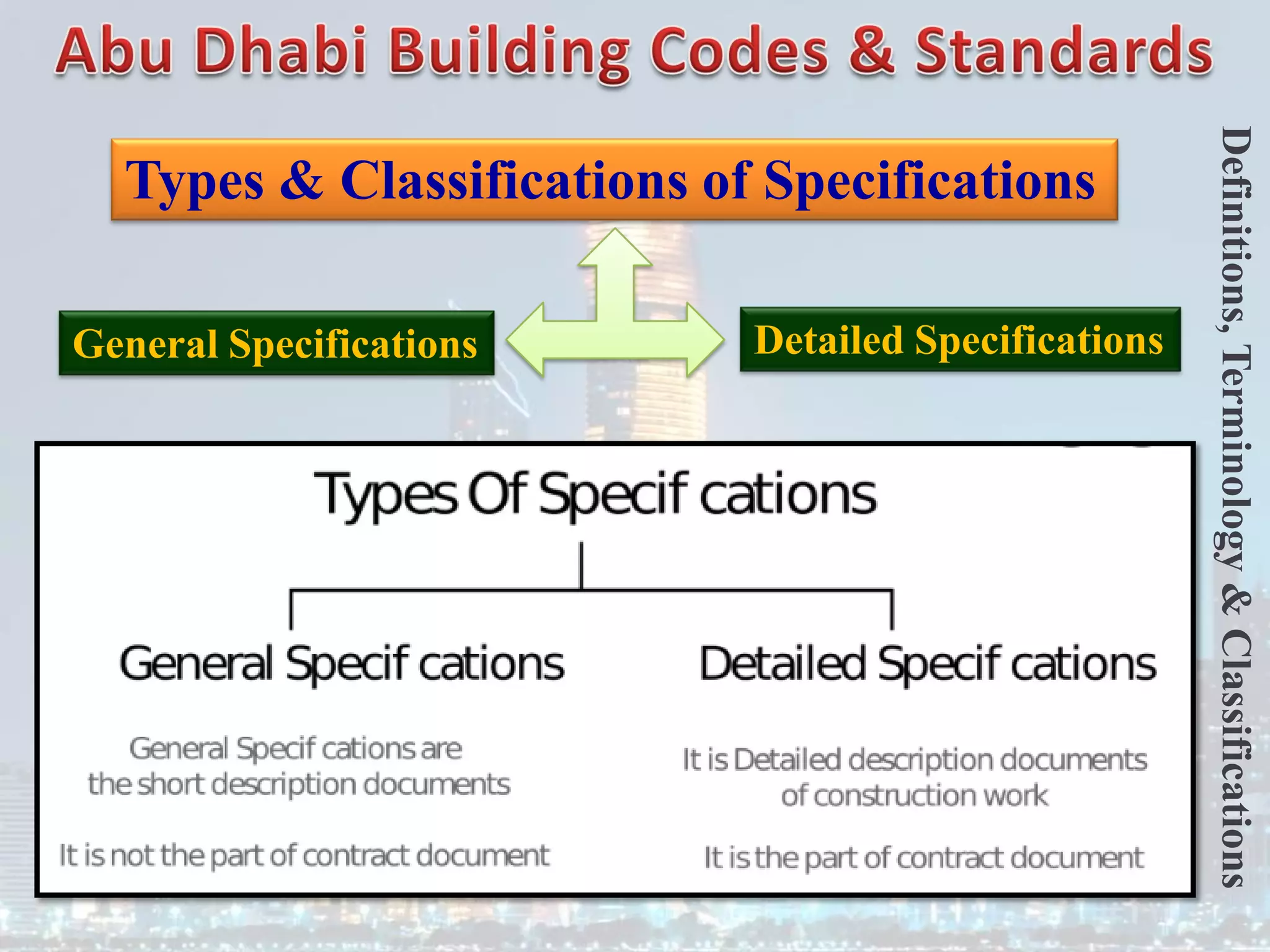
connector clearance requirements of Table 803.10.4.
Appendix B Tables for Pressure Distribution Systems
Appendix B provides a sample permit fee schedule for mechanical permits. The local
jurisdiction can adopt this appendix and fill in the dollar amounts in the blank spaces to
establish their official permit fee schedule.
The ICC does not establish permit fees because the code is adopted throughout the country
and there are vast differences in operating budgets between different parts of the country, as
well as between large and small municipalities within the same region.
Abu Dhabi International Fuel Gas Code (ADIFGC)
A - General Description of ADIFGC
B - Arrangement and Formatting
C - Chapter by Chapter Description
Abu Dhabi International Building Codes
Abu Dhabi International Fuel Gas Code (ADIFGC)
Abu Dhabi International Building Codes
Abu Dhabi International Fuel Gas Code (ADIFGC)
Abu Dhabi International Building Codes
Abu Dhabi International Fuel Gas Code (ADIFGC)
Abu Dhabi International Building Codes
Abu Dhabi International Fuel Gas Code (ADIFGC)
A - General Description of ADIFGC
The ADIFGC is a code that regulates the design and installation of fuel gas distribution piping and systems,
appliances, appliance venting systems, combustion air provisions, gaseous hydrogen systems and motor vehicle
gaseous-fuel-dispensing stations. The definition of fuel gas includes natural, liquefied petroleum and
manufactured gases and mixtures of these gases.
The purpose of the code is to establish the minimum acceptable level of safety and to protect life and property
from the potential dangers associated with the storage, distribution and usage of fuel gases and the byproducts of
combustion of such fuels.
The code also protects the personnel that install, maintain, service and replace the systems and appliances
addressed by this code.
With the exception of Section 401.1.1, the ADIFGC does not address utility-owned piping and equipment (i.e.,
anything upstream of the point of delivery). See the definition of “Point of delivery” and Section 501.8 for other
code coverage exemptions.
The ADIFGC is primarily a specification oriented (prescriptive) code with some performance-oriented text. For
example, Section 503.3.1 is a performance statement, but Chapter 5 contains prescriptive requirements that will
cause Section 503.3.1 to be satisfied.
The ADIFGC applies to all occupancies including one- and two-family dwellings and townhouses. The ADIFGC
does not apply to piping systems that operate at pressures in excess of 125 psig for natural gas and 20 psig for
LP-gas (note exception in Section 402.6).
The general Section 105.2 and the specific Sections 304.8, 402.3, 503.5.5 and 503.6.9 allow combustion air
provisions, pipe sizing and chimney and vent sizing to be performed by approved engineering methods as
alternatives to the prescriptive methods in the code.
Abu Dhabi International Building Codes
Abu Dhabi International Fuel Gas Code (ADIFGC)
B - Arrangement and Format of ADIFGC
The format of the ADIFGC allows each chapter to
be devoted to a particular subject, with the
exception of Chapter 3, which contains general
subject matters that are not extensive enough to
warrant their own independent chapter.
C - Chapter by chapter
description of
ADIFGC
Abu
Dhabi
International
Building
Codes
Abu
Dhabi
International
Fuel
Gas
Code
(ADIFGC)
Abu
Dhabi
International
Building
Codes
Abu
Dhabi
International
Fuel
Gas
Code
(ADIFGC)
Abu Dhabi International Building Codes
Abu Dhabi International Fuel Gas Code (ADIFGC)
Chapter 1 Scope and Administration
Chapter 1 establishes the limits of applicability of the code and describes how the code is to be applied and
enforced.
A fuel gas code, like any other code, is intended to be adopted as a legally enforceable document, and it cannot
be effective without adequate provisions for its administration and enforcement.
The provisions of Chapter 1 establish the authority and duties of the code official appointed by the jurisdiction
having authority and also establish the rights and privileges of the design professional, contractor and property
owner.
Abu Dhabi International Building Codes
Abu Dhabi International Fuel Gas Code (ADIFGC)
Chapter 2 Definitions
Chapter 2 is the repository of the definitions of terms used in the body of the code. Codes are
technical documents and every word, term and punctuation mark can impact the meaning of
the code text and the intended results. The code often uses terms that have a unique meaning
in the code and the code meaning can differ substantially from the ordinarily understood
meaning of the term as used outside of the code.
The terms defined in Chapter 2 are deemed to be of prime importance in establishing the
meaning and intent of the code text that uses the terms. The user of the code should be
familiar with and consult this chapter because the definitions are essential to the correct
interpretation of the code and because the user may not be aware that a term is defined.
Abu Dhabi International Building Codes
Abu Dhabi International Fuel Gas Code (ADIFGC)
Chapter 3 General Regulations
Chapter 3 contains broadly applicable requirements related to appliance location and
installation, appliance and systems access, protection of structural elements and
clearances to combustibles, among others. This chapter also covers combustion air
provisions for gas-fired appliances.
Abu Dhabi International Building Codes
Abu Dhabi International Fuel Gas Code (ADIFGC)
Chapter 4 Gas Piping Installations
Chapter 4 covers the allowable materials for gas piping systems and the sizing and
installation of such systems.
It also covers pressure regulators, appliance connections and overpressure protection
devices. Gas piping systems are sized to supply the maximum demand while maintaining
the supply pressure necessary for safe operation of the appliances served.
Abu Dhabi International Building Codes
Abu Dhabi International Fuel Gas Code (ADIFGC)
Chapter 5 Chimneys and Vents
Chapter 5 regulates the design, construction, installation, maintenance, repair and approval of chimneys,
vents, venting systems and their connections to gas-fired appliances. Properly designed chimneys, vents
and venting systems are necessary to conduct to the outdoors the flue gases produced by the combustion
of fuels in appliances. The provisions of this chapter are intended to minimize the hazards associated with
high temperatures and potentially toxic and corrosive combustion gases. This chapter addresses all of the
factory-built and site-built chimneys, vents and venting systems used to vent all types and categories of
appliances. It also addresses direct-vent appliances, integral vent appliances, side-wall mechanically
vented appliances and exhaust hoods that convey the combustion byproducts from cooking and other
process appliances.
Abu
Dhabi
International
Building
Codes
Abu Dhabi International Fuel Gas Code (ADIFGC)
Abu
Dhabi
International
Building
Codes Abu Dhabi International Fuel
Gas Code (ADIFGC)
Abu
Dhabi
International
Building
Codes Abu Dhabi International Fuel
Gas Code (ADIFGC)
Abu Dhabi International Building Codes
Abu Dhabi International Fuel Gas Code (ADIFGC)
Abu Dhabi International Building Codes
Abu Dhabi International Fuel Gas Code (ADIFGC)
Chapter 6 Specific Appliances
Chapter 6 addresses specific appliances
that the code intends to regulate. Each
main section applies to a unique type of
gas-fired appliance and specifies the
product standards to which the
appliance must be listed. The general
requirements found in the previous
Chapters 1 through 5 also apply and the
sections in Chapter 6 add the special
requirements that are specific to each
type of appliance.
Abu Dhabi International Building Codes
Abu Dhabi International Fuel Gas Code (ADIFGC)
Chapter 7 Gaseous Hydrogen Systems
Chapter 7 is specific to gaseous hydrogen generation, storage, distribution and utilization systems,
appliances and equipment. Note that hydrogen is not within the definition of “Fuel gas,” but it is,
nonetheless, commonly used as a fuel for fuel-cell power generation and fuel cell powered motor
vehicles. The scope of Chapter 7 is not limited to any particular use of hydrogen (see Sections 633
and 635).
Hydrogen systems have unique potential hazards because of the specific gravity of the gas, its
chemical effect on materials and the fact that it is not odorized.
Abu Dhabi International Building Codes
Abu Dhabi International Fuel Gas Code (ADIFGC)
Chapter 8 Referenced Standards
Chapter 8 lists all of the product and
installation standards and codes that are
referenced throughout Chapters 1 through
7.
As stated in Section 102.8, these standards
and codes become an enforceable part of
the code (to the prescribed extent of the
reference) as if printed in the body of the
code.
Chapter 8 provides the full title and edition
year of the standards and codes in addition
to the address of the promulgators and the
section numbers in which the standards
and codes are referenced.
Abu Dhabi International Building Codes
Abu Dhabi International Fuel Gas Code (ADIFGC)
Abu Dhabi International Building Codes
Abu Dhabi International Fuel Gas Code (ADIFGC)
Abu Dhabi International Building Codes
Abu Dhabi International Fuel Gas Code (ADIFGC)
Appendix A Sizing and Capacities of Gas Piping
This appendix is informative and not part of the
code. It provides design guidance, useful facts
and data and multiple examples of how to apply
the sizing tables and sizing methodologies of
Chapter 4.
Appendix B Sizing of Venting Systems
Serving Appliances Equipped with Draft
Hoods, Category I Appliances and
Appliances Listed for Use with Type B Vents
This appendix is informative and not part of
the code. It contains multiple examples of
how to apply the vent and chimney tables
and methodologies of Chapter 5.
Abu Dhabi International Building Codes
Abu Dhabi International Fuel Gas Code (ADIFGC)
Appendix C Exit Terminals of Mechanical Draft and
Direct-vent Venting Systems
This appendix is informative and not part of the code.
It consists of a figure and notes that visually depict
code requirements from Chapter 5 for vent terminals
with respect to the openings found in building
exterior walls.
Appendix D Recommended Procedure for
Safety Inspection of an Existing Appliance
Installation
This appendix is informative and not part of the
code. It provides recommended procedures for
testing and inspecting an appliance installation
to determine if the installation is operating
safely and if the appliance is in a safe condition.
Abu Dhabi International Building Codes
Abu Dhabi International Fuel Gas Code (ADIFGC)
Abu Dhabi International Building Codes
Abu Dhabi International Fuel Gas Code (ADIFGC)
Abu Dhabi International Building Codes
Abu Dhabi International Fuel Gas Code (ADIFGC)
Abu Dhabi International Building Codes
Abu Dhabi International Fuel Gas Code (ADIFGC)
Abu Dhabi International Building Codes
Abu Dhabi International Fuel Gas Code (ADIFGC)
Abu Dhabi International Building Codes
Abu Dhabi International Fuel Gas Code (ADIFGC)
Abu Dhabi International Building Codes
A - General Description of ADIPMC
B - Arrangement and Formatting
C - Chapter by Chapter Description
Abu Dhabi International Property Maintenance Code (ADIPMC)
Abu Dhabi International Building Codes
Abu Dhabi International Property Maintenance Code (ADIPMC)
Abu
Dhabi
International
Building
Codes Abu Dhabi International Property Maintenance Code (ADIPMC)
Samples of Abu Dhabi Design & Maintenance Specifications
Abu
Dhabi
International
Building
Codes Abu Dhabi International Property Maintenance Code (ADIPMC)
Samples of Abu Dhabi Design &
Maintenance Specifications
Abu
Dhabi
International
Building
Codes Abu Dhabi International Property Maintenance Code (ADIPMC)
Samples of Abu Dhabi Design & Maintenance Specifications
Abu
Dhabi
International
Building
Codes Abu Dhabi International Property Maintenance Code (ADIPMC)
Samples of Abu Dhabi Design & Maintenance Specifications
Abu
Dhabi
International
Building
Codes
Abu
Dhabi
International
Property
Maintenance
Code
(ADIPMC)
Samples of Abu Dhabi Design & Maintenance Specifications
Abu Dhabi International Building Codes
Abu Dhabi International Property Maintenance Code (ADIPMC)
A - General Description of ADIPMC
The Abu Dhabi International Property Maintenance
Code (ADIPMC) is a code that regulates the minimum
maintenance requirements for existing buildings.
The ADIPMC is a maintenance document intended to
establish minimum maintenance standards for basic
equipment, light, ventilation, heating, sanitation and fire
safety. Responsibility is fixed among owners, operators
and occupants for code compliance. The ADIPMC
provides for the regulation and safe use of existing
structures in the interest of the social and economic
welfare of the community.
Abu Dhabi International Building Codes
Abu Dhabi International Property Maintenance Code (ADIPMC)
B - Arrangement and Format of ADIPMC
C - Chapter by chapter description of ADIPMC
The following is a chapter-by-chapter summary of the scope and intent of the provisions
of the Abu Dhabi International Property Maintenance Code:
Abu
Dhabi
International
Building
Codes
Abu
Dhabi
International
Property
Maintenance
Code
(ADIPMC)
Abu Dhabi International Building Codes
Abu Dhabi International Property Maintenance Code (ADIPMC)
Chapter 1 Administration and Enforcement
This chapter contains provisions for the application, enforcement and administration of subsequent
requirements of the code. In addition to establishing the scope of the code, Chapter 1 identifies which
buildings and structures come under its purview. Chapter 1 is largely concerned with maintaining
“due process of law” in enforcing the property maintenance criteria contained in the body of the code.
Only through careful observation of the administrative provisions can the building official reasonably
expect to demonstrate that “equal protection under the law” has been provided.
Abu Dhabi International Building Codes
Abu Dhabi International Property Maintenance Code (ADIPMC)
Chapter 2 Definitions
All terms that are defined in the code are listed
alphabetically in Chapter 2. While a defined term may be
used in one chapter or another, the meaning provided in
Chapter 2 is applicable throughout the code.
Where understanding of a term’s definition is especially
key to or necessary for understanding of a particular code
provision, the term is show in italics wherever it appears
in the code.
This is true only for those terms that have a meaning that
is unique to the code. In other words, the generally
understood meaning of a term or phrase might not be
sufficient or consistent with the meaning prescribed by the
code; therefore, it is essential that the code-defined
meaning be known.
Guidance regarding tense, gender and plurality of defined
terms as well as guidance regarding terms not defined in
this code is provided.
Abu Dhabi International Building Codes
Abu Dhabi International Property Maintenance Code (ADIPMC)
Chapter 3 General Requirements
Chapter 3, “General Requirements,” is broad in scope. It includes a variety of requirements for the exterior
property areas as well as the interior and exterior elements of the structure. This chapter provides
requirements that are intended to maintain a minimum level of safety and sanitation for both the general
public and the occupants of a structure, and to maintain a building’s structural and weather-resistance
performance. Chapter 3 provides specific criteria for regulating the installation and maintenance of specific
building components; maintenance requirements for vacant structures and land; requirements regulating
the safety, sanitation and appearance of the interior and exterior of structures and all exterior property
areas; accessory structures; vehicle storage regulations and establishes who is responsible for complying
with the chapter’s provisions. This chapter also contains the requirements for swimming pools, spas and
hot tubs and the requirements for protective barriers and gates in these barriers.
Chapter 3 establishes the responsible parties for exterminating insects and
rodents, and maintaining sanitary conditions in all types of occupancies.
Abu Dhabi International Building Codes
Abu Dhabi International Property Maintenance Code (ADIPMC)
Chapter 4 Light, Ventilation and Occupancy Limitations
The purpose of Chapter 4 is to set forth these requirements in the
code and to establish the minimum environment for occupiable
and habitable buildings, by establishing the minimum criteria for
light and ventilation and identifies occupancy limitations
including minimum room width and area, minimum ceiling
height and restrictions to prevent overcrowding.
This chapter also provides for alternative arrangements of
windows and other devices to comply with the requirements for
light and ventilation and prohibits certain room arrangements
and occupancy uses.
Abu Dhabi International Building Codes
Abu Dhabi International Property Maintenance Code (ADIPMC)
Chapter 5 Plumbing Facilities and Fixture Requirements
Chapter 5 establishes the minimum criteria for the installation,
maintenance and location of plumbing systems and facilities, including
the water supply system, water heating appliances, sewage disposal
system and related plumbing fixtures.
Sanitary and clean conditions in occupied buildings are dependent upon
certain basic plumbing principles, including providing potable water to a
building, providing the basic fixtures to effectively utilize that water and
properly removing waste from the building. Chapter 5 establishes the
minimum criteria to verify that these principles are maintained
throughout the life of a building.
Abu Dhabi International Building Codes
Abu Dhabi International Property Maintenance Code (ADIPMC)
Chapter 6 Mechanical and Electrical Requirements
The purpose of Chapter 6 is to establish minimum performance requirements for heating, electrical and
mechanical facilities and to establish minimum standards for the safety of these facilities.
This chapter establishes minimum criteria for the installation and maintenance of the following: heating
and air-conditioning equipment, appliances and their supporting systems; water-heating equipment,
appliances and systems; cooking equipment and appliances; ventilation and exhaust equipment; gas and
liquid fuel distribution piping and components; fireplaces and solid fuel-burning appliances; chimneys
and vents; electrical services; lighting fixtures; electrical receptacle outlets; electrical distribution
system equipment, devices and wiring; and elevators, escalators and dumbwaiters.
Abu Dhabi International Building Codes
Abu Dhabi International Property Maintenance Code (ADIPMC)
Chapter 6 Mechanical and Electrical Requirements
Abu Dhabi International Building Codes
Abu Dhabi International Property Maintenance Code (ADIPMC)
Chapter 7 Fire Safety Requirements
The purpose of Chapter 7 is to address those fire hazards that
arise as the result of a building’s occupancy. It also provides
minimum requirements for fire safety issues that are most likely
to arise in older buildings.
This chapter contains requirements for means of egress in
existing buildings, including path of travel, required egress
width, means of egress doors and emergency escape openings.
Chapter 7 establishes the minimum requirements for fire safety
facilities and fire protection systems, as these are essential fire
safety systems.
Abu Dhabi
International
Building Codes
Chapter 7 Fire Safety Requirements
Abu Dhabi International Property Maintenance Code (ADIPMC)
Abu
Dhabi
International
Building
Codes Abu Dhabi International Property Maintenance Code (ADIPMC)
Chapter 7 Fire Safety Requirements
Abu Dhabi International Building Codes
Abu Dhabi International Property Maintenance Code (ADIPMC)
Chapter 8 Referenced Standards
The code contains numerous references to standards that are used to regulate materials and methods of
construction.
Chapter 8 contains a comprehensive list of all standards that are referenced in the code. The standards are part
of the code to the extent of the reference to the standard. Compliance with the referenced standard is necessary
for compliance with this code. By providing specifically adopted standards, the construction and installation
requirements necessary for compliance with the code can be readily determined.
The basis for code compliance is, therefore, established and available on an equal basis to the code official,
contractor, designer and owner.
Chapter 8 is organized in a manner that makes it easy to locate specific standards. It lists all of the referenced
standards, alphabetically, by acronym of the promulgating agency of the standard.
Each agency’s standards are then listed in either alphabetical or numeric order based upon the standard
identification. The list also contains the title of the standard; the edition (date) of the standard referenced; any
addenda included as part of the ICC adoption; and the section or sections of this code that reference the
standard.
Abu Dhabi International Building Codes
Abu Dhabi International Property Maintenance Code (ADIPMC)
Abu Dhabi International Building Codes
Abu Dhabi International Property Maintenance Code (ADIPMC)
Abu
Dhabi
International
Building
Codes
Abu
Dhabi
International
Property
Maintenance
Code
(ADIPMC)
Abu Dhabi International Building Codes
Abu Dhabi International Fire Codes (ADIFC)
Abu Dhabi International Building Codes
Abu Dhabi International Fire Codes (ADIFC)
Abu Dhabi
International
Fire Codes
(ADIFC)
Abu
Dhabi
International
Building
Codes
Abu
Dhabi
International
Building
Codes
Abu
Dhabi
International
Fire
Codes
(ADIFC)
Abu
Dhabi
International
Building
Codes
Abu
Dhabi
International
Fire
Codes
(ADIFC)
Abu
Dhabi
International
Building
Codes
Abu
Dhabi
International
Fire
Codes
(ADIFC)
Abu
Dhabi
International
Building
Codes
Abu
Dhabi
International
Fire
Codes
(ADIFC)
Abu
Dhabi
International
Building
Codes
Abu
Dhabi
International
Fire
Codes
(ADIFC)
Abu
Dhabi
International
Building
Codes
Abu
Dhabi
International
Fire
Codes
(ADIFC)
Abu
Dhabi
International
Building
Codes
Abu
Dhabi
International
Fire
Codes
(ADIFC)
Abu
Dhabi
International
Building
Codes
Abu
Dhabi
International
Fire
Codes
(ADIFC)
Abu
Dhabi
International
Building
Codes
Abu
Dhabi
International
Fire
Codes
(ADIFC)
Abu
Dhabi
International
Building
Codes
Abu
Dhabi
International
Fire
Codes
(ADIFC)
Abu
Dhabi
International
Building
Codes
Abu
Dhabi
International
Fire
Codes
(ADIFC)
Abu
Dhabi
International
Building
Codes
Abu
Dhabi
International
Fire
Codes
(ADIFC)
Abu Dhabi International Fire Codes (ADIFC)
Abu Dhabi
International
Building Codes
Abu
Dhabi
International
Building
Codes
Abu
Dhabi
International
Fire
Codes
(ADIFC)
356
Abu
Dhabi
International
Building
Codes
Abu
Dhabi
International
Fire
Codes
(ADIFC)
Abu
Dhabi
International
Building
Codes
Abu
Dhabi
International
Fire
Codes
(ADIFC)
Abu
Dhabi
International
Building
Codes
Abu
Dhabi
International
Fire
Codes
(ADIFC)
Abu
Dhabi
International
Building
Codes
Abu
Dhabi
International
Fire
Codes
(ADIFC)
Abu
Dhabi
International
Building
Codes Abu Dhabi International Fire Codes (ADIFC)
Abu
Dhabi
International
Building
Codes
Abu
Dhabi
International
Fire
Codes
(ADIFC)
Abu
Dhabi
International
Building
Codes
Abu
Dhabi
International
Fire
Codes
(ADIFC)
Abu
Dhabi
International
Building
Codes
Abu
Dhabi
International
Fire
Codes
(ADIFC)
IFC 2021 Chapter by Chapter
Abu
Dhabi
International
Building
Codes
Abu
Dhabi
International
Fire
Codes
(ADIFC)
IFC 2021 Chapter by Chapter
Abu
Dhabi
International
Building
Codes
Abu
Dhabi
International
Fire
Codes
(ADIFC)
IFC
2021
Chapter
by
Chapter
Abu
Dhabi
International
Building
Codes
Abu
Dhabi
International
Fire
Codes
(ADIFC)
IFC
2021
Chapter
by
Chapter
Abu
Dhabi
International
Building
Codes
Abu
Dhabi
International
Fire
Codes
(ADIFC)
IFC
2021
Chapter
by
Chapter
Abu
Dhabi
International
Building
Codes
Abu
Dhabi
International
Fire
Codes
(ADIFC)
IFC
2021
Chapter
by
Chapter
Abu
Dhabi
International
Building
Codes
Abu
Dhabi
International
Fire
Codes
(ADIFC)
IFC
2021
Chapter
by
Chapter
Abu
Dhabi
International
Building
Codes
Abu
Dhabi
International
Fire
Codes
(ADIFC)
IFC
2021
Chapter
by
Chapter
Abu
Dhabi
International
Building
Codes
Abu
Dhabi
International
Fire
Codes
(ADIFC)
IFC
2021
Chapter
by
Chapter
Abu
Dhabi
International
Building
Codes
Abu
Dhabi
International
Fire
Codes
(ADIFC)
IFC
2021
Chapter
by
Chapter
Abu
Dhabi
International
Building
Codes
Abu
Dhabi
International
Fire
Codes
(ADIFC)
IFC
2021
Chapter
by
Chapter
Abu
Dhabi
International
Building
Codes
Abu
Dhabi
International
Fire
Codes
(ADIFC)
IFC
2021
Chapter
by
Chapter
Abu
Dhabi
International
Building
Codes
Abu
Dhabi
International
Fire
Codes
(ADIFC)
IFC
2021
Chapter
by
Chapter
Abu
Dhabi
International
Building
Codes
Abu
Dhabi
International
Fire
Codes
(ADIFC)
We may notice
the big
differences
between IFC
2021 and the
previous
versions
IFC
2021
Chapter
by
Chapter
Abu
Dhabi
International
Building
Codes
Abu
Dhabi
International
Fire
Codes
(ADIFC)
2021 International Fire Code (IFC)
The 2021 IFC® contains regulations to safeguard life and property
from fires and explosion hazards. Topics include general
precautions, emergency planning and preparedness, fire
department access and water supplies, automatic sprinkler systems,
fire alarm systems, special hazards, and the storage and use of
hazardous materials. Key changes to the IFC include:
 Requirements for Additive Manufacturing (3-D Printing)
equipment and operations for both non-industrial and
industrial applications are now provided.
 Flame propagation performance of permanently installed
artificial combustible vegetation is required to be verified
when exceeding certain heights located on roofs or in close
proximity to buildings.
 Provisions for emergency responder communication were
revised to reflect the expansion of such systems beyond
radios and the need for increased performance of such
systems.
Abu
Dhabi
International
Building
Codes
Abu
Dhabi
International
Fire
Codes
(ADIFC)
2021 International Fire Code (IFC)
 Sprinkler requirements for the storage, manufacture and sale of
upholstered furniture and mattresses were updated and clarified.
Part of this update is a new exception for single-story self-storage
facilities accessed directly from the exterior.
 An automatic sprinkler system is now required for open parking
garages exceeding a certain fire area threshold.
 The requirements for energy storage system (ESS) were further
refined to reflect the variety of new technologies and applications
(in building and standalone) and the need for proper
commissioning and decommissioning of such systems.
 A new chapter was added that provides clarification and specific
requirements for the storage of distilled spirits and wines in
barrels and casks.
 The provisions for construction fire safety were reorganized and
expanded with an emphasis on the owner’s responsibilities. The
new language requires a site safety plan and designation of a site
safety director.
Abu
Dhabi
International
Building
Codes
Abu
Dhabi
International
Fire
Codes
(ADIFC)
2021 International Fire Code (IFC)
This book (Complete Revision History to the 2021 Codes) provides a
complete history of revisions made to the International Fire Code (IFC). It
composes the original change proposal, the names of the proponents, the
reason for the change, the modified content, the impact of the change
(increase or decrease in cost), any modifications to the proposal by the IFC
Committee, public comments, and the final action by the committee (with
acronyms defined in the Introduction section).
Deleted text is notated by a strikethrough, with new text underlined. The
changes improve understanding through editorial revisions to clarify the
language, update technical aspects of the code, or expunge obsolete
information. Code changes are listed in order and are also searchable in the
Table of Changes by chapter.
Abu
Dhabi
International
Building
Codes
Abu
Dhabi
International
Building
Codes
Abu Dhabi International Fire Codes (ADIFC)
1- Fire
Causes
2- Fire
Protection
Techniques
Reasons that make IFC (International Fire
Code) to be the most changeable code
among all the ICC codes:
Abu
Dhabi
International
Building
Codes
Abu
Dhabi
International
Fire
Codes
(ADIFC)
Abu
Dhabi
International
Building
Codes
Abu
Dhabi
International
Fire
Codes
(ADIFC)
2021 International Fire Code (IFC)
2021 IFC Resource A - Recommended Practices for Remote Virtual Inspections (RVI)
Recommended Practices for Remote Virtual Inspections (RVI) is the most
complete source of information on remote inspections. RVI is an alternative to
on-site inspections using a video call on a 4G or WiFi telephony (smartphone,
tablet, etc.) in order to interact with the inspector. It is a comprehensive tool for
local jurisdictions and the building industry alike that desire to implement a
remote inspection program.
This publication covers the RVI process, inspection scheduling, preparation, what
the owner/contractor should expect, training and communications, and recording
and maintaining records. While all types of inspections may not be suitable for
RVI, a list of potential construction activities suitable for remote inspections is
provided.
RVI also lends itself to connect seamlessly as part of an overall online program
that will allow jurisdictions to provide complete services to the public utilizing the
latest technology. Online permitting and electronic plan review together with
remote virtual inspections can provide a complete program that keeps the
construction industry moving while providing a healthy environment for all
participants.
Abu
Dhabi
International
Building
Codes
15 Codes
Encourages the use and reuse
of existing buildings. This code
covers repair, alteration,
addition and change of
occupancy for existing buildings
and historic buildings, while
achieving appropriate levels of
safety without requiring full
compliance with the new
construction requirements
contained in the other I-Codes.
For the most current adoptions
details go to International Code
Adoptions
Key changes include of IEBC 2018 Version:
1. Section 410 Accessibility has been relocated to a new Section 305. Chapters 4, 5, 6, 13 and 14 have been relocated
resulting in a reorganization and new chapter numbering.
2. Requirements for live loads from Chapters 4 and 8 have been combined and placed in Chapter 3 to apply for all
compliance methods.
3. Structural components damaged by snow events must be repaired assuming snow loads for new buildings from the
IBC.
4. A new exception is added for loading of existing structural elements next to an addition in buildings designed using
the IRC.
5. When a work area includes more than half the building in an alteration, wall anchors must be installed at the roof
line along reinforced concrete and masonry walls.
6. Buildings undergoing a change of occupancy shall have live, snow, wind and seismic loads checked. Design loads are
based on IBC-level forces.
7. When a change of occupancy occurs placing a building in a higher risk category, the seismic loads on the building
must be evaluated using IBC-level forces. Access to the building must be maintained when passing through or near
other buildings and structures.
8. Where storm shelters are required based on IBC and ICC 500 for Group E Occupancies, any addition to such existing
occupancies where the occupant load of the addition is 50 or more will trigger the construction of a storm shelter.
9. Carbon Monoxide provisions have been added in the Prescriptive Method Additions, Alterations Level 2 Additions,
and in Additions for I-1, I-2, I-4 and R Occupancies.
10. Emergency Escape and Rescue Opening provisions related to being operational have been added to Prescriptive
Compliance Method and Alterations Level 1.
11. Single exit buildings and spaces under Alteration Levels 2 and 3 have been modified to be more consistent with the
IBC.
12. The Alterations Level 2 requirement that water for automatic fire sprinkler system be available at the floor of
alteration without the need for a fire pump has been moved to Chapter 9 for Alterations Level 3 and the fire pump
criterion was deleted.
APSP:
Association of
Pool and Spa
Professionals
2018 International Residential Code for One- and Two-Family Dwellings (IRC®) ;
key changes:
1. An updated seismic map reflects the most conservative
Seismic Design Category (SDC) based on any soil type and a
new map reflects less conservative SDCs when Site Class A, B
or D is applicable.
2. The townhouse separation provisions now include options for
using two separate fire-resistant-rated walls or a common wall.
3. An emergency escape and rescue opening is no longer
required in basement sleeping rooms where the dwelling has
an automatic fire sprinkler system and the basement has a
second means of egress or an emergency escape opening.
4. The exemption for interconnection of smoke alarms in existing
areas has been deleted.
5. New girder/header tables have been revised to incorporate the
use of #2 Southern Pine in lieu of #1 Southern Pine.
6. New tables address alternative wood stud heights and the
required number of full height studs in high wind areas.
406
407
408
409
410
411
Stair width
and tread
depth?
Moisture
protection
issues?
Garage
emissions
separated
and safe?
Exit door
and stoop
safe?
Required
rooms
accounted
for?
Is the smallest
room big
enough for
human
impact?
Window
locations
and which
ones open?
Bedroom window
large enough to
get out if needed?
The
details
Fire Protection •Smoke Detectors-
•Required in each bedroom
•Required in adjoining areas to the
bedrooms
•One required per floor
Many life concerns in residential and hotel construction are centered
around one of the two strongest threats. Fire and Structure. Let’s
take a quick look at some of the code provisions for fire alarms and
safety requirements built into the home.
Egress
• Predominately a fire concern
and lobbied heavily by
emergency and fire response
services.
– Primary egress door required
– Minimum sizes for window
escape
– Requirements for stairways
and landings
– Provision for movement away
from building once out.
Stairs
• Stair height and tread distance combine to form a
ergo dynamic pattern. If too steep or without
adequate tread depth the stair becomes more likely
to cause falls.
Windows
• Required for
light and
ventilation
(clean air)
• Required for
escape
• Must be safety
glazed when
specific
conditions are
met.
– Size of glass
pane
– Location near
traffic or wet
area
Whhhoooops! Wrong windows!
The glass in my door broke and the glass shop will not sell me a piece of plate glass
to replace it. They say I need to buy "safety glass." Are they trying to cheat me?
No, but they may be saving your life - or keeping you out of legal trouble. You may
not know that glass is one of the few building materials actually regulated by the
Federal government and that usage of glass in and near doors falls under strict
Consumer Product Safety Commission rules. Quality glass shops know that all glass
in doors must meet the requirements of CPSC 16 CFR 1201 safety glazing - which
generally means that either tempered or laminated glass or plastic must be used
Windows 16 CFR Part 1201 (2002) - Safety Standard for Architectural Glazing
Windows
CPSC 16 CFR 1201 safety glazing
Windows CPSC 16 CFR 1201 safety glazing
Ventilation
 A certain amount of
light and ventilation is
required per room
Fans
• Required in bathrooms
• Whole house fan required
• Vent required over cook
top
Windows
• Operable windows in the
bathrooms and living areas
As a way of addressing the special needs of our Washington state climates, our local government has implemented a state
wide ventilation and energy code. Within the scope of this code are ventilation requirements intended to address health
issues that could result from moisture damage, or mold.
The Washington State Ventilation and Indoor Air Quality Code (VIAQC) provides for moisture expelling fans as well as
those required for cooking and odor.
The Washington State Ventilation and Indoor
Air Quality Code (VIAQC)
Ventilation
The Washington State Ventilation and Indoor
Air Quality Code (VIAQC) Ventilation
The Washington State Ventilation and Indoor
Air Quality Code (VIAQC) Ventilation
Building Planning
Structure…
Building planning is also about keeping the unit standing,
and more safety aspects, and because I know you are
intensely interested and curious about how and where and
why the Design department wants to share this exciting
safety information– after all…. It’s our baby!
427
428
429
430
431
432
433
434
435
436
437
438
439
440
441
442
443
444
445
446
447
448
449
450
451
452
453
454
455
456
457
458
459
460
461
462
UL 10 D , UL 1715,
UL 1040, UL 7235
463
464
465
Abu Dhabi International Building Codes
Abu Dhabi International Building Codes (ADIBC) 2013 Chapter 11 Accessibility
ICC/ANSI A117.1, Accessible and Usable Buildings and Facilities
467
468
469
470
471
472
473
474
475
476
477
478
479
480
Standards & Codes as mentioned previously
481
482
Total Quality Management (TQM)
Quality Assurance (QA)
Quality Control (QC)
Inspection
Partially Destructive Testing
Fully Destructive Testing
483
Abu
Dhabi
International
Building
Codes
Abu
Dhabi
International
Building
Codes
(ADIBC)
2013
484
Standards & Codes as mentioned previously
485
Abu Dhabi International Building Codes
USCS (UNIFIED SOIL CLASSIFICATION SYSTEM ) for soil types
USCS - AASHTO
492
493
494
495
496
497
498
Standards & Codes as
mentioned previously
499
500
501
502
503
Standards & Codes as mentioned previously
504
505
506
Standards & Codes as mentioned previously
507
Standards & Codes as mentioned previously
508
509
Standards & Codes as mentioned previously
Chapter 25 Gypsum Board and Plaster
511
512
Standards & Codes as mentioned previously
513
514
515
516
517
518
519
520
521
522
523
524
525
526
527
528
529
530
531
532
533
534
Key changes include: 2021 International Building Code® (IBC®)
Key changes include: 2018 International Building Code® (IBC®)
535
Key changes include: 2018 International Building Code® (IBC®)
1. Accessory storage spaces of any size are now permitted to be classified as part of the
occupancy to which they are accessory.
2. New code sections have been introduced addressing medical gas systems and higher
education laboratories.
3. Use of fire walls to create separate buildings is now limited to only the determination of
permissible types of construction based on allowable building area and height.
4. Where an elevator hoistway door opens into a fire-resistance-rated corridor, the opening
must be protected in a manner to address smoke intrusion into the hoistway.
5. The occupant load factor for business uses has been revised to one occupant per 150
square feet.
6. Live loads on decks and balconies increase the deck live load to one and one-half times
the live load of the area served.
7. The minimum lateral load that fire walls are required to resist is five pounds per square
foot.
8. Wind speed maps updated, including maps for the state of Hawaii. Terminology
describing wind speeds has changed again with ultimate design wind speeds now called
basic design wind speeds.
9. Site soil coefficients now correspond to the newest generation of ground motion
attenuation equations (seismic values).
10. Five-foot tall wood trusses requiring permanent bracing must have a periodic special
inspection to verify that the required bracing has been installed.
11. New alternative fastener schedule for construction of mechanically laminated decking is
added giving equivalent power-driven fasteners for the 20-penny nail.
12. Solid sawn lumber header and girder spans for the exterior bearing walls reduce span
lengths to allow #2 Southern Pine design values.
536
Key changes include: 2021 International Building Code® (IBC®)
537
Key changes include: 2021 International Building Code® (IBC®)
538
Key changes include: 2021 International Building Code® (IBC®)
539
Key changes include: 2021 International Building Code® (IBC®)
540
Key changes include: 2021 International Building Code® (IBC®)
541
Key changes include: 2021 International Building Code® (IBC®)
542
Key changes include: 2021 International Building Code® (IBC®)
543
Key changes include: 2021 International Building Code® (IBC®)
544
Key changes include: 2021 International Building Code® (IBC®)
545
Key changes include: 2021 International Building Code® (IBC®)
546
Key changes include: 2021 International Building Code® (IBC®)
547
Key changes include: 2021 International Building Code® (IBC®)
548
Key changes include: 2021 International Building Code® (IBC®)
549
Key changes include: 2021 International Building Code® (IBC®)
550
Key changes include: 2021 International Building Code® (IBC®)
551
Key changes include: 2021 International Building Code® (IBC®)
552
Key changes include: 2021 International Building Code® (IBC®)
553
Key changes include: 2021 International Building Code® (IBC®)
Many Publications related to IBC code application and implementation in various buildings
and structures had been achieved through cooperation between IBC committee (ICC council)
and many other standards committees like SEAOC (Structural Engineering Association of
California), NCSEA (National Council of Structural Engineers Associations) and others..
1378 pages
IBC CASE STUDY:
WOOD & TIMBER
STRUCTURES
CASE STUDY: WOOD & TIMBER STRUCTURES
568
CASE
STUDY:
WOOD
&
TIMBER
STRUCTURES
569
CASE
STUDY:
WOOD
&
TIMBER
STRUCTURES
570
Modern Building
Codes: Keeping
Pace with the
Wood Revolution
Wood
construction
and the 2012
International
Building Code
Image: Togawa Smith Martin, Inc.
Learning Objectives
1. Discuss provisions in the International
Building Code (IBC) intended to ensure
that wood buildings provide the same
level of fire performance as other
building types.
2. Evaluate techniques that allow designers
to safely increase the allowable heights
and areas of building projects beyond the
base limits stated in the IBC.
3. Identify the advantages of wood-frame
structures in seismic and high-wind
events.
4. Explain how advances in wood products
and building systems are influencing the
evolution of building codes. 572
TABLE OF CONTENTS
1.Wood Construction and the 2012 IBC
2.Fire Protection
3.Seismic Performance
4.Wind Resistance
5.Sound Transmission and Acoustics
6.The Evolution of Wood Construction
7.Green Building Codes, Standards and
Rating Systems
8.Wood: The Sensible Revolution
9.Endnotes
573
Table of Contents
Section 1
Wood
Construction and
the 2012 IBC
Section 2
Fire Protection
Section 3
Seismic
Performance
Section 4
Wind Resistance
Section 5
Sound
Transmission and
Acoustics
Section 6
The Evolution of
Wood
Construction
574
Table of Contents (continued)
Section 7
Green Building
Codes, Standards
& Rating Systems
Section 8
Wood: The
Sensible
Revolution
Section 9
Endnotes
575
WOOD CONSTRUCTION AND
THE 2012 IBC
SECTION 1
576
SECTION 1: Wood Construction and the 2012
IBC
a)IBC offers opportunities for wood
b)Designing with alternate materials: Promega
“The Crossroads”
c)American National Standards for wood design
i. 2015 National Design Specification®
(NDS®) for Wood Construction
ii. 2015 Special Design Provisions for
Wind and Seismic (SDPWS)
iii.2015 Wood Frame Construction
Manual (WFCM) for One- and Two-
Family Dwellings
iv.2015 Permanent Wood Foundation
(PWF) Design Specification
WOOD CONSTRUCTION
577
Photo: Mark Herboth Photography
IBC Offers : Opportunities for Wood
The pioneering nature of
building design
encourages architects
and engineers to push
beyond the conventional.
• Uniform code
adopted by most
jurisdictions
• Recognizes fire
protection
techniques for wood
construction
• Consolidates max
allowable areas and
heights
• Allows use of wood
in a wide range of
building types
• When the International Building Code (IBC) was introduced in 2000, it
consolidated three regional model building codes into one uniform code
that has since been adopted by most jurisdictions. It increased the
possibilities for wood construction by (among other things) recognizing
additional fire protection techniques, consolidating the maximum
allowable areas and heights from the three legacy codes into one (thus
increasing what’s allowable in some jurisdictions), and allowing the use of
wood in a wider range of building types.
• In subsequent versions of the IBC, even more opportunities have been
created where additional fire protection features are used. Even so, the
pioneering nature of building design is such that there are always
architects and engineers seeking to push beyond the conventional, and it
is common for project teams to request (and be granted) variances for
designs not covered by the code that nonetheless meet its intent. Given
the code’s three-year amendment cycle, this is necessary to keep pace
with advancements in building systems, materials and construction
practices. 579
IBC Section
104.11 states: ―An
alternative
material, design or
method of
construction shall
be approved
where the building
official finds that
the proposed
design is
satisfactory and
complies with the
intent of the
provisions of the
code.‖
KEY PROJECT Designing with Alternate Materials
Photo : EwingCole
580
Promega
―The
Crossroads‖
Madison, Wisconsin
Architect:
Uihlein/Wilson
Architects, Inc. /
EwingCole
Completed: 2013
• “The Crossroads” is a client and staff reception area within a 300,000-
square foot Good Manufacturing Practices (GMP) facility, which is a
highly regulated and specialized building used for manufacturing
medical device products. Together with glulam, CLT was a natural fit
for the warm aesthetic the designers wanted to achieve. They also
wanted a high-quality, exposed roof deck with long spans and
minimum on-site construction complexity—which CLT allowed.
• Although not yet included in the IBC, the design team earned local
building department approval by using ANSI/APA PRG 320-2011
Standard for Performance-Rated Cross-Laminated Timber. They
discussed the standard with building officials early in the process, and
submitted engineering information under the “alternate designs”
section of the IBC. IBC Section 104.11 states: “An alternative material,
design or method of construction shall be approved where the
building official finds that the proposed design is satisfactory and
complies with the intent of the provisions of the code.” 581
American National Standards for Wood Design
• 2015 National Design Specification® (NDS®) for
Wood Construction
• 2015 Special Design Provisions for Wind and
Seismic (SDPWS)
• 2015 Wood Frame Construction Manual (WFCM)
for One- and Two-Family Dwellings
• 2015 Permanent Wood Foundation (PWF) Design
Specification
582
The American Wood Council (AWC) offers a variety of publications to assist architects and
engineers in the design of wood buildings, using both dimension lumber and engineered wood
products. Several are referenced in the IBC and/or International Residential Code (IRC),
including four that were recently approved by the American National Standards Institute as
American National Standards.
2015 National Design Specification® (NDS®) for Wood Construction
• New chapter for cross laminated timber (CLT) that
covers:
• Member design
• Connections
• Fire design
• Structural composite lumber (SCL)
• Now permitted for fire requirements
• Updated design properties for visually-graded
southern pine dimension lumber
583
2015 National Design Specification® (NDS®) for Wood Construction
A new product design chapter for cross laminated timber (CLT) includes information on the design of CLT members,
connections and fire design.
Another significant change is new provisions that explicitly permit structural composite lumber (SCL) to be designed for
fire requirements using NDS Chapter 16.
The 2015 NDS Supplement: Design Values for Wood Construction, packaged with the NDS, contains updated design
properties for visually graded southern pine and mixed southern pine dimension lumber.
2015 Special Design Provisions for Wind
and Seismic (SDPWS)
• New provisions for seismic and wind design
of cantilevered wood-frame diaphragms
• Revisions to protocol for determining
equivalent deformation-based shear
distributions:
• Allows more efficient seismic design of
shear walls
584
2015 Special Design Provisions for Wind and Seismic (SDPWS)
New provisions have been added for seismic and wind design of cantilevered wood-frame
diaphragms that provide important design clarifications, especially for design of “corridor-
only” multi-story wood-frame structures. There are also revisions to the protocol for
determining equivalent deformation-based shear distributions that allow more efficient
seismic design of shear walls containing high aspect ratio shear walls.
• New tabulated spans for lumber
framing members
• Tables provide prescriptive wood-
frame solutions for rafters and
ceiling joists
• Meet new deflection limits for
ceilings using gypsum wallboard
or brittle finishes
585
2015 Wood Frame Construction
Manual (WFCM) for One- and
Two-Family Dwellings)
2015 Wood Frame Construction Manual (WFCM) for One- and Two-Family Dwellings
New tabulated spans for lumber framing members reflect changes to design values
referenced in the 2015 NDS. Tables were also added to provide prescriptive wood-
frame solutions for rafters and ceiling joists in response to new deflection limits
adopted in the 2015 IRC for ceilings using gypsum wallboard or brittle finishes.
2015 Permanent Wood Foundation (PWF) Design
Specification
• Load-bearing wood-frame wall system
• Used for above- and below-grade use
• Foundation for light-frame construction
586
2015 Permanent Wood Foundation (PWF) Design Specification
The permanent wood foundation is a load-bearing wood-frame wall system
designed for both above- and below-grade use as a foundation for light-frame
construction. The document primarily addresses structural design requirements
and has been updated to reflect reference to the 2015 NDS and 2015 SDPWS.
FIRE PROTECTION
SECTION 2
587
SECTION 2: Fire Protection
a) Wood’s code-compliant fire-resistive
performance
b) Techniques to increase allowable building size
i. Minimizing fire risk and impacts: Stella
c) Passive and active building fire safety
measures
d) Rated assemblies
e) Construction types
i. Designing for fire protection: Cityville
Cityplace
f) Heavy timber construction
g) Fire safety during construction
Wood’s Code-Compliant Fire-Resistive Performance
IBC specifies a basic allowable area based on:
• Single story
• Construction type
• Occupancy
IBC then increases the allowable area based on
features of the building, such as:
• Addition of an automatic sprinkler system
• Side yard open space
• Fire walls
• Augmented exiting
• Additional stories
• Use of FRT wood in exterior walls
Wood-frame
construction has an
excellent history of
code-compliant fire-
resistive performance.
588
• Building codes require all building components within a particular type of construction to
provide the same level of fire protection regardless of materials used.
• Wood-frame construction has an excellent history of code-compliant fire-resistive performance.
In fact, the IBC allows greater heights and areas for wood buildings than designers may think, in
a wider range of construction types.
• As a starting point, the IBC specifies a basic allowable area based on a single story, the type of
construction and occupancy classification. It then increases the allowable area based on features
of the building, including the addition of an automatic sprinkler system, side yard open space,
fire walls, augmented exiting and additional stories.
• For example, the code allows low-rise, two-story business and mercantile buildings of wood
construction to be of unlimited area when they are equipped with an automatic sprinkler system
throughout and have 60 feet of fire separation distance between the building and all property
lines.
• Residential wood buildings with sprinklers and exterior walls made from fire retardant-treated
wood (FRTW) can be up to five stories in height and have additional “levels” when mezzanines
are included. Under the 2012 IBC, mezzanines are permitted to be 33 percent of the floor area
below and considered part of that story, although some local jurisdictions may allow a greater
percentage.
• The code also permits the use of wood for many features in buildings required to be of a non-
combustible construction type, often even whole roof structures, based on other safety
features. 589
Techniques to Increase Allowable Building Size
• Use fire walls to create separate
buildings; each is measured separately
and subject to its own height and area
limits for area
• Add automatic sprinkler system
• Use IBC’s open frontage provision,
which allows an increase in building
area if the building fronts on a public
way or open space
• Increase to a higher construction type
590
• Under the IBC, designers can use fire walls to create separate buildings for
building area limitations when additional size is needed and sprinklers either
aren’t an option or they don’t afford the necessary increases for the project’s
use and site characteristics.
• In Type V Construction, fire walls are permitted to be of wood-frame
construction, allowing designers to divide the structure into separate
buildings for purposes of size, each subject to its own height and area limits.
Therefore, the size of a building can theoretically be doubled while
maintaining the same construction type.
• In addition to the sprinkler and open frontage increases, a designer’s options
also include increasing to a higher type of construction, which might include
the use of fire-resistive construction throughout the building, fire retardant-
treated lumber for exterior walls, or heavy timber construction.
591
Regardless of material,
building components
such as walls, floors
and roofs are designed
and rigorously tested to
ensure they provide the
necessary structural
performance to allow
occupants in a building
to escape should fire
occur, and for
emergency responders
to perform their duties.
Minimizing Fire Risk and Impacts
592
Stella
Marina del Rey, California
Architect: DesignARC
Completed: 2013
Photo: Lawrence Anderson, www.lawrenceanderson.net
• Regardless of material, building components such as
walls, floors and roofs are designed and rigorously
tested to ensure they provide the necessary
structural performance to allow occupants in a
building to escape should fire occur, and for
emergency responders to perform their duties. Fire
and building safety codes are updated regularly to
include new systems, standards and performance
requirements, based on testing and evaluation,
which continually improve the safety of buildings.
593
Photo: Davis & Church LLC
Passive:
• Limit height and area of the
building
• Prescribe use of fire-rated
building elements
• Provide egress
Active:
• Automatic fire detection system
• Automatic sprinkler system
• Alarm or other detection system
Codes are relying increasingly on
active systems, since—with
proper maintenance and alarm
supervision—they have a high
degree of reliability.
Passive and Active Building Fire Safety Measures
594
• Building fire safety incorporates a combination of
passive and active features. A passive fire safety
feature may limit the height and area of the building,
prescribe the use of fire-rated building elements or
provide for adequate means of egress. Active fire
safety features are those such as automatic fire
detection or suppression systems that provide
occupant notification, alarm transmittance and the
ability to suppress fire growth until the fire service
arrives. Codes are relying increasingly on active
systems, since, with proper maintenance and alarm
supervision, they have a high degree of reliability. 595
Photo: Davis & Church LLC
Fire-resistive assemblies:
• Vertical (wall)
• Horizontal (floors, roofs)
• Structural frame members
(columns, beams)
Most assemblies are required to
have a 1- or 2-hour fire-resistive
rating, as measured by ASTM Test
Method E-119.
Fire resistance of wood
assemblies may be calculated
using the provisions of Section
722.6 of the IBC.
Rated Assemblies
596
• There are several types of fire-resistive assemblies and components
within a building. These include: vertical assemblies (walls), horizontal
assemblies (floors and roofs) and structural frame members (columns
and beams). In most cases, these assemblies are required to have either
a 1- or 2-hour fire-resistive rating.
• Fire-resistive construction is typically designated as the number of hours
a representative test assembly will resist a standardized fire exposure
when tested in a laboratory. One of the standards used for measuring
fire resistance of building assemblies is ASTM Test Method E-119,
• Standard Test Methods for Fire Tests of Building Construction and
Materials.
• The fire resistance of wood assemblies may be calculated using the
provisions of Section 722.6 of the IBC, which is based on the known fire
resistance of many tested assemblies. The assemblies in this Section are
limited to 1 hour; however, the IBC also references Chapter 16 of the
NDS, which has a broader application for calculating fire resistance of
exposed wood members.
597
ASTM Test Method
E-119, & Standard
Test Methods for
Fire Tests of
Building
Construction and
Materials.
598
599
ASTM
Test
Method
E-119,
&
Standard
Test
Methods
for
Fire
Tests
of
Building
Construction
and
Materials
.
ASTM Test Method E-119
600
ASTM
Test
Method
E-119,
&
Standard
Test
Methods
for
Fire
Tests
of
Building
Construction
and
Materials
.
Fire Resistance Test furnace
for Prototype tests
601
ASTM
Test
Method
E-119,
&
Standard
Test
Methods
for
Fire
Tests
of
Building
Construction
and
Materials
.
Fire Resistance Test by NFRL for Full-Scale tests
Construction Types
• Influence Allowable Heights and Areas
• Example: Type III allows greater heights and areas than
Type V
• Permit FRT (Fire Resistant Treated) wood in different locations
• Type III and IV: FRT allowed in exterior walls, interior walls
and partitions
• Type I and II: FRT allowed in non-bearing partitions, non-
bearing exterior walls and portions of roof
• Type I: allows heavy timber roofs without FRT 602
Construction Types
603
FRT (Fire Resistant Treated) wood
• By designing a building to meet the provisions of Type III
Construction rather than Type V, the designer is able to
take advantage of greater allowable heights and areas.
• For example, fire retardant-treated wood (referenced in
IBC Section 2303.2) is permitted in different locations in
different types of construction, as noted in Sections 602.3
and 602.4.2.
• In Type III and IV Construction, this includes exterior walls
and interior walls and partitions. In Types I and II
Construction, fire retardant-treated wood is allowed in
non-bearing partitions, non-bearing exterior walls where
a fire-resistive rating is not required, and portions of the
roof construction. In Type I Construction, heavy timber
roofs are permitted without fire retardant treatment. 604
• A mixed-use urban infill project in the heart of Dallas, Cityville Cityplace includes
five stories of Type IIIA wood-frame construction (modified per Dallas IBC
amendments).
• To meet building code requirements for fire protection, the project includes fire
retardant-treated wood framing and sheathing at exterior walls, and an NFPA
13-compliant sprinkler system throughout—which, under the IBC, provides an
allowable increase from four to five stories.
• The architect cited cost and value as the main reason wood was chosen for the
project, saying that Type III Construction allows increased density over Type V
without going to more expensive Type I/II Construction.
605
Cityville
Cityplace
Dallas, Texas
Architect: JHP
Architecture/
Urban Design
Completed:
2013
KEY
PROJECT
Designing
for Fire
Protection
Photo: JHP Architecture
Photo: Davis & Church LLC
Member types:
• Sawn stress-grade lumber
• Tongue and groove decking
• CLT
• Glulam
Achieves fire resistance through:
• Use of wood members with specified minimum thickness and
composition (char)
• Meeting fire resistance requirements in exterior and interior
walls
• Avoids concealed spaces
• Uses approved fasteners, details and adhesives
Type IV Construction utilizes
heavy timber elements as the
structural members.
Heavy Timber Construction
607
Photo: Davis & Church LLC
Member types:
• Sawn stress-grade lumber
• Tongue and groove decking
• CLT
• Glulam
Heavy Timber Construction
608
Photo: Davis & Church LLC
Member types:
• Sawn stress-grade lumber
• Tongue and groove decking
• CLT (Cross Laminated Timber)
• Glulam
Heavy Timber Construction
609
Tongue and groove decking
Sawn stress-grade lumber
CLT (Cross Laminated Timber)
• Heavy timber construction combines the beauty of exposed wood
with the strength and fire resistance of heavy timbers. Modern
versions include sawn stress-grade lumber, tongue and groove
decking, CLT and glued laminated (glulam) timber.
• Under the code, fire resistance is achieved by using wood structural
members of specified minimum size and wood floors and roofs of
specified minimum thickness and composition; by providing the
required degree of fire resistance in exterior and interior walls; by
avoiding concealed spaces; and by using approved fastenings,
construction details and adhesives for structural members.
• Type IV Construction utilizes heavy timber elements as the
structural members. This type of construction recognizes the
inherent fire resistance of large timber and its ability to retain
structural integrity in fire situations. The fire resistance in heavy
timber construction typically comes from surface char, which
insulates the wood member and leaves a significant portion of the
member to continue supporting the structure during a fire. 610
Photo: Davis & Church LLC
• Building is vulnerable until fire doors, smoke
alarms and sprinklers are in place
• IBC Chapter 33 outlines safety precautions:
• Fire extinguishers
• Standpipes
• Egress
IBC Chapter 33 details
provisions for fire
extinguishers, standpipes
and means of egress during
construction.
Fire Safety During Construction
611
• The construction phase of a project presents unique risk scenarios
that make the building more vulnerable than it is once complete,
when features such as fire doors, smoke alarms and sprinklers are
in place.
• Minimum safety precautions for fire during construction and the
protection of adjacent public and private properties are provided
in IBC Chapter 33. This section includes, among other things,
provisions for fire extinguishers, standpipes and means of egress.
• The International Fire Code also includes detailed requirements.
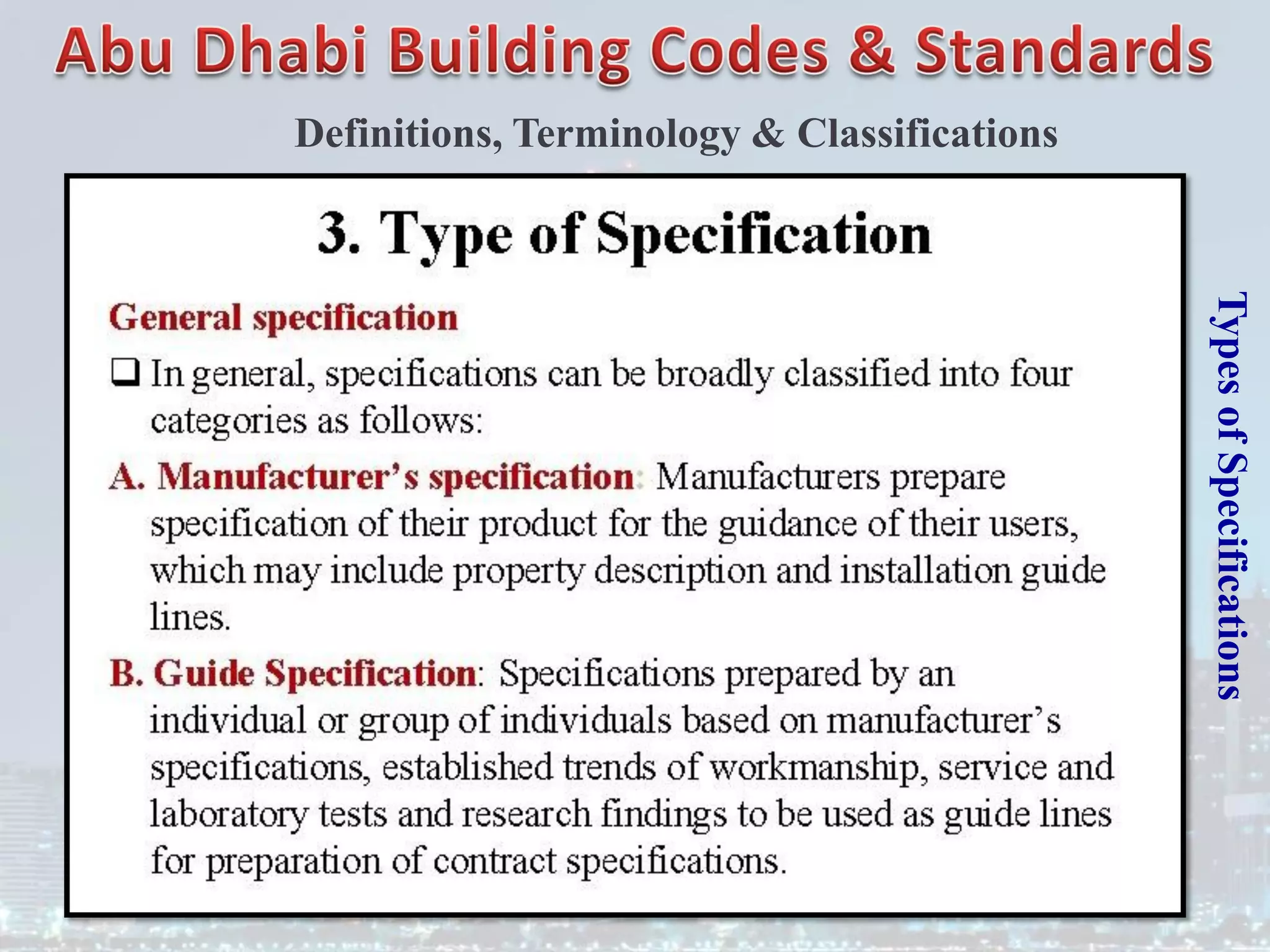
• In buildings under construction, arson and hot work are the most
common causes of fire. For this reason, site security, rigorous
procedures for workers and access to fire hydrants are essential.
Educating workers so they understand the vulnerabilities and how
to avoid dangerous situations is also a must.
612
SEISMIC
PERFORMANCE
SECTION 3
613
SECTION 3: Seismic Performance
a) Wood meets demanding earthquake design requirements
b) Designing for seismic performance: South Park
Wood Meets Demanding
Earthquake Design Requirements
• Wood is a lighter weight building material; wood
buildings resist less earthquake-induced force
• Numerous nail connections provide more load paths,
less chance of collapse and better ductility
• Properly-constructed building elements (frames, shear
walls, diaphragms, etc.) reduce weak links between
structural members
614
615
• Years of research and building code development have proven that
wood-frame and hybrid structures can meet or exceed the most
demanding earthquake design requirements.
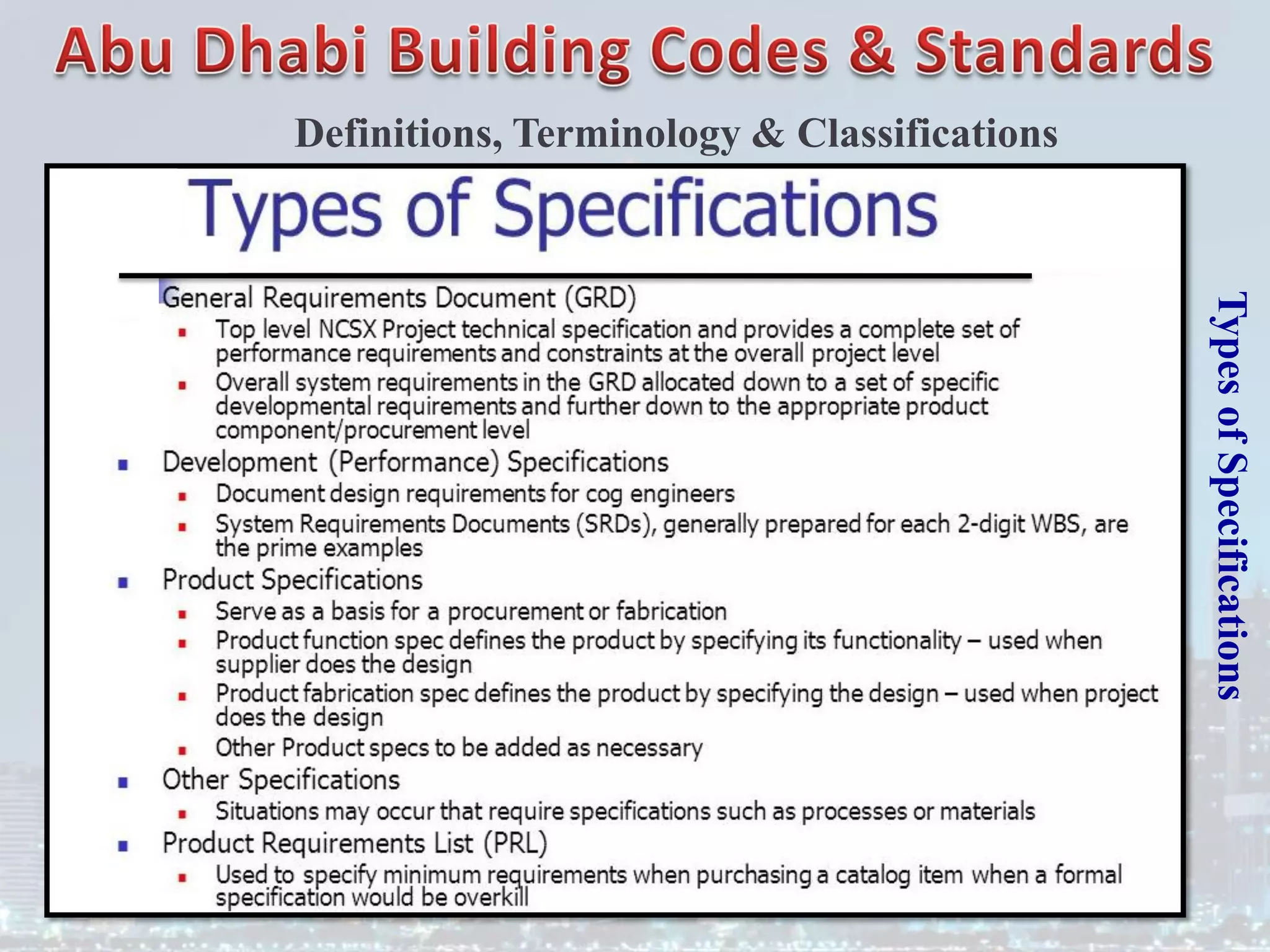
• Most earthquake damage is caused by seismic waves that force the
ground to move and cause the building foundation to shake. Forces
generated in an earthquake are proportional to the structure’s weight.
Thus, the overall magnitude of earthquake-induced forces that a
building must resist is generally less for lighter buildings—and wood is
substantially lighter than other common building materials.
• The fact that wood buildings tend to have numerous nail connections
means they have more load paths, and there is less chance the
structure will collapse should some connections fail. Numerous nail
connections also give wood buildings an inherent ductility.
• The correct design of elements such as frames, shear walls,
diaphragms and their connections to each other is of utmost
importance as earthquake forces “search out” the weak links between
structural members. 616
• Speed of construction and cost were cited as the main reasons
wood was chosen for this project, which includes five stories of
wood-frame structure over two stories of concrete and a concrete
mezzanine.
• According to the architect, the challenge for wood-frame buildings
in high seismic zones is how to accommodate large glass areas and
still provide sufficient shear walls. South Park in particular has a lot
of window area. To achieve this, the design team determined the
minimal length of shear wall required at each floor. Any area not
required for shear wall was used for windows. This approach
blended the structural characteristics of wood to create an
aesthetically pleasing open window grid on the exterior of the
building.
• Within the wood-frame portion of the building, typical walls are
either 2x6 (at exterior walls) or 2x4 studs spaced 16 inches on
center. Floor joists are 2x12 sawn lumber and shear walls are
plywood/OSB board. 617
South
Park
Los Angeles,
California
Architect:
Togawa Smith
Martin, Inc.
Completed: 2016
(planned)
618
Rendering: Togawa Smith Martin, Inc..
KEY PROJECT
Designing
for Seismic
Performance
WIND RESISTANCE
SECTION 4
619
SECTION 4: Wind Resistance
a) System integrity key to wind resistance
b) Building system failures under wind forces
System Integrity Key to Wind Resistance
When structural wood
panels are properly attached
and used to form
diaphragms and shear walls,
they also form some of the
most solid and stable roof,
floor and wall systems
available. Photo: Arch Wood Protection
All components—
including framing,
structural panel
sheathing and inter-
element fastening
details—must be
designed and installed
correctly for
diaphragms and shear
walls to be effective.
620
• In addition to superior seismic performance, wood buildings can be
designed to effectively resist high winds. Wood’s elastic limit and ultimate
strength are higher when loads are applied for a shorter time period, which
is typically the case in high wind events.
• When structural panels such as plywood or OSB are properly attached to
lumber framing and used to form diaphragms and shear walls, they also
form some of the most solid and stable roof, floor and wall systems
available.
• However, in order for the diaphragms and shear walls to be effective, all of
the related components—including framing, structural panel sheathing and
inter-element fastening details—must be designed and installed correctly.
• For the structural system to work as intended, the roof diaphragm must be
able to transfer lateral loads to the shear walls and the shear walls
themselves must transfer these loads to the foundation.
• The success of the entire system is only as good as the quality and quantity
of the connections. Therefore, the key to constructing a building that can
resist lateral loads is understanding how forces are transferred and how to
design and install proper connections. 621
plywood Vs. OSB
622
Building System Failures Under Wind Forces
Most local building codes require a minimum of 33 fasteners
for a standard 4×8 panel installed over roof supports at 24
inches on center.
• Loss of roofing materials and sheathing
• Improper connection detailing between structural systems
• Inadequate sheathing fastening
• Interrupted load path causes change in loading dynamics;
diaphragm ceases to function
623
• In hurricanes, the loss of roofing materials and sheathing is the
leading cause of failure in wood-frame buildings.
• The most common reasons behind these failures are improper
connection detailing between structural systems and inadequate
fastening of sheathing to the supporting members. Most local
building codes require a minimum of 33 fasteners for a standard
4×8 panel installed over the roof supports at 24 inches o.c.
Fasteners, such as 8d common nails (2.5 inches x 0.131 inch) or
other code-approved options, should be placed a maximum of 6
inches o.c. along panel edges and 12 inches o.c. at intermediate
supports.
• Once the roof sheathing has been pulled off its framing, the load
path is interrupted and the diaphragm ceases to function as part
of the lateral load-resisting system. In fact, the entire loading
dynamics of the building will have changed due to this breach.
This change in loading dynamics negatively affects the lateral
design of the building. 624
SOUND TRANSMISSION
AND ACOUSTICS
SECTION 5
625
SECTION 5: Sound Transmission and Acoustics
a) Acoustical considerations
b) Wood absorbs and disperses sound: Arena Stage at the Mead
Center for American Theater
c) Acoustic performance: University House Arena District
Photo: Davis & Church LLC
IBC provides minimum requirements
for sound protection between floors:
• Sound Transmission Class (STC) rating
• Impact Insulation Class (IIC) rating
Wood provides natural acoustic performance.
Can further reduce sound transmission using:
• Gypsum board attached using resilient metal channels
• Glass-fiber or rock-fiber insulation
Wood-frame
construction is
particularly
efficient in
residential
buildings where
sound insulation
is required.
Acoustical Considerations
626
Photo: Davis & Church LLC
Sound Transmission Class (STC) rating, Impact Insulation Class (IIC) rating,
Gypsum board attached using resilient metal channels, Glass-fiber or
rock-fiber insulation..
Acoustical Considerations
627
Sound Transmission Class (STC)
Photo: Davis & Church LLC
Sound Transmission Class (STC) rating, Impact Insulation Class (IIC) rating,
Gypsum board attached using resilient metal channels, Glass-fiber or
rock-fiber insulation..
Acoustical Considerations
628
Impact Insulation Class (IIC) rating
Photo: Davis & Church LLC
Sound Transmission Class (STC) rating, Impact Insulation Class (IIC) rating,
Gypsum board attached using resilient metal channels, Glass-fiber or
rock-fiber insulation..
Acoustical Considerations
629
Gypsum board attached using
resilient metal channels
Glass-fiber or rock-fiber insulation
• As with any issue of building performance, the acoustics of a
wood building can be designed to meet or exceed minimal
requirements, depending on the expectations of the developer,
buyers and tenants.
• In residential buildings, the IBC provides a minimum design
requirement for unit-to-unit acoustical protection between
floors. It requires a Sound Transmission Class (STC) rating and
Impact Insulation Class (IIC) rating of 50, unless the “Authority
Having Jurisdiction” has its own more stringent requirement,
which is rarely the case.
• Wood-frame construction is particularly efficient in residential
buildings where sound insulation is required. Attaching gypsum
board to walls and ceilings using resilient metal channels
significantly reduces sound transmission, as does placing glass-
fiber or rock-fiber insulation within wood-frame floor and wall
assemblies. 630
• Built to accommodate recent growth at the University
of Oregon, the University House Arena District student
housing project includes five stories of wood-frame
construction over a concrete podium.
• As with all of Mahlum’s student housing projects, it
includes a variety of techniques aimed at improving
acoustic performance.
• Since poor acoustics can have a dramatic impact on
student productivity, architects created higher levels of
details, tracking STC and ICC ratings, and both carefully
planning the location of mechanical systems and
utilizing spring isolators in their mounting systems.
They also field tested for acoustical performance at
various stages of construction. 631
University
House
Arena
District
Eugene,
Oregon
Architect:
Mahlum
Architects
Completed:
2013
KEY PROJECT
Acoustic Performance
Photo: Lincoln Barbour
• The design of any functional and safe building is difficult,
if not impossible without considering acoustics, and
wood has a proven record in this regard. Wood is not as
acoustically lively as other surfaces and can offer
acoustically absorptive qualities, hence its widespread
use in performance and musical venues.
• At the Arena Stage at the Mead Center for American
Theater, for example, a small theater called “The Cradle”
posed a challenge because of the sound reflections
caused by its oval shape. In response, Bing Thom
Architects developed a wood slat wall system made
from poplar, designed to look like a basket weave, which
could absorb and disperse sound. 633
Arena
Stage at the
Mead
Center for
American
Theater
Poplar wood
slat wall
system with
basket weave
design
absorbed and
dispersed
sound in ―The
Cradle,‖ a small
oval-shaped
theater.
634
Photo: Nic Lehoux, courtesy of Bing Thom Architects
Wood
Absorbs
and
Disperses
Sound
THE EVOLUTION OF
WOOD CONSTRUCTION
SECTION 6
635
SECTION 6: The Evolution of Wood Construction
a) Mid-rise/multi-family
b) Beyond five stories with the IBC: 1201
Mercer/Rivet
c) Schools
d) Motivating environment: El Dorado High
School
e) Mass timber
f) CLT code approvals
Typically Type III or V
Construction:
 V = allows use of
untreated wood
throughout
 III = requires exterior
walls to be non-
combustible
construction/FRT wood
Four stories common,
economical
IBC permits five stories
(six for office
occupancy)
Podium structures
common
Photo by Matt Todd, courtesy of WoodWorks
Mid-rise/
Multi-
family
• Mid-rise buildings are typically Type V Construction, which allows the
use of untreated wood throughout, or Type III Construction. Type III
Construction allows the same methods of construction as Type V except
the exterior walls are required to be of non-combustible construction,
which allows the use of fire retardant-treated wood.
• Many developers and design teams default to wood for mid-rise
buildings up to four stories because it is the most economical choice;
however, with five-story wood buildings permitted in the IBC (six for
office occupancy), there has been a marked interest among those who
see taller wood buildings as a way to achieve greater density at lower
cost.
• Podium structures in particular, which include multiple stories of
residential wood-frame construction over a concrete (3-hour-rated)
podium deck, are common among design professionals seeking to
incorporate parking, retail or restaurants into their designs. The specific
requirements for using podium construction to increase allowable
number of stories are detailed in Section 510 of the IBC. 637
1201
Mercer /
Rivet
Seattle,
Washington
Architect:
Ankrom
Moisan
Architects
Completed:
2014
Photo: Casey Braunger, CBPhoto
638
KEY
PROJECT
Beyond
Five
Stories
with the
IBC
• Utilizing code provisions to go beyond the base heights and areas
permitted for mid-rise wood-frame buildings is key to maximizing value.
• Located in Seattle’s Cascade Neighborhood, Ankrom Moisan’s design
for Rivet includes five stories of Type VA wood-frame construction over
a two-story Type IA concrete podium. The wood portion of the building
includes pre-manufactured floor joists supported by load-bearing stud
walls, and wood panel-sheathed shear walls.
• The IBC allows five stories of Type III wood-frame construction when
the building is equipped with an NFPA-compliant automatic sprinkler
system. However, Seattle’s building code is unique in that it also allows
five stories of wood with a Type VA structure (when the building has an
NFPA-compliant sprinkler system), which is even more cost effective
and is being considered by a growing number of other jurisdictions as a
way to encourage urban infill development. While the 2012 IBC allows a
one-story concrete podium, this has been increased to two stories for
the 2015 IBC.
639
Schools
Benefits of wood
construction
• Cost effective
• Speed of construction
• Design versatility
• Meets green building goals
• Reduces stress, creates
positive learning
environment
The IBC has well-established
parameters for wood-frame
schools, which is good news for
school districts trying to meet a
limited budget. 640
Photo by Bethel School District
• The IBC has well-established parameters for wood-frame schools, which is
good news for school districts trying to accommodate increasing enrollment on
a limited budget. However, many who turn to wood-frame construction for its
cost effectiveness find that wood also offers other advantages—such as speed
of construction, design versatility and the ability to meet green building goals.
• Increasingly, research is also supporting the idea that visual wood in a room
promotes the well-being of occupants, reduces stress and creates a positive
environment for learning.
• For example, one study at the University of British Columbia and
FPInnovations found that the presence of visual wood surfaces in a room
lowered activation of the sympathetic nervous system (SNS) in an office
environment. The SNS is responsible for physiological stress responses in
humans such as increased blood pressure and heart rate while inhibiting the
parasympathetic system responsible for digestion, recovery and repair
functions.
• Study author David Fell says the results of the office study apply to any interior
environment—and it is, in fact, supported by another more recent study of
wood in healthcare environments. “The stress-reducing effects we found for
wood in office environments are in theory transferable to any building type as
these are innate reactions to natural materials.”
641
• At the 322,500-square-foot El Dorado High School in Arkansas,
designers used exposed wood and natural light to create an
environment that would motivate students to stay in school.
Architects used exposed wood products in structural systems and in
elements such as doors, millwork and trim to provide a unique
architectural aesthetic that helps to naturally soften and warm the
spaces.
• From a code perspective, this project is noteworthy because it was
one of the first schools in Arkansas to make extensive use of wood
following a change in school board policy that had previously
prohibited wood in school construction. In 2008, recognition of
wood’s safety and performance attributes led the Arkansas School
Board to modify its School Facilities Manual to reflect the IBC. It is
also noteworthy from a cost perspective. Originally designed in
steel and masonry, the school was changed to wood-frame
construction for budget reasons—a move that saved the school
board $2.7 million. 642
Originally designed in steel and
masonry, El Dorado High School
was changed to wood-frame
construction—saving $2.7
million.
Motivating Environment El Dorado High School
• Exposed wood and
natural light enhances
learning and motivates
students
• Warm spaces
• One of the first schools in
Arkansas to make
extensive use of wood
• Successful
implementation prompted
change in school board
policy to allow use of
wood in school
construction
Photo: Dennis Ivy, courtesy WoodWorks
Mass Timber
Cross laminated timber / CLT
• 3, 5 or 7 layers of solid dimension lumber glued to create full-depth solid
wood panels
• Cross lamination provides exceptional strength, stability and rigidity
• Low-carbon alternative to concrete and steel
• Fast installation
• Reduced on-site waste
• Light weight/reduced foundation requirements
• Thermal performance
• Design versatility
• Chars slowly, providing fire-resistive protection
Photo courtesy of naturallywood.com
644
• Common in Europe but relatively new to North America, CLT
typically consists of three, five or seven layers of solid
dimension lumber, kiln-dried and layered perpendicular to one
another and then glued to create full-depth solid wood wall
and floor panels up to 12 feet by 60 feet.
• This cross lamination provides exceptional strength, stability
and rigidity, allowing CLT to be used as a low-carbon
alternative to concrete and steel in many applications. Benefits
also include quick installation, minimal on-site waste, light
weight and (as a result) reduced foundation requirements,
thermal performance and design versatility.
• Fire-resistance testing has confirmed that CLT, like heavy
timber, chars at a rate that is slow and predictable, maintaining
its strength and giving occupants more time to leave the
building.
645
IBC recognizes CLT products
manufactured to the ANSI/APA PRG
320-2011 Standard as code-
compliant.
CLT Code Approvals
2015 IBC allows CLT use
with Type IV Construction;
ANSI/APA PRG 320-2011
Standard for Performance-
Rated Cross-Laminated
Timber provides quality
assurance.
Photo courtesy of Lend Lease
• In the U.S., the 2015 IBC includes
use of CLT of a certain thickness
within Type IV construction.
• In May 2012, APA published
ANSI/APA PRG 320-2011
Standard for Performance-Rated
Cross-Laminated Timber, an
American National Standard that
provides requirements and test
methods for qualification and
quality assurance of CLT.
• CLT products manufactured to
the standard have been
recognized as code-compliant in
the 2015 IBC. 647
GREEN BUILDING
CODES, STANDARDS
AND RATING SYSTEMS
SECTION 7
648
SECTION 7: Green Building Codes, Standards and Rating Systems
a) Environmental evolution
b) Life Cycle Assessment (LCA)
Environmental Evolution
• U.S. Green Building Council
• California Green Building Standards Code (CALGreen)
• ASHRAE 189.1, a code-intended commercial green building
standard published by ASHRAE in cooperation with the
Illuminating Engineering Society of North America (IES)
• International Green Construction Code (IgCC)
IgCC’s key mandatory requirement is that
at least 55 percent of materials (based on
mass, volume or cost) be used, recycled,
bio-based and/or indigenous in any
combination. 649
International
Green
Construction
Code (IgCC)
International Green
Construction Code
(IgCC)
ASHRAE 189.1
ICC 700 National Green
Building Standard
CALGreen (California Green
Building Standards Code)
ANSI/GBI 01-2010: Green Building
Assessment Protocol for
Commercial Buildings
the Illuminating Engineering
Society of North America (IES)
the American
National Standard
based on Green
Globes
• The International Green Construction Code (IgCC), released in 2012 and
adopted by eight jurisdictions so far, is the latest phase in an evolution that’s
included two American National Standards (covering residential and non-
residential construction), the California Green Building Standards Code
(CALGreen) and ASHRAE 189.1, a code-intended commercial green building
standard published by the American Society of Heating, Refrigerating and Air-
Conditioning Engineers (ASHRAE) in cooperation with the Illuminating
Engineering Society of North America (IES) and U.S. Green Building Council.
• The IgCC covers subject areas typically found in any green building effort,
including site, materials, energy, water and indoor environment. Primarily a
voluntary code that jurisdictions have adopted to provide guidance regarding
public or publicly funded buildings, it includes “mandatory” provisions within
all subject areas as well as recommended provisions and electives. It is
potentially applicable to almost every commercial building project, including
additions and repairs.
• In terms of material use, the IgCC’s key mandatory requirement is that at least
55 percent of materials (based on mass, volume or cost) be used, recycled, bio-
based and/or indigenous in any combination. However, this rule need not be
met when a whole building life cycle assessment (LCA) is performed. 656
Life Cycle Assessment (LCA)
Encourages design professionals to:
• Compare different building designs based on their
true environmental impacts over their entire life
cycle, from extraction or harvest through
manufacturing, transportation, installation, use,
maintenance and disposal or recycling
• Make informed choices about the materials they
use
Source: Building Green With Wood
www.naturallywood.com
LCA studies consistently show that wood
is better for the environment than steel or
concrete in terms of embodied energy, air
and water pollution, and greenhouse gas
emissions. 659
• LCA is a scientific approach to evaluation that considers the impact of materials over
their entire life cycle, from extraction or harvest through manufacturing,
transportation, installation, use, maintenance and disposal or recycling. When
integrated into green building codes, standards and rating systems, LCA encourages
design professionals to compare different building designs based on their true
environmental impacts and to make informed choices about the materials they use.
• It replaces the prescriptive approach to material selection that’s been common until
now, which assumes that certain prescribed practices—such specifying products
with recycled content—are better for the environment regardless of the product’s
manufacturing process or disposal. LCA studies consistently show that wood is
better for the environment than steel or concrete in terms of embodied energy, air
and water pollution, and greenhouse gas emissions.
• In the U.S., LCA is included in the Green Globes rating system and the American
National Standard based on Green Globes, ANSI/GBI 01-2010: Green Building
Assessment Protocol for Commercial Buildings, as well as the ICC 700 National Green
Building Standard. It is part of both CALGreen and ASHRAE 189.1, and optional LCA
credits related to LCA were recently added to the Leadership in Energy and
Environmental Design (LEED) rating system (v.4).
• Although LCA isn’t mandatory in the IgCC, elimination of the “55 percent
requirement” is a powerful incentive for its use. 660
WOOD: THE SENSIBLE
REVOLUTION
SECTION 8
662
SECTION 8: Wood: The Sensible Revolution
a) Building codes recognize wood’s safety
Building Codes Recognize Wood’s Safety
IBC allows wood use in a wide range of building
applications.
Wood provides:
• Cost effectiveness
• Functionality
• Design flexibility
• Beauty
• Environmental performance
663
• Today’s building codes recognize wood’s safety and
structural performance capabilities and allow its use
in a wide range of building applications, from the
light-duty repetitive framing common in small
structures to the larger and heavier framing systems
used to build mid-rise/ multi-story buildings, schools
and arenas. This hasn’t been lost on design
professionals seeking to have it all—cost
effectiveness, functionality, design flexibility, beauty
and environmental performance—who, through
their collective projects, are leading a revolution
toward the greater use of wood in non-residential
and multi-family buildings.
664
ENDNOTES
SECTION 9
665
• SECTION 9: Endnotes
•
1. http://www.woodworks.org/why-wood/
2. http://www.woodworks.org/why-wood/carbon-footprint/carbon-footprintresources/
3. The American Wood Council offers a number of publications related to the fire design of wood buildings
for code acceptance: http://www.awc.org/codes/dcaindex.html
4. Design of Fire-Resistive Exposed Wood Members, American Wood Council,
http://www.awc.org/codes/dcaindex.html
5. ANSI/AF&PA SDPWS-2008 – Special Design Provisions for Wind and Seismic Standard with Commentary,
American Wood Council; Design Concepts for Building in High Wind and Seismic Zones, APA
6. ANSI/AF&PA SDPWS-2008– Special Design Provisions for Wind and Seismic Standard with Commentary,
American Wood Council; Design Concepts for Building in High Wind and Seismic Zones, APA
7. Acoustical Consideration for Mixed-Use Wood-Frame Buildings, U.S. WoodWorks, 2014
8. Fire Resistance and Sound Transmission in Wood-Frame Residential Buildings, Canadian Wood Council
9. Wood and Human Health, Issue 1, FPInnovations, 2013
10. Wood as a Restorative Material in Healthcare Environments, FPInnovations, 2015
11. American Wood Council, ww.awc.org/NewsReleases/2012/newsreleases2012.php#clt;
12. The City of Baltimore is the only jurisdiction in which the IgCC is mandatory for all building construction.
13. More information on the International Green Construction Code is available from Dovetail Partners, Inc.,
www.dovetailinc.org.
14. Life Cycle Environmental Performance of Renewable Building Materials in the Context of Building
Construction, Consortium for Research on Renewable Industrial Materials, Phase I 2005, Phase II 2010,
http://www.corrim.org/pubs/reports.asp; A Synthesis of Research on Wood Products and Greenhouse
Gas Impacts, Sarthre, R. and J. O’Connor, 2010, FPInnovations, http://woodworks.org/wp-
content/uploads/FPIGreenhouse-Gas.pdf; Wooden building products in comparative LCA: A literature
review, Werner, F. and Richter, K., 2007, International Journal of Life Cycle Assessment, 12(7):470-479
666
Photo by David Lena; courtesy of HMC Architects
668

Abu Dhabi Building Codes & Standards-Final.pdf

  • 2.
    Course Description The aimof this course is to introduce the required skill for understanding the importance, application, use, and management of various buildings and constructions codes, regulations, specifications and standards around the world; especially in UAE (Abu Dhabi).
  • 3.
    TRAINING METHODOLOGY This isan interactive course. There will be open question and answer sessions, regular group exercises and activities, videos, case studies, and presentations on best practice. Participants will have the opportunity to share with the facilitator and other participants on what works well and not so well for them, as well as work on issues from their own organizations.
  • 4.
    Who Should Attend? Thisprogram is suitable for Engineers who would like to be exposed on the different aspects of the various standards & codes used in the industry.
  • 5.
    Course Certificate: IFM certificatewill be issued to all attendees completing minimum of 75% of the total tuition hours of the course.
  • 6.
    Course Outline: Upon thesuccessful completion of this program, participants will be able to: 1. Understand the various standards and codes in the Process industry with emphasis on the right approach & methodology for using such codes. Applicable codes include ANSI, ISO, NBIC, ASME, ASTM, NEC, API, AWS, NFPA and ISA 2. Understand the various standards and codes of UAE (Dubai, JAFZA, & Abu Dhabi) in the Process construction industry with emphasis on the right approach & methodology for using such codes. 3. Detailed applicable codes of Abu Dhabi include : International Building Code (IBC), International Energy Conservation Code (IECC), International Fire Code (IFC), International Fuel Gas Code (IFGC), International Mechanical Code (IMC), International Plumbing Code (IPC), International Private Sewage Disposal Code (IPSDC), & International Property Maintenance Code (IPMC). 4. Review the definitions of codes, standards & regulations and be able to distinguish the differences among them 5. Understand the code objectives, code intents, stated and implied requirements 6. Determine the various uses of codes, standards & regulations for design, construction, continuing integrity, repairs and quality 7. Know the mandatory, recommended and optional stipulations of the code 8. Recognize the importance & role of compliance and be able to understand codes, code bodies and their relationships. 9. Heighten knowledge on super codes and standards globally, particular in UAE/ AD.
  • 8.
    Definitions, Terminology &Classifications Technology, Industry, or Activity Conditions & Specificat- ions Codes, Standards, Regulations & Manuals Sampling & Scaling Modeling & Drawing How to control and succeed any:
  • 9.
  • 10.
    Definitions, Terminology &Classifications A standard is a repeatable, harmonized, agreed and documented way of doing something. Standards contain technical specifications or other precise criteria designed to be used consistently as a rule, guideline, or definition. They help to make life simpler and increase the reliability and the effectiveness of many of the goods and services we use. Standards result from collective work by experts in a field and provide a consensus at the time when the standards are developed. As standards in the international arena are established on a consensus and broad stakeholder basis, they represent what can be agreed upon. A published standard is therefore the harmonized synthesis of what the group is prepared to publish. In terms of international and regional standardization, this is even more important than at the national level: the importance of consensus is critical because of large and diverse stakeholder groups and needs. Ultimately this may mean that a standard might lack some of the clarity, detail or specific criteria certain stakeholder groups or individuals would have preferred. Standards do not necessarily have to be developed by standardization bodies, such as ISO or the IEC. Any organization can establish standards for internal or external use. However, to be truly called a standard, the requirements stated above must be met.
  • 11.
    Definitions, Terminology &Classifications Regulation is broadly defined as imposition of rules by government, backed by the use of penalties that are intended specifically to modify the economic behavior of individuals and firms in the private sector. Various regulatory instruments or targets exist. Or; Regulation is a law, rule, or other order prescribed by authority, especially to regulate conduct: Safety regulations require the use of impact-resistant helmets. Or; it is the act of regulating or the state of being regulated: Adolescence is a potentially important time in the development of emotion regulation. Code is a system of words, letters, or signs used to represent a message in secret form, or a system of numbers, letters, or signals used to represent something in a shorter or more convenient form. Or; a code is a systematic statement of a body of law, or it is a system of principles or rules, or it is a a system of signals or symbols for communication. Manual is a book that gives you practical instructions on how to do something or how to use something, such as a machine. Or it is a book that is conveniently handled especially : HANDBOOK which is an instruction manual, or the prescribed movements in the handling of a weapon or other military item during a drill or ceremony.
  • 12.
    Definitions, Terminology &Classifications What is the Difference between Code, Standard and Specification? What is the Standard? Standard can define as a set of technical definitions and guidelines – or simply “how-to” instructions for designers and manufacturers. It gives all the requirements for the product, service, and operation. A designer will use the standard to design the product, and a manufacturer will use the standard for the manufacturing of the product. Standard serves as a common language for defining quality and establishing safety criteria for the product. ASTM, API, and ISO are some examples of the standard. ASTM has more than 12000 standards they cover all most everything. If you visit the ASTM website, they say that they have standards from toys to aircraft. Why is the standard required? let’s take the example of a mobile phone charger. If you are in the USA and traveling to India, you need an adapter to use your charger. This is because both the country follows different standards for power sockets. But your USB cables will work worldwide because they are manufactured as per the globally accepted standard. In the case of the process industry, piping components are sourced from around the world; we want all these materials, irrespective of their country of origin should fit perfectly with each other at the site. Standard help to achieve these; •By establishing common engineering or technical requirements for products, practices, methods, or operations that the manufacturer has to follow while manufacturing piping components. •Standard Built confidence about product quality in the users and •With standardization cost of production will reduce as you can produce in bulk for global markets.
  • 13.
    Definitions, Terminology &Classifications What is the Difference between Code, Standard and Specification? What is the Code? When governmental bodies adopt the standard and become legally enforceable, or when it has been incorporated into a business contract, the standard will become a code. ASME Codes are legally enforceable in many US states. Whereas, in the other part of the world, they are not legally enforceable, but such countries have similar codes. Please note that the requirements mentioned in the code will only be mandatory requirements if •The Code is adopted as law by a regulatory body •It is a part of the business contract Otherwise, the Code will serve as generally accepted guidelines for design, fabrication, construction, and installation, However, all most all process facility follows various American code and Standard in addition to their national standard. Examples of the codes are ASME Boiler and Pressure Vessel Code, BS, DIN, etc. Why is a Code required? •Code Provides a set of rules that specify the minimum acceptable level of safety & Quality for manufactured, fabricated, or constructed goods. •Codes also refer to standards or specifications for the specific details on additional requirements that are not specified in the Code.
  • 14.
    Definitions, Terminology &Classifications What is the Difference between Code, Standard and Specification? What is a Specification? Specifications provide specific/additional requirements for the materials, components, or services that are beyond the code or standard requirements. •For Example, if you want an A106 Gr B pipe with Maximum carbon of 0.23% against standard requirements of 0.3% Max, you have to specify your requirement in your specification or Purchase Order. •The specification is generated by private companies to address additional requirements applicable to a specific product or application. Why is Specification required? •It allows a purchaser to include special requirements as per design and service conditions. •It allows customizing your product. •Please note the requirements in the specification are must meet requirements Examples- Product specification, Shell DEP & EIL Specification
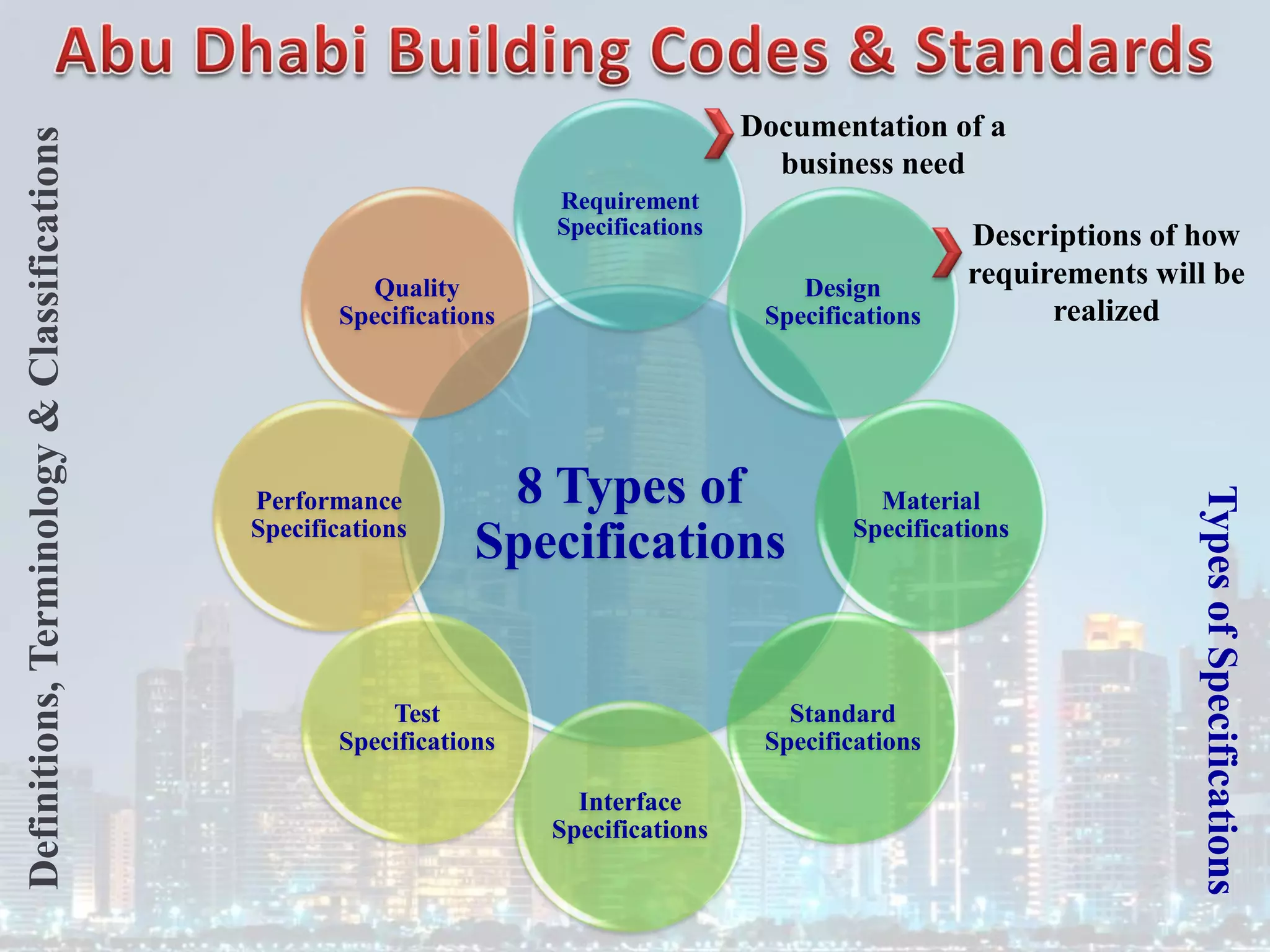
  • 15.
    Definitions, Terminology & Classifications What is theDifference between Code, Standard and Specification?
  • 16.
    Definitions, Terminology &Classifications What is the Difference between Code, Standard and Specification? Example: Difference Between Code, Standard, and Specification in Piping;
  • 17.
    Definitions, Terminology &Classifications What is the Difference between Code, Standard and Specification?
  • 18.
  • 19.
    Building Codes Life and SafetyIssues “Some History”
  • 20.
    Today's building codescan be traced back to the code of Hammurabi, circa 2200-1800 B.C. The Code of Hammurabi (also known as Codex Hammurabi) is one of the earliest and best preserved law codes from ancient Babylon, created ca. 1760 BC (middle chronology). It was enacted by the sixth Babylonian king, Hammurabi.
  • 21.
    228 If abuilder build a house for some one and complete it, he shall give him a fee of two shekels in money for each sar of surface. 229 If a builder build a house for some one, and does not construct it properly, and the house which he built fall in and kill its owner, then that builder shall be put to death. 230 If it kill the son of the owner the son of that builder shall be put to death. 231 If it kill a slave of the owner, then he shall pay slave for slave to the owner of the house. 232 If it ruin goods, he shall make compensation for all that has been ruined, and inasmuch as he did not construct properly this house which he built and it fell, he shall re-erect the house from his own means. 233 If a builder build a house for some one, even though he has not yet completed it; if then the walls seem toppling, the builder must make the walls solid from his own means. The code of Hammurabi provided for the death of a builder if the construction of a dwelling collapsed and caused the death of the owner. A shekel was originally 180 grains (8.33 grams). A sar is approximately 12 sq. ft.
  • 22.
    First building codesin the US established in 1625 addressed fire safety and specified materials for roof coverings. In 1630, Boston outlawed chimneys made with wood and thatch roof coverings. Late 1770s George Washington recommended that height and area limitations be imposed on wood frame buildings in his plans for the District of Columbia.
  • 23.
    NYC 500 bldgsdestroyed, chicago 4-1/2 miles 1800 bldgs 300+ lives, brklyn 295 lives, SF Earthquack 3000+
  • 24.
    Council of Hygiene,organized in 1863. Presented this plan to the Citizens’ Association of New York as a specimen “multiple domicile” “Here are 12 living rooms and 21 bedrooms, and only six of the latter have any provision or possibility for the admission of light and air, excepting through the family sitting and living room; being utterly dark, close, and unventilated. The living rooms are but 10 x 12 feet, bedrooms are 6.5 x 7 feet” Mortality rate 1:48 in 1815 to 1:27 in 1855.
  • 25.
    Disease Tuberculosis, cholera, smallpox; A death of a child was recorded as “plainly due to suffocation in the foul air of an unventilated apartment”.
  • 26.
  • 27.
    Today’s building codeaddresses many issues of life and safety. Prior to the International Code Council, building safety codes were regional. Most codes were produced by three model cod organizations. BOCA National Codes were used mostly in Eastern and Great Lakes states; ICBO Uniform Codes in Western and Midwest states; SBCCI Standard codes in Southern states. As a result the construction industry often faced the challenge, and cost, of building to different codes in different areas of the country.
  • 28.
  • 29.
    •Light, Ventilation, Heating •Roomsizes and Ceiling heights •Sanitation and bathroom requirements •Glazing and Hazardous locations •Other use areas—like Garages •How to get out safely. •Stairways and special requirements •Fire protection •Moisture and decay protection •Pesky pests… (termites among others) •And more….addresses, flood stuff…
  • 30.
    Types & Classificationsof Specifications General Specifications Detailed Specifications Definitions, Terminology & Classifications
  • 31.
  • 32.
  • 33.
  • 34.
  • 35.
  • 36.
  • 37.
  • 38.
  • 39.
  • 40.
    Types of Specifications In civil engineering,the specification is a detailed description document of all workmanship and materials which are going to be used in the building construction work. Specifications play an important role in the execution of the quality of work, so the specification must be clear, concise, and free from any uncertainty. Definitions, Terminology & Classifications
  • 41.
    Types of Specifications Types of ConstructionSpecifications According to the American Institute of Architects (AIA) Document A201-2007, the Contract Documents for a construction project consist of “the Agreement, Conditions of the Contract, Drawing, Specifications, Addenda…”, as well as other miscellaneous documents associated with the contract between the project Owner and the Contractor hired to complete the work. Construction specifications, as noted, become a part of the legal documents of the agreement and form a cornerstone of the project design. In fact, in most cases, the construction specifications override the project drawings in the event of conflicting information. The purpose of construction specifications is to delineate the requirements regarding the materials, products, installation procedures and quality aspects involved with execution of the work and fulfillment of the contract. There are three main types of construction specifications: 1. performance, 2. prescriptive , and 3. Proprietary. which are described below. Definitions, Terminology & Classifications
  • 42.
    Types of Specifications 1- Performance Specifications: Aperformance specification is a document that specifies the operational requirements of a component or installation. Simply put, a performance specification tells the contractor what the final installed product must be capable of doing. The contractor is not instructed as to how to accomplish the task of meeting the performance specification requirements - only as to how the component must function after installation. For example, a performance specification may be used in the construction of an industrial pumping system. The specification would provide a required pumping rate (say 500 gallons per minute), a required pressure (20 psi) and the difference in height between the pump and the final destination (+40 feet). The specification will also state that the liquid to be pumped will be at a temperature of 140°F and is corrosive (pH of 3). It is up to the contractor to provide pumping equipment that meets or exceeds the requirements stated in the specification. In many cases the contractor will also be required to test equipment to make sure that is operating properly, and will provide operations manuals. The general concept behind the performance specification is for the architect or engineer to describe what they need, and the contractor to determine the best way to get there. The performance specification focuses on the outcome and shifts the selection of materials and methods, as well as a portion of the design work, onto the shoulders of the contractor. This approach can provide incentives for innovation and flexibility in the construction approach, but also reduces the amount of control that the architect or engineer has over the project./p> Definitions, Terminology & Classifications
  • 43.
    Types of Specifications 2- Prescriptive Specifications: Prescriptivespecifications convey the requirements of a project through a detailed explanation of the materials that the contractor must use, and the means of installing those materials. This type of specification will typically be formatted in a manner similar to the following sections: A. General: This section will typically contain references to national/international standards, design requirements, a list of required submittals from the contractor to the architect/engineer, quality control requirements and product handling requirements. B. Products: This section will describe, in detail, the various products required for the task covered by the specification along with the individual structural and performance requirements of each product. C. Execution: This section will explain how to prepare the materials and conduct the installation, including the testing requirements to be followed. Prescriptive specifications shift more of the project design control onto the shoulders of the architect or engineer and away from the contractor by establishing a set of rules that is to be followed for each project component. This type of specification provides more certainty regarding the final product composition than the performance specification, and is very frequently used for highly complex portions of a project. Definitions, Terminology & Classifications
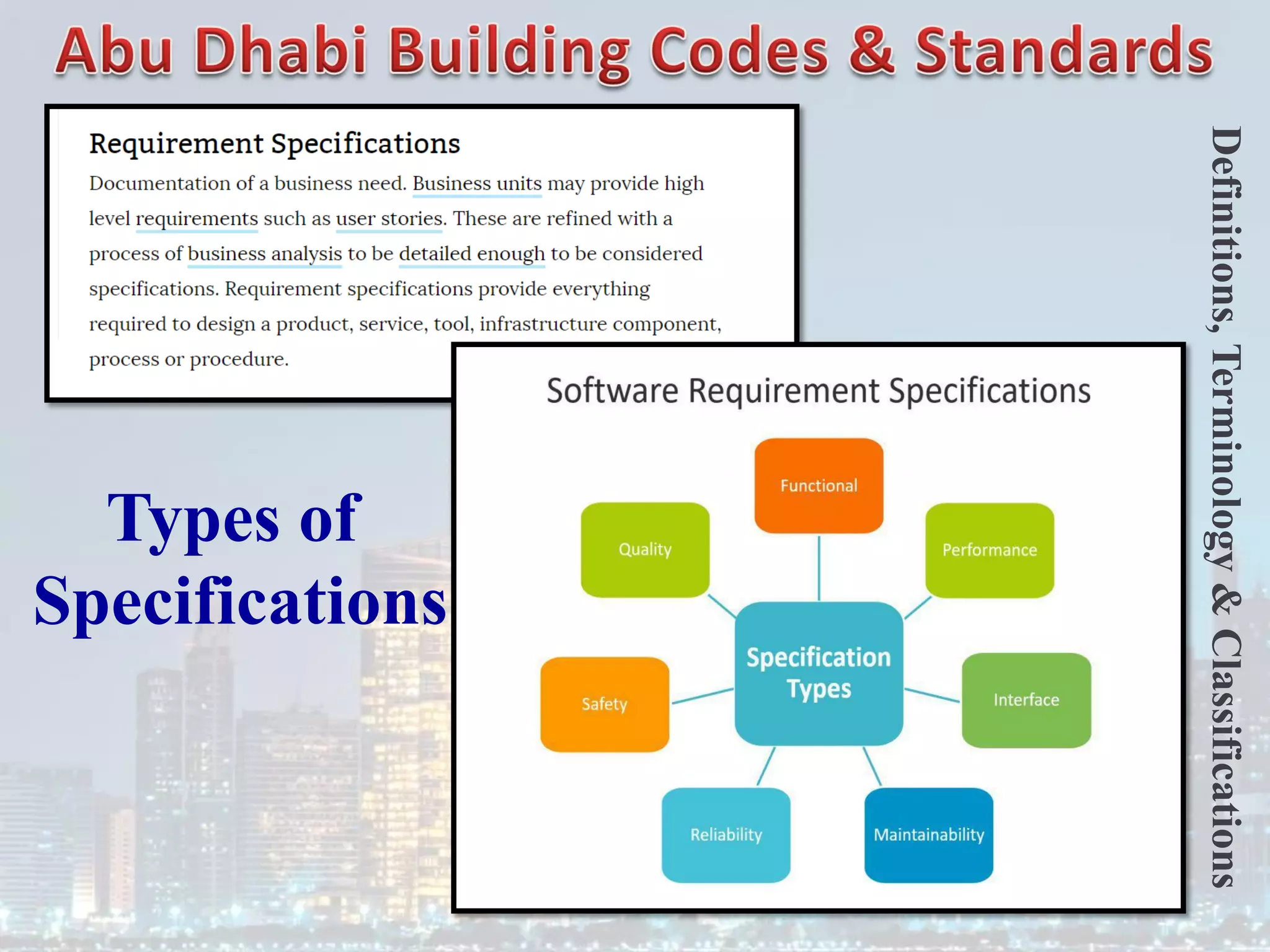
  • 44.
    Types of Specifications 3- Proprietary Specifications: Proprietaryspecifications are those that require the use of a single approved product type for any particular installation. Proprietary specifications are often used in cases where there is existing equipment or installations already on site. In these cases the owner may want to maintain consistency of materials or possibly simply prefers a specific type of product. Also, in highly complex installations where there is only one specific piece of equipment that will accomplish a specified task, a proprietary specification is required. Architects and engineers typically try to avoid utilizing proprietary specifications except when absolutely necessary, and will usually allow the contractor to select from a list of approved suppliers. Requiring the use of one specific product type can lead to the perception of favoritism towards a certain manufacturer and may eliminate competition during the bid phase, which may increase the project cost. Definitions, Terminology & Classifications
  • 45.
    Types of Specifications Construction SpecificationStandards Construction specifications used in the United States typically conform to the guidelines of the Construction Specifications Institute (CSI), who have created a specifications index entitled MasterFormat. The MasterFormat index groups specification sections into easily identifiable disciplines using a six-digit system with digits in groups of two, such as: 01 24 30. The first two digits denote the primary section (of which there are 48 sections). For example, all the items regarding concrete start with the digits 03. The second two digits identify the main headings and subheadings. In this case, we look at main headings Concrete Reinforcing (03 20 00) and Cast-in- Place Concrete (03 30 00) which can be broken down into Reinforcement Bars (03 21 00) and Structural Concrete (03 31 00). The breakdown continues further with the final two digits, for example: Plain Steel Reinforcement Bars (03 21 11) and Heavyweight Structural Concrete (03 31 13). Use of MasterFormat allows professional and construction personnel alike the ability to use a common system to reference and group materials and equipment when utilizing specifications, pay applications, estimating programs, etc. For a list of sections, refer to our MasterFormat Specification Divisions article. In addition, CSI also maintains UniFormat Specifications, which are used for the early phases of a project. UniFormat allows construction teams to begin investigating project schedules and costs without the detail of MasterFormat.
  • 46.
    Types of Specifications Or; we mayclassify specifications globally or locally according to regions and countries, into: 1- International Specifications: ISO, US, BS, etc. 2- Regional Specifications: Euro codes and specifications, GCC codes, etc.. 3- Local or National Specifications (for countries): Egyptian, UAE, in addition to all well known international specifications (US, BS, Canadian, etc.) Definitions, Terminology & Classifications
  • 47.
    Most Famous InternationalStandards USA BSi European DIN Canadian Japanese Russian Chinese Australian Indian French Others Types of Specifications Definitions, Terminology & Classifications
  • 48.
  • 53.
    ANSI, NBIC, ASME,ASTM, NEC, API, AWS, UBC, NFPA, ACI, PCI, AASHTO, AREA, ABS, ISA, etc.
  • 57.
  • 58.
    The global standardsfor sustainability reporting
  • 59.
    The global standardsfor sustainability reporting
  • 60.
  • 61.
  • 62.
  • 63.
    International Code Council(ICC) The International Codes, or I-Codes, are the most trusted source of model codes and standards. Decades of knowledge and experience guide our code development process to create safe, sustainable and affordable communities and a level playing field for builders, developers and manufacturers. As industry experts, we provide the codes and standards that our members turn to, building safety professionals rely on and manufacturers trust.
  • 64.
    International Code Council(ICC) The International Codes, or I-Codes, are the gathering and joining of all types of building and construction codes, standards, regulations and instructions in USA (e.g.; construction, materials, operational, environmental, and maintenance standards) to put them into a unique manner and arrangement in order to control and manage the entire activities of the construction industry.
  • 66.
    Codes: Our democraticapproach to developing and publishing codes (I-Codes) enables the people closest to codes to shape the regulations and participate in ensuring public health, safety and welfare of the people who live in, work in and visit the community you serve. Standards: The process of developing standards is led by a technical committee, including stakeholders, through meetings guided by expert opinions to ensure the safest standards are implemented. Codes and Standards Development Processes: The International Code Council has a system for developing model codes and standards based on trust and transparency.
  • 67.
    The Code Development Process:The International Code Council develops construction and public safety codes through a governmental consensus process. This system of code development has provided the highest level of safety in the world for more than 90 years. Click the buttons below to learn more about the code development process, and to download infographics that help explain the process. The Standards Development Process: As is the case with its codes, the Code Council adheres to openness and transparency in our standards development process. All Code Council standards committee meetings are open to the public. Any interested party can participate in committee meetings and can be considered by the committee for membership on any work-group that the committee creates. The International Codes (I-Codes), developed by the International Code Council, are a family of fifteen coordinated, modern building safety codes that help ensure the engineering of safe, sustainable, affordable and resilient structures. The I-Codes are the most widely accepted, comprehensive set of model codes used in the United States. All fifty states, the District of Columbia, and many other countries have adopted the I-Codes at the state or jurisdictional level.
  • 68.
    The International Codes TheCode Council has made the International Codes available as a comprehensive and coordinated set of publications including: 1. International Building Code (IBC) 2. International Energy Conservation Code (IECC) 3. International Existing Building Code (IEBC) 4. International Fire Code (IFC) 5. International Fuel Gas Code (IFGC) 6. International Green Construction Code (IGCC) 7. International Mechanical Code (IMC) 8. ICC Performance Code (ICCPC) 9. International Plumbing Code (IPC) 10. International Private Sewage Disposal Code (IPSDC) 11. International Property Maintenance Code (IPMC) 12. International Residential Code (IRC) 13. International Swimming Pool and Spa Code (ISPSC) 14. International Wildland Urban Interface Code (IWUIC) 15. International Zoning Code (IZC) Plumbing, Mechanical, Fuel Gas and Swimming Pool Codes (PMG): The Code Council has historically used the acronym PMG to refer to its model codes, standards, services and resources related to plumbing, mechanical, fuel gas. With the release of the International Swimming Pool and Spa Code (ISPSC) in 2012, it has expanded to include swimming pools and spa topics. 15 Codes
  • 69.
    The International Codes International Building Code (IBC) International Energy Conservation Code(IECC) International Existing Building Code (IEBC) International Fire Code (IFC) International Fuel Gas Code (IFGC) International Green Construction Code (IGCC) International Mechanical Code (IMC) ICC Performance Code (ICCPC) International Plumbing Code (IPC) International Private Sewage Disposal Code (IPSDC) International Property Maintenance Code (IPMC) International Residential Code (IRC) International Swimming Pool and Spa Code (ISPSC) International Wildland Urban Interface Code (IWUIC) International Zoning Code (IZC) 15 Codes
  • 70.
  • 71.
  • 73.
  • 74.
  • 75.
  • 77.
  • 78.
  • 79.
  • 80.
  • 82.
    Depend on: US,BS & other international Standards UAE Standards: Abu Dhabi Dubai JAFZA Other Emirates
  • 83.
  • 84.
  • 85.
  • 86.
    Abu Dhabi BuildingCodes control all construction and real estate activities throughout the Emirate and is applied to all projects in Abu Dhabi. The system is the minimum standard of technical specifications and standards that govern the design, implementation and maintenance of buildings to promote sustainable HSE standards. Abu Dhabi Codes economic benefits vary and corresponds with Abu Dhabi 2030 vision to achieve sustainable building standards. The benefits include reduced cost, improved structural safety, improved building quality, emergence of new markets due to the use of modern materials as well as technology and systems in construction, reduced building maintenance cost and long-term energy saving. INTRODUCTION UAE/AD Standards:
  • 87.
  • 88.
    Abu Dhabi’s newBuilding Codes – underpinning sustainable development ADSG FQM 2011.
  • 90.
    Now turned to(DMT) Department of Municipal Transport Department of Municipal Affairs
  • 91.
    Department of MunicipalAffairs Now turned to (DMT) Department of Municipal Transport
  • 92.
    Department of MunicipalAffairs (DMA) Now turned to (DMT) Department of Municipal Transport
  • 93.
    Department of MunicipalAffairs (DMA) Now turned to (DMT) Department of Municipal Transport
  • 94.
    Department of MunicipalAffairs (DMA) Now turned to (DMT) Department of Municipal Transport
  • 95.
    Department of MunicipalAffairs (DMA) Now turned to (DMT) Department of Municipal Transport
  • 96.
    Department of MunicipalAffairs (DMA) Now turned to (DMT) Department of Municipal Transport
  • 97.
    Department of MunicipalAffairs (DMA) Now turned to (DMT) Department of Municipal Transport
  • 98.
    Department of MunicipalAffairs (DMA) Now turned to (DMT) Department of Municipal Transport
  • 99.
    Department of UrbanPlanning and Municipalities The Department is specialized in developing sustainable urban growth standards in Abu Dhabi. The Department of Urban Planning and Municipalities is the main authority responsible for the Abu Dhabi Building Codes. The Department adopted the new international codes issued by the International Code Council as the international body for building specifications. Employees of government departments, academia and consulting companies to determine the required modifications to international codes to become suitable for local specifications in the Emirate of Abu Dhabi. For more information about the Department, please visit the Department of Urban Planning and Municipalities page. UAE/AD Standards:
  • 100.
    Abu Dhabi BuildingCodes Guide 1. Abu Dhabi International Building Code: Contains standards for construction, expansion, repair and use, structural design, interior finishes, and fire-resistant buildings. 2. Abu Dhabi International Building Code Requirements for Concrete Structures: Provides the required standards for the design and construction of concrete structures as required by Abu Dhabi Code of Building. 3. Abu Dhabi International Energy Conservation Code: Contains standards for the design and implementation of energy-efficient mechanical and electrical building covers and structures in line with the Estidama program. 4. Abu Dhabi International Private Sewage Disposal Code: Contains systems for the safe installation of sewage systems. 5. Abu Dhabi International Property Maintenance Code: This code focuses on the maintenance of existing buildings and contains minimum building requirements for maintenance, equipment, light, ventilation, cooling, drainage, protection against elements of nature, safety of life, fire and safety from hazards and safe and sanitary maintenance. 6. Abu Dhabi International Accessibility standards: Provides technical standards for the design of facilities and buildings for easy access of people of determination. 7. International Fuel Gas Code: Regulates design and installation of gas and gas-fired systems by emphasizing requirements 8. Abu Dhabi International Mechanical Code: This code regulates the design, installation, maintenance and inspections of mechanical systems installed to control the environment in buildings. UAE/AD Standards:
  • 101.
    The Abu DhabiCodes will be applied to existing buildings if the property owner submits a request for amendments. Compliance with new codes is required when new modifications or additions are made to buildings. UAE/AD Standards:
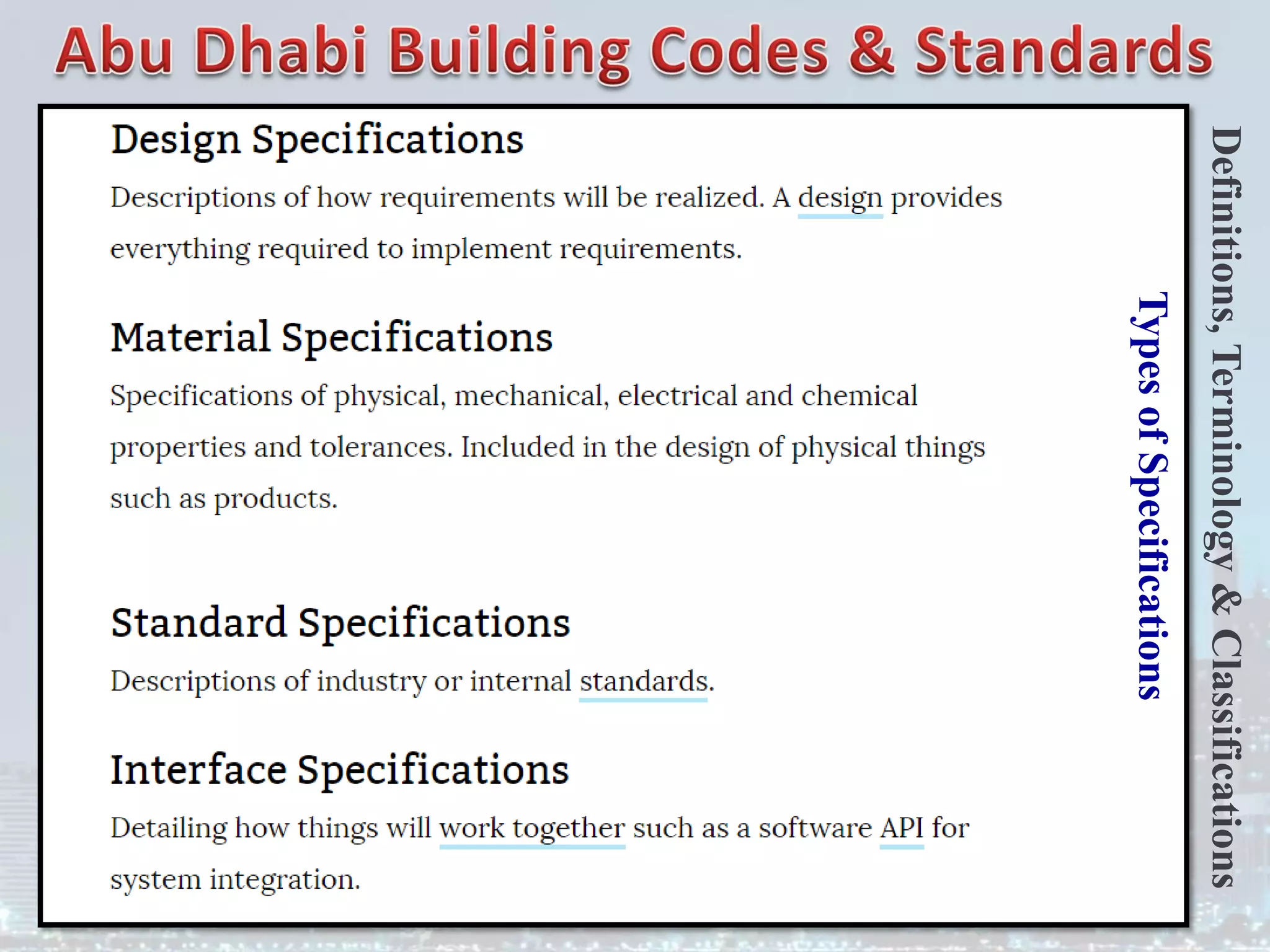
  • 103.
    International Codes Adoptedby the Emirate of Abu Dhabi Abu Dhabi government, through its Department of Municipal Affairs, has adopted the ICC family of codes to be the standards that will guide the development of construction projects in the Emirate of Abu Dhabi. Codes implemented effective I. International Building Code (IBC) II. International Energy Conservation Code (IECC) III. International Fire Code (IFC) IV. International Fuel Gas Code (IFGC) V. International Mechanical Code (IMC) VI. International Plumbing Code (IPC) VII. International Private Sewage Disposal Code (IPSDC) VIII.International Property Maintenance Code (IPMC)
  • 106.
    Helpful resources tohelp you better understand the Codes: 1. 2009 IBC® Handbook: Fire- and Life-Safety Provisions (CD Included) 2. 2009 IBC® Handbook: Structural Provisions (CD Included) 3. 2009 International Building Code® Study Companion 4. 2009 International Residential Code® Study Companion 5. 2009 International Fire Code Study Companion® 6. 2009 International Plumbing Code® Study Companion 7. 2009 International Mechanical Code® Study Companion 8. 2009 International Energy Conservation Code® Study Companion 9. 2009 Accessibility Study Companion 10. 2009 Permit Technician Study Companion 11. Building Code Basics: Fire, Based on the 2009 IFC® 12. Building Code Basics: Building, Based on the 2009 IBC® 13. Building Code Basics: Residential, Based on the 2009 IRC®
  • 107.
    Abu Dhabi InternationalBuilding Codes This Course is produced to provide you with a brief description of each of the new six codes and help you easily navigate through them. For the detailed code provisions. Referring to the actual code books or the soft copy provided with this handbook: 1. The Abu Dhabi International Building Code ( ADIBC ) 2. The Abu Dhabi International Mechanical Code ( ADIMC ) 3. The Abu Dhabi International Energy Conservation Code ( ADIECC ) 4. The Abu Dhabi International Fuel Gas Code ( ADIFGC ) 5. The Abu Dhabi International Property Maintenance Code ( ADIPMC ) 6. The Abu Dhabi International Private Sewage Disposal Code ( ADIPSDC )
  • 108.
    Department of MunicipalAffairs Adopts The 15 International Codes starting with 7 codes
  • 109.
  • 110.
    Abu Dhabi InternationalBuilding Codes The Higher Building Code Committee: 1. Department of Municipal Affairs (DMA) 2. Environment Agency, Abu Dhabi 3. Abu Dhabi Urban Planning Council (UPC) 4. Directorate General of Civil Deffence 5. Abu Dhabi Future Energy Company (MASDAR) 6. Abu Dhabi Quality and Conformity Council (QCC) 7. Abu Dhabi Tourism Authority (TDIC) 8. Abu Dhabi Water & Electricity Authority (ADWEA) 9. Abu Dhabi City Municipality (ADM) 10.Al Ain Municipality (AAM) 11.Western Region Municipality (WRM) 12.Higher Corporation for Specialized Economic Zones (ZonesCorps)
  • 111.
    Abu Dhabi InternationalBuilding Codes Key Stakeholders and Contributors: 1. Abu Dhabi Educational Council (ADEC) 2. Abu Dhabi Airport Company (ADAC) 3. Abu Dhabi Gas Industries (GASCO) 4. Abu Dhabi Sewage Service Company (ADSSC) 5. Emirate Standardization Meteorology (ESMA) 6. International Code Council (ICC) 7. Musanada 8. National Center of Metrology and Seismology (NCMS), Presidential Afairs 9. Regulation & Supervision Bureau (RSB) 10.Zayed Higher Organization for Humanitarian Care and Special Needs (ZHO)
  • 113.
    Abu Dhabi InternationalBuilding Codes Abu Dhabi International Building Codes Development Team: 1. Department of Municipal Affairs 2. International Code Council (ICC) 3. Abu Dhabi Municipality 4. Al Ain Municipality 5. Western Region Municipality
  • 114.
    Abu Dhabi InternationalBuilding Codes Abu Dhabi International Building Codes Development phases Introduction Since 2009, Department of Municipal Afairs (DMA) has been pursuing this strategic initiative to review the current state of regulations (code) governing the construction of buildings which clearly made evident the need for more comprehensive and updated construction codes. The Abu Dhabi Code Program (the Program) takes a holistic approach to improve the building and construction industry by adopting state of the art building codes, professionalizing the occupations and practices in this sector, engaging the stakeholders and coordinating with other government agencies who have direct impact on this industry. These Abu Dhabi Construction Codes are developed to meet the needs of the community through a set of regulations that safeguard the public health and safety in all communities, large and small. These Codes establish minimum requirements for prescriptive and performance-related provisions as they apply to the Emirate of Abu Dhabi. Based on the International Family of Codes (I-Codes) published by the International Code Council (ICC), these Codes are founded on broad-based principles that make possible the use of new materials, building designs and methods of construction. These Codes have been reviewed and customized for local conditions through the efforts of many stakeholders.
  • 115.
    Abu Dhabi InternationalBuilding Codes Abu Dhabi International Building Codes Development phases Development of the User Guide for the International Building Codes in the Emirate of Abu Dhabi As a first step into adopting the New Codes, the first edition of the Abu Dhabi Building Codes Guide was developed by the Emirate of Abu Dhabi’s Department of Municipal Affairs (DMA) along with work groups representing different stakeholders and representation from the three municipalities of the Emirate. This comprehensive guide to the I-Codes proven very effective as it guided the designers, builders and regulators on the proper application of the codes. Adoption of the Codes for the Emirate of Abu Dhabi The use of these codes within the Abu Dhabi Emirate is accomplished through adoption by reference in accordance with proceedings established by the Emirate’s jurisdictional laws. Through the adoption of the International Codes, the Abu Dhabi Emirate has established the provisions and laws necessary for the application and enforcement of these provisions across the Emirate as well as the appropriate judicial proceedings for correcting any violations of the adopted codes.
  • 116.
    Abu Dhabi InternationalBuilding Codes Abu Dhabi International Building Codes Development phases Code Customization Phases Phase I This phase enabled the local practitioners to apply the new codes and be ready for a more comprehensive adaptation of the new codes to the Abu Dhabi environment. This phase started since May 2009 and the following has been accomplished: 1. The adoption of the International Building Code and the other supporting Codes 2. Issuance of the Abu Dhabi Code Guide Book on use of the International Codes, 3. Government and major developers started the use of the I-Codes to design and construct their projects. Phase II 1. In coordination with 16 government and public Stakeholders and working with technical teams representing them, the I-Codes were reviewed and customized for adaptation to the Abu Dhabi environment. 2. All agreed upon code amendments resulted from these work groups constituted the Abu Dhabi Amendments to the following Six Codes: The Abu Dhabi International Building Code (ADIBC) The Abu Dhabi International Energy Conservation Code (ADIECC) The Abu Dhabi International Fuel Gas Code (ADIFGC) The Abu Dhabi International Mechanical Code (ADIMC) The Abu Dhabi International Private Sewage Disposal Code (ADIPSDC) The Abu Dhabi International Property maintenance Code (ADIPMC) Two National Standards were subject to amendments like: ICC/ANSI A117.1 ACI 318
  • 117.
    Abu Dhabi InternationalBuilding Codes Abu Dhabi International Building Codes Development phases Other Code Cycles The Plumbing and Fire Codes This initial adoption of the Abu Dhabi codes will not include the International Plumbing and the Fire codes as similar codes are currently in use by the construction industry in Abu Dhabi. Joint committees will be formed between DMA and the respective agencies having jurisdiction to harmonize these codes with the IPC and IFC. For subjects and matters not provided for in the UAE Fire Code of Practice or the Uniform Plumbing Code of Abu Dhabi Emirate, the International Fire Code (IFC) or the International Plumbing Code (IPC) shall be consulted. The Abu Dhabi Department of Municipal affairs is committed to maintaining the codes current and updated following the ICC code revision cycles. These updates will be accomplished via technical committees whose members will consist of local government personnel, as well as those from academia, consulting firms, oil industry, major developers and stakeholders within the Abu Dhabi Emirate.
  • 118.
    Abu Dhabi InternationalBuilding Codes Abu Dhabi International Building Codes Development phases Other Code Cycles: The Plumbing and Fire Codes The responsibilities of the technical committees are to review and draft the required amendments to the International Codes following the ICC code cycles. Technical committees will include but may not be limited to: Administration and Property Maintenance Building – Architectural Building - Structural, IBC Chapters 16-26 Accessibility Energy Conservation Fire Protection and Life Safety Plumbing/ Private Sewage Disposal Mechanical and Fuel Gas Green Construction Private Residence (Villa) Electrical
  • 119.
    Abu Dhabi InternationalBuilding Codes Abu Dhabi International Building Codes Development phases Identification of Amended Language In the adopted I-Codes, solid vertical lines in the margins within the body of the codes indicate a technical change from the requirements of the previous edition. Deletion indicators in the form of an arrow ( → ) are provided in the margin where an entire section, paragraph, exception or table has been deleted or an item in a list of items or in a table has been deleted. Text in the Abu Dhabi Amendments’ Document In the Amendments’ document, text shown with a Strikethrough is “Deleted”, and Underlined is “New” Coordination between the International Codes The six codes are adopted as a family of codes and will be complimented by other I-Codes as needed. When adopted together, as they are by the Abu Dhabi Emirate, there should be no conflict of any of the technical provisions. As multiple model codes are adopted by the Abu Dhabi Emirate, should a question of enforcement authority occur, the Department of Municipal Affairs will evaluate the issue in order to establish the appropriate enforcement agency. Italicized Terms Selected terms set forth in the definitions chapters of the adopted codes, are italicized where they appear in code text. Such terms are not italicized where the definition set forth in the definitions chapter does not impart the intended meaning in the use of the term. The terms selected have definitions which the user should read carefully to facilitate better understanding of the codes.
  • 120.
    Abu Dhabi InternationalBuilding Codes Abu Dhabi International Building Codes Development phases Arrangement and Format of the 2009 Editions of the International Codes The I-Codes are arranged and organized to follow sequential steps that generally occur during a design, plan review or inspection procedure. Users should gain a better understanding of the requirements outlined in each document by researching the contents of all applicable code sections. Training The Department of Municipal Affairs in collaboration with the International Code Council (ICC) and local colleges and universities has been, and will continue to provide the necessary training programs for all affected professionals, public and private, in order to assure a smooth transition to these adopted codes. Available training has been provided with interactive classroom instruction by highly qualified ICC instructors as well as through online courses and webinars. A structured training and “professional certification” program is also being offered for municipal employees and construction professionals in order to insure a high level of professional competence is achieved throughout the Emirate.
  • 121.
    Abu Dhabi InternationalBuilding Codes Abu Dhabi International Building Code (ADIBC) A - General Description of ADIBC B - Arrangement and Formatting C - Chapter by Chapter Description Abu Dhabi International Mechanical Code (ADIMC) A - General Description of ADIMC B - Arrangement and Formatting C - Chapter by Chapter Description Abu Dhabi International Energy Conservation Code (ADIECC) A - General Description of ADIECC B - Arrangement and Formatting C - Chapter by Chapter Description Abu Dhabi International Fuel Gas Code (ADIFGC) A - General Description of ADIFGC B - Arrangement and Formatting C - Chapter by Chapter Description Abu Dhabi International Property Maintenance Code (ADIPMC) A - General Description of ADIPMC B - Arrangement and Formatting C - Chapter by Chapter Description Abu Dhabi International Private Sewage Disposal Code (ADIPSDC) A - General Description of ADIPSDC B - Arrangement and Formatting C - Chapter by Chapter Description
  • 122.
  • 123.
    Abu Dhabi InternationalBuilding Codes Abu Dhabi International Building Code (ADIBC) A - General Description of ADIBC B - Arrangement and Formatting C - Chapter by Chapter Description
  • 124.
    Abu Dhabi InternationalBuilding Codes Abu Dhabi International Building Codes (ADIBC) 2013
  • 125.
    Abu Dhabi InternationalBuilding Codes Abu Dhabi International Building Codes (ADIBC) 2013
  • 126.
    Abu Dhabi InternationalBuilding Codes Abu Dhabi International Building Codes (ADIBC) 2013 A - General Description of ADIBC The Abu Dhabi International Building Code (ADIBC) is a code that provides minimum requirements to safeguard the public health, safety and general welfare of the occupants of new and existing buildings and structures. The ADIBC is fully compatible with the other Abu Dhabi International codes, including: Abu Dhabi International Energy Conservation Code (ADIECC), Abu Dhabi International Fuel Gas Code (ADIFGC), Abu Dhabi International Mechanical Code (ADIMC), Abu Dhabi International Private Sewage Disposal Code (ADIPSDC) and Abu Dhabi International Property Maintenance Code (ADIPMC). The ADIBC addresses structural strength, means of egress, sanitation, adequate lighting and ventilation, accessibility, energy conservation and life safety in regards to new and existing buildings, facilities and systems. The codes are promulgated on a 3-year cycle to allow for new construction methods and technologies to be incorporated into the codes. Alternative materials, designs and methods not specifically addressed in the code can be approved by the Building official where the proposed materials, designs or methods comply with the intent of the provisions of the code (see Section 104.11). The ADIBC applies to all occupancies and all types of buildings and structures unless exempted, including one - and two-family dwellings and townhouses.
  • 127.
    Abu Dhabi InternationalBuilding Codes Abu Dhabi International Building Codes (ADIBC) 2013 A - General Description of ADIBC
  • 128.
    Abu Dhabi InternationalBuilding Codes Abu Dhabi International Building Codes (ADIBC) 2013 B - Arrangement and Format of ADIBC Before applying the requirements of the ADIBC, it is beneficial to understand its arrangement and format. The ADIBC, like other codes based on ICC published codes, is arranged and organized to follow sequential steps that generally occur during a plan review and inspection. The ADIBC requirements for smoke control systems, and smoke and fire dampers are directly correlated to the requirements of the ADIMC. ADIBC Chapter 28 is a reference to the ADIMC and the ADIFGC for chimney, fireplaces and barbeques, and all aspects of mechanical systems. The following chapters/ sections of the ADIBC are correlated with the ADIMC:
  • 129.
    Abu Dhabi InternationalBuilding Codes Abu Dhabi International Building Codes (ADIBC) 2013 C - Chapter By Chapter Description of ADIBC The following is a chapter-by-chapter synopsis of the scope and intent of the provisions of the Abu Dhabi International Building Code.
  • 130.
  • 131.
  • 132.
  • 133.
  • 134.
  • 135.
  • 136.
  • 137.
    Abu Dhabi InternationalBuilding Codes Abu Dhabi International Building Codes (ADIBC) 2013 Chapter 1 Scope and Administration Chapter 1 establishes the limits of applicability of the code and describes how the code is to be applied and enforced. Chapter 1 is in two parts, Part 1-Scope and Application (Sections 101-102) and Part 2- Administration and Enforcement (Sections 103- 116). Section 101 identifies which buildings and structures come under its purview and references other Abu Dhabi and ICC codes as applicable. Standards and codes are scoped to the extent referenced (see Section 102.4). The building code is intended to be adopted as a legally enforceable document and it cannot be effective without adequate provisions for its administration and enforcement. The provisions of Chapter 1 establish the authority and duties of the code official appointed by the jurisdiction having authority and also establish the rights and privileges of the design professional, contractor and property owner.
  • 138.
    Abu Dhabi InternationalBuilding Codes Abu Dhabi International Building Codes (ADIBC) 2013 All terms that are defined in the code are listed alphabetically in Chapter 2. Terms are defined in Chapter 2 or there is a reference to the section where the definition is located. While a defined term may be listed in one chapter or another, the meaning is applicable throughout the code. Codes are technical documents and every word, term and punctuation mark can impact the meaning of the code text and the intended results. The code often uses terms that have a unique meaning in the code and the code meaning can differ substantially from the ordinarily understood meaning of the term as used outside of the code. Where understanding of a term’s definition is especially key to or necessary for understanding a particular code provision, the term is shown in italics wherever it appears in the code. This is true only for those terms that have a meaning that is unique to the code. In other words, the generally understood meaning of a term or phrase might not be sufficient or consistent with the meaning prescribed by the code; therefore, it is essential that the code-defined meaning be known. Definitions are deemed to be of prime importance in establishing the meaning and intent of the code text that uses the terms. The user of the code should be familiar with and consult this chapter because the definitions are essential to the correct interpretation of the code and because the user may not be aware that a term is defined. Chapter 2 Definitions
  • 139.
    Abu Dhabi InternationalBuilding Codes Abu Dhabi International Building Codes (ADIBC) 2013 Chapter 3 Use and Occupancy Classification Chapter 3 provides for the classification of buildings, structures and parts thereof based on the purpose or purposes for which they are used. Section 302 identifies the groups into which all buildings, structures and parts thereof must be classified. Sections 303 through 312 identify the occupancy characteristics of each group classification. In some sections, specific group classifications having requirements in common are collectively organized such that one term applies to all. For example: Groups A-1, A-2, A-3, A-4 and A-5 are individual groups for assembly-type buildings. The general term “Group A,” however, includes each of these individual groups. Other groups include Business (B), Educational (E), Factory (F-1, F-2), High Hazard (H-1, H-2, H-3, H-4, H-5), Institutional (I-1, I- 2, I-3, I-4), Mercantile (M), Residential (R-1, R-2, R-3, R-4), Storage (S-1, S-2) and Utility (U). In some occupancies, the smaller number means a higher hazard, but that is not always the case. Defining the use of the buildings is very important as it sets the tone for the remaining chapters of the code. Occupancy works with the height, area and construction type requirements in Chapters 5 and 6, as well as the special provisions in Chapter 4, to determine “equivalent risk,” or providing a reasonable level of protection or life safety for building occupants.
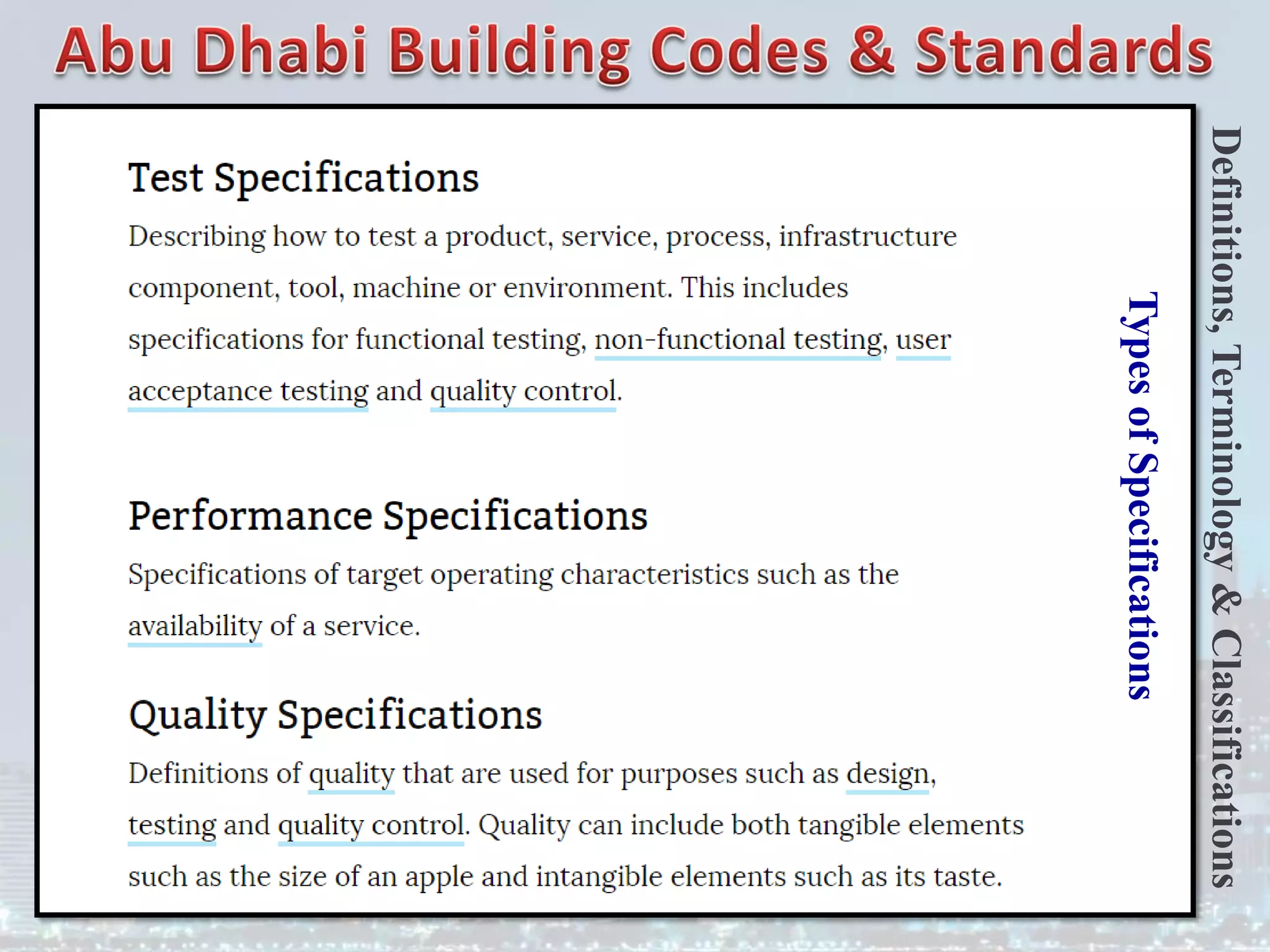
  • 140.
    Abu Dhabi InternationalBuilding Codes Abu Dhabi International Building Codes (ADIBC) 2013 Chapter 3 Use and Occupancy Classification The determination of equivalent risk involves three interdependent considerations: 1. the level of fire hazard associated with the specific occupancy of the facility; 2. the reduction of fire hazard by limiting the floor area(s) and the height of the building based on the fuel load (combustible contents and burnable building components); and 3. the level of overall fire resistance provided by the type of construction used for the building. The greater the potential fire hazards indicated as a function of the group, the lesser the height and area allowances for a particular construction type. Occupancy classification also plays a key part in organizing and prescribing the appropriate protection measures. As such, threshold requirements for fire protection and means of egress systems are based on occupancy classification (see Chapters 9 and 10). Other sections of the code also contain requirements respective to the classification of building groups. For example, Section 706 deals with requirements for fire wall fire-resistance ratings that are tied to the occupancy classification of a building and Section 803.9 contains interior finish requirements that are dependent upon the occupancy classification. The use of the space, rather than the occupancy of the building is utilized for determining occupant loading (Section 1004) and live loading (Section 1607).
  • 141.
    Abu Dhabi InternationalBuilding Codes Abu Dhabi International Building Codes (ADIBC) 2013 Chapter 4 Special Detailed Requirements Based On Use and Occupancy Chapter 4 contains the requirements for protecting special uses and occupancies, which are supplemental to the remainder of the code. Chapter 4 contains provisions that may alter requirements found elsewhere in the code; however, the general requirements of the code still apply unless modified within the chapter. For example, the height and area limitations established in Chapter 5 apply to all special occupancies unless Chapter 4 contains height and area limitations. In this case, the limitations in Chapter 4 supersede those in other sections. An example of this is the height and area limitations for open parking garages given in Section 406.3.5, which supersede the limitations given in Section 503. In some instances, it may not be necessary to apply the provisions of Chapter 4. For example, if a covered mall building complies with the provisions of the code for Group M, Section 402 does not apply; however, other sections that deal with a use, process or operation must be applied to that specific occupancy, such as stages and platforms, special amusement buildings and hazardous materials (Sections 410, 411 and 414). The chapter includes requirements for buildings and conditions that apply to one or more groups, such as high-rise buildings, underground buildings or atriums. Special uses may also imply specific occupancies and operations, such as for Group H, hazardous materials, application of flammable finishes, drying rooms, organic coatings and combustible storage or hydrogen cutoff rooms, all of which are coordinated with the IFC.
  • 142.
    Abu Dhabi InternationalBuilding Codes Abu Dhabi International Building Codes (ADIBC) 2013 Chapter 4 Special Detailed Requirements Based On Use and Occupancy Unique consideration is taken for special use areas, such as covered mall buildings, motor-vehicle-related occupancies, special amusement buildings and aircraft-related occupancies. Special facilities within other occupancies are considered, such as stages and platforms, motion picture projection rooms and storm shelters. Finally, in order that the overall package of protection features can be easily understood, unique considerations for specific occupancies are addressed: Groups I- 1, I-2, I-3, R-1, R-2, R-3 (by definition R-4), ambulatory care facilities and live/work units.
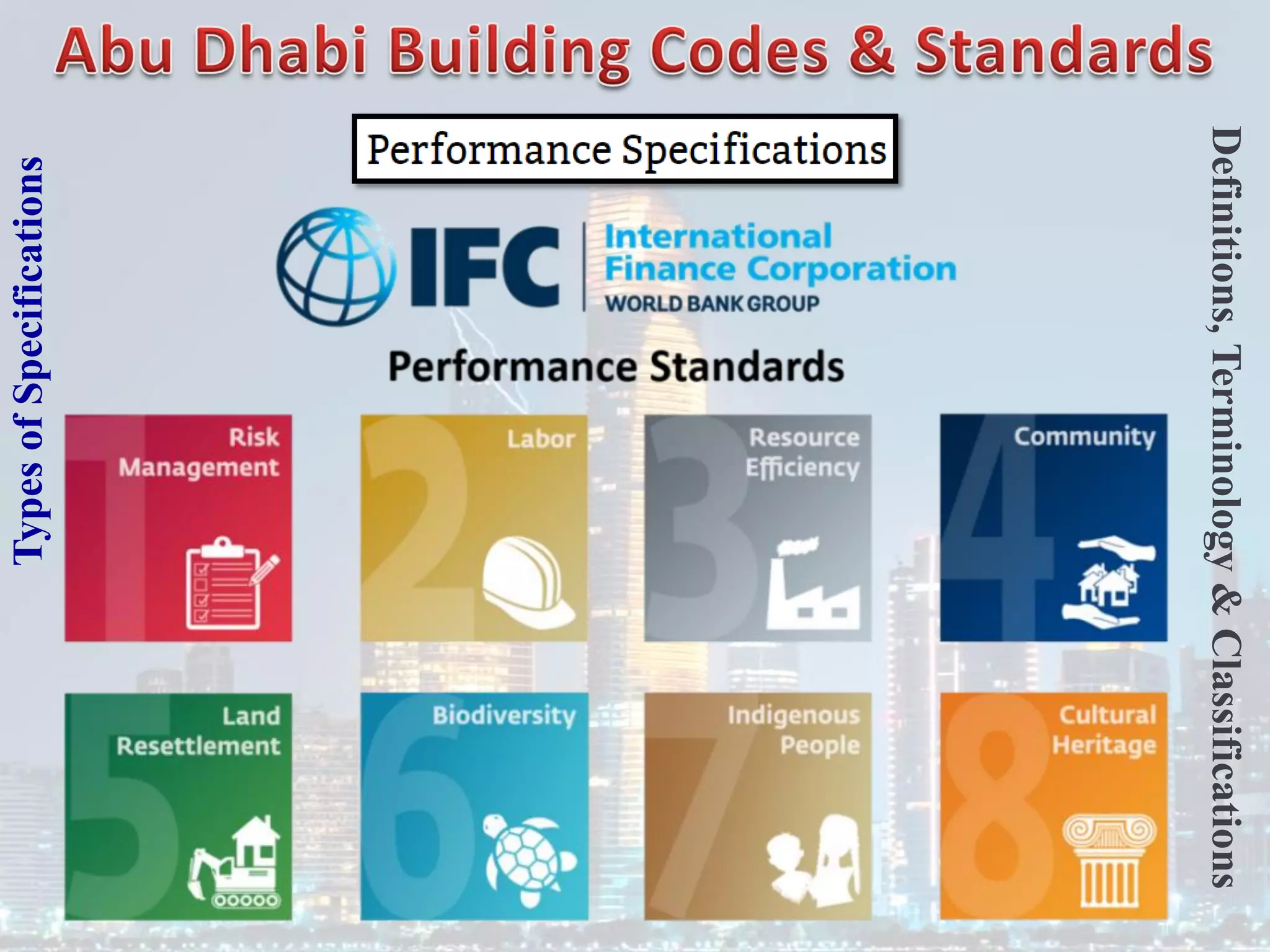
  • 143.
    Abu Dhabi InternationalBuilding Codes Abu Dhabi International Building Codes (ADIBC) 2013 Chapter 5 General Building Heights and Areas Chapter 5 contains the provisions that regulate the minimum type of construction for area limits and height limits based on the occupancy of the building. Height and area increases (including allowances for basements, mezzanines and equipment platforms) are permitted based on open frontage for fire department access, and the type of sprinkler protection provided and separation (Sections 503-506, 509). These thresholds are reduced for buildings over three stories in height in accordance with Section 506.4.1. Provisions include the protection and/or separation of incidental accessory occupancies (Table 508.2.5), accessory occupancies (Sections 508.2) and mixed uses in the same building (Sections 506.5, 508.3, 508.4 and 509). Unlimited area buildings are permitted in certain occupancies when they meet special provisions (Section 507). Table 503 is the keystone in setting thresholds for building size based on the building’s use and the materials with which it is constructed. If one then looks at Table 503, the relationship among group classification, allowable heights and areas and types of construction becomes apparent. Respective to each group classification, the greater the fire-resistance rating of structural elements, as represented by the type of construction, the greater the floor area and height allowances. The greater the potential fire hazards indicated as a function of the group, the lesser the height and area allowances for a particular construction type.
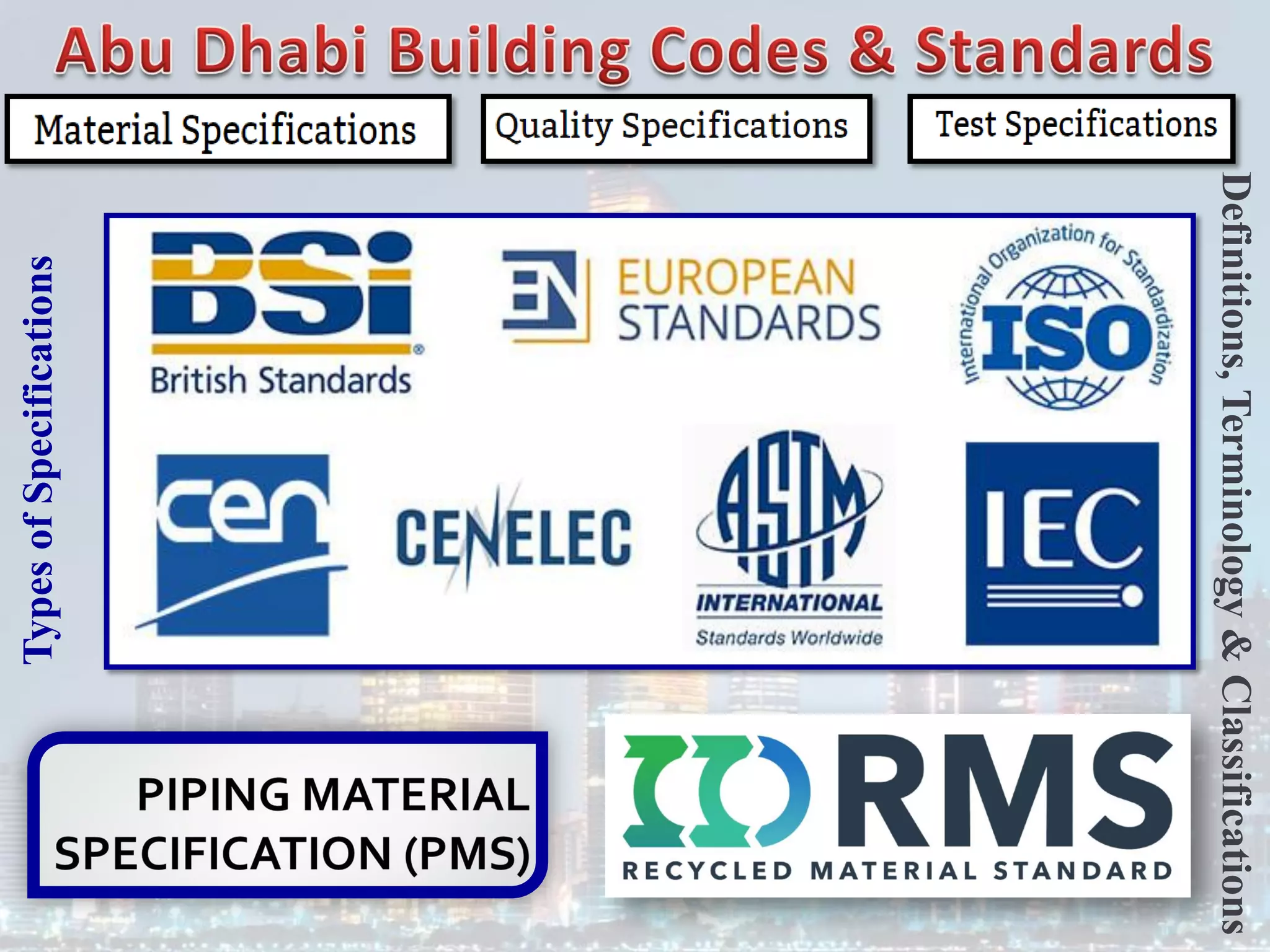
  • 144.
    Abu Dhabi InternationalBuilding Codes Abu Dhabi International Building Codes (ADIBC) 2013 Chapter 6 Types of Construction The interdependence of these fire safety considerations can be seen by first looking at Tables 601 and 602, which show the fire resistance ratings of the principal structural elements comprising a building in relation to the five classifications for types of construction. Type I construction is the classification that generally requires the highest fire-resistance ratings for structural elements, whereas Type V construction, which is designated as a combustible type of construction, generally requires the least amount of fire-resistance-rated structural elements. The greater the potential fire hazards indicated as a function of the group, the lesser the height and area allowances for a particular construction type. Section 603 includes a list of combustible elements that can be part of a noncombustible building (Types I and II construction).
  • 145.
    Abu Dhabi InternationalBuilding Codes Abu Dhabi International Building Codes (ADIBC) 2013 Chapter 7 Fire and Smoke Protection Features The provisions of Chapter 7 present the fundamental concepts of fire performance that all buildings are expected to achieve in some form. This chapter identifies the acceptable materials, techniques and methods which proposed construction can be designed and evaluated against to determine a building’s ability to limit the impact of fire. The fire-resistance-rated construction requirements within Chapter 7 provide passive resistance to the spread and effects of fire. Types of separations addressed include fire walls, fire barriers, fire partitions, horizontal assemblies, smoke barriers and smoke partitions. A fire produces heat that can weaken structural components and smoke products that cause property damage and place occupants at risk. The requirements of Chapter 7 work in unison with height and area requirements (Chapter 5), active fire detection and suppression systems (Chapter 9) and occupant egress requirements (Chapter 10) to contain a fire should it occur while helping ensure occupants are able to safely exit.
  • 146.
    Abu Dhabi InternationalBuilding Codes Abu Dhabi International Building Codes (ADIBC) 2013 Chapter 8 Interior Finishes This chapter contains the performance requirements for controlling fire growth within buildings by restricting interior finish and decorative materials. Past fire experience has shown that interior finish and decorative materials are key elements in the development and spread of fire. The provisions of Chapter 8 require materials used as interior finishes and decorations to meet certain lame-spread index or flame propagation criteria based on the relative fire hazard associated with the occupancy. As smoke is also a hazard associated with fire, this chapter contains limits on the smoke development characteristics of interior finishes. The performance of the material is evaluated based on test standards.
  • 147.
    Abu Dhabi InternationalBuilding Codes Abu Dhabi International Building Codes (ADIBC) 2013 Chapter 9 Fire Protection Systems Chapter 9 prescribes the minimum requirements for active systems of fire protection equipment to perform the following functions: detect a fire; alert the occupants or fire department of a fire emergency; and control smoke and control or extinguish the fire. Generally, the requirements are based on the occupancy, the height and the area of the building, because these are the factors that most affect fire-fighting capabilities and the relative hazard of a specific building or portion thereof. This chapter parallels and is substantially duplicated in Chapter 9 of the International Fire Code (IFC); however, the IFC Chapter 9 also contains periodic testing criteria that are not contained in the ADIBC. In addition, the special fire protection system requirements based on use and occupancy found in ADIBC Chapter 4 are duplicated in IFC Chapter 9 as a user convenience. This chapter references the UAE Fire and Life safety code of Practice.
  • 148.
    Abu Dhabi InternationalBuilding Codes Abu Dhabi International Building Codes (ADIBC) 2013 Chapter 10 Means of Egress The general criteria set forth in Chapter 10 regulating the design of the means of egress are established as the primary method for protection of people in buildings by allowing timely relocation or evacuation of building occupants. Both prescriptive and performance language is utilized in this chapter to provide for a basic approach in the determination of a safe exiting system for all occupancies. It addresses all portions of the egress system (i.e., exit access, exits and exit discharge) and includes design requirements as well as provisions regulating individual components. The requirements throughout Chapter 10 detail the size, arrangement, number and protection of means of egress components.
  • 149.
    Abu Dhabi InternationalBuilding Codes Abu Dhabi International Building Codes (ADIBC) 2013 Chapter 10 Means of Egress Functional and operational characteristics also are specified for the components that will permit their safe use without special knowledge or effort. The means of egress protection requirements work in coordination with other sections of the code, such as protection of vertical openings (see Chapter 7), interior finish (see Chapter 8), fire suppression and detection systems (see Chapter 9) and numerous others, all having an impact on life safety. Chapter 10 of the IBC is duplicated in Chapter 10 of the IFC; however, the IFC contains two additional sections on the means of egress system in existing buildings. This chapter references the UAE Fire and Life safety code of Practice.
  • 150.
    Abu Dhabi InternationalBuilding Codes Abu Dhabi International Building Codes (ADIBC) 2013 Chapter 11 Accessibility Chapter 11 contains provisions that set forth requirements for accessibility of buildings and their associated sites and facilities for people with physical disabilities. The fundamental philosophy of the code on the subject of accessibility is that everything is required to be accessible. This is reflected in the basic applicability requirement (see Section 1103.1). The code’s scoping requirements then address Chapter 11 Accessibility Chapter 11 contains provisions that set forth requirements for accessibility of buildings and their associated sites and facilities for people with physical disabilities. The fundamental philosophy of the code on the subject of accessibility is that everything is required to be accessible. This is reflected in the basic applicability requirement (see Section 1103.1). The code’s scoping requirements then address the conditions under which accessibility is not required in terms of exceptions to this general mandate. While the ADIBC contains scoping provisions for accessibility (e.g., what, where and how many), ICC/ANSI A117.1, Accessible and Usable Buildings and Facilities, is the referenced standard for the technical provisions (i.e., how).
  • 151.
    Abu Dhabi InternationalBuilding Codes Abu Dhabi International Building Codes (ADIBC) 2013 Chapter 11 Accessibility ICC/ANSI A117.1, Accessible and Usable Buildings and Facilities
  • 152.
    152 Abu Dhabi InternationalBuilding Codes Abu Dhabi International Building Codes (ADIBC) 2013 Chapter 11 Accessibility
  • 153.
    153 Abu Dhabi International Building Codes Chapter 11 Accessibility AbuDhabi International Building Codes (ADIBC) 2013
  • 154.
    154 Abu Dhabi International Building Codes Chapter 11 Accessibility AbuDhabi International Building Codes (ADIBC) 2013
  • 155.
    Abu Dhabi InternationalBuilding Codes Abu Dhabi International Building Codes (ADIBC) 2013 Chapter 11 Accessibility There are many accessibility issues that not only benefit people with disabilities, but also provide a tangible benefit to people without disabilities. This type of requirement can be set forth in the code as generally applicable without necessarily identifying it specifically as an accessibility-related issue. Such a requirement would then be considered as having been “mainstreamed.” For example, visible alarms are located in Chapter 9 and ramp requirements are addressed in Chapter 10. Accessibility criteria for existing buildings are addressed in Section 3411.
  • 156.
    Abu Dhabi InternationalBuilding Codes Abu Dhabi International Building Codes (ADIBC) 2013 Chapter 12 Interior Environment Chapter 12 provides minimum standards for the interior environment of a building. The standards address the minimum sizes of spaces, minimum temperature levels, and minimum light and ventilation levels. The collection of requirements addresses limiting sound transmission through walls, ventilation of attic spaces and under floor spaces (crawl spaces). Finally, the chapter provides minimum standards for walls, partitions and floors to resist water intrusion and damage in rooms such as toilet and shower facilities, where water is frequently in use.
  • 157.
    Abu Dhabi InternationalBuilding Codes Abu Dhabi International Building Codes (ADIBC) 2013 Chapter 13 Energy Efficiency The purpose of Chapter 13 is to provide minimum design requirements that will promote efficient utilization of energy in buildings. The requirements are directed toward the design of building envelopes with adequate thermal resistance and low air leakage, and toward the design and selection of mechanical, water heating, electrical and illumination systems that promote effective use of depletable energy resources. For the specifics of these criteria, Chapter 13 requires design and construction in compliance with the Abu Dhabi International Energy Conservation Code (ADIECC).
  • 158.
    Abu Dhabi InternationalBuilding Codes Abu Dhabi International Building Codes (ADIBC) 2013 Chapter 14 Exterior Walls This chapter addresses requirements for exterior walls of buildings. Minimum standards for wall covering materials, installation of wall coverings and the ability of the wall to provide weather protection are provided. This chapter also requires exterior walls that are close to plot lines, or that are bearing walls for certain types of construction, to comply with the minimum fire-resistance ratings specified in Chapters 6 and 7. The installation of each type of wall covering, be it wood, masonry, vinyl, metal composite material or an exterior insulation and finish system, is critical to its long-term performance in protecting the interior of the building from the elements and the spread of fire. Special attention to the use of combustible materials on the exterior of the building such as balconies, eaves, decks and architectural trim is the focus of Section 1406.
  • 159.
    Abu Dhabi InternationalBuilding Codes Abu Dhabi International Building Codes (ADIBC) 2013 Chapter 15 Roof Assemblies and Rooftop Structures Chapter 15 provides standards for both roof assemblies as well as structures which sit on top of the roof of buildings. The criteria address roof construction and covering which includes the weather protective barrier at the roof and, in most circumstances, a fire-resistant barrier. The chapter is prescriptive in nature and is based on decades of experience with various traditional materials. These prescriptive rules are very important for satisfying performance of one type of roof covering or another. Section 1509 addresses rooftop structures including penthouses, tanks, towers and spires. Rooftop penthouses larger than prescribed in this chapter must be treated as a story under Chapter 5.
  • 160.
    Abu Dhabi InternationalBuilding Codes Abu Dhabi International Building Codes (ADIBC) 2013 Chapter 16 Structural Design Chapter 16 prescribes minimum structural loading requirements for use in the design and construction of buildings and structural components. It includes minimum design loads, as well as permitted design methodologies. Standards are provided for minimum design loads (live, dead, snow, wind, rain, flood and earthquake as well as load combinations). The application of these loads and adherence to the serviceability criteria will enhance the protection of life and property. The chapter references and relies on many nationally recognized design standards. A key standard is the American Society of Civil Engineer’s Minimum Design Loads for Buildings and Other Structures (ASCE 7). Structural design needs to address the conditions of the site and location. Therefore maps of rainfall, seismic, snow and wind criteria in different regions are provided.
  • 161.
    Abu Dhabi InternationalBuilding Codes Abu Dhabi International Building Codes (ADIBC) 2013 Chapter 16 Structural Design
  • 162.
    Abu Dhabi InternationalBuilding Codes Abu Dhabi International Building Codes (ADIBC) 2013 Chapter 17 Structural Tests and Special Inspections Chapter 17 provides a variety of procedures and criteria for testing materials and assemblies, for labeling materials and assemblies, and for special inspection of structural assemblies. This chapter expands on the requirements of Chapter 1 regarding the roles and responsibilities of the building official regarding approval of building components. It also provides additional duties and responsibilities for the owner, contractor, design professionals and special inspectors. Proper assembly of structural components, proper quality of materials used, and proper application of materials are essential to ensuring that a building, once constructed, complies with the structural and fire-resistance minimums of the code and the approved design. To determine this compliance often requires continuous or frequent inspection and testing. Chapter 17 establishes these special inspection and testing standards as well as reporting of the work to the building official. Chapter 17 Structural Tests and Special Inspections refer to projects contract conditions & specifications that include the QA/QC report and inspection planning, in addition to all international standards related to this issue (ASTM, BS, NBIC, etc.)
  • 163.
    Total Quality Management(TQM) Quality Assurance (QA) Quality Control (QC) Inspection Abu Dhabi International Building Codes Abu Dhabi International Building Codes (ADIBC) 2013
  • 164.
    Abu Dhabi InternationalBuilding Codes Abu Dhabi International Building Codes (ADIBC) 2013
  • 165.
    Abu Dhabi InternationalBuilding Codes Abu Dhabi International Building Codes (ADIBC) 2013
  • 166.
    Abu Dhabi InternationalBuilding Codes Abu Dhabi International Building Codes (ADIBC) 2013 Chapter 18 Soils and Foundations Chapter 18 contains minimum requirements for design, construction and resistance to water intrusion of foundation systems for buildings and other structures. It provides criteria for the geotechnical and structural considerations in the selection and installation of adequate support for the loads transferred from the structure above. The uncertainties of foundation construction make it extremely difficult to address every potential failure within the text of the code. The chapter includes requirements for soils investigation and site preparation for receiving a foundation including the allowed load-bearing values for soils and for protecting the foundation from water intrusion. Section 1808 addresses the basic requirements for all foundation types. Later sections address foundation requirements that are specific to shallow foundations and deep foundations. Due care must be exercised in the planning and design of foundation systems based on obtaining sufficient soils information, the use of accepted engineering procedures, experience and good technical judgment.
  • 167.
    Abu Dhabi International Building Codes (ADIBC) 2013 Chapter 18 Soilsand Foundations Abu Dhabi International Building Codes
  • 168.
    Abu Dhabi InternationalBuilding Codes (ADIBC) 2013 Chapter 18 Soils and Foundations Abu Dhabi International Building Codes
  • 169.
    Abu Dhabi InternationalBuilding Codes (ADIBC) 2013 Chapter 18 Soils and Foundations Abu Dhabi International Building Codes
  • 170.
    Abu Dhabi InternationalBuilding Codes (ADIBC) 2013 Chapter 18 Soils and Foundations Abu Dhabi International Building Codes
  • 171.
    Abu Dhabi InternationalBuilding Codes (ADIBC) 2013 Chapter 18 Soils and Foundations Abu Dhabi International Building Codes
  • 172.
    Abu Dhabi InternationalBuilding Codes Abu Dhabi International Building Codes (ADIBC) 2013 Chapter 19 Concrete concrete slabs, anchorage to concrete, shotcrete, reinforced gypsum concrete and concrete- filled pipe columns. Because of the variable properties of material and numerous design and construction options available in the uses of concrete, due care and control throughout the construction process is necessary. This chapter provides minimum accepted practices to the design and construction of buildings and structural components using concrete-both plain and reinforced. Chapter 19 is formatted to parallel American Concrete Institute (ACI) 318, Building Code Requirements for Structural Concrete. The chapter also includes references to additional standards. Structural concrete must be designed and constructed to comply with this code and all listed standards. There are specific sections of the chapter addressing
  • 173.
  • 174.
    Abu Dhabi InternationalBuilding Codes Abu Dhabi International Building Codes (ADIBC) 2013 Chapter 20 Aluminum Chapter 20 contains standards for the use of aluminum in building construction. Only the structural applications of aluminum are addressed. The chapter does not address the use of aluminum in specialty products such as storefront or window framing or architectural hardware. The use of aluminum in heating, ventilating or air-conditioning systems is addressed in the Abu Dhabi International Mechanical Code (ADIMC). The chapter references national standards from the Aluminum Association for use of aluminum in building construction, AA ASM 35, Aluminum Sheet Metal Work in Building Construction , and AAADM 1, Aluminum Design Manual . By utilizing the standards set forth, a proper application of this material can be obtained.
  • 175.
    Abu Dhabi International Building Codes Abu Dhabi InternationalBuilding Codes (ADIBC) 2013 the Aluminum Association for use of aluminum in building construction, AA ASM 35, Aluminum Sheet Metal Work in Building Construction , and AAADM 1, Aluminum Design Manual. Chapter 20 Aluminum
  • 176.
    Abu Dhabi InternationalBuilding Codes Abu Dhabi International Building Codes (ADIBC) 2013 the Aluminum Association for use of aluminum in building construction, AAASM 35, Aluminum Sheet Metal Work in Building Construction , and AAADM 1, Aluminum Design Manual.
  • 177.
    Abu Dhabi InternationalBuilding Codes Abu Dhabi International Building Codes (ADIBC) 2013 Chapter 21 Masonry This chapter provides comprehensive and practical requirements for masonry construction. The provisions of Chapter 21 require minimum accepted practices and the use of standards for the design and construction of masonry structures. The provisions address: material specifications and test methods; types of wall construction; criteria for engineered and empirical designs; required details of construction including the execution of construction. Masonry design methodologies including allowable stress design, strength design and empirical design are covered by provisions of the chapter. Also addressed are masonry fireplaces and chimneys, masonry heaters and glass unit masonry. Fire-resistant construction using masonry is also required to comply with Chapter 7. Masonry foundations are also subject to the requirements of Chapter 18.
  • 178.
    Abu Dhabi InternationalBuilding Codes Abu Dhabi International Building Codes (ADIBC) 2013 Chapter 22 Steel Chapter 22 provides the requirements necessary for the design and construction of structural steel (including composite construction), cold-formed steel, steel joists, steel cable structures and steel storage racks. The chapter specifies appropriate design and construction standards for these types of structures. It also provides a road map of the applicable technical requirements for steel structures. Steel is a noncombustible building material commonly associated with Types I and II construction; however, it is permitted to be used in all types of construction. The code requires that materials used in the design of structural steel members conform to designated national standards. Chapter 22 is involved with the design and use of steel materials using the specifications and standards of the American Institute for Steel Construction, the American Iron and Steel Institute, the Steel Joist Institute and the American Society of Civil Engineers.
  • 179.
    Abu Dhabi InternationalBuilding Codes Abu Dhabi International Building Codes (ADIBC) 2013 AISC: American Institute for Steel Construction AISC: American Institute for Steel Construction
  • 180.
    Abu Dhabi InternationalBuilding Codes Abu Dhabi International Building Codes (ADIBC) 2013
  • 181.
    Abu Dhabi International Building Codes AbuDhabi International Building Codes (ADIBC) 2013
  • 182.
    Abu Dhabi InternationalBuilding Codes Abu Dhabi International Building Codes (ADIBC) 2013 Chapter 23 Wood This Chapter has been reserved in the ADIBC version due to the fact that wood construction is not common in the area. Therefore, in the event of using wood in the construction of any building, the original Chapter 23 of IBC shall be used.
  • 183.
    Abu Dhabi International Building Codes Abu DhabiInternational Building Codes (ADIBC) 2013 ANSI/APA PRG 320-2011 Standard for Performance- Rated Cross- Laminated Timber Chapter 23 Wood
  • 184.
    Abu Dhabi InternationalBuilding Codes Abu Dhabi International Building Codes (ADIBC) 2013 Chapter 24 Glass and Glazing This chapter establishes regulations for glass and glazing used in buildings and structures that, when installed, are subjected to wind, snow and dead loads. Engineering and design requirements are included in the chapter. Additional structural requirements are found in Chapter 16. A second concern of this chapter is glass and glazing used in areas where it is likely to have an impact on the occupants. Section 2406 identifies hazardous locations where glazing installed must either be safety glazing or blocked to prevent human impact. Safety glazing must meet stringent standards and be appropriately marked or identified. Additional standards for glass and glazing in guards, handrails, elevator hoistways and elevator cars, and in athletic facilities are provided.
  • 185.
    Abu Dhabi InternationalBuilding Codes Abu Dhabi International Building Codes (ADIBC) 2013 Chapter 24 Glass and Glazing
  • 186.
    Abu Dhabi InternationalBuilding Codes Abu Dhabi International Building Codes (ADIBC) 2013
  • 187.
    Abu Dhabi InternationalBuilding Codes Abu Dhabi International Building Codes (ADIBC) 2013 Chapter 25 Gypsum Board and Plaster Chapter 25 contains the provisions and referenced standards that regulate the design, construction and quality of gypsum board and plaster. These represent the most common interior and exterior finish materials in the building industry. This chapter primarily addresses quality-control related issues with regard to material specifications and installation requirements. Most products are manufactured under the control of industry standards. The building official or inspector primarily needs to verify that the appropriate product is used and properly installed for the intended use and location. While often simply used as wall and ceiling coverings, proper design and application are necessary to provide weather resistance and required fire protection for both structural and nonstructural building components.
  • 188.
    Abu Dhabi International Building Codes Abu Dhabi InternationalBuilding Codes (ADIBC) 2013 Chapter 25 Gypsum Board and Plaster
  • 189.
    Abu Dhabi InternationalBuilding Codes Abu Dhabi International Building Codes (ADIBC) 2013 Chapter 26 : Plastic The use of plastics in building construction and components is addressed in Chapter 26. This chapter provides standards addressing foam plastic insulation, foam plastics used as interior finish and trim, and other plastic veneers used on the inside or outside of a building. Plastic siding is regulated by Chapter 14. Sections 2606 through 2611 address the use of light-transmitting plastics in various configurations such as walls, roof panels, skylights, signs and as glazing. Requirements for the use of fiber reinforced polymers, fiberglass reinforced polymers and reflective plastic core insulation are also contained in this chapter. Some plastics exhibit rapid flame spread and heavy smoke density characteristics when exposed to fire. Additionally, exposure to the heat generated by a fire can cause some plastics to deform, which can affect their performance. The requirements and limitations of this chapter are necessary to control the use of plastic and foam plastic products such that they do not compromise the safety of building occupants.
  • 190.
    Abu Dhabi InternationalBuilding Codes Abu Dhabi International Building Codes (ADIBC) 2013 Chapter 26 : Plastic
  • 191.
    Abu Dhabi InternationalBuilding Codes Abu Dhabi International Building Codes (ADIBC) 2013 Chapter 26 : Plastic
  • 192.
    Abu Dhabi InternationalBuilding Codes Abu Dhabi International Building Codes (ADIBC) 2013 Chapter 27 Electrical Since electrical systems and components are an integral part of almost all structures, it is necessary for the code to address the installation of such systems. For this purpose, Chapter 27 references the Electricity Wiring Regulations 2007, Revision 1, dated January, 2009, as promulgated by the Regulation and Supervision Bureau, Emirate of Abu Dhabi. In addition, Section 2702 addresses emergency and standby power requirements. Such systems must comply with the International Fire Code (IFC) and referenced standards. This section also provides references to the various code sections requiring emergency and standby power, such as high-rise buildings and buildings containing hazardous materials.
  • 193.
    Abu Dhabi InternationalBuilding Codes Abu Dhabi International Building Codes (ADIBC) 2013 Chapter 27 Electrical
  • 194.
    Abu Dhabi InternationalBuilding Codes Abu Dhabi International Building Codes (ADIBC) 2013 Chapter 28 Mechanical Systems Nearly all buildings will include mechanical systems. This chapter provides references to the Abu Dhabi International Mechanical Code (ADIMC) and the Abu Dhabi International Fuel Gas Code (ADIFGC) for the design and installation of mechanical systems. In addition, the chapter references Chapter 21 of the ADIBC for masonry chimneys, fireplaces and barbecues.
  • 195.
    Abu Dhabi InternationalBuilding Codes Abu Dhabi International Building Codes (ADIBC) 2013 Chapter 29 Plumbing Systems Chapter 29 regulates the minimum requirements to design and install plumbing systems that must be provided for every type of building. This chapter also regulates the low rates of the required fixtures in various types of buildings to achieve the water conservation objective of Estidama program. This chapter provides references to the Uniform Plumbing Code– Abu Dhabi as published by the Abu Dhabi Environmental Agency and the Water Supply Regulations, January, 2009 (WRS) as published by the Regulation and Supervision Bureau. And for matters not provided for, the International Plumbing Code (IPC) shall be used.
  • 196.
    Abu Dhabi International Building Codes Abu Dhabi InternationalBuilding Codes (ADIBC) 2013 1. the Uniform Plumbing Code– Abu Dhabi; by the Abu Dhabi Environmental Agency 2. the Water Supply Regulations, January, 2009 (WRS); the Regulation and Supervision Bureau 3. the International Plumbing Code (IPC)
  • 197.
    Abu Dhabi InternationalBuilding Codes Abu Dhabi International Building Codes (ADIBC) 2013 Chapter 30 Elevators and Conveying Systems Chapter 30 provides standards for the installation of elevators into buildings. Referenced standards provide the requirements for the elevator system and mechanisms. Detailed standards are provided in the chapter for hoistway enclosures, hoistway venting and machine rooms. New provisions are added in the 2009 IBC for Fire Service Access Elevators required in high-rise buildings and for the optional choice of Occupant Evacuation Elevators (see Section 403).
  • 198.
    Abu Dhabi InternationalBuilding Codes Abu Dhabi International Building Codes (ADIBC) 2013 Chapter 31 Special Construction Chapter 31 contains a collection of regulations for a variety of unique structures and architectural features. Pedestrian walkways and tunnels connecting two buildings are addressed in Section 3104. Membrane and air-supported structures are addressed by Section 3102. Safeguards for swimming pool safety are found in Section 3109. Standards for temporary structures, including permit requirements are provided in Section 3103. Structures as varied as awnings, marquees, signs, telecommunication and broadcast towers and automatic vehicular gates are also addressed (see Sections 3105 through 3108 and 3110).
  • 199.
    Abu Dhabi InternationalBuilding Codes Abu Dhabi International Building Codes (ADIBC) 2013 Chapter 32 Encroachments into the Public Right-of-way Buildings and structures from time to time are designed to extend over a property line and into the public right- of-way. Local regulations outside of the building code usually set limits to such encroachments, and such regulations take precedence over the provisions of this chapter. Standards are provided for encroachments below grade for structural support, vaults and areaways. Encroachments above grade are divided into below 8 feet, 8 feet to 15 feet, and above 15 feet, because of headroom and vehicular height issues. This includes steps, columns, awnings, canopies, marquees, signs, windows, balconies. Similar architectural features above grade are also addressed. Pedestrian walkways must also comply with Chapter 31.
  • 200.
    Abu Dhabi InternationalBuilding Codes Abu Dhabi International Building Codes (ADIBC) 2013 Chapter 33 Safeguards During Construction Chapter 33 provides safety requirements during construction and demolition of buildings and structures. These requirements are intended to protect the public from injury and adjoining property from damage. In addition the chapter provides for the progressive installation and operation of exit stairways and standpipe systems during construction. This Chapter refers to the Codes of Practice issued by the Environment, Health and Safety Center of Abu Dhabi.
  • 201.
    Abu Dhabi International Building Codes Abu Dhabi InternationalBuilding Codes (ADIBC) 2013 The Occupational Safety and Health of Abu Dhabi - OSHAD
  • 202.
    Abu Dhabi International Building Codes Abu Dhabi InternationalBuilding Codes (ADIBC) 2013 the Codes of Practice issued by: the Environment, Health and Safety Center of Abu Dhabi.
  • 203.
    Abu Dhabi InternationalBuilding Codes Abu Dhabi International Building Codes (ADIBC) 2013 Chapter 34 Existing Structures The provisions in Chapter 34 deal with alternative methods or reduced compliance requirements when dealing with existing building constraints. This chapter allows for a controlled departure from full compliance with the technical codes, without compromising the minimum standards for fire prevention and life safety features of the rehabilitated building. Provisions are divided by addition, alterations, repairs, change of occupancy and moved structures. There are further allowances for registered historic buildings. There are also special allowances for replacement of existing stairways, replacement of glass and accessibility requirements. Section 3412, Compliance Alternatives, allows for existing buildings to be evaluated so as to show that alterations, while not meeting new construction requirements, will improve the current existing situation. Provisions are based on a numerical scoring system involving 18 various safety parameters and the degree of code compliance for each issue.
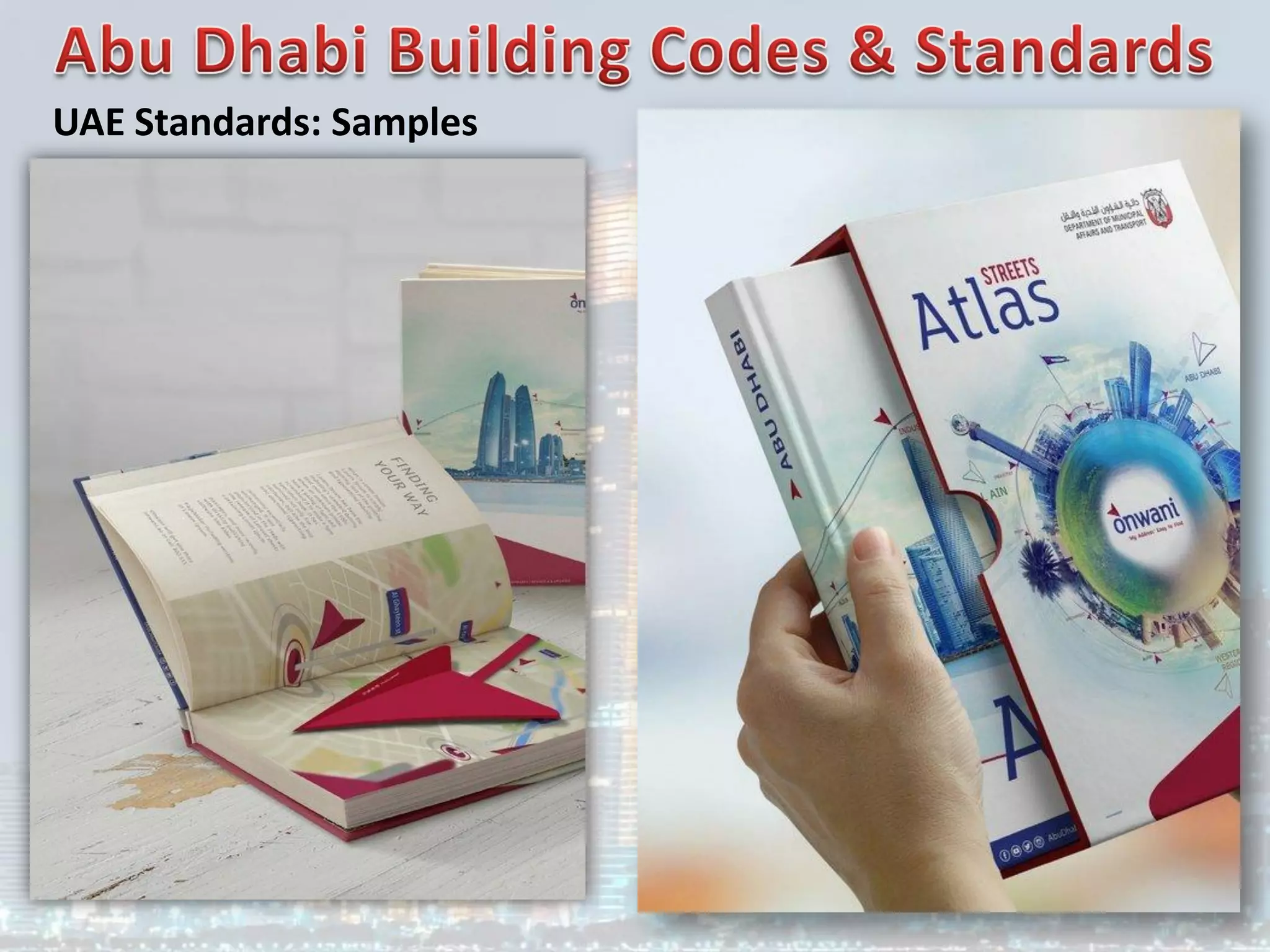
  • 204.
    Abu Dhabi InternationalBuilding Codes Abu Dhabi International Building Codes (ADIBC) 2013 Chapter 35 Referenced Standards The code contains numerous references to standards that are used to regulate materials and methods of construction. Chapter 35 contains a comprehensive list of all standards that are referenced in the code, including the appendices. The standards are part of the code to the extent of the reference to the standard (see Section 102.4). Compliance with the referenced standard is necessary for compliance with this code. By providing specifically adopted standards, the construction and installation requirements necessary for compliance with the code can be readily determined. The basis for code compliance is, therefore, established and available on an equal basis to the building code official, contractor, designer and owner. Chapter 35 is organized in a manner that makes it easy to locate specific standards. It lists all of the referenced standards, alphabetically, by acronym of the promulgating agency of the standard. Each agency’s standards are then listed in either alphabetical or numeric order based upon the standard identification. The list also contains the title of the standard; the edition (date) of the standard referenced; any addenda included as part of the ICC adoption; and the section or sections of this code that reference the standard.
  • 205.
    Abu Dhabi International Building Codes Abu DhabiInternational Building Codes (ADIBC) 2013
  • 206.
    Abu Dhabi International Building Codes Abu DhabiInternational Building Codes (ADIBC) 2013
  • 207.
    Abu Dhabi InternationalBuilding Codes Abu Dhabi International Building Codes (ADIBC) 2013 Appendices Appendices are provided in the ADIBC to offer supplemental criteria to the provisions in the main chapters of the code. Appendices have the same force and effect as the first 35 chapters of the ADIBC. Appendix A ( Reserved ) Appendix B ( Reserved ) Appendix C Group U-Agricultural Buildings. Appendix C provides a more liberal set of standards for the construction of agricultural buildings, rather than strictly following the Utility building provision, reflective of their specific usage and limited occupant load. The provisions of the appendix allow reasonable heights and areas commensurate with the risk of agricultural buildings. Appendix E Supplemental Accessibility Requirements. Appendix E includes scoping requirements contained in the new ADA/ABAAccessibility Guidelines that are not in Chapter 11 and not otherwise mentioned or mainstreamed throughout the code. Items in the appendix deal with subjects not typically addressed in the main chapter (e.g., beds, room signage, transportation facilities).
  • 208.
    Abu Dhabi InternationalBuilding Codes Abu Dhabi International Building Codes (ADIBC) 2013 Appendices Appendix F Rodent proofing. The provisions of this appendix are minimum mechanical methods to prevent the entry of rodents into a building. These standards, when used in conjunction with cleanliness and maintenance programs, can significantly reduce the potential of rodents invading a building. Appendix G Flood-resistant Construction. Appendix G is intended to fulfill the floodplain management and administrative requirements of the Emirate of Abu Dhabi agencies having jurisdiction over such regulations. Appendix H Signs. Appendix H gathers in one place the various code standards that regulate the construction and protection of outdoor signs. Whenever possible, the appendix provides standards in performance language, thus allowing the widest possible application.
  • 209.
    Abu Dhabi InternationalBuilding Codes Abu Dhabi International Building Codes (ADIBC) 2013 Appendix I Patio Covers. Appendix I provides standards applicable to the construction and use of patio covers. It is limited in application to patio covers accessory to dwelling units. Covers of patios and other outdoor areas associated with restaurants, mercantile buildings, offices, nursing homes or other non-dwelling occupancies would be subject to standards in the main code and not this appendix. Appendix J Grading Appendix J provides standards for the grading of properties. The appendix also provides standards for administration and enforcement of a grading program including permit and inspection requirements. Appendices
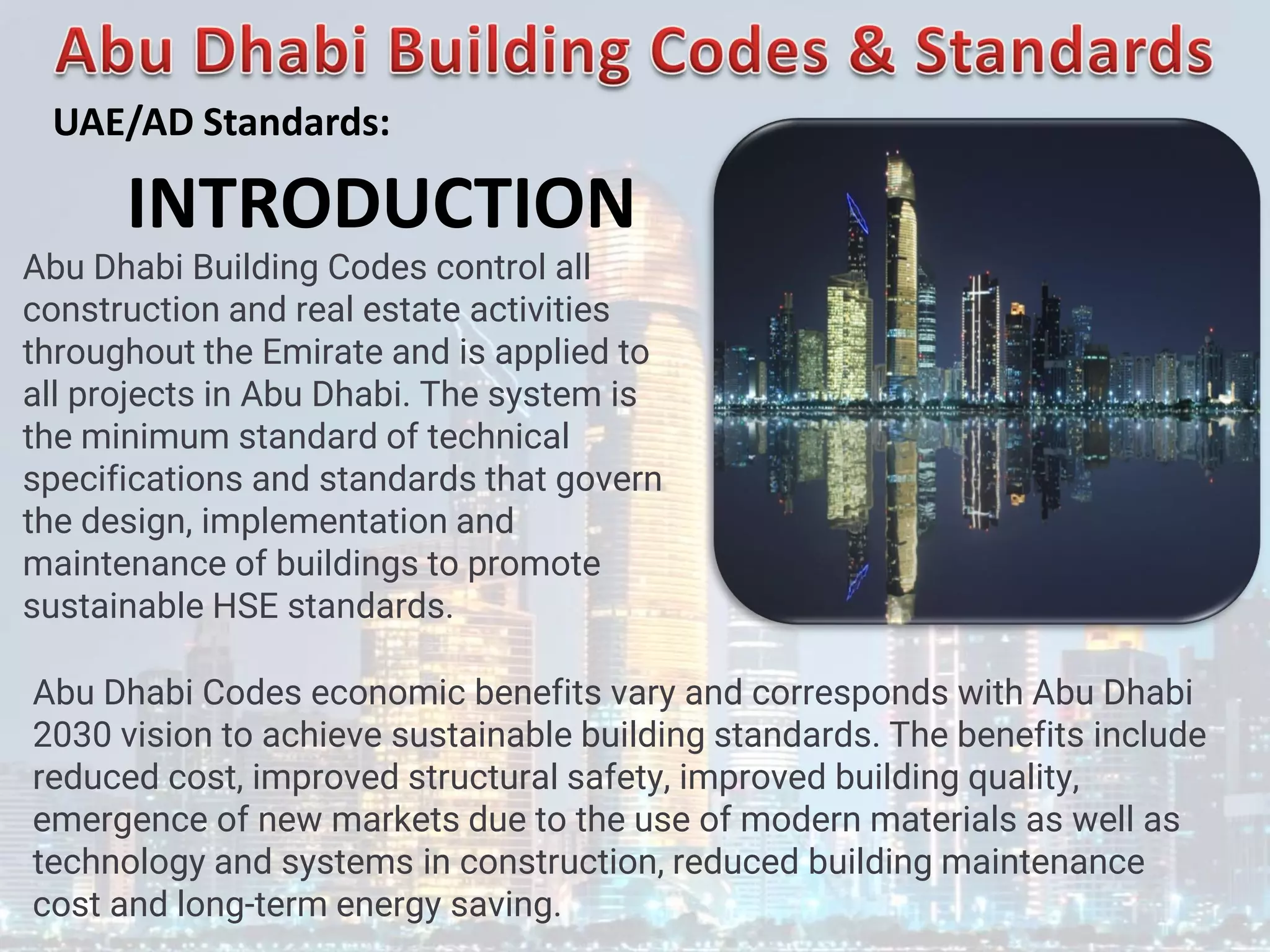
  • 210.
    Abu Dhabi InternationalBuilding Codes Abu Dhabi International Energy Conservation Code (ADIECC) A - General Description of ADIECC B - Arrangement and Formatting C - Chapter by Chapter Description
  • 211.
    Abu Dhabi InternationalBuilding Codes Abu Dhabi International Energy Conservation Code (ADIECC)
  • 212.
    Abu Dhabi InternationalBuilding Codes Abu Dhabi International Energy Conservation Code (ADIECC)
  • 213.
    Abu Dhabi InternationalBuilding Codes Abu Dhabi International Energy Conservation Code (ADIECC)
  • 214.
    Abu Dhabi InternationalEnergy Conservation Code (ADIECC) Abu Dhabi International Building Codes
  • 215.
    Abu Dhabi InternationalBuilding Codes Abu Dhabi International Energy Conservation Code (ADIECC)
  • 216.
  • 217.
    Abu Dhabi InternationalBuilding Codes Abu Dhabi International Energy Conservation Code (ADIECC)
  • 218.
    Abu Dhabi InternationalBuilding Codes A - General Description of ADIECC The Abu Dhabi International Energy Conservation Code (ADIECC) is a code that regulates minimum energy conservation requirements for new buildings. The ADIECC addresses energy conservation requirements for all aspects of energy uses in both commercial and residential construction, including heating and ventilating, lighting, water heating, and power usage for appliances and building systems. The ADIECC is a design document. For example, before one constructs a building, the designer must determine the minimum insulation R -values and fenestration U -factors for the building exterior envelope. Depending on whether the building is for residential use or for commercial use, the ADIECC sets forth minimum requirements for exterior envelope insulation, window and door U -factors and SHGC ratings, duct insulation, lighting and power efficiency, and water distribution insulation. Abu Dhabi International Energy Conservation Code (ADIECC)
  • 219.
    Abu Dhabi InternationalBuilding Codes B - Arrangement and Format of ADIECC Before applying the requirements of the ADIECC it is beneficial to understand its arrangement and format. The ADIECC, like other codes published by ICC, is arranged and organized to follow sequential steps that generally occur during a plan review or inspection. The ADIECC is divided into five different parts: C - Chapter by chapter description of ADIECC The following is a chapter-by-chapter summary of the scope and intent of the provisions of the Abu Dhabi International Energy Conservation Code: Abu Dhabi International Energy Conservation Code (ADIECC)
  • 220.
    Abu Dhabi InternationalBuilding Codes Abu Dhabi International Energy Conservation Code (ADIECC)
  • 221.
    Abu Dhabi InternationalBuilding Codes Abu Dhabi International Energy Conservation Code (ADIECC) Chapter 1 Administration This chapter contains provisions for the application, enforcement and administration of subsequent requirements of the code. In addition to establishing the scope of the code, Chapter 1 identifies which buildings and structures come under its purview. Chapter 1 is largely concerned with maintaining “due process of law” in enforcing the energy conservation criteria contained in the body of the code. Only through careful observation of the administrative provisions can the building official reasonably expect to demonstrate that “equal protection under the law” has been provided.
  • 222.
    Abu Dhabi InternationalBuilding Codes Abu Dhabi International Energy Conservation Code (ADIECC) Chapter 2 Definitions All terms that are defined in the code are listed alphabetically in Chapter 2. While a defined term may be used in one chapter or another, the meaning provided in Chapter 2 is applicable throughout the code. Additional definitions regarding climate zones are found in Tables 301.3(1) and (2). These are not listed in Chapter 2. Where understanding of a term’s definition is especially key to or necessary for understanding of a particular code provision, the term is show in italics wherever it appears in the code. This is true only for those terms that have a meaning that is unique to the code. In other words, the generally understood meaning of a term or phrase might not be sufficient or consistent with the meaning prescribed by the code; therefore, it is essential that the code- defined meaning be known.
  • 223.
    Abu Dhabi InternationalBuilding Codes Abu Dhabi International Energy Conservation Code (ADIECC) Chapter 3 General Requirements Chapter 3 specifies the climate zones that will serve to establish the exterior design conditions. In addition, Chapter 3 provides interior design conditions that are used as a basis for assumptions in heating and cooling load calculations, and provides basic material requirements for insulation materials and fenestration materials. Climate has a major impact on the energy use of most buildings. The code establishes many requirements such as wall and roof insulation R -values, window and door thermal transmittance requirement (U-factors) as well as provisions that affect the mechanical systems based upon the climate where the building is located. This chapter will contain the information that will be used to properly assign the building location into the correct climate zone and will then be used as the basis for establishing requirements or elimination of requirements.
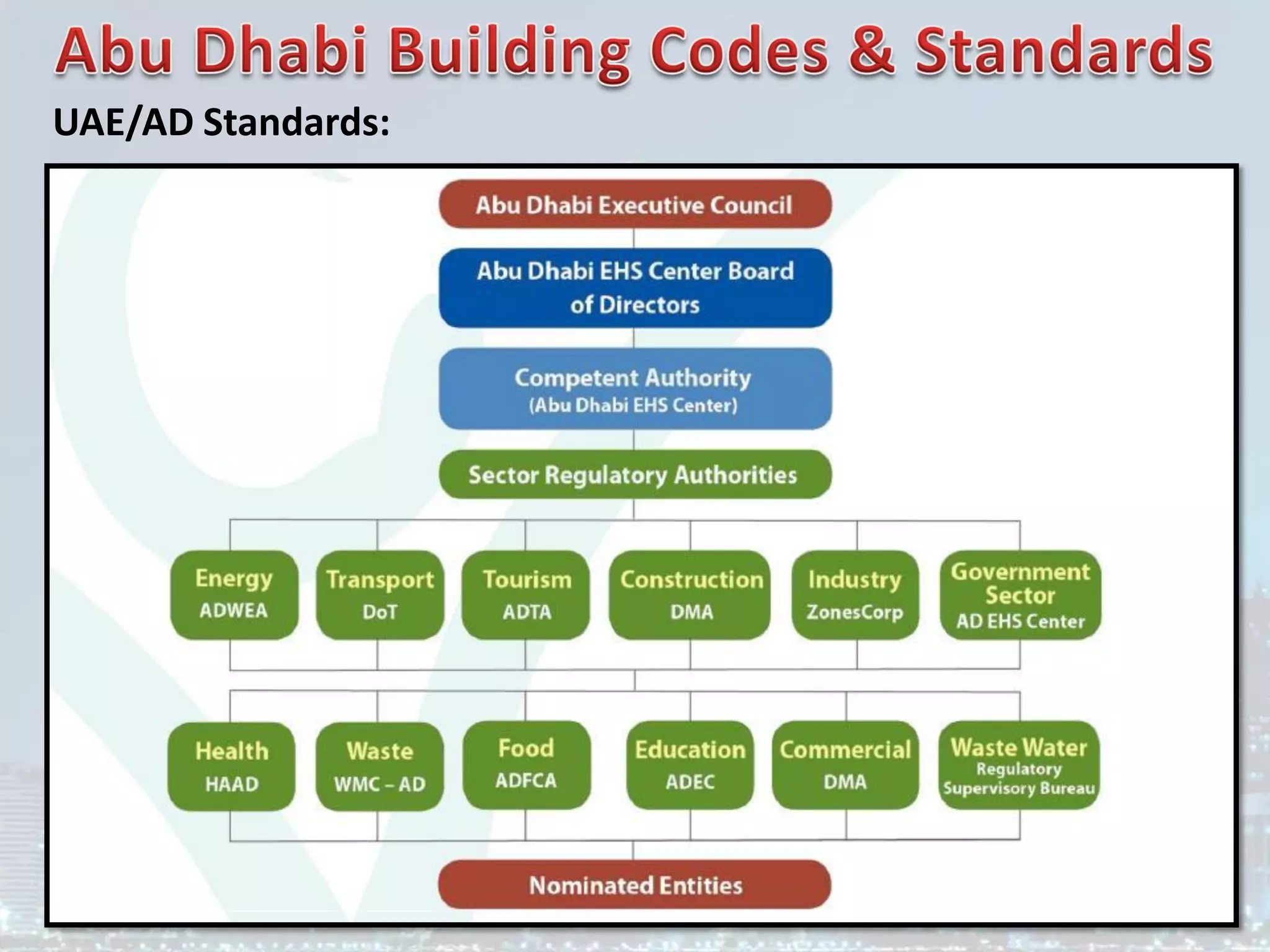
  • 224.
    Abu Dhabi InternationalBuilding Codes Abu Dhabi International Energy Conservation Code (ADIECC) Chapter 4 Residential Energy Efficiency Chapter 4 contains the energy-efficiency related requirements for the design and construction of residential buildings regulated under this code. It should be noted that the definition of a residential building in this code is unique for this code. In this code, a residential building is an R-2, R-3 or R-4 building three stories or less in height. All other buildings, including residential buildings greater than three stories in height, are regulated by the energy conservation requirements of Chapter 5. The applicable portions of a residential building must comply with the provisions within this chapter for energy efficiency. This chapter defines requirements for the portions of the building and building systems that impact energy use in new residential construction and promotes the effective use of energy. The provisions within the chapter promote energy efficiency in the building envelope, the heating and cooling system and the service water heating system of the building.
  • 225.
    Abu Dhabi InternationalBuilding Codes Abu Dhabi International Energy Conservation Code (ADIECC) Chapter 5 Commercial Energy Efficiency Chapter 5 contains the energy-efficiency related requirements for the design and construction of most types of commercial buildings and residential buildings greater than three stories in height above grade. Residential buildings, townhouses and garden apartments three stories or less in height are covered in Chapter 4. Like Chapter 4, this chapter defines requirements for the portions of the building and building systems that impact energy use in new commercial construction and new residential construction greater than three stories in height, and promotes the effective use of energy. The provisions within the chapter promote energy efficiency in the building envelope, the heating and cooling system and the service water heating system of the building.
  • 226.
    Abu Dhabi InternationalBuilding Codes Abu Dhabi International Energy Conservation Code (ADIECC) Chapter 6 Referenced Standards The code contains numerous references to standards that are used to regulate materials and methods of construction. Chapter 6 contains a comprehensive list of all standards that are referenced in the code. The standards are part of the code to the extent of the reference to the standard. Compliance with the referenced standard is necessary for compliance with this code. By providing specifically adopted standards, the construction and installation requirements necessary for compliance with the code can be readily determined. The basis for code compliance is, therefore, established and available on an equal basis to the code official, contractor, designer and owner. Chapter 6 is organized in a manner that makes it easy to locate specific standards. It lists all of the referenced standards, alphabetically, by acronym of the promulgating agency of the standard. Each agency’s standards are then listed in either alphabetical or numeric order based upon the standard identification. The list also contains the title of the standard; the edition (date) of the standard referenced; any addenda included as part of the ICC adoption; and the section or sections of this code that reference the standard.
  • 227.
    Abu Dhabi InternationalBuilding Codes Abu Dhabi International Energy Conservation Code (ADIECC)
  • 228.
    Abu Dhabi InternationalBuilding Codes Abu Dhabi International Energy Conservation Code (ADIECC)
  • 229.
    Abu Dhabi InternationalBuilding Codes Abu Dhabi International Mechanical Code (ADIMC) A - General Description of ADIMC B - Arrangement and Formatting C - Chapter by Chapter Description
  • 230.
    Abu Dhabi InternationalBuilding Codes Abu Dhabi International Mechanical Code (ADIMC)
  • 231.
    Abu Dhabi InternationalBuilding Codes Abu Dhabi International Mechanical Code (ADIMC)
  • 232.
    Abu Dhabi InternationalBuilding Codes Abu Dhabi International Mechanical Code (ADIMC) A - General Description of ADIMC The Abu Dhabi International Mechanical Code (ADIMC) is a code that regulates the design and installation of mechanical systems, appliances, appliance venting, duct and ventilation systems, combustion air provisions, hydronic systems and solar systems. The purpose of the code is to establish the minimum acceptable level of safety and to protect life and property from the potential dangers associated with the installation and operation of mechanical systems. The code also protects the personnel that install, maintain, service and replace the systems and appliances addressed by this code. The ADIMC is primarily a prescriptive code with some performance text. The code relies heavily on product specifications and listings to provide much of the appliance and equipment installation requirements. The general Section 105.2 and the exception to Section 403.2 allow designs and installations to be performed by approved engineering methods as alternatives to the prescriptive methods in the code.
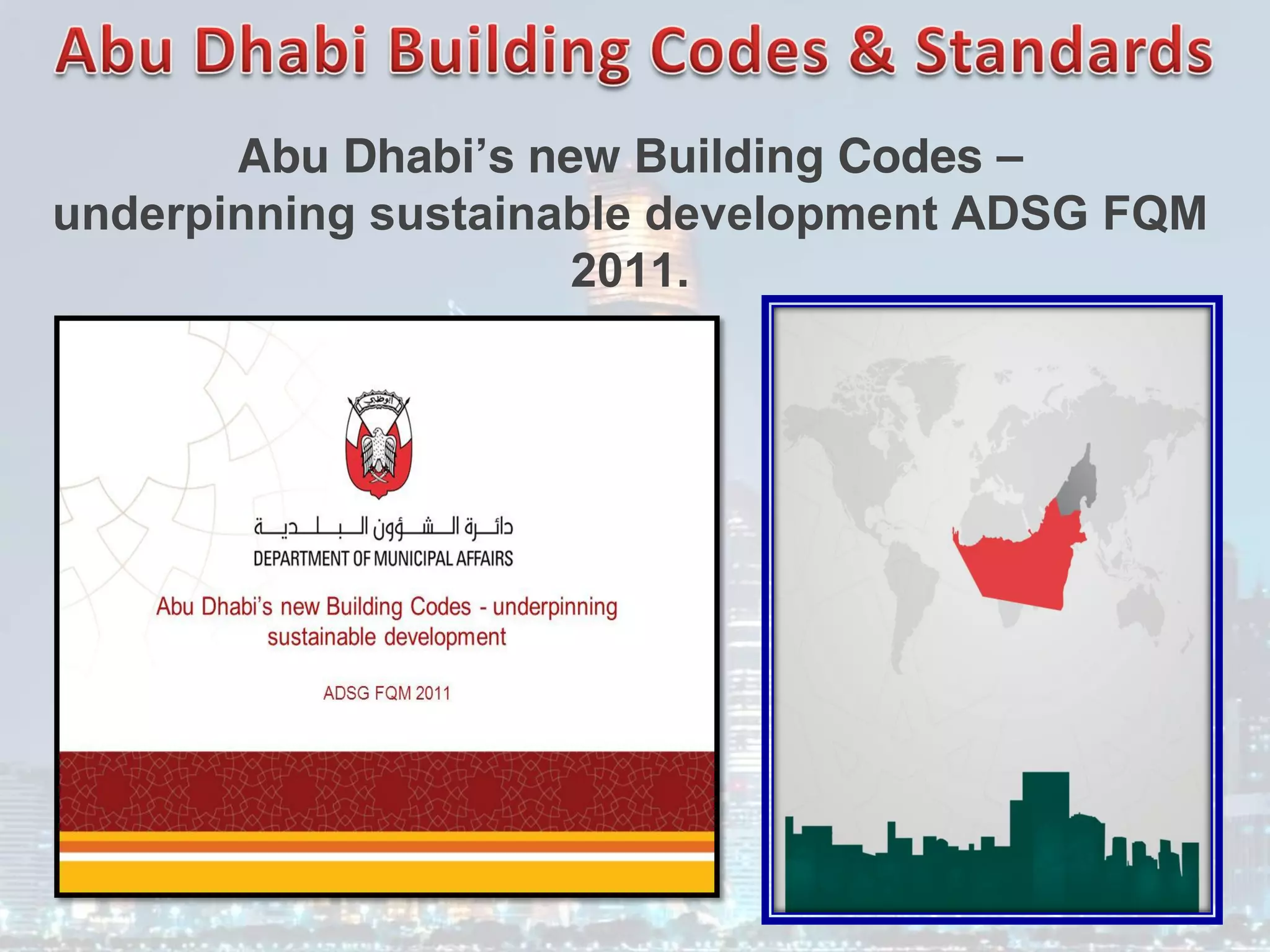
  • 233.
    Abu Dhabi InternationalBuilding Codes Abu Dhabi International Mechanical Code (ADIMC) B - Arrangement and Format of ADIMC The format of the ADIMC allows each chapter to be devoted to a particular subject with the exception of Chapter 3, which contains general subject matters that are not extensive enough to warrant their own independent chapter. C - Chapter by chapter description of ADIMC
  • 234.
  • 235.
  • 236.
    Abu Dhabi InternationalBuilding Codes Abu Dhabi International Mechanical Code (ADIMC)
  • 237.
    Abu Dhabi InternationalBuilding Codes Abu Dhabi International Mechanical Code (ADIMC) Chapter 1 Scope and Administration Chapter 1 establishes the limits of applicability of the code and describes how the code is to be applied and enforced. A mechanical code, like any other code, is intended to be adopted as a legally enforceable document and it cannot be effective without adequate provisions for its administration and enforcement. The provisions of Chapter 1 establish the authority and duties of the code official appointed by the jurisdiction having authority and also establish the rights and privileges of the design professional, contractor and property owner.
  • 238.
    Abu Dhabi InternationalBuilding Codes Abu Dhabi International Mechanical Code (ADIMC) Chapter 2 Definitions Chapter 2 is the repository of the definitions of terms used in the body of the code. Codes are technical documents and every word and term can impact the meaning of the code text and the intended results. The code often uses terms that have a unique meaning in the code and the code meaning can differ substantially from the ordinarily understood meaning of the term as used outside of the code. The terms defined in Chapter 2 are deemed to be of prime importance in establishing the meaning and intent of the code text that uses the terms. The user of the code should be familiar with and consult this chapter because the definitions are essential to the correct interpretation of the code and because the user may not be aware that a term is defined.
  • 239.
    Abu Dhabi InternationalBuilding Codes Abu Dhabi International Mechanical Code (ADIMC) Chapter 3 General Regulations Chapter 3 contains broadly applicable requirements related to appliance location and installation, appliance and systems access, protection of structural elements, condensate disposal and clearances to combustibles, among others.
  • 240.
    Abu Dhabi InternationalBuilding Codes Abu Dhabi International Mechanical Code (ADIMC) Chapter 4 Ventilation Chapter 4 includes means for protecting building occupant health by controlling the quality of indoor air and protecting property from the effects of inadequate ventilation. In some cases, ventilation is required to prevent or reduce a health hazard by removing contaminants at their source. Ventilation is both necessary and desirable for the control of air contaminants, moisture and temperature. Habitable and occupiable spaces are ventilated to promote a healthy and comfortable environment for the occupants. Uninhabited and unoccupied spaces are ventilated to protect the building structure from the harmful effects of excessive humidity and heat. Ventilation of specific occupancies is necessary to minimize the potential for toxic or otherwise harmful substances to reach dangerously high concentrations in air.
  • 241.
    Abu Dhabi InternationalBuilding Codes Abu Dhabi International Mechanical Code (ADIMC) Chapter 5 Exhaust Systems Chapter 5 provides guidelines for reasonable protection of life, property and health from the hazards associated with exhaust systems, air contaminants and smoke development in the event of a fire. In most cases, these hazards involve materials and gases that are flammable, explosive, toxic or otherwise hazardous. Where contaminants are known to be present in quantities that are irritating or harmful to the occupants’ health or are hazardous in a fire, both naturally and mechanically ventilated spaces must be equipped with mechanical exhaust systems capable of collecting and removing the contaminants. This chapter contains requirements for the installation of exhaust systems, with an emphasis on the structural integrity of the systems and equipment involved and the overall impact of the systems on the fire safety performance of the building. It includes requirements for the exhaust of commercial kitchen grease- and smokeladen air, hazardous fumes and toxic gases, clothes dryer moisture and heat and dust, stock and refuse materials.
  • 242.
    Abu Dhabi InternationalBuilding Codes Abu Dhabi International Mechanical Code (ADIMC) Chapter 6 Duct System Chapter 6 of the code regulates the materials and methods used for constructing and installing ducts, plenums, system controls, exhaust systems, fire protection systems and related components that affect the overall performance of a building’s air distribution system and the reasonable protection of life and property from the hazards associated with air-moving equipment and systems. This chapter contains requirements for the installation of supply, return and exhaust air systems. Specific exhaust systems are also addressed in Chapter 5. Information on the design of duct systems is limited to that in Section 603.2. The code is very much concerned with the structural integrity of the systems and the overall impact of the systems on the fire safety and life safety performance of the building. Design considerations such as duct sizing, maximum efficiency, cost effectiveness, occupant comfort and convenience are the responsibility of the design professional. The provisions for the protection of duct penetrations of wall, floor, ceiling and roof assemblies are extracted from the Abu Dhabi International Building Code.
  • 243.
    Abu Dhabi InternationalBuilding Codes Abu Dhabi International Mechanical Code (ADIMC) Chapter 7 Combustion Air Complete combustion of solid and liquid fuel is essential for the proper operation of appliances, for control of harmful emissions and for achieving maximum fuel efficiency. The specific combustion air requirements provided in previous editions of the code have been deleted in favor of a single section that directs the user to NFPA 31 for oil-fired appliance combustion air requirements and the manufacturer’s installation instructions for solid- fuel burning appliances. For gas-fired appliances, the provisions of the Abu Dhabi International Fuel Gas Code are applicable.
  • 244.
    Abu Dhabi InternationalBuilding Codes Abu Dhabi International Mechanical Code (ADIMC) Chapter 8 Chimneys and Vents Chapter 8 is intended to regulate the design, construction, installation, maintenance, repair and approval of chimneys, vents and their connections to solid and liquid fuel-burning appliances. The requirements of this chapter are intended to achieve the complete removal of the products of combustion from fuel- burning appliances and equipment. This chapter includes regulations for the proper selection, design, construction and installation of a chimney or vent, along with appropriate measures to minimize the related potential fire hazards. A chimney or vent must be designed for the type of appliance or equipment it serves. Chimneys and vents are designed for specific applications depending on the flue gas temperatures and the type of fuel being burned in the appliance. Chimneys and vents for gas-fired appliances are covered in the Abu Dhabi International Fuel Gas Code.
  • 245.
    Abu Dhabi InternationalBuilding Codes Abu Dhabi International Mechanical Code (ADIMC) Chapter 9 Specific Appliances, Fireplaces and Solid Fuel- burning Appliances Chapter 9 sets minimum construction and performance criteria for fireplaces, appliances and equipment and provides for the safe installation of these items. It reflects the code’s intent to specifically address all of the types of appliances that the code intends to regulate. Other regulations affecting the installation of solid fuel-burning fireplaces, appliances and accessory appliances are found in Chapters 3, 6, 7, 8, 10, 11, 12, 13 and 14.
  • 246.
    Abu Dhabi InternationalBuilding Codes Abu Dhabi International Mechanical Code (ADIMC) Chapter 10 Boilers, Water Heaters and Pressure Vessels Chapter 10 presents regulations for the proper installation of boilers, water heaters and pressure vessels to protect life and property from the hazards associated with those appliances and vessels. It applies to all types of boilers and pressure vessels, regardless of size, heat input, operating pressure or operating temperature. Because pressure vessels are closed containers designed to contain liquids, gases or both under pressure, they must be designed and installed to prevent structural failures that can result in extremely hazardous situations. Certain safety features are therefore provided in Chapter 10 to reduce the potential for explosion hazards.
  • 247.
    Abu Dhabi InternationalBuilding Codes Abu Dhabi International Mechanical Code (ADIMC) Chapter 11 Refrigeration Chapter 11 contains regulations pertaining to the life safety of building occupants. These regulations establish minimum requirements to achieve the proper design, construction, installation and operation of refrigeration systems. Refrigeration systems are a combination of interconnected components and piping assembled to form a closed circuit in which a refrigerant is circulated. The system’s function is to extract heat from a location or medium, 51 and to reject that heat to a different location or medium. This chapter establishes reasonable safeguards for the occupants by defining and mandating practices that are consistent with the practices and experience of the industry.
  • 248.
    Abu Dhabi InternationalBuilding Codes Abu Dhabi International Mechanical Code (ADIMC) Chapter 12 Hydronic Piping Hydronic piping includes piping, fittings and valves used in building space conditioning systems. Applications include hot water, chilled water, steam, steam condensate, brines and water/antifreeze mixtures. Chapter 12 contains the provisions that govern the construction, installation, alteration and repair of all hydronic piping systems that affect reliability, serviceability, energy efficiency and safety.
  • 249.
    Abu Dhabi InternationalBuilding Codes Abu Dhabi International Mechanical Code (ADIMC) Chapter 13 Fuel Oil Piping and Storage Chapter 13 regulates the design and installation of fuel oil storage and piping systems. The regulations include reference to construction standards for above-ground and underground storage tanks, material standards for piping systems (both aboveground and underground) and extensive requirements for the proper assembly of system piping and components. The International Fire Code® (IFC®) covers subjects not addressed in detail here. The provisions in this chapter are intended to prevent fires, leaks and spills involving fuel oil storage and piping systems.
  • 250.
    Abu Dhabi InternationalBuilding Codes Abu Dhabi International Mechanical Code (ADIMC) Chapter 14 Solar Systems Chapter 14 establishes provisions for the safe installation, operation and repair of solar energy systems used for space heating or cooling, domestic hot water heating or processing. Although such systems use components similar to those of conventional mechanical equipment, many of these provisions are unique to solar energy systems.
  • 251.
    Abu Dhabi InternationalBuilding Codes Abu Dhabi International Mechanical Code (ADIMC) Chapter 15 Referenced Standards Chapter 15 lists all of the product and installation standards and codes that are referenced throughout Chapters 1 through 14. As stated in Section 102.8, these standards and codes become an enforceable part of the code (to the prescribed extent of the reference) as if printed in the body of the code. Chapter 15 provides the full title and edition year of the standards and codes in addition to the address of the promulgators and the section numbers in which the standards and codes are referenced.
  • 252.
    Abu Dhabi InternationalBuilding Codes Abu Dhabi International Mechanical Code (ADIMC)
  • 253.
    Abu Dhabi InternationalBuilding Codes Abu Dhabi International Mechanical Code (ADIMC)
  • 254.
    Abu Dhabi InternationalBuilding Codes Abu Dhabi International Mechanical Code (ADIMC) Appendix A Combustion Air Openings and Chimney Connector Passthroughs Appendix A provides figures that illustrate various requirements in the body of the code. Figures A-1 through A-4 illustrate typical combustion air requirements. Figure A-5 illustrates the chimney connector clearance requirements of Table 803.10.4. APPENDIX B RECOMMENDED PERMIT FEE SCHEDULE
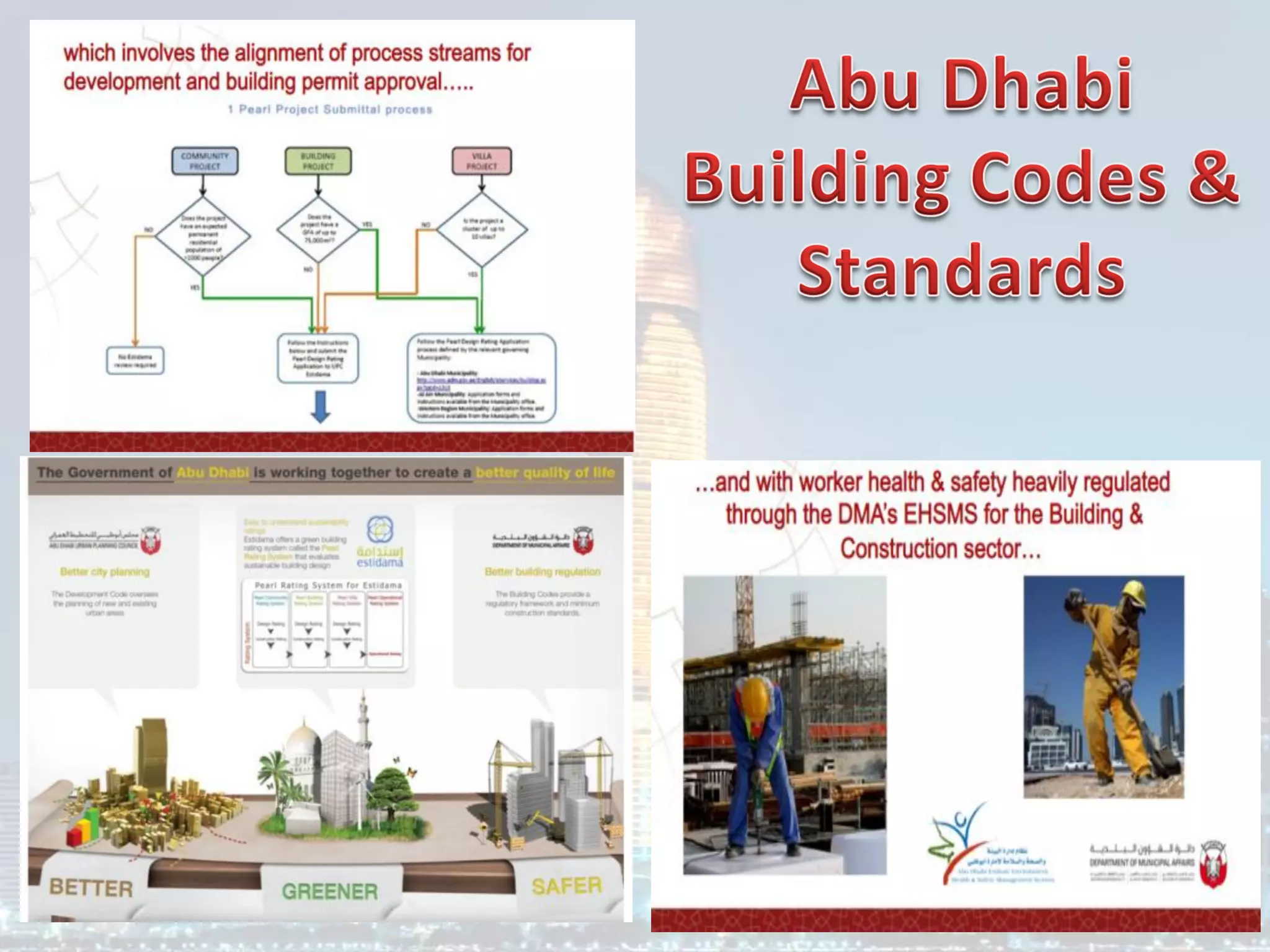
  • 255.
  • 256.
  • 258.
    Abu Dhabi InternationalBuilding Codes Abu Dhabi International Private Sewage Disposal Code (ADIPSDC) A - General Description of ADIPSDC B - Arrangement and Formatting C - Chapter by Chapter Description
  • 259.
    Abu Dhabi InternationalBuilding Codes Abu Dhabi International Private Sewage Disposal Code (ADIPSDC)
  • 260.
    Abu Dhabi InternationalBuilding Codes Abu Dhabi International Private Sewage Disposal Code (ADIPSDC)
  • 261.
    Abu Dhabi InternationalBuilding Codes Abu Dhabi International Private Sewage Disposal Code (ADIPSDC)
  • 262.
    Abu Dhabi InternationalBuilding Codes Abu Dhabi International Private Sewage Disposal Code (ADIPSDC)
  • 263.
    Abu Dhabi InternationalBuilding Codes Abu Dhabi International Private Sewage Disposal Code (ADIPSDC) A - General Description of ADIPSDC The Abu Dhabi International Private Sewage Disposal Code (ADIPSDC) is a code that regulates minimum requirements for the installation of new or the alteration of existing private sewage disposal systems. Where a building cannot be served by a public sewer system, the building site must be provided with a system for treating the waste water generated from the use of plumbing fixtures in the building. The ADIPSDC addresses site evaluations, materials, various soil absorption systems, holding tanks, cesspools and onsite waste water treatment systems. The ADIPSDC provides a total approach for the onsite, safe disposal of the waste low discharged to the plumbing fixtures in a building. The ADIPSDC is a specification- (prescriptive-) oriented code with very few occurrences of performance-oriented text. The site soil must be evaluated in a prescribed manner to determine its ability to accept the waste low. The chosen waste treatment method must be designed in a prescribed manner for the soil conditions at the building site, constructed using prescribed materials and installed according to prescribed dimensions. The ADIPSDC sets forth the minimum acceptable requirements for private sewage disposal systems in order to protect humans and the environment from insanitary conditions that would develop if waste lows were not rendered harmless.
  • 264.
    Abu Dhabi InternationalBuilding Codes Abu Dhabi International Private Sewage Disposal Code (ADIPSDC)
  • 265.
    Abu Dhabi InternationalBuilding Codes Abu Dhabi International Private Sewage Disposal Code (ADIPSDC) B - Arrangement and Format of ADIPSDC C - Chapter by chapter description of ADIPSDC
  • 266.
  • 267.
  • 268.
  • 269.
  • 270.
    Abu Dhabi InternationalBuilding Codes Abu Dhabi International Private Sewage Disposal Code (ADIPSDC) Chapter 1 Scope and Administration This chapter contains provisions for the application, enforcement and administration of subsequent requirements of the code. In addition to establishing the scope of the code, Chapter 1 identifies which buildings and structures come under its purview. Chapter 1 is largely concerned with maintaining “due process of law” in enforcing the requirements contained in the body of this code. Only through careful observation of the administrative provisions can the building official reasonably expect to demonstrate that “equal protection under the law” has been provided.
  • 271.
    Abu Dhabi InternationalBuilding Codes Abu Dhabi International Private Sewage Disposal Code (ADIPSDC) Chapter 2 Definitions Chapter 2 is the repository of the definitions of terms used in the body of the code. Codes are technical documents and every word, term and punctuation mark can impact the meaning of the code text and the intended results. The code often uses terms that have a unique meaning in the code and the code meaning can differ substantially from the ordinarily understood meaning of the term as used outside of the code. The terms defined in Chapter 2 are deemed to be of prime importance in establishing the meaning and intent of the code text. The user of the code should be familiar with and consult this chapter because the definitions are essential to the correct interpretation of the code and the user may not be aware that a term is defined. Where understanding of a term’s definition is especially key to or necessary for understanding of a particular code provision, the term is shown in italics wherever it appears in the code. This is true only for those terms that have a meaning that is unique to the code. In other words, the generally understood meaning of a term or phrase might not be sufficient or consistent with the meaning prescribed by the code; therefore, it is essential that the code-defined meaning be known. Guidance regarding tense, gender and plurality of defined terms, as well as guidance regarding terms not defined in this code, is provided.
  • 272.
    Abu Dhabi InternationalBuilding Codes Abu Dhabi International Private Sewage Disposal Code (ADIPSDC) Chapter 3 General Regulations The content of Chapter 3 is often referred to as “miscellaneous,” rather than general regulations. Chapter 3 received that label because it is the only chapter in the code whose requirements do not interrelate. If a requirement cannot be located in another chapter, it can be found in this chapter. Specific requirements concerning flood hazard areas are in this chapter.
  • 273.
    Abu Dhabi InternationalBuilding Codes Abu Dhabi International Private Sewage Disposal Code (ADIPSDC) Chapter 4 Site Evaluation and Requirements A private sewage disposal system has an effluent which cannot be directly discharged into waterways or open ponds. Soil of the right consistency and water content provides a natural filtering and treatment of this discharge. Because soil conditions vary widely, even on the same building site, tests and inspections of the soils must be performed to evaluate the degree to which the soil can accept these liquids. The results of the tests provide necessary information to design an adequate private sewage disposal system. Chapter 4 provides the methods for evaluating the building site.
  • 274.
    Abu Dhabi InternationalBuilding Codes Abu Dhabi International Private Sewage Disposal Code (ADIPSDC) Chapter 5 Materials Private sewage disposal systems depend on the strength, quality and chemical resistance of the components that make up the system. To that end, the purpose of Chapter 5 is to specify the minimum material and component standards to assure that the private sewage disposal system will correctly perform for its intended life.
  • 275.
    Abu Dhabi InternationalBuilding Codes Abu Dhabi International Private Sewage Disposal Code (ADIPSDC) Chapter 6 Soil Absorption Systems The design of soil absorption systems depends heavily on the result of the tests and evaluation of the site soil conditions required in Chapter 4. Where soil is less permeable, the area of the soil absorption must be large as compared to that required for soils that are highly permeable. The type of building that is being served by the private sewage disposal system also affects the size of the planned soil absorption area. This chapter provides the methods for computing the required absorption area and details for the proper installation of the soil absorption systems.
  • 276.
    Abu Dhabi InternationalBuilding Codes Abu Dhabi International Private Sewage Disposal Code (ADIPSDC) Chapter 7 Pressure Distribution Systems Chapter 6 deals with gravity-type soil absorption systems or systems where the effluent is allowed to drain out of the distribution piping by gravity. This chapter offers an alternate method of discharging the effluent into the ground by pressure means. As such, Chapter 7 provides the necessary details for designing the piping and pumping systems for pressure distribution systems.
  • 277.
    Abu Dhabi InternationalBuilding Codes Abu Dhabi International Private Sewage Disposal Code (ADIPSDC) Chapter 8 Tanks Tanks are an integral part of any private sewage disposal system whether they serve as treatment (septic) tanks or merely just holding tanks for leveling the peaks in low to the system. Where tanks are used for treatment, the dimensions, volume and location of internal features are very important to assure that the solid wastes are kept within the tank so as to not clog the effluent distribution system. Where tanks are used for holding purposes, they must be sized large enough to accommodate the total of peak lows coming from a building. Chapter 8 provides the necessary requirements for tanks.
  • 278.
    Abu Dhabi InternationalBuilding Codes Abu Dhabi International Private Sewage Disposal Code (ADIPSDC) Chapter 9 Mound Systems Mound systems are another method for applying the effluent from a private sewage disposal system to the soil. This type of system may be advantageous in some localities due to the existing soil conditions. Chapter 9 has specific requirements for soil and site evaluations for mound systems. Chapter 10 Cesspools Although prohibited from being installed as a permanent private sewage disposal system, cesspools may be necessary where permanent systems are under repair, or are being built. Chapter 10 provides the details for constructing a cesspool.
  • 279.
    Abu Dhabi InternationalBuilding Codes Abu Dhabi International Private Sewage Disposal Code (ADIPSDC) Chapter 11 Residential Waste Water System Another method of private sewage disposal is a small waste water treatment plant. Where permitted, these systems can discharge effluent directly to streams and rivers. Chapter 11 specifies the standard to which waste water treatment plants must conform. Chapter 12 Inspections The best soil and site analysis along with the best design will be rendered useless if the system is not installed according to the plans for the system. Chapter 12 provides requirements for inspection of private sewage disposal systems.
  • 280.
    Abu Dhabi InternationalBuilding Codes Abu Dhabi International Private Sewage Disposal Code (ADIPSDC) Chapter 13 Non-liquid Saturated Treatment Systems In some locations, water for the flushing of wastes into and through a sanitary piping system is not available. For example, a toilet facility provided for a remote campground without running water would require such a system. Chapter 13 specifies the standard to which nonliquid saturated treatment systems must conform.
  • 281.
    Abu Dhabi InternationalBuilding Codes Abu Dhabi International Private Sewage Disposal Code (ADIPSDC) Chapter 14 Reference Standards The code contains numerous references to standards that are used to regulate materials and methods of construction. Chapter 14 contains a comprehensive list of all standards that are referenced in the code. The standards are part of the code to the extent of the reference to the standard. Compliance with the referenced standard is necessary for compliance with this code. By providing specifically adopted standards, the construction and installation requirements necessary for compliance with the code can be readily determined. The basis for code compliance is, therefore, established and available on an equal basis to the code official, contractor, designer and owner. Chapter 14 is organized in a manner that makes it easy to locate specific standards. It lists all of the referenced standards, alphabetically, by acronym of the promulgating agency of the standard. Each agency’s standards are then listed in either alphabetical or numeric order based upon the standard identification. The list also contains the title of the standard; the edition (date) of the standard referenced; any addenda included as part of the ICC adoption; and the section or sections of this code that reference the standard.
  • 282.
    Abu Dhabi InternationalBuilding Codes Abu Dhabi International Private Sewage Disposal Code (ADIPSDC)
  • 283.
    Abu Dhabi InternationalBuilding Codes Abu Dhabi International Private Sewage Disposal Code (ADIPSDC)
  • 284.
    Abu Dhabi InternationalBuilding Codes Abu Dhabi International Private Sewage Disposal Code (ADIPSDC) Appendix A System Layout illustration Appendix A provides figures that illustrate various requirements in the body of the code. Figures A-1 through A-4 illustrate typical combustion air requirements. Figure A-5 illustrates the chimney connector clearance requirements of Table 803.10.4. Appendix B Tables for Pressure Distribution Systems Appendix B provides a sample permit fee schedule for mechanical permits. The local jurisdiction can adopt this appendix and fill in the dollar amounts in the blank spaces to establish their official permit fee schedule. The ICC does not establish permit fees because the code is adopted throughout the country and there are vast differences in operating budgets between different parts of the country, as well as between large and small municipalities within the same region.
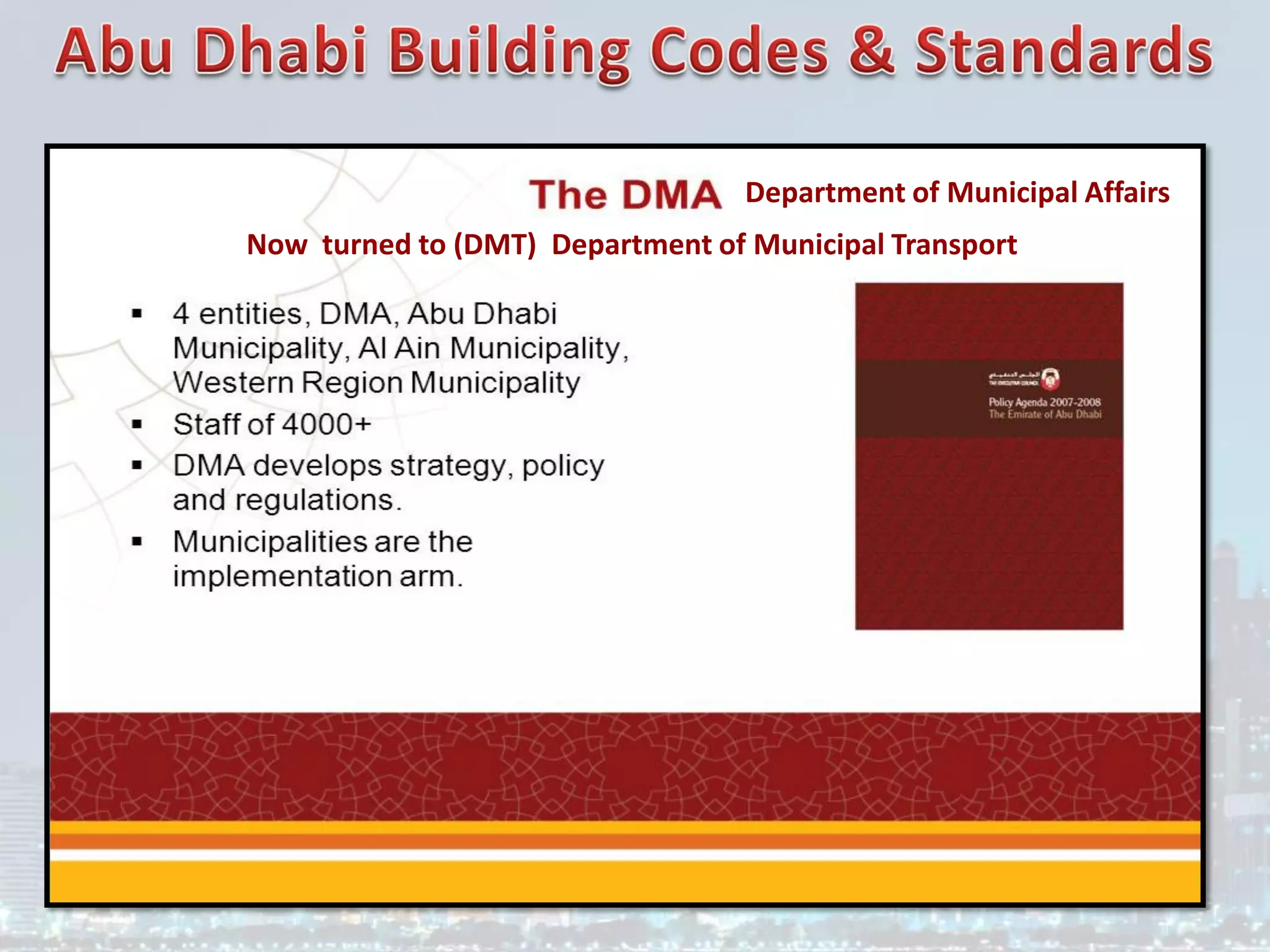
  • 285.
    Abu Dhabi InternationalFuel Gas Code (ADIFGC) A - General Description of ADIFGC B - Arrangement and Formatting C - Chapter by Chapter Description
  • 286.
    Abu Dhabi InternationalBuilding Codes Abu Dhabi International Fuel Gas Code (ADIFGC)
  • 287.
    Abu Dhabi InternationalBuilding Codes Abu Dhabi International Fuel Gas Code (ADIFGC)
  • 288.
    Abu Dhabi InternationalBuilding Codes Abu Dhabi International Fuel Gas Code (ADIFGC)
  • 289.
    Abu Dhabi InternationalBuilding Codes Abu Dhabi International Fuel Gas Code (ADIFGC) A - General Description of ADIFGC The ADIFGC is a code that regulates the design and installation of fuel gas distribution piping and systems, appliances, appliance venting systems, combustion air provisions, gaseous hydrogen systems and motor vehicle gaseous-fuel-dispensing stations. The definition of fuel gas includes natural, liquefied petroleum and manufactured gases and mixtures of these gases. The purpose of the code is to establish the minimum acceptable level of safety and to protect life and property from the potential dangers associated with the storage, distribution and usage of fuel gases and the byproducts of combustion of such fuels. The code also protects the personnel that install, maintain, service and replace the systems and appliances addressed by this code. With the exception of Section 401.1.1, the ADIFGC does not address utility-owned piping and equipment (i.e., anything upstream of the point of delivery). See the definition of “Point of delivery” and Section 501.8 for other code coverage exemptions. The ADIFGC is primarily a specification oriented (prescriptive) code with some performance-oriented text. For example, Section 503.3.1 is a performance statement, but Chapter 5 contains prescriptive requirements that will cause Section 503.3.1 to be satisfied. The ADIFGC applies to all occupancies including one- and two-family dwellings and townhouses. The ADIFGC does not apply to piping systems that operate at pressures in excess of 125 psig for natural gas and 20 psig for LP-gas (note exception in Section 402.6). The general Section 105.2 and the specific Sections 304.8, 402.3, 503.5.5 and 503.6.9 allow combustion air provisions, pipe sizing and chimney and vent sizing to be performed by approved engineering methods as alternatives to the prescriptive methods in the code.
  • 290.
    Abu Dhabi InternationalBuilding Codes Abu Dhabi International Fuel Gas Code (ADIFGC) B - Arrangement and Format of ADIFGC The format of the ADIFGC allows each chapter to be devoted to a particular subject, with the exception of Chapter 3, which contains general subject matters that are not extensive enough to warrant their own independent chapter. C - Chapter by chapter description of ADIFGC
  • 291.
  • 292.
  • 293.
    Abu Dhabi InternationalBuilding Codes Abu Dhabi International Fuel Gas Code (ADIFGC) Chapter 1 Scope and Administration Chapter 1 establishes the limits of applicability of the code and describes how the code is to be applied and enforced. A fuel gas code, like any other code, is intended to be adopted as a legally enforceable document, and it cannot be effective without adequate provisions for its administration and enforcement. The provisions of Chapter 1 establish the authority and duties of the code official appointed by the jurisdiction having authority and also establish the rights and privileges of the design professional, contractor and property owner.
  • 294.
    Abu Dhabi InternationalBuilding Codes Abu Dhabi International Fuel Gas Code (ADIFGC) Chapter 2 Definitions Chapter 2 is the repository of the definitions of terms used in the body of the code. Codes are technical documents and every word, term and punctuation mark can impact the meaning of the code text and the intended results. The code often uses terms that have a unique meaning in the code and the code meaning can differ substantially from the ordinarily understood meaning of the term as used outside of the code. The terms defined in Chapter 2 are deemed to be of prime importance in establishing the meaning and intent of the code text that uses the terms. The user of the code should be familiar with and consult this chapter because the definitions are essential to the correct interpretation of the code and because the user may not be aware that a term is defined.
  • 295.
    Abu Dhabi InternationalBuilding Codes Abu Dhabi International Fuel Gas Code (ADIFGC) Chapter 3 General Regulations Chapter 3 contains broadly applicable requirements related to appliance location and installation, appliance and systems access, protection of structural elements and clearances to combustibles, among others. This chapter also covers combustion air provisions for gas-fired appliances.
  • 296.
    Abu Dhabi InternationalBuilding Codes Abu Dhabi International Fuel Gas Code (ADIFGC) Chapter 4 Gas Piping Installations Chapter 4 covers the allowable materials for gas piping systems and the sizing and installation of such systems. It also covers pressure regulators, appliance connections and overpressure protection devices. Gas piping systems are sized to supply the maximum demand while maintaining the supply pressure necessary for safe operation of the appliances served.
  • 297.
    Abu Dhabi InternationalBuilding Codes Abu Dhabi International Fuel Gas Code (ADIFGC) Chapter 5 Chimneys and Vents Chapter 5 regulates the design, construction, installation, maintenance, repair and approval of chimneys, vents, venting systems and their connections to gas-fired appliances. Properly designed chimneys, vents and venting systems are necessary to conduct to the outdoors the flue gases produced by the combustion of fuels in appliances. The provisions of this chapter are intended to minimize the hazards associated with high temperatures and potentially toxic and corrosive combustion gases. This chapter addresses all of the factory-built and site-built chimneys, vents and venting systems used to vent all types and categories of appliances. It also addresses direct-vent appliances, integral vent appliances, side-wall mechanically vented appliances and exhaust hoods that convey the combustion byproducts from cooking and other process appliances.
  • 298.
  • 299.
    Abu Dhabi International Building Codes Abu DhabiInternational Fuel Gas Code (ADIFGC)
  • 300.
    Abu Dhabi International Building Codes Abu DhabiInternational Fuel Gas Code (ADIFGC)
  • 301.
    Abu Dhabi InternationalBuilding Codes Abu Dhabi International Fuel Gas Code (ADIFGC)
  • 302.
    Abu Dhabi InternationalBuilding Codes Abu Dhabi International Fuel Gas Code (ADIFGC) Chapter 6 Specific Appliances Chapter 6 addresses specific appliances that the code intends to regulate. Each main section applies to a unique type of gas-fired appliance and specifies the product standards to which the appliance must be listed. The general requirements found in the previous Chapters 1 through 5 also apply and the sections in Chapter 6 add the special requirements that are specific to each type of appliance.
  • 303.
    Abu Dhabi InternationalBuilding Codes Abu Dhabi International Fuel Gas Code (ADIFGC) Chapter 7 Gaseous Hydrogen Systems Chapter 7 is specific to gaseous hydrogen generation, storage, distribution and utilization systems, appliances and equipment. Note that hydrogen is not within the definition of “Fuel gas,” but it is, nonetheless, commonly used as a fuel for fuel-cell power generation and fuel cell powered motor vehicles. The scope of Chapter 7 is not limited to any particular use of hydrogen (see Sections 633 and 635). Hydrogen systems have unique potential hazards because of the specific gravity of the gas, its chemical effect on materials and the fact that it is not odorized.
  • 304.
    Abu Dhabi InternationalBuilding Codes Abu Dhabi International Fuel Gas Code (ADIFGC) Chapter 8 Referenced Standards Chapter 8 lists all of the product and installation standards and codes that are referenced throughout Chapters 1 through 7. As stated in Section 102.8, these standards and codes become an enforceable part of the code (to the prescribed extent of the reference) as if printed in the body of the code. Chapter 8 provides the full title and edition year of the standards and codes in addition to the address of the promulgators and the section numbers in which the standards and codes are referenced.
  • 305.
    Abu Dhabi InternationalBuilding Codes Abu Dhabi International Fuel Gas Code (ADIFGC)
  • 306.
    Abu Dhabi InternationalBuilding Codes Abu Dhabi International Fuel Gas Code (ADIFGC)
  • 307.
    Abu Dhabi InternationalBuilding Codes Abu Dhabi International Fuel Gas Code (ADIFGC) Appendix A Sizing and Capacities of Gas Piping This appendix is informative and not part of the code. It provides design guidance, useful facts and data and multiple examples of how to apply the sizing tables and sizing methodologies of Chapter 4. Appendix B Sizing of Venting Systems Serving Appliances Equipped with Draft Hoods, Category I Appliances and Appliances Listed for Use with Type B Vents This appendix is informative and not part of the code. It contains multiple examples of how to apply the vent and chimney tables and methodologies of Chapter 5.
  • 308.
    Abu Dhabi InternationalBuilding Codes Abu Dhabi International Fuel Gas Code (ADIFGC) Appendix C Exit Terminals of Mechanical Draft and Direct-vent Venting Systems This appendix is informative and not part of the code. It consists of a figure and notes that visually depict code requirements from Chapter 5 for vent terminals with respect to the openings found in building exterior walls. Appendix D Recommended Procedure for Safety Inspection of an Existing Appliance Installation This appendix is informative and not part of the code. It provides recommended procedures for testing and inspecting an appliance installation to determine if the installation is operating safely and if the appliance is in a safe condition.
  • 309.
    Abu Dhabi InternationalBuilding Codes Abu Dhabi International Fuel Gas Code (ADIFGC)
  • 310.
    Abu Dhabi InternationalBuilding Codes Abu Dhabi International Fuel Gas Code (ADIFGC)
  • 311.
    Abu Dhabi InternationalBuilding Codes Abu Dhabi International Fuel Gas Code (ADIFGC)
  • 312.
    Abu Dhabi InternationalBuilding Codes Abu Dhabi International Fuel Gas Code (ADIFGC)
  • 313.
    Abu Dhabi InternationalBuilding Codes Abu Dhabi International Fuel Gas Code (ADIFGC)
  • 314.
    Abu Dhabi InternationalBuilding Codes Abu Dhabi International Fuel Gas Code (ADIFGC)
  • 315.
    Abu Dhabi InternationalBuilding Codes A - General Description of ADIPMC B - Arrangement and Formatting C - Chapter by Chapter Description Abu Dhabi International Property Maintenance Code (ADIPMC)
  • 316.
    Abu Dhabi InternationalBuilding Codes Abu Dhabi International Property Maintenance Code (ADIPMC)
  • 317.
    Abu Dhabi International Building Codes Abu DhabiInternational Property Maintenance Code (ADIPMC) Samples of Abu Dhabi Design & Maintenance Specifications
  • 318.
    Abu Dhabi International Building Codes Abu DhabiInternational Property Maintenance Code (ADIPMC) Samples of Abu Dhabi Design & Maintenance Specifications
  • 319.
    Abu Dhabi International Building Codes Abu DhabiInternational Property Maintenance Code (ADIPMC) Samples of Abu Dhabi Design & Maintenance Specifications
  • 320.
    Abu Dhabi International Building Codes Abu DhabiInternational Property Maintenance Code (ADIPMC) Samples of Abu Dhabi Design & Maintenance Specifications
  • 321.
  • 322.
    Abu Dhabi InternationalBuilding Codes Abu Dhabi International Property Maintenance Code (ADIPMC) A - General Description of ADIPMC The Abu Dhabi International Property Maintenance Code (ADIPMC) is a code that regulates the minimum maintenance requirements for existing buildings. The ADIPMC is a maintenance document intended to establish minimum maintenance standards for basic equipment, light, ventilation, heating, sanitation and fire safety. Responsibility is fixed among owners, operators and occupants for code compliance. The ADIPMC provides for the regulation and safe use of existing structures in the interest of the social and economic welfare of the community.
  • 323.
    Abu Dhabi InternationalBuilding Codes Abu Dhabi International Property Maintenance Code (ADIPMC) B - Arrangement and Format of ADIPMC C - Chapter by chapter description of ADIPMC The following is a chapter-by-chapter summary of the scope and intent of the provisions of the Abu Dhabi International Property Maintenance Code:
  • 324.
  • 325.
    Abu Dhabi InternationalBuilding Codes Abu Dhabi International Property Maintenance Code (ADIPMC) Chapter 1 Administration and Enforcement This chapter contains provisions for the application, enforcement and administration of subsequent requirements of the code. In addition to establishing the scope of the code, Chapter 1 identifies which buildings and structures come under its purview. Chapter 1 is largely concerned with maintaining “due process of law” in enforcing the property maintenance criteria contained in the body of the code. Only through careful observation of the administrative provisions can the building official reasonably expect to demonstrate that “equal protection under the law” has been provided.
  • 326.
    Abu Dhabi InternationalBuilding Codes Abu Dhabi International Property Maintenance Code (ADIPMC) Chapter 2 Definitions All terms that are defined in the code are listed alphabetically in Chapter 2. While a defined term may be used in one chapter or another, the meaning provided in Chapter 2 is applicable throughout the code. Where understanding of a term’s definition is especially key to or necessary for understanding of a particular code provision, the term is show in italics wherever it appears in the code. This is true only for those terms that have a meaning that is unique to the code. In other words, the generally understood meaning of a term or phrase might not be sufficient or consistent with the meaning prescribed by the code; therefore, it is essential that the code-defined meaning be known. Guidance regarding tense, gender and plurality of defined terms as well as guidance regarding terms not defined in this code is provided.
  • 327.
    Abu Dhabi InternationalBuilding Codes Abu Dhabi International Property Maintenance Code (ADIPMC) Chapter 3 General Requirements Chapter 3, “General Requirements,” is broad in scope. It includes a variety of requirements for the exterior property areas as well as the interior and exterior elements of the structure. This chapter provides requirements that are intended to maintain a minimum level of safety and sanitation for both the general public and the occupants of a structure, and to maintain a building’s structural and weather-resistance performance. Chapter 3 provides specific criteria for regulating the installation and maintenance of specific building components; maintenance requirements for vacant structures and land; requirements regulating the safety, sanitation and appearance of the interior and exterior of structures and all exterior property areas; accessory structures; vehicle storage regulations and establishes who is responsible for complying with the chapter’s provisions. This chapter also contains the requirements for swimming pools, spas and hot tubs and the requirements for protective barriers and gates in these barriers. Chapter 3 establishes the responsible parties for exterminating insects and rodents, and maintaining sanitary conditions in all types of occupancies.
  • 328.
    Abu Dhabi InternationalBuilding Codes Abu Dhabi International Property Maintenance Code (ADIPMC) Chapter 4 Light, Ventilation and Occupancy Limitations The purpose of Chapter 4 is to set forth these requirements in the code and to establish the minimum environment for occupiable and habitable buildings, by establishing the minimum criteria for light and ventilation and identifies occupancy limitations including minimum room width and area, minimum ceiling height and restrictions to prevent overcrowding. This chapter also provides for alternative arrangements of windows and other devices to comply with the requirements for light and ventilation and prohibits certain room arrangements and occupancy uses.
  • 329.
    Abu Dhabi InternationalBuilding Codes Abu Dhabi International Property Maintenance Code (ADIPMC) Chapter 5 Plumbing Facilities and Fixture Requirements Chapter 5 establishes the minimum criteria for the installation, maintenance and location of plumbing systems and facilities, including the water supply system, water heating appliances, sewage disposal system and related plumbing fixtures. Sanitary and clean conditions in occupied buildings are dependent upon certain basic plumbing principles, including providing potable water to a building, providing the basic fixtures to effectively utilize that water and properly removing waste from the building. Chapter 5 establishes the minimum criteria to verify that these principles are maintained throughout the life of a building.
  • 330.
    Abu Dhabi InternationalBuilding Codes Abu Dhabi International Property Maintenance Code (ADIPMC) Chapter 6 Mechanical and Electrical Requirements The purpose of Chapter 6 is to establish minimum performance requirements for heating, electrical and mechanical facilities and to establish minimum standards for the safety of these facilities. This chapter establishes minimum criteria for the installation and maintenance of the following: heating and air-conditioning equipment, appliances and their supporting systems; water-heating equipment, appliances and systems; cooking equipment and appliances; ventilation and exhaust equipment; gas and liquid fuel distribution piping and components; fireplaces and solid fuel-burning appliances; chimneys and vents; electrical services; lighting fixtures; electrical receptacle outlets; electrical distribution system equipment, devices and wiring; and elevators, escalators and dumbwaiters.
  • 331.
    Abu Dhabi InternationalBuilding Codes Abu Dhabi International Property Maintenance Code (ADIPMC) Chapter 6 Mechanical and Electrical Requirements
  • 332.
    Abu Dhabi InternationalBuilding Codes Abu Dhabi International Property Maintenance Code (ADIPMC) Chapter 7 Fire Safety Requirements The purpose of Chapter 7 is to address those fire hazards that arise as the result of a building’s occupancy. It also provides minimum requirements for fire safety issues that are most likely to arise in older buildings. This chapter contains requirements for means of egress in existing buildings, including path of travel, required egress width, means of egress doors and emergency escape openings. Chapter 7 establishes the minimum requirements for fire safety facilities and fire protection systems, as these are essential fire safety systems.
  • 333.
    Abu Dhabi International Building Codes Chapter7 Fire Safety Requirements Abu Dhabi International Property Maintenance Code (ADIPMC)
  • 334.
    Abu Dhabi International Building Codes Abu DhabiInternational Property Maintenance Code (ADIPMC) Chapter 7 Fire Safety Requirements
  • 335.
    Abu Dhabi InternationalBuilding Codes Abu Dhabi International Property Maintenance Code (ADIPMC) Chapter 8 Referenced Standards The code contains numerous references to standards that are used to regulate materials and methods of construction. Chapter 8 contains a comprehensive list of all standards that are referenced in the code. The standards are part of the code to the extent of the reference to the standard. Compliance with the referenced standard is necessary for compliance with this code. By providing specifically adopted standards, the construction and installation requirements necessary for compliance with the code can be readily determined. The basis for code compliance is, therefore, established and available on an equal basis to the code official, contractor, designer and owner. Chapter 8 is organized in a manner that makes it easy to locate specific standards. It lists all of the referenced standards, alphabetically, by acronym of the promulgating agency of the standard. Each agency’s standards are then listed in either alphabetical or numeric order based upon the standard identification. The list also contains the title of the standard; the edition (date) of the standard referenced; any addenda included as part of the ICC adoption; and the section or sections of this code that reference the standard.
  • 336.
    Abu Dhabi InternationalBuilding Codes Abu Dhabi International Property Maintenance Code (ADIPMC)
  • 337.
    Abu Dhabi InternationalBuilding Codes Abu Dhabi International Property Maintenance Code (ADIPMC)
  • 338.
  • 339.
    Abu Dhabi InternationalBuilding Codes Abu Dhabi International Fire Codes (ADIFC)
  • 340.
    Abu Dhabi InternationalBuilding Codes Abu Dhabi International Fire Codes (ADIFC)
  • 341.
  • 342.
  • 343.
  • 344.
  • 345.
  • 346.
  • 347.
  • 348.
  • 349.
  • 350.
  • 351.
  • 352.
  • 353.
  • 354.
    Abu Dhabi InternationalFire Codes (ADIFC) Abu Dhabi International Building Codes
  • 355.
  • 356.
  • 357.
  • 358.
  • 359.
  • 360.
    Abu Dhabi International Building Codes Abu DhabiInternational Fire Codes (ADIFC)
  • 361.
  • 362.
  • 363.
  • 364.
  • 365.
  • 366.
  • 367.
  • 368.
  • 369.
  • 370.
  • 371.
  • 372.
  • 373.
  • 374.
  • 375.
  • 376.
    Abu Dhabi International Building Codes Abu Dhabi International Fire Codes (ADIFC) We may notice thebig differences between IFC 2021 and the previous versions IFC 2021 Chapter by Chapter
  • 377.
    Abu Dhabi International Building Codes Abu Dhabi International Fire Codes (ADIFC) 2021 International FireCode (IFC) The 2021 IFC® contains regulations to safeguard life and property from fires and explosion hazards. Topics include general precautions, emergency planning and preparedness, fire department access and water supplies, automatic sprinkler systems, fire alarm systems, special hazards, and the storage and use of hazardous materials. Key changes to the IFC include:  Requirements for Additive Manufacturing (3-D Printing) equipment and operations for both non-industrial and industrial applications are now provided.  Flame propagation performance of permanently installed artificial combustible vegetation is required to be verified when exceeding certain heights located on roofs or in close proximity to buildings.  Provisions for emergency responder communication were revised to reflect the expansion of such systems beyond radios and the need for increased performance of such systems.
  • 378.
    Abu Dhabi International Building Codes Abu Dhabi International Fire Codes (ADIFC) 2021 International FireCode (IFC)  Sprinkler requirements for the storage, manufacture and sale of upholstered furniture and mattresses were updated and clarified. Part of this update is a new exception for single-story self-storage facilities accessed directly from the exterior.  An automatic sprinkler system is now required for open parking garages exceeding a certain fire area threshold.  The requirements for energy storage system (ESS) were further refined to reflect the variety of new technologies and applications (in building and standalone) and the need for proper commissioning and decommissioning of such systems.  A new chapter was added that provides clarification and specific requirements for the storage of distilled spirits and wines in barrels and casks.  The provisions for construction fire safety were reorganized and expanded with an emphasis on the owner’s responsibilities. The new language requires a site safety plan and designation of a site safety director.
  • 379.
    Abu Dhabi International Building Codes Abu Dhabi International Fire Codes (ADIFC) 2021 International FireCode (IFC) This book (Complete Revision History to the 2021 Codes) provides a complete history of revisions made to the International Fire Code (IFC). It composes the original change proposal, the names of the proponents, the reason for the change, the modified content, the impact of the change (increase or decrease in cost), any modifications to the proposal by the IFC Committee, public comments, and the final action by the committee (with acronyms defined in the Introduction section). Deleted text is notated by a strikethrough, with new text underlined. The changes improve understanding through editorial revisions to clarify the language, update technical aspects of the code, or expunge obsolete information. Code changes are listed in order and are also searchable in the Table of Changes by chapter.
  • 380.
  • 381.
    Abu Dhabi International Building Codes Abu Dhabi InternationalFire Codes (ADIFC) 1- Fire Causes 2- Fire Protection Techniques Reasons that make IFC (International Fire Code) to be the most changeable code among all the ICC codes:
  • 382.
  • 383.
    Abu Dhabi International Building Codes Abu Dhabi International Fire Codes (ADIFC) 2021 International FireCode (IFC) 2021 IFC Resource A - Recommended Practices for Remote Virtual Inspections (RVI) Recommended Practices for Remote Virtual Inspections (RVI) is the most complete source of information on remote inspections. RVI is an alternative to on-site inspections using a video call on a 4G or WiFi telephony (smartphone, tablet, etc.) in order to interact with the inspector. It is a comprehensive tool for local jurisdictions and the building industry alike that desire to implement a remote inspection program. This publication covers the RVI process, inspection scheduling, preparation, what the owner/contractor should expect, training and communications, and recording and maintaining records. While all types of inspections may not be suitable for RVI, a list of potential construction activities suitable for remote inspections is provided. RVI also lends itself to connect seamlessly as part of an overall online program that will allow jurisdictions to provide complete services to the public utilizing the latest technology. Online permitting and electronic plan review together with remote virtual inspections can provide a complete program that keeps the construction industry moving while providing a healthy environment for all participants.
  • 384.
  • 393.
    Encourages the useand reuse of existing buildings. This code covers repair, alteration, addition and change of occupancy for existing buildings and historic buildings, while achieving appropriate levels of safety without requiring full compliance with the new construction requirements contained in the other I-Codes. For the most current adoptions details go to International Code Adoptions
  • 396.
    Key changes includeof IEBC 2018 Version: 1. Section 410 Accessibility has been relocated to a new Section 305. Chapters 4, 5, 6, 13 and 14 have been relocated resulting in a reorganization and new chapter numbering. 2. Requirements for live loads from Chapters 4 and 8 have been combined and placed in Chapter 3 to apply for all compliance methods. 3. Structural components damaged by snow events must be repaired assuming snow loads for new buildings from the IBC. 4. A new exception is added for loading of existing structural elements next to an addition in buildings designed using the IRC. 5. When a work area includes more than half the building in an alteration, wall anchors must be installed at the roof line along reinforced concrete and masonry walls. 6. Buildings undergoing a change of occupancy shall have live, snow, wind and seismic loads checked. Design loads are based on IBC-level forces. 7. When a change of occupancy occurs placing a building in a higher risk category, the seismic loads on the building must be evaluated using IBC-level forces. Access to the building must be maintained when passing through or near other buildings and structures. 8. Where storm shelters are required based on IBC and ICC 500 for Group E Occupancies, any addition to such existing occupancies where the occupant load of the addition is 50 or more will trigger the construction of a storm shelter. 9. Carbon Monoxide provisions have been added in the Prescriptive Method Additions, Alterations Level 2 Additions, and in Additions for I-1, I-2, I-4 and R Occupancies. 10. Emergency Escape and Rescue Opening provisions related to being operational have been added to Prescriptive Compliance Method and Alterations Level 1. 11. Single exit buildings and spaces under Alteration Levels 2 and 3 have been modified to be more consistent with the IBC. 12. The Alterations Level 2 requirement that water for automatic fire sprinkler system be available at the floor of alteration without the need for a fire pump has been moved to Chapter 9 for Alterations Level 3 and the fire pump criterion was deleted.
  • 397.
  • 403.
    2018 International ResidentialCode for One- and Two-Family Dwellings (IRC®) ; key changes: 1. An updated seismic map reflects the most conservative Seismic Design Category (SDC) based on any soil type and a new map reflects less conservative SDCs when Site Class A, B or D is applicable. 2. The townhouse separation provisions now include options for using two separate fire-resistant-rated walls or a common wall. 3. An emergency escape and rescue opening is no longer required in basement sleeping rooms where the dwelling has an automatic fire sprinkler system and the basement has a second means of egress or an emergency escape opening. 4. The exemption for interconnection of smoke alarms in existing areas has been deleted. 5. New girder/header tables have been revised to incorporate the use of #2 Southern Pine in lieu of #1 Southern Pine. 6. New tables address alternative wood stud heights and the required number of full height studs in high wind areas.
  • 406.
  • 407.
  • 408.
  • 409.
  • 410.
  • 411.
  • 413.
    Stair width and tread depth? Moisture protection issues? Garage emissions separated andsafe? Exit door and stoop safe? Required rooms accounted for? Is the smallest room big enough for human impact? Window locations and which ones open? Bedroom window large enough to get out if needed?
  • 414.
  • 415.
    Fire Protection •SmokeDetectors- •Required in each bedroom •Required in adjoining areas to the bedrooms •One required per floor Many life concerns in residential and hotel construction are centered around one of the two strongest threats. Fire and Structure. Let’s take a quick look at some of the code provisions for fire alarms and safety requirements built into the home.
  • 416.
    Egress • Predominately afire concern and lobbied heavily by emergency and fire response services. – Primary egress door required – Minimum sizes for window escape – Requirements for stairways and landings – Provision for movement away from building once out.
  • 417.
    Stairs • Stair heightand tread distance combine to form a ergo dynamic pattern. If too steep or without adequate tread depth the stair becomes more likely to cause falls.
  • 418.
    Windows • Required for lightand ventilation (clean air) • Required for escape • Must be safety glazed when specific conditions are met. – Size of glass pane – Location near traffic or wet area Whhhoooops! Wrong windows! The glass in my door broke and the glass shop will not sell me a piece of plate glass to replace it. They say I need to buy "safety glass." Are they trying to cheat me? No, but they may be saving your life - or keeping you out of legal trouble. You may not know that glass is one of the few building materials actually regulated by the Federal government and that usage of glass in and near doors falls under strict Consumer Product Safety Commission rules. Quality glass shops know that all glass in doors must meet the requirements of CPSC 16 CFR 1201 safety glazing - which generally means that either tempered or laminated glass or plastic must be used
  • 419.
    Windows 16 CFRPart 1201 (2002) - Safety Standard for Architectural Glazing
  • 420.
    Windows CPSC 16 CFR1201 safety glazing
  • 421.
    Windows CPSC 16CFR 1201 safety glazing
  • 422.
    Ventilation  A certainamount of light and ventilation is required per room Fans • Required in bathrooms • Whole house fan required • Vent required over cook top Windows • Operable windows in the bathrooms and living areas As a way of addressing the special needs of our Washington state climates, our local government has implemented a state wide ventilation and energy code. Within the scope of this code are ventilation requirements intended to address health issues that could result from moisture damage, or mold. The Washington State Ventilation and Indoor Air Quality Code (VIAQC) provides for moisture expelling fans as well as those required for cooking and odor.
  • 423.
    The Washington StateVentilation and Indoor Air Quality Code (VIAQC) Ventilation
  • 424.
    The Washington StateVentilation and Indoor Air Quality Code (VIAQC) Ventilation
  • 425.
    The Washington StateVentilation and Indoor Air Quality Code (VIAQC) Ventilation
  • 426.
    Building Planning Structure… Building planningis also about keeping the unit standing, and more safety aspects, and because I know you are intensely interested and curious about how and where and why the Design department wants to share this exciting safety information– after all…. It’s our baby!
  • 427.
  • 428.
  • 429.
  • 430.
  • 431.
  • 432.
  • 433.
  • 434.
  • 435.
  • 436.
  • 437.
  • 438.
  • 439.
  • 440.
  • 441.
  • 442.
  • 443.
  • 444.
  • 445.
  • 446.
  • 447.
  • 448.
  • 449.
  • 450.
  • 451.
  • 452.
  • 453.
  • 454.
  • 455.
  • 456.
  • 457.
  • 458.
  • 459.
  • 460.
  • 461.
  • 462.
    462 UL 10 D, UL 1715, UL 1040, UL 7235
  • 463.
  • 464.
  • 465.
  • 466.
    Abu Dhabi InternationalBuilding Codes Abu Dhabi International Building Codes (ADIBC) 2013 Chapter 11 Accessibility ICC/ANSI A117.1, Accessible and Usable Buildings and Facilities
  • 467.
  • 468.
  • 469.
  • 470.
  • 471.
  • 472.
  • 473.
  • 474.
  • 475.
  • 476.
  • 477.
  • 478.
  • 479.
  • 480.
    480 Standards & Codesas mentioned previously
  • 481.
  • 482.
    482 Total Quality Management(TQM) Quality Assurance (QA) Quality Control (QC) Inspection
  • 483.
    Partially Destructive Testing FullyDestructive Testing 483 Abu Dhabi International Building Codes Abu Dhabi International Building Codes (ADIBC) 2013
  • 484.
    484 Standards & Codesas mentioned previously
  • 485.
  • 487.
    Abu Dhabi InternationalBuilding Codes USCS (UNIFIED SOIL CLASSIFICATION SYSTEM ) for soil types
  • 488.
  • 492.
  • 493.
  • 494.
  • 495.
  • 496.
  • 497.
  • 498.
    498 Standards & Codesas mentioned previously
  • 499.
  • 500.
  • 501.
  • 502.
  • 503.
    503 Standards & Codesas mentioned previously
  • 504.
  • 505.
  • 506.
    506 Standards & Codesas mentioned previously
  • 507.
    507 Standards & Codesas mentioned previously
  • 508.
  • 509.
    509 Standards & Codesas mentioned previously
  • 510.
    Chapter 25 GypsumBoard and Plaster
  • 511.
  • 512.
    512 Standards & Codesas mentioned previously
  • 513.
  • 514.
  • 515.
  • 516.
  • 517.
  • 518.
  • 519.
  • 520.
  • 521.
  • 522.
  • 523.
  • 524.
  • 525.
  • 526.
  • 527.
  • 528.
  • 529.
  • 530.
  • 531.
  • 532.
  • 533.
  • 534.
    534 Key changes include:2021 International Building Code® (IBC®) Key changes include: 2018 International Building Code® (IBC®)
  • 535.
    535 Key changes include:2018 International Building Code® (IBC®) 1. Accessory storage spaces of any size are now permitted to be classified as part of the occupancy to which they are accessory. 2. New code sections have been introduced addressing medical gas systems and higher education laboratories. 3. Use of fire walls to create separate buildings is now limited to only the determination of permissible types of construction based on allowable building area and height. 4. Where an elevator hoistway door opens into a fire-resistance-rated corridor, the opening must be protected in a manner to address smoke intrusion into the hoistway. 5. The occupant load factor for business uses has been revised to one occupant per 150 square feet. 6. Live loads on decks and balconies increase the deck live load to one and one-half times the live load of the area served. 7. The minimum lateral load that fire walls are required to resist is five pounds per square foot. 8. Wind speed maps updated, including maps for the state of Hawaii. Terminology describing wind speeds has changed again with ultimate design wind speeds now called basic design wind speeds. 9. Site soil coefficients now correspond to the newest generation of ground motion attenuation equations (seismic values). 10. Five-foot tall wood trusses requiring permanent bracing must have a periodic special inspection to verify that the required bracing has been installed. 11. New alternative fastener schedule for construction of mechanically laminated decking is added giving equivalent power-driven fasteners for the 20-penny nail. 12. Solid sawn lumber header and girder spans for the exterior bearing walls reduce span lengths to allow #2 Southern Pine design values.
  • 536.
    536 Key changes include:2021 International Building Code® (IBC®)
  • 537.
    537 Key changes include:2021 International Building Code® (IBC®)
  • 538.
    538 Key changes include:2021 International Building Code® (IBC®)
  • 539.
    539 Key changes include:2021 International Building Code® (IBC®)
  • 540.
    540 Key changes include:2021 International Building Code® (IBC®)
  • 541.
    541 Key changes include:2021 International Building Code® (IBC®)
  • 542.
    542 Key changes include:2021 International Building Code® (IBC®)
  • 543.
    543 Key changes include:2021 International Building Code® (IBC®)
  • 544.
    544 Key changes include:2021 International Building Code® (IBC®)
  • 545.
    545 Key changes include:2021 International Building Code® (IBC®)
  • 546.
    546 Key changes include:2021 International Building Code® (IBC®)
  • 547.
    547 Key changes include:2021 International Building Code® (IBC®)
  • 548.
    548 Key changes include:2021 International Building Code® (IBC®)
  • 549.
    549 Key changes include:2021 International Building Code® (IBC®)
  • 550.
    550 Key changes include:2021 International Building Code® (IBC®)
  • 551.
    551 Key changes include:2021 International Building Code® (IBC®)
  • 552.
    552 Key changes include:2021 International Building Code® (IBC®)
  • 553.
    553 Key changes include:2021 International Building Code® (IBC®)
  • 554.
    Many Publications relatedto IBC code application and implementation in various buildings and structures had been achieved through cooperation between IBC committee (ICC council) and many other standards committees like SEAOC (Structural Engineering Association of California), NCSEA (National Council of Structural Engineers Associations) and others..
  • 561.
  • 567.
    IBC CASE STUDY: WOOD& TIMBER STRUCTURES
  • 568.
    CASE STUDY: WOOD& TIMBER STRUCTURES 568
  • 569.
  • 570.
  • 571.
    Modern Building Codes: Keeping Pacewith the Wood Revolution Wood construction and the 2012 International Building Code Image: Togawa Smith Martin, Inc.
  • 572.
    Learning Objectives 1. Discussprovisions in the International Building Code (IBC) intended to ensure that wood buildings provide the same level of fire performance as other building types. 2. Evaluate techniques that allow designers to safely increase the allowable heights and areas of building projects beyond the base limits stated in the IBC. 3. Identify the advantages of wood-frame structures in seismic and high-wind events. 4. Explain how advances in wood products and building systems are influencing the evolution of building codes. 572
  • 573.
    TABLE OF CONTENTS 1.WoodConstruction and the 2012 IBC 2.Fire Protection 3.Seismic Performance 4.Wind Resistance 5.Sound Transmission and Acoustics 6.The Evolution of Wood Construction 7.Green Building Codes, Standards and Rating Systems 8.Wood: The Sensible Revolution 9.Endnotes 573
  • 574.
    Table of Contents Section1 Wood Construction and the 2012 IBC Section 2 Fire Protection Section 3 Seismic Performance Section 4 Wind Resistance Section 5 Sound Transmission and Acoustics Section 6 The Evolution of Wood Construction 574
  • 575.
    Table of Contents(continued) Section 7 Green Building Codes, Standards & Rating Systems Section 8 Wood: The Sensible Revolution Section 9 Endnotes 575
  • 576.
    WOOD CONSTRUCTION AND THE2012 IBC SECTION 1 576 SECTION 1: Wood Construction and the 2012 IBC a)IBC offers opportunities for wood b)Designing with alternate materials: Promega “The Crossroads” c)American National Standards for wood design i. 2015 National Design Specification® (NDS®) for Wood Construction ii. 2015 Special Design Provisions for Wind and Seismic (SDPWS) iii.2015 Wood Frame Construction Manual (WFCM) for One- and Two- Family Dwellings iv.2015 Permanent Wood Foundation (PWF) Design Specification
  • 577.
  • 578.
    Photo: Mark HerbothPhotography IBC Offers : Opportunities for Wood The pioneering nature of building design encourages architects and engineers to push beyond the conventional. • Uniform code adopted by most jurisdictions • Recognizes fire protection techniques for wood construction • Consolidates max allowable areas and heights • Allows use of wood in a wide range of building types
  • 579.
    • When theInternational Building Code (IBC) was introduced in 2000, it consolidated three regional model building codes into one uniform code that has since been adopted by most jurisdictions. It increased the possibilities for wood construction by (among other things) recognizing additional fire protection techniques, consolidating the maximum allowable areas and heights from the three legacy codes into one (thus increasing what’s allowable in some jurisdictions), and allowing the use of wood in a wider range of building types. • In subsequent versions of the IBC, even more opportunities have been created where additional fire protection features are used. Even so, the pioneering nature of building design is such that there are always architects and engineers seeking to push beyond the conventional, and it is common for project teams to request (and be granted) variances for designs not covered by the code that nonetheless meet its intent. Given the code’s three-year amendment cycle, this is necessary to keep pace with advancements in building systems, materials and construction practices. 579
  • 580.
    IBC Section 104.11 states:―An alternative material, design or method of construction shall be approved where the building official finds that the proposed design is satisfactory and complies with the intent of the provisions of the code.‖ KEY PROJECT Designing with Alternate Materials Photo : EwingCole 580 Promega ―The Crossroads‖ Madison, Wisconsin Architect: Uihlein/Wilson Architects, Inc. / EwingCole Completed: 2013
  • 581.
    • “The Crossroads”is a client and staff reception area within a 300,000- square foot Good Manufacturing Practices (GMP) facility, which is a highly regulated and specialized building used for manufacturing medical device products. Together with glulam, CLT was a natural fit for the warm aesthetic the designers wanted to achieve. They also wanted a high-quality, exposed roof deck with long spans and minimum on-site construction complexity—which CLT allowed. • Although not yet included in the IBC, the design team earned local building department approval by using ANSI/APA PRG 320-2011 Standard for Performance-Rated Cross-Laminated Timber. They discussed the standard with building officials early in the process, and submitted engineering information under the “alternate designs” section of the IBC. IBC Section 104.11 states: “An alternative material, design or method of construction shall be approved where the building official finds that the proposed design is satisfactory and complies with the intent of the provisions of the code.” 581
  • 582.
    American National Standardsfor Wood Design • 2015 National Design Specification® (NDS®) for Wood Construction • 2015 Special Design Provisions for Wind and Seismic (SDPWS) • 2015 Wood Frame Construction Manual (WFCM) for One- and Two-Family Dwellings • 2015 Permanent Wood Foundation (PWF) Design Specification 582 The American Wood Council (AWC) offers a variety of publications to assist architects and engineers in the design of wood buildings, using both dimension lumber and engineered wood products. Several are referenced in the IBC and/or International Residential Code (IRC), including four that were recently approved by the American National Standards Institute as American National Standards.
  • 583.
    2015 National DesignSpecification® (NDS®) for Wood Construction • New chapter for cross laminated timber (CLT) that covers: • Member design • Connections • Fire design • Structural composite lumber (SCL) • Now permitted for fire requirements • Updated design properties for visually-graded southern pine dimension lumber 583 2015 National Design Specification® (NDS®) for Wood Construction A new product design chapter for cross laminated timber (CLT) includes information on the design of CLT members, connections and fire design. Another significant change is new provisions that explicitly permit structural composite lumber (SCL) to be designed for fire requirements using NDS Chapter 16. The 2015 NDS Supplement: Design Values for Wood Construction, packaged with the NDS, contains updated design properties for visually graded southern pine and mixed southern pine dimension lumber.
  • 584.
    2015 Special DesignProvisions for Wind and Seismic (SDPWS) • New provisions for seismic and wind design of cantilevered wood-frame diaphragms • Revisions to protocol for determining equivalent deformation-based shear distributions: • Allows more efficient seismic design of shear walls 584 2015 Special Design Provisions for Wind and Seismic (SDPWS) New provisions have been added for seismic and wind design of cantilevered wood-frame diaphragms that provide important design clarifications, especially for design of “corridor- only” multi-story wood-frame structures. There are also revisions to the protocol for determining equivalent deformation-based shear distributions that allow more efficient seismic design of shear walls containing high aspect ratio shear walls.
  • 585.
    • New tabulatedspans for lumber framing members • Tables provide prescriptive wood- frame solutions for rafters and ceiling joists • Meet new deflection limits for ceilings using gypsum wallboard or brittle finishes 585 2015 Wood Frame Construction Manual (WFCM) for One- and Two-Family Dwellings) 2015 Wood Frame Construction Manual (WFCM) for One- and Two-Family Dwellings New tabulated spans for lumber framing members reflect changes to design values referenced in the 2015 NDS. Tables were also added to provide prescriptive wood- frame solutions for rafters and ceiling joists in response to new deflection limits adopted in the 2015 IRC for ceilings using gypsum wallboard or brittle finishes.
  • 586.
    2015 Permanent WoodFoundation (PWF) Design Specification • Load-bearing wood-frame wall system • Used for above- and below-grade use • Foundation for light-frame construction 586 2015 Permanent Wood Foundation (PWF) Design Specification The permanent wood foundation is a load-bearing wood-frame wall system designed for both above- and below-grade use as a foundation for light-frame construction. The document primarily addresses structural design requirements and has been updated to reflect reference to the 2015 NDS and 2015 SDPWS.
  • 587.
    FIRE PROTECTION SECTION 2 587 SECTION2: Fire Protection a) Wood’s code-compliant fire-resistive performance b) Techniques to increase allowable building size i. Minimizing fire risk and impacts: Stella c) Passive and active building fire safety measures d) Rated assemblies e) Construction types i. Designing for fire protection: Cityville Cityplace f) Heavy timber construction g) Fire safety during construction
  • 588.
    Wood’s Code-Compliant Fire-ResistivePerformance IBC specifies a basic allowable area based on: • Single story • Construction type • Occupancy IBC then increases the allowable area based on features of the building, such as: • Addition of an automatic sprinkler system • Side yard open space • Fire walls • Augmented exiting • Additional stories • Use of FRT wood in exterior walls Wood-frame construction has an excellent history of code-compliant fire- resistive performance. 588
  • 589.
    • Building codesrequire all building components within a particular type of construction to provide the same level of fire protection regardless of materials used. • Wood-frame construction has an excellent history of code-compliant fire-resistive performance. In fact, the IBC allows greater heights and areas for wood buildings than designers may think, in a wider range of construction types. • As a starting point, the IBC specifies a basic allowable area based on a single story, the type of construction and occupancy classification. It then increases the allowable area based on features of the building, including the addition of an automatic sprinkler system, side yard open space, fire walls, augmented exiting and additional stories. • For example, the code allows low-rise, two-story business and mercantile buildings of wood construction to be of unlimited area when they are equipped with an automatic sprinkler system throughout and have 60 feet of fire separation distance between the building and all property lines. • Residential wood buildings with sprinklers and exterior walls made from fire retardant-treated wood (FRTW) can be up to five stories in height and have additional “levels” when mezzanines are included. Under the 2012 IBC, mezzanines are permitted to be 33 percent of the floor area below and considered part of that story, although some local jurisdictions may allow a greater percentage. • The code also permits the use of wood for many features in buildings required to be of a non- combustible construction type, often even whole roof structures, based on other safety features. 589
  • 590.
    Techniques to IncreaseAllowable Building Size • Use fire walls to create separate buildings; each is measured separately and subject to its own height and area limits for area • Add automatic sprinkler system • Use IBC’s open frontage provision, which allows an increase in building area if the building fronts on a public way or open space • Increase to a higher construction type 590
  • 591.
    • Under theIBC, designers can use fire walls to create separate buildings for building area limitations when additional size is needed and sprinklers either aren’t an option or they don’t afford the necessary increases for the project’s use and site characteristics. • In Type V Construction, fire walls are permitted to be of wood-frame construction, allowing designers to divide the structure into separate buildings for purposes of size, each subject to its own height and area limits. Therefore, the size of a building can theoretically be doubled while maintaining the same construction type. • In addition to the sprinkler and open frontage increases, a designer’s options also include increasing to a higher type of construction, which might include the use of fire-resistive construction throughout the building, fire retardant- treated lumber for exterior walls, or heavy timber construction. 591
  • 592.
    Regardless of material, buildingcomponents such as walls, floors and roofs are designed and rigorously tested to ensure they provide the necessary structural performance to allow occupants in a building to escape should fire occur, and for emergency responders to perform their duties. Minimizing Fire Risk and Impacts 592 Stella Marina del Rey, California Architect: DesignARC Completed: 2013 Photo: Lawrence Anderson, www.lawrenceanderson.net
  • 593.
    • Regardless ofmaterial, building components such as walls, floors and roofs are designed and rigorously tested to ensure they provide the necessary structural performance to allow occupants in a building to escape should fire occur, and for emergency responders to perform their duties. Fire and building safety codes are updated regularly to include new systems, standards and performance requirements, based on testing and evaluation, which continually improve the safety of buildings. 593
  • 594.
    Photo: Davis &Church LLC Passive: • Limit height and area of the building • Prescribe use of fire-rated building elements • Provide egress Active: • Automatic fire detection system • Automatic sprinkler system • Alarm or other detection system Codes are relying increasingly on active systems, since—with proper maintenance and alarm supervision—they have a high degree of reliability. Passive and Active Building Fire Safety Measures 594
  • 595.
    • Building firesafety incorporates a combination of passive and active features. A passive fire safety feature may limit the height and area of the building, prescribe the use of fire-rated building elements or provide for adequate means of egress. Active fire safety features are those such as automatic fire detection or suppression systems that provide occupant notification, alarm transmittance and the ability to suppress fire growth until the fire service arrives. Codes are relying increasingly on active systems, since, with proper maintenance and alarm supervision, they have a high degree of reliability. 595
  • 596.
    Photo: Davis &Church LLC Fire-resistive assemblies: • Vertical (wall) • Horizontal (floors, roofs) • Structural frame members (columns, beams) Most assemblies are required to have a 1- or 2-hour fire-resistive rating, as measured by ASTM Test Method E-119. Fire resistance of wood assemblies may be calculated using the provisions of Section 722.6 of the IBC. Rated Assemblies 596
  • 597.
    • There areseveral types of fire-resistive assemblies and components within a building. These include: vertical assemblies (walls), horizontal assemblies (floors and roofs) and structural frame members (columns and beams). In most cases, these assemblies are required to have either a 1- or 2-hour fire-resistive rating. • Fire-resistive construction is typically designated as the number of hours a representative test assembly will resist a standardized fire exposure when tested in a laboratory. One of the standards used for measuring fire resistance of building assemblies is ASTM Test Method E-119, • Standard Test Methods for Fire Tests of Building Construction and Materials. • The fire resistance of wood assemblies may be calculated using the provisions of Section 722.6 of the IBC, which is based on the known fire resistance of many tested assemblies. The assemblies in this Section are limited to 1 hour; however, the IBC also references Chapter 16 of the NDS, which has a broader application for calculating fire resistance of exposed wood members. 597
  • 598.
    ASTM Test Method E-119,& Standard Test Methods for Fire Tests of Building Construction and Materials. 598
  • 599.
  • 600.
  • 601.
  • 602.
    Construction Types • InfluenceAllowable Heights and Areas • Example: Type III allows greater heights and areas than Type V • Permit FRT (Fire Resistant Treated) wood in different locations • Type III and IV: FRT allowed in exterior walls, interior walls and partitions • Type I and II: FRT allowed in non-bearing partitions, non- bearing exterior walls and portions of roof • Type I: allows heavy timber roofs without FRT 602
  • 603.
    Construction Types 603 FRT (FireResistant Treated) wood
  • 604.
    • By designinga building to meet the provisions of Type III Construction rather than Type V, the designer is able to take advantage of greater allowable heights and areas. • For example, fire retardant-treated wood (referenced in IBC Section 2303.2) is permitted in different locations in different types of construction, as noted in Sections 602.3 and 602.4.2. • In Type III and IV Construction, this includes exterior walls and interior walls and partitions. In Types I and II Construction, fire retardant-treated wood is allowed in non-bearing partitions, non-bearing exterior walls where a fire-resistive rating is not required, and portions of the roof construction. In Type I Construction, heavy timber roofs are permitted without fire retardant treatment. 604
  • 605.
    • A mixed-useurban infill project in the heart of Dallas, Cityville Cityplace includes five stories of Type IIIA wood-frame construction (modified per Dallas IBC amendments). • To meet building code requirements for fire protection, the project includes fire retardant-treated wood framing and sheathing at exterior walls, and an NFPA 13-compliant sprinkler system throughout—which, under the IBC, provides an allowable increase from four to five stories. • The architect cited cost and value as the main reason wood was chosen for the project, saying that Type III Construction allows increased density over Type V without going to more expensive Type I/II Construction. 605
  • 606.
    Cityville Cityplace Dallas, Texas Architect: JHP Architecture/ UrbanDesign Completed: 2013 KEY PROJECT Designing for Fire Protection Photo: JHP Architecture
  • 607.
    Photo: Davis &Church LLC Member types: • Sawn stress-grade lumber • Tongue and groove decking • CLT • Glulam Achieves fire resistance through: • Use of wood members with specified minimum thickness and composition (char) • Meeting fire resistance requirements in exterior and interior walls • Avoids concealed spaces • Uses approved fasteners, details and adhesives Type IV Construction utilizes heavy timber elements as the structural members. Heavy Timber Construction 607
  • 608.
    Photo: Davis &Church LLC Member types: • Sawn stress-grade lumber • Tongue and groove decking • CLT • Glulam Heavy Timber Construction 608
  • 609.
    Photo: Davis &Church LLC Member types: • Sawn stress-grade lumber • Tongue and groove decking • CLT (Cross Laminated Timber) • Glulam Heavy Timber Construction 609 Tongue and groove decking Sawn stress-grade lumber CLT (Cross Laminated Timber)
  • 610.
    • Heavy timberconstruction combines the beauty of exposed wood with the strength and fire resistance of heavy timbers. Modern versions include sawn stress-grade lumber, tongue and groove decking, CLT and glued laminated (glulam) timber. • Under the code, fire resistance is achieved by using wood structural members of specified minimum size and wood floors and roofs of specified minimum thickness and composition; by providing the required degree of fire resistance in exterior and interior walls; by avoiding concealed spaces; and by using approved fastenings, construction details and adhesives for structural members. • Type IV Construction utilizes heavy timber elements as the structural members. This type of construction recognizes the inherent fire resistance of large timber and its ability to retain structural integrity in fire situations. The fire resistance in heavy timber construction typically comes from surface char, which insulates the wood member and leaves a significant portion of the member to continue supporting the structure during a fire. 610
  • 611.
    Photo: Davis &Church LLC • Building is vulnerable until fire doors, smoke alarms and sprinklers are in place • IBC Chapter 33 outlines safety precautions: • Fire extinguishers • Standpipes • Egress IBC Chapter 33 details provisions for fire extinguishers, standpipes and means of egress during construction. Fire Safety During Construction 611
  • 612.
    • The constructionphase of a project presents unique risk scenarios that make the building more vulnerable than it is once complete, when features such as fire doors, smoke alarms and sprinklers are in place. • Minimum safety precautions for fire during construction and the protection of adjacent public and private properties are provided in IBC Chapter 33. This section includes, among other things, provisions for fire extinguishers, standpipes and means of egress. • The International Fire Code also includes detailed requirements. • In buildings under construction, arson and hot work are the most common causes of fire. For this reason, site security, rigorous procedures for workers and access to fire hydrants are essential. Educating workers so they understand the vulnerabilities and how to avoid dangerous situations is also a must. 612
  • 613.
    SEISMIC PERFORMANCE SECTION 3 613 SECTION 3:Seismic Performance a) Wood meets demanding earthquake design requirements b) Designing for seismic performance: South Park
  • 614.
    Wood Meets Demanding EarthquakeDesign Requirements • Wood is a lighter weight building material; wood buildings resist less earthquake-induced force • Numerous nail connections provide more load paths, less chance of collapse and better ductility • Properly-constructed building elements (frames, shear walls, diaphragms, etc.) reduce weak links between structural members 614
  • 615.
  • 616.
    • Years ofresearch and building code development have proven that wood-frame and hybrid structures can meet or exceed the most demanding earthquake design requirements. • Most earthquake damage is caused by seismic waves that force the ground to move and cause the building foundation to shake. Forces generated in an earthquake are proportional to the structure’s weight. Thus, the overall magnitude of earthquake-induced forces that a building must resist is generally less for lighter buildings—and wood is substantially lighter than other common building materials. • The fact that wood buildings tend to have numerous nail connections means they have more load paths, and there is less chance the structure will collapse should some connections fail. Numerous nail connections also give wood buildings an inherent ductility. • The correct design of elements such as frames, shear walls, diaphragms and their connections to each other is of utmost importance as earthquake forces “search out” the weak links between structural members. 616
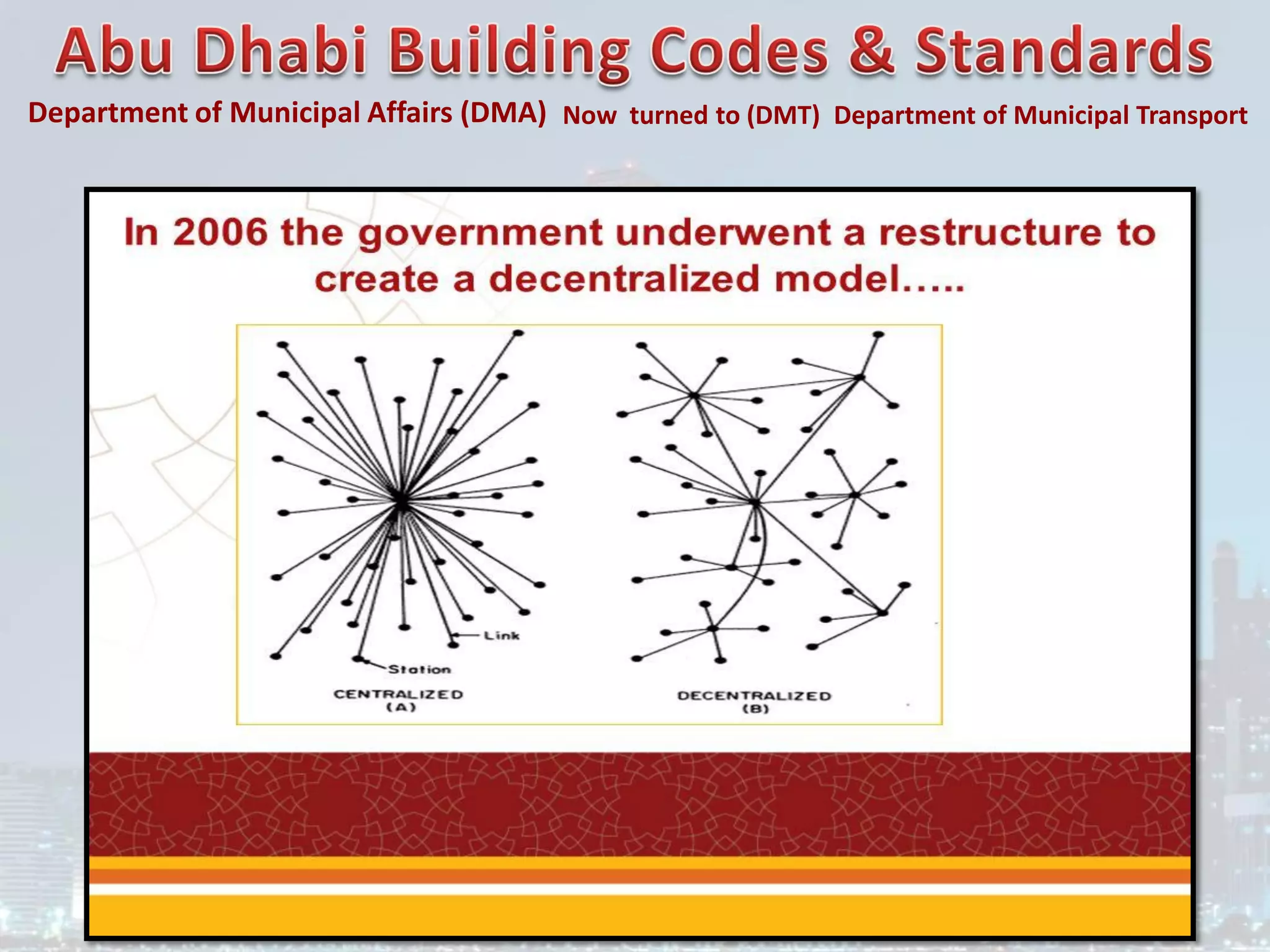
  • 617.
    • Speed ofconstruction and cost were cited as the main reasons wood was chosen for this project, which includes five stories of wood-frame structure over two stories of concrete and a concrete mezzanine. • According to the architect, the challenge for wood-frame buildings in high seismic zones is how to accommodate large glass areas and still provide sufficient shear walls. South Park in particular has a lot of window area. To achieve this, the design team determined the minimal length of shear wall required at each floor. Any area not required for shear wall was used for windows. This approach blended the structural characteristics of wood to create an aesthetically pleasing open window grid on the exterior of the building. • Within the wood-frame portion of the building, typical walls are either 2x6 (at exterior walls) or 2x4 studs spaced 16 inches on center. Floor joists are 2x12 sawn lumber and shear walls are plywood/OSB board. 617
  • 618.
    South Park Los Angeles, California Architect: Togawa Smith Martin,Inc. Completed: 2016 (planned) 618 Rendering: Togawa Smith Martin, Inc.. KEY PROJECT Designing for Seismic Performance
  • 619.
    WIND RESISTANCE SECTION 4 619 SECTION4: Wind Resistance a) System integrity key to wind resistance b) Building system failures under wind forces
  • 620.
    System Integrity Keyto Wind Resistance When structural wood panels are properly attached and used to form diaphragms and shear walls, they also form some of the most solid and stable roof, floor and wall systems available. Photo: Arch Wood Protection All components— including framing, structural panel sheathing and inter- element fastening details—must be designed and installed correctly for diaphragms and shear walls to be effective. 620
  • 621.
    • In additionto superior seismic performance, wood buildings can be designed to effectively resist high winds. Wood’s elastic limit and ultimate strength are higher when loads are applied for a shorter time period, which is typically the case in high wind events. • When structural panels such as plywood or OSB are properly attached to lumber framing and used to form diaphragms and shear walls, they also form some of the most solid and stable roof, floor and wall systems available. • However, in order for the diaphragms and shear walls to be effective, all of the related components—including framing, structural panel sheathing and inter-element fastening details—must be designed and installed correctly. • For the structural system to work as intended, the roof diaphragm must be able to transfer lateral loads to the shear walls and the shear walls themselves must transfer these loads to the foundation. • The success of the entire system is only as good as the quality and quantity of the connections. Therefore, the key to constructing a building that can resist lateral loads is understanding how forces are transferred and how to design and install proper connections. 621
  • 622.
  • 623.
    Building System FailuresUnder Wind Forces Most local building codes require a minimum of 33 fasteners for a standard 4×8 panel installed over roof supports at 24 inches on center. • Loss of roofing materials and sheathing • Improper connection detailing between structural systems • Inadequate sheathing fastening • Interrupted load path causes change in loading dynamics; diaphragm ceases to function 623
  • 624.
    • In hurricanes,the loss of roofing materials and sheathing is the leading cause of failure in wood-frame buildings. • The most common reasons behind these failures are improper connection detailing between structural systems and inadequate fastening of sheathing to the supporting members. Most local building codes require a minimum of 33 fasteners for a standard 4×8 panel installed over the roof supports at 24 inches o.c. Fasteners, such as 8d common nails (2.5 inches x 0.131 inch) or other code-approved options, should be placed a maximum of 6 inches o.c. along panel edges and 12 inches o.c. at intermediate supports. • Once the roof sheathing has been pulled off its framing, the load path is interrupted and the diaphragm ceases to function as part of the lateral load-resisting system. In fact, the entire loading dynamics of the building will have changed due to this breach. This change in loading dynamics negatively affects the lateral design of the building. 624
  • 625.
    SOUND TRANSMISSION AND ACOUSTICS SECTION5 625 SECTION 5: Sound Transmission and Acoustics a) Acoustical considerations b) Wood absorbs and disperses sound: Arena Stage at the Mead Center for American Theater c) Acoustic performance: University House Arena District
  • 626.
    Photo: Davis &Church LLC IBC provides minimum requirements for sound protection between floors: • Sound Transmission Class (STC) rating • Impact Insulation Class (IIC) rating Wood provides natural acoustic performance. Can further reduce sound transmission using: • Gypsum board attached using resilient metal channels • Glass-fiber or rock-fiber insulation Wood-frame construction is particularly efficient in residential buildings where sound insulation is required. Acoustical Considerations 626
  • 627.
    Photo: Davis &Church LLC Sound Transmission Class (STC) rating, Impact Insulation Class (IIC) rating, Gypsum board attached using resilient metal channels, Glass-fiber or rock-fiber insulation.. Acoustical Considerations 627 Sound Transmission Class (STC)
  • 628.
    Photo: Davis &Church LLC Sound Transmission Class (STC) rating, Impact Insulation Class (IIC) rating, Gypsum board attached using resilient metal channels, Glass-fiber or rock-fiber insulation.. Acoustical Considerations 628 Impact Insulation Class (IIC) rating
  • 629.
    Photo: Davis &Church LLC Sound Transmission Class (STC) rating, Impact Insulation Class (IIC) rating, Gypsum board attached using resilient metal channels, Glass-fiber or rock-fiber insulation.. Acoustical Considerations 629 Gypsum board attached using resilient metal channels Glass-fiber or rock-fiber insulation
  • 630.
    • As withany issue of building performance, the acoustics of a wood building can be designed to meet or exceed minimal requirements, depending on the expectations of the developer, buyers and tenants. • In residential buildings, the IBC provides a minimum design requirement for unit-to-unit acoustical protection between floors. It requires a Sound Transmission Class (STC) rating and Impact Insulation Class (IIC) rating of 50, unless the “Authority Having Jurisdiction” has its own more stringent requirement, which is rarely the case. • Wood-frame construction is particularly efficient in residential buildings where sound insulation is required. Attaching gypsum board to walls and ceilings using resilient metal channels significantly reduces sound transmission, as does placing glass- fiber or rock-fiber insulation within wood-frame floor and wall assemblies. 630
  • 631.
    • Built toaccommodate recent growth at the University of Oregon, the University House Arena District student housing project includes five stories of wood-frame construction over a concrete podium. • As with all of Mahlum’s student housing projects, it includes a variety of techniques aimed at improving acoustic performance. • Since poor acoustics can have a dramatic impact on student productivity, architects created higher levels of details, tracking STC and ICC ratings, and both carefully planning the location of mechanical systems and utilizing spring isolators in their mounting systems. They also field tested for acoustical performance at various stages of construction. 631
  • 632.
  • 633.
    • The designof any functional and safe building is difficult, if not impossible without considering acoustics, and wood has a proven record in this regard. Wood is not as acoustically lively as other surfaces and can offer acoustically absorptive qualities, hence its widespread use in performance and musical venues. • At the Arena Stage at the Mead Center for American Theater, for example, a small theater called “The Cradle” posed a challenge because of the sound reflections caused by its oval shape. In response, Bing Thom Architects developed a wood slat wall system made from poplar, designed to look like a basket weave, which could absorb and disperse sound. 633
  • 634.
    Arena Stage at the Mead Centerfor American Theater Poplar wood slat wall system with basket weave design absorbed and dispersed sound in ―The Cradle,‖ a small oval-shaped theater. 634 Photo: Nic Lehoux, courtesy of Bing Thom Architects Wood Absorbs and Disperses Sound
  • 635.
    THE EVOLUTION OF WOODCONSTRUCTION SECTION 6 635 SECTION 6: The Evolution of Wood Construction a) Mid-rise/multi-family b) Beyond five stories with the IBC: 1201 Mercer/Rivet c) Schools d) Motivating environment: El Dorado High School e) Mass timber f) CLT code approvals
  • 636.
    Typically Type IIIor V Construction:  V = allows use of untreated wood throughout  III = requires exterior walls to be non- combustible construction/FRT wood Four stories common, economical IBC permits five stories (six for office occupancy) Podium structures common Photo by Matt Todd, courtesy of WoodWorks Mid-rise/ Multi- family
  • 637.
    • Mid-rise buildingsare typically Type V Construction, which allows the use of untreated wood throughout, or Type III Construction. Type III Construction allows the same methods of construction as Type V except the exterior walls are required to be of non-combustible construction, which allows the use of fire retardant-treated wood. • Many developers and design teams default to wood for mid-rise buildings up to four stories because it is the most economical choice; however, with five-story wood buildings permitted in the IBC (six for office occupancy), there has been a marked interest among those who see taller wood buildings as a way to achieve greater density at lower cost. • Podium structures in particular, which include multiple stories of residential wood-frame construction over a concrete (3-hour-rated) podium deck, are common among design professionals seeking to incorporate parking, retail or restaurants into their designs. The specific requirements for using podium construction to increase allowable number of stories are detailed in Section 510 of the IBC. 637
  • 638.
  • 639.
    • Utilizing codeprovisions to go beyond the base heights and areas permitted for mid-rise wood-frame buildings is key to maximizing value. • Located in Seattle’s Cascade Neighborhood, Ankrom Moisan’s design for Rivet includes five stories of Type VA wood-frame construction over a two-story Type IA concrete podium. The wood portion of the building includes pre-manufactured floor joists supported by load-bearing stud walls, and wood panel-sheathed shear walls. • The IBC allows five stories of Type III wood-frame construction when the building is equipped with an NFPA-compliant automatic sprinkler system. However, Seattle’s building code is unique in that it also allows five stories of wood with a Type VA structure (when the building has an NFPA-compliant sprinkler system), which is even more cost effective and is being considered by a growing number of other jurisdictions as a way to encourage urban infill development. While the 2012 IBC allows a one-story concrete podium, this has been increased to two stories for the 2015 IBC. 639
  • 640.
    Schools Benefits of wood construction •Cost effective • Speed of construction • Design versatility • Meets green building goals • Reduces stress, creates positive learning environment The IBC has well-established parameters for wood-frame schools, which is good news for school districts trying to meet a limited budget. 640 Photo by Bethel School District
  • 641.
    • The IBChas well-established parameters for wood-frame schools, which is good news for school districts trying to accommodate increasing enrollment on a limited budget. However, many who turn to wood-frame construction for its cost effectiveness find that wood also offers other advantages—such as speed of construction, design versatility and the ability to meet green building goals. • Increasingly, research is also supporting the idea that visual wood in a room promotes the well-being of occupants, reduces stress and creates a positive environment for learning. • For example, one study at the University of British Columbia and FPInnovations found that the presence of visual wood surfaces in a room lowered activation of the sympathetic nervous system (SNS) in an office environment. The SNS is responsible for physiological stress responses in humans such as increased blood pressure and heart rate while inhibiting the parasympathetic system responsible for digestion, recovery and repair functions. • Study author David Fell says the results of the office study apply to any interior environment—and it is, in fact, supported by another more recent study of wood in healthcare environments. “The stress-reducing effects we found for wood in office environments are in theory transferable to any building type as these are innate reactions to natural materials.” 641
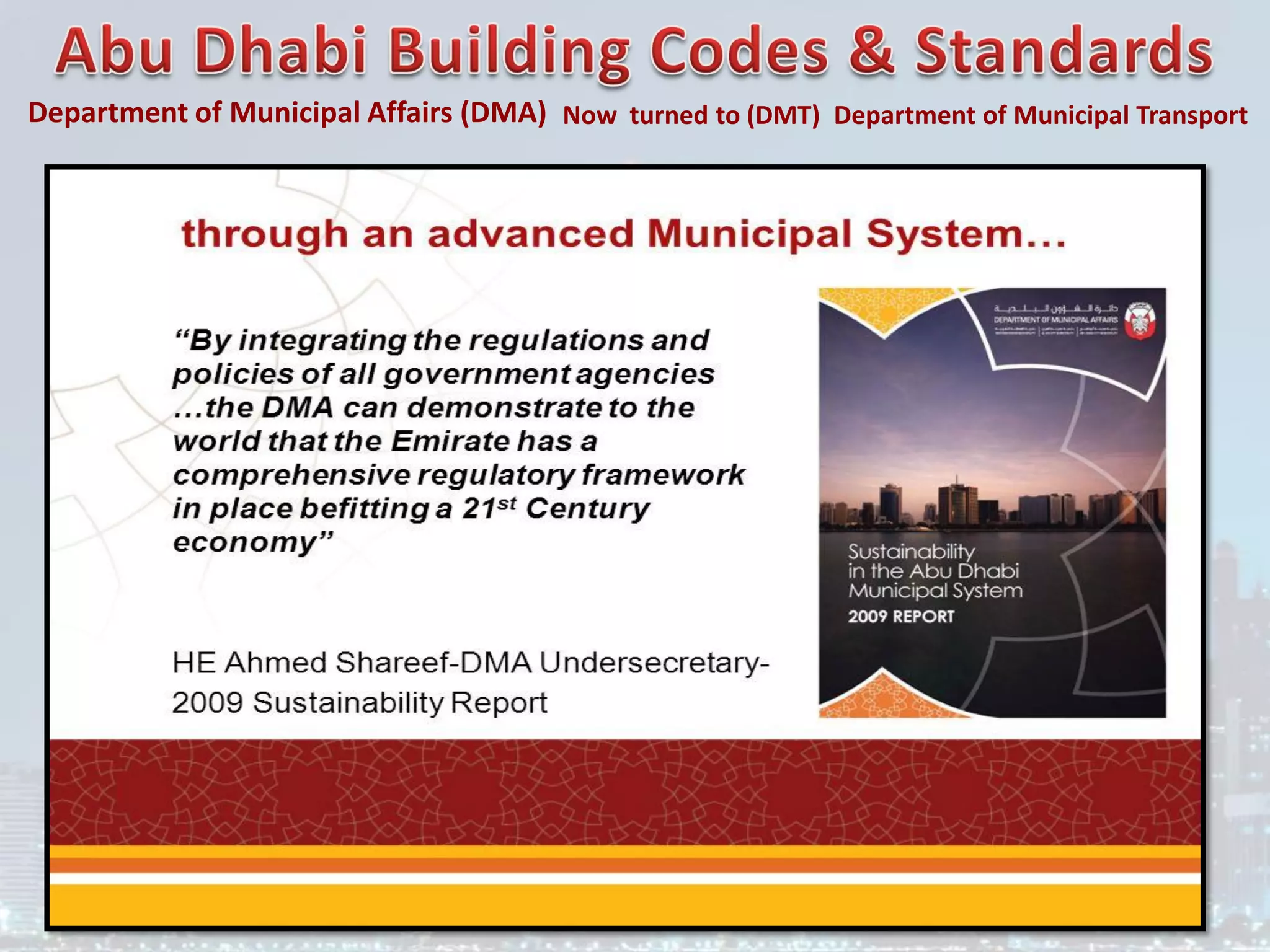
  • 642.
    • At the322,500-square-foot El Dorado High School in Arkansas, designers used exposed wood and natural light to create an environment that would motivate students to stay in school. Architects used exposed wood products in structural systems and in elements such as doors, millwork and trim to provide a unique architectural aesthetic that helps to naturally soften and warm the spaces. • From a code perspective, this project is noteworthy because it was one of the first schools in Arkansas to make extensive use of wood following a change in school board policy that had previously prohibited wood in school construction. In 2008, recognition of wood’s safety and performance attributes led the Arkansas School Board to modify its School Facilities Manual to reflect the IBC. It is also noteworthy from a cost perspective. Originally designed in steel and masonry, the school was changed to wood-frame construction for budget reasons—a move that saved the school board $2.7 million. 642
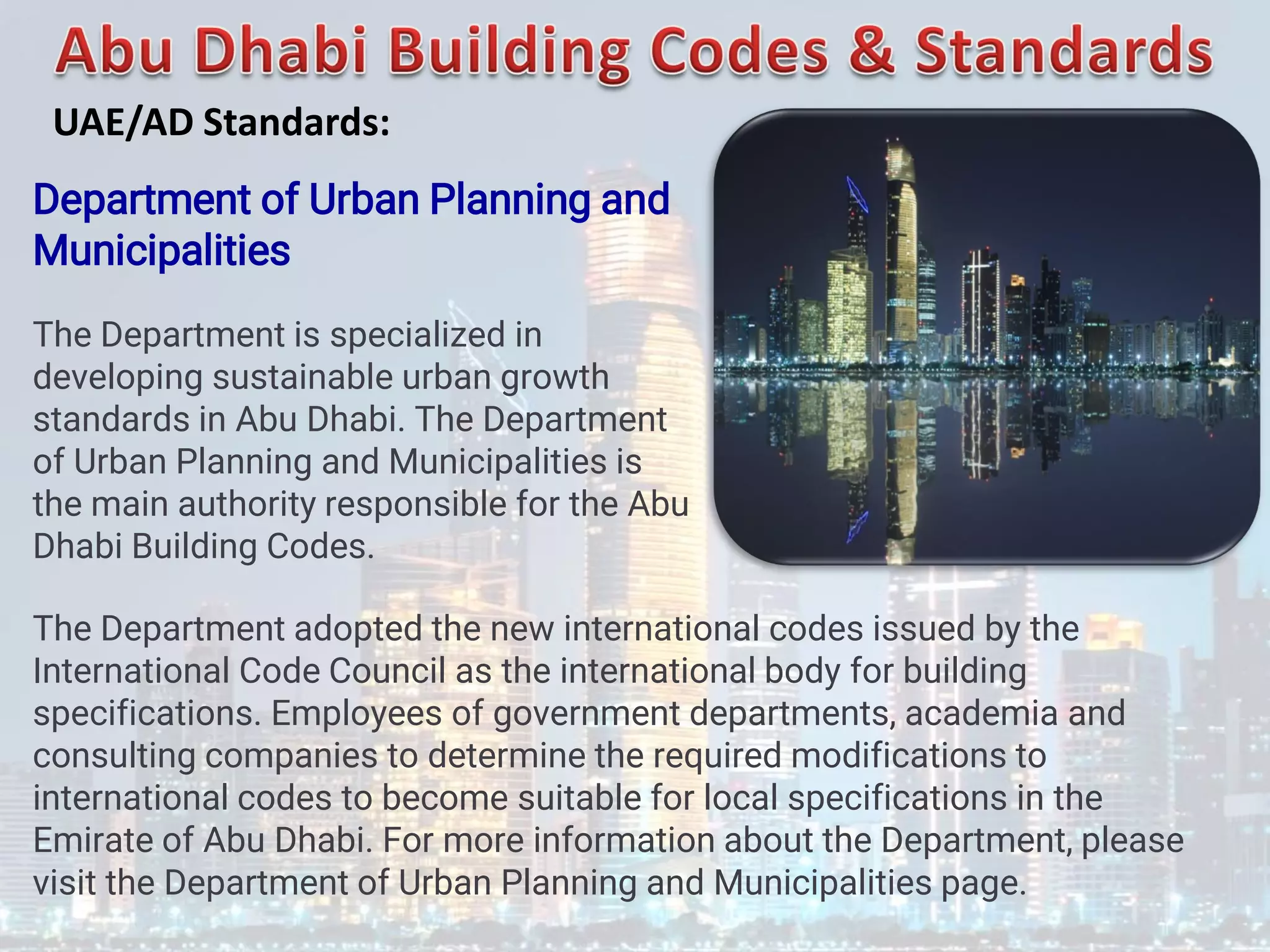
  • 643.
    Originally designed insteel and masonry, El Dorado High School was changed to wood-frame construction—saving $2.7 million. Motivating Environment El Dorado High School • Exposed wood and natural light enhances learning and motivates students • Warm spaces • One of the first schools in Arkansas to make extensive use of wood • Successful implementation prompted change in school board policy to allow use of wood in school construction Photo: Dennis Ivy, courtesy WoodWorks
  • 644.
    Mass Timber Cross laminatedtimber / CLT • 3, 5 or 7 layers of solid dimension lumber glued to create full-depth solid wood panels • Cross lamination provides exceptional strength, stability and rigidity • Low-carbon alternative to concrete and steel • Fast installation • Reduced on-site waste • Light weight/reduced foundation requirements • Thermal performance • Design versatility • Chars slowly, providing fire-resistive protection Photo courtesy of naturallywood.com 644
  • 645.
    • Common inEurope but relatively new to North America, CLT typically consists of three, five or seven layers of solid dimension lumber, kiln-dried and layered perpendicular to one another and then glued to create full-depth solid wood wall and floor panels up to 12 feet by 60 feet. • This cross lamination provides exceptional strength, stability and rigidity, allowing CLT to be used as a low-carbon alternative to concrete and steel in many applications. Benefits also include quick installation, minimal on-site waste, light weight and (as a result) reduced foundation requirements, thermal performance and design versatility. • Fire-resistance testing has confirmed that CLT, like heavy timber, chars at a rate that is slow and predictable, maintaining its strength and giving occupants more time to leave the building. 645
  • 646.
    IBC recognizes CLTproducts manufactured to the ANSI/APA PRG 320-2011 Standard as code- compliant. CLT Code Approvals 2015 IBC allows CLT use with Type IV Construction; ANSI/APA PRG 320-2011 Standard for Performance- Rated Cross-Laminated Timber provides quality assurance. Photo courtesy of Lend Lease
  • 647.
    • In theU.S., the 2015 IBC includes use of CLT of a certain thickness within Type IV construction. • In May 2012, APA published ANSI/APA PRG 320-2011 Standard for Performance-Rated Cross-Laminated Timber, an American National Standard that provides requirements and test methods for qualification and quality assurance of CLT. • CLT products manufactured to the standard have been recognized as code-compliant in the 2015 IBC. 647
  • 648.
    GREEN BUILDING CODES, STANDARDS ANDRATING SYSTEMS SECTION 7 648 SECTION 7: Green Building Codes, Standards and Rating Systems a) Environmental evolution b) Life Cycle Assessment (LCA)
  • 649.
    Environmental Evolution • U.S.Green Building Council • California Green Building Standards Code (CALGreen) • ASHRAE 189.1, a code-intended commercial green building standard published by ASHRAE in cooperation with the Illuminating Engineering Society of North America (IES) • International Green Construction Code (IgCC) IgCC’s key mandatory requirement is that at least 55 percent of materials (based on mass, volume or cost) be used, recycled, bio-based and/or indigenous in any combination. 649
  • 650.
  • 651.
  • 652.
    ASHRAE 189.1 ICC 700National Green Building Standard
  • 653.
    CALGreen (California Green BuildingStandards Code) ANSI/GBI 01-2010: Green Building Assessment Protocol for Commercial Buildings
  • 654.
  • 655.
  • 656.
    • The InternationalGreen Construction Code (IgCC), released in 2012 and adopted by eight jurisdictions so far, is the latest phase in an evolution that’s included two American National Standards (covering residential and non- residential construction), the California Green Building Standards Code (CALGreen) and ASHRAE 189.1, a code-intended commercial green building standard published by the American Society of Heating, Refrigerating and Air- Conditioning Engineers (ASHRAE) in cooperation with the Illuminating Engineering Society of North America (IES) and U.S. Green Building Council. • The IgCC covers subject areas typically found in any green building effort, including site, materials, energy, water and indoor environment. Primarily a voluntary code that jurisdictions have adopted to provide guidance regarding public or publicly funded buildings, it includes “mandatory” provisions within all subject areas as well as recommended provisions and electives. It is potentially applicable to almost every commercial building project, including additions and repairs. • In terms of material use, the IgCC’s key mandatory requirement is that at least 55 percent of materials (based on mass, volume or cost) be used, recycled, bio- based and/or indigenous in any combination. However, this rule need not be met when a whole building life cycle assessment (LCA) is performed. 656
  • 659.
    Life Cycle Assessment(LCA) Encourages design professionals to: • Compare different building designs based on their true environmental impacts over their entire life cycle, from extraction or harvest through manufacturing, transportation, installation, use, maintenance and disposal or recycling • Make informed choices about the materials they use Source: Building Green With Wood www.naturallywood.com LCA studies consistently show that wood is better for the environment than steel or concrete in terms of embodied energy, air and water pollution, and greenhouse gas emissions. 659
  • 660.
    • LCA isa scientific approach to evaluation that considers the impact of materials over their entire life cycle, from extraction or harvest through manufacturing, transportation, installation, use, maintenance and disposal or recycling. When integrated into green building codes, standards and rating systems, LCA encourages design professionals to compare different building designs based on their true environmental impacts and to make informed choices about the materials they use. • It replaces the prescriptive approach to material selection that’s been common until now, which assumes that certain prescribed practices—such specifying products with recycled content—are better for the environment regardless of the product’s manufacturing process or disposal. LCA studies consistently show that wood is better for the environment than steel or concrete in terms of embodied energy, air and water pollution, and greenhouse gas emissions. • In the U.S., LCA is included in the Green Globes rating system and the American National Standard based on Green Globes, ANSI/GBI 01-2010: Green Building Assessment Protocol for Commercial Buildings, as well as the ICC 700 National Green Building Standard. It is part of both CALGreen and ASHRAE 189.1, and optional LCA credits related to LCA were recently added to the Leadership in Energy and Environmental Design (LEED) rating system (v.4). • Although LCA isn’t mandatory in the IgCC, elimination of the “55 percent requirement” is a powerful incentive for its use. 660
  • 662.
    WOOD: THE SENSIBLE REVOLUTION SECTION8 662 SECTION 8: Wood: The Sensible Revolution a) Building codes recognize wood’s safety
  • 663.
    Building Codes RecognizeWood’s Safety IBC allows wood use in a wide range of building applications. Wood provides: • Cost effectiveness • Functionality • Design flexibility • Beauty • Environmental performance 663
  • 664.
    • Today’s buildingcodes recognize wood’s safety and structural performance capabilities and allow its use in a wide range of building applications, from the light-duty repetitive framing common in small structures to the larger and heavier framing systems used to build mid-rise/ multi-story buildings, schools and arenas. This hasn’t been lost on design professionals seeking to have it all—cost effectiveness, functionality, design flexibility, beauty and environmental performance—who, through their collective projects, are leading a revolution toward the greater use of wood in non-residential and multi-family buildings. 664
  • 665.
  • 666.
    • SECTION 9:Endnotes • 1. http://www.woodworks.org/why-wood/ 2. http://www.woodworks.org/why-wood/carbon-footprint/carbon-footprintresources/ 3. The American Wood Council offers a number of publications related to the fire design of wood buildings for code acceptance: http://www.awc.org/codes/dcaindex.html 4. Design of Fire-Resistive Exposed Wood Members, American Wood Council, http://www.awc.org/codes/dcaindex.html 5. ANSI/AF&PA SDPWS-2008 – Special Design Provisions for Wind and Seismic Standard with Commentary, American Wood Council; Design Concepts for Building in High Wind and Seismic Zones, APA 6. ANSI/AF&PA SDPWS-2008– Special Design Provisions for Wind and Seismic Standard with Commentary, American Wood Council; Design Concepts for Building in High Wind and Seismic Zones, APA 7. Acoustical Consideration for Mixed-Use Wood-Frame Buildings, U.S. WoodWorks, 2014 8. Fire Resistance and Sound Transmission in Wood-Frame Residential Buildings, Canadian Wood Council 9. Wood and Human Health, Issue 1, FPInnovations, 2013 10. Wood as a Restorative Material in Healthcare Environments, FPInnovations, 2015 11. American Wood Council, ww.awc.org/NewsReleases/2012/newsreleases2012.php#clt; 12. The City of Baltimore is the only jurisdiction in which the IgCC is mandatory for all building construction. 13. More information on the International Green Construction Code is available from Dovetail Partners, Inc., www.dovetailinc.org. 14. Life Cycle Environmental Performance of Renewable Building Materials in the Context of Building Construction, Consortium for Research on Renewable Industrial Materials, Phase I 2005, Phase II 2010, http://www.corrim.org/pubs/reports.asp; A Synthesis of Research on Wood Products and Greenhouse Gas Impacts, Sarthre, R. and J. O’Connor, 2010, FPInnovations, http://woodworks.org/wp- content/uploads/FPIGreenhouse-Gas.pdf; Wooden building products in comparative LCA: A literature review, Werner, F. and Richter, K., 2007, International Journal of Life Cycle Assessment, 12(7):470-479 666
  • 667.
    Photo by DavidLena; courtesy of HMC Architects
  • 668.