



Data Communication and Networking
(15EC44T)
 A standards organization, standards
body, standards developing organization (SDO),
or standards setting organization (SSO) is an
organization whose primary activities are
developing, coordinating, promulgating, revising,
amending, reissuing, interpreting, or otherwise
producing technical standards that are intended
to address the needs of a group of affected
adopters.
 Most standards are voluntary in the sense that
they are offered for adoption by people or
industry without being mandated in law. Some
standards become mandatory when they are
adopted by regulators as legal requirements in
particular domains
 Standards are necessary in almost every business and
public service entity. For example, before 1904, fire hose
couplings in the United States were not standard, which
meant a fire department in one community could not help
in another community. The transmission of electric current
was not standardized until the end of the nineteenth
century, so customers had to choose between Thomas
Edison’s direct current (DC) and George Westinghouse’s
alternating current (AC).
 The primary reason for standards is to ensure that
hardware and software produced by different vendors can
work together. Without networking standards, it would be
difficult—if not impossible—to develop networks that easily
share information. Standards also mean that customers are
not locked into one vendor. They can buy hardware and
software from any vendor whose equipment meets the
standard. In this way, standards help to promote more
competition and hold down prices.
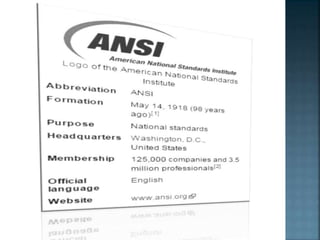
 The American National Standards Institute is a private non-
profit organization that oversees the development
of voluntary consensus standards for products, services,
processes, systems, and personnel in the United States.The
organization also coordinates U.S. standards with
international standards so that American products can be
used worldwide.
 ANSI accredits standards that are developed by
representatives of other standards
organizations, government agencies, consumer groups,
companies, and others. These standards ensure that the
characteristics and performance of products are
consistent, that people use the same definitions and
terms, and that products are tested the same way. ANSI
also accredits organizations that carry out product or
personnel certification in accordance with requirements
defined in international standards.
 IEEE stands for the "Institute of Electrical and
Electronics Engineers". The association is chartered
under this full legal name. IEEE's membership has
long been composed of engineers and scientists.
Allied professionals who are members include
computer scientists, software developers,
information technology professionals, physicists, and
medical doctors, in addition to IEEE's electrical and
electronics engineering core. For this reason the
organization no longer goes by the full name, except
on legal business documents, and is referred to
simply as IEEE.
 The IEEE is dedicated to advancing technological
innovation and excellence. It has about 430,000
members in about 160 countries, slightly less than
half of whom reside in the United States.
 ISO, the International Organization for
Standardization, is an independent, non-
governmental organization, the members of
which are the standards organizations of the
162 member countries. It is the world's
largest developer of voluntary international
standards and facilitates world trade by
providing common standards between
nations. Nearly twenty thousand standards
have been set covering everything from
manufactured products and technology to
food safety, agriculture and healthcare.
Standard organisations in data communication and networking

Standard organisations in data communication and networking

  • 1.
    Data Communication andNetworking (15EC44T)
  • 2.
     A standardsorganization, standards body, standards developing organization (SDO), or standards setting organization (SSO) is an organization whose primary activities are developing, coordinating, promulgating, revising, amending, reissuing, interpreting, or otherwise producing technical standards that are intended to address the needs of a group of affected adopters.  Most standards are voluntary in the sense that they are offered for adoption by people or industry without being mandated in law. Some standards become mandatory when they are adopted by regulators as legal requirements in particular domains
  • 3.
     Standards arenecessary in almost every business and public service entity. For example, before 1904, fire hose couplings in the United States were not standard, which meant a fire department in one community could not help in another community. The transmission of electric current was not standardized until the end of the nineteenth century, so customers had to choose between Thomas Edison’s direct current (DC) and George Westinghouse’s alternating current (AC).  The primary reason for standards is to ensure that hardware and software produced by different vendors can work together. Without networking standards, it would be difficult—if not impossible—to develop networks that easily share information. Standards also mean that customers are not locked into one vendor. They can buy hardware and software from any vendor whose equipment meets the standard. In this way, standards help to promote more competition and hold down prices.
  • 6.
     The AmericanNational Standards Institute is a private non- profit organization that oversees the development of voluntary consensus standards for products, services, processes, systems, and personnel in the United States.The organization also coordinates U.S. standards with international standards so that American products can be used worldwide.  ANSI accredits standards that are developed by representatives of other standards organizations, government agencies, consumer groups, companies, and others. These standards ensure that the characteristics and performance of products are consistent, that people use the same definitions and terms, and that products are tested the same way. ANSI also accredits organizations that carry out product or personnel certification in accordance with requirements defined in international standards.
  • 9.
     IEEE standsfor the "Institute of Electrical and Electronics Engineers". The association is chartered under this full legal name. IEEE's membership has long been composed of engineers and scientists. Allied professionals who are members include computer scientists, software developers, information technology professionals, physicists, and medical doctors, in addition to IEEE's electrical and electronics engineering core. For this reason the organization no longer goes by the full name, except on legal business documents, and is referred to simply as IEEE.  The IEEE is dedicated to advancing technological innovation and excellence. It has about 430,000 members in about 160 countries, slightly less than half of whom reside in the United States.
  • 12.
     ISO, theInternational Organization for Standardization, is an independent, non- governmental organization, the members of which are the standards organizations of the 162 member countries. It is the world's largest developer of voluntary international standards and facilitates world trade by providing common standards between nations. Nearly twenty thousand standards have been set covering everything from manufactured products and technology to food safety, agriculture and healthcare.