INDUSTRIAL
REVOLUTION
Why did it begin in Great
  Britain?
1.Farming (more land new
  crops, better food)
2.Britain had many
  workers (pop)
3. British had money or
 CAPITAL to invest.
4. ENTREPRENEURS:
 businessmen who want
 new opportunities to make
 money.
5. natural resources such
 as coal, iron, & water
 for power & shipping.
6. Colonies create
 markets to sell goods
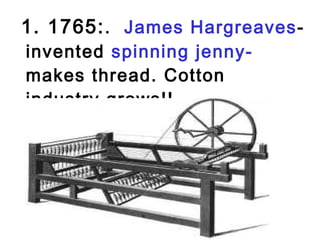
1. 1765: . James Hargreaves-
invented spinning jenny-
makes thread. Cotton
industry grows!!
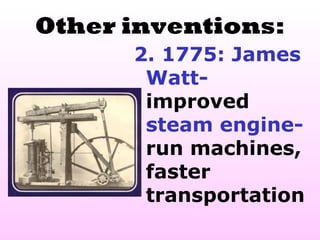
Other inventions:
      2. 1775: James
       Watt-
       improved
       steam engine-
       run machines,
       faster
       transportation
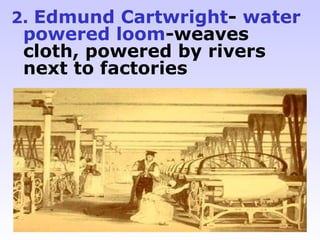
2. Edmund Cartwright- water
 powered loom-weaves
 cloth, powered by rivers
 next to factories
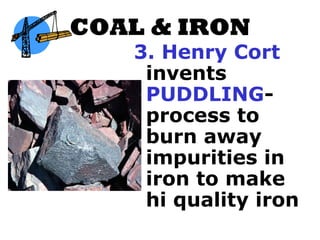
COAL & IRON
   3. Henry Cort
    invents
    PUDDLING-
    process to
    burn away
    impurities in
    iron to make
    hi quality iron
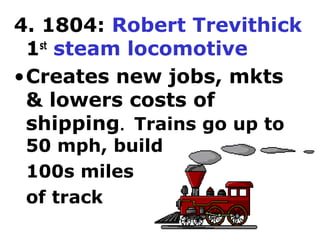
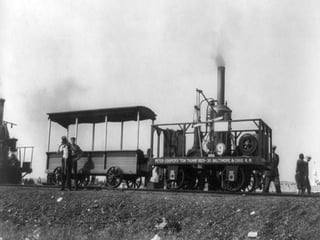
4. 1804: Robert Trevithick
 1 steam locomotive
   st

•Creates new jobs, mkts
 & lowers costs of
 shipping. Trains go up to
 50 mph, build
 100s miles
 of track
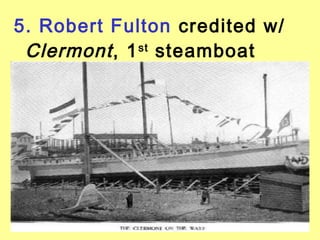
5. Robert Fulton credited w/
 Clermont , 1 steamboat
             st
• INDUSTRIAL
  CAPITALISM- an
  eco system based
  on industrial
  production & new
  classes developed
  as a result
• Factories built.
• Owners have
  shifts to run
  machines
  constantly.
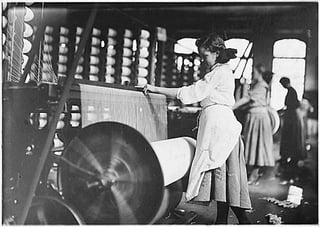
• Employees work
  assembly lines,
  repeating same
  task.
• Fined & beaten for
  being late
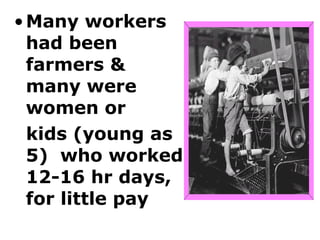
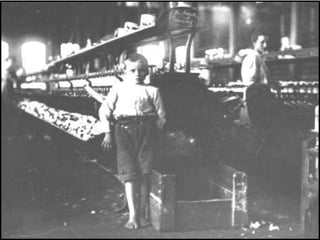
• Many workers
  had been
  farmers &
  many were
  women or
  kids (young as
  5) who worked
  12-16 hr days,
  for little pay
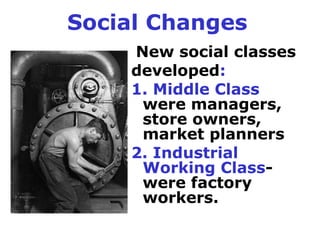
Social Changes
    New social classes
    developed:
    1. Middle Class
     were managers,
     store owners,
     market planners
    2. Industrial
     Working Class-
     were factory
     workers.
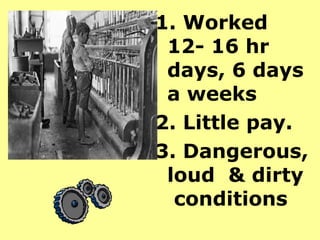
1. Worked
 12- 16 hr
 days, 6 days
 a weeks
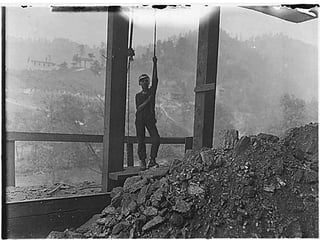
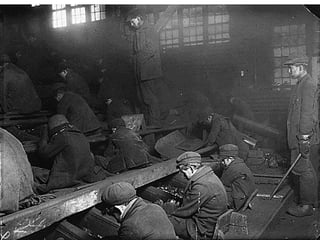
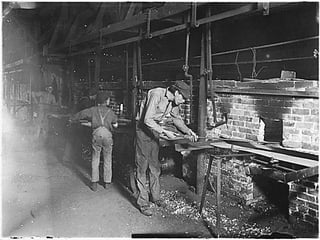
2. Little pay.
3. Dangerous,
 loud & dirty
  conditions
• Society changed:
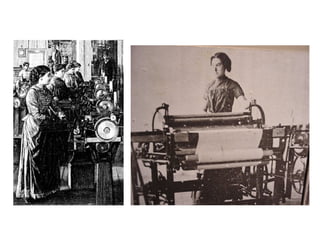
• Most factory laborers were
  farmers ( 2/3 were women &
  kids)
• Many moved to the cities
• Working class & middle class
  developed
• Women paid ½ &
  were 50% of
  factory laborers.
• Many also work
  out of home
  (called a
  COTTAGE
  INDUSTRY) doing
  cleaning, laundry,
  etc
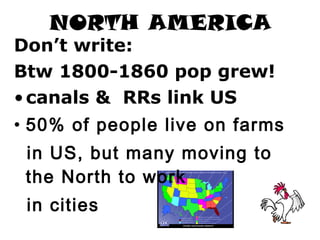
NORTH AMERICA
Don’t write:
Btw 1800-1860 pop grew!
• canals & RRs link US
• 50% of people live on farms
 in US, but many moving to
 the North to work
 in cities
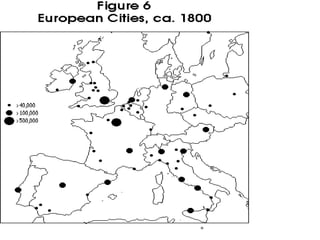
How did population change?
 Urbanization (city growth)
 factors include:
*Pop doubles in Europe. (266
 mil)
* Less wars & diseases, &
 better food led to growth.
* people come to city to work
 in factories
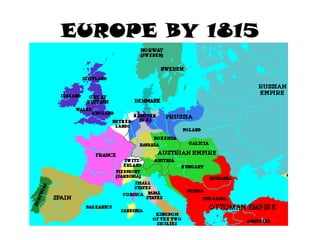
EUROPE BY 1815
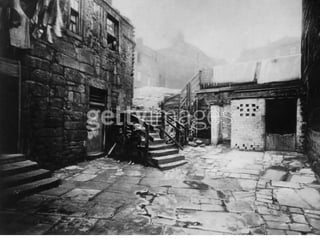
•Living conditions poor in
 cities
•Cheap, crowded, dirty
 apartments
•Rats & trash spread
 disease,
•sewage & poor
 sanitation
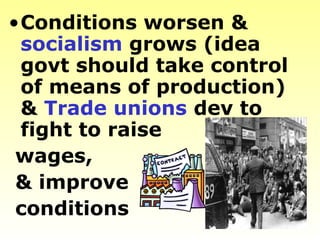
•Conditions worsen &
 socialism grows (idea
 govt should take control
 of means of production)
 & Trade unions dev to
 fight to raise
 wages,
 & improve
 conditions
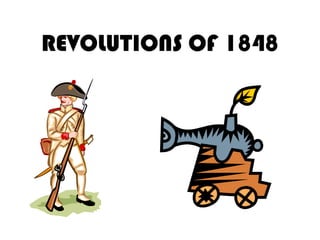
REVOLUTIONS OF 1848
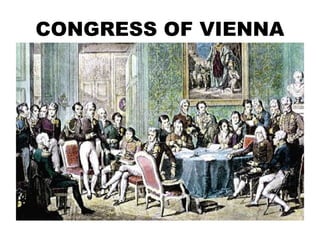
CONGRESS OF VIENNA
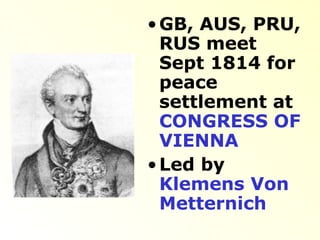
• GB, AUS, PRU,
  RUS meet
  Sept 1814 for
  peace
  settlement at
  CONGRESS OF
  VIENNA
• Led by
  Klemens Von
  Metternich
•Principle of Legitimacy-
  restore monarchies to
  power
•Divide territories so that
  so no one too strong
•GB, Rus, Pru Aus,
 Fr meet
 to keep peace
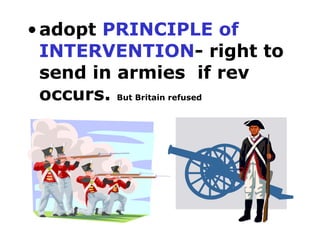
• adopt PRINCIPLE of
  INTERVENTION- right to
  send in armies if rev
  occurs. But Britain refused
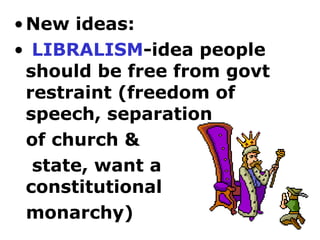
• New ideas:
• LIBRALISM-idea people
  should be free from govt
  restraint (freedom of
  speech, separation
  of church &
   state, want a
  constitutional
  monarchy)
•NATIONALISM- a unique
cultural identity of a people
based on a common
language, religion, history.
Often leads people to want
own nation. Starts
revolutions, upsets balance
of power
• GERMANY was 38 states (German
  Confederation)
• Rulers promise new constitutions
  & meet as Frankfort assembly to
  write one. Draft it, but can’t
  enforce.
• ITALY: 9 states, some owned by
  Austria.
• Revolts break out to create unified
  Italy w/ liberal constitutions, but
  Austrians stop it.
SECOND INDUSTRIAL
   REVOLUTION
•DON’T WRITE!!!
• Second Industrial Rev
  lasted from 1870s into
  1900s.
• 1st rev focused on
  railroads, iron, coal, and
  cloth. 2nd focused on:
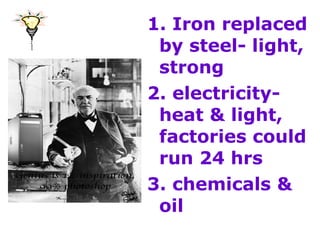
1. Iron replaced
 by steel- light,
 strong
2. electricity-
 heat & light,
 factories could
 run 24 hrs
3. chemicals &
 oil
NEW       1. telephone in
INVENTIONS      1876- Alexander
                Graham Bell
             2. Radio- Guglielmo
                Marconi
             3. Plane- Wright
                brothers
             4. Internal
                combustion
                engine- Daimler
OTHER CHANGES
   •Wages
    increased &
    prices drop
    due to
    cheaper
    transportation
    & factories
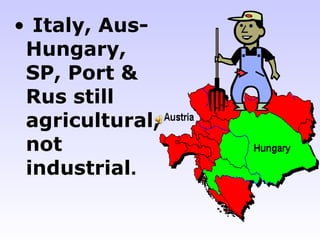
• Italy, Aus-
 Hungary,
 SP, Port &
 Rus still
 agricultural,
 not
 industrial.
Top- wealthy 5% of pop own
   30-40% of money
• Middle Class- Drs, lawyers,
  civil servants
• Lower-middle class-
  shopkeepers
• Lower class- sales people,
  secretaries.
•   Working class- 80% of
    pop (servants, farmers)
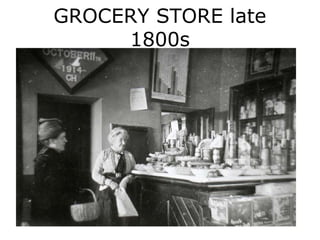
GROCERY STORE late
     1800s
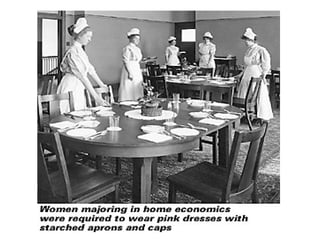
1. Women- new jobs open up.
 Create jobs as clerks,
 secretaries, typists
2. Women work until
 marriage in working class
 families.
3. Feminism grows.
4. Can divorce, own
 property, go to college
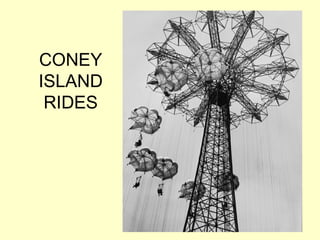
FUN!!!! • People had
          time & $$$$
          for leisure
        • Pro sports
          (Reds 1869)
        • Amusement
          parks & dance
          halls
          open
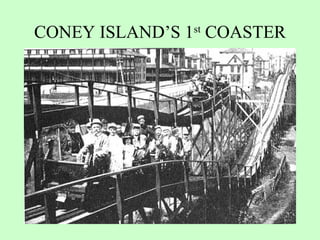
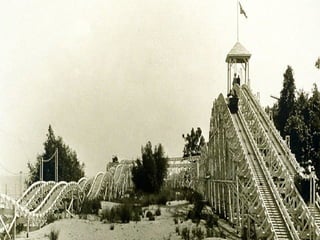
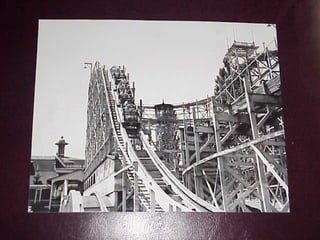
CONEY ISLAND’S 1st COASTER
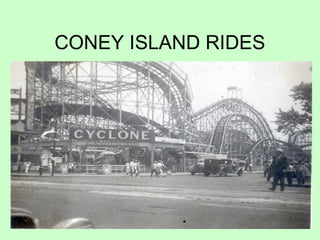
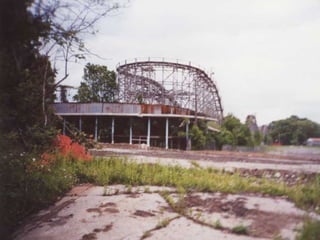
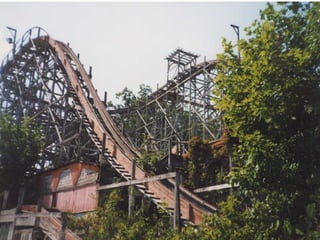
CONEY ISLAND RIDES
CONEY
ISLAND
 RIDES
•State financed schools
 set up for boys & girls to:
•train labor for factories
•Increase literacy
•Create patriotism
ORGANIZING THE WORKING
         CLASS
•Karl Marx & Friedrich
 Engels upset by factory
 conditions & blame
 industrial capitalism.
•Wrote in Communist
 Manifesto that:
COMMUNIST MANIFESTO
a.history is a class
  struggle
 b. Oppressors or
  Bourgeoisie are middle
  class who own means of
  production (land, $$$)
  & control govt
COMMUNIST MANIFESTO
c. Oppressed or Proletariat
   are working class &
   depend on oppressor
d. Huge struggle
   will occur w/
   violent
   revolution
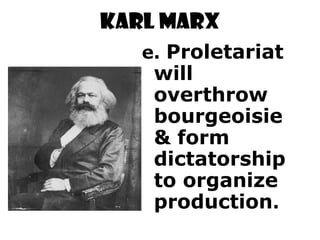
KARL MARX
   e. Proletariat
    will
    overthrow
    bourgeoisie
    & form
    dictatorship
    to organize
    production.
KARL MARX
f . Creates no
 social or
 economic
 classes or
 differences
 .

Industrial revolution

  • 1.
  • 2.
    Why did itbegin in Great Britain? 1.Farming (more land new crops, better food) 2.Britain had many workers (pop)
  • 3.
    3. British hadmoney or CAPITAL to invest. 4. ENTREPRENEURS: businessmen who want new opportunities to make money.
  • 4.
    5. natural resourcessuch as coal, iron, & water for power & shipping. 6. Colonies create markets to sell goods
  • 5.
    1. 1765: .James Hargreaves- invented spinning jenny- makes thread. Cotton industry grows!!
  • 6.
    Other inventions: 2. 1775: James Watt- improved steam engine- run machines, faster transportation
  • 7.
    2. Edmund Cartwright-water powered loom-weaves cloth, powered by rivers next to factories
  • 8.
    COAL & IRON 3. Henry Cort invents PUDDLING- process to burn away impurities in iron to make hi quality iron
  • 9.
    4. 1804: RobertTrevithick 1 steam locomotive st •Creates new jobs, mkts & lowers costs of shipping. Trains go up to 50 mph, build 100s miles of track
  • 11.
    5. Robert Fultoncredited w/ Clermont , 1 steamboat st
  • 12.
    • INDUSTRIAL CAPITALISM- an eco system based on industrial production & new classes developed as a result
  • 13.
    • Factories built. •Owners have shifts to run machines constantly. • Employees work assembly lines, repeating same task. • Fined & beaten for being late
  • 14.
    • Many workers had been farmers & many were women or kids (young as 5) who worked 12-16 hr days, for little pay
  • 23.
    Social Changes New social classes developed: 1. Middle Class were managers, store owners, market planners 2. Industrial Working Class- were factory workers.
  • 24.
    1. Worked 12-16 hr days, 6 days a weeks 2. Little pay. 3. Dangerous, loud & dirty conditions
  • 25.
    • Society changed: •Most factory laborers were farmers ( 2/3 were women & kids) • Many moved to the cities • Working class & middle class developed
  • 26.
    • Women paid½ & were 50% of factory laborers. • Many also work out of home (called a COTTAGE INDUSTRY) doing cleaning, laundry, etc
  • 28.
    NORTH AMERICA Don’t write: Btw1800-1860 pop grew! • canals & RRs link US • 50% of people live on farms in US, but many moving to the North to work in cities
  • 29.
    How did populationchange? Urbanization (city growth) factors include: *Pop doubles in Europe. (266 mil) * Less wars & diseases, & better food led to growth. * people come to city to work in factories
  • 30.
  • 32.
    •Living conditions poorin cities •Cheap, crowded, dirty apartments •Rats & trash spread disease, •sewage & poor sanitation
  • 34.
    •Conditions worsen & socialism grows (idea govt should take control of means of production) & Trade unions dev to fight to raise wages, & improve conditions
  • 35.
  • 36.
  • 37.
    • GB, AUS,PRU, RUS meet Sept 1814 for peace settlement at CONGRESS OF VIENNA • Led by Klemens Von Metternich
  • 38.
    •Principle of Legitimacy- restore monarchies to power •Divide territories so that so no one too strong •GB, Rus, Pru Aus, Fr meet to keep peace
  • 39.
    • adopt PRINCIPLEof INTERVENTION- right to send in armies if rev occurs. But Britain refused
  • 40.
    • New ideas: •LIBRALISM-idea people should be free from govt restraint (freedom of speech, separation of church & state, want a constitutional monarchy)
  • 41.
    •NATIONALISM- a unique culturalidentity of a people based on a common language, religion, history. Often leads people to want own nation. Starts revolutions, upsets balance of power
  • 42.
    • GERMANY was38 states (German Confederation) • Rulers promise new constitutions & meet as Frankfort assembly to write one. Draft it, but can’t enforce. • ITALY: 9 states, some owned by Austria. • Revolts break out to create unified Italy w/ liberal constitutions, but Austrians stop it.
  • 43.
  • 44.
    •DON’T WRITE!!! • SecondIndustrial Rev lasted from 1870s into 1900s. • 1st rev focused on railroads, iron, coal, and cloth. 2nd focused on:
  • 45.
    1. Iron replaced by steel- light, strong 2. electricity- heat & light, factories could run 24 hrs 3. chemicals & oil
  • 46.
    NEW 1. telephone in INVENTIONS 1876- Alexander Graham Bell 2. Radio- Guglielmo Marconi 3. Plane- Wright brothers 4. Internal combustion engine- Daimler
  • 47.
    OTHER CHANGES •Wages increased & prices drop due to cheaper transportation & factories
  • 48.
    • Italy, Aus- Hungary, SP, Port & Rus still agricultural, not industrial.
  • 49.
    Top- wealthy 5%of pop own 30-40% of money • Middle Class- Drs, lawyers, civil servants • Lower-middle class- shopkeepers • Lower class- sales people, secretaries. • Working class- 80% of pop (servants, farmers)
  • 50.
  • 51.
    1. Women- newjobs open up. Create jobs as clerks, secretaries, typists 2. Women work until marriage in working class families. 3. Feminism grows. 4. Can divorce, own property, go to college
  • 54.
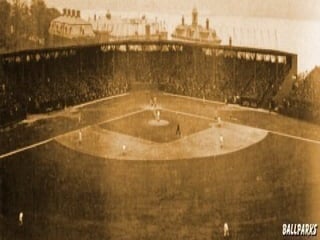
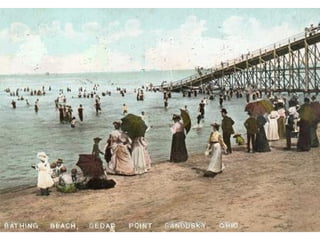
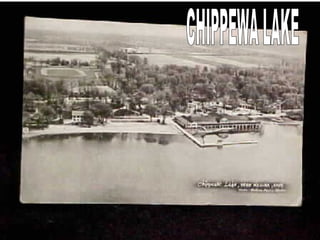
    FUN!!!! • Peoplehad time & $$$$ for leisure • Pro sports (Reds 1869) • Amusement parks & dance halls open
  • 56.
  • 57.
  • 58.
  • 66.
    •State financed schools set up for boys & girls to: •train labor for factories •Increase literacy •Create patriotism
  • 67.
    ORGANIZING THE WORKING CLASS •Karl Marx & Friedrich Engels upset by factory conditions & blame industrial capitalism. •Wrote in Communist Manifesto that:
  • 68.
    COMMUNIST MANIFESTO a.history isa class struggle b. Oppressors or Bourgeoisie are middle class who own means of production (land, $$$) & control govt
  • 69.
    COMMUNIST MANIFESTO c. Oppressedor Proletariat are working class & depend on oppressor d. Huge struggle will occur w/ violent revolution
  • 70.
    KARL MARX e. Proletariat will overthrow bourgeoisie & form dictatorship to organize production.
  • 71.
    KARL MARX f .Creates no social or economic classes or differences .