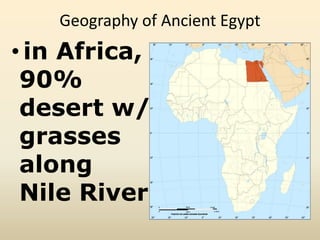
Geography of Ancient Egypt
• in Africa,
90%
desert w/
grasses
along
Nile River.
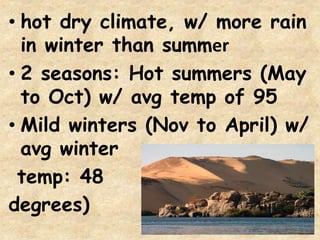
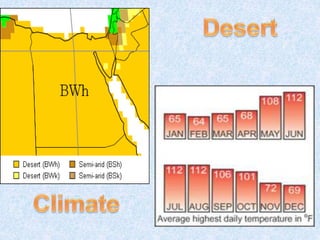
• hot dry climate, w/ more rain
in winter than summer
• 2 seasons: Hot summers (May
to Oct) w/ avg temp of 95
• Mild winters (Nov to April) w/
avg winter
temp: 48
degrees)
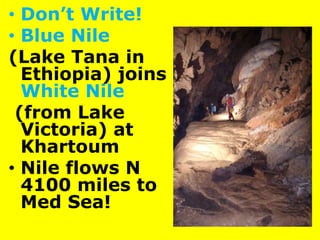
• Don’t Write!
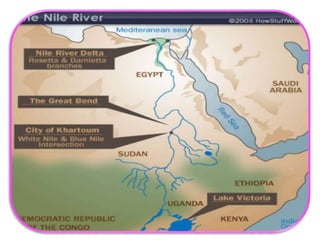
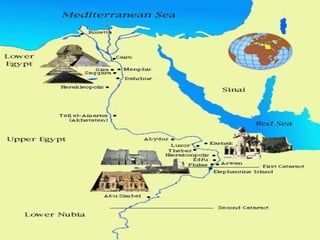
• Blue Nile
(Lake Tana in
Ethiopia) joins
White Nile
(from Lake
Victoria) at
Khartoum
• Nile flows N
4100 miles to
Med Sea!
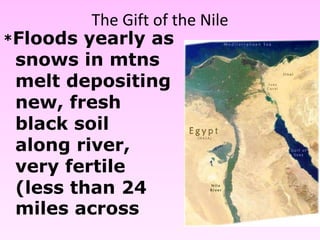
The Gift of the Nile
*Floods yearly as
snows in mtns
melt depositing
new, fresh
black soil
along river,
very fertile
(less than 24
miles across
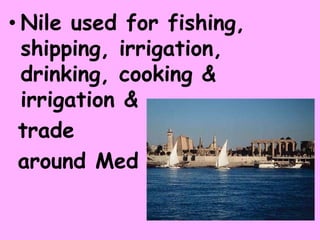
• Nile used for fishing,
shipping, irrigation,
drinking, cooking &
irrigation &
trade
around Med
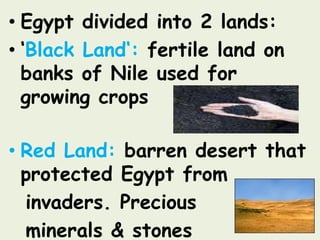
• Egypt divided into 2 lands:
• ‘Black Land‘: fertile land on
banks of Nile used for
growing crops
• Red Land: barren desert that
protected Egypt from
invaders. Precious
minerals & stones
•Issues:
• Floods too low, many starve
• Too high, seeds,
granaries destroyed
• Desert reduced interaction
•But:
• Protection from invaders
• Trade/transportation w/ river
• Fertile soil replenished
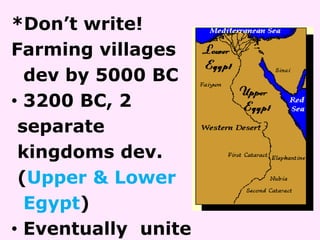
*Don’t write!
Farming villages
dev by 5000 BC
• 3200 BC, 2
separate
kingdoms dev.
(Upper & Lower
Egypt)
• Eventually unite
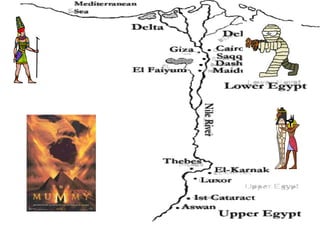
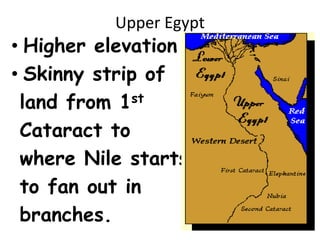
Upper Egypt
• Higher elevation
• Skinny strip of
land from 1st
Cataract to
where Nile starts
to fan out in
branches.
Upper Egypt
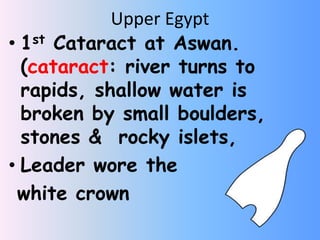
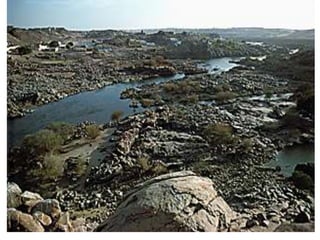
• 1st Cataract at Aswan.
(cataract: river turns to
rapids, shallow water is
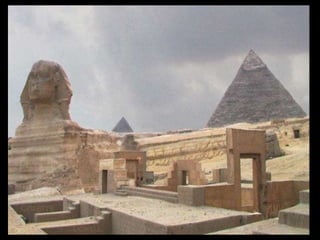
broken by small boulders,
stones & rocky islets,
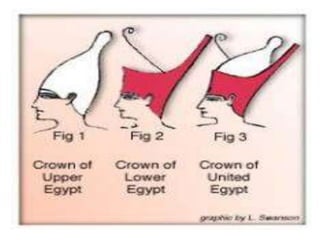
• Leader wore the
white crown
Lower Egypt
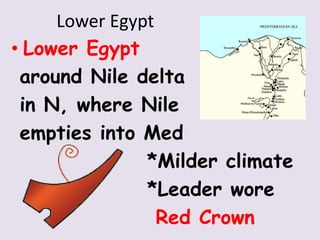
• Lower Egypt
around Nile delta
in N, where Nile
empties into Med
*Milder climate
*Leader wore
Red Crown
King Narmer
• Around 3000 BC, Upper &
Lower united by King
Narmer (Menes/Scorpion?)
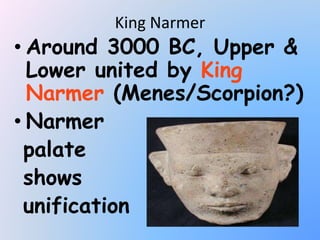
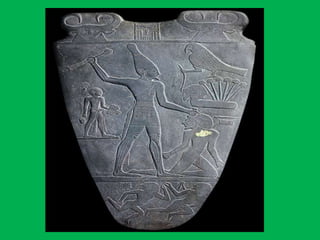
• Narmer
palate
shows
unification
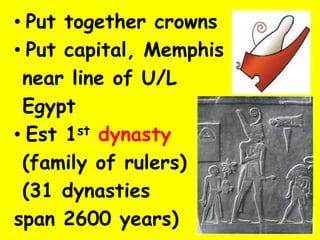
• Put together crowns
• Put capital, Memphis
near line of U/L
Egypt
• Est 1st dynasty
(family of rulers) where
(31 dynasties
span 2600 years)
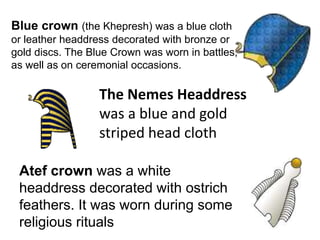
The Nemes Headdress
was a blue and gold
striped head cloth
Blue crown (the Khepresh) was a blue cloth
or leather headdress decorated with bronze or
gold discs. The Blue Crown was worn in battles,
as well as on ceremonial occasions.
Atef crown was a white
headdress decorated with ostrich
feathers. It was worn during some
religious rituals
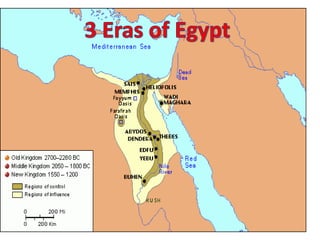
Old Kingdom 2780-2200 BC
• Wide spread patterns of
civilization dev & ruling
families known as
DYNASTIES control Egypt
• Pharaohs were rulers
(means great house) as
powerful as the gods
• Wealth spread out btw
kings & temples
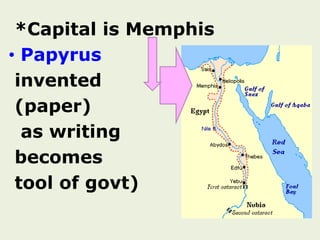
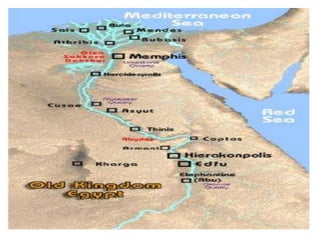
*Capital is Memphis
• Papyrus
invented
(paper)
as writing
becomes
tool of govt)
Pharaohs
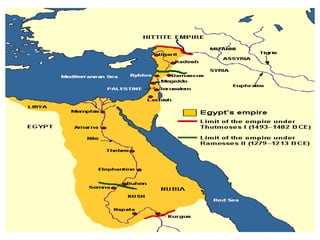
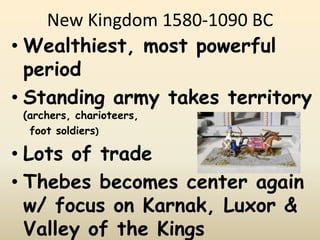
• Pharaohs considered to be
gods (represent Horus) so
Govt based on religious
authority (theocracy)
• Pharoah center of
religion & govt, leader of
military & chief priest
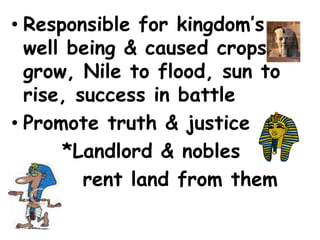
• Responsible for kingdom’s
well being & caused crops to
grow, Nile to flood, sun to
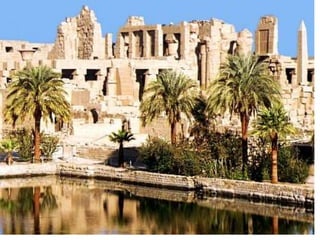
rise, success in battle
• Promote truth & justice
*Landlord & nobles
• rent land from them
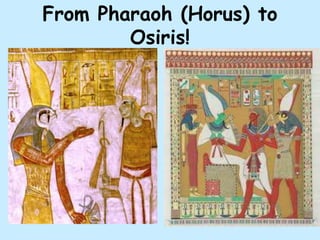
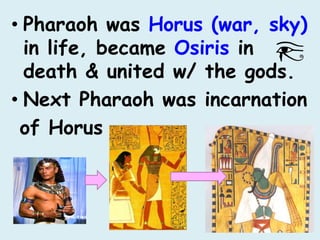
• Pharaoh was Horus (war, sky)
in life, became Osiris in
death & united w/ the gods.
• Next Pharaoh was incarnation
of Horus
and justify Pharaonic power
Death of a Pharaoh Don’t wrtie
• Believed king ruled after
death
• Eternal life force called KA
needed resting place after
death to protect spirit.
• KA was like the
living king with
needs & pleasures
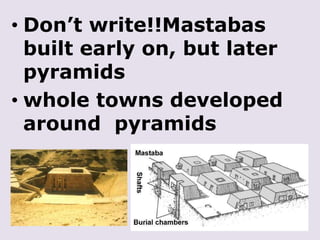
• Don’t write!!Mastabas
built early on, but later
pyramids
• whole towns developed
around pyramids
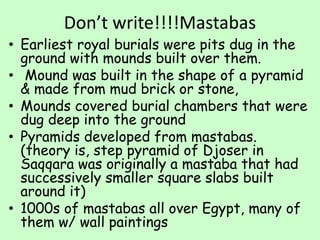
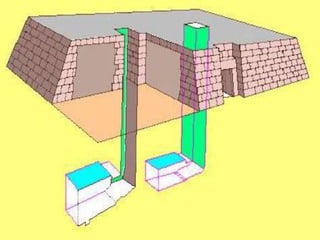
Don’t write!!!!Mastabas
• Earliest royal burials were pits dug in the
ground with mounds built over them.
• Mound was built in the shape of a pyramid
& made from mud brick or stone,
• Mounds covered burial chambers that were
dug deep into the ground
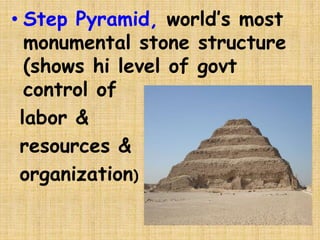
• Pyramids developed from mastabas.
(theory is, step pyramid of Djoser in
Saqqara was originally a mastaba that had
successively smaller square slabs built
around it)
• 1000s of mastabas all over Egypt, many of
them w/ wall paintings
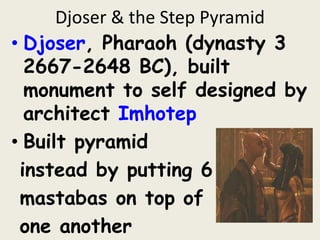
Djoser & the Step Pyramid
• Djoser, Pharaoh (dynasty 3
2667-2648 BC), built
monument to self designed by
architect Imhotep
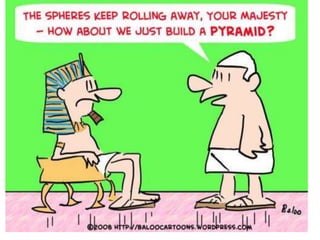
• Built pyramid
instead by putting 6
mastabas on top of
one another
• Step Pyramid, world’s most
monumental stone structure
(shows hi level of govt
control of
labor &
resources &
organization)
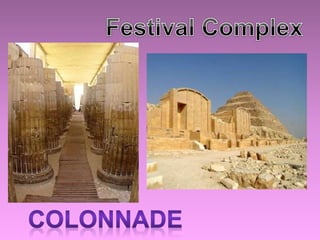
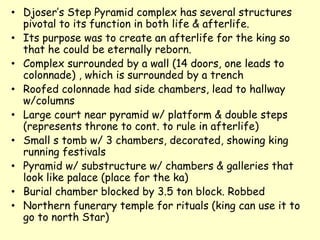
• Djoser’s Step Pyramid complex has several structures
pivotal to its function in both life & afterlife.
• Its purpose was to create an afterlife for the king so
that he could be eternally reborn.
• Complex surrounded by a wall (14 doors, one leads to
colonnade) , which is surrounded by a trench
• Roofed colonnade had side chambers, lead to hallway
w/columns
• Large court near pyramid w/ platform & double steps
(represents throne to cont. to rule in afterlife)
• Small s tomb w/ 3 chambers, decorated, showing king
running festivals
• Pyramid w/ substructure w/ chambers & galleries that
look like palace (place for the ka)
• Burial chamber blocked by 3.5 ton block. Robbed
• Northern funerary temple for rituals (king can use it to
go to north Star)
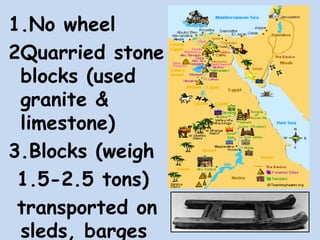
1.No wheel
2Quarried stone
blocks (used
granite &
limestone)
3.Blocks (weigh
1.5-2.5 tons)
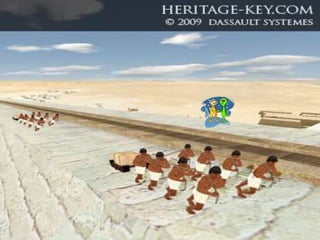
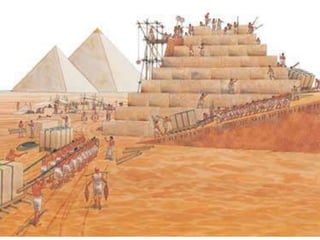
transported on
sleds, barges
4.Inclined earthen ramps built
up & torn down as pyramid
finished (may be straight or
spiral around pyramid)
5.No written records or art of
how built
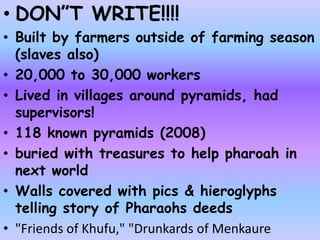
• DON”T WRITE!!!!
• Built by farmers outside of farming season
(slaves also)
• 20,000 to 30,000 workers
• Lived in villages around pyramids, had
supervisors!
• 118 known pyramids (2008)
• buried with treasures to help pharoah in
next world
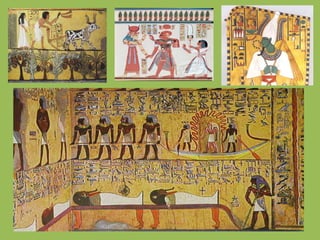
• Walls covered with pics & hieroglyphs
telling story of Pharaohs deeds
• "Friends of Khufu," "Drunkards of Menkaure
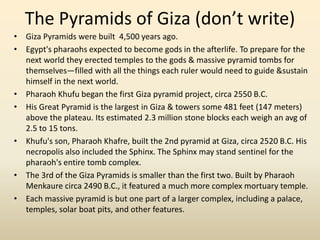
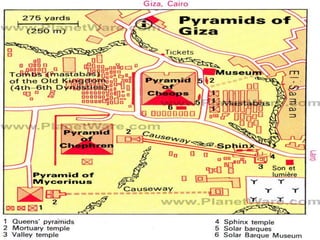
The Pyramids of Giza (don’t write)
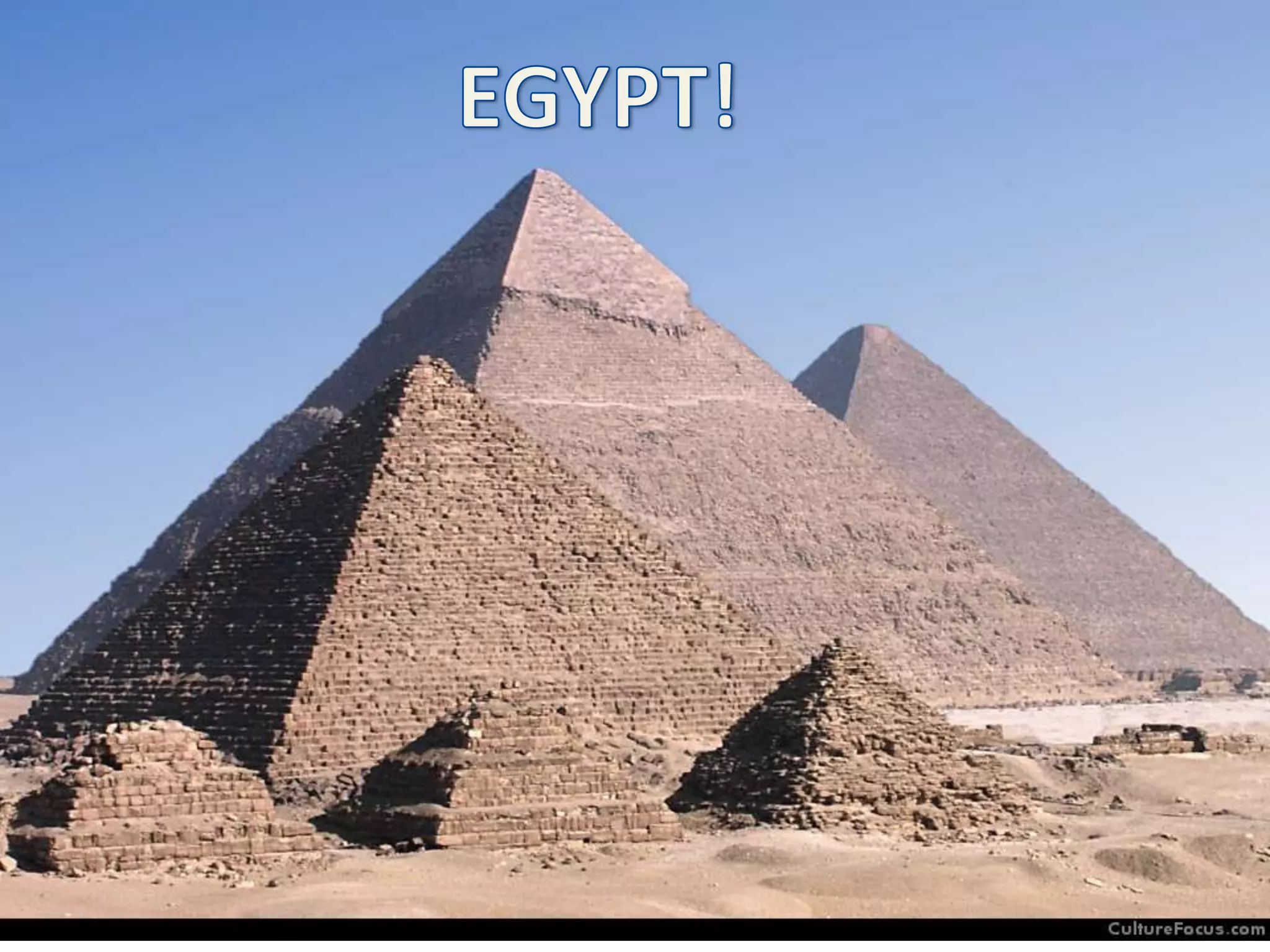
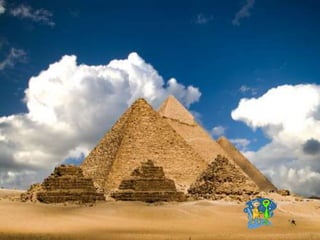
• Giza Pyramids were built 4,500 years ago.
• Egypt's pharaohs expected to become gods in the afterlife. To prepare for the
next world they erected temples to the gods & massive pyramid tombs for
themselves—filled with all the things each ruler would need to guide &sustain
himself in the next world.
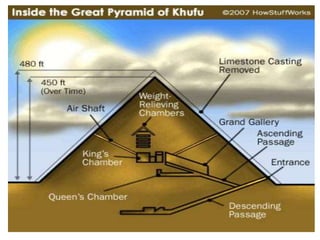
• Pharaoh Khufu began the first Giza pyramid project, circa 2550 B.C.
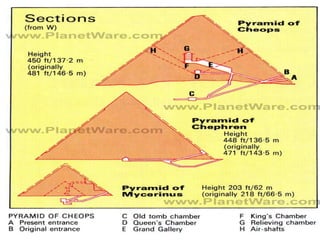
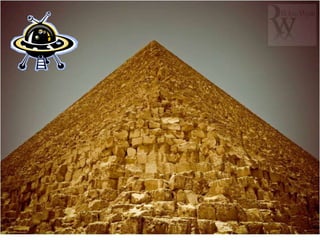
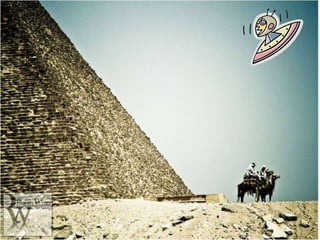
• His Great Pyramid is the largest in Giza & towers some 481 feet (147 meters)
above the plateau. Its estimated 2.3 million stone blocks each weigh an avg of
2.5 to 15 tons.
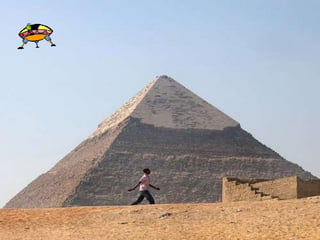
• Khufu's son, Pharaoh Khafre, built the 2nd pyramid at Giza, circa 2520 B.C. His
necropolis also included the Sphinx. The Sphinx may stand sentinel for the
pharaoh's entire tomb complex.
• The 3rd of the Giza Pyramids is smaller than the first two. Built by Pharaoh
Menkaure circa 2490 B.C., it featured a much more complex mortuary temple.
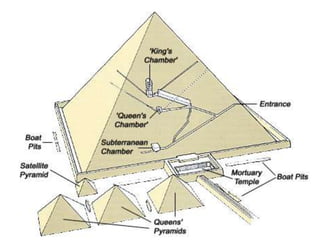
• Each massive pyramid is but one part of a larger complex, including a palace,
temples, solar boat pits, and other features.
*Don’t write!!
Shape thought to be representative of the descending rays of the
sun, & most pyramids were faced with polished, highly reflective
white limestone, in order to give them a brilliant appearance
when viewed from a distance
*While it is generally agreed that pyramids were burial monuments,
there is continued disagreement on the particular theological
principles (One theory is that they were designed as a type of
"resurrection machine)
• Egyptians believed dark area of the night sky around which the
stars appear to revolve was the physical gateway into the
heavens.
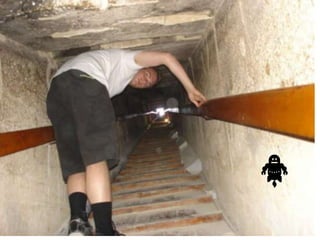
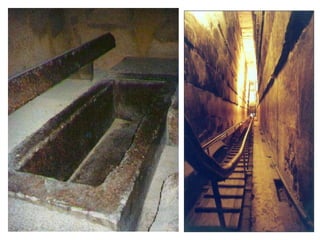
• One of the narrow shafts that extends from the main burial
chamber through the entire body of the Great Pyramid points
directly towards the center of this part of the sky.
• suggests the pyramid may have been designed to serve as a
means to magically launch the deceased pharaoh's soul directly
into the abode of the gods.
• All Egyptian pyramids were built on the west bank of the Nile,
which as the site of the setting sun was associated with the realm
of the dead in Egyptian mythology
Don’t’ Write!!!
• Probably took 23 years (Khufu 2551 to 2528 BC)
• Herodotus writes about 10 years of preparation &
20 years of building
• Per Day: With 2'500'000 stones, 342 stones have
to be moved daily (working during 365 days a
year) or 431 stones daily (working during 290
days a year).
• Per minute 10-hour day: every 2 minutes a stone
(34 to 43 per hour)
8-hour day: nearly a stone every
minute (42 to 53 stones per hour
• http://www.panoramas.dk/2008/flash/valley-
of-the-kings.html
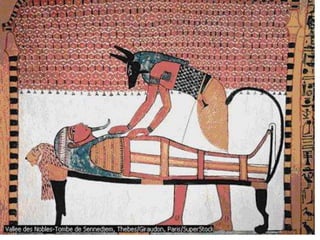
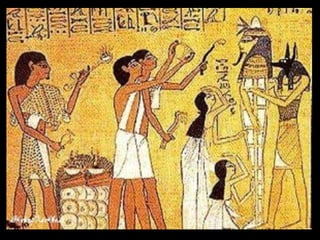
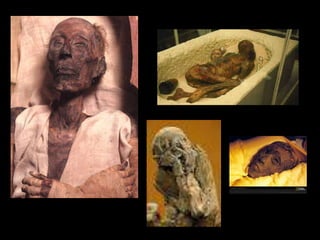
Mummification
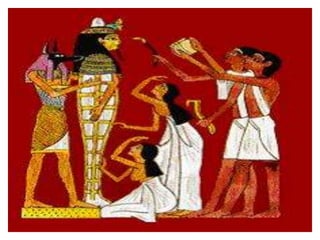
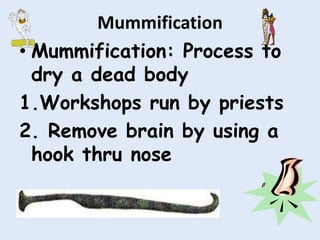
• Mummification: Process to
dry a dead body
1.Workshops run by priests
2. Remove brain by using a
hook thru nose
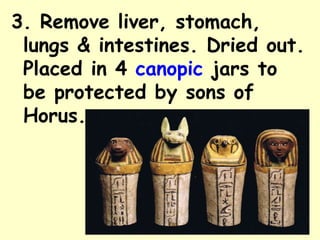
3. Remove liver, stomach,
lungs & intestines. Dried out.
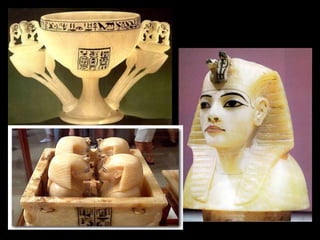
Placed in 4 canopic jars to
be protected by sons of
Horus.
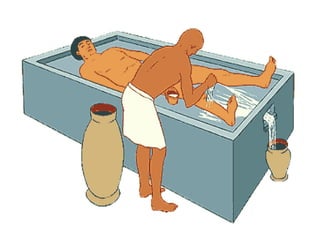
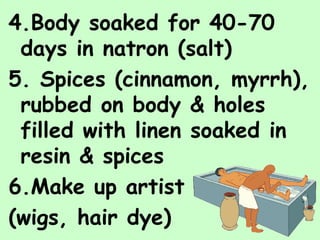
4.Body soaked for 40-70
days in natron (salt)
5. Spices (cinnamon, myrrh),
rubbed on body & holes
filled with linen soaked in
resin & spices
6.Make up artist
(wigs, hair dye)
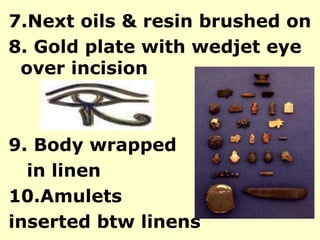
7.Next oils & resin brushed on
8. Gold plate with wedjet eye
over incision
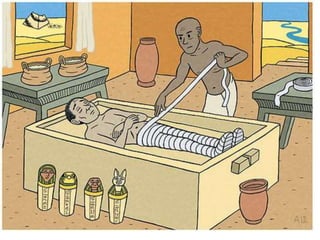
9. Body wrapped
in linen
10.Amulets
inserted btw linens
From Pharaoh (Horus) to
Osiris!
Features were meant to be recognizable
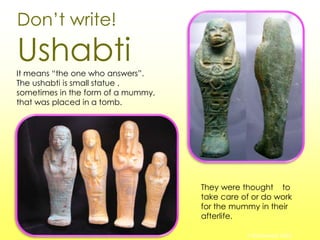
It means “the one who answers”.
The ushabti is small statue ,
sometimes in the form of a mummy,
that was placed in a tomb.
Don’t write!
Ushabti
They were thought to
take care of or do work
for the mummy in their
afterlife.
S Westwood 2010
• http://www.youtube.com/watch?v=CMs_IGKx
Mu0
• http://www.bbc.co.uk/history/ancient/egyptia
ns/launch_gms_mummy_maker.shtml
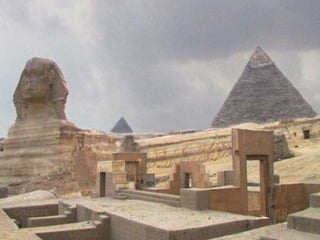
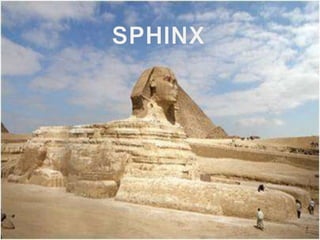
• Monument carved from
bedrock w/ blocks of
limestone to enlarge it
(hammers, bronze chisels)
• Body of lion (represents
strength of ruler) & head of
a man (face of the ruler)
• Represents Ra, sun god
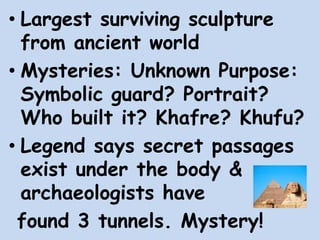
• Largest surviving sculpture
from ancient world
• Mysteries: Unknown Purpose:
Symbolic guard? Portrait?
Who built it? Khafre? Khufu?
• Legend says secret passages
exist under the body &
archaeologists have
found 3 tunnels. Mystery!
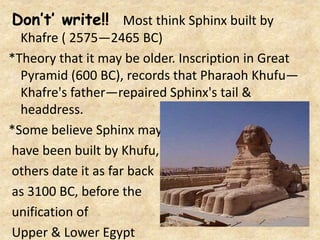
Don’t’ write!! Most think Sphinx built by
Khafre ( 2575—2465 BC)
*Theory that it may be older. Inscription in Great
Pyramid (600 BC), records that Pharaoh Khufu—
Khafre's father—repaired Sphinx's tail &
headdress.
*Some believe Sphinx may
have been built by Khufu,
others date it as far back
as 3100 BC, before the
unification of
Upper & Lower Egypt
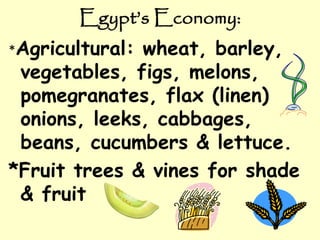
Egypt’s Economy:
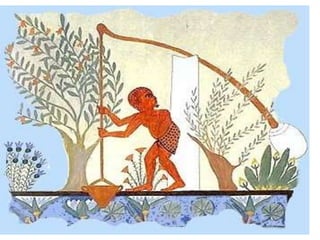
*Agricultural: wheat, barley,
vegetables, figs, melons,
pomegranates, flax (linen)
onions, leeks, cabbages,
beans, cucumbers & lettuce.
*Fruit trees & vines for shade
& fruit
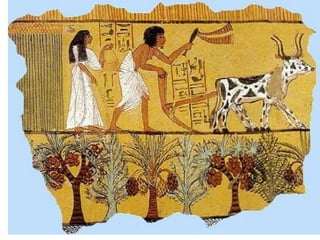
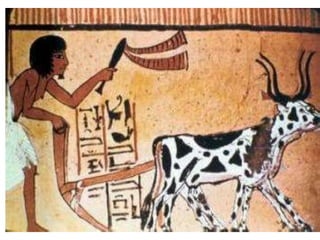
• Most villagers farmers, work
for Pharoah.
• *Paid in units of beer,
bread, cloth & meat
• Simple tools: winnowing
scoops, hoes, rakes,
*Repair during flood
season!
Egypt’s Economy
• Traded w/ countries around
Med, Aegean & Red Seas
(No coins, bartered!)
• Import: silver, iron, cedar
logs, horses, ivory, copper,
cattle, skins & spices.
• Export: gold & minerals,
wheat, barley & papyrus sheet
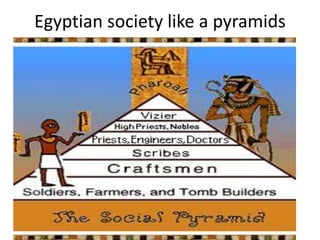
Egyptian society like a pyramids
Religion
• Polytheistic (many gods)
• Believed gods control all.
• Pharaoh is Horus/Osiris
• Priests highest social class,
powerful
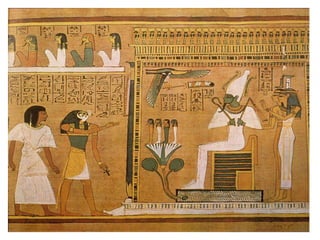
• Book of the Dead: guided the
soul in the after life
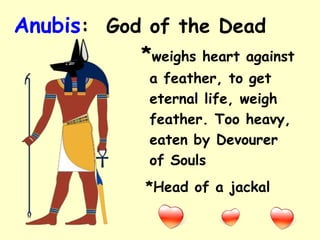
Anubis: God of the Dead
*weighs heart against
a feather, to get
eternal life, weigh
feather. Too heavy,
eaten by Devourer
of Souls
*Head of a jackal
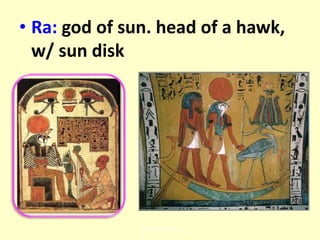
• Ra: god of sun. head of a hawk,
w/ sun disk
S Westwood 2010
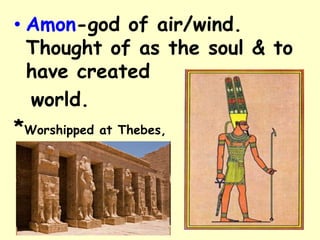
• Amon-god of air/wind.
Thought of as the soul & to
have created
world.
*Worshipped at Thebes,
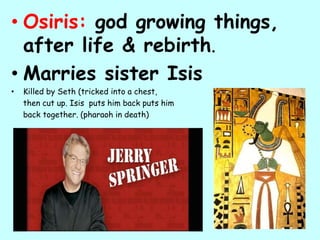
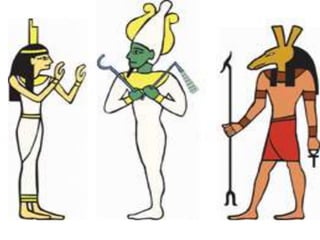
• Osiris: god growing things,
after life & rebirth.
• Marries sister Isis
• Killed by Seth (tricked into a chest,
then cut up. Isis puts him back puts him
back together. (pharaoh in death)
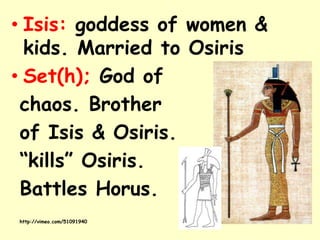
• Isis: goddess of women &
kids. Married to Osiris
• Set(h); God of
chaos. Brother
of Isis & Osiris.
“kills” Osiris.
Battles Horus.
http://vimeo.com/51091940
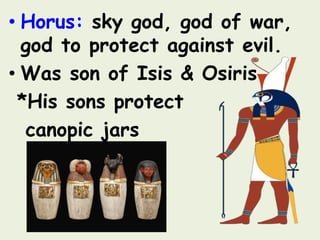
• Horus: sky god, god of war,
god to protect against evil.
• Was son of Isis & Osiris.
*His sons protect
canopic jars
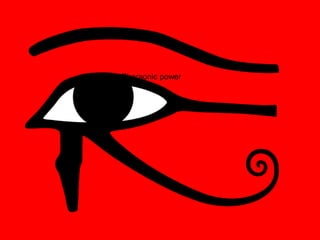
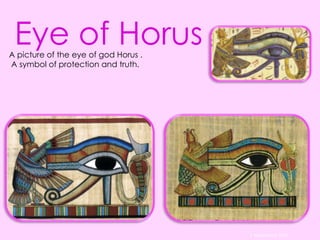
A picture of the eye of god Horus .
A symbol of protection and truth.
Eye of Horus
S Westwood 2010
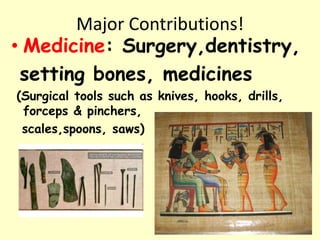
Major Contributions!
• Medicine: Surgery,dentistry,
setting bones, medicines
(Surgical tools such as knives, hooks, drills,
forceps & pinchers,
scales,spoons, saws)
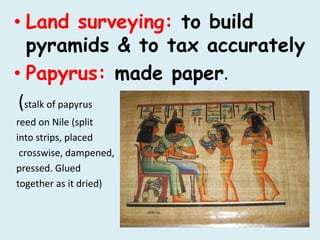
• Land surveying: to build
pyramids & to tax accurately
• Papyrus: made paper.
(stalk of papyrus
reed on Nile (split
into strips, placed
crosswise, dampened,
pressed. Glued
together as it dried)
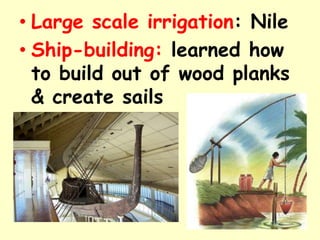
• Large scale irrigation: Nile
• Ship-building: learned how
to build out of wood planks
& create sails
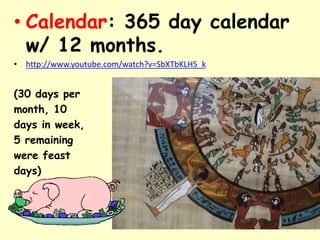
• Calendar: 365 day calendar
w/ 12 months.
• http://www.youtube.com/watch?v=SbXTbKLH5_k
(30 days per
month, 10
days in week,
5 remaining
were feast
days)
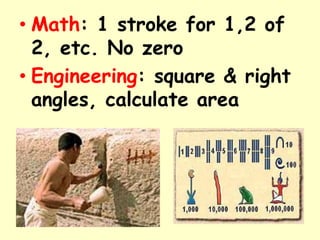
• Math: 1 stroke for 1,2 of
2, etc. No zero
• Engineering: square & right
angles, calculate area
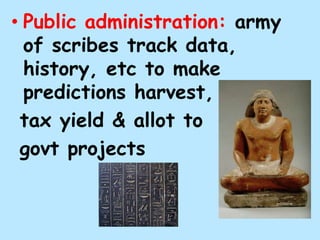
• Public administration: army
of scribes track data,
history, etc to make
predictions harvest,
tax yield & allot to
govt projects
More Major Contributions
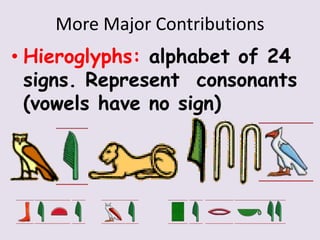
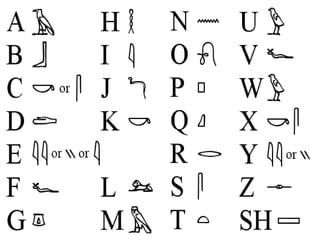
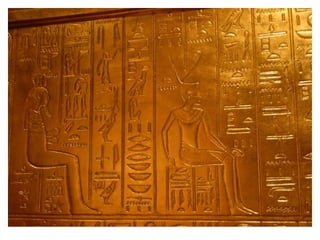
• Hieroglyphs: alphabet of 24
signs. Represent consonants
(vowels have no sign)
Don’t Write!!!
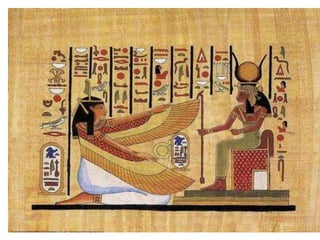
• How you read them depends on
which way the people or animals are
facing. IE: if an animal hieroglyph faces
right, you read from right to left. Just
to confuse you, sometimes they read
Hieroglyphs from top to bottom.
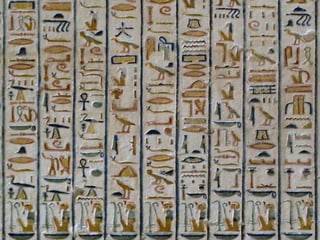
• here were more than 700 hieroglyphs.
Some pictures stood for whole word,
no vowels or punctuation
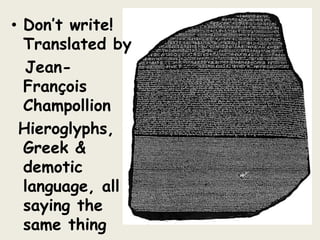
• Don’t write!
Translated by
Jean-
François
Champollion
Hieroglyphs,
Greek &
demotic
language, all
saying the
same thing
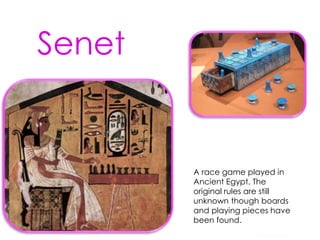
A race game played in
Ancient Egypt. The
original rules are still
unknown though boards
and playing pieces have
been found.
Senet
S Westwood 2010
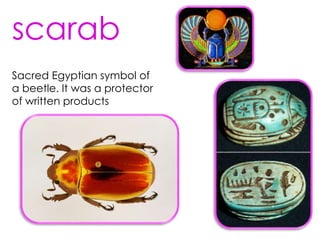
Sacred Egyptian symbol of
a beetle. It was a protector
of written products
scarab
S Westwood 2010
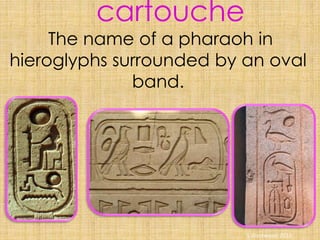
cartouche
The name of a pharaoh in
hieroglyphs surrounded by an oval
band.
S Westwood 2010
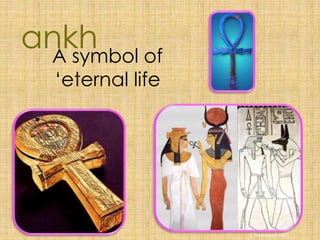
A symbol of
‘eternal life
ankh
S Westwood 2010
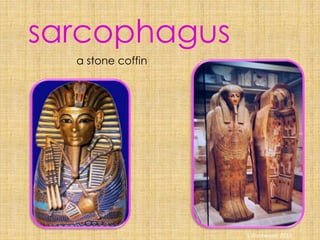
a stone coffin
sarcophagus
S Westwood 2010
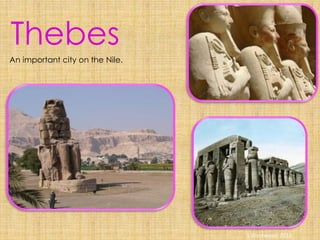
An important city on the Nile.
Thebes
S Westwood 2010
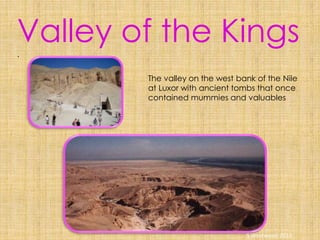
Valley of the Kings.
The valley on the west bank of the Nile
at Luxor with ancient tombs that once
contained mummies and valuables
S Westwood 2010
1st Intermediate Period
2160-2040 BC (don’t write)
*Pepi I outlives his heirs & messes up
succession (100 yrs old!)
*Lower levels of wealthy rebel
• class of feudal lords dev.
• Pharaoh now seen as a son of a god.
• Crops fail, hunger widespread, famine,
less trade
• Pharaohs blamed. Gov became rulers
• Power was split between Thebes &
Heracleopolis
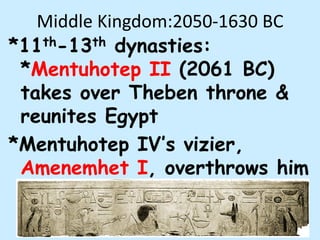
Middle Kingdom:2050-1630 BC
*11th-13th dynasties:
*Mentuhotep II (2061 BC)
takes over Theben throne &
reunites Egypt
*Mentuhotep IV’s vizier,
Amenemhet I, overthrows him
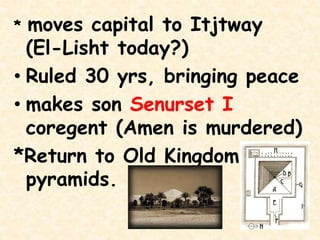
* moves capital to Itjtway
(El-Lisht today?)
• Ruled 30 yrs, bringing peace
• makes son Senurset I
coregent (Amen is murdered)
*Return to Old Kingdom
pyramids.
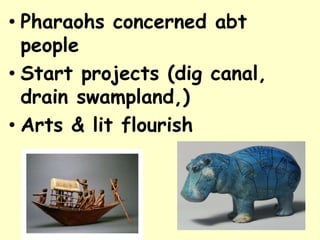
• Pharaohs concerned abt
people
• Start projects (dig canal,
drain swampland,)
• Arts & lit flourish
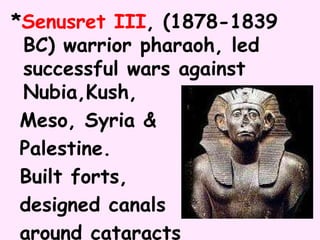
*Senusret III, (1878-1839
BC) warrior pharaoh, led
successful wars against
Nubia,Kush,
Meso, Syria &
Palestine.
Built forts,
designed canals
around cataracts
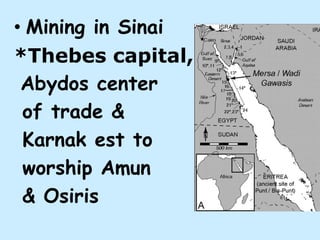
• Mining in Sinai
*Thebes capital,
Abydos center
of trade &
Karnak est to
worship Amun
& Osiris
2nd Intermediate Period:1650-1550 Bc
• Don’t Write!
• 1st female Pharoah, Queen Sobekneferu dies, no
heirs
• Power splits between multiple centers (Avairs,
Thebes & Itjtway) & provisional governors take
over
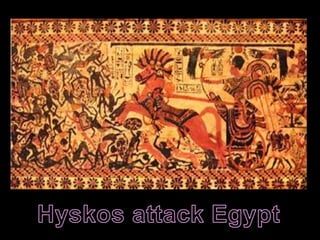
• 13th dynasty pharaohs lose
power as when Hyksos take over.
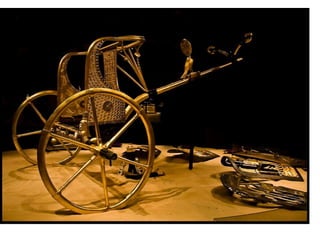
Warlike, use horses, chariots,
bronze weapons, destroy cities!
2nd Intermediate Period :1650-1550 BC
• DON’T WRITE: military tech
advances (bow, horse &
chariots, bronze weapons)
• lute & lyre
• Thebes rebels against Hyskos
• 1600 BC Pharaohs use same
tools to fight back & drive
out Hyksos (cultural diffusion
QUESTIONS TO PONDER
1. What problems led to the fall of each the
old kingdom? Describe them!
2. What similarities do you see in the
beginning of each new one. Describe them!
3. Make a prediction: What will lead Egypt
into it’s third and final great time period?
4. What will destroy the last one?
5. Summarize: What characteristics do the
rulers who unite the empires have?
(Nemes, Mentuhotep, Amenemhet,
Senurset)
New Kingdom 1580-1090 BC
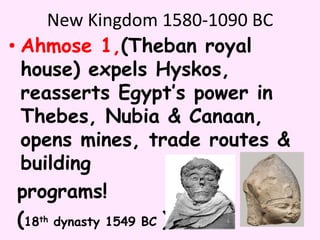
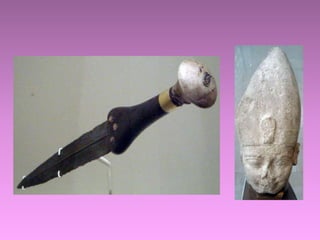
• Ahmose 1,(Theban royal
house) expels Hyskos,
reasserts Egypt’s power in
Thebes, Nubia & Canaan,
opens mines, trade routes &
building
programs!
(18th dynasty 1549 BC )
• DON”T WRITE
• Thebes became the religious & political center
of the country, its local god Amun credited with
inspiring Ahmose in his victories over the
Hyksos.
• Several stelae describe Ahmose as benefactor
of the Karnak temple. One stelae, (Tempest
Stele) , he claims to have rebuilt the pyramids
at Thebes that had been destroyed by a major
storm. The Thera eruption in the Aegean may
have done the damage, if this isn’t propaganda
• Had a pyramid, may be a cenotaph
New Kingdom 1580-1090 BC
• Wealthiest, most powerful
period
• Standing army takes territory
(archers, charioteers,
foot soldiers)
• Lots of trade
• Thebes becomes center again
w/ focus on Karnak, Luxor &
Valley of the Kings
DON’T WRITE
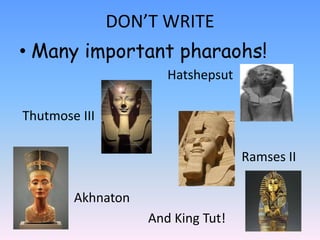
• Many important pharaohs!
Hatshepsut
Thutmose III
Ramses II
Akhnaton
And King Tut!
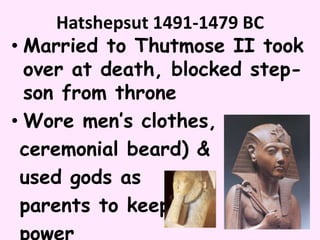
Hatshepsut 1491-1479 BC
• Married to Thutmose II took
over at death, blocked step-
son from throne
• Wore men’s clothes,
ceremonial beard) &
used gods as
parents to keep
power
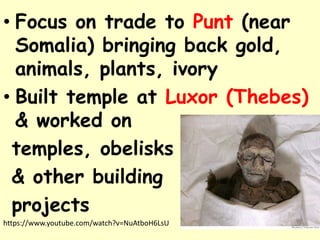
• Focus on trade to Punt (near
Somalia) bringing back gold,
animals, plants, ivory
• Built temple at Luxor (Thebes)
& worked on
temples, obelisks
& other building
projects
https://www.youtube.com/watch?v=NuAtboH6LsU
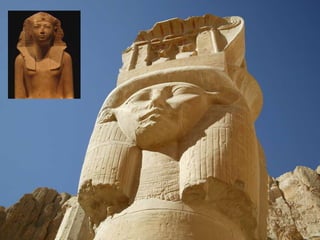
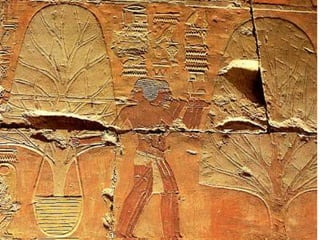
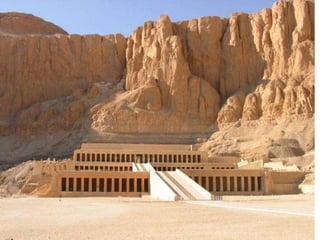
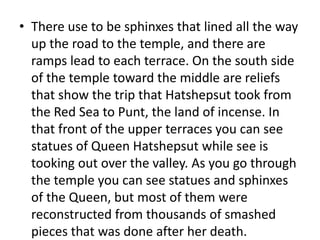
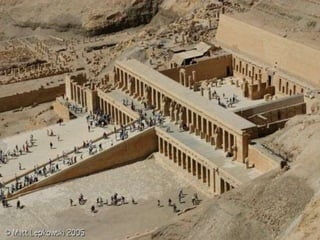
• There use to be sphinxes that lined all the way
up the road to the temple, and there are
ramps lead to each terrace. On the south side
of the temple toward the middle are reliefs
that show the trip that Hatshepsut took from
the Red Sea to Punt, the land of incense. In
that front of the upper terraces you can see
statues of Queen Hatshepsut while see is
tooking out over the valley. As you go through
the temple you can see statues and sphinxes
of the Queen, but most of them were
reconstructed from thousands of smashed
pieces that was done after her death.
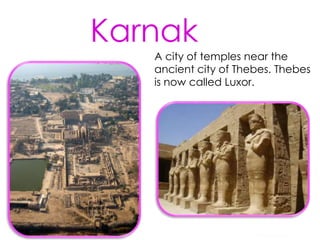
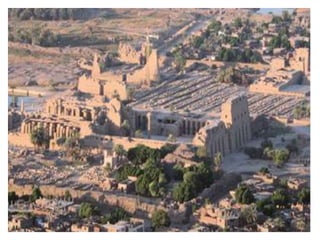
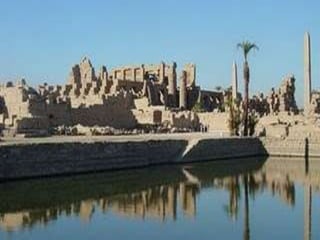
Karnak
A city of temples near the
ancient city of Thebes. Thebes
is now called Luxor.
S Westwood 2010
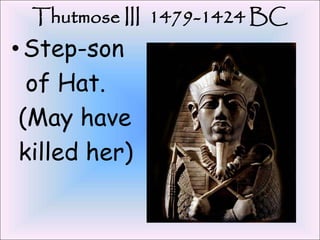
Thutmose III 1479-1424 BC
•Step-son
of Hat.
(May have
killed her)
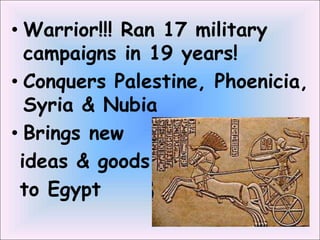
• Warrior!!! Ran 17 military
campaigns in 19 years!
• Conquers Palestine, Phoenicia,
Syria & Nubia
• Brings new
ideas & goods
to Egypt
• DON’T WRITE!!!
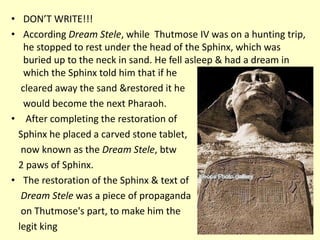
• According Dream Stele, while Thutmose IV was on a hunting trip,
he stopped to rest under the head of the Sphinx, which was
buried up to the neck in sand. He fell asleep & had a dream in
which the Sphinx told him that if he
cleared away the sand &restored it he
would become the next Pharaoh.
• After completing the restoration of
Sphinx he placed a carved stone tablet,
now known as the Dream Stele, btw
2 paws of Sphinx.
• The restoration of the Sphinx & text of
Dream Stele was a piece of propaganda
on Thutmose's part, to make him the
legit king
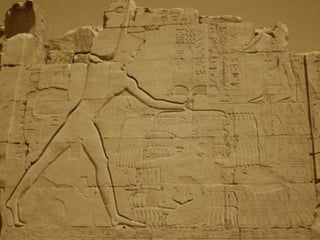
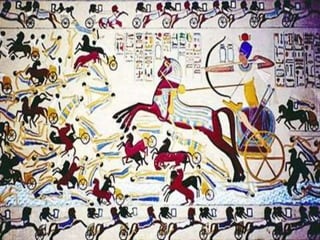
• Don’t Write!!!! Images in NK art!
• New Kingdom warrior pharaoh image include:
1. The pharaoh leading his soldiers into battle &
returning in victory.
2. Attacking the enemy in his chariot,
3. Wearing war regalia, e.g. the blue war crown or
other pharaonic headdresses.
4. Holding 1 or more enemies w/ 1 hand, while he
clubs their heads with a mace- “smiting the
enemy.”
5.In the guise of a sphinx trampling the enemy.
6. Offering the spoils of war to the god Amun,
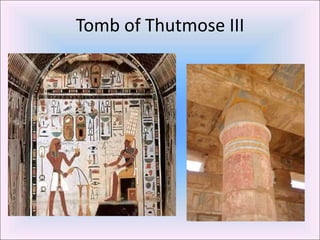
Tomb of Thutmose III
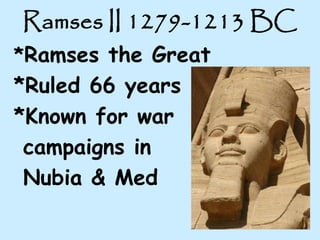
Ramses II 1279-1213 BC
*Ramses the Great
*Ruled 66 years
*Known for war
campaigns in
Nubia & Med
• Don’t Write!
• Signed treaty w/ Hittites for
peace
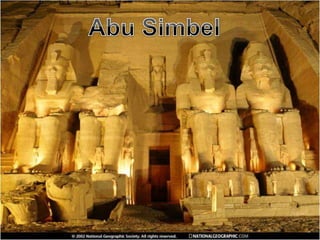
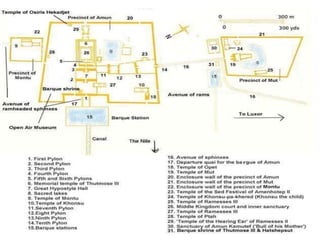
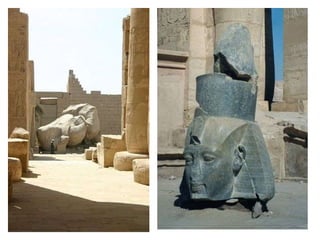
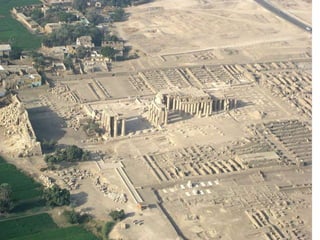
• Added to Amon-Ra’s temple
at Luxor, temple to self
(Rasmesseum), added to
temple of Karnak carved Abu
Simbel out of cliff along
Nile
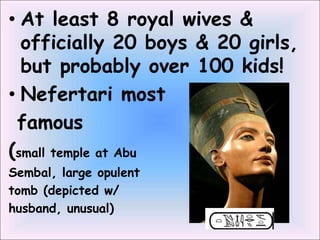
• At least 8 royal wives &
officially 20 boys & 20 girls,
but probably over 100 kids!
• Nefertari most
famous
(small temple at Abu
Sembal, large opulent
tomb (depicted w/
husband, unusual)
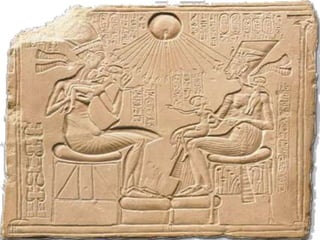
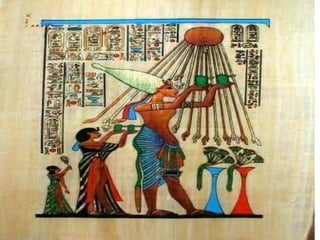
Amenhotep IV: 1353-1335?,
1.At first worshipped Amon
2. Dropped Amon & went to
Aton (“sole god, beside whom
there is no other”).
Aton was Sun disk,
creator & giver of life.
(monothiestic)
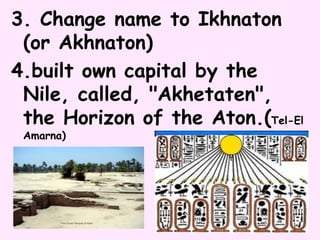
3. Change name to Ikhnaton
(or Akhnaton)
4.built own capital by the
Nile, called, "Akhetaten",
the Horizon of the Aton.(Tel-El
Amarna)
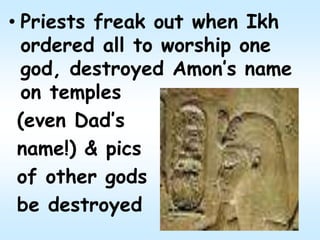
• Priests freak out when Ikh
ordered all to worship one
god, destroyed Amon’s name
on temples
(even Dad’s
name!) & pics
of other gods
be destroyed
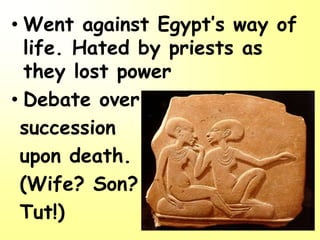
• Went against Egypt’s way of
life. Hated by priests as
they lost power
• Debate over
succession
upon death.
(Wife? Son?
Tut!)
Don’t write!!!!
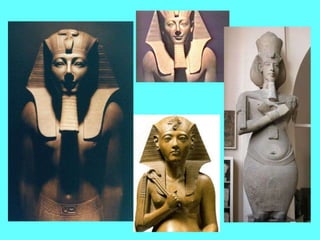
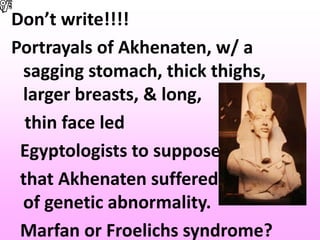
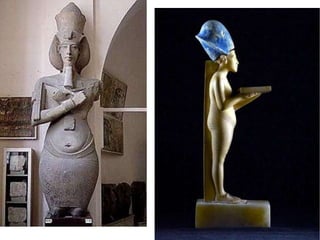
Portrayals of Akhenaten, w/ a
sagging stomach, thick thighs,
larger breasts, & long,
thin face led
Egyptologists to suppose
that Akhenaten suffered some kind
of genetic abnormality.
Marfan or Froelichs syndrome?
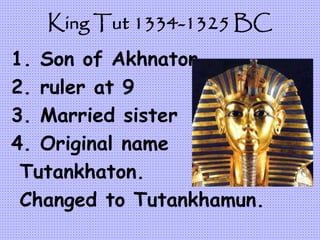
King Tut 1334-1325 BC
1. Son of Akhnaton
2. ruler at 9
3. Married sister
4. Original name
Tutankhaton.
Changed to Tutankhamun.
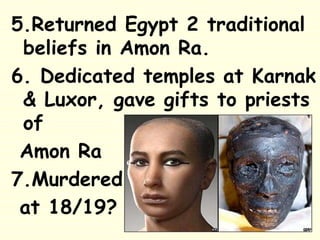
5.Returned Egypt 2 traditional
beliefs in Amon Ra.
6. Dedicated temples at Karnak
& Luxor, gave gifts to priests
of
Amon Ra
7.Murdered
at 18/19?
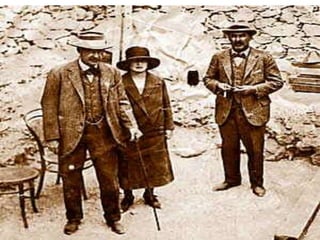
• Don’t write!! http://www.youtube.com/watch?v=H7ukJSMlazc
• http://video.nationalgeographic.com/video/places/countries-places/egypt/king-tuts-tomb/
• http://www.youtube.com/watch?v=5HKVE5fw9JY
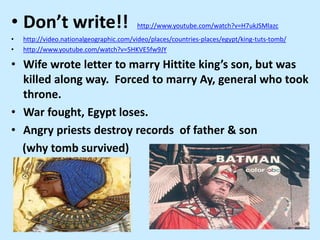
• Wife wrote letter to marry Hittite king’s son, but was
killed along way. Forced to marry Ay, general who took
throne.
• War fought, Egypt loses.
• Angry priests destroy records of father & son
(why tomb survived)
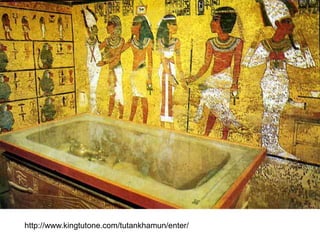
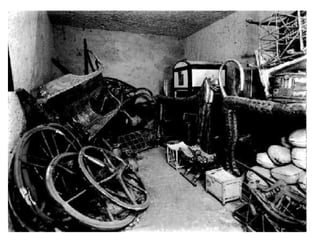
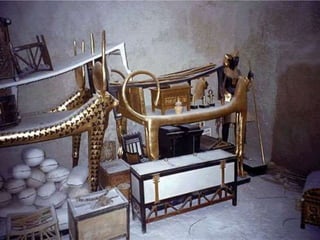
http://www.kingtutone.com/tutankhamun/enter/
Decline of Egypt
• Abt 1300 Bc
small invasions
begin w/ Hittites
• Ramses II makes peace
treaty in 1200 BC w/
Hittites, become allies
• Waves of invaders, including
Sea Peoples sweep through
DON’T WRITE!
1150-332 invaded repeatedly
• Ethiopians 1150 BC
• Libyans 950 BC
• Kush 751 BC
• Assyrians 670 BC
• Persians 525 BC
• Greeks 331 BC (Alexander the
Great w/ Cleopatra as last pharaoh)
• Romans: 31 BC now Roman province
Why did it decline?
• Pharaohs often concerned w
building for own glory
• Heavy taxes
• Lots of $$$$$ spent trying
to expand border
• Little individual freedom
• Stuck w/ social class system
(No real middle class)
Anksanamun’s letter to the Hittite king
• My husband is dead. I do not
have any sons. But you have
many sons. Please send me a
son to marry and he will
become my husband and will
be king of Egypt. I would
never marry one of my
1. Read the Letter from Ankhsenamun
2. Now, read the background information.
Make a list of 3 questions you have
3. Next, who do you think is guilty for the
death of Tut, the Hittite prince &
Ankhsenmum. Move around room to show who
you think it was!
4. Pass out graphic organizer. Fill in evidence
you have so far from the background info
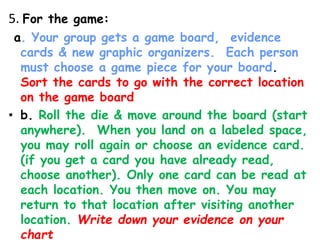
5. For the game:
a. Your group gets a game board, evidence
cards & new graphic organizers. Each person
must choose a game piece for your board.
Sort the cards to go with the correct location
on the game board
• b. Roll the die & move around the board (start
anywhere). When you land on a labeled space,
you may roll again or choose an evidence card.
(if you get a card you have already read,
choose another). Only one card can be read at
each location. You then move on. You may
return to that location after visiting another
location. Write down your evidence on your
chart
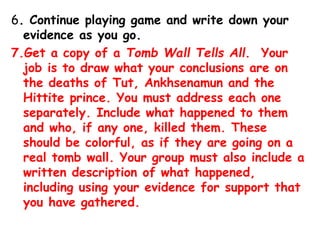
6. Continue playing game and write down your
evidence as you go.
7.Get a copy of a Tomb Wall Tells All. Your
job is to draw what your conclusions are on
the deaths of Tut, Ankhsenamun and the
Hittite prince. You must address each one
separately. Include what happened to them
and who, if any one, killed them. These
should be colorful, as if they are going on a
real tomb wall. Your group must also include a
written description of what happened,
including using your evidence for support that
you have gathered.
1. Read the situations. Answer the 4 questions
about WHERE you & your partner would settle &
WHY!
2. Next, look at the map. Think about
Mesopotamia’s geography, what you know about
Egypt & what you see on the map. List as many
reasons as you can to explain how rivers &
latitude helped contribute to long term
settlement (think advanced settlements,
specialized workers, technolgy, records, etc)
3. Next, read the Poem to the Nile. UNDERLINE
phrases, words & terms that tell you about the
importance of the Nile. EXPLAIN what they tell
you about what the Nile meant to Egypt! (on
back!)
• http://www.youtube.com/watch?v=CMs_IGKx
Mu0
• http://www.eduplace.com/kids/socsci/ca/boo
ks/bkf3/imaps/AC_05_143_egypt/AC_05_143
_egypt.html
Mummification!
1. With a partner, read Herodotus’
source on mummification.
2. Highlight words or phrases
that describe the process or
show a religious connection.
3. Answer the questions (in complete
sentences) about the source. Be
sure you cite SPECIFIC
textual examples for support.
4. Be ready for a quick quiz
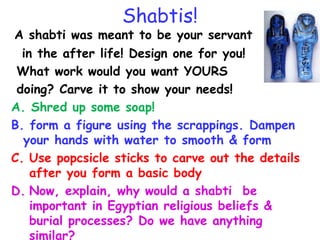
Shabtis!
A shabti was meant to be your servant
in the after life! Design one for you!
What work would you want YOURS
doing? Carve it to show your needs!
A. Shred up some soap!
B. form a figure using the scrappings. Dampen
your hands with water to smooth & form
C. Use popcsicle sticks to carve out the details
after you form a basic body
D. Now, explain, why would a shabti be
important in Egyptian religious beliefs &
burial processes? Do we have anything
similar?
1. Look at the list of artifacts. Make an inference
about each one. What is it? What was it used
for? It’s purpose would it have in the afterlife?
2. Now read Tombs over Time
3. Using the chart, Starting a Short story, develop a
storyline utilizing what you know about
Egyptian tombs, burials, building practices,
geography… (are you building, discovering,
being cursed, trapped, looking for treasure?)
4. Now write a story & incorporate what you know!
Use at least 5 items from your artifact list
5. Illustrate it!
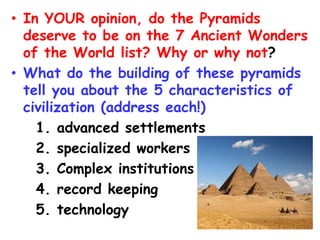
• In YOUR opinion, do the Pyramids
deserve to be on the 7 Ancient Wonders
of the World list? Why or why not?
• What do the building of these pyramids
tell you about the 5 characteristics of
civilization (address each!)
1. advanced settlements
2. specialized workers
3. Complex institutions
4. record keeping
5. technology
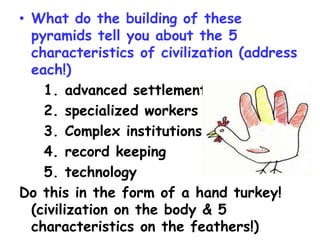
• What do the building of these
pyramids tell you about the 5
characteristics of civilization (address
each!)
1. advanced settlements
2. specialized workers
3. Complex institutions
4. record keeping
5. technology
Do this in the form of a hand turkey!
(civilization on the body & 5
characteristics on the feathers!)
• On the back:
1. Rank the leaders in order from most
to least important. Give a brief
explanation of why they received
that rank
2. What qualities do these leaders
have in common? Pick 3
3. Are these same qualities important
in leadership today? Why or why not
4. Describe the 2 contributions that
you feel had the most impact on
society (doesn’t matter if they are
from different leaders)

Egypt

  • 4.
    Geography of AncientEgypt • in Africa, 90% desert w/ grasses along Nile River.
  • 5.
    • hot dryclimate, w/ more rain in winter than summer • 2 seasons: Hot summers (May to Oct) w/ avg temp of 95 • Mild winters (Nov to April) w/ avg winter temp: 48 degrees)
  • 7.
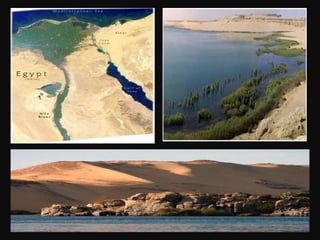
    • Don’t Write! •Blue Nile (Lake Tana in Ethiopia) joins White Nile (from Lake Victoria) at Khartoum • Nile flows N 4100 miles to Med Sea!
  • 8.
    The Gift ofthe Nile *Floods yearly as snows in mtns melt depositing new, fresh black soil along river, very fertile (less than 24 miles across
  • 9.
    • Nile usedfor fishing, shipping, irrigation, drinking, cooking & irrigation & trade around Med
  • 10.
    • Egypt dividedinto 2 lands: • ‘Black Land‘: fertile land on banks of Nile used for growing crops • Red Land: barren desert that protected Egypt from invaders. Precious minerals & stones
  • 12.
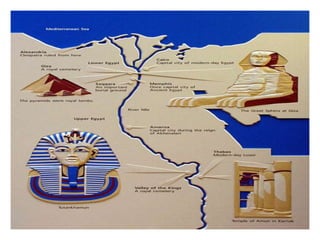
    •Issues: • Floods toolow, many starve • Too high, seeds, granaries destroyed • Desert reduced interaction •But: • Protection from invaders • Trade/transportation w/ river • Fertile soil replenished
  • 13.
    *Don’t write! Farming villages devby 5000 BC • 3200 BC, 2 separate kingdoms dev. (Upper & Lower Egypt) • Eventually unite
  • 15.
    Upper Egypt • Higherelevation • Skinny strip of land from 1st Cataract to where Nile starts to fan out in branches.
  • 16.
    Upper Egypt • 1stCataract at Aswan. (cataract: river turns to rapids, shallow water is broken by small boulders, stones & rocky islets, • Leader wore the white crown
  • 18.
    Lower Egypt • LowerEgypt around Nile delta in N, where Nile empties into Med *Milder climate *Leader wore Red Crown
  • 19.
    King Narmer • Around3000 BC, Upper & Lower united by King Narmer (Menes/Scorpion?) • Narmer palate shows unification
  • 21.
    • Put togethercrowns • Put capital, Memphis near line of U/L Egypt • Est 1st dynasty (family of rulers) where (31 dynasties span 2600 years)
  • 23.
    The Nemes Headdress wasa blue and gold striped head cloth Blue crown (the Khepresh) was a blue cloth or leather headdress decorated with bronze or gold discs. The Blue Crown was worn in battles, as well as on ceremonial occasions. Atef crown was a white headdress decorated with ostrich feathers. It was worn during some religious rituals
  • 25.
    Old Kingdom 2780-2200BC • Wide spread patterns of civilization dev & ruling families known as DYNASTIES control Egypt • Pharaohs were rulers (means great house) as powerful as the gods • Wealth spread out btw kings & temples
  • 26.
    *Capital is Memphis •Papyrus invented (paper) as writing becomes tool of govt)
  • 28.
    Pharaohs • Pharaohs consideredto be gods (represent Horus) so Govt based on religious authority (theocracy) • Pharoah center of religion & govt, leader of military & chief priest
  • 29.
    • Responsible forkingdom’s well being & caused crops to grow, Nile to flood, sun to rise, success in battle • Promote truth & justice *Landlord & nobles • rent land from them
  • 30.
    • Pharaoh wasHorus (war, sky) in life, became Osiris in death & united w/ the gods. • Next Pharaoh was incarnation of Horus
  • 31.
  • 32.
    Death of aPharaoh Don’t wrtie • Believed king ruled after death • Eternal life force called KA needed resting place after death to protect spirit. • KA was like the living king with needs & pleasures
  • 33.
    • Don’t write!!Mastabas builtearly on, but later pyramids • whole towns developed around pyramids
  • 34.
    Don’t write!!!!Mastabas • Earliestroyal burials were pits dug in the ground with mounds built over them. • Mound was built in the shape of a pyramid & made from mud brick or stone, • Mounds covered burial chambers that were dug deep into the ground • Pyramids developed from mastabas. (theory is, step pyramid of Djoser in Saqqara was originally a mastaba that had successively smaller square slabs built around it) • 1000s of mastabas all over Egypt, many of them w/ wall paintings
  • 36.
    Djoser & theStep Pyramid • Djoser, Pharaoh (dynasty 3 2667-2648 BC), built monument to self designed by architect Imhotep • Built pyramid instead by putting 6 mastabas on top of one another
  • 37.
    • Step Pyramid,world’s most monumental stone structure (shows hi level of govt control of labor & resources & organization)
  • 38.
    • Djoser’s StepPyramid complex has several structures pivotal to its function in both life & afterlife. • Its purpose was to create an afterlife for the king so that he could be eternally reborn. • Complex surrounded by a wall (14 doors, one leads to colonnade) , which is surrounded by a trench • Roofed colonnade had side chambers, lead to hallway w/columns • Large court near pyramid w/ platform & double steps (represents throne to cont. to rule in afterlife) • Small s tomb w/ 3 chambers, decorated, showing king running festivals • Pyramid w/ substructure w/ chambers & galleries that look like palace (place for the ka) • Burial chamber blocked by 3.5 ton block. Robbed • Northern funerary temple for rituals (king can use it to go to north Star)
  • 41.
    1.No wheel 2Quarried stone blocks(used granite & limestone) 3.Blocks (weigh 1.5-2.5 tons) transported on sleds, barges
  • 42.
    4.Inclined earthen rampsbuilt up & torn down as pyramid finished (may be straight or spiral around pyramid) 5.No written records or art of how built
  • 47.
    • DON”T WRITE!!!! •Built by farmers outside of farming season (slaves also) • 20,000 to 30,000 workers • Lived in villages around pyramids, had supervisors! • 118 known pyramids (2008) • buried with treasures to help pharoah in next world • Walls covered with pics & hieroglyphs telling story of Pharaohs deeds • "Friends of Khufu," "Drunkards of Menkaure
  • 48.
    The Pyramids ofGiza (don’t write) • Giza Pyramids were built 4,500 years ago. • Egypt's pharaohs expected to become gods in the afterlife. To prepare for the next world they erected temples to the gods & massive pyramid tombs for themselves—filled with all the things each ruler would need to guide &sustain himself in the next world. • Pharaoh Khufu began the first Giza pyramid project, circa 2550 B.C. • His Great Pyramid is the largest in Giza & towers some 481 feet (147 meters) above the plateau. Its estimated 2.3 million stone blocks each weigh an avg of 2.5 to 15 tons. • Khufu's son, Pharaoh Khafre, built the 2nd pyramid at Giza, circa 2520 B.C. His necropolis also included the Sphinx. The Sphinx may stand sentinel for the pharaoh's entire tomb complex. • The 3rd of the Giza Pyramids is smaller than the first two. Built by Pharaoh Menkaure circa 2490 B.C., it featured a much more complex mortuary temple. • Each massive pyramid is but one part of a larger complex, including a palace, temples, solar boat pits, and other features.
  • 54.
    *Don’t write!! Shape thoughtto be representative of the descending rays of the sun, & most pyramids were faced with polished, highly reflective white limestone, in order to give them a brilliant appearance when viewed from a distance *While it is generally agreed that pyramids were burial monuments, there is continued disagreement on the particular theological principles (One theory is that they were designed as a type of "resurrection machine) • Egyptians believed dark area of the night sky around which the stars appear to revolve was the physical gateway into the heavens. • One of the narrow shafts that extends from the main burial chamber through the entire body of the Great Pyramid points directly towards the center of this part of the sky. • suggests the pyramid may have been designed to serve as a means to magically launch the deceased pharaoh's soul directly into the abode of the gods. • All Egyptian pyramids were built on the west bank of the Nile, which as the site of the setting sun was associated with the realm of the dead in Egyptian mythology
  • 61.
    Don’t’ Write!!! • Probablytook 23 years (Khufu 2551 to 2528 BC) • Herodotus writes about 10 years of preparation & 20 years of building • Per Day: With 2'500'000 stones, 342 stones have to be moved daily (working during 365 days a year) or 431 stones daily (working during 290 days a year). • Per minute 10-hour day: every 2 minutes a stone (34 to 43 per hour) 8-hour day: nearly a stone every minute (42 to 53 stones per hour
  • 62.
  • 64.
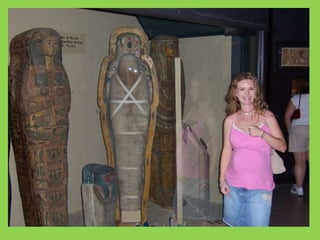
    Mummification • Mummification: Processto dry a dead body 1.Workshops run by priests 2. Remove brain by using a hook thru nose
  • 66.
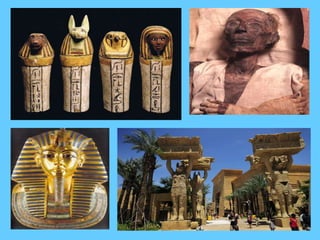
    3. Remove liver,stomach, lungs & intestines. Dried out. Placed in 4 canopic jars to be protected by sons of Horus.
  • 67.
    4.Body soaked for40-70 days in natron (salt) 5. Spices (cinnamon, myrrh), rubbed on body & holes filled with linen soaked in resin & spices 6.Make up artist (wigs, hair dye)
  • 70.
    7.Next oils &resin brushed on 8. Gold plate with wedjet eye over incision 9. Body wrapped in linen 10.Amulets inserted btw linens
  • 71.
  • 74.
    Features were meantto be recognizable
  • 76.
    It means “theone who answers”. The ushabti is small statue , sometimes in the form of a mummy, that was placed in a tomb. Don’t write! Ushabti They were thought to take care of or do work for the mummy in their afterlife. S Westwood 2010
  • 77.
  • 80.
    • Monument carvedfrom bedrock w/ blocks of limestone to enlarge it (hammers, bronze chisels) • Body of lion (represents strength of ruler) & head of a man (face of the ruler) • Represents Ra, sun god
  • 81.
    • Largest survivingsculpture from ancient world • Mysteries: Unknown Purpose: Symbolic guard? Portrait? Who built it? Khafre? Khufu? • Legend says secret passages exist under the body & archaeologists have found 3 tunnels. Mystery!
  • 82.
    Don’t’ write!! Mostthink Sphinx built by Khafre ( 2575—2465 BC) *Theory that it may be older. Inscription in Great Pyramid (600 BC), records that Pharaoh Khufu— Khafre's father—repaired Sphinx's tail & headdress. *Some believe Sphinx may have been built by Khufu, others date it as far back as 3100 BC, before the unification of Upper & Lower Egypt
  • 83.
    Egypt’s Economy: *Agricultural: wheat,barley, vegetables, figs, melons, pomegranates, flax (linen) onions, leeks, cabbages, beans, cucumbers & lettuce. *Fruit trees & vines for shade & fruit
  • 86.
    • Most villagersfarmers, work for Pharoah. • *Paid in units of beer, bread, cloth & meat • Simple tools: winnowing scoops, hoes, rakes, *Repair during flood season!
  • 88.
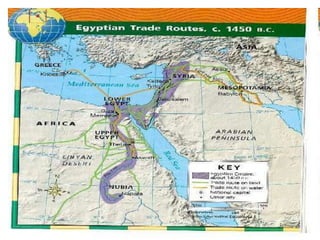
    Egypt’s Economy • Tradedw/ countries around Med, Aegean & Red Seas (No coins, bartered!) • Import: silver, iron, cedar logs, horses, ivory, copper, cattle, skins & spices. • Export: gold & minerals, wheat, barley & papyrus sheet
  • 90.
  • 91.
  • 92.
    • Polytheistic (manygods) • Believed gods control all. • Pharaoh is Horus/Osiris • Priests highest social class, powerful • Book of the Dead: guided the soul in the after life
  • 93.
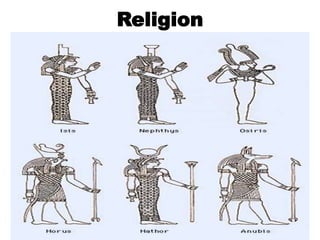
    Anubis: God ofthe Dead *weighs heart against a feather, to get eternal life, weigh feather. Too heavy, eaten by Devourer of Souls *Head of a jackal
  • 94.
    • Ra: godof sun. head of a hawk, w/ sun disk S Westwood 2010
  • 95.
    • Amon-god ofair/wind. Thought of as the soul & to have created world. *Worshipped at Thebes,
  • 96.
    • Osiris: godgrowing things, after life & rebirth. • Marries sister Isis • Killed by Seth (tricked into a chest, then cut up. Isis puts him back puts him back together. (pharaoh in death)
  • 97.
    • Isis: goddessof women & kids. Married to Osiris • Set(h); God of chaos. Brother of Isis & Osiris. “kills” Osiris. Battles Horus. http://vimeo.com/51091940
  • 99.
    • Horus: skygod, god of war, god to protect against evil. • Was son of Isis & Osiris. *His sons protect canopic jars
  • 100.
    A picture ofthe eye of god Horus . A symbol of protection and truth. Eye of Horus S Westwood 2010
  • 101.
    Major Contributions! • Medicine:Surgery,dentistry, setting bones, medicines (Surgical tools such as knives, hooks, drills, forceps & pinchers, scales,spoons, saws)
  • 102.
    • Land surveying:to build pyramids & to tax accurately • Papyrus: made paper. (stalk of papyrus reed on Nile (split into strips, placed crosswise, dampened, pressed. Glued together as it dried)
  • 103.
    • Large scaleirrigation: Nile • Ship-building: learned how to build out of wood planks & create sails
  • 104.
    • Calendar: 365day calendar w/ 12 months. • http://www.youtube.com/watch?v=SbXTbKLH5_k (30 days per month, 10 days in week, 5 remaining were feast days)
  • 105.
    • Math: 1stroke for 1,2 of 2, etc. No zero • Engineering: square & right angles, calculate area
  • 106.
    • Public administration:army of scribes track data, history, etc to make predictions harvest, tax yield & allot to govt projects
  • 108.
    More Major Contributions •Hieroglyphs: alphabet of 24 signs. Represent consonants (vowels have no sign)
  • 109.
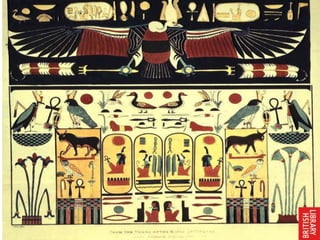
    Don’t Write!!! • Howyou read them depends on which way the people or animals are facing. IE: if an animal hieroglyph faces right, you read from right to left. Just to confuse you, sometimes they read Hieroglyphs from top to bottom. • here were more than 700 hieroglyphs. Some pictures stood for whole word, no vowels or punctuation
  • 110.
    • Don’t write! Translatedby Jean- François Champollion Hieroglyphs, Greek & demotic language, all saying the same thing
  • 115.
    A race gameplayed in Ancient Egypt. The original rules are still unknown though boards and playing pieces have been found. Senet S Westwood 2010
  • 116.
    Sacred Egyptian symbolof a beetle. It was a protector of written products scarab S Westwood 2010
  • 117.
    cartouche The name ofa pharaoh in hieroglyphs surrounded by an oval band. S Westwood 2010
  • 118.
    A symbol of ‘eternallife ankh S Westwood 2010
  • 119.
  • 120.
    An important cityon the Nile. Thebes S Westwood 2010
  • 121.
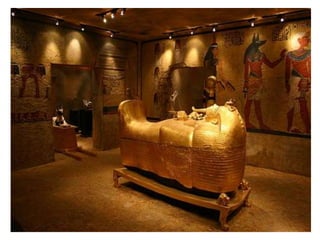
    Valley of theKings. The valley on the west bank of the Nile at Luxor with ancient tombs that once contained mummies and valuables S Westwood 2010
  • 122.
    1st Intermediate Period 2160-2040BC (don’t write) *Pepi I outlives his heirs & messes up succession (100 yrs old!) *Lower levels of wealthy rebel • class of feudal lords dev. • Pharaoh now seen as a son of a god. • Crops fail, hunger widespread, famine, less trade • Pharaohs blamed. Gov became rulers • Power was split between Thebes & Heracleopolis
  • 123.
    Middle Kingdom:2050-1630 BC *11th-13thdynasties: *Mentuhotep II (2061 BC) takes over Theben throne & reunites Egypt *Mentuhotep IV’s vizier, Amenemhet I, overthrows him
  • 124.
    * moves capitalto Itjtway (El-Lisht today?) • Ruled 30 yrs, bringing peace • makes son Senurset I coregent (Amen is murdered) *Return to Old Kingdom pyramids.
  • 125.
    • Pharaohs concernedabt people • Start projects (dig canal, drain swampland,) • Arts & lit flourish
  • 126.
    *Senusret III, (1878-1839 BC)warrior pharaoh, led successful wars against Nubia,Kush, Meso, Syria & Palestine. Built forts, designed canals around cataracts
  • 128.
    • Mining inSinai *Thebes capital, Abydos center of trade & Karnak est to worship Amun & Osiris
  • 129.
    2nd Intermediate Period:1650-1550Bc • Don’t Write! • 1st female Pharoah, Queen Sobekneferu dies, no heirs • Power splits between multiple centers (Avairs, Thebes & Itjtway) & provisional governors take over • 13th dynasty pharaohs lose power as when Hyksos take over. Warlike, use horses, chariots, bronze weapons, destroy cities!
  • 131.
    2nd Intermediate Period:1650-1550 BC • DON’T WRITE: military tech advances (bow, horse & chariots, bronze weapons) • lute & lyre • Thebes rebels against Hyskos • 1600 BC Pharaohs use same tools to fight back & drive out Hyksos (cultural diffusion
  • 132.
    QUESTIONS TO PONDER 1.What problems led to the fall of each the old kingdom? Describe them! 2. What similarities do you see in the beginning of each new one. Describe them! 3. Make a prediction: What will lead Egypt into it’s third and final great time period? 4. What will destroy the last one? 5. Summarize: What characteristics do the rulers who unite the empires have? (Nemes, Mentuhotep, Amenemhet, Senurset)
  • 133.
    New Kingdom 1580-1090BC • Ahmose 1,(Theban royal house) expels Hyskos, reasserts Egypt’s power in Thebes, Nubia & Canaan, opens mines, trade routes & building programs! (18th dynasty 1549 BC )
  • 135.
    • DON”T WRITE •Thebes became the religious & political center of the country, its local god Amun credited with inspiring Ahmose in his victories over the Hyksos. • Several stelae describe Ahmose as benefactor of the Karnak temple. One stelae, (Tempest Stele) , he claims to have rebuilt the pyramids at Thebes that had been destroyed by a major storm. The Thera eruption in the Aegean may have done the damage, if this isn’t propaganda • Had a pyramid, may be a cenotaph
  • 137.
    New Kingdom 1580-1090BC • Wealthiest, most powerful period • Standing army takes territory (archers, charioteers, foot soldiers) • Lots of trade • Thebes becomes center again w/ focus on Karnak, Luxor & Valley of the Kings
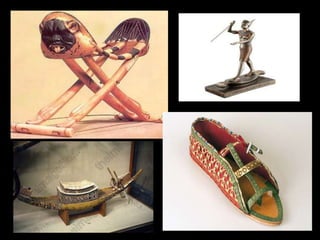
  • 139.
    DON’T WRITE • Manyimportant pharaohs! Hatshepsut Thutmose III Ramses II Akhnaton And King Tut!
  • 140.
    Hatshepsut 1491-1479 BC •Married to Thutmose II took over at death, blocked step- son from throne • Wore men’s clothes, ceremonial beard) & used gods as parents to keep power
  • 142.
    • Focus ontrade to Punt (near Somalia) bringing back gold, animals, plants, ivory • Built temple at Luxor (Thebes) & worked on temples, obelisks & other building projects https://www.youtube.com/watch?v=NuAtboH6LsU
  • 145.
    • There useto be sphinxes that lined all the way up the road to the temple, and there are ramps lead to each terrace. On the south side of the temple toward the middle are reliefs that show the trip that Hatshepsut took from the Red Sea to Punt, the land of incense. In that front of the upper terraces you can see statues of Queen Hatshepsut while see is tooking out over the valley. As you go through the temple you can see statues and sphinxes of the Queen, but most of them were reconstructed from thousands of smashed pieces that was done after her death.
  • 147.
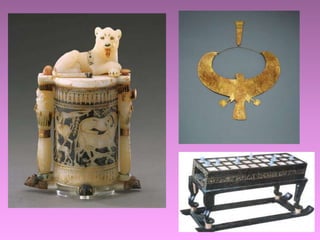
    Karnak A city oftemples near the ancient city of Thebes. Thebes is now called Luxor. S Westwood 2010
  • 148.
    Thutmose III 1479-1424BC •Step-son of Hat. (May have killed her)
  • 149.
    • Warrior!!! Ran17 military campaigns in 19 years! • Conquers Palestine, Phoenicia, Syria & Nubia • Brings new ideas & goods to Egypt
  • 151.
    • DON’T WRITE!!! •According Dream Stele, while Thutmose IV was on a hunting trip, he stopped to rest under the head of the Sphinx, which was buried up to the neck in sand. He fell asleep & had a dream in which the Sphinx told him that if he cleared away the sand &restored it he would become the next Pharaoh. • After completing the restoration of Sphinx he placed a carved stone tablet, now known as the Dream Stele, btw 2 paws of Sphinx. • The restoration of the Sphinx & text of Dream Stele was a piece of propaganda on Thutmose's part, to make him the legit king
  • 152.
    • Don’t Write!!!!Images in NK art! • New Kingdom warrior pharaoh image include: 1. The pharaoh leading his soldiers into battle & returning in victory. 2. Attacking the enemy in his chariot, 3. Wearing war regalia, e.g. the blue war crown or other pharaonic headdresses. 4. Holding 1 or more enemies w/ 1 hand, while he clubs their heads with a mace- “smiting the enemy.” 5.In the guise of a sphinx trampling the enemy. 6. Offering the spoils of war to the god Amun,
  • 154.
  • 155.
    Ramses II 1279-1213BC *Ramses the Great *Ruled 66 years *Known for war campaigns in Nubia & Med
  • 156.
    • Don’t Write! •Signed treaty w/ Hittites for peace • Added to Amon-Ra’s temple at Luxor, temple to self (Rasmesseum), added to temple of Karnak carved Abu Simbel out of cliff along Nile
  • 164.
    • At least8 royal wives & officially 20 boys & 20 girls, but probably over 100 kids! • Nefertari most famous (small temple at Abu Sembal, large opulent tomb (depicted w/ husband, unusual)
  • 166.
    Amenhotep IV: 1353-1335?, 1.Atfirst worshipped Amon 2. Dropped Amon & went to Aton (“sole god, beside whom there is no other”). Aton was Sun disk, creator & giver of life. (monothiestic)
  • 167.
    3. Change nameto Ikhnaton (or Akhnaton) 4.built own capital by the Nile, called, "Akhetaten", the Horizon of the Aton.(Tel-El Amarna)
  • 169.
    • Priests freakout when Ikh ordered all to worship one god, destroyed Amon’s name on temples (even Dad’s name!) & pics of other gods be destroyed
  • 170.
    • Went againstEgypt’s way of life. Hated by priests as they lost power • Debate over succession upon death. (Wife? Son? Tut!)
  • 172.
    Don’t write!!!! Portrayals ofAkhenaten, w/ a sagging stomach, thick thighs, larger breasts, & long, thin face led Egyptologists to suppose that Akhenaten suffered some kind of genetic abnormality. Marfan or Froelichs syndrome?
  • 175.
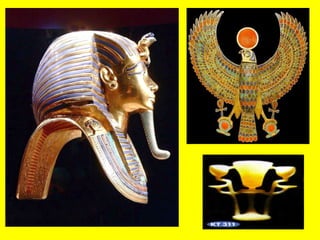
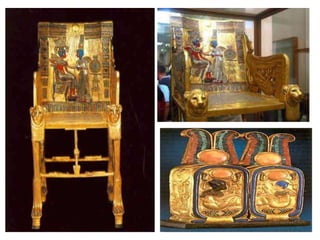
    King Tut 1334-1325BC 1. Son of Akhnaton 2. ruler at 9 3. Married sister 4. Original name Tutankhaton. Changed to Tutankhamun.
  • 176.
    5.Returned Egypt 2traditional beliefs in Amon Ra. 6. Dedicated temples at Karnak & Luxor, gave gifts to priests of Amon Ra 7.Murdered at 18/19?
  • 177.
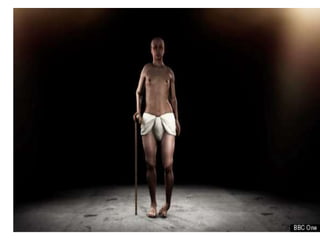
    • Don’t write!!http://www.youtube.com/watch?v=H7ukJSMlazc • http://video.nationalgeographic.com/video/places/countries-places/egypt/king-tuts-tomb/ • http://www.youtube.com/watch?v=5HKVE5fw9JY • Wife wrote letter to marry Hittite king’s son, but was killed along way. Forced to marry Ay, general who took throne. • War fought, Egypt loses. • Angry priests destroy records of father & son (why tomb survived)
  • 180.
  • 193.
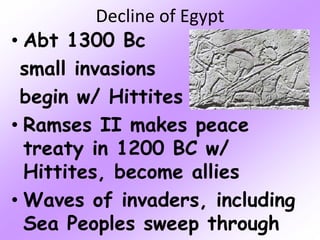
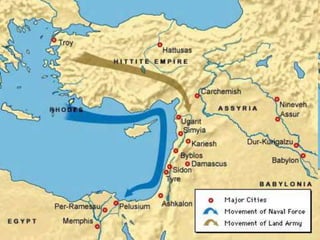
    Decline of Egypt •Abt 1300 Bc small invasions begin w/ Hittites • Ramses II makes peace treaty in 1200 BC w/ Hittites, become allies • Waves of invaders, including Sea Peoples sweep through
  • 195.
    DON’T WRITE! 1150-332 invadedrepeatedly • Ethiopians 1150 BC • Libyans 950 BC • Kush 751 BC • Assyrians 670 BC • Persians 525 BC • Greeks 331 BC (Alexander the Great w/ Cleopatra as last pharaoh) • Romans: 31 BC now Roman province
  • 196.
    Why did itdecline? • Pharaohs often concerned w building for own glory • Heavy taxes • Lots of $$$$$ spent trying to expand border • Little individual freedom • Stuck w/ social class system (No real middle class)
  • 197.
    Anksanamun’s letter tothe Hittite king • My husband is dead. I do not have any sons. But you have many sons. Please send me a son to marry and he will become my husband and will be king of Egypt. I would never marry one of my
  • 198.
    1. Read theLetter from Ankhsenamun 2. Now, read the background information. Make a list of 3 questions you have 3. Next, who do you think is guilty for the death of Tut, the Hittite prince & Ankhsenmum. Move around room to show who you think it was! 4. Pass out graphic organizer. Fill in evidence you have so far from the background info
  • 199.
    5. For thegame: a. Your group gets a game board, evidence cards & new graphic organizers. Each person must choose a game piece for your board. Sort the cards to go with the correct location on the game board • b. Roll the die & move around the board (start anywhere). When you land on a labeled space, you may roll again or choose an evidence card. (if you get a card you have already read, choose another). Only one card can be read at each location. You then move on. You may return to that location after visiting another location. Write down your evidence on your chart
  • 200.
    6. Continue playinggame and write down your evidence as you go. 7.Get a copy of a Tomb Wall Tells All. Your job is to draw what your conclusions are on the deaths of Tut, Ankhsenamun and the Hittite prince. You must address each one separately. Include what happened to them and who, if any one, killed them. These should be colorful, as if they are going on a real tomb wall. Your group must also include a written description of what happened, including using your evidence for support that you have gathered.
  • 207.
    1. Read thesituations. Answer the 4 questions about WHERE you & your partner would settle & WHY! 2. Next, look at the map. Think about Mesopotamia’s geography, what you know about Egypt & what you see on the map. List as many reasons as you can to explain how rivers & latitude helped contribute to long term settlement (think advanced settlements, specialized workers, technolgy, records, etc) 3. Next, read the Poem to the Nile. UNDERLINE phrases, words & terms that tell you about the importance of the Nile. EXPLAIN what they tell you about what the Nile meant to Egypt! (on back!)
  • 208.
  • 209.
    Mummification! 1. With apartner, read Herodotus’ source on mummification. 2. Highlight words or phrases that describe the process or show a religious connection. 3. Answer the questions (in complete sentences) about the source. Be sure you cite SPECIFIC textual examples for support. 4. Be ready for a quick quiz
  • 210.
    Shabtis! A shabti wasmeant to be your servant in the after life! Design one for you! What work would you want YOURS doing? Carve it to show your needs! A. Shred up some soap! B. form a figure using the scrappings. Dampen your hands with water to smooth & form C. Use popcsicle sticks to carve out the details after you form a basic body D. Now, explain, why would a shabti be important in Egyptian religious beliefs & burial processes? Do we have anything similar?
  • 211.
    1. Look atthe list of artifacts. Make an inference about each one. What is it? What was it used for? It’s purpose would it have in the afterlife? 2. Now read Tombs over Time 3. Using the chart, Starting a Short story, develop a storyline utilizing what you know about Egyptian tombs, burials, building practices, geography… (are you building, discovering, being cursed, trapped, looking for treasure?) 4. Now write a story & incorporate what you know! Use at least 5 items from your artifact list 5. Illustrate it!
  • 212.
    • In YOURopinion, do the Pyramids deserve to be on the 7 Ancient Wonders of the World list? Why or why not? • What do the building of these pyramids tell you about the 5 characteristics of civilization (address each!) 1. advanced settlements 2. specialized workers 3. Complex institutions 4. record keeping 5. technology
  • 213.
    • What dothe building of these pyramids tell you about the 5 characteristics of civilization (address each!) 1. advanced settlements 2. specialized workers 3. Complex institutions 4. record keeping 5. technology Do this in the form of a hand turkey! (civilization on the body & 5 characteristics on the feathers!)
  • 214.
    • On theback: 1. Rank the leaders in order from most to least important. Give a brief explanation of why they received that rank 2. What qualities do these leaders have in common? Pick 3 3. Are these same qualities important in leadership today? Why or why not 4. Describe the 2 contributions that you feel had the most impact on society (doesn’t matter if they are from different leaders)