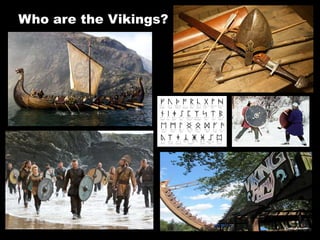
Who are the Vikings?
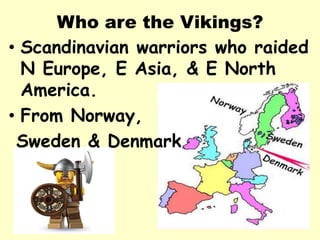
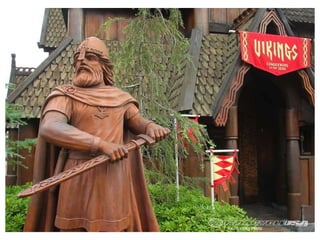
• Scandinavian warriors who raided
N Europe, E Asia, & E North
America.
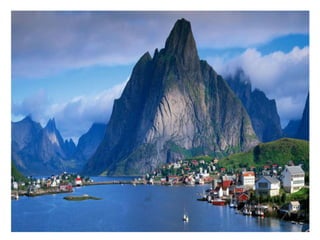
• From Norway,
Sweden & Denmark
Where did they go?
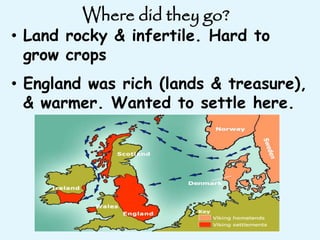
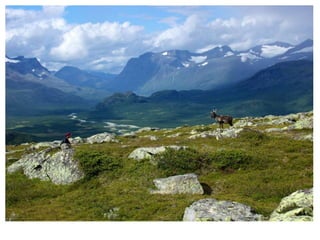
• Land rocky & infertile. Hard to
grow crops
• England was rich (lands & treasure),
& warmer. Wanted to settle here.
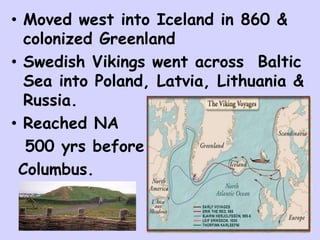
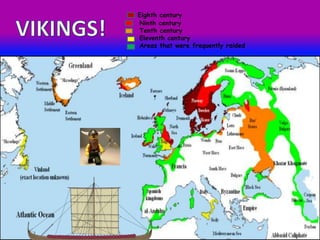
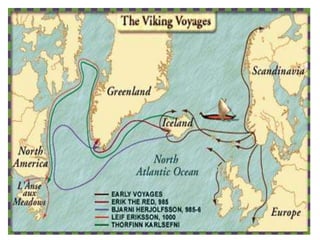
• Moved west into Iceland in 860 &
colonized Greenland
• Swedish Vikings went across Baltic
Sea into Poland, Latvia, Lithuania &
Russia.
• Reached NA
500 yrs before
Columbus.
Eighth century
Ninth century
Tenth century
Eleventh century
Areas that were frequently raided
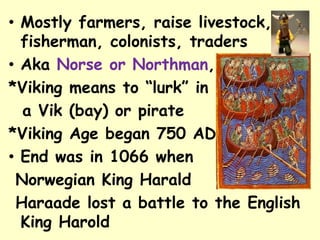
• Mostly farmers, raise livestock,
fisherman, colonists, traders
• Aka Norse or Northman,
*Viking means to “lurk” in
a Vik (bay) or pirate
*Viking Age began 750 AD
• End was in 1066 when
Norwegian King Harald
Haraade lost a battle to the English
King Harold
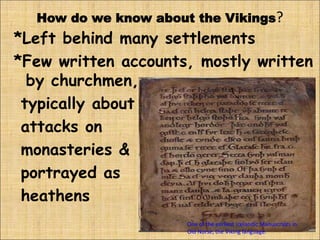
One of the earliest Icelandic Manuscripts in
Old Norse, the Viking language.
How do we know about the Vikings?
*Left behind many settlements
*Few written accounts, mostly written
by churchmen,
typically about
attacks on
monasteries &
portrayed as
heathens
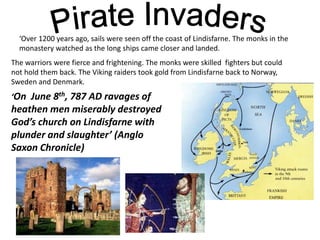
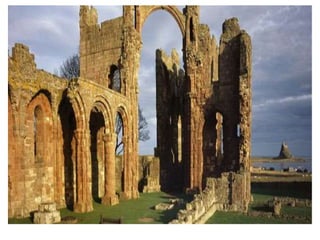
‘Over 1200 years ago, sails were seen off the coast of Lindisfarne. The monks in the
monastery watched as the long ships came closer and landed.
The warriors were fierce and frightening. The monks were skilled fighters but could
not hold them back. The Viking raiders took gold from Lindisfarne back to Norway,
Sweden and Denmark.
‘On June 8th, 787 AD ravages of
heathen men miserably destroyed
God’s church on Lindisfarne with
plunder and slaughter’ (Anglo
Saxon Chronicle)
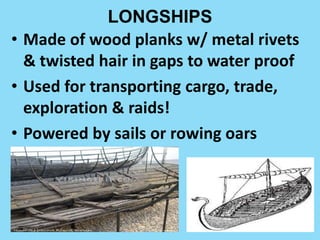
LONGSHIPS
• Made of wood planks w/ metal rivets
& twisted hair in gaps to water proof
• Used for transporting cargo, trade,
exploration & raids!
• Powered by sails or rowing oars
Don’t write
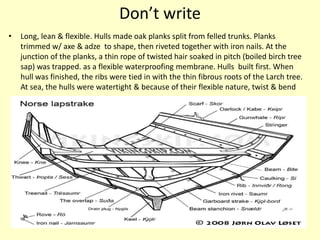
• Long, lean & flexible. Hulls made oak planks split from felled trunks. Planks
trimmed w/ axe & adze to shape, then riveted together with iron nails. At the
junction of the planks, a thin rope of twisted hair soaked in pitch (boiled birch tree
sap) was trapped. as a flexible waterproofing membrane. Hulls built first. When
hull was finished, the ribs were tied in with the thin fibrous roots of the Larch tree.
At sea, the hulls were watertight & because of their flexible nature, twist & bend
Don’t write!
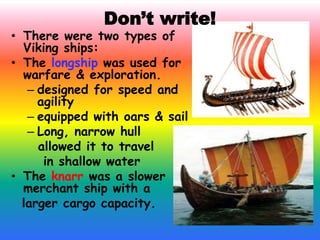
• There were two types of
Viking ships:
• The longship was used for
warfare & exploration.
– designed for speed and
agility
– equipped with oars & sail
– Long, narrow hull
allowed it to travel
in shallow water
• The knarr was a slower
merchant ship with a
larger cargo capacity.
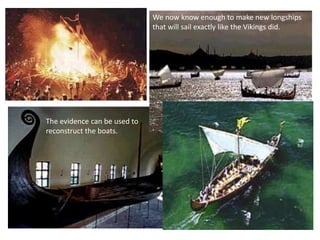
Archaeologists have discovered
many wrecks of longboats at the
bottom of the ocean or buried in
the ground.
The evidence can be used to
reconstruct the boats.
We now know enough to make new longships
that will sail exactly like the Vikings did.
Vikings even used their boats to bury
great warriors at sea. They used to
set fire to the longships.
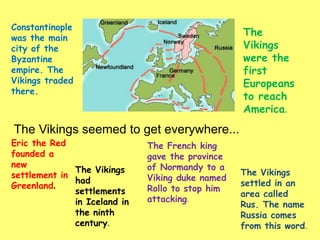
The Vikings seemed to get everywhere...
Constantinople
was the main
city of the
Byzantine
empire. The
Vikings traded
there.
Eric the Red
founded a
new
settlement in
Greenland.
The
Vikings
were the
first
Europeans
to reach
America.
The Vikings
had
settlements
in Iceland in
the ninth
century.
The French king
gave the province
of Normandy to a
Viking duke named
Rollo to stop him
attacking.
The Vikings
settled in an
area called
Rus. The name
Russia comes
from this word.
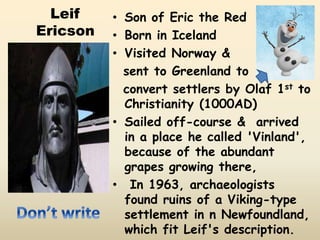
Leif
Ericson
• Son of Eric the Red
• Born in Iceland
• Visited Norway &
sent to Greenland to
convert settlers by Olaf 1st to
Christianity (1000AD)
• Sailed off-course & arrived
in a place he called 'Vinland',
because of the abundant
grapes growing there,
• In 1963, archaeologists
found ruins of a Viking-type
settlement in n Newfoundland,
which fit Leif's description.
Religion!
• 53 Viking Gods, gods for everything
• Die in battle, granted a place in
after life called Valhalla (hall of the
dead) for eternity (why Vikings were
bold & fearless in battle.
• Left meat & beer outside
the main hall for gods
Rune stones honor
gods
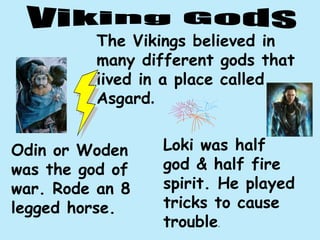
The Vikings believed in
many different gods that
lived in a place called
Asgard.
Odin or Woden
was the god of
war. Rode an 8
legged horse.
Loki was half
god & half fire
spirit. He played
tricks to cause
trouble.
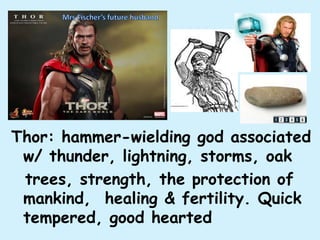
Thor: hammer-wielding god associated
w/ thunder, lightning, storms, oak
trees, strength, the protection of
mankind, healing & fertility. Quick
tempered, good hearted
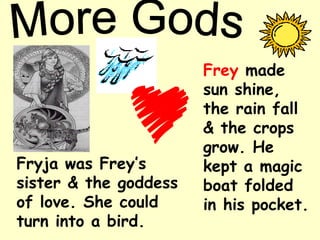
Fryja was Frey’s
sister & the goddess
of love. She could
turn into a bird.
Frey made
sun shine,
the rain fall
& the crops
grow. He
kept a magic
boat folded
in his pocket.
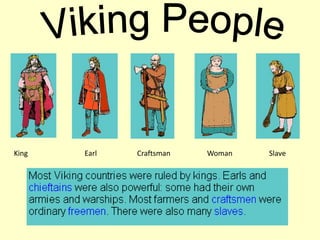
King Earl Craftsman Woman Slave
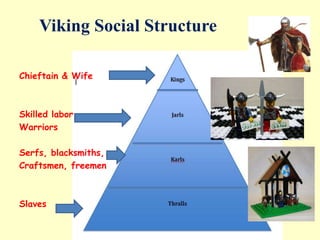
Viking Social Structure
Chieftain & Wife
Skilled labor,
Warriors
Serfs, blacksmiths,
Craftsmen, freemen
Slaves
Don’t write
• Swordsmiths highly skilled & respected.
• Thin bars of iron were packed in red-hot
charcoal to form steel; then cut up, twisted
& reforged several times, & filed into shape.
*Strips of especially fine steel were welded
onto the sides to form the cutting edges & then
hardened by alternately plunging it
into fire & cold liquid. Last, it was filed down &
polished by rubbing with acid.
• ! The hilt was made of iron, bone, ivory or
horn, often inlaid w/ precious metals.
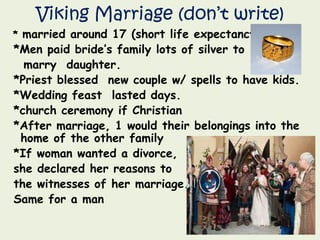
Viking Marriage (don’t write)
* married around 17 (short life expectancy)
*Men paid bride’s family lots of silver to
marry daughter.
*Priest blessed new couple w/ spells to have kids.
*Wedding feast lasted days.
*church ceremony if Christian
*After marriage, 1 would their belongings into the
home of the other family
*If woman wanted a divorce,
she declared her reasons to
the witnesses of her marriage.
Same for a man
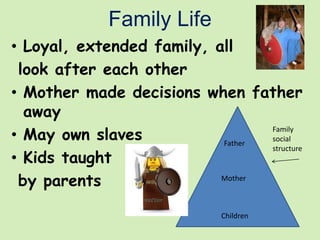
Family Life
• Loyal, extended family, all
look after each other
• Mother made decisions when father
away
• May own slaves
• Kids taught
by parents
Family
social
structure
Father
Mother
Children
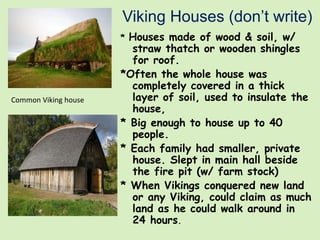
Viking Houses (don’t write)
* Houses made of wood & soil, w/
straw thatch or wooden shingles
for roof.
*Often the whole house was
completely covered in a thick
layer of soil, used to insulate the
house,
* Big enough to house up to 40
people.
* Each family had smaller, private
house. Slept in main hall beside
the fire pit (w/ farm stock)
* When Vikings conquered new land
or any Viking, could claim as much
land as he could walk around in
24 hours.
Common Viking house
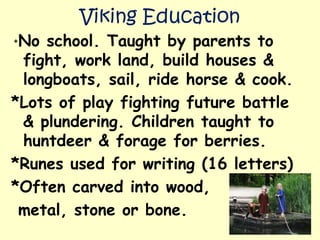
Viking Education
*No school. Taught by parents to
fight, work land, build houses &
longboats, sail, ride horse & cook.
*Lots of play fighting future battle
& plundering. Children taught to
huntdeer & forage for berries.
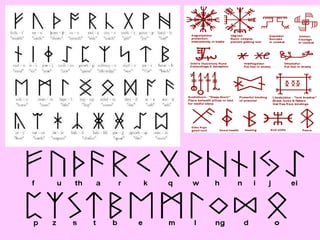
*Runes used for writing (16 letters)
*Often carved into wood,
metal, stone or bone.
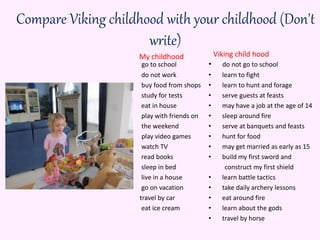
Compare Viking childhood with your childhood (Don't
write)
• do not go to school
• learn to fight
• learn to hunt and forage
• serve guests at feasts
• may have a job at the age of 14
• sleep around fire
• serve at banquets and feasts
• hunt for food
• may get married as early as 15
• build my first sword and
construct my first shield
• learn battle tactics
• take daily archery lessons
• eat around fire
• learn about the gods
• travel by horse
 go to school
 do not work
 buy food from shops
 study for tests
 eat in house
 play with friends on
the weekend
play video games
 watch TV
 read books
 sleep in bed
 live in a house
 go on vacation
 travel by car
 eat ice cream
My childhood Viking child hood
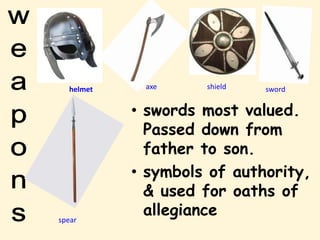
helmet axe shield
spear
sword
• swords most valued.
Passed down from
father to son.
• symbols of authority,
& used for oaths of
allegiance
Viking Food
*lots of foods, drank beer & mead
(honey based alcoholic drink)
*Viking feasts went on for
hours or days. Held outside
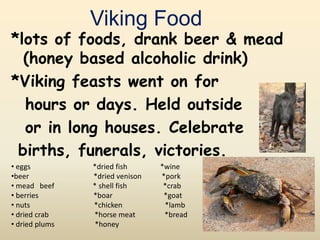
or in long houses. Celebrate
births, funerals, victories.
• eggs *dried fish *wine
•beer *dried venison *pork
• mead beef * shell fish *crab
• berries *boar *goat
• nuts *chicken *lamb
• dried crab *horse meat *bread
• dried plums *honey
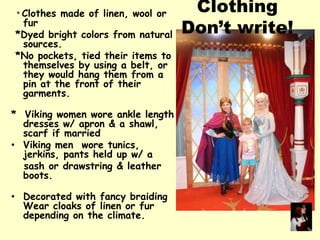
* Clothes made of linen, wool or
fur
*Dyed bright colors from natural
sources.
*No pockets, tied their items to
themselves by using a belt, or
they would hang them from a
pin at the front of their
garments.
* Viking women wore ankle length
dresses w/ apron & a shawl,
scarf if married
• Viking men wore tunics,
jerkins, pants held up w/ a
sash or drawstring & leather
boots.
• Decorated with fancy braiding
Wear cloaks of linen or fur
depending on the climate.
Clothing
Don’t write!
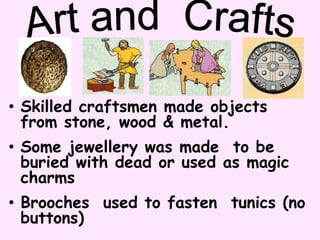
• Skilled craftsmen made objects
from stone, wood & metal.
• Some jewellery was made to be
buried with dead or used as magic
charms
• Brooches used to fasten tunics (no
buttons)
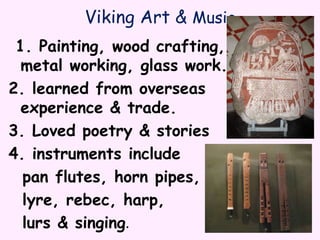
Viking Art & Music
1. Painting, wood crafting,
metal working, glass work.
2. learned from overseas
experience & trade.
3. Loved poetry & stories
4. instruments include
pan flutes, horn pipes,
lyre, rebec, harp,
lurs & singing.
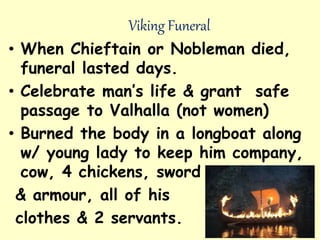
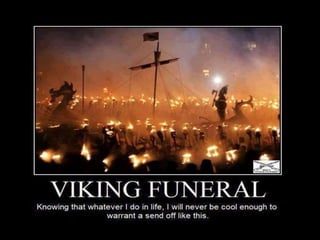
Viking Funeral
• When Chieftain or Nobleman died,
funeral lasted days.
• Celebrate man’s life & grant safe
passage to Valhalla (not women)
• Burned the body in a longboat along
w/ young lady to keep him company,
cow, 4 chickens, sword
& armour, all of his
clothes & 2 servants.
TREASURE!
• 1000 hoard of treasue have been found (often buried in coruntyside near landmarks
• From the 8th to 11th Centuries, Viking pirates, mainly from Norway, Denmark and Norse
• settlements in Scotland, made violent raids all round the coasts of Britain, Ireland, and most
• of Western Europe, including the Mediterranean lands; and also up many major rivers.
• ! The first recorded Viking raid on Britain was on the monastery at Lindisfarne (Holy Island), off
• the coast of Northumberland in 793.
• ! Monasteries were often targeted by Viking pirate raiders because they contained religious
• treasures, and wine used for Mass. But towns and villages were also regularly attacked.
• ! Monks, nuns and people of high social status were often captured alive by the pirates for
• ransom. Others were sold as slaves.
• ! The Icelandic Sagas - quasi-historical stories about the Viking Age, but first written down
• several centuries later - mention how powerful farmers indulged in pirate raiding as a part-
• time activity to increase their wealth. Even kings went raiding to fill their coffers. The 13th
• Century book, Orkneyinga Saga, says that when King Eirik Blood-Axe, who ruled York for
• some of the 10th Century, “...ran short of money... he spent the summers plundering”.
• ! The prevalence of piracy contrasts strongly with the fact that the Vikings had many laws and
• also a highly developed sense of honourable and moral behaviour. This emphasised
• behaving altruistically towards one’s own group; caution, moderation and fair play. The worst
• faults were considered to be disloyalty or treachery towards a friend or relative.
• http://www.youtube.com/watch?v=2MAZzSow5Uc (horrbile
h. viking report
• http://www.youtube.com/watch?v=2GuN61M380s (beliefs)
• http://www.youtube.com/watch?v=8qSkaAwKMD4
• http://www.youtube.com/watch?v=SrBnIoONit0 poetry
• http://www.youtube.com/watch?v=hwaSSVOPwSE attack
• http://www.youtube.com/watch?v=CQFD8FF
MLZA

Who are the vikings

  • 1.
    Who are theVikings?
  • 4.
    Who are theVikings? • Scandinavian warriors who raided N Europe, E Asia, & E North America. • From Norway, Sweden & Denmark
  • 5.
    Where did theygo? • Land rocky & infertile. Hard to grow crops • England was rich (lands & treasure), & warmer. Wanted to settle here.
  • 9.
    • Moved westinto Iceland in 860 & colonized Greenland • Swedish Vikings went across Baltic Sea into Poland, Latvia, Lithuania & Russia. • Reached NA 500 yrs before Columbus.
  • 10.
    Eighth century Ninth century Tenthcentury Eleventh century Areas that were frequently raided
  • 11.
    • Mostly farmers,raise livestock, fisherman, colonists, traders • Aka Norse or Northman, *Viking means to “lurk” in a Vik (bay) or pirate *Viking Age began 750 AD • End was in 1066 when Norwegian King Harald Haraade lost a battle to the English King Harold
  • 12.
    One of theearliest Icelandic Manuscripts in Old Norse, the Viking language. How do we know about the Vikings? *Left behind many settlements *Few written accounts, mostly written by churchmen, typically about attacks on monasteries & portrayed as heathens
  • 13.
    ‘Over 1200 yearsago, sails were seen off the coast of Lindisfarne. The monks in the monastery watched as the long ships came closer and landed. The warriors were fierce and frightening. The monks were skilled fighters but could not hold them back. The Viking raiders took gold from Lindisfarne back to Norway, Sweden and Denmark. ‘On June 8th, 787 AD ravages of heathen men miserably destroyed God’s church on Lindisfarne with plunder and slaughter’ (Anglo Saxon Chronicle)
  • 15.
    LONGSHIPS • Made ofwood planks w/ metal rivets & twisted hair in gaps to water proof • Used for transporting cargo, trade, exploration & raids! • Powered by sails or rowing oars
  • 16.
    Don’t write • Long,lean & flexible. Hulls made oak planks split from felled trunks. Planks trimmed w/ axe & adze to shape, then riveted together with iron nails. At the junction of the planks, a thin rope of twisted hair soaked in pitch (boiled birch tree sap) was trapped. as a flexible waterproofing membrane. Hulls built first. When hull was finished, the ribs were tied in with the thin fibrous roots of the Larch tree. At sea, the hulls were watertight & because of their flexible nature, twist & bend
  • 17.
    Don’t write! • Therewere two types of Viking ships: • The longship was used for warfare & exploration. – designed for speed and agility – equipped with oars & sail – Long, narrow hull allowed it to travel in shallow water • The knarr was a slower merchant ship with a larger cargo capacity.
  • 18.
    Archaeologists have discovered manywrecks of longboats at the bottom of the ocean or buried in the ground. The evidence can be used to reconstruct the boats. We now know enough to make new longships that will sail exactly like the Vikings did. Vikings even used their boats to bury great warriors at sea. They used to set fire to the longships.
  • 20.
    The Vikings seemedto get everywhere... Constantinople was the main city of the Byzantine empire. The Vikings traded there. Eric the Red founded a new settlement in Greenland. The Vikings were the first Europeans to reach America. The Vikings had settlements in Iceland in the ninth century. The French king gave the province of Normandy to a Viking duke named Rollo to stop him attacking. The Vikings settled in an area called Rus. The name Russia comes from this word.
  • 22.
    Leif Ericson • Son ofEric the Red • Born in Iceland • Visited Norway & sent to Greenland to convert settlers by Olaf 1st to Christianity (1000AD) • Sailed off-course & arrived in a place he called 'Vinland', because of the abundant grapes growing there, • In 1963, archaeologists found ruins of a Viking-type settlement in n Newfoundland, which fit Leif's description.
  • 23.
    Religion! • 53 VikingGods, gods for everything • Die in battle, granted a place in after life called Valhalla (hall of the dead) for eternity (why Vikings were bold & fearless in battle. • Left meat & beer outside the main hall for gods Rune stones honor gods
  • 24.
    The Vikings believedin many different gods that lived in a place called Asgard. Odin or Woden was the god of war. Rode an 8 legged horse. Loki was half god & half fire spirit. He played tricks to cause trouble.
  • 25.
    Thor: hammer-wielding godassociated w/ thunder, lightning, storms, oak trees, strength, the protection of mankind, healing & fertility. Quick tempered, good hearted
  • 26.
    Fryja was Frey’s sister& the goddess of love. She could turn into a bird. Frey made sun shine, the rain fall & the crops grow. He kept a magic boat folded in his pocket.
  • 27.
  • 28.
    Viking Social Structure Chieftain& Wife Skilled labor, Warriors Serfs, blacksmiths, Craftsmen, freemen Slaves
  • 29.
    Don’t write • Swordsmithshighly skilled & respected. • Thin bars of iron were packed in red-hot charcoal to form steel; then cut up, twisted & reforged several times, & filed into shape. *Strips of especially fine steel were welded onto the sides to form the cutting edges & then hardened by alternately plunging it into fire & cold liquid. Last, it was filed down & polished by rubbing with acid. • ! The hilt was made of iron, bone, ivory or horn, often inlaid w/ precious metals.
  • 31.
    Viking Marriage (don’twrite) * married around 17 (short life expectancy) *Men paid bride’s family lots of silver to marry daughter. *Priest blessed new couple w/ spells to have kids. *Wedding feast lasted days. *church ceremony if Christian *After marriage, 1 would their belongings into the home of the other family *If woman wanted a divorce, she declared her reasons to the witnesses of her marriage. Same for a man
  • 32.
    Family Life • Loyal,extended family, all look after each other • Mother made decisions when father away • May own slaves • Kids taught by parents Family social structure Father Mother Children
  • 33.
    Viking Houses (don’twrite) * Houses made of wood & soil, w/ straw thatch or wooden shingles for roof. *Often the whole house was completely covered in a thick layer of soil, used to insulate the house, * Big enough to house up to 40 people. * Each family had smaller, private house. Slept in main hall beside the fire pit (w/ farm stock) * When Vikings conquered new land or any Viking, could claim as much land as he could walk around in 24 hours. Common Viking house
  • 34.
    Viking Education *No school.Taught by parents to fight, work land, build houses & longboats, sail, ride horse & cook. *Lots of play fighting future battle & plundering. Children taught to huntdeer & forage for berries. *Runes used for writing (16 letters) *Often carved into wood, metal, stone or bone.
  • 36.
    Compare Viking childhoodwith your childhood (Don't write) • do not go to school • learn to fight • learn to hunt and forage • serve guests at feasts • may have a job at the age of 14 • sleep around fire • serve at banquets and feasts • hunt for food • may get married as early as 15 • build my first sword and construct my first shield • learn battle tactics • take daily archery lessons • eat around fire • learn about the gods • travel by horse  go to school  do not work  buy food from shops  study for tests  eat in house  play with friends on the weekend play video games  watch TV  read books  sleep in bed  live in a house  go on vacation  travel by car  eat ice cream My childhood Viking child hood
  • 37.
    helmet axe shield spear sword •swords most valued. Passed down from father to son. • symbols of authority, & used for oaths of allegiance
  • 38.
    Viking Food *lots offoods, drank beer & mead (honey based alcoholic drink) *Viking feasts went on for hours or days. Held outside or in long houses. Celebrate births, funerals, victories. • eggs *dried fish *wine •beer *dried venison *pork • mead beef * shell fish *crab • berries *boar *goat • nuts *chicken *lamb • dried crab *horse meat *bread • dried plums *honey
  • 39.
    * Clothes madeof linen, wool or fur *Dyed bright colors from natural sources. *No pockets, tied their items to themselves by using a belt, or they would hang them from a pin at the front of their garments. * Viking women wore ankle length dresses w/ apron & a shawl, scarf if married • Viking men wore tunics, jerkins, pants held up w/ a sash or drawstring & leather boots. • Decorated with fancy braiding Wear cloaks of linen or fur depending on the climate. Clothing Don’t write!
  • 40.
    • Skilled craftsmenmade objects from stone, wood & metal. • Some jewellery was made to be buried with dead or used as magic charms • Brooches used to fasten tunics (no buttons)
  • 41.
    Viking Art &Music 1. Painting, wood crafting, metal working, glass work. 2. learned from overseas experience & trade. 3. Loved poetry & stories 4. instruments include pan flutes, horn pipes, lyre, rebec, harp, lurs & singing.
  • 42.
    Viking Funeral • WhenChieftain or Nobleman died, funeral lasted days. • Celebrate man’s life & grant safe passage to Valhalla (not women) • Burned the body in a longboat along w/ young lady to keep him company, cow, 4 chickens, sword & armour, all of his clothes & 2 servants.
  • 44.
    TREASURE! • 1000 hoardof treasue have been found (often buried in coruntyside near landmarks • From the 8th to 11th Centuries, Viking pirates, mainly from Norway, Denmark and Norse • settlements in Scotland, made violent raids all round the coasts of Britain, Ireland, and most • of Western Europe, including the Mediterranean lands; and also up many major rivers. • ! The first recorded Viking raid on Britain was on the monastery at Lindisfarne (Holy Island), off • the coast of Northumberland in 793. • ! Monasteries were often targeted by Viking pirate raiders because they contained religious • treasures, and wine used for Mass. But towns and villages were also regularly attacked. • ! Monks, nuns and people of high social status were often captured alive by the pirates for • ransom. Others were sold as slaves. • ! The Icelandic Sagas - quasi-historical stories about the Viking Age, but first written down • several centuries later - mention how powerful farmers indulged in pirate raiding as a part- • time activity to increase their wealth. Even kings went raiding to fill their coffers. The 13th • Century book, Orkneyinga Saga, says that when King Eirik Blood-Axe, who ruled York for • some of the 10th Century, “...ran short of money... he spent the summers plundering”. • ! The prevalence of piracy contrasts strongly with the fact that the Vikings had many laws and • also a highly developed sense of honourable and moral behaviour. This emphasised • behaving altruistically towards one’s own group; caution, moderation and fair play. The worst • faults were considered to be disloyalty or treachery towards a friend or relative.
  • 45.
    • http://www.youtube.com/watch?v=2MAZzSow5Uc (horrbile h.viking report • http://www.youtube.com/watch?v=2GuN61M380s (beliefs) • http://www.youtube.com/watch?v=8qSkaAwKMD4 • http://www.youtube.com/watch?v=SrBnIoONit0 poetry • http://www.youtube.com/watch?v=hwaSSVOPwSE attack • http://www.youtube.com/watch?v=CQFD8FF MLZA