A Glimpse of
Industrial Polymers
CONTENTS
2

 What is ‘polymer’ and ‘plastic’?
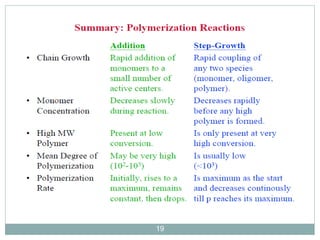
 Two types of polymerization reactions
 Chain polymerization examples

 Step growth polymerization examples
 Comparison of two types
 Rubber, Vulcanization, Synthetic elastomers
 Synthetic Fibers
 Synthetic Films

 Biodegradable plastic
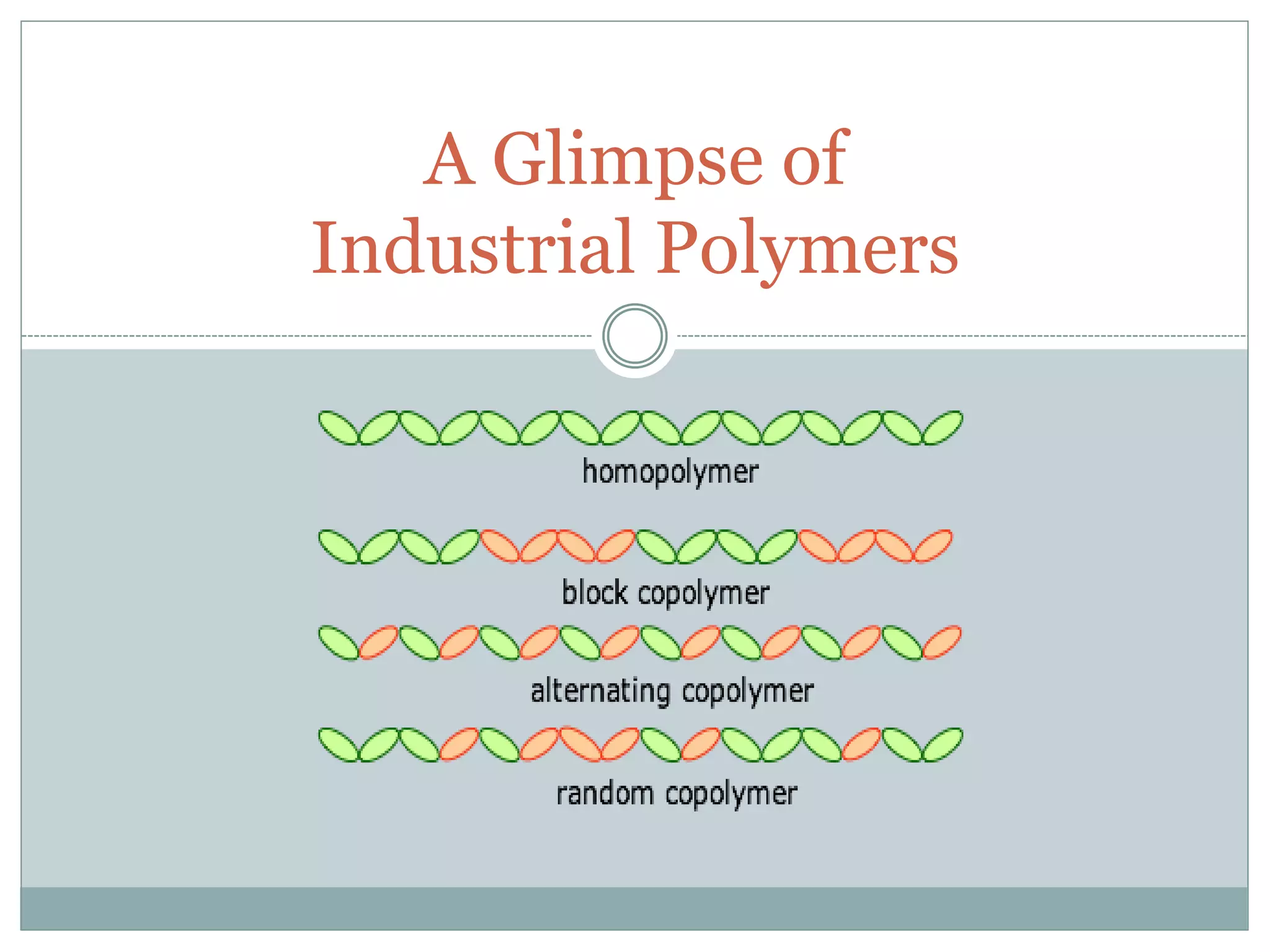
• Polymers are large molecules that are formed from
relatively small molecular fragments known as monomers
that are bonded together repetitively.
• Wool, cotton, silk, wood and leather are examples of
natural polymers that have been known and used since
ancient times. This group includes biopolymers such as
proteins and carbohydrates that are constituents of all
living organisms.
• Synthetic polymers, which includes the large group known

as plastics, came into prominence in the early twentieth
century.
3
POLYMERIZATION REACTION
4

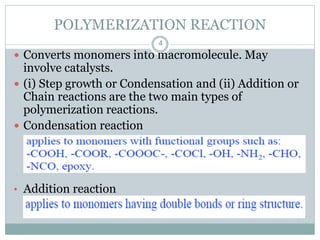
 Converts monomers into macromolecule. May

involve catalysts.
 (i) Step growth or Condensation and (ii) Addition or
Chain reactions are the two main types of
polymerization reactions.
 Condensation reaction

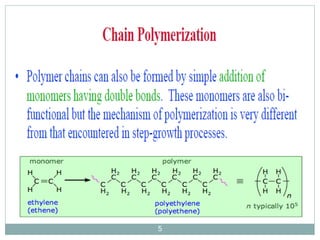
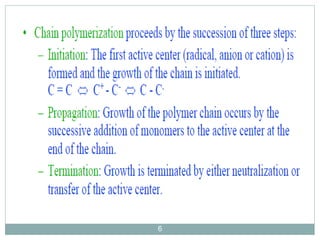
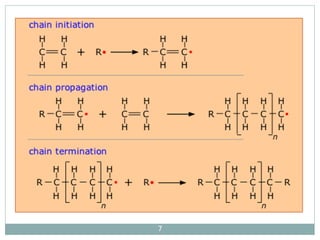
• Addition reaction
5
6
7
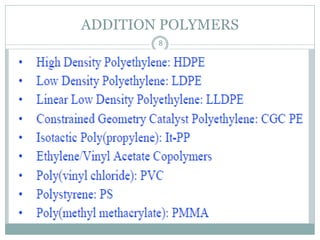
ADDITION POLYMERS
8
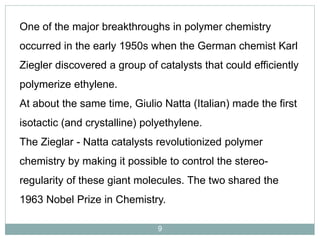
One of the major breakthroughs in polymer chemistry

occurred in the early 1950s when the German chemist Karl
Ziegler discovered a group of catalysts that could efficiently

polymerize ethylene.
At about the same time, Giulio Natta (Italian) made the first
isotactic (and crystalline) polyethylene.
The Zieglar - Natta catalysts revolutionized polymer
chemistry by making it possible to control the stereoregularity of these giant molecules. The two shared the
1963 Nobel Prize in Chemistry.
9
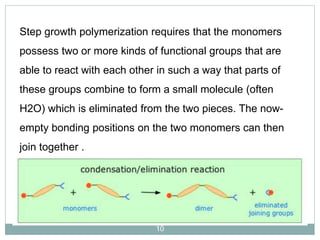
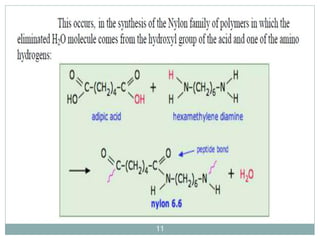
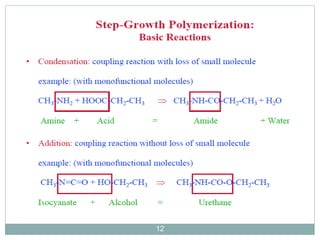
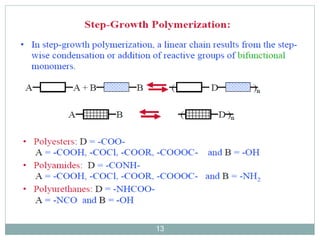
Step growth polymerization requires that the monomers
possess two or more kinds of functional groups that are
able to react with each other in such a way that parts of
these groups combine to form a small molecule (often

H2O) which is eliminated from the two pieces. The nowempty bonding positions on the two monomers can then
join together .

10
11
12
13
Thermoset polymer Bakelite
14
Phenolic resins
15

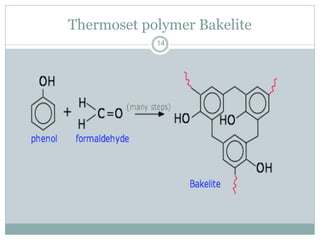
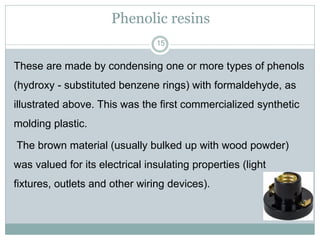
These are made by condensing one or more types of phenols
(hydroxy - substituted benzene rings) with formaldehyde, as
illustrated above. This was the first commercialized synthetic
molding plastic.
The brown material (usually bulked up with wood powder)
was valued for its electrical insulating properties (light
fixtures, outlets and other wiring devices).
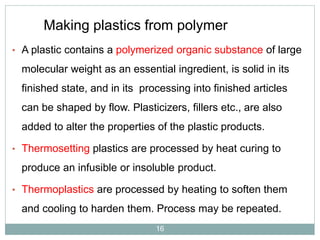
Making plastics from polymer
• A plastic contains a polymerized organic substance of large

molecular weight as an essential ingredient, is solid in its
finished state, and in its processing into finished articles

can be shaped by flow. Plasticizers, fillers etc., are also
added to alter the properties of the plastic products.
• Thermosetting plastics are processed by heat curing to

produce an infusible or insoluble product.
• Thermoplastics are processed by heating to soften them

and cooling to harden them. Process may be repeated.
16
17
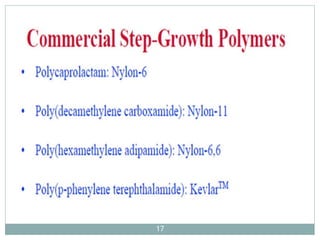
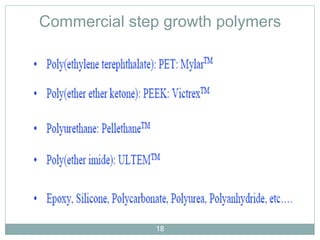
Commercial step growth polymers

18
19
Raw Materials
20

 Monomers: vinyl chloride, ethylene, propylene and

similar simple hydrocarbons
 Chemical intermediates : phenol, formaldehyde,

hexamethylenetetramine, phthalic anhydride,
methyl acrylate and methacrylate
 Other raw materials: plasticizers, fillers, and

reinforcements are also added to alter the properties
of the plastic products.
RUBBER
21

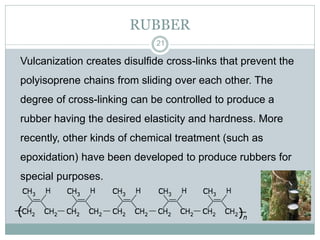
Vulcanization creates disulfide cross-links that prevent the
polyisoprene chains from sliding over each other. The

degree of cross-linking can be controlled to produce a
rubber having the desired elasticity and hardness. More
recently, other kinds of chemical treatment (such as
epoxidation) have been developed to produce rubbers for
special purposes.
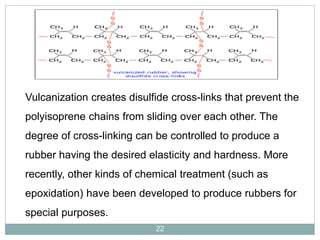
Vulcanization creates disulfide cross-links that prevent the
polyisoprene chains from sliding over each other. The

degree of cross-linking can be controlled to produce a
rubber having the desired elasticity and hardness. More

recently, other kinds of chemical treatment (such as
epoxidation) have been developed to produce rubbers for
special purposes.
22
Synthetic Fibers and their
Applications
 Polyamides –They are used in home furnishings,

especially carpets.
 Acrylics and Modacrylics – polyacrylonitrile is

the major component of several industrial textile
fibers.
 Spandex – It is used in foundation garments,

hose, swimwear and other elastic products.
23
Other Synthetic Fibers
 Polyolefins – They excel in special cases, such as

ropes, laundry nets, carpets, blankets and backing for
tuffed carpets, but are difficult to dye and their melting
point is low.

 Fluorocarbons – It is widely used in pump packings

and shaft bearings.

 Glass Fibers – are used for electrical insulation in

motors and generators, structural reinforcement of
plastics, fire-proof wall coverings and tire cords.
24
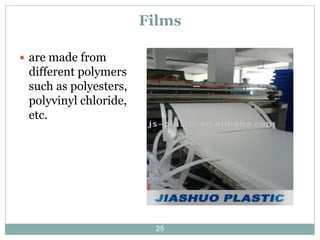
Films
 are made from

different polymers
such as polyesters,
polyvinyl chloride,
etc.

25
3 Common Types of Film Processing
 Slit-die process – produces flat sheets by extruding

the molten polymer through a slit-die into a quenching
water bath or onto a chilled roller.

 Blow-extrusion Process – produces tubular film by

using air pressure to force the molten polymer around
a mandrel.

 Calendering – preparation of film is produced by

feeding a plastic mix of polymer, stabilizer, and
plasticizers between two heated roll where it is
squeezed into a film.
26
Biodegradable disposable plastic
27

 Interest in biodegradable disposable plastic items has steadily grown

because of the environmental problems caused by non-degradable
synthetic polymers.
 Disposable packaging materials used to ship and protect purchased

items as well as disposable containers used for food and drink are of
special interest.
 The idea that one time use items can be disposed of with the peace of

mind, that they will not remain for centuries in a landfill, or as litter, is
one of the tenets driving the recent interest in "green" technologies and
lifestyles.
With packaging materials, the reduction in usage of raw
materials, re-use and recycling is of course the best route to
sustainable lifestyle.
However, for various reasons, in practice, much of the

material ends up being discarded to a landfill or accidentally
shows up as litter.

For these instances, it is advantageous to have a plastic
material that would biodegrade when exposed to
environments where other biodegradable materials are
undergoing decay.
28
What is Biodegradable?
Biodegradation is degradation caused by
biological activity, particularly by enzyme action
leading to significant changes in the material's
chemical structure. In essence, biodegradable
plastics should breakdown cleanly, in a defined
time period, to simple molecules found in the
environment such as carbon dioxide and water.
29
Polymer Science and Technology Books
30

 F. W. Billmayer, Textbook of Polymer Science 3rd

edition, 1984, John Wiley & Sons, Singapore
 F. Rodriguez, Principles of Polymer systems, 4th

edition, 1996, Taylor & Francis.
 Dryden’s Outline of Chemical Technology for 21st

Century, 3rd edition, chapter V a) Polymerization
Fundamentals, b) Polymerization Technology.

A Glimpse of Industrial polymers

  • 1.
  • 2.
    CONTENTS 2  What is‘polymer’ and ‘plastic’?  Two types of polymerization reactions  Chain polymerization examples  Step growth polymerization examples  Comparison of two types  Rubber, Vulcanization, Synthetic elastomers  Synthetic Fibers  Synthetic Films  Biodegradable plastic
  • 3.
    • Polymers arelarge molecules that are formed from relatively small molecular fragments known as monomers that are bonded together repetitively. • Wool, cotton, silk, wood and leather are examples of natural polymers that have been known and used since ancient times. This group includes biopolymers such as proteins and carbohydrates that are constituents of all living organisms. • Synthetic polymers, which includes the large group known as plastics, came into prominence in the early twentieth century. 3
  • 4.
    POLYMERIZATION REACTION 4  Convertsmonomers into macromolecule. May involve catalysts.  (i) Step growth or Condensation and (ii) Addition or Chain reactions are the two main types of polymerization reactions.  Condensation reaction • Addition reaction
  • 5.
  • 6.
  • 7.
  • 8.
  • 9.
    One of themajor breakthroughs in polymer chemistry occurred in the early 1950s when the German chemist Karl Ziegler discovered a group of catalysts that could efficiently polymerize ethylene. At about the same time, Giulio Natta (Italian) made the first isotactic (and crystalline) polyethylene. The Zieglar - Natta catalysts revolutionized polymer chemistry by making it possible to control the stereoregularity of these giant molecules. The two shared the 1963 Nobel Prize in Chemistry. 9
  • 10.
    Step growth polymerizationrequires that the monomers possess two or more kinds of functional groups that are able to react with each other in such a way that parts of these groups combine to form a small molecule (often H2O) which is eliminated from the two pieces. The nowempty bonding positions on the two monomers can then join together . 10
  • 11.
  • 12.
  • 13.
  • 14.
  • 15.
    Phenolic resins 15 These aremade by condensing one or more types of phenols (hydroxy - substituted benzene rings) with formaldehyde, as illustrated above. This was the first commercialized synthetic molding plastic. The brown material (usually bulked up with wood powder) was valued for its electrical insulating properties (light fixtures, outlets and other wiring devices).
  • 16.
    Making plastics frompolymer • A plastic contains a polymerized organic substance of large molecular weight as an essential ingredient, is solid in its finished state, and in its processing into finished articles can be shaped by flow. Plasticizers, fillers etc., are also added to alter the properties of the plastic products. • Thermosetting plastics are processed by heat curing to produce an infusible or insoluble product. • Thermoplastics are processed by heating to soften them and cooling to harden them. Process may be repeated. 16
  • 17.
  • 18.
  • 19.
  • 20.
    Raw Materials 20  Monomers:vinyl chloride, ethylene, propylene and similar simple hydrocarbons  Chemical intermediates : phenol, formaldehyde, hexamethylenetetramine, phthalic anhydride, methyl acrylate and methacrylate  Other raw materials: plasticizers, fillers, and reinforcements are also added to alter the properties of the plastic products.
  • 21.
    RUBBER 21 Vulcanization creates disulfidecross-links that prevent the polyisoprene chains from sliding over each other. The degree of cross-linking can be controlled to produce a rubber having the desired elasticity and hardness. More recently, other kinds of chemical treatment (such as epoxidation) have been developed to produce rubbers for special purposes.
  • 22.
    Vulcanization creates disulfidecross-links that prevent the polyisoprene chains from sliding over each other. The degree of cross-linking can be controlled to produce a rubber having the desired elasticity and hardness. More recently, other kinds of chemical treatment (such as epoxidation) have been developed to produce rubbers for special purposes. 22
  • 23.
    Synthetic Fibers andtheir Applications  Polyamides –They are used in home furnishings, especially carpets.  Acrylics and Modacrylics – polyacrylonitrile is the major component of several industrial textile fibers.  Spandex – It is used in foundation garments, hose, swimwear and other elastic products. 23
  • 24.
    Other Synthetic Fibers Polyolefins – They excel in special cases, such as ropes, laundry nets, carpets, blankets and backing for tuffed carpets, but are difficult to dye and their melting point is low.  Fluorocarbons – It is widely used in pump packings and shaft bearings.  Glass Fibers – are used for electrical insulation in motors and generators, structural reinforcement of plastics, fire-proof wall coverings and tire cords. 24
  • 25.
    Films  are madefrom different polymers such as polyesters, polyvinyl chloride, etc. 25
  • 26.
    3 Common Typesof Film Processing  Slit-die process – produces flat sheets by extruding the molten polymer through a slit-die into a quenching water bath or onto a chilled roller.  Blow-extrusion Process – produces tubular film by using air pressure to force the molten polymer around a mandrel.  Calendering – preparation of film is produced by feeding a plastic mix of polymer, stabilizer, and plasticizers between two heated roll where it is squeezed into a film. 26
  • 27.
    Biodegradable disposable plastic 27 Interest in biodegradable disposable plastic items has steadily grown because of the environmental problems caused by non-degradable synthetic polymers.  Disposable packaging materials used to ship and protect purchased items as well as disposable containers used for food and drink are of special interest.  The idea that one time use items can be disposed of with the peace of mind, that they will not remain for centuries in a landfill, or as litter, is one of the tenets driving the recent interest in "green" technologies and lifestyles.
  • 28.
    With packaging materials,the reduction in usage of raw materials, re-use and recycling is of course the best route to sustainable lifestyle. However, for various reasons, in practice, much of the material ends up being discarded to a landfill or accidentally shows up as litter. For these instances, it is advantageous to have a plastic material that would biodegrade when exposed to environments where other biodegradable materials are undergoing decay. 28
  • 29.
    What is Biodegradable? Biodegradationis degradation caused by biological activity, particularly by enzyme action leading to significant changes in the material's chemical structure. In essence, biodegradable plastics should breakdown cleanly, in a defined time period, to simple molecules found in the environment such as carbon dioxide and water. 29
  • 30.
    Polymer Science andTechnology Books 30  F. W. Billmayer, Textbook of Polymer Science 3rd edition, 1984, John Wiley & Sons, Singapore  F. Rodriguez, Principles of Polymer systems, 4th edition, 1996, Taylor & Francis.  Dryden’s Outline of Chemical Technology for 21st Century, 3rd edition, chapter V a) Polymerization Fundamentals, b) Polymerization Technology.