CONDUCTING
POLYMERS
From a Lab Curiosity to the Market Place
A Seminar On
September 17, 2019
Presented By Abhinav S
Sri Sathya Sai Institute Of Higher Learning
II M.Sc Chemistry
Introduction
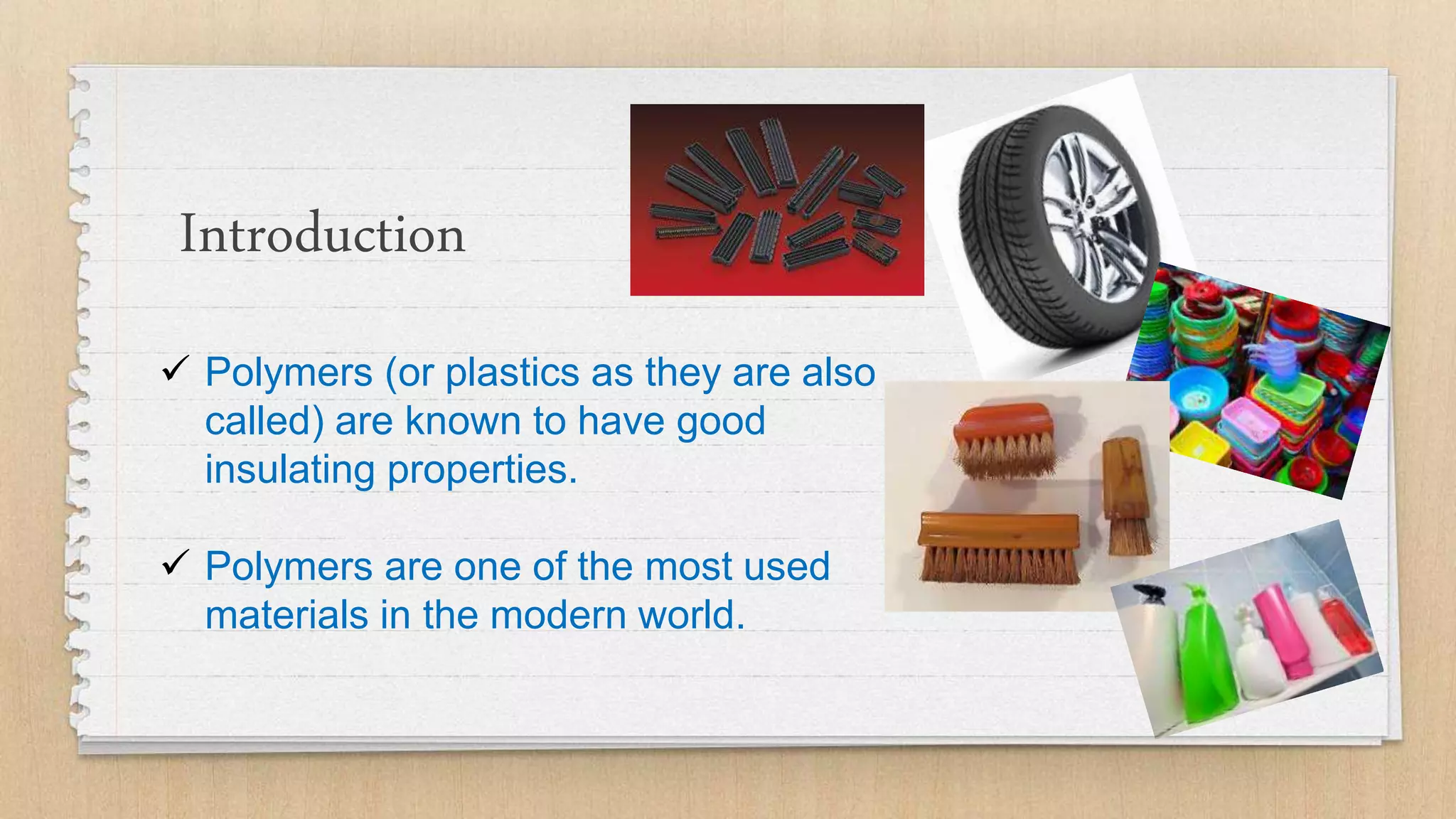
 Polymers (or plastics as they are also
called) are known to have good
insulating properties.
 Polymers are one of the most used
materials in the modern world.
3
Polymers shape our lives
because
Polymers can be shaped…
What is
Conductivity
???
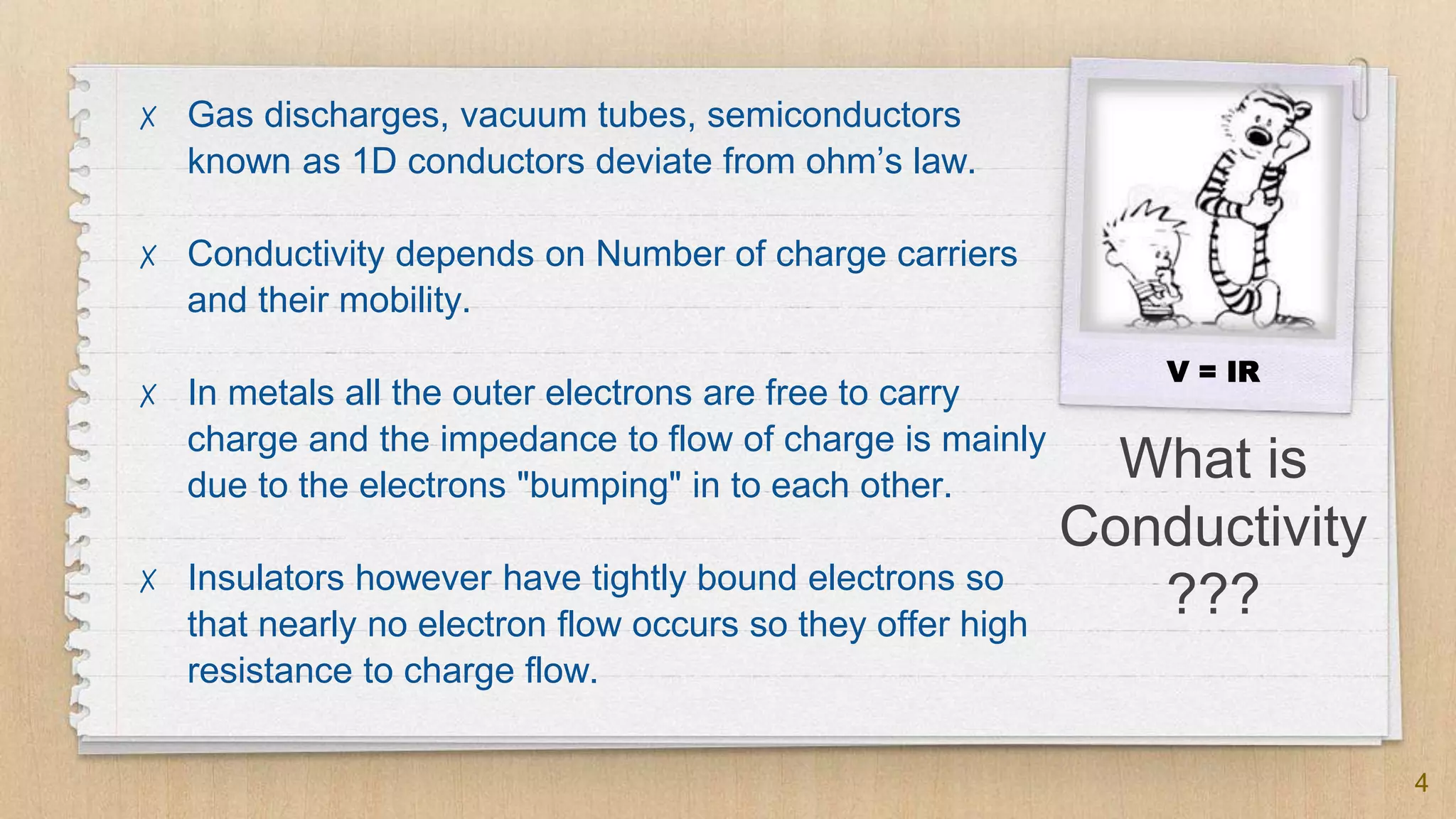
✗ Gas discharges, vacuum tubes, semiconductors
known as 1D conductors deviate from ohm’s law.
✗ Conductivity depends on Number of charge carriers
and their mobility.
✗ In metals all the outer electrons are free to carry
charge and the impedance to flow of charge is mainly
due to the electrons "bumping" in to each other.
✗ Insulators however have tightly bound electrons so
that nearly no electron flow occurs so they offer high
resistance to charge flow.
4
V = IR
So for conductance free electrons are
needed.

5
6
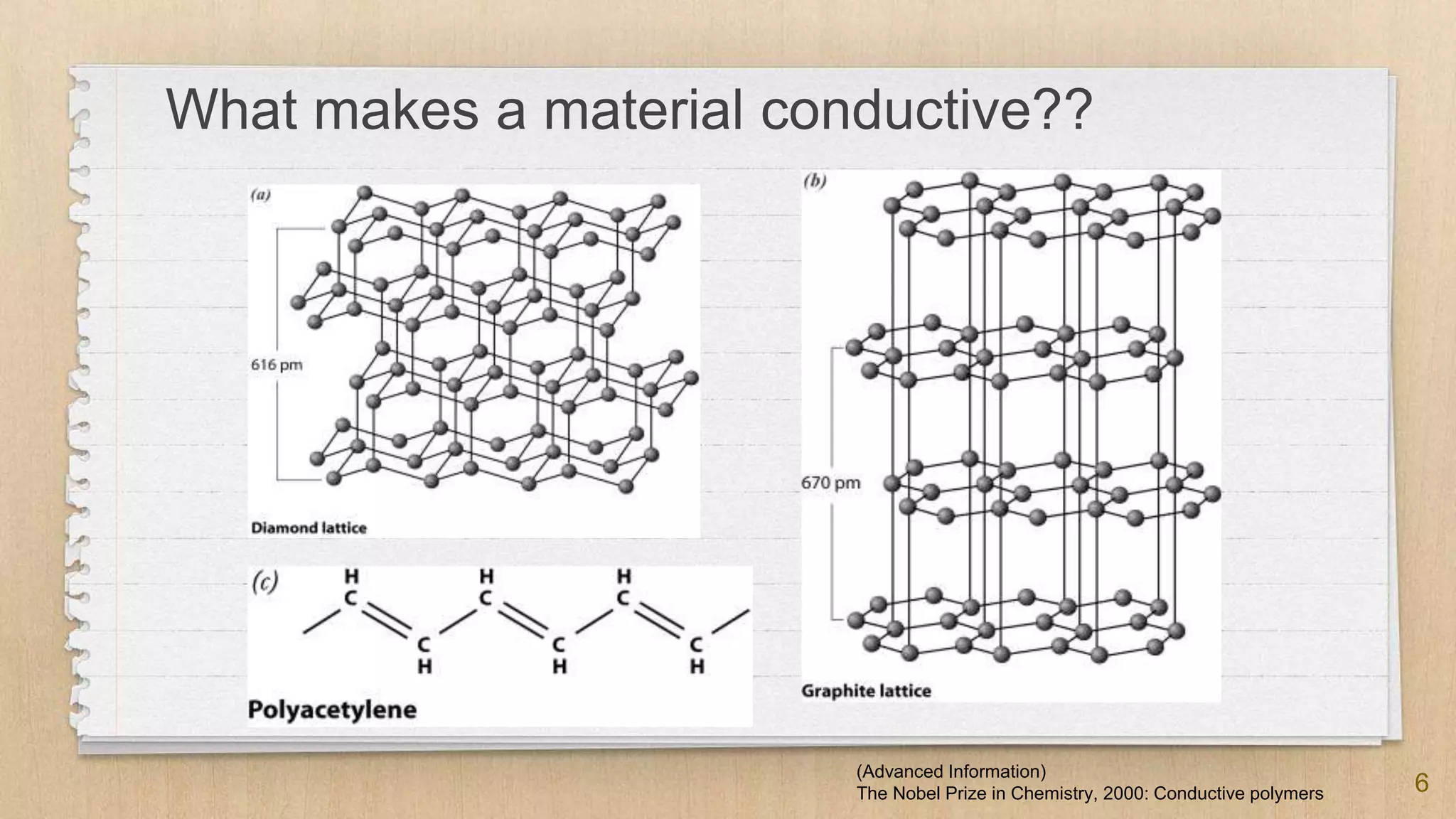
What makes a material conductive??
(Advanced Information)
The Nobel Prize in Chemistry, 2000: Conductive polymers
7
✗ Diamond and graphite are modifications of pure carbon, while in
polyacetylene one hydrogen atom is bound to each carbon atom.
✗ Diamond – σ bonds (insulator) & high symmetry gives isotropic
properties
✗ Graphite and acetylene both have mobile π electrons upon doping
gives highly anisotropic metallic conductors.
✗ The conductivity of stretch oriented polyacetylene is some 100 times
higher in the stretch direction than perpendicular to it.
How can plastic become
conductive ??
✗ Plastics are polymers, molecules that form long
chains, repeating themselves.
✗ In becoming electrically conductive, a polymer
has to imitate a metal, that is, its electrons need
to be free to move and not bound to the atoms.
✗ Polyacetylene is the simplest possible
conjugated polymer
8
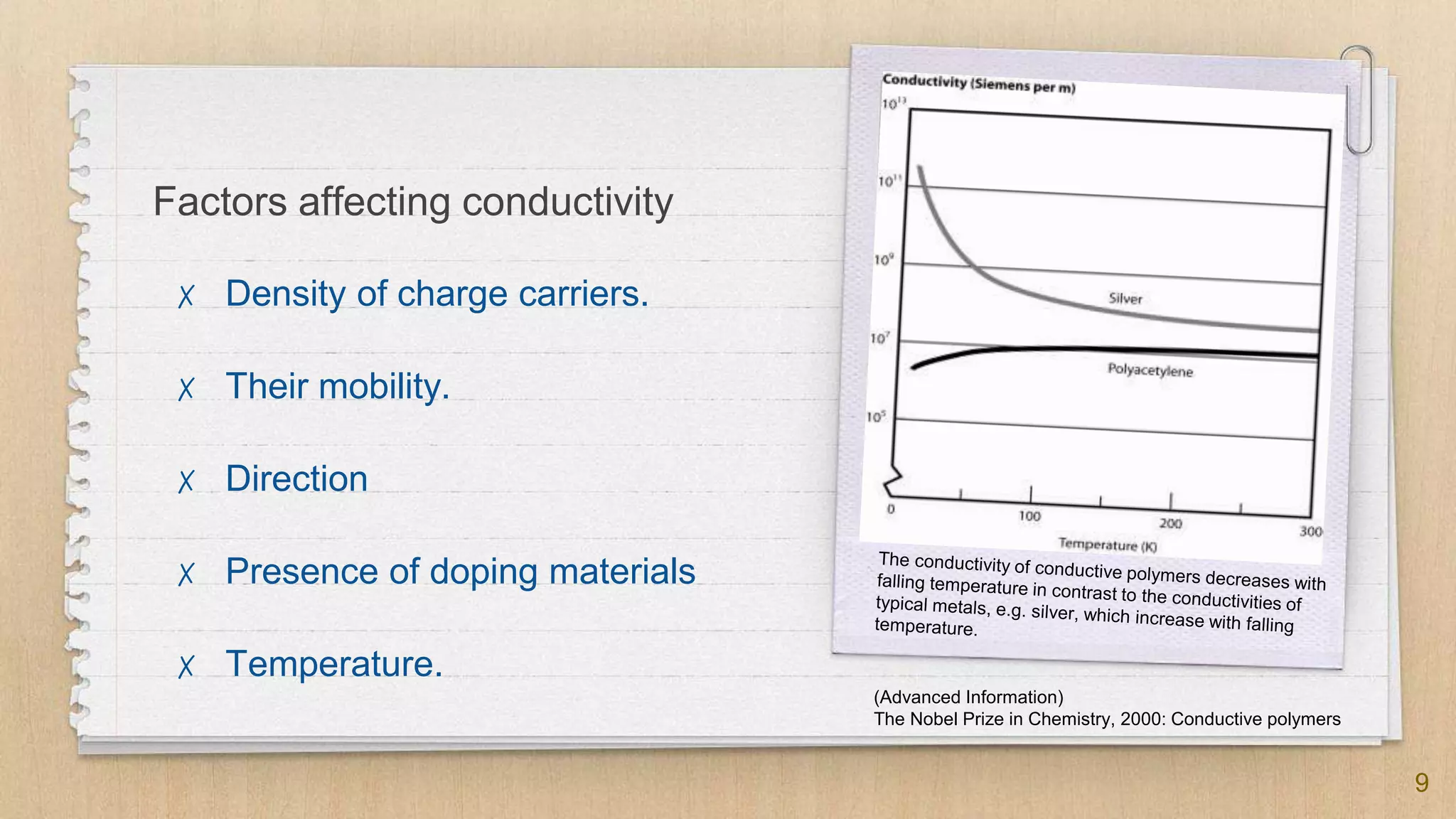
Factors affecting conductivity
✗ Density of charge carriers.
✗ Their mobility.
✗ Direction
✗ Presence of doping materials
✗ Temperature.
9
(Advanced Information)
The Nobel Prize in Chemistry, 2000: Conductive polymers
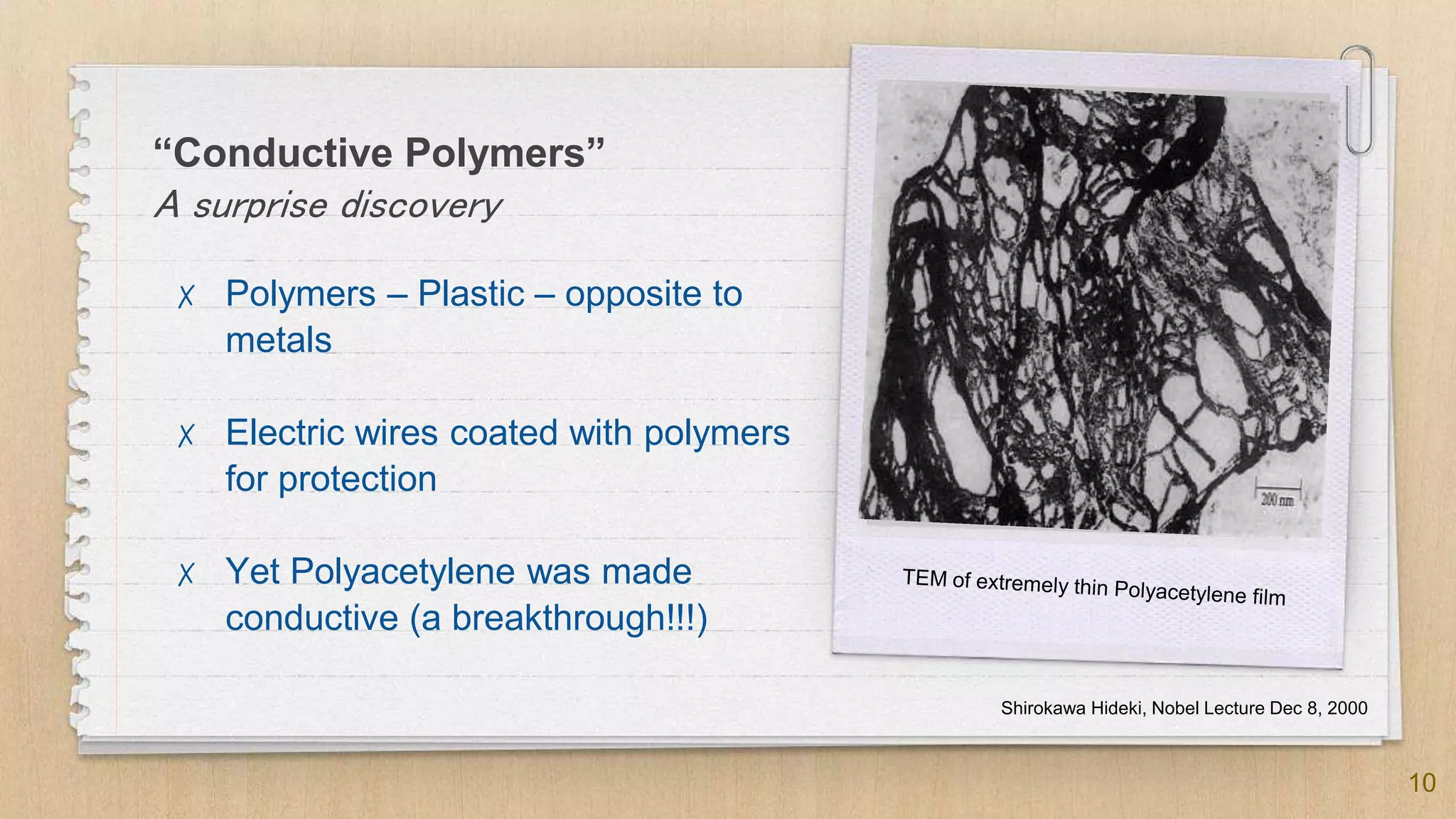
“Conductive Polymers”
A surprise discovery
✗ Polymers – Plastic – opposite to
metals
✗ Electric wires coated with polymers
for protection
✗ Yet Polyacetylene was made
conductive (a breakthrough!!!)
10
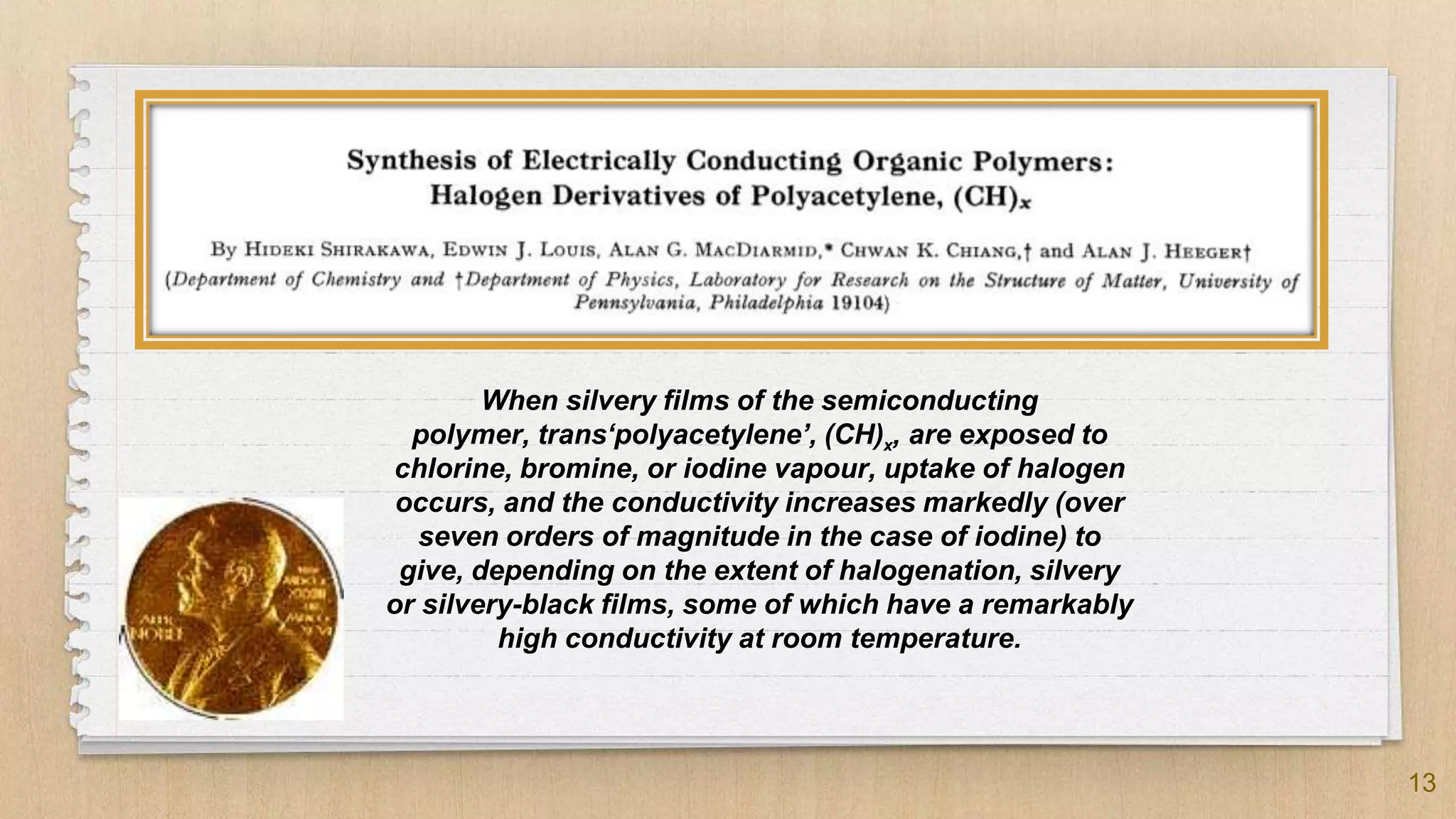
Shirokawa Hideki, Nobel Lecture Dec 8, 2000
11
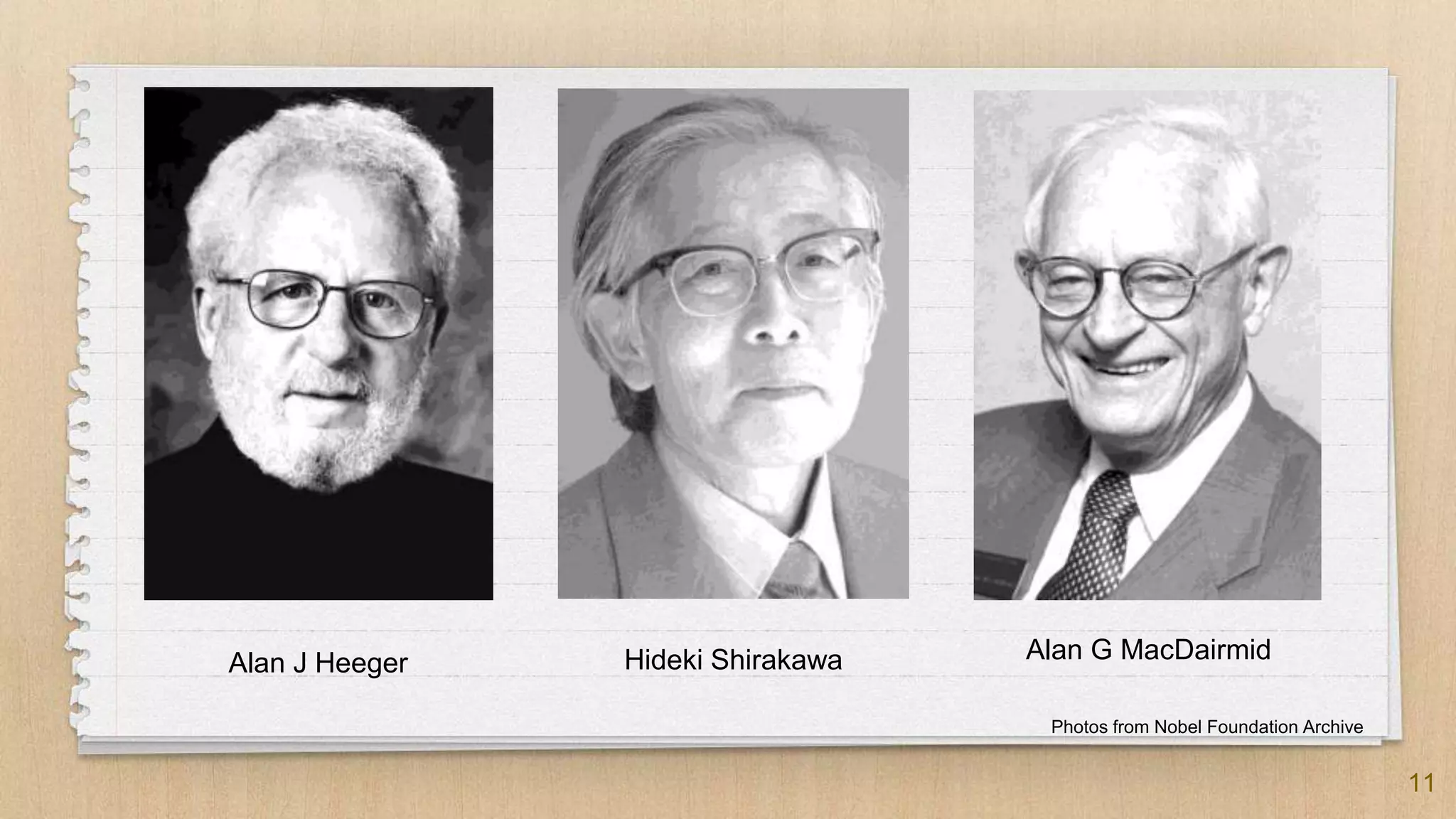
Alan J Heeger Hideki Shirakawa Alan G MacDairmid
Photos from Nobel Foundation Archive
12
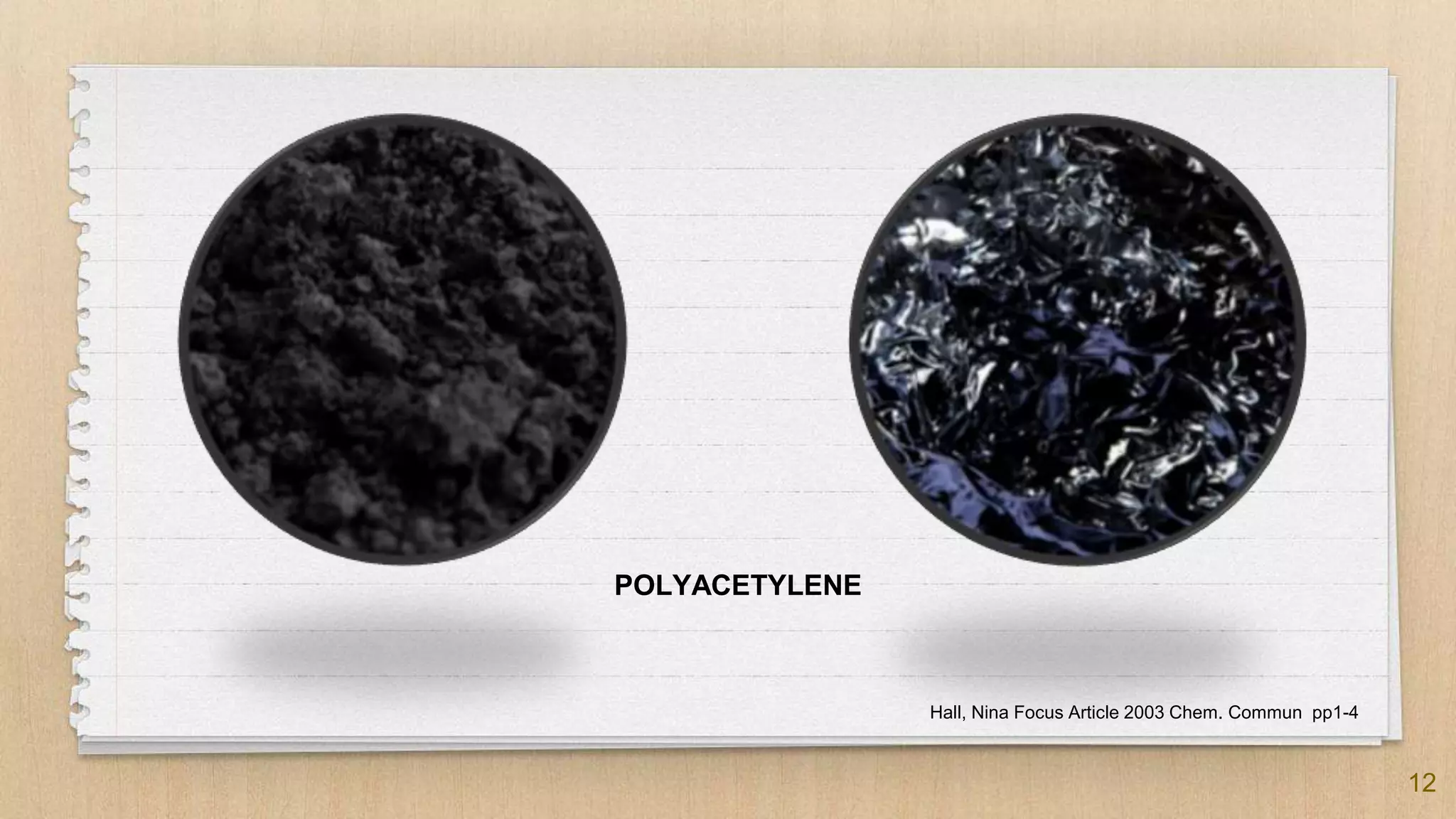
POLYACETYLENE
Hall, Nina Focus Article 2003 Chem. Commun pp1-4
13
When silvery films of the semiconducting
polymer, trans‘polyacetylene’, (CH)x, are exposed to
chlorine, bromine, or iodine vapour, uptake of halogen
occurs, and the conductivity increases markedly (over
seven orders of magnitude in the case of iodine) to
give, depending on the extent of halogenation, silvery
or silvery-black films, some of which have a remarkably
high conductivity at room temperature.
Charge Carriers
in Conducting
Polymers
14
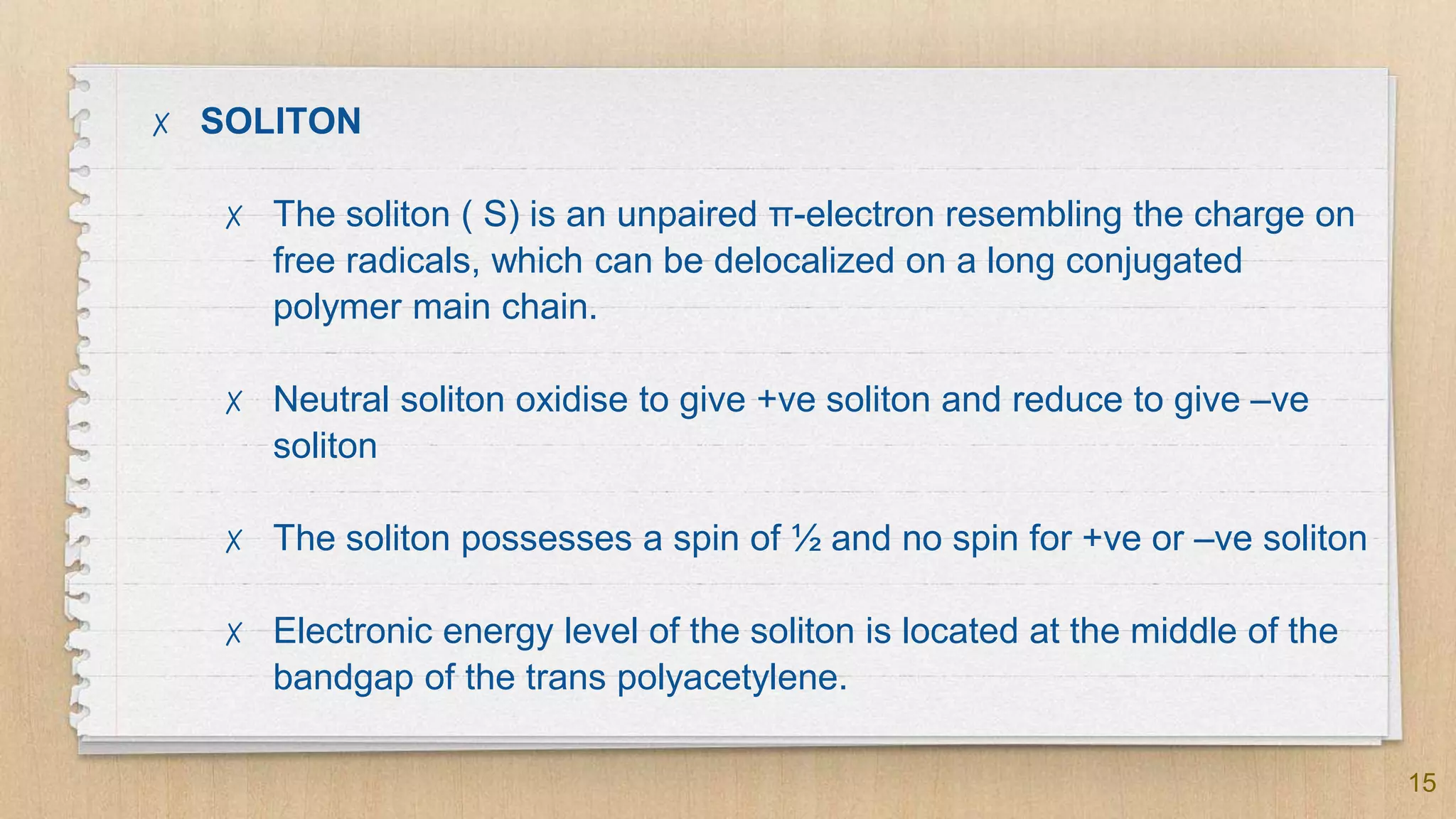
15
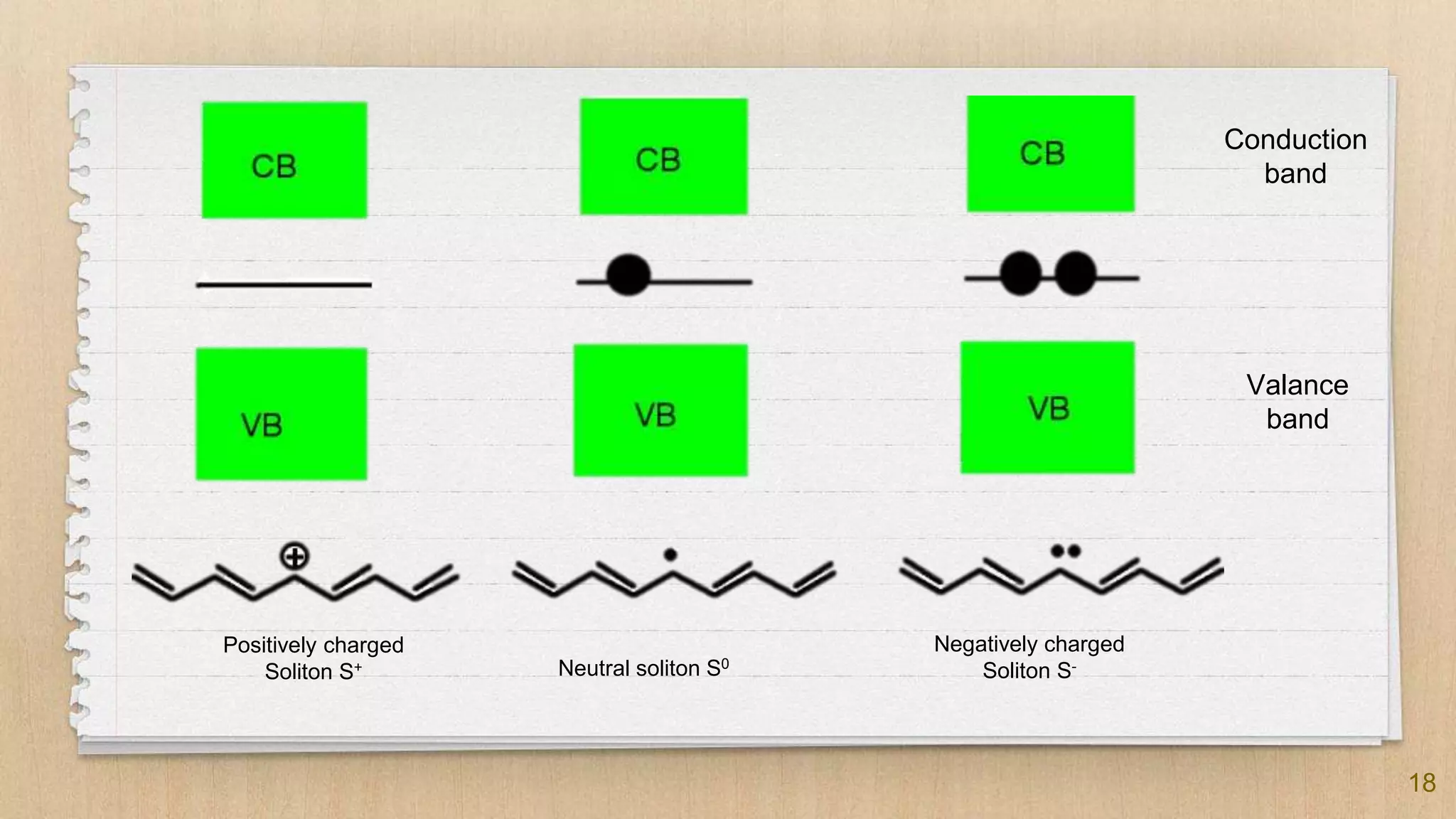
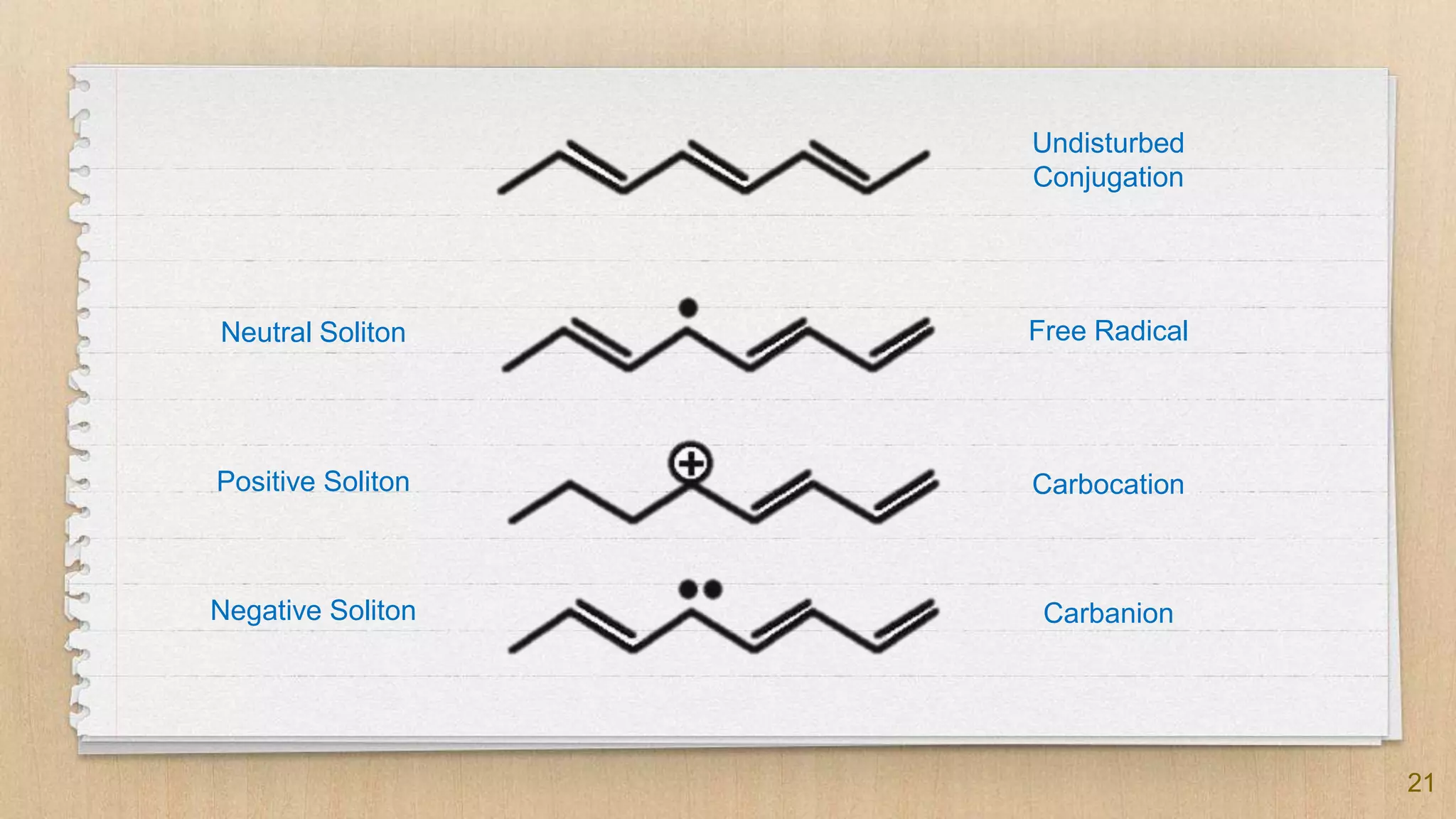
✗ SOLITON
✗ The soliton ( S) is an unpaired π-electron resembling the charge on
free radicals, which can be delocalized on a long conjugated
polymer main chain.
✗ Neutral soliton oxidise to give +ve soliton and reduce to give –ve
soliton
✗ The soliton possesses a spin of ½ and no spin for +ve or –ve soliton
✗ Electronic energy level of the soliton is located at the middle of the
bandgap of the trans polyacetylene.
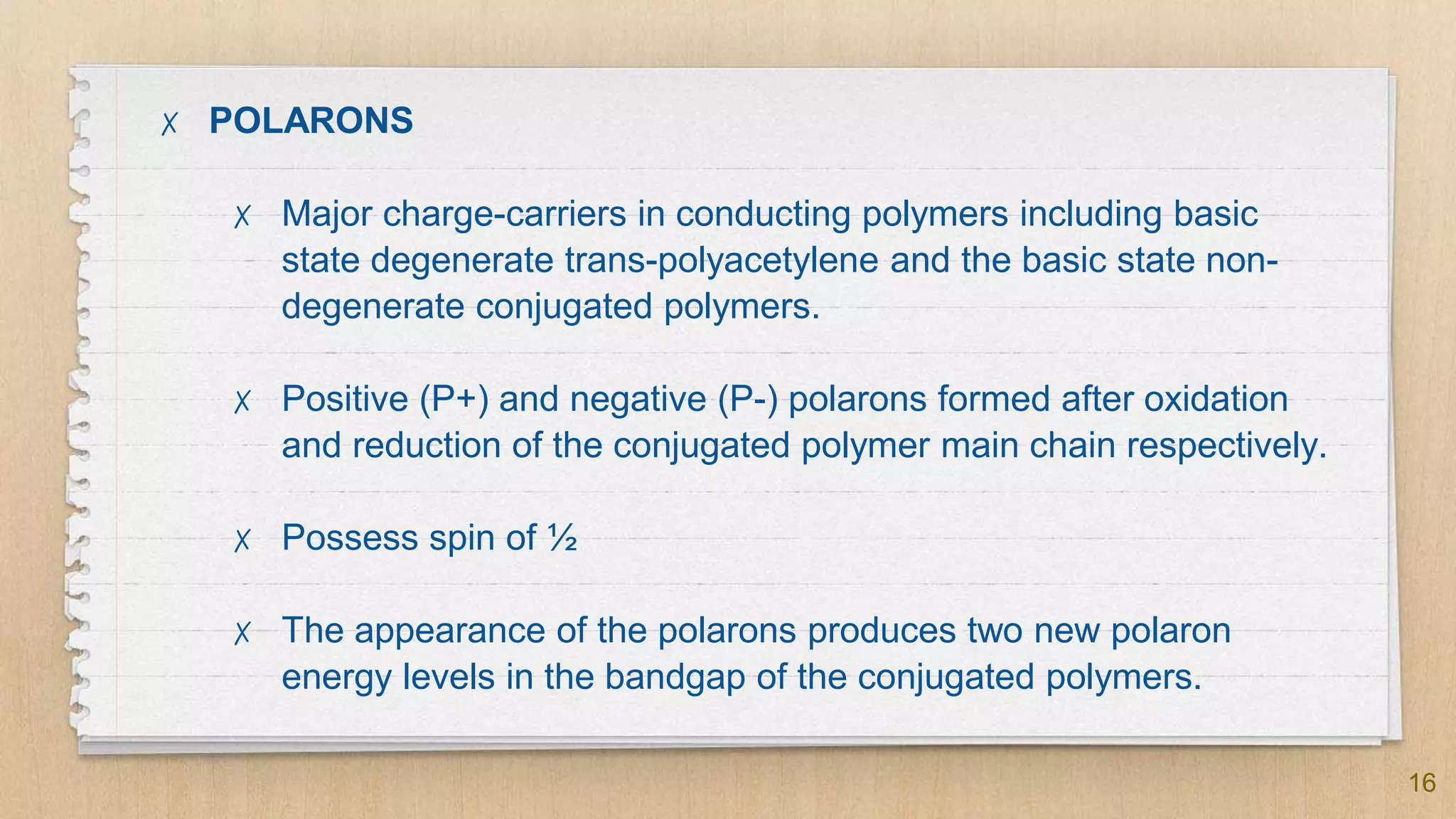
16
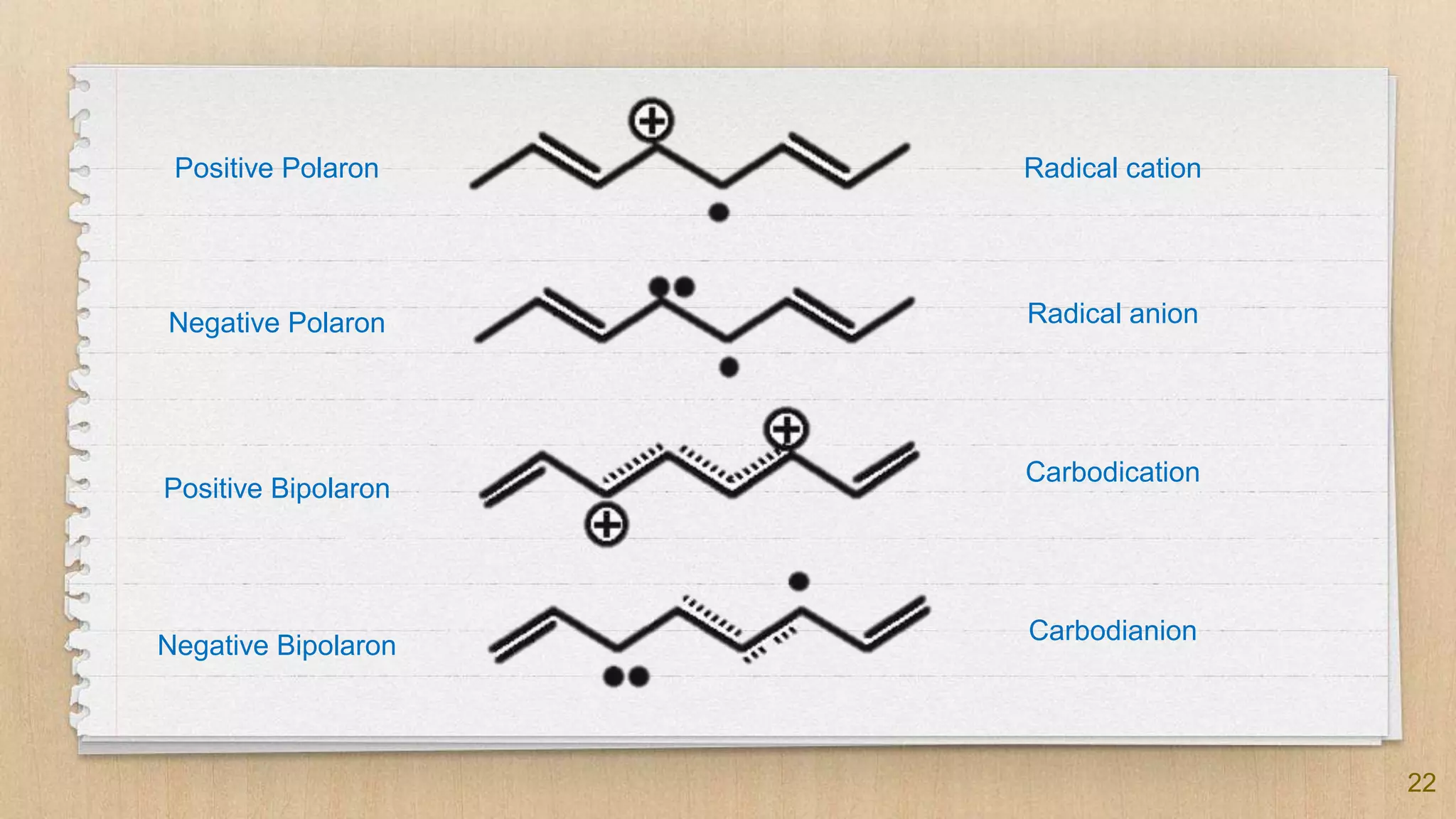
✗ POLARONS
✗ Major charge-carriers in conducting polymers including basic
state degenerate trans-polyacetylene and the basic state non-
degenerate conjugated polymers.
✗ Positive (P+) and negative (P-) polarons formed after oxidation
and reduction of the conjugated polymer main chain respectively.
✗ Possess spin of ½
✗ The appearance of the polarons produces two new polaron
energy levels in the bandgap of the conjugated polymers.
17
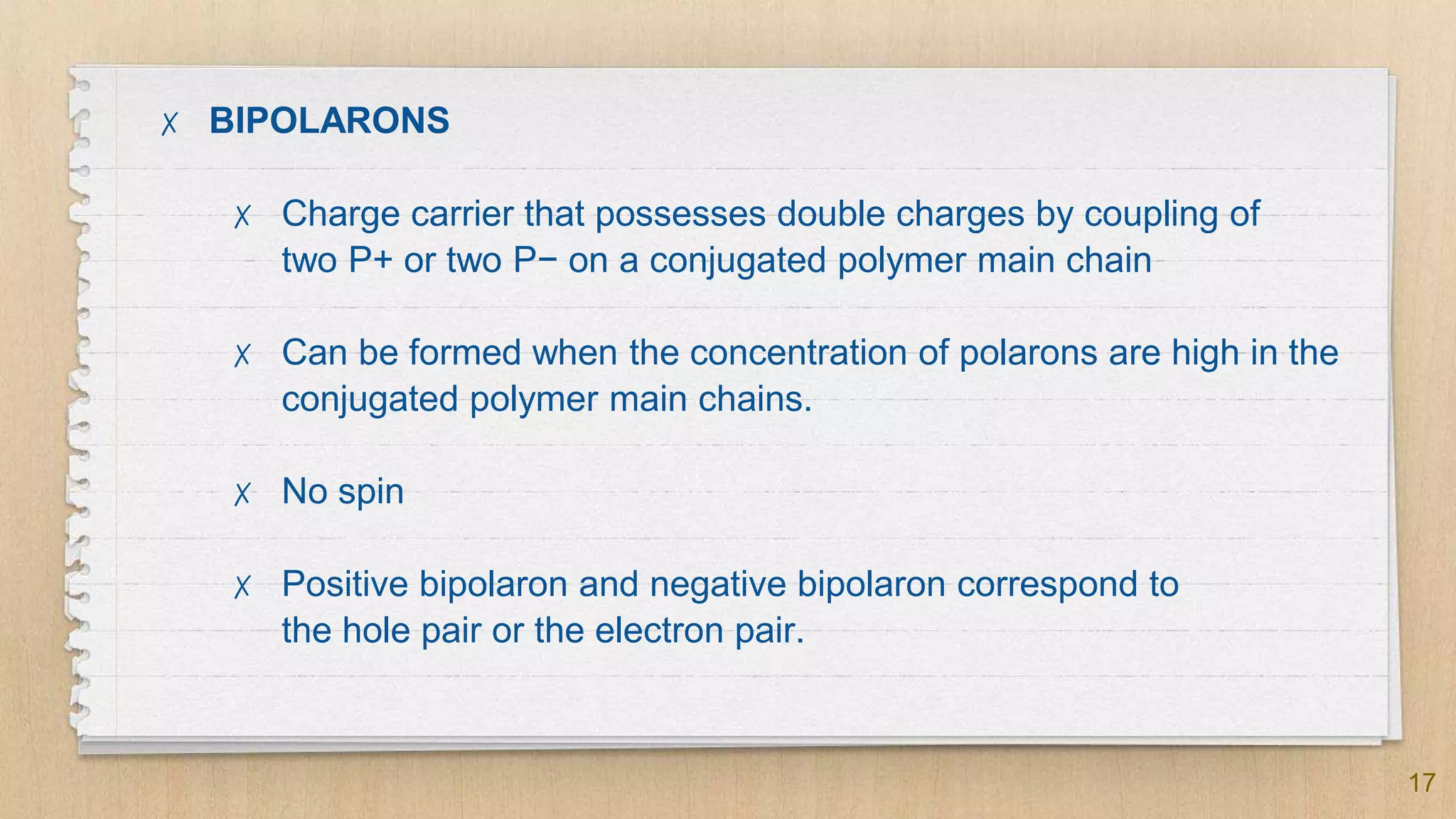
✗ BIPOLARONS
✗ Charge carrier that possesses double charges by coupling of
two P+ or two P− on a conjugated polymer main chain
✗ Can be formed when the concentration of polarons are high in the
conjugated polymer main chains.
✗ No spin
✗ Positive bipolaron and negative bipolaron correspond to
the hole pair or the electron pair.
18
Conduction
band
Valance
band
Neutral soliton S0
Negatively charged
Soliton S-
Positively charged
Soliton S+
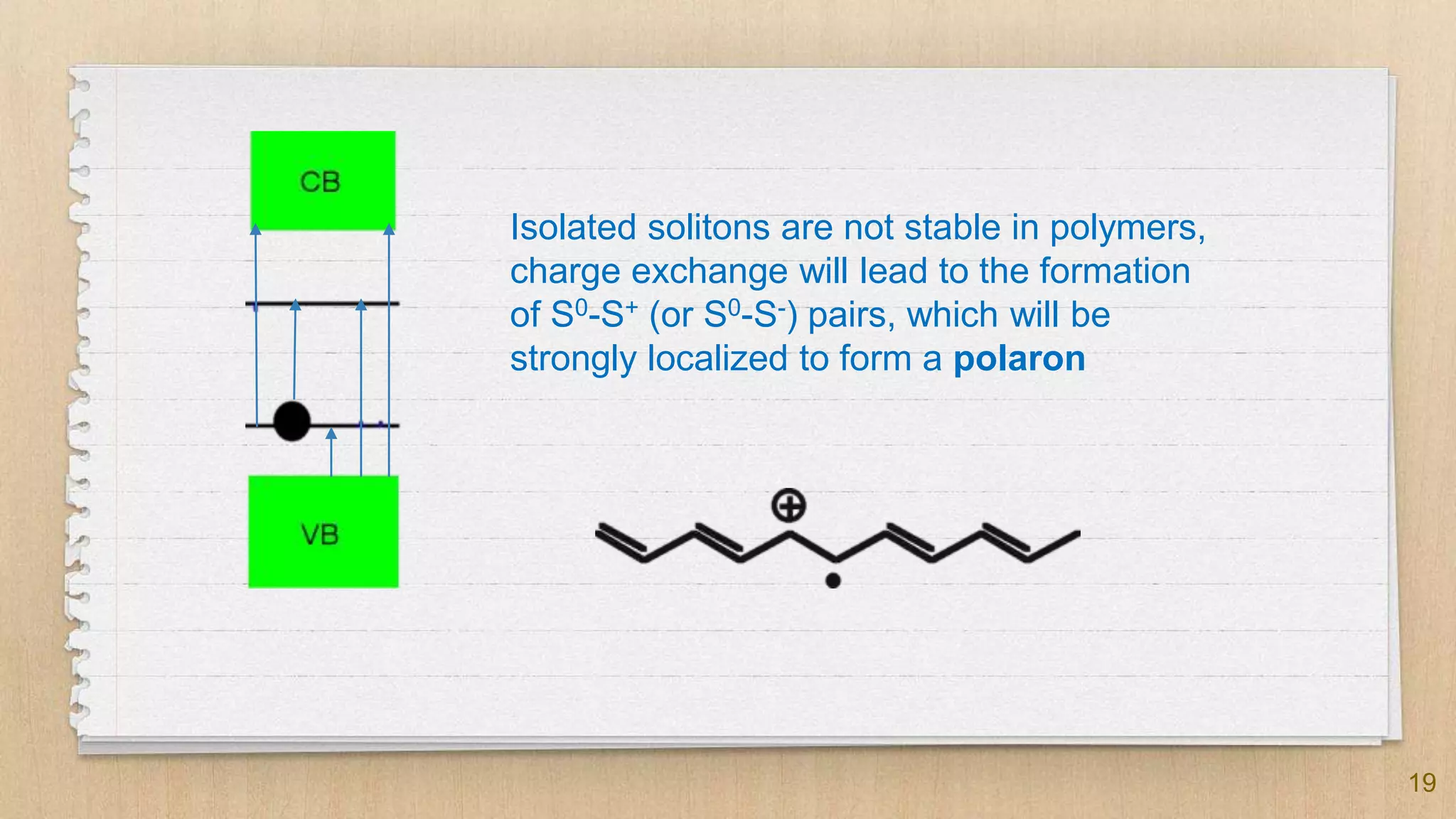
19
Isolated solitons are not stable in polymers,
charge exchange will lead to the formation
of S0-S+ (or S0-S-) pairs, which will be
strongly localized to form a polaron
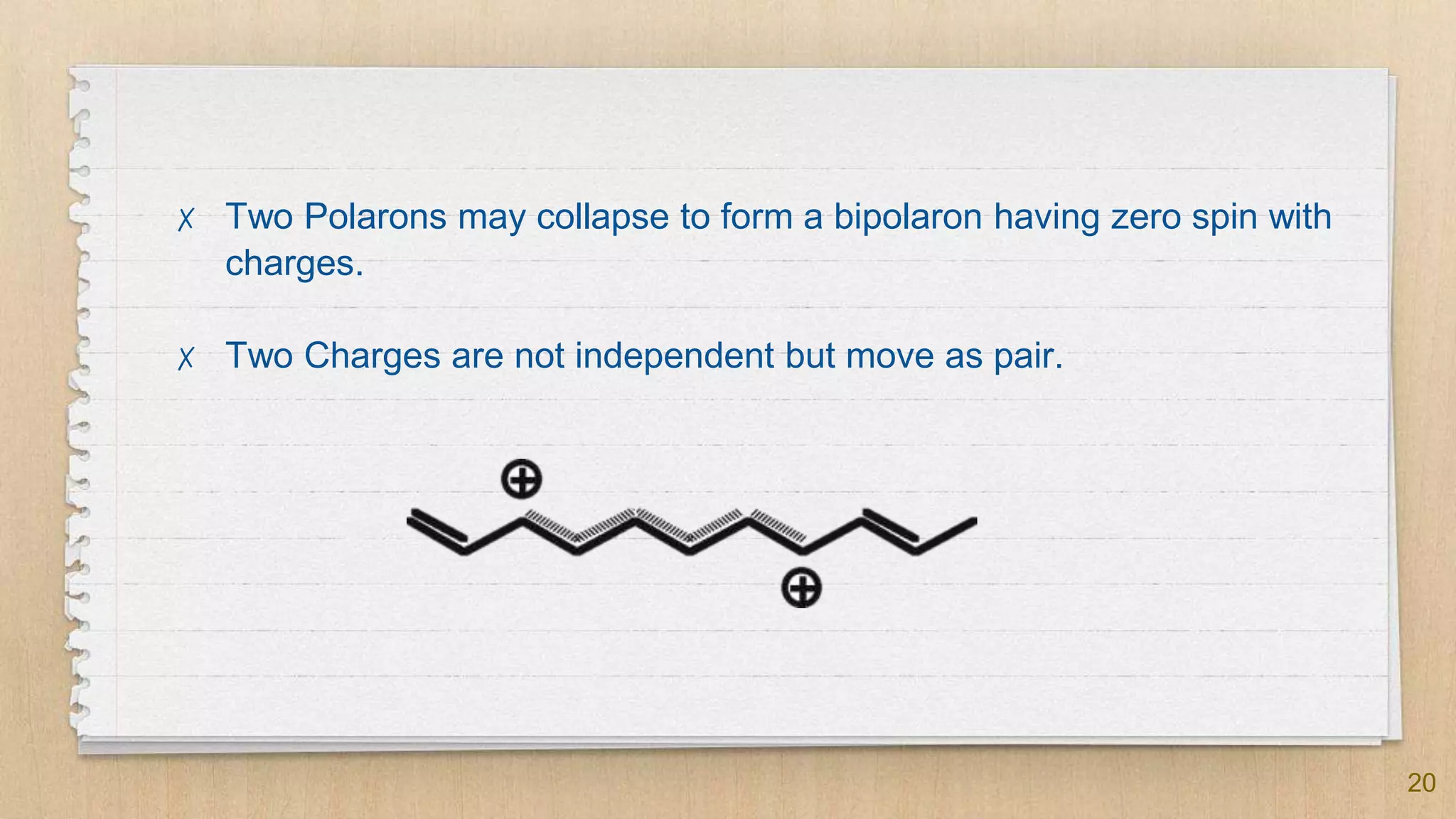
20
✗ Two Polarons may collapse to form a bipolaron having zero spin with
charges.
✗ Two Charges are not independent but move as pair.
21
Undisturbed
Conjugation
Free Radical
Carbocation
Carbanion
Neutral Soliton
Positive Soliton
Negative Soliton
22
Positive Polaron
Negative Polaron
Negative Bipolaron
Positive Bipolaron
Radical anion
Radical cation
Carbodication
Carbodianion
Doping
Characteristics
23
24
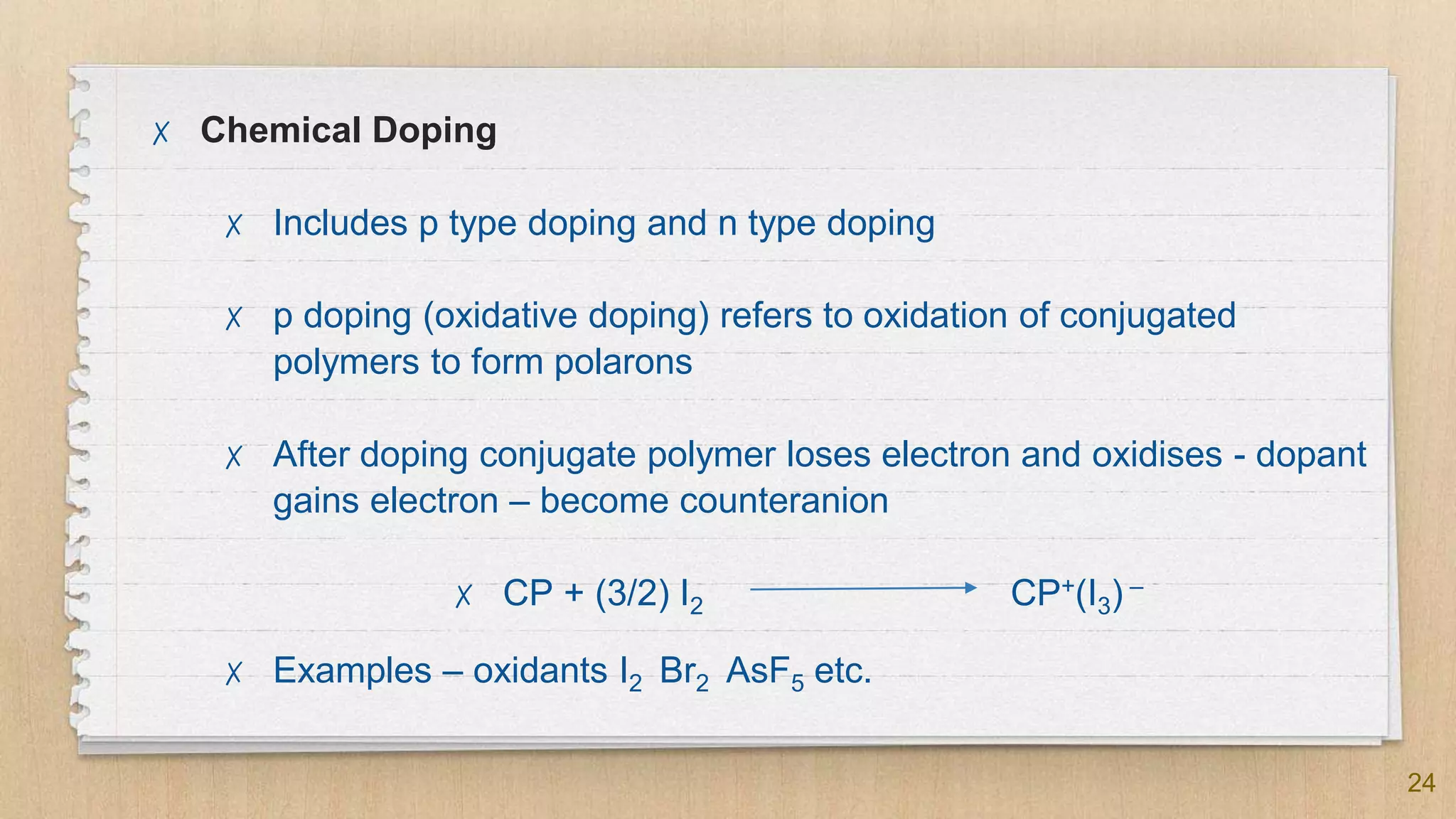
✗ Chemical Doping
✗ Includes p type doping and n type doping
✗ p doping (oxidative doping) refers to oxidation of conjugated
polymers to form polarons
✗ After doping conjugate polymer loses electron and oxidises - dopant
gains electron – become counteranion
✗ CP + (3/2) I2 CP+(I3) –
✗ Examples – oxidants I2 Br2 AsF5 etc.
25
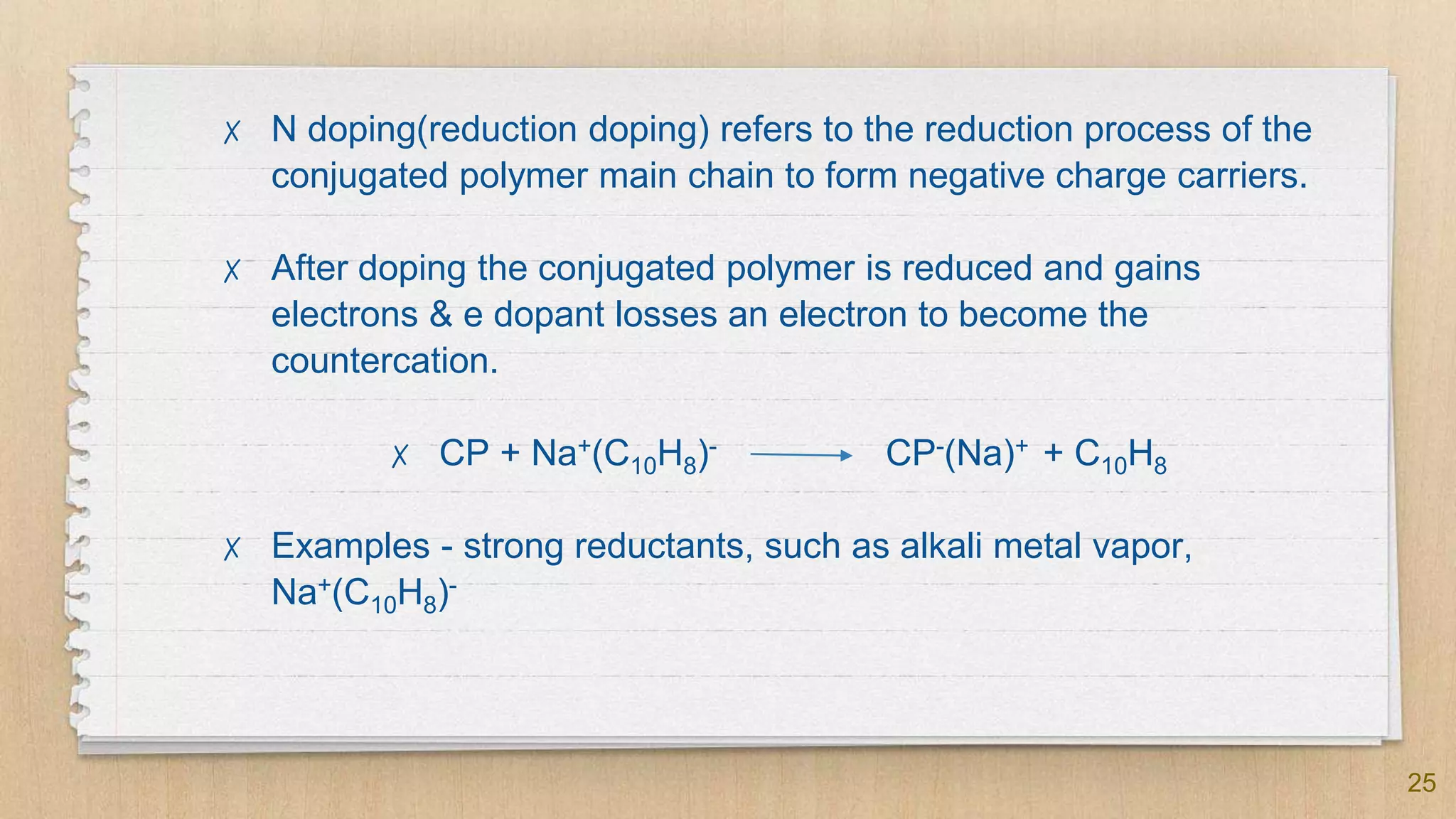
✗ N doping(reduction doping) refers to the reduction process of the
conjugated polymer main chain to form negative charge carriers.
✗ After doping the conjugated polymer is reduced and gains
electrons & e dopant losses an electron to become the
countercation.
✗ CP + Na+(C10H8)- CP-(Na)+ + C10H8
✗ Examples - strong reductants, such as alkali metal vapor,
Na+(C10H8)-
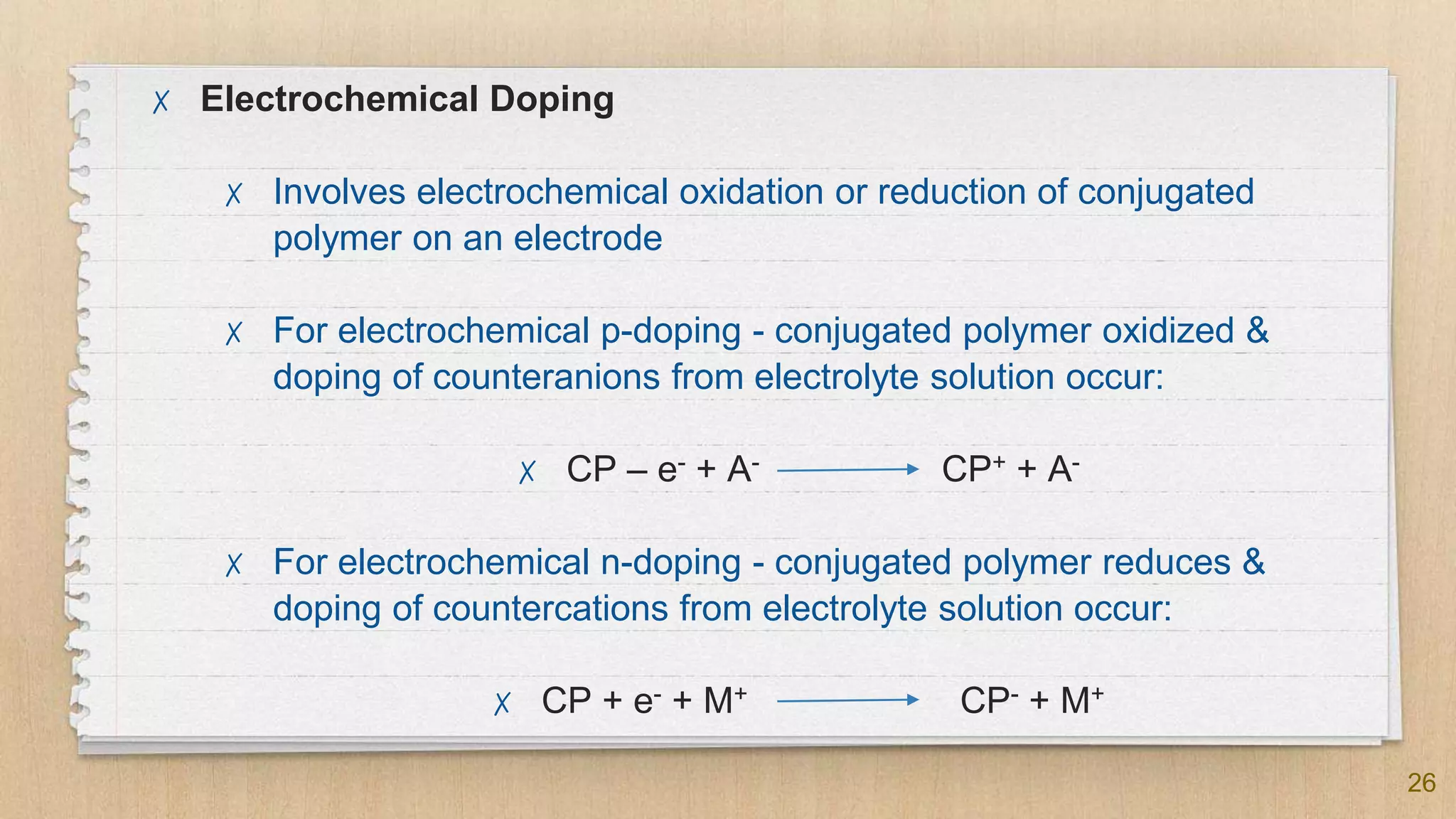
26
✗ Electrochemical Doping
✗ Involves electrochemical oxidation or reduction of conjugated
polymer on an electrode
✗ For electrochemical p-doping - conjugated polymer oxidized &
doping of counteranions from electrolyte solution occur:
✗ CP – e- + A- CP+ + A-
✗ For electrochemical n-doping - conjugated polymer reduces &
doping of countercations from electrolyte solution occur:
✗ CP + e- + M+ CP- + M+
Conductivity
Characteristics
27
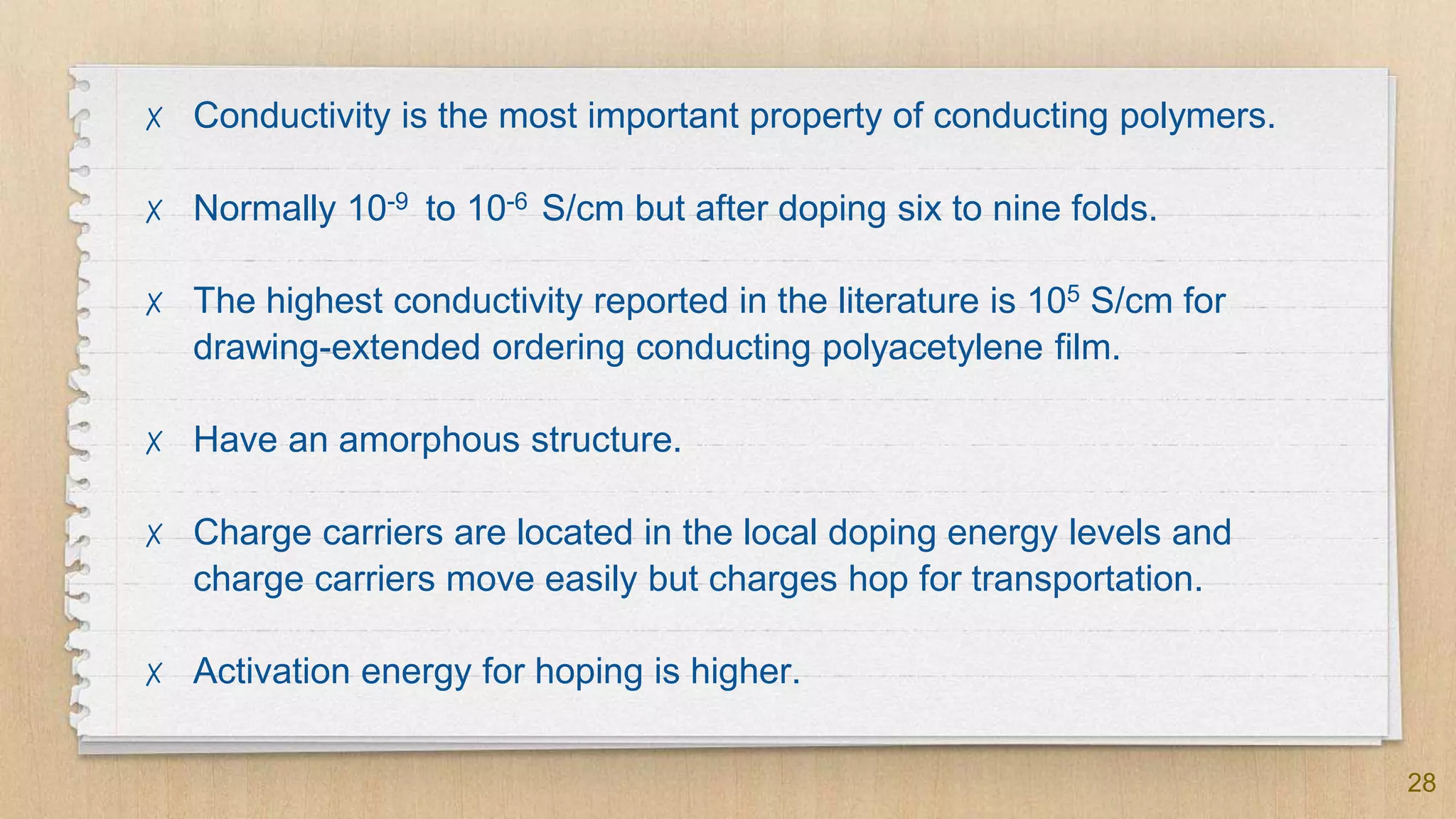
28
✗ Conductivity is the most important property of conducting polymers.
✗ Normally 10-9 to 10-6 S/cm but after doping six to nine folds.
✗ The highest conductivity reported in the literature is 105 S/cm for
drawing-extended ordering conducting polyacetylene film.
✗ Have an amorphous structure.
✗ Charge carriers are located in the local doping energy levels and
charge carriers move easily but charges hop for transportation.
✗ Activation energy for hoping is higher.
29
✗ The conductivity shows a temperature dependence similar to that of
semiconductors
✗ Obeys the Mott Variable Range Hopping (VRH) model:
✗ 𝜎(T) = 𝜎0 exp [ - (T0 / T)1/(n+1) ]
✗ n is dimension number
✗ 𝜎0 is a factor weakly related to temperature
✗ Conductivity closely related to the doping degree and the degree of
ordering of the polymer main chain
✗ The doping degree relates to the charge carrier concentration
30
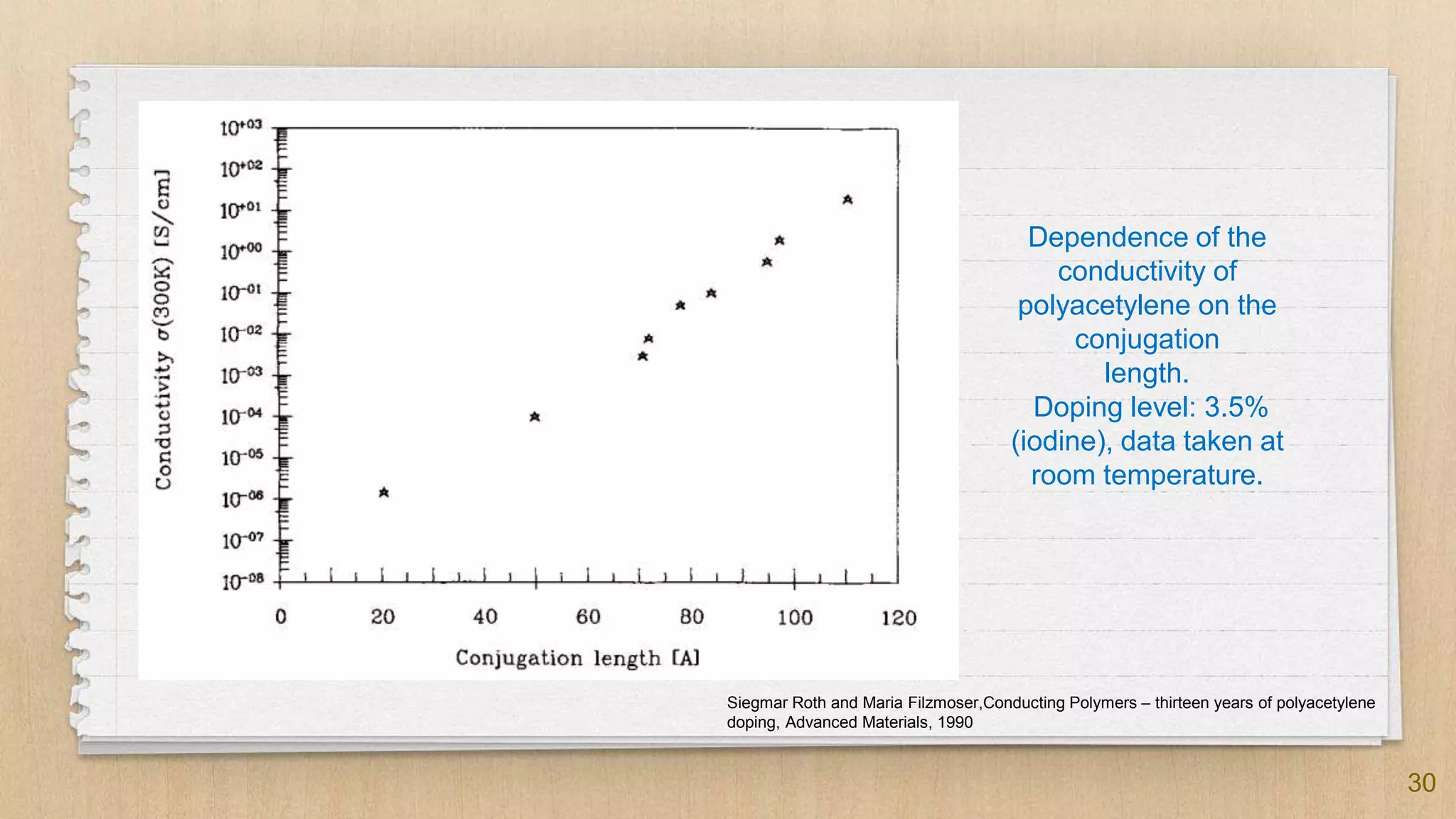
Dependence of the
conductivity of
polyacetylene on the
conjugation
length.
Doping level: 3.5%
(iodine), data taken at
room temperature.
Siegmar Roth and Maria Filzmoser,Conducting Polymers – thirteen years of polyacetylene
doping, Advanced Materials, 1990
31
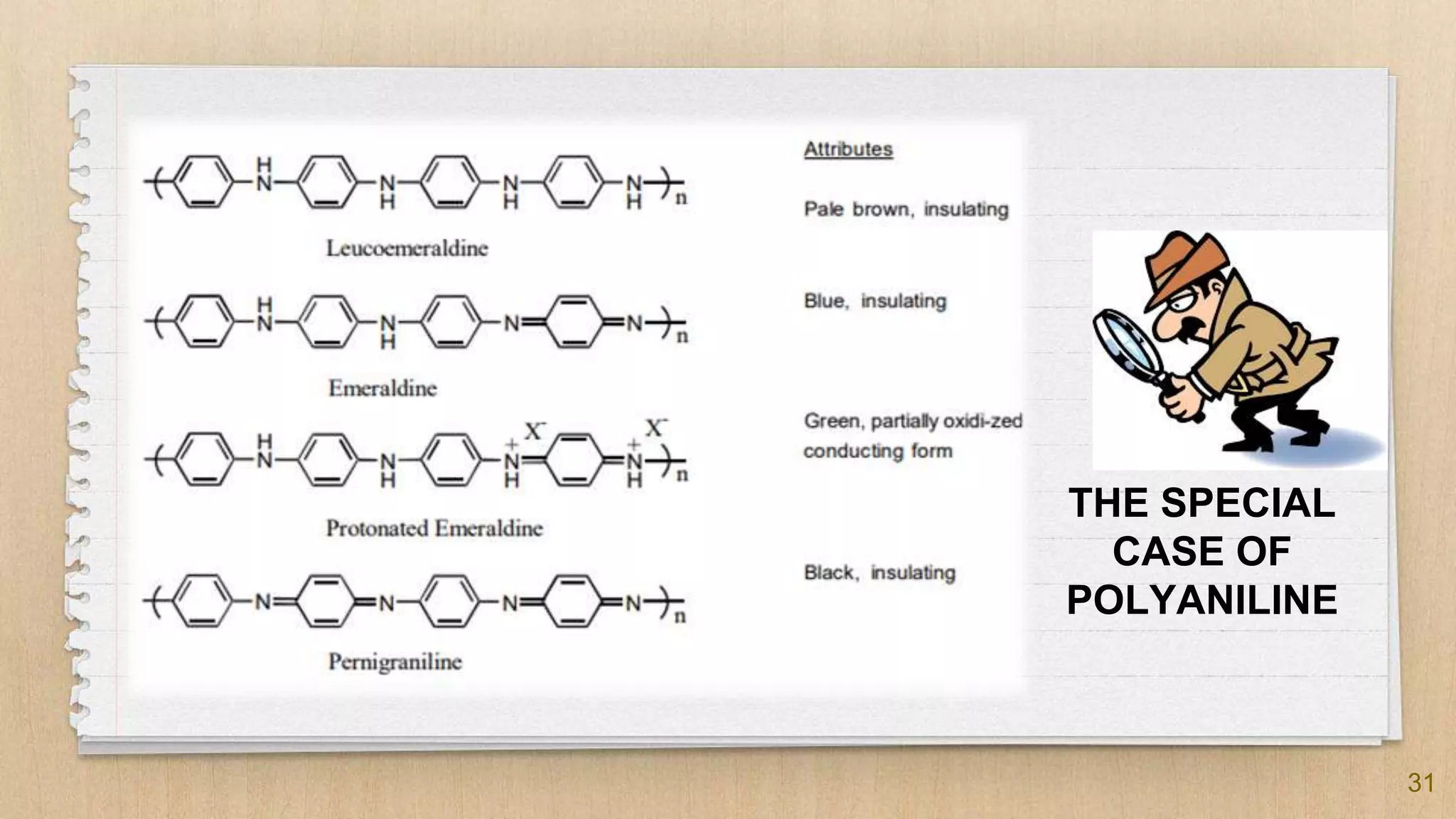
THE SPECIAL
CASE OF
POLYANILINE
Applications
32
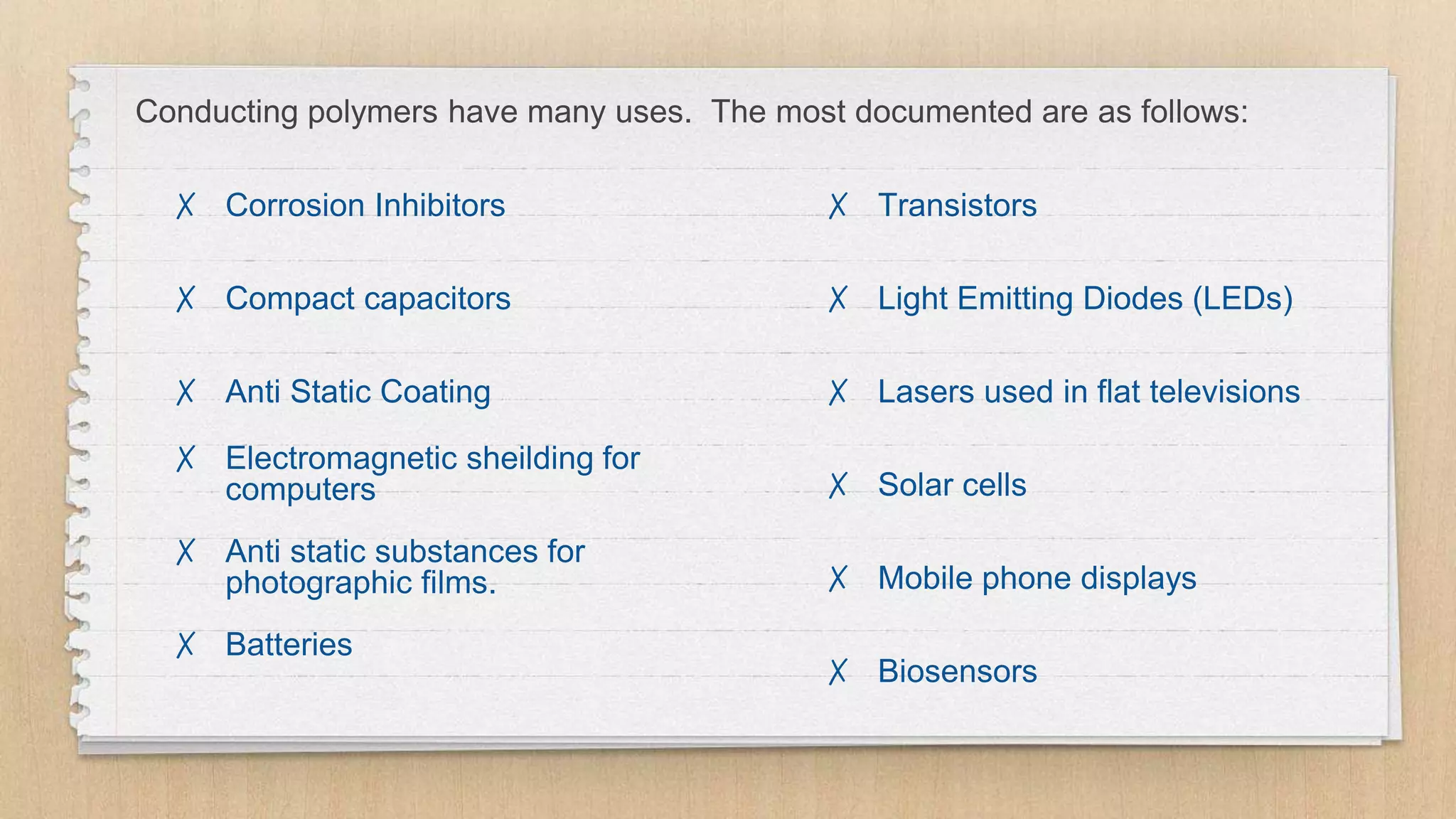
Conducting polymers have many uses. The most documented are as follows:
✗ Corrosion Inhibitors
✗ Compact capacitors
✗ Anti Static Coating
✗ Electromagnetic sheilding for
computers
✗ Anti static substances for
photographic films.
✗ Batteries
✗ Transistors
✗ Light Emitting Diodes (LEDs)
✗ Lasers used in flat televisions
✗ Solar cells
✗ Mobile phone displays
✗ Biosensors
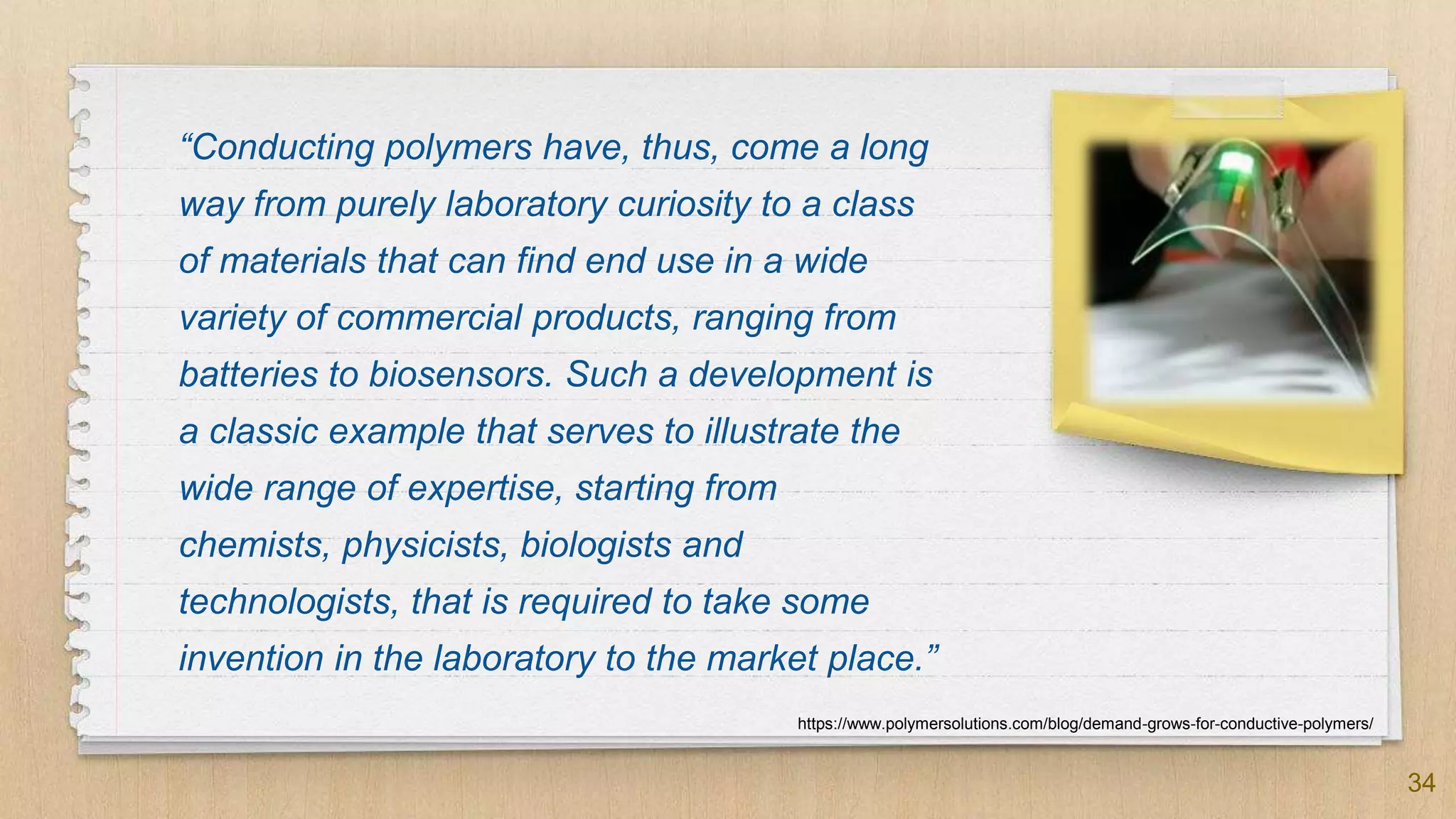
“Conducting polymers have, thus, come a long
way from purely laboratory curiosity to a class
of materials that can find end use in a wide
variety of commercial products, ranging from
batteries to biosensors. Such a development is
a classic example that serves to illustrate the
wide range of expertise, starting from
chemists, physicists, biologists and
technologists, that is required to take some
invention in the laboratory to the market place.”
34
https://www.polymersolutions.com/blog/demand-grows-for-conductive-polymers/
Credits
✗ Presentation template by SlidesCarnival
This presentation uses the following typographies:
✗ Titles: Inconsolata & Brush Script MT
✗ Body copy: Pangolin & Arial
https://www.fontsquirrel.com/fonts/inconsolata
https://www.urbanfonts.com/fonts/Pangolin.font
35
REFERENCES
✗ H. Shirakawa, E.J. Louis, A.G. MacDiarmid, C.K. Chiang and
A.J.Heeger, J Chem Soc Chem Comm (1977) 579
✗ http://nobelprize.org/nobel_prizes/chemistry/laureates/2000/index.html
✗ (Advanced Information) The Nobel Prize in Chemistry, 2000: Conductive
polymers Kungl. Vetenskapsademien, The Royal Swedish Academy Of
Sciences
✗ Yongfang Li , Organic Optoelectronic Materials, Springer International
Publications, 2015, pg 23 – 50
✗ Ramakrishnan S, Conducting Polymers: From Lab curiosity to the Market
Place, Resonance, vol 2, No.11 pp 48 - 58
✗ Siegmar Roth and Maria Filzmoser,Conducting Polymers – thirteen years
of polyacetylene doping, Advanced Materials, 1990
36
37
Thanks!
Any other
questions?
📌
Reach me out at
officialyashasabhinav10@gmail.com

Conducting Polymers

  • 1.
    CONDUCTING POLYMERS From a LabCuriosity to the Market Place A Seminar On September 17, 2019 Presented By Abhinav S Sri Sathya Sai Institute Of Higher Learning II M.Sc Chemistry
  • 2.
    Introduction  Polymers (orplastics as they are also called) are known to have good insulating properties.  Polymers are one of the most used materials in the modern world.
  • 3.
    3 Polymers shape ourlives because Polymers can be shaped…
  • 4.
    What is Conductivity ??? ✗ Gasdischarges, vacuum tubes, semiconductors known as 1D conductors deviate from ohm’s law. ✗ Conductivity depends on Number of charge carriers and their mobility. ✗ In metals all the outer electrons are free to carry charge and the impedance to flow of charge is mainly due to the electrons "bumping" in to each other. ✗ Insulators however have tightly bound electrons so that nearly no electron flow occurs so they offer high resistance to charge flow. 4 V = IR
  • 5.
    So for conductancefree electrons are needed.  5
  • 6.
    6 What makes amaterial conductive?? (Advanced Information) The Nobel Prize in Chemistry, 2000: Conductive polymers
  • 7.
    7 ✗ Diamond andgraphite are modifications of pure carbon, while in polyacetylene one hydrogen atom is bound to each carbon atom. ✗ Diamond – σ bonds (insulator) & high symmetry gives isotropic properties ✗ Graphite and acetylene both have mobile π electrons upon doping gives highly anisotropic metallic conductors. ✗ The conductivity of stretch oriented polyacetylene is some 100 times higher in the stretch direction than perpendicular to it.
  • 8.
    How can plasticbecome conductive ?? ✗ Plastics are polymers, molecules that form long chains, repeating themselves. ✗ In becoming electrically conductive, a polymer has to imitate a metal, that is, its electrons need to be free to move and not bound to the atoms. ✗ Polyacetylene is the simplest possible conjugated polymer 8
  • 9.
    Factors affecting conductivity ✗Density of charge carriers. ✗ Their mobility. ✗ Direction ✗ Presence of doping materials ✗ Temperature. 9 (Advanced Information) The Nobel Prize in Chemistry, 2000: Conductive polymers
  • 10.
    “Conductive Polymers” A surprisediscovery ✗ Polymers – Plastic – opposite to metals ✗ Electric wires coated with polymers for protection ✗ Yet Polyacetylene was made conductive (a breakthrough!!!) 10 Shirokawa Hideki, Nobel Lecture Dec 8, 2000
  • 11.
    11 Alan J HeegerHideki Shirakawa Alan G MacDairmid Photos from Nobel Foundation Archive
  • 12.
    12 POLYACETYLENE Hall, Nina FocusArticle 2003 Chem. Commun pp1-4
  • 13.
    13 When silvery filmsof the semiconducting polymer, trans‘polyacetylene’, (CH)x, are exposed to chlorine, bromine, or iodine vapour, uptake of halogen occurs, and the conductivity increases markedly (over seven orders of magnitude in the case of iodine) to give, depending on the extent of halogenation, silvery or silvery-black films, some of which have a remarkably high conductivity at room temperature.
  • 14.
  • 15.
    15 ✗ SOLITON ✗ Thesoliton ( S) is an unpaired π-electron resembling the charge on free radicals, which can be delocalized on a long conjugated polymer main chain. ✗ Neutral soliton oxidise to give +ve soliton and reduce to give –ve soliton ✗ The soliton possesses a spin of ½ and no spin for +ve or –ve soliton ✗ Electronic energy level of the soliton is located at the middle of the bandgap of the trans polyacetylene.
  • 16.
    16 ✗ POLARONS ✗ Majorcharge-carriers in conducting polymers including basic state degenerate trans-polyacetylene and the basic state non- degenerate conjugated polymers. ✗ Positive (P+) and negative (P-) polarons formed after oxidation and reduction of the conjugated polymer main chain respectively. ✗ Possess spin of ½ ✗ The appearance of the polarons produces two new polaron energy levels in the bandgap of the conjugated polymers.
  • 17.
    17 ✗ BIPOLARONS ✗ Chargecarrier that possesses double charges by coupling of two P+ or two P− on a conjugated polymer main chain ✗ Can be formed when the concentration of polarons are high in the conjugated polymer main chains. ✗ No spin ✗ Positive bipolaron and negative bipolaron correspond to the hole pair or the electron pair.
  • 18.
    18 Conduction band Valance band Neutral soliton S0 Negativelycharged Soliton S- Positively charged Soliton S+
  • 19.
    19 Isolated solitons arenot stable in polymers, charge exchange will lead to the formation of S0-S+ (or S0-S-) pairs, which will be strongly localized to form a polaron
  • 20.
    20 ✗ Two Polaronsmay collapse to form a bipolaron having zero spin with charges. ✗ Two Charges are not independent but move as pair.
  • 21.
  • 22.
    22 Positive Polaron Negative Polaron NegativeBipolaron Positive Bipolaron Radical anion Radical cation Carbodication Carbodianion
  • 23.
  • 24.
    24 ✗ Chemical Doping ✗Includes p type doping and n type doping ✗ p doping (oxidative doping) refers to oxidation of conjugated polymers to form polarons ✗ After doping conjugate polymer loses electron and oxidises - dopant gains electron – become counteranion ✗ CP + (3/2) I2 CP+(I3) – ✗ Examples – oxidants I2 Br2 AsF5 etc.
  • 25.
    25 ✗ N doping(reductiondoping) refers to the reduction process of the conjugated polymer main chain to form negative charge carriers. ✗ After doping the conjugated polymer is reduced and gains electrons & e dopant losses an electron to become the countercation. ✗ CP + Na+(C10H8)- CP-(Na)+ + C10H8 ✗ Examples - strong reductants, such as alkali metal vapor, Na+(C10H8)-
  • 26.
    26 ✗ Electrochemical Doping ✗Involves electrochemical oxidation or reduction of conjugated polymer on an electrode ✗ For electrochemical p-doping - conjugated polymer oxidized & doping of counteranions from electrolyte solution occur: ✗ CP – e- + A- CP+ + A- ✗ For electrochemical n-doping - conjugated polymer reduces & doping of countercations from electrolyte solution occur: ✗ CP + e- + M+ CP- + M+
  • 27.
  • 28.
    28 ✗ Conductivity isthe most important property of conducting polymers. ✗ Normally 10-9 to 10-6 S/cm but after doping six to nine folds. ✗ The highest conductivity reported in the literature is 105 S/cm for drawing-extended ordering conducting polyacetylene film. ✗ Have an amorphous structure. ✗ Charge carriers are located in the local doping energy levels and charge carriers move easily but charges hop for transportation. ✗ Activation energy for hoping is higher.
  • 29.
    29 ✗ The conductivityshows a temperature dependence similar to that of semiconductors ✗ Obeys the Mott Variable Range Hopping (VRH) model: ✗ 𝜎(T) = 𝜎0 exp [ - (T0 / T)1/(n+1) ] ✗ n is dimension number ✗ 𝜎0 is a factor weakly related to temperature ✗ Conductivity closely related to the doping degree and the degree of ordering of the polymer main chain ✗ The doping degree relates to the charge carrier concentration
  • 30.
    30 Dependence of the conductivityof polyacetylene on the conjugation length. Doping level: 3.5% (iodine), data taken at room temperature. Siegmar Roth and Maria Filzmoser,Conducting Polymers – thirteen years of polyacetylene doping, Advanced Materials, 1990
  • 31.
  • 32.
  • 33.
    Conducting polymers havemany uses. The most documented are as follows: ✗ Corrosion Inhibitors ✗ Compact capacitors ✗ Anti Static Coating ✗ Electromagnetic sheilding for computers ✗ Anti static substances for photographic films. ✗ Batteries ✗ Transistors ✗ Light Emitting Diodes (LEDs) ✗ Lasers used in flat televisions ✗ Solar cells ✗ Mobile phone displays ✗ Biosensors
  • 34.
    “Conducting polymers have,thus, come a long way from purely laboratory curiosity to a class of materials that can find end use in a wide variety of commercial products, ranging from batteries to biosensors. Such a development is a classic example that serves to illustrate the wide range of expertise, starting from chemists, physicists, biologists and technologists, that is required to take some invention in the laboratory to the market place.” 34 https://www.polymersolutions.com/blog/demand-grows-for-conductive-polymers/
  • 35.
    Credits ✗ Presentation templateby SlidesCarnival This presentation uses the following typographies: ✗ Titles: Inconsolata & Brush Script MT ✗ Body copy: Pangolin & Arial https://www.fontsquirrel.com/fonts/inconsolata https://www.urbanfonts.com/fonts/Pangolin.font 35
  • 36.
    REFERENCES ✗ H. Shirakawa,E.J. Louis, A.G. MacDiarmid, C.K. Chiang and A.J.Heeger, J Chem Soc Chem Comm (1977) 579 ✗ http://nobelprize.org/nobel_prizes/chemistry/laureates/2000/index.html ✗ (Advanced Information) The Nobel Prize in Chemistry, 2000: Conductive polymers Kungl. Vetenskapsademien, The Royal Swedish Academy Of Sciences ✗ Yongfang Li , Organic Optoelectronic Materials, Springer International Publications, 2015, pg 23 – 50 ✗ Ramakrishnan S, Conducting Polymers: From Lab curiosity to the Market Place, Resonance, vol 2, No.11 pp 48 - 58 ✗ Siegmar Roth and Maria Filzmoser,Conducting Polymers – thirteen years of polyacetylene doping, Advanced Materials, 1990 36
  • 37.
    37 Thanks! Any other questions? 📌 Reach meout at officialyashasabhinav10@gmail.com