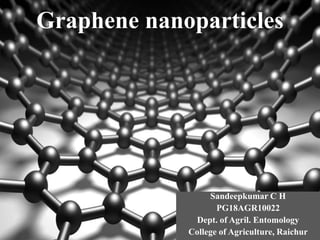
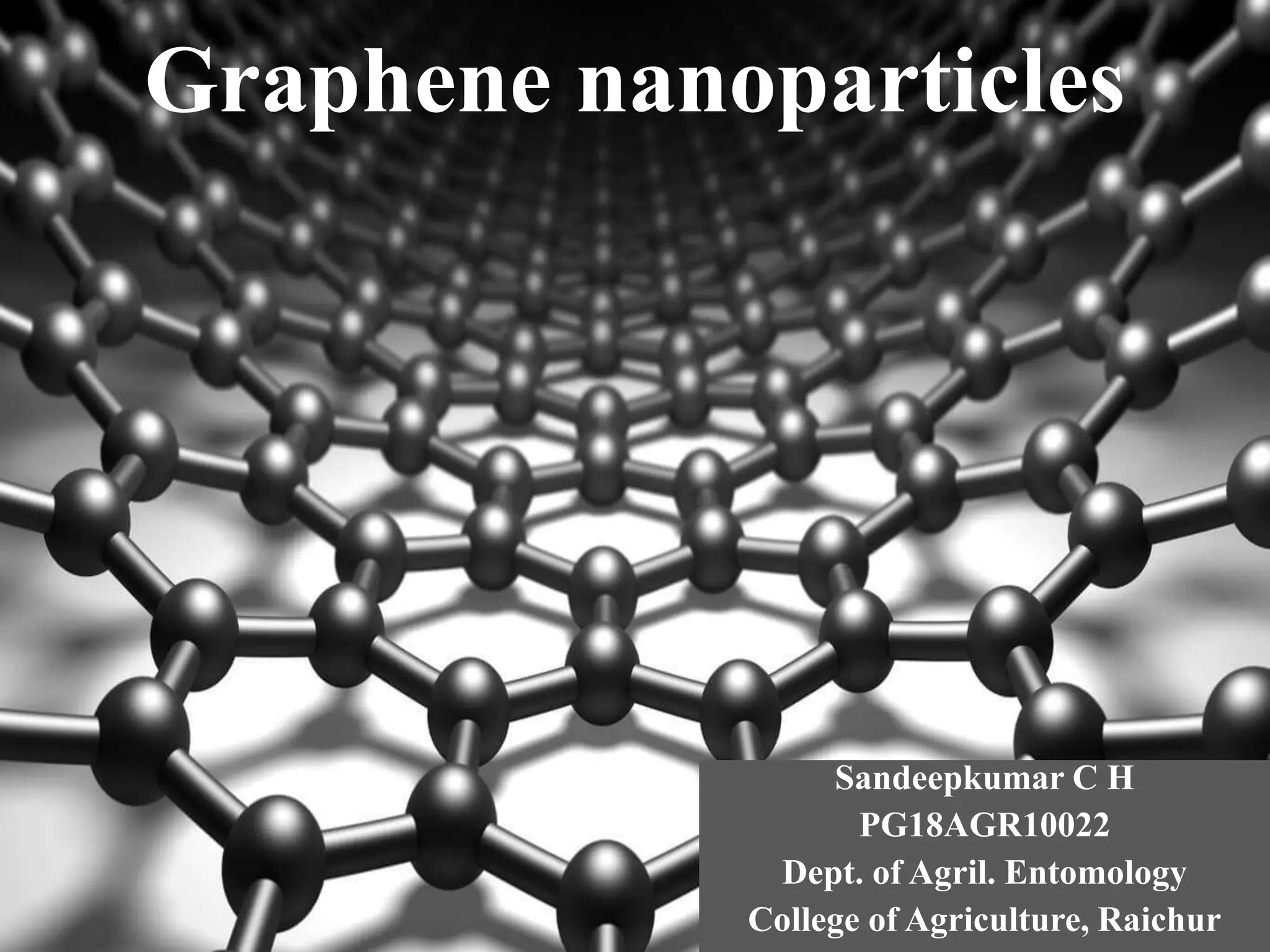
Graphene nanoparticles
Sandeepkumar C H
PG18AGR10022
Dept. of Agril. Entomology
College of Agriculture, Raichur
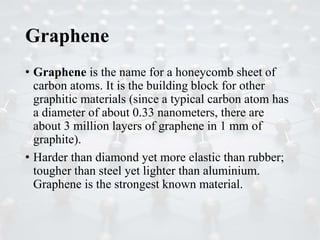
Graphene
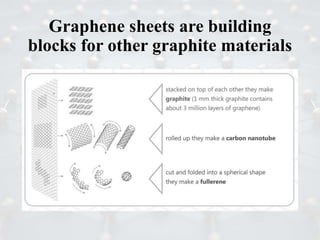
• Graphene is the name for a honeycomb sheet of
carbon atoms. It is the building block for other
graphitic materials (since a typical carbon atom has
a diameter of about 0.33 nanometers, there are
about 3 million layers of graphene in 1 mm of
graphite).
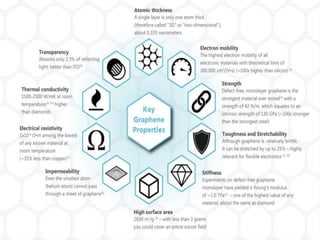
• Harder than diamond yet more elastic than rubber;
tougher than steel yet lighter than aluminium.
Graphene is the strongest known material.
Discovery
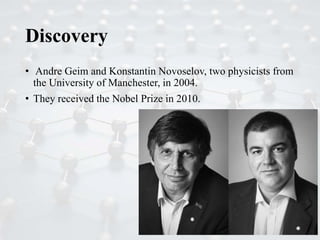
• Andre Geim and Konstantin Novoselov, two physicists from
the University of Manchester, in 2004.
• They received the Nobel Prize in 2010.
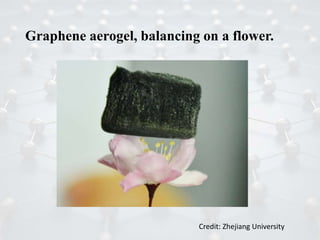
Graphene aerogel, balancing on a flower.
Credit: Zhejiang University
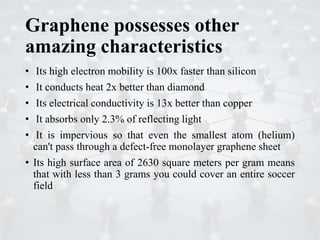
Graphene possesses other
amazing characteristics
• Its high electron mobility is 100x faster than silicon
• It conducts heat 2x better than diamond
• Its electrical conductivity is 13x better than copper
• It absorbs only 2.3% of reflecting light
• It is impervious so that even the smallest atom (helium)
can't pass through a defect-free monolayer graphene sheet
• Its high surface area of 2630 square meters per gram means
that with less than 3 grams you could cover an entire soccer
field
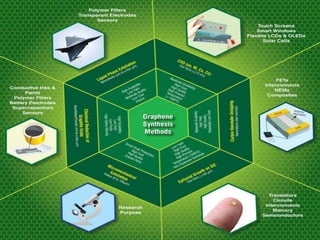
Graphene sheets are building
blocks for other graphite materials
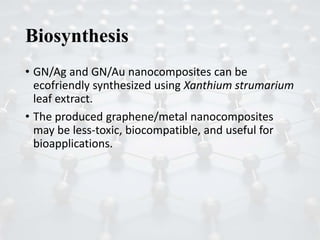
Biosynthesis
• GN/Ag and GN/Au nanocomposites can be
ecofriendly synthesized using Xanthium strumarium
leaf extract.
• The produced graphene/metal nanocomposites
may be less-toxic, biocompatible, and useful for
bioapplications.
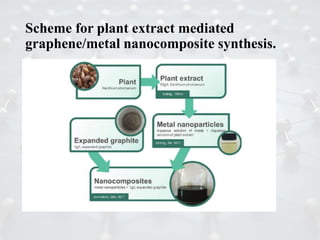
Scheme for plant extract mediated
graphene/metal nanocomposite synthesis.
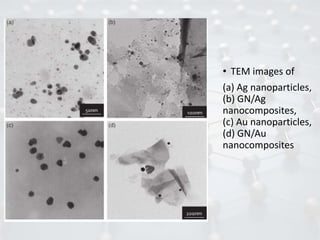
• TEM images of
(a) Ag nanoparticles,
(b) GN/Ag
nanocomposites,
(c) Au nanoparticles,
(d) GN/Au
nanocomposites
Toxicity
• GFNs can induce acute and chronic injuries in
tissues by penetrating through the blood-air barrier,
blood-testis barrier, blood-brain barrier, and blood-
placenta barrier etc. and accumulating in the lung,
liver, and spleen etc.
• GFNs did not pose a danger to human neural stem
cells at a dose of 250 μg/mL
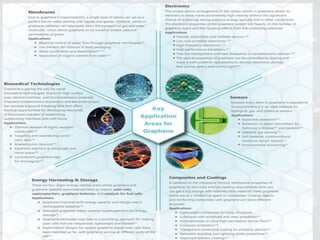
Graphene uses and applications
• Energy storage and solar cells
• Sensor applications
• Electronics applications
• Photodetectors
• Coatings
• Other uses
THANK YOU!

Graphene nanoparticles

  • 1.
    Graphene nanoparticles Sandeepkumar CH PG18AGR10022 Dept. of Agril. Entomology College of Agriculture, Raichur
  • 2.
    Graphene • Graphene isthe name for a honeycomb sheet of carbon atoms. It is the building block for other graphitic materials (since a typical carbon atom has a diameter of about 0.33 nanometers, there are about 3 million layers of graphene in 1 mm of graphite). • Harder than diamond yet more elastic than rubber; tougher than steel yet lighter than aluminium. Graphene is the strongest known material.
  • 3.
    Discovery • Andre Geimand Konstantin Novoselov, two physicists from the University of Manchester, in 2004. • They received the Nobel Prize in 2010.
  • 4.
    Graphene aerogel, balancingon a flower. Credit: Zhejiang University
  • 5.
    Graphene possesses other amazingcharacteristics • Its high electron mobility is 100x faster than silicon • It conducts heat 2x better than diamond • Its electrical conductivity is 13x better than copper • It absorbs only 2.3% of reflecting light • It is impervious so that even the smallest atom (helium) can't pass through a defect-free monolayer graphene sheet • Its high surface area of 2630 square meters per gram means that with less than 3 grams you could cover an entire soccer field
  • 6.
    Graphene sheets arebuilding blocks for other graphite materials
  • 9.
    Biosynthesis • GN/Ag andGN/Au nanocomposites can be ecofriendly synthesized using Xanthium strumarium leaf extract. • The produced graphene/metal nanocomposites may be less-toxic, biocompatible, and useful for bioapplications.
  • 10.
    Scheme for plantextract mediated graphene/metal nanocomposite synthesis.
  • 11.
    • TEM imagesof (a) Ag nanoparticles, (b) GN/Ag nanocomposites, (c) Au nanoparticles, (d) GN/Au nanocomposites
  • 12.
    Toxicity • GFNs caninduce acute and chronic injuries in tissues by penetrating through the blood-air barrier, blood-testis barrier, blood-brain barrier, and blood- placenta barrier etc. and accumulating in the lung, liver, and spleen etc. • GFNs did not pose a danger to human neural stem cells at a dose of 250 μg/mL
  • 13.
    Graphene uses andapplications • Energy storage and solar cells • Sensor applications • Electronics applications • Photodetectors • Coatings • Other uses
  • 15.