Linear, Branched, and Cross-linked Polymers
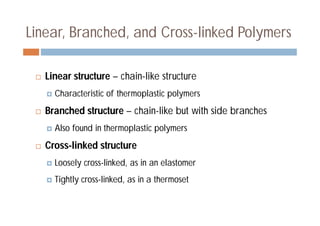
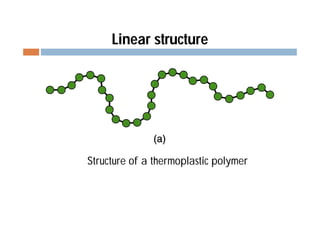
 Linear structure – chain-like structure
 Characteristic of thermoplastic polymers
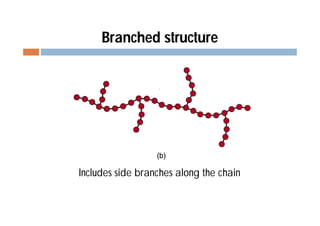
 Branched structure – chain-like but with side branches
 Also found in thermoplastic polymers
 Cross-linked structure
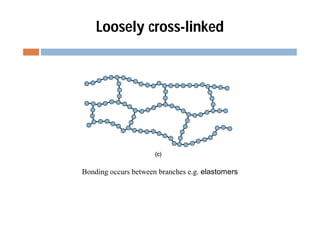
 Loosely cross-linked, as in an elastomer
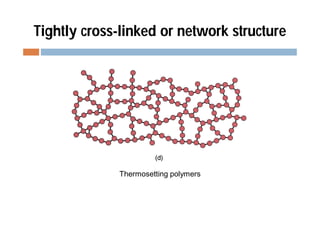
 Tightly cross-linked, as in a thermoset
Linear structure
Structure of a thermoplastic polymer
Branched structure
Includes side branches along the chain
Loosely cross-linked
Bonding occurs between branches e.g. elastomers
Tightly cross-linked or network structure
Thermosetting polymers
Effect of Branching on Properties
 Thermoplastic polymers-
 Always possess linear or branched structures, or a mixture
of the two
 Branches increase disorder among the molecules,
which makes the polymer:
 Stronger in the solid state
 More viscous at a given temperature in the plastic or
liquid state
Effect of Cross-Linking on Properties
 Thermosets possess a high degree of cross-linking,
while elastomers possess a low degree of cross-linking
 Thermosets are hard and brittle, while elastomers are
elastic and resilient
 Cross-linking causes the polymer to become chemically
set
 The reaction cannot be reversed
 The polymer structure is permanently changed; if heated, it
degrades or burns rather than melt
Mechanical Properties of Thermoplastics
 Low modulus of elasticity (stiffness)-lower than metals
and ceramics
 Low tensile strength, hardness than metals or ceramics
 Greater ductility on average
Important thermoplastic resins
 Commercially imp thermoplastic resins include natural
resins and resins derived from biopolymers and
sunthetic resins
 Natural Resins- resins such as copal, amber, rosin,
kauri, dammar and mastic, used in varnishes.
 When the plants and trees are wounded they exude
resins known as balsams as a protective measure.
9
 Natural resin polymers are hard with low thermal
conductivity and low dielectric constant
 They find use in electrical insulation and binders
10
Cellulose derivatives
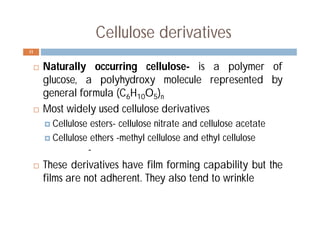
 Naturally occurring cellulose- is a polymer of
glucose, a polyhydroxy molecule represented by
general formula (C6H10O5)n
 Most widely used cellulose derivatives
 Cellulose esters- cellulose nitrate and cellulose acetate
 Cellulose ethers -methyl cellulose and ethyl cellulose
-
 These derivatives have film forming capability but the
films are not adherent. They also tend to wrinkle
11
POLY VINYL CHLORIDE (PVC)
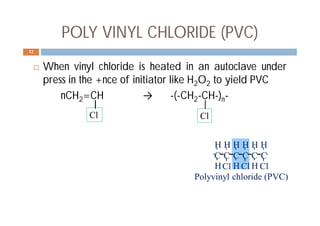
 When vinyl chloride is heated in an autoclave under
press in the +nce of initiator like H2O2 to yield PVC
nCH2=CH → -(-CH2-CH-)n-
12
ClCl Cl
C C C C C C
HHH
HHHHHH
Polyvinyl chloride (PVC)
Cl Cl
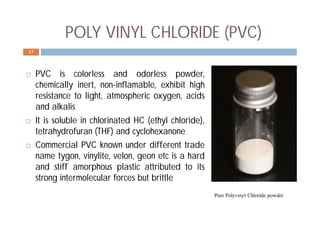
 PVC is colorless and odorless powder,
chemically inert, non-inflamable, exhibit high
resistance to light, atmospheric oxygen, acids
and alkalis
 It is soluble in chlorinated HC (ethyl chloride),
tetrahydrofuran (THF) and cyclohexanone
 Commercial PVC known under different trade
name tygon, vinylite, velon, geon etc is a hard
and stiff amorphous plastic attributed to its
strong intermolecular forces but brittle
13
Pure Polyvinyl Chloride powder
POLY VINYL CHLORIDE (PVC)
 Manufacture of pipes, tubes, tank linings, safety
helmets, refrigerator components, light fittings, trays,
cycle and motor cycle mudguards
 In the manufacture of flexible films or sheets of
varying thickness (0.1-8mm) required for making
table clothes, curtains, raincoats
 Also used for wire coating and insulation of eletric
cables and manufacture of upholstery
14
POLY VINYL CHLORIDE (PVC)
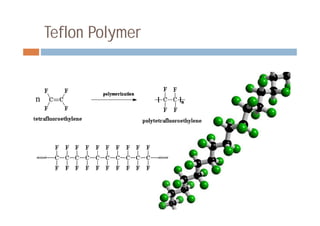
Polytetrafluoroethylene (PTFE)
 PTFE is a synthetic fluoropolymer of
tetrafluoroethylene that finds numerous applications
 The most well known brand name of PTFE is Teflon
 PTFE is hydrophobic: neither water nor water-
containing substances wet PTFE, as fluorocarbons
demonstrate moderate dispersion forces due to the
high electronegativity of fluorine.
 Has the lowest coefficients of friction against any solid
15
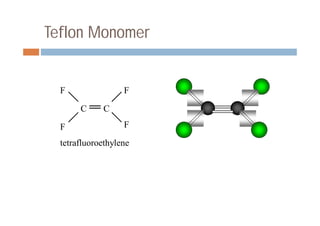
Teflon Monomer
C C
F
F
F
F
tetrafluoroethylene
Teflon Polymer
n
PTFE
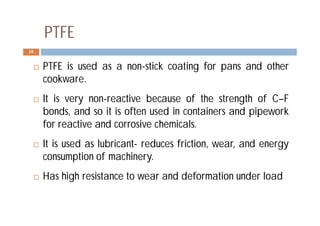
 PTFE is used as a non-stick coating for pans and other
cookware.
 It is very non-reactive because of the strength of C–F
bonds, and so it is often used in containers and pipework
for reactive and corrosive chemicals.
 It is used as lubricant- reduces friction, wear, and energy
consumption of machinery.
 Has high resistance to wear and deformation under load
18
PTFE
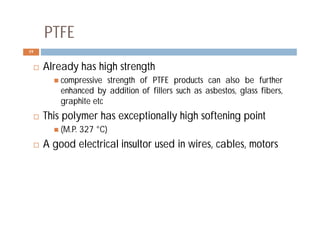
 Already has high strength
 compressive strength of PTFE products can also be further
enhanced by addition of fillers such as asbestos, glass fibers,
graphite etc
 This polymer has exceptionally high softening point
 (M.P. 327 °C)
 A good electrical insultor used in wires, cables, motors
19
POLYCARBONATE
20
 PC are thermoplastic polysters having functional groups linked
together by carbonate groups (-O-(C=O)-O) in a long molecular
chain and commercially known as MERLON, LEXAN.
 Most common type of polycarbonate plastics are obtained by
diphenyl carbonate with bis-phenol A (2,2-bis-(4-hydroxyphenyl)-
propane) to give bis phenol A groups linked by carbonate groups
21
POLYCARBONATE
 PC have high tensile and impact strength over a wide
range of temperatures
 Polymers are highly transparent to visible light and
have better light transmission characteristics than many
types of glasses
 They are soluble in organic solvents and alkalis
22
POLYCARBONATE
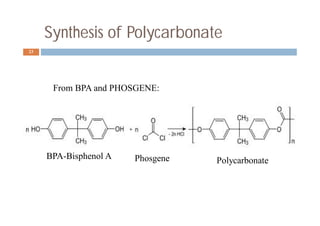
Synthesis of Polycarbonate
23
BPA-Bisphenol A Phosgene Polycarbonate
From BPA and PHOSGENE:
Synthesis of Polycarbonate
Alternative Route24
From BPA and diphenyl carbonate:
(HOC6H4)2CMe2 + (C6H5O)2CO → -[OC(OC6H4)2CMe2]-n
Diphenyl carbonate Polycarbonate
+
Bisphenol A (BPA)
+ 2 C6H5OH
APPLICATIONS
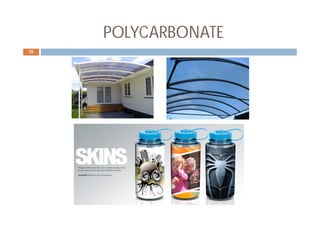
 PC are used for making MOULDED domestic wares,
housing for apparatus and electrical insulation
 Used in manufacture of sunglasses/eyeglass lenses
 CR-39 is a specific polycarbonate plastic with good optical and
mechanical properties
 CDs, DVDs, nalgene bottles and food storage
containers
 They can be laminated to make bullet proof glass
25
PHENOLIC RESINS (PHENOPLAST)
 PHENOLIC RESINS are derived from the condensation reaction
between phenol or phenolic derivatives (e.g. resorcinol) and
aldehydes (formaldehyde and furfural)
 Commercially imp. As well as the erliest phenolic resins known as
bakelite is obtained by condensation pol. of phenol with
formaldehyde
 Linear poly. As well as highly crosslinked 3-D network structure can
be obtained by varying the proportion of phenol and
formaldehyde as well as the nature of catalyst
26
 If the phenol to formaldehyde (P/F) ratio is greater
than 1, a linear polymer is obtained with an acid
catalyst
 On the other hand with P/F ratio less than 1 and with a
basic catalyst a 3D network polymer is obtained
27
 Phenol reacts with formaldehyde initially to form methylol
derivatives in the o- and p- positions which undergo polymerization
in the presence of acid catalyst to yield methylene bridged linear
polymeric resin called NOVOLAC resin with m.w. in the range of
about 1000 corresponding to about 10 phenyl residues
 NOVOLAC resin can undergo further polymerization to yield 3D
polymers only when access formaldehyde is added and a basic
catalyst is used
28
 Resole resin is obtained by condensing phenol with access of
formaldehyde (P/F < 1) in the presence of basic catalyst
 The reaction is exothermic and hence require cooling
 Viscosity of the mix increases indicating the formation of
polymer
29
 Condensation product water is removed by suction to yield a
thermoplastic A- stage resin soluble in organic solvents
 A- stage resin is powdered and necessary fillers, colorants,
lubricants are added then additional amount of formaldehyde
required is added in the form of hexamethylenetetramine which
decomposes to form HCHO and NH3 during the final step
 NH3 acts as a curing catalyst
 Mixture is rolled in heated mixing equipments to facilitate the
continuation of the polymerization reaction to yield B-stage resin
30
 Resin is cooled and cut into required form
 B-stage resin is nearly insoluble in organic sovents but
can be fused with the application of heat and pressure
 B-stage resin is moulded into the final desired finished
product and during moulding the highly crosslinked C-
stage polymer (bakelite is formed)
 Finished product is removed from the mould and cant
be reshaped or reclaimed in any manner as the
polymer has been permanently cured by heat settings
31
Properties and applications
 Phenolic Resins have good adhesive and bonding
properties
 After heat setting exhibit high resistance to heat,
flammability, abrasion, water, chemicals and
solvents
 However they are susceptible to attack by alkalis
 They are hard and infusible with good dielectric
properties
 Fillers are used during molding of these resins to
reduce cost and also to impart specific properties
32
 Common fillers- wood powder, asbestos, cotton rags
etc
 Phenolic resins find use in the manufacture of
 electric insulation parts such as switches, plugs, switch
boards, handles for electrical appliances
 Molded parts for automobiles, PCBs and consumer
electronics and bearing in propeller shafts for rolling
mills and paper mills
33

Polymers

  • 1.
    Linear, Branched, andCross-linked Polymers  Linear structure – chain-like structure  Characteristic of thermoplastic polymers  Branched structure – chain-like but with side branches  Also found in thermoplastic polymers  Cross-linked structure  Loosely cross-linked, as in an elastomer  Tightly cross-linked, as in a thermoset
  • 2.
    Linear structure Structure ofa thermoplastic polymer
  • 3.
    Branched structure Includes sidebranches along the chain
  • 4.
    Loosely cross-linked Bonding occursbetween branches e.g. elastomers
  • 5.
    Tightly cross-linked ornetwork structure Thermosetting polymers
  • 6.
    Effect of Branchingon Properties  Thermoplastic polymers-  Always possess linear or branched structures, or a mixture of the two  Branches increase disorder among the molecules, which makes the polymer:  Stronger in the solid state  More viscous at a given temperature in the plastic or liquid state
  • 7.
    Effect of Cross-Linkingon Properties  Thermosets possess a high degree of cross-linking, while elastomers possess a low degree of cross-linking  Thermosets are hard and brittle, while elastomers are elastic and resilient  Cross-linking causes the polymer to become chemically set  The reaction cannot be reversed  The polymer structure is permanently changed; if heated, it degrades or burns rather than melt
  • 8.
    Mechanical Properties ofThermoplastics  Low modulus of elasticity (stiffness)-lower than metals and ceramics  Low tensile strength, hardness than metals or ceramics  Greater ductility on average
  • 9.
    Important thermoplastic resins Commercially imp thermoplastic resins include natural resins and resins derived from biopolymers and sunthetic resins  Natural Resins- resins such as copal, amber, rosin, kauri, dammar and mastic, used in varnishes.  When the plants and trees are wounded they exude resins known as balsams as a protective measure. 9
  • 10.
     Natural resinpolymers are hard with low thermal conductivity and low dielectric constant  They find use in electrical insulation and binders 10
  • 11.
    Cellulose derivatives  Naturallyoccurring cellulose- is a polymer of glucose, a polyhydroxy molecule represented by general formula (C6H10O5)n  Most widely used cellulose derivatives  Cellulose esters- cellulose nitrate and cellulose acetate  Cellulose ethers -methyl cellulose and ethyl cellulose -  These derivatives have film forming capability but the films are not adherent. They also tend to wrinkle 11
  • 12.
    POLY VINYL CHLORIDE(PVC)  When vinyl chloride is heated in an autoclave under press in the +nce of initiator like H2O2 to yield PVC nCH2=CH → -(-CH2-CH-)n- 12 ClCl Cl C C C C C C HHH HHHHHH Polyvinyl chloride (PVC) Cl Cl
  • 13.
     PVC iscolorless and odorless powder, chemically inert, non-inflamable, exhibit high resistance to light, atmospheric oxygen, acids and alkalis  It is soluble in chlorinated HC (ethyl chloride), tetrahydrofuran (THF) and cyclohexanone  Commercial PVC known under different trade name tygon, vinylite, velon, geon etc is a hard and stiff amorphous plastic attributed to its strong intermolecular forces but brittle 13 Pure Polyvinyl Chloride powder POLY VINYL CHLORIDE (PVC)
  • 14.
     Manufacture ofpipes, tubes, tank linings, safety helmets, refrigerator components, light fittings, trays, cycle and motor cycle mudguards  In the manufacture of flexible films or sheets of varying thickness (0.1-8mm) required for making table clothes, curtains, raincoats  Also used for wire coating and insulation of eletric cables and manufacture of upholstery 14 POLY VINYL CHLORIDE (PVC)
  • 15.
    Polytetrafluoroethylene (PTFE)  PTFEis a synthetic fluoropolymer of tetrafluoroethylene that finds numerous applications  The most well known brand name of PTFE is Teflon  PTFE is hydrophobic: neither water nor water- containing substances wet PTFE, as fluorocarbons demonstrate moderate dispersion forces due to the high electronegativity of fluorine.  Has the lowest coefficients of friction against any solid 15
  • 16.
  • 17.
  • 18.
    PTFE  PTFE isused as a non-stick coating for pans and other cookware.  It is very non-reactive because of the strength of C–F bonds, and so it is often used in containers and pipework for reactive and corrosive chemicals.  It is used as lubricant- reduces friction, wear, and energy consumption of machinery.  Has high resistance to wear and deformation under load 18
  • 19.
    PTFE  Already hashigh strength  compressive strength of PTFE products can also be further enhanced by addition of fillers such as asbestos, glass fibers, graphite etc  This polymer has exceptionally high softening point  (M.P. 327 °C)  A good electrical insultor used in wires, cables, motors 19
  • 20.
  • 21.
     PC arethermoplastic polysters having functional groups linked together by carbonate groups (-O-(C=O)-O) in a long molecular chain and commercially known as MERLON, LEXAN.  Most common type of polycarbonate plastics are obtained by diphenyl carbonate with bis-phenol A (2,2-bis-(4-hydroxyphenyl)- propane) to give bis phenol A groups linked by carbonate groups 21 POLYCARBONATE
  • 22.
     PC havehigh tensile and impact strength over a wide range of temperatures  Polymers are highly transparent to visible light and have better light transmission characteristics than many types of glasses  They are soluble in organic solvents and alkalis 22 POLYCARBONATE
  • 23.
    Synthesis of Polycarbonate 23 BPA-BisphenolA Phosgene Polycarbonate From BPA and PHOSGENE:
  • 24.
    Synthesis of Polycarbonate AlternativeRoute24 From BPA and diphenyl carbonate: (HOC6H4)2CMe2 + (C6H5O)2CO → -[OC(OC6H4)2CMe2]-n Diphenyl carbonate Polycarbonate + Bisphenol A (BPA) + 2 C6H5OH
  • 25.
    APPLICATIONS  PC areused for making MOULDED domestic wares, housing for apparatus and electrical insulation  Used in manufacture of sunglasses/eyeglass lenses  CR-39 is a specific polycarbonate plastic with good optical and mechanical properties  CDs, DVDs, nalgene bottles and food storage containers  They can be laminated to make bullet proof glass 25
  • 26.
    PHENOLIC RESINS (PHENOPLAST) PHENOLIC RESINS are derived from the condensation reaction between phenol or phenolic derivatives (e.g. resorcinol) and aldehydes (formaldehyde and furfural)  Commercially imp. As well as the erliest phenolic resins known as bakelite is obtained by condensation pol. of phenol with formaldehyde  Linear poly. As well as highly crosslinked 3-D network structure can be obtained by varying the proportion of phenol and formaldehyde as well as the nature of catalyst 26
  • 27.
     If thephenol to formaldehyde (P/F) ratio is greater than 1, a linear polymer is obtained with an acid catalyst  On the other hand with P/F ratio less than 1 and with a basic catalyst a 3D network polymer is obtained 27
  • 28.
     Phenol reactswith formaldehyde initially to form methylol derivatives in the o- and p- positions which undergo polymerization in the presence of acid catalyst to yield methylene bridged linear polymeric resin called NOVOLAC resin with m.w. in the range of about 1000 corresponding to about 10 phenyl residues  NOVOLAC resin can undergo further polymerization to yield 3D polymers only when access formaldehyde is added and a basic catalyst is used 28
  • 29.
     Resole resinis obtained by condensing phenol with access of formaldehyde (P/F < 1) in the presence of basic catalyst  The reaction is exothermic and hence require cooling  Viscosity of the mix increases indicating the formation of polymer 29
  • 30.
     Condensation productwater is removed by suction to yield a thermoplastic A- stage resin soluble in organic solvents  A- stage resin is powdered and necessary fillers, colorants, lubricants are added then additional amount of formaldehyde required is added in the form of hexamethylenetetramine which decomposes to form HCHO and NH3 during the final step  NH3 acts as a curing catalyst  Mixture is rolled in heated mixing equipments to facilitate the continuation of the polymerization reaction to yield B-stage resin 30
  • 31.
     Resin iscooled and cut into required form  B-stage resin is nearly insoluble in organic sovents but can be fused with the application of heat and pressure  B-stage resin is moulded into the final desired finished product and during moulding the highly crosslinked C- stage polymer (bakelite is formed)  Finished product is removed from the mould and cant be reshaped or reclaimed in any manner as the polymer has been permanently cured by heat settings 31
  • 32.
    Properties and applications Phenolic Resins have good adhesive and bonding properties  After heat setting exhibit high resistance to heat, flammability, abrasion, water, chemicals and solvents  However they are susceptible to attack by alkalis  They are hard and infusible with good dielectric properties  Fillers are used during molding of these resins to reduce cost and also to impart specific properties 32
  • 33.
     Common fillers-wood powder, asbestos, cotton rags etc  Phenolic resins find use in the manufacture of  electric insulation parts such as switches, plugs, switch boards, handles for electrical appliances  Molded parts for automobiles, PCBs and consumer electronics and bearing in propeller shafts for rolling mills and paper mills 33