COMMON WORKPLACE HAZARD
AND THEIR CONTROL MEASURES
HOUSEHOLD SERVICES 8 | LESSON 4
1
ELECTRICAL HAZARD
Many of the electrical appliances used for household
services can create serious health and safety risks in
the workplace, particularly in wet conditions.
Damage to equipment increases this risk. An
electrical fault could result in electrical burns/shocks,
loss of business, electrical fire/death or injury.
2
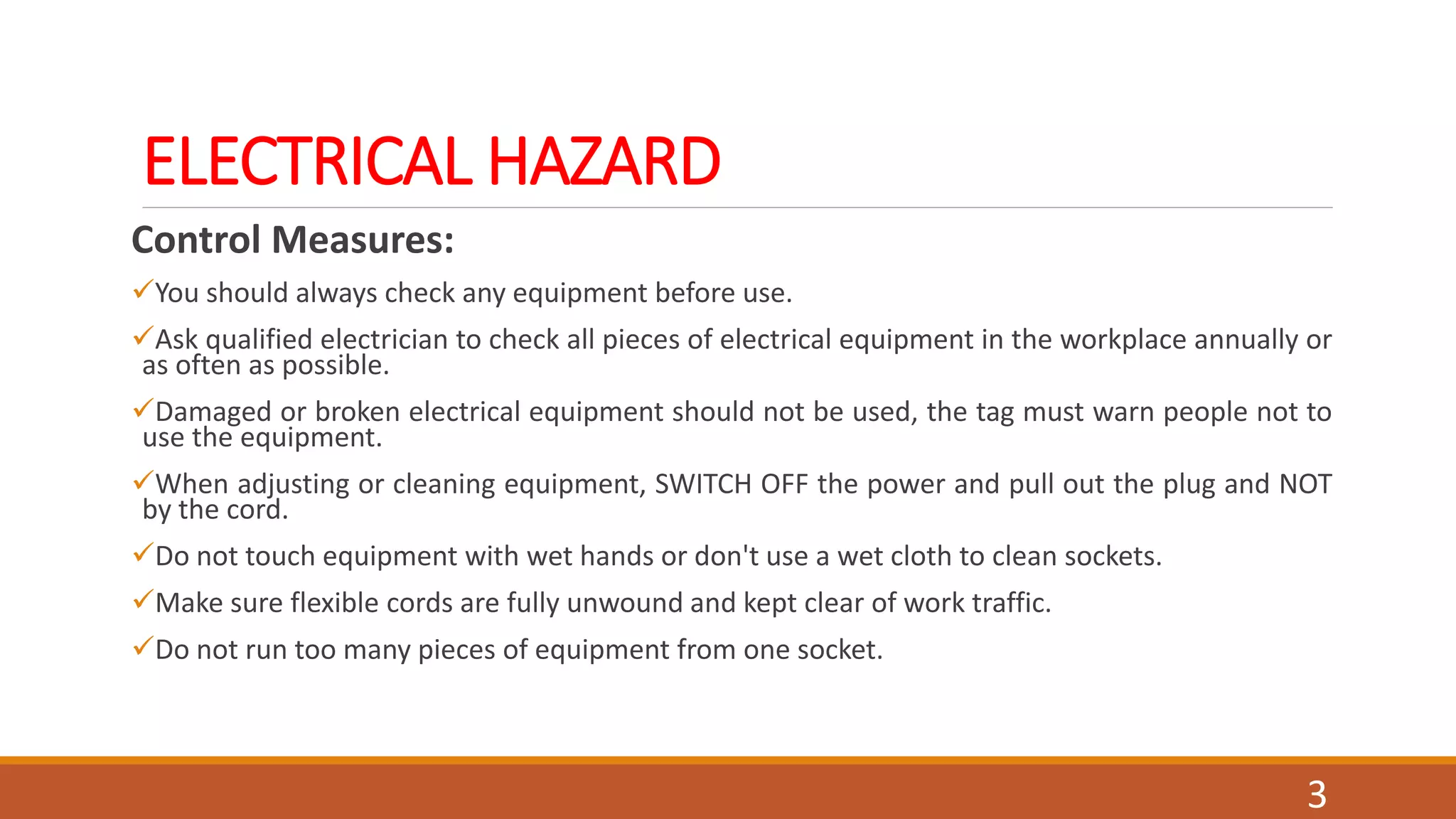
ELECTRICAL HAZARD
Control Measures:
You should always check any equipment before use.
Ask qualified electrician to check all pieces of electrical equipment in the workplace annually or
as often as possible.
Damaged or broken electrical equipment should not be used, the tag must warn people not to
use the equipment.
When adjusting or cleaning equipment, SWITCH OFF the power and pull out the plug and NOT
by the cord.
Do not touch equipment with wet hands or don't use a wet cloth to clean sockets.
Make sure flexible cords are fully unwound and kept clear of work traffic.
Do not run too many pieces of equipment from one socket.
3
CHEMICAL HAZARD
Chemicals are substances used and/or produced at
work that have the potential to harm the health and
safety of people at work. The effects of hazardous
substances may show immediately, or it may take
years for illness or disease to develop. Health effects
of some hazardous substances include skin irritation,
coughs, asthma, sensitization, poisoning and cancer.
4
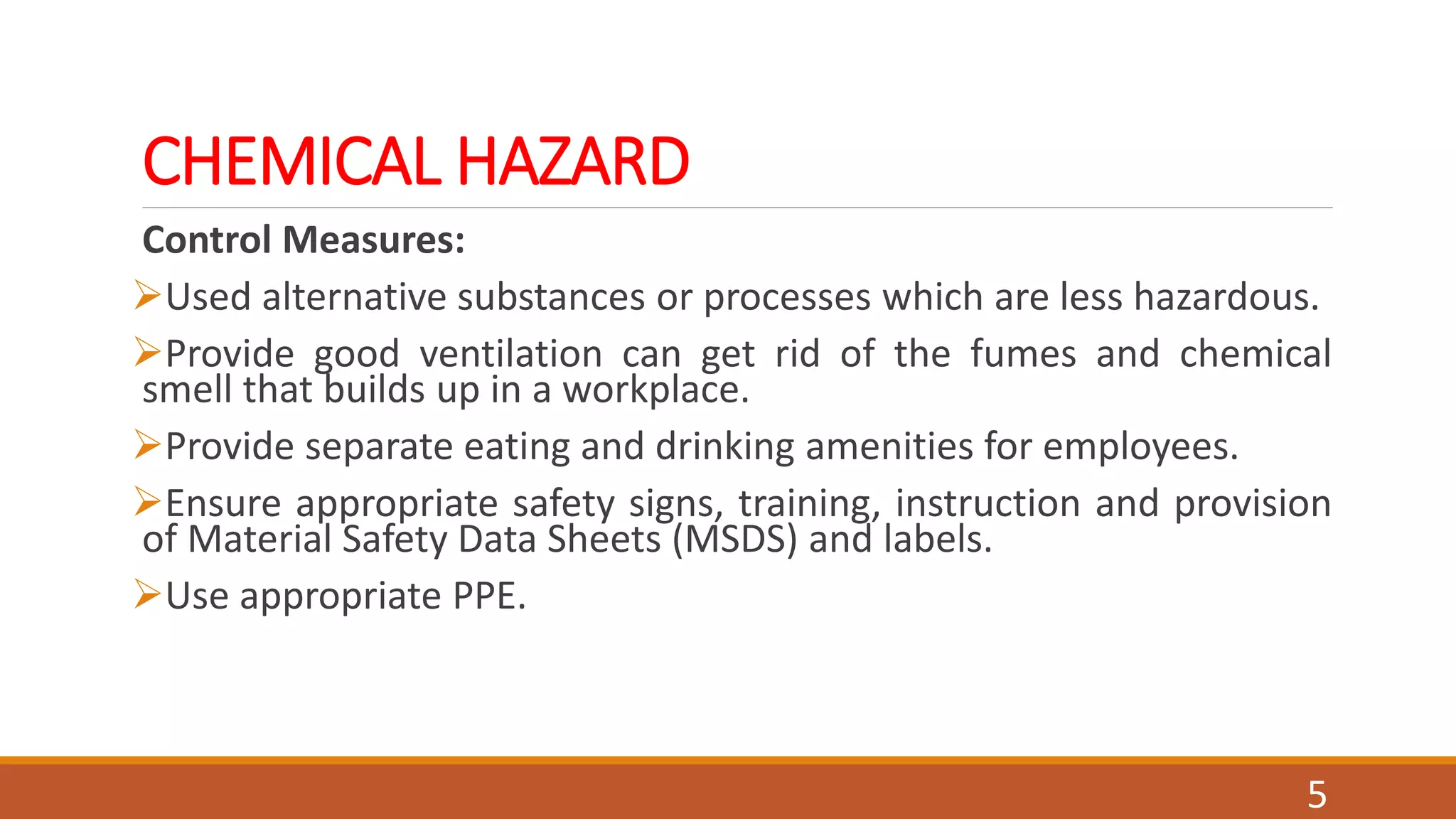
CHEMICAL HAZARD
Control Measures:
Used alternative substances or processes which are less hazardous.
Provide good ventilation can get rid of the fumes and chemical
smell that builds up in a workplace.
Provide separate eating and drinking amenities for employees.
Ensure appropriate safety signs, training, instruction and provision
of Material Safety Data Sheets (MSDS) and labels.
Use appropriate PPE.
5
SAFETY HAZARD
SLIPS, TRIPS, FALLS
Slips- loss of balance caused by too little friction between a people’s
foot and a walking surface.
Trips- hit an object, lose your balance and fall.
Falls- when you lose your balance & drop to the floor.
The results of slips, trips and falls include broken bones, abrasions,
contusions, strains, sprains, back or spinal injuries and other serious
injuries. During a slip, trip or fall accident, injury may be caused by
over stretching joints, bones and ligaments.
6
SAFETY HAZARD
Control Measures:
Clean up spills straight away.
Use mats on slippery floors.
Wear appropriate work shoes.
Improve cleaning methods to prevent build-up ofgrease/detergent.
Provide ample storage space to avoid materials being placed in
aisles/walkways.
Set absorbent flooring materials into entrance areas.
7
FIRE HAZARD
As a worker/citizen, you must be aware of and
trained in fire and emergency evacuation procedures
in the workplace. Emergency exit route will be the
easiest route by which all of the workers and staff can
leave the building/area safely.
8
FIRE HAZARD
Control Measures:
Keep all escape routes and fire exits clear, and make regular checks to
ensure they are safe to use.
Firefighting equipment must be available, located in specified area. You can
include fire extinguishers, blankets, sand buckets and water hoses.
Store products, particularly aerosols, away from naked flames or sources of
heat, at or below room temperature and in a dry atmosphere.
Switch off and unplug all electrical appliances before leaving the workplace.
Make sure that all workers in the area are aware of the action that must
takes in the event of a fire.
9
BIOLOGICAL HAZARD
also known as bio hazards, refer to biological
substances that pose a threat to the health of living
organisms, primarily that of humans. Micro-
organisms are everywhere and are continually
introduce into the environment.
10
BIOLOGICAL HAZARD
Control Measures: in the number of micro-organisms
from equipment surfaces by washing in detergent.
The following are the methods on how to control
infectious diseases:
Cleaning is the removal of soil and a reduction in the
number of micro-organisms from equipment surfaces
by washing in detergent and warm water.
11
BIOLOGICAL HAZARD
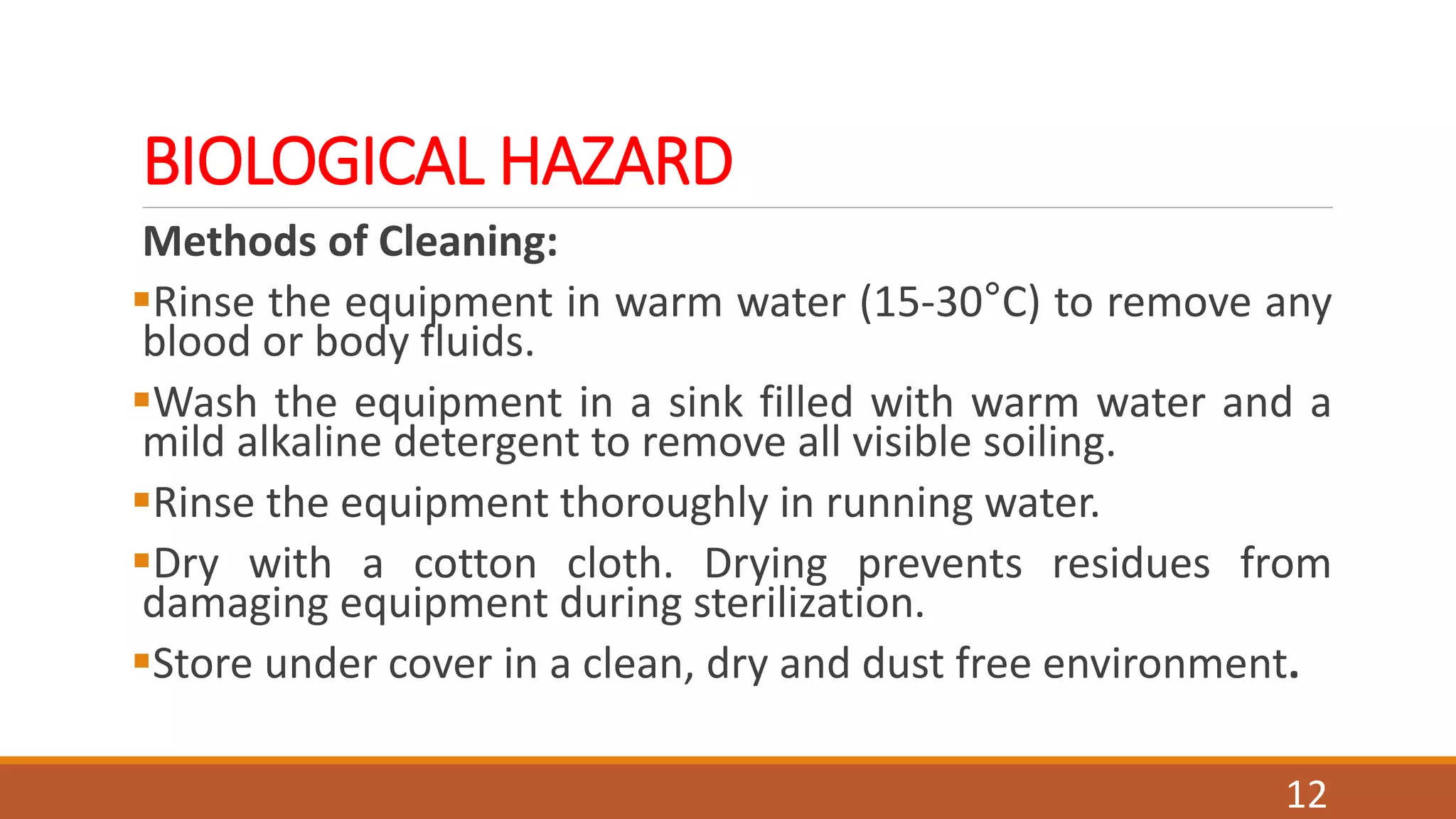
Methods of Cleaning:
Rinse the equipment in warm water (15-30°C) to remove any
blood or body fluids.
Wash the equipment in a sink filled with warm water and a
mild alkaline detergent to remove all visible soiling.
Rinse the equipment thoroughly in running water.
Dry with a cotton cloth. Drying prevents residues from
damaging equipment during sterilization.
Store under cover in a clean, dry and dust free environment.
12
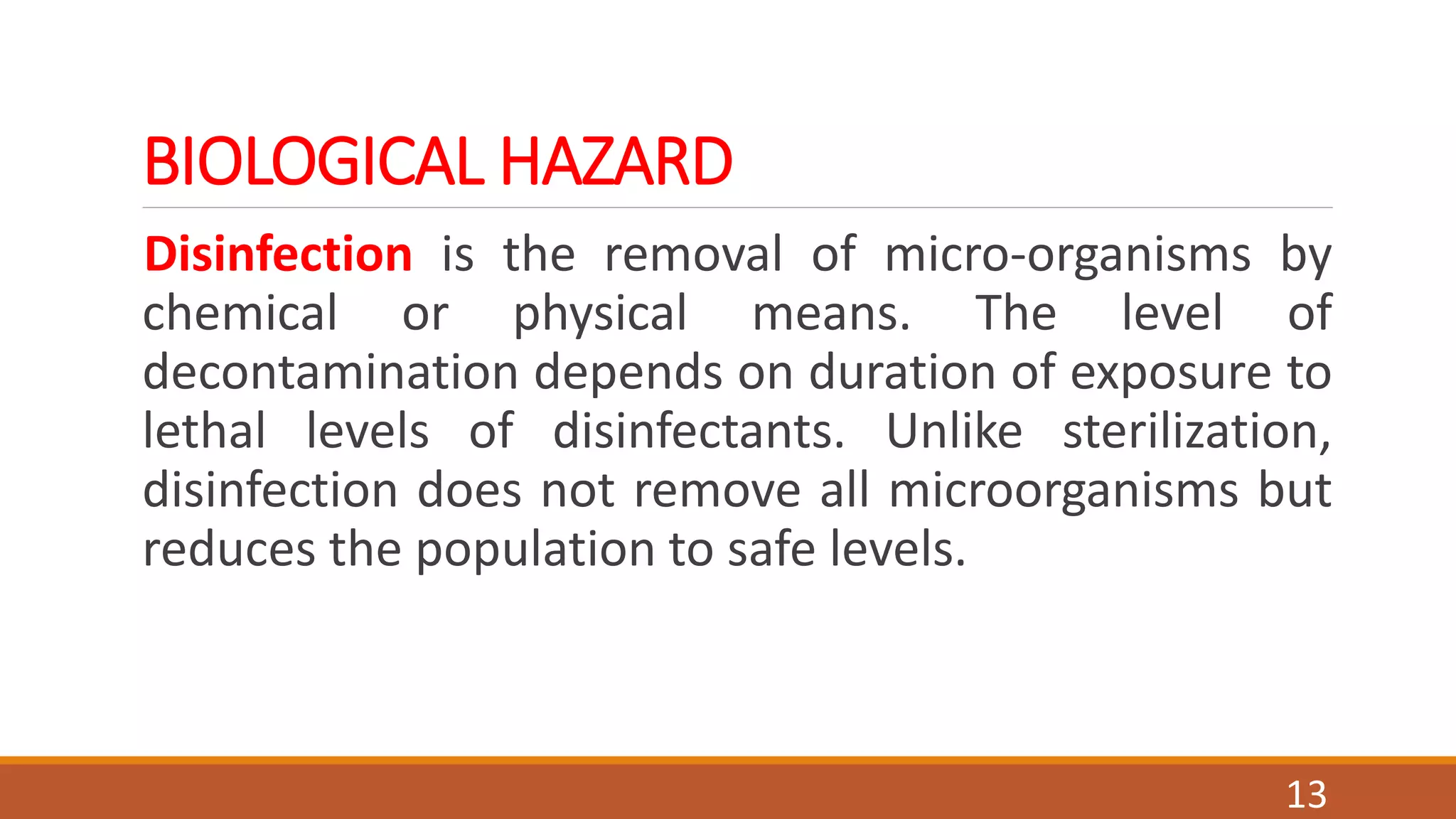
BIOLOGICAL HAZARD
Disinfection is the removal of micro-organisms by
chemical or physical means. The level of
decontamination depends on duration of exposure to
lethal levels of disinfectants. Unlike sterilization,
disinfection does not remove all microorganisms but
reduces the population to safe levels.
13
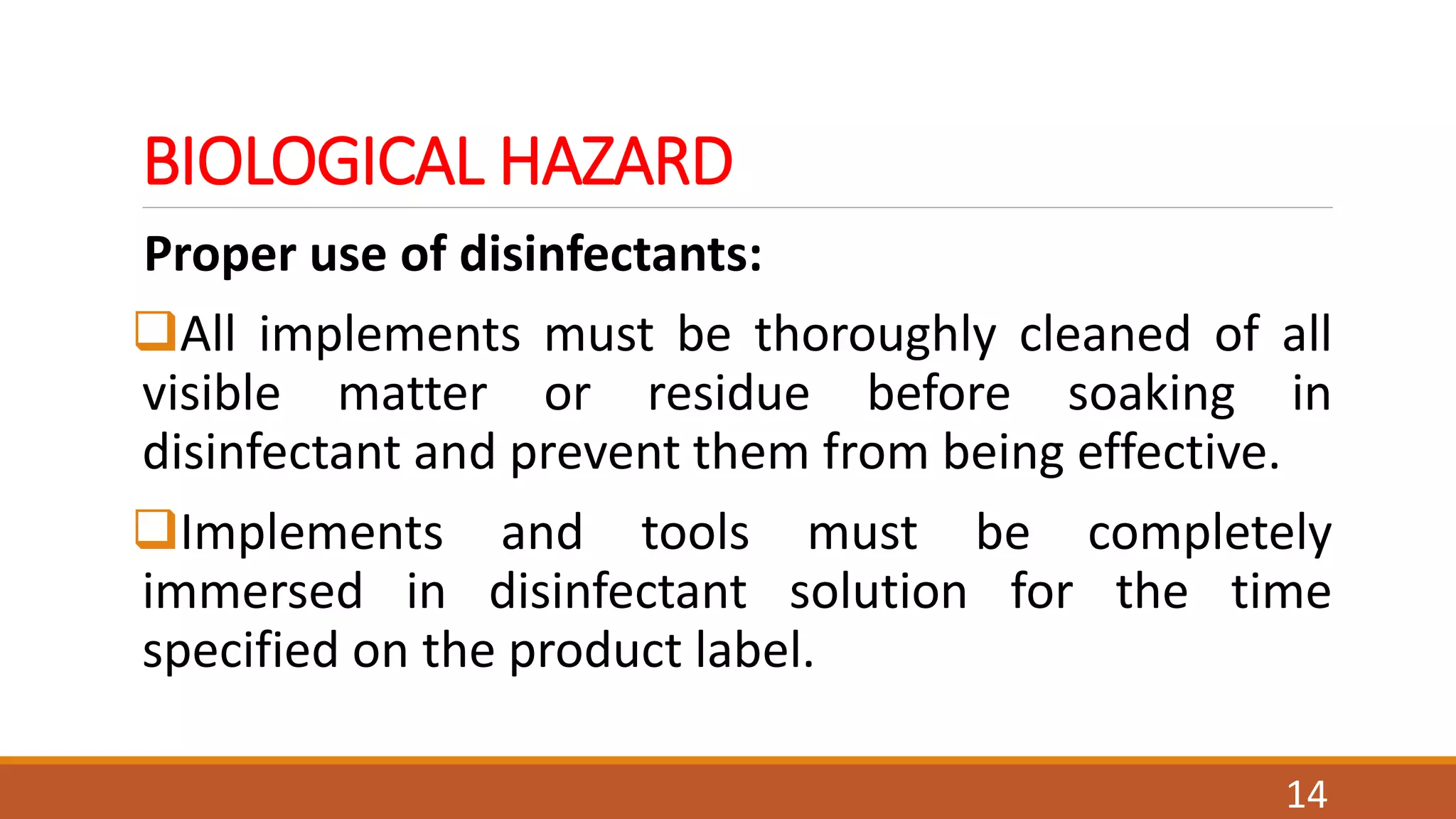
BIOLOGICAL HAZARD
Proper use of disinfectants:
All implements must be thoroughly cleaned of all
visible matter or residue before soaking in
disinfectant and prevent them from being effective.
Implements and tools must be completely
immersed in disinfectant solution for the time
specified on the product label.
14
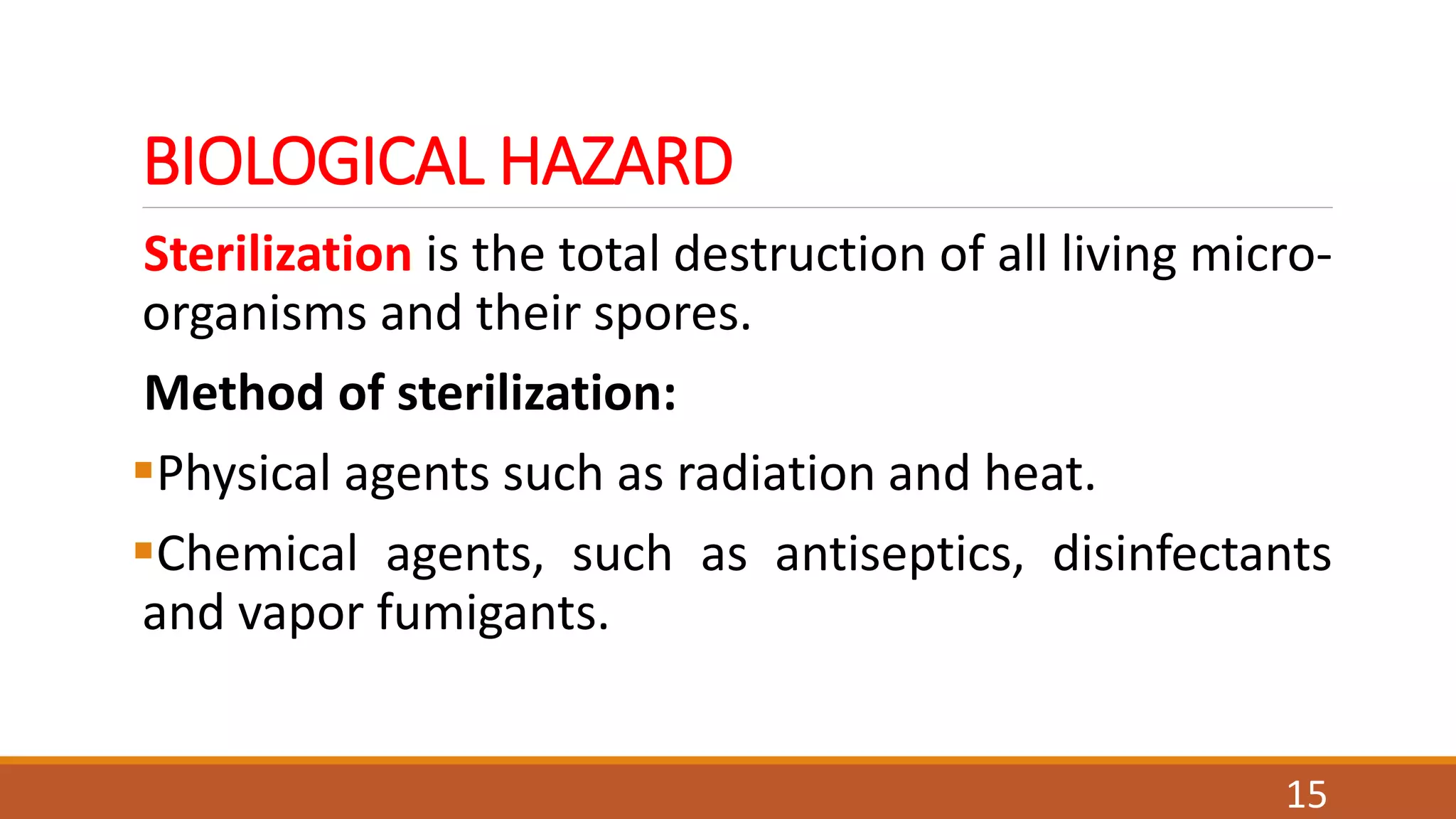
BIOLOGICAL HAZARD
Sterilization is the total destruction of all living micro-
organisms and their spores.
Method of sterilization:
Physical agents such as radiation and heat.
Chemical agents, such as antiseptics, disinfectants
and vapor fumigants.
15
ERGONOMIC HAZARD
Ergonomic is the study of how equipment and
furniture can be arranged in order that people can do
work or other activities more efficiently and
comfortably. It is important in the adaptation of work
conditions to the physical and psychological nature of
people.
16
ERGONOMIC HAZARD
Control Measures:
Practicing shifts.
Raised platform to help operators reach badly located
controls.
Provide height adjustable chairs to individual. Operator can
work at their preferred work height.
Proper orientation of machine to prevent squatting posture.
Take some rest if you feel tired to prevent pain and
numbness.
17

LESSON 4 Common workplace hazard and their control measure

  • 1.
    COMMON WORKPLACE HAZARD ANDTHEIR CONTROL MEASURES HOUSEHOLD SERVICES 8 | LESSON 4 1
  • 2.
    ELECTRICAL HAZARD Many ofthe electrical appliances used for household services can create serious health and safety risks in the workplace, particularly in wet conditions. Damage to equipment increases this risk. An electrical fault could result in electrical burns/shocks, loss of business, electrical fire/death or injury. 2
  • 3.
    ELECTRICAL HAZARD Control Measures: Youshould always check any equipment before use. Ask qualified electrician to check all pieces of electrical equipment in the workplace annually or as often as possible. Damaged or broken electrical equipment should not be used, the tag must warn people not to use the equipment. When adjusting or cleaning equipment, SWITCH OFF the power and pull out the plug and NOT by the cord. Do not touch equipment with wet hands or don't use a wet cloth to clean sockets. Make sure flexible cords are fully unwound and kept clear of work traffic. Do not run too many pieces of equipment from one socket. 3
  • 4.
    CHEMICAL HAZARD Chemicals aresubstances used and/or produced at work that have the potential to harm the health and safety of people at work. The effects of hazardous substances may show immediately, or it may take years for illness or disease to develop. Health effects of some hazardous substances include skin irritation, coughs, asthma, sensitization, poisoning and cancer. 4
  • 5.
    CHEMICAL HAZARD Control Measures: Usedalternative substances or processes which are less hazardous. Provide good ventilation can get rid of the fumes and chemical smell that builds up in a workplace. Provide separate eating and drinking amenities for employees. Ensure appropriate safety signs, training, instruction and provision of Material Safety Data Sheets (MSDS) and labels. Use appropriate PPE. 5
  • 6.
    SAFETY HAZARD SLIPS, TRIPS,FALLS Slips- loss of balance caused by too little friction between a people’s foot and a walking surface. Trips- hit an object, lose your balance and fall. Falls- when you lose your balance & drop to the floor. The results of slips, trips and falls include broken bones, abrasions, contusions, strains, sprains, back or spinal injuries and other serious injuries. During a slip, trip or fall accident, injury may be caused by over stretching joints, bones and ligaments. 6
  • 7.
    SAFETY HAZARD Control Measures: Cleanup spills straight away. Use mats on slippery floors. Wear appropriate work shoes. Improve cleaning methods to prevent build-up ofgrease/detergent. Provide ample storage space to avoid materials being placed in aisles/walkways. Set absorbent flooring materials into entrance areas. 7
  • 8.
    FIRE HAZARD As aworker/citizen, you must be aware of and trained in fire and emergency evacuation procedures in the workplace. Emergency exit route will be the easiest route by which all of the workers and staff can leave the building/area safely. 8
  • 9.
    FIRE HAZARD Control Measures: Keepall escape routes and fire exits clear, and make regular checks to ensure they are safe to use. Firefighting equipment must be available, located in specified area. You can include fire extinguishers, blankets, sand buckets and water hoses. Store products, particularly aerosols, away from naked flames or sources of heat, at or below room temperature and in a dry atmosphere. Switch off and unplug all electrical appliances before leaving the workplace. Make sure that all workers in the area are aware of the action that must takes in the event of a fire. 9
  • 10.
    BIOLOGICAL HAZARD also knownas bio hazards, refer to biological substances that pose a threat to the health of living organisms, primarily that of humans. Micro- organisms are everywhere and are continually introduce into the environment. 10
  • 11.
    BIOLOGICAL HAZARD Control Measures:in the number of micro-organisms from equipment surfaces by washing in detergent. The following are the methods on how to control infectious diseases: Cleaning is the removal of soil and a reduction in the number of micro-organisms from equipment surfaces by washing in detergent and warm water. 11
  • 12.
    BIOLOGICAL HAZARD Methods ofCleaning: Rinse the equipment in warm water (15-30°C) to remove any blood or body fluids. Wash the equipment in a sink filled with warm water and a mild alkaline detergent to remove all visible soiling. Rinse the equipment thoroughly in running water. Dry with a cotton cloth. Drying prevents residues from damaging equipment during sterilization. Store under cover in a clean, dry and dust free environment. 12
  • 13.
    BIOLOGICAL HAZARD Disinfection isthe removal of micro-organisms by chemical or physical means. The level of decontamination depends on duration of exposure to lethal levels of disinfectants. Unlike sterilization, disinfection does not remove all microorganisms but reduces the population to safe levels. 13
  • 14.
    BIOLOGICAL HAZARD Proper useof disinfectants: All implements must be thoroughly cleaned of all visible matter or residue before soaking in disinfectant and prevent them from being effective. Implements and tools must be completely immersed in disinfectant solution for the time specified on the product label. 14
  • 15.
    BIOLOGICAL HAZARD Sterilization isthe total destruction of all living micro- organisms and their spores. Method of sterilization: Physical agents such as radiation and heat. Chemical agents, such as antiseptics, disinfectants and vapor fumigants. 15
  • 16.
    ERGONOMIC HAZARD Ergonomic isthe study of how equipment and furniture can be arranged in order that people can do work or other activities more efficiently and comfortably. It is important in the adaptation of work conditions to the physical and psychological nature of people. 16
  • 17.
    ERGONOMIC HAZARD Control Measures: Practicingshifts. Raised platform to help operators reach badly located controls. Provide height adjustable chairs to individual. Operator can work at their preferred work height. Proper orientation of machine to prevent squatting posture. Take some rest if you feel tired to prevent pain and numbness. 17