Learning Objectives
• Brieflyexplain the relevance and importance of the practice of industrial
hygiene in society today and throughout history.
• Explain the types of sciences and studies that comprise the field of
industrial hygiene.
• Describe the differences between pathways of exposure and routes of
exposure to hazardous agents.
• List general types of workplace hazards.
• Identify the basic health effects of hazardous exposures in the workplace.
• Describe the concept of risk and the fundamental principles that it is based
upon.
• Discuss the basic tenets of industrial hygiene hazard assessment and
control.
• Recognize the types of careers and industries available for professional
industrial hygienists.
• Briefly describe the various government agencies and professional
organizations with roles in industrial hygiene.
3.
Industrial Hygiene Definition
“Thatscience and art devoted to the anticipation,
recognition, evaluation, and control of those
environmental factors or stresses arising in or
from the workplace that may cause sickness,
impaired health and wellbeing, or significant
discomfort among workers or among the citizens
of the community” (AIHA).
Chronic Exposure
• Alower level exposure that occurs over a long period of
time
• Days, weeks, months, years
15.
Acute Health Effects
•Seen shortly after exposure
• May be reversible
• Hearing loss
• Headache
• Dizziness
• Skin redness
16.
Chronic Health Effects
•May take a long time to occur or notice
• Cancer
• Bone degeneration
• Hearing loss
• Silicosis
• Emphysema
17.
Risk
• Probability
• abranch of mathematics that measures and describes the relative
likelihood or frequency of an event and looks at the distributions of
the event’s occurrences within a given population.
• Severity
• The level of hazard associated with a possible exposure
18.
Anticipation
• Identifying potentialor actual hazards through
knowledge of materials, operations, processes, and
conditions in the workplace.
• Using available information from a variety of sources.
19.
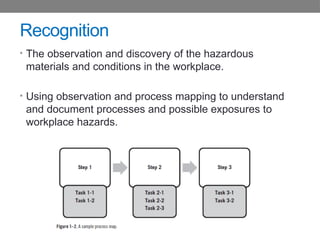
Recognition
• The observationand discovery of the hazardous
materials and conditions in the workplace.
• Using observation and process mapping to understand
and document processes and possible exposures to
workplace hazards.
20.
Evaluation
• Measure exposuresand doses, and comparing the
measurements to regulatory, professional, and other
exposure standards and limits.
• Measures could include air monitoring, ergonomic
observations, review of accident and injury records,
and worker interviews.
• Quantitatively evaluate and document levels of
exposure.
• Prioritize jobs with the most significant hazards.
21.
Control of Hazards
•The elimination or reduction of identified and measured
hazards.
• Use the hierarchy of controls to eliminate or reduce
hazards.
22.
Elimination and Substitution
•Completely eliminate the hazard from the workplace.
• Stop the use of a particular toxic or flammable chemical
used in the process or product.
• Reduce the quantity of a particular hazardous chemical
used.
• Change the chemical to a safer or less hazardous one.
• Change the work process to cut out the hazardous activity
or materials used.
23.
Engineering Controls
• Structures,systems, or devices that physically separate,
or protect the worker from the hazard.
• Barriers, walls, enclosures, covers, guards, shields.
• Ventilation systems, fume hoods.
• Distance (moving the hazard farther away from the
workers).
Personal Protective Equipment
•Respirators
• Gloves
• Lab coats
• Eyewear
• Footwear
• Lead aprons
• Face shields
• Ear muffs
26.
Industry Careers
• Manufacturing
•Health care
• Research/education
• Transportation
• Insurance
• Agriculture
• Public utilities
• Construction
• Energy
• Waste management
• Mining
27.
Government Careers
• EnvironmentalProtection Agency
• Federal Communications Commission
• Nuclear Regulatory Commission
• National Institutes of Health’s Center for Disease Control and
Prevention
• Public Health Service
• Chemical Safety Board
• National Institute for Environmental Health Studies
• Consumer Product Safety Commission
• Department of Energy
• Mine Safety and Health Administration
• National Transportation Safety Board
28.
Job Paths
• Consulting
•Laboratory analysis
• Management
• Exposure assessment and control
• Research
• Policy and regulation development and analysis
• Quality assurance
• Ergonomics
• Noise assessment and control
• Radiation safety
29.
Professional Organizations
• AmericanIndustrial Hygiene Association
• American Society of Safety Engineers
• American Conference of Governmental Industrial
Hygienists
• National Safety Council
• Health Physics Society
• Human Factors and Ergonomics Society
• American National Standards Institute
Editor's Notes
#3 Ask about science vs. art.
Review anticipation, recognition, evaluation, and control
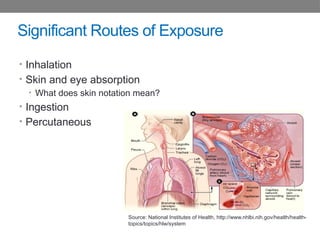
#6 Skin notation means it can be a significant pathway.



![CTEV [ clubfoot] DR ARUN LAL ,DR MOHAMED ASHRAF travancore medical college k...](https://cdn.slidesharecdn.com/ss_thumbnails/ctevclubfootdrarunlaldrmohamedashraftravancoremedicalcollegekollamkeralaindia-260208063247-18fc466c-thumbnail.jpg?width=640&height=640&fit=bounds)


