Industrial
Safety

TIRE SAFETY

…a Debo, Nat, & Philip presentation.
Special thanks to Keith W. Goodhew

SAFETY is our number 1 value !!!
...Safety, our no. 1 value!

Presenters
Megbuwawon Adebowale Adeniyi
B.Eng Agricultural Engineering

Oamhen Nathaniel Oseiga

HND Electrical/Electronics Engineering
MCITP, MCSA MCTS, MCP, A+

Eze Philip Ogechukwu

B.Eng Mechanical/Production Engineering
...Safety, our no. 1 value!

Objectives
...Safety, our no. 1 value!

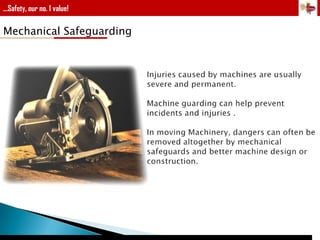
Mechanical Safeguarding
...Safety, our no. 1 value!

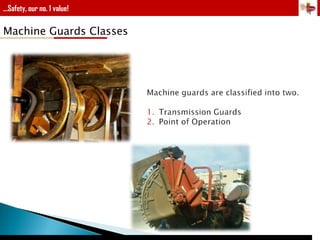
Machine Guards Classes
...Safety, our no. 1 value!

Types of guards

Guards include:
Fixed guards

* Usually on transmission machinery
•Do not move with each operation
•Adjusted to accommodate various sizes
•Fixed into place after adjustment

Interlocking guards

•Can be operated electronically, mechanically, pneumatically
•Prevents operation of the controls that sets the machine in
operation until guards is moved into place

Automatic guards
*Prevents operator from coming into contact with

dangerous parts of the machine while it is moving.
...Safety, our no. 1 value!

Characteristics

>How do I know a good guard?
Provides maximum protection
Block access to danger zone during operation
Corrosion and fire resistant
Does not create splinters and nip points
Should be a permanent part of the machinery
Should not affect efficient operation of machine
Strong enough to withstand wear and tear
If bulky, hinging should be considered to
facilitate servicing and repair of belt or gears
...Safety, our no. 1 value!

Precautions
If you work on Mechanical and Electrical equipments:


Never work on any “live” or moving equipment without
appropriate PPE



Inspect/Check before commissioning



Wear appropriate PPE



No bypassing of safety devices



Use correct tools and procedures



Do not use hands to remove jammed particles



Isolation (Energy source reduced to zero) requirement must always be
followed



Any hazardous task should be identified and covered by a work
permit or written safe work procedure.
...Safety, our no. 1 value!

Lock-out System
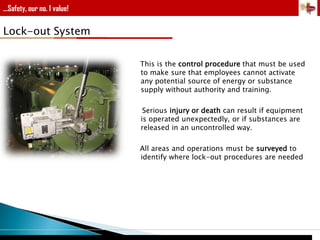
This is the control procedure that must be used
to make sure that employees cannot activate
any potential source of energy or substance
supply without authority and training.
Serious injury or death can result if equipment
is operated unexpectedly, or if substances are
released in an uncontrolled way.
All areas and operations must be surveyed to
identify where lock-out procedures are needed
...Safety, our no. 1 value!

Lock-out system contd.
 Your company should have a Policy which
addresses those items, pieces of equipment or
processes which might result in serious damage
or harm if operated without the necessary
controls in place
This applies especially during maintenance or
breakdown procedures.
 Each person who needs to use lock-out
procedures must be issued with his own
personal lock and key.
...Safety, our no. 1 value!

Switches, Isolators & Valve Labeling
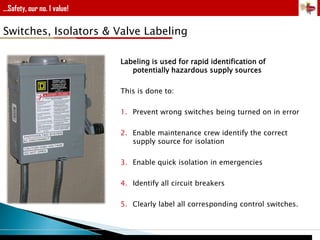
Labeling is used for rapid identification of
potentially hazardous supply sources
This is done to:
1. Prevent wrong switches being turned on in error
2. Enable maintenance crew identify the correct
supply source for isolation
3. Enable quick isolation in emergencies

4. Identify all circuit breakers
5. Clearly label all corresponding control switches.
...Safety, our no. 1 value!

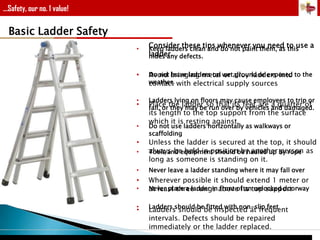
Basic Ladder Safety
•

Consider these tips whenever you need to use a
Keep ladders clean and do not paint them, as this
ladder defects.
hides any

•

Do not leave ladders on or ground or exposed
Avoid bringing metal wetalloy ladders into to the
weather. with electrical supply sources
contact

•

•

Ladders lying on floors may cause employees to trip or
Place the ladder so that its feet are and damaged.
a quarter of
fall, or they may be run over by vehicles

•

Do not use ladders horizontally as walkways or
scaffolding

its length to the top support from the surface
which it is resting against.

•

Unless the ladder is secured at the top, it should
always be held in position by another person
Tools and equipment should be hauled up by rope as
long as someone is standing on it.

•

Never leave a ladder standing where it may fall over

•
•

Wherever possible it should extend 1 meter or
Never place a ladder in above its top support
at least three rungs front of an unlocked doorway

•

Ladders should be fitted with non-slip feet

•

•

Ladders should be inspected at frequent
intervals. Defects should be repaired
immediately or the ladder replaced.
...Safety, our no. 1 value!

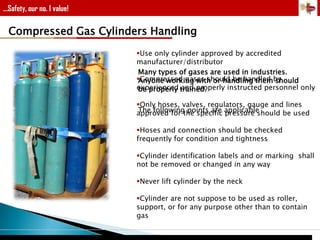
Compressed Gas Cylinders Handling
Use only cylinder approved by accredited
manufacturer/distributor
Many types of gases are used in industries.
Compressed gases should be handled by
Anyone working with or handling them should
experienced trained.
be properly and properly instructed personnel only
Only hoses, valves, regulators, gauge and lines
The following points are pressure should be used
approved for the specific applicable
Hoses and connection should be checked
frequently for condition and tightness
Cylinder identification labels and or marking shall
not be removed or changed in any way
Never lift cylinder by the neck
Cylinder are not suppose to be used as roller,
support, or for any purpose other than to contain
gas
...Safety, our no. 1 value!

CGC Handling
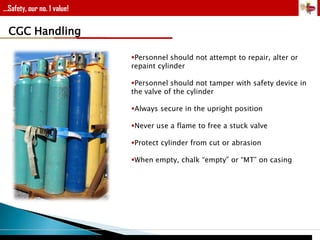
Personnel should not attempt to repair, alter or
repaint cylinder
Personnel should not tamper with safety device in
the valve of the cylinder
Always secure in the upright position
Never use a flame to free a stuck valve
Protect cylinder from cut or abrasion
When empty, chalk “empty” or “MT” on casing
...Safety, our no. 1 value!

Storage of CGC
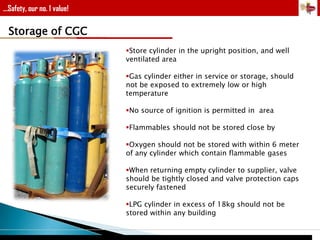
Store cylinder in the upright position, and well
ventilated area
Gas cylinder either in service or storage, should
not be exposed to extremely low or high
temperature
No source of ignition is permitted in area
Flammables should not be stored close by
Oxygen should not be stored with within 6 meter
of any cylinder which contain flammable gases
When returning empty cylinder to supplier, valve
should be tightly closed and valve protection caps
securely fastened
LPG cylinder in excess of 18kg should not be
stored within any building
...Safety, our no. 1 value!

Storage of acetylene cylinders
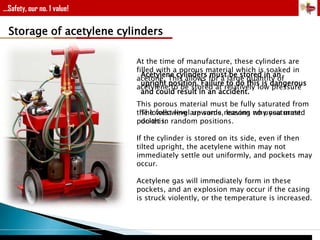
At the time of manufacture, these cylinders are
filled with a porous material which is soaked in
Acetylene cylinders must be stored in an
acetone. This allows for a large quantity of
upright position. Failure to do this is dangerous
acetylene to be stored at relatively low pressure
and could result in an accident.
This porous material must be fully saturated from
The following upwards, leaving why you must
the lowest levelare some reasons no unsaturated
do this.
pocket in random positions.
If the cylinder is stored on its side, even if then
tilted upright, the acetylene within may not
immediately settle out uniformly, and pockets may
occur.
Acetylene gas will immediately form in these
pockets, and an explosion may occur if the casing
is struck violently, or the temperature is increased.
...Safety, our no. 1 value!

Hazards and Safety Checks for Air Compressors
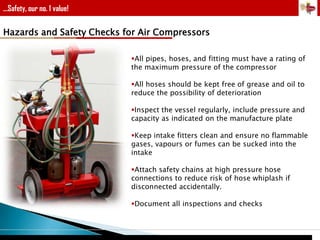
All pipes, hoses, and fitting must have a rating of
the maximum pressure of the compressor
All hoses should be kept free of grease and oil to
reduce the possibility of deterioration
Inspect the vessel regularly, include pressure and
capacity as indicated on the manufacture plate

Keep intake fitters clean and ensure no flammable
gases, vapours or fumes can be sucked into the
intake
Attach safety chains at high pressure hose
connections to reduce risk of hose whiplash if
disconnected accidentally.
Document all inspections and checks
...Safety, our no. 1 value!

Electricity

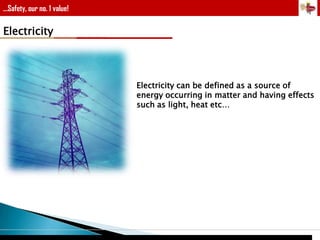
Electricity can be defined as a source of
energy occurring in matter and having effects
such as light, heat etc…
...Safety, our no. 1 value!

Elements of Electricity

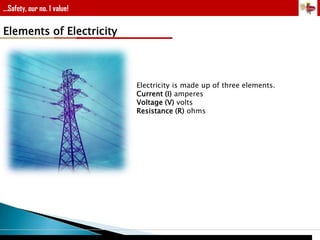
Electricity is made up of three elements.
Current (I) amperes
Voltage (V) volts
Resistance (R) ohms
...Safety, our no. 1 value!

Elements of Electricity
Amperage is the current, or “work force” of
Resistance ( “volume” ). Therethe ability of a
electricity is the measure of are two different
material to oppose the passage of an electric
kinds of current.
current (the “retardant”). This will depend on the
nature of the material, constant and flows in one
Direct current (DC) is its temperature, length,
diameter and the amount of radiation falling on it.
direction only.
Resistance iscurrent (AC) isOhms.
Alternating measured in a current which
(expressed in cycles) periodically reverses its
direction.
Electricity flows from one point to another through
aVoltage and can be compared the water flowing
circuit is the driving force in to
through a pipe. etc, which pushes electrons around
cell, generator,
a circuit (the “pressure”). (Voltage can be expressed
as the total work done in joules transported by one
amp in one second).
...Safety, our no. 1 value!

How does electricity kill?

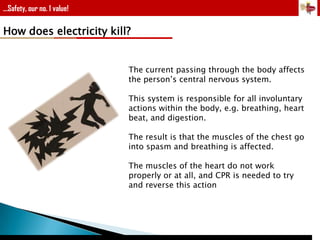
The current passing through the body affects
the person’s central nervous system.
This system is responsible for all involuntary
actions within the body, e.g. breathing, heart
beat, and digestion.

The result is that the muscles of the chest go
into spasm and breathing is affected.
The muscles of the heart do not work
properly or at all, and CPR is needed to try
and reverse this action
...Safety, our no. 1 value!

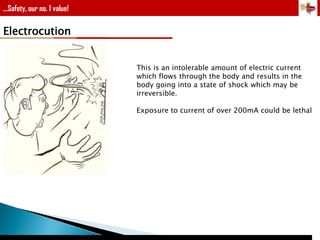
Electrocution
This is an intolerable amount of electric current
which flows through the body and results in the
body going into a state of shock which may be
irreversible.
Exposure to current of over 200mA could be lethal
...Safety, our no. 1 value!

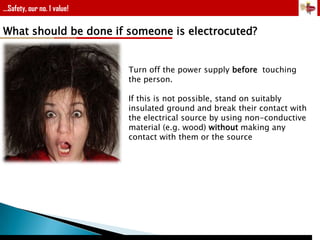
What should be done if someone is electrocuted?

Turn off the power supply before touching
the person.
If this is not possible, stand on suitably
insulated ground and break their contact with
the electrical source by using non-conductive
material (e.g. wood) without making any
contact with them or the source
...Safety, our no. 1 value!

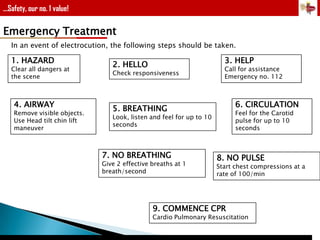
Emergency Treatment
In an event of electrocution, the following steps should be taken.

1. HAZARD

Clear all dangers at
the scene

4. AIRWAY

Remove visible objects.
Use Head tilt chin lift
maneuver

3. HELP

2. HELLO

Check responsiveness

Call for assistance
Emergency no. 112

6. CIRCULATION

5. BREATHING

Feel for the Carotid
pulse for up to 10
seconds

Look, listen and feel for up to 10
seconds

7. NO BREATHING

Give 2 effective breaths at 1
breath/second

8. NO PULSE

Start chest compressions at a
rate of 100/min

9. COMMENCE CPR

Cardio Pulmonary Resuscitation
...Safety, our no. 1 value!

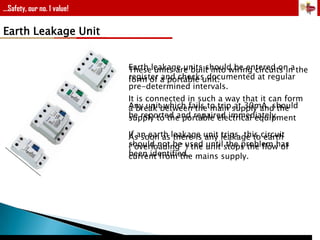
Earth Leakage Unit
Earth leakage units should be entered on a the
These units are built into wiring circuits in
register a portable unit.
form of and checks documented at regular
pre-determined intervals.
It is connected in such a way that it can form
Any unitbetween theto trip supply and the
a break which fails main at 30mA, should
be reported and repaired immediately.
supply to the portable electrical equipment

If an earth leakage unit leakage tocircuit
As soon as there is any trips, this earth
should not be used unit stops the flow of
(“overloading” ) the until the problem has
been identified. mains supply.
current from the
...Safety, our no. 1 value!

Polarity

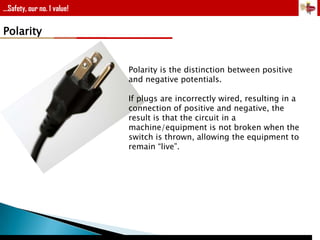
Polarity is the distinction between positive
and negative potentials.
If plugs are incorrectly wired, resulting in a
connection of positive and negative, the
result is that the circuit in a
machine/equipment is not broken when the
switch is thrown, allowing the equipment to
remain “live”.
...Safety, our no. 1 value!

Safety Checks Before Using Portable Equipments

Check that the equipment has three-core
wiring, unless it is of double insulated
design.
 Check that the “live” positive wire is
connected to the correct connected to
 Check that the earth wire isterminal in the
plug. This of the plug, and that
the earth pinensures that the current goes
directly to the operating switch..
sufficient slack is allowed to ensure that,
should the wire be pulled from the plug,
the earth wire will be the last to be
disconnected.




Check that the earth wire makes full
contact with the metal body of the
equipment. This does not apply to double
insulated appliances, which do not have an
earth wire
...Safety, our no. 1 value!

Colour Coding

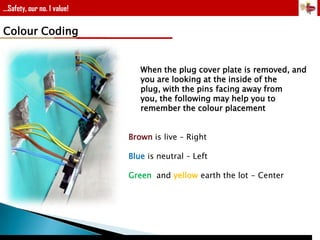
When the plug cover plate is removed, and
you are looking at the inside of the
plug, with the pins facing away from
you, the following may help you to
remember the colour placement

Brown is live – Right
Blue is neutral – Left
Green and yellow earth the lot - Center
...Safety, our no. 1 value!

Conclusion

Thank you for taking out time to learn about safety.
We hope this information was useful to you, if you
have any doubts or questions, please contact the
members of your SHEQ team; they will be glad to
assist you in anyway they can. Do have a safe and
successful day.
Thank

YOU

Any Questions?

Industrial safety.ppt

  • 1.
    Industrial Safety TIRE SAFETY …a Debo,Nat, & Philip presentation. Special thanks to Keith W. Goodhew SAFETY is our number 1 value !!!
  • 2.
    ...Safety, our no.1 value! Presenters Megbuwawon Adebowale Adeniyi B.Eng Agricultural Engineering Oamhen Nathaniel Oseiga HND Electrical/Electronics Engineering MCITP, MCSA MCTS, MCP, A+ Eze Philip Ogechukwu B.Eng Mechanical/Production Engineering
  • 3.
  • 4.
  • 5.
  • 6.
    ...Safety, our no.1 value! Objectives
  • 7.
    ...Safety, our no.1 value! Mechanical Safeguarding
  • 8.
    ...Safety, our no.1 value! Machine Guards Classes
  • 9.
    ...Safety, our no.1 value! Types of guards Guards include: Fixed guards * Usually on transmission machinery •Do not move with each operation •Adjusted to accommodate various sizes •Fixed into place after adjustment Interlocking guards •Can be operated electronically, mechanically, pneumatically •Prevents operation of the controls that sets the machine in operation until guards is moved into place Automatic guards *Prevents operator from coming into contact with dangerous parts of the machine while it is moving.
  • 10.
    ...Safety, our no.1 value! Characteristics >How do I know a good guard? Provides maximum protection Block access to danger zone during operation Corrosion and fire resistant Does not create splinters and nip points Should be a permanent part of the machinery Should not affect efficient operation of machine Strong enough to withstand wear and tear If bulky, hinging should be considered to facilitate servicing and repair of belt or gears
  • 11.
    ...Safety, our no.1 value! Precautions If you work on Mechanical and Electrical equipments:  Never work on any “live” or moving equipment without appropriate PPE  Inspect/Check before commissioning  Wear appropriate PPE  No bypassing of safety devices  Use correct tools and procedures  Do not use hands to remove jammed particles  Isolation (Energy source reduced to zero) requirement must always be followed  Any hazardous task should be identified and covered by a work permit or written safe work procedure.
  • 12.
    ...Safety, our no.1 value! Lock-out System This is the control procedure that must be used to make sure that employees cannot activate any potential source of energy or substance supply without authority and training. Serious injury or death can result if equipment is operated unexpectedly, or if substances are released in an uncontrolled way. All areas and operations must be surveyed to identify where lock-out procedures are needed
  • 13.
    ...Safety, our no.1 value! Lock-out system contd.  Your company should have a Policy which addresses those items, pieces of equipment or processes which might result in serious damage or harm if operated without the necessary controls in place This applies especially during maintenance or breakdown procedures.  Each person who needs to use lock-out procedures must be issued with his own personal lock and key.
  • 14.
    ...Safety, our no.1 value! Switches, Isolators & Valve Labeling Labeling is used for rapid identification of potentially hazardous supply sources This is done to: 1. Prevent wrong switches being turned on in error 2. Enable maintenance crew identify the correct supply source for isolation 3. Enable quick isolation in emergencies 4. Identify all circuit breakers 5. Clearly label all corresponding control switches.
  • 15.
    ...Safety, our no.1 value! Basic Ladder Safety • Consider these tips whenever you need to use a Keep ladders clean and do not paint them, as this ladder defects. hides any • Do not leave ladders on or ground or exposed Avoid bringing metal wetalloy ladders into to the weather. with electrical supply sources contact • • Ladders lying on floors may cause employees to trip or Place the ladder so that its feet are and damaged. a quarter of fall, or they may be run over by vehicles • Do not use ladders horizontally as walkways or scaffolding its length to the top support from the surface which it is resting against. • Unless the ladder is secured at the top, it should always be held in position by another person Tools and equipment should be hauled up by rope as long as someone is standing on it. • Never leave a ladder standing where it may fall over • • Wherever possible it should extend 1 meter or Never place a ladder in above its top support at least three rungs front of an unlocked doorway • Ladders should be fitted with non-slip feet • • Ladders should be inspected at frequent intervals. Defects should be repaired immediately or the ladder replaced.
  • 16.
    ...Safety, our no.1 value! Compressed Gas Cylinders Handling Use only cylinder approved by accredited manufacturer/distributor Many types of gases are used in industries. Compressed gases should be handled by Anyone working with or handling them should experienced trained. be properly and properly instructed personnel only Only hoses, valves, regulators, gauge and lines The following points are pressure should be used approved for the specific applicable Hoses and connection should be checked frequently for condition and tightness Cylinder identification labels and or marking shall not be removed or changed in any way Never lift cylinder by the neck Cylinder are not suppose to be used as roller, support, or for any purpose other than to contain gas
  • 17.
    ...Safety, our no.1 value! CGC Handling Personnel should not attempt to repair, alter or repaint cylinder Personnel should not tamper with safety device in the valve of the cylinder Always secure in the upright position Never use a flame to free a stuck valve Protect cylinder from cut or abrasion When empty, chalk “empty” or “MT” on casing
  • 18.
    ...Safety, our no.1 value! Storage of CGC Store cylinder in the upright position, and well ventilated area Gas cylinder either in service or storage, should not be exposed to extremely low or high temperature No source of ignition is permitted in area Flammables should not be stored close by Oxygen should not be stored with within 6 meter of any cylinder which contain flammable gases When returning empty cylinder to supplier, valve should be tightly closed and valve protection caps securely fastened LPG cylinder in excess of 18kg should not be stored within any building
  • 19.
    ...Safety, our no.1 value! Storage of acetylene cylinders At the time of manufacture, these cylinders are filled with a porous material which is soaked in Acetylene cylinders must be stored in an acetone. This allows for a large quantity of upright position. Failure to do this is dangerous acetylene to be stored at relatively low pressure and could result in an accident. This porous material must be fully saturated from The following upwards, leaving why you must the lowest levelare some reasons no unsaturated do this. pocket in random positions. If the cylinder is stored on its side, even if then tilted upright, the acetylene within may not immediately settle out uniformly, and pockets may occur. Acetylene gas will immediately form in these pockets, and an explosion may occur if the casing is struck violently, or the temperature is increased.
  • 20.
    ...Safety, our no.1 value! Hazards and Safety Checks for Air Compressors All pipes, hoses, and fitting must have a rating of the maximum pressure of the compressor All hoses should be kept free of grease and oil to reduce the possibility of deterioration Inspect the vessel regularly, include pressure and capacity as indicated on the manufacture plate Keep intake fitters clean and ensure no flammable gases, vapours or fumes can be sucked into the intake Attach safety chains at high pressure hose connections to reduce risk of hose whiplash if disconnected accidentally. Document all inspections and checks
  • 21.
    ...Safety, our no.1 value! Electricity Electricity can be defined as a source of energy occurring in matter and having effects such as light, heat etc…
  • 22.
    ...Safety, our no.1 value! Elements of Electricity Electricity is made up of three elements. Current (I) amperes Voltage (V) volts Resistance (R) ohms
  • 23.
    ...Safety, our no.1 value! Elements of Electricity Amperage is the current, or “work force” of Resistance ( “volume” ). Therethe ability of a electricity is the measure of are two different material to oppose the passage of an electric kinds of current. current (the “retardant”). This will depend on the nature of the material, constant and flows in one Direct current (DC) is its temperature, length, diameter and the amount of radiation falling on it. direction only. Resistance iscurrent (AC) isOhms. Alternating measured in a current which (expressed in cycles) periodically reverses its direction. Electricity flows from one point to another through aVoltage and can be compared the water flowing circuit is the driving force in to through a pipe. etc, which pushes electrons around cell, generator, a circuit (the “pressure”). (Voltage can be expressed as the total work done in joules transported by one amp in one second).
  • 24.
    ...Safety, our no.1 value! How does electricity kill? The current passing through the body affects the person’s central nervous system. This system is responsible for all involuntary actions within the body, e.g. breathing, heart beat, and digestion. The result is that the muscles of the chest go into spasm and breathing is affected. The muscles of the heart do not work properly or at all, and CPR is needed to try and reverse this action
  • 25.
    ...Safety, our no.1 value! Electrocution This is an intolerable amount of electric current which flows through the body and results in the body going into a state of shock which may be irreversible. Exposure to current of over 200mA could be lethal
  • 26.
    ...Safety, our no.1 value! What should be done if someone is electrocuted? Turn off the power supply before touching the person. If this is not possible, stand on suitably insulated ground and break their contact with the electrical source by using non-conductive material (e.g. wood) without making any contact with them or the source
  • 27.
    ...Safety, our no.1 value! Emergency Treatment In an event of electrocution, the following steps should be taken. 1. HAZARD Clear all dangers at the scene 4. AIRWAY Remove visible objects. Use Head tilt chin lift maneuver 3. HELP 2. HELLO Check responsiveness Call for assistance Emergency no. 112 6. CIRCULATION 5. BREATHING Feel for the Carotid pulse for up to 10 seconds Look, listen and feel for up to 10 seconds 7. NO BREATHING Give 2 effective breaths at 1 breath/second 8. NO PULSE Start chest compressions at a rate of 100/min 9. COMMENCE CPR Cardio Pulmonary Resuscitation
  • 28.
    ...Safety, our no.1 value! Earth Leakage Unit Earth leakage units should be entered on a the These units are built into wiring circuits in register a portable unit. form of and checks documented at regular pre-determined intervals. It is connected in such a way that it can form Any unitbetween theto trip supply and the a break which fails main at 30mA, should be reported and repaired immediately. supply to the portable electrical equipment If an earth leakage unit leakage tocircuit As soon as there is any trips, this earth should not be used unit stops the flow of (“overloading” ) the until the problem has been identified. mains supply. current from the
  • 29.
    ...Safety, our no.1 value! Polarity Polarity is the distinction between positive and negative potentials. If plugs are incorrectly wired, resulting in a connection of positive and negative, the result is that the circuit in a machine/equipment is not broken when the switch is thrown, allowing the equipment to remain “live”.
  • 30.
    ...Safety, our no.1 value! Safety Checks Before Using Portable Equipments Check that the equipment has three-core wiring, unless it is of double insulated design.  Check that the “live” positive wire is connected to the correct connected to  Check that the earth wire isterminal in the plug. This of the plug, and that the earth pinensures that the current goes directly to the operating switch.. sufficient slack is allowed to ensure that, should the wire be pulled from the plug, the earth wire will be the last to be disconnected.   Check that the earth wire makes full contact with the metal body of the equipment. This does not apply to double insulated appliances, which do not have an earth wire
  • 31.
    ...Safety, our no.1 value! Colour Coding When the plug cover plate is removed, and you are looking at the inside of the plug, with the pins facing away from you, the following may help you to remember the colour placement Brown is live – Right Blue is neutral – Left Green and yellow earth the lot - Center
  • 32.
    ...Safety, our no.1 value! Conclusion Thank you for taking out time to learn about safety. We hope this information was useful to you, if you have any doubts or questions, please contact the members of your SHEQ team; they will be glad to assist you in anyway they can. Do have a safe and successful day.
  • 33.